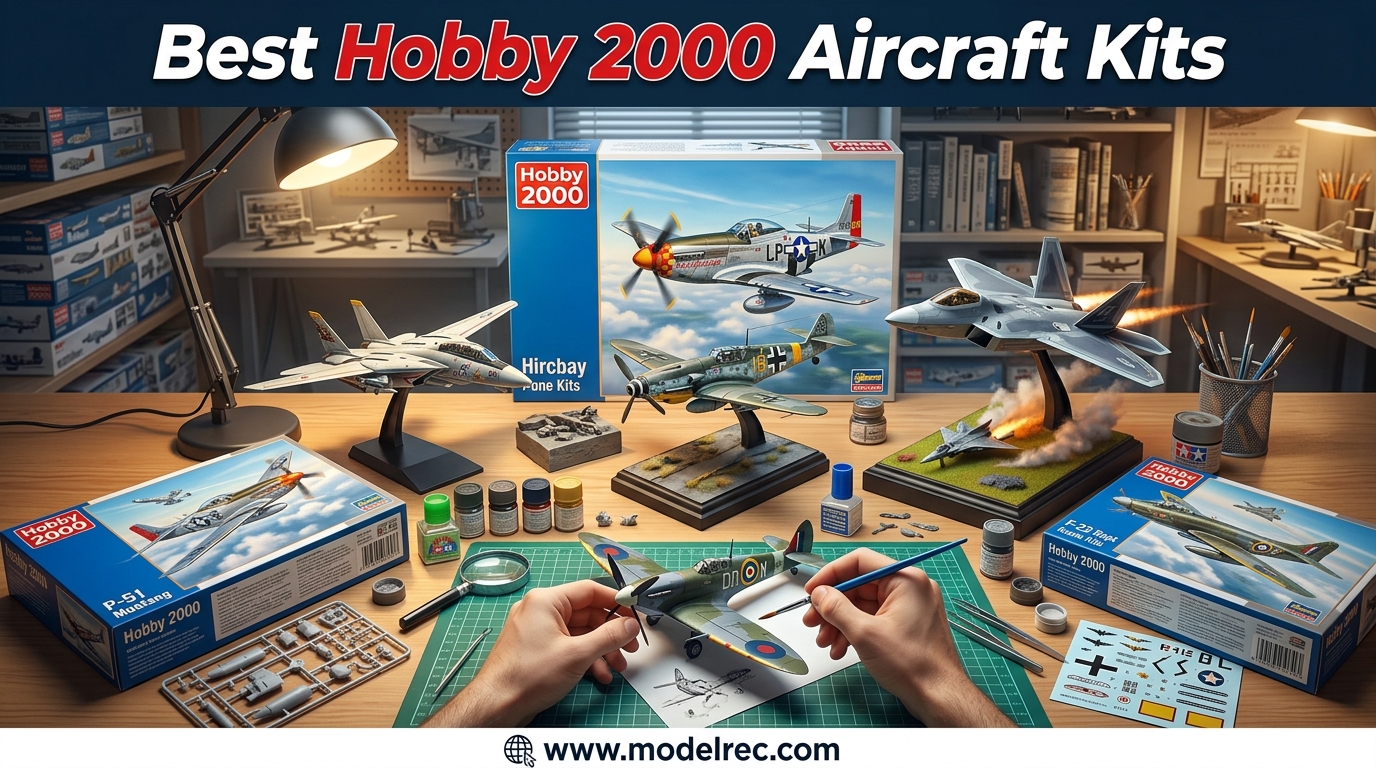
If you have spent any time browsing scale modeling forums or scrolling through aircraft model listings online, you have probably come across the Hobby 2000 brand. But figuring out which of their releases are actually worth your time and money can feel overwhelming when there are dozens of boxings to sort through. That is exactly why our team put together this guide to the best Hobby 2000 aircraft kits you can buy in 2026.
Hobby 2000 is a Polish model kit distributor that has built a loyal following by doing something clever. They take proven plastic model kits from established manufacturers like Hasegawa, Revell, Fujimi, Academy, and Dragon, and re-release them with upgraded Cartograf decals and pre-cut Pmask canopy masks. The result is a kit that often delivers more value than the original release, especially if you are after specific historical markings that were never available before.
In this guide, we are reviewing 12 aircraft kits that represent the range of what makes Hobby 2000 special. We have included WWII propeller fighters, jet-era legends, and even a few surprises across 1/72, 1/48, and 1/32 scales. Whether you are a weekend builder looking for a fun project or a serious competition modeler chasing that perfect finish, there is something here for you.
Table of Contents
Top 3 Picks for Hobby 2000 Aircraft Kits


Academy 1/72 P-51B Mustang
- 1/72 scale
- 3 marking options
- Engraved panel lines
- 4.5 star rating
12 Best Hobby 2000 Aircraft Kits in 2026
| Product | Specifications | Action |
|---|---|---|
 Revell Stuka Ju 87G-1 Tank Buster Revell Stuka Ju 87G-1 Tank Buster |
|
Check Latest Price |
 Premium Hobbies P-51D Blue Nose Premium Hobbies P-51D Blue Nose |
|
Check Latest Price |
 Premium Hobbies Bf 109 G-14 Black Tulip Premium Hobbies Bf 109 G-14 Black Tulip |
|
Check Latest Price |
 Tamiya 1/72 Bf 109 G-6 Tamiya 1/72 Bf 109 G-6 |
|
Check Latest Price |
| Academy 1/72 P-51B Mustang |
|
Check Latest Price |
 Revell 1/48 Bf 109G-10 Revell 1/48 Bf 109G-10 |
|
Check Latest Price |
| Tamiya 1/48 Bf 109 G-6 |
|
Check Latest Price |
| Tamiya 1/48 Fw 190 A-8/R2 |
|
Check Latest Price |
 Tamiya 1/48 Mosquito FB MK.VI Tamiya 1/48 Mosquito FB MK.VI |
|
Check Latest Price |
 Tamiya 1/48 F-4B Phantom II Tamiya 1/48 F-4B Phantom II |
|
Check Latest Price |
 Revell 1/32 Bf 109G-2/4 Revell 1/32 Bf 109G-2/4 |
|
Check Latest Price |
 Tamiya 1/32 Zero A6M5 Tamiya 1/32 Zero A6M5 |
|
Check Latest Price |
1. Revell Stuka Ju 87G-1 Tank Buster – Classic WWII Dive Bomber
Revell Stuka Ju 87G-1 Tank Buster Plastic Model Kit
1:48 Scale
54 Plastic Pieces
WWII Dive Bomber
Crew Figures Included
Pros
- Simple straightforward assembly
- Highly detailed for the price
- Excellent decals included
- Good fit of parts
- Detailed crew figures included
Cons
- Older mold tooling from 1960s
- Some fitting and adjusting required
- Fragile plastic pieces
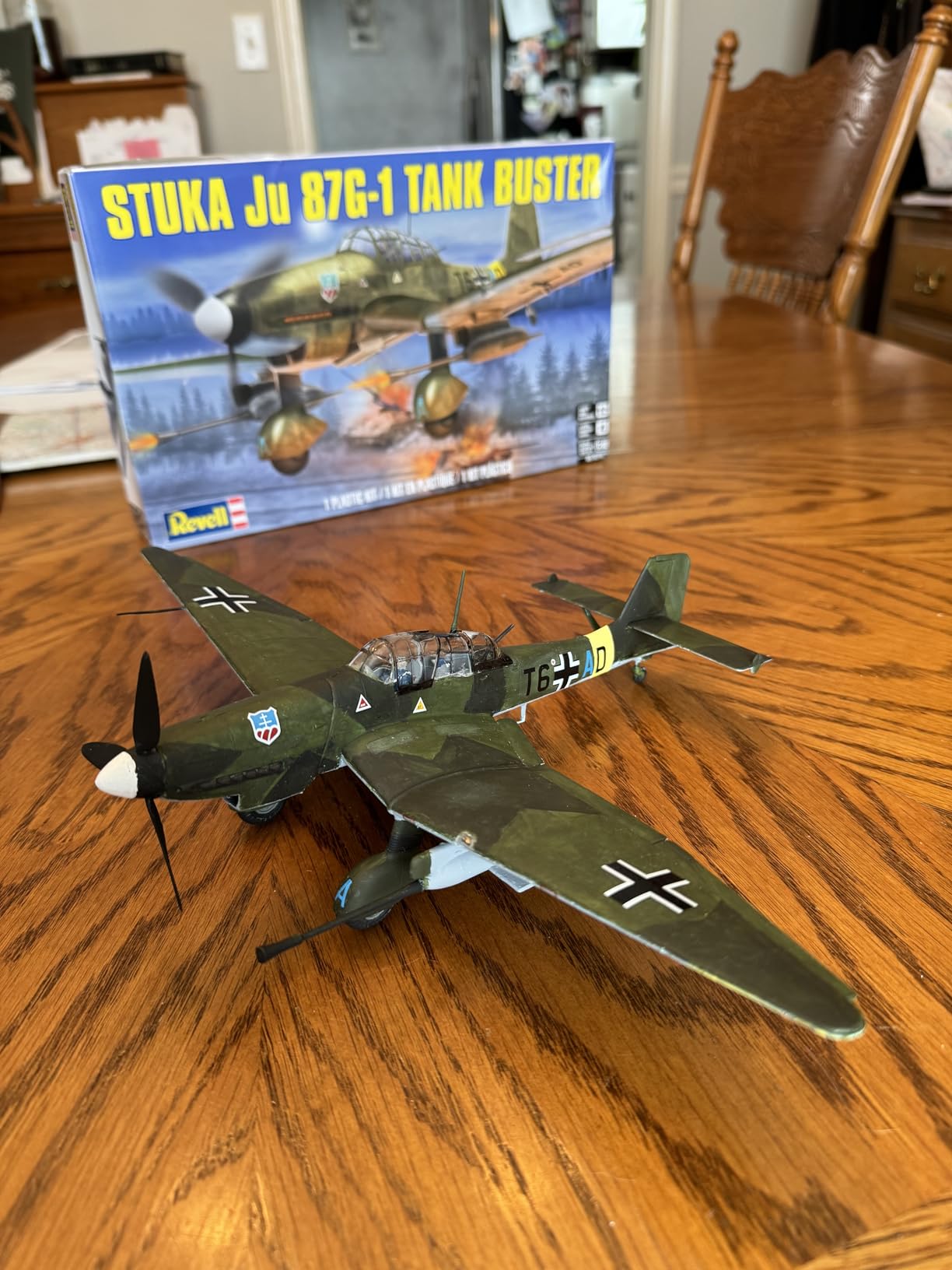
I built this Stuka over a couple of weekends and came away genuinely impressed with what you get for the money. The Junkers Ju 87G-1 is the tank-busting variant with those distinctive underwing 37mm BK cannons, and Revell captures the aggressive look of this aircraft perfectly. The kit has a certain charm that newer molds sometimes lack, even if the tooling dates back decades.
Assembly was refreshingly straightforward. The 54 pieces go together without much fuss, and the fuselage halves lined up better than I expected from an older mold. The crew figures are a nice bonus, giving the finished model real personality when displayed with the canopy open. I did need a small amount of putty along the wing root joins, but nothing that slowed me down.
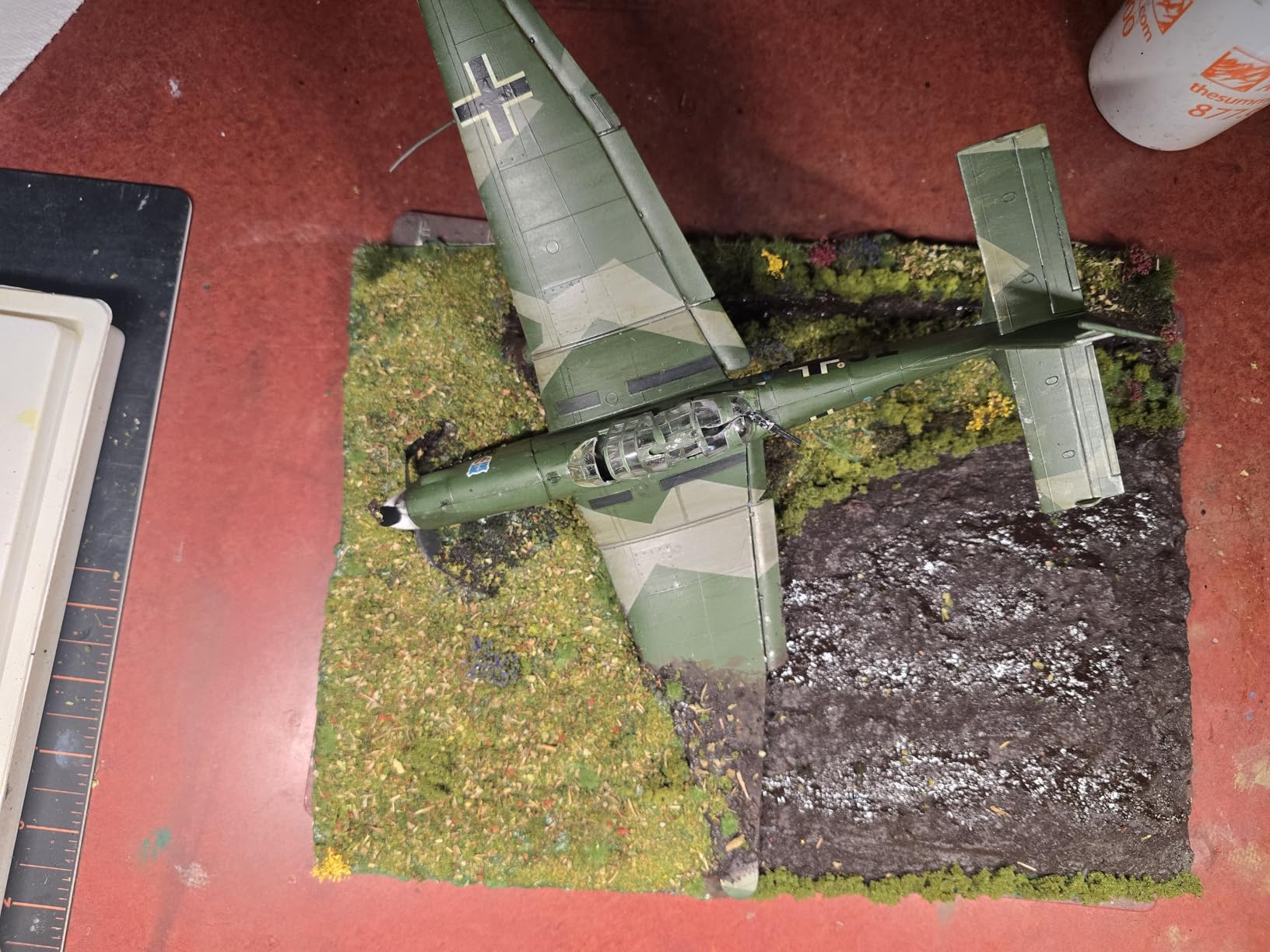
The 37mm cannons are the star of the show here. They attach cleanly under the wings and give the model its unmistakable tank-killer silhouette. The decals went down smoothly with a bit of setting solution, though I wish the instruction sheet was clearer about which markings apply to which historical unit. Paint and glue are not included, so plan accordingly.
One thing to keep in mind is that this is based on 1960s-era tooling. You will notice the engraved panel lines are not as fine as modern kits, and some of the smaller details are a bit soft. There are also no swastika markings included, which some modelers will want to source separately for historical accuracy. These are minor gripes for what is otherwise a fun and rewarding build.
Build difficulty and skill level
This kit sits comfortably in the intermediate range. It is simple enough that a determined beginner could handle it, but the fragile plastic pieces and some fitting work mean you will want basic modeling skills under your belt. The 54 parts count keeps things manageable without sacrificing the key details that matter.
Decal and marking options
The included decal sheet covers the standard Ju 87G-1 markings. They respond well to setting solutions and settle into panel lines nicely. For modelers wanting to depict specific historical aircraft, aftermarket decals are widely available for this airframe type in 1/48 scale.
2. Premium Hobbies P-51D Mustang Blue Nose – Budget-Friendly WWII Fighter
Premium Hobbies P-51D Blue Nose 1:72 Plastic Model Airplane Kit 126V
1:72 Scale
Approx 6 Inch Wingspan
Blue Nose Livery
3 Decal Sets Included
Pros
- Great value for the price
- Good quality plastic
- Perfect for beginners
- Highly detailed plastic parts
- 3 sets of decals included
Cons
- Simple stripped-down kit
- Box can arrive damaged
- Painting and gluing required
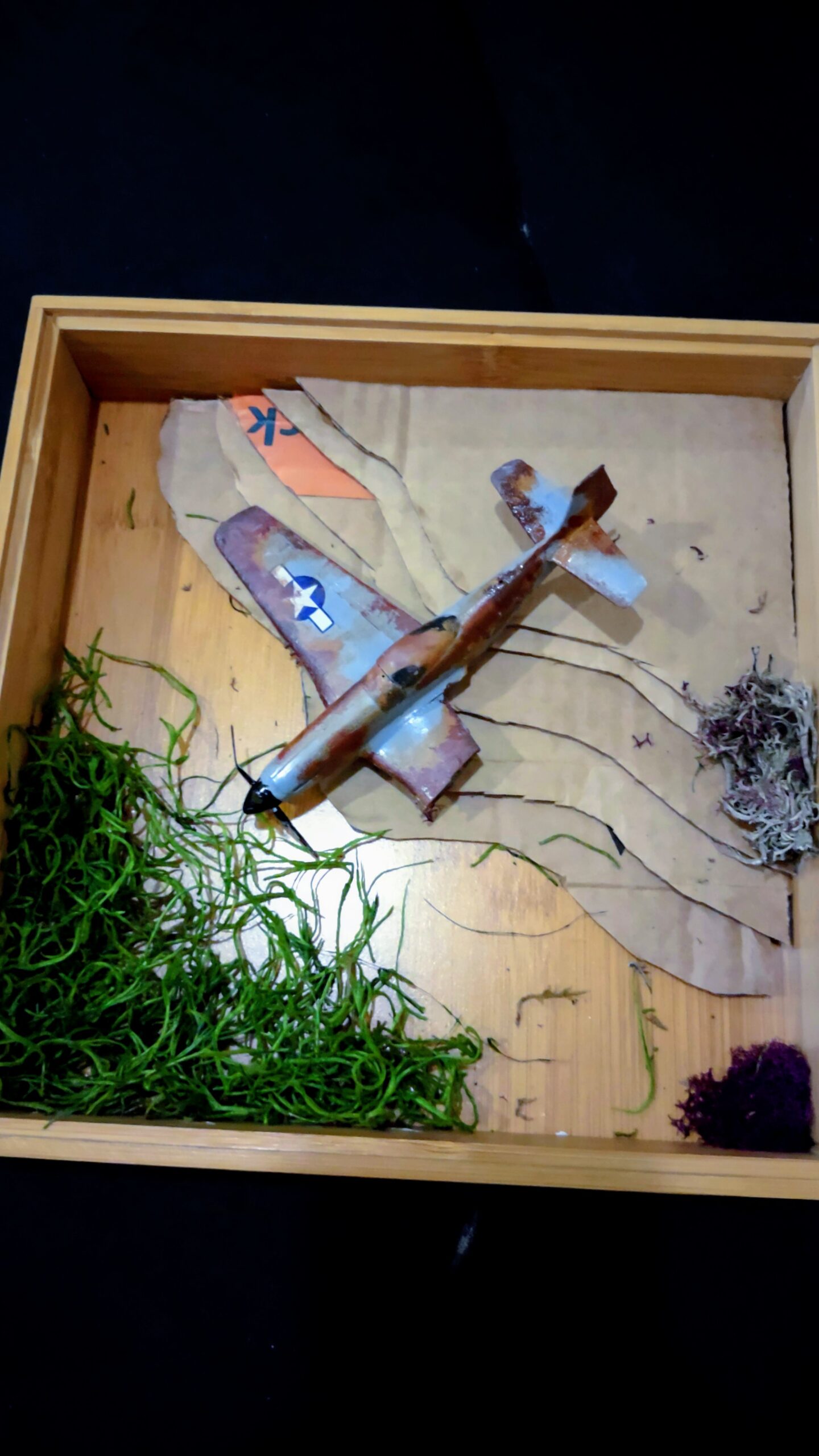
This P-51D from Premium Hobbies is essentially a repackaged Academy kit, and that is actually a good thing. Academy makes solid 1/72 Mustangs with clean molding and decent surface detail. The Blue Nose livery gives you something more interesting than the standard silver or olive drab schemes you see everywhere. I picked one up on a whim and ended up enjoying the build more than I expected.
The roughly 6-inch wingspan means this is a compact model when finished, perfect for display shelves where space is tight. Three sets of decals are included, which is generous at this price point. The plastic quality felt consistent across all the sprues, with no flash to clean up and crisp panel line engraving throughout.
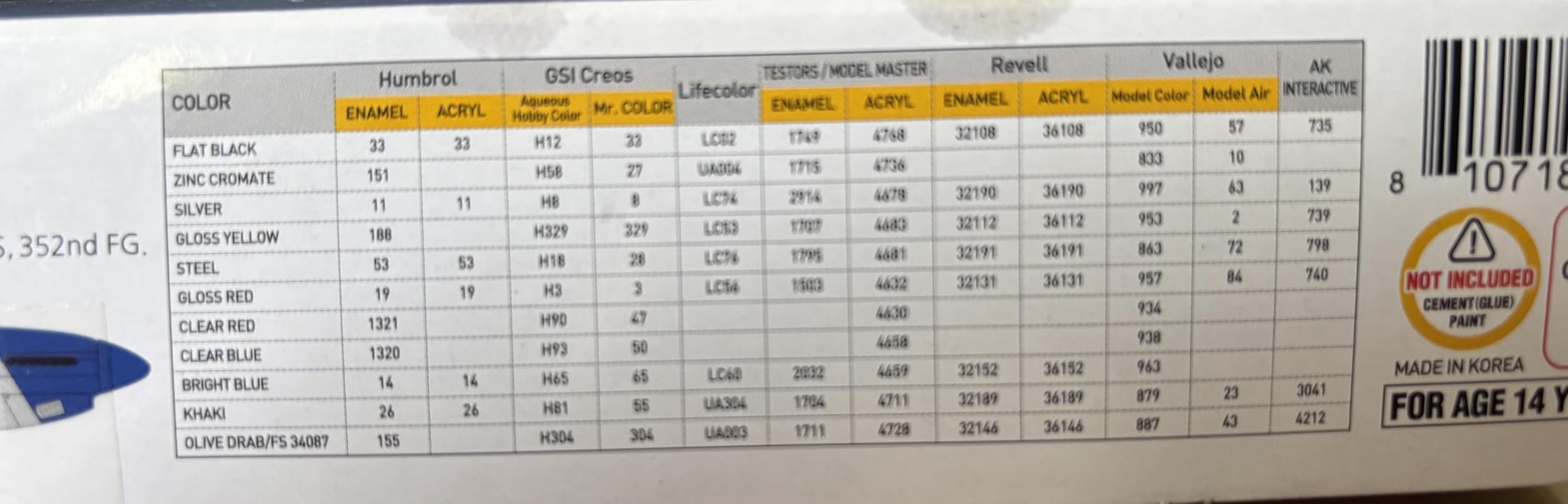
Assembly is about as straightforward as 1/72 aircraft kits get. The fuselage halves join cleanly, the wing is a single lower piece with two upper halves, and the landing gear is simple but effective. I spent maybe four hours total on this build, including painting. It is the kind of kit you can finish in a single weekend session without feeling rushed.
The main trade-off is that this is a relatively simple kit. You will not find the cockpit detail of a Tamiya release or the optional armament loads of a higher-end boxing. The decals performed adequately but are not in the same league as Cartograf sheets. Still, as a no-stress build that looks great on the shelf, it delivers exactly what you pay for.
Who should pick this kit
This is an ideal starter kit for someone new to aircraft modeling. The low parts count and simple assembly make it forgiving of mistakes, while the finished model still looks the part. Experienced modelers will appreciate it as a quick palette cleanser between more demanding projects.
Display and finishing tips
The Blue Nose scheme looks best with a gloss coat and careful decal application. I recommend using a wash on the panel lines to bring out the engraved detail, which is surprisingly crisp for this price range. A flat clear coat over the top ties everything together nicely.
3. Premium Hobbies Bf 109 G-14 Black Tulip – Iconic Luftwaffe Fighter
Premium Hobbies Bf 109 G-14 Black Tulip 1:72 Plastic Model Airplane Kit 127V
1:72 Scale
Approx 6 Inch Wingspan
Black Tulip Livery
3 Decal Sets Included
Pros
- Very easy assembly with perfect part fit
- Lots of extra parts for versions
- Paint recommendations included
- Well-made with accurate pieces
- Includes decals for multiple variants
Cons
- Ambiguous instructions on part versions
- Lacking cockpit detail
- Decals can be tacky and hard to apply
The Black Tulip nose art on this Bf 109 G-14 is instantly recognizable to anyone familiar with Luftwaffe aircraft history. Premium Hobbies captures that iconic look with a kit that goes together easily and looks the part when finished. I found the part fit to be genuinely impressive for this price range, with fuselage halves and wing joins needing minimal cleanup.
What caught my attention was the number of extra parts included on the sprues. You get components for different versions of the G-14, which means spare parts for your bits box if you build only one configuration. The paint guide includes recommendations for multiple paint brands, which is a thoughtful touch that not all manufacturers bother with.
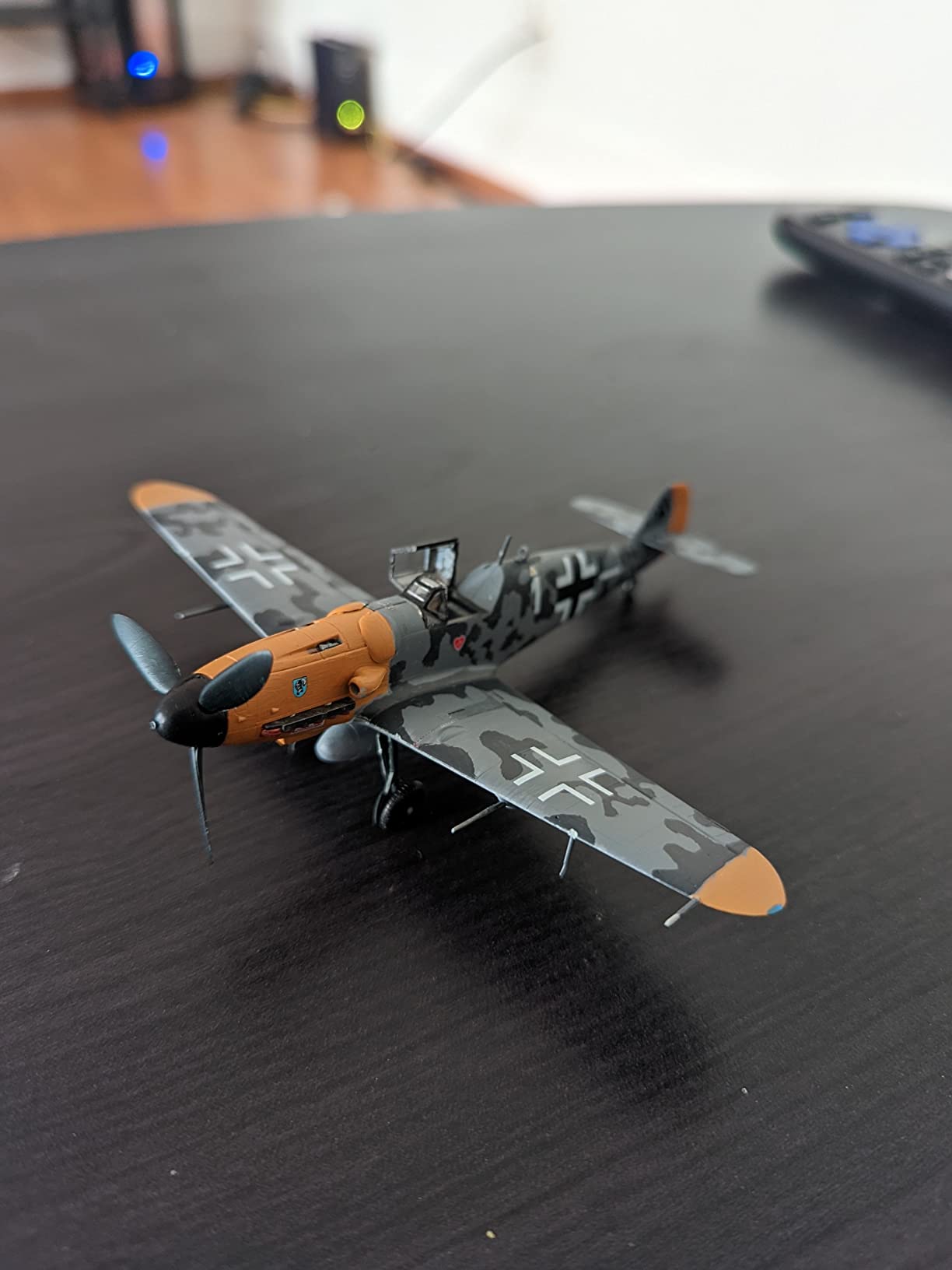
The cockpit is the weakest point of this kit. It is basic, with minimal sidewall detail and a simple instrument panel. I added a few scratch-built details to bring it up to a reasonable standard, but out of the box it looks a bit barren. If you plan to build with the canopy closed, this matters less, but open canopy builders will want to invest some extra effort here.
The decals deserve a mention because they are a mixed bag. The Black Tulip marking itself printed clearly and looked good on my finished model. However, some of the smaller stencils and Balkenkreuz markings felt a bit tacky and did not respond well to setting solutions. Take your time with them and use plenty of water during positioning.
Assembly tips for best results
The biggest challenge is figuring out which parts belong to which version, since the instructions are not always clear on this. I recommend studying the parts layout diagram carefully before starting. Test-fit the wing-to-fuselage join before committing to glue, as a few reviewers noted minor alignment issues at the seam line.
Historical accuracy and markings
The Black Tulip scheme represents one of the most famous Bf 109 liveries of the late war period. The kit includes decals for two different aircraft variants, giving you some choice in which historical machine to depict. Research your chosen subject beforehand for the most accurate color callouts and weathering approach.
4. Tamiya 1/72 Messerschmitt Bf 109 G-6 – Precision Engineered Classic
Tamiya 60790 1/72 Messerschmitt BF109 G-6 Plastic Model Airplane Kit
1/72 Scale
Perfect Part Fit
Optional Drop Tank
Open or Closed Canopy
Pros
- Best-fitting kit available
- Ingenious engineering choices
- Accurately formed parts
- Solid landing gear attachment
- Optional drop tank included
Cons
- Limited to only two marking options
- No dropped flaps option
- Small parts not suited for young beginners
Tamiya sets the gold standard for 1/72 aircraft kits, and this Bf 109 G-6 shows exactly why. From the moment I opened the box, the quality of the molding and engineering was apparent. Every part is crisp, flash-free, and designed to fit together with the kind of precision that makes modeling enjoyable rather than frustrating.
The assembly sequence is where Tamiya’s engineering really shines. The cockpit is designed to be inserted after the fuselage halves are joined, which eliminates the fiddly alignment work that plagues other 1/72 kits. The landing gear struts have a solid attachment point that inspires confidence the finished model will not end up a belly-lander on your display shelf.
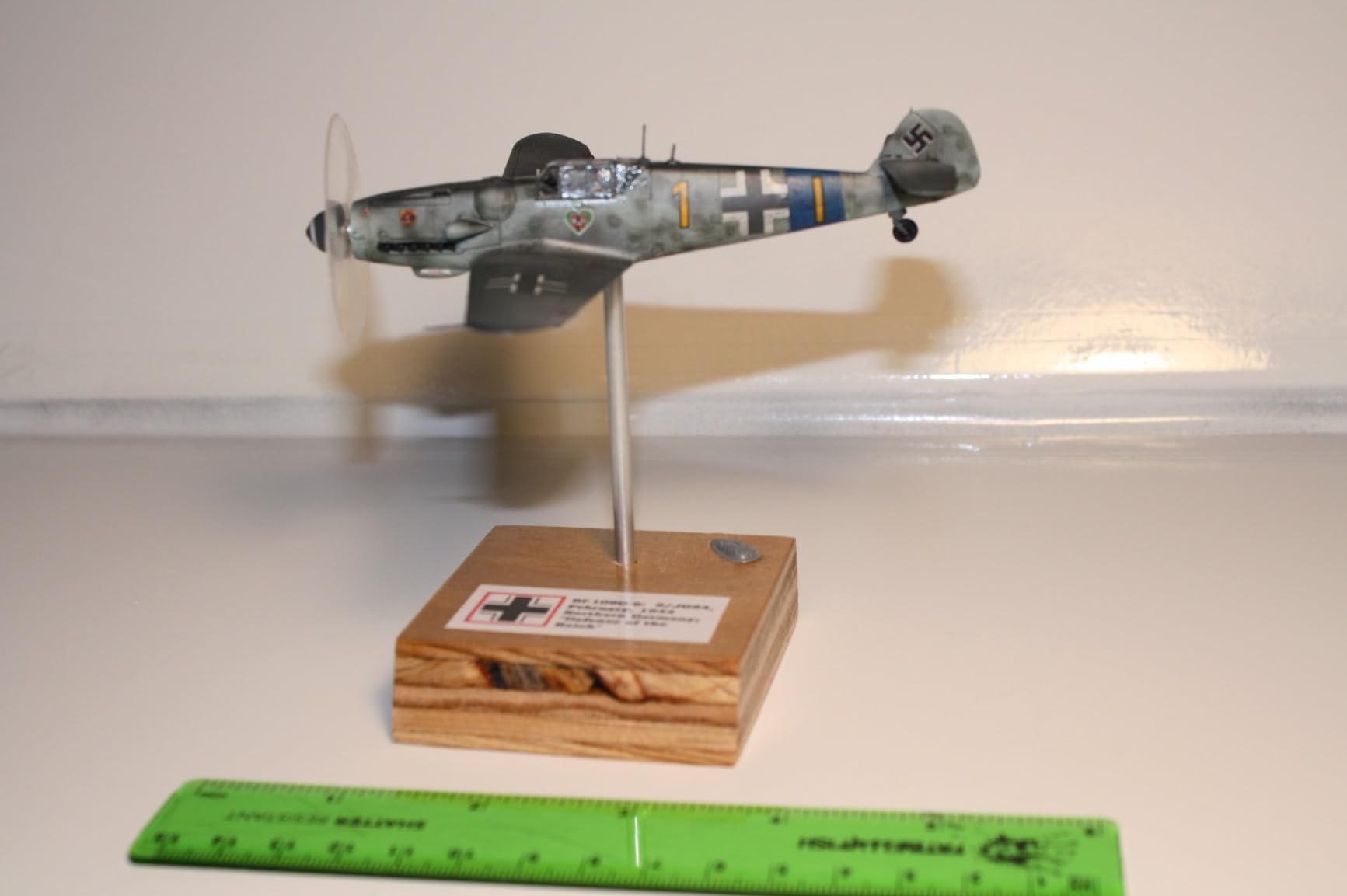
Surface detail is excellent, with finely engraved panel lines and subtle rivet detail where appropriate. The canopy can be assembled open or closed, which adds display flexibility. An optional drop tank is included for those wanting to depict a long-range mission configuration. The only real limitation is the marking options: you get just two schemes, which feels stingy for a kit of this quality.
If there is a criticism, it is that Tamiya played it safe with the engineering. There are no dropped flaps or slats, and the pose options are limited to landing gear down. For most builders this is fine, but super-detailers will need aftermarket additions to push this kit further. As a straight build out of the box though, it is hard to beat.
Assembly experience and fit quality
This is one of those rare kits where you can essentially skip the test-fitting step. Parts align with confidence-building precision, and I did not need any filler on my build. The streamlined assembly means you can focus your energy on painting and weathering, which is where the real satisfaction of modeling lives.
Who this kit suits best
Modelers with some experience will get the most from this kit. The small parts in 1/72 scale require steady hands and decent tools. That said, the excellent engineering makes it more accessible than many 1/72 kits. If you have built a couple of models and want to step up to something that rewards careful work, this is an outstanding choice.
5. Academy 1/72 P-51B Mustang – Detailed USAAF Fighter
Academy P-51B Mustang
1:72 Scale
3 USAAF and RAF Markings
Engraved Panel Lines
Detailed Cockpit and Gear Bay
Pros
- Parts fit perfectly
- Great detail at 1/72 scale
- 3 marking options for USAAF and RAF
- Fully engraved panel lines and rivet details
- Various under-wing stores included
- Good value
Cons
- Not a beginner kit
- Thin decals can break easily
- Decals have clear film around them
- Instructions in Mandarin
The P-51B is the often-overlooked earlier Mustang variant with the razorback fuselage, and Academy does it justice in 1/72 scale. This was one of those kits that surprised me with how much detail they packed into such a small package. The engraved panel lines are crisp and consistent, and the cockpit detail exceeds what I typically expect at this scale and price.
Three marking options are included, covering both USAAF and RAF schemes. Having that variety lets you choose between the familiar American theater markings or the more unusual British evaluation schemes. The under-wing stores give you additional display options, including drop tanks and bombs for a loaded fighter configuration.
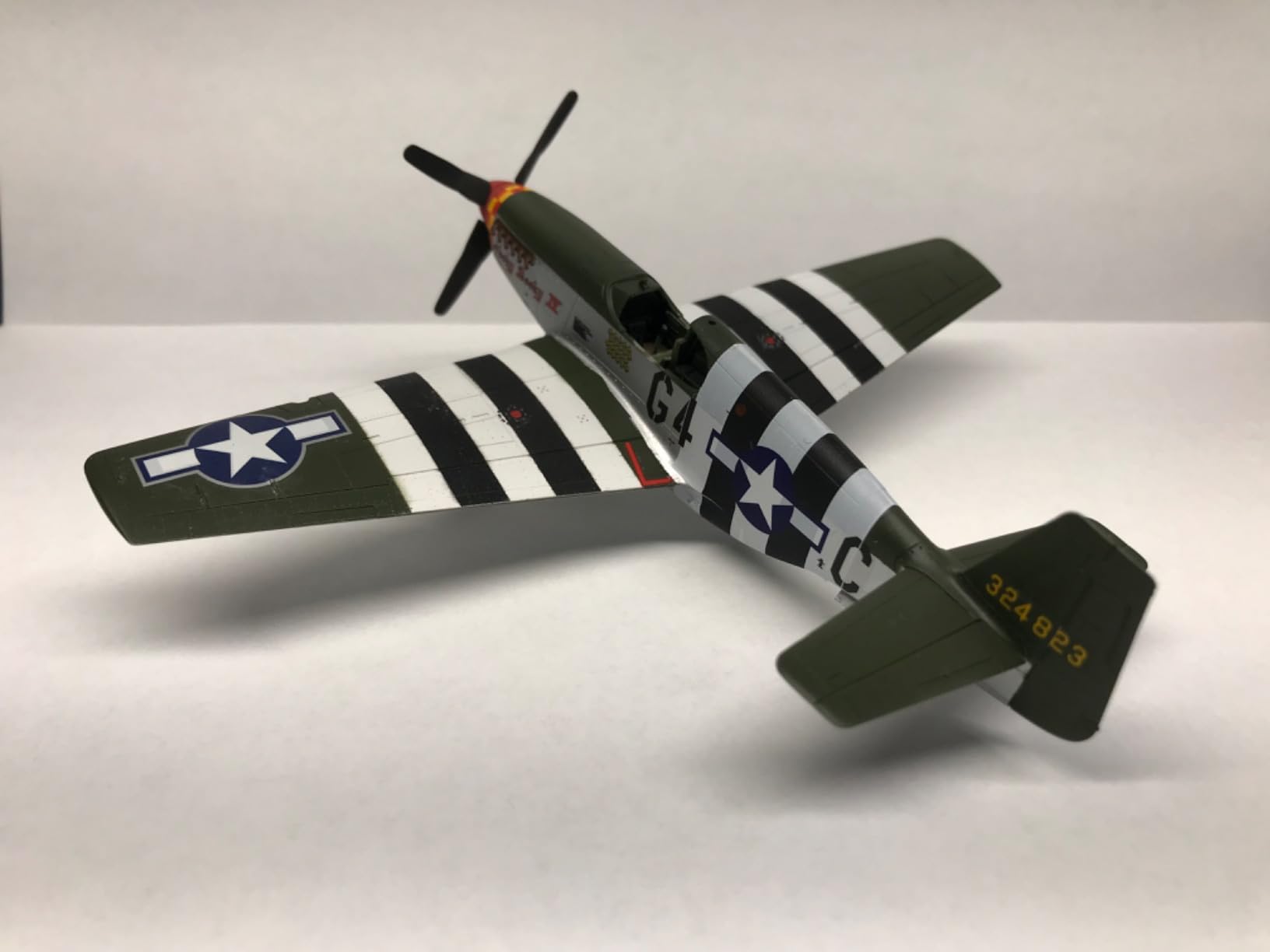
Part fit is excellent across the board. The fuselage seam disappeared with minimal work, and the wing-to-fuselage join needed only a light skim of putty. The landing gear bay has surprising depth of detail for 1/72, with visible structural elements that add realism when viewed up close. I spent a pleasant weekend on this build and was happy with the results.
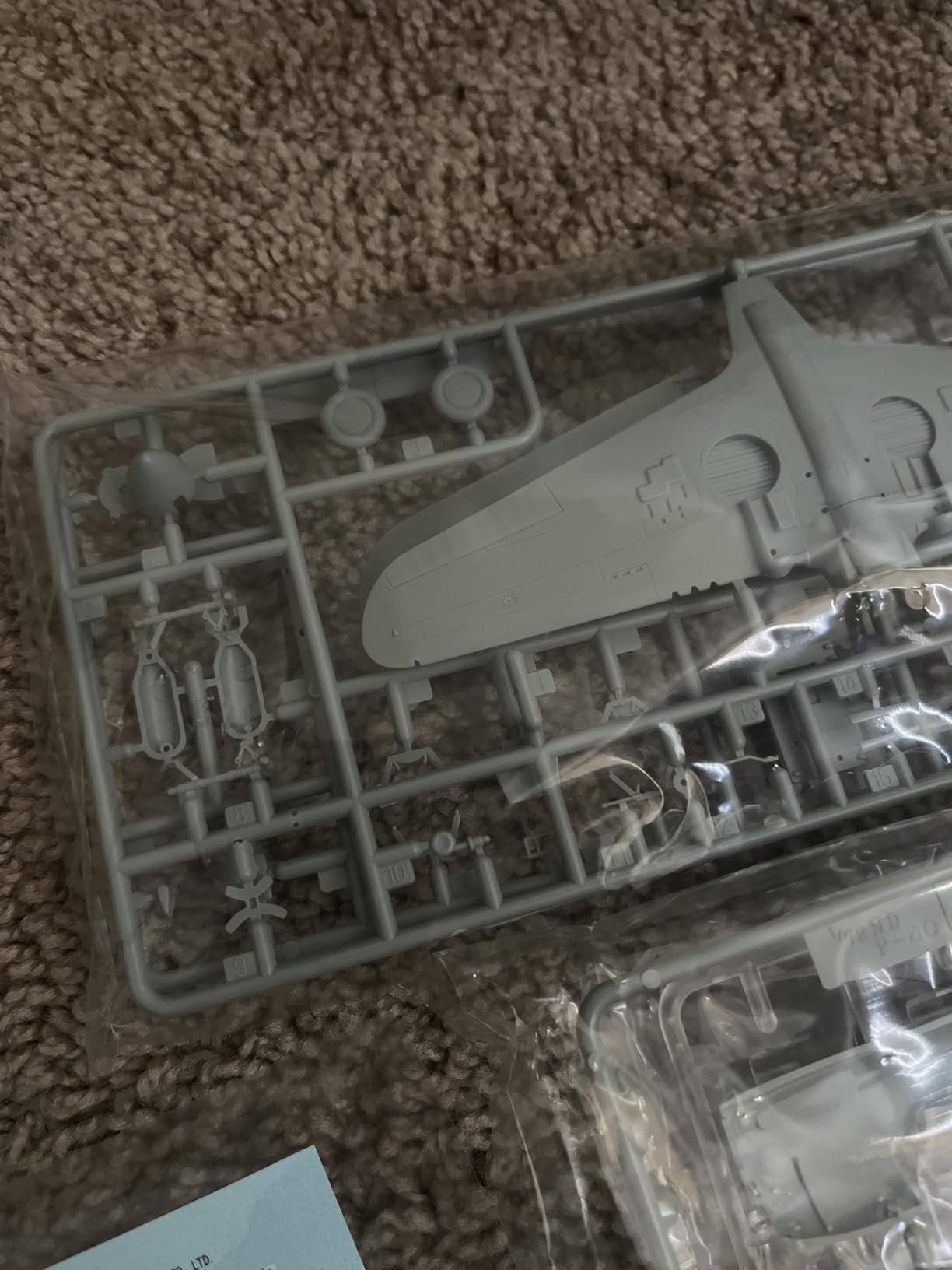
The decals are the one area where this kit falls short. They are thin and prone to tearing, with a noticeable clear film border that can show on lighter paint schemes. I lost one small stencil decal to breakage during application. Using a generous amount of water and handling them with extra care will help, but plan on patience during the decal stage.
Decal quality and marking options
Despite the fragility issues, the printing quality on the decals is actually quite good. The colors are accurate and register is tight. For modelers unhappy with the kit decals, this is a popular subject for aftermarket sheets, which makes it easy to find alternatives with more marking options and better carrier film.
Skill level and build experience
Academy rates this for experienced builders, and I agree with that assessment. The small parts and tricky decals demand more skill than a typical beginner kit. However, the excellent part fit means that if you can handle the painting and decal work, the assembly itself will not fight you. It is a satisfying build for intermediate modelers looking to sharpen their skills.
6. Revell 1/48 Bf 109G-10 – Accessible 1/48 Luftwaffe Fighter
Revell 15873 Messerschmitt BF 109G-10 1:48 Scale 40-Piece Skill Level 4 Model Airplane Building Kit
1:48 Scale
40 Parts
Skill Level 4
Movable Propeller
Pros
- Few parts easy to build
- Good fit with minimal putty
- Full sheet of decals included
- Clear instructions
- Decent value for the price
Cons
- Only 3 parts trees simpler than expected
- Landing gear fixed down only
- Raised copyright lettering on tail
- Thin stickers can be problematic
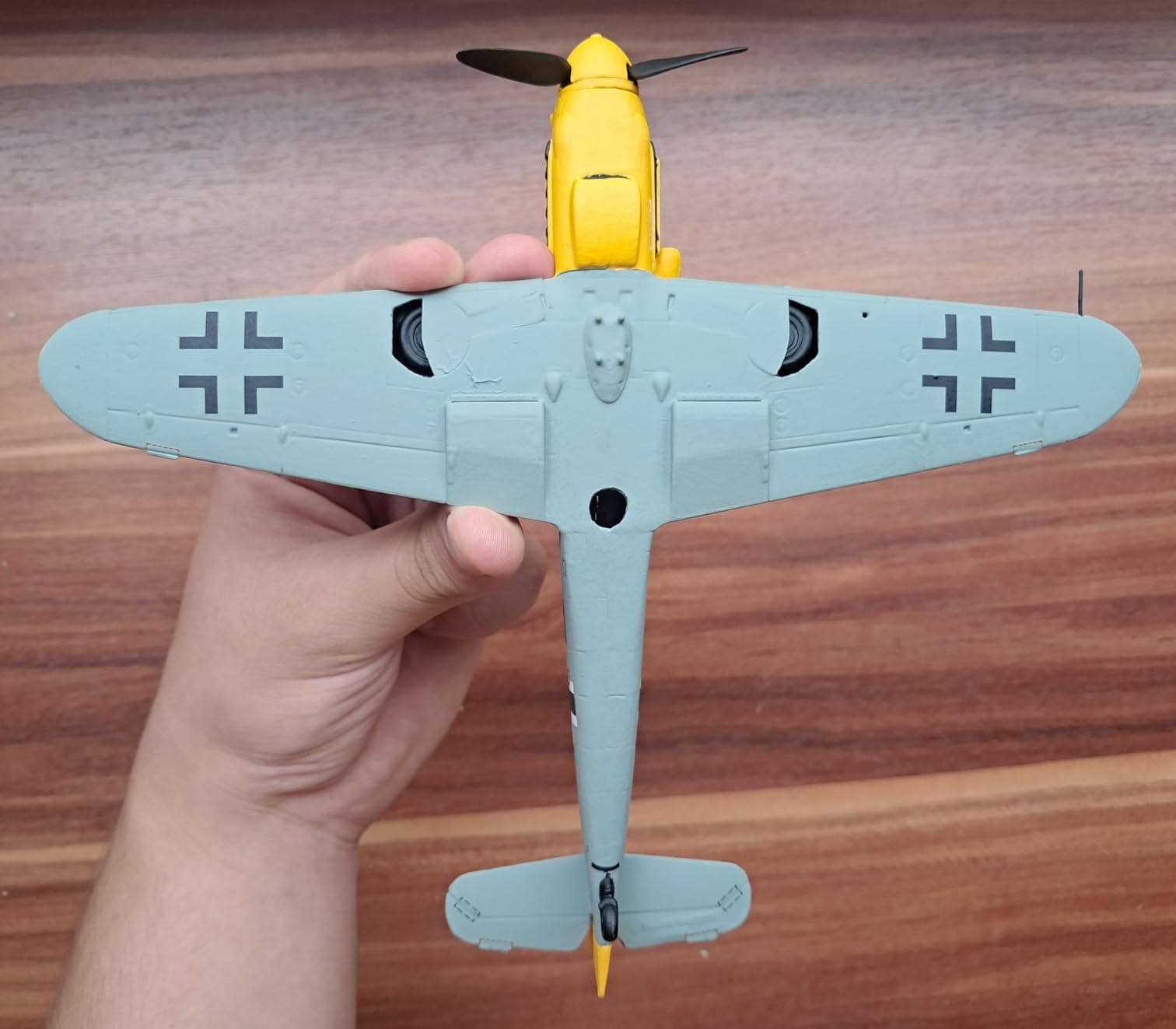
Sometimes you just want a kit you can build without a major time commitment, and that is exactly what this Revell Bf 109G-10 delivers. With only 40 parts spread across three sprues, this is about as streamlined as 1/48 scale gets. I finished mine in about six hours spread over two evenings, and the result looks great on the shelf next to more expensive kits.
The parts fit surprised me in a good way. Revell has been improving their tooling quality, and the fuselage and wing joins needed only a tiny amount of putty. The movable propeller is a fun touch that adds visual interest when the model is displayed. The authentic markings for IV./JG301 at Stendal in Spring 1945 give it a compelling historical backstory.
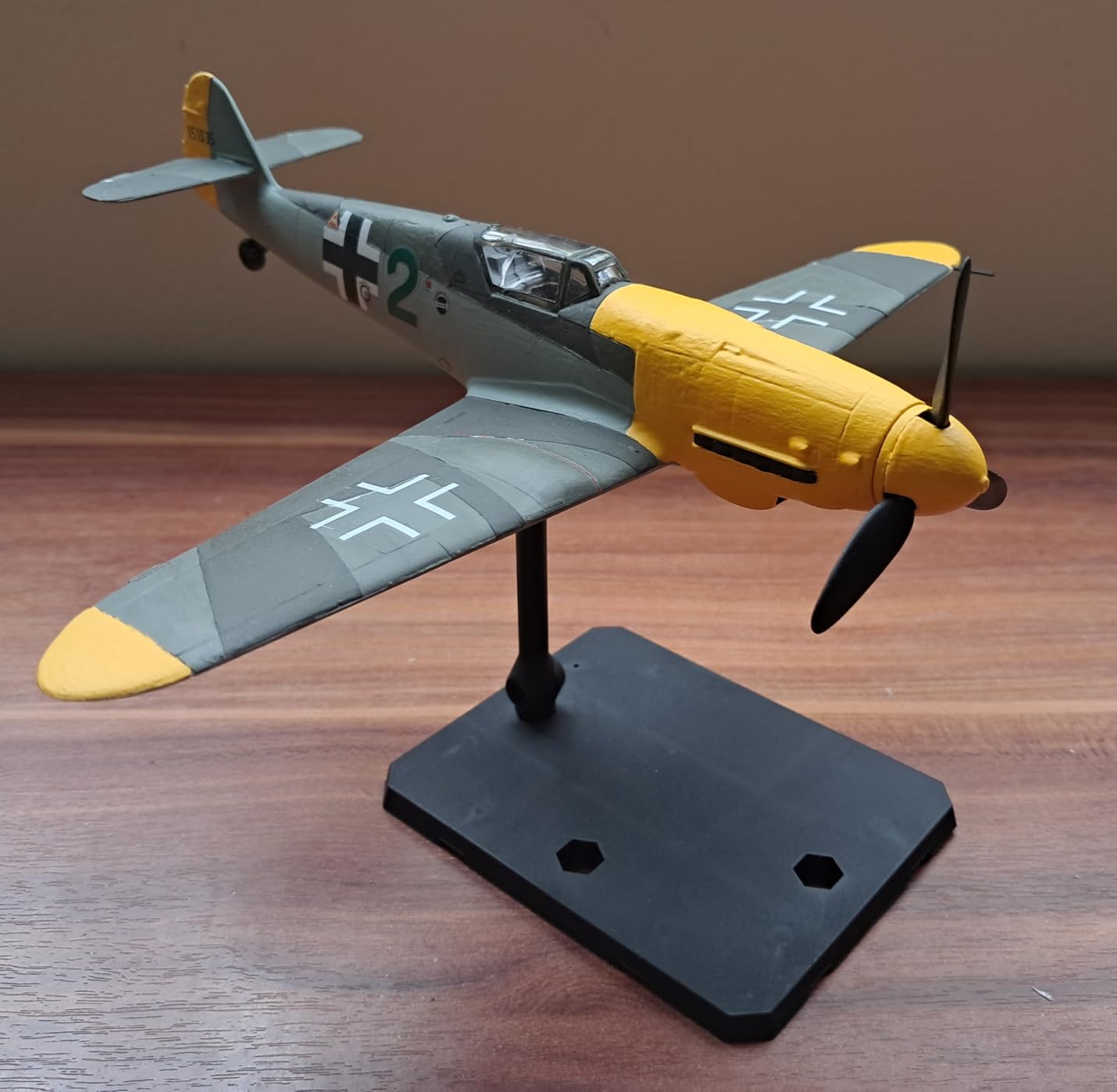
The full decal sheet covers all the standard markings for this late-war Bf 109 variant. They went down cleanly with warm water and responded to Micro Set without issues. The included long-range fuel tank adds a nice option for a mission-loaded configuration. Molded in light gray and clear plastic, the parts take paint well with proper priming.
My main complaint is that the landing gear is designed to be displayed in the down position only. If you want to build a gear-up in-flight model, you will need to modify the gear doors yourself. There is also raised copyright lettering on the tail stabilizer that needs careful sanding to remove. These are minor issues but worth knowing about before you start.
What to expect from this kit
Do not let the skill level 4 rating fool you. Most builders report this feels more like a level 2 kit in terms of complexity. The low parts count makes it approachable, and the instructions are clear and easy to follow. It is an excellent choice for anyone wanting to try 1/48 scale for the first time without a major investment of time or money.
Display options and limitations
The fixed landing gear position limits your display choices to a ground configuration. The propeller does spin, which adds a small dynamic element. For a more dramatic display, consider pairing this with a simple ground base or diorama setting. The late-war markings look particularly effective with heavy weathering to represent the deteriorating conditions of 1945 Germany.
7. Tamiya 1/48 Bf 109 G-6 – Premium Detail with Magnetic Cowlings
Tamiya 61117 1/48 Messerschmitt BF 109 G-6 Plastic Model Airplane Kit
1/48 Scale
DB605A Engine Detail
Magnetic Cowling System
3 Marking Options
Pros
- Excellent fit with no flash
- Very detailed engine and cockpit
- Magnetized cowlings allow display options
- High quality decals
- Easy assembly despite detail level
Cons
- Foot pedals very small and frustrating
- Some color matching challenges
- Not for first-time builders
This is the kit that made me understand why people pay more for Tamiya. The 1/48 Bf 109 G-6 is an exercise in what happens when a manufacturer puts real thought into the modeler’s experience. Every part fits perfectly, the engineering solves common assembly headaches, and the finished result looks like a much more expensive model than it is.
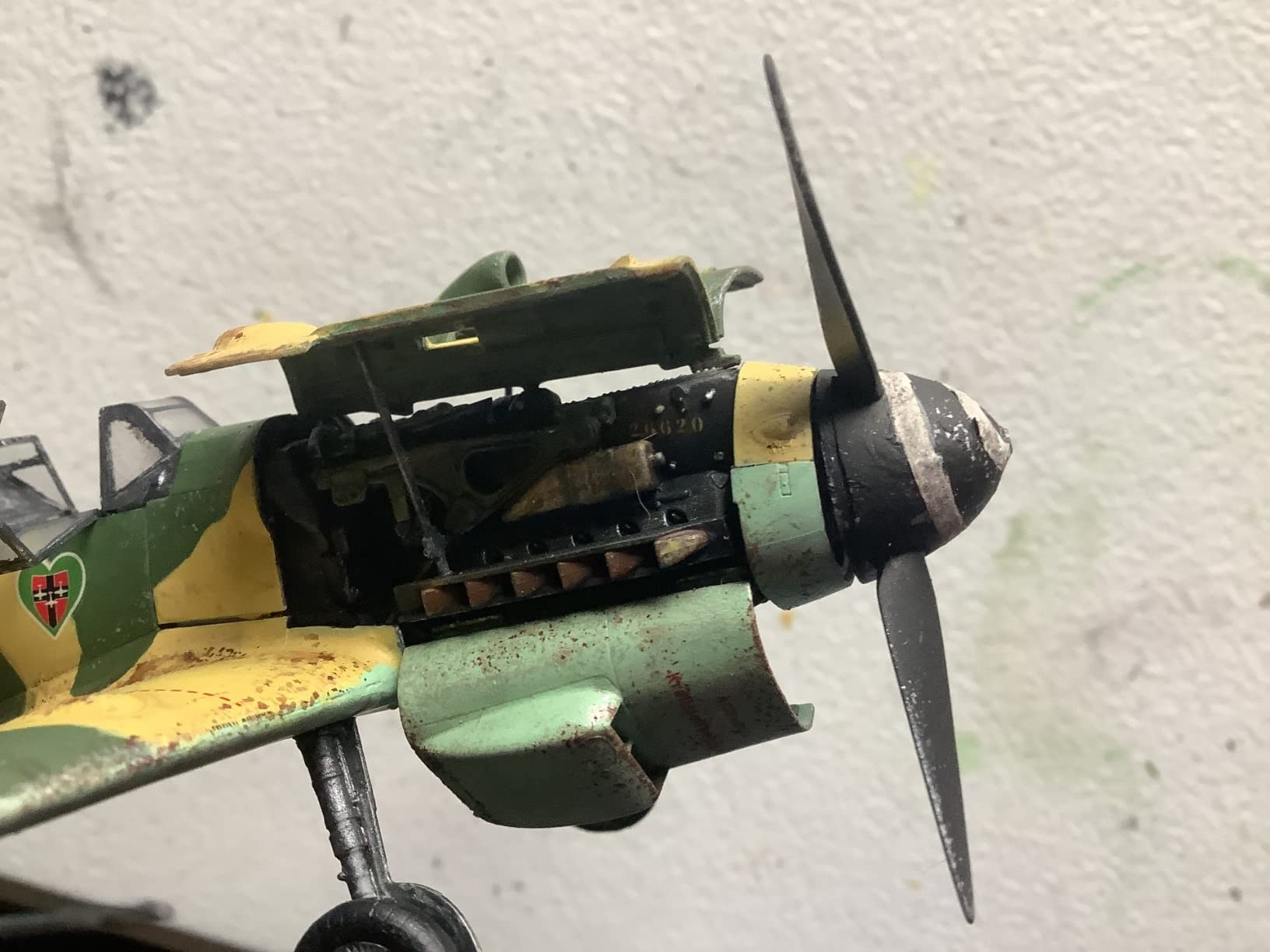
The standout feature is the magnet system for the engine cowlings. Small magnets embedded in the plastic let you attach and remove the cowling panels at will, so you can display the engine detail when you want and close it up for a cleaner look. The DB605A engine itself is a multi-part masterpiece with separate cylinders, pushrods, and accessories.
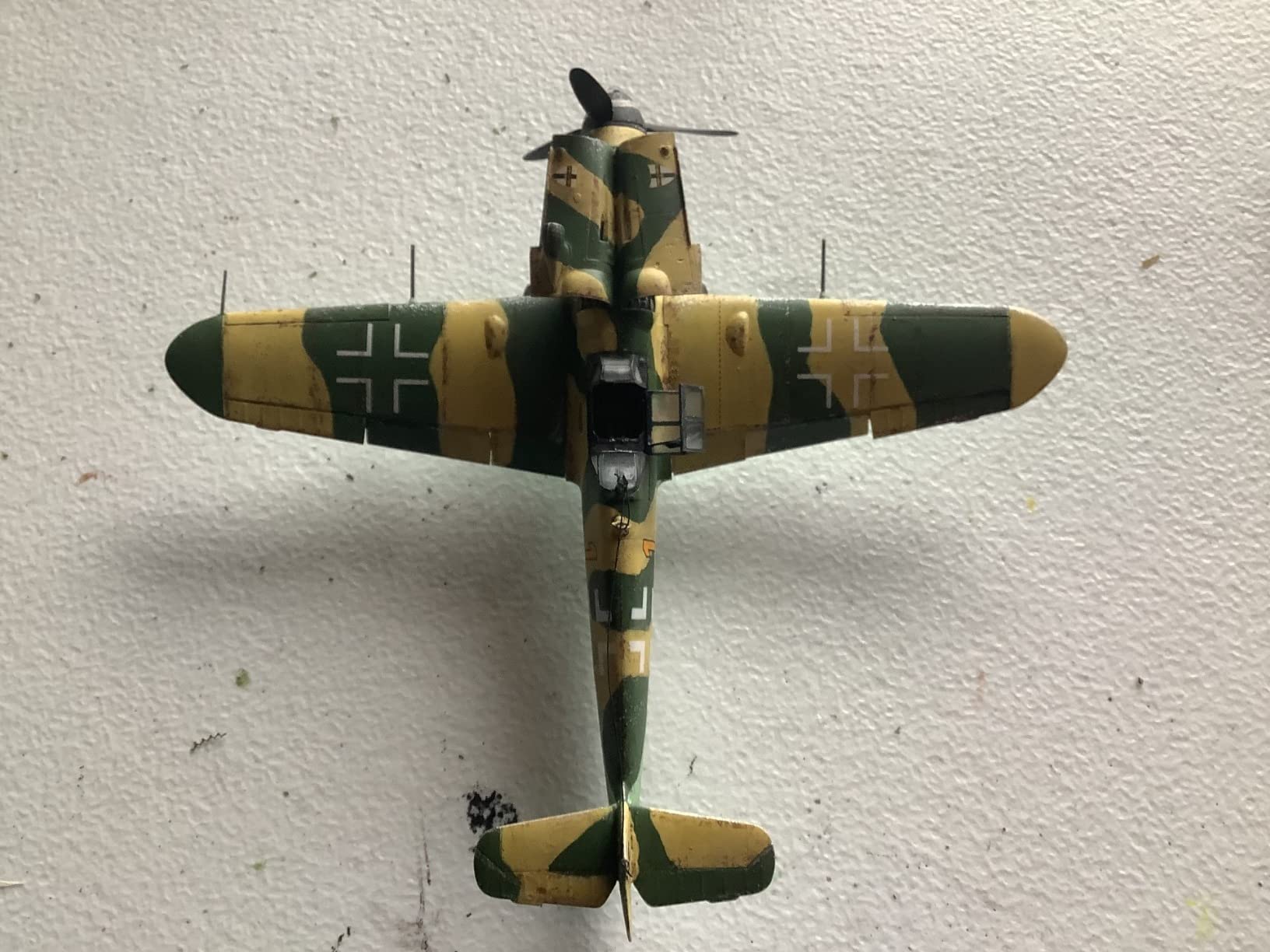
Cockpit detail is outstanding, with separate sidewall panels, a detailed instrument panel, and realistic seatbelts molded into the seat. The dual radiator flaps in the wings can be positioned open or closed. Three marking options give you choices between different theaters and time periods. The drop tank parts are included for longer-range configurations.
I did find the foot pedals frustratingly small during assembly. They are barely visible once installed, so do not stress too much if they do not go in perfectly. The color guide calls for Luftwaffe grey-purple on some interior surfaces, which can be tricky to match. I recommend having a good reference photo handy for the cockpit colors.
Unique features and engineering
The magnetic cowling system is genuinely innovative and something I have not seen from other manufacturers at this scale. Beyond the magnets, the kit includes adjustable radiator flaps, a well-engineered wing join, and thoughtful parts breakdown that minimizes visible seam lines. It is clear that Tamiya designed this kit with input from experienced modelers.
Paint and finishing recommendations
I recommend priming with a fine gray primer before applying any colors. The engraved surface detail is fine enough that heavy paint coats will fill it in. For the Luftwaffe camo scheme, use the Tamiya color callouts as a starting point but cross-reference with actual paint chips if accuracy matters to you. A panel line wash really brings out the detail on this kit.
8. Tamiya 1/48 Focke-Wulf Fw 190 A-8/R2 – Top-Rated WWII German Fighter
Tamiya 61095 1/48 Focke-Wulf FW190 A-8/A-8 R2 Plastic Model Airplane Kit
1/48 Scale
143 Parts
A-8 or R2 Variant Options
4 x 20mm Cannon Parts
Pros
- Very detailed and well engineered
- Pieces fit together nicely
- Great decals
- Excellent overall quality
- Good value for the price
Cons
- No option for retracted landing gear
- Instructions lack detail on bomb rack holes
- Requires planning before wing assembly
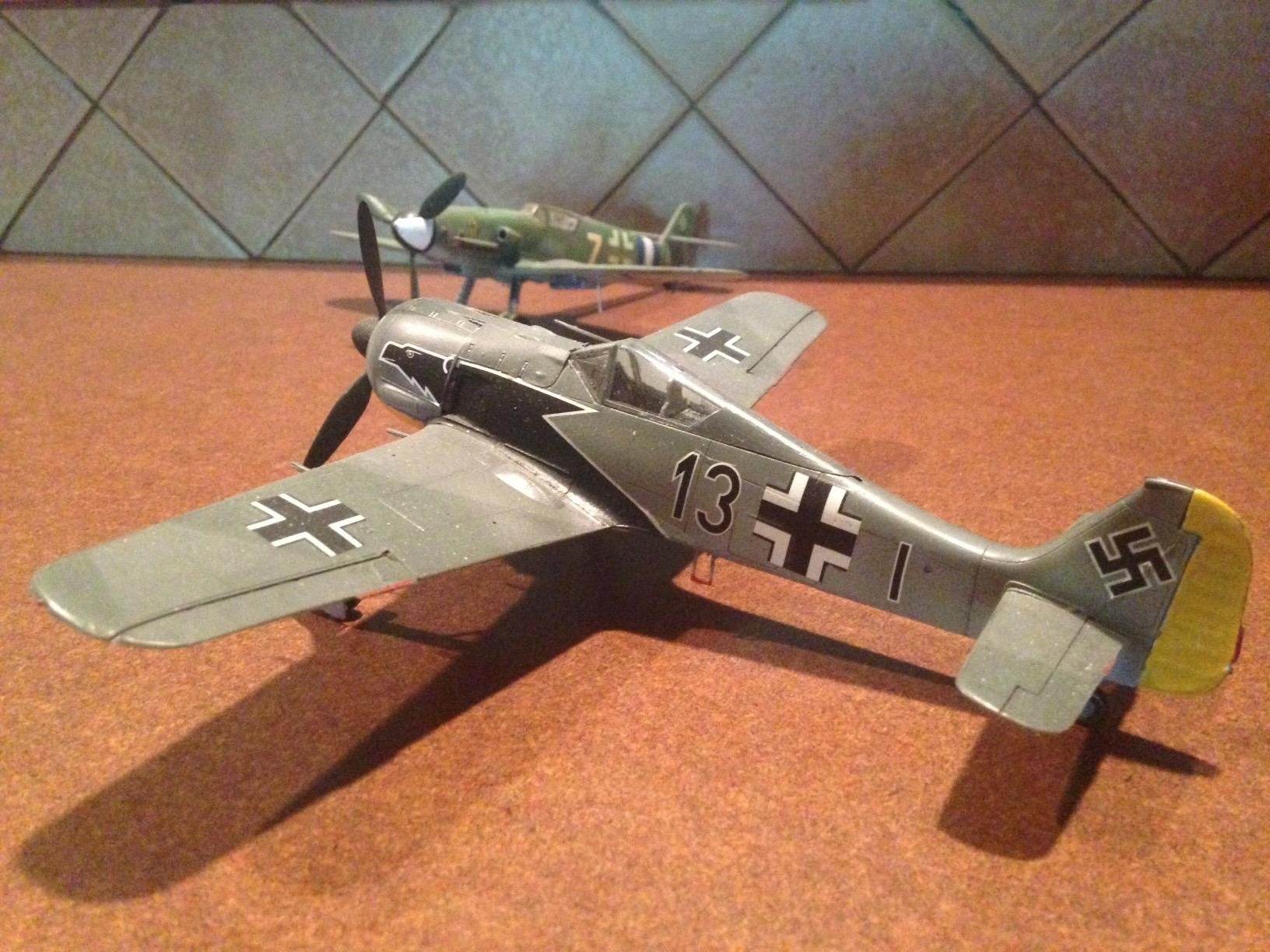
The Fw 190 is one of those aircraft that just looks right from every angle, and Tamiya captures that aggressive broad-shouldered stance perfectly in 1/48. With a 4.7-star rating from over 160 reviews, this kit has earned its reputation as one of the best WWII aircraft kits available at any price. After building one, I can confirm the praise is justified.
The 143 parts give you plenty of detail without making the build feel overwhelming. You get to choose between building the standard A-8 fighter or the up-armored R2 variant with additional cockpit armor plates. The parts for four 20mm cannons and two 13mm machine guns are all included, giving you the full armament complement regardless of which version you choose.
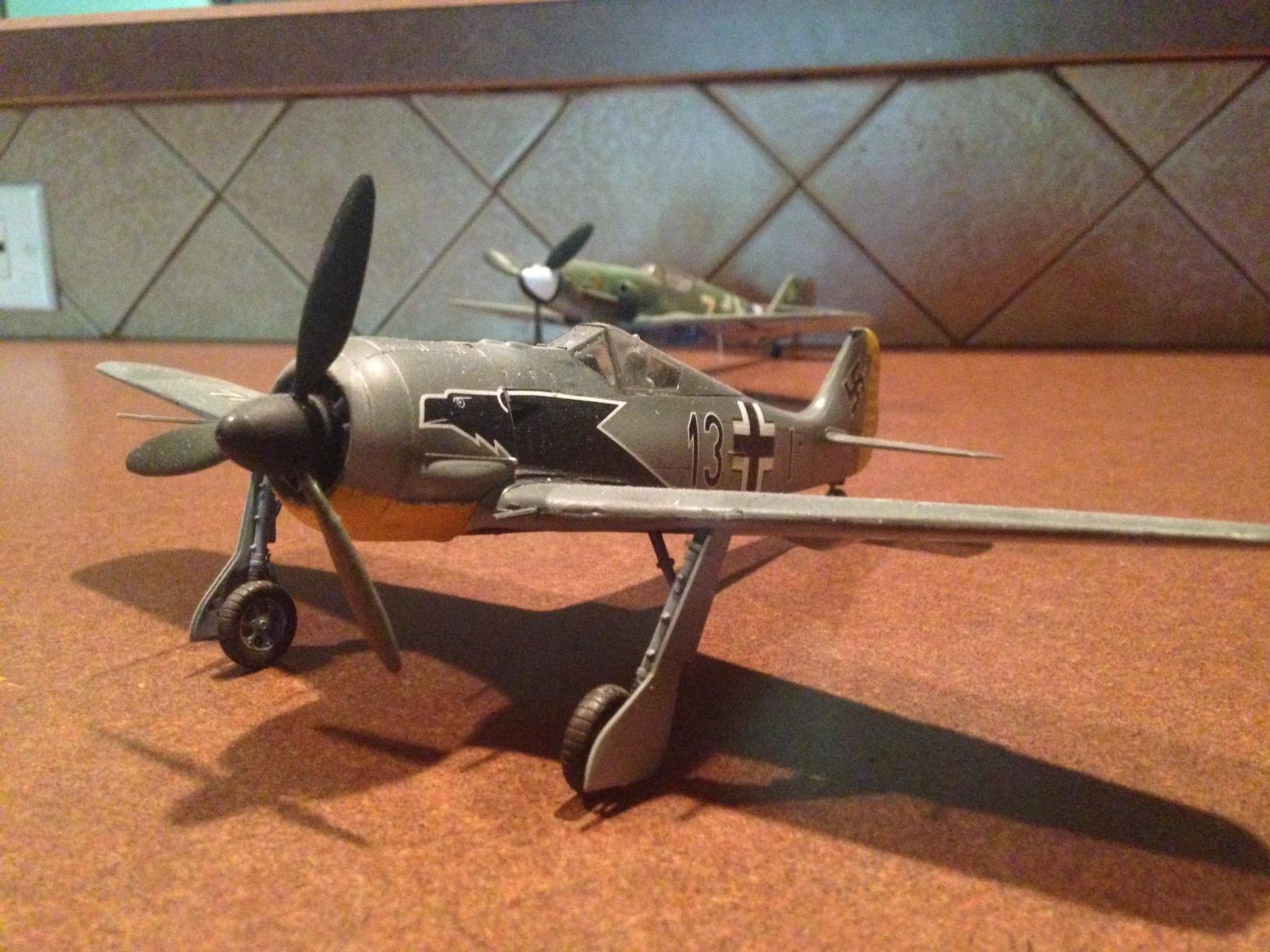
Assembly follows the typical Tamiya pattern of logical steps and excellent part fit. The wings go together in subsections that align precisely, and the fuselage join needed no filler on my build. The landing gear is detailed and sturdy, though it is designed for display in the extended position only. Modelers wanting a gear-up display will need to source aftermarket parts or modify the kit.
The decals are high quality with accurate colors and good registration. They are slightly thicker than some modern Cartograf sheets, so a strong setting solution is recommended to get them to conform to the curved surfaces around the cowling and wing roots. Take your time here and the results will reward your patience.
Assembly tips and pitfalls
The most important thing to know is that you need to plan ahead before gluing the wing halves together. There are holes to drill for the bomb rack attachments, and the instructions are not very clear about which ones apply to which configuration. Mark your chosen option before assembly to avoid regrets later. The outer wing panel fit at the fold line can also be tricky, so dry-fit carefully.
Variant selection guidance
The A-8 is the standard fighter variant and probably the better choice for your first build of this kit. The R2 is the up-armored version designed to attack heavy bombers, with additional armor plating around the cockpit. Both build from the same basic airframe, so the difference comes down to a few extra parts and your choice of markings. Pick whichever historical subject interests you more.
9. Tamiya 1/48 De Havilland Mosquito FB MK.VI – Legendary Wooden Wonder
Tamiya 61062 1/48 De Havilland Mosquito FB-MK.6 Plastic Model Airplane Kit
1/48 Scale
Two Figures Included
3 Squadron Markings
British Multi-Role Aircraft
Pros
- All parts fit together perfectly
- Fantastic quality kit
- Easy to build even in flight mode
- Gold standard of model kits
- Excellent detail for kit age
Cons
- Older tooling not matching current Tamiya levels
- Limited pose options
The Mosquito is one of the most fascinating aircraft of WWII. Built mostly from wood yet faster than most fighters of its era, the Wooden Wonder earned its nickname the hard way. Tamiya’s 1/48 kit captures the sleek, purposeful lines of the FB MK.VI fighter-bomber variant, and despite being an older tooling, it still sets the standard for this subject.
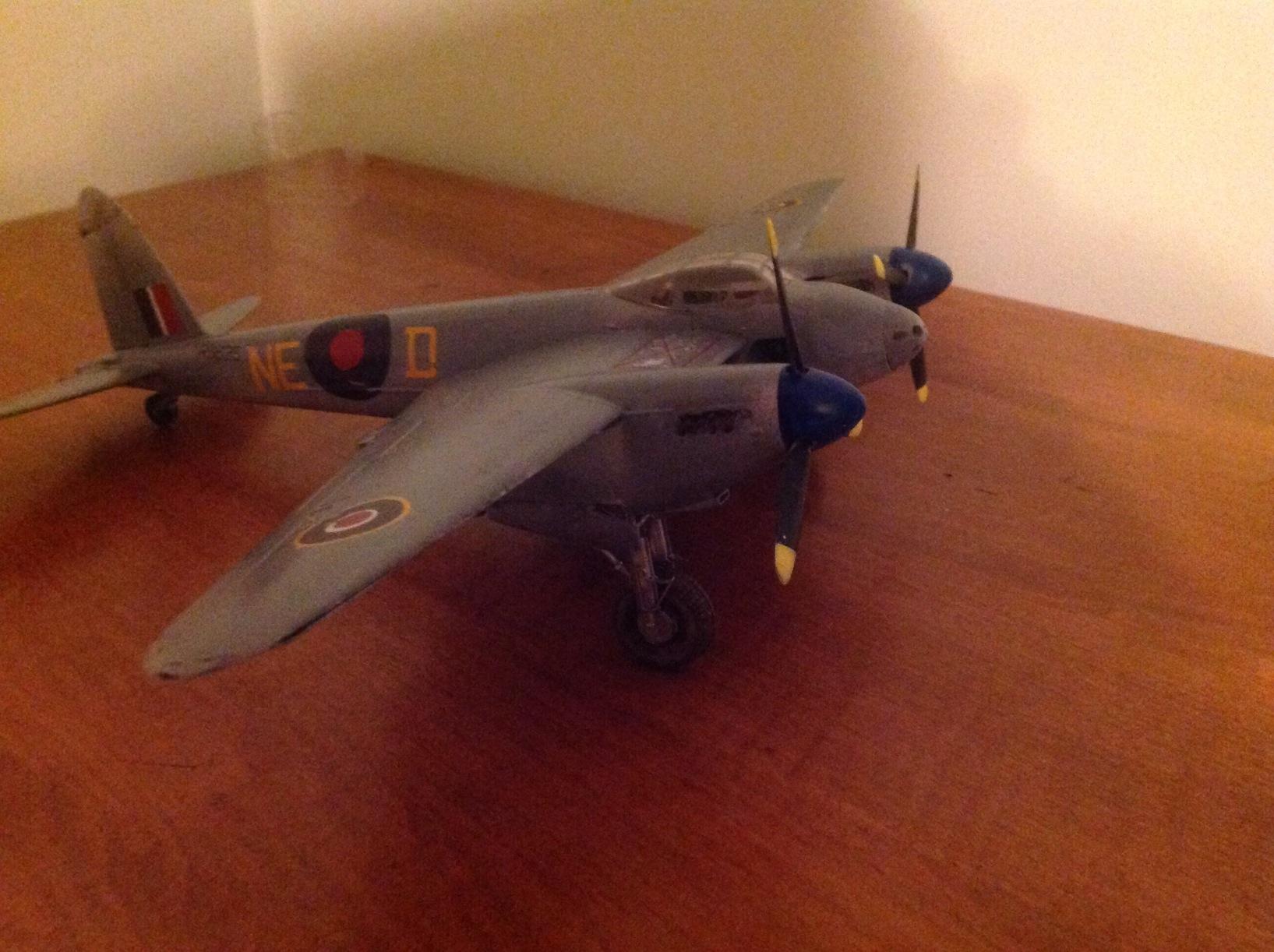
What impressed me most was how effortlessly everything went together. This is that rare kit where every seam disappears without filler, every joint aligns perfectly, and the build just flows. Tamiya’s reputation for the gold standard of model kits was built on releases like this one. Even the wing-to-fuselage join, often a trouble spot on twin-engine kits, was flawless on my example.
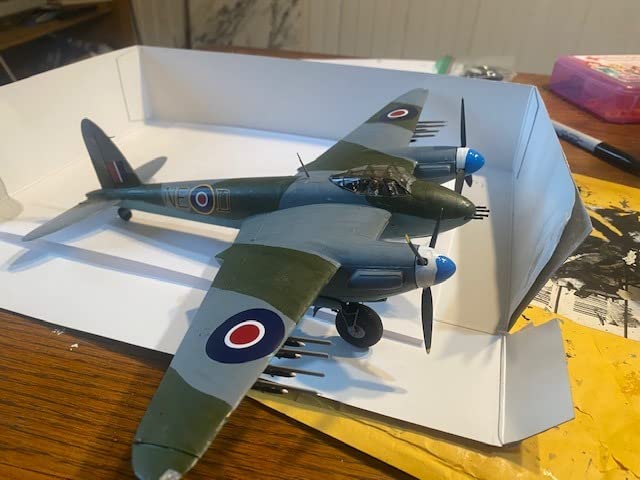
The kit includes markings for three squadrons: No 143 Sq, No 157 Sq, and No 487 Sq. Two crew figures are included, which add scale and life to the finished model. The surface detail represents the wooden and metal skin textures appropriately, and the overall proportions look accurate when compared to reference photos.
The main concession to age is that the interior detail does not match what you find in Tamiya’s newer releases. The cockpit is adequate but not spectacular, and the landing gear bays are simplified compared to modern standards. These are things that only bother super-detailers. For a straight build that looks spectacular on the shelf, this kit delivers beautifully.
Build quality and part fit
After building this kit, I understand why experienced modelers still recommend it despite newer alternatives. The part fit is genuinely perfect, with no gaps, no warping, and no alignment issues anywhere on the build. The engineering is straightforward enough that even the multi-part nacelle assembly went together without the usual twin-engine headaches.
Display and finishing suggestions
The Mosquito looks best in the invasion stripe scheme from one of the included marking options. I recommend a wood grain effect on the fuselage sides using a light tan base with brown streaks applied with a flat brush. The clear parts are well-molded and can be posed open to show off the cockpit interior. A subtle weathering wash brings out the panel line detail beautifully.
10. Tamiya 1/48 F-4B Phantom II – The Definitive Jet Fighter Kit
Tamiya 61121-000 Vehicle 61121 1:48 F-4B Phantom II Mcdonnell Douglas Faithful Replica, Model Building, Plastic Kit, Crafts, Hobby, Model Kit, Assembly, Unpainted
1:48 Scale
All-New Tooling
Folded and Extended Wing Options
Movable Tailplane
Pros
- Absolutely flawless fit with no gaps
- Best Phantom kit available
- Precise pieces with excellent detail
- Great instructions
- Phenomenal accuracy and detail
Cons
- Over engineered and complex
- Outer wing panel fit issues at fold line
- Defective decals on old stock
- Packaging may be damaged in shipping
The F-4 Phantom II is an icon of Cold War aviation, and Tamiya’s 1/48 kit is widely considered the definitive representation of this aircraft in plastic. This is an all-new tooling that takes full advantage of modern engineering techniques, and the result is a kit that captures every panel line, every antenna, and every distinctive feature of the B-model Phantom with stunning accuracy.
The folded wing option is what sets this apart from other Phantom kits. You can build it with wings spread for a dramatic display or folded for carrier deck storage, and both configurations are fully detailed. The movable tailplane adds another interactive element. Combined air intake and dust box assemblies solve a common fit problem that plagues other Phantom kits.
Build quality is everything you expect from Tamiya at this level. Parts fit with zero gaps across the board. The fuselage is broken down into logical subsections that go together with confidence. Decals cover multiple historical marking options, giving you choices between different Navy and Marine squadrons. It is the kind of kit that makes you want to clear your schedule and just build.
The complexity is real though. This is not a weekend project. The sheer number of parts and sub-assemblies demands patience and careful planning. Some builders have noted that the outer wing panels do not fit perfectly at the fold line, requiring some adjustment. There have also been reports of defective decals on older stock, so check your sheets when you open the box.
Complexity and build approach
I recommend tackling this kit in stages over several weeks rather than trying to rush through it. Build the cockpit and intake assemblies first, then move to the fuselage, then the wings. Each sub-assembly is satisfying on its own, and the logical construction sequence means you always feel like you are making progress. Have a good reference photo collection ready for the many small details.
Marking options and historical schemes
The included decals cover several historical F-4B configurations from the Vietnam War era. The color registration and print quality are generally excellent, though check for age-related issues if your kit has been sitting on a shelf. For modelers wanting even more options, this is a popular subject for aftermarket decal sheets covering specific squadrons and cruise deployments.
11. Revell 1/32 Messerschmitt Bf 109G-2/4 – Large Scale WWII Detail
Revell 03829 Messerschmitt Bf109G-2/4 1:32 Scale Model Kit
1:32 Scale
185 Pieces
G-2 or G-4 Version Options
Highly Detailed Surfaces
Pros
- Highly detailed surfaces
- Detailed cockpit
- Accurate aircraft representation
- Fun to build
- No flash on parts
- Two version options G2 and G4
Cons
- Level 5 complexity with tiny parts
- Some drilling required
- Parts difficult to paint when not visible
- Moving parts can be tricky to install
There is something special about building in 1/32 scale that makes you appreciate aircraft design in a way that smaller scales cannot match. This Revell Bf 109G-2/4 gives you 185 pieces of detail to work with, and when you see those surface engravings and cockpit components up close, you understand why large scale modeling has such a devoted following.
The kit lets you build either the G-2 or G-4 variant depending on which cowling configuration you choose. Both options share the same basic airframe, so the decision mainly affects the nose section and a few detail parts. I chose the G-4 variant for my build because the pressurized cockpit differences gave me more to work with in terms of superdetailing opportunities.
Surface detail is genuinely impressive for a Revell release at this price point. The panel lines are finely engraved and consistent across all surfaces. The cockpit has excellent depth of detail, with separate sidewall panels and a well-rendered instrument panel. There was no flash on any of my parts, which speaks to the quality of the mold tooling.
The complexity is not to be underestimated. Revell rates this as a level 5 kit, and with 185 pieces including some genuinely tiny components, that rating feels earned. Some assembly steps require drilling holes that are not pre-marked, and getting the moving parts to function properly demands patience and precise alignment. This is not a kit for your first foray into 1/32 scale.
Large scale build experience
Building in 1/32 requires a different mindset than smaller scales. The larger surface areas mean your paintwork needs to be smoother, your weathering more subtle, and your seam work more thorough because every flaw is visible at this size. I recommend investing in quality sanding sticks and a good airbrush if you do not already have them before tackling this kit.
Version options and customization
The choice between G-2 and G-4 comes down to which cowling parts you use during assembly. The G-2 is the earlier variant with a simpler nose section, while the G-4 includes the pressurized cockpit modifications. Both are valid historical subjects. The authentic decal set provides markings for each version, and aftermarket sheets are readily available for this popular subject in 1/32 scale.
12. Tamiya 1/32 Mitsubishi A6M5 Zero Fighter – Flagship Scale Detail
Tamiya 60318 1/32 Mitsubishi A6M5 Zero Fighter Plastic Model Airplane Kit
1:32 Scale
Detailed Sakae 21 Engine
Moveable Rudder and Flaps
Metal Cannon Parts
Pros
- Outstanding attention to detail
- Pieces fit perfectly
- Moveable landing gears and control surfaces
- Extensive assembly manual
- Many build options
Cons
- Not for beginners
- Injection marks on underside surfaces
- Many parts smaller than a match head
- Assembly instructions could be clearer
Tamiya’s 1/32 Zero is one of those kits that reminds you why this hobby is worth the investment of time and money. The level of detail packed into this box is remarkable, from the multi-part Nakajima Sakae type 21 engine to the individual metal parts for the 20mm cannons and pitot tube. When you open the box for the first time, the number of sprues and parts can feel intimidating, but the engineering is so good that the build flows naturally.
The beautifully curved engine cowling, the distinctive fuselage shape, the slender wings: every line of the A6M5 Zero is faithfully reproduced. You get options for open or closed cowl flaps and canopy, plus a choice between seated and standing pilot figures. The rudder, flaps, and lower fuselage parts are all moveable, which adds an interactive quality that makes the finished model feel alive.
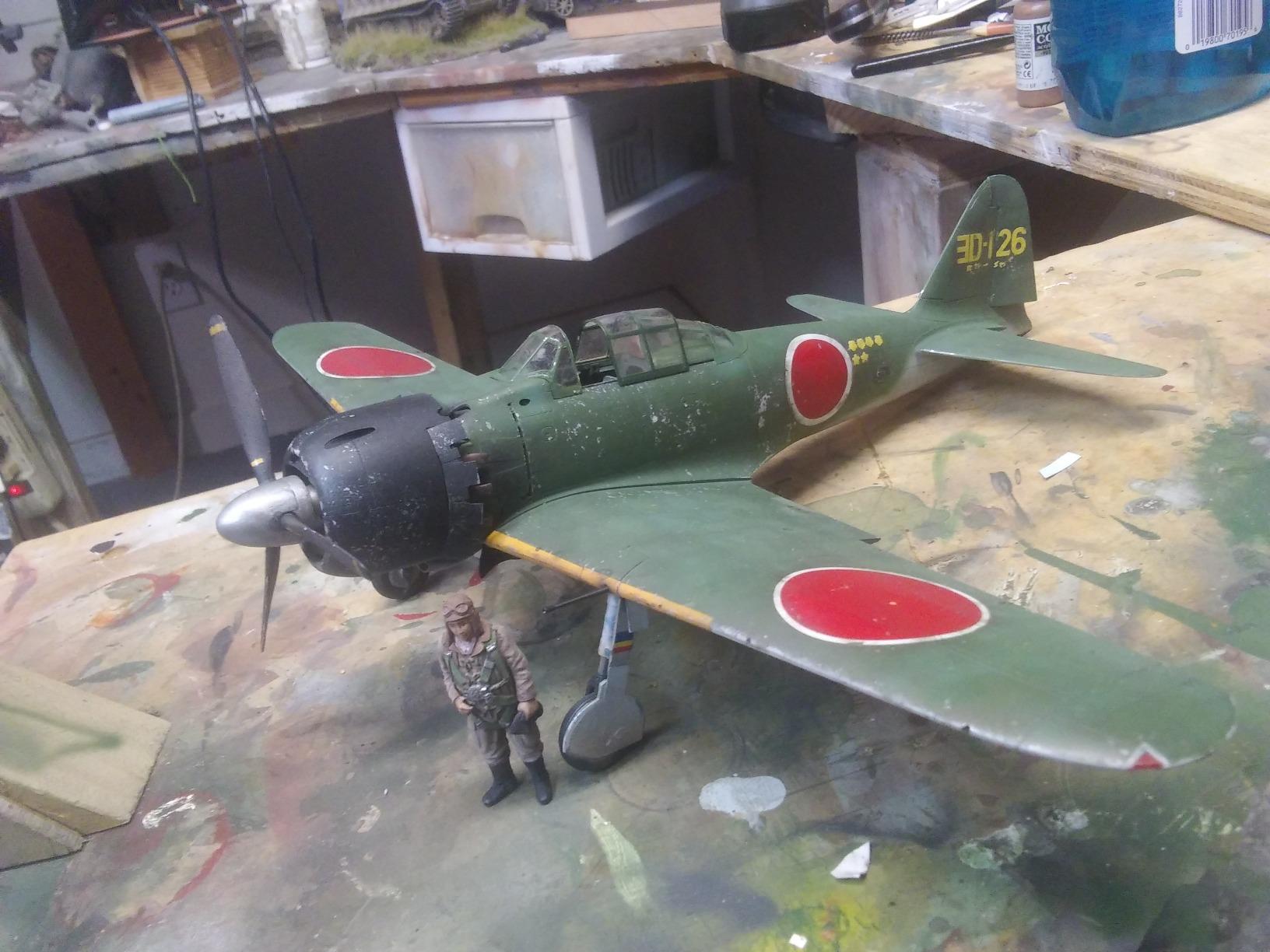
The pre-painted machine gun barrels are a thoughtful touch that saves time and looks better than most modelers could achieve with a brush. The landing gear is functional and sturdy enough to support the finished model’s weight. The extensive assembly manual walks you through every step, though some modelers have noted that the instructions could be clearer on certain sub-assemblies.
This is not a kit for the faint of heart. Many parts are smaller than a match head, and the assembly requires steady hands, good lighting, and quality tools. Injection marks on some underside surfaces will need attention if you plan to display the model where the belly is visible. But for experienced modelers willing to put in the effort, the results are stunning. This kit produces a display piece that rivals resin and multimedia kits costing far more.
Detail level and engineering quality
Every exterior surface features finely engraved detail that responds beautifully to washes and weathering techniques. The cockpit interior is rich with separate sidewall components, a detailed instrument panel, and realistic seatbelts. The engine is a kit within a kit, with individual cylinders and accessories that reward careful painting. The metal cannon and pitot tube parts provide a sharpness that plastic alone cannot match.
Who should invest in this kit
This kit is for experienced modelers who want a showcase piece. If you have built several 1/48 scale kits and feel ready for a larger challenge, this Zero will push your skills in rewarding ways. It is also an excellent choice for collectors building a 1/32 scale Pacific Theater collection. Budget enough time to do it justice: most experienced builders report spending 40 to 60 hours on this build.
How to Choose the Best Hobby 2000 Aircraft Kits?
Choosing the right aircraft kit from the Hobby 2000 catalog comes down to understanding a few key factors. Our team has broken down the most important considerations to help you make the right pick for your skill level and interests.
Scale comparison: 1/72 vs 1/48 vs 1/32
The scale you choose affects everything from display space to build time to detail level. Here is how the three main scales break down for Hobby 2000 aircraft kits.
1/72 scale is the most popular choice for good reason. Kits in this scale are compact, affordable, and perfect for building collections. A typical 1/72 fighter has a wingspan of about 6 inches, so you can display dozens on a single shelf. The trade-off is that cockpit and surface detail is naturally smaller and harder to paint. Kits like the Premium Hobbies P-51D and Bf 109 G-14 are excellent 1/72 choices that will not overwhelm newer builders.
1/48 scale hits the sweet spot for many modelers. The larger size means more visible detail, easier painting, and a more impressive finished model without requiring the massive display space of 1/32. The Tamiya Bf 109 G-6 and Fw 190 A-8/R2 from our list are standout 1/48 kits that deliver premium results. If you are unsure which scale to commit to, 1/48 is a safe and rewarding choice.
1/32 scale is for modelers who want maximum detail and are prepared to invest the time and space. These kits are large, complex, and produce stunning display pieces. The Tamiya Zero and Revell Bf 109G-2/4 from our list showcase what this scale can deliver. Make sure you have adequate display space and a comfortable workspace before diving in.
Skill levels explained
Hobby 2000 kits span the full range of skill levels, and choosing one that matches your experience is key to an enjoyable build. Beginner kits like the Premium Hobbies P-51D have low parts counts, simple assembly, and forgiving tolerances. Intermediate kits such as the Revell Stuka or Academy P-51B demand more from your painting and assembly skills. Advanced kits like the Tamiya F-4B Phantom or the 1/32 Zero require significant experience and a well-equipped workbench.
Understanding Cartograf decals
One of the main reasons modelers seek out Hobby 2000 releases is the Cartograf decals included in every boxing. Cartograf is an Italian company widely regarded as producing the finest water-slide decals in the modeling industry. Their sheets feature thin carrier film, accurate colors, tight registration, and excellent response to setting solutions.
Compared to the decals included in standard Hasegawa or Revell releases, Cartograf sheets are a significant upgrade. The thinner film conforms to curved surfaces better, the colors are more opaque, and the fine details like stencils and small text print more crisply. For modelers who have struggled with thick or poorly registered decals from other manufacturers, the Cartograf difference is immediately noticeable.
What are Pmask canopy masks?
Pmask canopy masks are pre-cut vinyl or kabuki tape masks designed to fit the clear canopy parts of specific kits. Instead of spending 30 to 60 minutes carefully cutting and applying masking tape to each canopy frame by hand, you simply peel the pre-cut masks from their backing sheet and apply them directly. The time savings alone make them valuable, but the consistent, clean demarcation lines they produce are what really set them apart.
Hobby 2000 includes Pmask sets with their releases, which means you get this convenience right in the box. On standard kits from other manufacturers, you would need to purchase these separately or cut them yourself. This added value is part of what makes Hobby 2000 releases attractive to experienced modelers who know how tedious canopy masking can be.
Source kit manufacturers and what they mean
Since Hobby 2000 reboxes kits from other manufacturers, understanding the original source tells you a lot about what to expect. Hasegawa-based kits generally offer excellent surface detail and accuracy with good engineering. Fujimi-based kits tend to be older tooling that may need more work during assembly. Dragon-based kits can be hit or miss depending on the age of the mold, with some forum users noting that older Dragon tools show their age. Revell-based kits in 1/32 scale often represent excellent value for the detail level provided.
The general consensus from the modeling community on forums like Large Scale Planes and Reddit is that Hasegawa-sourced Hobby 2000 releases are the most desirable, followed by Revell-sourced kits in larger scales. The enhanced Cartograf decals and Pmask additions mean you are getting the best possible version of whatever the base kit happens to be.
FAQs
Are Hobby 2000 model kits good?
Yes, Hobby 2000 model kits are highly regarded in the scale modeling community. They rebox proven kits from manufacturers like Hasegawa, Fujimi, and Revell, then upgrade them with premium Cartograf decals and pre-cut Pmask canopy masks. Forum users on Reddit and Britmodeller consistently praise the value proposition, noting that you get better decals and the convenience of canopy masks without paying extra for aftermarket additions.
What is the Hobby 2000 brand known for?
Hobby 2000 is a Polish model kit distributor known for re-releasing established aircraft kits from major manufacturers with upgraded components. Their signature additions include Cartograf decals, which are considered among the finest in the hobby, and Pmask pre-cut canopy masks that save modelers significant preparation time. They focus primarily on military aircraft in 1/72, 1/48, and 1/32 scales, often producing limited edition runs with unique historical markings not available elsewhere.
Who makes the best quality model kits?
Tamiya is widely considered the gold standard for aircraft model kits, with unmatched engineering quality, perfect part fit, and excellent instructions. Hasegawa produces highly accurate kits with fine surface detail. For larger scales, Revell offers excellent value with detailed 1/32 releases. Hobby 2000 occupies a unique position by enhancing proven kits from these manufacturers with superior Cartograf decals and canopy masks, often delivering better overall value than the original releases.
What scale should beginners choose for aircraft models?
1/72 scale is the best starting point for beginners. Kits in this scale are affordable, compact for display, and typically have lower parts counts that keep assembly manageable. The smaller size means less surface area to paint and weather, which reduces the learning curve. Kits like the Premium Hobbies P-51D or Bf 109 G-14 are excellent beginner-friendly options. Once you feel confident at 1/72, stepping up to 1/48 gives you more detail without a dramatic jump in complexity.
Final Thoughts on the Best Hobby 2000 Aircraft Kits
Finding the best Hobby 2000 aircraft kits comes down to matching the right kit to your skill level and interests. For most modelers, the Tamiya 1/48 Fw 190 A-8/R2 offers the best combination of detail, engineering quality, and build enjoyment. The Tamiya 1/48 Bf 109 G-6 with its innovative magnetic cowling system is a close second, while the Academy 1/72 P-51B Mustang delivers outstanding value for budget-conscious builders.
Whatever you choose, remember that Hobby 2000 releases tend to be limited runs. When you spot a kit that catches your eye, do not wait too long to pick it up. The modeling community consistently reports that popular boxings sell out quickly, and once they are gone, finding them at a reasonable price becomes a challenge. Happy building in 2026.