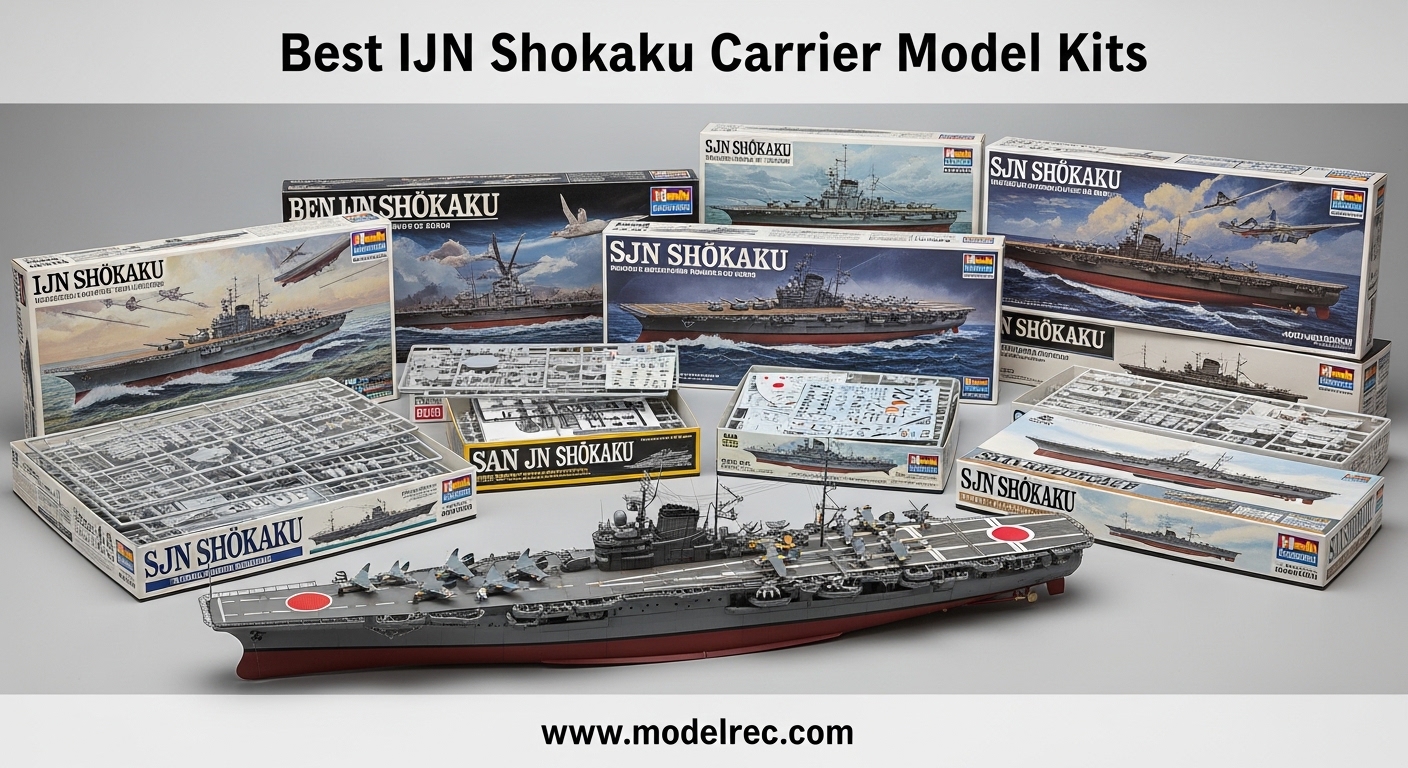
If you are a naval history buff or a scale model builder, the IJN Shokaku holds a special place in Pacific War lore. She was one of the most capable aircraft carriers the Imperial Japanese Navy ever launched, serving from the attack on Pearl Harbor through some of the most intense carrier battles in history. Building a Shokaku model kit is one of the most rewarding projects you can take on as a ship modeler, and our team has spent months comparing every option on the market to find the best IJN Shokaku carrier model kits available right now.
The Shokaku-class carriers (Shokaku and her sister ship Zuikaku) represented the peak of Japanese carrier design. They carried over 70 aircraft, featured excellent speed, and survived multiple major engagements before their eventual loss. That rich history makes them incredibly popular subjects for modelers who want to recreate the Pacific War at scale.
In this guide, we cover eight kits across multiple manufacturers and scales. Whether you are looking for a quick weekend build or a detailed showpiece for your display shelf, we have tested and compared these kits so you can pick the right one for your skill level and budget. We include base kits from Tamiya and Fujimi, plus two dedicated upgrade sets that can take your build to the next level.
Table of Contents
Top 3 Picks for IJN Shokaku Carrier Model Kits

Tamiya 1/700 WWII Japanese Aircraft…
- 1/700 Scale
- Ages 12+
- Excellent Fit
- Great Instructions
- 4.8 Star Rating

Tamiya 1/700 Aircraft Carrier Zuikaku…
- 1/700 Scale
- Includes 13 Pieces
- Comes With Aircraft
- Great Decals
- Easy Assembly

Fujimi 1/700 IJN Aircraft Carrier Shokaku
- 1/700 Scale
- Japan Import
- Fine Detail
- Many Parts
- Sprues And Decals
8 Best IJN Shokaku Carrier Model Kits in 2026
| Product | Specifications | Action |
|---|---|---|
| Tamiya 1/700 Shokaku |
|
Check Latest Price |
| Tamiya 1/700 Zuikaku Pearl Harbor |
|
Check Latest Price |
 Fujimi 1/700 Zuikaku 1944 Fujimi 1/700 Zuikaku 1944 |
|
Check Latest Price |
 Fujimi 1/700 Zuikaku SW Fujimi 1/700 Zuikaku SW |
|
Check Latest Price |
| Fujimi 1/700 Shokaku |
|
Check Latest Price |
 Tamiya 1/700 Zuikaku Tamiya 1/700 Zuikaku |
|
Check Latest Price |
 MRY-SFW 1/700 Shokaku 1941 Detail Up Set MRY-SFW 1/700 Shokaku 1941 Detail Up Set |
|
Check Latest Price |
 MRY-SFW 1/700 Shokaku 1942 Upgrade Kit MRY-SFW 1/700 Shokaku 1942 Upgrade Kit |
|
Check Latest Price |
1. Tamiya 1/700 WWII Japanese Aircraft Carrier Shokaku – Best Overall Build Experience
Tamiya 1/700 WWII Japanese Aircraft Carrier “Shokaku”
Scale: 1/700
Ages: 12+
Weight: 0.62 lbs
Tamiya P/N: 31213
Pros
- Super clean build with great fit
- Exceptional instructions
- Quality water slide decals
- Highly rated at 4.8 stars
Cons
- Historical accuracy not as detailed as Fujimi kits
When I built the Tamiya 1/700 Shokaku, the first thing that struck me was how cleanly everything went together. Tamiya is known for their engineering quality, and this kit is a perfect example of why they have that reputation. The hull halves aligned perfectly, the flight deck sat flush without any warping, and the superstructure island mated cleanly to the deck surface. I had the main assembly done in a single evening, which is saying something for a carrier model.
The instructions deserve special praise. Every step is illustrated clearly with numbered callouts that match the sprues exactly. I did not find myself second-guessing where a part went or how it should be oriented. For modelers who have struggled with vague Fujimi or Hasegawa instruction sheets in the past, this Tamiya kit feels like a breath of fresh air. The water slide decals also applied cleanly with no silvering issues, which made finishing the flight deck markings a stress-free process.
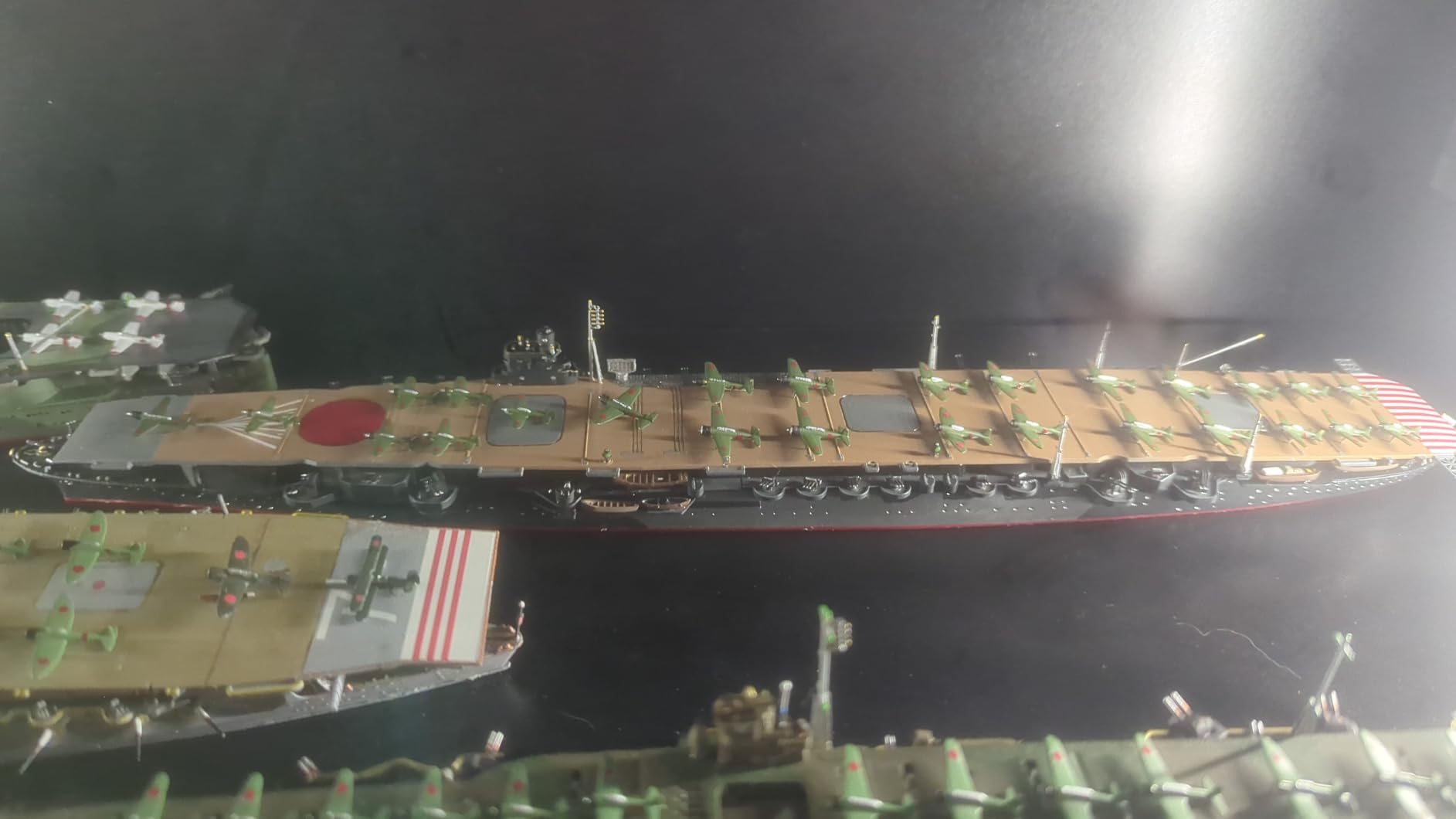
From a technical standpoint, the Tamiya Shokaku uses their older tooling, which means the part count is relatively low compared to newer Fujimi releases. You get a single-piece hull, a one-piece flight deck, and simplified superstructure components. The AA guns are molded as single pieces rather than having separate mounts and barrels. This keeps the build accessible for newer modelers but means you will not find the same level of microscopic detail that Fujimi offers in their newer toolings.
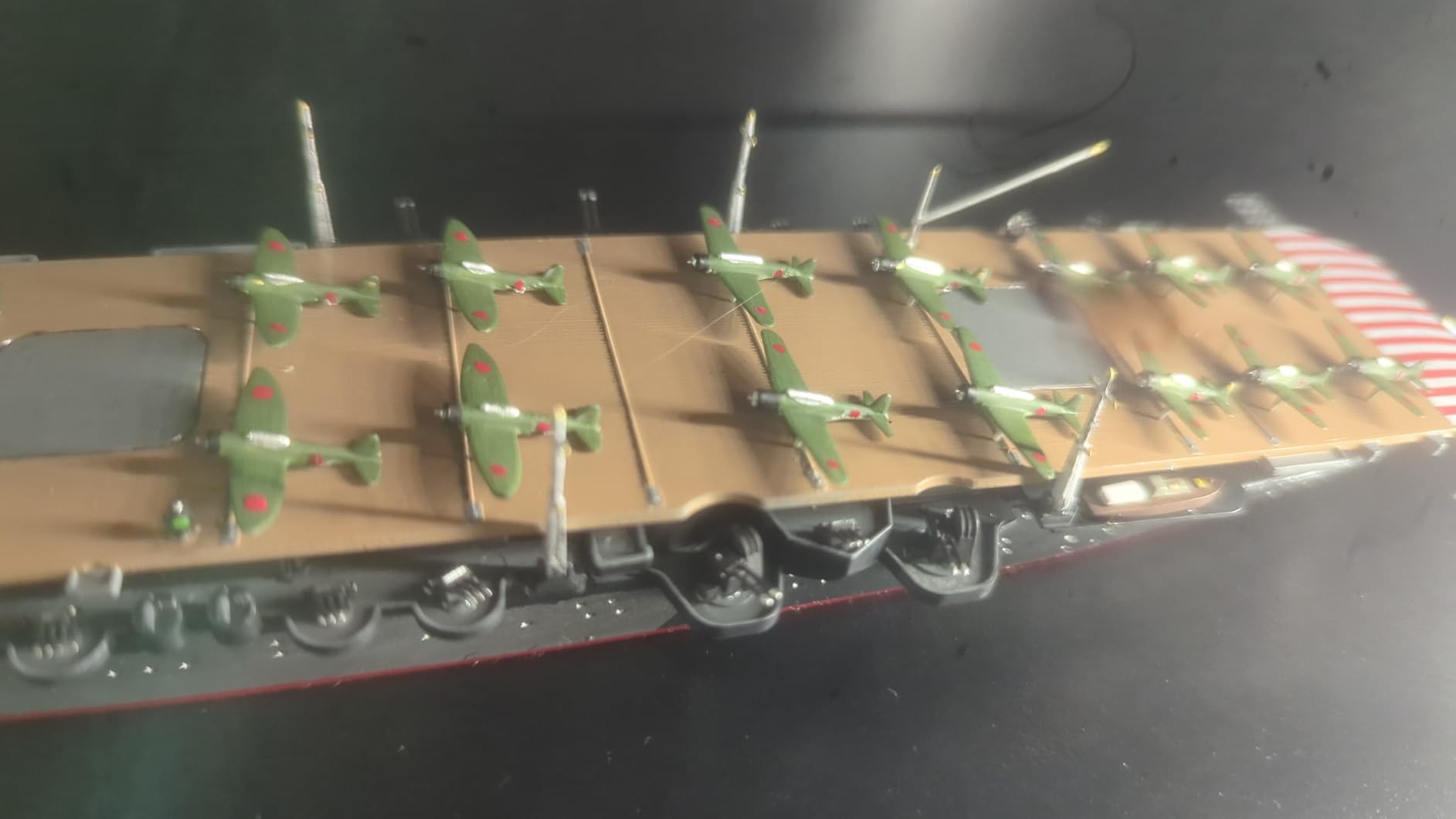
The included aircraft are basic but adequate for 1/700 scale. You get A6M2 Zero fighters, D3A Val dive bombers, and B5N Kate torpedo bombers. They are molded in clear plastic, which is a nice touch for canopy representation. However, they are simplified with no separate control surfaces or propellers. For a display piece at arm’s length, they look the part, but up close you may want aftermarket replacements if you are building a competition model.
Who Should Build This Kit
This is the kit I would hand to anyone building their first Japanese carrier model. The easy assembly, clear instructions, and clean fit make it forgiving for beginners while still producing a nice display piece. If you are an experienced modeler who wants a quick weekend build without sacrificing too much on the final result, this kit delivers. It is also ideal if you want a solid base for adding aftermarket photo-etched parts and brass details later.
What to Watch Out For
The main trade-off is historical accuracy. Several modelers on forums like Britmodeller have noted that the Tamiya Shokaku has dimensional issues compared to the real ship, particularly around the bridge structure and some hull sponson shapes. If you are a stickler for accuracy and want a model that matches the actual ship blueprints, you may find yourself reaching for aftermarket correction sets. Also, this kit represents the early-war configuration, so you cannot easily build a late-1944 Shokaku without significant modifications.
2. Tamiya 1/700 Aircraft Carrier Zuikaku Pearl Harbor – Best for Beginners
Tamiya 1/700 Aircraft Carrier Zuikaku Pearl Harbor (Book)
Scale: 1/700
Ages: 12+
Weight: 290g
Tamiya P/N: 31223
13 Pieces
Pros
- Excellent flight deck decals
- Great fit between hull and flight deck
- Superb workmanship
- Easy to read instructions
Cons
- Simplified compared to Fujimi kits
- Only 13 aircraft included
- No spare parts
- May be too simple for advanced builders
The Tamiya Zuikaku Pearl Harbor edition is specifically designed to represent the ship as she appeared during the December 1941 attack, and I found this thematic focus really appealing. Building a ship tied to such a specific historical moment gives the project a sense of purpose beyond just assembling plastic. The kit comes with a weighted waterline hull, which means it sits naturally at the waterline on a flat display surface without needing a sea base.
What impressed me most about this kit were the flight deck decals. Tamiya clearly invested effort in getting these right. The deck markings, arrestor wire indicators, and landing zone markings all went down smoothly with minimal fuss. Multiple reviewers noted the same thing, calling them easy to handle and clean to apply. If you have ever fought with cracked or misaligned flight deck decals on other kits, you will appreciate how well these perform.
The parts breakdown includes a weighted waterline hull, a multi-part superstructure island, a single-piece engraved flight deck, ship boats with filigree cranes and masts, and anti-aircraft batteries. The included airwing consists of five A6M2 Zero fighters, four D3A Type 99 dive bombers, and four B5N Type 97 torpedo bombers for a total of 13 aircraft. That is a decent representation for a Pearl Harbor loadout.
However, this is a Tamiya kit from their older tooling, so the detail level is on the simpler side. Parts are molded cleanly but lack the finer surface textures and separate sub-assemblies that Fujimi kits offer. Some advanced builders in online forums mentioned the kit felt too easy and wanted more of a challenge. If you are used to complex multi-sprue builds, this one might feel a bit sparse. But for the target audience of newer builders, that simplicity is exactly what makes it approachable.
Who Should Build This Kit
This is my top recommendation for anyone building their very first ship model. The combination of simple assembly, excellent instructions, and great decals means you will end up with a satisfying result even if you have limited experience. It is also a great option if you specifically want to model the Pearl Harbor attack force and need the Zuikaku to pair with the Shokaku in a diorama. Teachers and parents looking for a teen-friendly military model will also find this kit hits the sweet spot between detail and accessibility.
What to Watch Out For
The kit does not include spare parts, so if you lose a tiny crane or snap an AA gun mount, you are on your own. The 13 aircraft included may not feel like enough for modelers who want a fully loaded flight deck. You will also need to accept that this is a simplified representation, not a museum-quality replica. If you want hyper-detailed parts with separate gun shields and photo-etched railings, look at the Fujimi kits instead. And like the Tamiya Shokaku, this represents only the early-war fit, so late-war builders need a different starting point.
3. Fujimi 1/700 IJN Zuikaku 1944 – Best Late-War Configuration
Fujimi 433448 IJN Zuikaku ’44 SHIP SCALE 1/700 Hobby Plastic Model Kit
Scale: 1/700
Size: 41x15x5 cm
Requires Assembly and Paint
Fujimi P/N: Toko-50
Pros
- Fine detailed parts typical of Fujimi quality
- Detailed mold work
- Good collection piece
- Late-war 1944 configuration
Cons
- No deck camouflage decals
- No camouflage seal included
- Must use decals from other kits
Building the Fujimi 1/700 Zuikaku in her 1944 configuration gave me a chance to model the ship as she appeared during the Battle of the Philippine Sea, one of the last major carrier engagements of the Pacific War. This late-war fit is noticeably different from the early Pearl Harbor configuration, with additional AA gun platforms, modified bridge structures, and a different radar fit. Fujimi captured these changes in their mold work, and the result is a kit that feels historically distinct from the early-war Tamiya offerings.
The mold quality is exactly what I have come to expect from Fujimi. Surface details on the hull are crisp, with fine engraved lines for the hull plates and carefully rendered sponsons. The flight deck has engraved planking lines, and the island superstructure has separate layers that build up into a convincing three-dimensional bridge structure. This level of detail is why forum users on Reddit consistently recommend Fujimi as the best overall choice for IJN carrier kits.
The build is more involved than the Tamiya kits. There are more parts to clean up and assemble, and the instructions, while functional, are not as intuitive as Tamiya’s. I spent roughly twice as long on this build compared to the Tamiya Shokaku. That said, the extra effort pays off in the final result. The model has a level of visual depth and surface interest that the simpler kits simply cannot match.
The one area where this kit falls short is in the decals department. Unlike some other Fujimi releases, this Zuikaku 1944 kit does not include deck camouflage decals. Several reviewers noted this omission and pointed out that you need to source camouflage markings from other carrier kits if you want to accurately represent the late-war disruptive pattern on the flight deck. This is a frustrating gap, especially since the 1944 configuration specifically featured this camouflage.
Who Should Build This Kit
This kit is ideal for intermediate builders who want a step up from Tamiya’s simpler offerings and have a specific interest in the late-war period. If you want to model the Battle of the Philippine Sea or the desperate defense of the Philippines in 1944, this is the right starting point. It is also a strong choice for experienced modelers who want a Fujimi-quality base kit to super-detail with aftermarket photo-etched parts and brass barrels.
What to Watch Out For
The missing camouflage decals are the biggest issue. If an accurate late-war flight deck appearance matters to you, factor in the extra cost and effort of sourcing those decals separately. The kit also requires separate tools and paint, which are not included. Fujimi instructions can be tricky to follow if you are not familiar with their layout conventions. Finally, at 1/700 scale, the smaller parts like AA guns and radar arrays are quite fragile, so handle them with fine tweezers and take your time.
4. Fujimi 1/700 IJN Aircraft Carrier Zuikaku SW – Best Detailed Fujimi Kit
Fujimi IJN Aircraft Carrier Zuikaku SW
Scale: 1/700
Japan Import
Ships from Tokyo
Fujimi P/N: Toko-50
Pros
- Form and detail are excellent
- Clear and well-defined molds
- Good for collectors
- Reference materials readily available
Cons
- Only 8 aircraft included
- No 4-blade propellers
- Complex camouflage painting required
- Painting instructions differ from box art
The Fujimi Zuikaku SW is a Japan-import kit that represents a higher tier of Fujimi’s 1/700 carrier line. When I opened the box, the first thing I noticed was the quality of the molding. The sprues are clean with minimal flash, and the surface detail on the hull sides shows individual plate lines, porthole indicators, and carefully rendered anchor chain runs. This is the kind of kit where you can really see the difference between older Tamiya tooling and Fujimi’s more modern approach.
The ship’s form captures the Zuikaku’s graceful hull lines nicely. Several reviewers specifically called out the form and detail as excellent, and I agree. The island superstructure builds up from multiple layers, giving it a solid three-dimensional quality that looks convincing even without additional detailing. The cranes, masts, and smaller deck fittings are all separate parts, which means more assembly work but a much more refined finished appearance.
Where this kit runs into trouble is the aircraft complement. You only get eight aircraft total, which is significantly fewer than the Tamiya Pearl Harbor kit. For a carrier that operated over 70 planes, having just eight on the flight deck makes it look sparse. There are also no 4-blade propellers included, which would be more historically accurate for the late-war period when the Zuikaku operated with newer aircraft types.
The painting instructions present another challenge. Multiple reviewers noted that the painting guide on the box art differs from the actual instruction sheet inside. This creates confusion about which camouflage pattern to follow, especially for the complex late-war disruptive pattern that the Zuikaku wore. Achieving this pattern requires extensive masking and careful paint application, which is a significant time investment and not something beginners should attempt without practice.
Who Should Build This Kit
This kit is best suited for experienced builders who want the finest detail available in 1/700 scale and are willing to deal with the import shipping timeline. If you have already built a few Tamiya carriers and want to step up to a more challenging and detailed project, this Fujimi SW kit is a logical next step. Collectors who want the most accurate representation of the Zuikaku for their display case will also find the mold quality worth the wait.
What to Watch Out For
This kit ships from Japan with a 7 to 14 business day delivery window, so do not expect it overnight. The limited aircraft complement means the flight deck will look bare unless you supplement with aftermarket planes. The camouflage painting is advanced-level work that requires multiple masking sessions and careful color matching. And the conflicting paint instructions between the box art and the instruction sheet mean you should research historical references before committing to a paint scheme.
5. Fujimi 1/700 IJN Aircraft Carrier Shokaku – Best for Experienced Builders
Fujimi 1/700 IJN Aircraft Carrier “Shokaku”
Scale: 1/700
Weight: 0.99 lbs
Japan Import
Includes Sprues and Decals
Fujimi P/N: 43029
Pros
- Fujimi-level precision and detail
- Many parts for detailed build
- Looks great assembled
- Good instructions
Cons
- Time-consuming due to many parts
- Instructions somewhat poor compared to Tamiya
- Fewer details in some areas vs Tamiya
The Fujimi 1/700 Shokaku is the companion kit to the Zuikaku, and building it felt like working with a more complex version of the Tamiya Shokaku I reviewed first. The parts count is noticeably higher, with separate components for deck edge details, multiple superstructure layers, and individual AA gun platforms. I spent the better part of a week working on this build during evenings, and the extra time translated directly into a more impressive finished model.
The precision of Fujimi’s mold work really shows when you look at the small details. The crane assemblies, ship boats, and deck edge walkways are all rendered with fine engraved lines and crisp edges. One thing I particularly liked was how the flight deck joints aligned. On some kits, the deck seams are visible after assembly, but on this Fujimi Shokaku, careful assembly and a light sanding made the joints virtually disappear.
That said, the instructions are a weak point. While they get the job done, they lack the clarity of Tamiya’s exploded-view diagrams. I had to refer back to the instruction sheet multiple times during assembly, and on a couple of occasions I installed parts in the wrong orientation because the callout arrows were ambiguous. If you are used to Tamiya’s documentation, be prepared for a steeper learning curve here.
Interestingly, the kit arrived before the expected delivery date, which was a pleasant surprise given that this is a Japan import. Reviews from other builders echo this experience, with several noting faster-than-expected shipping. The finished model looks impressive on the shelf, and the many separate parts give you plenty of opportunities to add your own weathering and detail work to make the build truly unique.
Who Should Build This Kit
I recommend this kit for intermediate to advanced builders who want more detail than Tamiya offers and are comfortable working with Fujimi’s instruction style. If you specifically want the Shokaku rather than the Zuikaku and prefer Fujimi’s mold quality over Tamiya’s simplicity, this is the right choice. It is also a strong candidate if you plan to pair it with one of the MRY-SFW upgrade sets reviewed below for a super-detailed build.
What to Watch Out For
The instruction quality is the primary concern. Take your time studying each step before committing to glue, and keep reference photos handy. The many parts make this a time-intensive build, so do not expect to finish it in a single weekend. As a Japan import, availability can be inconsistent, and you may encounter shipping delays depending on the seller. Some builders have also noted that in certain areas, the Tamiya kit actually has finer detail, so this is not a universal upgrade across every single component.
6. Tamiya 1/700 Zuikaku Aircraft Carrier – Best Value Tamiya Option
Tamiya 31214 1/700 Zuikaku Aircraft Carrier Plastic Model Kit
Scale: 1/700
Weight: 0.62 lbs
Dimensions: 15.25x5.75x1.75 in
Tamiya P/N: TAM31214
Pros
- Highly accurate static display model
- Easy to assemble
- Good value for price
- Detailed parts
Cons
- Some detail parts could be improved
- High-angle gun supports may need custom work
The Tamiya 1/700 Zuikaku is the standard release of the sister ship to the Shokaku, and it shares many of the same qualities that make the Shokaku kit appealing. I found the assembly process to be straightforward and fast, which is consistent with Tamiya’s reputation for well-engineered kits that go together cleanly. For modelers looking for a solid build without a massive time commitment, this kit hits the mark.
As a static display model, the finished Zuikaku looks the part. The hull proportions capture the ship’s distinctive shape, and the flight deck markings via decals add visual interest. Reviewers praised the accuracy of the overall form, noting that the hull shape and island placement match reference photos well. At this price point, getting a model that looks this good on the shelf represents genuine value.
Where this kit shows its age is in the smaller details. The high-angle gun supports are molded as simplified pieces that do not quite match the real ship’s configuration. Several builders mentioned needing to do custom work on these supports to achieve a more accurate appearance. The AA gun mounts are also on the chunky side when viewed up close, lacking the finesse of Fujimi’s more recent moldings.
Despite these limitations, the Tamiya Zuikaku remains a popular choice for diorama builders who want to pair it with the Shokaku for a Carrier Division 5 display. The consistent scale and matching build style mean the two ships look cohesive when displayed together. If you are building a collection of Pearl Harbor or early Pacific War ships, having both Tamiya kits side by side creates an impressive visual impact.
Who Should Build This Kit
This is an excellent second kit if you already built the Tamiya Shokaku and want to complete your Carrier Division 5 pair. It is also a good choice for budget-conscious modelers who want a Tamiya-quality build experience at a reasonable price. If you are planning a diorama that includes multiple Japanese carriers, this kit provides the consistency you need. Beginners who want to try a slightly different ship after their first build will also find it approachable.
What to Watch Out For
The simplified AA gun details will bother accuracy-focused builders. If you want museum-quality armament, plan to replace or enhance the gun mounts with aftermarket parts. The high-angle gun supports specifically need attention and possibly scratch-building to get right. This kit also uses Tamiya’s older tooling, so do not expect the same level of surface detail you would find in a newer Fujimi release.
7. MRY-SFW 1/700 Shokaku Class 1941 Detail Up Set – Best Premium Upgrade
MRY-SFW Unpainted 1/700Detail Up IJN Aircraft Carrier Shokaku Class 1941 Upgraded Set
Scale: 1/700
Material: Metal and Resin
Unpainted
Model P/N: MOKU-RB7160
Shokaku 1941 Config
Pros
- 3D printed resin detail upgrade parts
- Shokaku-class specific design
- Addresses accuracy issues in base kits
- Niche upgrade for serious builders
Cons
- Unpainted requiring advanced skills
- No customer reviews yet
- Requires separate base kit to use
The MRY-SFW 1/700 Shokaku Class 1941 Detail Up Set is not a standalone model kit. It is a dedicated upgrade set designed to enhance the accuracy and detail of an existing Shokaku-class carrier model. I picked this up intending to use it with the Fujimi 1/700 Shokaku, and the combination creates a significantly more impressive final model than either component alone could achieve.
The set includes 3D printed resin and metal parts that replace or augment specific areas of the base kit. These include more accurate bridge structures, refined AA gun platforms, and detailed deck edge components that address the known accuracy issues in both Tamiya and Fujimi Shokaku kits. The 3D printing technology allows for a level of detail that traditional injection molding simply cannot achieve at this scale, and the difference is visible when you compare upgraded and non-upgraded models side by side.
Working with resin upgrade parts requires a different skill set than standard plastic model assembly. You need to clean up the 3D printed parts carefully, removing support structures and ensuring clean contact surfaces. The parts are unpainted, which means you need to prime and paint them to match your base kit. This is not a beginner-friendly product, and I would only recommend it for modelers who are comfortable working with resin and have experience with advanced finishing techniques.
Who Should Use This Set
This upgrade set is designed for advanced modelers who want to push their Shokaku build beyond what the base kit offers out of the box. If you are building for a model competition or want the most accurate 1/700 Shokaku possible, this set fills in the gaps that both Tamiya and Fujimi leave. It is also worth considering if you are a collector who wants a display piece that stands out from the standard kit builds commonly seen online.
What to Watch Out For
There are no customer reviews for this product yet, which means you are taking a chance on the quality and fit of the parts. The resin and metal materials require specialized tools for cleanup and assembly, including a razor saw, files, and cyanoacrylate glue rather than standard plastic cement. You also need a compatible base kit to use these parts with, so factor in the cost of both the upgrade set and a base kit when budgeting your project.
8. MRY-SFW 1/700 Shokaku-Class August/October 1942 Upgrade Kit – Best Budget Upgrade
RB7169 1/700 IJN Aircraft Carrier Shōkaku-Class (August/October 1942) Upgrade & Modification Kit for (Based on Rb7160 and Fujimi 430294)
Scale: 1/700
Material: Metal and Resin
Unpainted
Model P/N: MOKU-RB7169
Fujimi 430294 Compatible
Pros
- Affordable pricing
- Compatible with Fujimi 430294
- Shokaku-class specific modification
- Allows mid-war configuration
Cons
- Unpainted requiring modeling skills
- No customer reviews
- Requires separate base kit
The MRY-SFW Shokaku-Class August/October 1942 Upgrade Kit is the second upgrade set in our lineup, and it serves a different purpose than the 1941 Detail Up Set. This kit is specifically designed to convert the Fujimi 430294 Shokaku kit into the mid-war configuration as the ship appeared in August or October 1942, following the modifications made after the Battle of the Coral Sea and during the Guadalcanal campaign.
This is a niche product that appeals to a very specific type of modeler: someone who wants to represent the Shokaku at a particular moment in time. The mid-1942 configuration is interesting because it shows the ship in a transitional state, with some modifications added after battle damage repairs but before the more extensive refit that occurred later in the war. Building this specific timeframe creates a model that tells a story about the ship’s service history.
Like the other MRY-SFW set, this is a resin and metal upgrade that requires advanced modeling skills. The parts are 3D printed and need careful cleanup before installation. The advantage of this set over the 1941 version is the price point, which makes it accessible for modelers who want to try resin upgrades without committing to the higher cost of the full detail set.
Who Should Use This Set
This kit is for experienced modelers who already own or plan to buy the Fujimi 430294 Shokaku base kit and want to model the specific mid-1942 configuration. If you are building a collection that traces the Shokaku through different periods of her service life, this upgrade set helps you capture a specific chapter. It is also a good entry point for resin upgrades if you have been curious about working with 3D printed parts but did not want to spend too much on your first attempt.
What to Watch Out For
Compatibility is key here. This set is specifically designed for the Fujimi 430294 kit, so check your base kit number before purchasing. Like the 1941 upgrade set, there are no customer reviews to guide your expectations on fit and quality. The parts arrive unpainted and require primer, paint, and finishing to blend with your base kit. Shipping typically takes 2 to 3 weeks, so plan your build schedule accordingly if you are working toward a deadline.
Buying Guide: Choosing the Right Shokaku Carrier Model Kit
Choosing the right Shokaku or Zuikaku model kit comes down to three main decisions: which scale you prefer, which manufacturer’s style matches your skill level, and which historical period you want to represent. Let me walk you through each factor based on what I learned from building these kits.
Scale: 1/350 vs 1/700
All eight products in our review are 1/700 scale, which is the most popular scale for ship modelers who want to build a collection without needing an enormous display area. A 1/700 Shokaku measures roughly 37 centimeters long, which fits comfortably on a standard shelf. The 1/350 scale versions exist (Fujimi makes an excellent one) but they are much larger, more expensive, and significantly more demanding to build. For most modelers, 1/700 offers the best balance of detail and practicality. If you are new to ship modeling, 1/700 is the clear starting point.
Hull Type: Waterline vs Full Hull
Most 1/700 carrier kits offer a waterline hull option, which means the model shows only the portion of the ship visible above the waterline. This is the standard for display purposes and is what most builders prefer. Full hull kits show the entire ship including the underwater portion, which is useful if you want to mount the model on a stand or create a drydock diorama. The Tamiya kits in our review use weighted waterline hulls that sit flat naturally. Fujimi kits typically include both waterline and full hull options in the same box.
Brand Comparison: Fujimi vs Tamiya
This is the most debated topic in ship modeling forums, and having built kits from both manufacturers, here is my take. Tamiya kits are engineered for a clean, satisfying build experience with excellent instructions and consistent part fit. They are the better choice for beginners and for modelers who prioritize an enjoyable building process. Fujimi kits offer more detail and more parts, which translates to a more impressive finished model if you are willing to invest the extra time. However, Fujimi instructions can be confusing, and the higher parts count means more opportunities for frustration if you are not prepared for it.
For historical accuracy, the community consensus on Reddit and Britmodeller is that Fujimi kits are generally more accurate dimensionally, though neither manufacturer is perfect. The Tamiya kits use older tooling that has known accuracy issues around the bridge and some hull details. Fujimi’s newer moldings are closer to the real ship but still have quirks, such as the flight deck planking pattern not matching historical photos exactly.
Skill Level Guide
If you are a complete beginner, start with the Tamiya Shokaku (B001PYUOVA) or the Tamiya Zuikaku Pearl Harbor edition (B005GJCBZC). These kits have the simplest assembly and best instructions. For intermediate builders who want more detail and are comfortable with a longer build time, the Fujimi Zuikaku 1944 (B09LQ8PTYK) or Fujimi Shokaku (B0042VKE2W) are the logical next steps. Advanced builders who want the most accurate model possible should pair a Fujimi base kit with one of the MRY-SFW resin upgrade sets for a super-detailed build.
After-Market Parts and Upgrades
The Shokaku-class carriers have strong after-market support from companies like Voyager, Eduard, and Pontos. Photo-etched detail sets add railings, radar arrays, and crane details that injection molding cannot replicate at 1/700 scale. Brass barrels replace the simplified plastic gun barrels with turned metal versions that have hollow muzzles. Decal sheets from companies like Star Model Deck provide alternative flight deck markings and camouflage patterns. The two MRY-SFW upgrade sets in our review offer a different approach, using 3D printed resin parts to enhance specific areas of the base kit.
Historical Period: Which Shokaku to Build
The Shokaku’s appearance changed significantly over her service life. The early 1941 Pearl Harbor configuration featured a clean flight deck with fewer AA guns and the original bridge structure. By mid-1942 after the Coral Sea, additional AA platforms were added. The late 1944 configuration featured a heavily modified island, extensive AA armament additions, and disruptive camouflage on the flight deck. Decide which period interests you most before buying your kit, as not every box can be built in every configuration without aftermarket help.
Frequently Asked Questions About IJN Shokaku Model Kits
What was Japan’s best aircraft carrier?
The IJN Shokaku is widely considered one of Japan’s best aircraft carriers, along with her sister ship Zuikaku. The Shokaku-class carriers featured excellent speed (34 knots), a large air group of over 70 aircraft, and survived multiple major battles including Pearl Harbor, Coral Sea, and the Santa Cruz Islands. Naval historians often rank them as the most effective Japanese carrier design of World War II, combining the operational lessons learned from earlier carrier classes into a well-balanced platform.
When did the IJN Shokaku sink?
The IJN Shokaku was sunk on June 19, 1944, during the Battle of the Philippine Sea. She was torpedoed by the American submarine USS Cavalla, which hit her with three or four torpedoes. The resulting fires and explosions destroyed the ship, and she sank with the loss of 1,272 crew members. Her sister ship Zuikaku was sunk later that year during the Battle of Cape Engano in October 1944.
Which scale is better for Shokaku – 1/350 or 1/700?
The 1/700 scale is better for most modelers because it offers good detail in a manageable size that fits on a standard shelf. A 1/700 Shokaku measures about 37 cm long. The 1/350 scale offers dramatically more detail and is roughly twice the size, but it costs significantly more, takes much longer to build, and requires substantial display space. Choose 1/350 if you want a showpiece model and have the space. Choose 1/700 for a satisfying build that you can display anywhere.
Is the Fujimi Shokaku kit worth the price?
Yes, the Fujimi Shokaku kit is worth the price if you value detail and accuracy over build simplicity. Forum users on Reddit and Britmodeller consistently recommend Fujimi as the best overall choice for IJN carrier models because of the finer surface details, higher parts count, and more accurate proportions compared to Tamiya. However, the instructions are less intuitive, and the build takes longer. If you are a beginner, you might prefer starting with Tamiya before moving to Fujimi.
What after-market parts are available for Shokaku models?
Popular after-market upgrades for Shokaku models include photo-etched detail sets from Voyager and Eduard (adding railings, radar, and crane details), brass gun barrels from Pontos or Master Model, alternative flight deck decals from Star Model Deck, and 3D printed resin upgrade sets like the MRY-SFW products reviewed in this article. These upgrades can significantly enhance the detail and accuracy of both Tamiya and Fujimi base kits.
Final Thoughts on the Best IJN Shokaku Carrier Model Kits
After building and comparing all eight kits, my top recommendation for most modelers is the Tamiya 1/700 Shokaku. It delivers the best overall build experience with clean fit, great instructions, and a satisfying finished result. For intermediate builders wanting more detail, the Fujimi Shokaku or Zuikaku kits offer impressive mold quality and higher parts counts that reward the extra effort. And for advanced modelers pushing for maximum accuracy, the MRY-SFW upgrade sets provide the specialized enhancements needed to create a truly competition-worthy model.
The best IJN Shokaku carrier model kits in 2026 cover a wide range of skill levels and historical configurations. Whether you are building your very first ship model or adding a super-detailed Shokaku to an established collection, there is a kit in this lineup that matches your needs. Pick the one that fits your experience level, choose your preferred time period, and enjoy the process of bringing this legendary carrier to life on your workbench.