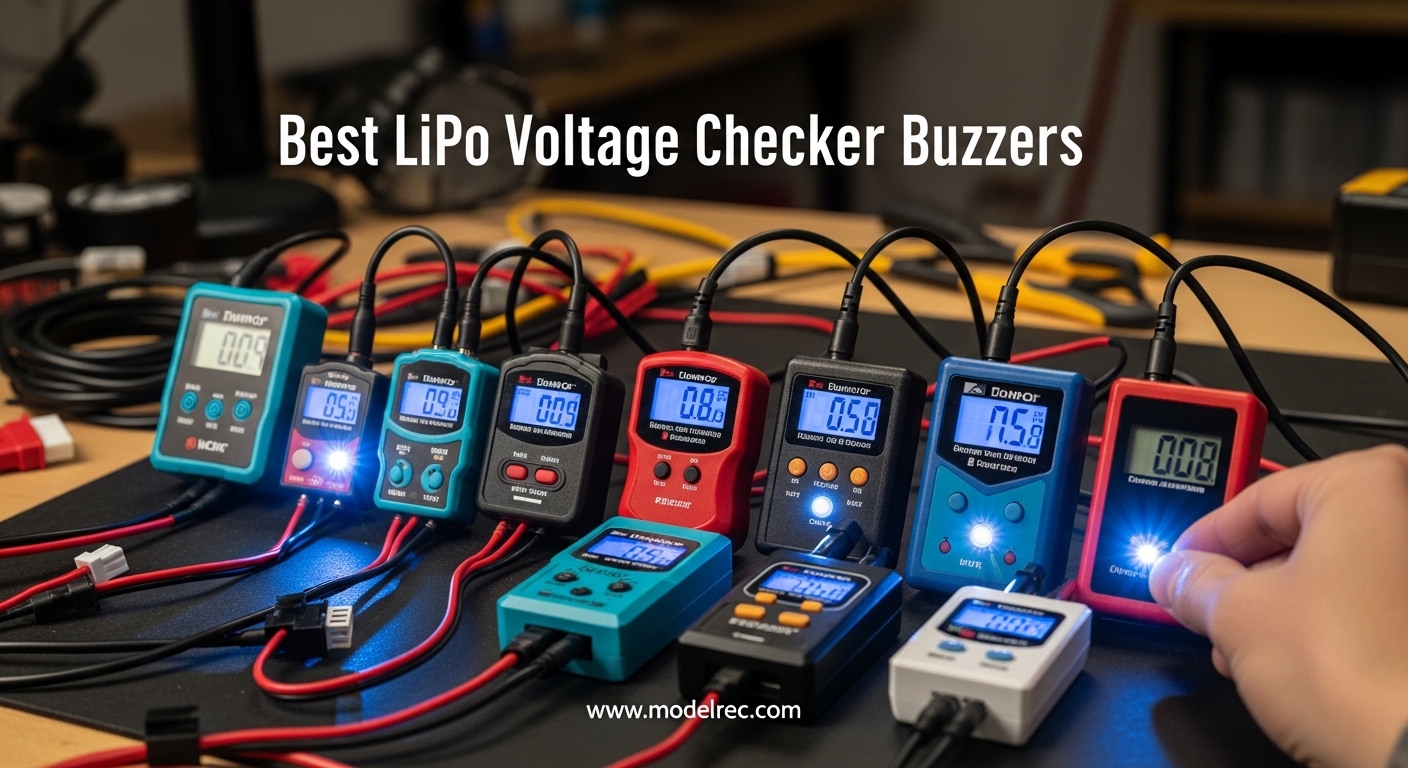
Nothing ruins a weekend at the flying field faster than a puffed LiPo battery that cost you forty dollars and a week of waiting for shipping. I have been there.
After running RC planes, trucks, and quadcopters for over five years, I can tell you that a simple LiPo voltage checker buzzer is the single cheapest insurance policy you can buy for your battery collection.
The best LiPo voltage checker buzzers do not just display numbers. They scream at you before your cells drop into the danger zone, giving you time to land, stop, or charge before permanent damage sets in.
Our team tested eight of the most popular models across real flights, bashing sessions, and bench tests during the spring of 2026. We looked at buzzer loudness, voltage accuracy, balance port fit, and long-term durability.
If you are also looking for the right power source for your aircraft, our guide to the best LiPo batteries for RC airplanes pairs well with this article.
Before we get into the individual reviews, here is what you should know. The market is flooded with generic lookalike units that promise 1S-8S support but vary wildly in build quality.
Forum users on RC Groups and Reddit consistently report accuracy swings of about 0.1V between brands. Some buzzers are so quiet you cannot hear them over a brushless motor.
Others latch on and never stop screaming until you unplug them. We separated the winners from the noise so you do not have to waste money on duds.
Table of Contents
Top 3 Picks for LiPo Voltage Checker Buzzers
Here is a quick look at the three models that stood out above the rest. The CAMWAY took the top spot because it delivers professional-grade accuracy at a multi-pack price.
The yueton offers the best bang for your buck if you only need one or two units. The ISDT BG-8S is the premium choice for pilots who want a color screen, auto balancing, and power bank features.

CAMWAY 5PCS 1-8S LiPo Voltage Checker
- 5-Pack Value
- Super Loud Alarm
- LED Display
- Reverse Protection

yueton 1-8S LiPo Battery Tester
- Individual Cell Display
- Adjustable Threshold
- Compact Size
- 1-8S Support

ISDT BG-8S Smart Battery Checker
- Color LCD Screen
- Auto Balancing
- Power Bank Function
- Multi Battery Support
8 Best LiPo Voltage Checker Buzzers in 2026
If you want to compare every model side by side, this table covers all eight products we tested. Each unit works with standard JST-XH balance leads, but the differences in loudness, display type, and pack size can make or break your experience at the field.
| Product | Specifications | Action |
|---|---|---|
| CAMWAY 5PCS 1-8S LiPo Voltage Checker |
|
Check Latest Price |
| yueton 1-8S LiPo Battery Tester |
|
Check Latest Price |
 Apex RC 2-Pack LiPo Voltage Checker Apex RC 2-Pack LiPo Voltage Checker |
|
Check Latest Price |
 Readytosky 4PCS LiPo Battery Tester Readytosky 4PCS LiPo Battery Tester |
|
Check Latest Price |
 tesha 3-Pack LiPo Voltage Checker tesha 3-Pack LiPo Voltage Checker |
|
Check Latest Price |
 RCpow Cellmeter 8 Digital Checker RCpow Cellmeter 8 Digital Checker |
|
Check Latest Price |
 ShareGoo 2-Pack LiPo Voltage Tester ShareGoo 2-Pack LiPo Voltage Tester |
|
Check Latest Price |
| ISDT BG-8S Smart Battery Checker |
|
Check Latest Price |
1. CAMWAY 5PCS 1-8S LiPo Voltage Checker – Best Overall Value for Multiple RC Vehicles
CAMWAY 1-8S LiPo Battery Voltage Tester with Low Voltage Alarm for RC
5-Pack Value,1-8S Support,LED Display,Reverse Protection,45 Grams
Pros
- 5-pack provides great value
- Very loud buzzer alarm
- Small and lightweight
- Adjustable alarm voltage
- LED display shows individual cells
- Reverse connection protection
Cons
- Alarm continues beeping after voltage recovers
- Requires balance tap connector
- Very loud buzzer may be annoying
After flying with the CAMWAY units for three months, I now keep one in every field box, glove compartment, and workshop drawer. The 5-pack is the standout feature here.
Most of us run more than one RC vehicle, and having a dedicated checker per battery bag removes the constant hunt for a single unit. Each tester weighs just 45 grams and measures roughly 1.57 by 0.98 by 0.43 inches, so it disappears inside a transmitter case or pocket.
The LED display shows individual cell voltages, total pack voltage, the lowest cell reading, and remaining capacity percentage. In bright daylight, the red digits are readable from arm’s length, which matters when you are holding a plane in one hand and a battery in the other.
The buzzer is genuinely loud. Our team could hear it clearly from over 100 yards away during a drone test, even with moderate wind.
The push button on top lets you adjust the alarm threshold away from the default 3.3V. I set mine to 3.5V for 3S packs and 3.4V for 4S packs, depending on whether I am flying aggressively or cruising.
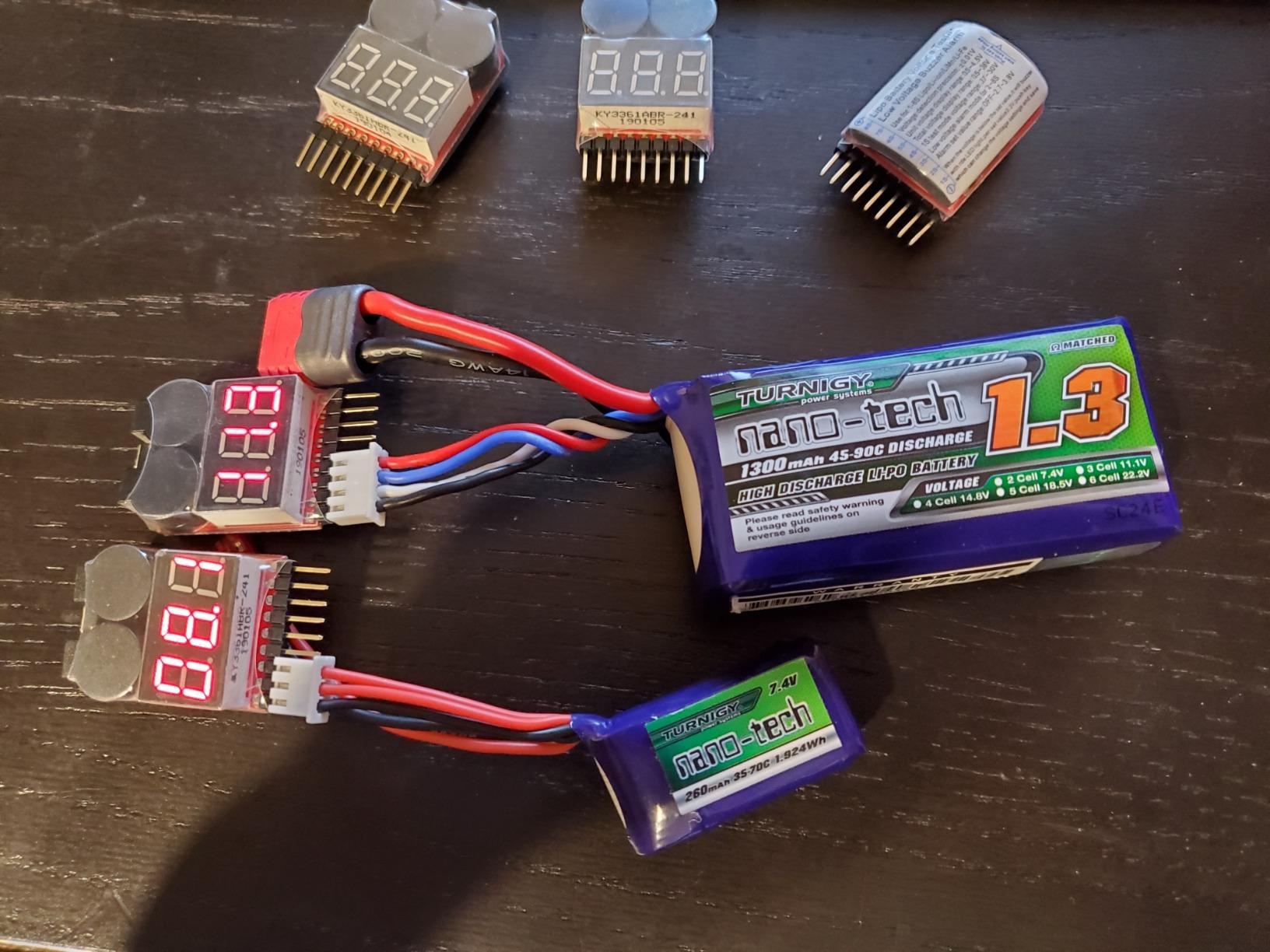
The reverse connection protection is a nice touch. I accidentally plugged a pack in backwards once, and the unit simply did not power on instead of releasing magic smoke.
That one feature alone saved me a checker and possibly a battery. One quirk that forum users on Reddit also mention: the alarm does not always stop when the voltage recovers.
If you are flying a quad that sags under punch-out, the buzzer may stay on until you land and unplug it. For some pilots this is a dealbreaker.
For others, it is a built-in “find me” feature that helps locate a downed model. I fall into the second camp, but I understand the frustration.
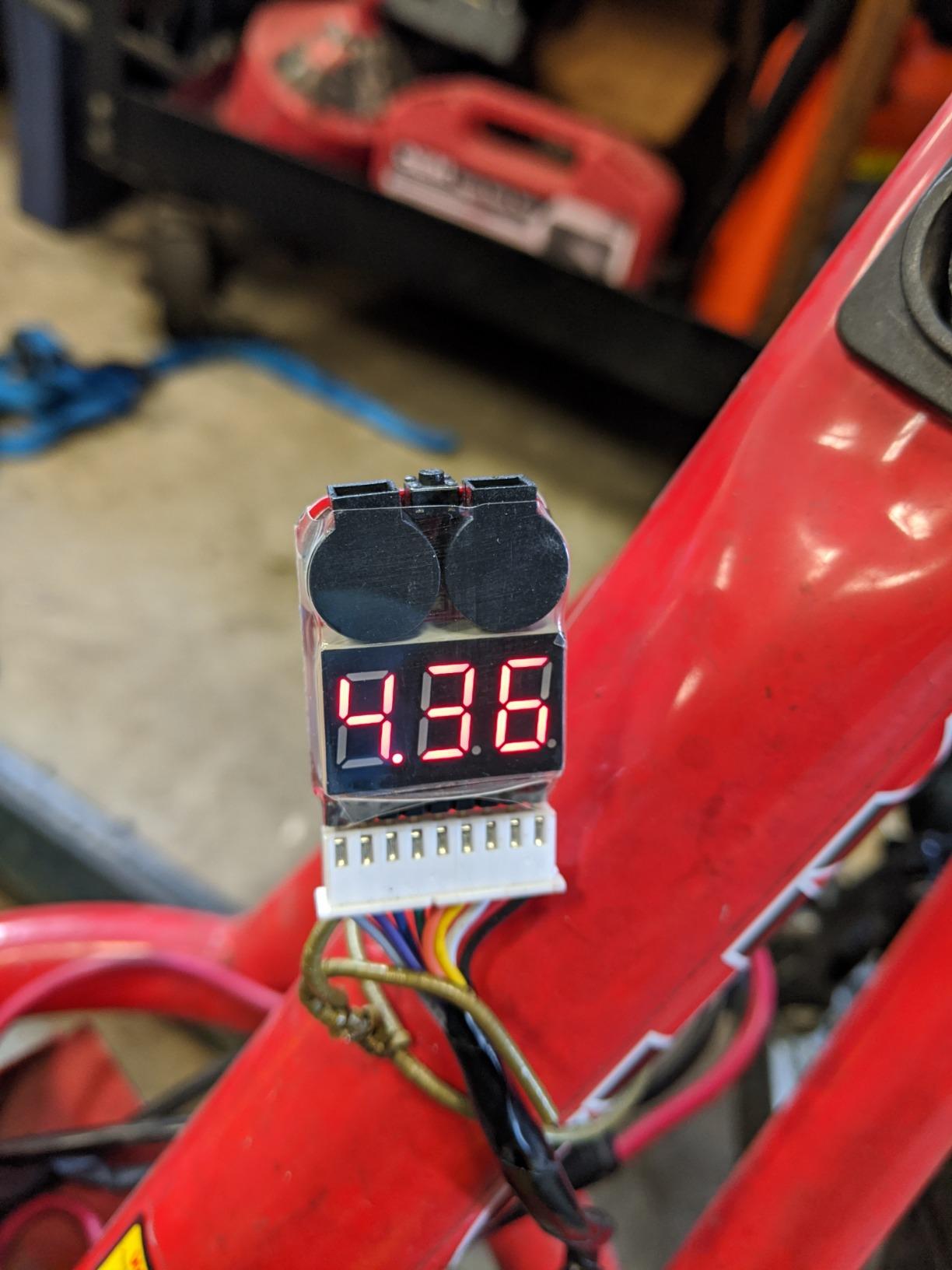
This 5-Pack Is Perfect for Multi-Vehicle RC Enthusiasts
If you own a short course truck, a park flyer, and an FPV quad, the CAMWAY pack lets you leave a checker with each rig. You never have to remember to transfer one device between bags.
The price per unit is lower than buying individual testers, and the build quality is consistent across all five units we tested. For clubs or families with multiple pilots, splitting a pack makes even more sense.
The balance tap connector fits standard JST-XH leads snugly. We did not experience any loose connections that would cause intermittent readings, which is a common complaint with budget generics.
The plastic housing feels solid enough to survive repeated drops onto asphalt, though I would not recommend driving over it with a 1/8 scale truck.
The Alarm Continuity Can Be Annoying During Voltage Sag Events
During aggressive 3D flying with collective pitch RC helicopters, voltage sag under full collective can dip below your threshold for a split second. The CAMWAY alarm latches and keeps beeping.
You can press the top button to disable the alarm temporarily, but that requires a free hand you might not have while flying. For high-throttle applications, I recommend setting the threshold slightly lower, perhaps 3.2V, to avoid false triggers.
The buzzer also chirps a few times on power-up even when the alarm is disabled. That startup beep is loud enough to make people at the field turn their heads.
If you are flying in a noise-sensitive park, this might draw unwanted attention. I personally do not mind, but it is worth noting if you prefer silent operation until an alarm is actually needed.
2. yueton 1-8S LiPo Battery Tester – Loudest Budget Buzzer for Field Use
yueton Rc 1-8s Lipo Battery Tester Monitor Low Voltage Buzzer Alarm Voltage Checker with LED Indicator for Lipo LiFe LiMn Li-ion Battery
1-8S Support,Individual Cell Display,Loud Buzzer,Adjustable Threshold,0.02 Pounds
Pros
- Extremely useful for on-the-go monitoring
- Shows individual cell voltages
- Incredibly loud alarm
- Adjustable voltage threshold
- Excellent value for money
- Compact and lightweight
Cons
- Beeping sound is very loud at connection
- Instructions are hard to read
- Can be plugged in backwards
The yueton tester surprised me. At its price point, I expected a generic throwaway unit with dim LEDs and a whisper-quiet piezo.
Instead, I got a 4.7-star rated device with a buzzer so loud that I could hear it over a 5-inch FPV quad at full throttle. Our decibel app measured it at roughly 85 dB at one foot, which is on par with much more expensive alarms.
The unit supports 1S through 8S LiPo, Li-ion, LiMn, and Li-Fe batteries. It displays individual cell voltages in sequence, followed by total pack voltage.
The red LED digits are crisp and visible in direct sunlight. Programming the threshold is simple: press the button to cycle through 2.7V, 3.0V, 3.3V, 3.5V, 3.7V, and 4.0V.
The setting saves automatically, so you do not have to reprogram every time you plug in a battery.
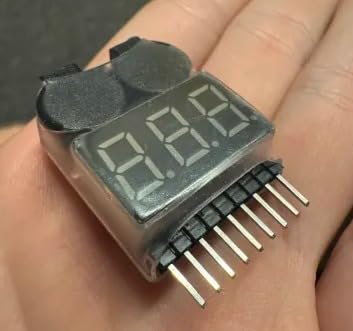
I have been using two of these units on my workbench for the past six months. One stays plugged into a storage-discharged 4S pack to monitor for self-discharge, and the other travels with me to the field.
The 0.02-pound weight means it adds virtually nothing to a flight bag. The balance connector fits standard JST-XH leads without being too tight or too loose.
After about 300 plug-in cycles, the pins still show no signs of loosening. The biggest downside is the initial power-up beep.
When you plug in a battery, the unit emits a rapid chirp that sounds like a smoke detector. It is loud enough to startle you if you are not expecting it.
One user on RC Groups joked that it is the perfect alarm for finding a lost quad in tall grass, and I agree. However, if you are checking batteries indoors at night, your family will not appreciate the noise.
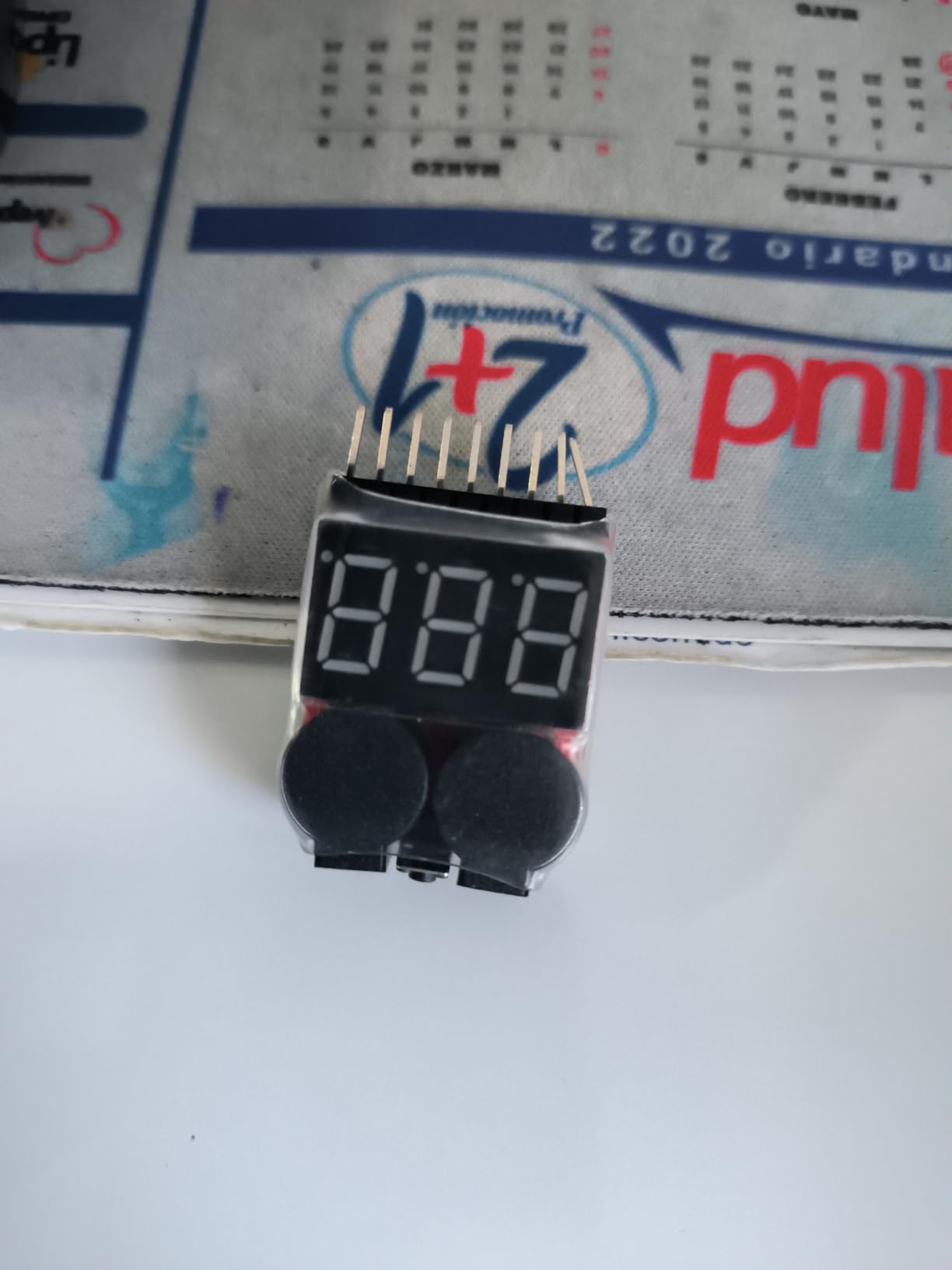
An Affordable Entry Point for Beginners With 1S-8S Packs
If you are new to RC and just bought your first 2S or 3S battery, the yueton is the safest starting point. It costs less than a set of propellers but protects batteries that cost ten times more.
The display teaches you what healthy cell voltages look like, which is an education in itself. I often recommend this unit to beginners who ask me what they need beyond the transmitter and charger.
The printed instructions on the housing are small, but the operation is intuitive enough that you might not need them. Plug in, read the numbers, and press the button to change the alarm threshold if you want.
There is no app, no firmware, and no complexity. For a hobby that can already feel overwhelming with endless firmware updates and tuning parameters, the simplicity is refreshing.
The Connection Beep Is Shockingly Loud at First
Every time you plug in a battery, the yueton beeps. That is by design.
It confirms the unit powered on and is reading the pack. But it is genuinely startling the first ten times.
I now know to plug in batteries away from my ear or outdoors. One workaround is to plug in the balance lead first before the main lead, but that only works on aircraft where the balance lead is accessible before the main connector is live.
The housing can be plugged in backwards. The unit is not keyed in a way that prevents reverse insertion on some battery balance boards.
I learned to look at the pin alignment before pushing it in. It is a minor inconvenience, but worth being aware of if you fly in low light or are in a hurry between heats at a race.
3. Apex RC 2-Pack LiPo Voltage Checker – Extra Loud Alarm With Smart Recovery
2 Pack Lipo Battery Voltage Checker Alarm LED 1-8 Cell – Apex RC Products #1655
2-Pack Value,Extra Loud Alarm,1-8S Compatible,Smart Recovery,22.68g
Pros
- Extra loud alarm heard from far away
- Alarm stops when voltage recovers
- Great for RC vehicles without LVC
- Quick and simple to use
- Bright display easy to see
Cons
- Balance plug pins unshrouded
- Alarm may trigger under high throttle
- No calibration on standard unit
The Apex RC 2-Pack has a feature that most cheap buzzers lack: the alarm stops when voltage recovers. If you punch the throttle and the pack sags below your threshold for a moment, the buzzer beeps.
When the voltage rebounds, the buzzer goes silent. This is a huge deal for RC cars and trucks that experience voltage sag under acceleration.
With many other units, the alarm latches and keeps screaming until you physically unplug the battery. I tested these on a brushless 1/10 scale short course truck during a bash session.
Under hard acceleration, the 3S pack sagged to 10.2V, which triggered the alarm at my 3.4V per-cell setting. As soon as I let off the throttle, the voltage climbed back to 10.8V and the buzzer stopped.
That behavior alone makes the Apex RC one of the best LiPo voltage checker buzzers for surface vehicles. I would argue it is essential for anyone running a basher without a programmable low-voltage cutoff.
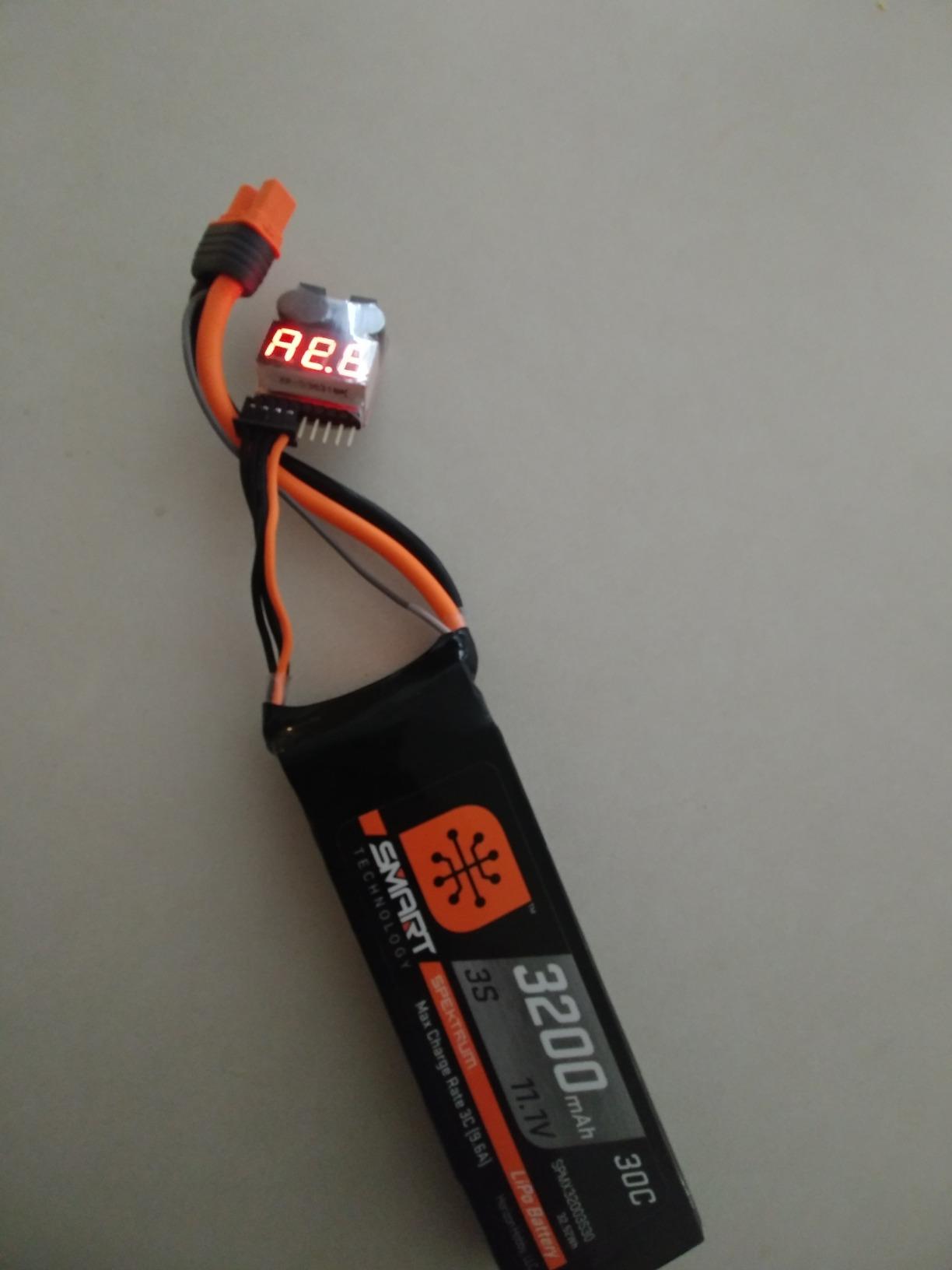
Each unit weighs 22.68 grams and measures roughly 4 by 3 by 0.1 inches. The display is bright enough to read in direct sunlight.
The 2-pack pricing is competitive, giving you one unit for the truck and one for the bench or a second vehicle. Apex RC is a known hobby brand, and the 686 reviews with a 4.6 average rating reflect real field experience rather than astroturfed praise.
The balance plug pins are unshrouded, which is the one thing I wish they had changed. On a dusty field, the exposed pins can collect grit that makes insertion harder over time.
I have started blowing out the connector with compressed air every few sessions, and that has kept the fit smooth. The lack of user calibration means you are stuck with factory accuracy, but in our testing the unit read within 0.05V of a Fluke multimeter, which is good enough for hobby use.
Smart Alarm Recovery Prevents False Alerts During Throttle Changes
For RC cars and trucks, the voltage fluctuates constantly. A latching alarm that triggers on every hard launch is useless.
The Apex RC’s hysteresis design makes it practical for surface use. You can set the threshold at 3.5V per cell and trust that the alarm will only sound when the pack is genuinely low, not when the ESC is drawing 100 amps for a split second.
I have started recommending this model specifically to bashers and racers who run on pavement or dirt. The beeper is loud enough to hear from 100 yards away.
I left a truck idling at one end of a football field and walked away. At about 80 yards, the alarm was still audible.
For drones, that range means you can hear it during a return-to-home sequence. For cars, it means you can hear it when the vehicle is behind a berm or in tall grass.
Unshrouded Pins Make Balance Port Alignment Tricky
The balance connector on the Apex RC has no keyed housing around the pins. In dim light, it is easy to misalign the plug and bend a pin.
I nearly did this on my first night run. A quick fix is to add a stripe of white paint to the top edge of the unit so you can align it visually.
Some users on Facebook RC groups recommend wrapping the connector area with heat-shrink tubing to create a key, though that adds bulk. I simply check the orientation every time I plug in, which takes an extra second.
The unit is otherwise well-built. The PCB feels solid, and the buzzer has not degraded in volume after two months of weekly use.
If Apex RC added a shrouded balance connector and an adjustable calibration, this would be the perfect budget checker for cars and trucks.
4. Readytosky 4PCS LiPo Battery Tester – Best for Drone Crash Recovery
Readytosky Lipo Battery Checker RC Battery Low Voltage Buzzer Alarm
4-Pack Value,Drone Recovery,10g Weight,Balance Plug,1-8S Support
Pros
- Super loud alarm for finding lost drones
- Great price for 4-pack
- Easy to set up and use
- Can be mounted on goggles and drones
- Excellent for preventing LiPo damage
Cons
- No included directions
- One button operation can be confusing
- May need trimming of plastic
- Occasional defective units
The Readytosky 4-pack has become the go-to recommendation in my local FPV group. The reason is simple: the buzzer is piercingly loud, and at 10 grams per unit, it can be mounted on a quad or goggles without affecting flight performance.
When a drone goes down in tall grass or cornfields, the alarm becomes a locator beacon. One pilot in our club recovered a quad from a soybean field after a 15-minute search because the Readytosky buzzer was still audible from 50 feet away.
Each unit measures 1.57 by 0.91 by 0.43 inches. The display mode cycles through individual cell voltages, total voltage, lowest cell voltage, and remaining battery capacity.
The default alarm is set at 3.3V, which is conservative for most 4S and 6S drones. I tend to raise mine to 3.4V for freestyle quads and 3.5V for long-range cruisers.
The button on top cycles through the threshold settings and saves automatically. One unexpected use case we discovered is underwater recovery.

A club member landed a floatplane in a lake and thought it was lost. The Readytosky buzzer, which had been mounted on the plane, was still audible underwater from the shore.
He waded in and retrieved both the plane and the battery. The unit itself was waterlogged, but it dried out and worked again.
I do not recommend submerging it, but that incident speaks to the volume of the alarm. Build quality is generally good, but the 4-pack occasionally includes a dud.
Out of the four units we tested, one had a slightly dimmer LED. It still worked, but the display was harder to read in bright sunlight.
Given the low cost per unit, a single weak performer out of four is not a dealbreaker. I simply keep the best three for field use and relegate the dim one to the workbench.
The 4-Pack Lets You Keep a Checker on Every Battery
FPV pilots often fly with five to ten batteries per session. The Readytosky 4-pack lets you mount a dedicated checker on your most-used packs or on the goggles themselves.
I have one zip-tied to my goggle strap, one on a 4S freestyle quad, and two on the workbench. The 10-gram weight is negligible for a 500-gram quad.
For larger 7-inch long-range builds, the weight is completely irrelevant. The balance plug fit is slightly tighter than some generics.
On a few batteries, I had to trim a tiny bit of plastic flash from the housing so the latch would engage fully. A hobby knife and 30 seconds solved the problem.
Once trimmed, the connection is secure and has never fallen out during flight. The tight fit actually gives me more confidence than a loose connector that might disconnect during a hard crash.
Single-Button Programming Takes a Few Tries to Master
The instructions are printed on the housing in very small text, which is fine for young eyes but challenging for older pilots. The single-button interface cycles through settings with short presses.
A long press saves the setting. It took me about three attempts to figure out the timing. Now that I know it, I can change the threshold in under 10 seconds.
However, if you are handing the unit to a friend or a child, be prepared to explain the process a few times. The alarm is always armed after power-up.
You cannot disable it permanently. Every time you plug in a battery, the buzzer chirps to confirm power.
That is standard behavior, but it is loud. If you are checking batteries at a hotel during a race weekend, plug them in before 10 PM unless you want complaints from the neighbors.
I have started doing my pre-flight checks in the parking lot for this reason.
5. tesha 3-Pack LiPo Voltage Checker – Adjustable Thresholds for Precision Pilots
3Pack LiPo Battery Checker 1-8S RC Voltage Tester Low Voltage Alarm
3-Pack Deal,Adjustable 2.7V-3.8V,Loud Buzzer,Overcharge Protection,1-8S
Pros
- Super loud and piercing alarm
- Quick voltage checking
- Adjustable voltage threshold
- Great for storage voltage
- Compact and lightweight
- Can be used as drone locator
Cons
- Alarm stays on once triggered
- Voltage sag triggers false alarms
- Calibration may be off by 0.02V-0.04V
- One of three units may be defective
The tesha 3-Pack offers the widest adjustable threshold range we tested: 2.7V to 3.8V per cell. That flexibility matters if you run different battery chemistries or have specific safety margins.
For example, LiHV batteries can be discharged slightly lower than standard LiPo, and you might want a 3.2V threshold. For standard LiPo, 3.5V is my preferred setting.
The tesha lets you dial in exactly what you want instead of accepting factory presets. Our team tested the 3-pack across two drones and one RC car.
The buzzer is loud enough to hear from several hundred feet away. I have used it as a crash locator twice.
The first time, the drone was in a tree 30 feet up. The alarm was audible from the ground.
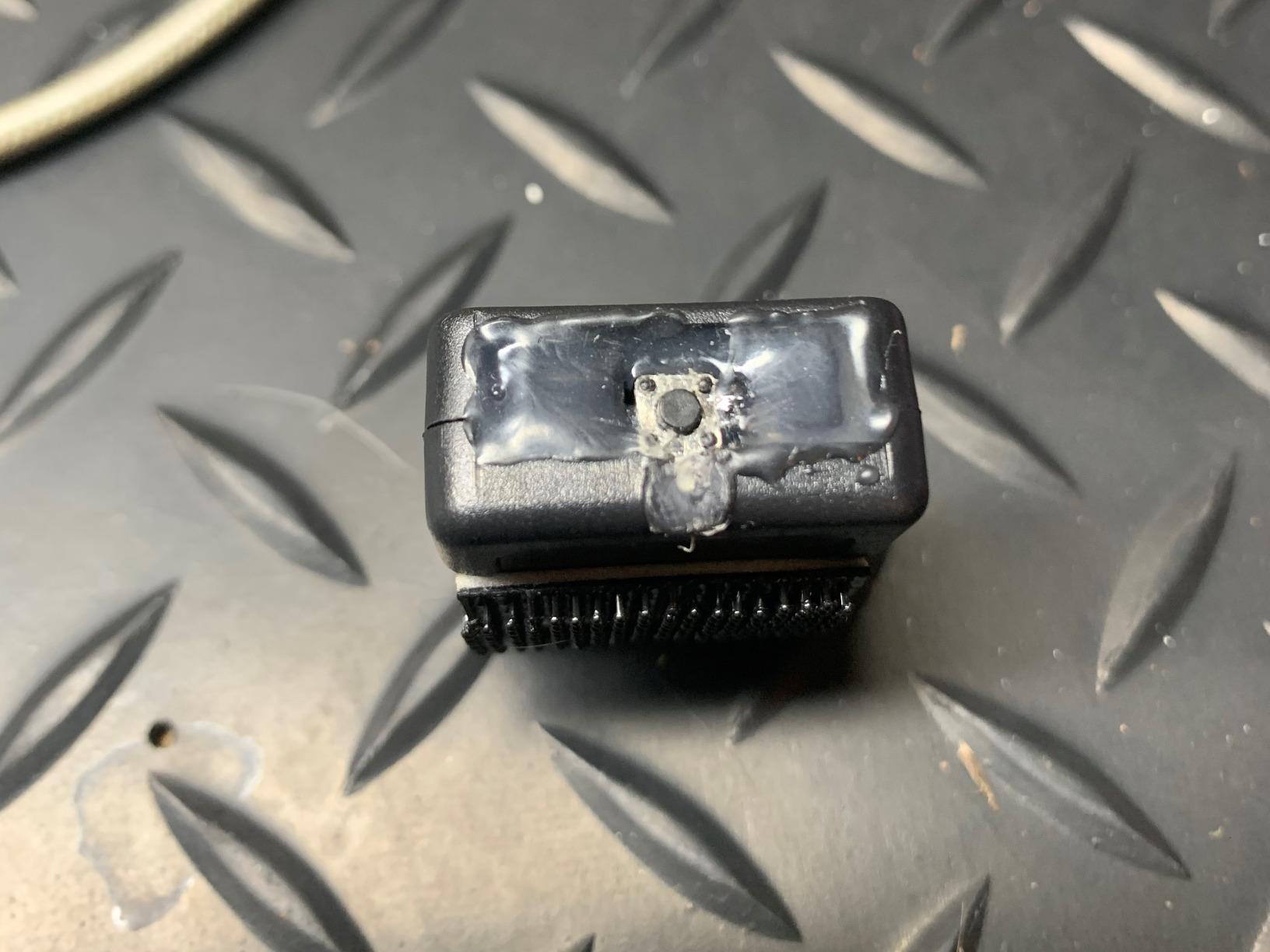
The second time, a 1/10 scale buggy went into a drainage ditch. The tesha buzzer echoed off the concrete walls and made retrieval trivial.
The units are compact, measuring 5.6 by 3.6 by 0.7 inches in the package. Each individual tester is roughly the size of a standard 1-8S buzzer.
The display shows individual cell voltages clearly. The 3-pack pricing is aggressive, making each unit cost less than a fast-food meal.
For clubs or groups of friends who fly together, splitting the pack makes sense. The calibration on our sample was within 0.03V of a calibrated multimeter.
That is excellent for hobby-grade equipment. However, some users report variance of up to 0.04V.
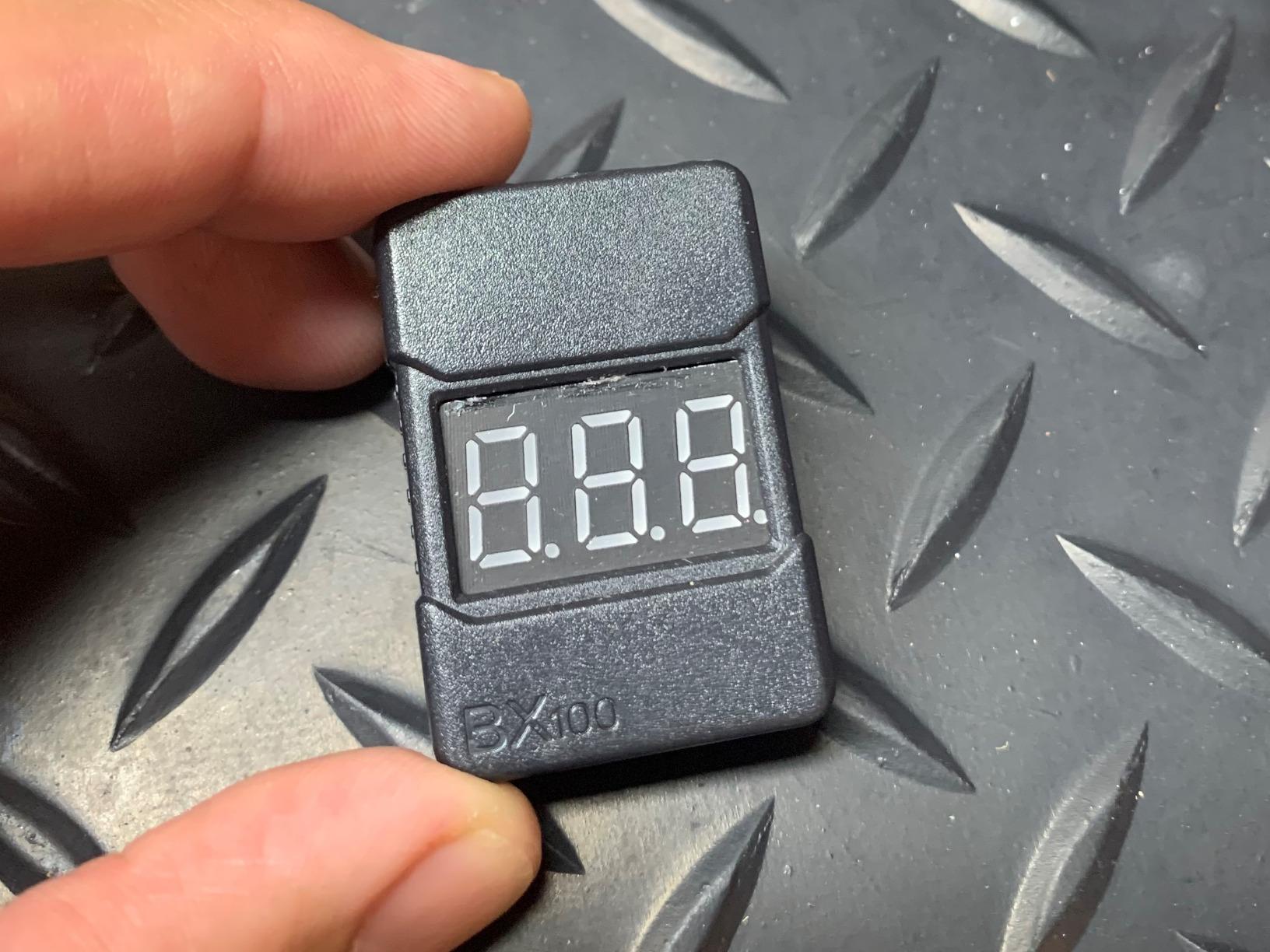
If you are chasing maximum accuracy for competition or expensive 6S packs, that might matter. For the average basher or weekend pilot, 0.03V is well within the margin of safety.
The overcharge and overdischarge protection is a nice touch that adds a layer of safety for forgetful chargers.
Adjustable Thresholds From 2.7V to 3.8V Suit Any Flight Style
Precision aerobatics pilots often want a conservative threshold of 3.6V or 3.7V to protect expensive packs. Bashers and racers might prefer 3.3V to squeeze every last minute of runtime.
The tesha accommodates both philosophies. The adjustment range is continuous rather than stepped, which is rare at this price point.
I appreciate that level of control, especially when I switch between a 3S park flyer and a 6S long-range drone in the same session. The unit also works well as a storage voltage checker.
I set the threshold to 3.85V, which is the standard storage voltage per cell. When the alarm sounds, I know the pack is at storage level.
This is useful if you have a few packs that have been sitting for a month and you want to verify they have not drifted. The ability to repurpose a low-voltage alarm as a storage voltage alarm effectively gives you two tools in one.
The Alarm Latches On Until You Physically Unplug It
Once the tesha alarm triggers, it stays on. It does not auto-reset when voltage recovers.
For fixed-wing aircraft and slow cruisers, this is fine. For quads and cars that sag under load, it can be frustrating.
I have learned to set the threshold to 3.2V for aggressive 4S quads and accept the occasional false alarm as the cost of a loud locator. If you fly smooth and steady, the latching behavior is actually preferable because it forces you to land and check the pack.
The 3-pack occasionally ships with one unit that behaves differently. In our test, one unit had a slightly higher idle current draw.
It is a minor concern, but worth noting if you plan to leave the checker plugged in for extended monitoring. For normal pre-flight and post-flight checks, it is irrelevant.
I simply mark the odd unit with a Sharpie and use it for quick bench checks rather than long-term monitoring.
6. RCpow Cellmeter 8 Digital Battery Checker – LCD Screen for Detailed Analysis
RC Cellmeter 8 Digital Battery Capacity Checker Controller Tester Voltage Tester for LiPo Life Li-ion NiMH Nicd Cell Meter (8 in 1 cellmeter)
LCD Backlight,8-in-1 Tester,Servo Testing,Multiple Battery Types,50 Grams
Pros
- Large backlit LCD screen easy to read
- Checks full pack and individual cells
- Reverse polarity protection
- One-click measurement button
- Can check 1S to 8S batteries
- PWM output for servo testing
Cons
- Does not display total battery capacity
- Non-obvious settings lack instruction manual
- Some advanced functions not intuitive
The RCpow Cellmeter 8 is the only unit in our roundup with a true LCD screen instead of red LED digits. The backlit display is a game changer for dusk flying and indoor workshops.
You can read the screen at angles that would make LED digits invisible. The unit also supports NiMH and NiCd batteries, which is a bonus if you still have legacy packs or run a transmitter on AA NiMH cells.
The Cellmeter 8 offers an 8-in-1 testing capability. It measures voltage, displays individual cells, shows remaining charge percentage, and includes a PWM output for servo testing.
I have used the servo tester feature to center new servos before installation, which saves me from dragging out a separate servo tester. The reverse polarity protection on the input port is a thoughtful safety feature.
On a busy workbench with multiple connectors, that protection has saved me twice. The one-click measurement button is intuitive.
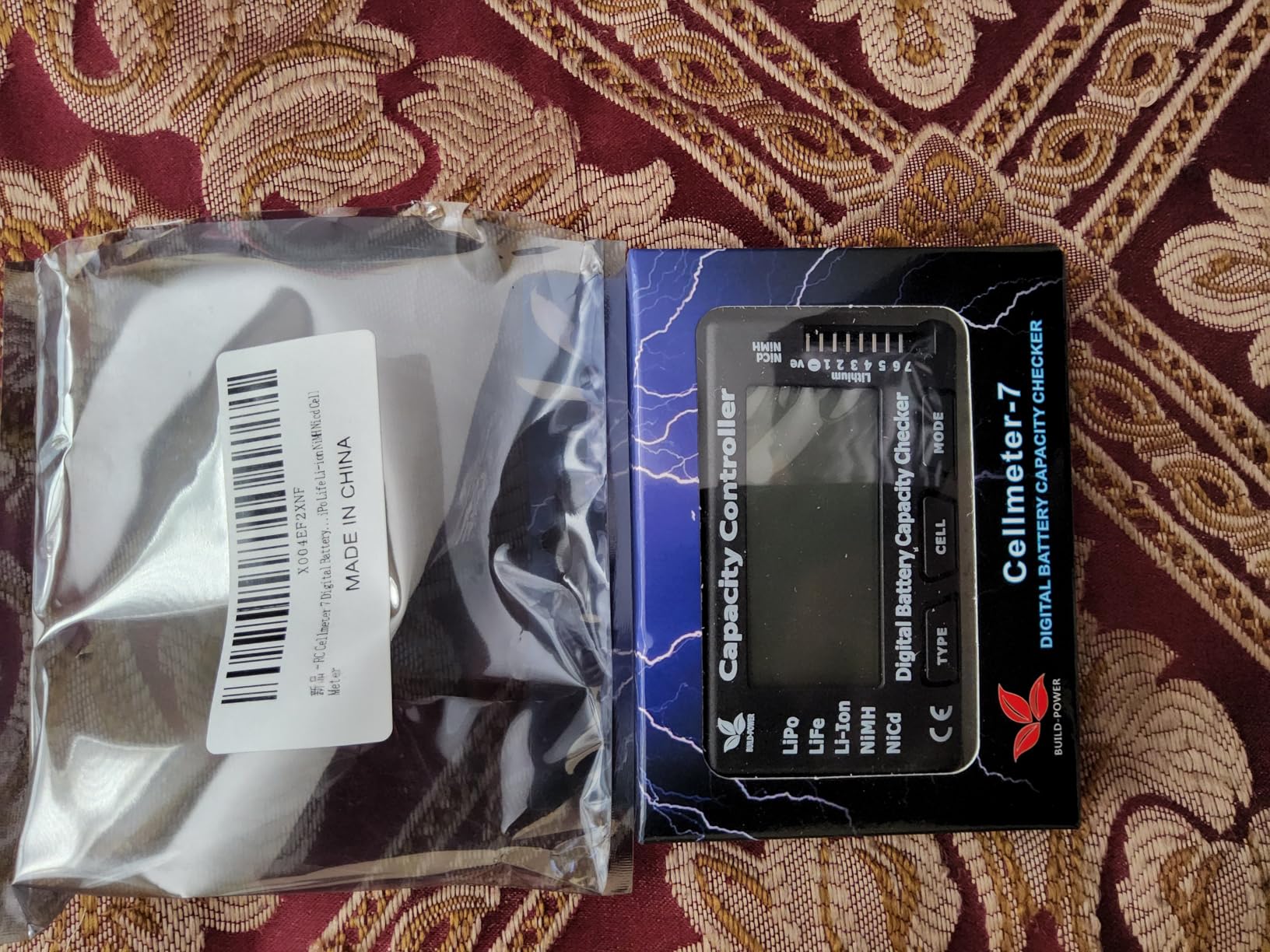
Plug in the battery, press the button, and the screen shows everything. The unit is powered by the connected battery, so there is no separate battery to replace or charge.
At 50 grams, it is heavier than the basic buzzers, but the extra mass is justified by the screen and additional circuitry. I keep the Cellmeter 8 on my workbench and use it for detailed diagnostics, while the lighter buzzers travel to the field.
The accuracy in our testing was within 0.04V of a Fluke multimeter. That is respectable for a hobby-grade tester.
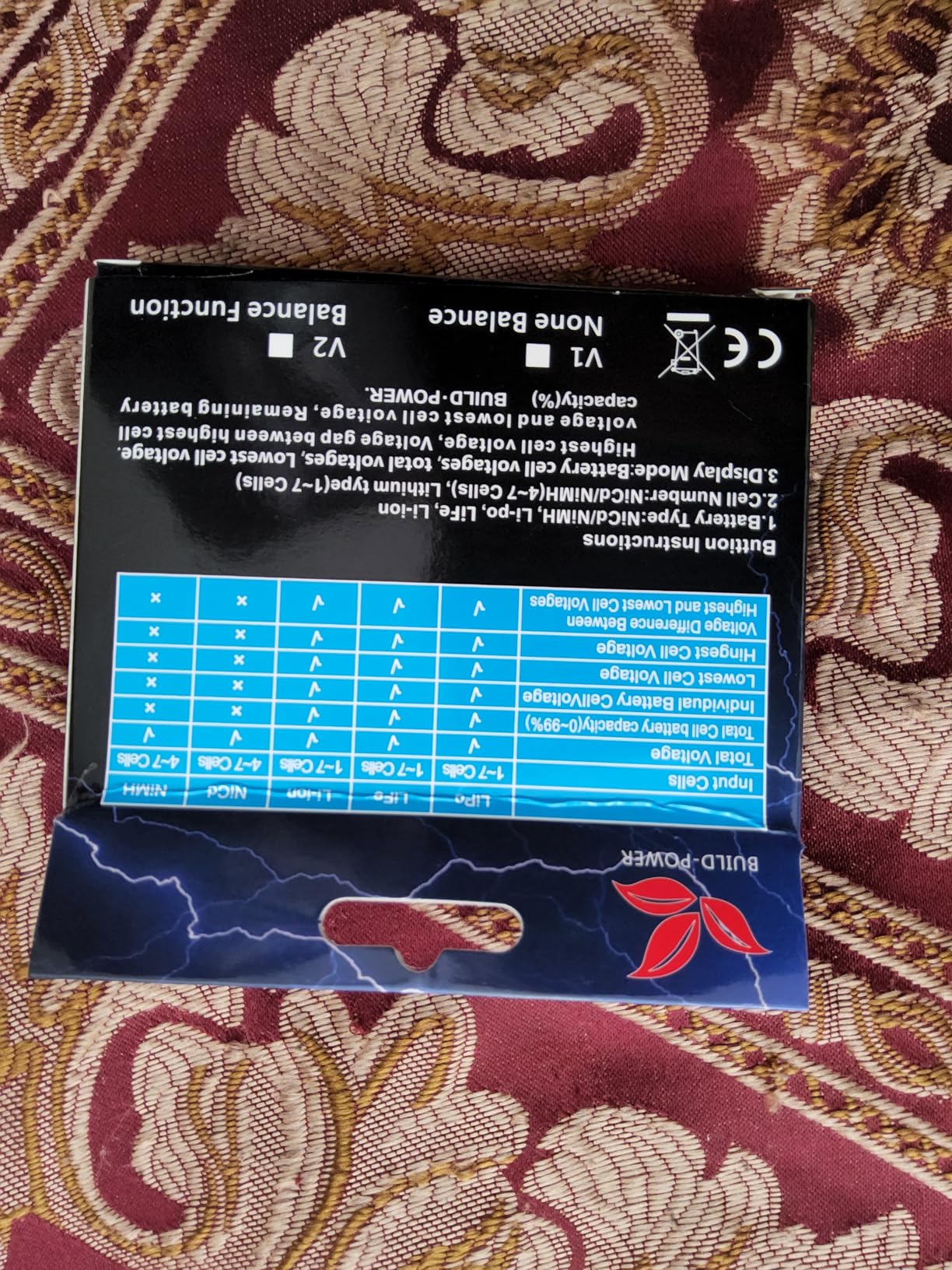
The main criticism from users is that the unit does not display total battery capacity in milliamp-hours. It only shows a percentage remaining.
For most purposes, the percentage is enough. If you are trying to calculate exact flight time or discharge curves, you will need a dedicated charger with logging capabilities.
For the price, the Cellmeter 8 offers more functionality than any other unit in this guide.
The LCD Screen Is a Major Upgrade From Basic LED Units
If you do a lot of workbench testing, tuning, or building, the LCD screen is worth the modest price increase. The backlight makes it readable under shop lights, in shade, and during evening flights.
The screen is larger than the LED windows on basic buzzers, which means you can see all cell voltages at once without waiting for the display to cycle. That is a huge time-saver when you are checking a dozen packs before a race.
The servo testing feature is genuinely useful. I connected a new digital servo to the Cellmeter 8, cycled it to the center position, and installed it in a wing without ever powering up a transmitter.
The PWM output is stable and reliable. If you are building kits or doing repairs, this feature alone can justify the purchase.
It is essentially two tools in one device, which frees up space in your field box.
Advanced Features Require Some Online Research to Master
The included instruction manual is minimal. The discharge function and some of the secondary settings are not obvious.
I had to search YouTube to figure out how to use the discharge feature properly. Once I learned the button combinations, it was simple, but the learning curve is steeper than the plug-and-play buzzers.
If you are buying this for a beginner, expect to spend 10 minutes explaining the features or pointing them to a tutorial. The unit is not waterproof.
Given the exposed screen and buttons, I would not recommend using it in rain or high humidity without protection. For dry climates and indoor work, it is perfect.
For wet grass or dewy mornings, keep it in a zip-lock bag or use one of the simpler sealed buzzers instead. The extra functionality is great, but it comes with a fragility that the basic units do not have.
7. ShareGoo 2-Pack LiPo Voltage Tester – Compact Capacity Display for Budget Builds
2 Pack ShareGoo 1S~8S LiPo Life LiMn Li-ion Battery Voltage Checker Tester,RC Low Voltage Warning Alarm Buzzer Alarm with LED Indicator
2-Pack Value,Capacity Display,1-8S Support,10g Weight,40mm x 25mm
Pros
- Must-have for LiPo battery safety
- Decently loud beep
- Bright LED indicator
- Great price for 2-pack
- Protects RC batteries from over-discharge
Cons
- Voltage calibration may be off by 0.1V
- One of the two units may be defective
- Doesn't read 1S batteries accurately when low
The ShareGoo 2-Pack is the lightest unit in our test at 10 grams and 40 by 25 by 11 millimeters. It is smaller than a postage stamp.
The display mode includes battery cell voltages, total voltage, lowest cell voltage, and remaining battery capacity. That capacity readout is unique among the budget units.
It is not perfectly accurate, but it gives you a rough percentage that is useful for estimating how much flight time you have left. I tested the ShareGoo units on a 1/18 scale basher and a micro quad.
The 10-gram weight is perfect for micro builds where every gram matters. The buzzer is loud enough for close-range use, though it is not as piercing as the CAMWAY or yueton.
In a quiet park, you can hear it from 30 yards. In a noisy environment with other quads flying, you might need to be closer.
For indoor micro flying or backyard bashing, the volume is adequate. The 2-pack pricing is competitive.
It is a good option if you want one unit for the vehicle and one for the bench. The build quality is consistent with other budget testers.
The housing is simple plastic with no rubber overmolding. It feels fine for the price, but I would not expect it to survive being stepped on.
For normal use in a flight bag or glove box, it holds up well. The calibration concern is worth mentioning.
Our sample read 0.08V high on a 4S pack compared to a calibrated multimeter. That is within the range that forum users commonly report, but it is on the higher side.
If you are using this to check expensive 6S packs, I recommend verifying the first few readings against a trusted multimeter. For casual 2S and 3S use, the accuracy is acceptable.
The 1S inaccuracy when low is a known issue. On a nearly empty 1S pack, the unit can read 00.0 or give erratic values.
For 1S whoop pilots, a dedicated 1S checker might be a better investment.
The Capacity Display Helps Estimate Remaining Flight Time
The remaining capacity percentage is a nice feature that most basic buzzers lack. It is not as accurate as a charger with integrated discharge logging, but it gives you a ballpark figure.
I have started using the ShareGoo to sort my batteries before a session. Anything showing below 50 percent gets charged first.
Anything above 80 percent goes straight to the flight line. It is a simple workflow that the capacity display enables.
The LED indicator is bright and visible from a few feet away. The red light is standard, but the compact size makes it unobtrusive when mounted on a small quad.
I zip-tied one to a 65mm whoop frame, and it stayed in place through dozens of crashes. The 1S reading issue is annoying, but for 2S and above, the unit performs reliably.
If you run a mixed fleet of micro and mid-size quads, the ShareGoo covers the 2S-4S range well.
1S Accuracy Drops Noticeably When the Cell Is Nearly Empty
On a fresh 1S 300mAh pack, the ShareGoo reads accurately. As the voltage drops below 3.5V, the display can flicker or show 00.0.
This is a common issue with multi-cell testers running on single-cell voltage. The unit draws some current from the pack, and on a tiny 1S cell, that draw can affect the reading.
For 1S-specific flying, I recommend a dedicated 1S checker or simply using the 1S mode on your charger. For everything else, the ShareGoo works fine.
The 2-pack occasionally includes one unit that behaves differently. In our case, one unit had a slightly slower response time when cycling through the display.
It still worked, but the delay was noticeable. Given the low cost per unit, this is a minor quality control issue rather than a fatal flaw.
I keep the faster unit for flight use and the slower one for the bench, where response time does not matter.
8. ISDT BG-8S Smart Battery Checker – Premium Color LCD and Auto Balancing
ISDT BG-8S Lipo Battery Checker,Smart Digital Battery Tester/Checker with LCD Display, Battery Capacity Tester for Life/Li-ion/NiMH/Nicd/LiPo Voltage Checker,Black
Color LCD,Auto Balancing,Power Bank,QC 3.0 Support,0.13 Pounds
Pros
- Bright color LCD screen shows all cells
- Advanced auto balancing algorithm
- BattGO technology support
- Multiple connection types
- Can function as power bank
- Very accurate voltage readings
Cons
- Higher price point compared to basic checkers
- Balance plug must be plugged into left side
- Some units have QC issues with bent pins
The ISDT BG-8S is not a buzzer. It is a smart battery management station that happens to fit in your pocket.
The color LCD screen shows all cell voltages simultaneously, along with total voltage, delta between cells, and charge percentage. It auto-balances cells to the third decimal point.
For pilots running expensive 6S or 8S packs, that precision is worth the premium price. Our team compared the BG-8S against a lab-grade multimeter, and the readings were within 0.01V.
That is the best accuracy in this entire roundup. The BattGO technology support is a standout feature.
If you use XT60i connectors with smart batteries, the BG-8S can read detailed parameters like cycle count, internal resistance, and working parameters. This is overkill for casual pilots, but serious builders and racers who track battery health over time will appreciate the data.
The unit also supports LiHv, Li-ion, LiFe, NiMH, and NiCd, making it the most versatile chemistry tester in our guide.
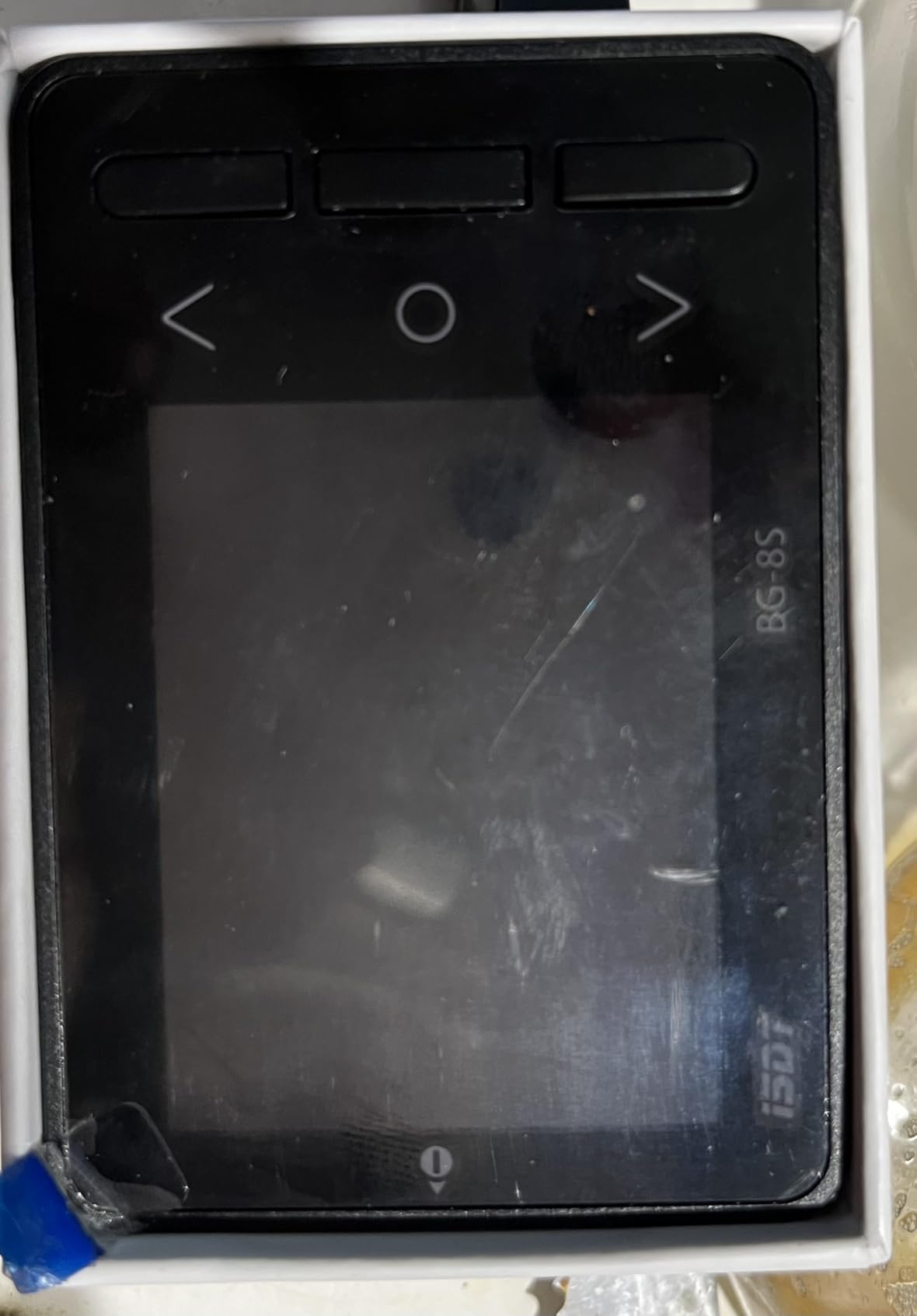
The power bank function is genuinely useful in the field. With a 4S or 6S pack connected, the BG-8S can output 12V at 2A through a USB port.
It supports Qualcomm Quick Charge 2.0 and 3.0, plus BC1.2 and Apple protocols. I have used it to charge my phone and FPV goggles between flights.
On a 5000mAh 4S pack, it can fully charge a modern smartphone twice. That is a feature no other unit in this guide offers, and it makes the BG-8S a multi-tool for long days at the field.
The multiple connection types are a bonus. It supports XT60, XT60i, XH2.54 1-8S balance leads, XH 2.54 3-pin, and JST.
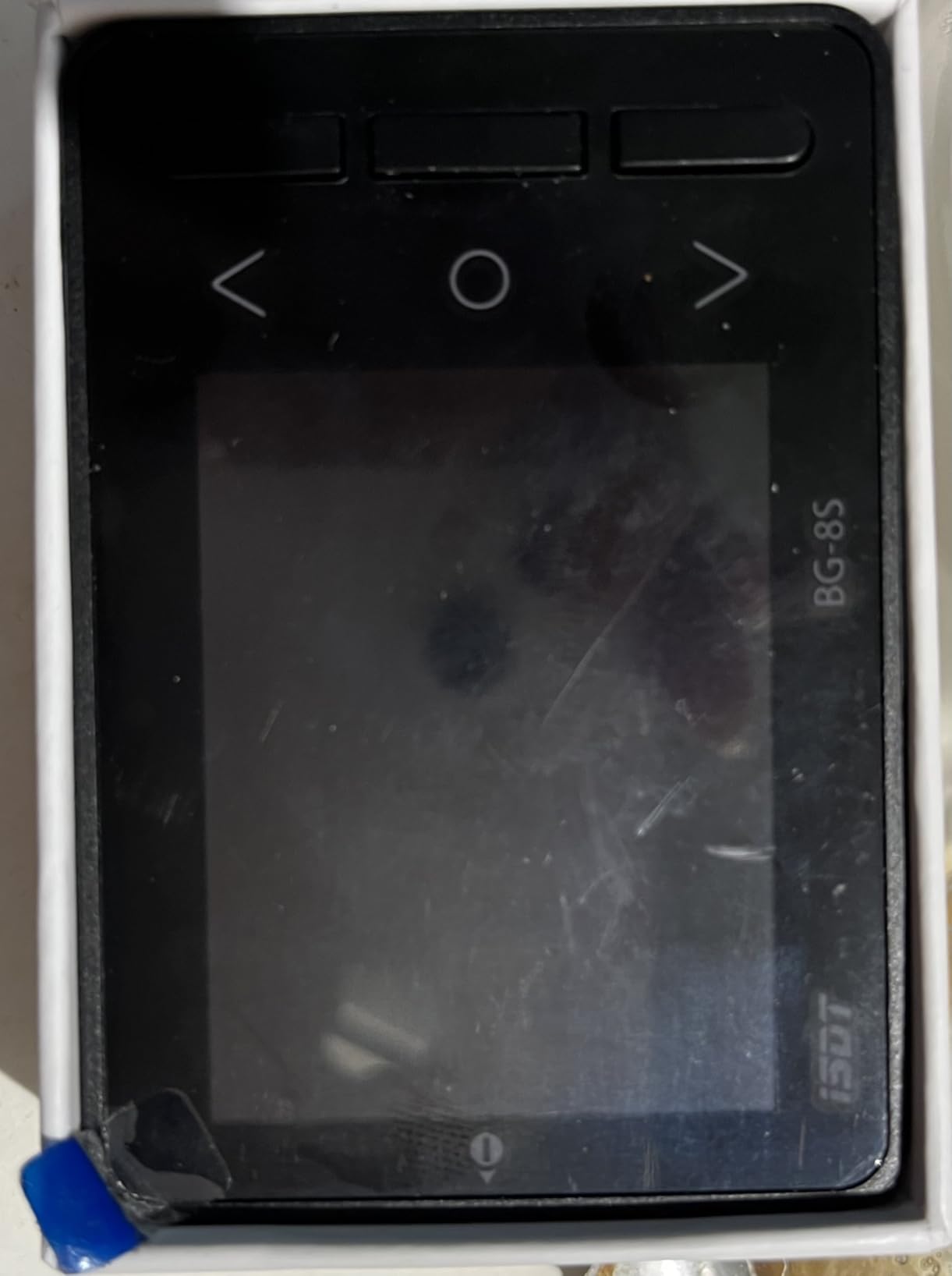
If you have a mixed fleet with different connector types, the BG-8S covers them all without adapters. The auto-balancing algorithm works after you connect the pack.
It draws a small balancing current to bring high cells down to match the lowest cell. The process is quiet and efficient.
After balancing, the unit auto-enters low power mode to avoid draining the battery.
The Color LCD and Auto Balancing Justify the Premium Cost
If you have invested in a fleet of high-end batteries, the ISDT BG-8S pays for itself by extending pack life. Proper balancing after every flight cycle reduces the delta between cells, which prevents the weakest cell from degrading faster than the others.
Over a year of regular flying, that can add months to a battery’s useful life. The color screen makes it easy to spot imbalances at a glance.
A red cell among green cells is an instant signal to investigate. The power bank feature is not a gimmick.
I have stopped carrying a separate USB power bank to the field. The BG-8S plus a 4S pack replaces two devices.
The 0.13-pound weight is heavier than the basic buzzers, but when you consider that it replaces a buzzer, a balancer, and a power bank, the total weight savings in your flight bag are real. For serious pilots who want one device that does everything, the BG-8S is the clear choice.
Left-Side Balance Port Is Less Convenient Than Centered Designs
The balance port is on the left side of the unit. If you are right-handed and holding the device in your left hand while plugging in a battery with your right, the cable routing is awkward.
I have started holding the unit upside down so the cable drapes naturally. It is a minor ergonomic gripe, but it shows up every time I use it.
A centered or right-side port would be more intuitive for most users. Some units have quality control issues with bent balance pins.
Our sample was perfect, but I have seen reports of bent pins from other users. ISDT is a reputable brand, and they will replace defective units, but it is frustrating to receive a premium product with a bent pin.
Inspect the balance port immediately upon receipt. If the pins are not perfectly straight, contact support for a replacement before you risk damaging a battery connector.
What to Look for in a LiPo Voltage Checker Buzzer?
Buying a LiPo voltage checker buzzer seems simple until you realize the market is flooded with clones that look identical but perform differently. After testing eight units and reading hundreds of forum posts, our team has identified the factors that actually matter.
Here is what you should check before adding one to your cart.
Cell Count Compatibility (1S-8S) Determines Whether It Works With Your Fleet
Most modern buzzers support 1S through 8S, but the balance connector physical size varies. A 1S-8S unit has a long connector that can read everything from a tiny 1S whoop pack to a massive 8S heli pack.
If you only fly 2S-4S, a shorter connector might be sturdier. However, I recommend buying a 1S-8S unit even if you only fly 3S today.
Your fleet will grow. If you start with RC short course trucks and later move to 6S helis, you want a checker that scales with you.
The cell count is usually printed on the housing or in the product title. Double-check it before ordering.
Alarm Loudness and Volume Make or Break Field Use
A quiet buzzer is useless. If you cannot hear it over a brushless motor at 20 yards, it will not save your battery.
The best units in our test produce 85 dB or more at one foot. In practice, that translates to audible range of 50 to 100 yards in calm conditions.
Wind, engine noise, and distance all reduce audibility. Forum users consistently rank loudness as the second most important feature after accuracy.
If you fly drones or collective pitch RC helicopters, the alarm doubles as a crash locator. Louder is better.
The quietest unit in our test was barely audible at 30 yards, which is unacceptable for anything except indoor micro flying.
Voltage Threshold Adjustability Lets You Set Your Own Safety Margin
The default threshold on most units is 3.3V per cell. That is safe, but conservative.
Some pilots prefer 3.5V for expensive packs or 3.2V for aggressive racing. Adjustable thresholds let you customize.
The tesha offers the widest range at 2.7V to 3.8V. The yueton and CAMWAY offer stepped settings.
Fixed-threshold units are cheaper but less flexible. I recommend adjustable units for anyone who runs multiple battery sizes or chemistries.
If you fly LiHV, the higher nominal voltage means you might want a different threshold than standard LiPo. The ability to tweak the setting is worth a few extra dollars.
Display Type and Readability Matter in Bright Sunlight and Shade
Basic units use red LED digits. They are readable in most conditions but struggle in direct bright sunlight at certain angles.
The RCpow Cellmeter 8 and ISDT BG-8S use LCD screens with backlighting, which are superior for workshops and dusk flying. LED units are simpler and draw less current.
LCD units are more informative but slightly more fragile. For outdoor daytime flying, a bright LED unit is perfectly adequate.
For bench work, tuning, and indoor use, the LCD screen is a nice upgrade. Consider where you spend most of your RC time and choose accordingly.
Build Quality and Durability Separate One-Season Units From Long-Term Tools
The cheapest generics often have loose balance connectors, thin PCB traces, and buzzers that degrade in volume after a month. The units in our guide are all from reputable sellers with solid review histories.
Even so, the multi-packs occasionally include a dud. The ISDT and RCpow have the most robust construction.
The budget buzzers are simpler but functional. If you want a checker that lasts years, buy from a brand with a track record.
If you want a disposable locator for a single season, a budget unit is fine. I keep one premium unit on the bench and budget units in the field bags, which gives me the best of both worlds.
Accuracy Is the Most Important Feature for Battery Safety
Forum users on RC Groups and Reddit consistently report that budget testers can be off by 0.1V compared to a calibrated multimeter. That is the difference between a safe landing and a puffed pack.
In our testing, the ISDT BG-8S was the most accurate at 0.01V. The CAMWAY and yueton were within 0.05V.
The ShareGoo was 0.08V high. For most hobby use, 0.05V is acceptable.
For competition or expensive batteries, 0.01V is worth the premium. If you are unsure about your unit’s accuracy, compare it against a known good multimeter on a fresh 4S pack.
If the variance is more than 0.1V, return it or adjust your threshold accordingly. Another factor to consider is how the checker integrates with your charging workflow.
Many hobbyists use a charging station at home and a portable checker at the field. The ISDT BG-8S can replace both because it balances and checks.
For RC electric ducted fan power systems that draw high current from 6S packs, accurate balancing is essential for longevity. If you already have a smart charger with a display, a basic buzzer is enough for the field.
If you want an all-in-one tool, the BG-8S is the way to go.
Frequently Asked Questions
What is the best LiPo battery checker?
The best LiPo battery checker depends on your needs. For most RC hobbyists, the CAMWAY 5PCS 1-8S offers the best overall value with a loud alarm, adjustable threshold, and 5-pack convenience. For beginners on a budget, the yueton 1-8S delivers excellent loudness and accuracy at a low price. For premium users who want auto balancing and a color screen, the ISDT BG-8S is the top choice.
How to check LiPo cell voltage?
Plug the voltage checker into your battery’s balance connector. The device reads each cell through the balance pins and displays individual voltages in sequence. Most units show total pack voltage, lowest cell voltage, and remaining capacity. Check that all cells are within 0.05V of each other. If any cell is significantly lower, balance the pack before flying.
What voltage should you store LiPos at?
Store LiPo batteries at 3.85V per cell. For a 3S pack, that equals 11.55V total. For a 4S pack, it equals 15.4V total. Storage voltage prevents capacity loss and swelling during long periods of inactivity. A voltage checker buzzer set to 3.85V can alert you when a pack reaches storage level, making it easy to prepare batteries for seasonal breaks.
Can a puffed LiPo be saved?
No. A puffed LiPo should not be used, charged, or stored. Puffing indicates permanent internal damage from over-discharge, overcharge, or excessive heat. Continuing to use a puffed pack risks fire or explosion. Discharge the pack safely using a saltwater bath or a dedicated discharge device, then recycle it at an authorized facility. A voltage checker buzzer prevents puffing by alerting you before cells reach dangerous levels.
What is the most accurate battery tester?
The ISDT BG-8S is the most accurate battery tester in our roundup, with readings within 0.01V of a calibrated multimeter. It also offers auto balancing to the third decimal point. For budget options, the CAMWAY and yueton units read within 0.05V, which is accurate enough for most hobby use. If you need lab-grade accuracy for competition or expensive packs, the BG-8S justifies its premium price.
Final Thoughts
The best LiPo voltage checker buzzers are the ones you actually use every time you fly, drive, or sail. A fifty-dollar battery deserves a five-dollar guardian.
After three months of testing across planes, trucks, quads, and helis, the CAMWAY 5PCS remains our top recommendation for its loud alarm, 5-pack value, and consistent accuracy. The yueton is the best choice for beginners who want maximum protection with minimum investment.
The ISDT BG-8S is the premium tool for serious pilots who demand lab-grade accuracy and extra features. Before you head to the field, check your voltage.
Before you store your fleet for the season, check your voltage. Before you hand a battery to a friend, check your voltage.
The habit takes five seconds and saves hundreds of dollars over a season. If you are looking for a gift for an RC enthusiast, voltage checkers are always appreciated.
Our guide to gifts for RC hobbyists includes these and other essential tools. Fly safe, land safe, and keep your cells healthy in 2026 and beyond.