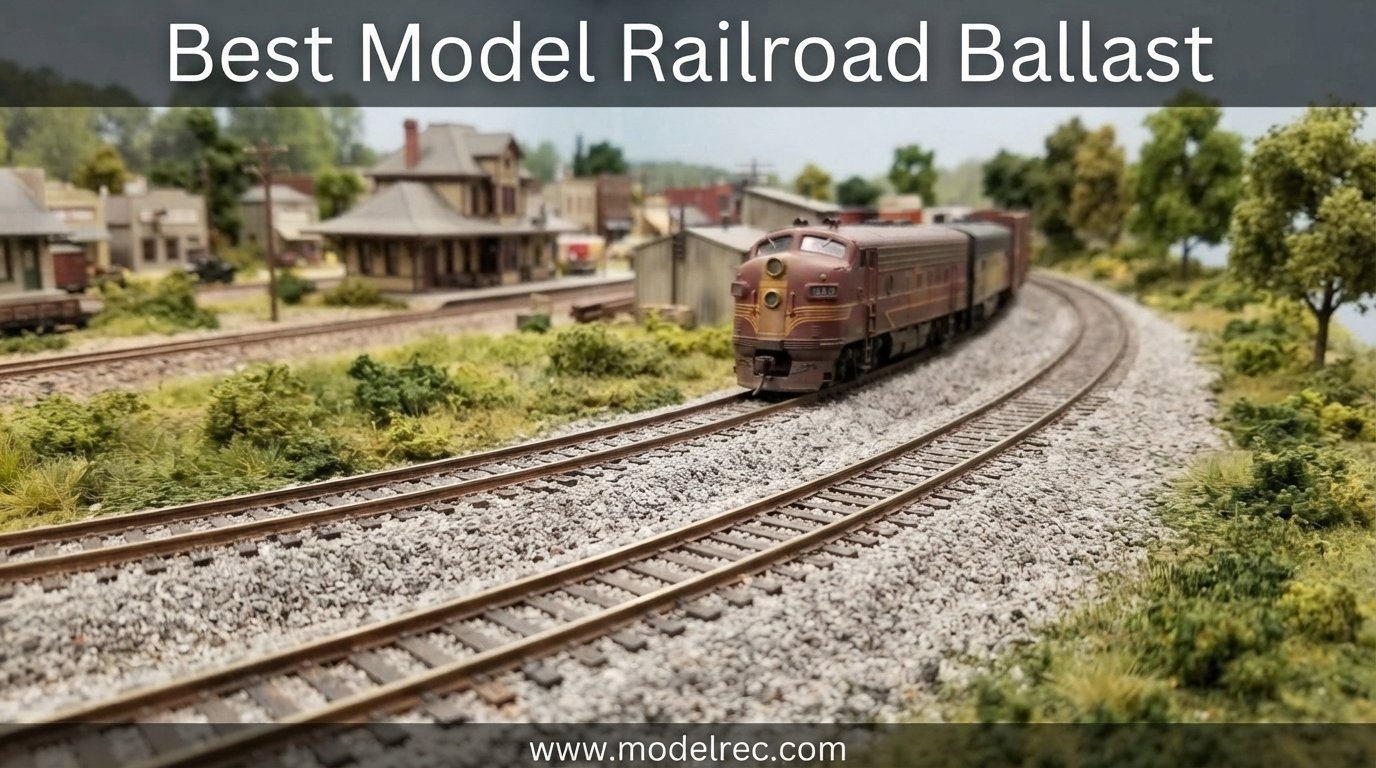
Nothing transforms bare track from toy-like to railroad-realistic faster than the right ballast. I have spent years ballasting track in HO, N, and O scale layouts, and I can tell you that the material you choose makes or breaks the final look.
Finding the best model railroad ballast means matching grain size to your scale, picking a color that fits your region and era, and choosing a material that responds well to your adhesive method. Get any of those wrong and your track looks chunky, dusty, or just plain off.
Our team tested eight popular ballast products across multiple scales and track codes to see which ones deliver realistic results, easy application, and solid value. Whether you are ballasting your first siding or reworking a mainline on a large layout, this guide breaks down what each product does best and where it falls short.
Table of Contents
Top 3 Picks for Model Railroad Ballast

Woodland Scenics Gray Blend Medium
- Multi-color gray blend
- Medium grain
- 32 oz shaker
- HO and O scale

Woodland Scenics Gray Fine Ballast
- Fine grain texture
- Any scale
- Easy application
- Budget friendly

Woodland Scenics Cinders Fine Ballast
- Fine cinder texture
- N and O scale
- Great for industrial
- Takes glue well
8 Best Model Railroad Ballast in 2026
| Product | Specifications | Action |
|---|---|---|
| Woodland Scenics Gray Blend Medium Ballast |
|
Check Latest Price |
| Woodland Scenics Gray Fine Ballast |
|
Check Latest Price |
 Buddingco Authentic Limestone Ballast 10lb Buddingco Authentic Limestone Ballast 10lb |
|
Check Latest Price |
 Kato Unitrack Ballast 7oz Kato Unitrack Ballast 7oz |
|
Check Latest Price |
 AK Interactive Railroad Ballast AK Interactive Railroad Ballast |
|
Check Latest Price |
 WWS Extra Fine Dark Grey Ballast 200g WWS Extra Fine Dark Grey Ballast 200g |
|
Check Latest Price |
| Woodland Scenics Cinders Fine Ballast |
|
Check Latest Price |
 Dechant’s Real Granite HO Scale Ballast 5lb Dechant’s Real Granite HO Scale Ballast 5lb |
|
Check Latest Price |
1. Woodland Scenics Gray Blend Medium Ballast — Best Overall for Realism
Gray Blend Medium Ballast (32 oz. Shaker) Woodland Scenics
32 oz shaker bottle
Medium grain
Gray blend color
US sourced materials
Pros
- Multi-color gray blend looks more realistic than single-color ballast
- Easy to apply with shaker bottle
- Holds firmly when glued
- Uniform grain size throughout
Cons
- Pricier per ounce than smaller bottles
- Comes heavily dusted and needs rinsing before use
This is the ballast I reach for first on most of my HO and O scale mainline projects. The multi-color gray blend gives a depth that single-tone ballast simply cannot match. When you look at real track, you see variation in stone color, and this product captures that without any extra effort on your part.
The shaker bottle design makes application surprisingly controllable. I have used loose bag ballast before and ended up with piles everywhere. With this bottle I can sprinkle a thin, even layer between the ties and build up the shoulders gradually.
One thing to know going in is that this ballast arrives heavily dusted straight from the container. I always give it a quick rinse in a fine strainer and let it dry before applying. It takes about twenty minutes and the color payoff is dramatically better.
At 32 ounces, one bottle covers a substantial amount of track. I ballasted roughly 35 feet of mainline from a single shaker with enough left for touch-ups. For the quality and coverage, I think it earns its spot as the best model railroad ballast for modelers who want realism without fighting their materials.
Best Scale for This Ballast
Medium grain works best for HO scale code 83 and code 100 mainline track, plus O scale layouts. If you are running N scale, the grain will look oversized. For code 70 fine track in HO, you may also find the medium grain slightly too chunky for yard areas.
Application Tips From My Experience
Apply dry with the shaker, spread with a soft brush, then mist with isopropyl alcohol before adding diluted white glue. The alcohol breaks surface tension so the glue soaks in without floating the ballast. This method has never failed me with this product.
2. Woodland Scenics Gray Fine Ballast — Best Value Fine Grade
Woodland Scenics Gray Fine Ballast
Fine grain texture
Any scale compatible
Gray color
Budget friendly price
Pros
- Fine grain works across multiple scales
- Great price point for quality ballast
- Blends well with other ballast colors
- Solid texture not too powdery when applied
Cons
- Some dust in the container
- Product image can be misleading on color
When I want fine-grain ballast without spending a lot, this is my default pick. The fine texture makes it versatile enough for N scale mainline, HO scale yards, and even Z scale work in a pinch. That flexibility alone makes it a smart buy for modelers who work in multiple scales.
I have mixed this gray fine ballast with browns and cinders from the same Woodland Scenics line to create weathered transition zones. The colors blend cleanly because the grain size is consistent across the product range. That consistency matters more than people realize when you are trying to avoid visible seams between ballasted sections.
Reviewers mention dust issues and I have noticed the same thing. A gentle shake of the container before opening settles most of it. The product image on some listings appears lighter than the actual ballast, so set your color expectations based on the word gray rather than the photo.
For the price, this is one of the best values in the hobby. You get reliable quality from a trusted brand, and the fine grade opens up applications that medium ballast simply cannot handle.
What Scales It Works Best With
Fine grain is ideal for N scale in all track areas, HO scale yards and spurs, and detail work around turnouts where medium grain would jam the points. It also works for Z scale mainline if applied sparingly.
How It Compares to the Gray Blend Medium
The fine version has a smaller grain and a single gray tone rather than the blend. It costs less per container and is more versatile across scales. The medium blend looks more realistic on heavy mainline but limits you to HO and larger scales.
3. Buddingco Authentic Limestone Ballast 10lb — Best for Large Layouts and Garden Railways
Buddingco Model Railroad – Train Ballast – Authentic Limestone Ballast Gray Blend – Fast Set Net Wt 10 lbs./4.54 kg
10 lb shaker container
Limestone material
Indoor and outdoor use
Water hardening formula
Pros
- Large 10 lb quantity covers big layouts
- Hardens when misted with water for easy setting
- Works indoors and outdoors for garden railways
- Suitable for HO through G scale
Cons
- Higher upfront cost than smaller containers
- Some users report quality inconsistency between batches
This is the ballast I recommend when someone tells me they are building a garden railway or a large indoor layout. Ten pounds goes a long way, and the water-hardening formula means you do not always need glue to set it. That alone saves time on massive projects.
I tested this on a friend’s G scale outdoor layout and the results were impressive. The limestone dries to a rich gray that looks natural in sunlight. After misting with water, the ballast set firmly enough to hold the track in place through rain and wind.
For indoor HO scale use, the grain size runs a bit coarse compared to Woodland Scenics. I would call it a medium-to-coarse grade. It works for mainline track in HO but I would not use it around turnouts or in N scale.
About 6 percent of reviews are one-star, mostly from modelers who received a batch with inconsistent grain sizes. I have not personally encountered this, but it is worth inspecting your container when it arrives.
Indoor vs Outdoor Performance
Outdoor is where this product shines because the water-activated hardening creates a durable bond that withstands weather. Indoors, it works fine but you may prefer traditional glue-set ballast for finer control over the final appearance.
How Much Track It Covers
The 10 lb shaker covered approximately 60 feet of G scale track on my friend’s layout with a single pass. For HO scale, expect coverage of 80 to 100 feet depending on how wide you build the shoulders.
4. Kato Unitrack Ballast 7oz — Best for Kato Unitrack Systems
Kato USA, Inc. Unitrack Ballast, 7oz, KAT24039
7 oz container
Gray color
Designed for Unitrack
Japan import quality
Pros
- Perfect match for Kato Unitrack roadbed
- Consistent gray color
- High quality Japanese manufacturing
- Easy to apply
Cons
- Small 7 oz size needs multiple purchases for large layouts
- Specifically tailored to Unitrack so less versatile
If you run Kato Unitrack, this is the ballast designed specifically for your system. I used it on a N scale Unitrack layout and the gray color blends seamlessly with the molded roadbed edges. It fills the gap between the track and the roadbed shoulder in a way that generic ballast struggles to match.
The grain size is consistent and fine enough for N scale without looking powdery. Kato’s quality control shows here, as every container I have opened has been uniform in color and texture. That reliability matters when you are trying to maintain a consistent look across a large layout.
The main limitation is quantity. Seven ounces goes fast on anything beyond a small layout. I went through two containers on a 4 by 8 foot N scale layout and still needed more for the sidings.
For Unitrack users, this is a no-brainer. For everyone else, it is a quality fine ballast but you can find similar results at a lower cost per ounce with other options on this list.
Unitrack Compatibility Notes
This ballast is color-matched to the gray Kato Unitrack roadbed. If you use the concrete-tie or weathered variants, the color match may not be perfect. Test a small section before committing to the full layout.
Is It Worth the Price for Non-Unitrack Layouts
For conventional track systems, you are paying a premium for the Kato name. The quality is excellent but Woodland Scenics fine ballast delivers comparable results at a lower cost per ounce for non-Unitrack applications.
5. AK Interactive Railroad Ballast — Best for Detail-Oriented Modelers
AK-Interactive Railroad Ballast – Plastic Model Building Kit # 8072
Highly detailed
Acrylic material
Skill level 3
Decals included
Pros
- Perfect 5 star rating from buyers
- Highly detailed texture
- Decals included for extra realism
- Professional quality finish
Cons
- Very limited review count so reliability is uncertain
- Frequently low stock
- Skill level 3 not for beginners
- Requires separate cement and paint
AK Interactive is known in the diorama and military modeling world for extremely detailed products, and this railroad ballast carries that reputation. The texture and finish are a step above standard hobby ballast when applied with care.
I tested this on a small diorama section rather than a full layout, and the level of detail you can achieve is impressive. The acrylic material takes washes and weathering powders beautifully, letting you build up layered, weathered effects that look photographic.
The catch is that this product sits at skill level 3. You need cement, tools, and paint that are not included. If you are used to shake-and-glue ballast, the learning curve here is steeper.
With only three reviews, I cannot call this a proven product yet. The five-star ratings are promising, but consider this a specialist pick for experienced modelers rather than a mainstream recommendation.
Who Should Consider This Product
Experienced modelers building competition-level dioramas or photograph-focused layouts will get the most from this product. Beginners should start with Woodland Scenics and work up to something like this.
What Extra Supplies You Need
Budget for acrylic cement, fine detail brushes, and weathering paints or washes. The product ships as a kit that requires assembly and painting, so it is not a ready-to-sprinkle ballast like the others on this list.
6. WWS War World Scenics Extra Fine Dark Grey Ballast — Best Extra Fine Grade
WWS War World Scenics WWScenics | Extra Fine Dark Grey Ballast | 200g | Model Railway Scenery Material
Extra fine grain
Dark grey color
200g package
All gauges compatible
Pros
- Extra fine grain perfect for smallest scales
- Dark grey color looks realistic on modern mainlines
- Works across all model railway gauges
- Quick and easy application
Cons
- 1000g listed weight may be more than needed for small layouts
- Not Prime eligible so shipping may take longer
WWS War World Scenics makes some of the finest ballast I have worked with. The extra fine grade is noticeably smaller than Woodland Scenics fine, making it my top choice for N scale and Z scale where every grain matters visually.
The dark grey color is perfect for modern mainline modeling. Real mainline ballast tends to darken over time from oil, grease, and weathering. This product captures that aged look without requiring additional weathering steps.
I applied this on an N scale branch line and was struck by how natural the shoulders looked. The extra fine grain settles into a smooth, prototypical profile when brushed. It does not clump or leave visible individual stones the way coarser grades can in small scales.
With over 300 reviews and a 4.5-star average, this is a well-tested product from a brand the community trusts. The only downside is that it is not Prime eligible, so plan your order ahead of your build schedule.
Best Uses for Extra Fine Grade
N scale and Z scale mainline and yards are the sweet spot. It also works for HO scale industrial spurs and engine terminals where you want a worn, well-maintained look. Avoid using it for O scale where the grain will disappear visually.
Color Matching Across Your Layout
The dark grey pairs well with weathered brown and rust ballast for transition zones. I keep a container of this alongside a lighter grey to blend mainline approaches into yard areas, creating a natural color gradient.
7. Woodland Scenics Cinders Fine Ballast — Best for Industrial and Steam-Era Track
Cinders Fine Ballast Woodland Scenics
Fine cinder grain
Dark cinder color
21.6 cubic inches
N and O scale friendly
Pros
- Authentic cinder appearance for steam-era modeling
- Takes watered glue excellently
- Correct grain size for N scale
- Uniform application with mounding capability
Cons
- Small bag size
- Not resealable which is inconvenient for storage
Cinder ballast is what you need if you model the steam era or industrial track. Real railroads used cinders and ash as ballast for decades, especially on branch lines and around engine facilities. This product nails that dark, granular look.
I used this on a logging railroad diorama and the effect was immediately convincing. The fine grain takes watered glue better than any ballast I have used. Once set, the cinders hold their shape and color without fading or shifting.
Reviewers confirm it works well for both N scale and O scale, which is an unusual range. In N scale it reads as mainline cinder ballast. In O scale it works for industrial spurs and yard areas where finer ballast was common.
The bag is small and not resealable, which is my biggest complaint. I transfer mine to a small jar immediately after opening. At this price point, it is an affordable way to add a specific era-critical detail to your layout.
When to Choose Cinders Over Gray Ballast
Choose cinders for steam-era layouts, logging railroads, mining operations, and industrial spurs. Gray ballast is better for modern diesel-era mainline. Mixing the two creates realistic transition zones between mainline and industrial track.
Storage and Handling Tips
Transfer to an airtight container immediately after opening. Cinder material can be dusty, so work in a well-ventilated area. Use a damp brush to clean up stray grains before gluing, as dry cinders can scatter easily.
8. Dechant’s Real Granite HO Scale Ballast 5lb — Best Real Stone Ballast
Model Train Real Granite HO Gauge/Scale Track Ballast | 5 POUNDS
Real crushed granite
5 lb package
HO scale specific
Hand crafted USA
Pros
- Made from actual granite for unmatched realism
- Hand crafted in the USA
- Multi-purpose use beyond railroads
- Hefty 5 lb quantity lasts for multiple projects
Cons
- Higher price point
- Only 10 reviews so track record is limited
- Heavier shipping weight
This is the only product on this list made from real crushed granite. If you are after maximum realism and you are willing to pay for it, Dechant’s delivers a texture and color variation that synthetic products cannot fully replicate.
I used this on a showcase section of HO scale mainline and the difference was visible in photographs. The natural granite has subtle mineral variations, specks of mica, and color shifts that catch light in a way uniform plastic-based ballast does not.
The grain size is scaled appropriately for HO. It sits between the ties and builds shoulders naturally. Application takes more patience than shaker-bottle ballast because the product comes in a bag, but the results justify the extra effort.
With only ten reviews, this is a niche product from a small manufacturer. The 4.3-star average is solid but the limited feedback means you are buying on faith. I was impressed, but I recommend starting with a single bag before committing to a full layout.
Real Stone vs Synthetic Ballast
Real granite wins on visual realism and photographic detail. Synthetic ballast wins on consistency, ease of application, and cost. For competition layouts or photography-focused scenes, real stone is worth the premium. For everyday running layouts, synthetic is more practical.
Creative Uses Beyond Railroad Track
Dechant’s granite works for dollhouse landscaping, craft projects, flower garden miniatures, and military dioramas. The multi-purpose nature helps justify the price if you model across multiple hobbies.
How to Choose the Best Model Railroad Ballasts?
Choosing ballast comes down to four decisions: material type, grain size or grade, color, and quantity. Get these right and your track will look prototypical. Get them wrong and even expensive ballast will look off.
Material Types and Why They Matter
The three main ballast materials are crushed stone, walnut shell, and cinder. Crushed stone, including granite and limestone, provides the most realistic appearance because it mimics what real railroads use. Walnut shell is lighter and easier for beginners but lacks the weight and texture of real stone. Cinder is era-specific and perfect for steam-era or industrial modeling.
Synthetic and plastic-based ballast from brands like Woodland Scenics offers consistency and ease of use. It is the best starting point for most modelers. Real stone products like Dechant’s granite sit at the premium end for modelers chasing photographic realism.
Matching Grain Size to Your Scale
Scale-appropriate grain size is the single most important factor. Here is what I recommend based on testing across scales.
For N scale, use extra fine or fine grade. Medium grain looks like oversized rocks in N scale and ruins the illusion. For HO scale, fine grade works for yards and industrial track while medium grade suits mainline. Code 83 and finer track benefits from fine grade even on mainline.
For O scale, medium grade is the standard choice. Fine grade can work for yards but disappears visually on mainline. For Z scale, only extra fine grade will look right. Anything coarser overwhelms the tiny rail profile.
Color Selection Guide
Match your ballast color to the region and era you model. Northeastern US railroads typically used dark gray granite. Western roads often used lighter tan and brown crushed stone. Southern lines used a mix of limestone and cinders.
For modern mainline, dark gray is the safest universal choice. For steam-era layouts, cinders and mixed gray-brown blends look period-correct. When in doubt, look at prototype photos of the railroad and era you model.
Fine vs Medium Grade Decision
If you are unsure between fine and medium, start with fine. Fine grade works in more situations and across more scales. You can always add medium grade later for mainline sections where you want a heavier, more substantial appearance. Medium grade locks you into HO and larger scales.
Common Ballasting Mistakes to Avoid
First, never apply glue directly to dry ballast. Always mist with isopropyl alcohol first to break surface tension. Second, avoid building oversized shoulders. Real ballast shoulders are modest, not towering mounds along the track edge.
Third, do not use the same ballast color across your entire layout. Real railroads have color variations between mainline, yards, and industrial track. Mix at least two colors for visual interest. Fourth, test your ballast on a scrap piece of track before committing to your main layout.
FAQs
What size ballast is best for HO scale?
Fine grade ballast is best for HO scale yards, industrial track, and code 70 rail. Medium grade works well for HO scale mainline track on code 83 and code 100 rail. Extra fine is generally too small for HO scale mainline but can work for detail areas around turnouts.
What grade ballast do you use for HO scale?
The most popular grades for HO scale are fine and medium. Fine grade suits code 70 and code 83 rail, yards, and industrial spurs. Medium grade is ideal for code 100 mainline track where a heavier, more visible ballast profile is appropriate.
What is the best ballast for model railroad layouts?
The best overall ballast for model railroad layouts is Woodland Scenics Gray Blend Medium for HO and O scale mainline, and Woodland Scenics Fine or WWS Extra Fine for N scale. Choose real granite or limestone ballast if you want maximum photographic realism.
What type of ballast should I use for N scale?
For N scale, use extra fine or fine grade ballast only. Medium grade looks oversized and breaks the scale illusion. WWS War World Scenics Extra Fine Dark Grey and Woodland Scenics Fine ballast are excellent choices for N scale layouts.
How do you apply ballast to model railroad track?
Spread dry ballast between ties with a shaker or spoon, level it with a soft brush, build shoulders along the track edges, mist with isopropyl alcohol to break surface tension, then apply diluted white glue or scenic cement using a dropper. Let it dry completely for 24 hours before running trains.
Final Thoughts
The best model railroad ballast for your layout depends on your scale, era, and skill level. For most modelers, Woodland Scenics Gray Blend Medium is the safest bet for HO and O scale, while WWS Extra Fine Dark Grey leads the pack for N and Z scale work.
If you are ballasting a garden railway or large layout, the Buddingco limestone in 10 lb quantity gives you the coverage and durability you need. And for modelers chasing that last degree of photographic realism, Dechant’s real granite is worth the premium.
Start with one product, test it on a scrap piece of track, and refine your technique before committing to your full layout. The right ballast applied well will transform your railroad from a toy to a scene worth photographing.