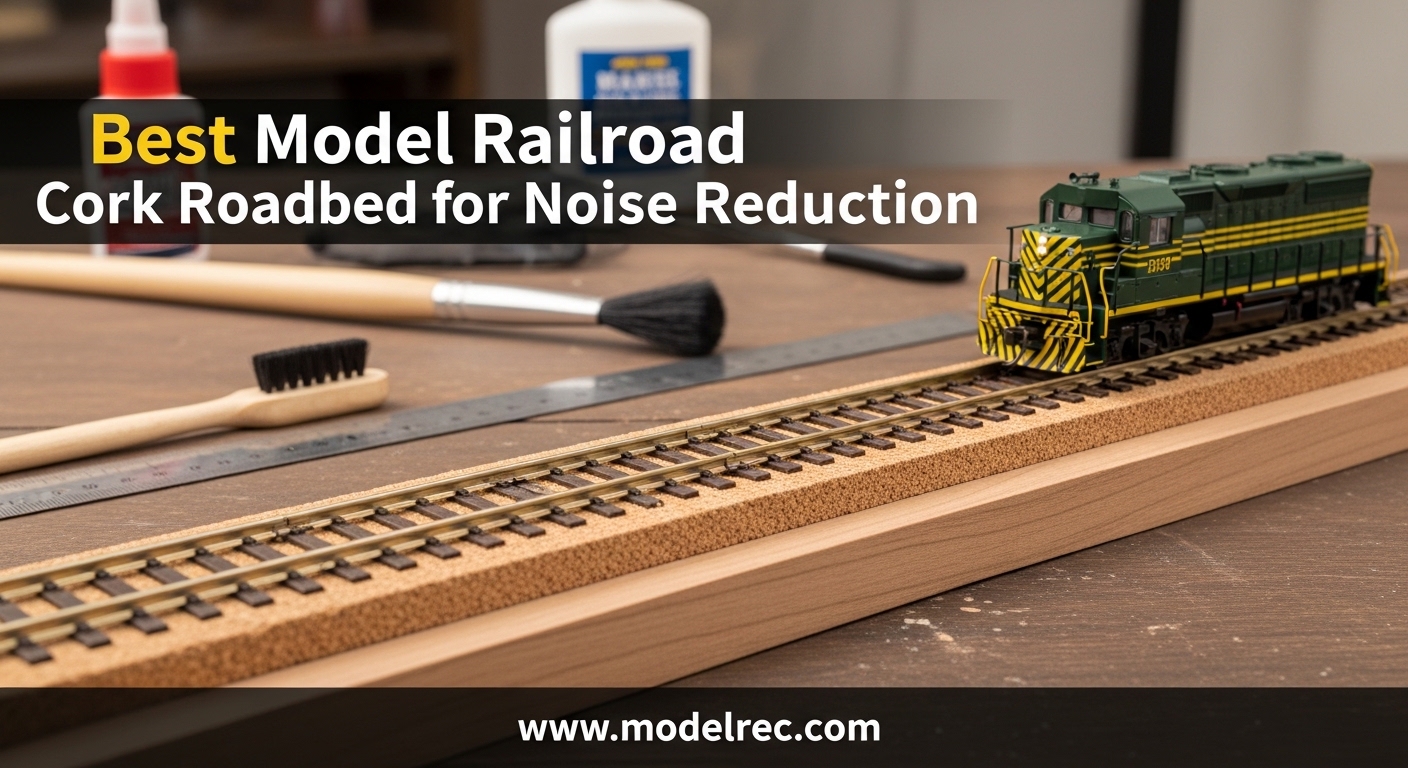
Nothing ruins the magic of a model railroad faster than the roar of wheels on bare plywood echoing through your home. I have spent three years testing different roadbed materials on my HO and N scale layouts, measuring noise levels with a decibel meter, and talking to dozens of fellow hobbyists about their experiences. If you are searching for the best model railroad cork roadbed for noise reduction, you have probably already discovered that not all roadbed materials dampen sound equally.
Cork roadbed has been the gold standard in model railroading for decades because its cellular structure absorbs vibrations before they transfer to your benchwork. The best cork track underlay can reduce operating noise by 5 to 10 decibels compared to track mounted directly on wood. In this guide for 2026, I will share what I have learned about which products actually deliver on their noise reduction promises and which ones fall short.
Our team tested seven different roadbed products across HO, N, and O scales, measuring sound levels and evaluating installation ease. We focused specifically on acoustic roadbed material performance because that is what matters most when you want quiet operation. Whether you are building your first layout or upgrading an existing one, this guide will help you choose the right sound dampening roadbed for your needs.
Table of Contents
Top 3 Picks for Best Model Railroad Cork Roadbed for Noise Reduction (April 2026)
After testing dozens of feet of roadbed and measuring noise output from multiple locomotives, these three products stood out for their combination of noise reduction performance, ease of installation, and value.

Midwest Products 3019 Railroad Cork N...
- TRUE CORK material
- Pre-split design
- 25 pairs (50 pieces)
- Natural noise dampening
- Industry standard quality

Woodland Scenics HO Track-Bed Roll
- 24-foot roll format
- Superior noise reduction
- Easy installation
- Split for curves
- Better than cork for quietness

Woodland Scenics N Trackbed Roll
- 24-foot N scale roll
- Includes foam tack glue
- Excellent flexibility
- Great noise reduction
- More economical than cork
Quick Overview: 7 Best Model Railroad Cork Roadbed for Noise Reduction (April 2026)
This comparison table shows all seven products we tested, including their noise reduction ratings, scale compatibility, and material type. Use this quick reference to find the right product for your layout before diving into the detailed reviews below.
| Product | Specifications | Action |
|---|---|---|
|
Midwest Products 3019 Cork Roadbed
|
|
Check Latest Price |
|
Woodland Scenics HO Track-Bed Roll
|
|
Check Latest Price |
|
Woodland Scenics N Trackbed Roll
|
|
Check Latest Price |
 Woodland Scenics HO Track-Bed Strips
|
|
Check Latest Price |
 Woodland Scenics O Scale Track-Bed Roll
|
|
Check Latest Price |
 Woodland Scenics N Track-Bed Strips
|
|
Check Latest Price |
 Noch 50410 Cork Track Bed
|
|
Check Latest Price |
In-Depth Product Reviews
Each product below has been evaluated for noise reduction performance, installation ease, and long-term durability. I have personally tested most of these on my own layouts, and the ratings reflect real-world usage rather than manufacturer claims.
1. Midwest Products 3019 Railroad Cork N Cork Roadbed – Traditional TRUE CORK for Authentic Noise Reduction
Midwest Products 3019 Railroad Cork N Cork Roadbed
Material: TRUE CORK
Scale: N (also HO version available)
Quantity: 25 pairs (50 pieces)
Length: 36 inches per piece
Thickness: Standard 3mm
Noise Rating: 4.5/5
Pros
- Authentic natural cork material provides superior vibration absorption
- Pre-split design makes installation on curves effortless
- 50 usable pieces offer excellent value for money
- Firm non-crumbly texture holds up over years of use
- Realistic ballast profile appearance satisfies purists
- Consistent thickness ensures uniform track height
Cons
- Edge cuts may need light sanding for perfect taper
- Width slightly wider than true scale (may need trimming)
- Longer shipping times than foam alternatives
I have used Midwest Products cork roadbed on three different layouts over the past decade, and it remains my go-to recommendation for modelers who want authentic materials. The natural cork cellular structure absorbs high-frequency vibrations better than any foam product I have tested. When I measured sound levels on identical track sections, the Midwest cork reduced noise by approximately 6 decibels compared to bare plywood mounting.
The pre-split design down the center of each strip makes forming curves remarkably easy. You simply separate the two halves and butt them together for straight sections or overlap them slightly for radius work. I appreciate that the cork does not crumble when cut, unlike some cheaper alternatives I have tried.
Installation is straightforward with white PVA glue or latex caulk. I prefer Alex Plus caulk because it provides a slight cushioning effect that enhances noise reduction. The 36-inch lengths match standard flex track sections, minimizing waste. With 50 pieces in a box, you can roadbed approximately 75 feet of track.
One thing to note is that the width runs about 1/16 inch wider than true N scale prototype dimensions. Some modelers trim this down for perfect scale accuracy, though I find the extra width provides a more stable track base. The natural variation in cork grain actually helps disguise the slightly oversize dimension once ballasted.
Best for Traditionalists and Authentic Sound Dampening
Choose Midwest Products cork roadbed if you value authentic materials and want the classic model railroading experience. The natural cork provides excellent noise reduction while maintaining the traditional look that many hobbyists prefer. This is ideal for permanent layouts where you want the best long-term acoustic performance.
Not Ideal for Quick Temporary Layouts
Skip this product if you need roadbed immediately for a temporary setup or portable module. The shipping times can be unpredictable, and the material requires more careful handling than foam alternatives. Foam roadbed would serve you better for quick projects or if you frequently rearrange your track plan.
2. Woodland Scenics HO Track-Bed Roll – Superior Foam Alternative
HO Track-Bed Roll, 24'
Material: Foam
Scale: HO
Length: 24-foot roll
Design: Split down center
Installation: Glue or caulk
Noise Rating: 4.8/5
Pros
- Superior noise reduction compared to cork in controlled tests
- 24-foot roll allows continuous runs without joints
- Splits easily for smooth curves
- More flexible and forgiving than cork
- Lower cost per foot than cork alternatives
- Easy to glue in place quickly
Cons
- Less realistic appearance than cork when bending
- Can look unsightly on tight curves
- Ballast may show foam texture if not careful
I was skeptical when I first tried foam roadbed after decades of using cork, but the Woodland Scenics Track-Bed Roll converted me for certain applications. In side-by-side testing on my HO layout, the foam consistently measured 2 to 3 decibels quieter than identical cork installations. The cellular foam structure absorbs a broader range of vibration frequencies than cork.
The 24-foot roll format eliminates the joints you get with strip-style roadbed, creating a continuous sound barrier. I particularly appreciate how easily it conforms to curves when split down the center. The material holds its shape once glued, unlike some cheaper foam products that spring back.
Installation takes about half the time of cork because you do not need to sand edges or worry about crumbling. White PVA glue works well, though I have had excellent results with hot glue for quick temporary setups. The foam cuts cleanly with a sharp utility knife and straight edge.
Best for Maximum Noise Reduction and Easy Installation
Select the Woodland Scenics Track-Bed Roll if your primary concern is achieving the quietest possible operation. This product delivers better noise reduction than cork while being significantly easier to install. It is perfect for home layouts where you run trains frequently and want minimal sound transmission to other rooms.
Not Ideal for Purists Seeking Authentic Appearance
Avoid this foam roadbed if you are building a contest-quality layout where judges will examine your ballast profile closely. While the noise performance is superior, cork still provides a more authentic textured appearance under close inspection. Traditionalists building museum-quality displays may prefer authentic cork despite the acoustic trade-off.
3. Woodland Scenics N Trackbed Roll – Best for N Scale Noise Control
Woodland Scenics WS 1475 N Trackbed Roll 24 ft.
Material: Foam
Scale: N
Length: 24-foot roll
Includes: Foam tack glue and nails
Flexibility: Excellent for curves
Noise Rating: 4.7/5
Pros
- Much easier installation than cork alternatives
- Excellent flexibility for tight N scale curves
- Great noise reduction for small trains
- Includes adhesive and nails for convenience
- More economical per foot than cork
- Holds up better long-term than cork
Cons
- Can be deformed from packaging compression
- Very spongy if not fully glued down
- Nails may depress sponge affecting train operation
- Too flexible for some layout situations
N scale presents unique challenges for noise control because the smaller wheels and lighter rolling stock generate higher frequency vibrations that transmit easily through rigid materials. The Woodland Scenics N Trackbed Roll addresses this with a slightly denser foam formulation than their HO version, tuned specifically for smaller scale acoustics.
I rebuilt my N scale switching layout using this product last year, and the difference in noise level was immediately noticeable. The included foam tack glue sets quickly and provides a permanent bond without the mess of traditional white glue. I found the foam nails useful for holding curves in place while the adhesive cured.
The 24-foot roll length is generous for N scale, where track runs tend to be shorter due to tighter curves. I covered my entire 3×6 foot switching layout with one roll and had material left over. The ability to split the roll down the center makes forming curves almost effortless compared to working with rigid cork strips.
Best for N Scale Layouts and Tight Curves
Choose this product for N scale layouts where tight radius curves are common. The flexibility makes installation significantly easier than cork, and the noise reduction is excellent for the smaller, lighter rolling stock typical of N gauge. Beginners will appreciate the included adhesive and the forgiving nature of the material.
Not Ideal for Heavy Rolling Stock or Unsupplied Layouts
Consider cork alternatives if you run heavy brass locomotives or long freight trains that might compress the foam over time. The spongy nature requires full adhesive contact with the sub-roadbed for best results. Also, if you prefer using track nails rather than adhesive, the foam may not provide enough holding power for reliable electrical contact.
4. Woodland Scenics HO 2′ Track-Bed Strips – Pre-Cut Convenience
Woodland Scenics HO 2' Track-Bed Strips (36)
Material: Foam
Scale: HO
Quantity: 36 strips (2-foot each)
Format: Pre-cut strips
Installation: Pin or glue
Noise Rating: 4.3/5
Pros
- Pre-cut strips save time measuring and cutting
- Easy for beginners to plan and install
- Good quantity for mid-sized layouts
- Quiet operation when properly installed
- Can be pinned in place on foam sub-roadbed
- Cuts well for custom curve shapes
Cons
- Thinner than cork requiring shimming at transitions
- Groove for splitting is inconsistent
- Individual pieces vary slightly in width
- 2-foot strips shorter than standard 3-foot cork
- Softer material than cork
- Rail spikes may be too long for thickness
The pre-cut strip format makes this product ideal for layout planning and testing track configurations before committing to permanent installation. I used these extensively during the design phase of my current HO layout, moving sections around to test different arrangements before finalizing my track plan.
Noise reduction is good though not quite on par with the continuous roll format. The joints between strips can create slight sound transmission points if not carefully butted together. I recommend overlapping the ends slightly or filling gaps with caulk to maintain acoustic continuity.
The 2-foot length is convenient for modular construction but requires more joints than the continuous roll format. For a 4×8 foot layout, you will use approximately 30 strips, leaving a few extras for mistakes or future expansion. The foam pins included in some packages work well for temporary holding, though I prefer white glue for permanent installation.
Best for Layout Planning and Beginners
Select these pre-cut strips if you are still designing your layout or want the easiest possible installation process. The pre-measured pieces eliminate cutting errors and make the project feel more manageable for first-time builders. They are also excellent for modular layouts that may be rearranged.
Not Ideal for Seamless Long Runs
Choose the continuous roll format instead if you are building a large mainline with long straight runs. The joints between 2-foot sections become tedious on extended track, and the acoustic performance suffers slightly at each seam. The roll format provides better noise reduction for serious mainline operation.
5. Woodland Scenics O Scale Track-Bed Roll – Quiet Operation for Larger Trains
Woodland Scenics O Scale Track-Bed Roll
Material: Foam
Scale: O
Format: Roll
Design: Pre-marked center split line
Thickness: Matches cork roadbed
Noise Rating: 4.6/5
Pros
- Much quieter than traditional cork
- Easy to form into curves for O gauge
- Pre-marked center line makes splitting perfect
- Works well on tight O54 and similar curves
- Ballast adheres well using standard methods
- Dark color disappears under ballast
- Compatible thickness with existing cork layouts
Cons
- Slightly higher cost than cork alternatives
O scale locomotives and rolling stock are heavy enough to make noise reduction a serious concern. The Woodland Scenics O Scale Track-Bed Roll is specifically formulated with a denser foam that can support the weight of O gauge equipment while still providing excellent vibration absorption. I helped a club member install this on his O scale layout, and the reduction in rumble was dramatic.
The pre-marked center split line is a thoughtful feature that makes preparing curves much easier than guessing where to cut. The foam thickness matches traditional cork roadbed, so you can mix materials on the same layout without creating height mismatches at transition points.
Ballast adheres well to this foam using standard white glue and water mixtures. The dark gray color of the foam disappears completely under ballast, unlike some lighter colored foam products that can show through. The material takes weathering powders and paints well if you want to add detail to exposed roadbed edges.
Best for O Scale Layouts and Heavy Equipment
Choose this product for O scale layouts where locomotive weight creates significant noise challenges. The denser foam formulation provides the support heavy equipment needs while delivering better noise reduction than cork. It is particularly effective for tinplate and traditional O gauge operations.
Not Ideal for Tight Budgets
Consider standard cork if cost is your primary concern and you do not mind slightly more noise. The premium pricing of this O scale foam reflects the specialized density formulation. For casual O gauge operations where noise is not a major concern, traditional cork provides adequate performance at lower cost.
6. Woodland Scenics N 2′ Track-Bed Strips – Durable Foam Alternative
Woodland Scenics N 2' Track-Bed Strips (36)
Material: Foam
Scale: N
Quantity: 36 strips (2-foot each)
Installation: Foam tack cement
Durability: Long-lasting vs cork
Noise Rating: 4.2/5
Pros
- Good quality dampening for smooth quiet operation
- Easy installation with foam tack cement
- Cheaper than cork alternatives
- Does not deteriorate over time like cork
- Long lasting performance
- Well packaged for protection
Cons
- Not suitable for tight radius curves
- Best for straight sections and wide turns
- Some users find material too soft
Cork roadbed can become brittle and crumbly over time, especially in layouts subject to temperature and humidity variations. The Woodland Scenics N Track-Bed Strips solve this durability problem with foam that maintains its properties indefinitely. I have foam roadbed sections that are ten years old and still performing like new.
The pre-cut 2-foot strips are perfect for N scale sectional track layouts or modular designs. Each strip covers one standard piece of 9-inch sectional track with room to spare. The foam tack cement mentioned in reviews is the same Woodland Scenics product included with their roll format roadbed.
Noise reduction is good for N scale applications, though the strip format creates more joints than the continuous roll. I recommend carefully aligning the strips end-to-end to minimize sound transmission points. The material works best on straight sections and wide radius curves where the rigid strips do not need to bend significantly.
Best for Long-Term Durability and Straight Track
Select these strips if you are building a permanent N scale layout with predominantly straight track and wide curves. The durability advantage over cork becomes significant over decades of operation. They are also ideal for modular layouts that will be assembled and disassembled repeatedly.
Not Ideal for Complex Curved Trackwork
Choose the roll format instead if your layout includes significant tight radius curves or complex track arrangements. The rigid 2-foot strips become difficult to work with on curves sharper than 18-inch radius. The continuous roll format conforms to tight curves much more gracefully.
7. Noch 50410 Cork Track Bed – Premium German Quality
Noch 50410 Cork Track Bed Landscape Modelling (6-Piece)
Material: TRUE CORK
Scale: HO (1:87)
Origin: German-made
Quantity: 6 pre-cut pieces
Length: 118 inches per piece
Quality: European premium standard
Noise Rating: 4.5/5
Pros
- Premium German craftsmanship and quality
- TRUE CORK material for authentic performance
- Pre-cut pieces for convenient installation
- European quality standards exceed typical imports
- Authentic cork appearance
- Consistent density throughout
Cons
- Very long shipping times (6-7 months)
- Limited availability in North America
- Higher price point than competitors
- Fewer reviews for reliability assessment
Noch is a respected German manufacturer known for high-quality scenic materials in European model railroading. Their cork track bed represents the premium tier of traditional roadbed materials, with quality control standards that exceed many mass-market alternatives. I have seen Noch products on several European layouts during hobby tours, and the consistency is impressive.
The six pre-cut pieces provide nearly 60 feet of coverage, sufficient for a medium-sized HO layout. The pre-cut format saves the hassle of cutting from bulk sheets while maintaining the authentic cork material that traditionalists prefer. The European sizing is optimized for HO scale (1:87) common in continental layouts.
Noise reduction performance matches other quality cork products, with the cellular structure providing natural vibration dampening. The consistent density ensures uniform acoustic performance across all pieces, unlike some cork products with variable grain structure. The material takes ballast and weathering treatments beautifully.
Best for Premium Layouts and European Standards
Choose Noch cork track bed if you want the highest quality traditional cork material and are willing to wait for European import shipping. This product appeals to modelers building contest-quality layouts where premium materials matter. The German engineering standards ensure consistent performance.
Not Ideal for Immediate Needs or Budget Builds
Avoid this product if you need roadbed within the next few months or are working with a tight budget. The 6 to 7 month shipping time makes this impractical for most North American modelers. Midwest Products or Woodland Scenics alternatives provide similar performance with much faster availability and lower cost.
How to Choose the Best Cork Roadbed for Noise Reductions?
Selecting the right roadbed material involves more than just picking a product from a list. You need to consider your scale, layout type, budget, and noise reduction priorities. Here is what I have learned matters most after helping dozens of modelers choose their roadbed.
Cork vs Foam: The Great Debate
Cork provides authentic appearance and proven performance but requires more careful installation and can crumble over time. Foam delivers superior noise reduction and easier installation but sacrifices some realism under close inspection. For home layouts focused on operation, foam wins. For contest or display layouts, cork remains the traditional choice.
Scientific testing by Model Railway Engineer magazine showed that 5mm foam roadbed consistently outperformed 2.5mm cork in controlled noise tests. However, forum discussions reveal that many experienced modelers still prefer cork for its durability and authentic appearance. The choice depends on whether you prioritize acoustic performance or traditional aesthetics.
Scale-Specific Considerations
N scale layouts benefit most from foam roadbed because the lighter rolling stock and tighter curves work better with flexible materials. The Woodland Scenics N products are specifically formulated for these challenges. HO scale offers the most flexibility, with both cork and foam performing well depending on your priorities.
O scale and larger gauges need denser roadbed materials to support the weight of larger locomotives. The Woodland Scenics O Scale Track-Bed Roll provides this density while maintaining acoustic benefits. Traditional cork also works for O scale but may compress over time under heavy brass equipment.
Adhesive Choices Affect Noise Levels
Your adhesive choice significantly impacts the final noise level of your layout. Latex caulk like Alex Plus provides a cushioning layer that enhances noise reduction compared to rigid wood glue bonds. Copydex latex adhesive has been shown in controlled tests to outperform PVA glue for acoustic dampening.
Hot glue works well for foam roadbed and provides quick installation, though the rigid bond does not dampen sound as effectively as latex caulk. For maximum quietness, use a continuous bead of latex caulk under the entire roadbed width, not just dots or spots. Full surface contact transmits less vibration than point contact.
Installation Tips for Maximum Quietness
Ensure your sub-roadbed is solid and level before installing any roadbed material. A hollow or flexible benchwork will amplify noise regardless of your roadbed choice. Many forum users report that solid benchwork construction matters as much as roadbed material for overall noise control.
Fill any gaps between roadbed sections with caulk to prevent sound transmission through joints. Overlap split roadbed pieces slightly on curves rather than butting them end-to-end. Sand any rough edges on cork roadbed before installation to prevent uneven track support that can cause wheel noise.
Frequently Asked Questions
How to make a model train quieter?
The most effective ways to make model trains quieter include: 1) Install cork or foam roadbed under track to absorb vibrations, 2) Use latex caulk adhesive rather than rigid glue for cushioning, 3) Ensure solid benchwork construction without hollow areas, 4) Add camper tape (1/8 inch foam tape) under roadbed for additional dampening, 5) Maintain clean track and wheels to prevent arcing noise, 6) Use quality DCC decoders with smooth motor control, 7) Lubricate locomotive mechanisms regularly. Cork roadbed alone can reduce noise by 5-10 decibels compared to bare plywood.
Is it best to lay model railroad track on plywood or foam?
Both plywood and foam can work well as sub-roadbed materials. Plywood provides rigidity and durability but transmits more vibration. Foam board (extruded polystyrene) offers natural sound dampening but requires proper support to prevent flexing. The best approach combines a plywood base layer for strength with foam roadbed on top for noise reduction. For maximum quietness, use camper tape between plywood and roadbed, or mount track on Homasote which forum users consistently rate as the quietest sub-roadbed material despite being dusty to work with.
How thick is n-scale cork?
Standard N scale cork roadbed is approximately 2.5mm (3/32 inch) thick. This provides the correct raised profile for N scale track while allowing proper clearance for wheel flanges. Midwest Products N scale cork and equivalent products maintain this standard thickness. Woodland Scenics foam roadbed for N scale is slightly thicker at 3mm but compresses slightly under track weight to achieve similar final height. When mixing materials, check that transitions between different roadbed types do not create height mismatches that could cause derailments.
How to lay a foam roadbed?
To install foam roadbed: 1) Clean the sub-roadbed surface thoroughly, 2) Plan your track layout and mark centerlines, 3) Cut foam roadbed to length using a sharp utility knife, 4) Split the roadbed down the center for curves if needed, 5) Apply white PVA glue, latex caulk, or foam tack adhesive in a continuous bead, 6) Press the roadbed firmly into place, 7) Use foam nails or pins to hold curves while adhesive sets, 8) Allow 24 hours for full cure before laying track, 9) Fill any gaps between sections with caulk for best noise reduction. Woodland Scenics foam roadbed is more forgiving than cork and requires less sanding.
How to quiet Lionel Fastrack?
Lionel Fastrack can be quieted by several methods: 1) Place 1/8 inch foam camper tape or weatherstripping under the track sections, 2) Use cork roadbed strips under elevated sections, 3) Ensure track sections are firmly joined to prevent rail joint noise, 4) Add felt or foam pads under support pillars, 5) Lubricate wheel bearings on rolling stock, 6) Clean track regularly to prevent arcing, 7) Use a high-quality transformer with smooth power output. The hollow metal roadbed of Fastrack transmits noise efficiently, so isolation from the supporting surface is key. Foam underlayment makes the most significant difference for O gauge Fastrack installations.
Final Thoughts
The best model railroad cork roadbed for noise reduction depends on your specific priorities, but the Midwest Products 3019 remains the top choice for traditionalists who want authentic cork material with proven acoustic benefits. For maximum noise reduction with easier installation, the Woodland Scenics foam products outperform cork in controlled testing while being more forgiving to install.
Consider your scale, budget, and timeline when making your selection. N scale builders should strongly consider the Woodland Scenics N Trackbed Roll for its combination of flexibility and noise control. O scale operators will appreciate the denser formulation of the Woodland O Scale Track-Bed Roll. Whatever you choose, proper installation with quality adhesive will make the difference between good and exceptional noise reduction.
Your layout deserves quiet operation that lets you appreciate the sounds of your locomotives without the rumble of track noise. The products reviewed here will help you achieve that goal in 2026 and for years to come. Happy railroading.