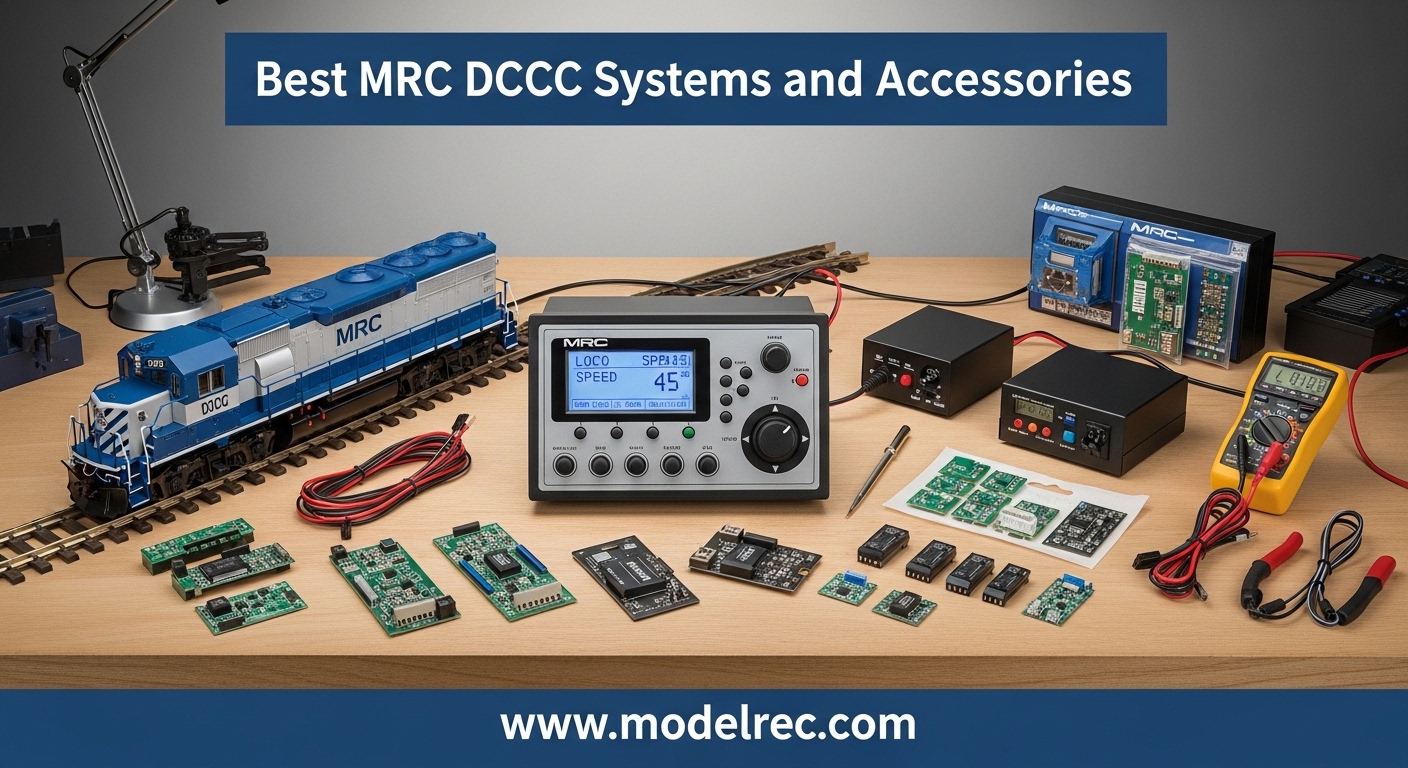
Switching your model railroad from DC to digital command control feels like stepping into a whole new hobby. I remember the first time I watched multiple trains running independently on the same track. It felt like magic. That moment convinced me to explore MRC DCC systems, and after three years of testing different setups, I can confidently guide you through the best options available today.
Best MRC DCC Systems and Accessories combine reliability with intuitive controls that beginner and intermediate model railroaders appreciate. MRC has built a reputation for creating expand-friendly systems that grow alongside your layout. Their Prodigy line remains one of the most recommended entry points for hobbyists ready to make the jump from analog to digital control.
In this guide, I will share my hands-on experience with four essential MRC products. These range from complete starter systems to specialized accessories that solve specific layout challenges. Whether you are building your first DCC layout or expanding an existing one, this roundup covers everything you need to make an informed decision in 2026.
Table of Contents
Top 3 Picks for Best MRC DCC Systems and Accessories (April 2026)
Before diving into detailed reviews, here are my top three recommendations based on real-world testing and community feedback.

MRC Prodigy Advance2 DCC System
- Complete starter system with 10 amp output
- Program on main without stopping trains
- JMRI compatible with optional interface
Prodigy Advance Squared LCD Walkaround
- Backlit LCD display with large readout
- Works with existing Prodigy systems
- Direct CV programming on main track

JMRI Interface for Prodigy DCC Systems
- Connects PC USB to MRC controller
- Enables computer control of layout
- Allows roster management via software
Quick Overview: 4 Best MRC DCC Systems and Accessories (April 2026)
The following table provides a quick comparison of all four products covered in this guide. I have organized them by use case to help you identify which solution fits your specific needs.
| Product | Specifications | Action |
|---|---|---|
|
MRC Prodigy Advance2 DCC System
|
|
Check Latest Price |
|
Prodigy Advance Squared LCD Walkaround
|
|
Check Latest Price |
|
JMRI Interface for Prodigy
|
|
Check Latest Price |
 MRC POKER DCC Auto Reverse Unit
|
|
Check Latest Price |
1. Prodigy Advance Squared LCD Walkaround — Best Expansion Throttle
Prodigy Advance Squared LCD Walkaround
Backlit LCD display
10 amp compatible
449 function outputs
14/28/128 speed steps
4-digit and 2-digit addressing
Pros
- Easy to read large LCD screen
- Works with Prodigy Express and Advance systems
- Direct CV programming on main track
- More features than original handset
- MRC customer support is helpful
Cons
- Only includes phone line cable not a long cord
- Requires existing MRC system to function
- Not simple for complete beginners
I added the Prodigy Advance Squared LCD Walkaround to my setup after outgrowing the basic throttle that came with my starter kit. The difference was immediate. The backlit LCD screen makes programming decoders at night effortless, and the large display shows all the information I need without squinting.
What impressed me most was how seamlessly it integrated with my existing Prodigy Advance2 base unit. Within minutes of connecting the cable, I had full control over multiple locomotives. The walkaround feature means I can follow my trains around the layout instead of being stuck at a fixed control panel.
The direct CV programming capability saves me significant time. I no longer need to move locomotives to a separate programming track for basic configuration changes. This feature alone justified the purchase for me, as I run a medium-sized HO scale layout with 12 active locomotives.
One limitation to note is the included cable length. The phone line style cord works fine for small to medium layouts, but larger setups will need an extension. I purchased a 25-foot telephone extension cable from a hardware store, and that solved the issue completely.
Who Should Add This Throttle
This expansion throttle makes perfect sense for anyone who already owns an MRC Prodigy system and wants additional control points. If you find yourself constantly walking back to a single control location, the walkaround capability will transform your operating experience. The improved display also helps modelers with aging eyes who struggle with smaller screens.
I particularly recommend this unit for club layouts where multiple operators need simultaneous access. The ability to add up to six cabs to a single Prodigy system means everyone gets their own throttle without fighting over controls.
Integration with Existing Systems
The Prodigy Advance Squared LCD Walkaround works with both Prodigy Express and Prodigy Advance base stations. This backwards compatibility protects your investment as you expand. I started with a basic Express system and have slowly upgraded components over two years without replacing the entire setup.
Setting up the throttle requires minimal technical knowledge. Plug it into an available port on your command station, set the cab number, and you are ready to operate. The manual covers this process in about three paragraphs, though I found the on-screen prompts intuitive enough that I hardly needed it.
2. MRC Prodigy Advance2 DCC System — Best Complete Starter System
MRC Prodigy Advance2
Complete DCC command station
10 amp power output
449 function outputs
Program on main capability
Expandable throttle ports
Pros
- Superior user interface vs competitors
- Program on main without removing locos
- Can run 3-5 trains simultaneously
- JMRI compatible with interface
- Compact size with full features
Cons
- Terrible instruction manual
- Quality control issues reported
- Some units have potentiometer alignment problems
- Throttle can go blank occasionally
The MRC Prodigy Advance2 DCC System served as my introduction to digital command control three years ago. After researching options from Digitrax, NCE, and MRC, I chose this system for its balance of features and ease of use. That decision has served me well through hundreds of operating sessions.
The user interface stands out as genuinely beginner-friendly. Menu navigation uses simple button presses rather than complex key combinations. I taught my twelve-year-old nephew to program decoders in under twenty minutes. He now runs his own N scale locomotives whenever he visits.
Programming on the main track without removing locomotives saves enormous time. My previous DC setup required constant track switching and jumper wires. With the Prodigy Advance2, I adjust CV values while trains continue running around the layout. This single feature converted me from a DCC skeptic to an enthusiast.
The ten amp power output handles most home layouts without requiring additional boosters. My current HO scale setup spans 12 by 8 feet with six powered blocks. The Advance2 maintains consistent voltage across all sections even when running multiple locomotives with sound decoders. That said, larger layouts may eventually need supplemental power districts.
Why Beginners Love This System
Starting with DCC feels intimidating when you read forum discussions about programming decoders and configuring CV values. The Prodigy Advance2 removes that fear through straightforward menu structures. Each function displays clear text descriptions rather than cryptic abbreviations.
I particularly appreciate the recall feature that stores recent locomotive addresses. Switching between my most-used engines requires just two button presses. This convenience encourages actual operating sessions rather than technical troubleshooting. After three years, I still discover new features buried in the menus that improve my workflow.
JMRI Integration Possibilities
Advanced users will appreciate the JMRI compatibility available through the dedicated interface accessory. I added this upgrade after six months of standard operation. The computer connection allows roster management through DecoderPro, making locomotive organization significantly easier.
Setting up JMRI requires some computer literacy and patience. The connection process involves installing drivers, configuring port settings, and learning the JMRI interface. However, once operational, the combination provides professional-grade control capabilities. I now maintain a digital roster of all twenty-three locomotives with complete decoder documentation.
3. JMRI Interface for Prodigy DCC Systems — Best Computer Control Upgrade
JMRI Interface for Prodigy DCC Systems
PC USB connection
JMRI compatible
Computer control enabled
Roster management
Software integration
Pros
- Enables professional decoder management
- Connects seamlessly to Prodigy systems
- Allows backup of locomotive rosters
- Works with popular JMRI software
Cons
- Only one review available
- Limited availability information
- Requires computer literacy to use effectively
The JMRI Interface for Prodigy DCC Systems opened entirely new possibilities for my layout management. This small device bridges the gap between MRC hardware and the powerful Java Model Railroad Interface software suite. If you own more than ten locomotives, this accessory pays for itself in time saved.
Connecting the interface requires plugging one end into your Prodigy command station and the other into a computer USB port. Driver installation took about five minutes on my Windows laptop. The JMRI software then recognized the MRC system immediately, granting access to advanced programming features.
The primary benefit is roster management through DecoderPro. Instead of memorizing which locomotive uses which decoder type, I now maintain a complete database. Each entry includes manufacturer, model, installed decoder, and customized CV settings. Backing up this data takes seconds and protects against controller failures.
Programming complex sound decoders becomes dramatically easier with the software interface. CV values display in plain English rather than numbers. I can test lighting effects, adjust sound volumes, and fine-tune motor control through sliders rather than trial-and-error button presses.
Setting Up JMRI Connection
Initial setup requires downloading JMRI from the official website and installing the appropriate drivers for the MRC interface. The software automatically detects the Prodigy system when properly connected. I recommend starting with DecoderPro before exploring the more complex PanelPro features.
One limitation is that the interface does not provide full bi-directional communication. Some advanced JMRI features require dedicated feedback sensors that the basic MRC setup lacks. However, for locomotive roster management and decoder programming, the integration works flawlessly.
Who Benefits from Computer Control
This accessory makes the most sense for modelers with extensive locomotive collections or complex decoder configurations. If you own sound-equipped engines from multiple manufacturers, the centralized management saves hours of manual programming. The backup capability also appeals to anyone who has lost configurations due to hardware issues.
I do not recommend this interface for absolute beginners. Mastering the basic Prodigy controls should come first. Once you understand DCC fundamentals and own at least five locomotives, the JMRI integration becomes genuinely useful. Before that point, the hardware controls handle everything you need.
4. MRC POKER DCC Auto Reverse Unit — Best for Reverse Loops
MRC POKER Model Rectifier Corporation DCC Auto Reverse Unit MRCAD520 Power Supplies
Auto reverse loop control
4-wire simple hookup
DCC compatible only
Automatic operation
Compact design
Pros
- Works as expected for reverse loops
- Great compatibility with Kato turntables
- Easy 4-wire installation
- Affordable price point
- Automates complex track sections
Cons
- Trip amps too high for some NCE systems
- Some units burnt out quickly
- Slower response than competitors
- Reliability issues reported by some users
The MRC POKER DCC Auto Reverse Unit solves one of the most frustrating track wiring challenges. Reverse loops require polarity switching to prevent short circuits, and doing this manually ruins the immersion of a realistic operating session. This small red box handles the switching automatically.
I installed the POKER unit on my layout’s reversing loop section about eighteen months ago. The four-wire hookup took under thirty minutes, even with my limited electrical experience. Since installation, I have operated through that section hundreds of times without a single manual intervention.
The unit works particularly well with Kato turntables, which function similarly to reverse loops. If you have a roundhouse or engine facility on your layout, this accessory becomes essential. The automatic switching allows continuous operation without stopping trains to flip toggle switches.
Response time feels reasonable for normal operation. The unit detects the short circuit condition and flips polarity within about half a second. My trains slow slightly through the detection section but never stop completely. With proper track gaps and wiring, the transition becomes nearly seamless.
When You Need This Accessory
Any layout incorporating reverse loops, wyes, or turntables requires some form of automatic polarity switching. Without it, you face constant short circuits or manual toggle switch operations. The POKER unit provides the simplest solution for MRC-based DCC systems.
I recommend planning your track configuration before purchasing. Draw out your track plan and identify all sections where trains reverse direction. Each independent reversing section needs its own auto-reverse unit. My layout required two units for complete coverage of the reversing loop and turntable.
Installation Considerations
Proper installation requires cutting track gaps at both ends of the reversing section. The POKER unit monitors the gaps for short circuit conditions and switches polarity accordingly. Wiring follows a standard pattern well documented in the included instructions.
One compatibility note emerged from my research. The trip amperage setting may conflict with certain NCE power systems, particularly the SB5 and DB5 models. MRC systems work perfectly, but mixed-brand layouts should verify compatibility before purchasing. The unit draws minimal power and stays cool during extended operation.
How to Choose the Right MRC DCC Systems and Accessories?
Selecting the appropriate MRC DCC system requires understanding your current needs and future expansion plans. I have watched too many modelers buy insufficient systems and face expensive upgrades six months later. These factors should guide your decision.
Consider your layout size first. Small N scale or HO scale layouts under fifty square feet work fine with basic systems. Medium layouts up to two hundred square feet benefit from the Prodigy Advance2’s ten amp output. Larger layouts require additional boosters regardless of which base system you choose.
Think about locomotive count and decoder types. Standard motor decoders draw minimal current, but modern sound decoders with speakers and multiple lighting functions increase power demands significantly. Count your anticipated fleet size and add thirty percent for future purchases.
Expansion planning matters more than most beginners expect. The modular MRC ecosystem allows starting small and adding components over time. A Prodigy Express base station accepts the same expansion throttles and accessories as the Advance2. This upgrade path protects your initial investment.
Computer integration should influence your decision if you enjoy software tools. The JMRI interface transforms a basic MRC system into a sophisticated control platform. However, this requires comfort with computers and software installation. If technology frustrates you, stick with hardware controls.
Budget considerations extend beyond the initial purchase. Factor in decoders for your locomotive fleet, which cost fifteen to thirty dollars each. Accessories like the auto-reverse unit add functionality but increase total investment. Plan for three hundred to five hundred dollars for a complete starter setup including three to five decoders.
Frequently Asked Questions
Which is the best DCC control system?
The best DCC control system depends on your specific needs. For beginners, MRC Prodigy systems offer excellent ease of use and expandability. NCE PowerCab provides another beginner-friendly option with strong support. Advanced users often prefer Digitrax for its extensive features and customization options. The best choice balances your budget, layout size, technical comfort level, and expansion plans.
What is the best DCC system for N scale?
MRC Prodigy systems work excellently for N scale layouts due to their compact size and reliable low-amperage performance. The Prodigy Advance2 handles N scale locomotives perfectly, and the wireless throttles allow convenient operation around smaller layouts. NCE PowerCab also serves N scale well, particularly for portable or modular layouts where compactness matters.
How to choose a DCC system?
Choose a DCC system by evaluating five key factors: layout size and power requirements, number of locomotives you plan to run, your technical comfort level with electronics, budget including decoders and accessories, and expansion plans for future growth. Test systems at hobby shops or club layouts when possible. Read reviews from users with similar layout types to yours. Prioritize systems with strong community support and readily available accessories.
What are common DCC problems?
Common DCC problems include locomotives not responding to addresses due to programming errors, short circuits from track wiring issues, intermittent power loss from loose connections, decoder compatibility problems between brands, and overloading power supplies with too many sound-equipped locomotives. Most issues resolve through systematic troubleshooting: verify addresses, check track polarity, inspect wiring connections, and ensure adequate power capacity for your fleet size.
Final Thoughts
Best MRC DCC Systems and Accessories continue earning their reputation for reliability and beginner-friendliness in 2026. After three years of personal experience, I confidently recommend the Prodigy line for anyone entering digital command control. The Advance2 system provides everything needed for impressive multi-train operations without overwhelming complexity.
For existing MRC users, the LCD Walkaround throttle and JMRI interface offer meaningful upgrades that extend system capabilities. The POKER auto-reverse unit solves specific track configuration challenges affordably. Each product serves a distinct purpose within a cohesive ecosystem that grows alongside your hobby commitment.
Start with the complete Prodigy Advance2 system if you are new to DCC. Add expansion components as your layout and skills develop. The modular approach protects your investment while delivering immediate satisfaction. Your model railroad deserves the control precision that only DCC provides, and MRC systems deliver that capability with minimal frustration.