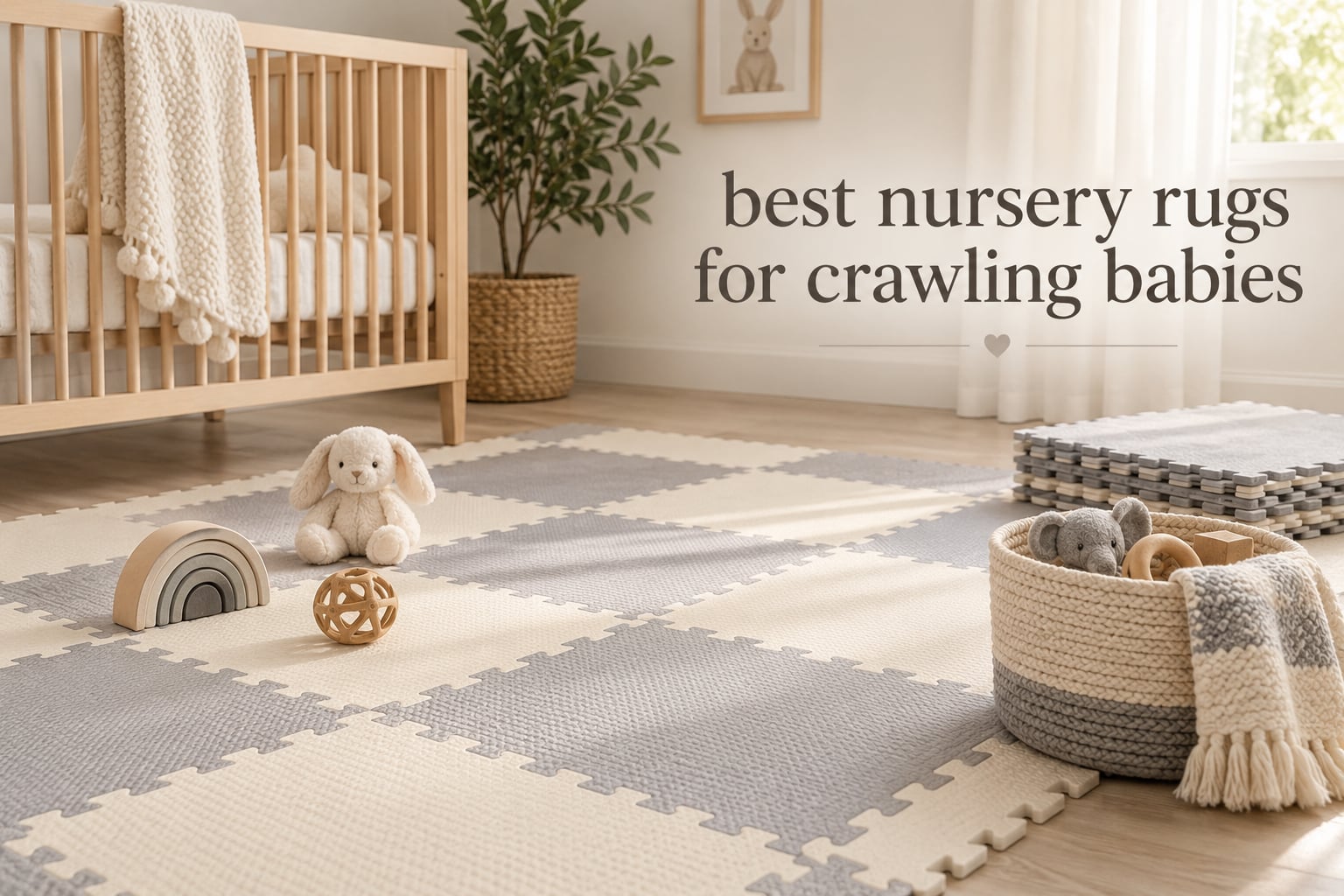
A nursery floor covering for a crawling baby has to do two jobs at once: feel soft under bare knees, palms and a tummy-time chin, and stay put on the floor when your baby pulls up on it. Most of the rugs sold for nurseries fail one of those tests. Shag and high-pile options swallow tiny fingers, woven wool weathers slowly, and a hard slide under a cruising baby is how most playtime tumbles start.
That is why the best nursery rugs for crawling babies in 2026 are increasingly cushioned play mats rather than traditional rugs. Foam and memory foam mats give you a measurable layer between your baby and the floor, they wipe clean after a bottle spillage, and they arrive without a chemical story you have to dig for. Every pick below is a mat built for the crawling-to-cruising stage, and each one is listed with the same attributes so you can compare them honestly: thickness, coverage, washability, grip, and what certifications the listing actually claims.
I spent weeks reading the customer reviews on all twelve of these mats with the same three questions: does it stay flat under a moving baby, does it come back after a spill, and does it survive being washed or wiped hundreds of times. The ratings and review counts below are the current ones on the product pages, so you can see how much history each one has behind it. If you have hardwood floors and are still furnishing the room, our nursery glider picks cover the chair side of the same setup.
Table of Contents
Top 3 Best Nursery Rug Picks for Crawling Babies in 2026
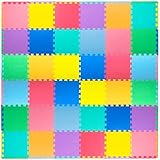
ProSource Interlocking Foam Tiles
- 36 tiles covering 6 x 6 ft
- Phthalate-free EVA foam
- Water resistant
- Wipe clean
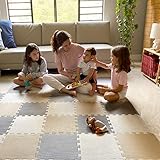
MioTetto Interlocking Foam Tiles
- 16 tiles at 0.4 in thick
- Neutral cream-grey colours
- Wipeable surface
- Fits 50x50 and 74x74 playpens
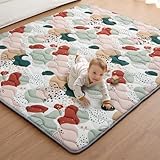
Blissful Diary Foldable Play Mat
- 71 x 59 in playpen fit
- Extra thick foam
- Non-slip dot backing
- Folds for storage
All 12 Nursery Rugs Compared Side by Side in October
| Product | Specifications | Action |
|---|---|---|
| ProSource Interlocking Foam Tiles |
|
Check Latest Price |
| MioTetto Interlocking Foam Tiles |
|
Check Latest Price |
| Blissful Diary Foldable Play Mat |
|
Check Latest Price |
 UANLAUO Extra Large XPE Mat UANLAUO Extra Large XPE Mat |
|
Check Latest Price |
 VIVIDVIBEBEARPAS Foldable Foam Mat VIVIDVIBEBEARPAS Foldable Foam Mat |
|
Check Latest Price |
 Infantino Reversible Foam Mat Infantino Reversible Foam Mat |
|
Check Latest Price |
 Nuby XXL Foldable Play Mat Nuby XXL Foldable Play Mat |
|
Check Latest Price |
 Huloo Sleep 1.3 Inch Memory Foam Mat Huloo Sleep 1.3 Inch Memory Foam Mat |
|
Check Latest Price |
 Vibe Bear 71 x 59 Washable Mat Vibe Bear 71 x 59 Washable Mat |
|
Check Latest Price |
 Hakuna Matte CloudSoft Mat Hakuna Matte CloudSoft Mat |
|
Check Latest Price |
 XVISHX Waterproof XPE Mat XVISHX Waterproof XPE Mat |
|
Check Latest Price |
 NOONKTY 79 x 71 Sensory Play Mat NOONKTY 79 x 71 Sensory Play Mat |
|
Check Latest Price |
1. ProSource Interlocking Foam Tiles – the largest tile coverage
ProSource Play Mat, Soft Foam Floor Tiles for Kids, Interlocking EVA Panels for Playpen Use, Crawling Development Surface, Safe Non-Toxic Toddler Flooring, 36 Tiles, Multicolor
36 interlocking EVA tiles
Covers 6 x 6 ft
Phthalate-free foam
5.6 lb total
Pros
- Widest tile coverage in the roundup at 36 sq ft
- Water resistant and easy to wipe
- Interlocking edges let you resize it any time
- Phthalate-free EVA foam
- Limited lifetime warranty
Cons
- Tiles can separate with heavy foot traffic
- Colours fade over years of use
- Seams read as ridges under bare knees
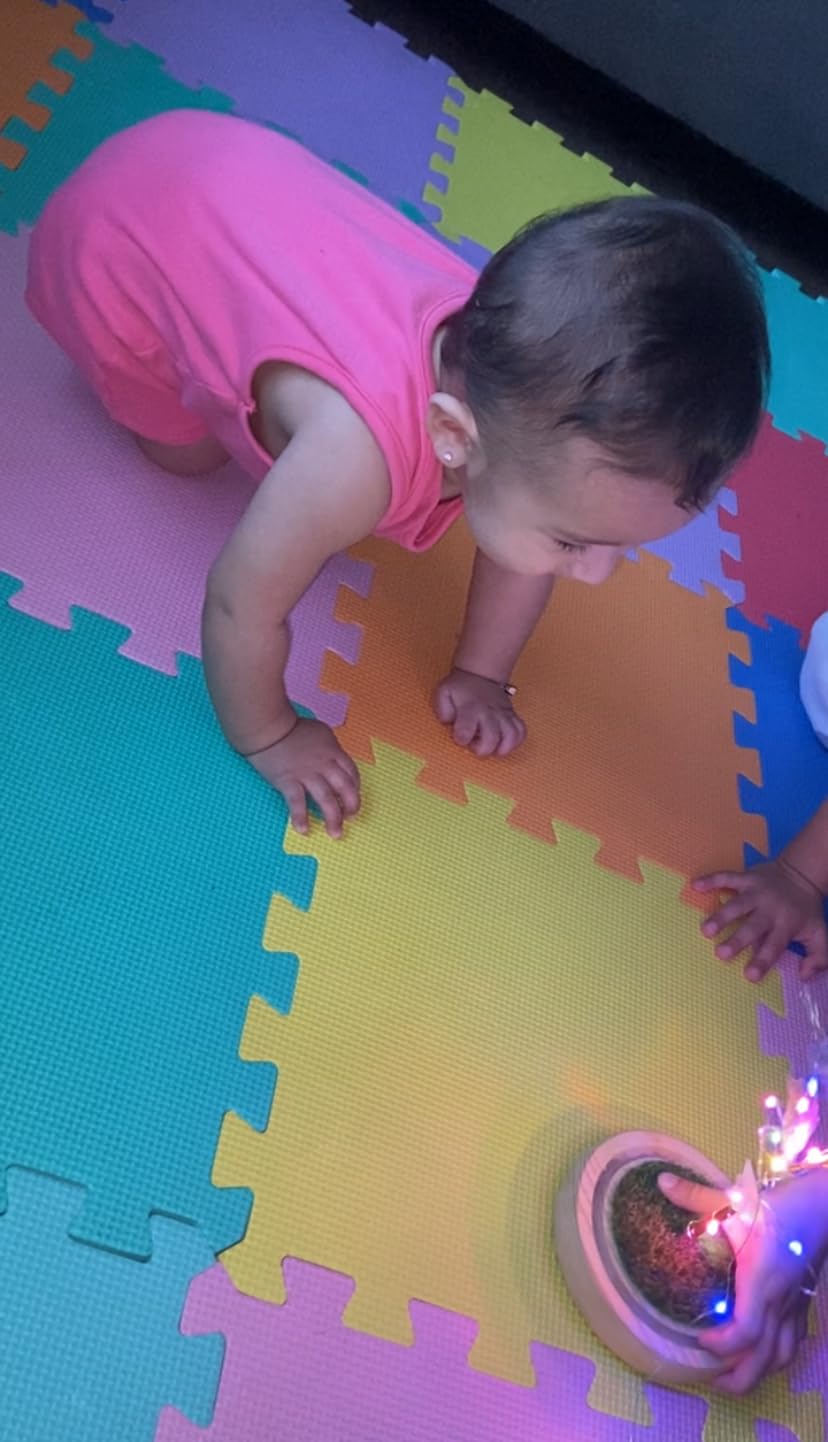
The ProSource tile mat is the one I keep coming back to because of raw coverage. Thirty-six interlocking twelve-inch squares build out into a six-by-six-foot area, and because the layout is modular you can grow it or shrink it, which no single panel here lets you do.
Assembly is genuinely satisfying. Edge pieces finish the border so the mat has a clean outline, and you can pull a few tiles out when you need a smaller footprint for a nap corner. Each piece is soft EVA foam with a textured top, and the listing states the material is free from harmful phthalates.
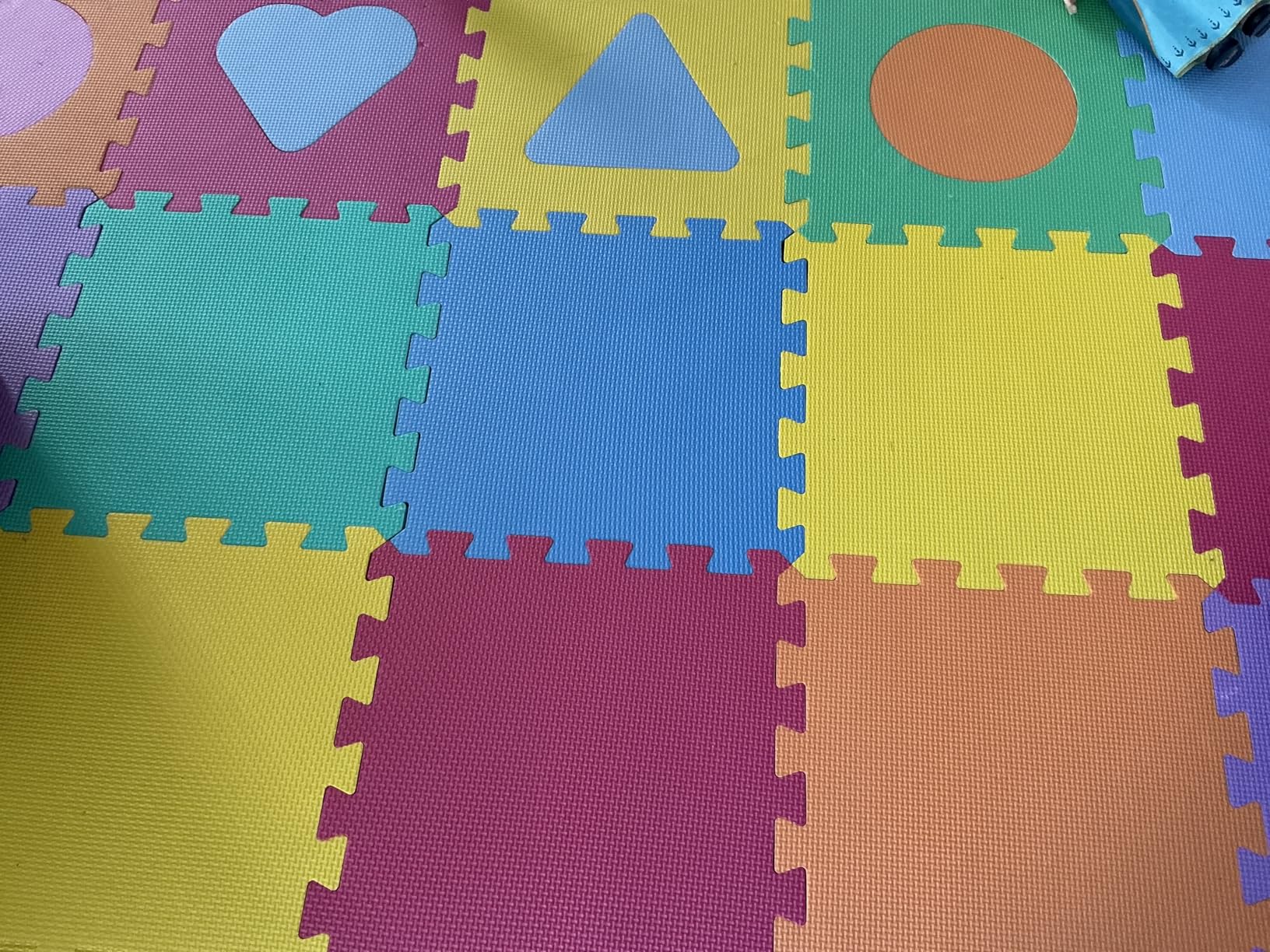
The catch is the thickness. At roughly a tenth of an inch, these tiles are noticeably thinner than the padded mats further down this list. On carpet that is plenty. On hardwood or tile, I would put down a thin foam underlay first if your baby is dropping from standing height onto the mat.
Water resistance is the other strength here. A wipe with a damp cloth is enough for almost anything a bottle or a nappy throws at it, and the foam does not absorb liquid the way a fabric playpen pad does. Colour is the most divisive feature, and reviewers report the bright primary palette works well for toddlers who like visual stimulation but blends with nothing.
Why it works for a crawling baby
Interlocking tiles are the only format here you can grow into. Start with four tiles for tummy time on the living room floor, add twelve more when the crawling starts, and you never have to buy a second mat. The edges lock tight enough that a baby hauling herself up does not lift the mat.
Because the foam is dense and closed-cell, there is no loose fibre for a mouthing baby to swallow, and nothing sheds into a toy bin. It carries a limited lifetime warranty, which is unusual in this category.
Where it falls short
Reviewers are candid that tiles can separate after months of heavy foot traffic, and the seams between panels create a ridged surface that some babies dislike on their knees during the early crawling months. If your floor is hard and your baby is already pulling to stand, this is a comfort mat more than a fall-protection mat.
Over a few years the colours fade, which is fine for a play surface and not fine if you wanted the mat to double as decor.
2. MioTetto Interlocking Foam Tiles – neutral colours, customisable size
MioTetto Baby Play Mat, Soft Foam Floor Tiles for Kids. Adjustable Interlocking Foam Tiles, Fits with 50×50 Playpen Baby mat for Crawling & Development, Safe & Non-Toxic Playmat for Babies 6-12 Months
16 EVA tiles
0.4 in thick
48 x 48 in assembled
Wipe clean
Pros
- Cream-grey palette fits neutral nurseries
- Customise the footprint tile by tile
- Waterproof surface wipes down fast
- At 0.4 in it is far thicker than basic tile mats
- Single tiles can be replaced if damaged
Cons
- Light tiles show dirt over time
- Can slide on carpet without an underlay
- Assembled size runs smaller than the playpen in some cases
The MioTetto tiles solve the aesthetic problem that most foam tiles create. Where the ProSource set is a block of saturated primary colour, this one is cream and grey, the kind of palette that looks deliberate in a room you also want to read books in.
Sixteen squares of twelve-point-four inches assemble to about forty-eight inches square, and the tile geometry is designed to sit under common fifty-inch and seventy-four-inch playpens. That compatibility matters more than it sounds, because a mat that is a few inches short leaves a bare strip where a cruising baby will find the floor edge first.
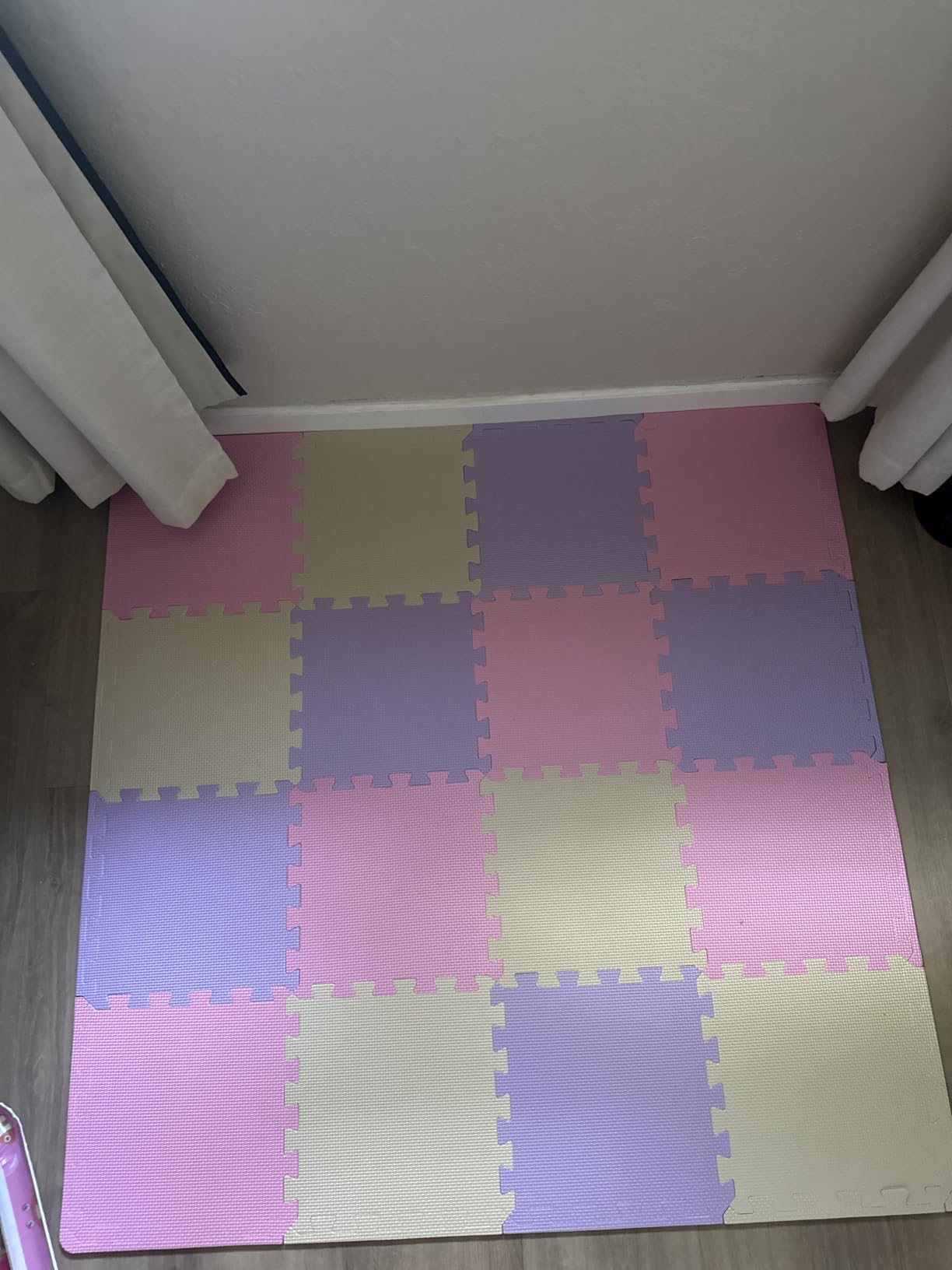
Thickness is the real upgrade here at roughly four tenths of an inch, which is four times the ProSource panel. That extra depth is what stops a hard floor from registering through every knee strike, and it is still thin enough that the baby feels the floor temperature through it.
The surface is waterproof, so a wipe with a damp cloth handles formula, breast milk and the usual spills. It is also reversible in effect, since the neutral scheme means you do not have to think about which way up it goes.
Why it works for a crawling baby
Neutral colour removes the biggest objection parents raise about foam play mats, which is that they look like a gym. This one reads as a piece of the room, so it can stay down when the baby moves from a playpen to open-floor practice.
Individual tiles can be swapped out rather than replacing the whole set, which quietly extends its life in a home where the mat takes daily punishment.
Where it falls short
Light cream tiles show dirt, and reviewers note that a year of daily crawling leaves them visibly grubby in a way a darker mat would not. On carpet the set can slide as a unit, so a non-slip pad underneath helps if you move it between rooms.
Some buyers find the assembled footprint slightly smaller than they expected once the edges are seated, so measure your playpen before you commit.
3. Blissful Diary Foldable Play Mat – thick cushioning at playpen size
Blissful Diary Baby Play Mats for Floor, 71×59 Inch Thicker Foam Playmats for Babies and Toddlers, Soft Cushioning Baby Crawling Mat, Modern Abstract
71 x 59 in single panel
Extra thick foam
Non-slip dot backing
Folds with carry bag
Pros
- Thicker than standard play mats for real cushioning
- Drop-in size for a standard playpen
- Folds flat for storage in a cupboard
- Doubles as nursery decor with an abstract print
- Wipe-clean waterproof surface
Cons
- Arrives compressed and takes time to expand
- Heavier than tile mats to move
- Print is limited to one pattern
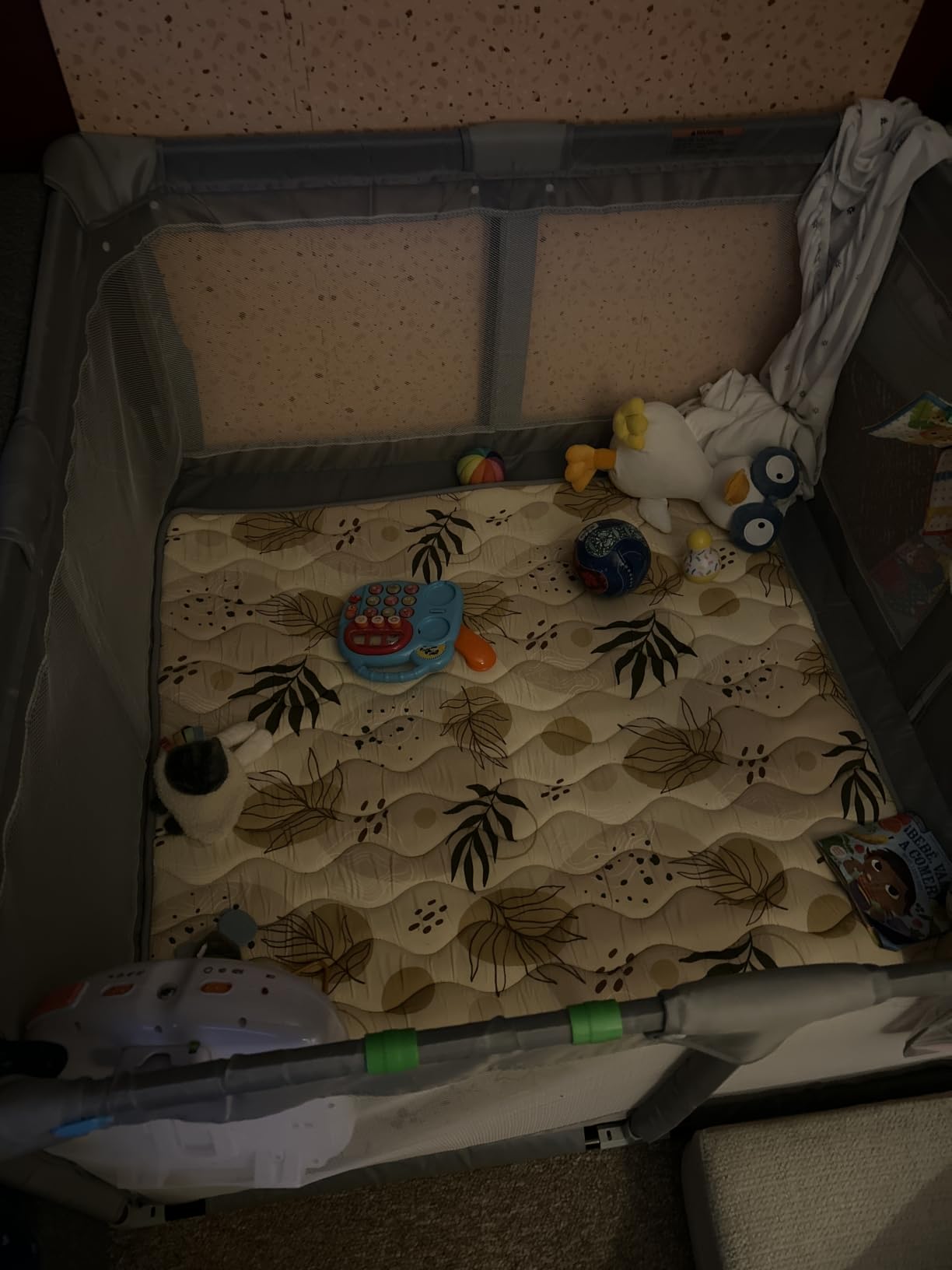
The Blissful Diary mat is the first single-piece option that solves both problems at once. Seventy-one by fifty-nine inches matches the inside dimensions of a standard playpen, so it drops straight in without the trimming that tile mats never need but often leave behind.
What separates it is cushioning. The listing describes the foam as thicker than standard play mats, and buyers consistently mention the difference when their baby goes from crawling to dropping from standing height. Combined with a non-slip dot pattern on the underside, it holds position on a hard floor without an added pad.
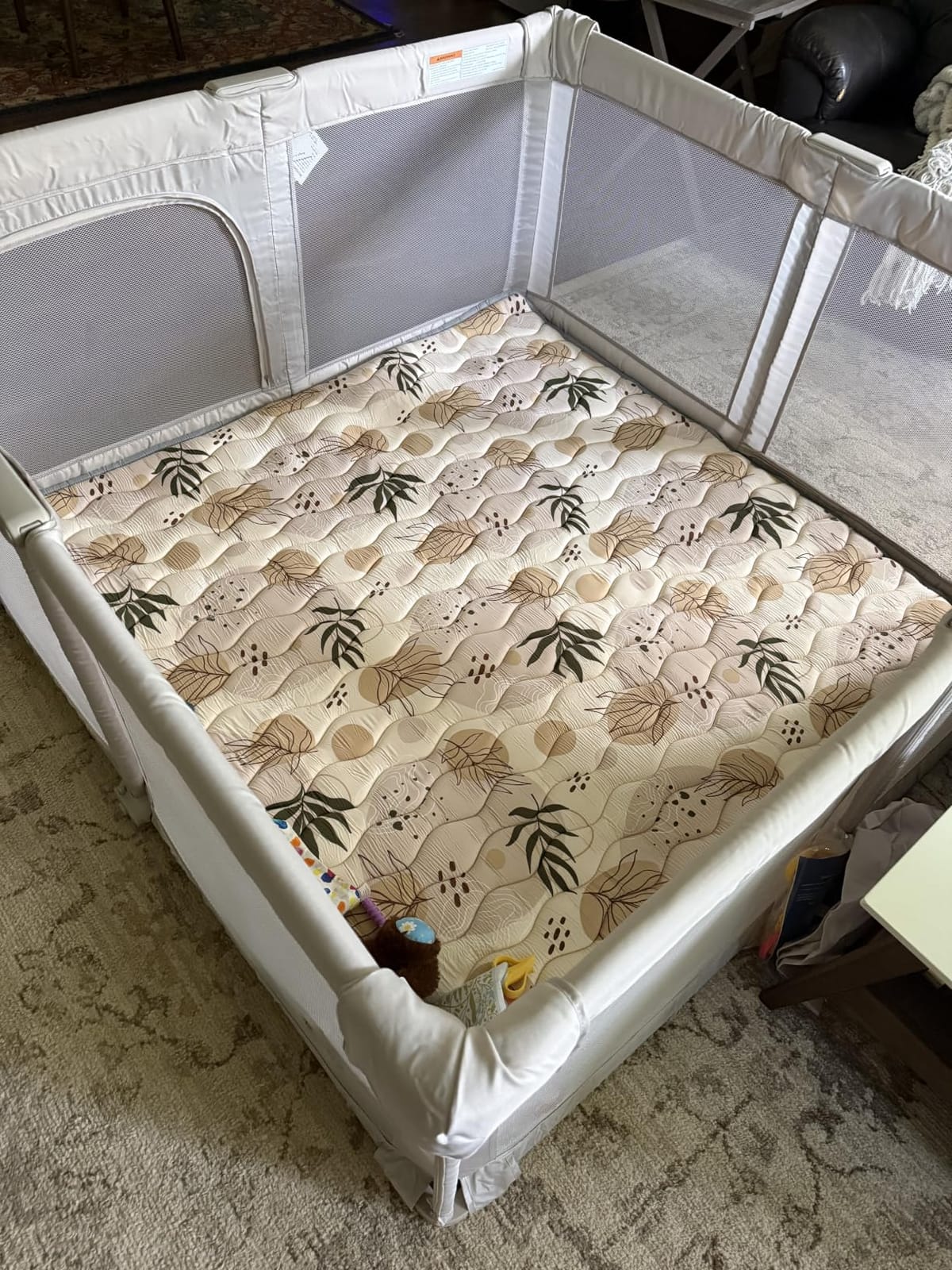
It folds down for storage, which matters more than it sounds. A nursery that has to double as a storage room on most days is the usual reason people abandon play mats, and this one collapses to roughly the size of a folded pushchair.
The abstract boho print is the quiet win. It is the kind of pattern that stays out once the baby outgrows the playpen and gets folded into the corner of a reading nook.
Why it works for a crawling baby
Drop-in sizing means no gaps. A baby who crawls to the edge of the mat finds more mat, not floor, which removes the most common reason babies stall halfway through a session.
The cushioned build and grip backing together make it a reasonable surface for the pulling-up-to-stand stage, when most thin mats become decorative rather than protective.
Where it falls short
It arrives compressed, and reviewers report needing a few days before the foam reaches full thickness. Plan for it to sit flat and unused for the first week if you are setting it up before birth.
As a single panel it cannot be resized, and buyers wanting a smaller footprint for a travel nap setup will find no way to trim it.
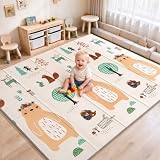
4. UANLAUO Extra Large XPE Mat – maximum floor coverage
UANLAUO Foldable Baby Play Mat for Floor, 79×71 Extra Large Baby Floor Mat for Crawling, Reversible Waterproof & Non-Toxic Baby Foam Playmat, Baby Play Mat for Babies, Infants & Toddlers 6-12 Months
79 x 71 in
0.4 in XPE foam
Reversible design
Waterproof top layer
Pros
- One of the two largest panels in the roundout at 79 x 71 in
- Reversible with a different animal pattern per side
- Textured surface gives grip for early walkers
- Waterproof top layer wipes clean
- Light enough to move between rooms
Cons
- XPE foam punctures from pet claws or sharp edges
- Textured top traps debris in the grooves
- Fold creases take time to relax
When floor space is the problem, footprint wins. Seventy-nine by seventy-one inches matches the largest single panels here, sized to fit most large playpen setups without the dovetailing that tile mats need.
XPE foam behaves differently from the EVA used in cheaper tile mats. It is a closed-cell material that resists puncturing better and does not compress into a flat pancake as quickly, and the listing describes it as high density at roughly four tenths of an inch thick.
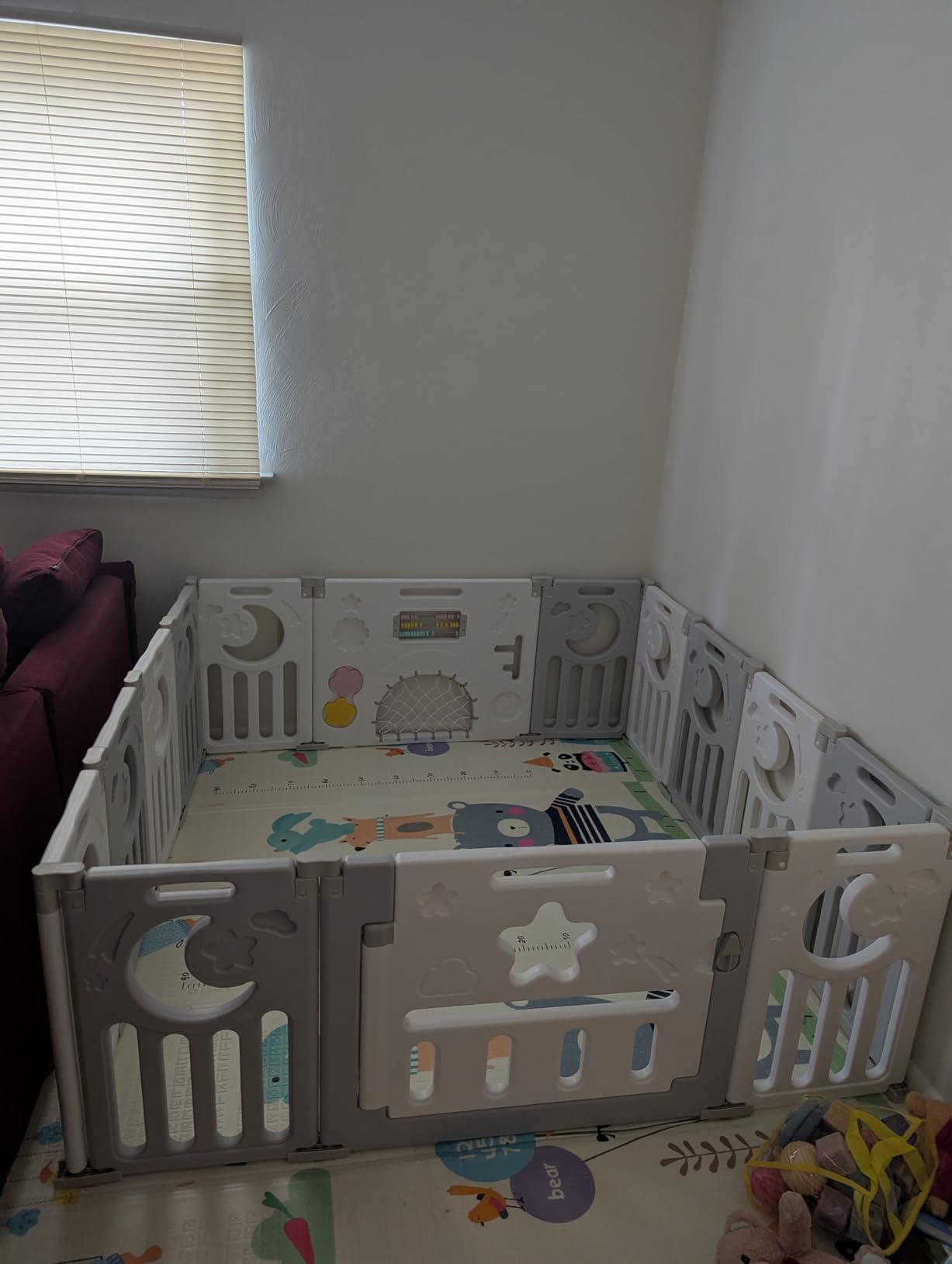
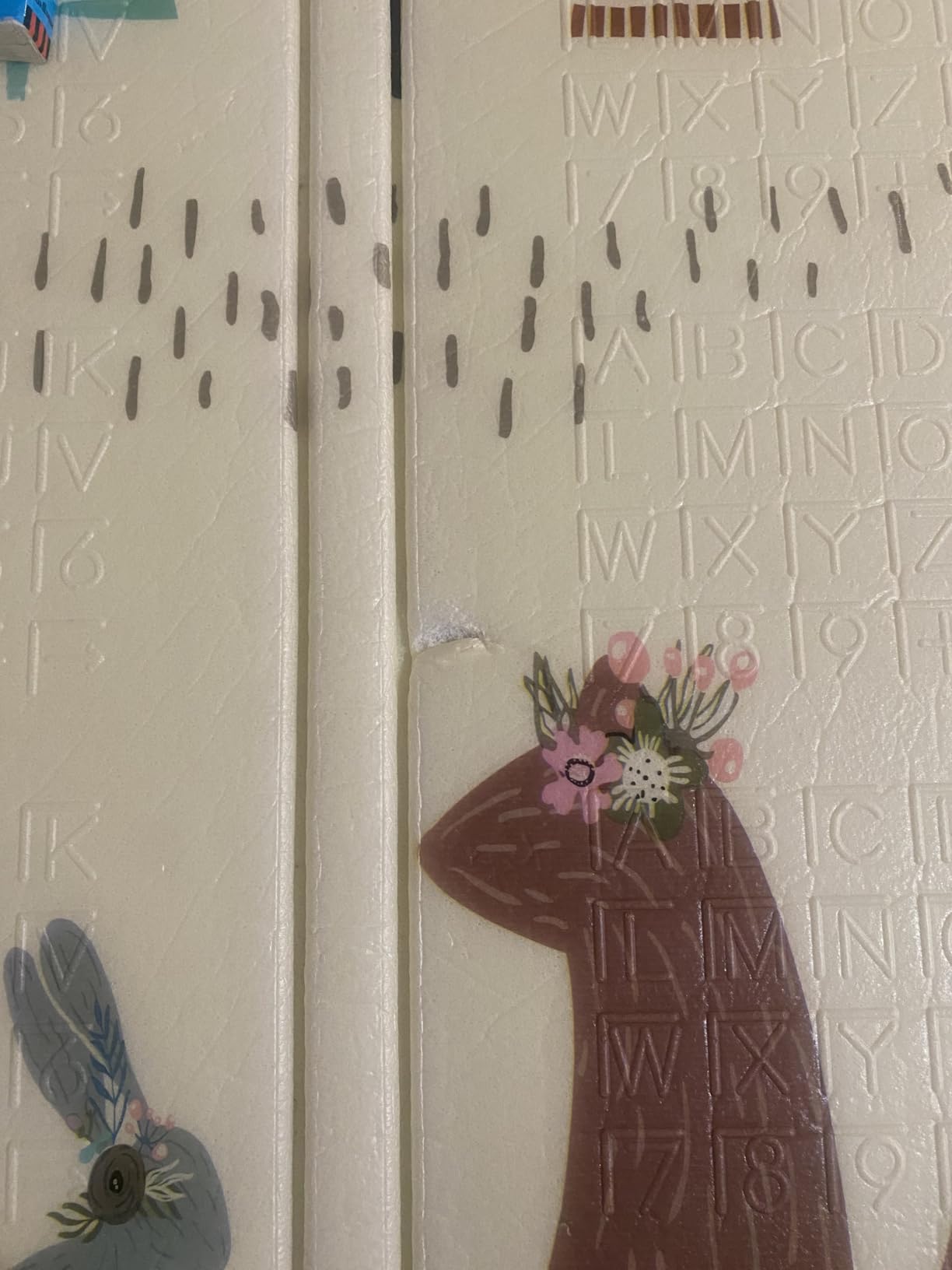
The reversible design is more useful than it looks. One side carries an animal pattern, the other a different one, so a single mat serves a baby who has just moved past black-and-white contrast and one who is now obsessed with naming animals.
The textured top is intended as grip, which is genuinely helpful once your baby is walking rather than crawling. It gives a bare foot or a pyjama sole something to catch on.
Why it works for a crawling baby
A footprint roughly double a fifty-inch square means long crawling sessions without you repositioning the mat. In a small nursery that is the difference between practice time and five minutes of it.
Waterproofing is complete on the top layer, so spills wipe off rather than soaking in, and the fold-flat design means it disappears into a closet between sessions.
Where it falls short
Buyers with cats or dogs warn explicitly against this mat. XPE punctures readily from claws, and a punctured foam panel cannot be repaired.
The textured grip surface that helps walking also traps crumbs and grit in the grooves, which makes a deep clean a slow job. Fold creases can take a while to relax out of the foam.
5. VIVIDVIBEBEARPAS Foldable Foam Mat – best washable budget pick
50″ x 50″ Foldable Baby Play Mat, Odorless Premium Foam Microfiber Floor Mat, Hypoallergenic Non‑Slip Washable for Infants Toddlers, Playpen, Tummy Time & Travel
50 x 50 in
Machine washable
Diamond non-slip backing
Phthalate and lead free
Pros
- Machine washable on a gentle cycle
- Non-slip diamond-textured backing
- Phthalate-free and lead-free build
- Odourless so no off-gassing wait
- Fits most playpen sizes
Cons
- Thinner than premium foam mats
- Foam density lower than higher-priced rivals
- Runs short of some playpen sizes
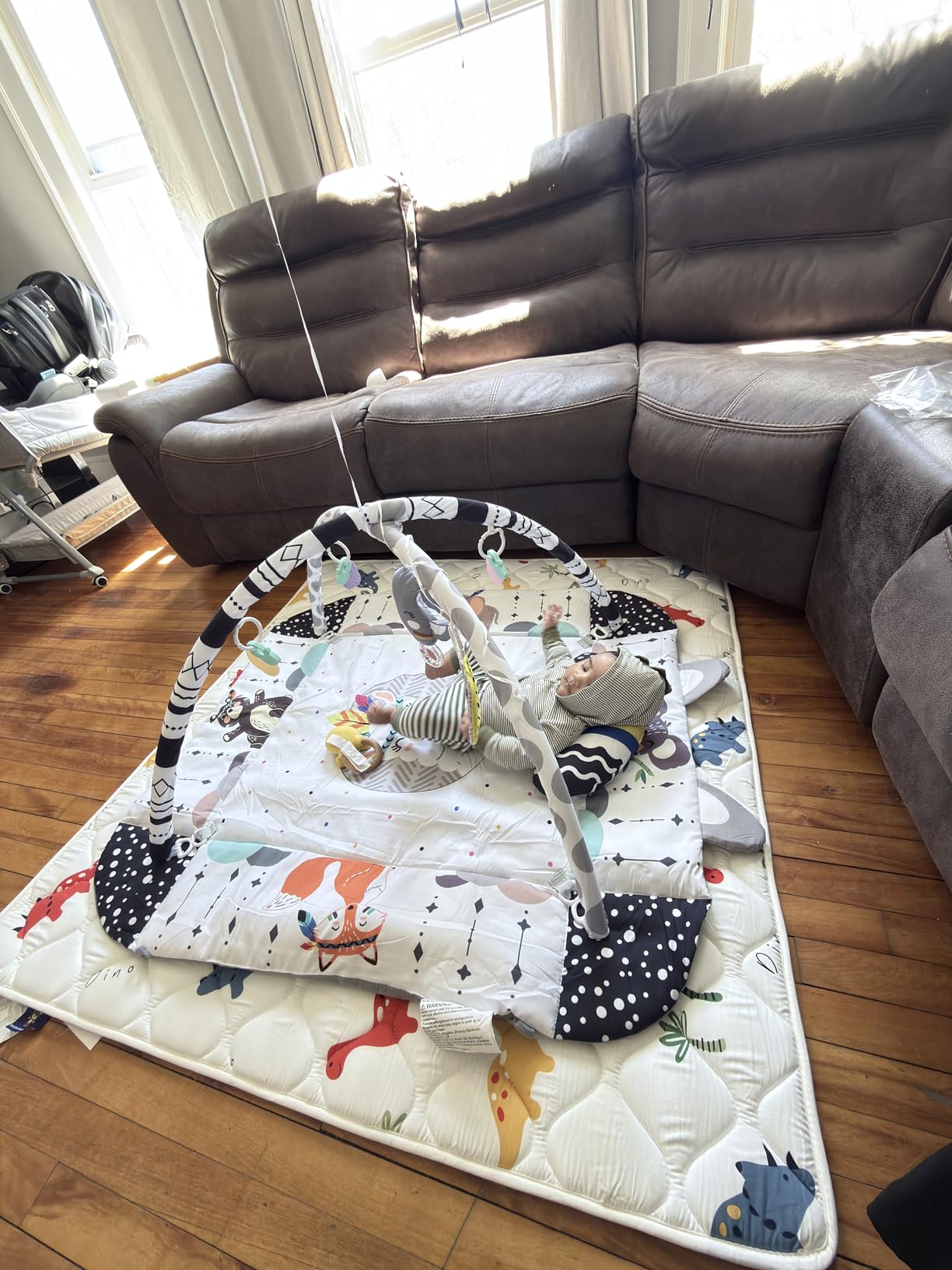
Washability is what separates this from every other mat in the roundup apart from the Vibe Bear panel further down, and it is the feature parents ask for most once a baby is on solids. This one goes into a domestic washing machine on a gentle cycle, which means a full wipe-down is not the ceiling of what you can clean.
The listing states it is phthalate-free and lead-free and tested against CPSIA safety standards, plus an odourless build. That last point is worth pausing on, because a foam product that arrives without a chemical smell removes the off-gassing anxiety most new parents bring to a nursery.
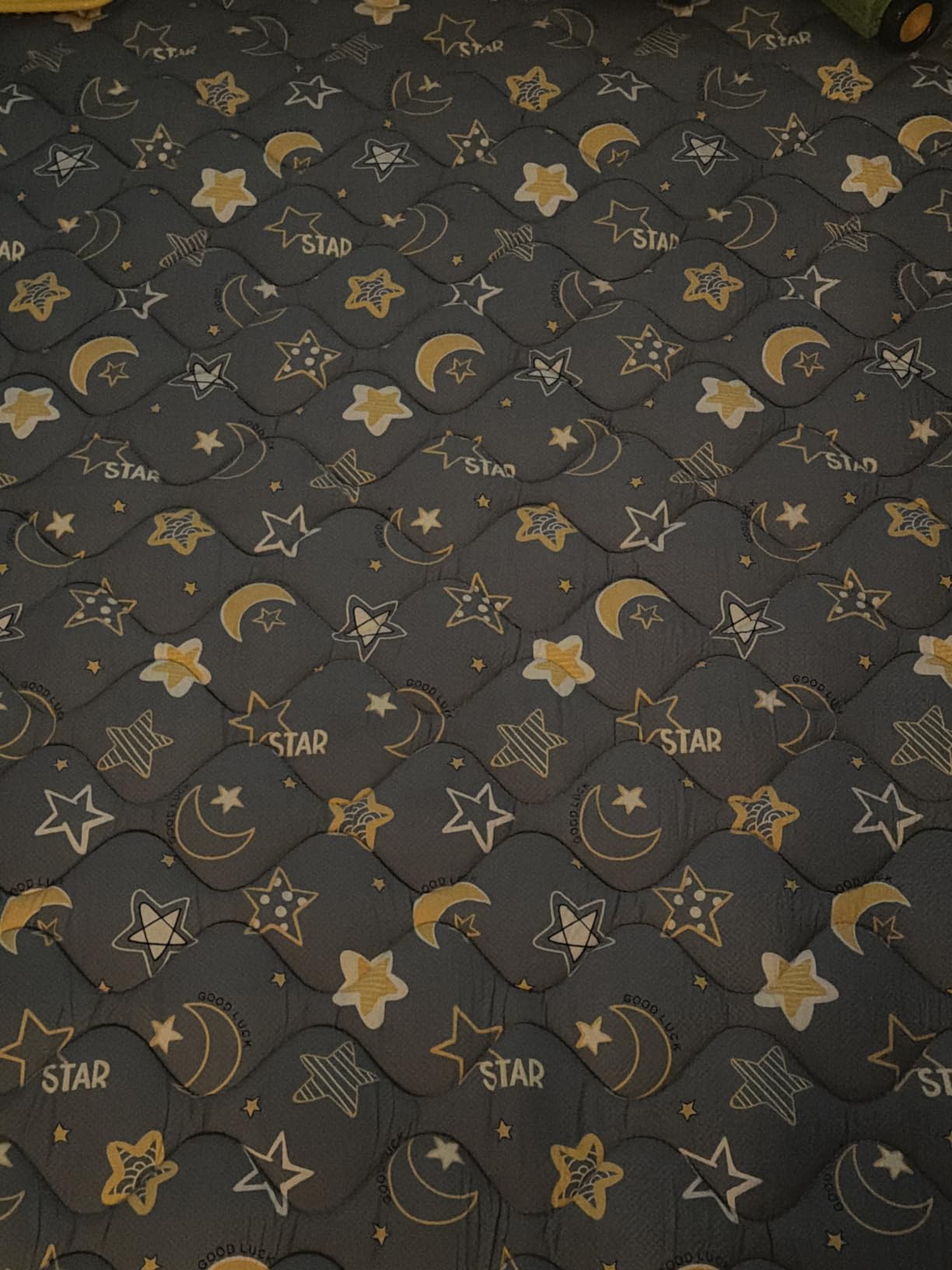
Grip comes from a diamond-textured backing rated to hold the mat in place, and the foam itself is described as absorbing noticeably more impact than a standard mat for the same footprint. The fifty-inch square fits most playpens as a drop-in base.
It folds small enough to travel, which makes it the one to take to a grandparents’ house if you want a familiar crawling surface rather than whatever is under the carpet there.
Why it works for a crawling baby
Being able to wash the mat removes an entire category of worry. Spilled milk, puréed food and nappy leaks are parts of the job in the first year, and a washable surface means you never have to scrub a stain out of fabric by hand.
Hypoallergenic and phthalate-free claims are unusually specific for this price point, and they matter more in a room where your baby spends most of the day face-down on the surface.
Where it falls short
It is thinner than the premium padded mats, and buyers on hard tile floors specifically note needing to layer it for real cushioning. Foam density is lower than premium brands, so it is a crawling and tummy-time surface first.
Fifty inches is the smallest of the washable options here, so check your playpen’s internal measurement before buying.
6. Infantino Reversible Foam Mat – folds into a contained play area
Infantino Foldable Foam Play Mat Reversible 57×57 in, Multicolor
57 x 57 in foam
Reversible sides
Water-resistant surface
Folds up into a play area
Pros
- Folds up at the edges to create a contained play area
- Reversible design gives two looks
- Long-standing baby brand with safety focus
- Lightweight and easy to reposition
- Wipe-clean water-resistant surface
Cons
- Foam compresses over time with heavy use
- Side straps and buckles are fiddly to work
- Slides on hard floors without a pad
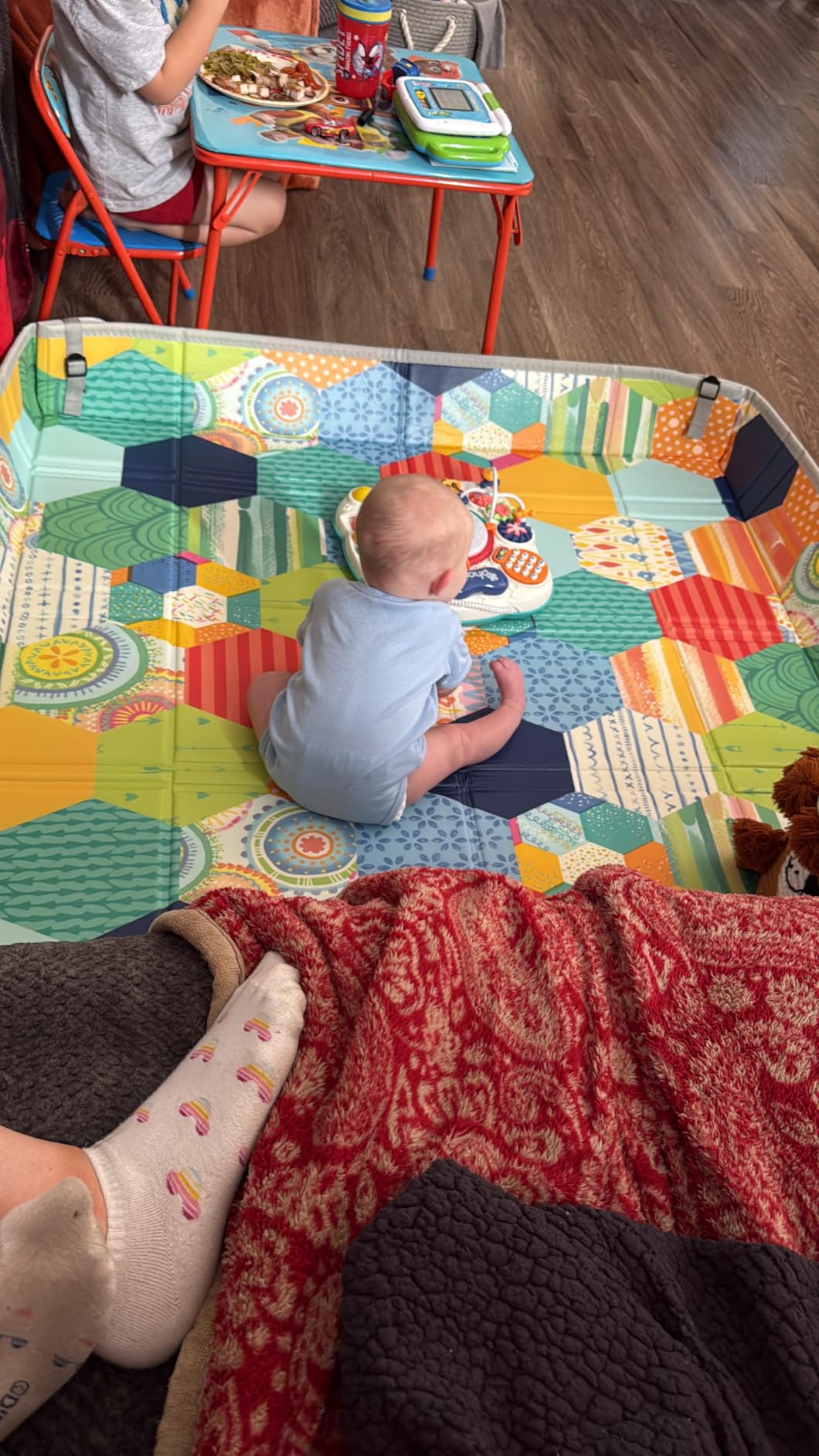
This is the only mat here that turns into a contained play area with nothing extra to buy. Fold the edges up and buckle the straps, and the fifty-seven-inch square becomes a contained area for a baby who has learned to crawl and now treats every room as a stadium.
Infantino is an established baby brand, and that history shows in the detail work: corner straps hold the folded walls in place, the surface is water-resistant, and the whole mat is light enough for one adult to move while holding a baby in the other arm.
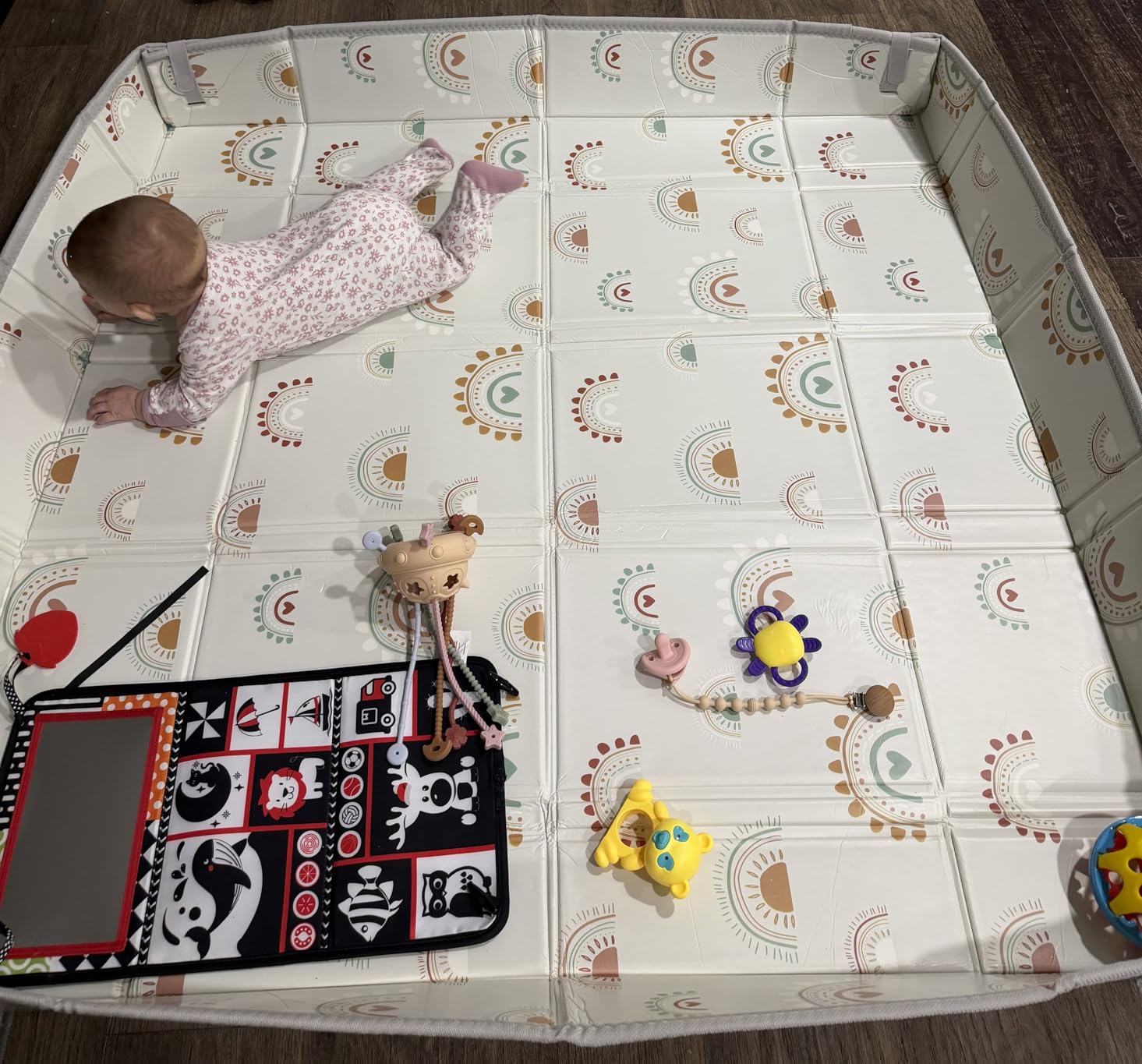
The reversible print means you get a second look from the same mat when the first pattern is retired. Nothing here needs plugging in, nothing needs assembling with tools, and it folds down for a cupboard between uses.
I would note the rating sits below the rest of this list, which usually means the design works but something in the execution disappoints. In this case the reports point at the foam and the hardware rather than the concept.
Why it works for a crawling baby
A contained edge stops a crawling baby from launching themselves across the floor, which is the specific problem parents in playpen-adjacent-floor setups complain about most. It is a self-contained solution with no separate wall purchase.
Water resistance and a wipe-clean surface make it workable for tummy time, and the flat configuration still works once your baby is past the edge-standing stage.
Where it falls short
Buyers report the foam compresses over time under daily use, which matters because you want this in place for at least a couple of years. Sliding on hard floors is a recurring comment, and the straps that create the contained area are described as fiddly.
If you already own a playpen, this solves a problem you have already solved.
7. Nuby XXL Foldable Play Mat – roomy reversible mat
Nuby Foldable Reversible Baby Play Mat, 77″ x 58″, XXL, 0M+, Car Tracks
77 x 58 in soft foam
Reversible
Suitable from birth
Wipes clean
Pros
- Very large 77 x 58 in footprint
- Reversible with a different pattern per side
- Suitable from birth through toddler years
- Folds quickly for travel and storage
- Wipes clean with a damp cloth
Cons
- Foam dents under heavy furniture legs
- Pattern choices suit playful rooms only
- Thinner than memory foam options
Nuby’s mat covers seventy-seven by fifty-eight inches, which puts it in the same coverage class as the seventy-nine-inch panels but from a brand whose entire catalogue is built around infant products rather than general baby gear.
The listing marks it suitable from birth, and buyers use it that way: as a floor mat for a newborn doing tummy time, then as the same surface eight months later when that baby is crawling the length of it. Reversibility gives you two patterns, and the fold is fast enough that it lives in a cupboard rather than a corner.
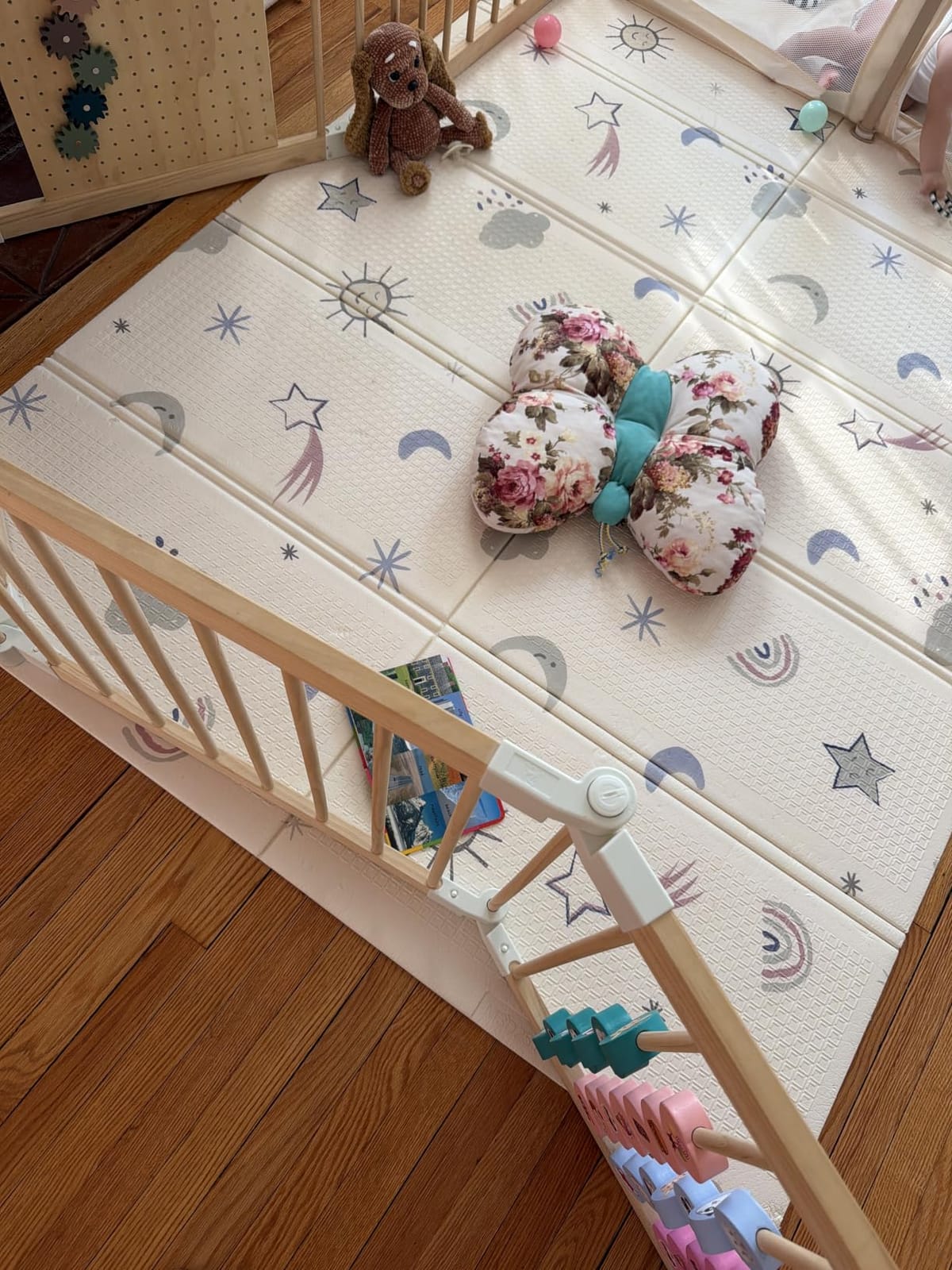
Other patterns in the range run quieter, including a grey option and one with stars and sky, which matters if the play surface is going to stay visible in a nursery you also use for changing and dressing.
Cleaning is a damp cloth. Foam without a stitched quilted cover means nothing to unzip and nothing to launder, so there is less to maintain than a fabric-faced mat.
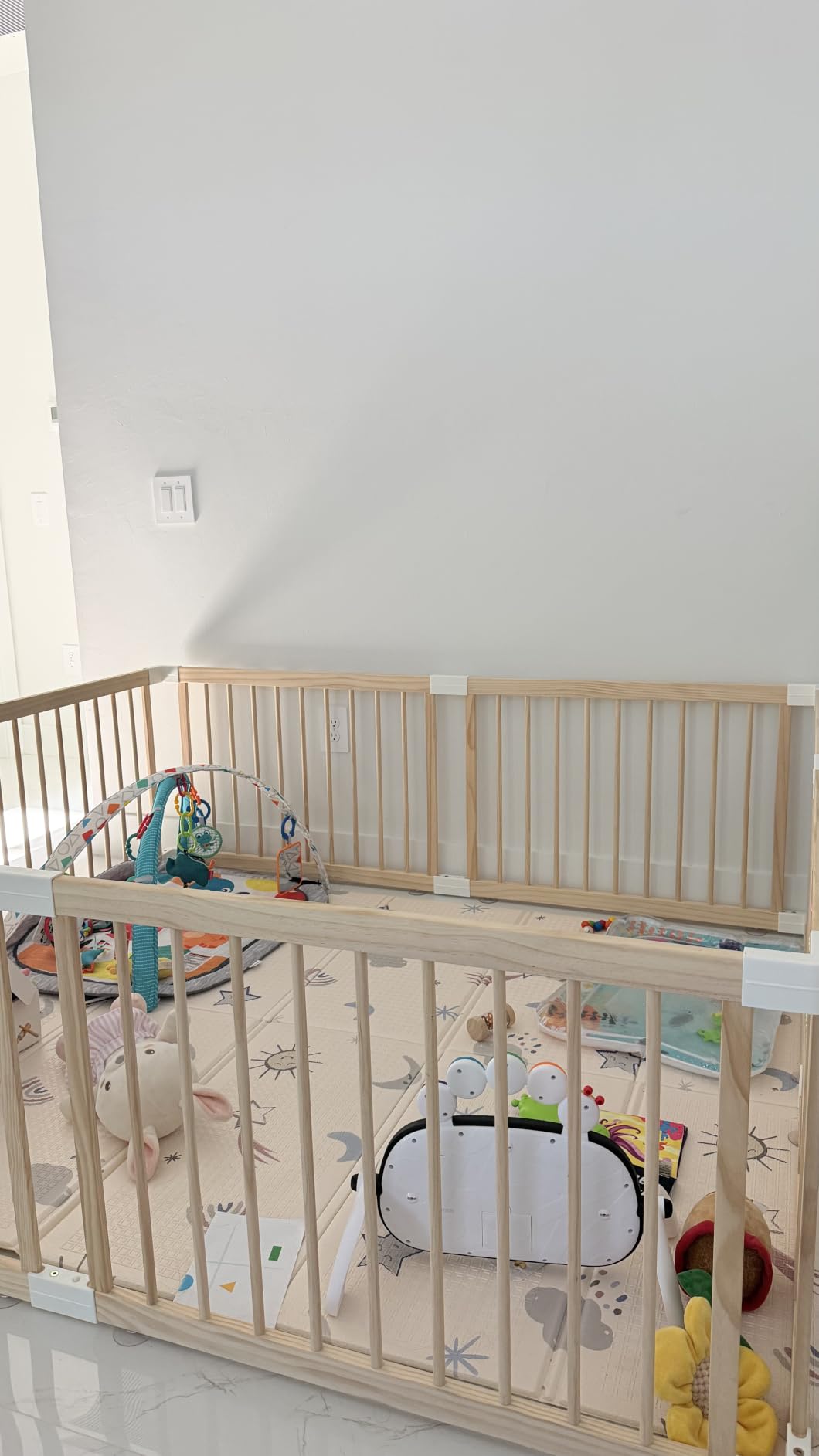
Why it works for a crawling baby
The length is the selling point. A baby crawling with intent needs run-up, and seventy-seven inches gives enough distance to practise the rocking-and-knee-lunge motion without stopping at the edge.
Starting at birth means one purchase covers tummy time, crawling and the first pulling-up attempts, which removes the reshuffle most families make twice in the first year.
Where it falls short
Foam dents under heavy furniture legs, so if you are planning to put a dresser on the mat, use felt pads or keep the furniture off it.
The playful patterns are the main visual limitation. If your nursery is neutral and this is going to stay down permanently, check the pattern against your colour scheme first.
8. Huloo Sleep 1.3 Inch Memory Foam Mat – thickest cushioning here
Baby Play Mat for Floor,1.3″ Thick Memory Foam Tummy Time Mat,Soft Coral Velvet Nursery Rug,Large Non Slip for Crawling,Toddlers,Infants,Kids,Yoga & Tatami Style for Living Room(Dark Gray)
1.3 in memory foam
Coral velvet top
OEKO-TEX fabric
Non-slip backing
Pros
- Deepest cushioning of every mat in the roundup
- Memory foam absorbs a drop from standing height
- Coral velvet surface is soft against bare skin
- OEKO-TEX certified fabric
- Water-repellent and stain resistant
Cons
- Arrives compressed and needs 3 to 7 days to expand
- Bigger sizes exceed a domestic washing machine
- Velvet holds pet odour if spills are left
If cushioning is the deciding factor, this is the clear answer. One-point-three inches of slow-rebound memory foam is roughly three times the depth of the standard foam mats in this roundup, and slow rebound means it absorbs a drop rather than passing the shock straight through to the floor.
The top is a coral velvet surface that does not shed, which matters more than it sounds: a mouthing baby on a shedding rug is a problem, and a velvet face has no loose fibres to swallow. The fabric is OEKO-TEX certified, and the mat is tested to CPSIA and ASTM standards.
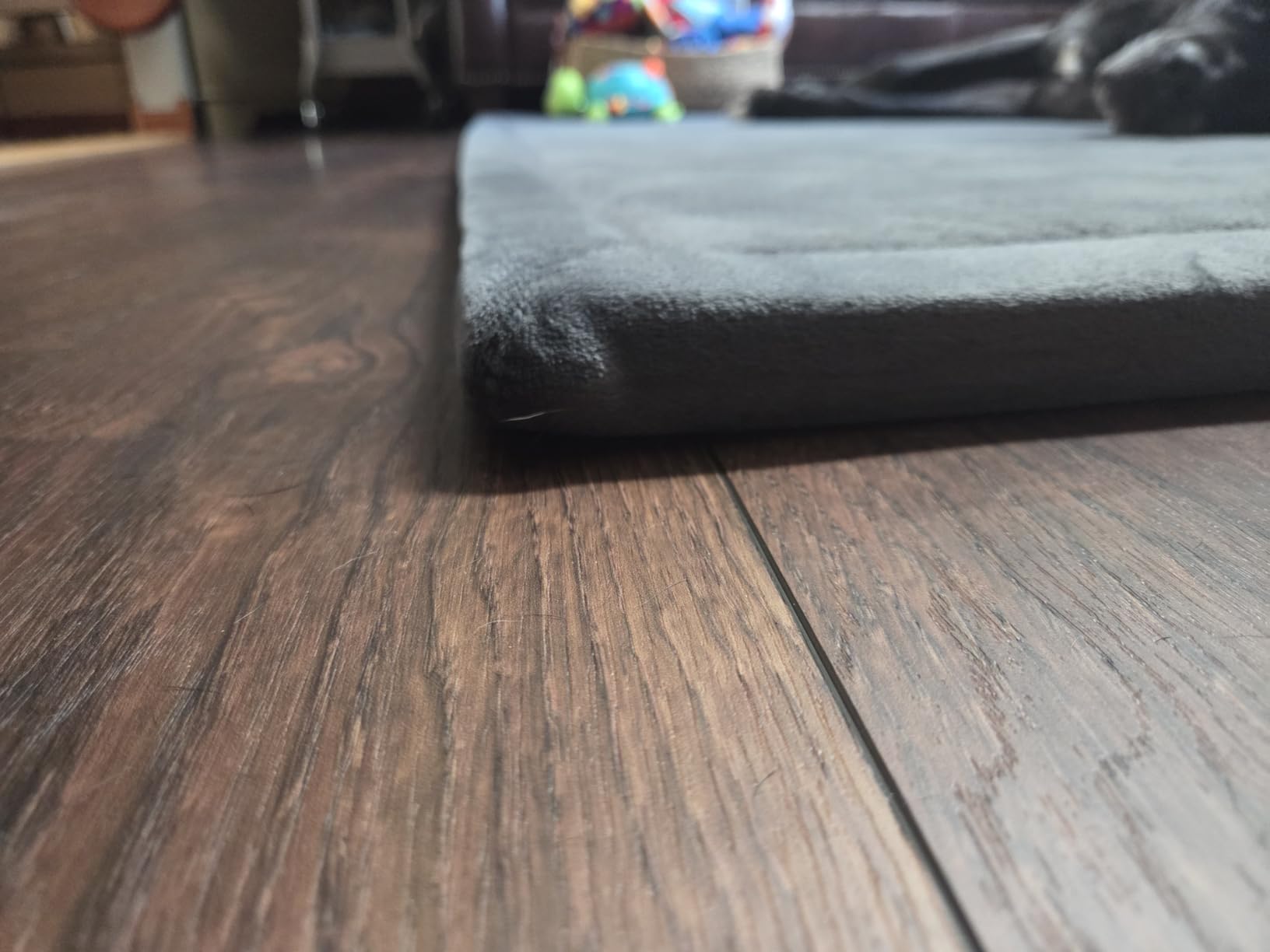
Backing is non-slip for hard floors, and the surface is water-repellent and stain resistant, so a wipe handles the usual spills. The coral velvet also stays cool to the touch, which makes tummy time more comfortable in a warm room.
Sizes run from thirty-nine by fifty-nine inches up to one hundred eighteen by seventy-nine, so you can size to your room rather than your playpen. The same panel works as a tatami-style rug, a yoga mat or a dog bed after the crawling years.
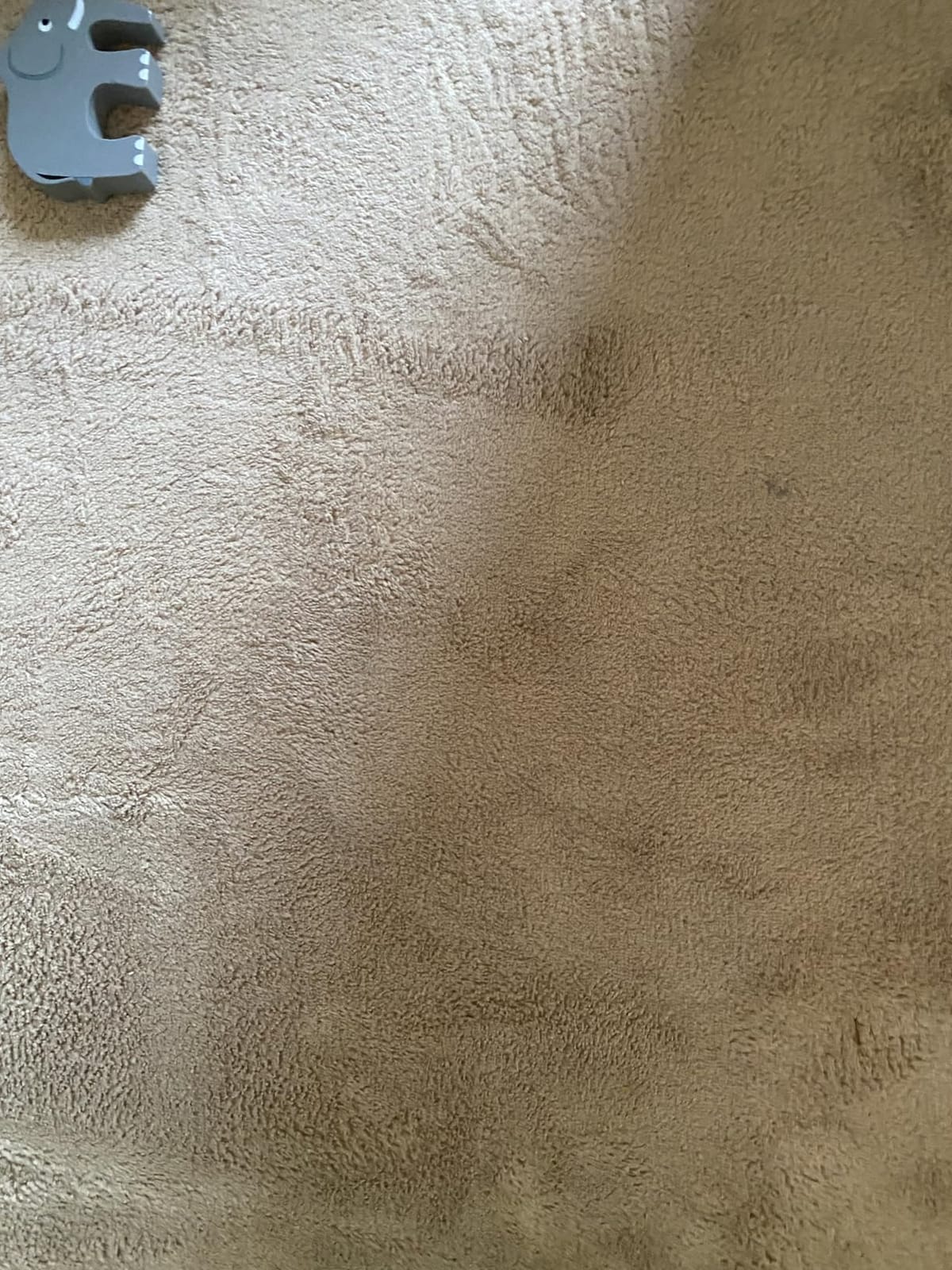
Why it works for a crawling baby
The depth is the whole argument. Once a baby pulls up on furniture and starts dropping backward onto her bottom, a flat foam mat does little for her. A memory foam layer this thick genuinely absorbs the landing, which is why this is the one I would pick for a nursery with hardwood floors.
Velvet is also cooler and less scratchy than a woven polypropylene rug, so it stays comfortable for extended floor sessions.
Where it falls short
It arrives compressed and needs three to seven days to reach full thickness, so plan for an airing-out period before use. Larger size variants will not go in a domestic washing machine, and reviewers warn that velvet can hold onto pet odour if a spill is left to dry.
At this depth it is the thickest panel in the roundup, and that extra volume is a real trade-off for a surface your baby may outgrow by eighteen months.
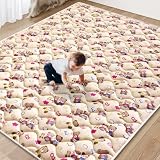
9. Vibe Bear 71 x 59 Washable Mat – large and machine washable
Baby Play Mat, 71″ X 59″ Extra Large Foldable Crawling Floor Mat for Playpen & Babies, Toddlers. Premium Thicker Foam playmat, Anti-Slip Soft Cushioning Padding, Machine Washable Mat
71 x 59 in
Machine washable
Cotton surface over foam
CPC certified
Pros
- Large enough to fill a standard playpen
- Machine washable with a normal gentle cycle
- Quilted build stops the filling shifting
- Anti-slip rubber dot backing
- CPC certified and lead tested
Cons
- Thinner than premium mats in practice
- Compressed packaging takes about 48 hours to recover
- Too large for a small playpen
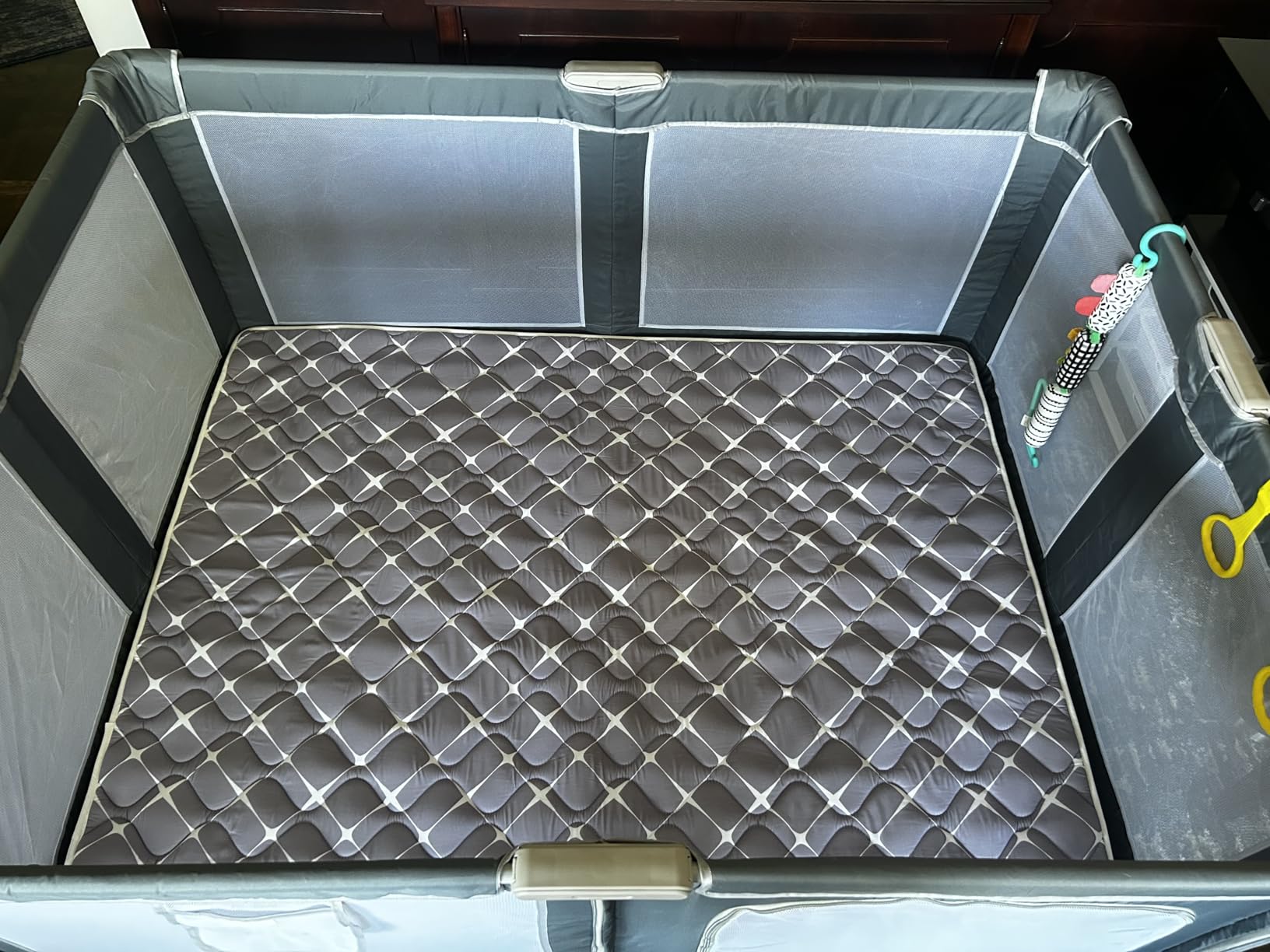
This solves the problem that makes most parents hesitate about washable mats: size. Most machine-washable options top out around fifty inches, which fits a small playpen and nothing larger. Seventy-one by fifty-nine inches fills a standard playpen and still washes in a domestic machine on a gentle cycle with low heat.
The quilted construction is the detail that sets it apart from a plain foam panel wrapped in fabric. Stitching across the fill stops it shifting toward one corner over repeated washes, which is the failure mode buyers report with cheaper washable mats.
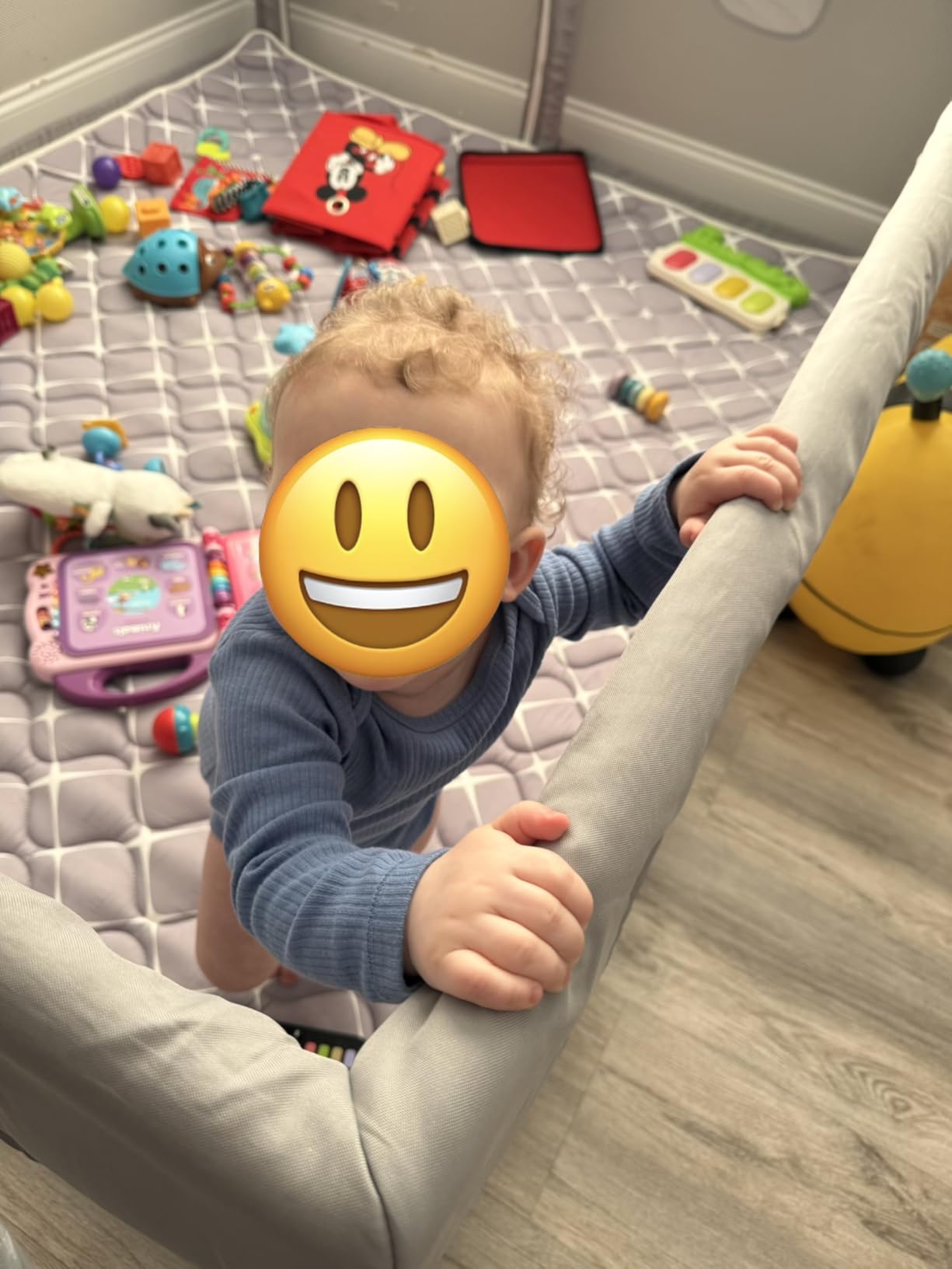
The listing states CPC certification and testing for phthalates, lead and toxicity, plus a BPA-free foam build with no odour from the packaging. That last point is practical, because a compressed foam mat that arrives smelling of chemicals needs days of airing before it goes near a newborn.
Anti-slip backing uses rubber dots, which is a quieter grip mechanism than a textured foam face and does not trap crumbs.
Why it works for a crawling baby
Cotton over foam gives you a warm, breathable surface that is far more comfortable for long tummy-time sessions than bare EVA, and the quilting keeps the padding even under a shifting baby.
Machine washability at this size means a weekly routine is realistic. That single fact removes most of the anxiety about a baby who is currently in the solids-and-everything stage.
Where it falls short
Buyers report it as thinner than expected and say that on hard tile you may want two layers for real cushioning. Packaging is compressed and takes roughly forty-eight hours to recover its shape.
At seventy-one by fifty-nine inches it is too large for smaller playpens, so measure the internal floor of yours rather than the frame footprint.
10. Hakuna Matte CloudSoft Mat – styled like a real nursery rug
Hakuna Matte CloudSoft Baby Play Mat for Floor 60″ x 80″ Brown
60 x 80 in
Soft pile over foam core
OEKO-TEX Standard 100
2 year warranty
Pros
- Designed to pass as a nursery rug rather than gym equipment
- OEKO-TEX Standard 100 certified fabric
- Low pile surface stays quiet underfoot
- High-density foam recovers shape fast
- Suitable over underfloor heating
Cons
- Not water resistant so spills need prompt blotting
- Hand wash only rather than machine wash
- Low pile shows wear patterns over time
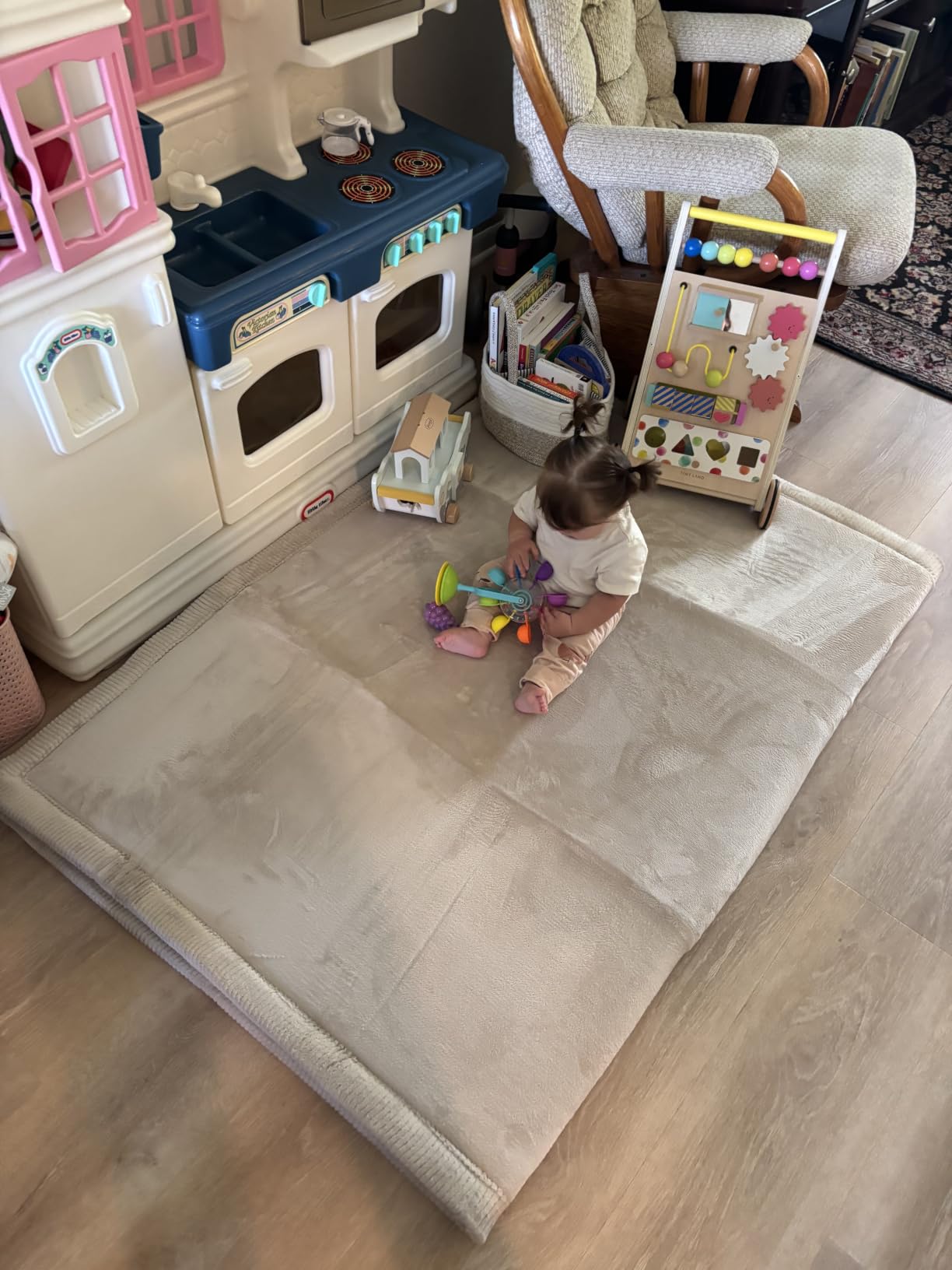
This is the answer for parents who want a nursery that looks finished. Sixty by eighty inches of soft low-pile velvet over a high-density foam core is styled as a rug, quiet underfoot, and it was designed in Germany rather than adapted from a play mat.
Certification details here are unusually concrete: OEKO-TEX Standard 100 with a certificate number on the listing, plus stated freedom from BPA, phthalates, formaldehyde and PAHs. For parents who spend their first weeks reading chemical safety pages at two in the morning, a named certificate number is worth more than a marketing adjective.
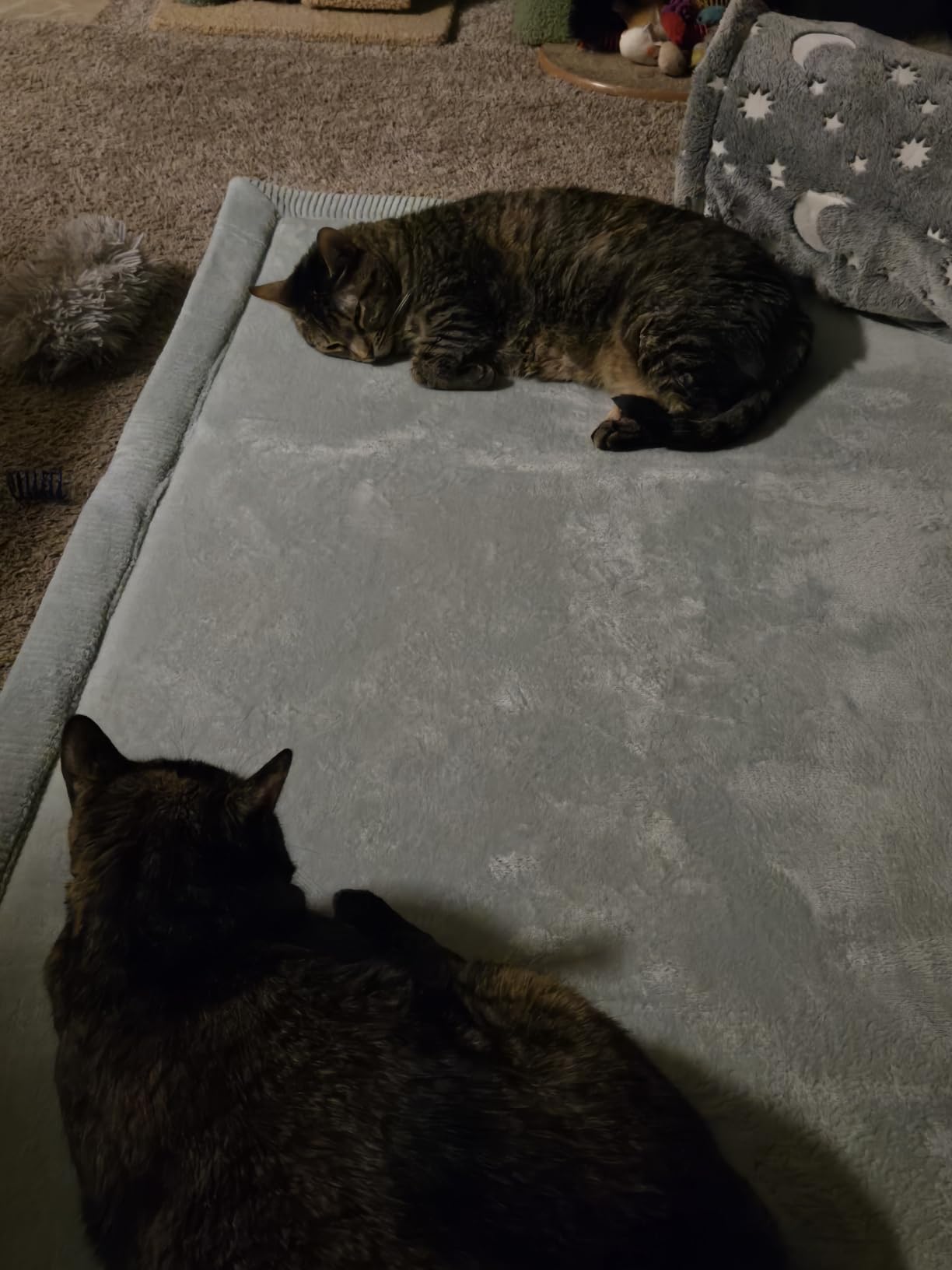
Non-slip backing keeps it in place on hard floors, and the foam is designed to recover its shape within a day or two rather than staying dented. It is also suitable over underfloor heating, which matters in a nursery in a colder climate.
Compression is deliberate here, cutting packaging emissions, and the mat carries a two-year limited warranty.
Why it works for a crawling baby
Low pile is the correct construction for this stage. There is nothing for a hand to grab, nothing to shed, and nothing that can swallow a fingertip. Velvety surface, flat profile, no loops.
The sixty-by-eighty footprint is large enough for open-floor crawling practice rather than just a playpen drop-in, which is the stage most rugs get bought for.
Where it falls short
It is not water resistant, and cleaning is hand wash at thirty degrees or a vacuum. Spills need prompt blotting, and any parent whose baby is currently eating solids on the floor should weigh that against the machine-washable picks.
Buyers also note the low pile shows wear patterns with heavy use, and this is the most design-led item in the roundup, which is a trade-off some prefer and others do not.
11. XVISHX Waterproof XPE Mat – compact and travel friendly
XVISHX Baby Play Mat, 50 x 50 Inch Play Mat Perfect for Use Baby Playpen, Foldable Baby Foam Playmat for Floor, Portable Waterproof Activity PlayMats for Babies, Infants and Toddlers
Marketed 50 x 50 in
0.4 in XPE foam
Fully waterproof
Reversible print
Pros
- Fully waterproof so liquid wipes off instantly
- Folds to a compact size for travel
- Double-sided animal patterns
- Anti-slip texture helps early walkers
- Odourless and BPA-free
Cons
- Measures smaller than the advertised size
- Only 0.4 in thick on hard floors
- Foam dents permanently under furniture
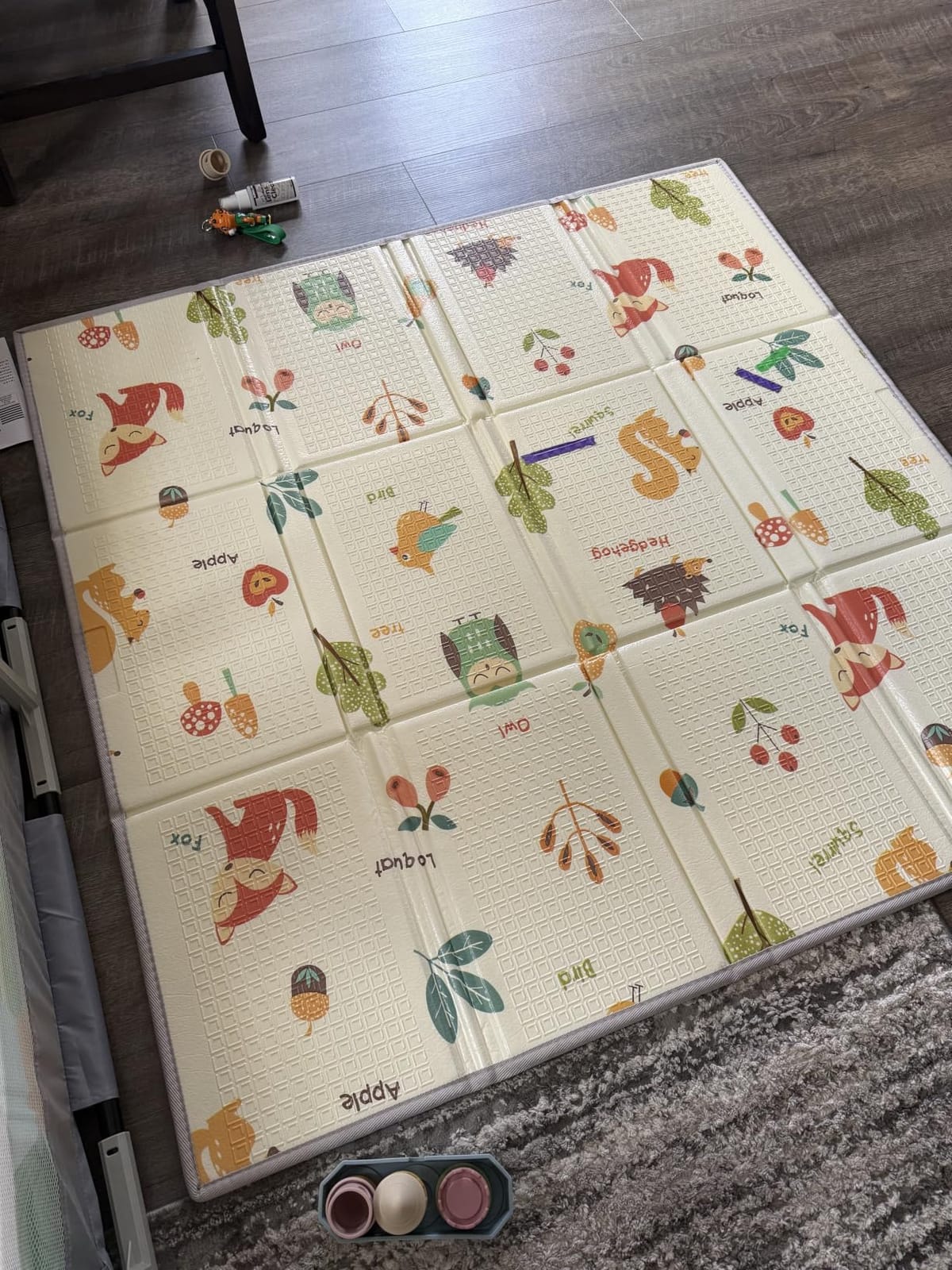
The defining feature here is complete waterproofing. The listing states liquid will not penetrate the surface at all, which puts it ahead of anything with a fabric face you have to blot before it stains.
That makes it the one to pack. Folded flat it fits in a car boot or a suitcase, and buyers use it as a picnic mat, a yoga mat and a floor covering for a playpen on holiday. Being double-sided with a different animal pattern on each face gives you two looks in one panel.
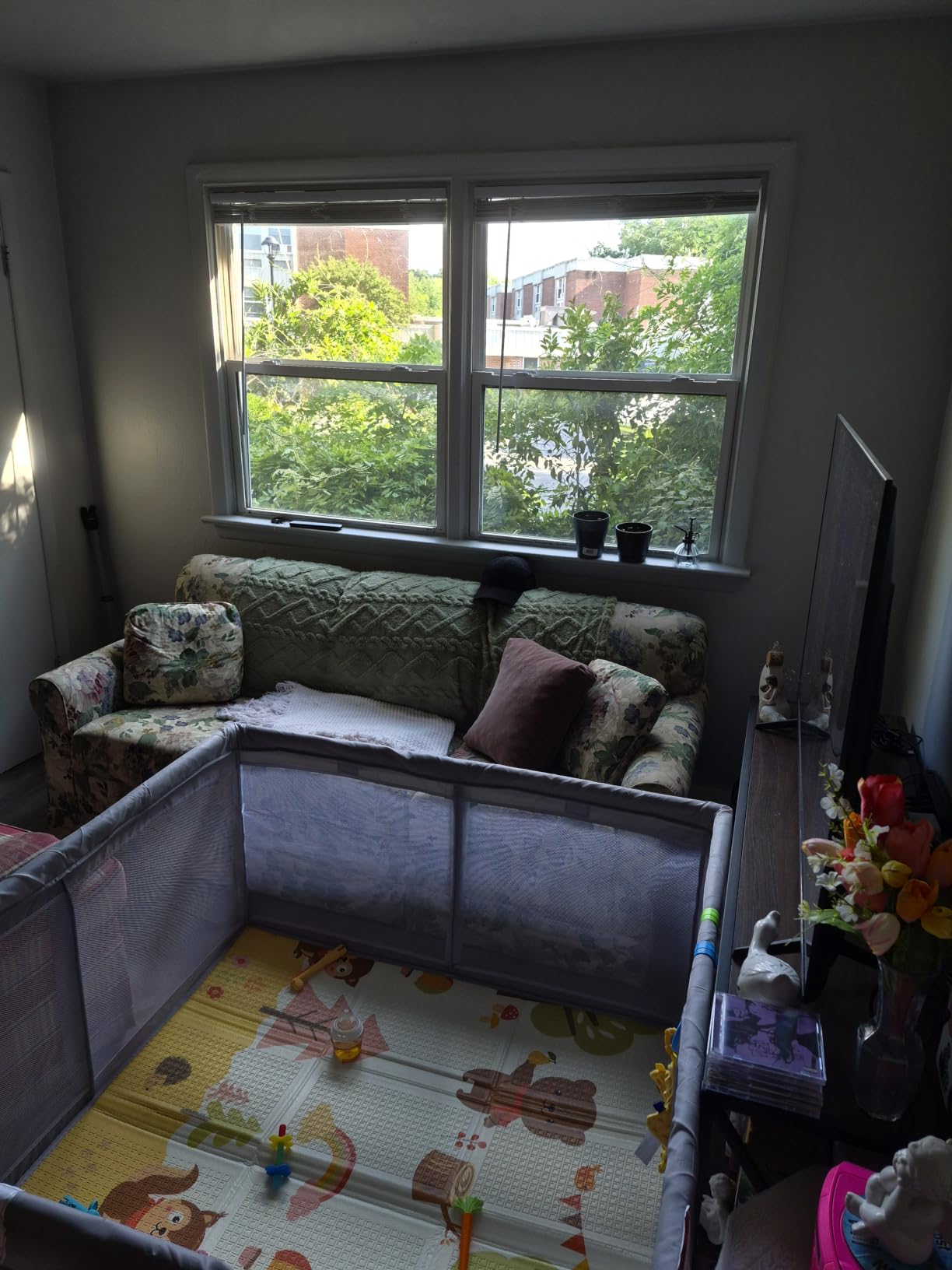
Foam is high-density XPE rated as scratch resistant, and the build is described as odourless and BPA-free, so there is no chemical wait before you hand it to a baby.
The anti-slip texture is aimed at early walkers, which is a sensible detail for the stage just past crawling. Do not expect it to stop a running toddler, though.
Why it works for a crawling baby
A surface that does not absorb anything is the easiest to keep hygienic. Food, milk and water wipe straight off, and there is no fabric layer where a stain can set permanently.
Light weight and compact folding mean it can live in a bag rather than a cupboard, so it travels to grandparents’ houses and holiday accommodation without a logistics argument.
Where it falls short
Buyers measure it at roughly forty-seven inches rather than the advertised fifty, so check your playpen against the smaller real figure before you rely on the label.
At four tenths of an inch it is thin on hardwood or tile, and foam dents permanently under heavy furniture legs. It is a crawling mat rather than a fall-protection surface.
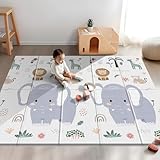
12. NOONKTY 79 x 71 Sensory Play Mat – educational print
NOONKTY 79×71 Extra Large Baby Play Mat for Floor, Foldable Foam Playmat for Babies 0-12 Months & Kids, Non-Toxic Waterproof Baby Mat for Floor, Thick Playpen Mat for Tummy Time Crawling, Elephant+Mon
79 x 71 in
0.4 in XPE foam
Reversible print with numbers
Fully waterproof
Pros
- Very large 79 x 71 in play area
- Reversible sides pair animals with numbers and letters
- Raised textures add sensory input
- Waterproof surface wipes clean instantly
- Non-toxic and BPA-free XPE foam
Cons
- Only 0.4 in thick so limited cushioning
- Newer design with fewer long-term reviews
- Foam dents from heavy furniture
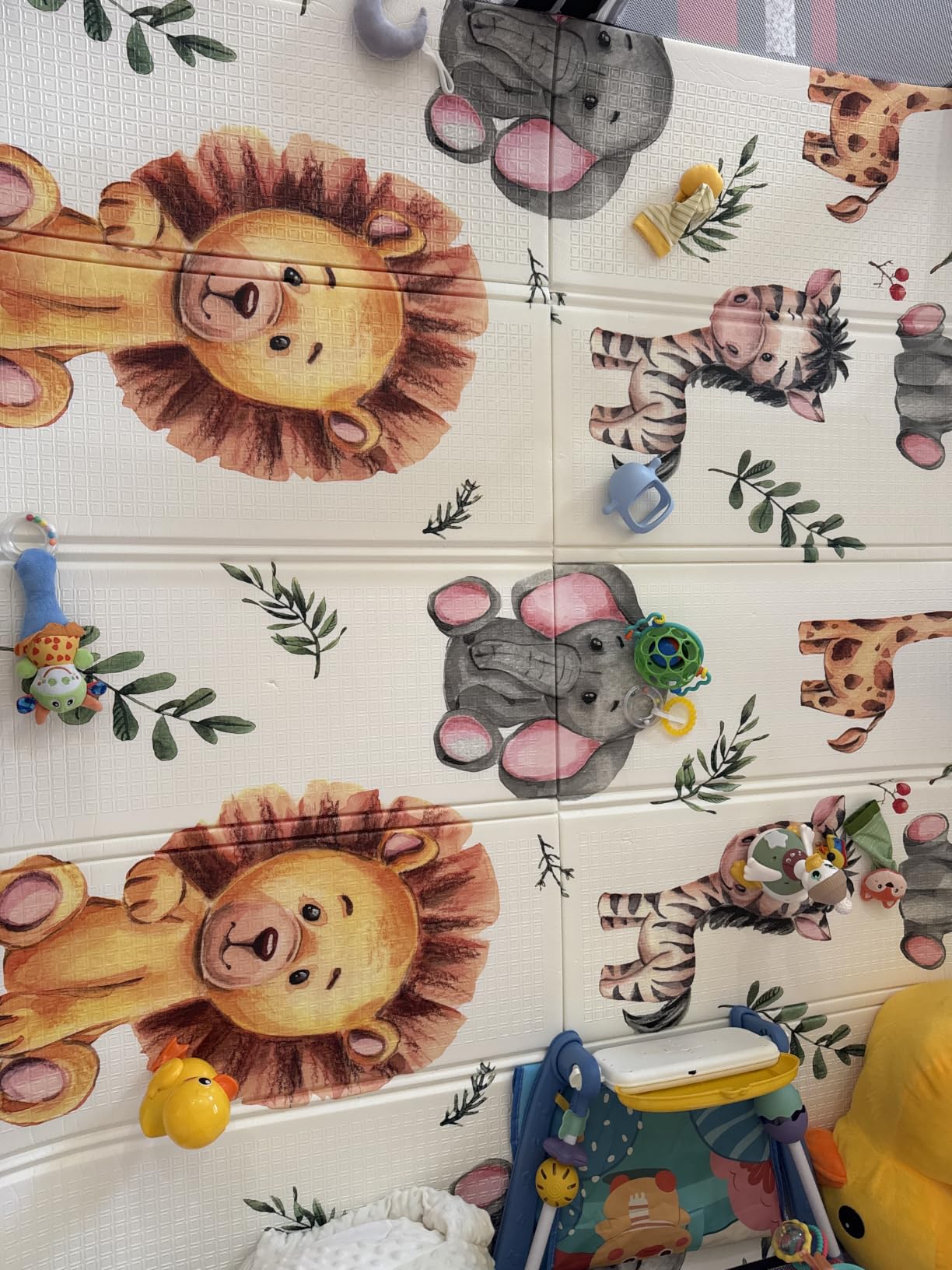
The NOONKTY mat pairs one of the two largest footprints here with the most deliberately educational surface. One side carries animal prints, the other grey stars with printed numbers and letters, and raised textures add a tactile element under small hands.
That sensory angle is the differentiator. A baby working through the crawling months spends a lot of time running hands over whatever is on the floor, and varied surface texture gives that behaviour something to do other than chew a flat sheet of foam.
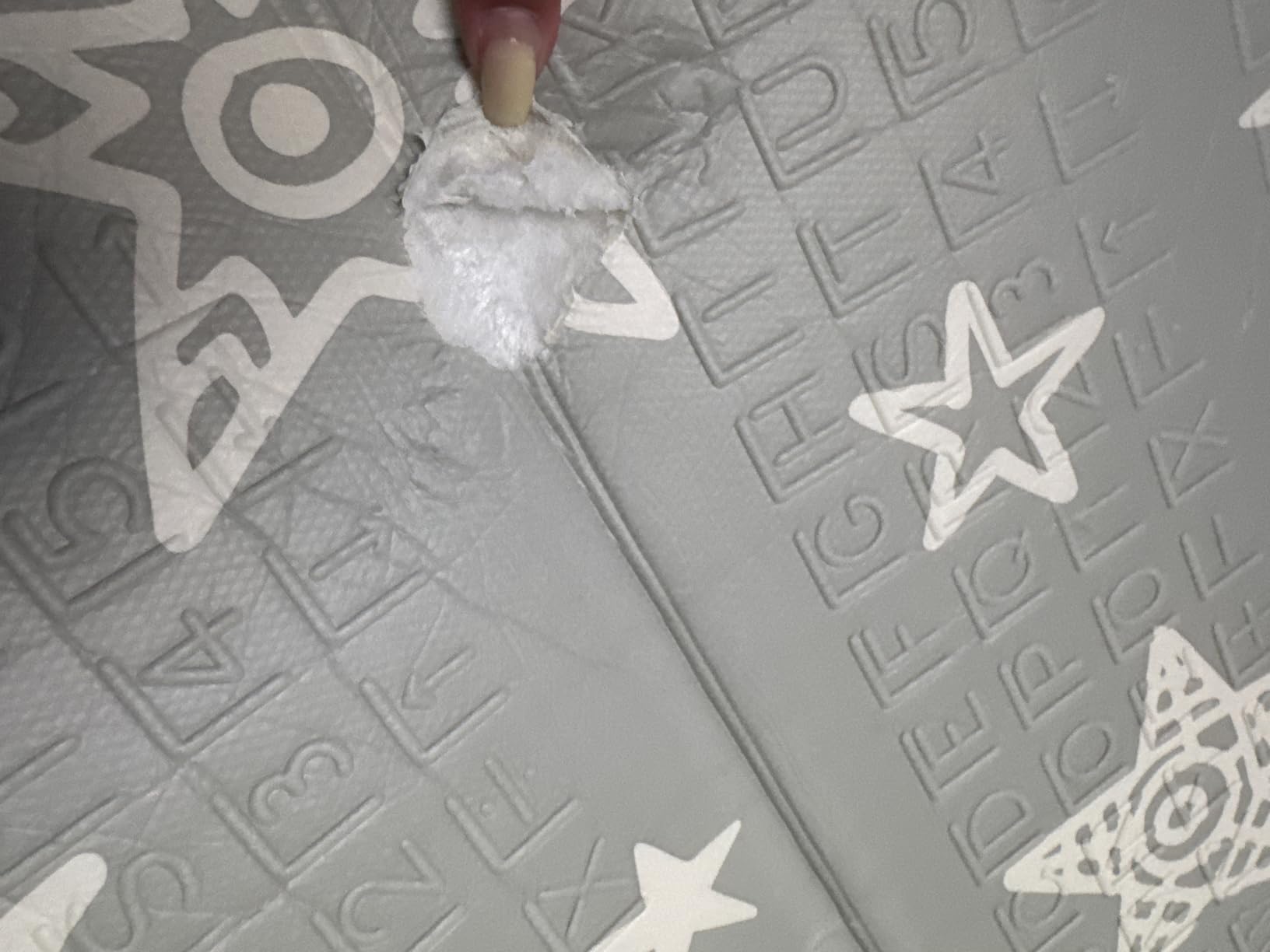
Fully waterproof, so the surface wipes clean with a damp cloth and the printing will not wear off with washing. A carry bag is included, which makes it easy to move between the nursery and a playroom.
The foam is described as high-density XPE, non-toxic and BPA-free, with a no-peel surface layer that resists separating at the edges, a known failure mode on cheaper mats.
Why it works for a crawling baby
Seventy-nine by seventy-one inches gives the longest uninterrupted crawl lane here alongside the UANLAUO panel of the same footprint, and large-footprint mats are the ones that survive the transition to cruising because the baby never reaches the edge mid-session.
Raised textures and printed numerals support the sensory and early-number work that tends to happen alongside crawling, which makes the mat do double duty in a room with limited floor space.
Where it falls short
At four tenths of an inch it sits in the thinner half of the roundup, so it needs a carpet or an underlay underneath to feel cushioned on a hard floor.
The design is newer with fewer long-term reviews, and foam dents under heavy furniture legs. Check that your ceiling-height storage can take a folded panel this wide before committing.
How to Choose the Best Nursery Rugs for Crawling Babies
Cushioning depth decides how long the mat stays useful. Standard interlocking tiles sit around a tenth of an inch, mid-range foam panels land between four tenths and half an inch, and thick memory foam mats reach one inch or more. Those numbers only matter once your baby pulls to stand and starts dropping onto her bottom, which is when a thin panel becomes decoration and a memory foam layer is doing real work. For younger babies still on tummy time, anything in the middle of that range is plenty.
Size matters more than any feature once cruising starts. A fifty-inch square serves a playpen; a six-by-six-foot tile set serves open-floor practice. Measure the usable floor area in your nursery, subtract the furniture footprint, and buy the largest mat that fits without leaving a trip hazard around the edge. Our classroom rug roundup covers larger coverage needs if the nursery opens into a shared room.
Washable or wipe-clean: the honest trade-off
Machine washability is the most requested feature and the one with the biggest downside. Washable rugs are thinner than un-washed equivalents because the fill has to survive a domestic cycle, and repeated washing flattens corners and encourages shrinkage. If you go this route, expect to replace a washable mat sooner than a wipe-clean foam panel.
Wipe-clean foam is more durable and more cushioned but less forgiving. Spills have to be lifted before they soak in, and a fabric-faced mat needs prompt blotting. Our judgement: if your baby is already eating solids, washable wins. If you are buying during pregnancy for tummy time, durable foam wins.
Certifications worth trusting, and what they do not cover
GOTS and OEKO-TEX Standard 100 both test finished textiles for harmful substances. OEKO-TEX Standard 100 is the broader of the two and is what you will see on most of the picks above; GOTS additionally requires organic fibre content and environmentally responsible processing. GREENGUARD Gold goes further and certifies low chemical emissions into indoor air, which is the standard most relevant to off-gassing. CertiPUR-US applies to foam rather than fabric and checks for the chemicals used in foam processing.
None of these certify a product as safe from every angle. They test against a defined list of substances, which is meaningful, but they do not measure fall protection, pile height, or whether a fringe poses a strangulation risk. Treat a certificate as one signal rather than the whole decision. If you want a non-toxic option for a high-traffic hallway instead of a nursery, our entryway rug guide covers a different risk profile entirely.
Constructions to skip entirely
Shag, high-pile, tufted-with-deep-loops and anything with a fringe are the four to rule out for a crawling baby. Long fibres get caught in small hands, shed into mouths, and hide the grit that builds up under a play mat. Wool rugs shed loose fibre for months, and jute and sisal are rough enough to abrade baby skin during the crawling stage.
Flatweave cotton is the traditional answer if you want a real rug rather than a mat: low pile, no loops, no fringe, and naturally breathable. The trade-off is cushioning, which is exactly the gap a play mat fills.
Arrival checklist for a new nursery mat
Air the mat out for a few days before your baby goes near it, and vacuum it with a HEPA filter rather than shaking it indoors. Use a non-PVC rug pad underneath if the mat drifts on hardwood, since PVC backing is itself a chemical exposure and a dust trap. Measure your playpen’s internal dimensions against the mat’s real measurements rather than the label, and put furniture on felt pads if the surface dents easily under load.
Frequently Asked Questions
What is the safest rug material for a crawling baby?
Untreated organic cotton and low-pile wool are the safest natural options, both breathable and free of the chemical treatments applied to many synthetic rugs. For foam play mats, look for phthalate-free and BPA-free XPE or EVA with an OEKO-TEX or CPC certification listed. Whichever material you choose, the safety comes from three things working together: no loose fibres to mouth, no high pile to swallow fingers, and no chemical treatment off-gassing into a room where a baby spends hours face-down.
Are IKEA rugs safe for babies?
Most IKEA rugs are made from synthetic fibres such as polypropylene, PET or polyamide, which are not certified to the organic or chemical-free standards we would want for a baby floor surface, and many are tufted with a pile deep enough for small fingers to catch in. A flat-woven IKEA rug with a low pile and an anti-slip underlay is a reasonable choice for a nursery you also use as a room. For a dedicated crawling surface, a certified washable cotton or foam mat is the safer default.
What are the downsides of machine washable rugs?
The main downsides are thickness, durability and size. Washable rugs are built thinner so the fill survives a domestic cycle, repeated washing flattens the pile and encourages corners to curl or pull, and they generally shrink slightly over time. Most are also smaller than un-washed rugs because the fabric has to fit a domestic machine, which is why the washable picks in this roundup max out around 71 by 59 inches. For a baby eating solids, washability usually wins; for long-term cushioning, wipe-clean foam lasts longer.
Are all wool rugs itchy?
No. Itchiness comes from fibre length and coarseness rather than wool itself, so a densely woven, low-pile wool rug with a soft chemical-free finish feels fine against baby skin, while a coarse, loosely woven shag in wool does not. Merino wool is the softest grade and the best choice for nursery use if you want wool. Wool also sheds loose fibre for the first few months, which is the practical reason many families choose cotton instead for the crawling stage.
How do you place an area rug in a nursery?
Measure the free floor area first, then centre the rug on that space rather than on the room. Leave a clear path from the door to the changing table so the rug edge never becomes a trip line. Keep it entirely clear of the crib, since an infant on a mattress does not need a rug beneath, and position the play zone away from the window and any cords. On hardwood floors, lay a non-PVC rug pad under a lighter rug or a foam mat to stop it sliding once your baby is cruising.
Final Verdict for the Best Nursery Rugs in 2026
The ProSource interlocking tile mat takes our Editor’s Choice because nothing else here gives you thirty-six square feet you can resize as the baby grows, and it carries the deepest review history in the roundup at more than seven thousand ratings. If your floor is hard and your baby is already pulling to stand, the Huloo Sleep memory foam mat is the smarter buy despite the higher cost, because one-point-three inches of slow-rebound foam is the difference between a mat and protection.
For washability the Vibe Bear seventy-one by fifty-nine panel is the pick, since it is large enough to fill a standard playpen and still survives a domestic cycle. The MioTetto tiles are the value option when your nursery needs a neutral palette rather than primary colours, and the Hakuna Matte CloudSoft is the one to buy if the mat has to look like furniture. Whichever you choose, air it out for a few days, put a non-PVC pad under it if it drifts, and skip the shag aisle entirely.