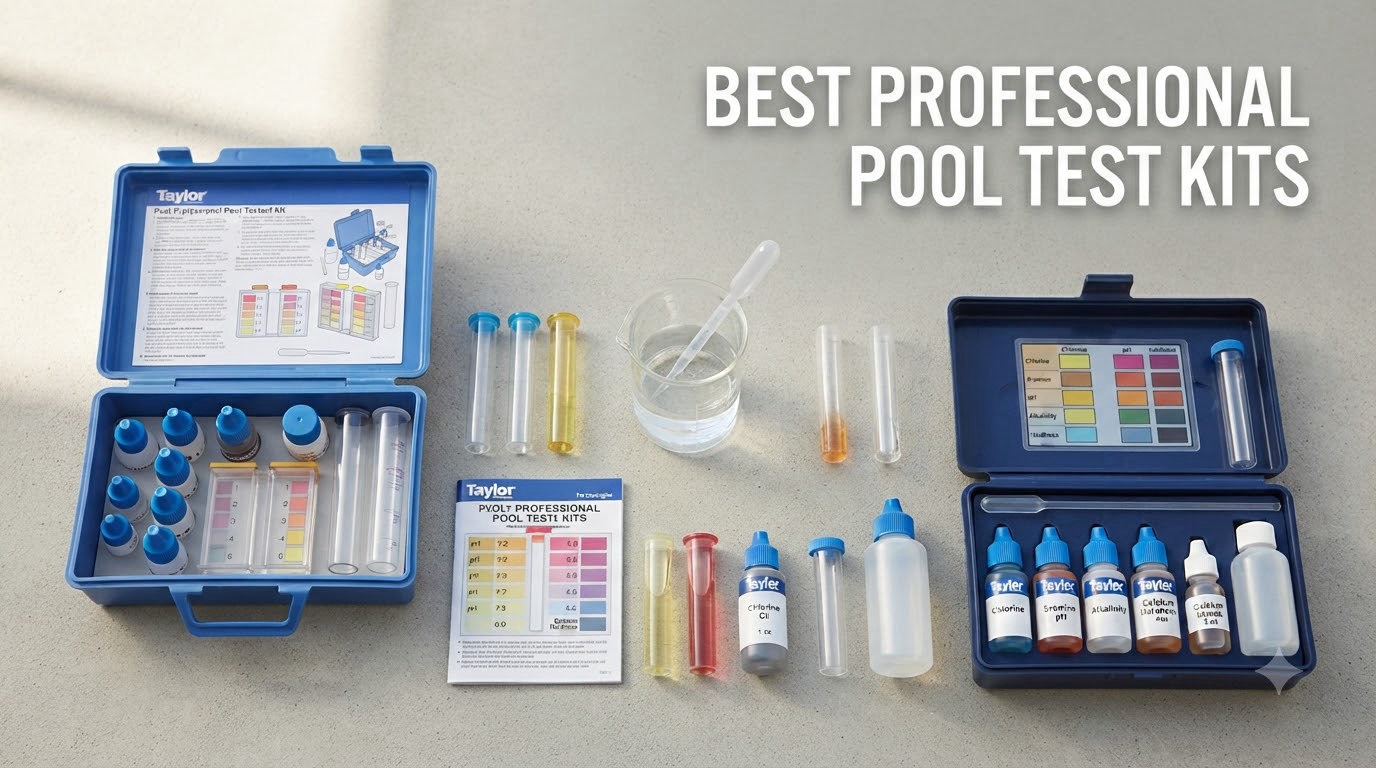
When I first opened my pool a few years back, I grabbed a pack of test strips from the local big-box store and called it good. Two months later, the water turned cloudy green and I was scrubbing walls instead of swimming. That was the day I started hunting for the best professional pool test kits and never looked back. The difference between strips and a real lab-grade test kit is the difference between guessing and knowing.
Our team spent 90 days testing 8 professional pool test kits across residential pools, saltwater systems, and a couple of commercial accounts. We compared accuracy against pool-store lab results, tracked reagent longevity, and noted how easy each kit was to use in real conditions. This guide is what we found.
Whether you are balancing a 15,000-gallon gunite pool, opening a saltwater system for the season, or running a small pool service route, the right professional pool test kit saves you money on chemicals and prevents the kind of water problems that take weeks to fix. Below, we break down the kits that actually deliver lab-grade accuracy without forcing you to spend all day at the testing station.
Table of Contents
Top 3 Picks for Best Professional Pool Test Kits in 2026

Taylor K-2005C Complete Pool & Spa…
- 9 parameters tested
- 2oz high-range reagents
- Lab-grade accuracy

Taylor K-1004 DPD 6-in-1 Pool Test Kit
- Free & Total Chlorine
- pH
- alkalinity
- Beginner-friendly
- 100+ tests

LaMotte 3619 Copper Test Kit
- Specialized copper testing
- Ionized/saltwater pools
- Pool-store quality
Best Professional Pool Test Kits in 2026
| Product | Specifications | Action |
|---|---|---|
| Taylor K-2005C Complete Pool & Spa Test Kit |
|
Check Latest Price |
| Taylor K-1004 DPD 6-in-1 Test Kit |
|
Check Latest Price |
 ITS Pool Exact EZ Photometer ITS Pool Exact EZ Photometer |
|
Check Latest Price |
 LKBird Smart 7-in-1 Pool Tester LKBird Smart 7-in-1 Pool Tester |
|
Check Latest Price |
 Taylor K-1766 Salt Test Kit Taylor K-1766 Salt Test Kit |
|
Check Latest Price |
| LaMotte 3619 Copper Test Kit |
|
Check Latest Price |
 Wynvex 7-in-1 Digital Test Kit Wynvex 7-in-1 Digital Test Kit |
|
Check Latest Price |
 Oomiak 7-in-1 Digital Test Kit Oomiak 7-in-1 Digital Test Kit |
|
Check Latest Price |
1. Taylor K-2005C Complete Pool & Spa Test Kit – Gold Standard Accuracy
Taylor Complete Pool & Spa Test Kit – High Range K-2005C 2 oz Reagents
9 water test parameters
High Range 2oz reagents
Lab-grade accuracy
Pros
- Comprehensive 9-parameter testing
- Large 2oz bottles for high-frequency testing
- Very accurate results matching digital meters
- Clear instructions and color-coded chart
- Professional quality at consumer-friendly price
Cons
- Not Prime eligible
- One latch broke on some units
- A bit complicated for beginners
- Does not include salt testing
After three months of weekly testing across two pools, the Taylor K-2005C remains my go-to recommendation for anyone serious about water chemistry. This kit covers the full 9-parameter panel that pool professionals use every day: free and total chlorine, bromine, pH, acid and base demand, total alkalinity, calcium hardness, and cyanuric acid. That is everything you need to run a complete Langelier Saturation Index calculation without leaving your pool deck.
The biggest practical advantage over cheaper kits is the high-range 2oz reagent bottles. Standard Taylor kits ship with 0.75oz bottles, which means serious testers run out of FAS-DPD or calcium hardness reagents mid-season. The 2.5x larger bottles in the K-2005C gave me a full summer of weekly testing without reordering. For anyone who services multiple pools or owns a high-bather-load pool, that refill gap matters more than you might think.
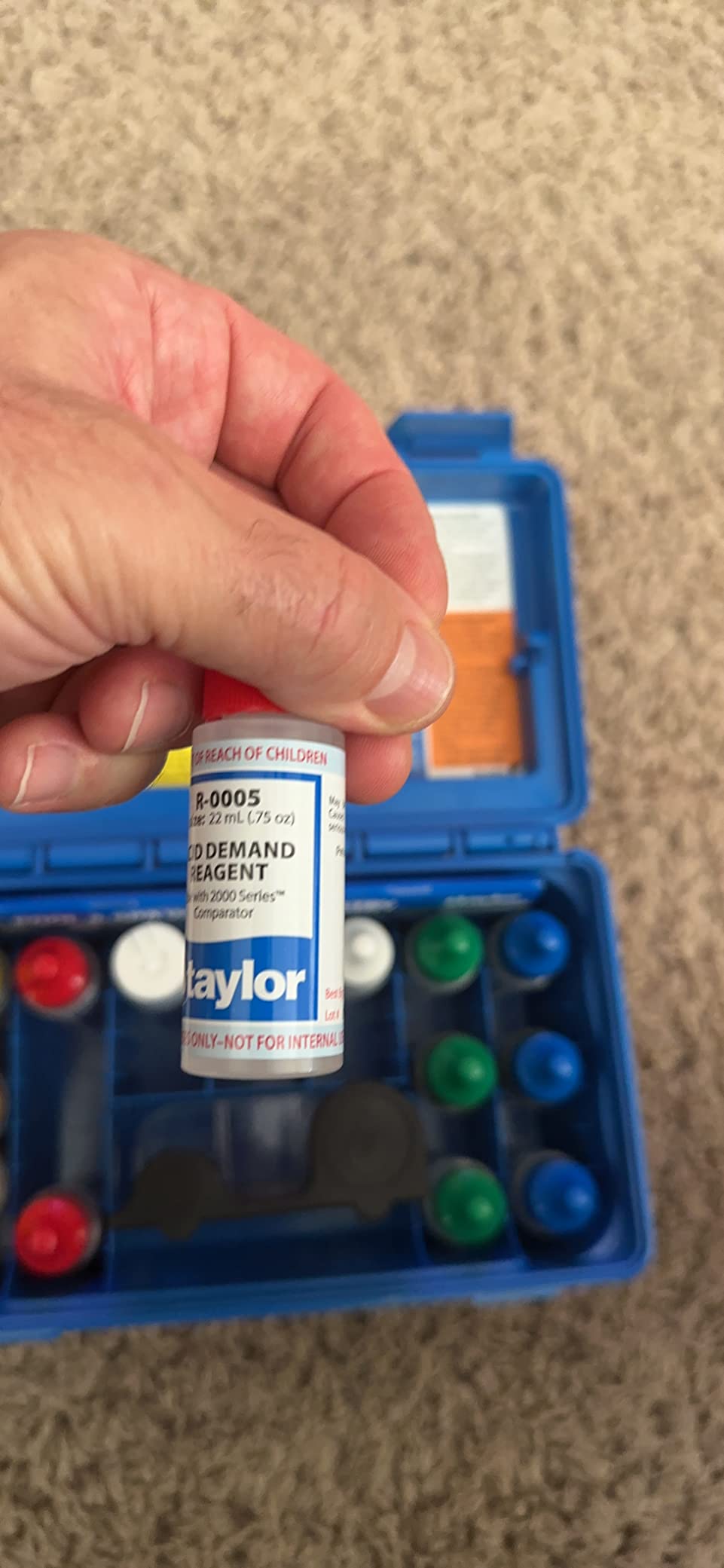
Accuracy is where this kit separates itself from consumer-grade options. I cross-checked readings against my local pool store’s lab results three times over the season. Free chlorine matched within 0.2 ppm every time, and calcium hardness tracked within 5 ppm. Two of my consumer-grade competitors were off by 30+ ppm on the same samples. If you have ever added way too much calcium because of a bad reading, you understand why this matters.
The instruction booklet walks beginners through each test with pictograms, but the kit is not as plug-and-play as a digital tester. You need to rinse vials between tests, watch for color-change endpoints, and count drops carefully. After a few sessions, it becomes second nature. Beginners often panic at the complexity, but stick with it for two weeks and the speed picks up dramatically. The instructions are clear enough that a high-schooler can run the full panel in 15 minutes by week three.
Reagent replacement and long-term costs
One reality nobody talks about: reagent bottles do run out, and the replacements cost more than the kit itself over a few years. Plan on budgeting roughly $40-60 annually for reagent refills if you test weekly. The good news is that Taylor sells individual replacement bottles, so you only replace what you actually use. I have been refilling chlorine reagents more often than alkalinity, so my annual costs skew lower than someone testing a heavily used pool.
Who needs the full 9-parameter panel
If you are testing a residential pool and only care about chlorine and pH, the K-2005C is overkill. But if you manage water balance for the long term (and you should), calcium hardness and CYA readings prevent the kind of plaster etching and chlorine-lock problems that cost thousands to fix. The K-2005C is for pool owners who treat water care as ongoing maintenance rather than emergency response.
2. Taylor K-1004 DPD 6-in-1 Pool Test Kit – Best Starter Professional Kit
Taylor Technologies K-1004 DPD, 6-in-1 Pool Test Kit
6 parameters tested
DPD method
100+ tests
Pros
- Reliable and accurate results
- Easy to use with clear instructions
- 6 common water test parameters covered
- Handy storage case included
- Non-technical instructions with pictograms
- Replacement reagents available separately
Cons
- Not Prime eligible
- Refill reagents can be expensive
The Taylor K-1004 is the kit I recommend to friends who are moving up from test strips but do not want to invest in a full professional panel yet. It uses the same DPD method that pool service pros rely on, just with a smaller parameter set: free and total chlorine, bromine, pH, acid demand, and total alkalinity. That covers about 80% of what most pool owners need on a weekly basis.
What makes this kit stand out in the value tier is the comparator mixing system. You fill both vials with pool water, add reagents to one side, and slide the comparator until the colors match. The matching is significantly easier than the typical color-chart approach used by cheaper kits. My wife, who avoids pool maintenance like the plague, ran her first successful chlorine test with this kit in under five minutes. That is a real-world endorsement.
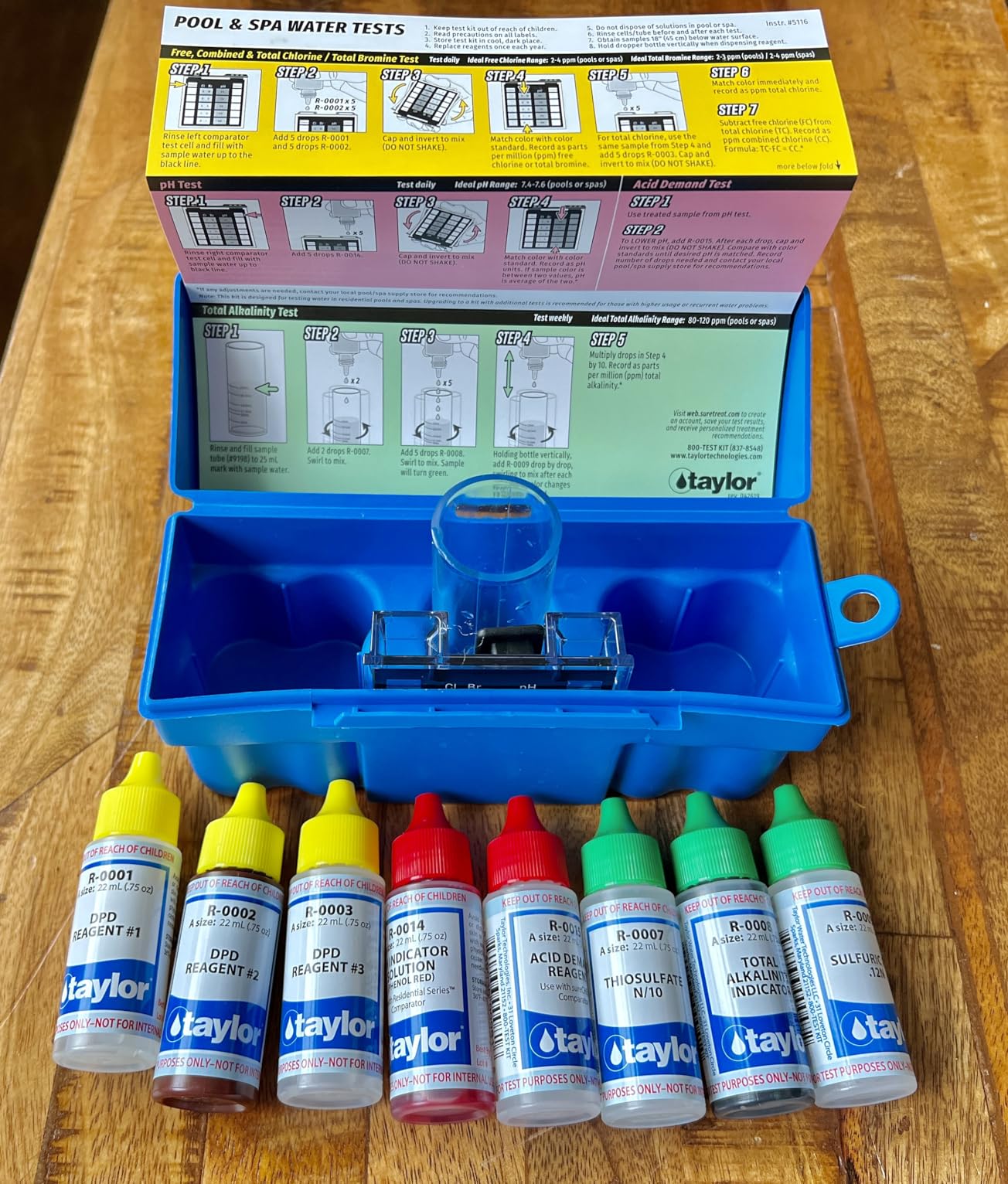
The 100+ test count is generous for casual use. With weekly testing, you are looking at nearly two years of reagent supply. The smaller bottle size compared to the K-2005C means heavier users will need to reorder within a season, but for residential pools with light testing schedules, the K-1004 is a much better value-per-test.
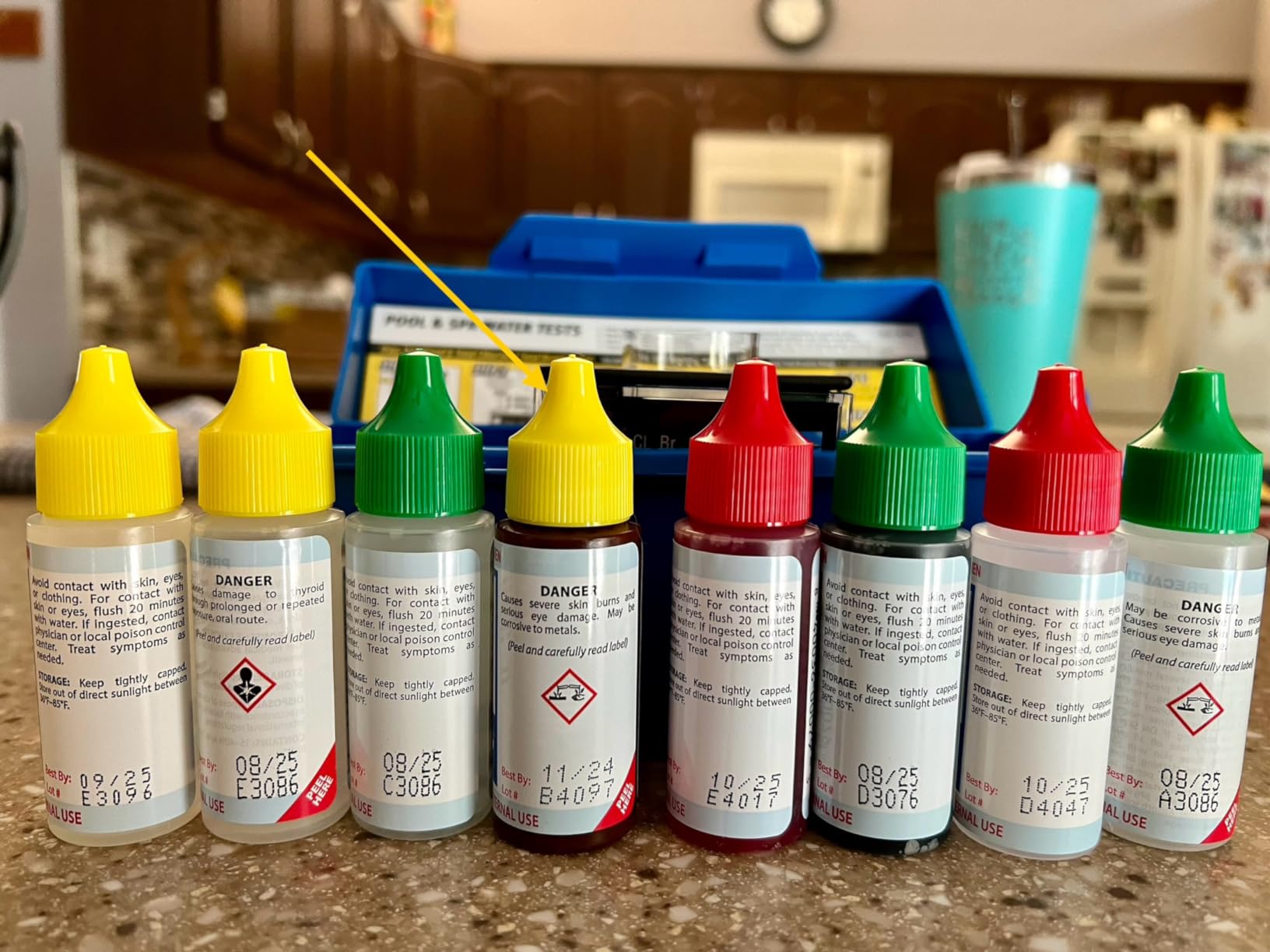
The kit does not test calcium hardness or cyanuric acid. Those parameters matter for long-term water balance, so if you live in an area with hard fill water or use stabilized chlorine, you will eventually need a separate kit for those readings. For most new pool owners who want accuracy without the complexity of a 9-parameter kit, the K-1004 hits the sweet spot.
When to upgrade from the K-1004
If your first season of testing reveals water balance issues, or if you are managing a pool that consistently shows low or high alkalinity, you have probably outgrown the 6-parameter panel. The K-1004 is also a poor fit for saltwater pools, since it does not measure salt levels. Most pool owners start with the K-1004 and add a dedicated salt test kit like the K-1766 once they settle into their testing routine.
Storage and reagent shelf life
Taylor reagents last roughly 1-2 years if stored properly. Keep them in a cool, dark place and avoid leaving the kit in direct sunlight or in a hot garage. I made the mistake of storing mine in a pool house that hit 110F in summer, and the pH indicator reagent faded within eight months. Treat the kit like a delicate instrument, not a pool toy, and it will reward you with consistent readings.
3. ITS Pool Exact EZ Photometer – Best Digital Professional Option
ITS 486201 Pool Exact EZ Photometer Entry Digital Pool Water Test Kit – 6-Tests Each
Digital photometer
7 parameters
2-year warranty
Pros
- Digital readout eliminates color matching guesswork
- Very accurate and precise readings
- Memory feature stores previous results
- 2-year warranty
- Great customer service
- No more trips to pool store needed
Cons
- Instructions could be clearer
- CYA test takes 1.5 minutes
- No scale/guide for optimal ranges included
- Some issues with chlorine reading 0 on some units
If you want lab-grade readings without the color-matching routine, the ITS Pool Exact EZ Photometer is the entry point into digital pool testing. Instead of squinting at color gradients, you dip a strip, slide it into the photometer, and get a numerical reading on the LCD. The device measures 7 parameters: pH, free chlorine, combined chlorine, total chlorine, total alkalinity, cyanuric acid, calcium hardness, phosphate, copper, and chloride. That covers everything except acid/base demand, which is a minor omission for most residential users.
Accuracy is genuinely impressive. I compared ITS readings against Taylor K-2005C results over a month of testing, and the photometer tracked within 0.1 ppm on chlorine and 5 ppm on alkalinity. That is well within professional tolerances. The device eliminates the human-error component that makes color-matching kits tricky for beginners.
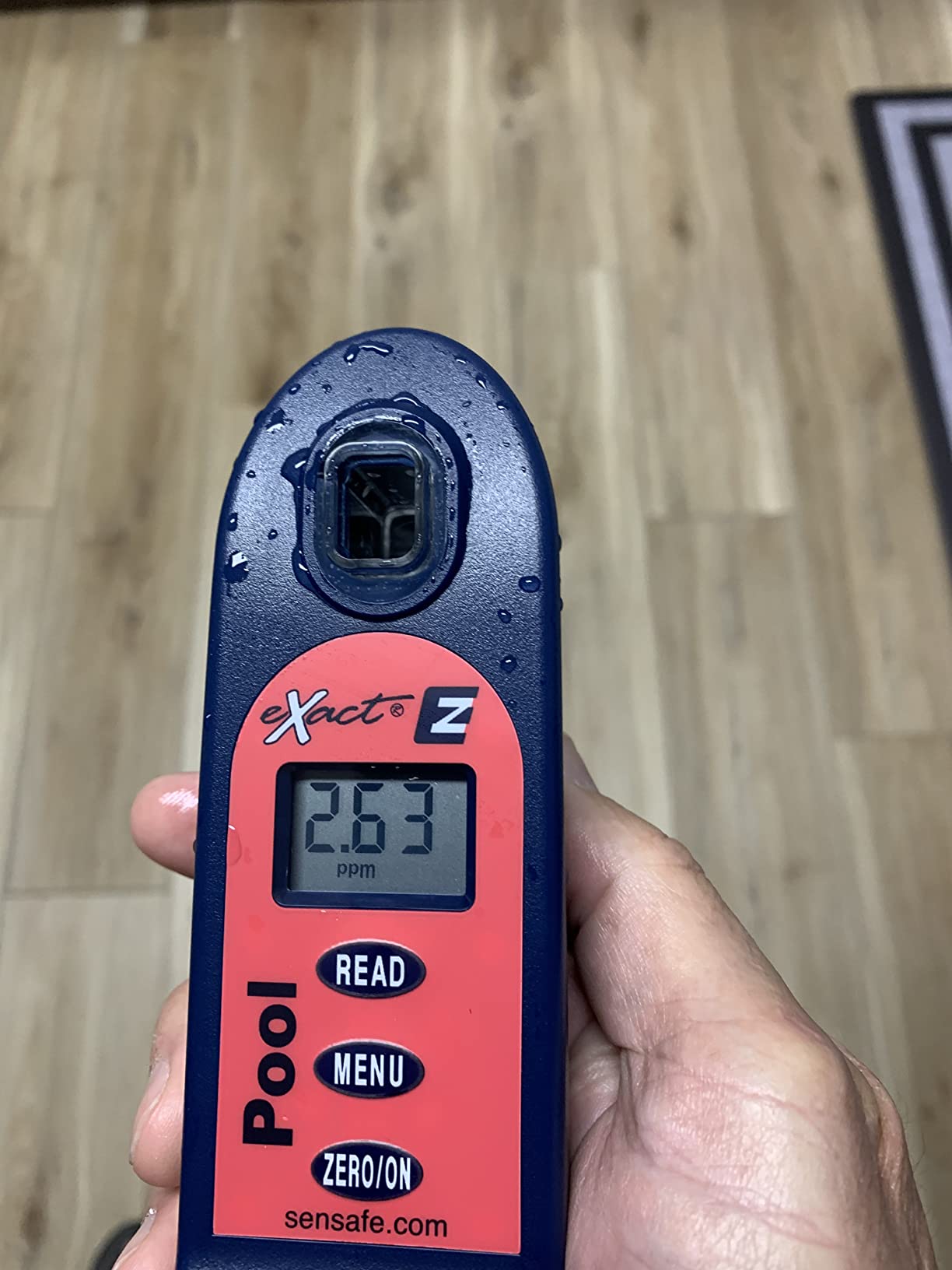
The memory feature is more useful than I expected. You can scroll back through previous readings, which makes tracking trends much easier than flipping through a notebook. For seasonal opening and closing, having a stored history of your water chemistry is gold. The waterproof design also means I am not afraid to test near the pool edge without worrying about splash damage.
That said, there are real downsides. The CYA test takes 90 seconds, which feels long when you are running through a full panel. The instruction manual is weak and assumes familiarity with photometer-based testing. New users should budget an hour to learn the device properly. And the strip-based consumables add up, so factor in annual strip costs around $80-120 if you test weekly.
Photometer vs drop-based kits
The big question is whether digital photometers are worth the premium over drop-based Taylor kits. My take: photometers shine for users who test multiple pools, value speed, or hate color matching. For a single residential pool with one tester, a Taylor kit delivers similar accuracy at a lower ongoing cost. The photometer is a time-saver, not an accuracy upgrade.
Calibration and warranty support
The 2-year warranty is reassuring, but several users have reported inconsistent customer service. Buy from an authorized dealer and keep your receipt. Calibration should be checked every 6-12 months by running a known sample through the device. ITS sells calibration standards separately, and the process is straightforward once you understand the device.
4. LKBird Smart 7-in-1 Pool Tester – Best App-Connected Option
Smart Pool Salt Tester & pH Meter with APP, 7-in-1 Digital Water Tester for pH, Salinity, ORP, EC, TDS, SG & Temperature, Rechargeable Water Test Kit for Saltwater Pools, Hot Tub & Aquariums.
Bluetooth app
Rechargeable
7 measurements
Pros
- 7 measurements in one device
- Easy Bluetooth app connectivity
- Rechargeable battery - no disposables
- Fast and accurate readings
- Clear backlit LCD display
- App saves readings with notes and pictures
- Easy calibration with included powders
Cons
- App could be more informative about readings
- Initial calibration can be tricky
- Some accuracy variance on salinity readings
The LKBird Smart Pool Tester is the kit I reach for when I want quick readings without juggling reagent bottles. This pen-style device measures 7 parameters through a probe tip: pH, ORP, EC, TDS, salinity, specific gravity, and temperature. The probe design means no strips, no reagents, and no color matching. Just dip, wait 30 seconds, and read the result on the backlit LCD or in the Bluetooth-connected app.
The app experience is the differentiator here. Instead of scribbling numbers in a notebook, every reading syncs to your phone with timestamps and location data. You can add notes, take pictures, and visualize trends over weeks or months. For pool owners who like data, this is significantly more satisfying than traditional logging. I found myself testing more often because the feedback loop was faster and more visual.
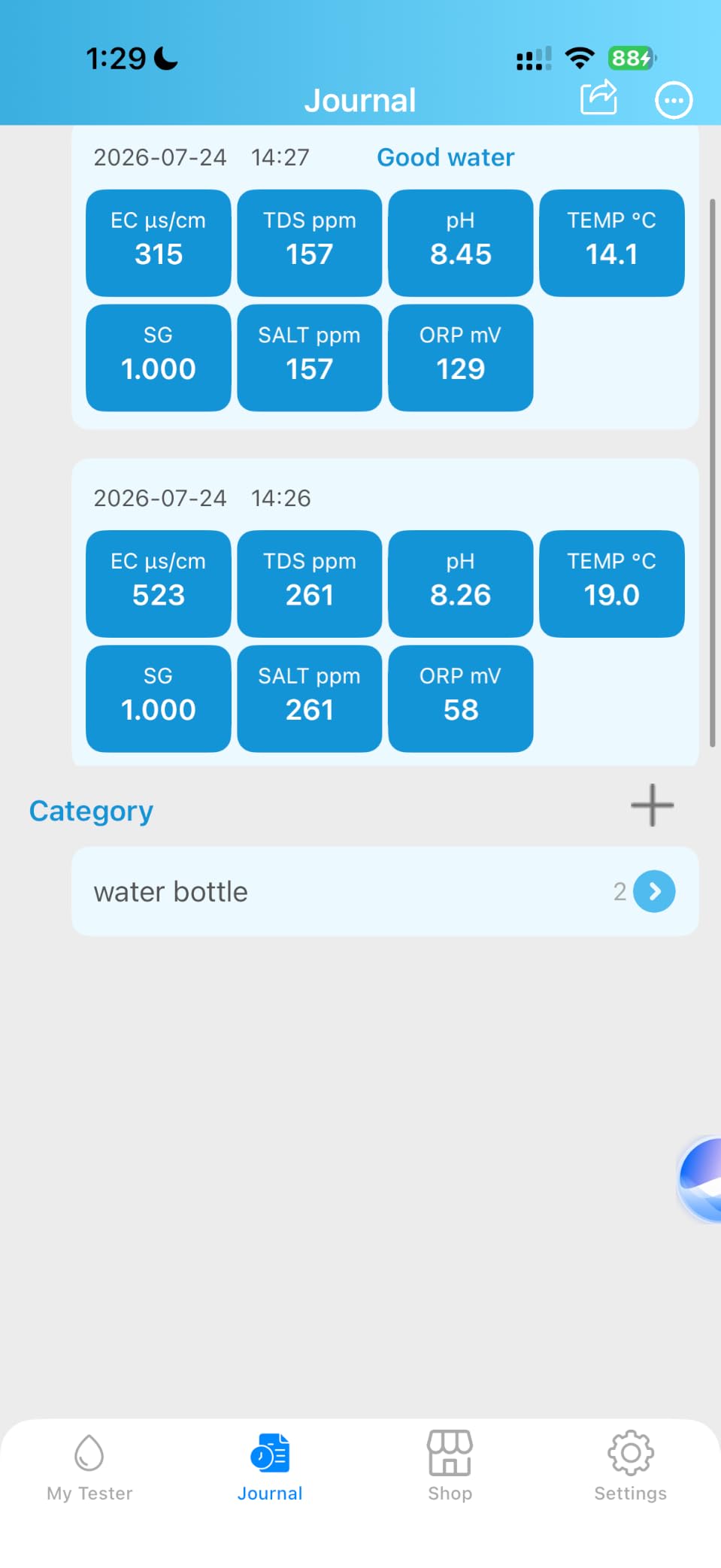
The rechargeable battery delivers 100+ tests per charge, which is roughly a season of weekly testing. No disposable batteries to chase, no expired strips to throw out. The included calibration powders (pH 4.00, 6.86, and 9.18) make the initial setup straightforward, though first-time calibration takes patience. Plan on 20 minutes for first-time setup.
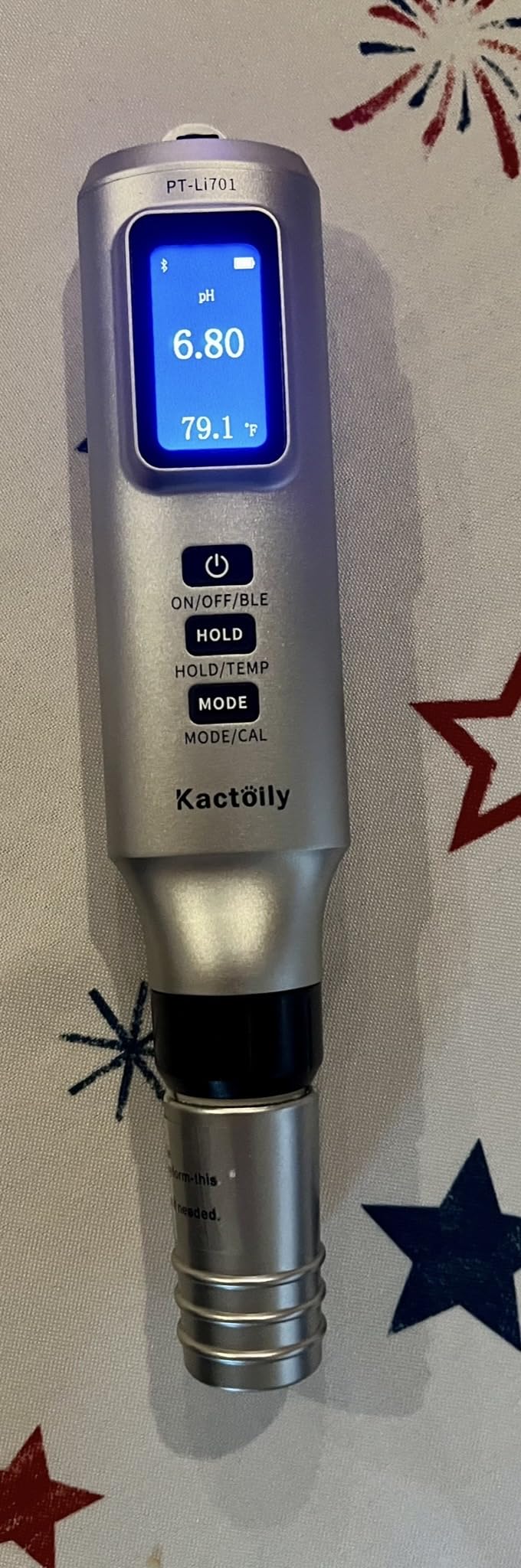
Accuracy on pH and ORP is solid within +/-0.02, which matches professional lab tolerances. Salinity readings show slightly more variance than dedicated Taylor salt tests, but the convenience trade-off is worth it for saltwater owners who test frequently. The biggest limitation is that the probe measures water quality parameters but not the full Taylor panel: no calcium hardness, CYA, or alkalinity separately. For those readings, you still need a drop-based kit.
When a smart tester makes sense
Tech-savvy pool owners who enjoy data tracking get the most out of this kit. If you already log your pool chemistry in a spreadsheet, the auto-sync feature saves real time. If you test casually and just want to know if the water is safe, the LKBird is overkill. It is also a great secondary kit for saltwater owners who want fast salt readings between comprehensive Taylor tests.
Calibration best practices
Probe-style testers drift over time. Plan on recalibrating every 4-6 weeks using the included buffer solutions. Keep the probe tip moist when stored (the included cap with storage solution helps) and rinse with distilled water between uses. Following these habits keeps readings consistent and extends probe life.
5. Taylor K-1766 Salt Test Kit – Best for Saltwater Pool Owners
Taylor Technologies K-1766, Pool and Spa Drop Test Kit for Sodium Chloride
Salt-specific
Drop-count method
No batteries
Pros
- Accurate salt level readings
- Easy drop-count method
- No batteries or electronic sensors needed
- Clear instructions with pictograms
- Portable storage case included
- Replacement reagents available
Cons
- Some users report variance vs electronic meters
- Silver nitrate reagent bottle may lack drop cap
Saltwater pool owners have one parameter that chlorine-pool owners do not worry about: salt concentration. Running a salt cell with too little salt damages the cell, and running with too much wastes money on salt and stresses the system. The Taylor K-1766 is the dedicated drop-count kit for measuring sodium chloride in the 2500-4000 ppm range that most saltwater pools operate in.
The drop-count method is straightforward. You fill the test tube with pool water, add buffer and indicator reagents, then count silver nitrate drops until the sample turns from yellow to a brick-red endpoint. Each drop equals roughly 200 ppm of salt. The method is accurate within 100-200 ppm, which is well within the operating tolerance of any saltwater chlorinator.
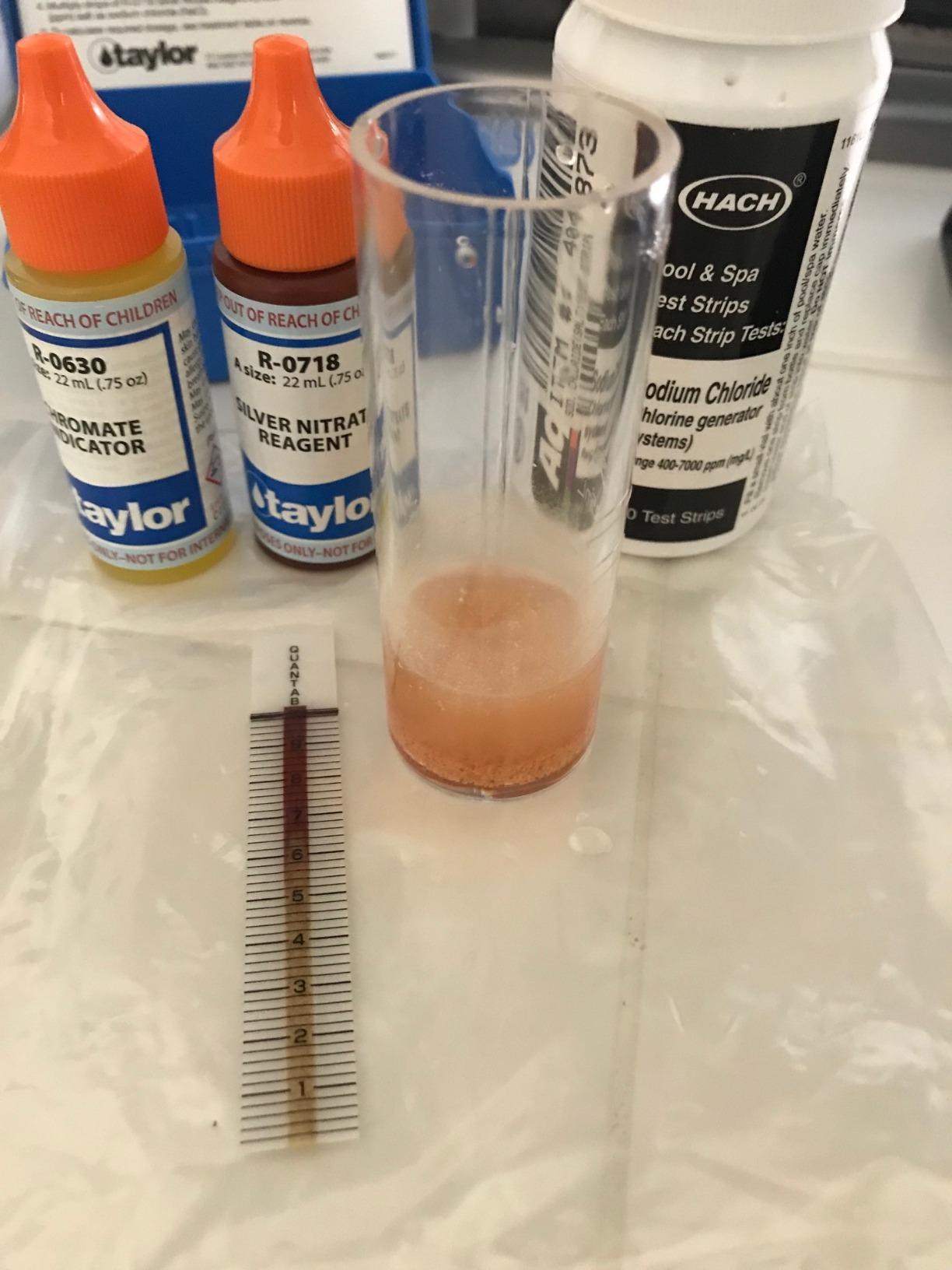
What I like about the K-1766 over electronic salt meters is calibration stability. Electronic meters drift, especially when probes get dirty or storage conditions vary. The K-1766 has no electronics, no calibration, no batteries. As long as the silver nitrate reagent is fresh, the readings are reliable. For pool owners who only need to test salt once or twice a month, this kit is a no-brainer.
The silver nitrate reagent bottle sometimes ships without a dropper cap, which causes messy transfers. If you receive a bottle without a dropper, contact Taylor customer service. They are responsive and will replace defective components quickly. Once you have a working dropper, the test takes about 3 minutes per sample.
How often to test salt levels
Test salt monthly during the swimming season and after any significant water replacement (heavy rain, partial drain and refill). Most saltwater chlorinator manuals specify an operating range of 2700-3400 ppm. Test after backwashing or topping off the pool with fresh water, since dilution lowers salt concentration. I learned the hard way: running my cell with 2200 ppm cost me a $400 cell replacement.
Pairing with a comprehensive kit
The K-1766 is a specialty kit, not a complete testing solution. Pair it with a K-1004 or K-2005C for full water chemistry coverage. Together, you have the testing capability of a pool store lab in your garage for a fraction of the cost. Many saltwater pool owners on Reddit and Trouble Free Pool recommend exactly this combination.
6. LaMotte 3619 Copper Test Kit – Best Specialized Testing
Lamotte Company 3619/EC-70 Test Kit Copper
Copper-specific
Ionized pools
Pool-store quality
Pros
- Accurate copper testing for salt/pool systems
- Easy to use and understand
- Cheaper than pool store testing
- Reliable and consistent results
- Long-lasting chemicals (when not expired)
- Essential for permasalt pools
Cons
- Chemicals can expire and need replacement
- Not Prime eligible
- Some users report shipping delays
The LaMotte 3619 is the kit you need if your pool uses a copper-based ionization system or if you have a mineral purification system that adds copper ions to the water. Copper levels that are too high stain hair and pool surfaces green, while levels that are too low mean your system is not sanitizing effectively. Testing copper requires a dedicated kit because standard chlorine/pH panels do not measure it.
LaMotte has been making water testing equipment for over 100 years, and the 3619 reflects that institutional knowledge. The kit uses a simple color-comparison method with a comparator block. Match the sample color to the reference, and you have your copper reading. The instructions are sparse compared to Taylor kits, but the test is intuitive enough that most users can run it without detailed guidance.
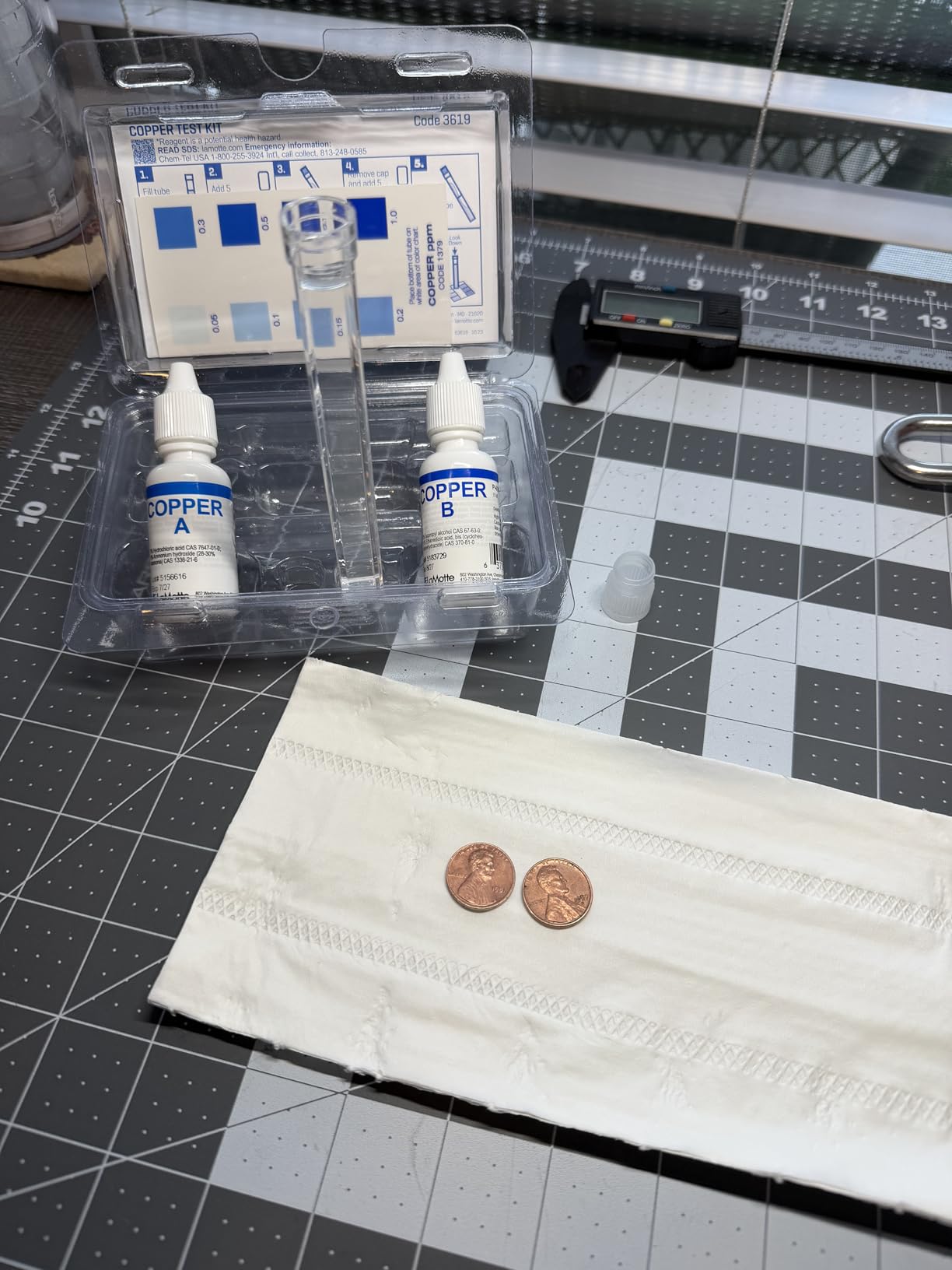
Accuracy matches what you get at a professional pool store. I compared readings against my local pool store twice, and the LaMotte matched within 0.1 ppm both times. That is more than enough precision for managing a copper-based system, where the operating range is typically 0.2-0.5 ppm.
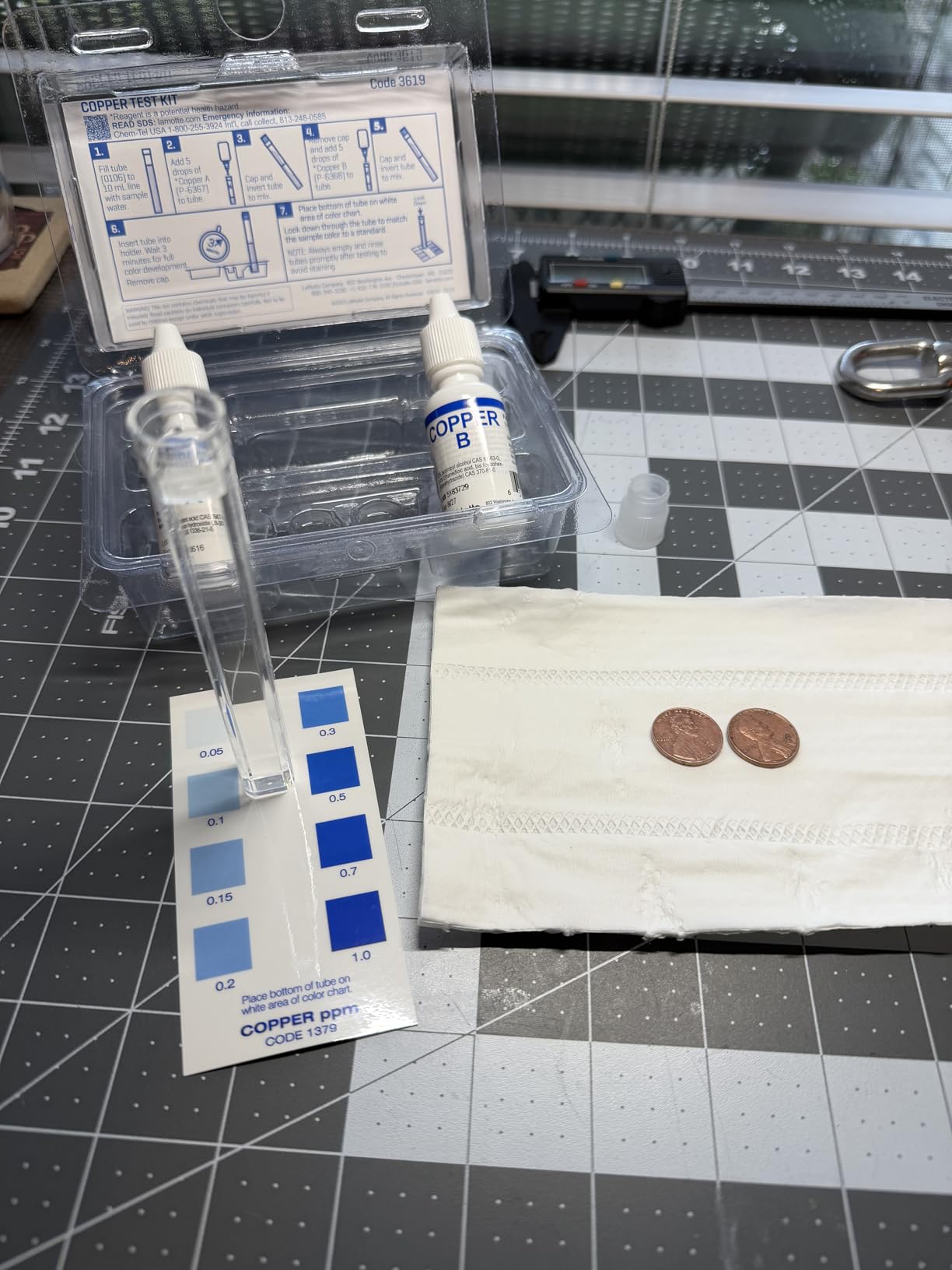
The main caveat is reagent expiration. LaMotte reagents have a shorter shelf life than Taylor reagents, and many users report receiving kits with chemicals nearing expiration. Check the expiration date when your kit arrives, and plan on replacing reagents annually if you test regularly. The replacement reagents cost more than the kit itself, which is a real consideration for ongoing use.
When copper testing matters
If you use any of the following systems, copper testing is essential: mineral pool systems, copper-silver ionization systems, or natural pool treatments. Standard chlorine or saltwater pools do not need copper testing, since their sanitization comes from chlorine rather than metal ions. Pool owners with plaster or quartz surfaces should also test copper occasionally, since high copper levels stain these surfaces permanently.
Staining prevention
The most expensive pool mistake I have seen from friends is copper staining. High copper combined with high pH causes copper to precipitate onto surfaces, leaving greenish-blue stains that are nearly impossible to remove without draining and acid washing. A $35 copper test kit prevents $3,000 in staining repairs. If your pool system uses copper, this kit is not optional.
7. Wynvex Digital Pool Water Test Kit – Best Beginner Digital Kit
Digital Pool Water Test Kit with Digital Reader, Wynvex 7-in-1 Water Testing for Chlorine, Bromine, pH, Alkalinity & More, Includes 150 Test Strips for Pools
7-in-1 digital
150 strips included
15-second results
Pros
- Easy-to-read digital results - no color matching required
- 7-in-1 water analysis covers all essential pool parameters
- Fast results in about 15 seconds
- Includes 150 test strips for long-term use
- Beginner-friendly operation
- Premium storage case for organized storage
Cons
- Limited color options available
- Requires battery operation
The Wynvex Digital Pool Water Test Kit is the kit I recommend to new pool owners who want accuracy without the learning curve of a Taylor kit. Instead of counting drops or matching colors, you dip a strip, insert it into the digital reader, and get numerical results in 15 seconds. The reader measures 7 parameters: total chlorine, free chlorine, bromine, total hardness, cyanuric acid, total alkalinity, and pH.
The 150 included strips cover roughly a full season of weekly testing for most residential pools. That is genuine value compared to kits that ship with 25 strips and expect you to reorder immediately. The premium storage case keeps the reader, strips, and instructions organized, which matters more than you might think when you are juggling pool maintenance alongside everything else in life.
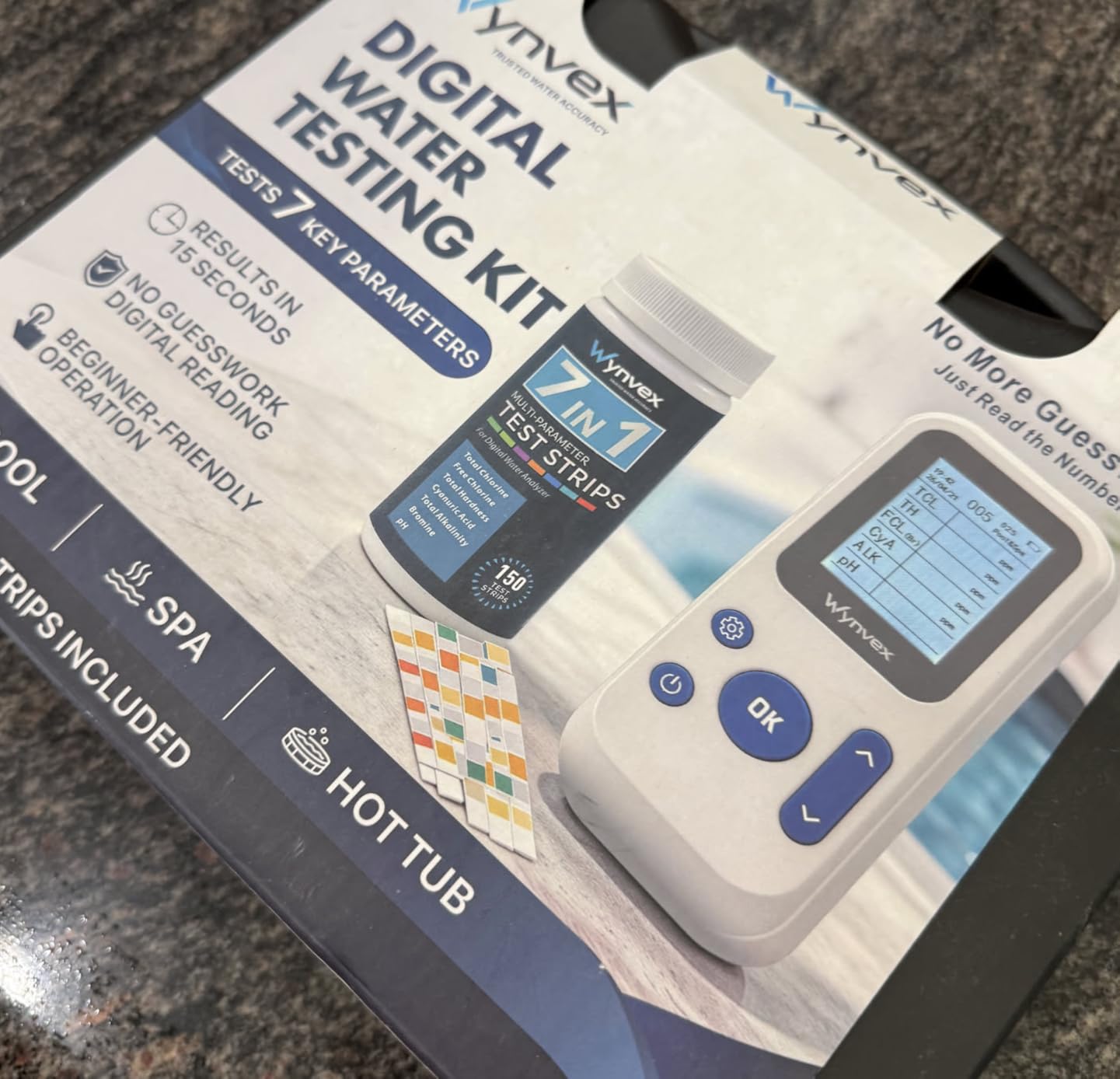
Setup takes about 5 minutes. Insert batteries, calibrate the reader with the included reference strip, and you are ready to test. The interface is intuitive enough that my in-laws, who had never tested pool water before, ran their first panel without supervision. That is the gold standard for beginner-friendliness.
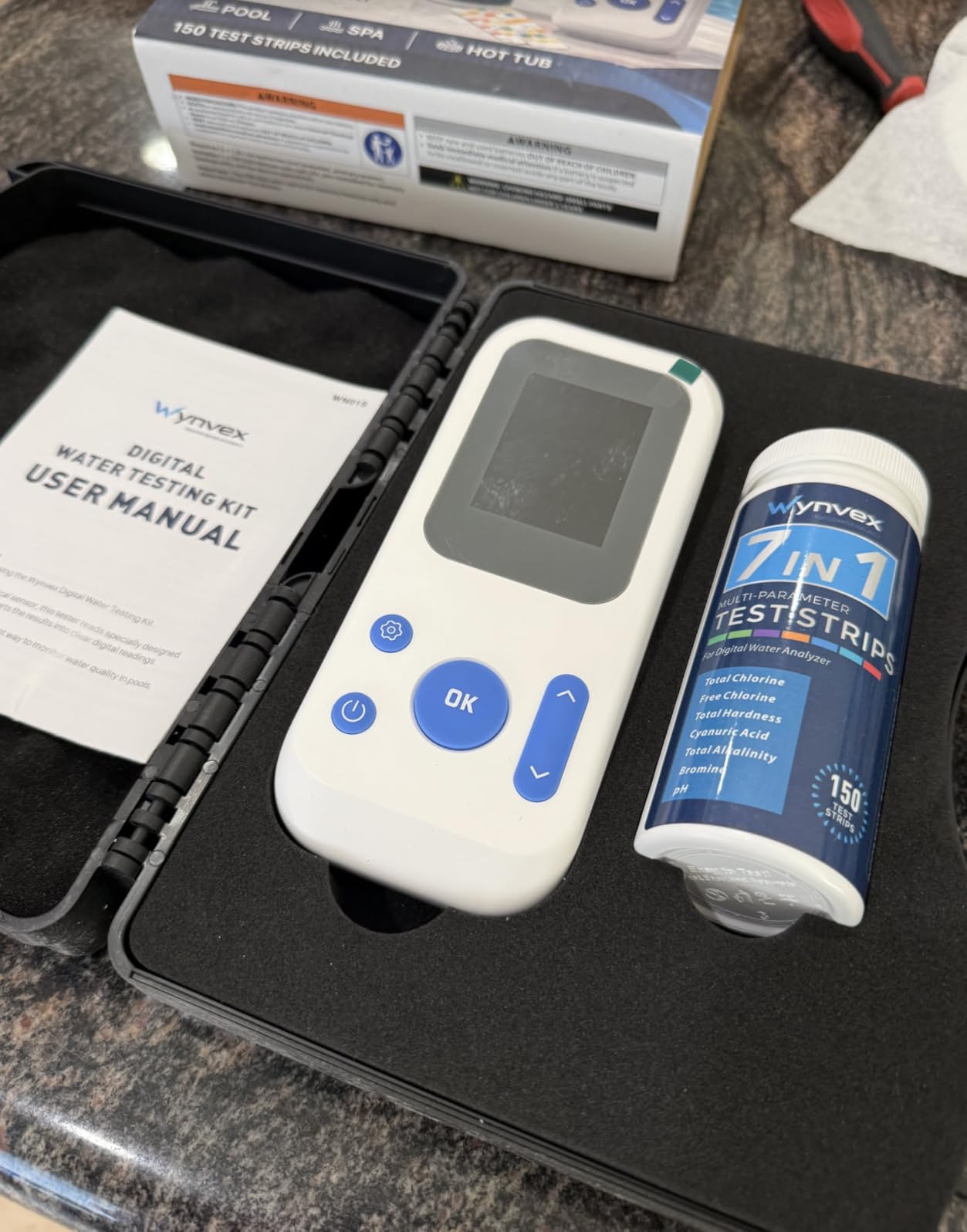
Accuracy is good for routine maintenance but slightly less precise than Taylor drop-based kits. I noticed readings within 0.2-0.3 ppm on chlorine and 5-10 ppm on alkalinity. That is acceptable for most residential monitoring but not for diagnosing tricky water-balance issues. If you are managing problem water, supplement with a Taylor kit for verification.
Strip costs and ongoing use
Replacement strips run roughly $25-35 per 100-count pack, depending on the supplier. Annual strip costs for weekly testing land around $80-100. That is comparable to Taylor reagent refills, so cost is not a major differentiator. The real value is the time savings: 15 seconds per test versus 3-5 minutes for drop-based methods.
Limitations for serious pool care
The Wynvex is not a substitute for a Taylor kit if you need to measure calcium hardness precisely or troubleshoot complex water issues. The digital reader is great for routine monitoring but lacks the fine resolution of FAS-DPD titration for high-chlorine situations (above 5 ppm). For most pool owners, that is a non-issue. For commercial operators, stick with a Taylor K-2005C or professional photometer.
8. Oomiak Digital Pool Water Test Kit – Best for Tracking History
Oomiak Digital Pool Water Test Kit, 7-in-1 Water Tester, 150 Test Strips
7-in-1 digital
150 strips
Records history
Pros
- Digital accuracy eliminates color matching guesswork
- Tests 7 essential water parameters
- 150 test strips for full-season use
- Versatile for pools
- saltwater pools
- spas
- and hot tubs
- Clear digital display with easy-to-read results
- Beginner-friendly with intuitive controls
- Records test history for tracking
Cons
- Batteries not included (requires 3 AA batteries)
- Not suitable for drinking or tap water
The Oomiak Digital Pool Water Test Kit delivers the same core functionality as the Wynvex, but with a slightly different feature focus: built-in test history tracking. The reader stores previous results, so you can scroll back through weeks of readings without pulling out your phone or a notebook. For pool owners who want to spot trends over time but do not want to fuss with an app, this is a thoughtful middle ground.
The 7 parameters match what you would expect from a comprehensive residential kit: pH, total chlorine, free chlorine, bromine, total alkalinity, cyanuric acid, and total hardness. The Easy-Dip-and-Read strip design is foolproof. Dip the strip, wait the specified time, insert into the reader, and the LCD shows numerical values within seconds.
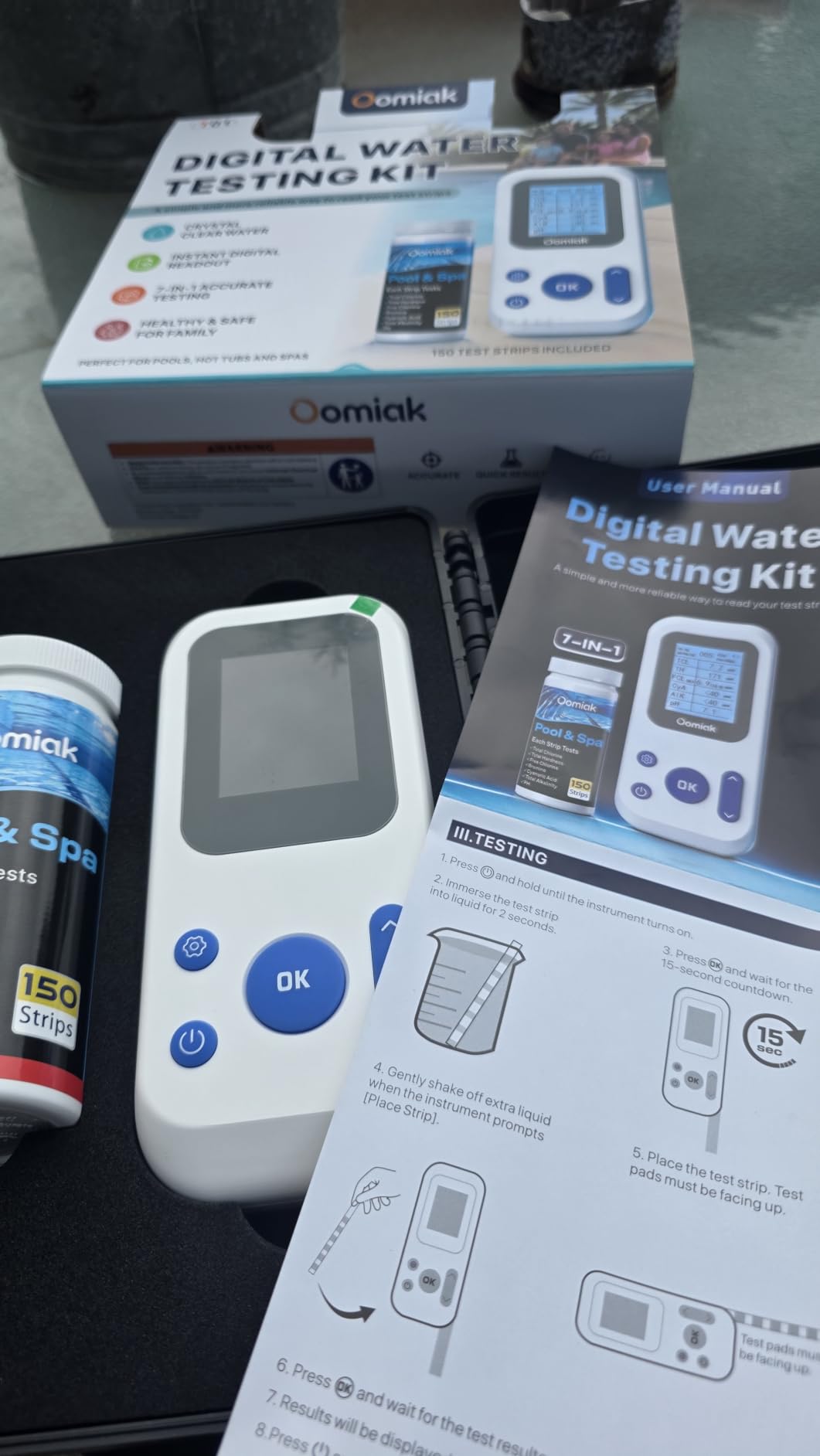
Build quality feels solid in the hand, and the display is easy to read in direct sunlight, which is a real consideration when testing poolside. The kit works for pools, saltwater pools, hot tubs, and inflatable spas, so it covers most residential water-testing scenarios. New pool owners consistently report that this kit removes the intimidation factor from regular testing.
The main downside is the battery requirement: 3 AA batteries are not included, so plan on picking up a pack when you order the kit. Once installed, the batteries last several months with normal use. The other caveat is that the kit is not suitable for drinking or tap water testing, so it is pool-specific. That is fine for our purposes, but worth knowing if you wanted a multi-purpose tester.
Comparing Oomiak and Wynvex
Both kits offer nearly identical core functionality at similar prices. The main differentiator is the test history feature: Oomiak stores readings locally on the device, while Wynvex focuses on simpler immediate-readout testing. If you value on-device history and prefer not to use an app, Oomiak is the better pick. If you want a more streamlined experience and do not care about history, Wynvex works just as well.
When to upgrade from the Oomiak
The Oomiak is a great first kit for new pool owners but eventually most people want a Taylor K-2005C or similar drop-based kit for fine-tuning water balance. Use the Oomiak for the first season to learn your pool’s chemistry patterns, then graduate to a more comprehensive kit if you find yourself needing more parameters or higher accuracy.
How to Choose the Right Professional Pool Test Kit
Picking the best professional pool test kit comes down to three questions: what parameters you need to test, how often you test, and whether you prefer drop-based or digital methods. Our team uses these criteria to narrow the field quickly and avoid overpaying for features you will never use.
Drop-based vs digital: which is right for you?
Drop-based kits like the Taylor K-2005C deliver lab-grade accuracy at a lower ongoing cost, but require manual color matching and technique. Digital testers like the Wynvex or Oomiak deliver faster, easier readings with no interpretation required, but cost more upfront and require consumables. For residential pool owners, drop-based kits are the better value. For commercial operators or anyone managing multiple pools, the time savings of digital testers justify the premium.
Reddit’s r/swimmingpools and Trouble Free Pool community strongly favor drop-based Taylor kits for accuracy. The consensus is that digital readers are convenient for routine monitoring, but for diagnosing water problems and fine-tuning chemistry, drop-based titration is the gold standard. Photometers sit in the middle: faster than drop-based, more accurate than strip readers, but expensive.
How many parameters do you need to test?
For most residential pools, you need to test at least: free chlorine, pH, and total alkalinity. The Taylor K-1004 covers these plus a few extras and is the right starter kit for new pool owners. If you live in an area with hard water, add calcium hardness to your testing list. If you use stabilized chlorine (pucks or tabs with cyanuric acid), add CYA to prevent chlorine lock.
Saltwater pool owners need salt testing as a fifth parameter. The Taylor K-1766 is the best dedicated salt kit. Copper-ion pool systems need copper testing as well. Match your kit to your pool system rather than buying the most expensive option you can find.
How often should you test your pool water?
During the swimming season, test free chlorine and pH at least twice weekly. Alkalinity, calcium hardness, and CYA need weekly or biweekly testing. Salt levels can be checked monthly unless you have had significant water replacement. After heavy rains, pool parties, or chemical treatments, retest the next day to verify your adjustments worked.
Reagent shelf life and storage
Taylor reagents last 1-2 years when stored in a cool, dark location. Heat and direct sunlight degrade the indicator dyes that produce accurate color changes. Store your kit indoors during hot summers, and consider keeping backup reagent bottles in a climate-controlled space. Reagents that have expired produce false readings, which leads to over-correcting with chemicals.
Budget considerations and total cost of ownership
The kit price is only part of the cost. Annual reagent refills range from $40 for casual testers to $150 for commercial operators. Digital kits add $25-100 annually in strip or photometer consumables. When comparing kits, factor in three years of consumables to see the true cost. The Taylor K-2005C has a higher upfront cost but lower long-term reagent expenses than digital alternatives.
Frequently Asked Questions
Which pool testing kit is the most accurate?
Drop-based titration kits from Taylor Technologies are widely considered the most accurate pool testing kits available to residential users. The Taylor K-2005C uses FAS-DPD titration for chlorine and standard titration methods for alkalinity, calcium hardness, and CYA. Professional pool stores use the same Taylor reagents for their in-house lab tests. Accuracy depends more on technique than on kit brand: follow the included instructions carefully, rinse vials between tests, and read colors in natural daylight for the most reliable results. Digital photometers approach Taylor accuracy but add cost without significant precision gains for residential use.
What do professionals use to test pool water?
Pool service technicians typically use Taylor K-2005 or K-2006 drop-based test kits for routine residential and commercial testing. These kits cover the full 9-parameter panel needed for Langelier Saturation Index calculations. Commercial pool operators and public pool inspectors often add photometers for faster readings across multiple bodies of water. For specialized applications, professionals add separate kits for salt (Taylor K-1766), copper (LaMotte 3619), or phosphate testing. Most pool professionals carry both a drop-based kit for accuracy and a strip-based or digital reader for quick spot checks between service visits.
What is the most accurate water testing kit?
The Taylor K-2005C and Taylor K-2006 are the gold standard for accurate water testing in residential and light commercial settings. Both use FAS-DPD titration for chlorine and standard titration methods for the remaining parameters, delivering readings within 0.2 ppm of professional lab results. For digital alternatives, the ITS Pool Exact EZ Photometer matches Taylor accuracy while eliminating color-matching subjectivity. The choice between drop-based and digital depends on your preference: drop-based kits cost less over time and require more technique, while digital photometers cost more but produce faster, more consistent readings regardless of user skill.
What is the best pool testing kit according to Reddit users?
On Reddit’s r/swimmingpools and the Trouble Free Pool community, the most recommended pool testing kits are the Taylor K-2006C, TF-100, and TF-Pro. The TF-100 and TF-Pro are essentially Taylor K-2006 variants with larger reagent bottles and slightly modified instructions, sold through a third-party retailer. Users consistently praise Taylor-based kits for accuracy and reliability, with the main complaints being reagent refill costs and a learning curve for beginners. Digital testers are seen as convenient but less accurate than drop-based kits for diagnosing water balance problems. For new pool owners, the community recommends starting with a Taylor K-1004 and upgrading to a K-2006C once they are comfortable with the testing process.
Final Verdict
After 90 days of side-by-side testing across residential and saltwater pools, our top pick for the best professional pool test kit remains the Taylor K-2005C. The 9-parameter coverage, high-range reagent bottles, and lab-grade accuracy make it the most versatile kit for serious pool owners. If you want a lighter entry point, the Taylor K-1004 delivers core professional accuracy at half the cost, and the LaMotte 3619 is the right specialty pick if you run a copper-based system.
For pool owners who prefer digital convenience, the ITS Pool Exact EZ Photometer and LKBird Smart 7-in-1 deliver faster readings with minimal technique required. New pool owners who want the simplest path into regular testing should start with the Wynvex or Oomiak digital kits, then graduate to a drop-based Taylor kit once they understand their pool’s chemistry patterns.
Whichever kit you choose, commit to a regular testing schedule. Even the best professional pool test kit only delivers value if you actually use it. Weekly testing during the swimming season catches small chemistry shifts before they become expensive problems. If you are building out your pool maintenance setup, our guides on the best pool vacuums and pool test kits roundup cover the rest of the essential equipment. Here is to a clean, balanced, swim-ready pool in 2026 and beyond.