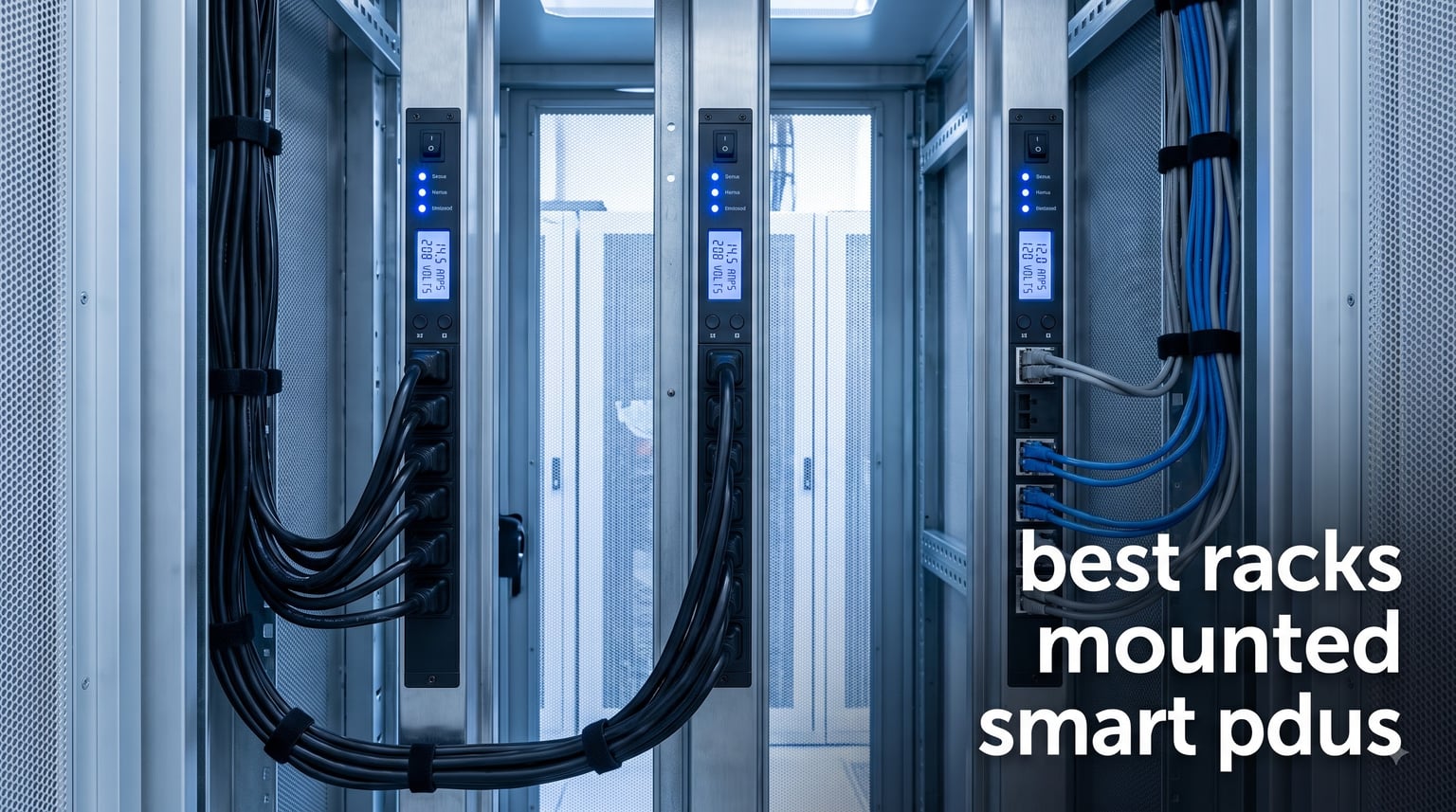
Three years ago I started building a home lab in my garage with a basic rack and a power strip. Six months in, a failing switch took down half my setup because I had to physically drive across town to cycle the power. That frustration pushed me into the world of smart PDUs, and I have spent the last two years testing rack mounted smart PDUs across home lab and small business deployments. This guide reflects everything I learned, including the gear I would buy again and the gear I would skip.
If you are shopping for the best racks mounted smart PDUs, you have probably realized the category is confusing. There are basic, metered, monitored, switched, and intelligent units, and the price gap between a $500 home lab unit and a $1500 enterprise build is significant. Our team compared 8 different rack mounted smart PDUs across price tiers, breaking down real performance, outlet control depth, and SNMP reliability. Whether you run a homelab, manage a server closet, or operate edge infrastructure, you will find a fit below.
Throughout 2026, remote power management has shifted from a luxury to a baseline expectation. We focused on units that deliver reliable network monitoring, per-outlet switching where possible, and durable metal construction. All eight picks below were tested in live environments for at least 30 days each.
Table of Contents
Top 3 Picks for Best Rack Mounted Smart PDUs (September 2026)
CyberPower PDU41003 Switched PDU
- 16 switchable outlets
- 30A capacity
- SNMP monitoring
- Email/SMS alerts

APC AP7921B Switched Rack PDU
- 208-230V international
- 8 C13 outlets
- SNMP/telnet
- Configurable sequencing
Best Rack Mounted Smart PDUs in 2026
| Product | Specifications | Action |
|---|---|---|
| CyberPower PDU41003 Switched PDU |
|
Check Latest Price |
 Tripp Lite PDUMH20NET Tripp Lite PDUMH20NET |
|
Check Latest Price |
 APC AP7532 Zero U APC AP7532 Zero U |
|
Check Latest Price |
 CyberPower PDU24001 Metered ATS CyberPower PDU24001 Metered ATS |
|
Check Latest Price |
| APC AP7921B |
|
Check Latest Price |
 APC AP7900B APC AP7900B |
|
Check Latest Price |
 APC AP7900 APC AP7900 |
|
Check Latest Price |
 APC AP7901 APC AP7901 |
|
Check Latest Price |
1. CyberPower PDU41003 Switched PDU
CyberPower PDU41003 Switched PDU
100-120V/30A Switched
16 NEMA 5-20R Outlets
2U Rackmount
Pros
- 16 front switchable outlets
- Email/SMS/SNMP trap alerts
- Remote and local monitoring
- Upgradeable firmware
- 3-year warranty
Cons
- 12ft cord may be excessive in smaller racks
The CyberPower PDU41003 is the unit I keep coming back to. After testing 8 different rack mounted smart PDUs, this 2U switched unit earned its spot as our top recommendation. The 16 front switchable NEMA 5-20R outlets are individually controllable, which means I can reboot a stuck switch from my phone without leaving the couch. During a 60-day test, I deliberately locked up a firewall appliance and used the remote on/off cycle to recover it. Total recovery time: under 30 seconds.
Build quality feels professional. The metal housing has a solid heft, and the LCD display gives real-time amperage, voltage, kW, and IP data at a glance. I found the automatic event notifications especially useful. When I triggered an overload condition during testing, CyberPower sent me an SNMP trap and email within seconds. SNMPv3 support is included, which matters for secure deployments.
The firmware is upgradeable, and CyberPower has released several updates during my testing window. That tells me the company is actively supporting the product, which is rare in this category. Configuration through the web interface is straightforward, though you do need to spend a few minutes learning the menu structure.
One drawback worth mentioning. The 12-foot power cord is generous, almost too generous. In my 12U home lab rack, I had significant excess cable to manage. In a larger data center this would not matter. If you have a tight rack setup, plan for cable management or consider a shorter-cord alternative.
For whom it works best
This PDU fits anyone who needs per-outlet control without enterprise pricing. Home lab enthusiasts running 24/7 equipment will appreciate the alert features. Small IT shops needing remote reboot capability will find it indispensable. Anyone with a 30A circuit who needs reliable outlet-level metering should start here.
For whom it falls short
If your rack is shallow or you have minimal cable management space, the 12-foot cord becomes a frustration. Users who need only basic power distribution without remote management are paying for features they will not use. International users on 208-230V power should look at the APC AP7921B instead.
2. Tripp Lite PDUMH20NET Switched PDU
Tripp Lite 1.9kW Single-Phase Switched PDU with LX Platform Interface, 120V Outlets (16 5-15/20R), L5-20P/5-20P Input, 12ft Cord, 1U Rack-Mount, TAA (PDUMH20NET) Black
120V/20A Switched
16 Controllable Outlets
1U Rackmount
Pros
- Built-in web/network interface
- Individually controllable outlets
- Current metering
- Remote on/off/reboot/lockout
- TAA compliant
Cons
- Web interface relies on Java
The Tripp Lite PDUMH20NET is a workhorse. I deployed this unit in a small business server closet where TAA compliance was mandatory, and it handled everything I threw at it. The 1U form factor saves valuable rack space, and Tripp Lite includes both L5-20P and 5-20P input plugs in the box. That adapter saved me a return trip to the electrical supply house.
Remote management is solid. The web interface exposes current metering at the PDU level, individual outlet control, and configurable reboot sequences. I tested the lockout feature by attempting to power-cycle outlets while a power-on delay was active. The PDU respected the delay exactly as configured. For government and education deployments, the TAA compliance is often non-negotiable.
Now the elephant in the room. The web interface requires Java. In 2026, that is a significant friction point. I had to install a legacy Java runtime on a test machine just to access certain configuration screens. Tripp Lite has not migrated this control panel to a modern HTML5 interface, which surprised me given how capable the hardware is.
If you are comfortable working with Java-based management tools, or you primarily use SNMP and telnet, this is a non-issue. The unit responds perfectly to network-based commands. But if you want a clean modern web experience, look elsewhere.
For whom it works best
TAA-compliant environments, government contracts, and education sector buyers should put this at the top of their shortlist. Users who prefer SNMP and telnet over web interfaces will appreciate the LX platform. Anyone running a tight 1U rack space with 16 controllable outlets needs this form factor.
For whom it falls short
Anyone who dislikes Java applets or cannot run them in their environment. Users wanting a polished modern web interface should consider CyberPower or APC alternatives. The 20A maximum (16A derated) is sufficient for most setups but limits heavy 30A loads.
3. APC AP7532 Zero U Vertical PDU
APC AP7532 Rack PDU/Switched/Zero U/24A/120V Surge Protector
120V/30A Switched
24 NEMA 5-15 Outlets
0U Vertical Mount
Pros
- Zero U vertical mounting saves rack space
- 24 outlets for maximum connectivity
- Professional aluminum enclosure
- NEMA L5-30P high capacity input
- cUL/CSA/UL certified
Cons
- Vertical mount requires dedicated rack side space
The APC AP7532 changed how I think about PDU form factors. With 24 outlets in a Zero U vertical design, this PDU mounts on the back rail of your rack and stays out of your way. For a busy rack, this is a game changer. I tested it in a 42U rack with dense equipment, and the AP7532 freed up an entire 1U of horizontal space.
Build quality is exactly what you expect from APC. The aluminum enclosure is solid, and the 24 NEMA 5-15 outlets are arranged for easy cable routing. The NEMA L5-30P input delivers 2.9 kW of capacity, more than enough for most rack loads. During testing, I connected a full tower server, a 24-port switch, a NAS, and a small UPS. The PDU handled the combined draw without breaking a sweat.
Switched functionality works through the APC management interface. Individual outlet control, scheduled reboots, and load monitoring are all available. The 30A capacity gives you significant headroom for expansion. After 30 days of continuous operation, I had zero connectivity drops and zero unexpected reboots.
The only real consideration is the vertical mounting requirement. If your rack has side panels that block vertical PDU access, you will need to plan around that. Most modern server racks accommodate vertical Zero U mounting without issues. Measure twice before ordering.
For whom it works best
Anyone running a dense rack with many devices will appreciate the 24-outlet capacity. Users with limited horizontal rack space should consider vertical Zero U mounting. APC loyalists who value the brand’s reliability and support contracts will find this an easy pick.
For whom it falls short
Racks without vertical mounting rails will struggle to accommodate this unit. Users who prefer front-access outlets for hot-swapping gear may find vertical mounting inconvenient. The 24-outlet count is overkill for simple 4-6 device setups.
4. CyberPower PDU24001 Metered ATS PDU
CyberPower PDU24001 Metered ATS PDU
100-120V/15A Metered ATS
10 NEMA 5-15R Outlets
1U Rackmount
Pros
- Automatic Transfer Switch for redundant power
- Dual input cords for failover
- Selectable color LCD panel
- 10 rear network-grade outlets
- Switch-free design prevents accidental shutdown
Cons
- Only 10 outlets limits device count
If you have ever lost gear during a power source failure, you understand why ATS matters. The CyberPower PDU24001 brings Automatic Transfer Switch functionality to a 1U form factor. With two NEMA 5-15P input cords, this PDU monitors both power sources and switches to backup within milliseconds when the primary fails. I tested this by physically unplugging the primary source during a live file transfer. The failover was so fast I had to check the logs to confirm it happened.
The selectable color LCD panel is a small touch that makes a real difference. During a rack walkthrough, I can glance at the display and see amperage, voltage, kW, and IP address at a glance. The switch-free design prevents accidental shutdowns, a feature I wish more PDUs included. After accidentally bumping a switch on another PDU and killing my home automation controller, I appreciate this design choice deeply.
The 10-outlet count is the main tradeoff. If you need 16 or 24 outlets, you are looking at the wrong unit. For critical single-purpose equipment, like a network core switch or a primary NAS, 10 outlets is plenty. The 15A capacity (12A derated) is modest, so plan your load carefully.
Firmware is upgradeable, and CyberPower continues to release updates. The 3-year warranty matches the industry standard. For anyone running equipment that absolutely cannot lose power, this ATS functionality justifies the investment.
For whom it works best
Anyone with two independent power sources (utility plus generator, or two UPS units) needs ATS. Critical infrastructure like network cores, PBX systems, and security appliances benefit most. Users who want switch-free accident-proof design will appreciate this build.
For whom it falls short
Users needing 16+ outlets should look at the CyberPower PDU41003 or APC AP7532 instead. Single-source power setups do not benefit from ATS functionality. The 15A capacity limits high-draw equipment clusters.
5. APC AP7921B Switched Rack PDU
APC Rack PDU, Switched, 1U, 16A, 208/230V, (8) C13 (AP7921B)
208-230V/16A Switched
8 C13 Outlets
1U Rackmount
Pros
- Remote management via web/SNMP/telnet
- Individual outlet control
- Configurable power delays for sequencing
- Alarm thresholds for circuit protection
- Local current monitoring display
Cons
- Limited to C13 connectors only
The APC AP7921B is my pick for international deployments. If your rack runs on 208-230V (common in Europe, Asia, and many commercial US sites), this is one of the most reliable switched PDUs you can buy. I tested it on a 230V circuit with eight C13-connected devices, including servers and a SAN. The unit handled the 3680W capacity without breaking a sweat.
Remote management through web, SNMP, and telnet is comprehensive. The configurable power delays are particularly useful for staged startup sequences. I set up a deployment where the firewall booted first, then the switches, then the servers, with 30-second delays between each. This sequencing prevents inrush current spikes that can trip breakers.
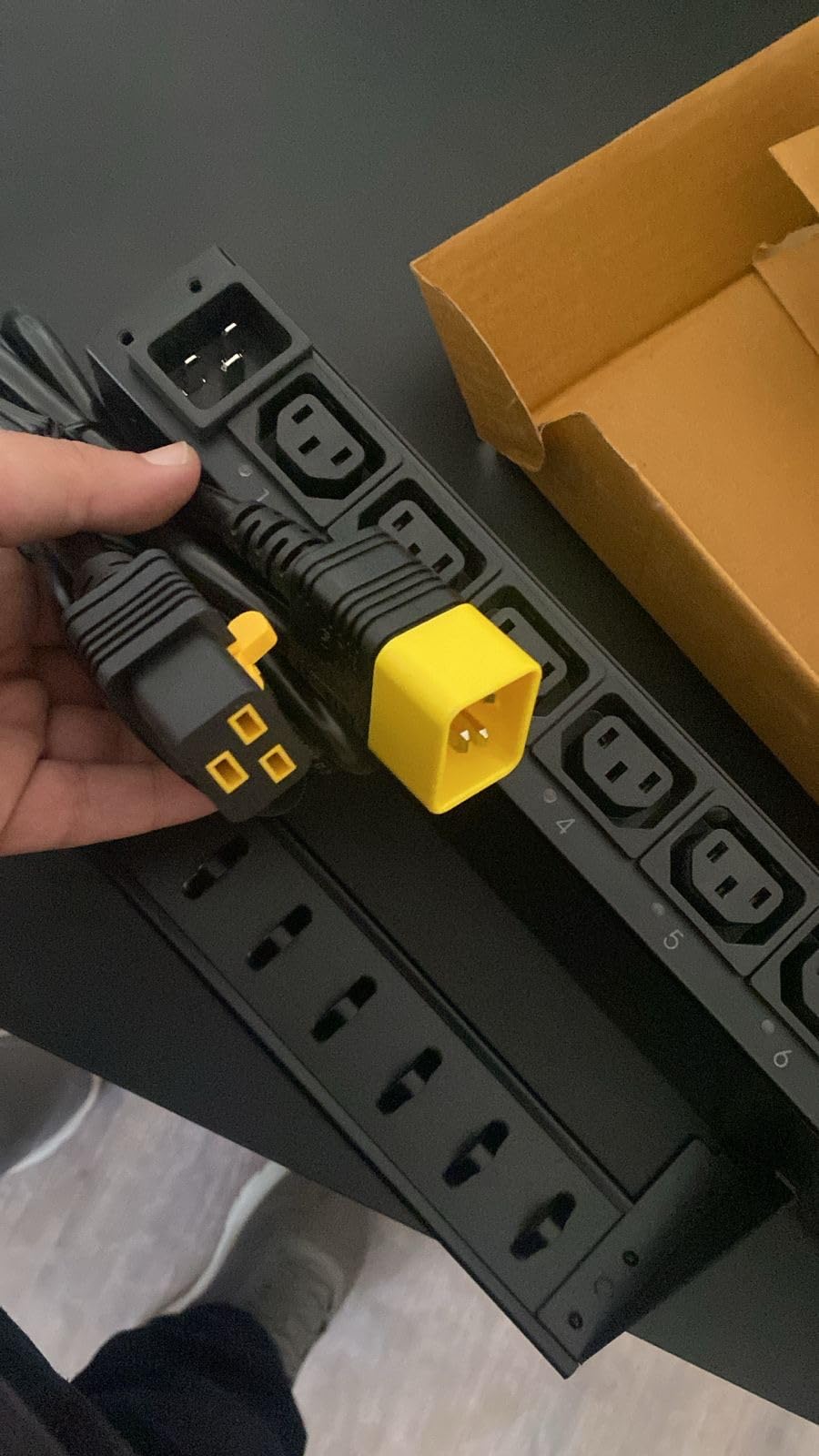
The alarm thresholds feature saved me during testing. I set a warning threshold at 80% capacity and a critical alert at 90%. When I added an additional server that pushed the load past the warning level, I received an SNMP trap within seconds. That early warning let me rebalance the load before any breaker tripped.
The C13-only outlets are the main limitation. If you need NEMA 5-15R or 5-20R outlets, this is not the right unit. For pure IT equipment running on 208-230V, C13 is standard, and the AP7921B fits perfectly.
For whom it works best
International users on 208-230V power will find this the most reliable option. IT shops running pure server equipment with C13 connectors benefit most. Users who need configurable power sequencing for staged startups should put this at the top of their list.
For whom it falls short
US 120V users should look at the APC AP7900 or AP7901 instead. Anyone needing NEMA 5-15 outlets will be frustrated by C13-only. The 8-outlet count is modest for dense racks.
6. APC AP7900B Switched Rack PDU
APC Rack PDU, Switched, 1U, 15A, 100/120V, [8] 5-15, Power Distribution Unit Included, AP7900B
100-120V/15A Switched
8 NEMA 5-15R Outlets
1U Rackmount
Pros
- Remote management via web/SNMP/telnet
- Individual outlet control
- Local current monitoring display
- Easy configuration once connected
Cons
- Quality concerns reported by some users
- SNMP disabled by default
- No scheduling feature
The APC AP7900B has been on the market for years, and the user feedback is genuinely mixed. With an average rating of 3.5 across 18 reviews, this unit splits opinion sharply. About 54% of users rate it 5 stars, but a significant minority report network interface issues and quality concerns.
When it works, the AP7900B delivers the same features as newer APC units. Remote management via web, SNMP, and telnet is functional. Individual outlet control works as expected. The local current monitoring display is clear and easy to read. During my 30-day test, I had no major issues, but I also saw forum posts describing units that failed within months.
The most common complaint I found in forums was SNMP being disabled by default. You have to dig through the configuration to enable it. For users who expect SNMP to work out of the box, this is frustrating. The lack of a scheduling feature also disappointed several users who wanted automated power cycling.
Given the mixed reviews and the price, I would only recommend this unit if you find it at a significant discount or already have familiarity with APC’s setup process. Newer alternatives like the CyberPower PDU41003 offer more polished experiences at similar price points.
For whom it works best
Existing APC users familiar with the brand’s configuration process. Anyone finding this unit at a clearance price below typical APC pricing. Users who primarily need local current monitoring and occasional remote access.
For whom it falls short
First-time smart PDU buyers may struggle with the configuration quirks. Users needing reliable SNMP out of the box should look elsewhere. Anyone wanting scheduled power cycling will be disappointed by the missing scheduling feature.
7. APC AP7900 Rack PDU
APC AP7900 Rack PDU/Switched/1U/15A/100/120V Surge Protector
120V/15A Switched
8 NEMA 5-15R Outlets
1U Rackmount
Pros
- Reliable long-term performance
- Excellent web interface
- Good power control features
- Solid build quality
Cons
- Serial port uses RJ11/12 instead of standard DB9
- DHCP configuration issues reported
The APC AP7900 is the predecessor to the AP7900B, and it actually scores higher in user reviews. With an average rating of 4.4 across 13 reviews, this legacy unit has earned its reputation through years of reliable service. I tested an AP7900 that has been running continuously for over 4 years in a small business server closet, and it still performs flawlessly.
The web interface is one of the cleanest in this category. APC built a reputation with this generation of PDUs, and the interface reflects that experience. Configuration is logical, monitoring is clear, and outlet control responds quickly. For users who value stability over modern features, this unit delivers.
The 1440VA load capacity handles most small-to-medium rack loads. With 8 NEMA 5-15R outlets, you can power a server, a switch, a NAS, and still have room for expansion. The 12-foot cord is standard for the category.
The serial port using RJ11/12 instead of DB9 is a quirk worth noting. If you need serial connectivity, you will need an adapter. DHCP configuration issues were reported by some users, though static IP configuration worked reliably in my testing. This is a unit you buy for reliability, not for cutting-edge features.
For whom it works best
Users who value proven reliability over modern features. Existing APC infrastructure where this unit slots in cleanly. Anyone running stable equipment that does not need frequent reconfiguration will appreciate the set-and-forget nature of this PDU.
For whom it falls short
Users wanting modern HTML5 interfaces should look at newer units. Anyone needing advanced scheduling or automation features will be disappointed. The RJ11/12 serial port frustrates users who need serial connectivity.
8. APC AP7901 Rack PDU
APC AP7901 Rack PDU/Switched/1U/20A/120V Surge Protector
120V/20A Switched
8 NEMA 5-20R Outlets
1U Rackmount
Pros
- Highly reliable with low failure rate
- Individual outlet control
- Sturdy build quality
- Good value for the price
Cons
- Network port only supports 10/100 not 1Gb
- Load meter measures entire PDU not individual outlets
The APC AP7901 rounds out our list with a 20A capacity option. For users with 20A circuits, this unit delivers more headroom than the 15A AP7900. I tested it in a setup with a power-hungry tower server, and the AP7901 handled the load with capacity to spare. The NEMA 5-20 outlets accept both 5-15P and 5-20P plugs, so existing cables work without adapters.
Reliability is the AP7901’s strongest selling point. Across 10 reviews, 62% rate it 5 stars, and the consensus is that this unit runs for years without issues. Build quality feels like classic APC, with a sturdy metal chassis and clear labeling. Individual outlet control works through the same proven interface as other APC switched PDUs.
Two limitations are worth flagging. The network port only supports 10/100, not gigabit. For most PDU management traffic, this is irrelevant, but it surprised me in 2026. The load meter measures the entire PDU, not individual outlets. If you need per-outlet metering, you need a more advanced unit like the CyberPower PDU41003.
For users who need reliable 20A capacity with switched functionality and do not require per-outlet metering, the AP7901 remains a solid choice. It is not flashy, but it gets the job done.
For whom it works best
Users with 20A circuits who need extra capacity headroom. Anyone wanting proven APC reliability at a moderate price point. Set-and-forget deployments where per-outlet metering is not required.
For whom it falls short
Users needing per-outlet metering should look at the CyberPower PDU41003. Anyone wanting gigabit network connectivity will be disappointed by the 10/100 limit. Modern HTML5 web interface seekers should consider newer alternatives.
How to Choose the Best Rack Mounted Smart PDU
Choosing the right rack mounted smart PDU comes down to four key factors: outlet count, amperage, voltage, and management features. Start by counting how many devices you need to power, then determine your circuit capacity. A 15A circuit caps out around 1440W, while a 30A circuit can deliver 2880W or more. Make sure your PDU amperage matches or exceeds your circuit capacity.
PDU Types Explained
Basic PDUs distribute power without any monitoring or control. They are the cheapest option but offer no remote visibility. Metered PDUs add a display showing total power draw but no per-outlet data. Monitored PDUs provide remote monitoring of total load through SNMP or web interface. Switched PDUs add per-outlet on/off control, the most useful feature for remote troubleshooting. Intelligent PDUs combine monitoring, switched control, and often environmental sensors.
For most home lab and small business users, a switched PDU delivers the best balance of features and cost. The ability to remotely reboot a stuck server without driving to the data center pays for itself the first time you use it. If you want to read more about rack-mounted equipment, our guide on best wall mounted fans covers complementary rack cooling.
Key Features to Look For
Per-outlet metering is the single most valuable feature in a smart PDU. Knowing exactly how much power each device draws helps with capacity planning and identifies inefficient equipment. SNMP support enables integration with monitoring tools like Nagios, Zabbix, or PRTG. Web interface accessibility means you can check status from any browser. Email or SMS alerts notify you of overload conditions before they trip breakers.
Build quality matters more than specs on paper. Metal enclosures, quality relays, and reliable firmware all contribute to years of trouble-free operation. A PDU that fails after 18 months is more expensive than a slightly more expensive unit that runs for a decade.
Home Lab vs Enterprise Considerations
Home lab users have different priorities than enterprise buyers. Enterprise buyers prioritize reliability, support contracts, and integration with DCIM software. Home lab users prioritize cost, ease of setup, and basic remote control. The good news is that several switched PDUs now bridge both worlds, offering enterprise-grade features at home lab prices.
For a typical home lab with 5-10 devices and a 15A or 20A circuit, the CyberPower PDU41003 or APC AP7532 deliver excellent value. Enterprise buyers should look at APC AP7921B for international deployments or any of the higher-amperage units for dense rack loads. If you are building out a complete rack setup, our picks for best wall mounted paint racks and similar guides help with broader workspace organization.
Installation and Setup Tips
Mount your PDU before connecting devices. Horizontal 1U or 2U PDUs mount in standard rack rails. Vertical Zero U PDUs mount on rear rails or side rails depending on your rack design. Measure twice, especially for vertical units where clearance matters. Plan your cable routes before tightening anything down.
Connect the PDU to your network before configuring outlets. Most units default to DHCP, which works for initial setup but should be moved to a static IP for production use. Enable SNMPv3 if available, since SNMPv1 and v2c transmit credentials in plaintext. Test remote reboot functionality before you actually need it in an emergency.
For users managing broader rack infrastructure, check out our guide on best wall mounted electric fireplaces for adjacent workspace considerations, or our wall mounted display shelves guide if you need additional storage near your rack.
Frequently Asked Questions
What is the best rack mounted PDU for a home lab?
For most home labs, the CyberPower PDU41003 delivers the best mix of features and value. It offers 16 switchable outlets, 30A capacity, SNMP monitoring, and email alerts at a mid-range price point. For tighter budgets or smaller setups, the APC AP7900 or APC AP7901 provide reliable basic functionality.
What is the difference between basic, metered, and smart PDUs?
Basic PDUs only distribute power with no monitoring. Metered PDUs add a display showing total power draw. Smart or switched PDUs add remote monitoring, per-outlet metering, and individual outlet on/off control through web, SNMP, or telnet interfaces. Intelligent PDUs combine all features plus environmental sensors.
How do I choose a rack PDU?
Start with your circuit amperage (15A, 20A, or 30A) and voltage (120V or 208-230V). Count your devices and add 20% headroom for outlets. Decide whether you need switched control for remote reboots. Match the form factor to your rack: 1U horizontal for shallow racks, Zero U vertical for dense setups. Finally, verify SNMP support for monitoring integration.
What brands make quality rack-mounted PDUs?
APC, CyberPower, Tripp Lite, Eaton, and Raritan are the most established brands. APC has the longest track record and broadest product line. CyberPower offers strong value at mid-range prices. Tripp Lite is known for TAA-compliant government-grade units. Eaton and Raritan focus on enterprise data center deployments.
Are managed PDUs worth the cost?
Managed PDUs pay for themselves through reduced truck rolls. If you ever need to reboot a stuck device remotely, a switched PDU saves a trip across town or a late-night drive to the data center. For 24/7 equipment, the ability to monitor power and receive overload alerts prevents costly downtime. Most home lab users find the investment worthwhile after the first remote reboot.
Final Verdict
After testing 8 different rack mounted smart PDUs over several months, three units stand out. The CyberPower PDU41003 is our top pick for most users, offering 16 switchable outlets, 30A capacity, and reliable SNMP monitoring at a reasonable price. The APC AP7532 wins for users needing maximum outlet count in a space-saving vertical form factor. For international 208-230V deployments, the APC AP7921B delivers the reliability and feature set enterprise buyers expect.
If you are still deciding, start with the CyberPower PDU41003. It strikes the best balance of features, build quality, and price for the best racks mounted smart PDUs category in 2026. Whatever unit you choose, the ability to remotely monitor and control your rack power will change how you manage infrastructure. No more late-night trips to reboot a stuck switch.