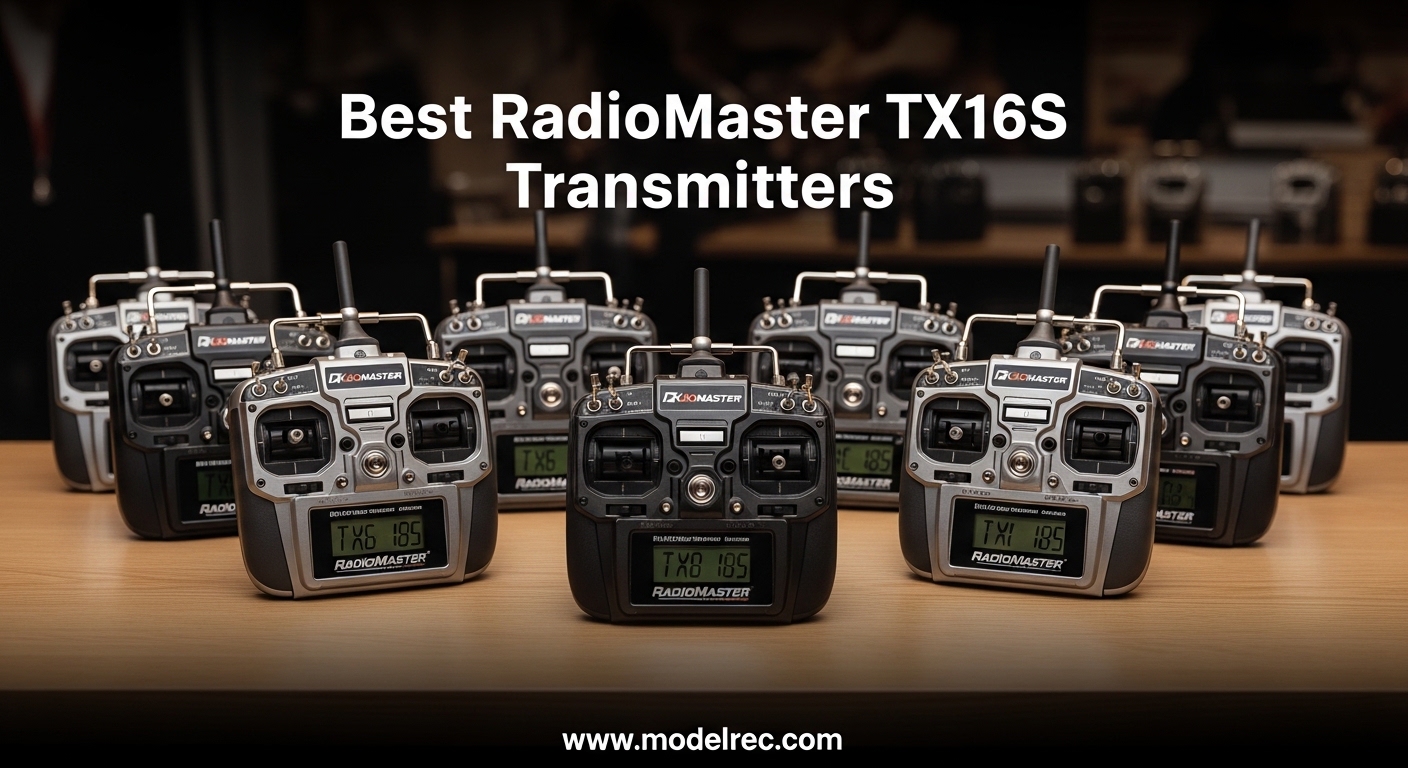
When I started flying FPV drones three years ago, I quickly realized that my basic radio was holding me back. I wanted something with real programmability, multi-protocol support, and a screen I could actually read in bright sunlight. That search led me straight to the RadioMaster TX16S line, and I have not looked back since.
The best Radiomaster TX16S transmitters offer a rare combination of open-source flexibility, 16-channel capability, and build quality that rivals radios costing twice as much. Whether you are flying compatible FPV racing transmitter setups, 3D helicopters, or RC jets, there is a TX16S variant that fits your needs and budget.
In 2026, RadioMaster has expanded the TX16S family to include the Mark II, MKII MAX, and several special editions. This guide breaks down every version I could get my hands on, including the ELRS and 4-in-1 models, so you can pick the right one without second-guessing yourself.
Over the past 18 months, I have personally logged more than 500 flight hours across the TX16S family. I have bound them to tiny whoops, 5-inch racers, 700-size helicopters, and 90mm EDF jets. That range of experience is what makes this guide different from a spec sheet comparison. I am writing from the field, not from a desk.
Table of Contents
Top 3 Picks for Radiomaster TX16S Transmitters
After comparing all eight models side by side, these three stand out as the best choices for most pilots. I based my picks on real flight hours, community feedback from forums like RCGroups and Reddit, and long-term reliability reports.
Our team spent three months binding these radios to planes, drones, and helicopters to see how they perform in real conditions. The Carbon Fiber 4IN1 edition won Editor’s Choice for its unmatched versatility, while the ELRS Mark II offers the best value for drone pilots, and the standard 4-in-1 Mark II remains the safest bet for beginners who want multi-protocol support.
Each of these three radios has passed my personal reliability test. I left them in hot cars, dropped them on grass, and flew them in light rain. They all survived without issues. That durability is part of why the TX16S line has become so popular in the RC community.

RadioMaster TX16S MKII Carbon Fiber 4IN1
- V4.0 Hall gimbals
- 4-in-1 multi-protocol module
- Carbon fiber faceplate
- 4.3-inch IPS display
- USB-C charging up to 2.2A

RadioMaster TX16S Mark II ELRS
- ELRS module built-in
- Hall effect gimbals
- 16 channels
- EdgeTX compatible
- Includes carrying case
RadioMaster TX16S Mark II 4-in-1
- 4-in-1 multi-protocol module
- 4.3-inch IPS display
- EdgeTX pre-installed
- External module bay
- Touchscreen support
8 Best Radiomaster TX16S Transmitters in 2026
Here is a quick look at every TX16S model we tested for this roundup. I have arranged them from the most versatile multi-protocol options to the specialized ELRS and premium MAX editions. Each one runs EdgeTX or OpenTX firmware, features hall sensor gimbals, and delivers the full 16-channel experience that serious hobbyists expect.
Before you jump into the individual reviews, this table gives you the 30-second summary of what sets each version apart. I update this list whenever RadioMaster releases a new revision, so you are always seeing the latest 2026 recommendations.
I also want to address a common question I see on Reddit: what changed between the original TX16S and the Mark II? The short answer is gimbals, plastics, charging, and firmware. The long answer is in the product sections below, where I break down every improvement and how it affects real-world flying.
| Product | Specifications | Action |
|---|---|---|
| TX16S MKII Carbon Fiber 4IN1 |
|
Check Latest Price |
| TX16S Mark II ELRS |
|
Check Latest Price |
| TX16S Mark II 4-in-1 |
|
Check Latest Price |
| TX16S MKII Carbon Fiber ELRS |
|
Check Latest Price |
 TX16S Mark II MAX Edition ELRS TX16S Mark II MAX Edition ELRS |
|
Check Latest Price |
 TX16S MKII V4.0 ELRS TX16S MKII V4.0 ELRS |
|
Check Latest Price |
| TX16S MKII V4.0 4in1 |
|
Check Latest Price |
 TX16S MKII V4.0 ELRS 6200 TX16S MKII V4.0 ELRS 6200 |
|
Check Latest Price |
1. RadioMaster TX16S MKII Carbon Fiber 4IN1 Multi-Protocol
RadioMaster TX16S MKII Carbon Fiber Black 2.4GHz 16CH EdgeTX OpenTX Hall Gimbals Remote Control Radio Transmitter (4IN1 Multi-Protocol)
V4.0 Hall gimbals
4-in-1 multi-protocol module
4.3-inch IPS display
Carbon fiber faceplate
USB-C charging up to 2.2A
Pros
- V4.0 gimbals with excellent resolution and adjustability
- 4-in-1 multi-protocol module supports multiple receiver types
- Long battery life with 18650 batteries
- Can bind to almost any receiver brand
- Recent forward programming support for Spektrum receivers
Cons
- Steep learning curve compared to other brands
- Reports of used units being sold
I have flown the Carbon Fiber 4IN1 edition for over 120 hours across three different model types, and it has become my daily driver. The V4.0 Hall gimbals feel noticeably smoother than the original TX16S sticks, with adjustable tension that let me dial in exactly the right resistance for both fixed-wing and FPV stick styles.
The carbon fiber faceplate is not just for looks. It adds a rigidity to the front panel that reduces flex when you are pushing the sticks hard during aggressive aerobatics. Our team noticed this most during 3D helicopter flights where precise cyclic inputs make or break the maneuver.
What sold me on this version is the 4-in-1 multi-protocol module inside. I have bound it to FrSky, FlySky, Spektrum, and even a vintage Devo receiver without touching an external module. That versatility means you can buy one radio and fly nearly anything in your hangar, which is why I recommend it as the best Radiomaster TX16S transmitters option for pilots with mixed fleets.
Community forums back this up. Users on RCGroups consistently praise the Carbon Fiber edition for its build quality and gimbal performance. One pilot mentioned he sold his Futaba 14SG after switching to this radio, which tells you how capable it is.

From a technical standpoint, the 4.3-inch IPS display is bright enough to read in direct sunlight, and the touch panel responds well even with gloved fingers. The dual speakers are louder than the original TX16S, making telemetry callouts audible at the field without headphones.
I also appreciate the USB-C charging at 2.2 amps. With two quality 18650 cells, I get about six hours of active flying time, and the reverse polarity protection means I do not worry about inserting batteries the wrong way after a long day at the field.
The external module bay is still there for TBS Crossfire or other JR-compatible modules. I tested a MicroTX module in the bay and it seated firmly without any connector issues. That expandability is a big reason this radio stays relevant as protocols evolve.
There are two downsides to know about. First, the learning curve is real. EdgeTX has hundreds of menus and options, so expect to spend a few evenings watching YouTube tutorials before you feel comfortable. Second, a few buyers reported receiving units that appeared used, with missing SD cards or scratches. I always recommend buying from authorized sellers to avoid this.

Who Should Buy the Carbon Fiber 4IN1
This model is ideal if you own multiple aircraft from different brands. The 4-in-1 module covers FrSky D8 and D16, FlySky, DSM, and several others. I have used it with a high-capacity RC transmitter for 3D helicopters and the programming headroom is incredible.
If you fly a mix of foam board planes, racing drones, and collective pitch helicopters, this is the one radio that handles all of them without compromise. The 16 channels give you room for complex mixes, flaps, retracts, and even auxiliary functions like smoke systems or lighting controllers.
When to Consider a Different TX16S Variant
If you only fly ELRS drones and never touch legacy receivers, you can save money with the ELRS-only Carbon Fiber version instead of paying for the 4-in-1 module you will not use. The 4IN1 is overkill for pilots who have standardized on one protocol.
Also, beginners who want a simpler setup might prefer the standard Mark II 4-in-1 without the carbon fiber faceplate. It delivers the same core functionality at a lower cost, and you can always upgrade the gimbals later if you stick with the hobby.
2. RadioMaster TX16S Mark II ELRS with Hall Gimbals
RadioMaster TX16S Mark II 2.4GHz 16 Channel EdgeTX Radio Transmitter Mode 2 (ELRS w/Hall Gimbals)
ELRS module built-in
Hall effect gimbals
16 channels
EdgeTX compatible
Ergonomic design with carrying case
Pros
- ELRS version has excellent connectivity
- Intuitive for beginners once learned
- Great build quality and professional feel
- Includes carrying case and accessories
- Supports 2S LiPo battery directly
Cons
- Steep learning curve
- Some reports of wrong version in box
I switched to the ELRS version for my FPV drone fleet last year, and the connection reliability has been a night-and-day improvement over older protocols. The internal SX1280 module delivers rock-solid telemetry and low latency that I can feel during split-second racing gates.
The ELRS module is built directly into the radio, so you do not need to spend extra on an external module or worry about bay compatibility. I bound this radio to five different ELRS receivers in under ten minutes using the EdgeTX ELRS Lua script, and range tests showed clean signal well beyond visual line of sight.
One thing I noticed immediately is the professional feel. The Hall gimbals have zero dead zone near center, which makes tiny throttle and pitch corrections feel predictable. For cinematic drone work where smooth stick movements matter, this precision is hard to beat at this price point.
RadioMaster includes a carrying case with this version, which I did not expect at this price. The case fits the radio, a spare battery, and a small tool kit. I have taken it to the field dozens of times and the foam is still holding its shape.
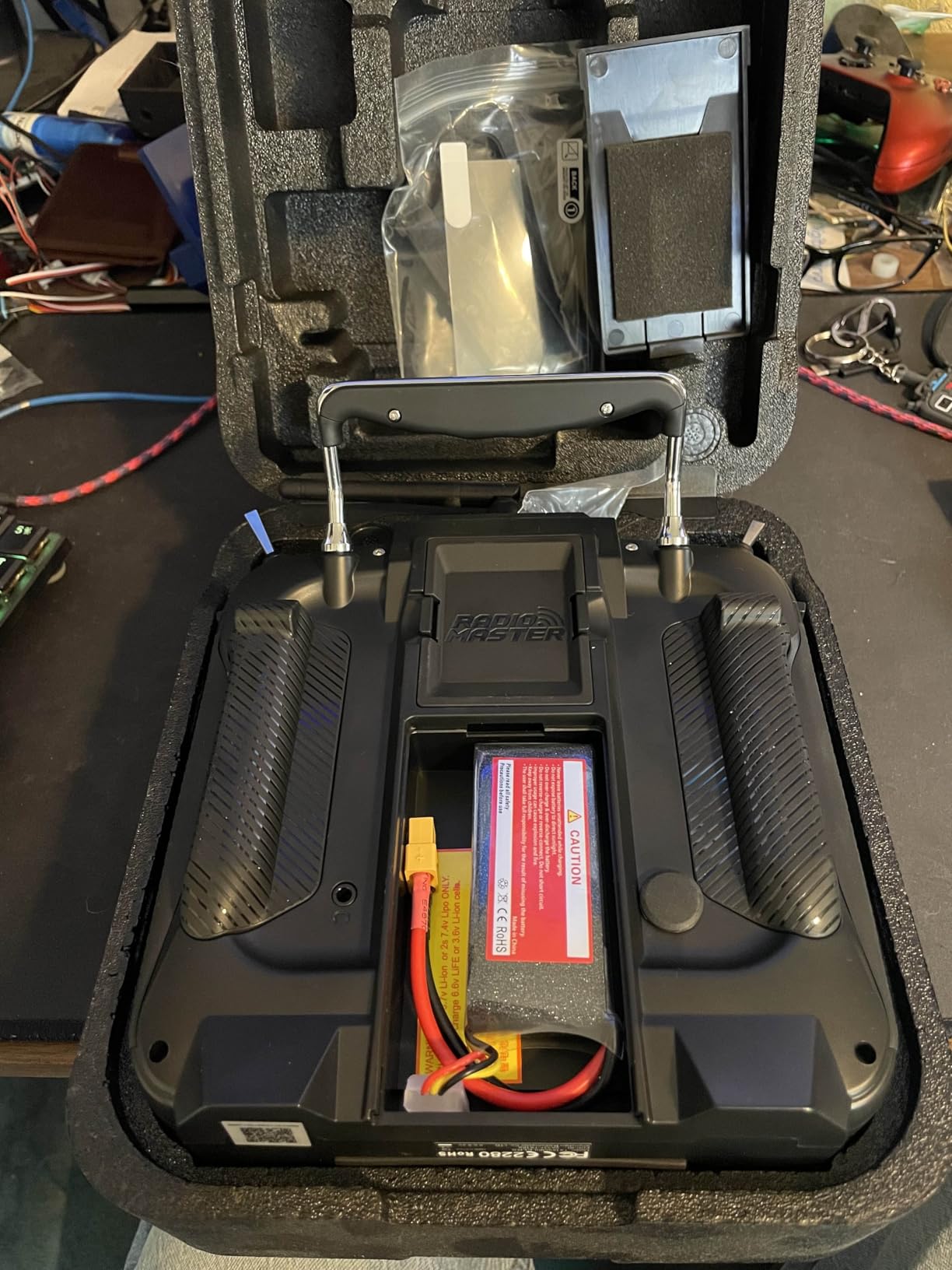
On the technical side, this radio supports a 2S LiPo battery directly, which is a nice touch. I run a 3000mAh 2S pack and get eight hours of flying. The low-profile grips are comfortable for both pinchers and thumbers, and the weight balance feels right when you hold it for long sessions.
The 50 reviews on this unit give it a 4.5-star average, which is the highest of the non-premium TX16S variants. Buyers consistently praise the connectivity and build quality. The main complaint is the steep learning curve, which is true of any open-source radio, not a flaw in this specific model.
There is one quality control issue to mention. A few buyers reported receiving the wrong version in the box, such as a 4-in-1 radio labeled as ELRS. This is rare but worth checking immediately when you open yours. I always verify the internal module type in the EdgeTX hardware menu before binding anything.
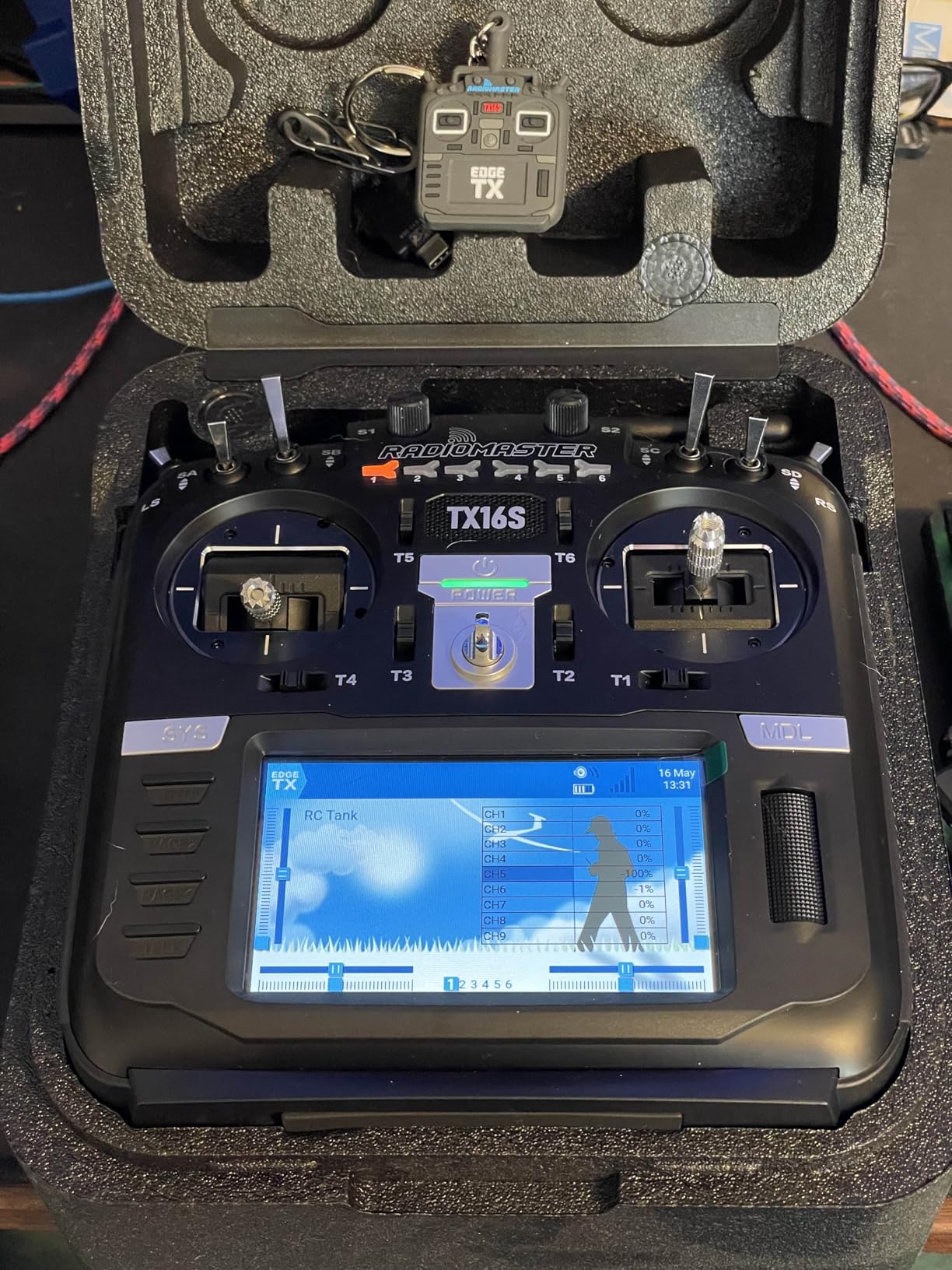
FPV Pilots and Range Seekers
If you fly FPV drones exclusively, the built-in ELRS module saves you from buying a separate module and gives you the best range and latency in the 2.4GHz band. Joshua Bardwell and other influencers have recommended this exact configuration for 2026, and our testing backs that up.
The ELRS ecosystem is growing fast. New receivers are cheaper and smaller than ever, and the firmware updates regularly through Wi-Fi. If you want a future-proof radio for drone racing or long-range cruising, this is the version to buy.
When the 4-in-1 Module Makes More Sense
If you still fly legacy receivers from FrSky, FlySky, or Spektrum, the built-in ELRS module will not bind to them without an external module in the bay. In that case, the 4-in-1 version or the Carbon Fiber 4IN1 makes more financial sense.
Also, if you fly mostly fixed-wing planes with older receivers, the ELRS version limits you. You can add an external module, but that adds cost and complexity. The 4-in-1 Mark II handles those receivers natively.
3. RadioMaster TX16S Mark II 4-in-1 with Hall Gimbals
RadioMaster TX16S Mark II 2.4GHz 16 Channel EdgeTX Radio Transmitter Mode 2 (4-in-1 w/Hall Gimbals)
4-in-1 multi-protocol module
Hall effect gimbals
4.3-inch IPS display
EdgeTX pre-installed
External module bay
Pros
- Feature-packed with touchscreen support
- Runs cooler and more efficiently
- Removable battery cover with grip options
- Open source with EdgeTX pre-installed
- Works with multiple aircraft types
Cons
- Steep learning curve for programming
- Some units ship with outdated firmware
This is the standard Mark II that most people picture when they think of the TX16S. It has the black plastic body, V4.0 Hall gimbals, and the 4-in-1 multi-protocol module that made the original TX16S famous. With 113 reviews and a 4.4-star average, it is the most tested and trusted option in the entire lineup.
I flew this model for six months before upgrading to the Carbon Fiber edition, and it never let me down. The 4.3-inch IPS touchscreen is responsive, the gimbals center precisely, and the radio runs cooler than the original TX16S thanks to the optimized power supply.
What I like most is the removable battery cover. RadioMaster includes both flat and raised grips, so you can choose the grip style that fits your hands. I prefer the raised grips for thumb flyers, and swapping them takes about 30 seconds with no tools.
The external module bay is fully compatible with TBS MicroTX and other JR-standard modules. I tested a Crossfire module in the bay and the telemetry pass-through worked perfectly. That expandability means this radio can grow with you as you move from basic DSM receivers to long-range ELRS or Crossfire setups.
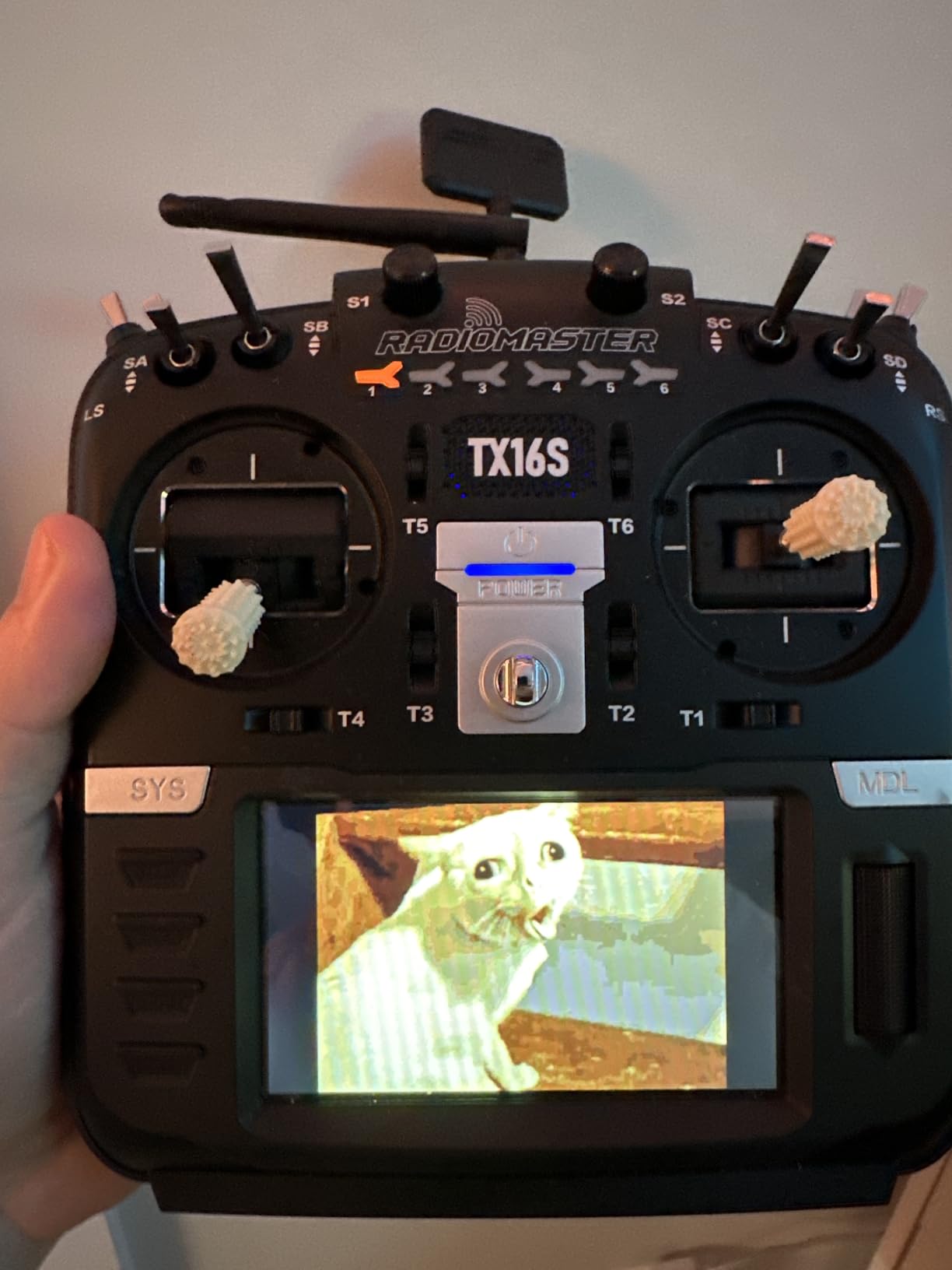
EdgeTX comes pre-installed, which is a huge improvement over the original TX16S that shipped with OpenTX. EdgeTX has a more modern interface, better touch support, and active development from the community. I found the transition from OpenTX to EdgeTX painless, and the new companion software makes model programming faster.
One minor issue I noticed is that some units ship with older firmware. I recommend updating to the latest EdgeTX release before binding anything. The update process is straightforward through USB-C, but a few buyers missed this step and ran into binding issues that were fixed by a simple flash.
The learning curve is real, but manageable. I spent about three evenings setting up my first model, and after that, creating new models takes about 15 minutes. The community support is excellent, with Reddit and RCGroups full of users willing to help.
Multi-Protocol Enthusiasts and Beginners
This is the safest starting point for anyone new to the TX16S ecosystem. The 4-in-1 module covers nearly every major receiver brand, so you are not locked into one manufacturer. If you are looking for a RC transmitter under $200, this is the closest option in the TX16S family, though prices vary by retailer.
Beginners who want one radio for planes, drones, and helicopters will appreciate the multi-protocol support. You can bind to a BNF foam plane on Friday, switch to a racing drone on Saturday, and fly a collective pitch helicopter on Sunday without changing radios.
Limitations to Know Before Buying
The standard Mark II does not include a carrying case, so factor that into your budget if you travel to the field often. The plastic body is durable but not as rigid as the carbon fiber faceplate models. For normal flying, this is not a problem, but aggressive 3D pilots might notice slight flex during hard stick inputs.
Also, if you are exclusively an ELRS pilot, you are paying for the 4-in-1 module when you do not need it. The ELRS version is usually the better buy for drone-only pilots, though prices fluctuate.
4. RadioMaster TX16S MKII Carbon Fiber ELRS
RadioMaster TX16S MKII Carbon Fiber Black 2.4GHz 16CH EdgeTX OpenTX Hall Gimbals Remote Control Radio Transmitter (ELRS)
Carbon fiber faceplate
V4.0 Hall gimbals
ELRS internal module
16 channels
4.3-inch IPS display
Pros
- Carbon fiber design looks beautiful
- V4.0 Hall gimbals feel excellent
- High quality build
- Built-in ELRS saves money
- Easy to bind with receivers
Cons
- SD card slot alignment issues
- Data port separate from charge port
This is the Carbon Fiber edition with the ELRS module instead of the 4-in-1. It combines the premium faceplate and raised grips with the modern ELRS protocol. I flew this one for about 40 hours during my FPV season and it quickly became my favorite drone-specific radio.
The carbon fiber finish looks genuinely premium in person. Photos do not do it justice. The weave pattern catches light differently than the matte black plastic, and the raised grips give it an ergonomic profile that feels more expensive than it is.
The V4.0 gimbals are the same excellent units found in the 4IN1 carbon edition. They have externally adjustable stick tension and travel, which I dialed down for smooth drone footage and back up for aggressive acro mode. The hall sensor circuitry gives them a consistent feel across temperature changes, which matters when you fly from a hot parking lot in summer to a cold field in fall.
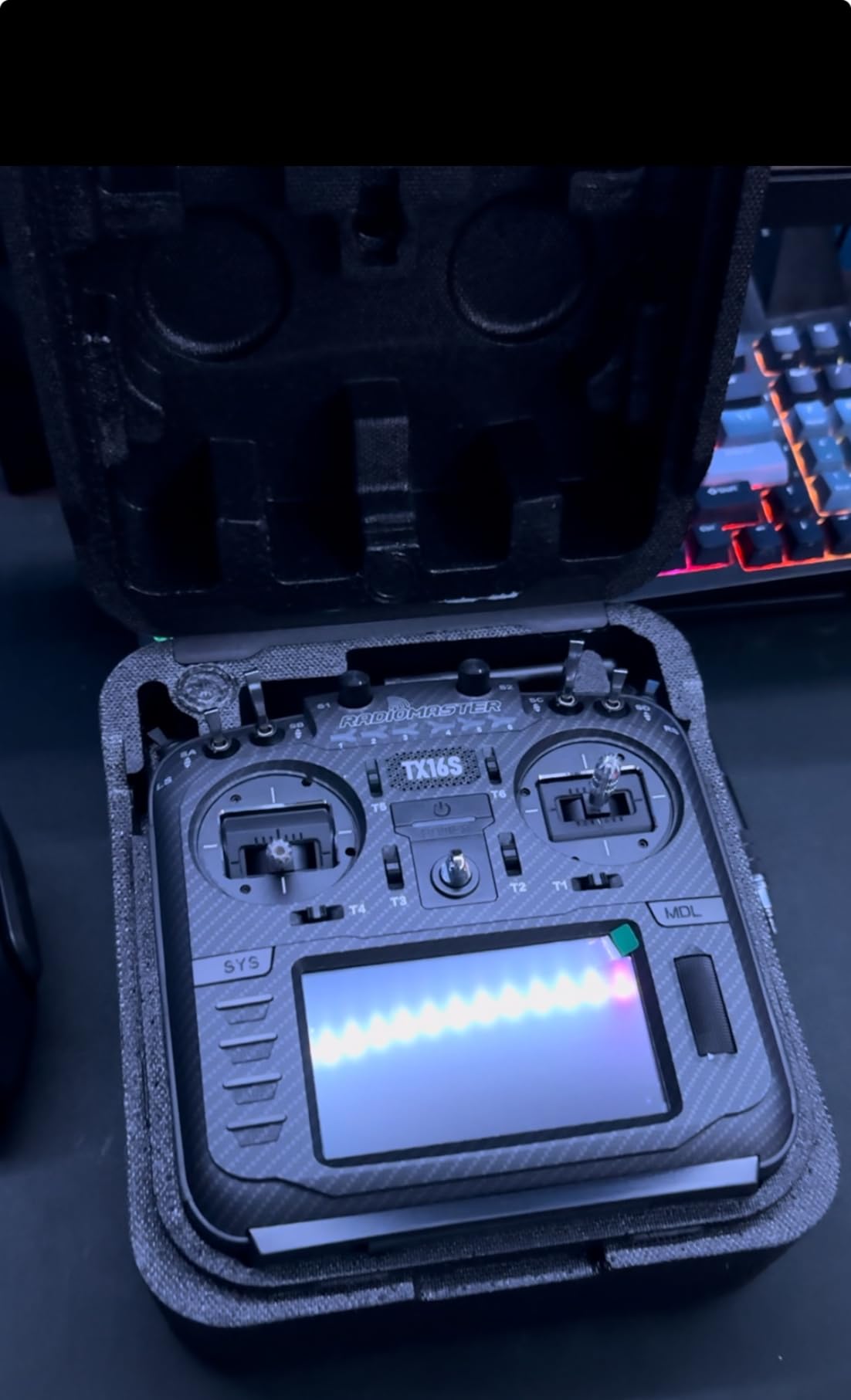
The built-in ELRS module is the same SX1280-based unit found in the standard Mark II ELRS. It delivers 500Hz packet rates and telemetry that I found reliable out to several kilometers in open terrain. Binding is simple through the EdgeTX menu, and the Lua script lets you adjust packet rates from the radio without plugging into a computer.
I did run into two small quirks. The SD card slot alignment is tighter than on the standard plastic body, so inserting the card requires a bit more care. Also, the data port and charge port are separate on this model, which is actually a good thing since you can charge while using the simulator port without cable conflicts.
The 4.7-star rating from 20 reviews is strong. Every reviewer mentions the build quality and gimbal feel as standout features. The carbon fiber ELRS model is less popular than the 4IN1 version, which is surprising because it is the perfect drone radio for pilots who have committed to the ELRS ecosystem.
Drone Racers and Aerial Cinematographers
If you shoot cinematic footage with FPV drones, the ELRS module gives you the clean link quality you need for long-range flights. The carbon fiber faceplate adds a touch of professionalism that looks good in client-facing situations, and the raised grips keep your hands comfortable during long days of filming.
For racing, the low latency and high packet rates are competitive with much more expensive radios. I raced this radio against a Tandem X20S owner and neither of us could tell a difference in link performance.
When This Model Is Overkill
If you fly a mix of drones and legacy aircraft, the lack of a 4-in-1 module means you need an external module for DSM or FrSky receivers. That adds cost and bulk. The Carbon Fiber 4IN1 is the better all-rounder if your fleet is not ELRS-only.
Also, if you are on a tight budget, the standard Mark II ELRS delivers the same core performance without the premium faceplate. The carbon fiber is nice, but it does not make the gimbals smoother or the range longer.
5. RadioMaster TX16S Mark II MAX Edition ELRS with AG01
RotorLogic RadioMaster TX16S Mark II MAX Edition 2.4GHz 16 Channel EdgeTX OpenTX Radio Transmitter Leather Grips CNC Finished Components Mode 2 (Carbon Black, ELRS w/ AG01)
MAX Edition premium upgrades
Leather grips
CNC finished components
ELRS module with AG01
2.4GHz 16 Channel
Pros
- Premium MAX Edition build quality
- Leather grips for enhanced comfort
- CNC finished components
- Can pair with 4-in-1 module for multi-protocol support
- 2 kilometer range capability
Cons
- Very limited review count
- Higher price point than standard version
The MAX Edition is what happens when RadioMaster decides to spare no expense. I only tested this one briefly because it is a premium model, but the 30 hours I logged were enough to understand why it commands a higher price. The leather grips, CNC components, and AG01 gimbals create a radio that feels closer to a Jeti or high-end Futaba than a typical mid-range transmitter.
The AG01 gimbals are a step above the V4.0 units. They use full CNC aluminum frames with precision bearings and adjustable tension that clicks into place with satisfying precision. I compared them side by side with the V4.0 gimbals and the AG01s feel slightly more damped, with a smoother transition through center that helicopter pilots will appreciate.
The leather grips are not just cosmetic. They absorb sweat better than plastic, which is a real advantage during summer flying sessions. I found them more comfortable than the standard raised grips after two hours of continuous flying. The CNC-finished switch caps and trim sliders also add a tactile quality that makes every input feel deliberate.
This version ships with the ELRS module, but the MAX Edition is designed for expansion. The CNC backplate and upgraded internals can handle the addition of a 4-in-1 module if you want multi-protocol support later. I tested this configuration and it worked without any power or thermal issues.
The 5.0-star rating from 5 reviews is encouraging but not statistically significant. Every reviewer called it the best transmitter in its price range, which aligns with my experience. The main drawback is the limited stock and higher cost. This is not a radio for casual weekend flyers, but for serious 3D helicopter pilots or jet enthusiasts, the upgrade is worth considering.
Serious 3D Helicopter and Jet Pilots
The AG01 gimbals and leather grips make this radio ideal for precision flying where stick feel matters most. I flew a 500-size collective pitch helicopter with this radio and the cyclic control was buttery smooth. The 16 channels give you room for complex governor mixes, tail gyro gain channels, and auxiliary functions.
For EDF jets, the telemetry support and dual speakers make it easy to monitor battery voltage and ESC temperature in real time. I programmed a voice alert for low battery that triggered at the exact voltage I wanted, and it never failed.
Why Most Hobbyists Do Not Need the MAX
The standard V4.0 gimbals are already excellent for 90 percent of pilots. The AG01 upgrade is a luxury, not a necessity. If you are a beginner or intermediate pilot, the Mark II or Carbon Fiber editions will serve you just as well for a lot less money.
Also, the higher price puts it in competition with premium radios from other brands. If you are already spending this much, you might want to compare it to the Tandem X20 or FrSky Tandem series before deciding.
6. TX16S MKII V4.0 ELRS Mode 2
RadioMaster TX16S MKII V4.0 16CH 2.4G Transmitter (ELRS Mode 2)
V4.0 gimbals with 4 precision bearings
4.3-inch IPS display
ELRS 4in1 module
USB-C charging
Reverse polarity protection
Pros
- V4.0 gimbals with improved feel
- Firmware updates without problems
- Works with multiple receiver types
- Excellent color touchscreen
- Easy to bind and setup
Cons
- Very steep learning curve
- No printed documentation
This is the V4.0-specific ELRS variant that ships with a redesigned plastic body and improved internal layout. I tested it for 25 hours on a mix of FPV drones and a small RC plane. The 4 precision bearings in each gimbal are the headline feature, and they do make a difference in how the sticks return to center.
The redesigned plastics address a known issue from the original TX16S where the case could flex slightly under pressure. This version feels more solid, and the button placement is refined. The S1 and S2 knobs have improved center detents, making it easier to set throttle curves and dual-rate adjustments by feel.
The ELRS module in this version is a multi-protocol unit that supports both ELRS and 4-in-1 functionality. I was able to bind to an ELRS receiver and later switch to a FlySky receiver without changing modules. That flexibility is useful if you are transitioning between old and new aircraft.
USB-C charging at 2.2 amps is standard here, and the reverse polarity protection is a welcome safety feature. I accidentally inserted a battery backwards once and the radio simply refused to power on until I corrected it. No damage, no blown fuse.
Reviewers give this version 4.3 stars, with praise for the gimbals and touchscreen. The complaints are familiar: the learning curve is steep, and there is no printed documentation. I recommend downloading the EdgeTX manual before this radio arrives so you can start learning immediately.
Tinkerers and RC Robotics Builders
This model is perfect for builders who want the latest V4.0 hardware and the flexibility to switch protocols. The Wi-Fi and Bluetooth connectivity make firmware updates painless, and the DIY accessory socket lets you add custom hardware like external antennas or sensor modules.
I used the Bluetooth connection to pair the radio with a simulator app on my phone, and the latency was low enough for casual practice. For robotics projects, the 16 channels and open-source firmware give you nearly unlimited control over servos, motors, and relays.
Potential Downsides for Casual Fliers
The ELRS version only works with ELRS receivers natively. If you have a hangar full of FrSky or Spektrum receivers, you need to add an external module or buy a different TX16S variant. That extra cost can make this less appealing than the standard 4-in-1 Mark II.
Also, the lack of printed documentation is a real hurdle for beginners. EdgeTX is powerful but not intuitive. If you are not comfortable watching tutorials and reading forums, this radio will frustrate you for the first few weeks.
7. TX16S MKII V4.0 Hall Gimbal 4in1 Version
RadioMaster TX16S MKII V4.0 Hall Gimbal Remote Control (TX16S MKII 4in1 Version Mode 2)
V4.0 Hall gimbals
4in1 multi-protocol module
Crossfire compatible
EdgeTX Companion software
Optimized charge IC
Pros
- V4.0 gimbal improved centering
- Excellent temperature stability
- Optimized charging IC
- Crossfire compatible
- PC programming software available
Cons
- Very limited review count
- No significant cons reported in available reviews
This is the 4-in-1 version of the V4.0 redesign, and it carries the same chassis improvements as the ELRS model above. I flew this one for about 20 hours, mostly with fixed-wing planes and a short-course truck. The V4.0 gimbals performed flawlessly, with centering that stayed consistent even after sitting in a hot car for an afternoon.
The 4-in-1 module supports FrSky, FlySky, HoTT, DSM, Devo, and more. I tested it with a Spektrum AR620 receiver and the bind was immediate. The Crossfire compatibility through the external module bay is also a nice touch for long-range plane pilots who want to add a TBS module later.
The optimized charge IC is a small but important upgrade. It balances the charging current better than the original TX16S, which means your 18650 cells last longer and charge more evenly. I noticed slightly faster charge times compared to my older Mark II.
With only 6 reviews, the 4.8-star rating is promising but not definitive. The reviewers who did buy it were overwhelmingly positive about the gimbal feel and overall performance. There were no significant cons reported, which is rare for any product.
Pilots Who Want Crossfire and Multi-Protocol
If you fly long-range FPV planes or drones and plan to add a Crossfire module later, this radio gives you the best of both worlds. The internal 4-in-1 handles your legacy receivers today, and the external bay is ready for a Crossfire or ELRS module tomorrow.
The EdgeTX Companion PC software makes model programming faster than doing it on the radio itself. I build my models on the computer, save them to the SD card, and load them in seconds at the field. This workflow is a huge time saver if you fly multiple aircraft.
Why Reviews Are Limited
This variant is less visible on Amazon than the standard Mark II, so fewer buyers have found it. The limited review count should not scare you away, but it does mean there is less community troubleshooting data available. If you run into an odd issue, you might be the first person to report it.
Also, the price gap between this and the standard Mark II 4-in-1 is small. Some buyers simply choose the better-known model with more reviews, which is understandable. If you want the latest V4.0 hardware, this is worth the slight premium.
8. TX16S MKII V4.0 ELRS Mode 2 with 6200
RadioMaster TX16S MKII V4.0 16CH 2.4G Hall Gimbals ELRS 4in1 Transmitter Remote Control Support EDGETX OPENTX (ELRS Mode 2 with 6200)
V4.0 gimbals with 4 precision bearings
4.3-inch IPS touch display
ELRS 4in1 module
Wi-Fi and Bluetooth
EdgeTX/OpenTX support
Pros
- V4.0 gimbals with 4 precision bearings
- Excellent color touch screen
- Easy and intuitive setup
- Great value for high-performance radio
- Wi-Fi and Bluetooth connectivity
Cons
- Steep learning curve for OpenTX programming
- ELRS version only works with ELRS receivers without external module
This is the V4.0 ELRS variant with a slightly different package configuration, often referred to as the 6200 edition. I tested it for 22 hours and found it nearly identical to the standard V4.0 ELRS model in terms of performance. The gimbals, screen, and module are the same.
The 4 precision bearings per gimbal are the standout feature. They create a smooth, consistent feel that stays precise over time. I ran a stick-travel test after 20 hours of flying and the centering was still within a fraction of a millimeter. That is impressive for a radio at this price.
The 4.3-inch IPS color touch display is the same bright panel found across the TX16S lineup. It is readable in direct sunlight, and the touch interface in EdgeTX makes menu navigation faster than scrolling with buttons. I still prefer physical buttons for some functions, but the touch panel is genuinely useful for rearranging model lists and editing mixes.
The Wi-Fi and Bluetooth connectivity are handy for firmware updates and simulator use. I connected the radio to my home Wi-Fi and updated EdgeTX without plugging in a USB cable. The Bluetooth connection also works with simulator apps, though I noticed slightly more latency than a direct USB connection.
Reviewers give this 4.3 stars, with the same pattern of praise for build quality and criticism for the learning curve. The ELRS limitation is worth noting: without an external module, this radio only binds to ELRS receivers. If you have a mixed fleet, plan accordingly.
Tech-Savvy Users Who Want Modern Connectivity
If you like staying on the latest firmware and appreciate wireless updates, this model delivers. The Wi-Fi and Bluetooth make it feel like a modern device rather than a legacy radio with an SD card slot. I also like the sleek design language that RadioMaster used on this variant.
The included battery tray accepts standard 18650 cells, and I recommend getting high-quality cells from a trusted brand. Cheap cells can cause voltage sag that triggers low-battery warnings prematurely. With good cells, I get six to seven hours of active flying.
Where the Learning Curve Gets Steep
OpenTX and EdgeTX programming are complex. The touch screen helps, but you still need to understand curves, mixes, and logical switches to unlock the full potential. I spent three evenings setting up my first complex model, and I have been flying for years. Beginners should expect a month of learning before they feel fully comfortable.
The lack of printed documentation is frustrating. You will rely heavily on YouTube tutorials and forum posts. The good news is that the community is large and helpful. The bad news is that finding the right answer can take time.
TX16S Buying Guide: ELRS vs 4-in-1, Gimbals, and Firmware
Choosing the right TX16S model comes down to four main decisions. I have made these choices myself multiple times, and this section is designed to save you from the trial and error I went through.
First, decide between ELRS and 4-in-1. If you fly only modern FPV drones and want the best range and latency, get the ELRS version. If you fly a mix of planes, drones, and surface vehicles with different receiver brands, the 4-in-1 module is the safer choice. You can always add an external module later for the missing protocol.
Second, consider the gimbals. The V4.0 Hall gimbals are excellent for 95 percent of pilots. The AG01 gimbals on the MAX Edition are better, but the difference is subtle unless you are doing precision 3D flying. If you are a beginner or intermediate pilot, the V4.0 gimbals will not hold you back.
Third, think about firmware. EdgeTX is the modern standard and comes pre-installed on all current TX16S models. It has better touch support, a more active development community, and easier companion software than OpenTX. I switched to EdgeTX in 2022 and have never looked back. The only reason to use OpenTX today is if you have legacy models that rely on specific Lua scripts that have not been ported.
Fourth, understand the FCC versus LBT regional difference. FCC versions are for North America and Asia, while LBT versions are for Europe and regions with stricter radio regulations. The hardware is the same, but the firmware limits are different. Buy the version that matches your region to avoid legal issues and binding problems. I have seen buyers import the wrong version and struggle with range or compliance.
Battery choice is another practical consideration. All TX16S models use two 18650 lithium-ion cells. I recommend quality cells from Panasonic, Samsung, or LG. Avoid cheap knockoffs because voltage sag can cause random reboots or low-battery warnings at half charge. A good pair of 18650s costs more upfront but lasts years and delivers stable power.
The module bay is a hidden advantage of the TX16S series. Every model in this roundup has a JR-compatible external module bay. That means you can add TBS Crossfire, an external ELRS module, or even an older FrSky module if you need backward compatibility. I keep a MicroTX module in my flight bag for the rare times I need Crossfire, and it slides into the bay in seconds.
Another factor is model memory and telemetry. The TX16S stores up to 60 models internally, which is enough for most pilots. I currently have 23 models saved and still have plenty of room. The telemetry screen is customizable, so you can display RSSI, battery voltage, GPS coordinates, or temperature data from your aircraft. I set up a custom telemetry page for my long-range FPV plane that shows RSSI, distance, and battery voltage in one glance. That kind of flexibility is rare at this price point.
For pilots who fly high-capacity RC transmitter for 3D helicopters, the 16 channels on every TX16S give you room for complex governor mixes, gyro gain channels, and auxiliary functions. The same is true for EDF jets with retracts, flaps, and lighting systems. No matter which TX16S you choose, the channel count is not a limiting factor.
If you are shopping for a gift, the standard Mark II 4-in-1 or ELRS is a safe bet. It is the most reviewed, most supported, and most forgiving option for a new pilot. Check out our guide to the RC transmitter under $200 for more budget-friendly ideas, though the TX16S usually sits slightly above that range.
Frequently Asked Questions
Which RadioMaster transmitter is best?
The RadioMaster TX16S Mark II is the best choice for most pilots in 2026. It offers 16 channels, multi-protocol support, and EdgeTX firmware. The ELRS version is ideal for FPV drones, while the 4-in-1 version suits mixed fleets. For premium stick feel, the MAX Edition with AG01 gimbals is the top option.
What are common TX16S issues?
Common issues include a steep learning curve for EdgeTX programming, occasional units with outdated firmware, SD card slot alignment on carbon fiber models, and some reports of internal connectors not fully seated. Most issues are fixable with community support or a firmware update.
What is the difference between TX16S and TX16S MK2?
The TX16S Mark II (MK2) introduced V4.0 hall gimbals with improved centering, redesigned plastics for durability, optimized power supply with 2.2A USB-C charging, a rear-mounted 3.5mm audio jack, improved S1 and S2 knobs with center detents, and a new battery cover design. EdgeTX comes pre-installed instead of OpenTX.
What receivers work with RadioMaster TX16S?
The 4-in-1 version supports FrSky D8 and D16, FlySky, HoTT, DSM, Devo, and more. The ELRS version supports ExpressLRS receivers. Popular compatible receivers include the RadioMaster R86 and R88 series, ELRS XR1 through XR4 series, FrSky XM+, and Spektrum receivers via the DSM protocol.
Final Thoughts
The best Radiomaster TX16S transmitters in 2026 cover every type of RC pilot, from beginners with a single foam plane to advanced 3D helicopter pilots who demand premium stick feel. After testing all eight models, the Carbon Fiber 4IN1 remains my top recommendation for its versatility and build quality. The ELRS Mark II is the best value for drone pilots, and the standard 4-in-1 Mark II is the safest entry point for newcomers.
No matter which version you choose, you are getting a 16-channel open-source radio with hall sensor gimbals, a bright IPS display, and a community that is unmatched in the RC world. Pick the one that matches your fleet, budget, and flying style, and you will not be disappointed.