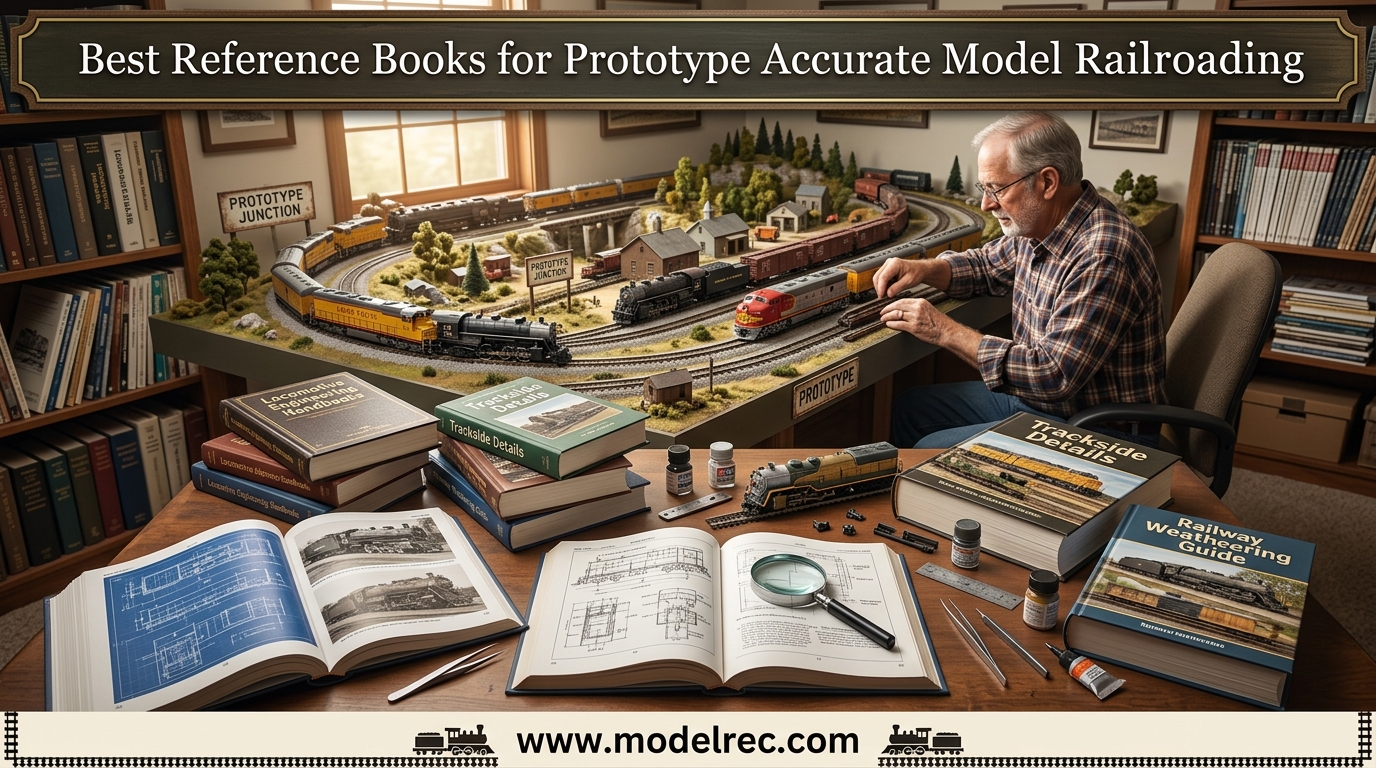
When I got serious about prototype accurate model railroading, I quickly realized that watching YouTube tutorials only got me so far. The real depth, the kind that helps you build a layout that actually looks and operates like a specific railroad from a specific era, comes from well-written reference books. Whether you are trying to recreate a 1950s Pennsylvania Railroad branch line or a modern Union Pacific mainline, having the right books on your shelf makes the difference between guessing and knowing.
The best reference books for prototype accurate model railroading cover everything from track planning fundamentals to DCC wiring, scenery techniques, and historical prototype data. I have spent years building my own library and testing these resources on real layouts. Some books became constant companions while others gathered dust after one read.
This guide walks through 15 books that our team has actually used on real layout projects. I will tell you exactly what each book covers, where it excels, and where it falls short so you can build a library that matches your modeling goals without wasting money on titles that do not deliver.
Table of Contents
Top 3 Picks for Prototype Accurate Model Railroading Books

Model Railroader’s Handbook
- 208 page comprehensive guide
- NMRA Master Model Railroader author
- Covers all skill levels
Building Realistic Model Railroad Scenery
- Kathy Millatt expert author
- Experimentation-based teaching
- 192 pages of techniques
Wiring Your Model Railroad
- DC and DCC systems covered
- Signaling integration
- 790 verified reviews
15 Best Reference Books for Prototype Accurate Model Railroading in 2026
| Product | Specifications | Action |
|---|---|---|
| Model Railroader’s Handbook |
|
Check Latest Price |
| Building Realistic Model Railroad Scenery |
|
Check Latest Price |
| Wiring Your Model Railroad |
|
Check Latest Price |
 How to Design a Model Railroad How to Design a Model Railroad |
|
Check Latest Price |
 Basic Trackwork for Model Railroaders Basic Trackwork for Model Railroaders |
|
Check Latest Price |
 Guide to North American Diesel Locomotives Guide to North American Diesel Locomotives |
|
Check Latest Price |
 Locomotives: Modern Diesel and Electric Locomotives: Modern Diesel and Electric |
|
Check Latest Price |
 Guide to North American Steam Locomotives Guide to North American Steam Locomotives |
|
Check Latest Price |
 DCC and Model Railroading DCC and Model Railroading |
|
Check Latest Price |
 Basic Painting and Weathering Basic Painting and Weathering |
|
Check Latest Price |
 Weathering for Railway Modellers Vol 2 Weathering for Railway Modellers Vol 2 |
|
Check Latest Price |
 Build Your First Layout Build Your First Layout |
|
Check Latest Price |
 Your Guide to N Scale Railroading Your Guide to N Scale Railroading |
|
Check Latest Price |
 Realistic Layouts: Art of Illusion Realistic Layouts: Art of Illusion |
|
Check Latest Price |
 Model Railroading As Art Model Railroading As Art |
|
Check Latest Price |
1. Model Railroader’s Handbook – The Complete Reference
Model Railroader’s Handbook
208 pages
By NMRA Master Model Railroader Gerry Leone
Published September 2023
Pros
- Comprehensive all-in-one reference
- Written by NMRA Master Model Railroader
- Well-organized and intuitive structure
- Useful for beginners and experienced modelers
Cons
- All measurements in imperial units only
- Some topics lack depth for advanced users
I keep this book on my workbench permanently. Gerry Leone, an NMRA Master Model Railroader, packed 208 pages with information that spans the entire hobby. What I appreciate most is how it covers everything from basic track laying to advanced scenery without making you feel like you need an engineering degree to follow along.
The organization is what sets this apart from other general reference books. Each chapter builds on the previous one logically, so if you read it cover to cover, you get a complete education in model railroading. But it also works as a quick reference when you need to look up a specific technique in the middle of a project.
One thing I noticed is that all measurements use imperial units. If you model in European scales or prefer metric, you will need to do some conversion. And while it covers a wide range of topics, some areas feel a bit surface-level if you are already an advanced modeler looking for deep technical details.
Who should buy this book
This is the single best starting point for anyone new to the hobby. If you can only buy one book, make it this one. It also works well for returning modelers who have been away from the hobby for years and need a refresher on modern techniques and materials.
Advanced modelers who already own specialized books on specific topics may find it redundant for their areas of expertise. But even experienced modelers I know keep a copy handy for topics outside their specialty.
Where it fits in your library
Think of this as your foundation book. It covers enough of every topic to get you started, then you can add specialized books for areas where you want deeper knowledge like DCC wiring or prototype research. It pairs especially well with a dedicated scenery book and a wiring guide.
2. Building Realistic Model Railroad Scenery – Best Scenery Guide Available
Building Realistic Model Railroad Scenery
192 pages
By Kathy Millatt
Published February 2022
Pros
- Teaching through experimentation approach
- Encouraging for all skill levels
- Examples from multiple renowned modelers
- Shows what works and what does not
Cons
- US-focused content may limit international appeal
- No scenery maintenance or aging coverage
Kathy Millatt wrote the scenery book that our community has needed for years. What makes this different from older scenery guides is the experimentation-based approach. Instead of just showing you one way to make trees or pour water, she walks through what works, what does not, and why. I tested several of her ground cover techniques on my latest project and the results were noticeably better than what I had been doing for years.
The book draws examples from multiple well-known modelers, which means you get different perspectives on achieving similar effects. This variety helped me understand that there is no single right way to create realistic scenery. Some methods clicked with me immediately while others I plan to revisit on future projects.
At 192 pages, this is a substantial guide that covers planning, tools, materials, and methods in detail. It has earned its reputation as the best scenery book since Dave Frary’s legendary guide. The photos throughout are clear and genuinely helpful for understanding each technique.
Best scenery techniques covered
The chapter on ground cover and vegetation alone is worth the price. Millatt shows how to layer materials for a natural look that avoids the obvious fake appearance many beginners struggle with. Her water scene techniques using multiple layers and reflections produce some of the most realistic results I have achieved on any layout.
The structure scenery section covers everything from brickwork to weathered wood siding. I found her approach to painting and aging structures particularly useful for achieving prototype accuracy on building facades.
Skill level and accessibility
Beginners will find the clear step-by-step instructions easy to follow without feeling overwhelmed. The encouraging tone throughout the book helps build confidence. Experienced modelers will still find value in the alternative techniques and the problem-solving approach that Millatt uses throughout.
3. Wiring Your Model Railroad – Essential Electrical Reference
Wiring Your Model Railroad (Essentials)
127 pages
By Larry Puckett
Published August 2015
Pros
- Thorough coverage of both DC and DCC systems
- Excellent system-level explanations
- Signaling systems integration included
- Easy to understand for beginners
Cons
- Limited to HO gauge examples
- Some electrical theory inaccuracies
- Missing major brands in examples
Wiring is the part of model railroading that scares more people away than anything else. Larry Puckett wrote this book specifically for modelers who do not have an electrical engineering background, and it shows. I used this book when I converted my first layout from DC to DCC, and the system-level explanations of how all the components connect together saved me from several costly mistakes.
The book covers both DC and DCC systems, which is important if you are running a legacy layout or considering upgrading. Puckett explains equipment interconnections clearly, showing how command stations, boosters, and decoders all work together as a system rather than treating each component in isolation.
With 790 reviews and a 4.6 rating, this has been a go-to wiring reference for years in the model railroading community. The signaling systems integration section is a bonus that many other basic wiring books skip entirely.
DCC wiring explained clearly
The DCC keep-alive current information in the appendix is genuinely useful. Puckett covers track bus wiring, feeder connections, and power district management in practical terms that you can apply directly to your layout. The track plan examples drawn from Model Railroader magazine help illustrate how wiring applies to real-world layouts.
Be aware that the examples are primarily HO scale. N scale modelers will need to adapt some of the turnout wiring diagrams since no N gauge examples are shown. Also, the electrical theory section has some issues with electron flow versus current flow conventions that more technically minded readers have noted.
Practical application tips
I recommend reading this book before you start laying any track. Planning your wiring infrastructure early prevents the frustrating experience of tearing up scenery to fix electrical problems later. The supplier listings in the appendix help you source the right components for your specific setup.
4. How to Design a Model Railroad – Planning Before You Build
How to Design a Model Railroad
143 pages
By Lance Mindheim
Published June 2021
Model Railroad Handbook series
Pros
- Logical sequenced approach to design
- Addresses the why behind design decisions
- Excellent for planning before building
- Works for beginners and experienced modelers
Cons
- Examples concentrate heavily on HO scale
- Some subject matter duplication noted
- Could benefit from more prototype photos
Lance Mindheim approaches railroad design differently than most authors. Instead of giving you track plans to copy, he teaches you how to think about design. I found this refreshing because it gave me the tools to create a layout that fits my specific space, interests, and operating style rather than trying to adapt someone else’s plan to my situation.
The book follows a logical sequence that takes you from initial concept through to a buildable plan. Mindheim explains the reasoning behind each design decision, which helps you understand why certain arrangements work better than others. This emphasis on the why rather than just the what is what makes this book stand out in the model railroading reference library.
At 143 pages, it is detailed enough to be genuinely useful without overwhelming you with theory. Part of the Model Railroad Handbook series, it pairs well with other titles in that collection.
Design methodology
Mindheim’s approach starts with defining what you want from your railroad before you draw a single line. He walks through operational considerations, space constraints, and prototype research that should all happen before track planning begins. I wish I had read this book before my first layout attempt, as it would have prevented several design mistakes that required costly rework.
Scale considerations
The examples skew heavily toward HO scale, which reflects the most popular scale in North America. N scale and O scale modelers can still apply the design principles, but you will need to adapt the specific track arrangements and spacing recommendations to your scale.
5. Basic Trackwork for Model Railroaders – Track Laying Fundamentals
Basic Trackwork for Model Railroaders (Essentials)
88 pages
2nd Edition
By Jeff Wilson
Published January 2014
Pros
- Excellent step-by-step track laying instructions
- Great photos and practical info
- Useful for beginners and experienced modelers
- Includes handlaying track techniques
Cons
- Focus is on trackwork not digital wiring
- Primarily oriented to American HO gauge
Good trackwork is the foundation of any reliable layout. Jeff Wilson wrote this second edition to cover everything from laying flextrack to handlaying your own turnouts. I used this book when I rebuilt my mainline after persistent derailment issues, and the track laying tips alone solved problems I had been fighting for months.
The photos are clear and genuinely helpful for understanding each step of the process. Wilson covers making track work properly, achieving realistic appearance, and includes updated manufacturer listings so you can find the right products for your chosen scale and era.
At 88 pages, this is a focused reference that does exactly what it promises. It covers trackwork thoroughly without trying to be a general model railroading guide.
Handlaying track techniques
The handlaying section is particularly valuable for modelers seeking prototype accuracy. Building your own turnouts allows you to match specific prototype designs that commercial track may not replicate. Wilson breaks the process into manageable steps that even a first-timer can follow successfully.
Realistic track appearance
Beyond just making track function properly, Wilson covers techniques for making track look right. Ballasting, weathering rail, and adding details like joint bars and derail devices all contribute to the prototype accurate appearance that separates a good layout from a great one.
6. Guide to North American Diesel Locomotives – Prototype Reference Must-Have
Guide to North American Diesel Locomotives
303 pages
By Jeff Wilson
Published November 2017
Pros
- Comprehensive locomotive rosters
- Excellent historical context and evolution
- Great photos and illustrations
- Builder-by-builder analysis
Cons
- Would benefit from specs in table form
- Some readers wanted more history less rosters
- Format can be large and awkward
If you model any era from the diesel transition onward, this 303-page reference belongs on your shelf. Jeff Wilson compiled comprehensive rosters for major railroads along with builder-by-builder analysis of locomotive designs. I reach for this book every time I need to verify which specific diesel locomotive a particular railroad operated during a given time period.
The historical context Wilson provides helps you understand how and why different locomotive designs evolved. This background knowledge is essential for achieving prototype accuracy, since knowing which locomotives were running on your chosen railroad during your modeled era determines what you should and should not have on your layout.
The photos and illustrations throughout are excellent reference material for detailing HO scale locomotives. Seeing prototype details clearly helps you add the right details to your models and avoid anachronistic elements that break the illusion of realism.
Locomotive roster research
The roster information covers both historical and current locomotives across Class One and smaller railroads. This is the kind of data that is hard to find in any single source, making this book invaluable for prototype modelers who need to know exactly which units were assigned to which territories during specific time periods.
Builder history and design evolution
Understanding how EMD, GE, Alco, and other builders approached locomotive design helps you recognize the visual characteristics that distinguish one model from another. This knowledge is critical when selecting and detailing models for your specific prototype railroad.
7. Locomotives: The Modern Diesel and Electric Reference – Top-Rated Photography
Locomotives: The Modern Diesel and Electric Reference
288 pages
Third Edition
By Greg McDonnell
Published August 2023
Pros
- Outstanding photographs and schematics
- Right level of detail without being overwhelming
- Useful for modelers updating locomotive details
- Modern diesel and electric coverage
Cons
- No significant cons noted by reviewers
Greg McDonnell’s third edition is the highest-rated book in this entire guide with a 4.9 rating across 68 reviews. What makes it special is the combination of excellent photography with just the right amount of technical detail. I found the schematics particularly useful for understanding the external details that matter most when building accurate locomotive models.
At 288 pages in its expanded third edition, this reference covers modern diesel and electric locomotives that many other books neglect. If you model contemporary railroading, this fills a gap that older diesel reference books leave wide open.
The photographs are large enough to see meaningful detail, which is not always the case in reference books. Modelers can use these images directly to verify paint schemes, detail placement, and weathering patterns on their models.
Modern era coverage
This book shines for modelers focused on contemporary railroading. Coverage of modern diesels and electric locomotives provides reference material that is genuinely difficult to find elsewhere in a single volume. The expanded third edition adds significant content over earlier versions.
Reference quality
The combination of photographs, schematics, and historical details makes this useful for both modelers and rail enthusiasts. I have used it to verify locomotive details on several builds, and the accuracy of the information has been consistently reliable.
8. Guide to North American Steam Locomotives – Classic Steam Reference
Guide to North American Steam Locomotives (Railroad Reference Series No. 8)
448 pages
By George H. Drury
Published January 1993
Paperback edition
Pros
- Exhaustive research on locomotive rosters
- Excellent descriptions of steam technologies
- Beautiful photos and line drawings
- Covers Whyte classification system
Cons
- Not detailed enough for blueprint seekers
- Some typos in newer printing
- Limited coverage of smaller railroads
At 448 pages, this is the most substantial reference in this guide. George Drury compiled an exhaustive resource on North American steam locomotives built after 1900. I consider this essential reading for anyone modeling the steam era, as the depth of roster information and technical descriptions is unmatched in a single volume.
The book covers the Whyte classification system thoroughly, which is fundamental knowledge for steam-era modelers. Understanding why a 2-8-2 Mikado differs from a 2-8-4 Berkshire matters when you are selecting and detailing locomotives for your prototype railroad.
The black and white photos and line drawings throughout the book provide solid reference material. While not as visually spectacular as modern color photography books, they contain accurate dimensional and detail information that matters more for prototype modeling than pretty pictures.
Steam locomotive research value
The roster information spans major railroad companies and covers locomotive classes, builders, and dispositions. This data is critical for determining which specific locomotives your prototype railroad operated during your modeled era. Without this kind of reference, achieving prototype accuracy in your locomotive fleet is essentially guesswork.
Historical accuracy for modelers
Drury provides the historical context that helps modelers understand why certain locomotive types were developed and how they were used. This knowledge informs layout design decisions about which locomotives to run on which trains, adding operational realism to your modeling.
9. DCC and Model Railroading – Modern DCC Starter Guide
DCC and Model Railroading
96 pages
By Allan Gartner
Published August 2024
Pros
- Great starter info on DCC wiring
- Very informative for beginners
- Well laid out with practical tips
- Easy to understand for newcomers
Cons
- Decoder programming coverage is superficial
- Some topics lie outside the scope
Allan Gartner’s DCC guide is one of the most recent books in this guide, published in August 2024. That recency matters because DCC technology and best practices have evolved significantly over the past decade. I found the practical tips throughout the book reflect current products and methods rather than outdated approaches that no longer apply.
The book covers digital command control wiring, point motors, speaker installation, and systems like the Peco SmartSwitch. For someone just getting started with DCC, this provides a solid foundation without overwhelming you with advanced topics that you may never need.
At 96 pages, it is concise and focused. You can read it in a weekend and have enough knowledge to wire your first DCC layout confidently.
Getting started with DCC
The wiring instructions are clear and practical, walking you through connecting your command station, running bus wires, and installing decoders. Gartner assumes no prior electrical knowledge, which makes this accessible for complete beginners who are intimidated by the technical aspects of DCC.
Limitations to consider
The decoder programming section stays at a surface level. If you need to do advanced CV programming or sound file customization, you will need additional resources. This book is best viewed as your starting point for DCC, not your final reference on the topic.
10. Basic Painting and Weathering for Model Railroaders – Finishing Techniques
Basic Painting & Weathering for Model Railroaders (Essentials)
87 pages
2nd Edition
By Jeff Wilson
Published August 2014
Pros
- Easy to follow with plenty of illustrations
- Great introduction to painting and weathering
- Covers paints pigments airbrushes brushes
- Excellent value
Cons
- Mostly about rolling stock less about structures
- Basic level may not satisfy advanced modelers
- Only 87 pages
Jeff Wilson’s painting and weathering guide is a community favorite that forum members on Reddit and model train forums consistently recommend. I picked up this book when my weathering attempts looked more like mud than realistic grime, and the techniques in here transformed my results almost immediately.
The book covers paints, pigments, airbrushes, brushes, and techniques for achieving realistic weathering effects. Wilson explains which tools and materials to use and why, which helps you make smart purchasing decisions rather than buying products you do not need.
The second edition includes updated product information and techniques. At 87 pages, it is concise but packs in genuinely useful information on every page without filler.
Weathering techniques that work
Wilson covers a range of weathering approaches from simple drybrushing to more involved airbrush techniques. The progression from basic to more advanced methods lets you start where you are comfortable and build skills over time. Each technique is illustrated with clear photos showing the process and results.
Focus and scope
The primary focus is on rolling stock weathering rather than structures or scenery. If you need to weather buildings and bridges, you may want to supplement this with a scenery-specific book. The techniques translate well across multiple scales, which is helpful if you model in more than one scale.
11. Weathering for Railway Modellers Volume 2 – Buildings and Scenery Weathering
Weathering for Railway Modellers Volume 2: Buildings, Scenery and the Lineside
By George Dent
Published July 2018
1st Edition
The Crowood Press
Pros
- Well written and informative
- Great painting techniques and ideas
- Effective guide to weathering materials
- Good for beginners
Cons
- UK author so some brand products not available in US
George Dent’s second volume shifts the weathering focus to buildings, scenery, and the lineside environment. While many weathering books focus on locomotives and rolling stock, this one fills the gap for modelers who want their structures and scenery to look realistically weathered rather than freshly painted. I found the building weathering section particularly useful for achieving that lived-in look on my layout structures.
The airbrushing guidance is thorough and practical. Dent walks through specific techniques for different materials like brick, wood, concrete, and metal, explaining how each weathers differently in the real world and how to replicate those effects at model scale.
At 124 reviews with a 4.6 rating, this has earned strong community approval. The writing style is accessible and the step-by-step approach makes it easy to follow along with real projects.
Buildings and scenery focus
This book complements rolling stock weathering guides by covering the structures and environment that surround your trains. Weathered buildings, rusted fences, stained concrete, and faded signage all contribute to the overall realism of a layout that prototype modelers strive for.
International considerations
Since Dent is a UK author, some of the specific brand-name products he recommends may not be readily available in North America. However, the techniques themselves transfer easily to equivalent products available from US suppliers. The principles of how and why materials weather remain the same regardless of geography.
12. Build Your First Layout – Beginner Project Walkthrough
Build Your First Layout (Model Railroader Essential)
96 pages
By Peter Vassallo
Published September 2020
4x6 ft HO scale layout
Pros
- Detailed descriptions of compact layout construction
- Covers benchwork track laying and scenery
- Five switching areas developed
- Good value for beginners
Cons
- Focus on author's specific layout not general principles
- Limited for designing your own layout
- Primarily for HO gauge
Peter Vassallo takes you through building a complete 4×6 foot HO scale layout from start to finish. I like this book for what it is: a practical project guide that shows you exactly how one specific layout comes together, step by step. The Northspur and Tiburon layout features a station, log loader, sawmill, wharf, brewery, and boathouse across five switching areas.
The book covers benchwork construction, track laying, western scenery creation, and an operations scheme for up to three operators. For someone who has never built a layout before, having a complete project to follow removes the paralysis of too many choices.
The operations scheme included in the book is a nice bonus. Many beginner books stop at getting trains running but never explain how to operate them in a realistic manner. Vassallo includes enough operational interest to keep you engaged after the building is done.
Beginner-friendly project approach
The step-by-step nature of this book makes it ideal for someone building their very first layout. You can follow along with the exact project or adapt individual elements to your own design. The many illustrations help clarify each construction step.
Design limitations
Because the book focuses on one specific layout, it is less useful for modelers who want to design their own track plan from scratch. The principles are transferable, but you will need additional resources for layout design theory. O gauge modelers should also note this is entirely HO scale focused.
13. Your Guide to N Scale Railroading – N Scale Specific Reference
Your Guide to N Scale Railroading
112 pages
By David Popp
Published August 2024
N scale specific guide
Pros
- Good introduction to N scale
- Valuable information and good layouts
- Great beginners book
- Complete easy to read instructive
- Great pictures
Cons
- No significant cons noted by reviewers
N scale modelers have fewer dedicated reference books compared to HO scale, which makes David Popp’s guide especially valuable. Published in August 2024, this book covers everything from choosing your first N scale train set through building a complete layout with track plans, benchwork, wiring, and scenery. I recommend this to anyone considering switching to N scale from another scale.
The track plans range from basic ovals to room-size layouts, giving you options regardless of your available space. Popp addresses the specific challenges of working in N scale, where the smaller size demands different techniques and tools than larger scales.
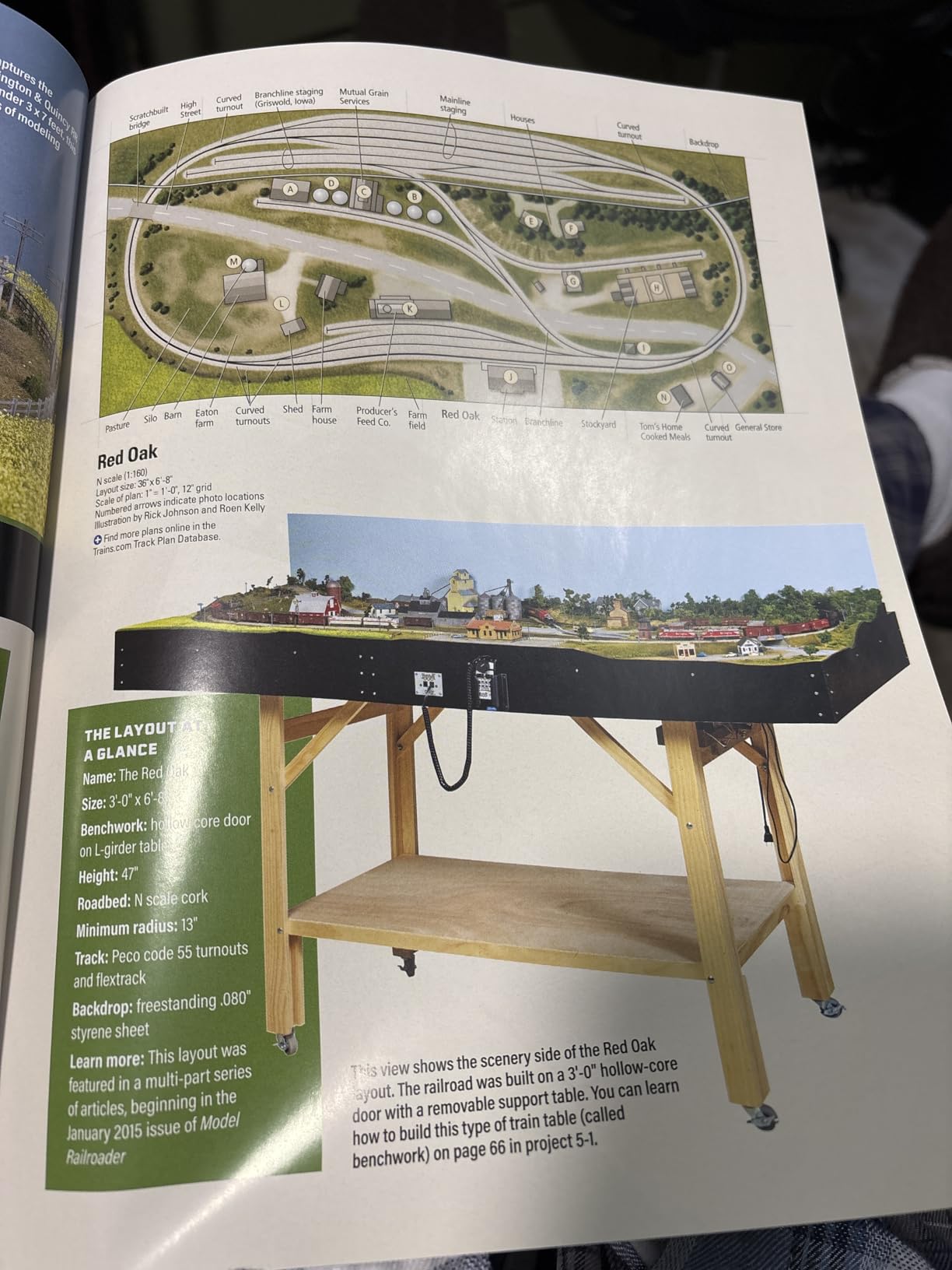
The book covers both DC and DCC train control options, which is helpful for N scale modelers deciding between the two approaches. With 112 pages of content, it provides substantial coverage without being overwhelming for beginners.
N scale specific advice
Working in N scale presents unique challenges around track reliability, wiring precision, and scenery detail that differ from HO or O scale. Popp addresses these differences throughout the book, providing N scale-specific solutions rather than just scaling down HO scale advice.
Track planning for small spaces
Many N scale modelers choose the scale specifically because they have limited space. The track plans in this book reflect that reality, offering interesting operational possibilities in compact footprints that would be impossible in larger scales.
14. Realistic Layouts: Use the Art of Illusion to Model Like a Pro
Realistic Layouts: Use the Art of Illusion to Model Like a Pro
95 pages
By C. J. Riley
Published May 2020
Pros
- Quality writing with plentiful diagrams
- Lots of great creative ideas
- Must have for any railroad modeller
- Prototype simulation guidance
Cons
- Could explain thought process more
- Photos too small to see details
- Missed step by step examples
C. J. Riley takes a different approach from most model railroading books by focusing on illusion techniques that make layouts appear larger and more detailed than they actually are. I found the chapter on using mirrors in model railroading particularly creative, and the scenery finishing touches section offers ideas I had not encountered in other reference books.
The book covers realistic operation techniques alongside the visual illusion methods. This combination of operational and visual realism is what separates layouts that look good in photos from layouts that actually convince viewers they are seeing a real railroad in miniature.
At 95 pages, this is a compact but idea-dense reference. The writing quality is high and the diagrams illustrate concepts clearly, though some readers have noted that the photos could be larger for better detail visibility.
Illusion techniques
Riley covers forced perspective, strategic scenery placement, and visual framing techniques that trick the eye into perceiving greater depth and distance. These methods are especially valuable for modelers working in small spaces who want their layouts to feel bigger than the actual room dimensions suggest.
Prototype simulation methods
The prototype simulation guidance helps modelers create the appearance of specific railroad operations without needing massive amounts of space or equipment. This is where the art of illusion directly supports prototype accurate modeling goals.
15. Model Railroading As Art – Unique Artistic Perspective
Model Railroading As Art
142 pages
By Lance Mindheim
Published December 2018
Artistic modeling approach
Pros
- Unique artistic perspective on the hobby
- Explains the why behind modeling techniques
- Excellent chapter on scene composition
- More pages and pictures than other Mindheim books
Cons
- Examples concentrate on urban scenes
- Self-publishing quality could be improved
This is the only book in this guide with a perfect 5.0 rating, and it earns that score by offering something genuinely different. Lance Mindheim treats model railroad layouts as art pieces, focusing on scene composition, visual storytelling, and the emotional impact of a well-designed diorama or layout scene. The chapter on scene composition alone is worth the price of admission.
Mindheim explains why certain visual arrangements work better than others, drawing on principles from fine art and photography that most model railroading books never touch. I applied his composition ideas to my latest layout and the difference in visual impact was immediately noticeable.
At 142 pages with more photos than his other books, this represents good value. The artistic perspective complements technical reference books perfectly, giving you the creative skills to apply your technical knowledge more effectively.
Scene composition principles
The scene composition chapter teaches you how to arrange elements within a scene for maximum visual impact. Mindheim covers focal points, visual flow, color theory, and how to guide the viewer’s eye through a scene. These principles apply whether you are building a small diorama or filling a basement with a large layout.
Art meets accuracy
What makes this book special for prototype modelers is how it bridges the gap between artistic expression and historical accuracy. Mindheim shows how understanding artistic principles helps you present prototype-accurate details in ways that viewers actually notice and appreciate, rather than having accurate details get lost in a visually confused scene.
Buying Guide: How to Choose the Right Model Railroading Reference Books?
Building a useful model railroading library is not about buying every book available. It is about choosing books that match your current skill level, your modeling goals, and the specific challenges you face on your layout. I have seen too many beginners buy a dozen books only to feel overwhelmed and never actually build anything.
Determine Your Current Skill Level
If you are completely new to model railroading, start with a general reference like the Model Railroader’s Handbook or Build Your First Layout. These give you a foundation across all topics. Books focused on specific techniques like weathering or DCC wiring will make more sense once you understand the basics.
Intermediate modelers who have built a layout or two should focus on books that address their specific weak areas. If your track work causes constant derailments, get Basic Trackwork for Model Railroaders. If your scenery looks flat and unconvincing, Building Realistic Model Railroad Scenery will help. Targeted learning produces faster improvement than broad general references at this stage.
Advanced modelers should seek out specialized references for prototype accuracy. The locomotive guides, artistic composition books, and weathering volumes fill gaps that general guides cannot address. This is where books like Model Railroading As Art and the North American locomotive guides become essential additions.
Match Books to Your Modeling Goals
Think about what you want to achieve with your layout. If operational realism is your priority, focus on track planning, wiring, and operations books. If visual impact matters most, scenery and weathering guides should top your list. For prototype accuracy, the locomotive reference books are indispensable.
Consider also which era and railroad you model. Steam-era modelers need different reference materials than modern-era modelers. The Guide to North American Steam Locomotives serves steam modelers, while the Modern Diesel and Electric Reference serves contemporary modelers. Having the wrong era reference books wastes shelf space and money.
Consider Scale-Specific Needs
HO scale modelers have the most book options available, which reflects the popularity of the scale. Many general reference books default to HO scale examples. N scale modelers should definitely pick up Your Guide to N Scale Railroading since N scale-specific resources are harder to find. O scale, S scale, and large scale modelers will need to adapt general principles from books that primarily show HO examples.
The techniques in most books transfer between scales, but the specific tools, materials, and dimensions change. A weathering technique that works in HO may need modification for N scale where details are smaller and more fragile.
DC vs DCC Wiring: Know Which You Need
If you are building a new layout in 2026, DCC should be your starting point. Both Wiring Your Model Railroad and DCC and Model Railroading cover DCC wiring, but they take different approaches. Puckett’s book is more comprehensive at 127 pages while Gartner’s is more recent and reflects current technology. If budget allows, both complement each other well.
Modelers with existing DC layouts who are considering a DCC conversion should read Wiring Your Model Railroad first, as it covers both systems and explains the conversion process clearly. The system-level approach helps you understand how to integrate new DCC components with your existing infrastructure.
Prototype Accuracy Depth
The level of prototype accuracy you pursue determines which reference books matter most. Casual modelers who want things to look generally right can get by with general reference books. Serious prototype modelers who want to match specific railroads, time periods, and geographic locations need the specialized locomotive rosters and historical references.
Start with the locomotive guide that matches your era, then add structure and scenery references as your layout develops. Building a prototype-accurate layout is a long-term project, and your book library should grow alongside your modeling skills and layout progress.
Frequently Asked Questions
What is a prototype railroad?
A prototype railroad is the real, full-size railroad that model railroaders base their models on. In prototype accurate model railroading, builders research a specific real railroad, time period, and geographic area, then recreate it in miniature with historically accurate trains, structures, scenery, and operations. The goal is to model what actually existed rather than a fictional or generic railroad.
What books should I start with for model railroading?
Start with the Model Railroader’s Handbook by Gerry Leone for a broad foundation. Add Build Your First Layout by Peter Vassallo if you want a hands-on project to follow. For specific skills, pick up Wiring Your Model Railroad for electrical work and Building Realistic Model Railroad Scenery for scenery techniques. These four books cover everything a beginner needs to build a first layout.
Is model railroading a good hobby?
Model railroading combines woodworking, electrical engineering, painting, history research, and artistic composition into one hobby. It offers continuous learning opportunities and produces a tangible result you can enjoy for decades. The community is active and supportive both online and at local clubs. Many modelers find it relaxing and rewarding, though it does require patience and a willingness to learn multiple skills.
Which track planning book is most recommended?
How to Design a Model Railroad by Lance Mindheim is the most recommended track planning book for modelers who want to learn design principles rather than copy existing plans. It teaches you how to think about layout design so you can create plans that fit your specific space and interests. For beginners who want a ready-made project, Build Your First Layout provides a complete track plan to follow.
How to wire a model railroad with DCC?
Start with DCC and Model Railroading by Allan Gartner for the most current beginner-friendly DCC wiring guide, published in 2024. For more comprehensive coverage that includes both DC and DCC systems, Wiring Your Model Railroad by Larry Puckett provides 127 pages of wiring instruction. Both books cover command station setup, bus wiring, feeder connections, and decoder installation in terms accessible to non-electricians.
Building your reference library for prototype accurate model railroading does not happen overnight. Start with one or two books that address your immediate needs, then grow your collection as your skills develop and your layout progresses. The Model Railroader’s Handbook gives you the broadest foundation, while specialized titles like the locomotive guides and scenery books add depth where you need it most. Every book in this list has been vetted by our team and by the model railroading community at large. Pick the ones that match your current projects and start building the layout you have been imagining.