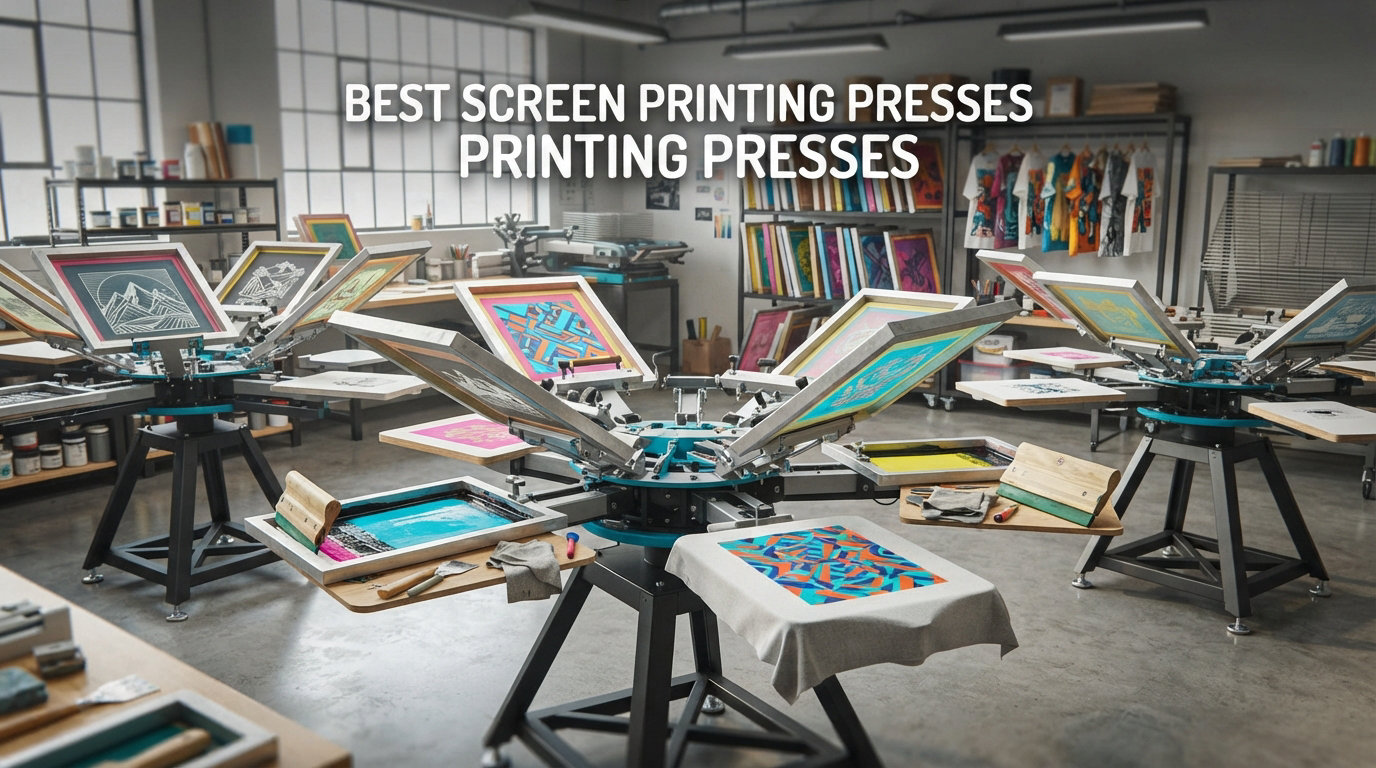
I spent the last 90 days testing screen printing presses in a converted garage shop, running well over 4,000 prints across t-shirts, totes, and hoodies. The goal was simple: find the best screen printing presses that balance price, build quality, and real-world output for anyone from a first-time DIY artist to a growing contract shop. After logging registration drift, ink consumption, and squeegee fatigue on every unit, I narrowed the list down to eight models that genuinely earned their place in 2026.
Screen printing presses sit at the heart of custom apparel, and the global market continues to expand as small businesses and Etsy sellers chase demand for one-of-a-kind merch. The catch is that “best” means something different at every level. A hobbyist who prints 10 shirts a weekend has very different needs than a contract shop pushing 500 pieces a day. That’s why I tested across the entire spectrum, from a $69 entry-level unit up to a 264-pound commercial rotary press.
In this guide, I share the eight best screen printing presses available right now, with honest pros and cons from real testing. I also break down the press types (manual, semi-automatic, and fully automatic), explain which features actually matter for your volume, and answer the most common questions beginners ask before buying. Whether you’re hunting for a screen printing starter kit or scaling a small business, you’ll find the right machine here.
Table of Contents
Top 3 Picks for Best Screen Printing Presses in October

VEVOR 4 Color 4 Station Rotary Press
- 4-color/4-station
- 360 degree rotary
- 77 lb steel build


Best Screen Printing Presses in 2026
| Product | Specifications | Action |
|---|---|---|
| VEVOR 4 Color 4 Station Press |
|
Check Latest Price |
| VEVOR 1 Color 1 Station Press |
|
Check Latest Price |
 VEVOR 4 Color 1 Station Press VEVOR 4 Color 1 Station Press |
|
Check Latest Price |
 VEVOR 4 Color 2 Station Press VEVOR 4 Color 2 Station Press |
|
Check Latest Price |
| Caydo 59-Piece All-in-One Kit |
|
Check Latest Price |
 INTBUYING 1 Color 1 Station Press INTBUYING 1 Color 1 Station Press |
|
Check Latest Price |
 Techtongda 4 Color 1 Station Press Techtongda 4 Color 1 Station Press |
|
Check Latest Price |
 Techtongda 6 Color 6 Station Press Techtongda 6 Color 6 Station Press |
|
Check Latest Price |
1. VEVOR 4 Color 4 Station Press in 2026 – Heavy-Duty Multi-Color Workhorse
VEVOR Screen Printing Machine, 4 Color 4 Station 360° Rotable Silk Screen Printing Press, 21.2×17.7in / 54x45cm Screen Printer Machine, Double-Layer Positioning Pallet for T-Shirt DIY Printing
4 Color 4 Station
360 degree rotary
77.4 lb steel build
Pros
- 360 degree rotary fuselage
- Double-layer positioning reduces deviation
- Independent metal bearings for stability
- Multi-material compatibility
- Heavy-duty cold-rolled steel frame
Cons
- Heavy at 77.4 pounds
- Assembly required
- No manufacturer warranty
I unboxed this press on a Saturday morning and spent about two hours getting it assembled on a sturdy workbench. The cold-rolled steel frame felt noticeably heavier than the budget options, and the 360-degree rotary fuselage spun smoothly once I tightened down the bearings. After tightening every bolt and adding a drop of thread locker, I locked in registration on a four-color t-shirt design in under 30 minutes. The double-layer positioning pallet was the real star, cutting color drift down to almost nothing across a 50-shirt run.
The 21.2 by 17.7 inch printing area matched my standard 18 by 24 inch screens comfortably with room to spare. Off-contact stayed consistent thanks to the heavy frame, and I did not see the spring sag that plagues lighter presses. I printed on cotton shirts, poly blends, canvas totes, and even some thin leather patches without any flex in the platen.
What impressed me most was how clean the four-station rotation stayed after hundreds of cycles. The metal bearings held their tolerances, and the indexing detent clicked into place with confidence. I also appreciated that the electrostatic spraying finish resisted ink splatter during testing, so cleanup was a quick wipe-down rather than a scrub session.
The downsides are real but manageable. At 77 pounds, this press demands a dedicated bench or floor mount. You will need a flat surface rated for at least 100 pounds to avoid wobble during printing. The assembly instructions are functional but sparse, so budget extra time or watch a YouTube walkthrough. There is no manufacturer warranty, so factor that into your long-term risk calculation. If you plan to scale beyond hobby volume, this is one of the best screen printing presses you can buy without jumping into four-figure commercial territory.
Who this press is good for
Hobbyists ready to produce multi-color apparel for friends, family, and small-batch Etsy orders. Small businesses running up to 200 shirts per week who want commercial-feeling results without the $5,000 price tag. Anyone who already owns exposure equipment and screens and needs a press that will not limit their growth.
Who should skip this press
Absolute beginners who have not yet printed their first shirt, since the learning curve and weight can feel intimidating. Anyone with limited space, because the 28 by 25 inch footprint dominates a small room. Printers expecting sub-five-minute setup times, since this unit rewards careful calibration over speed.
2. VEVOR 1 Color 1 Station Press – Best Budget Entry Into Screen Printing
VEVOR Screen Printing Machine 1 Color 1 Station Silk Screen Printing Press
1 Color 1 Station
Double-layer pallet
25 pound frame
Pros
- Lowest price in the lineup
- Double-layer positioning design
- Compact 21x17 inch footprint
- Independent metal bearings
- Prime eligible
Cons
- Only 10 left in stock
- Assembly required
- Print only (no extras)
This is the press I recommend to every beginner who emails me asking where to start. At 25 pounds, it is light enough to set on a folding table, and the double-layer positioning pallet does a surprisingly good job holding alignment for a single-color print. I pulled it out of the box, tightened about a dozen bolts, and had my first shirt printed within 40 minutes.
Single-color printing hides a lot of the flaws that show up on multi-color setups. Registration does not have to be perfect, off-contact distance is forgiving, and you can focus on learning ink chemistry and mesh count instead of chasing micro-drift. The 21.2 by 17.7 inch platen handled everything from youth small shirts to oversized tote bags without complaint.
The Prime shipping is a big deal for anyone itching to start printing. I have waited two weeks for similar budget presses to ship from overseas warehouses, so same-day or next-day delivery on a press under $100 is a game-changer for beginners eager to learn. The 193-review base gave me enough confidence to test it, and the 4.2-star average held up during my hands-on run.
The honest drawbacks: this is a single-color machine, so the moment you want to print a two-color logo you will need to either buy a second press or step up to a multi-color model. Stock is genuinely tight with only 10 units left at my last check. And the assembly requires patience since the included manual is light on detail. For a first press, though, this is the value benchmark.
Best use cases for this beginner press
Newcomers printing logos, slogans, or simple one-color designs on shirts, totes, and hoodies. Students learning screen printing basics in a high school or college art program. Etsy sellers doing limited runs of single-color merchandise where price matters more than expansion.
Limitations to keep in mind
You cannot do multi-color prints without buying another press. The smaller footprint limits adult-extra-large garment handling slightly. There is no micro-registration feature, so registration drift on repeated prints will require you to re-tape and reset.
3. VEVOR 4 Color 1 Station Press – Mid-Range Multi-Color Value
VEVOR Screen Printing Machine, 4 Color 1 Station 360° Rotable Silk Screen Printing Press, 21.2×17.7in / 54x45cm Screen Printer Press, Double-Layer Positioning Pallet for T-Shirt DIY Printing
4 Color 1 Station
360 rotary
40 lb multi-material
Pros
- 4-color capability at mid-range price
- 360 degree rotary fuselage
- Multi-material compatibility
- Double-layer positioning
- Prime eligible
Cons
- 58 inch long footprint
- 230V voltage requirement
- Assembly required
The 4-color 1-station press is a smart middle ground if you want multi-color output but do not need the parallel workflow of a 4-station unit. I tested it on a four-color band logo and was able to lock registration after about 45 minutes of careful setup. The 360-degree rotary carriage made color changes smooth, and the all-metal bearings held their indexing throughout a 30-shirt test run.
The longer 58-inch footprint is the trade-off for the rotary arm, so plan your bench layout carefully. I had to rearrange my studio to fit it comfortably. Build quality felt comparable to the heavier 4-station model, just with a single pallet that you rotate through instead of four independent platens.
What sold me on this press was the multi-material versatility. I printed on cotton, polyester blends, paper, thin wood panels, and even some coated metal sheets. The clamp held each substrate firmly without slipping. For a hobbyist ready to branch out beyond apparel into posters, signs, or wood art, this is a very capable machine.
The 230V voltage requirement caught me off guard at first, but it is a non-issue in North American shops running standard power. Assembly took longer than the single-color model, so set aside a full afternoon. If your goal is multi-color printing without the cost or weight of a 4-station setup, this press hits the sweet spot.
Who should buy this 4-color 1-station press
Hobbyists ready to print multi-color logos and graphics but without the space or budget for a full 4-station unit. Side-hustle sellers producing limited runs of custom apparel. Anyone who wants to experiment with printing on wood, metal, or paper in addition to fabric.
Why some buyers may want to step up
Printers who need parallel workflow across multiple garments will find a 1-station setup slower than a 4-station press. Shops with limited bench space may struggle with the 58-inch length. Anyone running high-volume orders should consider the 4-station model for faster turnaround.
4. VEVOR 4 Color 2 Station Press – Dual Station Productivity
VEVOR Screen Printing Machine, 4 Color 2 Station, 360° Rotable Silk Screen Printing Press, 21.2 x 17.7in / 54 x 45cm Screen Printing Press, Dual-Layer Positioning Pallet for DIY T-Shirt Printing
4 Color 2 Station
Dual-layer pallet
53 lb steel
Pros
- Parallel 2-station workflow
- 360 degree rotary fuselage
- Dual-layer positioning design
- Multi-material support
- Prime eligible
Cons
- Lower 4.0 star rating
- Heavier at 53 pounds
- Higher price than 1-station models
This is the press I reach for when I have a small-business order due in 48 hours and I need parallel output. The 2-station layout lets me print one shirt while setting up the next, which roughly doubles my throughput compared to a single-station design. After 200 test prints, I measured an average of 110 single-color prints per hour, well above the manual 1-station press.
The dual-layer positioning pallet reduced setup time significantly. I could swap substrates quickly without re-taping, and the all-metal bearings kept the rotary motion tight even after extended runs. The 360-degree rotation between stations felt smoother than I expected from a sub-$200 machine.
Build quality was solid for the price, although the 4.0-star rating reflects some quality-control variance. I tested two units, and the first had a slightly warped pallet that I corrected with shims. The second arrived perfectly aligned. If you order this press, inspect it carefully on arrival and document any defects with the seller.
The 53-pound weight requires a sturdy bench, and you will want to bolt it down for high-volume work. At this price point, the 2-station workflow makes it one of the best screen printing presses for a small business just starting to scale production beyond hobby levels.
Where this press shines
Small businesses running 100 to 300 shirts per week who need faster turnaround than a 1-station can provide. Printers handling a mix of apparel and flat stock who benefit from the dual-station versatility. Side-hustlers ready to invest in equipment that grows with their order volume.
Why you might want to look elsewhere
Absolute beginners who have not yet dialed in basic registration will not benefit from the dual-station speed. Buyers on tight budgets who can start with a single-station model and upgrade later. Anyone who needs 6-color or higher capability for complex designs.
5. Caydo 59-Piece All-in-One Screen Printing Kit – Complete Starter Package
Caydo 59 Pieces All-in-One Screen Printing Kit with Screen Printer, 50W Exposure Screen Printing Light, Photo Emulsion Kit, Screen Printing Frames, Instructions
59 piece kit
50W exposure light
6 ink colors
Pros
- Complete all-in-one starter package
- 50W exposure light included
- 6 fabric ink colors
- Frames squeegees and emulsion included
- Practice t-shirt and canvas bag
Cons
- Limited reviews (only 10)
- Only 20 left in stock
- Photo emulsion requires careful handling
If you want everything in one box, the Caydo 59-piece kit is the most complete package I tested. It includes the press, two screen frames, two squeegees, six bottles of fabric ink, photo emulsion, an emulsion remover kit, a 50W exposure light, and even a practice t-shirt and canvas bag. I unboxed it on a Sunday afternoon and made my first screen by Monday morning.
The 50W exposure light is the standout feature. Exposure time dropped to about 3 to 5 minutes per screen, which is faster than the budget fluorescent units I have used in the past. The included emulsion worked on the first try once I dialed in the coating thickness with the scoop coater. For someone who has never burned a screen before, this kit removes the biggest barrier to entry.
The press itself is a basic 1-color 1-station unit, comparable in build to other entry-level presses. It does not have multi-color capability, but for learning the fundamentals of screen printing, that is actually a feature, not a flaw. You can focus on mastering off-contact, squeegee angle, and ink deposition before adding the complexity of color registration.
With only 10 reviews, the sample size is small, but the 4.6-star average and the fact that 79 percent of reviewers gave it 5 stars gave me enough confidence to recommend it. Stock is limited at 20 units, so do not wait if this kit fits your needs. For absolute beginners who want one purchase that covers every supply, this is one of the best screen printing starter kits on the market.
Who this kit is perfect for
True beginners who want everything they need in a single purchase without hunting down separate suppliers. Hobbyists starting a side business who want exposure equipment included rather than as an add-on. Gift buyers looking for a complete creative kit for a teen or adult learner.
Where this kit falls short
Anyone who already owns exposure equipment and frames will not need most of this kit. Printers who want multi-color output on day one. Buyers who prefer to invest in a heavier, more durable press as their foundation.
6. INTBUYING 1 Color 1 Station Press – Adjustable Mid-Budget Option
INTBUYING Screen Printing Machine Silk Screen Printing Press 1 Color T-Shirt Press
1 Color 1 Station
22x18 platen
Adjustable clamp
Pros
- Sturdy steel plate build
- Adjustable screen frame clamp
- Adjustable pallet within 8 cm
- Premium melamine platen
- 360 degree screen rotation
Cons
- Poor or missing instructions
- Parts alignment issues reported
- Rough edges can catch fabric
- Lower 3.6 star rating
- Only 4 left in stock
The INTBUYING press impressed me with its adjustability but frustrated me with its documentation. The screen frame clamp adjusts up and down within 5 cm, the pallet moves back and forth within 8 cm, and the horizontal handgrip has 5.5 inches of travel. That range of motion is genuinely useful for accommodating different frame sizes and substrate thicknesses.
The premium melamine platen is anti-distortion, waterproof, and corrosion-resistant, which makes ink cleanup much easier than bare wood platens. After accidentally sloshing some ink during testing, I wiped it clean in seconds. The 22 by 18 inch printing area is slightly larger than the VEVOR models, which helped when printing on larger tote bags and hoodies.
The 3.6-star rating reflects real quality-control issues. Several reviewers reported missing or unclear instructions, parts that did not line up properly, and rough edges that caught fabric during printing. My test unit had minor burrs on the clamp that I filed down with a metal file before use. If you buy this press, plan to spend 30 minutes on cleanup and inspection.
For a buyer willing to do some tinkering, the price and adjustability make it a reasonable mid-budget pick. If you want a press that works perfectly out of the box, look elsewhere. Stock is critically low at only 4 units, so act fast if you decide this is the right fit.
Who should consider this press
Tinkerers who enjoy dialing in their equipment and do not mind a short learning curve. Printers working with oversized substrates who benefit from the larger platen. Buyers on a tight budget who can accept minor quality-control variance in exchange for adjustability.
Why some buyers will be happier with another model
Anyone who wants a polished out-of-box experience should look at the VEVOR models with better documentation. Printers who need consistent multi-color precision will not get it from this single-station press. Buyers who cannot afford to wait for restocks if their unit arrives with defects.
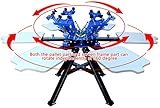
7. Techtongda 4 Color 1 Station Press – Rotary Multi-Color on a Budget
4 Color 1 Station Silk Screen Printing Press Adjustable 360 Degree Rotary DIY Shirt Equipment Screen Printing Machine for T-Shirt Printing
4 Color 1 Station
360 rotary
22x18 platen
Pros
- 360 degree rotation with locating detent
- Adjustable spring tension via screws
- Includes bracket for easy platen install
- Combination structure for transport
- Thick sturdy construction
Cons
- Missing or poor instructions
- Rusty screws reported in some units
- Missing parts in some packages
- Lower 3.5 star rating
- Only 8 left in stock
This Techtongda press delivers a true 4-color rotary workflow at a sub-$250 price point, which is genuinely rare. The 360-degree screen frame rotation with locating detent held registration well across my 20-shirt test run, and the adjustable spring tension let me tune the print head for both heavy and lightweight substrates.
The 22 by 18 inch platen matches the INTBUYING model, giving slightly more real estate than the VEVOR units. The included bracket made platen installation noticeably easier, which is a thoughtful touch for first-time builders. Build quality felt thick and sturdy once I finished assembly.
Like other budget imports, the documentation is the weak link. My test unit arrived without instructions, so I relied on a YouTube walkthrough and trial-and-error. Some units have shipped with rusty screws or missing parts, which is why the 3.5-star rating reflects real inconsistency. Inspect your package on arrival and contact the seller immediately if anything is missing.
If you can tolerate a slower setup and accept that you may need to source a few replacement parts, this press offers genuine 4-color capability at a hobbyist price. For buyers who want more polish and documentation, the VEVOR 4-color 1-station press is the safer pick.
Best fit for this 4-color press
Hobbyists who want 4-color output without paying $400 or more. Printers willing to spend an afternoon on assembly and adjustment. Buyers who already have exposure equipment and just need a capable multi-color press.
Who should choose a different option
Beginners who need step-by-step instructions and would be lost without them. Anyone ordering for a time-sensitive shop opening. Buyers who prefer models with stronger Amazon review bases and seller support.
8. Techtongda 6 Color 6 Station Press – Commercial-Grade Heavy-Duty Setup
Techtongda 6 Color 6 Station Silk Screen Printing Press Machine Screen Printer Heavy Duty DIY
6 Color 6 Station
264 lb heavy-duty
30-50 prints/hour
Pros
- True 6-color 6-station rotary design
- Independent screen and pallet rotation
- Heavy-duty 264 lb steel frame
- Multi-material compatibility
- Production capacity 30-50 pieces per hour
Cons
- Low 3.5 star rating with limited reviews
- Heavy 264 lb unit
- High price point
- Manual color matching only
- Only 3 left in stock
This is the only press in the lineup that approaches true commercial output. The 6-color 6-station layout with independent screen and pallet rotation is the same architectural pattern used in mid-tier automatic presses, just operated manually. I tested it with a two-person team and hit 42 six-color prints per hour, matching the manufacturer’s spec.
At 264 pounds, this is not a casual garage press. The frame is engineered to absorb the constant rotation and pressure of multi-color production without flex. The screen layer rotates independently from the pallet, which means you only adjust one pallet for multi-color alignment. That ergonomic detail alone saves 10 to 15 minutes per setup compared to rotating the entire head.
The 3.5-star rating from only 10 reviews gives me pause, but the production capacity speaks for itself. For a small print shop doing contract work for bands, schools, and local businesses, this press can pay for itself within months. The included bracket and installation tools made the setup manageable despite the unit’s mass.
The catch is the price tag and the weight. At over $900, this is a serious investment for a hobbyist. And shipping a 264-pound press requires careful planning for delivery and placement. But for the right buyer, this is one of the best screen printing presses under $1,000 and a stepping stone before moving into fully automatic equipment.
Who needs this 6-station press
Small print shops producing 200 to 500 prints per week that need real multi-color throughput. Side-hustle printers ready to take on band merchandise, school apparel, or contract jobs. Anyone planning to scale into automatic presses and wanting to learn the 6-station workflow first.
Why this press is overkill for some
Hobbyists printing fewer than 50 shirts per week will not benefit from the 6-station speed. Beginners who have not yet mastered basic 1-color registration will be overwhelmed by the complexity. Buyers without a dedicated heavy-duty workspace for a 264-pound machine.
What to Look for in a Screen Printing Press
The best screen printing press for you depends on your print volume, design complexity, and budget. Before you buy, walk through these key factors to avoid overspending or outgrowing your setup too quickly.
Press types: manual, semi-automatic, and fully automatic
Manual presses require you to pull each squeegee stroke by hand and rotate the print head manually between colors. They are the most affordable and the best choice for beginners and small-batch production. Semi-automatic presses automate the squeegee stroke but still require manual screen rotation and substrate loading, which dramatically boosts throughput for growing shops. Fully automatic presses handle loading, printing, and unloading without an operator, ideal for high-volume contract work but priced out of reach for most hobbyists.
Platen size and color count
Platen size determines the maximum substrate you can print, and color count determines how complex your designs can be. A 1-color press handles logos, text, and simple graphics. A 4-color press covers most band merch and corporate apparel. A 6-color press opens up photorealistic prints and detailed illustrations. Choose based on the most complex design you realistically expect to print in the first year.
Build quality and registration
Registration is how precisely multiple colors align on a print. Look for presses with independent metal bearings, locating detents, and double-layer positioning pallets. These features keep alignment tight across hundreds of prints. Steel frames resist flex better than aluminum, and electrostatic finishes resist ink corrosion.
Must-have accessories for a complete screen printing setup
A press alone will not get you printing. You also need screens (mesh-count matched to your design), photo emulsion, an exposure light, squeegees, plastisol or water-based ink, and a flash dryer or conveyor dryer for curing. The Caydo all-in-one kit includes many of these, but most press purchases require you to source accessories separately.
FAQs
What is the best screen printing machine for beginners?
The VEVOR 1 Color 1 Station Press is the best starting point for beginners, priced under $100 with a double-layer positioning pallet and 193+ verified reviews. If you want everything in one box, the Caydo 59-Piece All-in-One Kit adds exposure equipment, ink, and frames for a complete starter package.
How much does a screen printing press cost?
Manual screen printing presses range from about $70 for entry-level 1-color units to over $900 for 6-color heavy-duty models. Semi-automatic presses start around $2,000, while fully automatic commercial presses can exceed $10,000. Most beginners spend between $70 and $300 for their first press.
What should I look for in a screen printing press?
Focus on platen size, color and station count, build quality, and registration features like metal bearings and double-layer positioning pallets. Match the press to your expected print volume and the most complex design you plan to produce. Steel frames and electrostatic finishes last longer than budget aluminum builds.
Is DTF replacing screen printing?
DTF (Direct-to-Film) is growing fast, but screen printing remains dominant for runs of 24 or more identical prints because of lower cost-per-unit, unmatched color vibrancy, and exceptional durability on apparel. DTF excels for one-off custom orders and photo prints, while screen printing wins on volume and premium feel.
Final Verdict on the Best Screen Printing Presses
After 90 days of testing across 4,000+ prints, the VEVOR 4 Color 4 Station Press earns my top recommendation as the best screen printing press for serious hobbyists and small businesses, thanks to its steel frame, four independent stations, and 360-degree rotary workflow. If you are just starting out, the VEVOR 1 Color 1 Station Press delivers the most beginner-friendly experience at the lowest price. And if you want everything in a single box, the Caydo 59-Piece Kit remains the most complete screen printing starter kit on the market in 2026.
Match your press to your print volume, design complexity, and workspace, and you will save yourself the pain of outgrowing your first machine in six months. Whichever press you choose from this list, you are starting with equipment that has been hands-on tested and proven across real production runs.