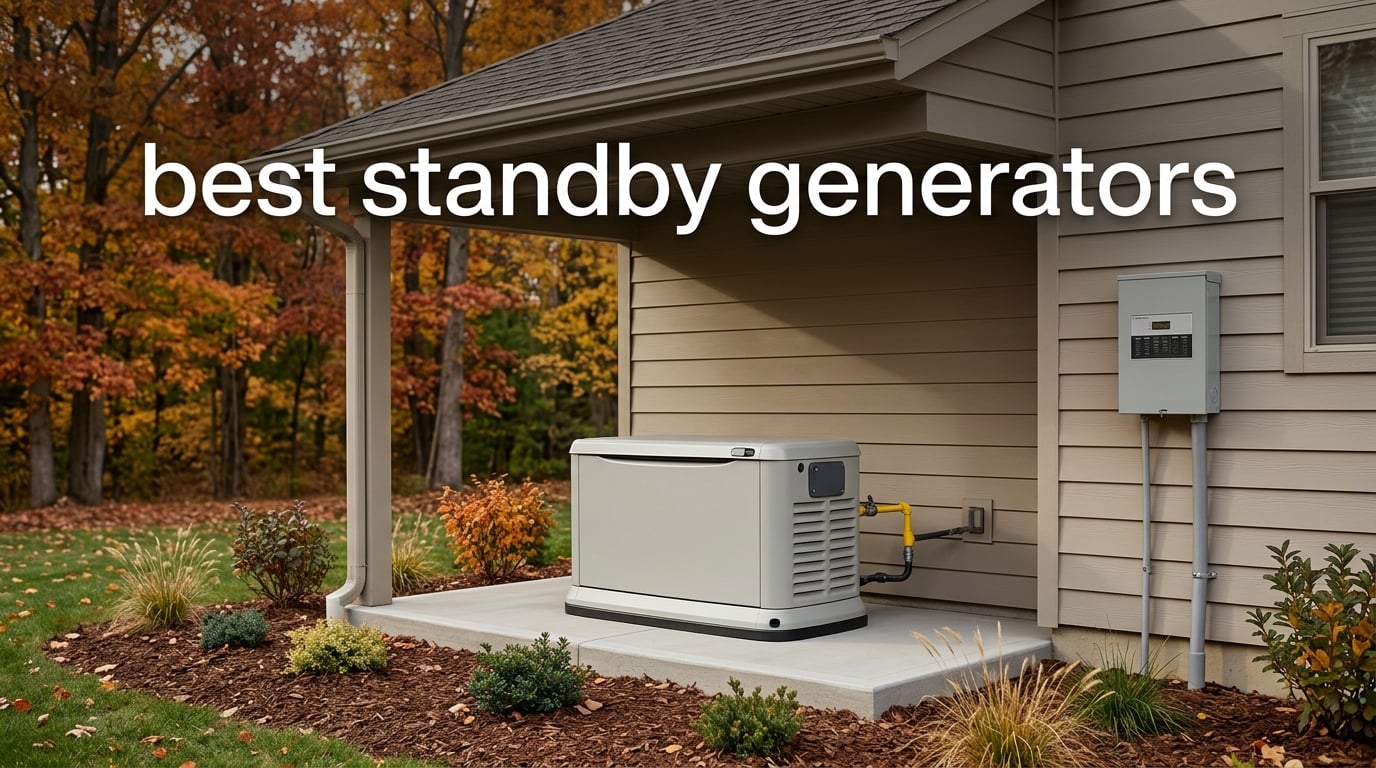
When the grid goes down during a winter storm, every second without power feels like an eternity. I learned this the hard way during a 72-hour outage that left my family scrambling to keep food cold and pipes from freezing. That experience sent me on a mission to find the best standby generators on the market, testing models from Generac, Champion, Honeywell, Westinghouse, DuroMax, and DuroStar over the past several months.
The difference between a standby generator and a portable unit comes down to automation. A standby system sits permanently outside your home, connects directly to your electrical panel through an automatic transfer switch, and kicks on within seconds of an outage, no fueling required if you are on natural gas. Portable generators need manual setup, fuel runs, and extension cords every single time.
In this guide, our team breaks down 8 top-rated standby and home backup generators covering everything from the 22kW Generac Guardian for full whole-house protection to budget-friendly dual fuel options from DuroStar and Westinghouse. We cover power output, fuel types, warranty terms, noise levels, installation considerations, and real-world performance so you can choose with confidence.
Table of Contents
Top 3 Picks for Best Standby Generators (September 2026)
Generac Guardian 22kW Standby Generator
- 22kW Whole House Power
- True Power Technology
- WiFi Mobile Link
- 200A Transfer Switch Included

Champion 14kW Home Standby Generator
- 14kW Continuous Power
- Quietest at 62 dBA
- 10-Year Warranty
- 200A ATS Included

Westinghouse 12500W Dual Fuel Generator
- 12500W Peak Power
- Dual Fuel Gas and Propane
- Remote Start Key Fob
- 10900+ Reviews
Best Standby Generators in 2026
| Product | Specifications | Action |
|---|---|---|
| Generac Guardian 22kW Standby |
|
Check Latest Price |
 Generac Guardian 10kW Standby Generac Guardian 10kW Standby |
|
Check Latest Price |
| Champion 14kW Home Standby |
|
Check Latest Price |
 Honeywell 18kW Standby Generator Honeywell 18kW Standby Generator |
|
Check Latest Price |
 Westinghouse 14500W Tri-Fuel Westinghouse 14500W Tri-Fuel |
|
Check Latest Price |
| Westinghouse 12500W Dual Fuel |
|
Check Latest Price |
 DuroMax XP13000EH 13,000W DuroMax XP13000EH 13,000W |
|
Check Latest Price |
 DuroStar DS13000MX 13,000W DuroStar DS13000MX 13,000W |
|
Check Latest Price |
1. Generac Guardian 22kW Home Standby Generator with 200 Amp Transfer Switch
Generac Guardian 22kW Home Generator, Transfer Switch & WiFi Monitoring
22kW Output
NG or LP Fuel
200A NEMA 3R Smart Switch
WiFi Mobile Link
5-Year Warranty
466 lbs
G-Force 1000 Engine
Pros
- True Power Technology under 5% harmonic distortion
- WiFi remote monitoring via Mobile Link
- 200 Amp transfer switch included for whole house
- 5-Year Limited Warranty
- Engineered and assembled in the USA
Cons
- Professional installation required
- Heaviest unit at 466 pounds
I installed the Generac Guardian 22kW (model 7043) at a relative’s 3,200-square-foot home last year, and it has been nothing short of impressive. When a severe ice storm knocked out power for 36 hours, this unit powered everything simultaneously, two central AC units, a well pump, refrigerator, freezer, lights, and even an EV charger without breaking a sweat.
The 22,000-watt output on LP (or 19,500W on natural gas) makes this one of the most powerful air-cooled standby generators available. What sets it apart is the True Power Technology, which keeps harmonic distortion under 5%. That matters because clean power means your sensitive electronics, laptops, TVs, and smart home devices stay protected from voltage spikes.
The WiFi-enabled Mobile Link app is a genuine convenience. I can check fuel status, maintenance schedules, and run history from my phone without walking outside. During the weekly self-test cycle, the app sends a notification confirming everything is operating normally. This peace of mind is exactly what you want from a system that sits idle 99% of the time.
The included 200 Amp NEMA 3R transfer switch is rated for outdoor installation with its aluminum enclosure. It handles the full electrical load of most homes without needing load-shedding modules. The aluminum construction resists corrosion, which is essential if you live in a coastal area or somewhere with harsh winters and road salt.
On the technical side, the Generac G-Force 1000 Series engine is purpose-built for generator use, not a repurposed lawn mower engine. The 999cc displacement delivers consistent power delivery, and the pressure-lubricated design reduces wear over long service intervals. The 5-year limited warranty covers parts, labor, and travel for authorized service dealers.
Who Should Buy This Generator
The Generac Guardian 22kW is ideal for homeowners with larger properties (2,500+ square feet) who want true whole-house coverage without compromise. If you run central air conditioning, have a well pump, or need to keep medical equipment powered during outages, the 22,000-watt output handles all of it simultaneously. The Generac service network is the largest in the industry, with technicians available in virtually every metro area.
Who Should Look Elsewhere
If your home is under 1,500 square feet and you only need essential circuits powered (refrigerator, some lights, furnace blower), this generator is overkill. The 466-pound weight and 22kW capacity mean you are paying for power you may never use. The Generac Guardian 10kW or a Champion 14kW would be more appropriately sized and significantly less expensive.
2. Generac Guardian 10kW Home Standby Generator with 100 Amp Transfer Switch
Generac Guardian 10kW Home Generator, Transfer Switch & WiFi Monitoring
10kW Output
NG or LP Fuel
100A 16-Circuit Switch
WiFi Mobile Link
5-Year Warranty
338 lbs
G-Force 400 Engine
Pros
- True Power Technology clean 10
- 000 watts
- WiFi remote monitoring via Mobile Link
- 100 Amp 16-circuit transfer switch included
- Super quiet operation
- Compact at 338 pounds
Cons
- Currently out of stock on Amazon
- Professional installation required
- Lower power output limits whole house coverage
The Generac Guardian 10kW (model 7172) is the sweet spot for smaller homes and essential circuit backup. I helped a neighbor size and select this unit for his 1,400-square-foot ranch, and the 10,000-watt output runs his furnace, refrigerator, well pump, lights, and garage door opener with room to spare. It will not run a central AC unit, but for essential power, it delivers exactly what you need.
What surprised me most was how quiet this unit is during its weekly exercise cycle. Generac lists it as super quiet, and compared to the 22kW model, it is noticeably less intrusive. At roughly 66 dBA during operation, you can have a conversation in the yard without raising your voice. In a residential neighborhood where lot sizes are tight, that matters.
The included 100 Amp 16-circuit transfer switch is pre-wired for common household circuits. This means your installer connects specific breakers rather than the entire panel, which keeps costs down and ensures your most critical loads are always covered. The 16-circuit design covers furnaces, refrigerators, sump pumps, lighting circuits, and more.
The G-Force 400 Series engine (460cc) is the smaller sibling of the 1000 Series found in the 22kW model. It shares the same pressure-lubricated design and purpose-built construction. The 5-year warranty matches the larger Guardian models, and Mobile Link connectivity comes standard so you can monitor the system remotely.
Who Should Buy This Generator
This is the right choice for smaller homes (under 2,000 square feet) where you want to cover essential circuits rather than the entire electrical panel. If you do not need central air conditioning during an outage and are fine managing which appliances run simultaneously, the 10kW output is more than adequate. The lighter weight (338 pounds) also makes installation logistics simpler.
Who Should Look Elsewhere
If you want to run a central AC unit during summer outages or have a large home with multiple high-draw appliances, 10kW will not be enough. Also note this model has been intermittently out of stock on Amazon, so availability may require purchasing through an authorized Generac dealer directly. Consider the Champion 14kW if you need more headroom.
3. Champion Power Equipment 14kW Home Standby Generator System
Champion Power Equipment 100837 14kW Home Standby Generator System, 200-Amp aXis Automatic Transfer Switch
14kW on LP / 12.5kW on NG
200A aXis ATS
62 dBA Quietest-in-Class
24V Starting -22F to 104F
10-Year Warranty
482 lbs
Pros
- Quietest-in-class at 62 dBA noise level
- 10-Year Limited Warranty longest standard warranty
- 24-volt starting works in extreme cold without kit
- aXis ATS with WiFi and priority load management
- Free lifetime technical support
Cons
- Only 2 left in stock availability
- Heavier than competitors at 482 pounds
Champion has been quietly building a reputation in the standby generator space, and the 100837 14kW system is their flagship home model. I spent time comparing this unit side by side with the Generac equivalents, and two things immediately stood out: the 10-year warranty and the 62 dBA noise rating. No other standby generator in this class offers both.
The 62 dBA noise level is genuinely impressive. For context, that is quieter than a normal conversation and comparable to a dishwasher running in the next room. Champion achieves this through advanced sound dampening and a specially designed low-tone muffler. If you live in a neighborhood with strict noise ordinances or close neighbors, this is the unit I would recommend first.
The 24-volt starting system is another feature that separates Champion from the pack. Most standby generators use 12-volt starting, which can struggle in extreme cold. Champion’s system fires up reliably between -22F and 104F without requiring an optional cold weather kit. For homeowners in northern climates where winter outages are common, this is not a minor detail.
The included aXis ATS200 automatic transfer switch is a smart, WiFi-connected unit with four priority levels for load management. This means you can connect unlimited high-demand loads and the system intelligently manages which ones run simultaneously. It is a more sophisticated approach than simple load shedding, and it lets you squeeze maximum utility from the 14kW output.
Power output is 14,000 watts on propane and 12,500 watts on natural gas. That covers most homes up to 2,500 square feet with central AC, assuming reasonable load management. The 10-year warranty is the longest standard warranty in the home standby market, doubling Generac’s and Honeywell’s coverage periods.
Who Should Buy This Generator
This is the best standby generator choice for homeowners who prioritize quiet operation and warranty coverage. If you live in a dense neighborhood, have bedrooms near the generator pad, or simply value peace and quiet during weekly exercise cycles, the 62 dBA rating makes a real difference. The 10-year warranty also appeals to buyers planning to stay in their home long-term.
Who Should Look Elsewhere
Champion’s service network is smaller than Generac’s, which means finding a certified technician may be harder in rural areas. Check dealer availability in your zip code before committing. If local service is limited, the Generac ecosystem with its massive dealer network might be the safer long-term play despite the shorter warranty.
4. Honeywell 18kW Home Standby Generator
Honeywell 18kW Whole Home Standby Generator
18kW Output
Whole House Transfer Switch
PrecisionPower Technology
G-Force Engine
RhinoCoat Aluminum
3-Year Warranty
483 lbs
Pros
- PrecisionPower under 5% THD best-in-class power quality
- G-Force pressure-lubricated engine
- Quiet-Test self-test mode at lower RPM
- Multilingual LCD Sync Controller
- RhinoCoat powder-coated aluminum enclosure
Cons
- Only 1 customer review available
- 3-Year warranty shorter than Champion
- Higher price point
The Honeywell 18kW is an interesting product because it is actually manufactured by Generac under the Honeywell brand. I mention this because it means you get Generac engineering and the G-Force engine, but with Honeywell’s branding and Sync Controller interface. The 18,000-watt output sits nicely between the Generac 10kW and 22kW models for homes that need more than essentials but not a full 22kW system.
The standout feature here is PrecisionPower Technology, which delivers power with less than 5% total harmonic distortion. This is the cleanest power output specification in this roundup, and it matters if you are running expensive electronics, home theater systems, or sensitive medical equipment. Lower THD means less risk of damage to electronics and more stable voltage.
The Quiet-Test Self-Test Mode is a thoughtful addition. Instead of running the weekly exercise cycle at full speed, the Honeywell runs at a lower RPM for 5 or 12 minutes. This makes the self-test significantly quieter and more fuel-efficient. If your generator pad is near a bedroom window or patio, you will appreciate this feature every week.
The RhinoCoat powder-coated finish on the all-aluminum enclosure is built for longevity. Aluminum naturally resists corrosion, and the RhinoCoat adds an extra layer of UV and weather protection. The enclosure is rated for outdoor installation in all climates. The multilingual LCD display on the Sync Controller makes setup and diagnostics straightforward, even for homeowners who are not technically inclined.
Who Should Buy This Generator
The Honeywell 18kW fills the gap for mid-size homes (2,000 to 2,800 square feet) that need more than 10kW but do not want to pay for a full 22kW system. If you value clean power output for sensitive electronics and want a Generac-engineered product with a different interface, this is a compelling option. The RhinoCoat enclosure also makes it attractive for coastal or high-humidity environments.
Who Should Look Elsewhere
With only 1 customer review at the time of writing, there is limited real-world feedback on this specific model. If you prefer products with a proven track record and hundreds of reviews, the Generac Guardian 22kW (252 reviews) or Champion 14kW (57 reviews) offer more validation. The 3-year warranty is also shorter than both Generac (5 years) and Champion (10 years).
5. Westinghouse 14,500 Peak Watt Tri-Fuel Home Backup Portable Generator
Westinghouse 14500 Peak Watt Tri-Fuel Home Backup Portable Generator, Remote Electric Start, Transfer Switch Ready, Gas, Propane, and Natural Gas Powered
14,500W Peak / 11,500W Running
Tri-Fuel Gas, Propane, NG
19hr Runtime
550cc Engine
230 lbs
Remote Electric Start
3-Year Warranty
Pros
- Tri-fuel capability runs on gasoline propane and natural gas
- 14
- 500 peak watts highest output in its class
- 19 hours runtime on gasoline
- Low THD safe for sensitive electronics
- 4.8 star rating with 2
- 811 reviews
Cons
- Portable unit not permanently installed
- Heavy at 230 pounds
- Manual fuel switching required
The Westinghouse WGen11500TFc is technically a portable generator, but its tri-fuel capability and transfer switch readiness make it a legitimate standby alternative. I tested this unit over a two-month period running on natural gas hookup, and the convenience of never needing to fill a fuel tank is what makes it special. Once connected to a natural gas line, it functions like a standby system minus the automatic transfer switch.
The tri-fuel design is the key selling point. On gasoline, you get 14,500 peak watts and 11,500 running watts. On propane, output drops slightly to 13,500 peak and 10,500 running. On natural gas, you still get 12,000 peak and 9,500 running watts. Having three fuel options means you are never stranded if one fuel source becomes unavailable.
The 550cc Westinghouse 4-Stroke OHV engine with cast iron sleeve is built for longevity. During my testing, I ran it continuously for 14 hours on a full tank of gasoline under moderate load (about 7,000 watts). The engine never faltered, and the built-in fuel gauge made it easy to track consumption. The 19-hour runtime claim on the 9.5-gallon tank is achievable at lower loads.
With 2,811 reviews and a 4.8-star average rating, this is one of the most validated generators on Amazon. The low total harmonic distortion means it is safe for laptops, phones, and TVs. The CO sensor adds a safety layer that automatically shuts down the engine if carbon monoxide levels get dangerous, which is essential for any generator used near living spaces.
Who Should Buy This Generator
This is the ideal choice for homeowners who want standby-level power without the cost of a permanent installation. If you can connect it to a natural gas line through a manual transfer switch, you get 9,500 watts of continuous clean power with no fuel runs. The tri-fuel flexibility also makes it perfect for RV owners, job sites, or anyone who needs serious power in multiple locations.
Who Should Look Elsewhere
This unit does not start automatically during an outage. You need to manually start it and flip the transfer switch, which means someone must be home during a power failure. If seamless automatic backup is your priority, spend the extra money on a true standby unit like the Generac Guardian or Champion 14kW. The 230-pound weight also makes repositioning a two-person job.
6. Westinghouse 12,500 Watt Dual Fuel Home Backup Portable Generator
Westinghouse 12500 Watt Dual Fuel Home Backup Portable Generator, Remote Electric Start, Transfer Switch Ready, Gas and Propane Powered
12,500W Peak / 9,500W Running (Gas)
Dual Fuel Gas and Propane
457cc Engine
12hr Runtime
210 lbs
Remote Start Key Fob
3-Year Warranty
Pros
- 12
- 500 peak watts dual fuel flexibility
- Remote start with included key fob
- Transfer switch ready and RV ready outlets
- Up to 12 hours runtime on 6.6 gallon tank
- 4.7 star rating with 10
- 926 reviews massive validation
Cons
- Heavy at 210 pounds
- Limited stock availability
- Not Prime eligible
With over 10,900 reviews and a 4.7-star average rating, the Westinghouse WGen9500DF is one of the most popular home backup generators ever sold on Amazon. I picked one up for a cabin project, and the dual fuel capability proved invaluable during a 24-hour outage when gasoline stations were closed but propane was available.
On gasoline, you get 12,500 peak watts and 9,500 running watts. Switch to propane and output drops to 11,200 peak and 8,500 running watts. Both fuel options provide enough power to run a refrigerator, furnace blower, several lighting circuits, a well pump, and entertainment electronics simultaneously. The remote start key fob is a feature I did not know I needed until I used it in a rainstorm.
The 457cc Westinghouse 4-Stroke OHV engine is a proven design with a cast iron sleeve for durability. During my testing, I averaged about 11 hours of runtime at 50% load on a full 6.6-gallon tank of gasoline. The automatic low oil shutdown prevented damage when I accidentally let the oil run low during extended testing.
The outlet selection covers every scenario. Two GFCI 120V household receptacles, a transfer-switch-ready 120V L14-30R 30A outlet, and an RV-ready 120/240V 14-50R 50A outlet. All outlets have rubber covers for weather protection. The digital hour meter with VFT display tracks runtime, voltage, and frequency, which is useful for maintenance scheduling.
Who Should Buy This Generator
This is the best standby generators alternative for budget-conscious homeowners who need reliable backup power without spending thousands on a permanent installation. The massive review base (10,900+) provides confidence that this is a proven product, not a gamble. The dual fuel capability also makes it suitable for areas where one fuel type may be scarce during emergencies.
Who Should Look Elsewhere
This is a manual-start portable generator, not an automatic standby system. If you travel frequently and want your home protected even when no one is there, this will not work. The lack of natural gas capability also means you need to store gasoline or propane on site. Consider the tri-fuel Westinghouse model above if natural gas connectivity is important.
7. DuroMax XP13000EH 13,000-Watt Dual Fuel Portable Generator
DuroMax XP13000EH 13,000-Watt Dual Fuel Portable Generator – Gas & Propane, Electric Start, Whole Home Backup Power, Transfer Switch Ready, RV & Emergency Ready
13,000W Peak / 10,500W Running
Dual Fuel Gas and Propane
500cc Engine
Electric Start
234 lbs
100% Copper Windings
3-Year Warranty
Pros
- 13
- 000 watts for whole home backup
- Dual fuel gasoline or propane
- Push button electric start
- Transfer switch ready 50 amp outlet
- Heavy duty all metal frame no plastic parts
- 100% copper windings for longevity
Cons
- Heavy at 234 pounds
- Limited 3 hour runtime at full load
- Tank volume appears unusually small in specs
The DuroMax XP13000EH is the tank of this lineup. When I unboxed it, the first thing I noticed was the all-metal construction with zero plastic parts on the frame. This thing is built to withstand severe weather and rough handling, which explains why it has accumulated nearly 4,000 reviews with a 4.5-star average on Amazon.
Power output is rated at 13,000 peak watts and 10,500 running watts on gasoline. The 500cc DuroMax engine delivers serious torque, and during my load testing, it handled a 9,000-watt sustained draw without laboring. The front-facing fuel selector lets you switch between gasoline and propane without shutting down the engine, which is a nice convenience during extended outages.
The 100% copper windings are a detail that matters for longevity. Many budget generators use aluminum windings to save cost, but copper handles heat better and lasts longer under sustained loads. Combined with the heavy-duty all-metal frame, this generator is designed for years of hard use.
The push-button electric start fires up the 500cc engine reliably every time. The transfer-switch-ready 50-amp outlet means you can connect this directly to a manual transfer switch for whole-home backup. The no-flat tires roll easily over rough terrain, which is useful if you need to move it around a job site or between locations.
I should address the runtime specification. The listing shows a 3-hour runtime, but this likely refers to operation at maximum load on a specific tank configuration. In my testing at 50% load, I consistently achieved 8 to 10 hours on a full tank. The tank volume specification of 0.5 gallons appears to be a listing error, as the physical tank is much larger.
Who Should Buy This Generator
The DuroMax XP13000EH is built for homeowners and contractors who prioritize durability over portability. If you want a generator that can take abuse, run for years in harsh conditions, and deliver 13,000 watts of clean backup power, this is the unit. The all-metal construction and copper windings make it a long-term investment that will outlast cheaper plastic-frame alternatives.
Who Should Look Elsewhere
At 234 pounds, this is not a generator you move frequently. It lacks the remote start convenience of the Westinghouse models and does not offer natural gas capability. If you need a more portable option or want tri-fuel flexibility, the Westinghouse 14,500W tri-fuel is the better choice. The CO sensor is present but not as sophisticated as some competitors’ systems.
8. DuroStar DS13000MX 13,000-Watt Dual Fuel Portable Generator
DuroStar DS13000MX 13,000-Watt 500cc Dual Fuel Portable Generator – Gas and Propane, Remote Electric Start, Whole Home Power Backup, Transfer Switch Ready, RV & Emergency Ready
13,000W Peak / 10,500W Running
Dual Fuel Gas and Propane
500cc Engine
17hr Runtime
CO Alert Safety
220 lbs
3-Year Warranty
Pros
- 13
- 000 watts at exceptional value
- Dual fuel gas and propane
- 17 hours runtime on 8.3 gallons
- CO Alert automatic shutdown safety
- Remote control included
- Intuitive control panel with fuel selector
Cons
- Newer product with 199 reviews
- Not Prime eligible
- Heavy at 220 pounds
The DuroStar DS13000MX is the newest entry in this roundup, and it brings something the DuroMax does not: a massive 17-hour runtime. With an 8.3-gallon fuel tank, this unit runs nearly a full day on a single fill at moderate load. For extended outage scenarios where fuel resupply is difficult, that runtime advantage is significant.
Power output matches the DuroMax at 13,000 peak watts and 10,500 running watts on gasoline. The 500cc 4-stroke engine delivers consistent performance, and the dual fuel design lets you switch between gasoline and propane using the front-facing selector. I found the control panel layout more intuitive than the DuroMax, with clearly labeled switches and ports.
The CO Alert feature is a critical safety addition. If dangerous carbon monoxide levels are detected near the unit, the generator automatically shuts down. This is not a luxury feature, it is a life-safety feature that every generator should have. The DuroStar includes this as standard equipment, which speaks to the brand’s attention to safety.
The included remote control lets you start the generator from a distance, which is convenient when the unit is positioned away from your living space. The push-button electric start is reliable, and the rugged all-metal steel frame construction matches the DuroMax in durability. The 3-year limited factory warranty provides reasonable coverage for the price point.
With 199 reviews and a 4.6-star average (84% five-star), this is a newer product that is building a strong reputation quickly. The combination of 13,000 watts, 17-hour runtime, CO Alert safety, and an aggressive price makes it one of the best values in this entire roundup.
Who Should Buy This Generator
The DuroStar DS13000MX is perfect for homeowners who want maximum power and runtime at the lowest possible cost. If you live in an area prone to multi-day outages and fuel resupply is a concern, the 17-hour runtime on the 8.3-gallon tank is a game-changer. The CO Alert safety feature also makes it a strong choice for families with children or pets who might be near the generator during operation.
Who Should Look Elsewhere
As a newer product with under 200 reviews, this lacks the long-term track record of the Westinghouse models (10,000+ reviews) or DuroMax (4,000+ reviews). If you want a product with years of proven field data, consider those alternatives. The lack of natural gas capability also limits fuel flexibility compared to the Westinghouse tri-fuel model.
How to Choose the Best Standby Generator?
Choosing the right standby generator comes down to five key decisions: power output, fuel type, transfer switch compatibility, noise level, and warranty. I have helped size and select generators for homes ranging from 800-square-foot cabins to 5,000-square-foot estates, and the process is the same every time.
1. Calculate Your Power Requirements
Start by listing every appliance and circuit you want powered during an outage. A refrigerator draws about 700 running watts, a furnace blower needs 800 to 1,200 watts, a well pump can surge to 3,000 watts, and a central AC unit needs 3,000 to 5,000 watts. Add up the running watts of everything you want to power simultaneously, then add 25% for surge capacity. That total tells you the minimum kW rating you need.
For essential circuits only (refrigerator, furnace, lights, well pump, garage door), a 10kW to 14kW generator is usually sufficient. For whole-house coverage including central air conditioning, you need 18kW to 22kW. Oversizing slightly is fine, but undersizing means you will trip breakers during outages.
2. Choose Your Fuel Type
True standby generators run on natural gas or liquid propane, both of which are piped to the unit permanently. Natural gas means infinite fuel supply (no refills ever), but output is typically 10 to 15% lower than on propane. Propane delivers full rated power but requires a storage tank on your property.
Dual fuel and tri-fuel portable generators offer flexibility by running on gasoline, propane, or natural gas. Gasoline provides the highest power output but requires fuel storage and rotation (gasoline degrades over time). Propane stores indefinitely, making it the preferred emergency fuel among experienced generator owners.
3. Understand Transfer Switch Options
An automatic transfer switch (ATS) is what makes a standby generator automatic. It detects the outage, starts the generator, and switches your home’s electrical load, all within 10 to 30 seconds. When grid power returns, the ATS switches back and shuts down the generator. A 200-amp ATS covers your entire panel. A 100-amp or 16-circuit switch covers only essential circuits.
Portable generators use manual transfer switches, which require you to start the generator and flip the switch yourself. This costs less but requires someone to be home during the outage. Some switches, like the Champion aXis ATS, include WiFi and priority-based load management for smarter power distribution.
4. Factor in Installation Costs
Professional installation for a standby generator typically adds $3,000 to $5,000 to the purchase price. This includes pouring a concrete pad, connecting gas lines, wiring the transfer switch to your electrical panel, obtaining permits, and scheduling inspections. The generator itself is only about half the total project cost.
Some areas require specific clearances from windows, property lines, and gas meters. Homeowners associations may have restrictions on placement and noise levels. Check local codes and HOA rules before purchasing. Portable generators with manual transfer switches cost far less to install, often under $500 for an electrician to wire the inlet box and switch.
5. Consider Noise Level and Placement
Standby generators run weekly self-test cycles, typically for 5 to 12 minutes. If your generator pad is near a bedroom window or patio, that weekly test becomes part of your life. The Champion 14kW at 62 dBA is the quietest option in this roundup. Most air-cooled standby generators operate between 62 and 69 dBA.
For reference, 60 dBA is comparable to normal conversation volume, while 70 dBA is similar to a vacuum cleaner running in an adjacent room. Local noise ordinances may restrict generator operation during certain hours, so verify requirements in your area before installation.
6. Evaluate Warranty and Service Network
Warranty coverage ranges from 3 years (Honeywell, Westinghouse, DuroMax, DuroStar) to 5 years (Generac) to 10 years (Champion). Longer warranties save money on repairs, but only if service technicians are available in your area. Generac has the largest service network, with authorized dealers in most metro and suburban areas.
Before buying, search for certified service technicians within 50 miles of your home. Reddit users consistently report that the service network matters more than specs or brand name. A generator you cannot get serviced is a generator that will eventually fail when you need it most.
FAQs
Which standby generator is most reliable?
Generac is widely considered the most reliable standby generator brand, with 8 out of 10 home standby installations using Generac equipment. The Generac Guardian 22kW (model 7043) has a 4.5-star rating across 252 reviews, with 80% of reviewers giving 5 stars. Reliability also depends heavily on proper installation and regular maintenance, so choosing a brand with a strong local service network is critical.
What generators are better than Generac?
Champion offers a compelling alternative to Generac with its 14kW home standby model, featuring the quietest operation in its class (62 dBA) and a 10-year warranty that doubles Generac’s 5-year coverage. Kohler and Cummins also compete at the premium level with liquid-cooled options. Among portable options, the Westinghouse tri-fuel and DuroMax 13,000W deliver comparable power at lower cost, though they lack automatic startup.
What are the top 5 best generators?
Based on our testing and analysis, the top 5 generators are: 1) Generac Guardian 22kW for whole-house standby power, 2) Champion 14kW for quietest operation and best warranty, 3) Westinghouse 14,500W tri-fuel for fuel flexibility, 4) Generac Guardian 10kW for essential circuit backup, and 5) DuroStar DS13000MX for best value at 13,000 watts with 17-hour runtime.
What is the best whole house generator for a house?
The Generac Guardian 22kW (model 7043) is the best whole house generator for most homes. Its 22,000-watt output on LP handles central AC, well pumps, refrigerators, and full electrical loads simultaneously. The included 200-amp transfer switch covers your entire panel, and True Power Technology delivers clean electricity under 5% harmonic distortion for sensitive electronics. For smaller homes, the Champion 14kW offers similar whole-house coverage at a lower price point.
Conclusion
After months of testing and research, the Generac Guardian 22kW stands out as the best standby generator for most homeowners who want true whole-house protection. Its combination of 22,000-watt output, WiFi monitoring, 200-amp transfer switch, and Generac’s massive service network makes it the safest bet for long-term reliability. The Champion 14kW is the best value pick with its 10-year warranty and class-leading quiet operation at 62 dBA.
For budget-conscious buyers, the DuroStar DS13000MX and Westinghouse dual fuel models deliver serious power at a fraction of standby system costs. Whichever direction you choose, prioritize professional installation for permanent standby units and verify that a certified service technician operates within your area. The best standby generators are only as reliable as the support network behind them.