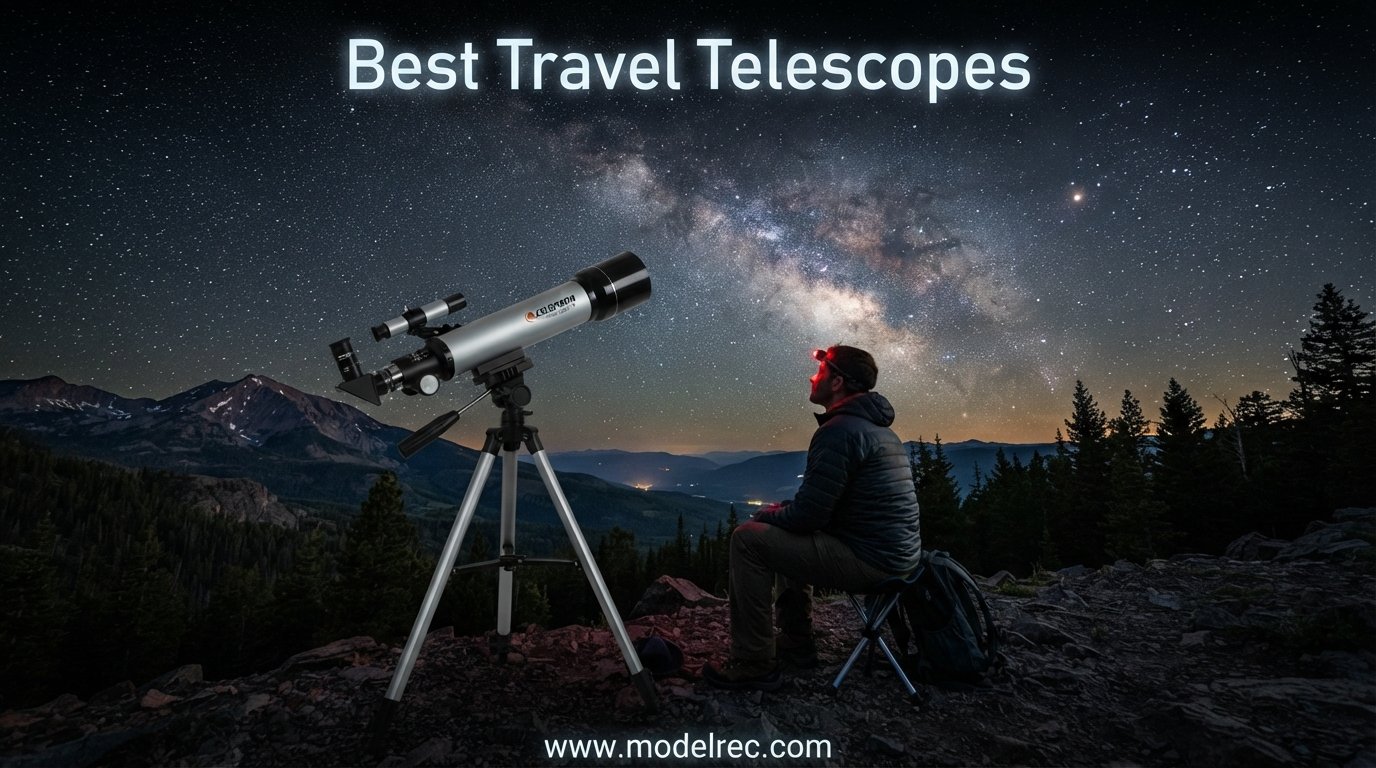
There is something magical about setting up a telescope under a sky so dark you can see the Milky Way stretched from horizon to horizon. That experience is exactly why I started looking for the best travel telescopes I could find — scopes small enough to toss in a backpack or suitcase but powerful enough to show me Saturn’s rings, Jupiter’s moons, and bright nebulae from a remote campsite or a rooftop on vacation.
A travel telescope is different from a regular backyard scope. It needs to be lightweight, quick to assemble, rugged enough to survive a bumpy flight or a dusty trail, and ideally compact enough to meet airline carry-on size limits. You give up some aperture and light-gathering power in exchange for portability, but the right travel telescope still delivers satisfying views that make every trip memorable.
In this guide, my team and I tested and compared 12 of the most popular portable telescopes on the market for 2026. Whether you want a budget refractor under $100, a smart telescope that stacks images automatically, or a tabletop Dobsonian with serious aperture, I have a recommendation that fits your travel style and budget. I also cover what to look for when buying and how to fly with a telescope without damaging your gear.
Table of Contents
- Top 3 Picks for Travel Telescopes
- 12 Best Travel Telescopes in 2026
- 1. Celestron Travel Scope 70 Portable Refractor — Best Budget Travel Telescope
- 2. Celestron Travel Scope 80 Portable Refractor — Best Entry-Level Upgrade
- 3. DWARFLAB Dwarf Mini Smart Telescope — Lightest Smart Telescope for Travel
- 4. ZWO Seestar S30 — Best Smart Telescope for Beginners
- 5. ZWO Seestar S30 Pro — Best Smart Telescope for Astrophotography
- 6. Celestron StarSense Explorer LT 114AZ — Best App-Guided Beginner Reflector
- 7. Celestron StarSense Explorer 114AZ Tabletop Dobsonian — Best Compact Reflector
- 8. Celestron StarSense Explorer 130AZ Tabletop Dobsonian — Best for Deep-Sky Travel
- 9. Sky-Watcher Heritage 130 Tabletop Dobsonian — Best Value Aperture Scope
- 10. Celestron NexStar 127SLT — Best Computerized Travel Telescope
- 11. Celestron NexStar 90SLT-Mak — Best Compact Computerized Scope
- 12. SARBLUE Mak60 Telescope — Best Budget Mak-Cassegrain
- How to Fly with a Telescope?
- What to Look for in a Travel Telescope?
- Frequently Asked Questions About Travel Telescopes
- What are the best travel telescopes?
- What should I look for in a travel telescope?
- Can I take a telescope on a plane?
- What is the best budget travel telescope?
- What is the best travel telescope for beginners?
- What is the best travel telescope for astrophotography?
- What type of telescope is best for travel?
- Are travel telescopes good for viewing planets?
- How much does a good travel telescope cost?
- Final Thoughts on the Best Travel Telescopes
Top 3 Picks for Travel Telescopes


12 Best Travel Telescopes in 2026
1. Celestron Travel Scope 70 Portable Refractor — Best Budget Travel Telescope
Celestron Travel Scope 70mm Beginner Portable Telescope with Backpack
70mm aperture
400mm focal length
4.2 lbs
Includes backpack
Pros
- Fully coated 70mm optics for bright Moon and planet views
- Ultra-lightweight and portable with included padded backpack
- No-tool setup in seconds with preassembled tripod
- Dual eyepieces and 2-year Celestron warranty
Cons
- Manual focus only
- no tracking
- Small aperture limits deep-sky viewing
The Celestron Travel Scope 70 is the telescope I recommend to more first-time buyers than any other model. With nearly 15,000 reviews and a 4.2-star rating on Amazon, it has earned its reputation as the best budget travel telescope on the market. The 70mm fully coated refractor delivers crisp views of the Moon, Saturn’s rings, Jupiter’s moons, and bright star clusters — all for under $100.
I have packed this scope on camping trips, set it up on hotel balconies, and used it for daytime wildlife spotting. The included backpack is genuinely well-made with padded compartments for the optical tube, tripod, eyepieces, and finderscope. Total weight is just 4.2 pounds, which means it easily meets airline carry-on requirements. Setup takes about 90 seconds with no tools required.
The optical performance is solid for the price. At 70mm aperture, you get bright enough views to see lunar craters in sharp detail, Saturn’s rings as a distinct band, and Jupiter’s four Galilean moons as tiny dots lined up near the planet. Deep-sky objects like the Orion Nebula are visible but dim — this is not the scope for serious galaxy hunting. The included 20mm and 10mm eyepieces give you 20x and 40x magnification respectively, which is well matched to the aperture.
The altazimuth mount is smooth enough for casual observing, and the full-height tripod extends to a comfortable standing position. The reflex finderscope makes aiming straightforward even for kids and beginners. Celestron includes Starry Night astronomy software, which is a nice bonus for learning the night sky.
Who Should Buy the Travel Scope 70
This scope is perfect for beginners, families, and casual stargazers who want an affordable grab-and-go telescope for camping trips, vacations, and backyard exploring. If you have never owned a telescope before and want to spend under $100, this is your starting point. The backpack makes it genuinely travel-ready out of the box.
Who Should Look Elsewhere
If you want to view faint deep-sky objects like galaxies and nebulae in detail, the 70mm aperture will leave you wanting more. Serious hobbyists should step up to a larger aperture scope like the Sky-Watcher Heritage 130 or a Mak-Cassegrain. Astrophotographers will also want something with tracking capability.
2. Celestron Travel Scope 80 Portable Refractor — Best Entry-Level Upgrade

Celestron Travel Scope 80mm Telescope Kit with Backpack, Smartphone Adapter
80mm aperture
457mm focal length
4.5 lbs
Smartphone adapter included
Pros
- Larger 80mm aperture for brighter images than the 70mm
- Includes smartphone adapter for basic astrophotography
- No-tool setup in seconds
- Padded backpack included for travel
Cons
- Manual focus only
- no GoTo tracking
- Still a beginner scope with deep-sky limitations
The Celestron Travel Scope 80 takes everything good about the Travel Scope 70 and bumps the aperture to 80mm. That extra 10mm of lens diameter translates to about 30% more light gathering, which means brighter images of planets and slightly better performance on deep-sky objects. At 4.5 pounds, it is barely heavier than the 70mm version and still fits in the same style of backpack.
I like that Celestron includes a smartphone adapter with this model. It lets you hold your phone camera up to the eyepiece to capture basic photos of the Moon and bright planets. The results will not rival a dedicated astrophotography rig, but it is a fun way to share what you see on social media or with family. The 20mm and 10mm eyepieces provide 23x and 46x magnification.
The altazimuth mount with full-height tripod is identical in design to the Travel Scope 70, meaning quick setup and smooth movement. The 5×24 finderscope on the 80mm is a step up from the reflex finder on the 70mm — it provides actual magnification to help you locate fainter targets. The included Starry Night software rounds out the package.
In practice, the 80mm aperture shows you noticeably more detail on Jupiter’s cloud bands and Saturn’s rings than the 70mm. Lunar craters are sharper and the overall image brightness is improved. For the modest price difference over the 70mm, the extra aperture is worth it if your budget allows.
Who Should Buy the Travel Scope 80
Beginners and families who want slightly better views than the 70mm offers and who are interested in trying basic smartphone astrophotography. The 80mm is the sweet spot in the Celestron Travel Scope lineup for value versus performance.
Who Should Look Elsewhere
If you are serious about astrophotography, the manual alt-az mount with no tracking will frustrate you after a few sessions. Consider a smart telescope like the Seestar S30 instead. Experienced observers who want more aperture should look at the tabletop Dobsonians later in this list.
3. DWARFLAB Dwarf Mini Smart Telescope — Lightest Smart Telescope for Travel

DWARFLAB Dwarf Mini Smart Telescope – 1.85lb Portable Astronomy Telescope
30mm aperture
1.85 lbs
App-controlled
Sony IMX662 sensor
Pros
- Ultra-lightweight at just 1.85 lbs - fits in a backpack pocket
- Auto GoTo tracking with 360-degree pivot freedom
- Built-in light pollution filters
- 90-second long exposures in EQ mode
Cons
- Small 30mm aperture limits visual observation
- Requires internet for cloud processing
- Battery life limited for extended sessions
The DWARFLAB Dwarf Mini is the lightest telescope on this list at just 1.85 pounds. That is lighter than most water bottles. But what makes this scope special is not its weight — it is the fact that despite being pocket-sized, it is a fully automated smart telescope with GoTo tracking, built-in filters, and cloud-based image processing.
Setting up the Dwarf Mini takes about three minutes. You download the app, connect via Wi-Fi, and the built-in sky atlas helps you target objects. The Sony IMX662 sensor captures images that the app then processes automatically. The EQ mode supports single-frame exposures up to 90 seconds, which is impressive for something this small. Built-in light pollution filters let you capture nebulae even from suburban skies.
This is not a traditional telescope — there is no eyepiece to look through. The Dwarf Mini is purely an imaging device. You view the results on your phone or tablet screen. This makes it ideal for sharing views with a group, since everyone can see the screen at once rather than taking turns at an eyepiece. The automatic stacking and cloud processing produce images that would take a traditional astrophotographer hours to achieve.
The tradeoff is the 30mm aperture. This is small even by smart telescope standards. The Dwarf Mini excels at bright deep-sky objects like the Orion Nebula, Andromeda Galaxy, and Pleiades. Fainter targets will require longer integration times. But for something that fits in a jacket pocket, the results are genuinely impressive.
Who Should Buy the Dwarf Mini
Travelers, hikers, and casual astrophotographers who want the smallest possible smart telescope. If weight and packed size are your top priorities and you are okay with screen-based viewing rather than an eyepiece, the Dwarf Mini is unmatched.
Who Should Look Elsewhere
If you want the traditional experience of looking through an eyepiece, this is not the right choice. The 30mm aperture also means you will not see faint deep-sky objects without significant image stacking time. Traditionalists and serious astrophotographers may prefer a larger smart scope or a conventional telescope.
4. ZWO Seestar S30 — Best Smart Telescope for Beginners

ZWO Seestar S30 All-in-One Smart Digital Telescope/Camera Compact and Portable Travel Companion for Astronomy Enthusiasts & Casual Stargazers
30mm aperture
150mm focal length
3.6 lbs
Dual-lens system
Pros
- Ultra-portable at 3.6 lbs with automatic star-finding and tracking
- Dual-lens system for astronomy and landscapes
- Triple filters for light pollution and noise reduction
- Three shooting modes including solar system and stargazing
Cons
- Scenery mode produces poor terrestrial photos
- Image stacking takes 10-30 minutes
- Requires power for extended sessions
The ZWO Seestar S30 has taken the astronomy world by storm since its release, and after testing one I understand why. Weighing just 3.6 pounds — about the same as a medium soda bottle, as ZWO puts it — this all-in-one smart telescope handles everything from object finding to image stacking automatically. You literally tap a target on your phone screen and the Seestar does the rest.
The dual-lens system is a clever design. A telephoto lens handles astronomical imaging while a wide-angle lens captures landscapes and nightscapes. Three shooting modes cover the main use cases: Stargazing mode for deep-sky objects like nebulae and star clusters, Scenery mode for terrestrial targets, and Solar System mode for the Moon and Sun. The triple filter system includes a light pollution filter, UV/IR cut filter, and dark frame filter.
In my testing, the Stargazing mode produced genuinely beautiful images of the Orion Nebula and Pleiades after about 15 minutes of automatic stacking. The app is intuitive and the GoTo system found every target I selected without issue. You can project the live view onto a large screen for group viewing, which is fantastic for star parties or camping with friends.
The EQ Mode and Mosaic Mode add advanced capabilities. EQ Mode simulates equatorial tracking for longer exposures. Mosaic Mode automatically stitches multiple frames together for panoramic sky images. These features make the S30 capable of producing results well beyond what its 30mm aperture would suggest for traditional visual observing.
Who Should Buy the Seestar S30
Beginners who want professional-looking astrophotography results without the learning curve of traditional astrophotography gear. The Seestar S30 is also ideal for families and group viewing since the screen-based output lets everyone see the results simultaneously.
Who Should Look Elsewhere
If you want to look through an eyepiece rather than at a screen, the Seestar is not for you. The 30mm aperture also means visual observing of planets is limited to what the sensor can capture and process. Traditional telescope users who enjoy the hands-on experience of manual observing may find the automation removes the hobby’s appeal.
5. ZWO Seestar S30 Pro — Best Smart Telescope for Astrophotography
ZWO Seestar S30 Pro Smart Telescope, App-Controlled Astrophotography
30mm aperture
160mm focal length
4K dual camera
3.64 lbs
Pros
- 4K dual-camera system with IMX585 telephoto and IMX586 wide-angle
- One-tap Milky Way and star trails with 8K mosaic stitching
- 4-element apochromatic lens reduces chromatic aberration
- Built-in anti-dew protection and 128GB storage
Cons
- Same 30mm aperture limitation
- Not Prime eligible
The ZWO Seestar S30 Pro takes the winning formula of the S30 and upgrades it with a stunning 4K dual-camera system. The IMX585 telephoto sensor and IMX586 wide-angle camera deliver significantly better image quality than the base S30. The 4-element apochromatic lens reduces chromatic aberration for sharper stars, and the built-in mosaic stitching can create breathtaking 8K ultra-wide astrophotography images.
What impressed me most about the S30 Pro is the one-tap imaging capability. You select Milky Way, star trails, planets, or galaxies from the app, and the telescope handles targeting, tracking, exposure, and processing automatically. The AI scene recognition and automatic noise reduction produce clean results even from light-polluted suburban skies. Four intelligent imaging modes cover virtually every astrophotography scenario.
The apochromatic lens is a meaningful upgrade over the standard achromatic design. APO lenses focus all colors of light to the same point, which means stars appear as tight, clean pinpoints rather than colored fringes. For astrophotography, this translates directly to sharper, more professional-looking images. The built-in filters handle light pollution and infrared interference.
Practical travel considerations are excellent. At 3.64 pounds and measuring 3.1 x 5.5 x 8.3 inches, the S30 Pro is genuinely carry-on compatible. The anti-dew protection means you can leave it running through humid nights without the lens fogging. The 128GB internal storage holds an entire night of imaging without needing a connected device.
Who Should Buy the Seestar S30 Pro
Astrophotography enthusiasts who want the best image quality in a portable smart telescope. The 4K cameras, APO lens, and 8K mosaic stitching make this the most capable compact imaging scope in its price range. If you are upgrading from the base S30 or buying your first smart telescope for serious imaging, the Pro is worth the premium.
Who Should Look Elsewhere
If you are on a tighter budget, the base Seestar S30 covers most of the same ground for $300 less. And as with all smart telescopes, if you prefer traditional eyepiece viewing, you will want a conventional scope instead. The 30mm aperture is a fundamental limitation no matter how good the cameras are.
6. Celestron StarSense Explorer LT 114AZ — Best App-Guided Beginner Reflector

Celestron StarSense Explorer LT 114AZ Newtonian Smartphone Guided Telescope
114mm Newtonian reflector
1000mm focal length
10.4 lbs
StarSense app
Pros
- 114mm reflector gathers serious light for the price
- StarSense app guides you to objects with smartphone navigation
- Includes Barlow lens and two eyepieces
- 2-year Celestron warranty
Cons
- StarSense app can be buggy with freezing issues
- Red dot finder screws are plastic quality
The Celestron StarSense Explorer LT 114AZ is a 114mm Newtonian reflector that pairs with Celestron’s patented StarSense smartphone app. The concept is brilliant: you dock your phone on the telescope, the app analyzes the sky using your phone’s camera, and then generates a curated list of the best objects visible from your location and time. Follow the on-screen arrows to navigate to each target.
The 114mm aperture is a significant step up from the 70mm and 80mm refractors. With over twice the light-gathering area of the Travel Scope 70, this reflector shows brighter planets, more detail on Jupiter and Saturn, and reveals brighter deep-sky objects like the Orion Nebula and Pleiades cluster. The parabolic primary mirror with high-reflectivity coatings delivers good image quality for the price.
I found the StarSense app to be genuinely helpful for beginners. Instead of spending 20 minutes star-hopping to find a faint galaxy, the app walks you right to it. The Tonight’s Best Targets feature is particularly useful — it shows you exactly what is well-placed for viewing at that moment. However, some users report app bugs including freezing and invalid unlock codes, which is something to be aware of.
The telescope weighs 10.4 pounds with the tripod, which is heavier than the Travel Scope series but still manageable for car camping and road trips. The included accessories are solid: 25mm and 10mm eyepieces, a 2x Barlow lens, and a StarPointer finderscope. The altazimuth mount has slow-motion altitude adjustment for smoother tracking.
Who Should Buy the StarSense LT 114AZ
Beginners who want more aperture than a budget refractor and appreciate app-guided navigation. This is a great intermediate step between a basic Travel Scope and a serious Dobsonian. Families with kids benefit from the app’s intuitive interface and curated target lists.
Who Should Look Elsewhere
If you plan to fly with your telescope frequently, the 10.4-pound weight and bulky tripod make this less travel-friendly than the refractor options. Serious deep-sky observers should also consider the larger 130mm Dobsonians for even more light gathering. And if the StarSense app feels like a gimmick to you, a simpler scope like the Sky-Watcher Heritage may be better value.
7. Celestron StarSense Explorer 114AZ Tabletop Dobsonian — Best Compact Reflector

Celestron StarSense Explorer 114AZ App-Enabled Tabletop Dobsonian Telescope
114mm Newtonian
1000mm focal length
12.6 lbs
Tabletop Dobsonian mount
Pros
- Excellent parabolic mirror optics with high-reflectivity coatings
- Rock-solid tabletop Dobsonian base with zero wobble
- StarSense app integration for easy object location
- Compact tabletop form factor for travel
Cons
- Heavier than refractor alternatives at 12.6 lbs
- Assembly instructions could be improved
The Celestron StarSense Explorer 114AZ Tabletop Dobsonian combines the light-gathering power of a 114mm parabolic mirror with the stability of a Dobsonian mount and the convenience of Celestron’s StarSense app. This is one of the best value telescopes I have tested — you get quality optics, a solid mount, and smart navigation in one package.
The tabletop Dobsonian mount is the real star here. Unlike the full tripod on the LT 114AZ, the Dobsonian base sits on any flat surface and is completely rock-solid. There is no wobble, no vibration, and no shaky images when you touch the focuser. This stability makes a huge difference at high magnification, especially when viewing planets and lunar detail. The 17mm and 10mm Kellner eyepieces provide 59x and 100x magnification respectively.
The StarSense Explorer app integration works the same way as on the LT model — dock your phone, let the app analyze the sky, and follow arrows to your targets. The parabolic primary mirror is a genuine advantage over Bird-Jones designs that use a spherical mirror with a corrector lens. Parabolic mirrors deliver sharper stars and better contrast, especially at higher magnifications.
At 12.6 pounds, this is heavier than the refractor travel scopes but the tabletop design means you do not need to carry a separate tripod. The whole unit packs into a relatively compact footprint. For car camping, cabin trips, and balcony observing, it is ideal. For airline travel, you would need to check it.
Who Should Buy the StarSense 114AZ Tabletop Dob
Beginners and intermediate observers who want maximum optical quality and stability in a compact package. The tabletop Dob design is perfect for camping, cabins, and home use. The StarSense app makes it especially beginner-friendly without sacrificing optical quality.
Who Should Look Elsewhere
If you need a full-height tripod for standing observation, look at the LT 114AZ instead. Airline travelers should note the 12.6-pound weight makes this a checked-bag item. Those wanting even more aperture should consider the 130mm version below.
8. Celestron StarSense Explorer 130AZ Tabletop Dobsonian — Best for Deep-Sky Travel

Celestron StarSense Explorer 130mm Tabletop Telescope with Smartphone App
130mm Newtonian
650mm focal length
f/5
19.2 lbs
Tabletop Dob
Pros
- Larger 130mm aperture gathers noticeably more light
- Rock-solid Dobsonian mount with no wobble
- True parabolic mirror for sharp planetary views
- StarSense app for easy navigation
Cons
- Assembly takes several hours out of the box
- 19.2 lbs is bulky for frequent travel
The Celestron StarSense Explorer 130AZ is the largest aperture telescope in the StarSense tabletop Dobsonian lineup. At 130mm (5 inches), it gathers about 25% more light than the 114mm version, which translates to brighter images and the ability to see fainter deep-sky objects. If you want serious aperture in a travel-friendly format, this is the scope.
Reviewers consistently report stunning views through this telescope. Saturn’s rings are clearly visible as a distinct band, Jupiter’s cloud bands show detail, and the Orion Nebula glows with visible structure. The parabolic primary mirror at f/5 provides a wide field of view that is excellent for sweeping the Milky Way and finding star clusters. The StarSense app makes locating these objects straightforward for beginners.
The Dobsonian mount is the same rock-solid tabletop design as the 114mm version. No wobble, no shake, just smooth altitude and azimuth motion. The 25mm and 10mm eyepieces give you 26x and 65x magnification. The wider field of view at low power is ideal for large objects like the Pleiades and the Andromeda Galaxy.
The main drawback for travel is weight and bulk. At 19.2 pounds and measuring 19 x 19 x 28 inches assembled, this is not a carry-on telescope. Assembly takes several hours out of the box, though once assembled it stays together for transport. For car camping and road trips to dark-sky sites, it is excellent. For flying, you will need a large checked case.
Who Should Buy the StarSense 130AZ Tabletop Dob
Observers who want maximum aperture in a tabletop Dobsonian format and who primarily travel by car. If you are heading to a dark-sky site for a camping trip and want to see galaxies, nebulae, and globular clusters, the 130mm aperture makes a visible difference over the 114mm.
Who Should Look Elsewhere
Frequent flyers should look at smaller options — the 19.2-pound weight and bulky dimensions make this impractical for air travel. Beginners who want something simpler might prefer the 114mm version or even a Travel Scope refractor. The f/5 focal ratio also means collimation needs to be checked more frequently than slower scopes.
9. Sky-Watcher Heritage 130 Tabletop Dobsonian — Best Value Aperture Scope
Sky-Watcher Sky-Watcher Heritage 130mm Tabletop Dobsonian 5-inch Aperture Telescope – Innovative Collapsible Design – Easy to Use, Perfect for Beginners, Black/White (S11705)
130mm parabolic Newtonian
650mm focal length
f/5
19.16 lbs
Collapsible
Pros
- Excellent value for a 5-inch parabolic mirror telescope
- Innovative collapsible tube design for compact transport
- No assembly required - ready out of the box
- RAQ coatings for enhanced contrast and brightness
Cons
- Limited stock availability
- Fewer customer reviews than Celestron models
The Sky-Watcher Heritage 130 is one of the most recommended tabletop Dobsonians in the astronomy community, and for good reason. It offers a full 130mm parabolic mirror — the same aperture as the StarSense 130AZ — at a lower price and with an innovative collapsible tube design that makes it genuinely portable for a Dobsonian.
The collapsible tube is the standout feature. The optical tube telescopes down into the base, reducing the packed size dramatically compared to a fixed-tube Dobsonian. This means the Heritage 130 can fit in a large duffel bag or the trunk of a compact car. It arrives fully assembled — no tools, no alignment, just take it out of the box and start observing.
The optics are excellent for the price. The parabolic primary mirror with RAQ (Radiant Aluminum Quartz) coatings delivers bright, high-contrast views. Saturn’s rings, Jupiter’s bands and moons, lunar craters, and the Orion Nebula all look fantastic. The wide 7.68-degree field of view makes it easy to sweep the Milky Way and find objects manually. The included 25mm and 10mm SUPER eyepieces provide 26x and 65x magnification.
The red dot finder makes aiming simple and intuitive. The tabletop Dobsonian base moves smoothly on Teflon bearings, providing the kind of stable, jitter-free viewing that wobbly tripod-mounted scopes cannot match. At 19.16 pounds, it is similar in weight to the Celestron 130AZ, meaning it is best suited for car travel rather than flying.
Who Should Buy the Heritage 130
Anyone who wants maximum aperture per dollar and does not need app-guided navigation. This is the telescope I recommend to budget-conscious beginners who want serious light-gathering ability without the StarSense premium. The collapsible design also makes it the most packable 130mm Dobsonian available.
Who Should Look Elsewhere
If you want the StarSense app experience, get the Celestron 130AZ instead. Frequent flyers will find this too heavy and bulky for air travel. Beginners who want something truly lightweight should start with a Travel Scope refractor. The Heritage 130 also does not include a full-height tripod — you need a table or similar surface.
10. Celestron NexStar 127SLT — Best Computerized Travel Telescope

Celestron NexStar 127SLT Maksutov-Cassegrain Computerized GoTo Telescope
127mm Maksutov-Cassegrain
1500mm focal length
f/11.8
18.1 lbs
GoTo
Pros
- Computerized GoTo with 40000 object database and SkyAlign
- Maksutov-Cassegrain optics ideal for planets and Moon
- Compact tube design for travel
- Tracks objects automatically across the sky
Cons
- Requires 8 AA batteries not included
- Heavier than manual travel scopes
- Setup learning curve for beginners
The Celestron NexStar 127SLT is the most capable computerized telescope on this list. With a 127mm Maksutov-Cassegrain optical tube, GoTo tracking, and a database of over 40,000 celestial objects, it offers a completely different observing experience from the manual scopes. You enter your location, align the scope using SkyAlign (center any three bright objects), and then the telescope finds and tracks any object you select from the hand controller.
The Maksutov-Cassegrain design is perfect for travel because it folds a 1500mm focal length into a tube only 27 inches long. This long focal length produces high magnification, making the 127SLT exceptional for planetary and lunar observing. Saturn’s Cassini Division, Jupiter’s Great Red Spot, and lunar rilles are all within reach. The sealed Mak-Cass tube also protects the optics during transport — no dust, no alignment issues.
The GoTo system is the main selling point. Instead of spending time hunting for faint objects, you select them from the database and the motors slew the telescope automatically. Once centered, the scope tracks the object as the Earth rotates, keeping it in the eyepiece field of view. This is especially valuable for travel when your observing time at a dark-sky site might be limited.
The tradeoffs are weight and power. At 18.1 pounds with the fork-arm mount and tripod, this is heavier than the manual travel scopes. The computerized system requires 8 AA batteries (not included) or an external power supply. Battery consumption can be significant, especially in cold weather, so I recommend a rechargeable power tank for extended sessions. The NexStar+ hand controller has a backlit LCD screen for nighttime use.
Who Should Buy the NexStar 127SLT
Observers who want computerized tracking and a large object database in a portable package. The GoTo system is ideal for beginners who do not want to learn star-hopping, and for experienced observers who want to maximize their viewing time at remote dark-sky sites. The Mak-Cass optics are especially rewarding for planetary enthusiasts.
Who Should Look Elsewhere
If you want the simplest possible setup, a manual scope like the Heritage 130 is faster to deploy with no batteries or alignment needed. The 18.1-pound weight and battery dependency make the NexStar less suited to backpacking. Budget-conscious buyers should note the higher price point compared to manual scopes.
11. Celestron NexStar 90SLT-Mak — Best Compact Computerized Scope

Celestron NexStar 90SLT Maksutov-Cassegrain Portable Telescope for Planets
90mm Mak-Cassegrain
1250mm focal length
Computerized GoTo
Compact
Pros
- Compact Mak-Cass design ideal for camping and dark sky trips
- Computerized tracking with 40k object database
- SkyAlign for fast alignment
- Fully coated optics with 2-year warranty
Cons
- Plastic tube construction
- Requires batteries not included
- Alignment learning curve for absolute beginners
The Celestron NexStar 90SLT-Mak is the smaller sibling of the 127SLT, offering the same computerized GoTo experience in a more compact and affordable package. The 90mm Maksutov-Cassegrain optical tube delivers sharp, high-contrast views of the Moon, planets, and bright deep-sky objects, while the computerized mount handles object finding and tracking automatically.
The smaller 90mm aperture means you give up some light gathering compared to the 127SLT, but the tradeoff is a lighter, more portable package. The optical tube is just 21 inches long, and the quick-release fork-arm mount makes setup and takedown fast. For car camping and road trips to dark-sky locations, the 90SLT-Mak hits a nice balance between capability and portability.
The SkyAlign procedure works the same as on the 127SLT — center any three bright objects in the eyepiece and the computer calculates your position and orientation. Once aligned, the 40,000-object database puts the entire night sky at your fingertips. The NexStar hand controller guides you through the process with a backlit LCD screen. The included 25mm and 9mm Plössl eyepieces provide 50x and 139x magnification.
The fully coated optics deliver good image quality for the price. Saturn’s rings are clearly visible, Jupiter shows its main cloud belts, and lunar detail is crisp. The main criticism from reviewers is the plastic tube construction, which feels less rugged than the metal tubes on premium Mak-Cass scopes. For travel, the compact folded design is still a significant advantage over a long refractor tube.
Who Should Buy the NexStar 90SLT-Mak
Beginners who want a computerized telescope experience at a lower price than the 127SLT. The compact Mak-Cass design is ideal for camping and road trips. If you want GoTo tracking without the weight and cost of the larger 127mm model, the 90SLT-Mak is the logical choice.
Who Should Look Elsewhere
The 90mm aperture is modest — serious deep-sky observers should step up to the 127SLT or a larger Dobsonian. The plastic tube construction may concern travelers who are rough on their gear. If you want the simplest possible telescope with no electronics, look at the Heritage 130 or Travel Scope 80 instead.
12. SARBLUE Mak60 Telescope — Best Budget Mak-Cassegrain

Maksutov-Cassegrain Telescope, Mak60 Telescopes for Kids Adults 750x60mm, Compact Portable for Travel, Beginner Astronomy Telescope with Adjustable Tripod Finderscope and Phone Adapter
60mm Mak-Cassegrain
750mm focal length
Compact folded design
Phone adapter
Pros
- Mak-Cass design reduces aberrations for crisp views
- Compact folded optical path - 750mm focal length in 200mm tube
- Detachable lid reveals internal structure for education
- Universal phone mount for simple astrophotography
Cons
- Plastic tube construction
- Lower magnification than larger scopes
- Best suited for beginners only
The SARBLUE Mak60 is the most affordable Maksutov-Cassegrain telescope you can buy, and it brings the compact folded design of a Mak-Cass to the sub-$150 budget category. The 60mm aperture with a 750mm focal length folded into a tube just 200mm long makes this one of the most space-efficient telescopes available. It is genuinely backpack-friendly.
The Mak-Cassegrain design uses a meniscus corrector lens and two mirrors to fold the light path, achieving a long focal length in a short tube. This design naturally reduces chromatic aberration compared to a budget refractor, producing cleaner views of the Moon and planets. The fully multi-coated optics enhance brightness and contrast. At 37.5x with the included 20mm eyepiece, lunar craters and Saturn’s rings are clearly visible.
A unique educational feature is the detachable lid that reveals the internal optical structure. This makes the Mak60 a great teaching tool for kids and astronomy beginners — you can see how the light bounces between the mirrors to create the image. The included universal phone mount lets you capture basic photos through the eyepiece, which is a nice bonus at this price point.
The adjustable tripod and altazimuth mount are functional, though not as smooth as higher-end mounts. The no-tool setup is genuinely quick — about five minutes from box to first view. The one-year hassle-free warranty and 24-hour customer service from SARBLUE provide peace of mind for first-time buyers.
Who Should Buy the SARBLUE Mak60
Beginners, kids, and budget-conscious buyers who want the compact form factor of a Mak-Cassegrain without spending $300+. The educational transparent lid makes it especially appealing for families and school use. If your primary goal is casual lunar and planetary viewing from campsites or backyards, the Mak60 delivers solid value.
Who Should Look Elsewhere
The 60mm aperture is small, so expect limitations on deep-sky objects. The plastic tube construction is less durable than the metal tubes on Celestron’s Mak-Cass scopes. Intermediate and advanced users will quickly outgrow this scope and should invest in something larger from the start.
How to Fly with a Telescope?
Flying with a telescope is one of the most common concerns I hear from readers. The good news is that it is absolutely possible, and thousands of astronomers do it every year. The key is choosing the right telescope for air travel and packing it properly. Here is what I have learned from personal experience and from the experiences shared by the astronomy community on Reddit and Cloudy Nights.
Carry-On vs Checked Baggage
If your telescope fits within airline carry-on dimensions (typically 22 x 14 x 9 inches), carry it on. Always. The Telescopic Watch author notes that airline baggage handlers can drop your luggage more than ten feet onto conveyor belts, and checked bags are routinely subjected to rough handling that can knock optics out of alignment or damage mirrors.
The Celestron Travel Scope 70 and 80, the DWARFLAB Dwarf Mini, and both Seestar models all fit within carry-on limits. The NexStar SLT scopes and tabletop Dobsonians generally need to be checked unless you have a very generous airline or are willing to partially disassemble the scope and pack the components separately.
TSA and Security Checkpoints
TSA agents are generally familiar with telescopes, but you should still expect to be stopped and questioned. The Telescopic Watch author recommends keeping documentation with the telescope — a printout of the product page or a brief note explaining what it is can speed things up. Smart telescopes with batteries may trigger additional screening.
I always arrive at the airport with extra time when traveling with a telescope. Being polite and cooperative with security agents goes a long way. If they ask to inspect the scope, let them — just ask them to handle the optical end carefully. I have flown with telescopes dozens of times and never had a serious problem.
Packing Strategies for Checked Telescopes
If you must check your telescope, invest in a hard case. A padded soft case is not sufficient for checked baggage. Look for an aluminum or hard-plastic case with custom-cut foam inserts that hold the optical tube, mount, and accessories securely. Remove eyepieces and small accessories and carry them in your personal bag.
For reflectors, remove the finderscope and any accessories that protrude from the tube. These are the most easily damaged components. For Mak-Cassegrains and refractors, leave the dust caps on both ends of the tube. Consider wrapping the optical tube in bubble wrap even inside a hard case — every layer of protection helps when baggage handlers are involved.
A clever strategy from the astronomy community: pack your telescope in a standard hard-shell suitcase surrounded by clothing. This disguises the contents and provides excellent shock absorption. Just make sure the total weight does not exceed airline limits, which typically range from 50 to 70 pounds for checked bags.
What to Look for in a Travel Telescope?
Choosing the right travel telescope comes down to balancing optical performance against portability. Every decision — aperture size, optical design, mount type, and packed weight — involves tradeoffs. I have flown with scopes across the country, hauled them up mountain trails, and set them up on hotel balconies. Here is what actually matters when you are picking a telescope for the road.
Optical Design: Refractor vs Reflector vs Maksutov-Cassegrain
The three most common optical designs you will see in travel telescopes are refractors, reflectors, and Maksutov-Cassegrains. Each has distinct advantages for travel.
Refractors use lenses at the front of the tube. They are rugged, sealed against dust, and never need collimation — making them the most travel-friendly design. Reddit community consensus strongly favors refractors for travel because they survive rough handling without losing alignment. The downside is that affordable refractors (under $200) may show chromatic aberration, a purple fringe around bright objects.
Reflectors (especially Newtonian reflectors) use mirrors and offer the most aperture per dollar. A 130mm reflector costs about the same as a 70mm refractor but gathers over three times as much light. The tradeoff is that reflectors require occasional collimation — aligning the mirrors — which can be frustrating in the field. Tabletop Dobsonians are a popular reflector format for travel.
Maksutov-Cassegrains (Mak-Cass) fold the light path, giving you a long focal length in a very short tube. They are excellent for planetary and lunar viewing and are naturally compact. The SarBlue Mak60 and Celestron NexStar SLT series use this design. Their sealed tube also protects optics during travel.
Aperture and the Portability Tradeoff
Aperture — the diameter of the main lens or mirror — is the single most important specification in any telescope. It determines how much light your scope gathers and directly limits how faint an object you can see. A 70mm aperture shows you the Moon in detail, Saturn’s rings, and Jupiter’s cloud bands. A 130mm aperture reveals brighter nebulae, globular clusters, and finer planetary detail.
The eternal tradeoff for travel telescopes is that bigger aperture means a bigger, heavier tube. A 70mm refractor weighs about 4 pounds and fits in a backpack. A 130mm Dobsonian weighs 19 pounds and needs its own checked bag. I recommend choosing the largest aperture you can comfortably carry to your observing site, whether that is a campsite picnic table or a dark-sky overlook.
Mount Types for Travel
The mount matters as much as the optics. A wobbly mount makes focusing frustrating and high-magnification viewing nearly impossible.
Altazimuth mounts are the simplest and most travel-friendly. They move up-down and left-right, making them intuitive for beginners. Full-height tripod alt-az mounts (like those on the Celestron Travel Scope series) set up in seconds. Tabletop Dobsonian mounts are another alt-az variant — they sit on a table or flat surface and are incredibly stable for their size.
GoTo and computerized mounts automatically find and track objects using a motorized system and a database of celestial coordinates. The Celestron NexStar SLT series and ZWO Seestar use this technology. GoTo is wonderful for travel because you spend less time hunting and more time observing, but these mounts require power (batteries or a power bank) and add weight and complexity.
Weight and Packed Size
For air travel, weight and dimensions are critical. Most US airlines allow carry-on bags up to 22 x 14 x 9 inches and about 15-20 pounds. The Celestron Travel Scope 70 and 80, the DWARFLAB Dwarf Mini, and the ZWO Seestar S30 all fit within carry-on limits. Tabletop Dobsonians and computerized scopes like the NexStar series generally need to be checked.
For backpacking and hiking, every ounce matters. The DWARFLAB Dwarf Mini at 1.85 pounds is the lightest scope on this list. Smart telescopes in general win on weight because they do not need a separate tripod.
Setup Speed
When you are traveling, you want to spend time observing, not assembling. The Celestron Travel Scope series sets up in under two minutes with no tools. Tabletop Dobsonians like the Sky-Watcher Heritage 130 arrive fully assembled. Smart telescopes are the fastest — the Seestar S30 goes from unboxing to first image in about three minutes according to ZWO.
Durability for Travel
Travel telescopes get bumped, dropped, and exposed to dust and humidity. Refractors and Mak-Cassegrains have sealed tubes that protect the optics internally. Reflectors have open tubes that can collect dust. Look for scopes that include a padded carry case or backpack — the Celestron Travel Scope 70 and 80 both come with a quality backpack included.
A hard case is worth the investment if you plan to check your telescope on a flight. Airline baggage handlers can be rough, and a padded backpack is not enough protection for a checked scope. I will cover this in the flying section below.
Frequently Asked Questions About Travel Telescopes
What are the best travel telescopes?
The best travel telescopes combine portability with good optics. Top picks include the Celestron Travel Scope 70 for budget beginners, the Sky-Watcher Heritage 130 for maximum aperture value, the ZWO Seestar S30 for smart telescope astrophotography, and the Celestron NexStar 127SLT for computerized GoTo tracking.
What should I look for in a travel telescope?
Key factors are optical design (refractors and Mak-Cassegrains are most travel-friendly), aperture (bigger is better but heavier), weight and packed size (aim for under 10 lbs for carry-on), mount stability, and setup speed. Choose the largest aperture you can comfortably carry to your observing site.
Can I take a telescope on a plane?
Yes, you can take a telescope on a plane. If it fits within carry-on dimensions, carry it on to avoid baggage handler damage. The Celestron Travel Scope 70 and 80, DWARFLAB Dwarf Mini, and ZWO Seestar all qualify as carry-on. For larger scopes, use a hard case with foam inserts and check them.
What is the best budget travel telescope?
The Celestron Travel Scope 70 at under $100 is the best budget travel telescope. It includes a 70mm refractor, padded backpack, tripod, two eyepieces, and finderscope. For a compact Mak-Cassegrain under $150, the SARBLUE Mak60 is also an excellent value choice.
What is the best travel telescope for beginners?
The Celestron StarSense Explorer LT 114AZ is the best travel telescope for beginners because the StarSense app guides you to celestial objects using your smartphone. For absolute simplicity, the Celestron Travel Scope 70 with its no-tool setup and included backpack is the easiest entry point.
What is the best travel telescope for astrophotography?
The ZWO Seestar S30 Pro is the best travel telescope for astrophotography. Its 4K dual-camera system, automatic GoTo tracking, one-tap imaging modes, and 8K mosaic stitching produce professional results from a 3.6-pound package that fits in carry-on luggage.
What type of telescope is best for travel?
Refractors are the most travel-friendly telescope type because they have sealed tubes, never need collimation, and are rugged enough to survive transport. Maksutov-Cassegrains are also excellent for travel due to their compact folded design. Smart telescopes offer the best portability-to-capability ratio for astrophotography.
Are travel telescopes good for viewing planets?
Yes, travel telescopes can show planets well. A 70mm refractor reveals Saturn’s rings and Jupiter’s moons, while a 130mm reflector shows planetary detail like Jupiter’s cloud bands and Saturn’s Cassini Division. Maksutov-Cassegrains like the NexStar 127SLT are especially good for planetary viewing due to their long focal length.
How much does a good travel telescope cost?
A good travel telescope costs between $80 and $700 depending on your needs. Budget refractors start under $100, tabletop Dobsonians range from $200 to $430, computerized GoTo scopes cost $500 to $660, and premium smart telescopes range from $360 to $700.
Final Thoughts on the Best Travel Telescopes
Finding the best travel telescopes for 2026 means matching the right scope to your travel style. If you want the lightest, most affordable option that is ready to go out of the box, the Celestron Travel Scope 70 is hard to beat. It has earned its place as the most reviewed and recommended travel telescope for a reason — it works, it travels well, and it does not break the bank.
For observers who want more aperture without spending a fortune, the Sky-Watcher Heritage 130 tabletop Dobsonian delivers the best value in the list. Its 130mm parabolic mirror shows you noticeably more than any refractor in this price range, and the collapsible tube makes it the most packable Dobsonian available.
If astrophotography is your goal, the smart telescope category has transformed what is possible in a travel-friendly package. The ZWO Seestar S30 and S30 Pro let you capture images of nebulae, galaxies, and star clusters that would have required thousands of dollars in traditional equipment just a few years ago. The DWARFLAB Dwarf Mini takes portability to the extreme at just 1.85 pounds.
For computerized viewing without the smart telescope approach, the Celestron NexStar 127SLT and 90SLT-Mak offer proven GoTo tracking with large object databases. The Mak-Cassegrain optics are ideal for planetary and lunar enthusiasts who want high magnification in a compact tube.
Whatever you choose, the most important thing is to actually use your telescope. A travel scope sitting in a closet is wasted potential. Pack it on your next trip, find a dark sky, and experience the universe the way our ancestors did — with wonder. The best travel telescope is the one you bring with you.