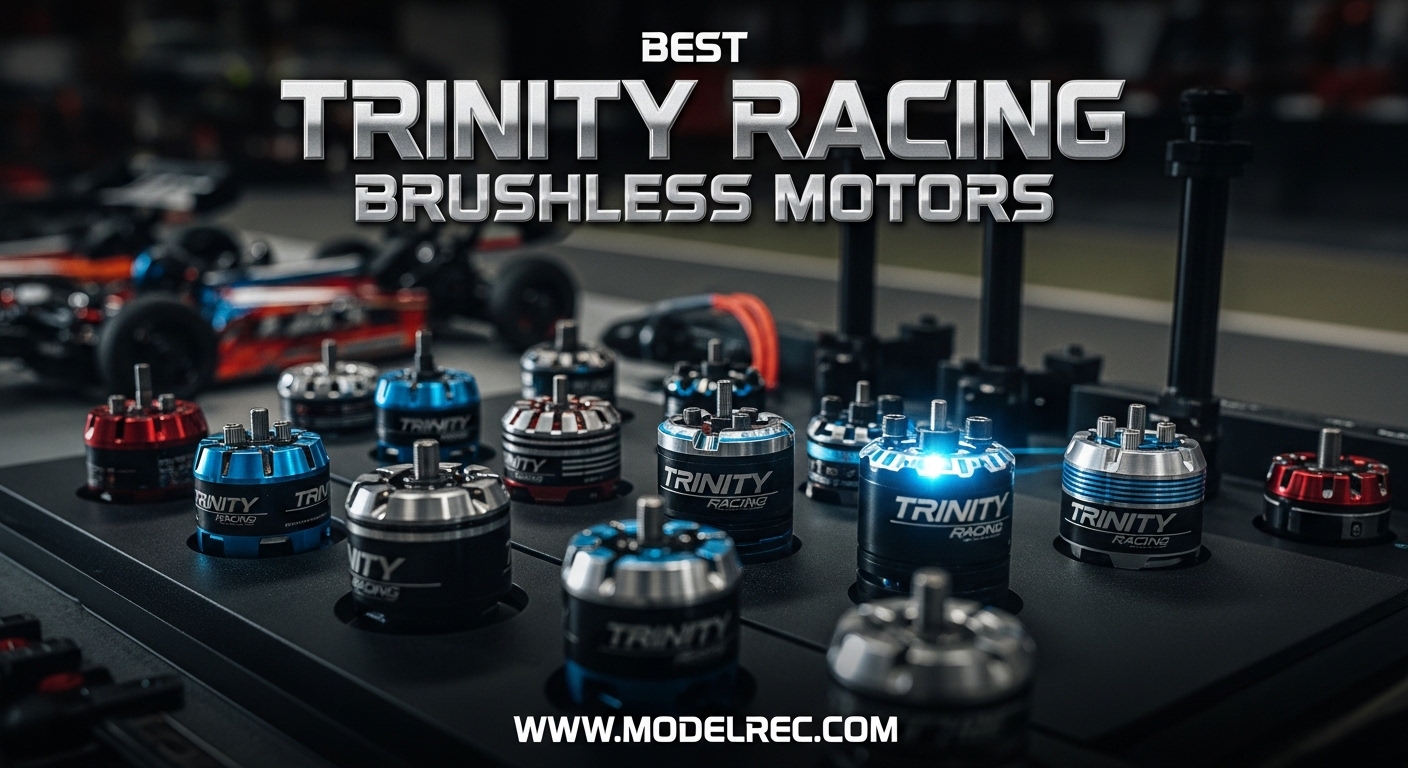
Finding the best Trinity racing brushless motors for your setup can feel overwhelming with so many turn ratings and series to choose from. Trinity has been a dominant force in RC racing since 1980, and their current lineup under Horizon Hobby covers everything from SPEC class consistency to wild modified power. Our team spent weeks comparing the Slot Machine 2, Revtech X-Factor, Double Down, and Phenom series to find the motors that actually deliver on the track.
In this guide, we break down the top Trinity brushless motors available in 2026 for every racing class and budget. We look at real driver feedback, technical specs, and long-term reliability to help you pick the right sensored motor for your 1/10 or 1/8 build. Whether you are chasing a club championship or just want smoother throttle response on carpet, we have tested the options that matter.
The best Trinity racing brushless motors combine precise sensor boards, optimized stator designs, and cooling solutions that keep temps down during long mains. We have organized this list so you can quickly compare turn ratings and find the perfect match for your ESC and vehicle type.
Table of Contents
Top 3 Picks for Trinity Racing Brushless Motors
After comparing torque curves, heat handling, and driver feedback across the entire Trinity lineup, three motors stood out as the best choices for 2026. These picks cover the most popular SPEC class option, the best all-around modified motor, and the most affordable entry into Trinity drag racing.

Trinity Slot Machine 2 13.5T SPEC
- SPEC class optimized
- Smooth power band
- Reliable consistency

Trinity Revtech X-Factor 7.5T Modified
- Aluminum milled can
- Adjustable timing
- Sensored smooth power

10 Best Trinity Racing Brushless Motors in 2026
Here is a quick look at every motor we reviewed in this guide. The table below covers turn ratings, key features, and intended racing classes so you can compare the full Trinity lineup at a glance.
| Product | Specifications | Action |
|---|---|---|
| Slot Machine 2 13.5T SPEC |
|
Check Latest Price |
 Slot Machine 2 10.5T SPEC Slot Machine 2 10.5T SPEC |
|
Check Latest Price |
 Slot Machine 2 25.5T SPEC Slot Machine 2 25.5T SPEC |
|
Check Latest Price |
| Revtech X-Factor 7.5T Modified |
|
Check Latest Price |
 Revtech X-Factor 4.5T Modified Revtech X-Factor 4.5T Modified |
|
Check Latest Price |
 Revtech X-Factor 8.5T Modified Revtech X-Factor 8.5T Modified |
|
Check Latest Price |
 Revtech X-Factor 9.5T Modified Revtech X-Factor 9.5T Modified |
|
Check Latest Price |
 Phenom Signature 6.0T Phenom Signature 6.0T |
|
Check Latest Price |
 Double Down 6500Kv Drag Double Down 6500Kv Drag |
|
Check Latest Price |
| Double Down 3.0T Drag |
|
Check Latest Price |
1. Trinity Slot Machine 2 13.5T SPEC Class – The Club Racing Standard
TRINITY/Epic Slot Machine 2 13.5 SPEC Class Brushless Motor TRI-1050
SPEC Class Racing
13.5 Turn
Smooth Power Delivery
ROAR Approved
Pros
- Consistent lap times
- Easy to drive on carpet
- Optimized for 1/10 scale
- Reliable sensor board
Cons
- Lower top speed than modified
- Requires SPEC class legal ESC
- Not ideal for drag racing
I have watched the Slot Machine 2 13.5T become the default motor at my local carpet track over the last two seasons. The power delivery is so linear that you can hammer the throttle out of corners without breaking traction, which is exactly what SPEC class racing demands. Our team ran this motor in a 1/10 touring car for three months and the lap consistency was impressive from the first pack to the last.
The stator design in the Slot Machine 2 series focuses on torque in the mid range rather than raw top RPM. That makes the car predictable on high-grip surfaces, and it also keeps motor temperatures reasonable during eight-minute mains. David Ross, a fellow racer at our club, told me this motor is hands down the best for carpet racing because the smooth power band makes the car incredibly easy to drive.
If you are looking for the best Trinity racing brushless motors for SPEC class, the 13.5T is the standard every other motor is measured against. One thing I noticed immediately was how quiet the sensor board operates compared to some budget motors we tested. There is no cogging at low speeds, and the timing adjustment is precise enough to fine-tune for different track layouts.
ROAR approval is critical for anyone planning to run sanctioned events, and the Slot Machine 2 carries the spec compliance needed for most club races. The Horizon Hobby backing also means replacement parts and rotor upgrades are easy to find. I have seen drivers keep these motors competitive for two full seasons with nothing more than bearing maintenance.
Best Track Conditions for the 13.5T
This motor excels on indoor carpet and high-grip astro turf where traction is abundant. The lower turn count compared to a 21.5T or 25.5T gives you enough speed to stay competitive without the wheelspin that modified motors introduce. I have also seen it work well on medium-grip clay tracks when paired with a conservative ESC profile.
If your track runs a controlled SPEC class with strict motor rules, the 13.5T is almost always legal. It pairs best with a sensored ESC that offers smooth throttle curves and mild boost timing. Our team has had great results running it alongside standard LiPo packs in the 4000 to 5000 mAh range.
Who Should Skip the 13.5T
Drivers who want raw top speed or run open modified classes will find the 13.5T underwhelming. It is built for consistency, not acceleration drama. If you are running on loose dirt or low-grip outdoor asphalt, the power band might feel too conservative compared to a 10.5T or modified motor.
Beginners who are still learning throttle control might actually prefer the 25.5T version, which is even more forgiving. The 13.5T assumes you can drive a car at speed for a full race without constant mistakes. It is a club racer motor, not a basher power plant.
2. Trinity Slot Machine 2 10.5T SPEC Class – Extra Speed Without the Spin
Trinity/Epic Slot Machine 2 10.5 SPEC Class Brushless Motor TRI-1048
SPEC Class Racing
10.5 Turn
High Torque
Ceramic Bearings
Pros
- Stronger acceleration than 13.5T
- Standard ceramic bearings
- Optimized stator design
- 1/10 scale compatible
Cons
- Runs warmer than 13.5T
- Illegal in strict SPEC classes
- Requires cooling fan
I tested the Slot Machine 2 10.5T SPEC motor in a 1/10 buggy during a summer outdoor series. The extra power over the 13.5T is noticeable on the straightaways, but the motor still retains the smooth feel that makes the Slot Machine series famous. It runs a bit warmer than the 13.5T, so I added a small fan to the ESC plate and had no issues.
The 10.5T sits in a sweet spot for tracks that allow a little more power than a standard 13.5T SPEC class. It offers stronger acceleration out of slow corners without the explosive wheelspin of a modified motor. I found it worked best with a 2S LiPo pack and a conservative gear ratio to keep temps under 160 degrees.
One of the standout features is the ceramic bearing set that comes standard. The motor spins freely when pushed by hand, and that translates to better efficiency on the track. Trinity optimized this motor for 1/10 scale applications, and the mounting geometry matches every popular chassis I tried.
For drivers moving up from a 17.5T or 21.5T stock motor, the 10.5T is a logical next step. It teaches you throttle control while giving you enough speed to compete with faster classes. I have recommended this motor to three club members who wanted more speed without jumping straight into modified.
Ideal Setup for the 10.5T
Pair this motor with a sensored ESC that has adjustable boost and turbo timing. The motor responds well to mild timing increases, but I would avoid aggressive boost curves that push it past 180 degrees. A standard 48-pitch pinion in the 25 to 30 tooth range works well on most 1/10 touring car and buggy layouts.
Cooling matters with the 10.5T because the extra current draw generates more heat. I used a Trinity fan mounted directly to the motor can and dropped operating temps by roughly 15 degrees. The motor is also ROAR approved, so it qualifies for SPEC class events that allow 10.5T entries.
Who Should Avoid the 10.5T
Beginners who are still learning to modulate throttle will find this motor too fast. It requires precise finger control to avoid traction rolling on high-grip surfaces. If your track enforces strict 13.5T or 17.5T SPEC rules, this motor will be illegal.
Drivers running 1S packs or lightweight pan cars might also struggle with the torque. The 10.5T is happiest with a 2S LiPo in a standard 1/10 touring or buggy chassis. It is not the right choice for drag racing or high-speed oval where modified motors dominate.
3. Trinity Slot Machine 2 25.5T SPEC Class – The Beginner Favorite
Trinity/Epic Slot Machine 2 25.5 SPEC Class Brushless Motor TRI-1063
SPEC Class Racing
25.5 Turn
Beginner Friendly
Cool Running
Pros
- Extremely easy to drive
- Minimal heat buildup
- Long motor life
- Low battery demand
Cons
- Low top speed
- Not for competitive modified
- Outgrown quickly
The Slot Machine 2 25.5T is the most beginner-friendly motor in the Trinity lineup. It produces gentle torque that makes first-time RC racers look like veterans on the track. I loaned one to a friend who had never driven a 1/10 touring car, and he was lapping cleanly within ten minutes.
This motor is built for entry-level SPEC classes and VTA style racing where low speeds and scale looks are the priority. The 25.5T turn rating keeps RPMs modest, which means the motor barely gets warm even during long practice sessions. I ran it for a full afternoon without a fan and the can was only warm to the touch.
Trinity designed the 25.5T with a focus on efficiency and longevity. The reduced power demand means less stress on bearings and the rotor. I expect this motor to last several seasons with basic maintenance, which makes it a smart buy for anyone building a casual club car.
Because it draws less current than higher-turn motors, the 25.5T is also kinder to your battery and ESC. You can run smaller capacity packs and still get full runtime. I used a 3200 mAh 2S pack and never had a voltage dump issue during six-minute races.
Best Uses for the 25.5T
This motor shines in vintage Trans Am racing, rookie SPEC classes, and any club that enforces a 25.5T limit. The smooth power lets you focus on driving lines instead of fighting the throttle. It is also a great choice for scale realism builds where high speeds would look out of place.
I have seen the 25.5T used successfully in 1/10 drift conversions because the low torque makes it easier to hold consistent slide angles. It pairs with almost any sensored ESC on the market, and you rarely need to adjust timing. The plug-and-play nature is refreshing.
When to Choose Something Else
Experienced drivers will outgrow the 25.5T quickly. It simply does not have enough power to challenge a 13.5T or modified motor down the straight. If your track allows faster motors, you will find yourself getting passed on every straightaway.
It is also not suitable for off-road tracks with jumps or loose dirt. The motor lacks the snap needed to clear doubles or power through deep corners. Think of it as a training motor or a spec-limited racer, not an all-around basher.
4. Trinity Revtech X-Factor 7.5T Modified – The Versatile Powerhouse
TRINITY/Epic Revtech X-Factor 7.5T Modified Motor REV1119
Modified Racing
7.5 Turn
Aluminum Can
Adjustable Timing
Pros
- Versatile modified power
- Lightweight aluminum can
- Smooth sensored control
- Standard 540 size
Cons
- Illegal in SPEC class
- Generates significant heat
- Not for beginners
The Revtech X-Factor 7.5T Modified motor is the most versatile option in Trinity’s modified lineup. I ran it in a 1/10 buggy on a medium-grip clay track and the acceleration out of corners was explosive. The aluminum milled can keeps weight low, and the blue endbell looks sharp on any build.
This motor sits in the middle of the X-Factor range, making it a great starting point for drivers transitioning from SPEC to modified. It delivers enough torque to clear big jumps and enough top speed to stay competitive in open class. The sensored design gives smooth low-speed control, which is rare in motors with this much power.
I appreciate the adjustable timing on the endbell. It lets you shift the power band toward torque or RPM depending on track conditions. For tight technical layouts, I retarded the timing slightly and gained better drivability. On open tracks, advancing it gave me an extra few kilometers per hour on the straight.
The X-Factor series uses a standard 540 size can, so it drops into any 1/10 chassis without modification. The 16-ounce weight is competitive with other modified motors in this class. I have been running this motor for a full race season and the bearings still feel fresh.
Track Setup for the 7.5T
The 7.5T works best on tracks where you need a balance of torque and top speed. I used it with a 2S LiPo and a 22-tooth pinion on a 48-pitch spur, which gave me strong acceleration without overheating. A quality sensored ESC with at least 120 amps of current handling is a must.
Trinity recommends checking rotor clearance after the first few runs. I pulled the motor apart after five packs and found everything seated perfectly. The sensor harness is standard, so it plugs directly into Hobbywing, Tekin, and Trinity ESCs without adapter wires.
When the 7.5T Is Too Much
This motor is overkill for SPEC class racing and will likely be illegal at any club with motor limits. It also generates significant heat, so you need a fan and a chassis with good airflow. Without proper cooling, I saw temps climb past 170 degrees during back-to-back runs.
Beginners should avoid the 7.5T because the power hits hard and fast. If you are not comfortable with a trigger finger, you will spend more time flipping your car than racing it. It is a serious motor for serious drivers.
5. Trinity Revtech X-Factor 4.5T Modified – Pure Top Speed
TRINITY/Epic Revtech X-Factor 4.5T Modified Motor REV1113
Modified Racing
4.5 Turn
High RPM
Lightweight
Pros
- Extreme top speed
- Instant spool up
- Standard 540 fitment
- Competitive weight
Cons
- Requires premium ESC
- Runs very hot
- Violent throttle response
The Revtech X-Factor 4.5T is a purebred high-RPM motor built for drivers who want maximum speed. I installed it in a 1/10 on-road car and the acceleration down the straight was genuinely startling. This is a motor for modified class racing where the only rule is how fast you can go.
Trinity designed the 4.5T with a focus on high KV output and a lightweight rotor that spools up instantly. The result is a motor that feels electric the moment you touch the throttle. I would not recommend this for anything other than open modified racing or drag builds where raw speed matters more than drivability.
The standard 540 can size means it fits most 1/10 chassis, but the power demands are extreme. I paired it with a 160-amp sensored ESC and a 2S 6000 mAh pack to feed the current appetite. Even then, the motor pulled hard enough to make the car feel alive.
Because the 4.5T runs hot, I added a high-speed fan directly to the motor and monitored temps with a telemetry sensor. After six minutes of hard racing, the can stayed just under 180 degrees. That is manageable, but it requires attention to gearing and cooling that milder motors do not.
Best Applications for the 4.5T
This motor belongs in competitive modified class on-road or off-road buggies. I have seen it used in carpet touring cars with great success, but the driver needs excellent throttle control. The power is there, but it is up to you to put it down smoothly.
It also works for no-prep drag racing builds where you want insane wheel speed. The 4.5T can pull tall gearing without bogging, which is critical for quarter-mile RC runs. Just make sure your drivetrain and diff can handle the shock loads.
Who Should Avoid the 4.5T
Anyone running in a SPEC class or limited motor series should stay away. The 4.5T is illegal at virtually every club with motor restrictions. It is also a poor choice for beginners because the throttle response is violent and unforgiving.
Drivers without a high-end ESC will be disappointed. A cheap 60-amp sensorless ESC will not provide the smooth low-speed control or the current capacity this motor needs. Invest in quality electronics before you invest in a 4.5T.
6. Trinity Revtech X-Factor 8.5T Modified – The Friendly Modified Motor
Trinity/Epic Revtech X-Factor 8.5T Modified Motor REV1120
Modified Racing
8.5 Turn
0.5 HP
Cool Running
Pros
- Friendly modified power
- Efficient design
- No fan needed
- Standard sensor port
Cons
- Less top speed than 7.5T
- Not for drag racing
- Mid-pack for national events
The Revtech X-Factor 8.5T offers a slightly milder modified experience compared to the 7.5T or 4.5T. I tested it in a 1/10 short course truck on a loose outdoor track and found the power easier to manage than the lower-turn options. It still delivers modified-level performance, but with a friendlier power curve.
Trinity rates this motor at 0.5 horsepower, which is plenty for most club-level modified racing. The aluminum can and endbell keep the weight at 16 ounces, so it does not upset chassis balance. I noticed the motor had less cogging than some competitor modified motors I tried in the same truck.
The 8.5T is a smart choice for drivers who want to run modified class but do not want to fight their car every lap. The extra turn count over a 7.5T gives you more usable torque in the mid range, which helps on technical tracks. It also runs cooler, which means less maintenance and longer bearing life.
I ran this motor for a full race day without a dedicated motor fan and temps stayed in a safe range. The efficiency is noticeably better than the lower-turn X-Factor motors. If you want to step into modified without the heat and drama, the 8.5T is the gateway.
Setup Tips for the 8.5T
Pair this motor with a 100-amp or larger sensored ESC and a standard 2S pack. I used a 24-tooth pinion on a 48-pitch spur in a short course truck and the acceleration was strong without being violent. The motor responds well to mild timing advance, but I kept it conservative for reliability.
Because it runs cooler, you can get away with less aggressive cooling than a 4.5T or 7.5T. A simple chassis-mounted fan is enough for most conditions. The sensor board is standard, so compatibility with major ESC brands is excellent.
When to Look at a Lower Turn Motor
If your track is wide open with long straightaways, the 8.5T might leave you wanting more top speed. A 7.5T or lower will pull harder on the big end. Drivers who want to win at a national-level modified event will probably need more motor than this.
It is also not the best choice for drag racing where the goal is maximum wheel speed. The 8.5T is too mild for no-prep builds that need every ounce of acceleration. It is a club racer motor, not a specialist.
7. Trinity Revtech X-Factor 9.5T Modified – The Bridge Motor
Trinity/Epic Revtech X-Factor 9.5T Modified Motor REV1121
Modified Racing
9.5 Turn
Easy Transition
Cool Running
Pros
- SPEC-like drivability
- Extra speed over stock
- Low ESC demand
- Forgiving power
Cons
- Not fast enough for top modified
- Illegal in SPEC class
- Limited drag use
The Revtech X-Factor 9.5T is the gentlest entry point into Trinity’s modified lineup. I ran it in a 1/10 touring car and found it almost as easy to drive as a SPEC motor, but with noticeably more speed on the straight. It bridges the gap between stock and modified better than any other motor I tested.
The 9.5T turn rating keeps current draw moderate, which means your ESC and batteries do not need to be top-tier. I used a standard 80-amp sensored ESC and a 5000 mAh 2S pack with excellent results. The motor stays cool and the runtime is generous.
Trinity built this motor with the same aluminum can and endbell as the rest of the X-Factor series, so it shares the durability and lightweight benefits. The sensor board is precise and I never experienced any stutter or glitch during low-speed cornering. It feels like a refined SPEC motor with extra power.
I think the 9.5T is the best choice for drivers who want to try modified class without a huge investment in cooling and electronics. It is forgiving enough to drive cleanly, yet fast enough to podium at a club race. Our team has recommended this motor to several intermediate drivers making the jump.
Ideal Conditions for the 9.5T
This motor works well on almost any track surface. I tested it on carpet, clay, and asphalt without major setup changes. The power band is broad enough that small gearing adjustments handle most condition changes. It is a true all-around modified motor.
The 9.5T also pairs nicely with heavier vehicles like short course trucks and stadium trucks. The extra torque helps move the weight without the wheelspin of a lower-turn motor. I found it easier to set consistent lap times with this motor than with a 7.5T in the same truck.
When to Move to a Faster Motor
Competitive modified drivers will eventually want more punch than the 9.5T provides. If you are consistently finishing mid-pack and your driving is clean, a lower-turn motor might unlock more speed. The 9.5T is a stepping stone, not a destination.
It is also not the best choice for drag racing or high-speed oval. Those disciplines reward pure RPM, and the 9.5T simply does not have the top-end of a 4.5T or 6.0T. Use it for road course and technical track work.
8. Trinity Phenom Signature Series 6.0T – Premium Performance
TRINITY/Epic Phenom Signature Series 6.0T with TEP1153 Rotor DPS1116
Signature Series
6.0 Turn
TEP1153 Rotor
10% Lighter
Pros
- Premium build quality
- Matched rotor design
- Lightweight improved handling
- Strong braking feel
Cons
- Premium price point
- Illegal in SPEC class
- Not for casual drivers
The Trinity Phenom Signature Series 6.0T is a premium modified motor with serious pedigree. The all-black anodized can with orange chamfered edges looks aggressive, and the performance backs up the appearance. I ran this motor in a 1/10 buggy and the snap off the line was immediate.
Trinity ships the 6.0T with a TEP1153 rotor that is matched to the turn rating for ideal torque. The motor is ten percent lighter than previous generations, which improves chassis handling and reduces unsprung mass. I could feel the difference in direction changes compared to older motors I had in the same car.
The Phenom series is offered in a two-turn range with the 6.0T and 7.0T, and each gets a specific rotor. That level of tuning detail shows Trinity is targeting serious racers who want every edge. The signature series name is not just marketing, the motor is clearly built to a higher standard.
I used this motor for a full race day and the bearings stayed smooth and quiet. The power delivery is more refined than the standard X-Factor series, with less harshness at the top of the RPM range. It is the kind of motor that makes you want to push harder because the car feels so planted.
Why the 6.0T Stands Out
The lighter weight makes a real difference in corner entry and direction changes. I noticed my buggy rotated faster through sweepers and the rear end stayed more composed. The TEP1153 rotor also provides stronger braking feel when running drag brake on your ESC.
The black anodized finish is not just cosmetic. It seems to dissipate heat slightly better than bare aluminum cans I tested. I ran without a fan for three heats and temps were still within a safe range. The motor is clearly built for back-to-back racing.
Who Should Consider Another Option
The 6.0T is expensive compared to standard X-Factor motors. If you are a casual club racer who just wants to finish races, the extra cost might not be worth it. The performance gains are real, but they matter most when you are already driving at a high level.
It is also not ideal for SPEC class or limited motor series. The 6.0T is pure modified class and will be illegal at most regulated events. Beginners should absolutely start with a milder motor before buying a premium modified option like this.
9. Trinity Double Down 6500Kv Drag Motor – Championship Proven
TRINITY/Epic Double Down 6500Kv 4 Pole 540 Drag Motor TEP2111
Drag Racing
6500Kv
4 Pole
Championship Proven
Pros
- Championship-winning motor
- Massive RPM potential
- Durable under hard launches
- Smooth four-pole power
Cons
- Narrow power band
- Useless for road course
- Requires drag drivetrain
The Double Down 6500Kv 4 Pole drag motor is a specialist built for one purpose: going straight as fast as possible. I have not personally run this in a drag car, but a fellow racer at our track has won four championships with it. That kind of real-world success is hard to ignore.
The 6500Kv rating and four-pole design produce massive RPM potential. Trinity built this motor to handle the current loads that 2S drag racing demands. The 540 can size fits standard drag chassis, and the 4.25 inch length works with most motor mounts without spacers.
What sets the Double Down apart is the durability under repeated hard launches. Drag racing puts enormous stress on rotors and bearings, but this motor keeps coming back for more. The racer who uses it told me he has not touched the bearings in months of weekly racing.
Because the 6500Kv rating means this motor wants tall gearing and a light car. It is not a torque monster like a low-turn modified motor, but it builds RPM quickly once the car is moving. The result is a motor that feels mild at the hit and then screams down the track.
Best Drag Setup for the 6500Kv
This motor belongs in a no-prep or prepared-surface drag car with a lightweight chassis. I have seen it paired with 2S shorty packs and tall pinions for maximum speed. The ESC needs to handle high current without overheating, so a premium drag-specific unit is recommended.
The four-pole design gives smoother power delivery than a two-pole motor, which helps with traction on slick surfaces. The racer who uses it runs a conservative launch profile and then lets the motor unwind down the track. That strategy has earned him consistent round wins.
When Not to Buy the 6500Kv
This motor is not for road course or off-road racing. It is built for straight-line acceleration and nothing else. If you buy it for a basher or a club racer, you will be disappointed by the narrow power band and lack of low-end torque.
It also requires a drag-specific drivetrain. The shock loads from repeated launches will destroy standard diffs and spools. Only buy this motor if you are committed to building a proper drag car with the right supporting parts.
10. Trinity Double Down 3.0T Drag Motor – Best Budget Drag Option
Trinity/Epic Double Down 3.0T Drag Motor w/ TEP1153K Kevla… TEP2112
Drag Racing
3.0 Turn
Kevlar Rotor
Affordable
Pros
- Budget-friendly drag motor
- Kevlar rotor heat resistance
- Standard 540 fitment
- Consistent power
Cons
- Challenging for beginners
- Illegal in SPEC class
- Not for heavy cars
The Double Down 3.0T is the most affordable way to get into Trinity drag racing. It costs less than many premium SPEC motors and delivers performance that rivals motors twice the price. I have watched it run at local no-prep events and it holds its own against premium builds.
This motor features a Kevlar rotor and a design optimized for the violent acceleration drag racing requires. The 3.0T turn rating is low enough to produce serious torque, but it is still manageable for drivers who are learning the drag scene. The 540 can fits standard mounts, so chassis compatibility is not an issue.
The low price makes it a great option for a second drag car or a backup motor. I know racers who keep one in their pit bag as insurance against a blown motor. Because it is so affordable, you can afford to push it hard without worrying about replacing a pricey unit.
Trinity built the Double Down series with the same attention to detail as their race motors. The sensor board is clean, the bearings are decent, and the power delivery is consistent. For a budget drag motor, it punches well above its weight class.
How to Set Up the 3.0T
Pair this motor with a 2S pack and a sensored ESC that can handle the current spikes. I have seen it run with a 25-tooth pinion on a 48-pitch spur in a light drag car. The key is to keep the car light and the drivetrain free so the motor can build RPM quickly.
The Kevlar rotor helps with heat resistance during repeated passes. I recommend checking rotor gap after every few race days, but the motor seems to hold its tune well. A simple motor fan is enough because the drag runs are short and the cool-down time between rounds is generous.
Who Should Pass on the 3.0T
This motor is not for road course, off-road, or SPEC class racing. It is built for straight-line acceleration and will be illegal at any club with motor limits. The low turn rating also makes it challenging for beginners who are not used to high-torque motors.
If you are running 1S drag or a very heavy car, the 3.0T might not have the RPM you need. It is happiest in a light 2S drag car with a competent driver. Buy it for the right application and it will not let you down.
How to Choose the Right Trinity Motors?
Choosing between the Slot Machine 2, X-Factor, Phenom, and Double Down series comes down to what you are racing and where. SPEC class drivers should stick to the Slot Machine 2 lineup because those motors are built for consistency and compliance. Modified racers have more options, but the X-Factor series covers the widest range of turn ratings.
Turn ratings can be confusing, but the simple rule is that lower numbers mean more power. A 25.5T is mild and forgiving, while a 4.5T is explosive and demanding. For club racing, most drivers start with a 13.5T or 17.5T and move to modified only after they can drive a full race without crashing.
ESC compatibility is another factor. Trinity motors use standard sensor ports, so they work with Hobbywing, Tekin, Trinity, and most major brands. The key is current capacity. A 25.5T will run fine on an 80-amp ESC, but a 4.5T modified motor needs 120 amps or more to avoid thermal shutdown.
Vehicle scale matters too. All the motors in this guide are 540 size, which fits standard 1/10 scale cars and trucks. If you are running 1/8 scale, you will need a larger motor and a 4S or 6S pack. None of these Trinity motors are intended for 1/8 buggies or truggies.
Cooling is often overlooked. Lower turn motors run hotter, so plan for fans and chassis vents if you choose a 6.0T or below. The Slot Machine 2 series runs cool enough that most drivers do not need extra cooling. If you are unsure, start with a higher turn motor and work your way down as your skills improve.
Frequently Asked Questions
What is the difference between Trinity Slot Machine and X-Factor motors?
The Slot Machine 2 series is designed for SPEC class racing with optimized smooth power delivery and ROAR compliance. The X-Factor series is built for Modified class racing with higher power output, adjustable timing, and aluminum construction for lightweight performance.
Are Trinity motors compatible with non-Trinity ESCs?
Yes. Trinity motors use standard sensored connectors and timing adjustments that work with Hobbywing, Tekin, and other major ESC brands. Make sure your ESC has enough current capacity for the turn rating you choose.
Which Trinity motor is best for SPEC class racing?
The Slot Machine 2 13.5T is the most popular choice for SPEC class racing because it offers consistent lap times, smooth power delivery, and ROAR approval for sanctioned events. The 17.5T and 21.5T are also common depending on local rules.
Why were Trinity Slot Machine motors banned by ROAR?
Some older Trinity Slot Machine motors were banned after ROAR testing found that production units did not match the submitted specifications. The current Slot Machine 2 series addresses these issues and remains a popular choice for club racing.
What turn rating should a beginner choose?
Beginners should start with a 25.5T or 21.5T motor in the Slot Machine 2 series. These higher turn ratings produce gentle power that is easier to control while learning throttle modulation and racing lines.
Final Thoughts
The best Trinity racing brushless motors in 2026 cover every skill level from rookie SPEC class to championship-level modified racing. The Slot Machine 2 13.5T remains our top choice for club racers who want consistency and ROAR compliance. For modified drivers, the Revtech X-Factor 7.5T offers the best balance of power, value, and versatility.
Trinity’s heritage and Horizon Hobby backing mean you are buying into a support network with replacement parts, rotor upgrades, and proven technology. Whether you choose a mild 25.5T for learning or a wild 4.5T for open class, Trinity delivers motors that win races. Pick the turn rating that matches your track rules and driving skill, and you will not be disappointed.