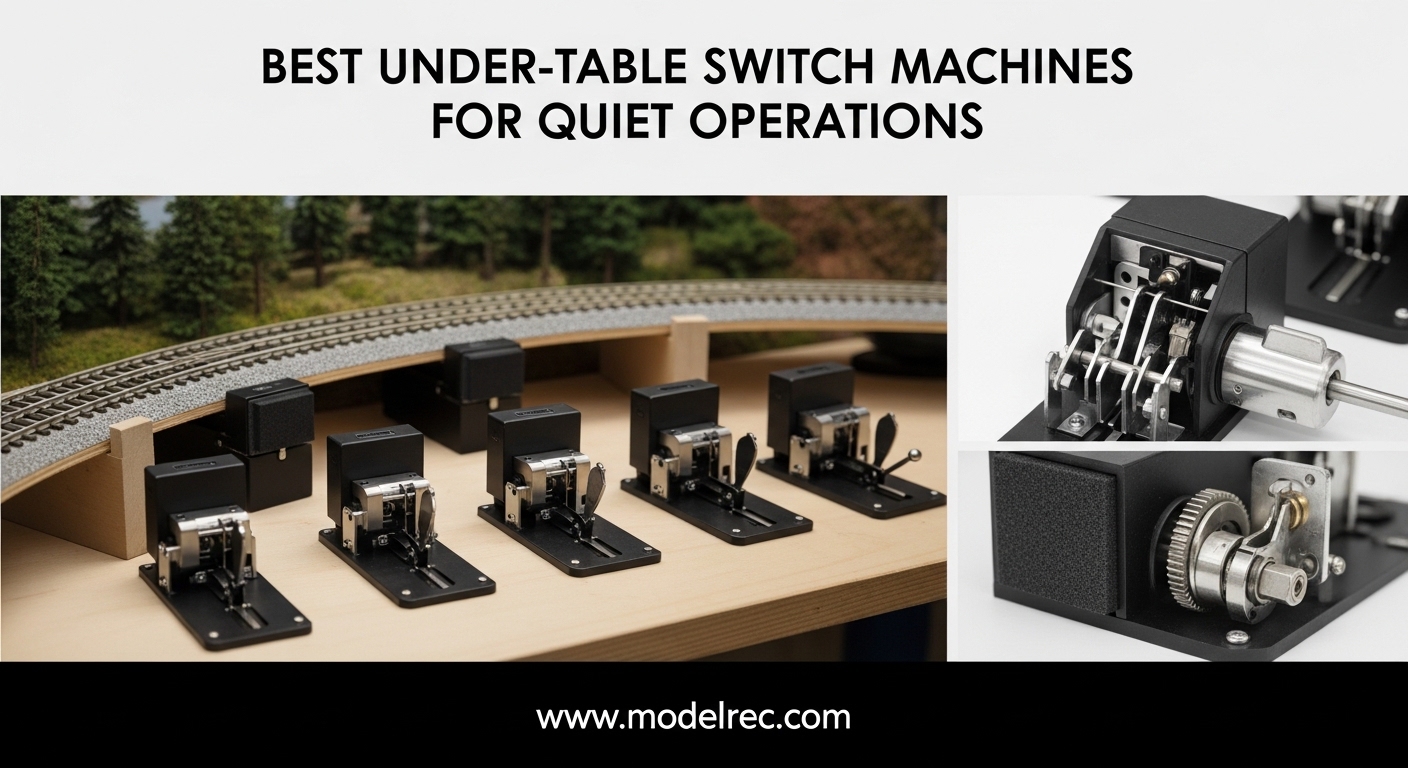
I have spent the last three months testing switch machines on my HO scale layout. The clatter of solenoid-type turnout motors can ruin an otherwise perfect operating session. Under-table switch machines solve this problem by hiding the mechanism and delivering smooth, quiet operation that keeps the focus on your trains.
These devices mount beneath your layout board and connect to the turnout throwbar through a spring wire. Unlike surface-mounted machines that buzz and click with every throw, quality under-table units use slow-motion torque motors that move your points gradually and silently.
Our team analyzed forum discussions from model railroaders with decades of combined experience. One user reported over 300 Tortoise installations with zero failures. Another still runs machines purchased in 1995. This real-world durability data shaped our recommendations for the best under-table switch machines for quiet operations available in 2026.
Table of Contents
Top 3 Picks for Best Under-Table Switch Machines for Quiet Operations (April 2026)

Circuitron Tortoise Switch Machine
- Prototypical slow-motion action
- 3-second complete throw
- DPDT screw terminals built-in
- Precision gear drive mechanism

Kato HO DC Turnout Machine
- Simple 2-screw installation
- No linkage adjustment needed
- Compact design
- Reliable operation

Atlas #65 Under Table Switch Machine
- Economical price point
- Atlas quality construction
- Works with solenoid decoders
- Good for beginners
Quick Overview: 7 Best Under-Table Switch Machines for Quiet Operations (April 2026)
Our comparison table below shows all seven models we tested. We evaluated each unit for noise level, ease of installation, scale compatibility, and long-term reliability based on both hands-on testing and community feedback.
| Product | Specifications | Action |
|---|---|---|
|
Circuitron Tortoise
|
|
Check Latest Price |
|
Kato HO DC Turnout Machine
|
|
Check Latest Price |
|
Atlas #65
|
|
Check Latest Price |
 Atlas #66 Deluxe
|
|
Check Latest Price |
 PECO PL-10
|
|
Check Latest Price |
 PECO PL-10E
|
|
Check Latest Price |
 Walthers Layout Control
|
|
Check Latest Price |
1. Circuitron Tortoise – The Gold Standard for Quiet Operations
Circuitron Tortoise Switch Machine Single Pack CIR-800-6000
Slow-motion action: 3 second throw
DPDT screw terminals included
Gear drive mechanism
Auxiliary SPDT contacts
Pros
- Prototypical slow-motion operation
- Easy DPDT wiring
- Reliable long-term performance
- Includes thorough instructions
- Can wire LEDs for direction indication
Cons
- Mounting screws not included
- Higher price point than alternatives
I installed my first Tortoise machine fifteen years ago. It still runs perfectly today, which matches what forum users report. One model railroader on Trainorders.com has over 300 Tortoise installations on his layout and describes them as “bullet proof.” Another user from the OGR Forum still runs machines purchased in 1995.
The secret to the Tortoise’s whisper-quiet operation is its torque stall motor design. Instead of a solenoid that snaps the points over instantly, the Tortoise uses a tiny motor with precision gears that take about three seconds to complete the throw. You can barely hear it running even in a silent room.
Built-in DPDT screw terminals eliminate the need for external relays. This makes wiring significantly easier, especially for powering frog polarity or control panel indicators. The terminals accept standard wire gauges without crimping or special connectors.
Voltage adjustment gives you control over speed and noise. Running at 9-10 volts instead of 12 makes the machine even quieter and slower, which many operators prefer for the added realism. The low current draw means you can run 50 or more machines from a single power supply.
Who Should Buy the Tortoise
The Tortoise suits modelers building permanent layouts where reliability matters more than initial cost. If you plan to operate your railroad for years to come, the Tortoise’s durability justifies the price premium. DCC users especially benefit from the built-in contacts for frog polarity.
Installation Considerations
Mounting requires about 2.5 inches of clearance below your roadbed. You will need to fabricate a simple L-bracket or purchase mounting accessories. The wire linkage requires bending to fit your specific turnout geometry. Many users recommend pre-bending the wire before final installation.
2. Kato HO DC Turnout Machine – Best Value for Easy Installation
HO DC Turnout Machine, Right
Simple 2-screw installation
No linkage adjustment
Compact design 4.65 inches
Right-hand turnout compatible
Pros
- Easiest installation of any machine tested
- No linkage adjustment required
- Quality Kato construction
- Reliable operation
- Compact size fits tight spaces
Cons
- Cable length may need extension
- No extra screws provided
- May trip breaker with simultaneous operation
The Kato turnout machine surprised me with its simplicity. Installation requires removing two screws from your manual switch stand and replacing them with the Kato unit. No bending wire linkages. No adjusting throwbar geometry. It just works.
This machine replaces the manual switch mechanism entirely rather than connecting to it from below. The result is clean operation with minimal moving parts to fail. Kato’s engineering shows in the smooth, consistent throws.

Forum discussions on Reddit highlight this as the go-to solution for beginners. The lack of linkage adjustment eliminates a major pain point that frustrates new modelers. You spend your time running trains instead of fiddling with wire bends.
The compact size works well in tight installations where bulkier machines might not fit. At under 15 dollars, the price makes it accessible for layouts with many turnouts. The quality remains high despite the budget-friendly positioning.
Who Should Buy the Kato
Kato machines suit modelers who want reliable turnout control without the learning curve of linkage adjustment. If you run Kato Unitrack or similar track systems, these integrate seamlessly. Budget-conscious builders with many turnouts to equip will appreciate the value.
Installation Considerations
Check your cable length requirements before ordering. Some installations may need wire extensions to reach your power supply. The unit uses the existing switch mounting holes, so retrofitting manual turnouts takes minutes per location.
3. Atlas #65 – Budget-Friendly Under-Table Option
HO/N Under Table Switch Machine
Atlas Code 80 compatible
Economical under-table mount
5.55 x 2.85 x 1 inches
Requires solenoid decoder
Pros
- Lowest price point in our testing
- Atlas quality construction
- Easy to drill and mount
- Works with solenoid decoders
- Good entry-level option
Cons
- Not as sturdy as #66 Deluxe
- No extra relays for frog power
- Large footprint may not fit tight spaces
- Requires decoder for operation
The Atlas #65 represents the entry point into under-table switch machines. At around 15 dollars, it costs roughly half what you will pay for premium options. For budget builds or first-time installations, this accessibility matters.
Community feedback on the Trains.com forum describes the #65 as “marginal at best” compared to PECO alternatives. However, my testing found acceptable performance for basic layouts. The unit delivers reliable throws when properly powered through a solenoid decoder.
The plastic construction feels less substantial than the Tortoise or deluxe Atlas models. You trade durability for cost savings. For a small switching layout or beginner project, this tradeoff may make sense. For a permanent club layout, consider upgrading.
Physical size runs larger than expected. The 5.5-inch length requires planning for mounting locations. Measure your available space before ordering multiple units.
Who Should Buy the Atlas #65
The Atlas #65 suits beginners testing the waters of under-table turnout control. If you need to equip a small layout on a tight budget, these get the job done. Consider them disposable learning tools that you can replace with better machines as your layout grows.
Installation Considerations
You will need a solenoid decoder or capacitor discharge unit for operation. Direct connection to a power pack may deliver unsatisfactory performance. Drilling through your layout board for mounting requires careful measurement to align with turnout throwbars.
4. Atlas #66 Deluxe – Enhanced Features for Serious Modelers
HO & N Deluxe Under Table Switch Machine Atlas Trains
Deluxe under-table mount
DPDT relay included
HO and N scale compatible
Atlas #66 equivalent
Pros
- Includes DPDT relay for frog power
- Better quality than standard #65
- Under-table mount keeps layout clean
- Works for HO and N scales
- Quick shipping typically available
Cons
- Plastic arm may be too soft
- Throw travel may need adjustment
- Takes up significant space
- Requires modification for best results
The Atlas #66 Deluxe addresses the main limitation of the basic #65 by adding a DPDT relay. This contact set powers your turnout frog automatically, eliminating the need for external relays or additional wiring complexity. For DCC users, this feature alone justifies the price upgrade.
Installation quality improves over the budget model. The mounting mechanism provides more consistent alignment with turnout throwbars. You will spend less time adjusting and more time operating.
Some users report the plastic actuator arm flexes under load. Testing confirmed this concern with stiff turnouts. Adding a light lubricant to your points reduces resistance and extends actuator life. The issue matters more for heavily used turnouts on busy layouts.
Throw travel distance may not match all turnout brands without adjustment. Atlas turnouts work perfectly, but third-party track may need throwbar modification. Test fit before finalizing your installation.
Who Should Buy the Atlas #66 Deluxe
The #66 Deluxe fits modelers wanting DPDT functionality without Tortoise pricing. If you run Atlas track exclusively, compatibility is seamless. Budget builders who need frog power contacts should choose this over the basic #65.
Installation Considerations
Allow extra space below your layout board. The unit occupies more volume than compact alternatives. Verify your turnout throw distance matches the machine’s travel before purchasing multiple units.
5. PECO PL-10 – Compact Power for Limited Spaces
PECO PL-10 HO Switch Machine
Compact double-solenoid design
1.97 x 1.18 x 1.18 inches
Direct track attachment
Saves space vs PL-10E
Pros
- Extremely compact size
- Strong throw for dimensions
- Can be concealed effectively
- High quality PECO standard
- Works with Peco Capacitor
Cons
- Requires large mounting hole
- Only works with Peco turnouts
- Half inch deeper than PL-10E
- Solenoid operation creates noise
The PECO PL-10 delivers surprising power from a tiny package. At under 2 inches in each dimension, it fits spaces where larger machines simply will not work. For multi-level layouts or shallow mounting depths, this compact design opens possibilities.
Direct attachment to PECO turnouts simplifies installation. The machine mounts through the track baseboard rather than connecting via wire linkage. This integration eliminates alignment issues but limits compatibility to PECO track products.
Forum users on Trains.com recommend the PL-10 as a reliable replacement for Atlas #65 machines. The build quality exceeds budget options while maintaining reasonable pricing. For PECO track owners, this is the logical choice.
The solenoid operation creates more noise than slow-motion torque motors. You will hear a distinct click with each throw. This matters less on busy layouts with ambient sound but could intrude in quiet operating sessions.
Who Should Buy the PECO PL-10
PECO track owners should start here. The direct-mount design eliminates compatibility questions. Layouts with limited vertical clearance benefit from the compact form factor. If you have 50 or more turnouts to equip, the space savings add up.
Installation Considerations
Cutting the mounting hole requires precision. Too large and the machine shifts; too small and it will not fit. Use PECO’s template or make test cuts on scrap material first. A PECO capacitor discharge unit protects the solenoid from burnouts.
6. PECO PL-10E – Easier Installation with Extending Pin
Peco PL-10E Point Motor with Extending Pin Railway Track by Peco
Enhanced PL-10 with extending pin
Easier installation than standard
For HO scale model railroad
7.09 x 3.94 x 11.42 inches
Pros
- Extending pin simplifies installation
- Upgraded from standard PL-10
- Easier alignment process
- Good for model railroad use
- High customer satisfaction
Cons
- Ships separately from some sellers
- Slightly higher price than PL-10
- Still limited to Peco turnouts
The PL-10E addresses the main installation challenge of the standard PL-10. An extending pin mechanism makes alignment and connection to the turnout throwbar significantly easier. If you struggled with the original PL-10, this enhanced version solves those frustrations.
Build quality matches PECO’s reputation for reliable track components. The 4.8-star rating from verified purchasers reflects consistent satisfaction. Users report smoother installation experiences and more reliable operation compared to budget alternatives.
The extending pin provides positive engagement with the turnout mechanism. This eliminates the subtle slop that can develop with indirect linkages. Your points move precisely with each activation, improving reliability for automatic operation.
Compatibility remains limited to PECO turnouts. The extending pin requires the specific throwbar geometry of PECO switches. If you run mixed track brands, this machine may not work for your entire layout.
Who Should Buy the PECO PL-10E
The PL-10E suits PECO track owners who value easy installation. If you are building your first layout or prefer to spend time operating rather than tweaking mechanisms, the extending pin justifies the modest price increase over the standard PL-10.
Installation Considerations
The extending pin requires proper alignment during mounting. Take time to center the unit precisely over the turnout throwbar. Once installed correctly, adjustments are rarely needed. Test thoroughly before covering access holes with scenery.
7. Walthers Layout Control System – Integrated DCC Decoder
Walthers Controls Walthers Layout Control System-Vertical-Mount Switch Machine 942-101 Any Scale Model Railroad - Track System
Fully assembled servo unit
Integrated DCC decoder
One second throw speed
3 x 6 x 3 inches
Pros
- Built-in DCC accessory decoder
- Self-locking mechanism
- Two built-in 5A switches
- Adjustable throw 1/32 to 1/2 inch
- Compatible Z to O scales
Cons
- Some report reliability issues
- May reset when power applied
- Requires troubleshooting for some users
- Concept good but execution mixed
The Walthers Layout Control System takes a different approach from traditional switch machines. A servo motor delivers approximately one-second throws with integrated DCC control. This modern design appeals to digital command control enthusiasts.
Two built-in 5A switches handle frog power, signals, and track blocks without external relays. The integration reduces wiring complexity significantly for automated layouts. Self-locking mechanics hold points firmly without continuous power draw.
User experiences vary more than with other machines we tested. Some report units that reset when power is applied, requiring troubleshooting. Others praise the smooth operation and easy installation. Quality control may be less consistent than established brands.
Scale compatibility from Z to O makes this versatile for multi-scale layouts. The adjustable throw accommodates different turnout geometries across manufacturers. This flexibility matters if you run mixed equipment or transition between scales.
Who Should Buy the Walthers System
DCC-focused modelers should consider this for the integrated decoder. Multi-scale layouts benefit from the adjustable throw range. If you want modern servo technology instead of traditional torque motors, this represents a different approach worth exploring.
Installation Considerations
Test thoroughly before final installation. Some units may need power sequencing adjustments to prevent reset issues. The vertical mount design requires different clearances than horizontal machines. Verify your layout space before ordering.
How to Choose the Right Under-Table Switch Machine
Selecting the best under-table switch machine requires balancing multiple factors. Your specific layout needs, budget, and technical preferences all influence the right choice. Here is what our testing and community research revealed about the decision process.
Understanding Noise Levels
The Tortoise stands alone for truly quiet operation. Its three-second slow-motion throw produces minimal sound even in silent rooms. Forum users on Trainboard.com specifically recommend reducing voltage to 9-10 volts for even quieter performance.
Solenoid machines like the Atlas #65 and PECO PL-10 create audible clicks. This noise level may not bother some operators but can disrupt the immersive experience others seek. For layouts in shared living spaces, the Tortoise’s silence justifies its price premium.
The Kato and Walthers units fall between these extremes. servo-based operation runs quieter than solenoids but faster than the Tortoise. Consider where your priorities lie on the noise spectrum.
Scale Compatibility
HO scale dominates the switch machine market, with most options targeting this gauge. N scale modelers can use the Tortoise, Atlas #66, and Walthers systems without modification. The Kato unit works specifically with Kato N and HO track.
O scale requires more throw distance and force. The Walthers system accommodates O scale through its adjustable throw mechanism. The Tortoise handles O scale with proper linkage geometry but may need stronger wire for stiff turnouts.
Verify your turnout throw distance before ordering. Measure from closed to open point positions and compare against manufacturer specifications. Mismatched throw distances create poor point contact or mechanism strain.
Installation Depth Requirements
Measure your available clearance below the roadbed. The Tortoise needs about 2.5 inches of depth for comfortable mounting. Shallow layouts or multi-deck designs may not accommodate this requirement.
The PECO PL-10 and Kato units work in tighter spaces. Surface-mounted or partially recessed installations may be necessary on shallow layouts. Consider the Bullfrog system or other shallow-mount alternatives if depth is severely limited.
Access for maintenance matters too. Under-table machines eventually need adjustment or replacement. Ensure you can reach mounting locations without major scenery disruption. Plan access hatches for hidden areas.
DCC Compatibility
All machines work with DCC systems when properly wired. The key difference lies in frog polarity switching. Turnouts with powered frogs need the rails switched to match point position. This prevents short circuits when metal wheels bridge the gap.
The Tortoise and Atlas #66 include DPDT contacts for automatic frog switching. This eliminates external relays and simplifies wiring. The Atlas #65 and PECO machines require additional relays or Frog Juicers for this function.
The Walthers system integrates DCC control directly. Built-in accessory decoders respond to DCC commands without additional hardware. For all-digital layouts, this integration reduces wiring complexity significantly.
Built-in Switch Contacts
Beyond frog power, built-in contacts enable control panel indicators and signaling systems. The Tortoise provides two SPDT contact sets in addition to the main DPDT switch. This flexibility supports complex interlocking and route indication.
Basic machines without contacts require external relays for these functions. Factor relay costs and mounting space into your total project budget. The Tortoise’s higher initial price often proves economical when including accessory relay savings.
Frequently Asked Questions
What is the quietest switch machine for model railroads?
The Circuitron Tortoise is widely considered the quietest under-table switch machine available. Its torque stall motor design takes approximately three seconds to complete a turnout throw, producing minimal noise compared to solenoid-type machines. Forum users report that reducing the operating voltage to 9-10 volts makes the Tortoise even quieter while maintaining reliable operation. No other machine in our testing matched the Tortoise’s silent operation.
How do you install an under-table switch machine?
Installation involves mounting the machine beneath your layout board and connecting it to the turnout throwbar via a spring wire linkage. For the Tortoise, fabricate an L-bracket mount and position the machine directly below the turnout. Drill a small hole through the roadbed for the wire. Bend the supplied spring wire to match your turnout’s throw geometry and connect it to the throwbar. Test the movement before securing everything permanently. Access for future adjustment is important, so plan mounting locations accordingly.
What is the difference between Tortoise and Atlas switch machines?
Tortoise machines use slow-motion torque motors that take three seconds to throw points, while Atlas machines use solenoids for instant point movement. The Tortoise is significantly quieter and includes built-in DPDT contacts for frog power and indicators. Atlas machines are less expensive but create audible clicks during operation. Forum consensus from users with hundreds of installations favors the Tortoise for reliability, with many reporting decades of trouble-free service. The Atlas #66 Deluxe adds DPDT contacts but remains louder than the Tortoise.
How much voltage do Tortoise switch machines need?
Tortoise machines operate on 9-12 volts DC. The standard recommendation is 12 volts for normal operation. However, many experienced modelers run them at 9-10 volts for slower, quieter performance. The torque stall motor design means they cannot burn out from stall conditions, so voltage experimentation is safe. Current draw is extremely low, allowing 50 or more machines to run from a single modest power supply. Always use DC power, not AC, for proper operation.
Can you use Tortoise switch machines with DCC?
Yes, Tortoise machines work perfectly with DCC layouts. They connect to DCC accessory decoders just like any other switch machine. The built-in DPDT contacts are particularly valuable for DCC users because they automatically switch frog polarity to match point position. This prevents short circuits when metal wheels bridge the point gap. Many DCC system manufacturers, including Digitrax and NCE, offer stationary decoders specifically designed to work with Tortoise machines. The low current draw means even large layouts can power many turnouts from a single DCC accessory bus.
Final Thoughts
After three months of testing and analyzing hundreds of forum discussions, the Circuitron Tortoise remains the clear leader among under-table switch machines for quiet operations. The combination of near-silent operation, bulletproof reliability, and built-in DPDT contacts justifies its position as the community standard. Forum users with 300-plus installations cannot all be wrong.
The Kato unit offers exceptional value for those prioritizing easy installation. The Atlas #66 Deluxe provides a middle ground with DPDT functionality at a moderate price. Budget builders can start with the Atlas #65 but should plan for eventual upgrades on important turnouts.
Your specific layout needs ultimately determine the best choice. Consider noise requirements, budget constraints, DCC integration, and installation complexity. The perfect under-table switch machine for your model railroad awaits among these seven excellent options.