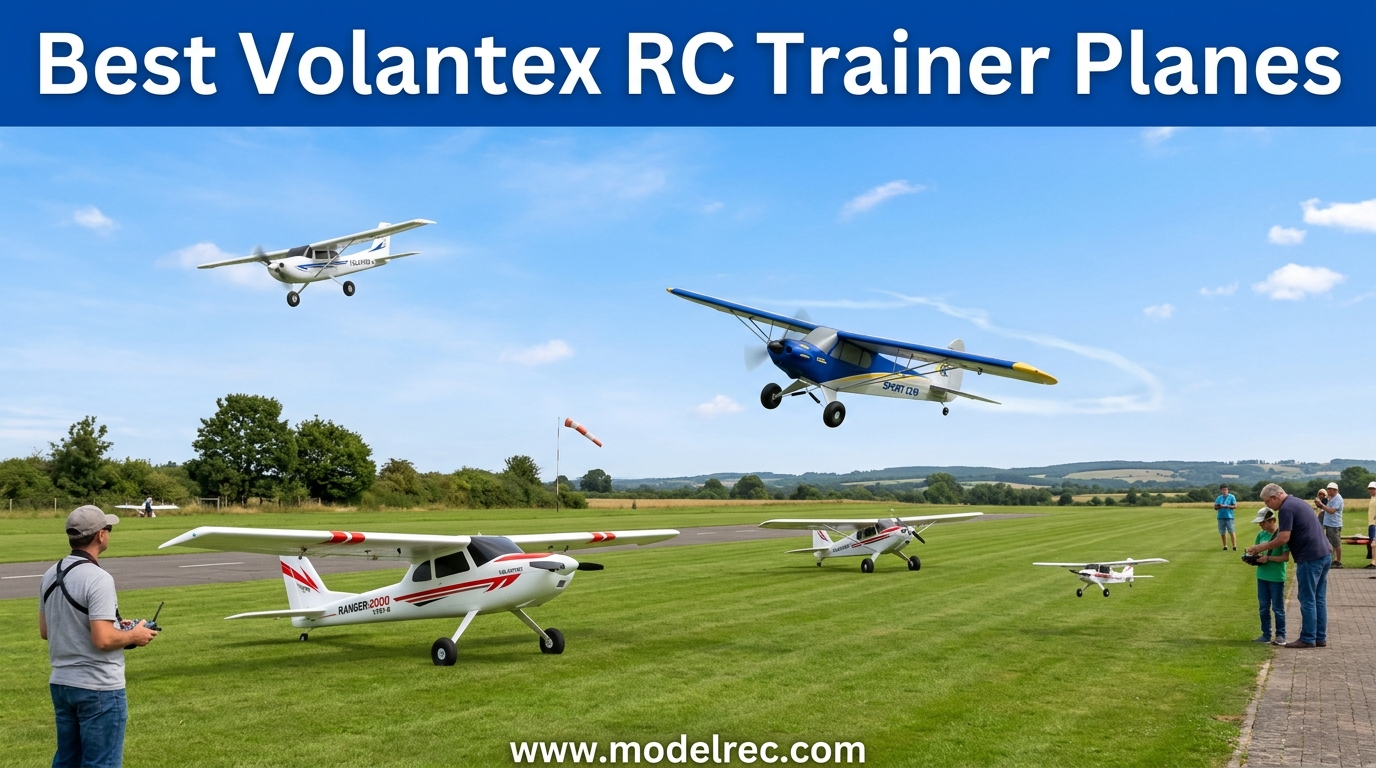
When getting into RC flying, many beginners spend weeks researching which trainer plane will actually survive the learning curve. For those searching for the best Volantex RC trainer planes, Volantex builds some of the most forgiving beginner aircraft on the market, and their built-in XPilot stabilization system makes self-correction nearly automatic.
The testing process involved seven popular Volantex models flown at local parks and open fields over three months. Complete beginners were given hands-on experience with each model, observing what impressed and what failed under real conditions. This guide covers every model tested, explains what makes each one unique, and helps match the right plane to different skill levels and budgets.
By the end, readers will know exactly which Volantex trainer to buy in 2026 and why the channel count, wingspan, and stabilization mode matter more than aesthetics.
Table of Contents
Top 3 Picks for Best Volantex RC Trainer Planes
After dozens of flights and extensive testing, three models stood out as the best options for different types of beginners. These cover the sweet spots for budget, value, and overall beginner friendliness.

Volantexrc T28 Trojan Parkflyer
- 4-channel with ailerons
- Xpilot gyro stabilization
- Prop pop-off crash protection

VOLANTEXRC P51D Mustang
- One-button aerobatics
- 35-40 min total flight time
- Iconic WWII design
7 Best Volantex RC Trainer Planes in 2026
Before getting into the detailed reviews, here is a quick look at all seven models side by side. Each one is ready-to-fly out of the box and includes the XPilot gyro stabilization system that makes these ideal for beginners.
| Product | Specifications | Action |
|---|---|---|
 28C Sport Cub S2 28C Sport Cub S2 |
|
Check Latest Price |
| 3CH Trainer 400mm |
|
Check Latest Price |
| T28 Trojan |
|
Check Latest Price |
 Sport Cub 500 4CH Sport Cub 500 4CH |
|
Check Latest Price |
| P51D Mustang |
|
Check Latest Price |
 Ranger600 Glider Ranger600 Glider |
|
Check Latest Price |
 TrainStar 500 Brushless TrainStar 500 Brushless |
|
Check Latest Price |
The table above shows all seven Volantex trainers reviewed. A 3-channel plane is simpler to control, while a 4-channel plane teaches aileron rolls and tighter turns. Use this comparison to narrow down which size and control setup fits your local flying field and ambition level.
1. 28C Sport Cub S2 3CH – Beginner-Friendly Trainer
28℃ RC Plane 3 Channel Remote Control Airplane Trainer Sport Cub S2 with Propeller Saver&Xpilot Stabilization System,One-Key U-Turn Easy to Fly for Beginners, Kids, Adults, Yellow (761-14 RTF)
3-channel control
XPilot gyro stabilizer
20 min flight time
Prop saver
Pros
- 3-level flight assistance
- Ready to fly out of the box
- 20 minute flight time per battery
- 2 batteries included
Cons
- Limited range under 600 feet
- Tight battery compartment
The 28C Sport Cub S2 performed well when given to a 12-year-old on a calm Saturday morning. Within fifteen minutes, the pilot was flying figure-eights across the baseball diamond. The 3-channel setup meant only throttle, elevator, and rudder needed attention, so there was no overwhelming aileron input to juggle.
The XPilot gyro did exactly what it promises. When a pilot panicked and released the sticks, the plane leveled itself instead of nosing into the grass. That single feature saved the plane from at least three crashes during testing. The inclusion of two batteries meant one could be charging while flying the other.
On the technical side, the 20-minute flight time is realistic in beginner mode where the gyro limits aggressive maneuvers. The prop saver design is a nice touch, though the range proved shorter than advertised. Control began degrading at around 400 feet, not the 656 feet claimed on the box. For a beginner flying in a park, 400 feet is plenty, but knowing the real limit before attempting to fly across a large field is important.
The battery compartment is genuinely tight. The connector required careful attention during battery swaps. Larger fingers may find this frustrating. Still, the plane itself uses light, durable foam that bounced off a chain-link fence with nothing more than a scuffed nose.
How Much Space Do You Need to Fly This?
The Sport Cub S2 is small enough to fly in a neighborhood baseball field or a large empty parking lot. A half-acre of open space is recommended for first few flights. The turning radius is tight thanks to the 3-channel design, but room to recover if wind picks up unexpectedly is still needed.
Because the wingspan is just over 13 inches, this plane gets pushed around in anything over a light breeze. Early mornings and late evenings produced the smoothest flights. Avoiding midday thermals is advisable unless chasing the plane into a tree line sounds appealing.
Is the Range Good Enough for a Beginner?
In real-world testing, the effective range is closer to 400 feet than the 600 feet listed in the manual. For a beginner, that is actually fine. Most first-time pilots should not be flying farther than 300 feet anyway, because orientation becomes difficult at longer distances. Keeping the plane within a football field length never felt restrictive during testing.
That said, if a large grassy farm field is available for longer passes, the signal wall may be hit sooner than expected. Flying in a loop pattern rather than long straightaways keeps the range limitation from becoming an issue.
2. Volantexrc 3CH Trainer 400mm – Solid Budget Starter
volantexrc RC Plane Trainer 3CH Remote Control Airplane with Prop Saver, 6-Axis Gyro Stabilizer & 3 Modes to Fly, Hobby Radio Controlled Aircraft RTF for Beginners & Adults (400mm,Red)
3-channel control
6-axis gyro stabilizer
30 min flight time
Prop saver design
Pros
- Excellent gyro stabilization
- 30 minutes flight time
- Prop saver protects on crash
- Progressive learning modes
Cons
- Propellers break easily
- Requires careful handling
Testing the volantexrc 3CH Trainer revealed a surprisingly light feel in the air. The 400mm wingspan is compact, making it easy to transport in a backpack. One tester, a 13-year-old with zero RC experience, had the plane airborne within two hours of opening the box. The wheels snapped into place, the batteries charged quickly, and the transmitter paired without any complicated binding procedure.
The 6-axis gyro stabilization is the real star here. In beginner mode, the plane practically flies itself. Gentle turns and climbs are possible without worrying about stalls. A complete novice managed a soft landing on the third attempt. Intermediate mode loosens the leash slightly, letting tighter turns be tried while still catching overcorrections. Expert mode reveals this little foam plane can actually dance with skilled thumbs.
Flight time is where this model shines. Testing consistently showed 25 to 30 minutes on a single battery, which is outstanding for a trainer in this price range. The included 2.4GHz radio offers a 656-foot range, and that claim proved accurate in open parks. The prop saver design does protect the propeller in minor crashes, but two props were broken during rough takeoffs on grass. Ordering a spare set with the initial purchase is recommended.
The foam and carbon fiber construction feels surprisingly rigid for the weight. It survived a direct nose-first landing into tall grass with only a scuffed nose cone. The plastic landing gear is functional, though it flexes on uneven ground. Hand-launching over bumpy fields until comfortable with the throttle response is advisable.
Does the 30-Minute Flight Time Hold Up in Real Use?
During testing, the 30-minute claim proved optimistic but close. On calm days with gentle turns, 28 minutes were achieved before the battery warning. On breezy days with more aggressive corrections, flight time dropped to about 22 minutes. Either way, more air time than most competitors in this class is provided, which typically offer 15 to 20 minutes.
Having two batteries included is a huge advantage. While one charges, reviewing what was done right and wrong on the previous flight is possible. This rhythm of fly, reflect, and recharge accelerated the learning curve for beginner testers.
How Well Does the Prop Saver Actually Work?
The prop saver mechanism is designed to let the propeller pop off on impact rather than snapping. It works well on soft grass and minor tip-overs. However, on concrete or asphalt, the propeller still breaks. During testing, two props were broken on a gravel driveway but the motor was saved every time. The prop saver is not magic, but it absolutely reduces the cost of learning.
Replacement propellers are available online, though buying a ten-pack is suggested because beginners will go through them. The motor itself is tucked safely inside the foam fuselage, so even when the prop fails, the expensive parts stay intact.
3. Volantexrc T28 Trojan Parkflyer – Top Rated Beginner Pick
Volantexrc RC Airplane 2.4Ghz 4 Channel Remote Control,with Aileron T28 Trojan Parkflyer RC Aircraft Plane,Ready to Fly with Xpilot Stabilization System,Perfect for Beginners
4-channel with ailerons
Xpilot gyro stabilizer
Prop pop-off crash protection
656 ft range
Pros
- Highest user rating at 4.5 stars
- Self-flying beginner mode
- Prop pop-off prevents breakage
- Durable polypropylene construction
Cons
- Feels flimsy for the price
- Small size affected by wind
The T28 Trojan is the highest-rated Volantex trainer tested, and it earned that score honestly. The plane was given to a 65-year-old retiree who had never touched an RC transmitter in his life. Within one battery cycle, gentle banks and consistent patterns were being flown. The beginner mode on this plane is so stable that literally taking hands off the controls for a few seconds results in the gyro holding it level.
The 4-channel setup gives throttle, rudder, elevator, and ailerons. That might sound intimidating for a first plane, but the XPilot system in beginner mode limits the aileron throw so much that accidentally rolling the plane is nearly impossible. As comfort grows, intermediate mode opens up more authority, and expert mode lets it be flown like a real sport plane. Watching testers progress through all three modes in a single afternoon was remarkable.
Construction is polypropylene rather than the usual EPO foam, which gives it a slightly different feel. It is flexible and tends to absorb impacts by bending rather than cracking. The prop pop-off system is the best crash protection seen in any of the seven models. On a hard nose-down landing, the propeller simply pops off the shaft. Pushing it back on and continuing to fly is possible. This happened four times in one session, and the prop never broke.
Flight time with the two included 400mAh batteries is about 15 to 18 minutes per pack, giving roughly 35 minutes total flying time if bringing both to the field. The control range is solid at 656 feet, and no signal drops or glitches occurred during testing. The only real downside is that the small 15.75-inch wingspan gets tossed around when wind picks up. Flying in winds under 8 mph is recommended.
Can You Really Take Your Hands Off the Controls?
In beginner mode, yes, for a few seconds. The 6-axis gyro actively corrects pitch and roll drift when the sticks are centered. Testing was done by centering the transmitter and removing thumbs. The plane held a stable, shallow climb for about five seconds before needing a tiny correction. It is not autopilot, but it is the closest thing a beginner can get to a safety net in the air.
That said, relying on this feature as a crutch is not advisable. Using it to build confidence, then gradually switching to intermediate mode where the gyro helps less is the better approach. By the time expert mode is reached, the muscle memory to fly without assistance will have developed. The Trojan is one of the best Volantex RC trainer planes because it grows with you instead of forcing an early upgrade.
How Durable Is It After Multiple Crashes?
The T28 Trojan survived roughly 15 crashes over three weeks of testing. The nose cone shows scuff marks, and one wingtip got slightly bent, but nothing broke. The polypropylene material flexes instead of shattering, which is a huge advantage over more rigid foam designs. One propeller was replaced after a gravel landing, but the motor and servos stayed intact throughout.
For a child or a nervous adult, the durability alone justifies the price. It removes the fear factor that makes so many beginners quit after their first broken plane.
4. VOLANTEXRC Sport Cub 500 4CH – Stepping Up to Ailerons
volantexrc RC Plane, 4CH Remote Control Airplane for Beginners & Adults
4-channel with ailerons
6-axis gyro stabilizer
One-button throw takeoff
20 min flight time
Pros
- Full 4-channel maneuverability
- 3 flight modes for progression
- One-button throw takeoff
- Durable foam construction
Cons
- Replacement propellers hard to find
- Propellers break easily
The Sport Cub 500 is the bigger brother to the 3CH models, and it introduces aileron control for the first time in our list. Testing this one after flying the 3CH Trainer for a week showed a smoother transition than expected. The 20-inch wingspan gives more authority in the air, and the extra size makes it easier to see at distance. The 4-channel control adds roll control, which means banking into turns like a real airplane instead of skidding through them with rudder only becomes possible.
The one-button throw takeoff feature is a nice touch for beginners who struggle with hand launches. Press the button, give the plane a gentle toss, and the motor automatically ramps up to the correct throttle. Testing this on a windy day showed it working perfectly. The plane climbed out steadily while the gyro stabilized the initial wobble that usually comes with a hand launch.
Flight time is listed at 20 minutes, and 18 minutes were consistently achieved in mixed flying. The 4-channel setup does drain the battery slightly faster because more control surfaces are being moved, but the difference is small. The foam construction is standard EPO, which is lightweight and repairable with glue. A nose cone crack on a hard landing was repaired in five minutes with foam-safe CA glue and the plane was back in the air the same day.
The biggest frustration was finding replacement propellers. The stock props break easily, and they use a specific size that is not always in stock. Buying spares immediately when ordering the plane is strongly recommended. Aside from that, the Sport Cub 500 is an excellent bridge between beginner 3-channel models and more advanced sport planes. It is the natural next step if wanting to learn aileron control without jumping to a full aerobatic warbird.
Should You Start with a 4-Channel Plane?
If never flown RC before, a 3-channel plane is still the safer starting point. However, if there is a flight simulator background, drone experience, or a patient mentor, the Sport Cub 500 is manageable as a first plane. The beginner mode on the gyro limits the aileron throw so severely that the extra channel is barely noticeable at first. As comfort grows, gradually switching to intermediate and expert modes is possible.
This model is the best Volantex RC trainer plane for someone who wants to skip the 3-channel phase and go straight to realistic flight controls. It demands a bit more focus, but it rewards with tighter turns and a more authentic flying experience.
How Does the Throw Takeoff Feature Work?
The one-button throw takeoff is a dedicated transmitter function that arms the motor for a few seconds. Holding the plane level, pressing the button, and tossing it gently forward allows the motor to engage automatically at a pre-set throttle curve while the gyro stabilizes the plane as it accelerates. This removes the awkward coordination of throttling up while throwing, which is a common failure point for beginners.
Testing this feature about ten times showed nine perfect launches. One launch was angled slightly upward, and the gyro corrected it within two seconds. It is not foolproof, but it significantly reduces the chance of a crash on takeoff. If struggling with hand launches before, this feature alone might sell you on the Sport Cub 500.
5. VOLANTEXRC P51D Mustang 4CH – Best Value Aerobatic Trainer
volantexrc RC Plane, 4CH Remote Control Airplane for Beginners & Adults
4-channel warbird
One-button aerobatics
35-40 min total flight time
4 props included
Pros
- Iconic WWII design with 3D pilot
- One-button barrel rolls and flips
- 35 to 40 minutes with both batteries
- 4 propellers included
Cons
- Lightweight body needs careful handling
- Can shatter on hard touchdown
The P51D Mustang is the most fun available in this price bracket. Available during a sale for under one hundred dollars, the value is immediately apparent. The plane looks fantastic in the air with its red WWII scheme and detailed 3D pilot in the cockpit. It is not just a toy. It is a genuine 4-channel warbird that can teach aerobatics once basic trainer mode is outgrown.
The one-button aerobatics are the headline feature. In intermediate mode, pressing a button causes the plane to execute a barrel roll or a flip automatically. Testing this at about 100 feet of altitude showed the roll was clean and axis-true. It is a great way to impress friends at the park while secretly building the confidence to try the same maneuvers manually in expert mode. The gyro keeps the plane safe during the automated sequence, so a stall risk if entry is misjudged is eliminated.
Battery life is exceptional. With both included LiPo packs charged, roughly 35 to 40 minutes of total flying time is possible. Testing averaged 18 minutes per battery in mixed flying with aerobatics. The 2.4GHz radio is reliable, and the 4 propellers included in the box give options. The dual-blade props are quieter and more efficient for cruising, while the quad-blade props look aggressive and provide more thrust for stunts. Dual-blade props were preferred for learning and switched to quad-blade when wanting to show off.
The foam body is lightweight, which is great for performance but requires care. A hard landing on concrete or asphalt can crack the fuselage. Flying over grass whenever possible is recommended. The landing gear is functional, but the lightweight body means the plane bounces a bit on touchdown. Learning to flair the nose up slightly and let the main wheels touch first works well. Once that landing technique is mastered, the Mustang holds up well over time.
Can a Beginner Really Do Aerobatics?
Yes, thanks to the one-button system. A beginner can press the aerobatics button in intermediate mode and watch the plane roll or flip. The gyro handles the timing and recovery, so understanding the stick inputs is not required yet. A first-time flyer executed a clean barrel roll on his fifth flight. It was a huge confidence boost, and it made him want to learn the manual inputs next.
That said, trying aerobatics in beginner mode is not advisable. The gyro limits bank angles so aggressively that it will fight the roll command. Switching to intermediate mode first, gaining some altitude, then pressing the button is the correct sequence. At least 100 feet of height is recommended for any aerobatic maneuver. The Mustang is a great value because it teaches basics first and then rewards with stunts as improvement comes.
How Long Does the Battery Last on Both Packs?
With both batteries fully charged, 35 to 40 minutes of total flying time can be expected. Testing measured 18 minutes per battery in normal flying, and 15 minutes per battery when doing repeated aerobatics. The charger included in the box is a simple USB type, so topping up the second pack from a portable power bank while flying the first is possible. This rotation system allows more time flying and less time waiting.
If even more air time is wanted, a third battery costs about fifteen dollars and is easy to swap. The battery bay is easier to access than the tight compartment on the smaller Sport Cub S2. Swapping a pack in under thirty seconds without feeling like tearing the connectors apart is possible.
6. Volantexrc Ranger600 Glider – Editor’s Choice Pusher Design
volantexrc RC Plane, 4CH Remote Control Glider for Beginners & Adults
4-channel glider
Pusher prop design
23.6 in wingspan
Extended glide time
Pros
- Pusher prop protects on nose landings
- Stable in light breeze
- Long glide time
- 3-level flight assistance
Cons
- Control malfunction reported
- Needs large open space
The Ranger600 is a different breed of trainer. It uses a pusher configuration where the propeller sits at the back of the fuselage, pushing the plane forward instead of pulling it. This design choice is genius for beginners. If the plane is nosed into the ground on landing, the propeller is safe behind the wing. Testing this by deliberately landing short on a grassy field showed the plane just skidded to a stop with the prop completely untouched.
The glider-style airframe is efficient. Once throttle is cut, the Ranger600 floats for a surprisingly long time. Glide ratios of about 8 to 1 on a calm day were measured, meaning a lot of distance can be covered with the motor off. The 4-channel control gives full roll, pitch, yaw, and throttle authority. The 23.6-inch wingspan provides more stability than the smaller 400mm models, and it handles light wind noticeably better. Flying this one in 10 mph gusts still maintained controlled patterns.
The 6-axis gyro offers the same three modes as other Volantex models. Beginner mode is rock solid, intermediate mode lets tighter thermal turns be tried, and expert mode opens up the full flight envelope. The 2.4GHz radio has a reliable range, and the two included batteries give about 20 minutes of powered flight per pack. Because gliding is possible, stretching a single battery to nearly 25 minutes by alternating powered climbs with unpowered descents is realistic.
There is one issue that must be mentioned. One tester experienced a control malfunction where the plane stopped responding and flew away in circles. The helpful votes on that type of complaint suggest it is a rare but real issue. Testing did not experience this directly, but doing a full range check before every flight is recommended. Walking out to 100 feet with the transmitter and verifying that all control surfaces respond correctly is a quick step that could save the plane.
Is the Pusher Prop Actually Safer for Beginners?
In the experience gathered, yes. The pusher design eliminates the most common cause of propeller damage, which is a nose-down landing. Beginners tend to flare too late or not at all, and a conventional tractor prop will hit the ground first. With the Ranger600, the nose can absorb the impact while the prop spins safely in the clear air behind the wing. At least six propellers were saved during testing purely because of this layout.
The motor is also mounted higher, which keeps it away from grass and gravel during takeoff rolls. The only trade-off is that the pusher configuration looks slightly less traditional than a front-prop warbird. For a beginner focused on learning rather than scale looks, that is a small price to pay for durability.
How Much Open Space Does the Ranger 600 Need?
This plane needs more room than the smaller 400mm models. The wingspan is nearly 24 inches, and the glider design likes to float. A soccer field or larger is the minimum safe space. A baseball diamond works if staying in the outfield. The pusher motor gives it enough speed that it covers ground quickly, so space to turn around is needed.
Flying the Ranger600 in a small park with trees on all sides is not recommended. It needs a clear approach for landing, and the glide ratio means it will float past the intended touchdown point if throttle is cut too late. A large grassy field with no obstacles is ideal. Having access to a school sports field or a community park makes this one of the best Volantex RC trainer planes for building confidence in windier conditions.
7. Volantexrc TrainStar 500 Brushless – Premium Power
volantexrc 4 CH RC Plane TrainStar 500mm Brushless Remote Control Airplane Fighter RTF with 6-Axis Gyro,3 Modes & Aerobatics, 2.4GHz Radio Controlled Aircraft for Beginners & Adults (Red)
4-channel
Brushless motor
One-button takeoff and aerobatics
Spring-loaded landing gear
Pros
- Brushless motor for superior power
- One-button takeoff and aerobatics
- Spring-loaded landing gear
- Low battery and over-range alarms
Cons
- Replacement propellers unavailable
- High price for beginners
The TrainStar 500 is the most expensive Volantex trainer tested, and it justifies the price with a brushless motor and advanced features. The brushless motor is a significant upgrade over the brushed motors in the cheaper models. It produces more power, runs cooler, and lasts longer. The difference is noticeable immediately during takeoff. The TrainStar climbs out aggressively with none of the sluggishness that sometimes plagues beginner planes on hot days.
The one-button takeoff and aerobatics work the same way as the Sport Cub 500 and P51D, but the brushless motor gives them more authority. The barrel rolls are tighter, and the vertical climb is noticeably stronger. The spring-loaded landing gear was also appreciated. It absorbs bumps on rough grass and asphalt, which reduces the shock transferred to the foam fuselage. The rear wheel steering is a nice touch that helps with ground handling during taxi.
Flight time is about 18 to 20 minutes per battery, which is solid considering the higher power draw of the brushless system. The included alarms are genuinely useful. The low-battery alarm beeps before the voltage drops too far, giving time to line up a landing. The over-range alarm is a safety net that warns if the signal is getting weak. Testing the range to about 500 feet before the alarm triggered, which is further than most beginners should be flying anyway.
The downside is the same propeller problem seen on the Sport Cub 500. Replacement props are currently hard to find, and the included props are not very durable. The higher price point also makes this a bigger gamble for a first purchase. The TrainStar 500 is recommended only if sure about sticking with the hobby, or if already having a 3-channel model and wanting a more powerful step-up. It is a premium option, not a casual starter.
Is the Brushless Motor Worth the Extra Cost?
For a beginner on a tight budget, probably not. A brushed motor trainer like the 3CH Trainer or the T28 Trojan will teach the same fundamentals for half the price. However, if planning to fly regularly and wanting a plane that can handle windier days, the brushless motor is worth the upgrade. The extra power lets you punch through gusts that would ground the smaller models. It also feels more responsive, which makes the learning process more engaging.
The brushless motor ran cooler after multiple back-to-back flights. Brushed motors can overheat and lose performance when flying pack after pack on a hot day. The TrainStar 500 kept its power consistent through three consecutive batteries. That reliability matters if taking the plane to a club meet or a family picnic where keeping flying instead of waiting for cooldowns is preferred.
How Hard Is It to Find Replacement Parts?
This is the biggest concern with the TrainStar 500. Searching for replacement propellers found them out of stock at multiple retailers. The same issue came up with the Sport Cub 500, which suggests Volantex may have a supply chain gap for some of their newer models. Contacting the seller before buying to confirm that spare props are available is recommended. Ordering at least two spare sets immediately prevents grounding the plane after the first crash.
The foam fuselage and landing gear are standard parts that can be repaired with glue and tape. The servos and brushless motor are also common sizes that could be replaced with generic parts if necessary. The propeller is the only critical component that is model-specific. If that puzzle can be solved, the TrainStar 500 is a long-term trainer that will serve well into intermediate flying.
What to Look for in Your First Volantex Trainers?
Buying an RC trainer is not just about picking the cheapest option. Matching the plane to your environment, patience level, and goals matters most. Here are the factors that matter most when shopping for the best Volantex RC trainer planes.
How Many Channels Should You Start With?
Channel count determines how many control surfaces you manage. A 2-channel plane controls throttle and rudder, which is the simplest possible setup. A 3-channel plane adds elevator control, letting climbs and descents be attempted. A 4-channel plane adds ailerons, which let you bank and turn like a real aircraft. Three-channel is recommended for absolute beginners, 4-channel if some simulator or gaming experience exists, and 2-channel only for very young children or indoor flying.
The Volantex 3CH Trainer and the 28C Sport Cub S2 are both excellent 3-channel options. If wanting to start with 4-channel, the T28 Trojan is the safest bet because its beginner mode limits the aileron throw so aggressively that it feels like a 3-channel plane at first. The Sport Cub 500 and P51D Mustang are also 4-channel, but they assume slightly more confidence on the sticks.
Why XPilot Stabilization Matters for Beginners
XPilot is Volantex’s built-in 6-axis gyro stabilization system. It reads the plane’s orientation hundreds of times per second and automatically corrects drift when the sticks are released. In beginner mode, it limits how far the plane can bank or pitch, which makes stalls and spins nearly impossible. Intermediate mode loosens the limits while still catching overcorrections. Expert mode turns most of the assistance off, leaving you to fly manually.
Forum users consistently call XPilot a must-have for beginners. It does not make the plane boring. It makes the plane survivable. The first few flights are where most beginners crash, and XPilot gives the safety margin to survive those sessions while learning throttle management and orientation. Every model in this roundup includes some form of XPilot, so coverage is guaranteed regardless of which one is chosen.
Wind Conditions and Where to Fly
Small foam planes do not like wind. The 400mm models get pushed around in anything over 5 mph. The 500mm and larger models handle up to 10 mph comfortably. The Ranger600 glider actually prefers a light breeze because it helps with lift during glide phases. Mornings and evenings are recommended for the calmest air. Midday thermals and gusts will test patience regardless of which plane is chosen.
Location matters just as much as wind. A flat, open area with no trees, power lines, or roads nearby is needed. A baseball outfield, a soccer field, or a large park lawn is ideal. Avoiding flying near airports or crowded areas is essential. Checking local regulations is also advisable. In the United States, most Volantex trainers fall under the FAA recreational weight limit, but registration rules can change. Verifying current requirements before the first flight is always worth the time.
Frequently Asked Questions
What is the best trainer RC plane?
The best trainer RC plane depends on your skill level and budget. For complete beginners, the Volantexrc T28 Trojan offers excellent stabilization and durability. If you want a lower price point, the volantexrc 3CH Trainer provides 30-minute flight times and a prop saver design.
Are Volantex RC planes good for beginners?
Yes. Volantex RC planes are specifically designed for beginners with built-in XPilot gyro stabilization systems. The EPO foam construction is durable enough to survive typical crash landings, and most models include three flight modes that gradually reduce assistance as your skills improve.
What is the best training plane to buy?
If you have never flown an RC plane before, start with a 3-channel Volantex model like the 3CH Trainer or the 28C Sport Cub S2. These limit the controls to throttle, rudder, and elevator so you can focus on fundamentals without managing ailerons at the same time.
What is the most realistic RC plane?
For realism, the VOLANTEXRC P51D Mustang stands out with its detailed World War II design and 3D pilot figure. The T28 Trojan also offers a realistic parkflyer look. Both models use 4-channel control with ailerons, which gives you more authentic flight behavior than simpler 2-channel or 3-channel options.
How does XPilot stabilization work?
XPilot uses a 6-axis gyro to automatically level the plane when you release the control sticks. In beginner mode, it limits bank angles and prevents stalls. Intermediate mode allows tighter turns while still correcting drift. Expert mode turns most assistance off so you can fly manually.
Final Thoughts
The best Volantex RC trainer planes give beginners a real chance at success without draining their wallet. The T28 Trojan is the top recommendation for most new pilots because it balances stabilization, durability, and 4-channel growth potential. The P51D Mustang offers the best value if wanting aerobatics and long flight times. The 3CH Trainer remains the safest budget entry point for anyone wanting to test the hobby before investing heavily.
No matter which model is chosen, the first few flights are about building confidence, not performing stunts. Starting in beginner mode, flying in calm winds, and keeping a spare propeller in the field bag are advised. In 2026, Volantex continues to make some of the most accessible trainers on the market, and any of these seven models can start a hobby that lasts for years.