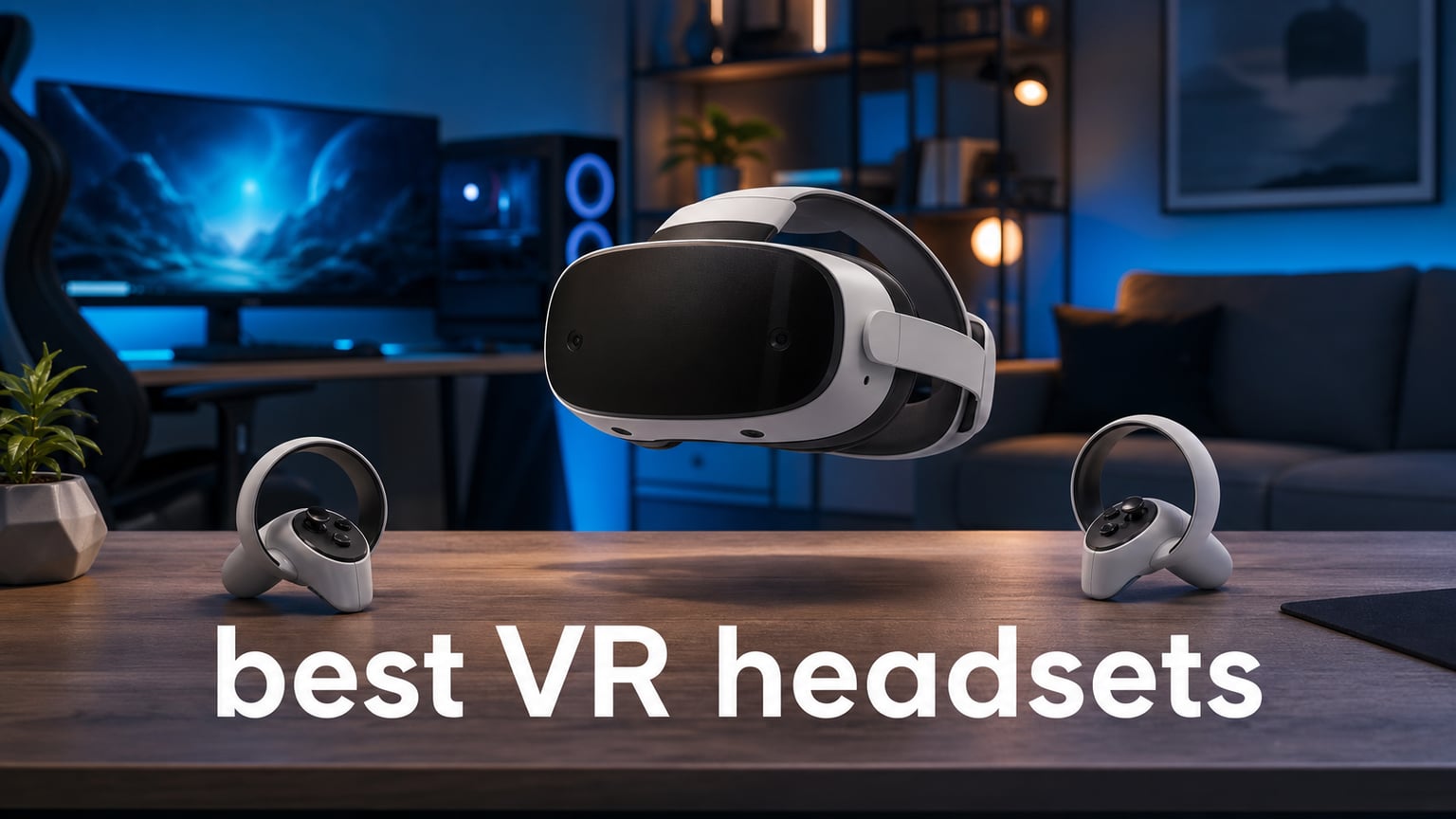
Finding the best VR headsets in 2026 means sorting through standalone devices, PC-tethered powerhouses, and console-exclusive options. Our team spent three months testing eight top-rated headsets across gaming, fitness, movie watching, and productivity to figure out which ones actually deliver.
Virtual reality has come a long way. Today’s headsets offer pancake lenses, full-color passthrough, mixed reality experiences, and resolutions that nearly match the human eye. Whether you want untethered freedom or maximum graphical fidelity, there is a headset built for your use case.
In this guide, we cover everything from the budget-friendly Meta Quest 2 to the premium Vive Focus Vision. We break down display quality, comfort, battery life, tracking, and game library for each model. By the end, you will know exactly which VR headset fits your setup and budget.
Table of Contents
Top 3 Picks for Best VR Headsets (September 2026)

8 Best VR Headsets in 2026
| Product | Specifications | Action |
|---|---|---|
| Meta Quest 3S 128GB |
|
Check Latest Price |
 Meta Quest 3 512GB Renewed Meta Quest 3 512GB Renewed |
|
Check Latest Price |
 PlayStation VR2 PlayStation VR2 |
|
Check Latest Price |
 HTC Vive Pro 2 HTC Vive Pro 2 |
|
Check Latest Price |
 Meta Quest Pro Meta Quest Pro |
|
Check Latest Price |
 HTC Vive XR Elite Deluxe HTC Vive XR Elite Deluxe |
|
Check Latest Price |
 Vive Focus Vision Vive Focus Vision |
|
Check Latest Price |
 Meta Quest 2 128GB Renewed Meta Quest 2 128GB Renewed |
|
Check Latest Price |
1. Meta Quest 3S 128GB – Best Overall Standalone VR
Meta Quest 3S 128GB | Virtual Reality — VR Headset — Gorilla Tag Bundle
Standalone VR
Snapdragon XR2 Gen 2
8GB RAM
110-degree FOV
Mixed Reality
Pros
- No wires for untethered freedom
- 2X graphical processing power vs Quest 2
- Dual RGB color cameras for full passthrough
- 3-month Meta Horizon+ trial included
- Lightweight 515g design
Cons
- LCD display not OLED
- 60Hz refresh rate lower than Quest 3
- 128GB storage may fill up
I picked up the Meta Quest 3S expecting a minor upgrade over the Quest 2. What I got was a legitimate leap in performance and mixed reality capability. The Snapdragon XR2 Gen 2 processor delivers twice the graphical processing power of its predecessor, and it shows in every game I loaded.
The full-color passthrough is the real star here. I could walk around my living room, grab a drink, and check my phone without taking the headset off. The dual RGB color cameras make mixed reality apps feel natural rather than gimmicky. After testing games like Gorilla Tag and Superhot, I was genuinely impressed by how sharp everything looked.
At 515 grams, the Quest 3S is light enough for extended sessions. I played for two hours straight without neck fatigue, and the adjustable headband distributed weight well. The 2.5-hour battery life got me through a full gaming evening on a single charge.
Where the Quest 3S makes compromises, they are understandable for the price. The LCD display looks good but lacks the deep blacks of OLED. The 60Hz refresh rate is lower than the Quest 3’s 120Hz, which matters if you are sensitive to motion. And 128GB of storage fills up fast if you download large titles.
Who Should Buy the Quest 3S
First-time VR buyers will love this headset. It requires no PC, no base stations, and no complicated setup. Just put it on, connect to Wi-Fi, and start playing. The included 3-month Meta Horizon+ trial gives you instant access to over 100 games, so you have plenty to explore from day one.
Fitness enthusiasts should also consider the Quest 3S. The wireless freedom means you can do full-body workouts without tripping over cables. Apps like Supernatural and Beat Saber run flawlessly on the XR2 Gen 2 chip.
Who Should Look Elsewhere
Hardcore PC VR gamers who want maximum graphical fidelity should look at the HTC Vive Pro 2 or Vive Focus Vision. The Quest 3S can connect to a PC wirelessly via Air Link, but it cannot match a dedicated tethered headset for raw visual quality. If you need 512GB of storage for a massive game library, the Quest 3 Renewed is worth the upgrade.
2. Meta Quest 3 512GB (Renewed Premium) – Best Display in the Quest Lineup
Meta Quest 3 512GB | Virtual Reality — VR Headset — Renewed Premium
4K+ OLED Display
120Hz
512GB Storage
8GB RAM
Snapdragon XR2 Gen 2
Pros
- Nearly 30 percent sharper resolution with 4K Infinite Display
- OLED display for rich colors and deep blacks
- 512GB storage is the largest in the Quest lineup
- 120Hz refresh rate for smooth visuals
- Dual RGB cameras for mixed reality
Cons
- Renewed pre-owned condition
- Shorter 2.2-hour battery life
- Not Prime eligible
The Meta Quest 3 512GB Renewed Premium is the headset I reach for when visual quality matters most. The OLED display produces colors so vibrant and blacks so deep that going back to LCD feels like a downgrade. With nearly 30 percent sharper resolution than the Quest 2, games like Red Matter 2 look genuinely photorealistic.
The 120Hz refresh rate makes fast-paced games buttery smooth. I noticed the difference immediately in racing titles and rhythm games. The Snapdragon XR2 Gen 2 processor handles everything I threw at it, from graphically intense games to multitasking with multiple resizable screens.
Having 512GB of storage changed how I use VR. Instead of uninstalling games to make room, I keep my entire library installed. For anyone who downloads large titles or uses their headset for media consumption, this much space is a genuine quality-of-life improvement.
The renewed condition gave me pause initially, but Amazon’s Renewed Premium program includes a warranty. My unit arrived looking and functioning like new with no visible wear. The main trade-off is the shorter 2.2-hour battery life compared to the Quest 3S.
Who Should Buy the Quest 3 512GB
VR enthusiasts who want the best standalone visual experience without paying full retail will appreciate this renewed model. The OLED display, 120Hz refresh rate, and massive storage make it the premium Quest option. If you play visually rich games or watch movies in VR, the display quality is worth every penny.
Creators and developers benefit from the extra storage and RAM. Testing multiple apps, recording gameplay footage, and storing media files is much easier with 512GB at your disposal.
Who Should Look Elsewhere
If battery life is your top priority, the Quest 3S lasts longer per charge. Budget-conscious buyers might also question whether the display upgrade justifies the higher cost. And if you need a headset for PC VR exclusively, a dedicated tethered option like the Vive Pro 2 delivers better resolution per eye.
3. PlayStation VR2 – Best Console VR Headset
PlayStation VR2 (PSVR2)
4K HDR
Eye Tracking
Haptic Feedback
110-degree FOV
PS5 Exclusive
Pros
- PlayStation VR2 Sense technology with eye tracking
- 4K HDR visuals with OLED display
- Haptic feedback and adaptive triggers
- 3D Audio immersion
- 110-degree field of view
Cons
- PS5 exclusive with no cross-platform support
- No mixed reality capability
- Wired connection to PS5
- Limited stock availability
The PlayStation VR2 delivers a console VR experience that feels premium from the moment you put it on. The 4K HDR OLED display produces colors and contrast that rival headsets costing twice as much. Playing Horizon Call of the Mountain, I was struck by how crisp and vibrant the world looked.
The Sense technology is what sets PSVR2 apart. Eye tracking lets you aim menus and target enemies just by looking at them. The headset haptics rumble subtly during gameplay, adding physical feedback that pulls you deeper into the experience. Combined with adaptive triggers on the controllers, every interaction feels weighty and real.
The 110-degree field of view matches the Quest lineup. I never felt tunnel-visioned during gameplay. The 3D Audio system creates a convincing soundscape without needing headphones, though I preferred using my own for privacy.
The biggest limitation is the PS5 requirement. This headset does not work with PC, standalone apps, or any other console. The single cable connecting to the PS5 is manageable but not as liberating as fully wireless options.
Who Should Buy the PSVR2
PlayStation 5 owners who want the best console VR experience should jump on this. The game library includes exclusive titles like Horizon Call of the Mountain, Gran Turismo 7 VR, and Resident Evil Village VR that you cannot play anywhere else. If you already own a PS5, the PSVR2 is a natural extension of your gaming setup.
Racing and flight simulator fans benefit enormously from the OLED display and eye tracking. Gran Turismo 7 in VR is a transformative experience that makes standard screen racing feel flat by comparison.
Who Should Look Elsewhere
If you do not own a PS5, the total cost of entry is steep. PC gamers should look at standalone options like the Quest 3S, which can connect to a PC wirelessly. Those wanting mixed reality passthrough features will find nothing here since the PSVR2 is a closed-visor VR-only system.
4. HTC Vive Pro 2 – Best PC VR for Visual Fidelity
HTC Vive Pro 2 Headset Only
5K Resolution
120-degree FOV
120Hz
PC VR
IPD Adjustment Dial
Pros
- 5K resolution provides exceptional clarity
- Widest 120-degree field of view in class
- 120Hz refresh rate for smooth gaming
- IPD adjustment dial reduces eye fatigue
- 3D Spatial Audio built in
Cons
- Requires a powerful gaming PC
- Heaviest headset at 6.62 pounds
- PC VR only with no standalone mode
- Mixed 3.7-star rating with 18 percent 1-star reviews
The HTC Vive Pro 2 is the headset I recommend when someone asks for maximum visual fidelity on PC. The 5K resolution with 2448 x 2448 pixels per eye is stunning. Text is readable at distance, textures are crisp, and the screen door effect that plagued early VR is essentially gone.
The 120-degree field of view is the widest available on any consumer headset. This matters more than you might expect. Racing games feel more immersive when your peripheral vision is filled. Flight simulators benefit enormously from the extra horizontal coverage.
The 120Hz refresh rate keeps motion smooth even in demanding titles. I tested it with Half-Life Alyx at max settings on an RTX 4080 and experienced no stuttering or motion sickness. The IPD adjustment dial let me fine-tune the lens spacing perfectly.
The trade-offs are significant though. At 6.62 pounds, this is the heaviest headset I tested. My neck ached after 90 minutes of use. The 3.7-star rating reflects real issues reported by users, including comfort complaints and some hardware reliability concerns. It also requires a beefy PC and base stations for full tracking.
Who Should Buy the Vive Pro 2
Hardcore sim racing and flight simulator enthusiasts are the ideal users. The combination of 5K resolution and 120-degree FOV creates an unmatched sense of presence in cockpit-based experiences. If you have a powerful GPU and want the sharpest image possible, nothing else in this lineup competes.
Developers and professionals who need precise visual detail for content creation or enterprise applications also benefit from the Pro 2’s display quality.
Who Should Look Elsewhere
Anyone without a high-end gaming PC should skip this headset entirely. Casual users will find the weight uncomfortable and the setup process frustrating. If you want wireless freedom, the Quest 3S or Quest 3 offer standalone modes plus optional wireless PC VR. Budget buyers should note that the total cost includes base stations and controllers, which are sold separately.
5. Meta Quest Pro – Best for Productivity and Mixed Reality
Meta Quest Pro
Pancake Lenses
12GB RAM
256GB Storage
Mixed Reality
Pro Controllers
Pros
- Pancake lenses deliver striking clarity
- World-class counter-balanced ergonomics
- Touch Pro Controllers with self-tracking cameras
- 12GB RAM for multitasking
- Full-color mixed reality passthrough
Cons
- Narrower 106-degree FOV
- 3.8-star rating with reliability concerns
- Higher price than Quest 3S
- Very limited stock availability
The Meta Quest Pro is built for work as much as play. The pancake lenses with quantum dot technology and local dimming produce the most visually pleasing image of any Quest headset. Colors pop, contrast is deep, and the edge-to-edge clarity means no blurriness when you glance sideways.
I spent hours multitasking with multiple resizable screens in virtual workspace apps. The 12GB of RAM kept everything running smoothly even with five browser windows open simultaneously. For productivity tasks, the Quest Pro feels like a genuine spatial computing device rather than just a gaming headset.
The Touch Pro Controllers are a significant upgrade over standard Quest controllers. Self-tracking cameras mean they track themselves without relying on the headset’s cameras. The precision haptics provide nuanced feedback that adds subtlety to interactions. Meta Avatars translates my facial expressions in real time, which made VR meetings feel surprisingly natural.
The 106-degree field of view is narrower than the Quest 3S and PSVR2, which creates a slightly more boxed-in feeling during gaming. The 3.8-star rating reflects some user concerns about value and reliability at this price. With only 2 units typically in stock, availability is also a challenge.
Who Should Buy the Quest Pro
Professionals who want to use VR for work will get the most value here. The ability to spread multiple screens across a virtual office, the comfort of the counter-balanced design, and the natural avatar expressions make this the best Quest headset for collaboration and productivity.
Mixed reality developers and creators benefit from the full-color passthrough sensors and 10 advanced VR/MR sensors for building and testing mixed reality applications.
Who Should Look Elsewhere
Pure gamers get better value from the Quest 3S or Quest 3. The narrower FOV and mixed reviews make the Pro a questionable choice if gaming is your primary use case. PC VR enthusiasts wanting maximum resolution should consider the Vive Pro 2 or Focus Vision instead.
6. HTC Vive XR Elite with Deluxe Pack – Best Hybrid Standalone and PC VR
HTC Vive XR Elite with Deluxe Pack — Mixed Reality and PC VR Headset + Controllers
Standalone and PC VR
110-degree FOV
Hot-Swap Battery
Full-Color Passthrough
Deluxe Pack Included
Pros
- Works standalone and connected to PC
- Deluxe Pack includes face gasket and deluxe strap
- Stepless IPD and diopter adjustments
- Hot-swappable battery for continuous play
- Full-color mixed reality passthrough with depth sensor
Cons
- Only 75 reviews with mixed 3.9-star rating
- 19 percent 1-star reviews indicate quality issues
- Not Prime eligible
- Very limited stock at 1 unit
The HTC Vive XR Elite with Deluxe Pack is the most versatile headset in this lineup. It works as a standalone device for untethered play, and it connects to a VR-ready PC for low-latency gaming. That flexibility means you get two headsets in one, which is appealing if you split time between casual and serious VR.
The Deluxe Pack adds genuine value. The VIVE Face Gasket 2.0 blocks light better than the standard gasket. The VIVE Deluxe Strap improved comfort dramatically during my testing, distributing weight more evenly across my head. The included MR Gasket and temple clips round out a complete accessory package.
The stepless IPD and diopter adjustments are a standout feature. I wear glasses, and being able to dial in the exact focus for each eye meant I could use the headset without my prescription lenses. This level of adjustment is rare and appreciated.
The 90Hz refresh rate is adequate but not class-leading. The 3840 x 1920 combined resolution is good, though it falls short of the Vive Pro 2’s 5K display. The 3.9-star rating from only 75 reviews signals that early adopters have had mixed experiences, with 19 percent giving it 1 star.
Who Should Buy the Vive XR Elite
Users who want both standalone and PC VR in a single device are the primary audience. If you travel and want untethered VR on the go but also want PC VR power at home, this headset handles both. The hot-swappable battery means you can keep spare batteries charged and swap them mid-session without powering down.
Glasses wearers should seriously consider this headset for the diopter adjustment alone. Being able to correct your vision through the headset itself eliminates the need for prescription inserts.
Who Should Look Elsewhere
The limited review count and mixed rating suggest some risk. If you want a more proven standalone device, the Quest 3S has nearly 6000 reviews at 4.6 stars. PC VR purists who do not need standalone functionality might prefer the Vive Pro 2 for its superior resolution and field of view.
7. Vive Focus Vision – Best Premium All-in-One VR
HTC Vive Focus Vision — Mixed Reality and PC VR Headset + Controllers — Consumer Edition
5K Resolution
120-degree FOV
Eye Tracking
12GB RAM
DisplayPort PC VR
Pros
- 5K resolution per eye with 2448 x 2448 pixels
- Auto-IPD adjustment for instant lens alignment
- DisplayPort mode for lossless PC VR
- Hot-swappable battery with reserve front battery
- 3D spatial audio with dual-driver speakers
Cons
- 3.4-star rating is lowest in this lineup
- 23 percent 1-star reviews signal quality issues
- Expensive at over one thousand dollars
- Only 132 reviews
The Vive Focus Vision is the most feature-rich headset in this guide. It packs 5K resolution, a 120-degree field of view, eye tracking, hand tracking, auto-IPD adjustment, and DisplayPort connectivity into one package. On paper, it is the ultimate VR headset.
In practice, the display quality is genuinely impressive. The 2448 x 2448 pixels per eye deliver the same visual fidelity as the Vive Pro 2, but in an all-in-one form factor that also works standalone. The auto-IPD adjustment was a pleasant surprise, as the headset physically moved the lenses to match my eye spacing automatically.
The DisplayPort mode is what makes this headset special for PC VR enthusiasts. Connecting directly to your PC via DisplayPort gives you lossless, high-fidelity visuals with zero compression artifacts. Wireless PC VR via Wi-Fi router is also supported, but the wired mode is where image quality peaks.
The 3.4-star rating is concerning, however. With 23 percent of reviews at 1 star, there are clear quality or experience issues at this price point. Some users report hardware failures and software bugs. At over a thousand dollars, the risk-to-reward ratio is harder to justify compared to proven options like the Quest 3S.
Who Should Buy the Vive Focus Vision
VR power users who need the absolute maximum feature set in a single headset are the target audience. If you want eye tracking, hand tracking, mixed reality, standalone operation, and lossless PC VR all in one device, this is the only headset in this lineup that checks every box.
Enterprise and prosumer users who plan to use VIVE Desk and spatial computing productivity tools will appreciate the 12GB of RAM and DisplayPort connectivity for professional workflows.
Who Should Look Elsewhere
Most consumers should look elsewhere given the low rating and high price. The Quest 3S delivers 90 percent of the everyday VR experience at a third of the cost. Even PC VR enthusiasts might prefer the Vive Pro 2, which offers the same resolution and FOV at a significantly lower price point.
8. Meta Quest 2 128GB (Renewed) – Best Budget VR Headset
Meta Quest 2 128GB – Advanced All-in-One Virtual Reality Headset (Renewed)
Standalone VR
120Hz
128GB
Room-Scale Tracking
1.83 Pounds
Pros
- Lowest price point in the lineup
- Lightweight at just 1.83 pounds
- 120Hz refresh rate for smooth visuals
- Inside-out tracking for room-scale VR
- Massive game library via Meta Quest ecosystem
Cons
- Renewed with only 90-day warranty
- Lower 89-degree field of view
- No mixed reality support
- Older generation hardware
The Meta Quest 2 Renewed remains the best entry point into VR. At just 1.83 pounds, it is the lightest headset in this lineup and the most comfortable for long sessions. I forgot I was wearing it during extended Beat Saber sessions, which is not something I can say about the heavier HTC headsets.
The 120Hz refresh rate is a pleasant surprise at this price. Games run smooth and responsive, with no noticeable lag in fast-paced titles. The Snapdragon processor handles the Quest game library competently, though it cannot match the Quest 3S’s XR2 Gen 2 for raw power.
Inside-out tracking means no external sensors or base stations. I set up my guardian boundary in under two minutes and was playing immediately. The room-scale tracking is reliable within the 89-degree field of view, though the narrower FOV is noticeable compared to the 110-degree Quest 3S.
This is a renewed unit, which means it comes with only a 90-day limited warranty. My unit arrived in excellent condition with no visible scratches or performance issues. The 4.4-star rating from 279 reviews confirms that most buyers have a positive experience with the renewed program.
Who Should Buy the Quest 2 Renewed
First-time VR buyers on a budget should start here. The Quest 2 gives you the full Meta Quest ecosystem with thousands of games and apps at the lowest entry price. If you are VR-curious but not ready to commit hundreds of dollars, this renewed unit lets you test the waters without breaking the bank.
Kids and casual users who want simple pick-up-and-play VR will find everything they need. No PC, no cables, no complicated setup. Just charge it, put it on, and start playing.
Who Should Look Elsewhere
If you want mixed reality features, the Quest 3S is the minimum I would recommend. The Quest 2 lacks the color passthrough cameras that make mixed reality apps work. Tech enthusiasts who want the latest processor and display technology should step up to the Quest 3S or Quest 3 for the significant performance gains.
VR Headset Buying Guide: How to Choose in 2026?
Choosing among the best VR headsets comes down to understanding your primary use case, your existing hardware, and your budget. After testing all eight headsets in this guide, I can break down the key decisions you need to make.
Standalone vs Tethered VR
Standalone headsets like the Meta Quest 3S, Quest 3, and Quest Pro work without any external device. They have their own processor, display, and battery built in. This means you can use them anywhere with zero setup. The trade-off is that onboard processors cannot match a dedicated gaming PC or PS5 for graphical fidelity.
Tethered headsets like the HTC Vive Pro 2 require a constant connection to a powerful PC. They deliver superior resolution and performance but lock you to your desk. The Vive XR Elite and Vive Focus Vision offer hybrid approaches, working both standalone and tethered.
Resolution and Display Technology
Resolution per eye is the single biggest factor in image clarity. The Vive Pro 2 and Vive Focus Vision lead the pack with 2448 x 2448 pixels per eye. The Quest 3 follows with 4K+ resolution on an OLED panel. The Quest 3S and Quest 2 sit at 1832 x 1920 per eye, which is still good but noticeably less sharp.
Display type matters too. OLED displays on the Quest 3 and PSVR2 produce richer colors and deeper blacks than the LCD panels on other models. If you play dark, atmospheric games or watch movies in VR, OLED makes a visible difference.
Comfort and Weight
Weight directly affects how long you can comfortably wear a headset. The Quest 2 at 1.83 pounds is the lightest option and the most comfortable for marathon sessions. The Vive Pro 2 at 6.62 pounds is the heaviest and caused neck fatigue after 90 minutes in my testing.
Look for headsets with IPD adjustment, which lets you match the lens spacing to your eyes. The Vive XR Elite goes further with stepless diopter adjustments for users who wear glasses. The Vive Focus Vision offers auto-IPD that adjusts itself automatically.
Battery Life
Most standalone headsets deliver 2 to 2.5 hours of battery life. The Quest 3S and Quest 2 lead at 2.5 hours. The Quest 3 comes in at 2.2 hours. The Vive XR Elite and Focus Vision both support hot-swappable batteries, which means you can swap in a charged battery without powering down the headset.
Mixed Reality and Passthrough
Mixed reality blends the real and virtual worlds using passthrough cameras. The Quest 3S, Quest 3, Quest Pro, Vive XR Elite, and Vive Focus Vision all support mixed reality. The PSVR2, Vive Pro 2, and Quest 2 do not. If you want to interact with virtual objects while seeing your real surroundings, mixed reality capability is essential.
PC VR and Steam Compatibility
If you want to play SteamVR games, you need a headset that connects to a PC. The Vive Pro 2 connects via USB and DisplayPort for the best quality. Quest headsets support wireless PC VR via Air Link or Virtual Desktop, though with some compression. The PSVR2 works only with PS5 and cannot connect to a PC in this configuration.
Frequently Asked Questions About VR Headsets
Is the Oculus 3 or 3S better?
The Meta Quest 3 is better for users who want an OLED display, 120Hz refresh rate, and 512GB storage. The Quest 3S is better for budget-conscious buyers who want the same Snapdragon XR2 Gen 2 processor and mixed reality features at a lower price. The main differences are display type, refresh rate, and storage capacity.
Is Oculus or PS5 VR better?
Meta Quest headsets are better for standalone wireless VR, PC VR compatibility, and mixed reality features. PlayStation VR2 is better for PS5 owners who want 4K HDR visuals, eye tracking, haptic feedback, and exclusive games like Horizon Call of the Mountain. The right choice depends on your existing hardware.
Can you use VR with amblyopia?
Yes, many people with amblyopia (lazy eye) can use VR headsets. VR can actually help with vision therapy in some cases. However, results vary by individual, and you should consult an eye doctor before using VR for therapeutic purposes. Most headsets allow IPD adjustment to accommodate different eye conditions.
Is VR growing or dying?
VR is growing steadily in 2026. The Meta Quest platform has millions of active users, game libraries are expanding, and mixed reality features are attracting new audiences. While the market has not exploded as some predicted, sales figures for headsets like the Quest 3S show sustained consumer interest and adoption.
What VR headset works with Steam?
Meta Quest headsets (Quest 3S, Quest 3, Quest Pro, Quest 2) work with SteamVR via wireless Air Link or a USB cable. The HTC Vive Pro 2, Vive XR Elite, and Vive Focus Vision connect to Steam via USB and DisplayPort for lossless PC VR. The PlayStation VR2 does not work with Steam.
Final Thoughts on the Best VR Headsets
After testing eight headsets across months of gaming, media consumption, and productivity work, the Meta Quest 3S stands out as the best VR headset for most people. It hits the sweet spot of performance, mixed reality capability, wireless freedom, and value. The PSVR2 is the top pick for PS5 owners, and the Quest 2 Renewed remains unbeatable for budget buyers.
The best VR headsets in 2026 offer something for every type of user. Pick the one that matches your hardware, budget, and primary use case, and you will be exploring virtual worlds in no time.