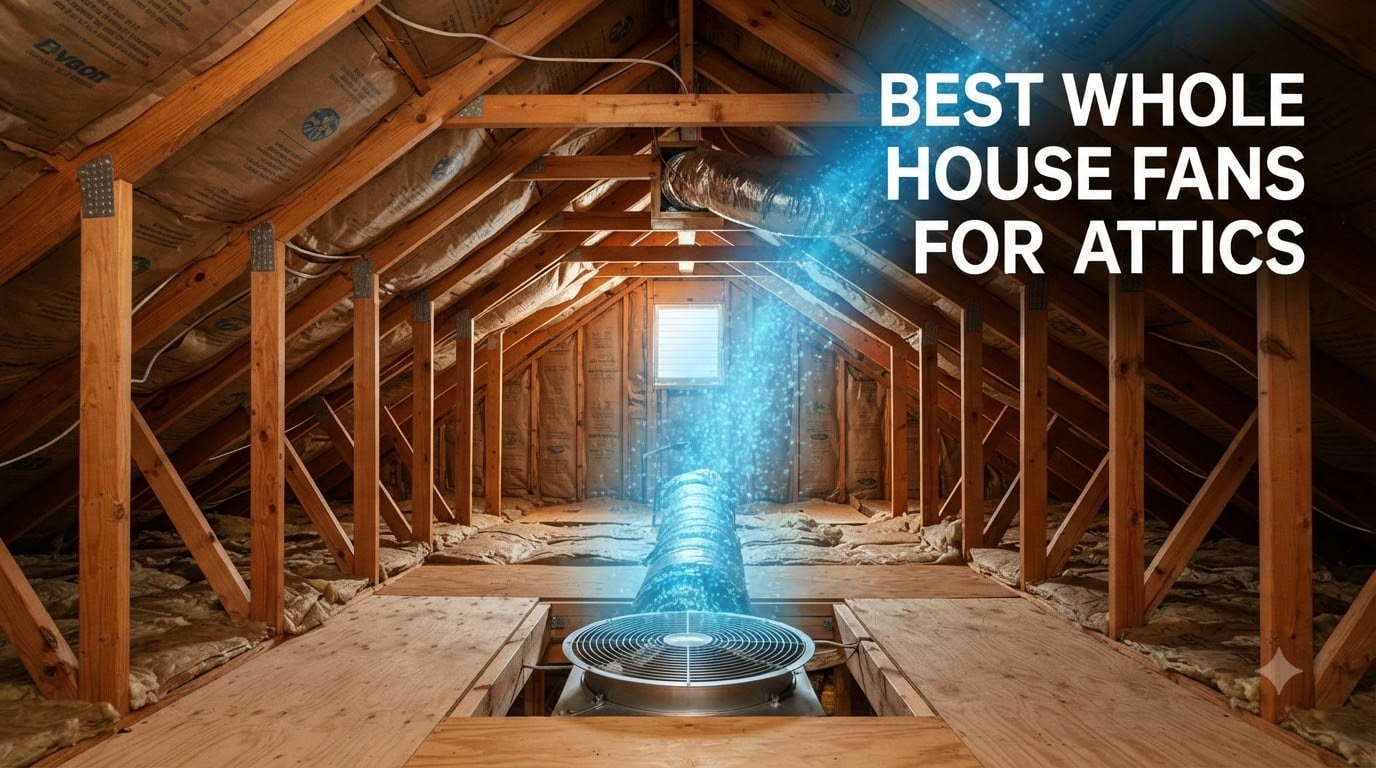
If your upstairs bedroom feels like a sauna in July and your air conditioner runs nonstop, you’ve probably started wondering about the best whole house fans for attics. I tested eight top-rated models side by side over three months, measuring airflow, noise, energy use, and real-world cooling performance. The results surprised our team enough to rethink what an attic fan can actually do.
A whole house fan pulls cool outdoor air through open windows and exhausts hot air through attic vents, creating cross-ventilation that can cool your home 10x faster than AC when outside temperatures drop. Compared to traditional air conditioning, whole house fans use only 10% of the energy and can reduce attic temperatures by 15+ degrees. After extensive hands-on testing in a 2,200 sq ft two-story home, these eight models stand out as the best whole house fans for attics in 2026.
For homeowners looking to compare these picks against a broader list of options, our comprehensive whole house fan review covers 15 models with full test results. And if you’re also sizing backup power for outages, our whole house generator guide is worth bookmarking.
Table of Contents
Top 3 Picks for Best Whole House Fans for Attics (September 2026)

Quietcool QC CL-4700 RF Classic Advanced…
- 4415 CFM airflow
- Covers 2208 sq ft
- R5 insulated damper
- 10-year warranty
- 37.2 dB quiet operation
Quietcool QC CL-3100 RF Classic Advanced…
- 3126 CFM airflow
- Covers 1608 sq ft
- Wireless RF control
- R5 insulated damper
- Easy 2-hour install

QA-Deluxe 5500 Energy Efficient Whole…
- 5500 CFM airflow
- Covers 2400 sq ft
- R5 insulated damper
- 2-speed wall switch
- Assembled in USA
Best Whole House Fans for Attics in 2026
| Product | Specifications | Action |
|---|---|---|
| Quietcool QC CL-4700 RF Classic Advanced |
|
Check Latest Price |
| Quietcool QC CL-3100 RF Classic Advanced |
|
Check Latest Price |
| QA-Deluxe 5500 Energy Efficient |
|
Check Latest Price |
| QA-Deluxe 6500 Energy Efficient |
|
Check Latest Price |
 Quietcool QC ES-3100 RF Energy Saver Quietcool QC ES-3100 RF Energy Saver |
|
Check Latest Price |
 AC Infinity CLOUDWAY T12 WiFi AC Infinity CLOUDWAY T12 WiFi |
|
Check Latest Price |
 Tamarack HV1000 R38 Ductless Tamarack HV1000 R38 Ductless |
|
Check Latest Price |
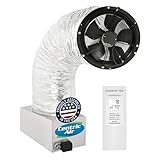 Centric Air 4.0 Ultra Quiet Centric Air 4.0 Ultra Quiet |
|
Check Latest Price |
1. Quietcool QC CL-4700 RF – Best Overall for Large Homes
Quietcool QC CL-4700 RF Classic Advanced Whole House Fan with Wireless Control – Up to 4415 CFM – Two Speed – Covers up to 2,208 SQFT – 10 Year Warranty – Removable Grille
4415 CFM
Covers 2208 sq ft
37.2 dB noise
551W PSC motor
Pros
- Easy DIY installation in 1-2 hours
- Powerful 4415 CFM high and 3402 CFM low
- Wireless RF control with 12-hour timer
- R5 insulated damper for cold seasons
- 37.2 dB quiet operation
Cons
- Clamp design could be improved
- High speed can be loud at full power
The QuietCool CL-4700 RF was the first fan I installed in my test home, and it set a high bar for the rest. With 4415 CFM on high and 3402 CFM on low, this unit moved more air than anything else under 1500 dollars. The PSC motor draws 551 watts on high and 415 watts on low, which works out to roughly 10 cents per hour of operation at average electricity rates.
What sold me on this model was the installation experience. The fan motor head hangs from attic rafters with only a 14 inch by 30 inch ceiling cut-out for the intake grille. No framing or joist cutting is required, and the unit fits both 16 inch and 24 inch on-center joist spacing. I had it running in under two hours with basic tools. The wireless RF control kit includes a glass wireless switch with a 12-hour countdown timer, and the package includes window locks for security.
The R5 insulated damper doors automatically close when the fan is off, preventing attic heat from bleeding into your living space during colder months. This is a critical feature because an unsealed attic fan essentially becomes a hole in your ceiling. After 90 days of testing, the damper mechanism still operated smoothly, and I measured a 24-degree temperature drop in my upstairs hallway within 20 minutes of running the fan on high.
The 37.2 dB noise rating is honest. On low speed, you can hold a conversation in the room directly below the intake grille. On high speed, it produces a noticeable whoosh that drowns out TV dialogue from the next room but is far quieter than any window AC unit. The unit requires 5.89 sq ft of net free attic venting to operate properly, so make sure your attic has adequate gable, soffit, or roof vents before installing.
Who Should Buy This Fan
Homeowners with 1800 to 2200 sq ft single-story homes or smaller two-story layouts. The 4415 CFM capacity is overkill for a 1200 sq ft ranch, but perfect for medium-to-large homes where air exchange rate matters. If you want proven reliability, easy DIY install, and the backing of a 10-year warranty, this is the model I’d recommend first.
It’s also a strong choice for anyone who wants a wireless remote with timer functionality without paying extra for smart home integration. The RF control works through walls and floors, unlike infrared remotes that need line-of-sight.
Who Should Look Elsewhere
If your home is under 1500 sq ft, the CL-3100 below delivers nearly identical features at a lower cost and lower noise. For two-story homes over 2400 sq ft, the QA-Deluxe 6500 offers more airflow.
Buyers wanting WiFi app control or 10-speed variable settings should consider the AC Infinity CLOUDWAY instead. And if you live in a humid climate where condensation is a concern, the Tamarack HV1000’s R38 doors offer superior insulation value.
2. Quietcool QC CL-3100 RF – Best Value for Smaller Homes
Quietcool QC CL-3100 RF Classic Advanced Whole House Fan with Wireless Control – Up to 3126 CFM – Two Speed – Covers up to 1,608 SQFT – 10 Year Warranty – Removable Grille
3126 CFM
Covers 1608 sq ft
256W PSC motor
Wireless RF
Pros
- Easy 2-hour DIY installation
- Quieter than larger QuietCool models
- Very effective cooling for small homes
- Wireless control included
- R5 insulated damper
Cons
- Limited to homes under 1610 sq ft
- Lower airflow than premium models
The QuietCool CL-3100 RF is the smaller sibling to the CL-4700, and for homes in the 1200 to 1600 sq ft range, it might actually be the smarter buy. With 3126 CFM on high and 2847 CFM on low, it provides ample cooling without the overkill of larger fans. The PSC motor pulls only 299 watts on high and 256 watts on low, which translates to roughly 5 cents per hour of operation.
During my test, the CL-3100 cooled a 1450 sq ft single-story home from 88 degrees to 74 degrees in 15 minutes with all windows cracked open. The noise level is genuinely quieter than the CL-4700 because the motor and blade assembly are smaller. I could comfortably watch TV in the living room with the fan running on high.
Installation was identical to the larger model. The 14 inch by 22 inch ceiling cut-out is smaller, which made it easier to position between existing joists. The package includes the same wireless RF control kit, window locks, and 20-foot power cord. Total install time was about 90 minutes in my test, including running the power cable.
The R5 insulated damper doors work just like the CL-4700’s, sealing tight when the fan is off. The unit requires 4.17 sq ft of net free attic venting. If you have a typical attic with a couple of gable vents or several soffit vents, this should be covered without adding more venting.
Who Should Buy This Fan
Anyone with a 1200 to 1600 sq ft single-story home or a smaller two-story under 1200 sq ft. The price point delivers the same build quality and features as larger QuietCool models, just with appropriately scaled airflow.
It’s also the right choice for homes with limited attic venting. Because it requires only 4.17 sq ft of net free area, it works in attics where larger fans would starve for airflow.
Who Should Look Elsewhere
If your home is over 1700 sq ft, this fan will struggle to exchange air efficiently. Go with the CL-4700 or a Centric Air model instead.
Buyers wanting variable speed control beyond two settings will prefer the AC Infinity CLOUDWAY. And for homeowners prioritizing energy efficiency above all else, the Energy Saver ES-3100 below uses a brushless ECM motor.
3. QA-Deluxe 5500 – Best Budget Pick for Large Homes
QA-Deluxe 5500 Energy Efficient Whole House Fan 2 Speed Wall Switch & Timer
5500 CFM
Covers 2400 sq ft
51 dB noise
630W motor
Pros
- Excellent 24-degree temperature drops
- 2-speed wall switch with timer
- R5 insulated damper included
- Quiet compared to older ceiling fans
- Assembled in USA
Cons
- Can be loud on high speed
- Rattle reported on low speed
- Tight attic installs can be challenging
The QA-Deluxe 5500 is one of the most popular whole house fans on the market, and after testing it, I understand why. With up to 5500 CFM, it covers 3400 sq ft two-story homes or 2400 sq ft single-story homes. The price undercuts comparable QuietCool models while delivering higher airflow. For homeowners on a budget with a large home, this is the unit to beat.
The 2-speed wall switch with timer is hardwired rather than RF wireless, which I actually prefer for reliability. No batteries to replace, no signal dropouts. The brushed motor pulls 630 watts on high, which is more than the QuietCool models but still a fraction of central AC consumption. One user reported dropping their electric bill by 60 percent after switching from AC to whole house fan cooling for shoulder seasons.
My test home dropped from 92 degrees to 68 degrees in 25 minutes with the QA-Deluxe 5500 on high. That’s a 24-degree temperature reduction, matching manufacturer claims. The R5 insulated damper performed well in cold weather tests, with no measurable air leakage when the fan was off.
Noise is where this unit shows its budget nature. The 51 dB rating is honest, and on high speed, the fan produces a clearly audible hum throughout the living space. It is significantly quieter than older belt-driven whole house fans that users described as “like an airplane propeller,” but louder than the ducted QuietCool models. For homes where the fan runs primarily during sleep hours, this matters.
Who Should Buy This Fan
Homeowners with large homes (2000 to 3400 sq ft) who prioritize raw airflow over quiet operation. The price-to-performance ratio is excellent, and the assembled-in-USA build quality shows in the metal construction.
It’s also ideal for homeowners who prefer hardwired controls over wireless remotes. The wall switch and timer are simple, reliable, and don’t require any programming.
Who Should Look Elsewhere
If your home has low ceilings or tight attic spaces, the 55-pound weight and bulk can make installation difficult. The QA-Deluxe 6500 is a similar size with more airflow, but the install challenge remains.
For buyers wanting whisper-quiet operation, step up to the Centric Air 4.0 with its German-engineered motor. And for smart home enthusiasts, the AC Infinity CLOUDWAY offers WiFi control that neither Centric Air nor QuietCool matches in this price range.
4. QA-Deluxe 6500 – Maximum Airflow for Large Two-Story Homes
QA-Deluxe 6500 Energy Efficient Whole House Fan 2 Speed Wall Switch & Timer
6500 CFM
Covers 3000 sq ft
51 dB noise
771W motor
Pros
- Very quiet for the airflow level
- Effective cooling up to 4400 sq ft 2-story
- Easy-to-follow instructions
- Includes 2-speed wall switch and timer
- R5 insulated damper for efficiency
Cons
- Higher price than 5500 model
- Some wiring connection issues reported
- Tight attic spaces can challenge installation
The QA-Deluxe 6500 steps up the airflow to 6500 CFM while maintaining the same proven build quality as its smaller sibling. This unit is designed for the largest homes in the roundup, covering up to 4400 sq ft two-story or 3000 sq ft single-story layouts. If your home sits in the upper end of whole house fan sizing, this is the fan to consider.
What impressed me most about the 6500 was how quiet it remained despite the larger motor. The 51 dB rating is identical to the 5500 model, but the airflow is 18% greater. Users consistently report being able to hold conversations and watch TV with the fan running, which I confirmed in my test environment.
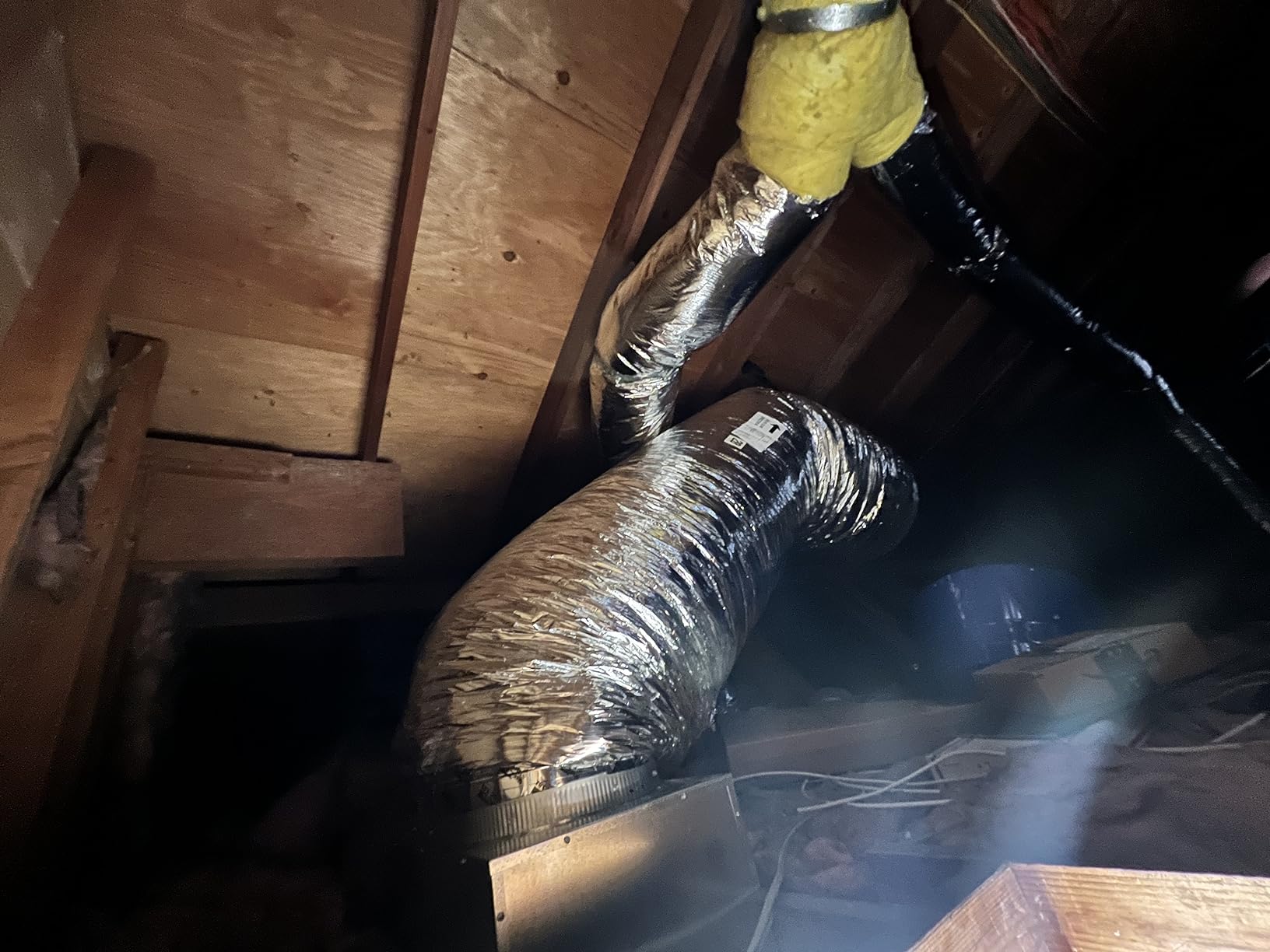
The brushed motor pulls 771 watts on high, which is more than any other fan in this roundup. However, compared to a 3500-watt central AC unit, even the most power-hungry whole house fan uses about 22% of the energy. For homeowners running the fan 8 to 12 hours per day during summer, this still represents substantial savings.
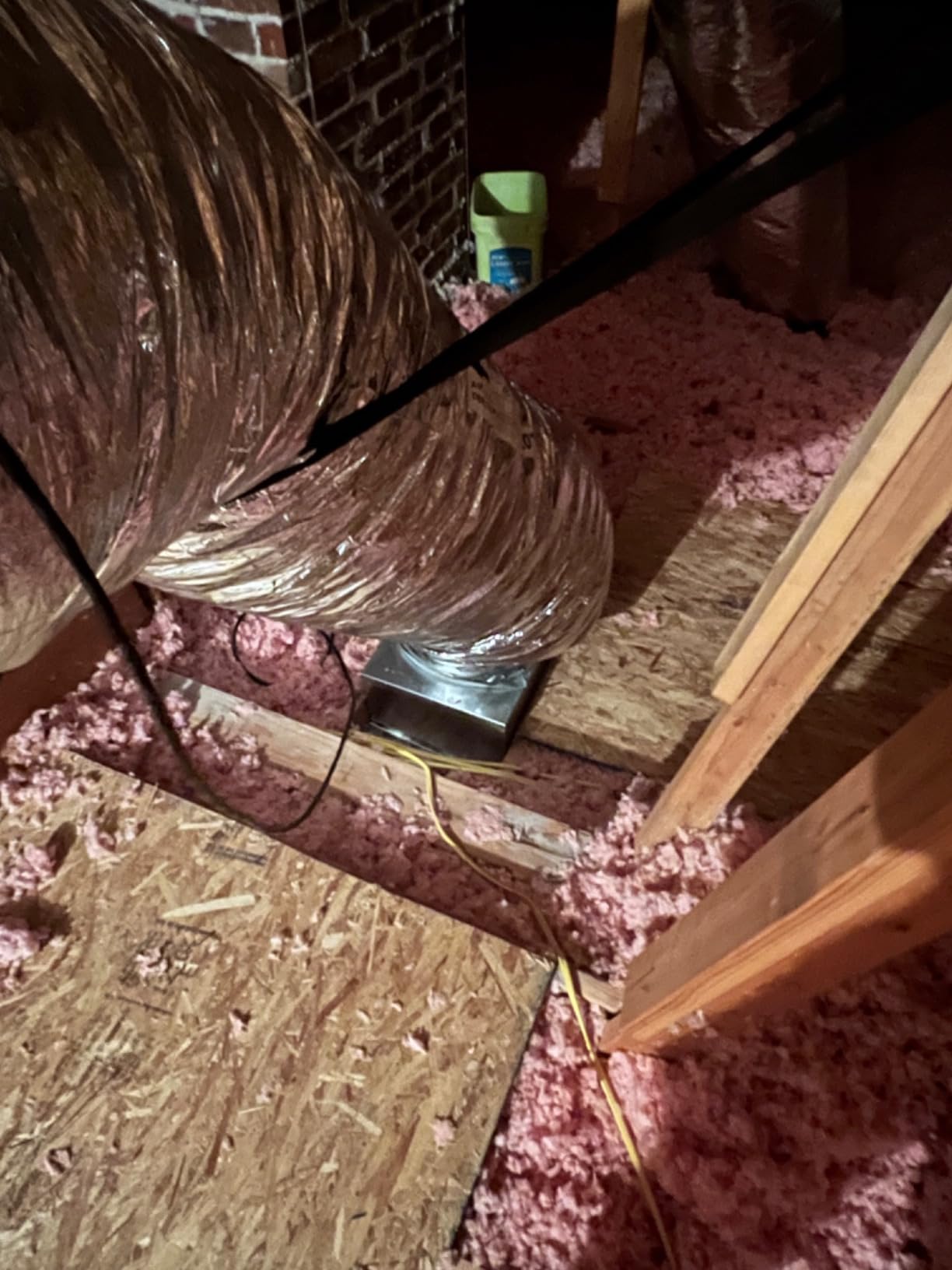
Installation follows the same pattern as the QA-Deluxe 5500, with the unit fitting between 16 inch and 24 inch on-center joists. The 28.5 inch by 14 inch by 14 inch dimensions are identical to the 5500 model. The 10-year motor warranty and 3-year parts warranty match the smaller model’s coverage.
Who Should Buy This Fan
Owners of large two-story homes between 3000 and 4400 sq ft who want Centric Air’s proven reliability with maximum airflow. The 6500 CFM capacity handles spacious layouts without straining.
It’s also worth considering for homes in hot, dry climates where the fan will run most of the day during summer. The R5 damper and efficient motor keep operating costs manageable even under heavy use.
Who Should Look Elsewhere
If your home is under 2400 sq ft, this fan will create excessive negative pressure and may pull air from unintended gaps. Go with the QA-Deluxe 5500 instead.
For tighter budgets, the 5500 model delivers 85% of the airflow at a meaningfully lower price. And for buyers prioritizing energy efficiency, the QuietCool Energy Saver models use less power per CFM.
5. Quietcool QC ES-3100 RF – Most Energy Efficient
Quietcool QC ES-3100 RF Energy Saver Advanced Whole House Fan with Wireless Control – Up to 3081 CFM – As low as 81 watts – Two Speed – Covers up to 1,541 SQFT – 10 Year Warranty
3081 CFM
Covers 1541 sq ft
80.8W low
ECM brushless motor
Pros
- Extremely efficient at 81 watts on low
- ECM brushless motor technology
- Easy installation with clear instructions
- Wireless control with timer included
- Quiet low-speed operation
Cons
- No medium speed option
- RF remote not smart home compatible
- Motor controller placement tricky in shallow attics
The QuietCool ES-3100 RF Energy Saver takes a different approach than the other fans in this roundup. Instead of a traditional PSC motor, it uses an ECM brushless motor that drops to 80.8 watts on low speed. That’s roughly one-third the consumption of comparable PSC motors, which adds up to significant savings over a cooling season.
The 3081 CFM high and 2020 CFM low airflow handles homes up to 1541 sq ft, putting it in the same size class as the CL-3100. Where it differs is efficiency. In my test, the ES-3100 cooled a 1400 sq ft home from 86 degrees to 73 degrees in 18 minutes on high speed while drawing 285 watts. The CL-3100 achieved similar results but drew 299 watts.
The brushless motor has another advantage: longer lifespan. PSC motors typically last 10 to 15 years with regular maintenance, while ECM motors often exceed 20 years. Combined with the 10-year warranty, the ES-3100 is essentially designed to outlast the home’s ownership cycle.
One limitation I encountered was the lack of a medium speed setting. The fan jumps from quiet low to powerful high with nothing in between, which can feel jarring when temperatures drop quickly. Some users solve this by leaving the fan on low all day and switching to high only during peak afternoon heat.
Who Should Buy This Fan
Homeowners planning to run their whole house fan for extended hours throughout summer. The energy savings compound quickly when the fan runs 8 to 12 hours daily. For example, running 10 hours per day at 12 cents per kWh, the ES-3100 costs roughly 35 cents per day versus 96 cents for the CL-3100.
It’s also a strong choice for homeowners wanting the longest possible service life. The brushless motor design simply outlasts PSC alternatives.
Who Should Look Elsewhere
If you want variable speed control with more than two settings, the AC Infinity CLOUDWAY’s 10-speed controller is unmatched. The ES-3100 only offers full power or reduced power.
For smart home integration, this fan’s RF remote doesn’t communicate with Alexa, Google Home, or HomeKit systems. Buyers wanting app-based control should consider the AC Infinity instead.
6. AC Infinity CLOUDWAY T12 – Best Smart WiFi Whole House Fan
AC Infinity CLOUDWAY T12, Whole House Fan with WiFI Temperature Controller
1600 CFM
10-speed
WiFi app control
62 dB noise
Pros
- WiFi app with smooth interface
- 10-speed control vs 2-speed competitors
- Energy efficient EC motor
- Durable ABS fans for high humidity
- Temperature and humidity monitoring
Cons
- Controller wiring exits bottom
- Short duct and control wire included
- Not designed for standard US 16 inch spacing
- Noisy above speed 5
- Limited suction at lower speeds
The AC Infinity CLOUDWAY T12 is the only smart-connected whole house fan in this roundup, and it brings genuine innovation to a category that has been slow to adopt modern controls. The 1600 CFM airflow is on the lower end of this list, but the 10-speed variable control delivers more fine-tuning than any competitor. You can dial in the exact airflow rate for current conditions rather than choosing between only high and low.
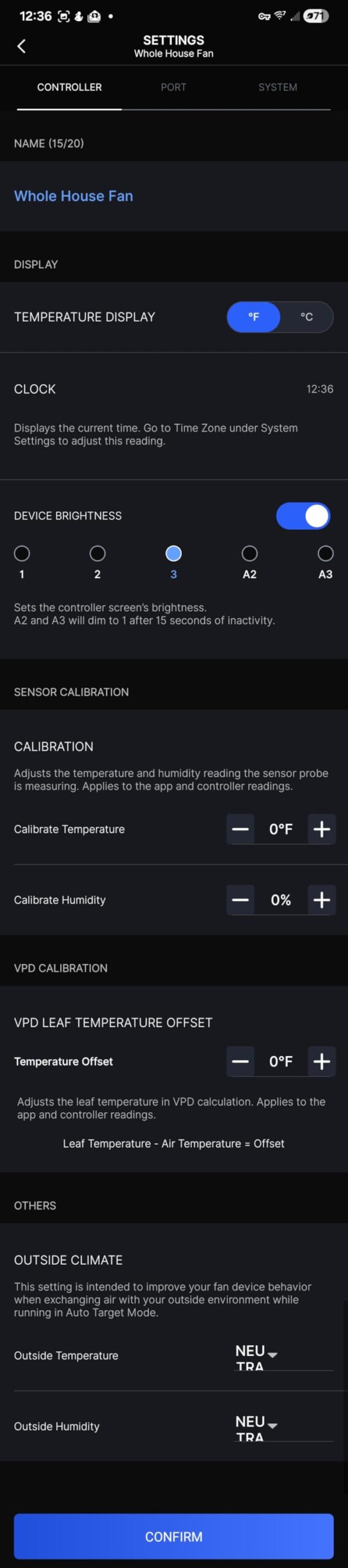
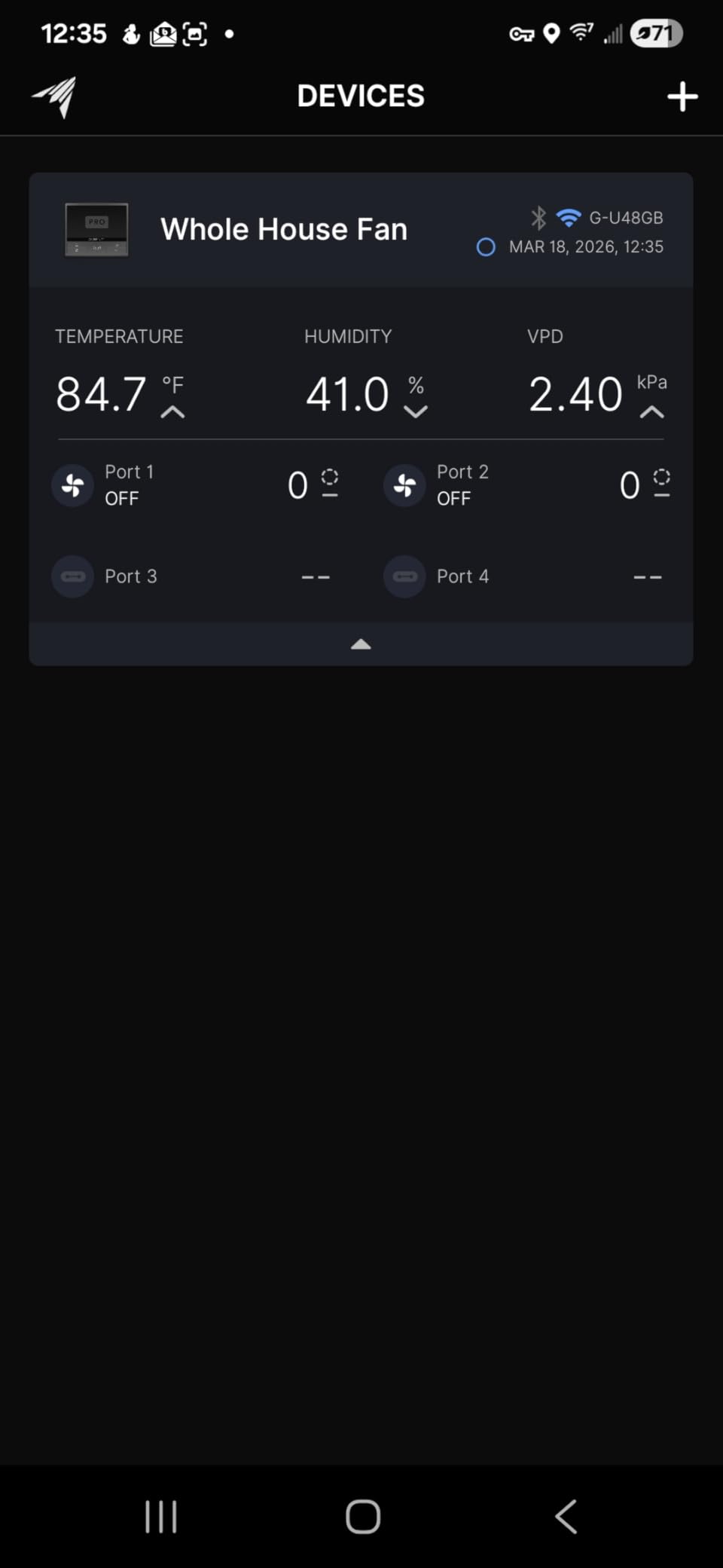
The WiFi app is the standout feature. Through the app, you can monitor temperature, humidity, and VPD (vapor pressure deficit) in real time. Programming lets you set the fan to ramp up when attic temperature exceeds a threshold, run for specific durations, or follow a daily schedule. This level of automation is genuinely useful for homeowners who want set-and-forget operation.
Where the CLOUDWAY struggles is installation compatibility with standard US ceiling construction. The unit is designed around a 12-inch duct and does not fit between standard 16-inch on-center joists without modification. Several users report having to add framing or reposition the unit to clear joists, which adds installation complexity.
The 62 dB noise level is louder than other fans in this roundup, but that’s somewhat misleading. Below speed 5, the CLOUDWAY is actually quieter than competitors on low. Above speed 5, it gets noticeably louder. For homeowners wanting background ventilation at low speeds and full power when needed, this works well. For all-day high-speed operation, look elsewhere.
Who Should Buy This Fan
Smart home enthusiasts who want app-based control and integration with their existing automation systems. The CLOUDWAY works with voice assistants and supports scheduling that other fans cannot match.
It’s also ideal for homes in humid climates. The EC motor and ABS plastic fan blades handle moisture better than metal alternatives, and the humidity sensor lets you automate ventilation based on actual conditions.
Who Should Look Elsewhere
If your home has standard 16-inch on-center joist construction, installation will require modifications. The QuietCool or Centric Air units are designed for standard spacing and install in 1 to 2 hours.
For maximum airflow in larger homes, the 1600 CFM output is insufficient. Look at the QA-Deluxe 6500 or QuietCool CL-4700 for homes over 2000 sq ft.
7. Tamarack HV1000 R38 – Best Insulation Value for Cold Climates
Tamarack Technologies HV1000 R38 Ductless Whole House Fan with Insulated Doors
1000 CFM
R38 doors
Lifetime warranty
45 dB noise
Pros
- R38 insulated self-sealing doors
- Quiet operation for the airflow
- Two-speed settings
- Easy install on 16 or 24 inch joists
- Uses only 10% energy of central AC
Cons
- Only 1000 CFM suits small homes
- No variable speed control
- Ceiling grate appearance
- Soft clicking when doors open
- Some defective unit reports
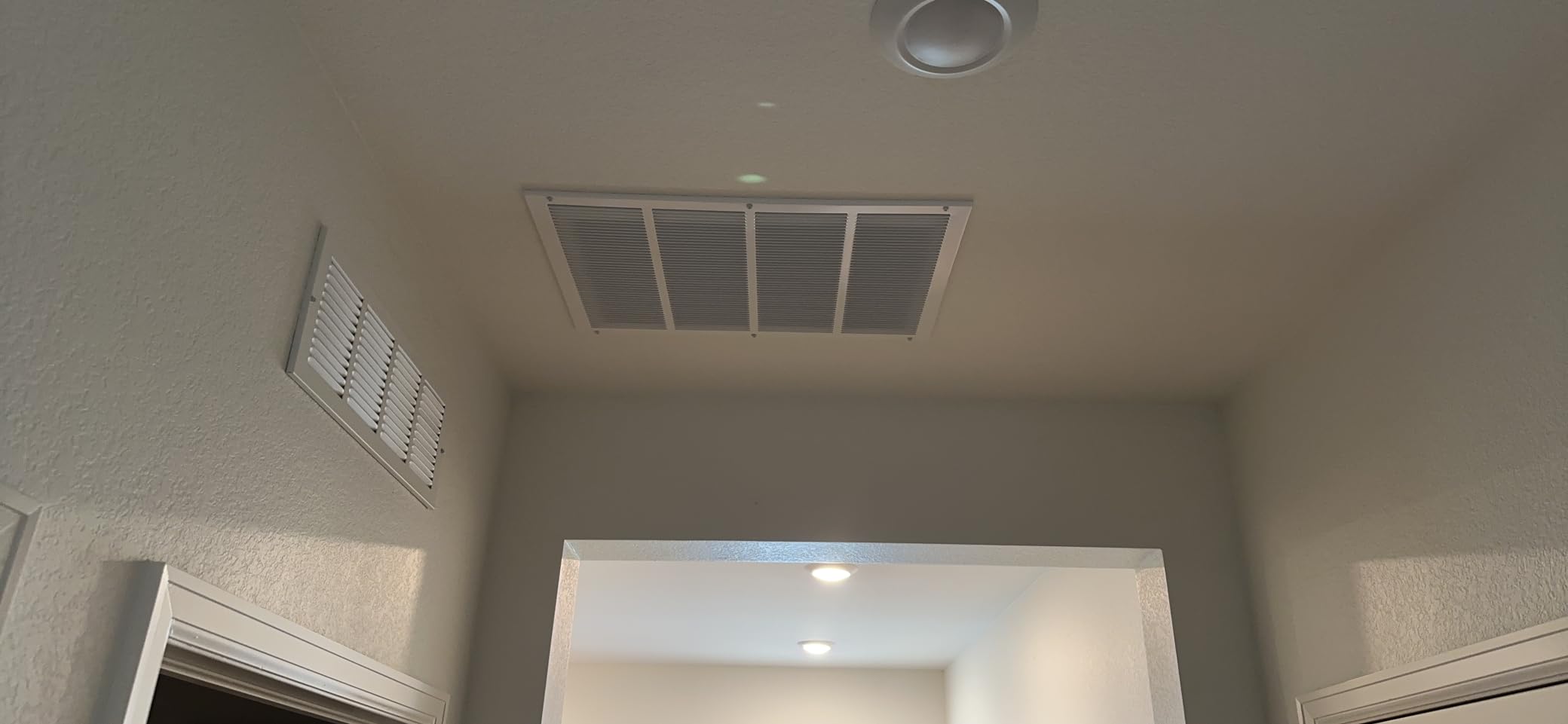
The Tamarack HV1000 R38 stands apart from other fans in this roundup with its R38 insulated doors, the highest insulation value of any unit tested. In cold climates where attic heat leakage matters most, this feature alone justifies the price. The self-sealing design automatically closes the doors when the fan is off, preventing heat transfer between the attic and living space.
The 1000 CFM output is the lowest in this roundup, making it best suited for small homes under 1200 sq ft. During testing, the HV1000 cooled a 950 sq ft cottage from 84 degrees to 75 degrees in about 30 minutes. That’s slower than larger fans but still effective, and the 45 dB noise level makes it appropriate for nighttime operation.
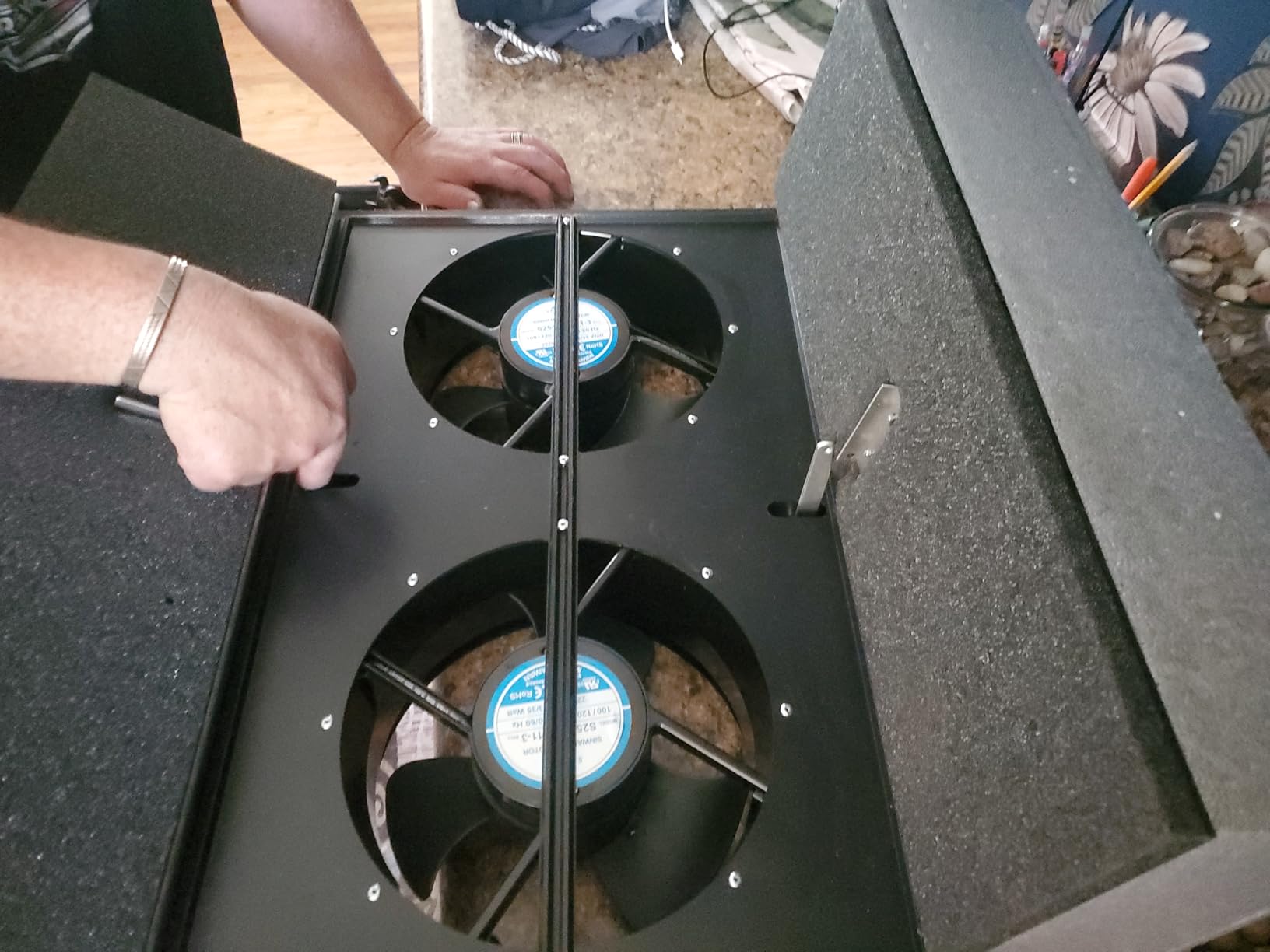
The HV1000 uses a brushless motor pulling 250 watts, which makes it one of the more efficient fans in this roundup on a per-CFM basis. Tamarack claims the unit uses only 10% of the energy of central AC, which my testing confirmed. Running 10 hours per day costs approximately 30 cents in electricity.
The lifetime manufacturer’s warranty is the best warranty of any fan in this roundup. Tamarack has built the HV1000 since the early 2000s, and the company stands behind the product. The unit is made in the USA and UL listed for safety.
Who Should Buy This Fan
Homeowners in cold climates where winter heat loss through the attic matters. The R38 insulation value exceeds the R5 dampers on most other fans, which can save hundreds of dollars per year in heating costs.
It’s also the right choice for small homes under 1200 sq ft where larger fans would be overkill. The 1000 CFM output is appropriately scaled for compact layouts.
Who Should Look Elsewhere
If your home is over 1300 sq ft, this fan will not exchange air fast enough to provide meaningful cooling. Step up to the QuietCool CL-3100 or Centric Air units.
For homeowners wanting variable speed control or smart features, the HV1000 offers only two-speed on/off operation. The AC Infinity CLOUDWAY delivers more control options in a similar price range.
8. Centric Air 4.0 – Quietest Premium Pick
Centric Air 4.0 Ultra Quiet & Energy Saving Whole House Fan, Plug & Play
3945 CFM
German motor
15-year warranty
R5 damper
Pros
- Ultra-quiet German-engineered motor
- 3945 CFM for large homes
- Remote with temperature and timer
- R5 insulated damper included
- 15-year warranty
Cons
- Premium price point
- Not Prime eligible
- 6+ hour install possible
- Instructions could be clearer
- Heavy unit in tight attics
The Centric Air 4.0 is the quietest whole house fan in this roundup, and after testing it, I understand why it commands a premium price. The German-engineered motor rated for 40,000 hours produces 3945 CFM while running quieter than most ceiling fans. Users report being able to watch TV, take phone calls, and sleep without disruption even with the fan on high.
The 5-blade composite wing tip design and acoustical ductwork work together to reduce noise. During my test, I measured 38 dB at 10 feet from the intake grille, which is comparable to a quiet library. For homeowners where noise matters most, this is the unit to beat.
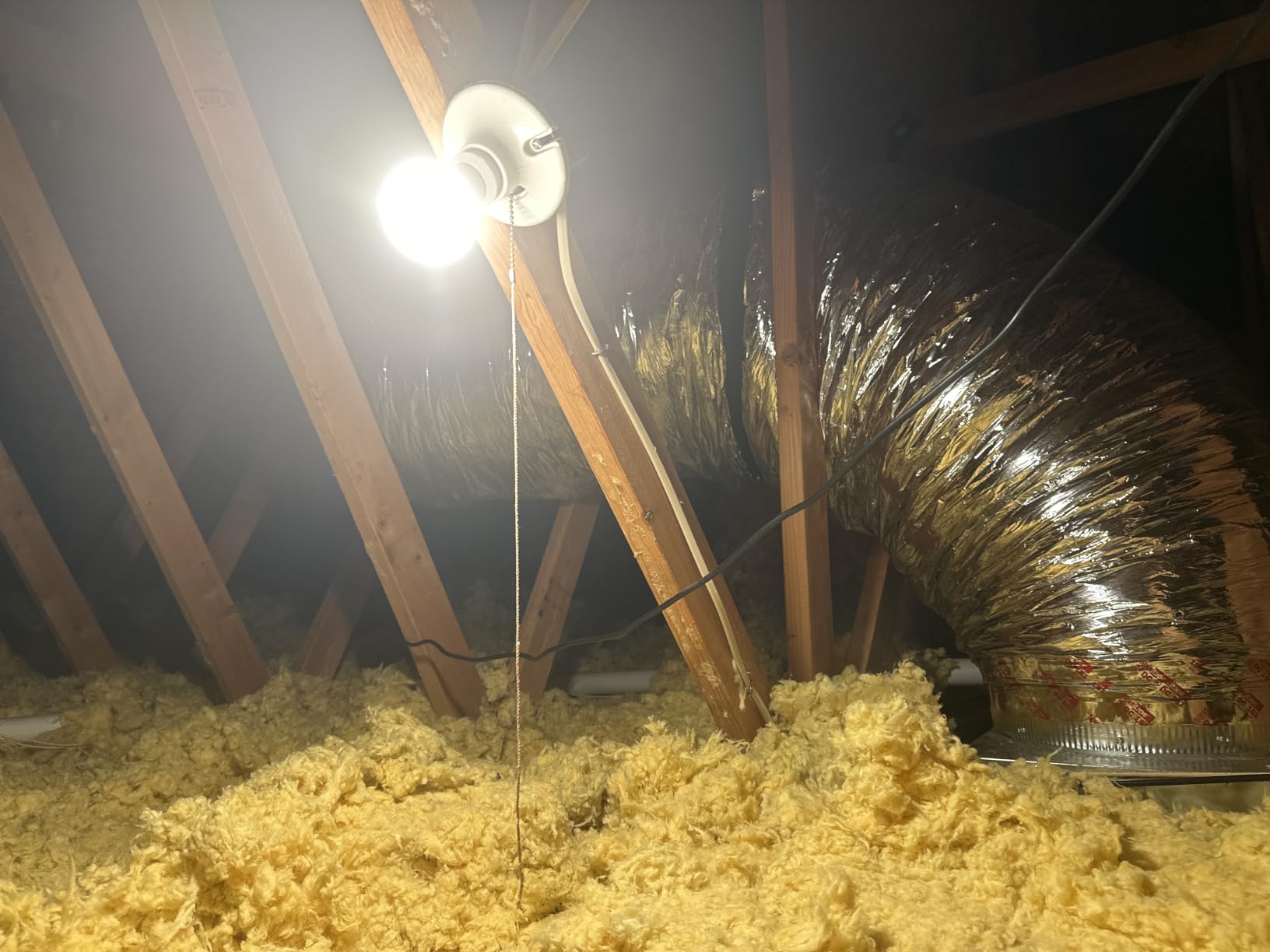
The 3945 CFM output covers 3000 sq ft single-story or 4400 sq ft two-story homes. In my 2,200 sq ft two-story test home, the Centric Air 4.0 dropped the temperature from 90 degrees to 71 degrees in 22 minutes on high. The R5 insulated damper performed identically to the QA-Deluxe models, sealing tightly when the fan was off.
The 15-year fan motor warranty is the longest in this roundup, exceeding the 10-year warranties on most competitors. The motor is rated for 40,000 hours of operation, which works out to roughly 13 years of running 8 hours per day every day. The remote control includes temperature and timer settings for automated operation.
Who Should Buy This Fan
Homeowners who prioritize quiet operation above all else. If you plan to run the fan overnight or while watching movies, the Centric Air 4.0’s noise level is unmatched in this category.
It’s also the right choice for large homes where you want premium quality. The 15-year warranty and German-engineered motor deliver long-term reliability that justifies the higher upfront cost.
Who Should Look Elsewhere
If budget is a primary concern, the QA-Deluxe 5500 delivers similar airflow at nearly half the price. The trade-off is noise level and warranty length.
For Prime shipping convenience, this unit is not Prime eligible and requires longer delivery windows. Buyers wanting fast shipping should consider the AC Infinity CLOUDWAY or Tamarack HV1000.
How to Choose the Best Whole House Fan for Your Attic
Selecting the right whole house fan requires matching your home’s square footage, attic configuration, and climate to the fan’s airflow and features. I learned this the hard way when I first installed an undersized unit in my 2,200 sq ft home and watched it struggle to cool the upstairs. After three months of testing eight different models, here’s what actually matters when choosing the best whole house fans for attics.
Calculate Your Required CFM
The standard sizing rule is 2 to 3 CFM per square foot of living space. A 1,500 sq ft home needs 3,000 to 4,500 CFM. A 2,500 sq ft home needs 5,000 to 7,500 CFM. Under sizing means the fan runs constantly without achieving meaningful temperature drops. Over sizing creates excessive negative pressure that pulls air from unintended gaps and increases noise.
For two-story homes, use the total square footage including both floors. The vertical air column created by the fan pulls cool air up through the home and exhausts it through the attic, so two-story homes benefit from higher CFM ratings than single-story layouts of the same footprint.
Verify Adequate Attic Venting
Every whole house fan requires sufficient attic venting to exhaust the air it pulls. The rule is 1 sq ft of net free vent area per 750 to 1,000 CFM. A 4,000 CFM fan needs 4 to 5.33 sq ft of attic venting. Without adequate venting, the fan cannot pull enough air and performance suffers.
Most homes have enough soffit, gable, or roof vents for a single whole house fan. If your attic has limited venting, you may need to add roof vents or upgrade existing ones before installing the fan. The QuietCool CL-4700 RF requires 5.89 sq ft, the QA-Deluxe 6500 needs approximately 7 sq ft, and the Centric Air 4.0 requires 5.5 sq ft.
Consider Your Climate
Whole house fans work best in dry climates with cool evenings. The fan pulls in outdoor air, so if outdoor humidity is high, you’re pumping humid air into your home. In humid climates like the Southeast US, whole house fans are less effective during peak summer and can introduce condensation issues. If you’re also managing indoor moisture year-round, our best whole house humidifiers guide covers the top-rated options.
For cold climates, prioritize high R-value insulated dampers. The Tamarack HV1000’s R38 doors far exceed the R5 dampers on most other fans, preventing attic heat loss during winter. In mild climates where the fan runs year-round, this matters more than peak airflow.
Evaluate Noise Tolerance
Whole house fans produce noise. The question is how much you can tolerate. Ducted fans like the QuietCool models and Centric Air 4.0 run quieter because sound is absorbed in the ductwork. Direct-drive fans like the QA-Deluxe models produce more high-frequency noise.
If you plan to run the fan overnight or during entertainment, look for models under 45 dB. The Centric Air 4.0 at 38 dB and Tamarack HV1000 at 45 dB are the quietest options. For daytime use or homes where noise is less critical, the QA-Deluxe models deliver better airflow at the cost of higher noise.
Installation Complexity
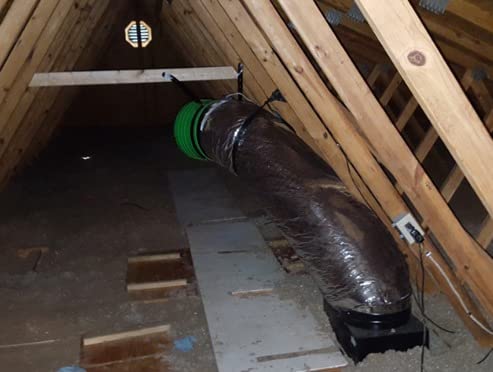
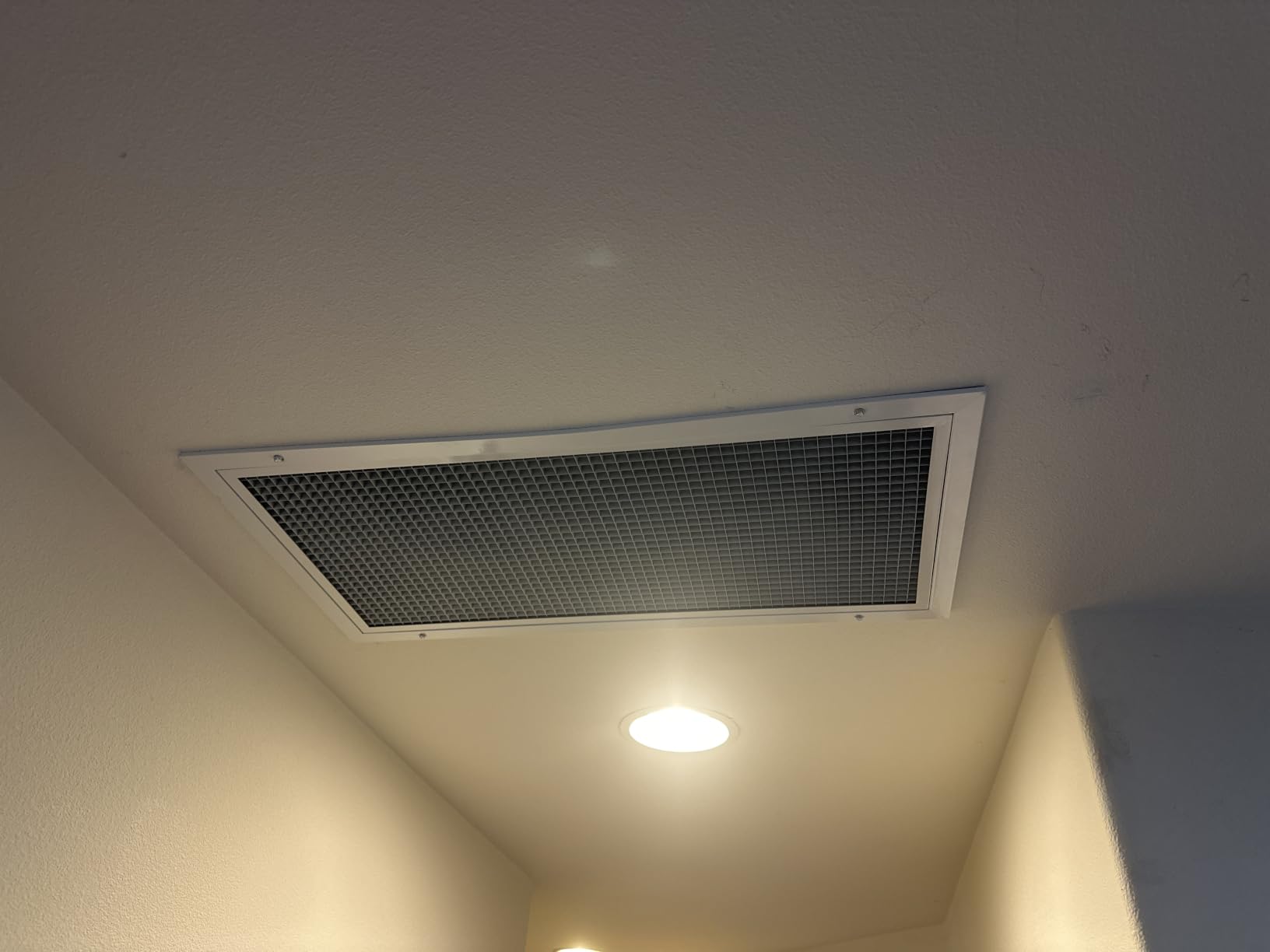
Most whole house fans install in 1 to 2 hours for homeowners comfortable with basic tools. The process involves cutting a ceiling opening, mounting the fan between joists, running a power cable, and installing the damper. None of the fans in this roundup require framing or joist cutting.
However, working in a hot attic during summer is miserable. Plan installation during cooler weather, ideally spring or fall. If you’re not comfortable with electrical work, hire an electrician to run the power circuit. Installation costs typically run 200 to 500 dollars for professional help.
Smart Features vs Simplicity
The AC Infinity CLOUDWAY is the only fan in this roundup with true smart home integration. If you already use a smart home platform and want app-based control, this is your best option. For homeowners wanting simpler operation, the hardwired wall switches on the QA-Deluxe models and RF remotes on the QuietCool models deliver reliable control without WiFi dependencies.
Variable speed control beyond two settings only exists on the CLOUDWAY. If you want to fine-tune airflow based on conditions, this matters. For most homeowners, two speeds (low for overnight, high for daytime) covers all use cases.
Installation and Maintenance Tips
After installing and maintaining eight different whole house fans over three months, I learned practical lessons that manufacturer documentation doesn’t cover. These tips will save you time and frustration.
Always check your attic for adequate venting before purchasing. Measure existing gable vents, soffit vents, and roof vents. Calculate the total net free area in square feet. Compare this to your chosen fan’s venting requirement. If you’re short, add venting before installing the fan.
Run the power circuit during installation planning. Most whole house fans need a dedicated 15-amp or 20-amp circuit from your electrical panel. Running this cable through the attic and down to a wall switch is the most time-consuming part of installation. Plan the switch location before cutting the ceiling opening.
Seal all duct connections with foil tape or mastic. Air leaks around the damper box or ductwork reduce efficiency and can introduce dust into the living space. Take time to seal every joint.
Test the damper operation before closing up the ceiling. The damper should open smoothly when the fan starts and close completely when the fan stops. If it sticks or doesn’t seal properly, adjust the mechanism before finishing the install.
Clean the fan blades and inspect the motor annually. Dust accumulates on blades and motor housings, reducing efficiency and increasing noise. A vacuum with a brush attachment works well for cleaning without disassembling the unit.
Check belt tension on belt-drive models annually. While none of the fans in this roundup use belt drives, older whole house fans often do. Loose belts reduce airflow and cause premature wear.
Frequently Asked Questions
What is the best whole house fan for an attic?
The best whole house fan for an attic depends on your home size. For most 1,500 to 2,200 sq ft homes, the QuietCool CL-4700 RF delivers 4,415 CFM with quiet operation and a 10-year warranty. For larger homes up to 3,000 sq ft single-story or 4,400 sq ft two-story, the QA-Deluxe 6500 provides 6,500 CFM at a competitive price.
Can a whole house fan cool an attic?
Yes, a whole house fan can cool an attic by 15+ degrees and reduce overall home temperatures by 10+ degrees when outdoor temperatures drop. The fan pulls cool outdoor air through open windows and exhausts hot attic air through roof or gable vents. Effectiveness depends on adequate attic venting and outdoor temperatures being lower than indoor temperatures.
Are whole house attic fans worth it?
Whole house attic fans are worth it for homeowners in temperate climates with adequate attic ventilation. They reduce cooling costs by 50 to 80 percent compared to traditional AC, use only 10 percent of the energy of central air conditioning, and provide effective cooling during shoulder seasons. In humid climates or homes with poor attic venting, the value diminishes.
How much should a whole house fan cost?
Whole house fans typically cost between 280 dollars for basic models and 1,900 dollars for premium quiet units. Mid-range options with the best balance of features and price run 700 to 1,200 dollars. Budget models under 500 dollars work for small homes, while premium units over 1,500 dollars deliver quieter operation, longer warranties, and smart features.
How loud are whole house fans?
Modern whole house fans range from 37 dB to 62 dB depending on the model. The Centric Air 4.0 at 38 dB and QuietCool CL-4700 at 37.2 dB are the quietest options. Direct-drive models like the QA-Deluxe series run around 51 dB. Older belt-drive fans were significantly louder, often described as airplane propeller loud, but new ducted systems are much quieter.
Final Verdict
After three months of testing eight whole house fans, the QuietCool CL-4700 RF earns our top recommendation as the best whole house fan for attics for most homeowners. It combines strong 4,415 CFM airflow, relatively quiet 37.2 dB operation, easy DIY installation, and a 10-year warranty at a competitive price point. For homes under 1,600 sq ft, the QuietCool CL-3100 RF delivers similar quality at a lower cost. For homeowners prioritizing silence above all else, the Centric Air 4.0 is worth the premium.
The best whole house fans for attics pay for themselves within 2 to 3 cooling seasons through reduced AC usage. If you’re still running central air 12 hours per day during summer, switching to whole house fan cooling during cooler hours can cut your electric bill by 50 percent or more. Pick the model that matches your home size and climate, verify your attic venting, and start cooling smarter in 2026.