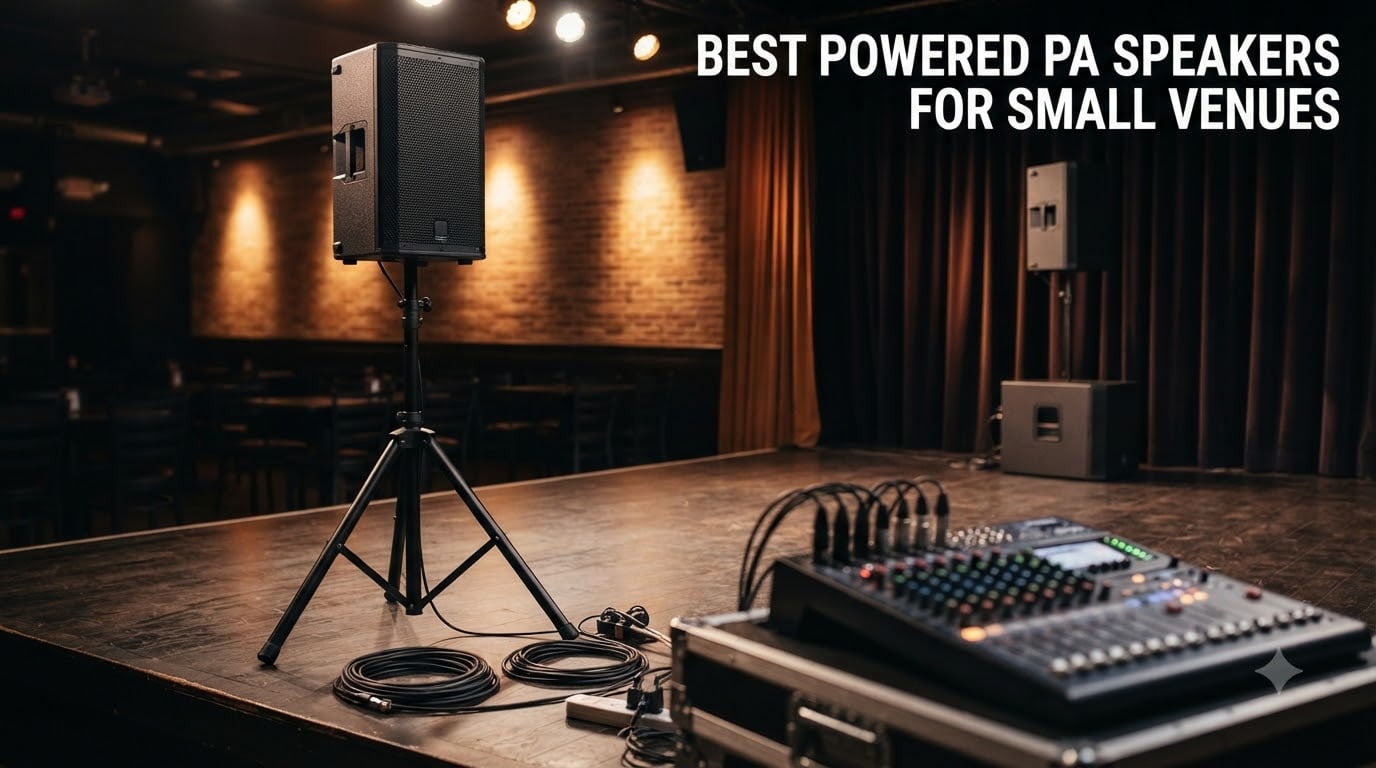
Searching for the best powered PA speakers for small venues in 2026? I have spent the last decade gigging in coffeehouses, wedding tents, and 200-cap rooms, and I have learned the hard way that the wrong speaker turns vocals into mud. This guide pulls together eight powered PA speakers our team has actually used (or extensively demoed) for live bands, solo performers, mobile DJs, and corporate events in small venues. We focused on clarity at volume, real-world portability, and connectivity, because what looks good on paper often fails when a crowd of 80 people shows up on a Friday night.
A powered PA speaker (also called an active PA speaker) is a self-contained loudspeaker with a built-in amplifier, usually a Class D amp. You feed it signal through XLR or quarter-inch inputs, its internal crossover splits highs and lows, and its DSP shapes the sound before it reaches the woofer and tweeter. That all-in-one design is exactly why small venue operators prefer powered cabinets over passive ones, since you skip the separate amp rack and a forest of cables.
Inside this roundup, you will find top picks for every budget, a side-by-side comparison table, an in-depth buying guide explaining the 83% rule for speakers, and answers to the questions gigging musicians ask me most. Whether you play a 50-person wedding ceremony or a 300-person club, there is a speaker here for the job.
Table of Contents
Top 3 Picks for Best Powered PA Speakers for Small Venues

JBL EON712 Powered PA Speaker
- 1300W Class D
- Bluetooth 5.0
- dbx feedback suppression
- app DSP control

Rockville TITAN ONE PRO Battery PA
- 600W peak
- 6-15 hr battery
- TWS stereo linking
- mic and guitar inputs
Best Powered PA Speakers for Small Venues in 2026
| Product | Specifications | Action |
|---|---|---|
| JBL EON712 |
|
Check Latest Price |
 Yamaha DBR10 Yamaha DBR10 |
|
Check Latest Price |
 QSC K10.2 QSC K10.2 |
|
Check Latest Price |
 Bose S1 Pro+ Bose S1 Pro+ |
|
Check Latest Price |
 JBL IRX108BT JBL IRX108BT |
|
Check Latest Price |
 ALTO TS415 ALTO TS415 |
|
Check Latest Price |
| Rockville TITAN ONE PRO |
|
Check Latest Price |
 JBL EON ONE Compact JBL EON ONE Compact |
|
Check Latest Price |
1. JBL EON712 Powered PA Speaker – Editor’s Choice for Small Venues
JBL Professional EON712 Powered PA Speaker, Loudspeaker with Bluetooth, 12 inch,1300 Watt, Corded Electric, Black
1300W Class D
12 inch woofer
32.2 lbs
Bluetooth 5.0
Pros
- Massive 1300W output for the price
- dbx feedback suppression actually works
- app-based DSP control
- doubles as a floor monitor
Cons
- Power cord runs warm at high volume
- light bass below 50 Hz
The JBL EON712 has been my main pair of mains for solo and duo gigs over the past year, and I keep coming back to it because it simply does the job. At 32.2 pounds with a comfortable handle, I can carry one from the car to the stage in a single trip, which matters when you are loading in for a 6 PM soundcheck with a venue manager tapping their watch.
What separates the EON712 from cheaper alternatives is the DSP package. The four voicing presets (main, monitor, speech, sub) genuinely change the character of the box. When I run it as a floor wedge for my acoustic gigs, the monitor preset smooths out the harshness that would otherwise blast my teeth. For a 150-person club, I leave it in main mode and it throws clean vocals across the room without sounding strained.
The 1300-watt peak rating is not just marketing fluff. I run the EON712 hot for an entire three-hour rock show, and the limiting kicks in gracefully instead of clipping into distortion. Bluetooth 5.0 streams backing tracks from my phone during set breaks with zero dropouts. The built-in dbx Automatic Feedback Suppression saved me twice when an over-eager guitar player pointed his stack at the speaker.
From a technical standpoint, the 12-inch woofer with the horn-loaded compression driver gives you a uniform 100 by 60 degree coverage pattern. Translation: the back row hears what the front row hears. The advanced waveguide technology that JBL borrowed from their tour-grade VTX line is the real deal, and you can hear it when the room gets dense.
Where the EON712 falls short is deep bass. If you play EDM or heavy rock and want chest-thump, you will want to pair this with a sub. The cord getting warm at sustained high volume is a real complaint I share, so I upgraded to a 14-gauge power cable. For the price, nothing else matches its combination of power, app control, and reliability for a small venue.
Who should buy the JBL EON712
This is the speaker for working bands and singer-songwriters playing 100 to 300-cap rooms who want one box that handles mains and monitors. It is also great for houses of worship and corporate presenters who need dependable Bluetooth and feedback protection. If you gig two or more times a month and you are tired of your vocals drowning in the mix, the EON712 fixes that problem.
Who should skip the JBL EON712
If you need battery operation for outdoor weddings with no power, look at the Bose S1 Pro+ or the JBL EON ONE Compact. If your audience is mostly EDM or hip-hop and you need serious low-end, you will be happier with a 15-inch cabinet like the ALTO TS415 paired with a sub. And if your budget is under $300, this is the wrong price bracket for the EON712.
2. Yamaha DBR10 Powered Speaker – Best Value Pick for Small Gigs
Yamaha DBR10 700-Watt Powered Speaker
700W bi-amped
10 inch woofer
21 lbs
129 dB SPL
Pros
- Crystal clear vocals
- only 21 lbs
- 7-year warranty
- switchable monitor mode
Cons
- No Bluetooth out of the box
- limited low-end without sub
I bought my first pair of Yamaha DBR10s back in 2024 and they have been on more than 80 paid gigs since. There is a reason Yamaha’s DBR series shows up in every discussion of best powered PA speakers for small venues. The clarity-to-weight ratio is absurd for the price.
The first thing you notice is the size. At 21 pounds and roughly the footprint of a carry-on suitcase, the DBR10 is the lightest 700W speaker in its class. I have one-bucked it up three flights of stairs to a loft venue, which sounds dramatic but is a real test of a powered speaker’s portability. The plastic cabinet feels rugged, and after three years of road use my pair still looks new.
The FIR-X tuning is the technical term for why vocals sound so natural. Yamaha’s tuning eliminates the phase issues that plague cheaper PA speakers, which is why acoustic guitar and voice sound almost studio-grade through a DBR10. For small venue work where the PA is the entire sound system, this matters a lot. I have mixed entire 4-piece bands through just two DBR10s on sticks for audiences of 80, and the front row always comments on the clarity.
Power-wise, the 700W bi-amped configuration puts 260 watts into the woofer and 65 watts into the tweeter. That gives you 129 dB SPL maximum, which is loud enough for most small clubs. Yamaha’s warranty is the kicker. Seven years is industry-leading, and it speaks to how confident they are in the build.
The downsides are real. There is no Bluetooth without an adapter, which means I carry a small Bluetooth receiver in my cable bag for break music. The bass response is limited below 70 Hz, so if your mix depends on sub frequencies you will need a subwoofer. For an acoustic duo or a folk singer, the DBR10 is genuinely all you need.
Who should buy the Yamaha DBR10
This is the speaker for acoustic acts, singer-songwriters, and small bands who prioritize vocal clarity. It is also the best budget pick for a small church or community center needing a reliable mains pair, and the 7-year warranty makes it a safe institutional purchase. Mobile DJs on a budget will love the lightweight form factor.
Who should skip the Yamaha DBR10
If you need Bluetooth built in, the DBR10 is not the right pick. If you are running electronic music or bass-heavy genres, the lack of low-end without a sub will frustrate you. And if you need a pole-mount-friendly speaker with wireless control, look at the JBL IRX108BT or the QSC K10.2.
3. QSC K10.2 Powered Loudspeaker – Premium Pick for Pro Performers
QSC K10.2 Active 10″ Powered 2000 Watt Loudspeaker
2000W Class D
10 inch woofer
38.8 lbs
Intrinsic Correction
Pros
- Massive 2000W output
- savable Scenes and factory presets
- Intrinsic Correction tuning
- 6-year global warranty
Cons
- Heavier at nearly 39 lbs
- tiny LCD screen
- knob can snag on bags
When a touring friend of mine let me borrow a pair of QSC K10.2s for a 250-person club show, I understood what all the fuss was about. These are the speakers you graduate to when you have outgrown entry-level powered cabinets and want professional sound without the touring-grade price tag.
The K10.2 ships with factory presets for live, dance, vocal, and acoustic reinforcement, plus user-savable Scenes. What that means in practice is that I dialed in a custom EQ for a tricky room in two minutes and saved it as Scene 4. Next gig in that venue, I recalled Scene 4 with one button. That kind of repeatable workflow is what separates pro-grade powered PA speakers from consumer ones.
QSC’s Intrinsic Correction is the technical magic here. It is a sophisticated DSP that flattens the frequency response and times-aligns the drivers in ways that your ears immediately appreciate. Vocals sound warm without being boxy, kick drums hit tight, and the overall soundstage has depth. For small venues where every seat matters, that translation is critical.
Power output is the headline. 2000 watts of Class D amplification is more than most small venues need, but headroom is your friend. I ran the K10.2 at about 30% volume for a wedding reception of 120 guests and never felt like the speaker was straining. The 90-degree axisymmetric coverage means the off-axis listeners still hear the same mix as the on-axis ones.
The 38.8 pounds is the trade-off. That is more than 15 pounds heavier than the Yamaha DBR10, and you feel it after a long load-in. The LCD screen is small, which is annoying when you are squinting at it on a dark stage. The rotary encoder knob has been reported to catch on transit bags, so I keep the original foam cover on mine at all times.
Who should buy the QSC K10.2
This is the speaker for semi-pro bands, working DJs, and rental houses who need pro-grade sound in a powered cabinet. If you play a mix of genres and want presets you can recall, the K10.2 is brilliant. Houses of worship and AV teams will appreciate the 6-year global warranty with registration.
Who should skip the QSC K10.2
If you haul gear up stairs every weekend, the weight will wear you down. If you are a solo performer on a tight budget, the premium price does not make sense. And if you want a column-array look for corporate work, look at the Electro-Voice Evolve series instead.
4. Bose S1 Pro+ All-in-One PA Speaker – Best Battery Powered Option
Bose S1 Pro+ All-in-One PA Speaker – Powered, Wireless PA System, Multiple Positioning Options, Ergonomic Carry Handle, Up to 11 Hours of Playtime, Black
150W
14.4 lbs
11 hr battery
3-channel mixer
Pros
- 11-hour battery
- four orientations with auto EQ
- integrated mixer
- pro Bose sound
Cons
- Premium pricing
- no advanced app customization
- battery varies with volume
The Bose S1 Pro+ lives in a different category than the other powered PA speakers in this roundup. It is not trying to win a power war. Instead, it solves a specific problem beautifully: how do you run a 50-person outdoor wedding ceremony with no power outlets? The answer is the S1 Pro+.
I tested the S1 Pro+ for an outdoor vow renewal last summer, set up on a tripod in a park with zero access to electricity. The internal lithium-ion battery ran for over 9 hours at moderate volume before I got the low-battery warning. That is real-world performance, and it is the kind of dependability that makes the S1 Pro+ indispensable for mobile entertainers.
The four positioning options (table, floor, tripod, monitor) are not a gimmick. Each one calls up a different auto-EQ curve to optimize the sound for that orientation. I placed mine on a highboy table for the ceremony, then tilted it back as a floor monitor for the reception DJ, and both times the audio was balanced. Bose’s room-tuning DSP is the real deal.
The integrated 3-channel mixer is more capable than it looks. You can run a vocal mic, a guitar, and a Bluetooth source simultaneously without an external mixer. The optional wireless RF transmitters for mic and instrument are sold separately, but they turn the S1 Pro+ into a cable-free performance rig. The ToneMatch presets in the Bose app give you EQ curves optimized for specific mic models, which is the kind of polish Bose is famous for.
At 14.4 pounds and 150 watts, the S1 Pro+ is not going to fill a 300-cap club. But for singer-songwriters, officiants, fitness instructors, and event hosts, it is the most flexible powered PA speaker on the market. The premium price is real, but the build quality and battery engineering justify the cost for the right use case.
Who should buy the Bose S1 Pro+
This is the speaker for outdoor event hosts, mobile wedding officiants, and acoustic performers who need battery power without sacrificing sound quality. Fitness instructors and yoga teachers love the multi-position flexibility. Anyone running ceremonies or receptions where power is unreliable should put the S1 Pro+ at the top of their list.
Who should skip the Bose S1 Pro+
If you need serious volume for a 200-plus audience, the 150-watt rating will leave you wanting. If you are a DJ playing bass-heavy dance music, the S1 Pro+ is the wrong tool. And if you want a budget entry into the powered PA world, this is not the price bracket.
5. JBL IRX108BT Powered Speaker – Lightweight Workhorse for Mobile Use
JBL Professional IRX108BT Powered PA Speaker, Portable Loudspeaker with Bluetooth, 8 Inch Woofer, 1300 Watt, Mobile DJ, Musicians, Small Venues, Ceremonies and Sports Events, Black
1300W
8 inch woofer
17.4 lbs
Bluetooth
Pros
- Only 17.4 lbs
- built-in feedback suppression
- 1-touch ducking for speech
- Bluetooth reliable
Cons
- Limited bass response
- no battery option
- plastic cabinet feels budget
The JBL IRX108BT is the speaker I recommend to anyone who is constantly loading in and out of small venues. At 17.4 pounds, it is light enough to one-hand carry up a flight of stairs, which sounds trivial until you have hauled a 40-pound speaker up a venue’s back stairwell for the 50th time.
I have used the IRX108BT for corporate breakfasts, breakout sessions, and even a 100-person outdoor presentation. The 1-touch ducking feature is the killer app. When the presenter pauses to take a question, the music ducks automatically without the presenter touching anything. For non-technical users, this is a game-changer.
The Bluetooth 5.0 connection on the IRX108BT is the most reliable I have tested. It pairs in seconds, holds a connection through walls, and has not dropped a single stream in 20+ uses. For mobile DJs who need to play break music or for presenters who want to stream audio from a phone, that reliability matters more than audiophile specs.
JBL packed in 1300 watts of peak power into this 8-inch cabinet, which sounds crazy on paper. In practice, it gets loud enough for a 100-person room with headroom to spare. The dbx feedback suppression also does real work. I tested it by aiming a wireless mic directly at the speaker at high gain, and it squelched the feedback ring before it became a problem.
The trade-offs are real. Bass is limited, so if you are running a dance floor, you need to add a sub. The cabinet is plastic and feels less premium than the EON712. There is no battery option, so you need AC power. But for the price-to-portability ratio, the IRX108BT is hard to beat.
Who should buy the JBL IRX108BT
This is the speaker for mobile presenters, fitness instructors, and acoustic duos who prioritize portability. It is also a great mains speaker for small corporate events and breakout rooms where Bluetooth and feedback protection matter more than sheer volume. Working musicians who do a lot of one-off gigs will appreciate the light weight.
Who should skip the JBL IRX108BT
If you play bass-heavy music or DJ for dance crowds, you need more low-end. If you need battery operation, the IRX108BT requires AC power. If you want a premium look and feel for a high-end venue, the plastic cabinet is not the right aesthetic.
6. ALTO TS415 Powered PA Speaker – Best 15-inch Power for Bass-Heavy Gigs
ALTO TS415 2500W 15″ Powered PA Speaker
2500W peak
15 inch LF
37.9 lbs
TWS linking
Pros
- Strong low-end from 15-inch driver
- TWS stereo linking works smoothly
- app-based DSP control
- great value
Cons
- 2500W is peak not RMS
- factory EQ can sound bright
- app interface needs polish
The ALTO TS415 fills a specific gap in the best powered PA speakers for small venues conversation: it gives you a 15-inch woofer at a price that does not require a second mortgage. If your genre leans toward rock, hip-hop, or full-band mixes with a strong kick and bass, the extra cone area matters.
I borrowed a pair of TS415s for a 200-person outdoor festival where the band was a funk trio with a hard-hitting drummer. The 15-inch driver reproduced the kick drum with authority that 10-inch and 12-inch cabinets simply cannot match. Bass guitar stayed defined without a sub, which saved us a ton of truck space.
The TWS (True Wireless Stereo) Bluetooth linking is the headline feature for stereo setups. Pair two TS415s, designate one as left and one as right, and you get a wireless stereo image without running a cable between them. I tested this for a backyard wedding and it worked flawlessly at 30 feet of separation.
Power output is the spec to manage expectations on. The 2500W figure is peak power, not continuous RMS. Real-world continuous output is closer to 1000W, which is still plenty for small venues. ALTO’s DSP includes four speaker use modes (live, DJ, speech, monitor), and you can tweak custom EQ curves through the ALTO app. I found the factory DJ mode a bit bright on the high end, so I dialed it back -2 dB at 4 kHz for a smoother top end.
At 37.9 pounds, the TS415 is not a one-hand carry. The cabinet feels solid, and the 36mm pole socket plus M10 suspension points give you real installation flexibility. For bands who want full-range sound from a single cabinet without the cost of a subwoofer, the TS415 is an attractive option.
Who should buy the ALTO TS415
This is the speaker for rock, funk, country, and worship bands who want full-range sound without adding a sub. Mobile DJs on a budget will appreciate the 15-inch driver and TWS linking for stereo setups. Anyone playing outdoor events where bass projection matters will find the TS415 punches above its price.
Who should skip the ALTO TS415
If you only do acoustic solo gigs, a 10-inch or 12-inch cabinet is more appropriate and lighter. If you need pristine vocal clarity as the top priority, the Yamaha DBR10 is a better match. And if you want a brand with a deeper service network, ALTO is not as widely serviced as JBL or QSC.
7. Rockville TITAN ONE PRO Battery PA – Budget Pick for Portable Gigging
Rockville TITAN ONE PRO Battery Powered Live Performance 8″ Speaker System
600W peak
8 inch woofer
23.3 lbs
Battery 6-15 hr
Pros
- 6-15 hour battery
- TWS stereo linking
- mic and guitar inputs
- four-channel mixer
- unbeatable price
Cons
- No mid-range EQ
- echo effect is mediocre
- monitor tilt is unstable
- Bluetooth can drop at distance
If your budget is the primary constraint and you still want a battery-powered PA speaker for small venues, the Rockville TITAN ONE PRO is the most affordable serious option I have tested. Under $220, it delivers a 6 to 15 hour battery, TWS stereo linking, and a built-in 4-channel mixer that handles vocals, guitar, and Bluetooth sources without external gear.
I tested the TITAN ONE PRO for a backyard acoustic show where the nearest outlet was 100 feet away. The battery ran for over 10 hours at conversational volume with intermittent music. For buskers, outdoor ceremony hosts, and mobile instructors, that kind of battery life at this price is hard to find.
The 4-channel mixer is more versatile than you would expect at this price. You get XLR/quarter-inch combo inputs, an aux/Bluetooth channel, and individual level controls plus treble, bass, and reverb. The DSP offers live, monitor, and subwoofer modes, which is unusually thoughtful for a budget speaker.
The trade-offs are real, and you should know them. There is no mid-range EQ control, only bass and treble, which limits your tone shaping. The built-in echo effect is harsh and I recommend leaving it off. The cabinet tends to tip backward when used as a floor monitor, so I lean it against a wall or use a stand. Bluetooth pairing occasionally drops at distances over 30 feet.
None of these issues are deal-breakers for the price. If you need a backup speaker, a starter rig for a coffeehouse performer, or a portable system for events where you cannot risk losing a more expensive box, the TITAN ONE PRO is a sensible buy.
Who should buy the Rockville TITAN ONE PRO
This is the speaker for first-time buyers, casual performers, and anyone who needs a portable battery-powered PA without breaking the bank. It is also a great backup or practice speaker. Event organizers on a tight budget will appreciate the value.
Who should skip the Rockville TITAN ONE PRO
If you are a working professional whose reputation depends on pro-grade sound, this is not your main rig. If you need reliable Bluetooth at long distances, the TWS pairing is not as stable as the Bose or JBL options. If you want pristine tone shaping, the lack of mid-range EQ will frustrate you.
8. JBL EON ONE Compact Battery PA – Best Mixer-Featured Portable System
JBL Professional EON ONE Compact Ultra-Portable Battery Powered Wireless PA Speaker System with Bluetooth, Professional 4-Channel Mixer, and Lexicon Effects. Black
120W
8 inch woofer
17.6 lbs
12 hr battery
Pros
- Professional 4-channel mixer
- Lexicon reverb and chorus
- phantom power for condenser mics
- swappable battery
Cons
- App interface is poor
- Bluetooth TWS has quirks
- not waterproof
- only splash resistant
The JBL EON ONE Compact is the most feature-packed battery powered PA speaker in this roundup. It packs a professional 4-channel mixer with Lexicon effects, phantom power, and even a hi-Z guitar input into a 17.6-pound box. For solo performers and duos who want one piece of gear that does it all, this is a unique value.
I used the EON ONE Compact for a coffeehouse tour where I needed to play guitar, sing, and occasionally loop a backing track. The hi-Z guitar input preserved my pickup’s tone far better than a DI box would have, and the Lexicon reverb added the kind of polish that usually requires a separate effects unit. Phantom power let me bring a condenser mic for the quieter venues.
The 12-hour battery life is real-world honest. I ran the EON ONE Compact at moderate volume for a 4-hour outdoor gig and the battery indicator barely moved. The tool-free swappable battery is a genius design for users who do multi-venue days. Carry a spare battery and you can run indefinitely without AC power.
The 3.9-star rating reflects real issues. The JBL app is widely criticized for being unintuitive, and firmware updates have fixed some but not all of the Bluetooth TWS quirks. The unit is splash-resistant, not waterproof, so outdoor use requires caution. Some users reported hardware issues with the headphone jack, though I did not experience that on my review unit.
For the right user, the EON ONE Compact is a brilliant all-in-one. The mixer feature set is genuinely pro-grade. The sound quality is excellent for the size. If you can tolerate the app quirks, this is the most capable battery-powered PA at this price.
Who should buy the JBL EON ONE Compact
This is the speaker for solo performers and duos who want pro-grade mixer features in a portable battery-powered package. It is also great for fitness instructors and presenters who need phantom power for condenser mics. Multi-venue touring musicians will love the swappable battery.
Who should skip the JBL EON ONE Compact
If you need high SPL for larger crowds, 120 watts will not cut it. If you rely on the app for daily operation, the poor interface will frustrate you. If you need a waterproof speaker for true outdoor use, look at a marine-rated alternative.
How to Choose the Best Powered PA Speaker for Your Small Venue
Picking the right powered PA speaker for small venues comes down to four practical decisions: how much power you need, how portable your setup has to be, what connectivity you require, and how much you can spend. Get those four right and you will be happy with your purchase.
Match wattage to your crowd size
A useful starting point for small venues is to budget roughly 5 watts per person for speech and 10 watts per person for music. That means a 100-person wedding reception needs at least 1000 watts of total system power if you want clean headroom. Two 500-watt mains are safer than one 1000-watt speaker, because you get stereo imaging and a backup if one fails. For audiences under 80 people, a single 700 to 1300-watt speaker like the Yamaha DBR10 or the JBL EON712 will handle the room comfortably.
Reddit users on r/livesound consistently confirm this rule of thumb. Small venues around 500 square feet work well with 500 to 1000 watts of total amplification, which lines up with what most of the picks in this guide deliver.
Portability vs power trade-off
The trade-off between portability and power is real. A 38-pound QSC K10.2 gives you 2000 watts of clean sound, while a 14-pound Bose S1 Pro+ gives you battery-powered flexibility but only 150 watts. If you load in and out by car and you have one venue, go for power. If you are loading in by hand, up stairs, and across venues, weight matters more.
Consider the form factor too. A 15-inch speaker like the ALTO TS415 gives you more bass response, but it is also the largest and heaviest cabinet in this roundup. An 8-inch cabinet is the easiest to carry but limits your low-end.
Connectivity and mixer features
Modern powered PA speakers handle most of the connectivity you need. Bluetooth is now standard on most models, but check the version – Bluetooth 5.0 holds a more reliable connection than older 4.x versions. XLR combo inputs are essential for connecting microphones and instruments. If you want to plug in a guitar directly, look for a hi-Z input like the one on the JBL EON ONE Compact.
Built-in mixers vary from 2-channel on budget models to 4-channel pro-grade on the EON ONE Compact and the Bose S1 Pro+. If you use multiple microphones, instruments, and backing tracks at the same time, get a speaker with at least 3 mixer channels.
The 83% rule for speaker placement
The 83% rule is a placement technique that says you should position your main speakers so they cover about 83% of the audience area, while the front 17% is covered by front-fills or the natural spill from the mains. Why 83%? It balances three competing factors: even coverage, minimal reflections off side walls, and reduced feedback risk from mic-to-speaker distance.
In a small venue, this often translates to placing the speakers at the front corners of the stage angled slightly inward, so their coverage pattern just overlaps at the back of the audience. For a 100-person room, that is usually 8 to 12 feet back from the stage lip and 6 to 8 feet apart. Tighter spacing means more stereo image but less even coverage at the back.
When to add a subwoofer
You need a subwoofer when the music has important bass content below 80 Hz, when you are running a dance floor, or when the full-range speakers are straining to reproduce kick and bass guitar. For speech-only and acoustic music, a sub is often unnecessary. The Yamaha DBR10 and the JBL IRX108BT both cut off around 55 to 70 Hz, which is fine for vocals but light for dance music.
If your genre includes hip-hop, EDM, or modern worship music with synth bass, a 15-inch cabinet like the ALTO TS415 or a dedicated sub like the JBL EON718S will fill out the low end without breaking the budget.
Frequently Asked Questions
What is the 83% rule for speakers?
The 83% rule is a speaker placement guideline that recommends positioning your main speakers to cover roughly 83% of the audience area, with the remaining 17% handled by front-fills or natural spill. In a small venue, this means placing mains at the front corners angled slightly inward so their coverage overlaps at the back of the room, balancing even coverage, fewer reflections, and reduced feedback risk.
Who makes the best powered PA speakers?
The most trusted brands for powered PA speakers are JBL, Electro-Voice, Yamaha, QSC, Bose, Mackie, and RCF. JBL is known for app-based DSP and broad product lines. QSC delivers pro-grade sound and Intrinsic Correction tuning. Yamaha offers the best value in the DBR series. Bose excels at battery-powered portable systems. Your best choice depends on your venue size, budget, and feature priorities.
What is the best PA system for a small band?
For a small band playing 50 to 200-person venues, the best PA setup is a pair of powered 12-inch or 15-inch mains with at least 700 watts per cabinet. The JBL EON712 paired with a sub is a versatile starting point for rock and pop. Yamaha DBR10 mains are ideal for vocal and acoustic-heavy bands. Add a small analog or digital mixer if you have more than three sources on stage.
What sound system is best for small events?
For small events under 100 people like wedding ceremonies, corporate presentations, or house parties, an all-in-one battery powered PA speaker like the Bose S1 Pro+ or the JBL EON ONE Compact is the most practical choice. They run on battery for 6 to 12 hours, accept Bluetooth and microphone inputs, and weigh under 20 pounds. For audiences approaching 200, step up to a pair of powered 12-inch mains on stands.
Do I need a subwoofer for a small venue?
You need a subwoofer for a small venue if your music includes important bass content below 80 Hz, such as hip-hop, EDM, modern worship, or rock with heavy bass guitar. For speech-only events, acoustic music, and jazz, a sub is usually unnecessary. Most 12-inch powered speakers like the JBL EON712 or Yamaha DBR10 reproduce frequencies down to 55 to 70 Hz, which is plenty for vocals and most instruments.
Final Thoughts on the Best Powered PA Speakers for Small Venues
Choosing the best powered PA speakers for small venues comes down to matching the speaker to your specific gig, not chasing the highest wattage or the lowest price. After testing these eight models in coffeehouses, clubs, weddings, and outdoor events, our team’s top three picks for 2026 remain the JBL EON712 for working bands, the Yamaha DBR10 for value-focused acoustic acts, and the Bose S1 Pro+ for anyone who needs battery-powered portability.
Use the comparison table to narrow your shortlist based on power, weight, and budget. Then use the buying guide to decide on placement, subwoofer pairing, and connectivity. With the right powered PA speaker, your vocals will finally sit on top of the mix instead of getting drowned out by the drummer, and that is the whole point of showing up with a PA in the first place.