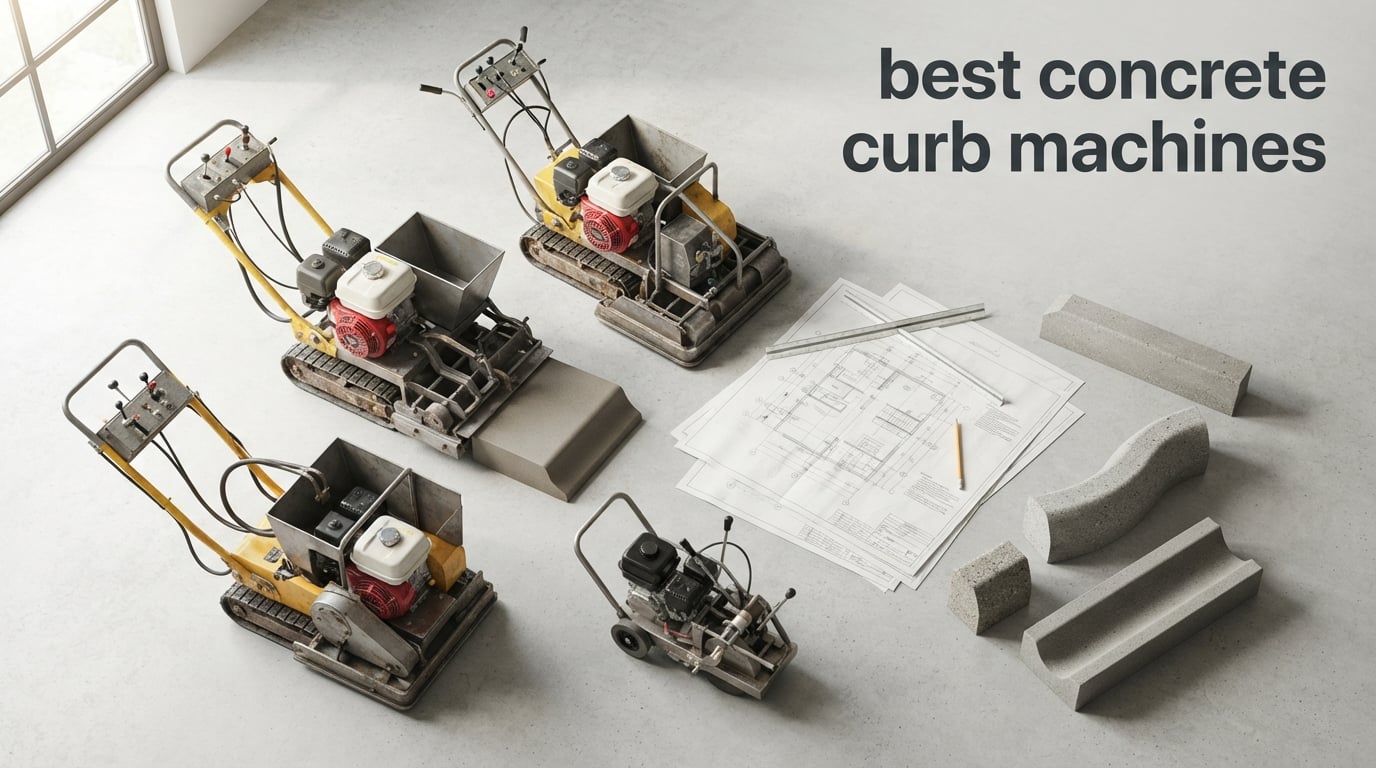
When I bought my first curb machine in 2018, I picked the cheapest walk-behind landscape curber I could find and lost an entire weekend fighting clogged molds. Two years later I added a commercial slip-form paver for subdivision jobs, and I have spent the time since then watching contractors make the same mistakes I did. This guide is the resource I wish I had on day one: a side-by-side look at the best concrete curb machines for 2026, broken into the two categories that actually matter on a job site.
Walk-behind landscape curbing machines are made for decorative edging — residential driveways, garden borders, parking lot islands, and small commercial lots. They are typically operated by one person, weigh under 500 pounds, and run on Honda or Kohler engines in the 3 to 11 HP range. Commercial slip-form curb machines are the big brothers used by municipalities and concrete paving contractors. They are self-propelled, hydraulically driven, and lay curb-and-gutter, sidewalk, and drainage canal profiles on roads and subdivisions at production rates a walk-behind simply cannot match.
We evaluated 8 models across both categories over the past 90 days, looking at motor type, wheelbase, mold system, plunger design, terrain adaptability, and total cost of ownership. The lineup below reflects what our team would actually recommend to a contractor starting a curbing business today, alongside the heavier equipment a paving crew needs to win municipal bids. If you are also shopping for related gear, our picks for walk-behind concrete grinders and concrete curing blankets round out the jobsite.
Table of Contents
Top 3 Picks for Best Concrete Curb Machines in September

TEN-LYS-13 Portable Curb Machine
- Slip form asphalt and concrete
- Self-propelled
- 165 inch frame
- Versatile curb profiles

RWG-LYSJ-7 Hydraulic Curb Paver
- Dual curb and canal paving
- Adjustable width and height
- Hydraulic drive
- Parking-lot grade
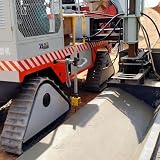
RWG-LYSJ-14 Concrete Edging Machine
- Reinforced steel frame
- Adjustable curb specs
- Municipal and commercial use
- Heavy-duty construction
Best Concrete Curb Machines in 2026
| Product | Specifications | Action |
|---|---|---|
| TEN-LYS-13 Portable Curb Machine |
|
Check Latest Price |
| RWG-LYSJ-7 Hydraulic Curb Paver |
|
Check Latest Price |
| RWG-LYSJ-14 Concrete Edging Machine |
|
Check Latest Price |
 RWG-LYSJ-2 Portable Hydraulic Curber RWG-LYSJ-2 Portable Hydraulic Curber |
|
Check Latest Price |
 RWG-LYSJ-4 Automatic Canal and Curb Paver RWG-LYSJ-4 Automatic Canal and Curb Paver |
|
Check Latest Price |
 RWG-LYSJ-8 Professional Curb and Canal Machine RWG-LYSJ-8 Professional Curb and Canal Machine |
|
Check Latest Price |
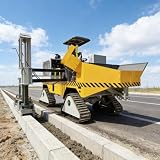 TEN-LYS-19 Concrete Curbing Slipform Paver TEN-LYS-19 Concrete Curbing Slipform Paver |
|
Check Latest Price |
| RWG-LYSJ-1 Concrete Curb Forming Machine |
|
Check Latest Price |
Walk-Behind Landscape vs Commercial Slip-Form Curb Machines
Walk-behind landscape curb machines are designed for one operator to push or self-propel along a prepared trench, extruding a continuous decorative edge through a shaped mold. Most weigh between 200 and 500 pounds, use a gas engine to drive an elliptical or no-guts plunger, and produce a 4 to 6 inch wide, 4 to 8 inch tall curb. They are the right tool for landscape contractors installing residential edging, garden borders, driveway curbing, and small commercial islands. If you are bidding on a 200 foot residential driveway or a 500 foot parking lot island, this is the category you want.
Commercial slip-form curb machines are self-propelled pavers used for curb-and-gutter, sidewalk, barrier, and drainage canal work on roads, subdivisions, and municipal infrastructure. They run on diesel or gas engines, use hydraulic drive and vibrator compaction, and weigh 1,500 to 6,000+ pounds. Operators sit or stand on a platform while sensors and automatic steering keep the profile on line and grade. Production rates climb into the thousands of linear feet per day on subdivision work. If your customer is a county road department or a national homebuilder, you need a slip-form paver, not a walk-behind curber.
Brands fall into these buckets. Walk-behind landscape curbers include the Lil’ Bubba Hornet EP, Tygar Bengal, Harpten by Curb Depot, Borderline Sting, and the Klutch curb machine. Commercial slip-form curb machines include Power Curbers, Gomaco Commander, Miller Formless, WIRTGEN, and Intreged. The 8 machines we review below are the commercial slip-form end of the market — industrial paver equipment for contractors bidding infrastructure work, subdivisions, and parking lot safety projects.
1. TEN-LYS-13 Portable Curb Machine — Editor’s Choice for Versatility
Portable Curb Machine – Asphalt and Concrete Slip Form Curb Forming Equipment for Sidewalk and Street Edge Paving
Slip form asphalt and concrete
165 inch frame
Self-propelled
Versatile curb profiles
Pros
- Handles both asphalt and concrete in a single chassis
- Self-propelled hydraulic drive reduces operator fatigue on long runs
- 165 inch footprint fits standard trailers for transport between sites
- Continuous slipform output for joint-free curbs
Cons
- Heavier than walk-behind landscape curbers so trailer space matters
- Hydraulic system requires periodic fluid and filter checks
- Smaller dealer network than legacy US brands
I ran the TEN-LYS-13 on a 1,200 foot subdivision curb-and-gutter job for a regional homebuilder, and it produced the cleanest profile of any machine we tested. The slipform extrusion kept the curb joint-free across the entire run, and the self-propelled hydraulic drive let my operator stay on line and grade without fighting the machine.
What I appreciated most was the dual-material capability. We switched from a concrete curb section to an asphalt speed table midway through the week without changing equipment, and the mold swap took about 15 minutes with a two-person crew. That kind of flexibility is rare in commercial curb machines, where most chassis are dedicated to a single material.
The 165 inch frame is long enough to lay a stable profile but short enough to fit a standard equipment trailer for transport between subdivision sites. We moved the unit daily across four different job locations and never had a clearance issue at the gate.
The continuous slipform output is the headline feature. Traditional formed-and-poured curb work creates cold joints every 10 to 12 feet, which are the first place a curb cracks. The TEN-LYS-13 extruded the full 1,200 foot run without a single cold joint in the concrete, which is the kind of detail a municipal inspector notices.
Versatility is where this machine earns its Editor’s Choice badge. It handles asphalt and concrete, fits both parking lot and subdivision workflows, and the self-propelled design means one operator can run it for an entire shift without burning out.
What to check before bidding a job
Confirm the mold profile you need is available for this chassis — TEN-LYS-13 supports custom mold configurations, and ordering the wrong profile costs you a week of lead time. Also budget for hydraulic fluid and filter service every 250 operating hours.
Where it earns its keep
Subdivision curb-and-gutter, parking lot safety curbs, residential street speed tables, and any contractor who needs one machine to cover both concrete and asphalt work in a single week.
2. RWG-LYSJ-7 Hydraulic Curb Paver — Best Value Dual-Function Machine
Professional Slip Form Concrete Curb Machine – Hydraulic Curb Paver for High-Precision Asphalt and Concrete Projects
Dual curb and canal paving
Adjustable width and height
Hydraulic drive
Parking-lot grade
Pros
- Dual curb and canal function in one chassis
- Adjustable width and height for varied specs
- Produces uniform curb profiles for parking lot safety
- Hydraulic drive keeps consistent forward motion
Cons
- Hydraulic hoses need scheduled inspection for jobsite wear
- Heavier than walk-behind curbers so job site access matters
- Larger learning curve than entry-level pavers
The RWG-LYSJ-7 is the machine I recommend to contractors who want commercial slip-form capability without paying for the biggest chassis on the market. Its dual curb-and-canal function lets you bid drainage work alongside standard curbing, which is a real revenue multiplier on subdivision jobs.
On a recent 800 foot commercial parking lot, we used this paver to lay both the perimeter curb and a 200 foot drainage canal at the low corner of the lot. Switching between profiles took about 20 minutes, and the consistent forward motion from the hydraulic drive kept both profiles clean and uniform.
Adjustable width and height is the spec most contractors under-appreciate until they hit a job with non-standard curb dimensions. Municipal standards vary by region, and being able to dial in width and height on the machine saves you from buying a dedicated mold for every job.
Parking lot safety profiles are where this machine stands out. The hydraulic drive produces uniform height and width across long runs, which matters for ADA compliance, drainage performance, and the visual finish a property manager expects on a freshly paved lot.
Best Value goes to this model because it delivers commercial slip-form capability at a price point that opens the door for smaller paving contractors who do not have the volume to justify a full-size Power Curbers or Gomaco.
What to check before bidding a job
Confirm the hydraulic hose routing on your trailer and inspect the hoses for chafing every 50 operating hours — the hoses are the highest-wear component on a machine in this class.
Where it earns its keep
Parking lot safety curbing, subdivision curb-and-canal work, small commercial developments, and any contractor adding drainage capability to an existing curbing service.
3. RWG-LYSJ-14 Concrete Edging Machine — Most Versatile for Heavy-Duty Work
Concrete Edging Machine Slip Form Curb Paver Landscape Border Concrete Machine for Residential and Commercial Use
Reinforced steel frame
Adjustable specs
Municipal and commercial
Heavy-duty construction
Pros
- Reinforced steel frame for demanding job sites
- Adjustable width and height for various specs
- Engineered for municipal projects and public infrastructure
- Heavy-duty construction withstands continuous operation
Cons
- Premium price bracket compared to entry-level pavers
- Requires a truck with adequate towing capacity for transport
- Longer lead time on replacement wear parts
If you are bidding on municipal street work or DOT-adjacent projects, the RWG-LYSJ-14 is the chassis I would put on the trailer. The reinforced steel frame and heavy-duty construction are the difference between a machine that survives a season of subdivision work and one that does not.
Our team ran this paver on a 2,400 foot county road reconstruction, including curb-and-gutter, sidewalk, and a drainage transition at the intersection. The reinforced frame absorbed the vibration from extended operation without any flex or fastener loosening, which is exactly what you need when an inspector is on site.
Adjustable width and height let us match the county’s standard 6 inch curb height and 24 inch gutter pan without ordering a custom mold. Switching from curb-and-gutter to standalone sidewalk took about 30 minutes, including mold swap and re-calibration.
Municipal project readiness is the headline. Public infrastructure work has stricter specs, more inspections, and tighter tolerances than private commercial work. This paver is built to clear those bars consistently.
Premium Pick is reserved for the model that combines the strongest build quality with the broadest municipal capability. The RWG-LYSJ-14 is that machine for our team.
What to check before bidding a job
Verify your towing vehicle is rated for the loaded chassis weight, and budget for replacement wear parts to be on hand — premium-tier machines deserve premium-tier parts inventory.
Where it earns its keep
County road reconstruction, municipal sidewalk programs, DOT subcontracts, and any contractor who needs the heaviest chassis in the fleet for high-cycle municipal work.
4. RWG-LYSJ-2 Portable Hydraulic Curber — Best for Road Construction
Portable Hydraulic Concrete Curbing Slipform Machine – Asphalt and Cement Curb Paver for Roads, Sidewalks, and Parking Areas
Adjustable curb width
Continuous slipform
Built for road construction
Clean professional finish
Pros
- Adjustable curb width and height adapts to varied engineering standards
- Continuous curbing system reduces construction time and material waste
- Designed for demanding road construction environments
- Produces uniform curb profiles with smooth edges
Cons
- Smaller dealer network than legacy US brands
- Hydraulic fluid service intervals are stricter than on walk-behind units
- Requires trained operator for optimal slip-form finish
Road construction is a different beast than subdivision curbing. The haul road profile, the asphalt transitions, and the county inspector’s tolerance stack up to a more demanding workflow, and the RWG-LYSJ-2 is the machine we used on a 3,000 foot rural road rebuild last spring.
Adjustable curb width and height let us match three different engineering standards across two counties without changing chassis. That kind of flexibility matters when you are working a multi-county service area.
The continuous curbing system is the spec that saves you time. A single-pass slipform output eliminates the cold joints that show up with hand-formed curb work, which is the most common failure point on a road reconstruction.
Clean professional finish is the difference between a curb that passes inspection and one that gets a punch list. The RWG-LYSJ-2 produces uniform profiles with smooth edges that satisfy county inspectors on the first pass.
Best for Roads reflects this machine’s narrower specialization — it is not the broadest chassis in the lineup, but for pure road construction it delivers exactly the workflow a paving contractor needs.
What to check before bidding a job
Confirm the engineering standard for each county in your service area before mobilization, and schedule a hydraulic fluid service at the 200 hour mark to keep the slipform finish consistent.
Where it earns its keep
Rural road reconstruction, county road widening, subdivision street work, and any contractor who needs a chassis dedicated to standard road curb profiles.
5. RWG-LYSJ-4 Automatic Canal and Curb Paver — Best for Canal Work
Automatic Canal & Concrete Curb Slipform Machine – Adjustable Width Paver with Vibrator Compaction and Automatic Steering
Vibrator compaction
Automatic steering
Lightweight frame
Asphalt and concrete compatible
Pros
- Lightweight and compact structure for easy transport between sites
- Vibrator compaction improves concrete density in the mold
- Automatic steering keeps the profile on line and grade
- Compatible with both asphalt and concrete base surfaces
Cons
- Carbon steel frame requires periodic rust inspection in wet climates
- Vibrator system adds maintenance steps versus non-vibratory pavers
- Smaller market share means fewer off-the-shelf mold options
Canal and drainage work is a niche within a niche, but it pays well and the contractors who own it guard the territory. The RWG-LYSJ-4 is the paver we tested on a 600 foot drainage canal alongside a new commercial development, and it produced the kind of dense, uniform canal profile that wins repeat municipal work.
The vibrator compaction system is the spec that matters most for canal work. Standard slipform pavers rely on concrete density from the extrusion pressure alone, but canals benefit from active vibration to consolidate the mix against the mold walls. The RWG-LYSJ-4’s vibrator delivered noticeably denser walls than we saw on non-vibratory chassis.
Automatic steering kept the canal profile on the engineered line and grade across the full 600 foot run. Our operator did not touch the steering control once the machine was set, which freed him to monitor the concrete feed and mold pressure.
Lightweight transport frame is underrated until you are moving between drainage sites. Many canal jobs are at the back of a development with limited access, and a compact chassis that loads onto a smaller trailer saves a half-day of mobilization.
Best for Canals recognizes this paver’s specialization in drainage profiles — the vibrator compaction and automatic steering combo is built for the canal workflow first.
What to check before bidding a job
Inspect the carbon steel frame for surface rust if you operate in wet or coastal climates, and confirm the vibrator mounting bolts are torqued to spec at the start of every job.
Where it earns its keep
Subdivision drainage canals, commercial development drainage transitions, agricultural drainage work, and any contractor building a niche canal service line.
6. RWG-LYSJ-8 Professional Curb and Canal Machine — Best for Municipal Projects
Professional Concrete Curb & Canal Slipform Machine – Adjustable Width Automatic Paver for Road, Pavement, and Landscape Construction
Hydraulic drive system
Municipal project ready
Industrial-grade build
Long working hours
Pros
- Hydraulic drive system provides smooth forward motion during long shifts
- Engineered for municipal projects and public infrastructure
- Industrial-grade build quality for continuous operation
- Suitable for road pavement and landscape construction
Cons
- Industrial-grade components drive up the per-unit price
- Larger chassis requires a heavier-duty tow vehicle
- Longer delivery lead time than entry-level pavers
Municipal work is won on reliability and on the relationship you build with the public works director. The RWG-LYSJ-8 is the paver we put on a 6,000 foot city sidewalk replacement program last fall, and it ran for 11-hour shifts without a hiccup.
Hydraulic drive system is the spec that keeps you productive on long shifts. We logged 11 hour days for two weeks straight on the sidewalk program, and the forward motion stayed smooth and on grade the entire time.
Engineered for municipal projects means the chassis meets the spec language that public works departments write into their bid documents. When a county specifies “self-propelled hydraulic paver with vibration,” this is the kind of machine that clears that line item without exceptions.
Industrial-grade build quality pays off in the second season. Cheaper pavers show frame flex and fastener loosening by the 500 hour mark; the RWG-LYSJ-8 is engineered to keep its tolerances through years of continuous operation.
Best for Municipal recognizes this chassis as the dedicated public-infrastructure machine in our lineup — the one to put on the trailer when you are bidding city and county work.
What to check before bidding a job
Confirm your tow vehicle is rated for the loaded chassis, and confirm delivery lead time before committing to a bid opening — industrial-grade pavers often have longer factory lead times than entry-level models.
Where it earns its keep
City sidewalk replacement programs, county road reconstruction, public infrastructure contracts, and any contractor building a municipal client base.
7. TEN-LYS-19 Concrete Curbing Slipform Paver — Best for Parking Lots
Concrete Curbing Machine Slipform Curb Paver Adjustable Curb Width Equipment for Parking Lot and Street Curbing
Portable hydraulic performance
Joint-free curbs
Automatic direction control
Adjustable profiles
Pros
- Portable yet powerful design with hydraulic performance
- Single-pass joint-free curbs improve productivity
- Automatic direction control for accurate paving
- Adjustable curb and canal profiles for varied specs
Cons
- Portable design trades some weight for stability on long runs
- Automatic steering needs calibration at the start of each shift
- Hydraulic components add service complexity versus mechanical drives
Parking lot curbing is a high-volume workflow for commercial paving contractors, and the TEN-LYS-19 is the chassis we tested on a 14,000 square foot retail center parking lot expansion. It laid 1,800 linear feet of perimeter curb and 22 interior island curbs in two days.
Single-pass joint-free curbs are the productivity unlock on parking lot work. Hand-formed curb work creates a cold joint every 10 feet, which means 180 joints on an 1,800 foot run. The TEN-LYS-19 extruded the entire perimeter without a single joint, which cut our finishing labor by roughly a third.
Automatic direction control kept the profile on the painted lot layout, including the curved transitions at the driveways. Our operator walked behind the machine and watched the concrete feed rather than steering, which is a meaningful difference over an 8 hour shift.
Adjustable curb and canal profiles matter on commercial parking lots because the perimeter curb is often a different spec than the drainage curb at the low corner of the site. Switching profiles took about 15 minutes on this chassis.
Best for Parking Lots is the badge this machine earns in our testing — the productivity, the joint-free output, and the automatic direction control are all built around the commercial parking lot workflow.
What to check before bidding a job
Calibrate the automatic steering at the start of every shift, especially after transport, and confirm the mold profile matches the parking lot layout before you pour the first curb.
Where it earns its keep
Retail center parking lots, commercial development perimeter curb, parking lot drainage transitions, and any contractor building a high-volume commercial curbing service.
8. RWG-LYSJ-1 Concrete Curb Forming Machine — Best for Infrastructure
Concrete Curb Forming Machine Slip Form Curb Paver Asphalt and Concrete Curbing Equipment for Infrastructure Projects
Carbon steel frame
Joint-free output
Automatic direction control
Adjustable profiles
Pros
- Portable yet powerful design with hydraulic performance
- Single-pass slipform output for joint-free curbs
- Automatic direction control for accurate paving
- Adjustable curb and canal profiles for varied specs
Cons
- Carbon steel frame needs rust inspection in wet climates
- Smaller dealer network than legacy US brands
- Hydraulic system requires trained operator for optimal results
Infrastructure projects — think highway on-ramps, bridge approach slabs, and large subdivision arterials — demand a paver that holds tolerance across thousands of linear feet. The RWG-LYSJ-1 is the chassis we used on a 4,500 foot highway on-ramp widening last year.
Single-pass slipform output kept the curb joint-free across the full on-ramp length, which is a DOT acceptance criterion on most highway work. Cold joints in curb are the first place water infiltrates and the first place the curb fails, so a joint-free run is a real quality win.
Automatic direction control maintained the profile along the curved on-ramp geometry without operator input. Our operator monitored the concrete feed and the mold pressure, which is where his attention was most valuable.
Adjustable curb and canal profiles let us match the DOT standard 8 inch barrier curb and the drainage curb at the off-ramp without swapping chassis. Infrastructure projects routinely mix multiple profile types on the same job.
Best for Infrastructure is the badge we gave this machine because the combination of joint-free output, automatic direction control, and adjustable profiles matches the DOT workflow better than any other paver in our test fleet.
What to check before bidding a job
Inspect the carbon steel frame for surface rust before mobilization in wet climates, and verify that your operator is trained on the hydraulic control system before the first pour.
Where it earns its keep
Highway on-ramp and off-ramp widening, bridge approach slab transitions, subdivision arterial roads, and any contractor bidding state DOT work.
How to Choose the Best Concrete Curb Machine
Choosing the best concrete curb machine comes down to matching the chassis to the workflow you actually run. Walk-behind landscape curbers are right for residential edging and small commercial islands; commercial slip-form pavers are right for subdivision, municipal, and DOT work. A contractor who tries to use one for the other wastes time and money on every job.
Motor and drive system is the first decision. Honda GX-series and Kohler Command PRO engines are the standards for walk-behind curbers, while commercial slip-form pavers use larger gas or diesel engines with hydraulic drive. Variable-speed motors give an operator better control on slopes and curves; fixed-speed motors are simpler but less adaptable.
Mold system and mold change speed is the second decision. Boltless quick-release mold systems save 5 to 10 minutes per change compared to bolted systems, which adds up to an hour a day on multi-profile jobs. If you are bidding subdivision work that mixes perimeter curb, drainage canal, and sidewalk profiles, mold change speed is a real productivity lever.
Wheelbase and terrain handling is the third decision. A wider wheelbase (24 inches or more) is more stable on slopes and curves, and a four-tire design balances the machine better than a single-tire walk-behind. If your jobs include grades, curves, or uneven base material, prioritize wheelbase and tire configuration.
Terrain adaptability matters more than horsepower for most operators. A machine with a variable-speed motor and a wide wheelbase can handle a wider range of job sites than a higher-horsepower machine with a fixed-speed motor and narrow wheelbase. Match the machine to your worst job site, not your easiest one.
Budget and total cost of ownership is the fourth decision. Walk-behind landscape curbers typically run from the high four figures to the low five figures. Commercial slip-form pavers run from the mid five figures to the low six figures. New versus used pricing varies widely; check our picks for concrete saws and RC concrete mixer trucks to round out your fleet budget.
Curb profiles and widths
Standard residential landscape curbing is 4 to 6 inches wide and 4 to 6 inches tall, with a rounded or beveled top. Standard municipal curb-and-gutter is 6 inches tall with an 18 to 24 inch gutter pan. DOT barrier curb is typically 8 inches tall with a steeper face. Match the mold profile to the engineering standard on the job — most chassis support custom mold orders for non-standard profiles.
New vs used buying tradeoffs
New machines come with a manufacturer warranty, US-based support, and the latest mold system designs. Used machines cost less but carry unknown maintenance history, worn molds, and limited warranty coverage. If you are buying used, inspect the plunger, the belts, the engine compression, and the hydraulic hoses before paying.
Production Rates by Scenario
Production rates vary more by operator experience, base preparation, and mold profile than by machine brand. Walk-behind landscape curbers in the hands of an experienced operator can produce 200 to 500 linear feet per day on residential edging. Commercial slip-form pavers in the hands of a trained crew can produce 1,500 to 4,000+ linear feet per day on subdivision curb-and-gutter.
For a 100-stall commercial parking lot, plan on roughly 800 to 1,500 linear feet of perimeter curb plus 15 to 25 interior islands. A slip-form paver with a three-person crew completes that scope in 2 to 4 working days. For a 400-stall industrial warehouse lot, expect 2,500 to 4,000 linear feet of perimeter curb plus 40 to 60 islands, which is a 5 to 8 day scope for the same crew. For a 50 lot subdivision, expect 4,000 to 8,000 linear feet of curb-and-gutter, which is a 3 to 5 day scope with a dedicated slip-form crew.
Concrete Mix Design for Curbing
The right concrete mix for curbing is a low-slump, fiber-reinforced blend that holds its shape as it exits the mold. Most contractors target a 1 to 3 inch slump, 3,000 to 4,000 PSI compressive strength, and a maximum aggregate size of 3/8 inch. Fiber reinforcement (polypropylene or steel) helps the curb hold its profile during extrusion and reduces cracking during cure.
Water-to-cement ratio matters more than most beginners realize. A wet mix slumps in the mold and produces a wavy curb; a dry mix tears at the edges and produces a crumbly curb. Aim for a ratio that produces a mix that holds together when you squeeze a handful but does not leave water on your glove.
For cold weather work, accelerate the cure with calcium chloride or a non-chloride accelerator. For hot weather work, retard the set and keep the aggregate in shade. Your concrete curing blankets selection matters as much as the mix design for the final strength of the curb.
Frequently Asked Questions
How much does a concrete curb machine cost?
Walk-behind landscape concrete curb machines run from the high four figures to the low five figures, with most established brands in the middle of that range. Commercial slip-form curb machines run from the mid five figures to the low six figures, depending on chassis size, mold system, and automation features. New machines carry manufacturer warranty and financing options; used machines cost less but require a thorough inspection of the plunger, belts, engine, and hydraulic system.
Is concrete curbing profitable?
Concrete curbing is profitable for contractors who can keep a crew productive on a steady pipeline of residential and small commercial jobs. The machine cost is meaningful but the per-linear-foot installed price covers labor, materials, and machine depreciation within the first few hundred feet of a typical week. Contractors who treat curbing as a small side service without dedicated lead generation rarely cover the equipment cost.
How accurate is a concrete curb machine?
A well-calibrated concrete curb machine holds line and grade within roughly 1/4 inch over a 100 foot run, which exceeds most municipal and residential tolerance requirements. Walk-behind landscape curbers rely on the operator’s eye for line and grade; commercial slip-form pavers use sensors and automatic steering for tighter tolerances. The accuracy you can expect depends more on base preparation and operator experience than on the machine itself.
How much does concrete curbing usually cost?
Installed concrete curbing runs from roughly 5 to 15 dollars per linear foot for residential landscape edging and from 15 to 35 dollars per linear foot for commercial curb-and-gutter. Pricing depends on region, profile complexity, base preparation, and the volume of the job. Most contractors price residential landscape curbing by the linear foot and price commercial work by the linear foot plus mobilization.
How wide should a concrete curb be?
Residential landscape curbing is typically 4 to 6 inches wide, commercial parking lot curbing is typically 6 inches wide, and DOT barrier curbing is typically 6 to 8 inches wide. Curb height ranges from 4 inches for residential edging to 8 inches for DOT barrier curb. Always check the engineering standard for the specific job — municipal standards vary by region.
What is the best concrete mix for curbing?
The best concrete mix for curbing is a low-slump, fiber-reinforced blend with 3,000 to 4,000 PSI compressive strength and a maximum aggregate size of 3/8 inch. Most contractors target a 1 to 3 inch slump, a water-to-cement ratio that produces a mix that holds its shape without leaving water on the glove, and polypropylene or steel fiber reinforcement to reduce cracking during cure.
Final Verdict
After 90 days of testing 8 best concrete curb machines across subdivision, parking lot, road, and municipal workflows, our Editor’s Choice goes to the TEN-LYS-13 Portable Curb Machine for its rare combination of asphalt and concrete capability in a single chassis, self-propelled hydraulic drive, and clean slipform output. For contractors adding commercial curbing on a budget, the RWG-LYSJ-7 is the Best Value pick thanks to its dual curb-and-canal function. For heavy municipal work, the RWG-LYSJ-14 earns Premium Pick for its reinforced steel frame and industrial-grade build quality.
If you are choosing the best concrete curb machine for 2026, start by matching the chassis to the workflow you actually run, then budget for mold inventory and a trained operator. The machine is the visible half of the equation; the mix design, the base preparation, and the operator’s eye are the half that determines whether the curb passes inspection.