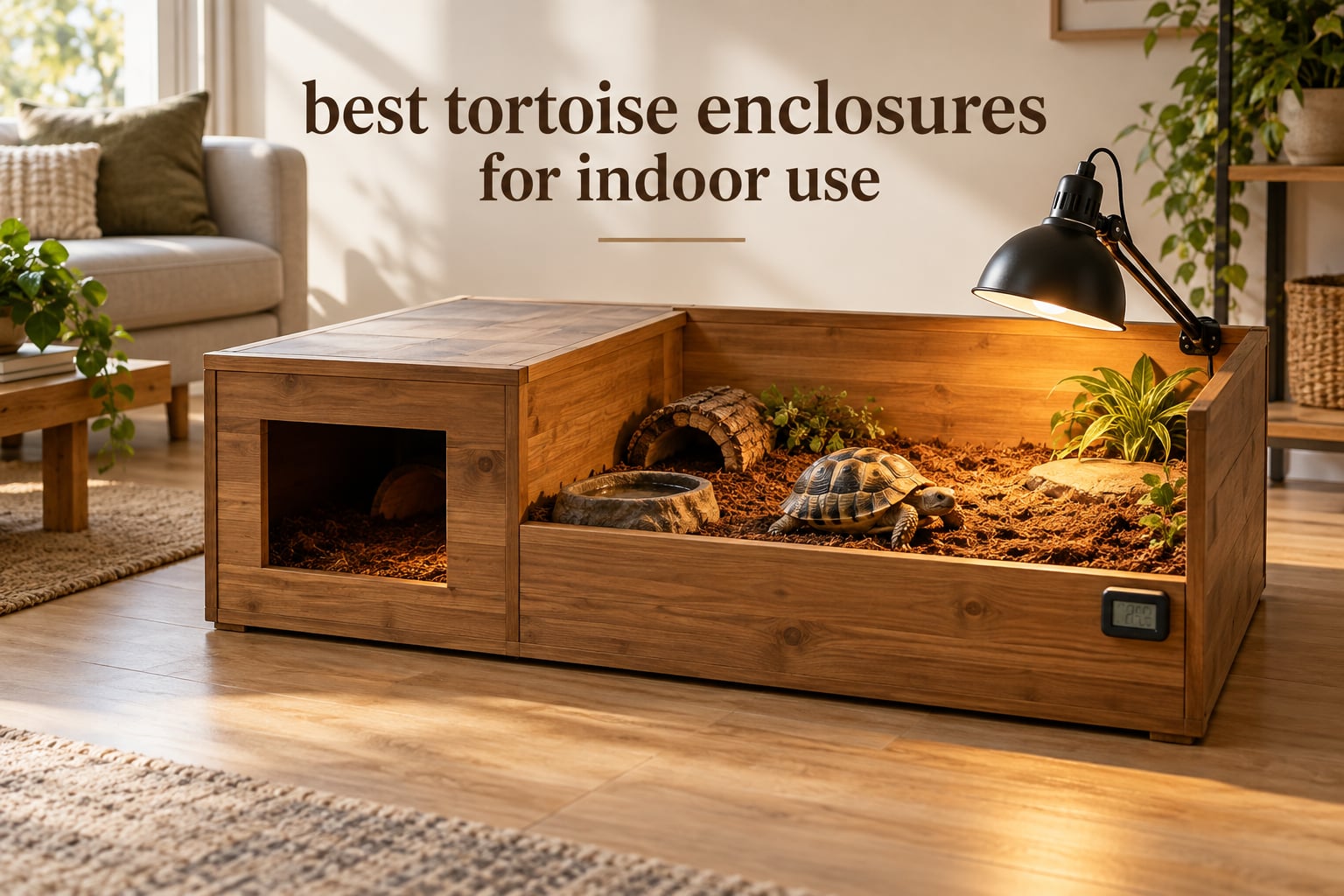
If you only read one answer: the GEGURI two-room fir wood habitat is the best tortoise enclosure for indoor use, and an adult tortoise needs far more floor space than any listing advertises. Plan on at least 4 by 8 feet of usable floor for a grown Hermann’s, Russian, or Greek, with an enclosed dark hide, a waterproof pull-out tray, and enough wall clearance to hang a UVB lamp at a safe distance above the basking zone.
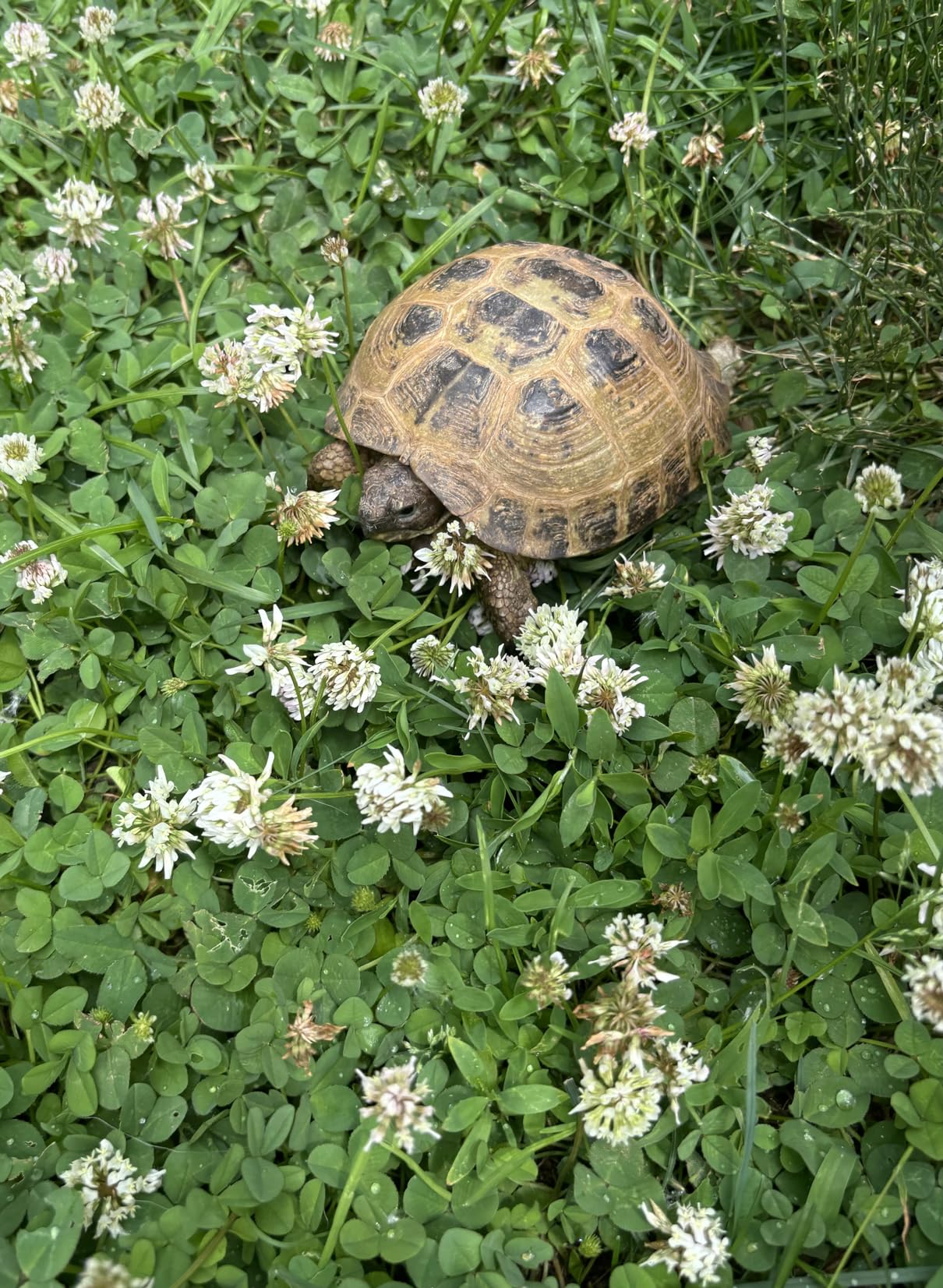
I have spent the last two winters setting up indoor tortoise housing in our own home, comparing wooden tortoise tables, vivariums, and converted plastic totes while our Russian tortoise came in and out of the cold-weather setup. That hands-on time is why this list reads differently from the roundups I found when I started researching. Most of them show seven enclosures at most, report the footprint of the box including the stand, and never once mention wall height.
That last omission matters more than it sounds. A UVB lamp has to sit 12 to 18 inches above the basking surface, and most commercial wooden enclosures measure 12 to 14 inches from the tray to the top of the wall. Buy the wrong box and you are into drilling out lamp frames on day one. So this guide covers all 12 wooden indoor tortoise enclosures worth considering, with interior dimensions, wall height, weight, and the room layout called out for each one, plus a buying guide that explains the size floor no listing mentions.
I am not the only person who noticed that gap. Long-running threads on TortoiseForum’s indoor enclosure and lighting board keep repeating the same point: keepers buy a 36 by 24 inch house, and a few months later their adult tortoise is crammed into it. The fix is not a bigger brand name. It is knowing how to read a listing, which is what the rest of this article is for.
Table of Contents
Top 3 Best Indoor Tortoise Enclosures in September

GEGURI Two-Room Fir Wood Habitat
- 38 x 23 x 32 in with legs
- Two-room design
- Removable pull-out tray
- Fir wood
Aivituvin Tortoise Habitat with Lamp Stand
- Adjustable lamp holder 11-31 in
- Storage shelf
- Weatherproof hide
- Removable legs

PawHut Two-Room Wooden Habitat
- Fir wood with lockable latches
- Expandable side panels
- Three viewing windows
- Indoor and outdoor
All 12 Indoor Tortoise Enclosures Compared in 2026
| Product | Specifications | Action |
|---|---|---|
| GEGURI Two-Room Fir Wood Habitat |
|
Check Latest Price |
| Aivituvin Habitat with Adjustable Lamp Stand |
|
Check Latest Price |
| PawHut Two-Room Wooden Habitat |
|
Check Latest Price |
 PetsCosset Two-Room Habitat with Detachable Legs PetsCosset Two-Room Habitat with Detachable Legs |
|
Check Latest Price |
 PawHut Habitat with Shelf Storage PawHut Habitat with Shelf Storage |
|
Check Latest Price |
 Magazoopet Large Habitat with Lamp Stand Magazoopet Large Habitat with Lamp Stand |
|
Check Latest Price |
 ZENTAVO Three-Room Dual-Level Habitat ZENTAVO Three-Room Dual-Level Habitat |
|
Check Latest Price |
 VEVOR Cedar Habitat with Light Stand VEVOR Cedar Habitat with Light Stand |
|
Check Latest Price |
 BIRASIL Two-Tier Habitat with Soak Tray BIRASIL Two-Tier Habitat with Soak Tray |
|
Check Latest Price |
 PawHut Two-Layer Habitat with Lamp Holder PawHut Two-Layer Habitat with Lamp Holder |
|
Check Latest Price |
 FunXplore Tortoise Enclosure FunXplore Tortoise Enclosure |
|
Check Latest Price |
 Luyitton Wooden Habitat with Lamp Stand Luyitton Wooden Habitat with Lamp Stand |
|
Check Latest Price |
1. GEGURI Two-Room Fir Wood Habitat – Best Overall Indoor Tortoise Enclosure
GEGURI Tortoise Habitat Indoor & Outdoor, Wooden Tortoise House with Detachable Legs, Reptile Cage for Small Animals
38 x 23 x 32 in including legs
Two rooms, private sleep area
Removable tray
17.86 lb
Pros
- Largest owner feedback base in this roundup at 507 reviews
- Solid fir wood that resists warping
- Detachable legs let you choose tabletop or floor placement
- Removable plastic pull-out tray for cleaning
Cons
- Thin wire mesh top reported as flimsy under a heat lamp
- Wood pieces can crack during assembly
This is the enclosure we ended up with after cycling through three cheaper options, and the reason is unglamorous: it is the one I could find the most owner feedback on. At 507 reviews with 65 percent five-star, there is a large enough sample of real setups to see the failure points clearly.
The layout is the classic two-room tortoise table arrangement. One side is an enclosed private sleeping area, the other is an open viewing and activity area with acrylic windows on three sides. My tortoise uses the dark room within about an hour of switching the lamp on, which is exactly the behavior you want to see.
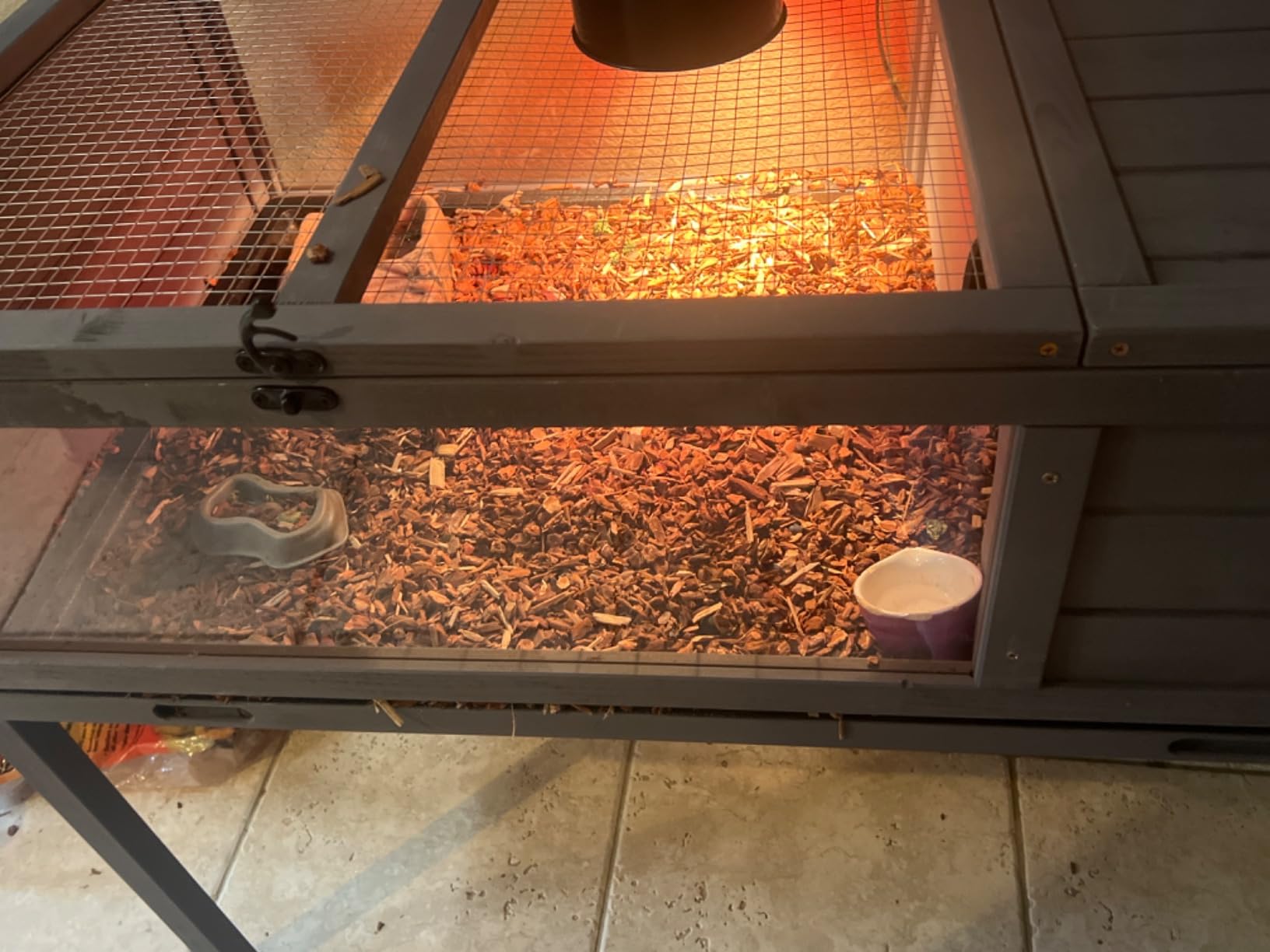
The spec that sold me is 38 by 23 by 32 inches, and the key detail is that the 32 inch height includes the detachable legs. Strip the legs off and you get a low box that fits on a table, which is how it is sold. The footprint is generous for a commercial unit, though still well short of the 4 by 8 feet an adult needs.
Weighing 17.86 pounds, it is one of the lighter enclosures here, which matters when you are the one dragging it to the sink for a substrate change. The all-surrounding bottom means substrate cannot fall through the seams, and the plastic tray slides straight out.
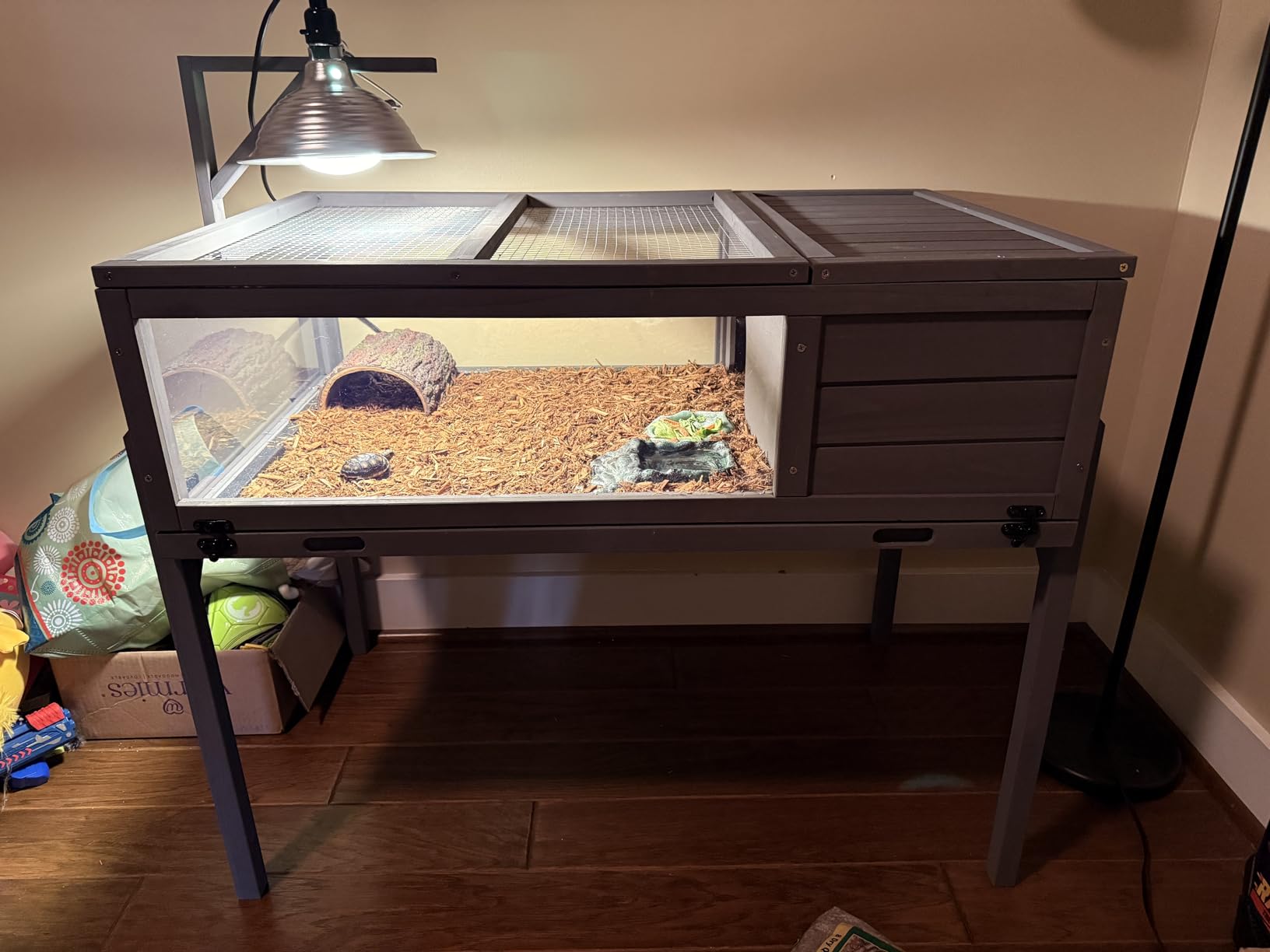
The one consistent complaint from owners is the mesh top. It is thin enough that several people report adding their own support before hanging a heat lamp above it. If you buy this, plan to either reinforce the mesh or mount your lamp on a separate external stand, which is what we did.
Is the GEGURI enclosure big enough for a growing tortoise?
It is a hatchling and juvenile enclosure first and foremost. The roughly 3 by 2 foot usable floor suits a tortoise up to about four inches of shell comfortably, and that is where most of the 507 reviews sit.
Plan on it being outgrown in a year or two for a fast-growing species. Owners frequently mention buying it as a starter and then regretting not buying twice the size, so think about where it will be in eighteen months.
What works and what does not in daily use
Works well: the fir wood, the removable tray, the detachable legs, and the way the two rooms let you create a genuine thermal gradient with the lamp over one side only. The tray takes a wet wash without any concern about swelling.
Does not work well: the mesh top under a heavy lamp, and the fact that this is still a 3 by 2 foot box. I also found the acrylic windows scratch easily once a tortoise starts pushing against them, which is normal behavior.
2. Aivituvin Tortoise Habitat with Adjustable Lamp Stand – Most Versatile
Aivituvin Tortoise Habitat Turtle Enclosure, Wooden Tortoise House Reptile Cage for Small Animals, Reptile Tank with Large Storage Shelf
39.4 x 22.5 x 31.5 in
Adjustable lamp holder
Fir wood, storage shelf
29.5 lb
Pros
- Adjustable metal lamp holder spanning 11-31 in
- Roof opens with 360 degree holder rotation
- Moisture-proof finish rated for outdoor use
- Large storage shelf underneath
Cons
- Heavier at 29.5 lb
- which makes deep cleanouts harder
This is the closest thing in the list to a fully specified indoor setup. Where most wooden houses include a flimsy mesh strip and leave you to improvise a lamp mount, the Aivituvin ships with a real adjustable metal light stand rated from 11 to 31 inches tall and 13 to 21.1 inches wide.
That range is the whole reason I rank it second rather than first. Our enclosure is 12 inches of interior wall height, and the Aivituvin is one of the few units here where the lamp stand can be raised high enough to give a UVB tube proper distance without removing anything.
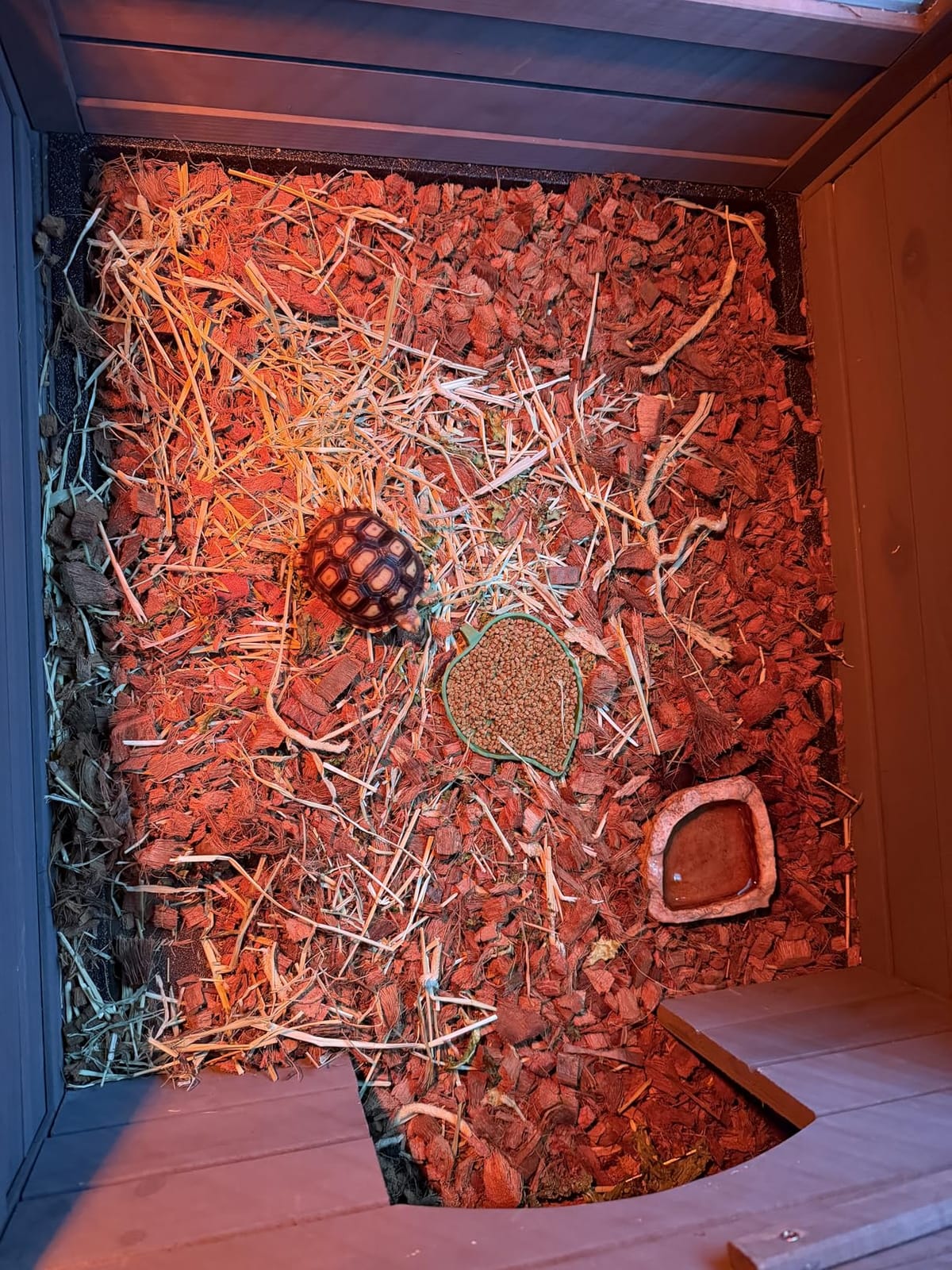
At 39.4 by 22.5 by 31.5 inches it is marginally larger than the GEGURI, and the 322 reviews with 67 percent five-star suggest the build quality is consistent. The two-bedroom layout gives a weatherproof hide and a separate activity area with acrylic viewing.
The roof opens with full rotation on the lamp holder, so you can get a hand in without moving the light out of position. That sounds minor until you have tried to rearrange a water bowl under a fixed lamp arm.
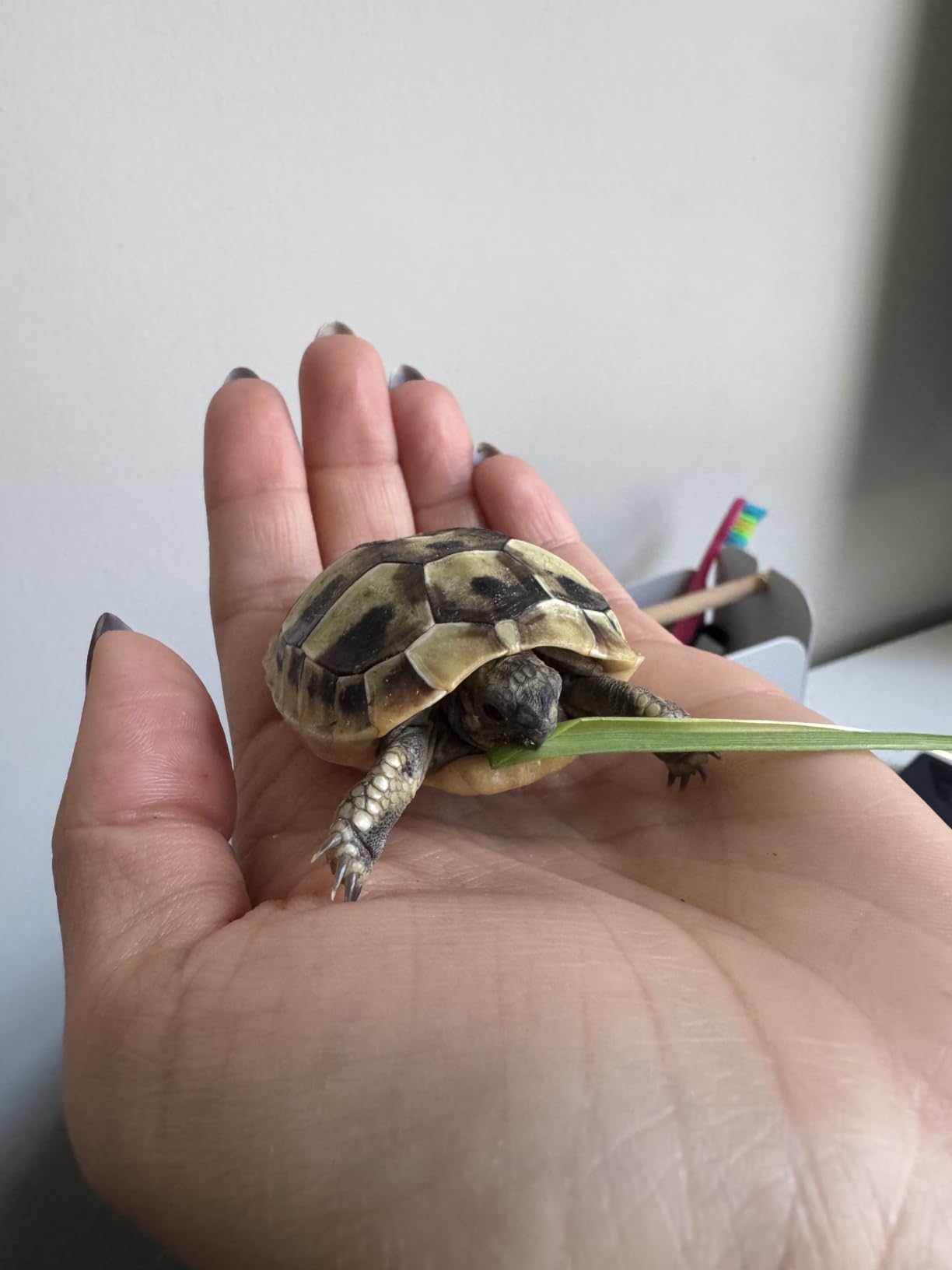
Owners also point out the large storage shelf underneath, which keeps food, substrate, and a shovel off the floor of your living room. The legs are removable, so it works on a table or on the floor depending on your setup.
The trade-off is weight. At 29.5 pounds this is one of the heavier enclosures here, and it is the main reason I do not put it at number one. If you plan to move the enclosure for deep cleanouts more than a few times a year, that is real work.
Does the adjustable lamp stand solve the UVB distance problem?
Partly, and better than any other enclosure here. The stand adjusts up to 31 inches, which lets you hang a lamp well above a low-walled table instead of pressing it down toward the animal. That extra distance is the difference between usable UVB and a lamp that is too close to be safe.
It does not fix everything. You still need a T5 HO fixture rather than a compact lamp if you want a meaningful UVB gradient across the basking zone, and the width range means the lamp covers only part of a 22 inch enclosure.
Where this enclosure falls short
The clear acrylic panels scratch and mar readily, and reviewers report that visible wear accumulates fast with a tortoise that likes to rub against the front. Nothing structural breaks, but it stops looking new quickly.
It is also one of the heavier options to lift. Our own advice: if you are furnishing a small apartment and cannot lift 30 pounds without thinking about it, pick the lighter alternative above.
3. PawHut Two-Room Wooden Habitat – Best Value
PawHut Wooden Tortoise Habitat Indoor Tortoise House Enclosure Gray
35.75 x 23.75 x 12.5 in
Fir wood, lockable latches
Expandable panels
16.5 lb
Pros
- Lockable latches for homes with dogs or young children
- Side panels pull out to expand the living space
- Three large viewing windows
- Solid fir wood base that assembles easily
Cons
- Wood can warp and leak in humid conditions over time
- Some pieces do not align flush during assembly
The PawHut D40-012 is the one I recommend to people who ask a single question: which enclosure should I buy first. It is a 35.75 by 23.75 by 12.5 inch fir wood box at 16.5 pounds, and it is the unit in this roundup that pairs a solid fir frame with working lockable latches as standard.
That lock matters more than hobby forums give it credit for. If you have a dog that has never met a reptile, or a toddler who pulls on things, a latched enclosure is the difference between a contained animal and an emergency trip to a reptile vet. Owners with large dogs mention the latches specifically in their reviews.
The other feature I did not expect to use is the removable side panels of the run area. Pull them out and the usable floor grows without buying a second box, which is a partial answer to the size problem. At roughly 3 by 2 feet it is still a starter footprint, but it stretches further than the alternatives.
With 207 reviews and 66 percent five-star, the feedback is solidly positive on assembly. Multiple buyers describe it as a breeze to put together, and the solid fir wood gives a stable frame for a 3 to 4 inch substrate depth.
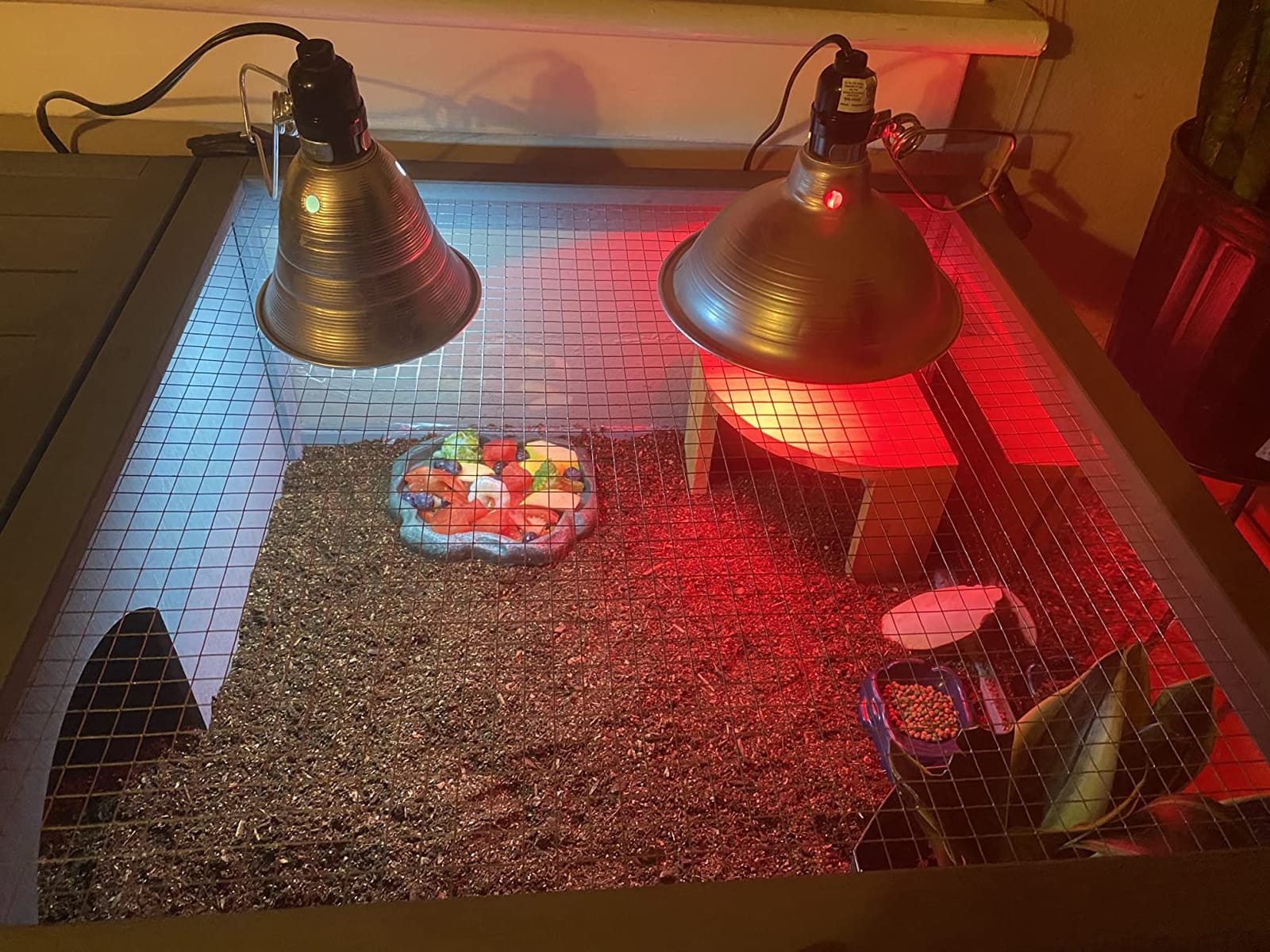
The same 207 reviews supply the main warning. Owners running coconut fiber in humid conditions report mold growth under the tray, and the wood can warp or leak over time if it stays wet. For tropical species that need high humidity, this is the wrong box.
For a Hermann’s, Russian, or Greek in a climate where you can hold indoor humidity moderate, the warp risk drops a lot. We run ours on a tiled floor with good ventilation and have had no issues across two winters.
Are the lockable latches strong enough for a determined dog?
They are adequate and they are better than nothing, but reviewers are candid that the latch hardware is thin. A small, curious dog will not open it. A large dog with time and a chewing habit is a different problem, and for that case we would add a second clip clamp.
For children, the latches work well because they are at the top of the front opening and require a deliberate two-handed action to unhook.
What is genuinely missing from this enclosure
There is no lamp holder. You are mounting your own fixture on an external stand or inside the frame, which is an extra step but gives you more control over lamp distance.
The second thing missing is height. At 12.5 inches this is one of the lowest-walled units here, so a UVB fixture inside the box will be too close to the substrate unless you mount it above the enclosure. Budget for an external lamp stand.
4. PetsCosset Two-Room Habitat with Detachable Legs – Best Budget Pick
PetsCosset Tortoise Habitat with Detachable Legs, Wooden Indoor & Outdoor Turtle Enclosure, Two-Room Reptile House, Large Observation Windows, Removable Pull-Out Tray, for Tortoises
37.2 x 22.8 x 32.3 in
Detachable legs
Removable pull-out tray
Fir wood
Pros
- Spacious footprint for an entry-level two-room box
- Detachable legs work on floor
- table
- or any raised surface
- Labeled pieces and clear instructions simplify assembly
- Three large acrylic observation windows
Cons
- Thin wire mesh top cannot support a heat lamp
- Seams between tray and walls let humidity and substrate escape
The PetsCosset is the enclosure to look at if the PawHut is out of reach and you want the same two-room footprint. At 37.2 by 22.8 by 32.3 inches it prints a larger number than anything else at this tier, and detachable legs let you run it on the floor or up on a table.
Owners consistently single out the labeled pieces and the instructions. With 182 reviews and 59 percent five-star, the five-star share here is lower than the leaders in this roundup, but the complaints are almost entirely about the tray fit and the mesh rather than the overall concept.
The manufacturer names pet stores, classrooms and homes as suitable placements, which tells you how this product is positioned. We think floor placement is the better call, because a 3 by 2 foot box on a table top is a lot of weight on furniture that was not designed for it.
Can this enclosure handle a heat lamp?
Not with the mesh it comes with. That is the most consistent owner complaint in the 182 reviews, and it is a real limitation rather than nitpicking. Several people report the wire bending under a lamp, and one describes it as unable to support a heat lamp at all.
Mount your lamp on a separate stand above the enclosure instead. This is a normal workaround and it also solves the UVB distance problem that the low wall height would otherwise create.
What about the tray gaps?
There are reports of roughly a one inch gap between the tray and the walls, and of the tray slipping off its ledge without supports. That gap lets humidity out, which is a problem for tropical species, and it lets fine substrate fall through onto your floor.
We solved ours with a thin strip of foam tape along the tray edge. If you buy this enclosure and keep a high-humidity species, do that on day one rather than after a mold outbreak.
5. PawHut Habitat with Shelf Storage – Best for Small Rooms
PawHut Tortoise Habitat with Shelf Storage, Tortoise Enclosure with Weather Protection, Reptile Gift Accessory, Reptile Enclosure with Tray, Light Support Frame, Light Gray
33 x 20 x 40.5 in
Storage shelf underneath
Hide box plus basking area
24.3 lb
Pros
- Integrated shelf underneath saves cabinet and closet space
- Steel grating in the basking area carries a heat lamp
- Openable lid for reaching in without moving the light
- Observation windows on each side
Cons
- Narrow running area at 20 in wide
- limiting roam space
- Taller frame at 40.5 in is awkward in low-ceilinged rooms
This PawHut solves a problem the others ignore: where do you put everything that is not the enclosure. The D40-025V00LG has a full shelf underneath that holds food, substrate, and a water bottle, so the habitat does not need floor space reserved for storage.
At 33 by 20 by 40.5 inches it is among the narrowest and tallest units in this list, and that shape is the trade-off. The 20 inch width gives you roughly 5 square feet of total footprint across two rooms, but the running area is genuinely narrow for an adult tortoise that wants to roam.
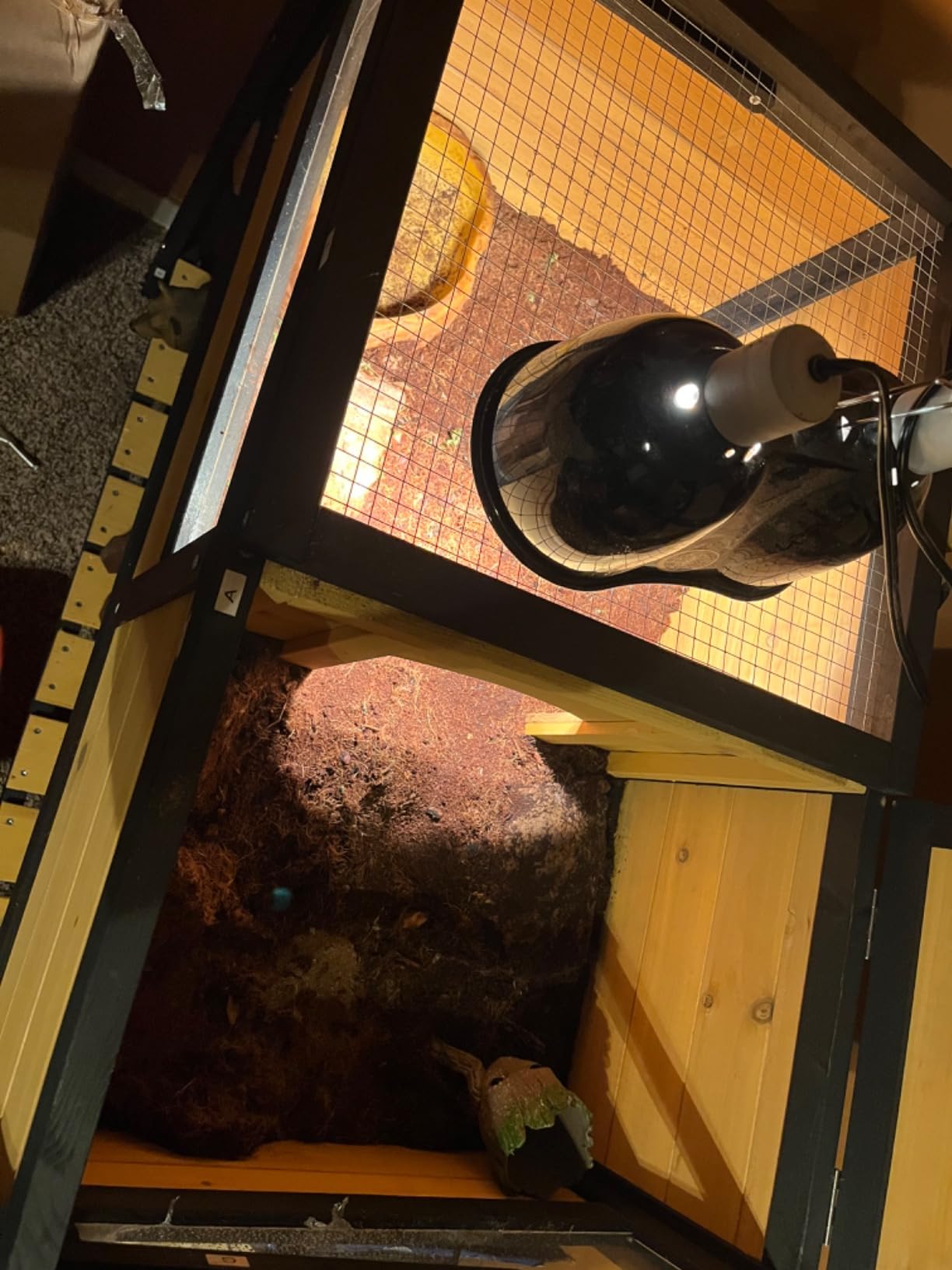
What it does well is lamp support. The basking area has steel grating rather than thin wire mesh, and owners are noticeably less anxious about hanging a heat lamp over this one. The hide box measures 12.5 by 17.25 by 12.5 inches, which is a proper enclosed dark room rather than a token alcove.
The 119 reviews and 59 percent five-star sit below the leaders, and the recurring complaint is assembly. Owners report alignment difficulties and a fiddly build, so set aside a proper hour with a second person.
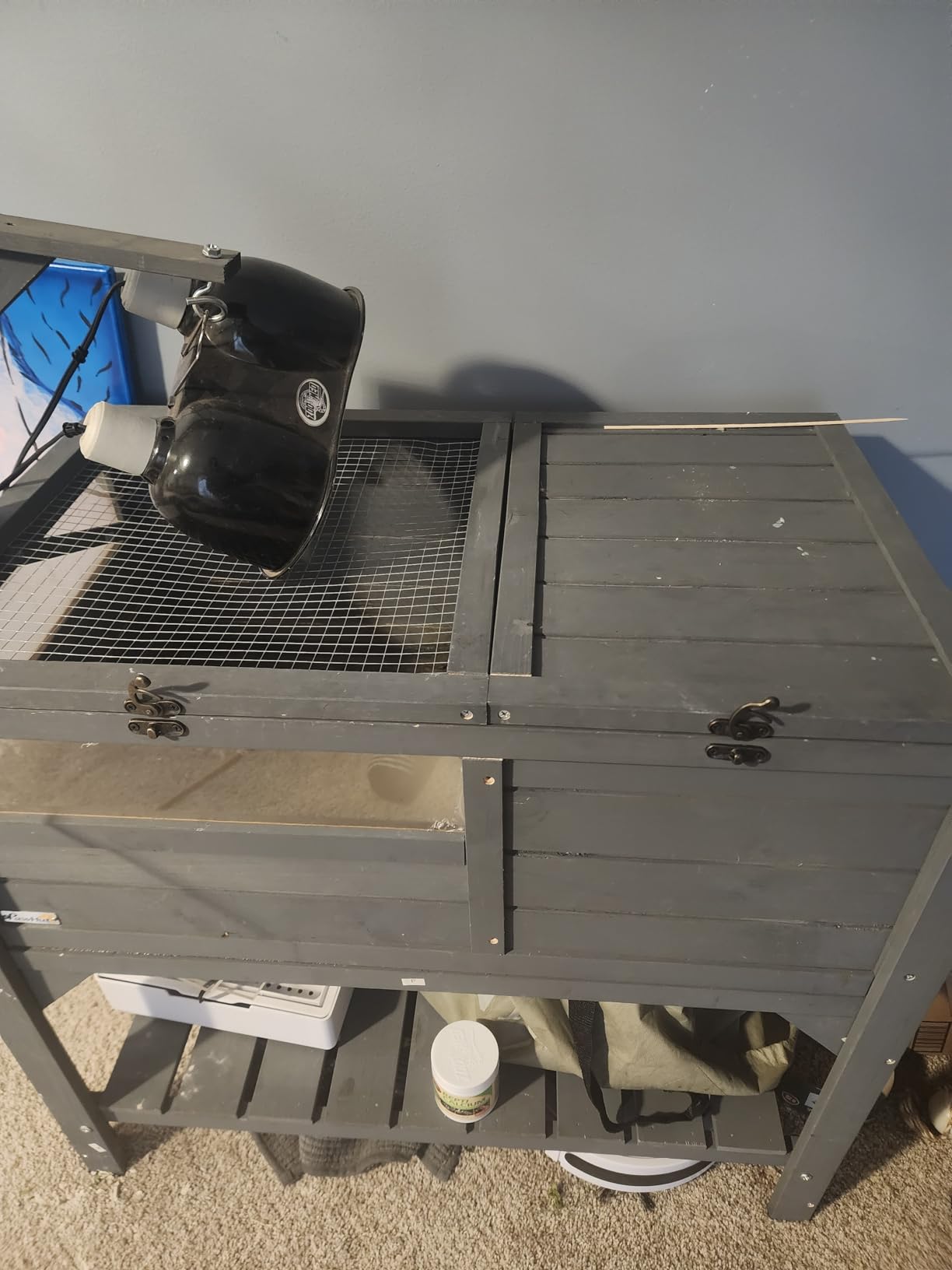
The mesh wire screen over the living space gets positive mentions for airflow and for letting natural sunlight through during the day. Ventilation is a genuine problem in enclosed wooden houses, and owners rate this one highly on it.
The openable lid is another practical win. You can get a hand in to reposition a water bowl or check on a hatchling without dismantling the lamp setup, which is something we appreciate during the first months of a new animal.
Is a 20 inch wide enclosure too narrow?
For a hatchling or a small juvenile, no. Plenty of owners use this exact size for animals up to about four inches of shell and report no problems with activity levels.
For an adult, yes. TortoiseForum advice consistently points to a minimum 4 by 8 feet for a grown animal of any small species, so this is a grow-out box or a supplementary enclosure rather than an adult solution.
Is the 40.5 inch height useful or annoying?
Useful for lamp mounting, since a taller frame gives you more vertical room to hang a fixture at a safe distance without removing the lamp frame. It is also useful if you want to add a second tier of shelving above it later.
Annoying in practice if your room has low ceilings, a sloped attic space, or a standard-height bookcase you were hoping to use. Measure the space and the door before ordering. The same caution applies if you plan to move it often, since the legs come off but the shell is awkward to lift alone.
6. Magazoopet Large Habitat with Lamp Stand – Top Rated
Large Tortoise Enclosure with Lamp Stand, Wooden & Plastic Turtle Habitat
40.3 x 22.8 x 34.2 in
Five-level lamp holder
Dual-zone layout
27.6 lb
Pros
- 4.4 average rating with 78 percent five-star across 100 reviews
- Lamp holder adjusts horizontally and vertically across wide ranges
- Dual-zone layout separates lounging from activity
- Compact enough for travel and camper use
Cons
- Lamps are not included with the lamp holder
- Wood smell present for the first days after assembly
On features, this is the strongest all-rounder here. At 4.4 stars across 100 reviews with 78 percent five-star, it pairs a generous 40.3 by 22.8 by 34.2 inch footprint with the most granular lamp adjustment we tested, and that is why we rate it a Top Rated pick despite ranking it sixth overall.
The lamp holder is the standout feature. It offers five levels of horizontal adjustment from 14.6 to 22.4 inches and height adjustment from 30.5 to 38.4 inches, which is far more granular than the single-post stands most competitors include. You can dial a heat gradient across the basking zone rather than just lighting one spot.
Owners report the build is straightforward and the acrylic viewing window gives an unobstructed view without the visual noise of mesh across the front. The dual-zone layout gives a separate lounging area and activity area, which supports the same thermal gradient strategy as the two-room designs.
Is the Magazoopet the best choice for a first-time indoor keeper?
On features, absolutely. The lamp stand and the footprint are both ahead of the field, and the dual-zone design is the arrangement experienced keepers tend to prefer.
On evidence, it is a newer product, so the 100 reviews are recent and there is no long-term track record of how the fir wood holds up across multiple humid winters. That is a real reason to consider a more established model instead.
What should new owners watch out for?
There is an initial wood smell, and a few owners report cracking in panels during assembly. Aquarium-safe silicone is the recommended fix for sealing those cracks, which is a small DIY step on top of a flat-pack build.
Lamps are not included, which is true of most enclosures here but worth stating plainly. You need a basking lamp and a UVB fixture regardless of which box you buy, so plan for both.
7. ZENTAVO Three-Room Dual-Level Habitat – Best for Multi-Level Setups
3-Room Large Tortoise Habitat with Pull-Out Tray, Wooden Tortoise Enclosure Indoor & Outdoor with Ramp, Grass Mat, Openable Roof, Luxurious Reptile Enclosure for Small Animals, Yellow
44 x 25.6 x 24 in
Three rooms, ramp, balcony
32 lb
Pros
- Largest footprint in the roundup at 44 x 25.6 in
- Three-room layout with ramp connecting the levels
- Water-resistant outdoor paint over premium fir wood
- Pre-drilled holes make assembly forgiving
Cons
- One of the heaviest units here at 32 lb
- Single colour option offered
The ZENTAVO is the most complex enclosure in this roundup, and that changes the way you use vertical space. The upper level holds a wooden sleeping house and a balcony; the lower level is the activity area, connected by a ramp.
At 44 by 25.6 by 24 inches it has the largest printed footprint of anything we tested, which matters because footprint is the resource you cannot add later. The ramp lets a tortoise use the height you have rather than leaving it empty.
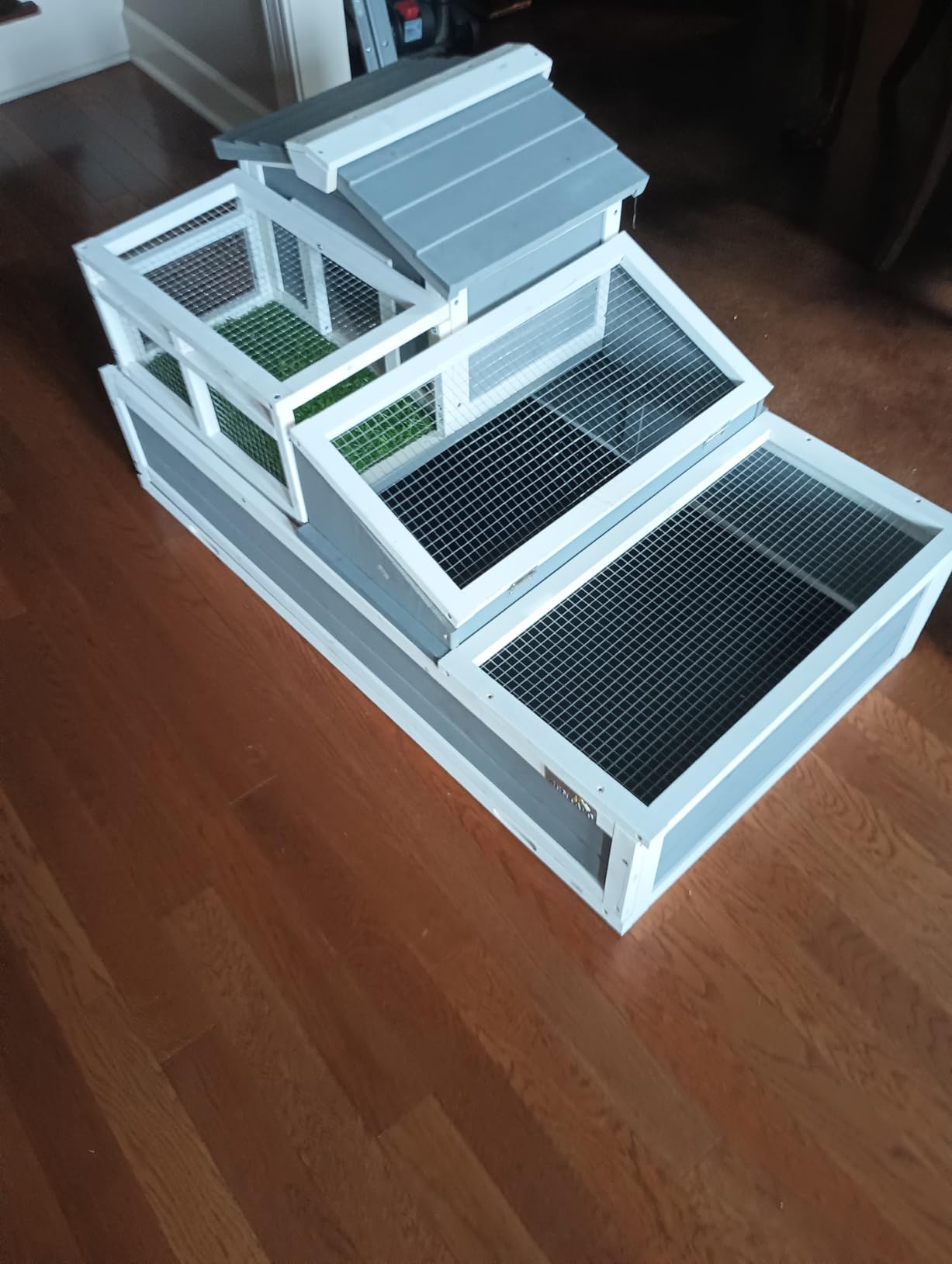
The metal mesh on the upper balcony gives good airflow and lets sunlight through, which addresses the ventilation problem common to sealed wooden houses. Owners appreciate that the pull-out plastic tray makes cleaning straightforward despite the more complicated layout.
With 94 reviews and 66 percent five-star, feedback is positive on the design and on assembly. The pre-drilled holes are called out specifically, and owners note that the included grass mat saves you a trip to the garden centre.
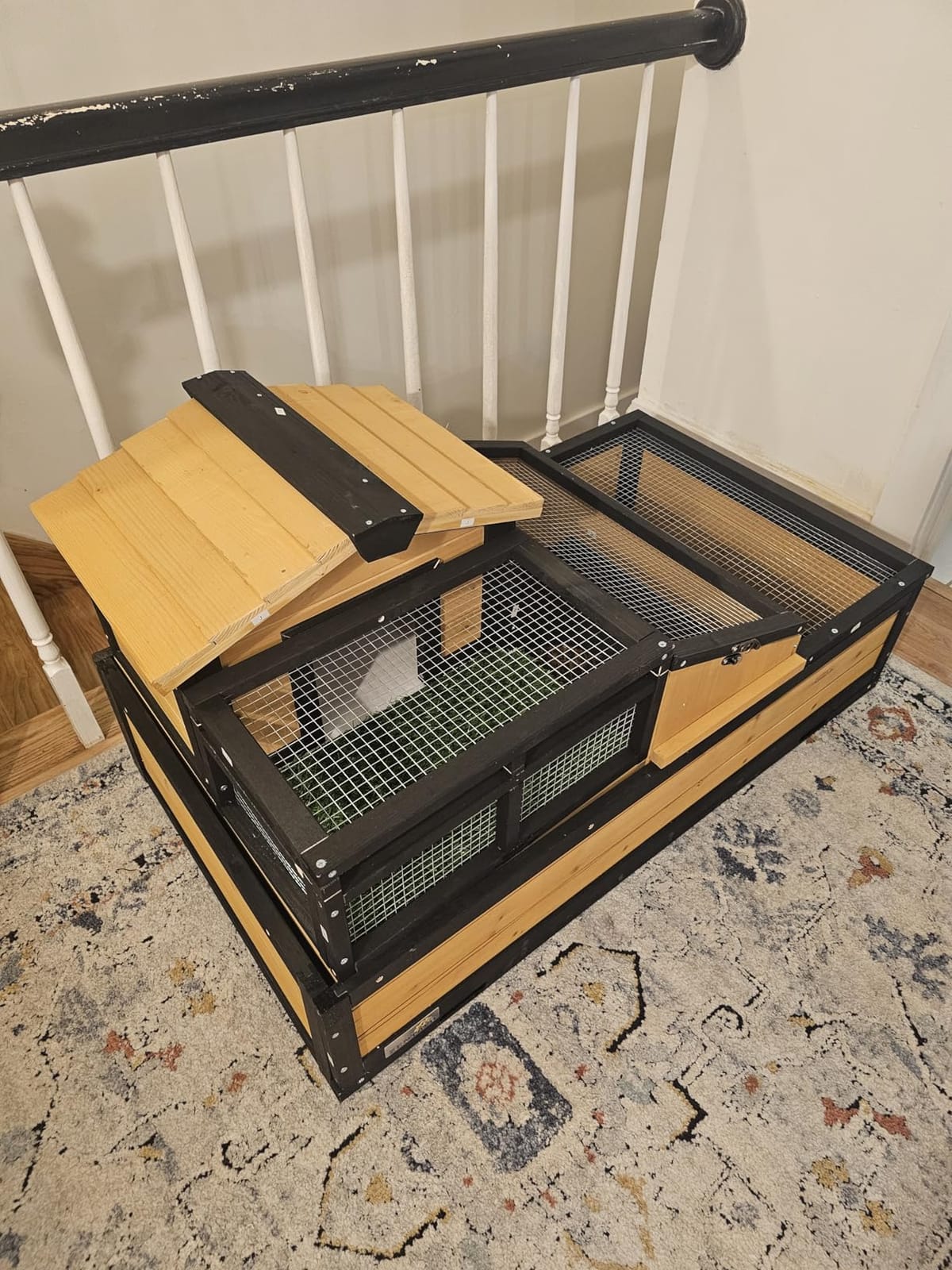
It comes with a water-resistant outdoor paint over premium fir wood, so it doubles as a seasonal outdoor pen in warm months. That dual indoor and outdoor use is the reason many owners bought it, particularly cold-climate keepers who use an indoor table for winter.
At 32 pounds it is one of the heavier units here, and the ramp and balcony add pieces that need care during assembly. Two people is the sensible assumption. That weight also means it is not the enclosure to move for weekly cleanouts if you are on your own.
Is a multi-level design better than a single-level table?
For enrichment, yes. Owners report their tortoises using the ramp and the upper sleeping house within days, and vertical space is a genuine welfare improvement in a small footprint.
For simplicity, no. A single-level table is easier to clean, has fewer seams where substrate collects, and puts the basking zone closer to the lamp. If your priority is easy maintenance rather than enrichment, a two-room flat design is the calmer choice.
What are the drawbacks of the extra level?
Weight, mainly, plus the fact that the ramp is a fixed piece that makes cleaning underneath harder. Fine substrate gets into the joints where the ramp meets the upper floor, and it is tedious to reach.
Its 24 inch overall height is the lowest of the multi-level units, and low overall height means a UVB fixture will need to sit above the enclosure rather than inside it. Plan your lamp mounting before you commit.
8. VEVOR Cedar Habitat with Light Stand – Best for Non-Tortoise Reptiles
VEVOR Tortoise Habitat, Cedar Wooden Tortoise House Indoor & Outdoor, Tortoise Enclosure with Light Stand, Reptile Enclosure Small Animal Cage with Stand Legs for Gecko, Lizard, Snake
33 x 19.7 x 32.5 in
Cedar wood construction
Light stand, storage shelf
26.46 lb
Pros
- Cedar wood gives a natural aroma owners consistently enjoy
- Leg frame includes a heavy-duty storage shelf
- Multiple variants including casters
- Assembly reported at about 40 minutes
Cons
- Cedar is not suitable for tortoise keeping and is flagged by the manufacturer
- Bottom tray is unsupported and bows under substrate
- Wood can split even with pre-drilled holes
I want to be direct about this one, because the manufacturer says it plainly and so should we: this enclosure is cedar, and the listing carries a warning that cedar wood may not be appropriate for all reptiles because some tortoise species can have respiratory issues with it.
Several verified buyers in the 59 reviews repeat that warning independently. If you are buying a tortoise enclosure for a tortoise, skip this one. The build quality is fine. The material is the problem.
For other reptiles, it is a perfectly reasonable enclosure. The two-room layout has a private sleeping zone with a solid wood top and an open activity space with a metal mesh window, and owners who keep geckos, lizards, and snakes are broadly happy with it at 4.2 stars.
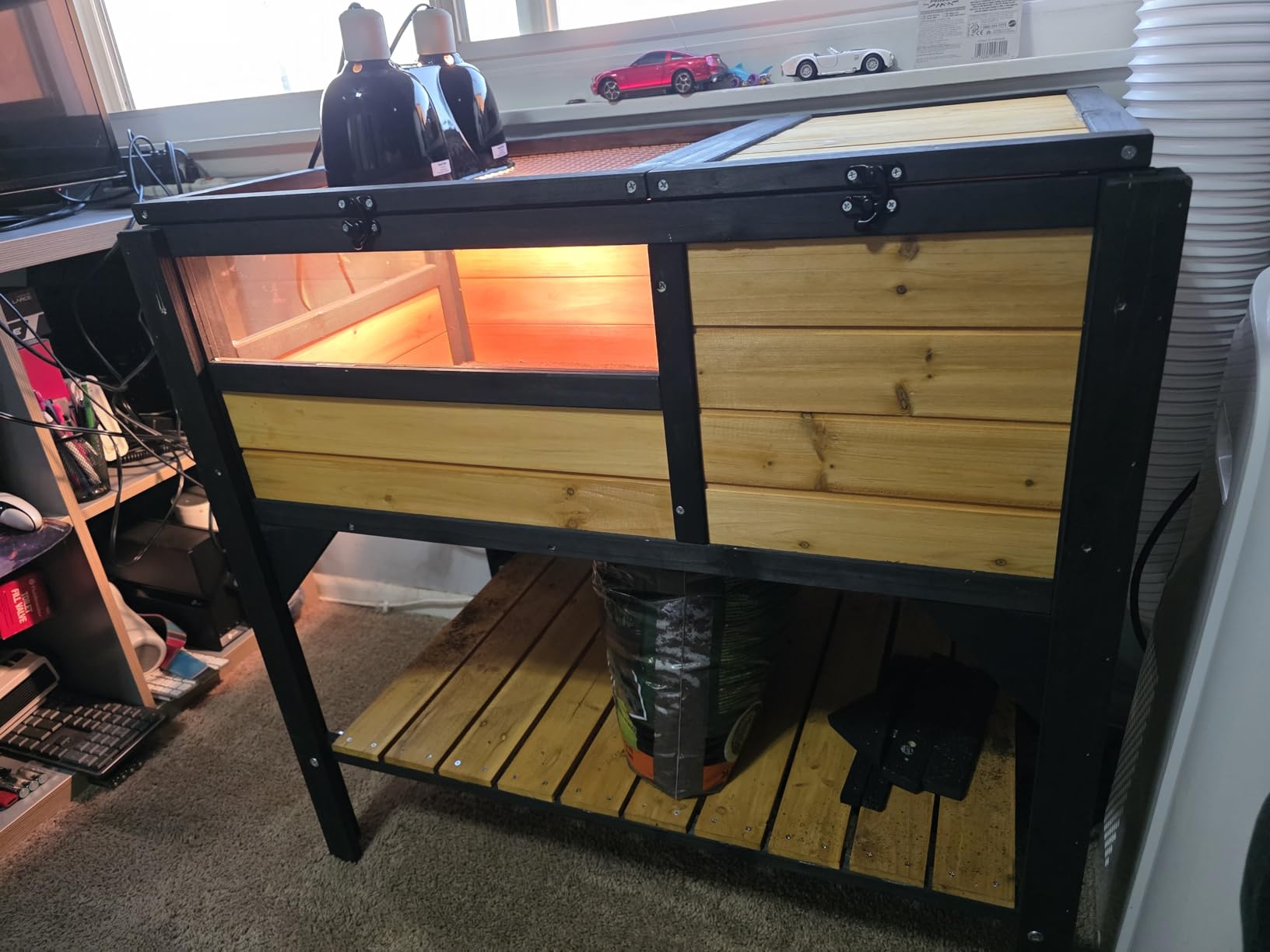
It is 33 by 19.7 by 32.5 inches at 26.46 pounds, with a light stand for heat lamp placement and a heavy-duty storage shelf on the leg frame. Variants are offered with legs, with casters, and without, which is unusual at this level of build.
Owners report roughly 40 minutes of assembly for one person, which is faster than most wooden houses of this complexity. Several also mention that the instructions appear reversed, so check the diagram before you start.
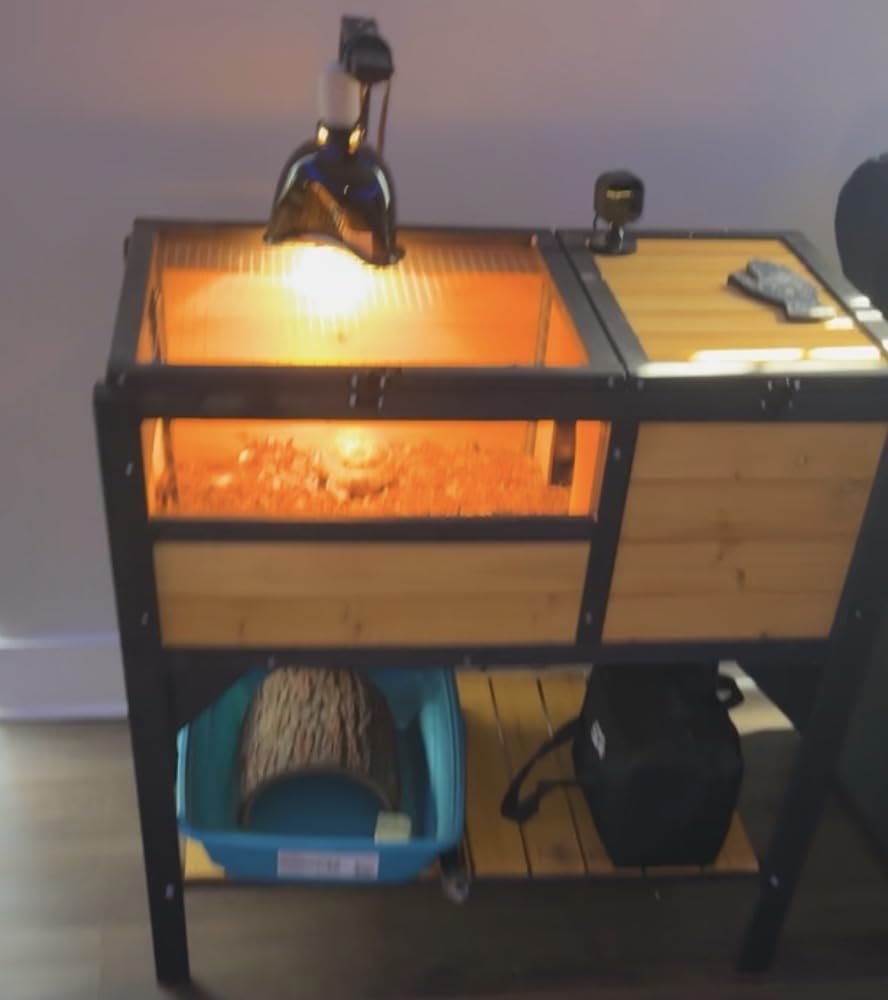
There are build complaints worth knowing: the bottom tray has no support underneath and bows or drops out when loaded with substrate, and the wood can split during assembly even with pre-drilled holes. Some owners describe the materials as flimsy.
My overall take is that this is a decent habitat for the reptiles it suits, and the wrong purchase for the animal this article is about. Buy the Aivituvin or the GEGURI instead and get fir wood.
Why is cedar a problem for tortoises?
Softwood resins like those in cedar release aromatic oils that tortoises cannot tolerate well in a confined space. Because a tortoise house is a small enclosed volume with a basking lamp raising the temperature, those oils are concentrated exactly where the animal breathes.
Fir wood, which most of the enclosures in this roundup use, is widely accepted as safe. If a listing does not name the wood species, that is a question to ask before buying.
What about the unsupported bottom tray?
It is a genuine build weakness rather than a user error. Owners report the tray bowing under a few inches of substrate and dropping out of its rails, which spills substrate and makes cleaning worse.
If you already own this enclosure for a non-tortoise reptile, a flat support board cut to the tray footprint fixes it in about five minutes. If you are shopping for a tortoise, choose a fir wood model where this is not an issue.
9. BIRASIL Two-Tier Habitat with Soaking Tray – Best for Soaking and Feeding
BIRASIL Wood Tortoise Enclosure with Adjustable Light Stand,2-Tier Habitat Reptile Cage with Swimming Area Feeding Area, Tortoises House for Small Animals Lizards Hamster (Gray/White)
38.97 x 23.03 x 31.5 in
Two-tier layout
Soak and feed tray
32.55 lb
Pros
- Two-tier layout adds usable area without a wider footprint
- Built-in soaking and feeding areas on the upper level
- Wire spacing wide enough that UVB passes through unobstructed
- Latching door helps contain a wary animal
Cons
- Sliding bottom floor leaves gaps at the wall seams
- Holes are not pre-drilled so assembly risks splitting the wood
The BIRASIL 9653 is a two-tier design at 38.97 by 23.03 by 31.5 inches and 32.55 pounds, and its selling point is the plastic swimming and feeding tray mounted on the upper level. Owners like having a built-in soak station rather than a separate tub on the floor.
The two-tier layout is the clever part. It gains usable area without making the enclosure any deeper, which solves a real problem in apartments where you cannot push a 24 inch deep box against anything.
With 55 reviews and a 4.0 average, feedback is more mixed than the rating alone suggests. The concept gets clear praise while the build quality gets consistent criticism, so the useful question is whether you are comfortable doing minor repairs.
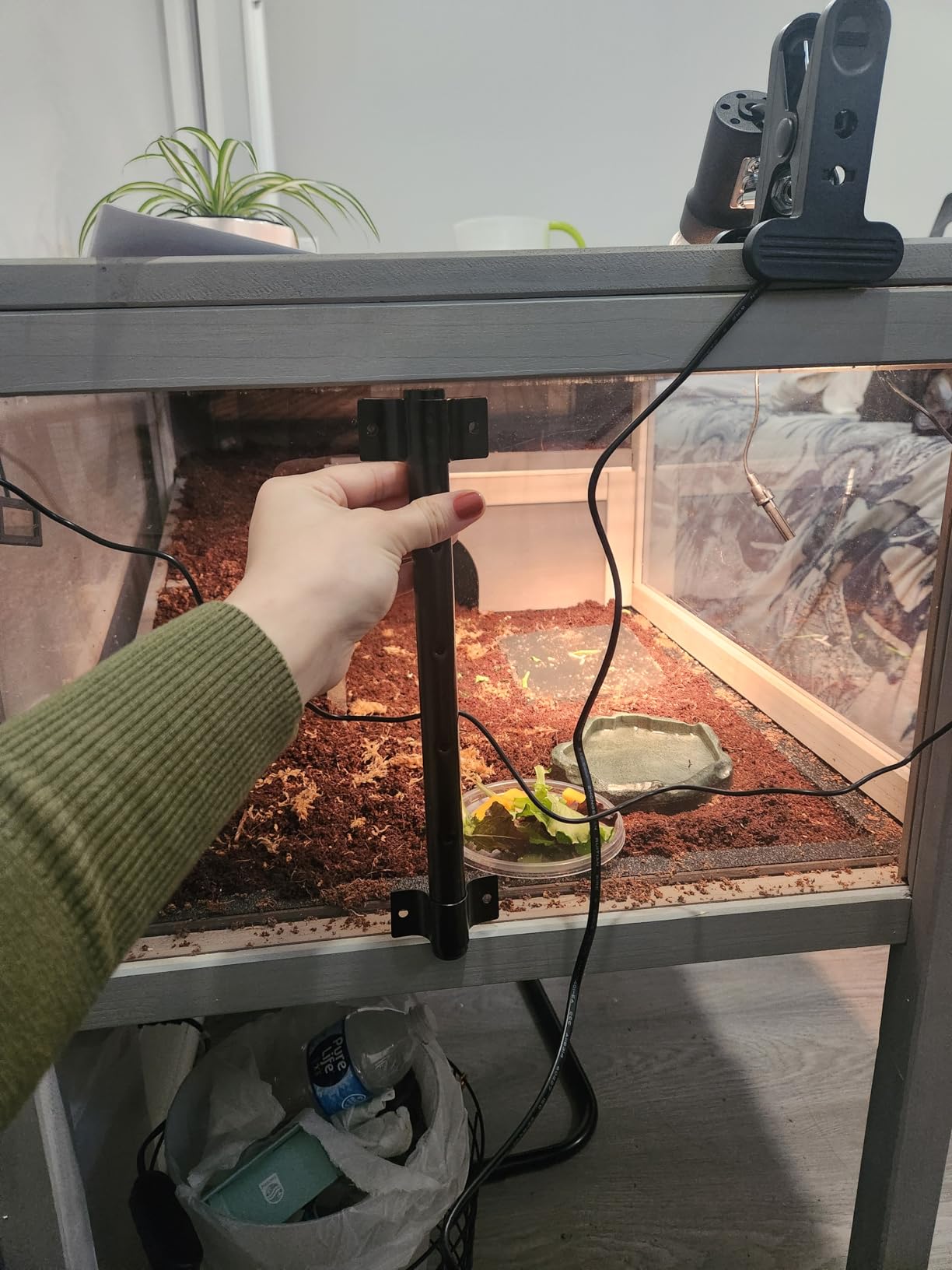
The steel mesh screen over the living space is wide enough that UVB lighting passes through without heavy obstruction, which is not true of every fine-mesh top in this roundup. That matters more than it sounds, because a tight mesh can eat a meaningful share of your UVB output.
The removable plastic tray prevents water leaks from the soak area reaching the wood below, and the detachable legs let the whole unit sit on a table when you need to reach the floor beneath it.
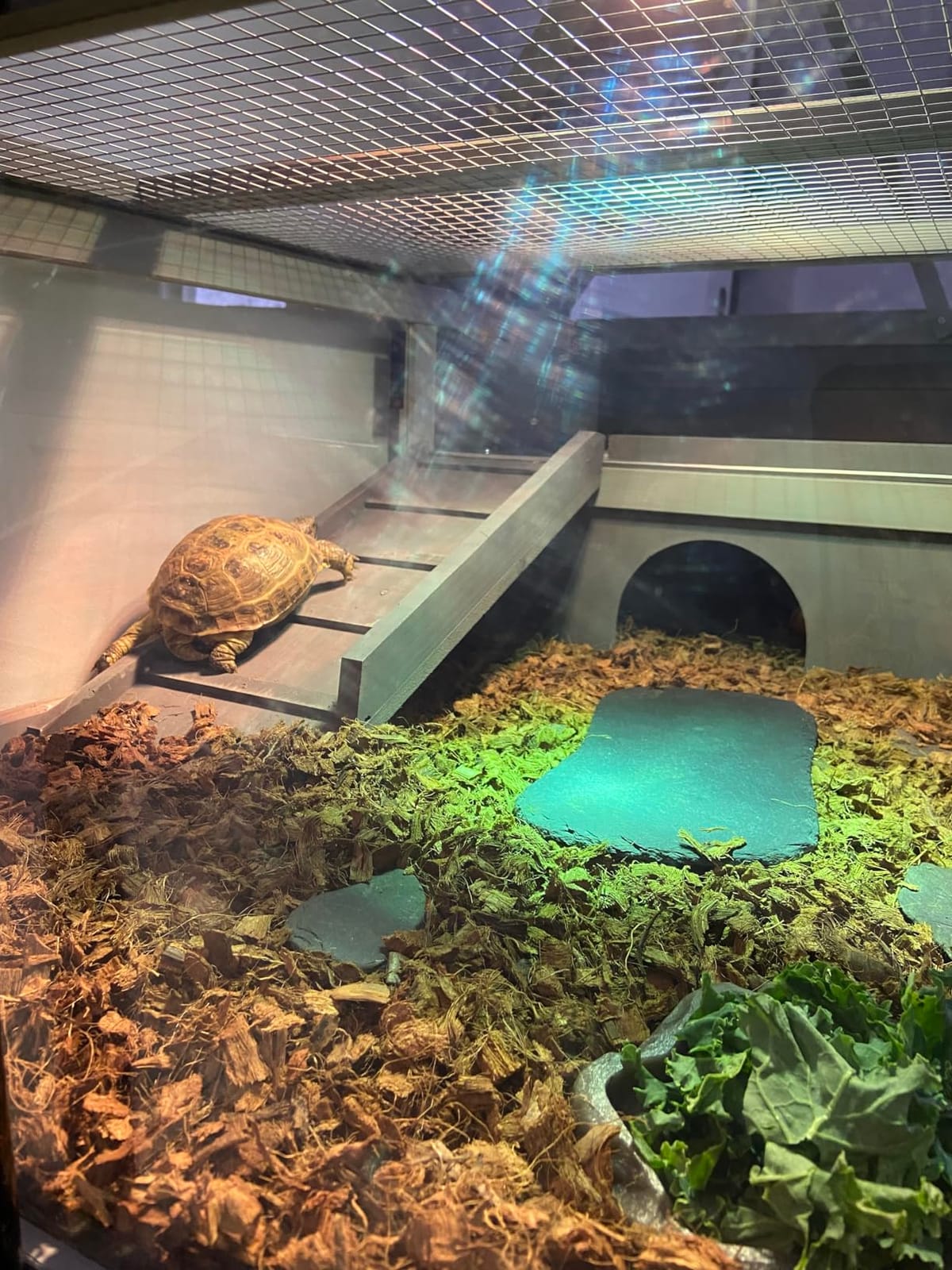
The consistent complaints are structural. Owners report wood that splinters, panels arriving cracked or discoloured, and holes that are not pre-drilled so the build can split under the pressure of the screws. The sliding bottom floor also leaves gaps at the wall seams.
Those seams let small feeder insects escape and make humidity retention difficult. If you keep a high-humidity species, this is a persistent annoyance rather than a one-time issue.
Is the built-in soaking tray worth the build quality trade-off?
For a species that needs regular soaking, yes. Having a dedicated soak area attached to the habitat means your tortoise is more likely to use it, and it removes the weekly chore of carrying a tub in from another room.
For a Hermann’s or Russian that does not need frequent soaking, the tray is a nice extra rather than a necessity. In that case the PawHut at number three is the cleaner buy.
How much repair work should I expect?
Owners describe an afternoon of careful assembly, with some sanding and sealing of splintered areas afterwards. Aquarium-safe silicone is the usual recommendation for sealing cracks and seams.
It is not a project that defeats a first-time owner, but it is more hands-on than the labelled-piece assembly of the PetsCosset or the pre-drilled ZENTAVO.
10. PawHut Two-Layer Habitat with Adjustable Lamp Holder – Best for Tall Rooms
PawHut Tortoise Habitat with Adjustable Lamp Holder, 2 Layer Tortoise Enclosure with Storage Shelf, Removable Main House, Fixed Tray, Openable Lid, Gray
40.2 x 22 x 40.9 in
Two-layer design
Removable main house
34 lb
Pros
- Tallest enclosure in the roundup with generous lamp mounting height
- Removable main house and ramp make cleaning straightforward
- Bottom storage shelf for food and supplies
- Openable top lid plus a clear viewing window
Cons
- Open top cannot hold humidity for tropical species
- Ramp is fixed at the centre and not lift-out
The PawHut D40-034V00GY is the tallest enclosure here at 40.2 by 22 by 40.9 inches, and that height is precisely why it is worth considering. Vertical clearance is the constraint that decides whether your UVB fixture can sit at a proper distance, and this one gives you the most room to work with.
The layout is two-layer: a main house on the upper level and a run box below, connected by a ramp. The main house lifts out entirely for cleaning, which owners single out as the feature that keeps this one on their list long term.
With 50 reviews and a 4.1 average, the feedback is practical rather than glowing. Buyers like the build quality once assembled, roughly 45 minutes of work for two people, and the storage shelf underneath for food and supplies.
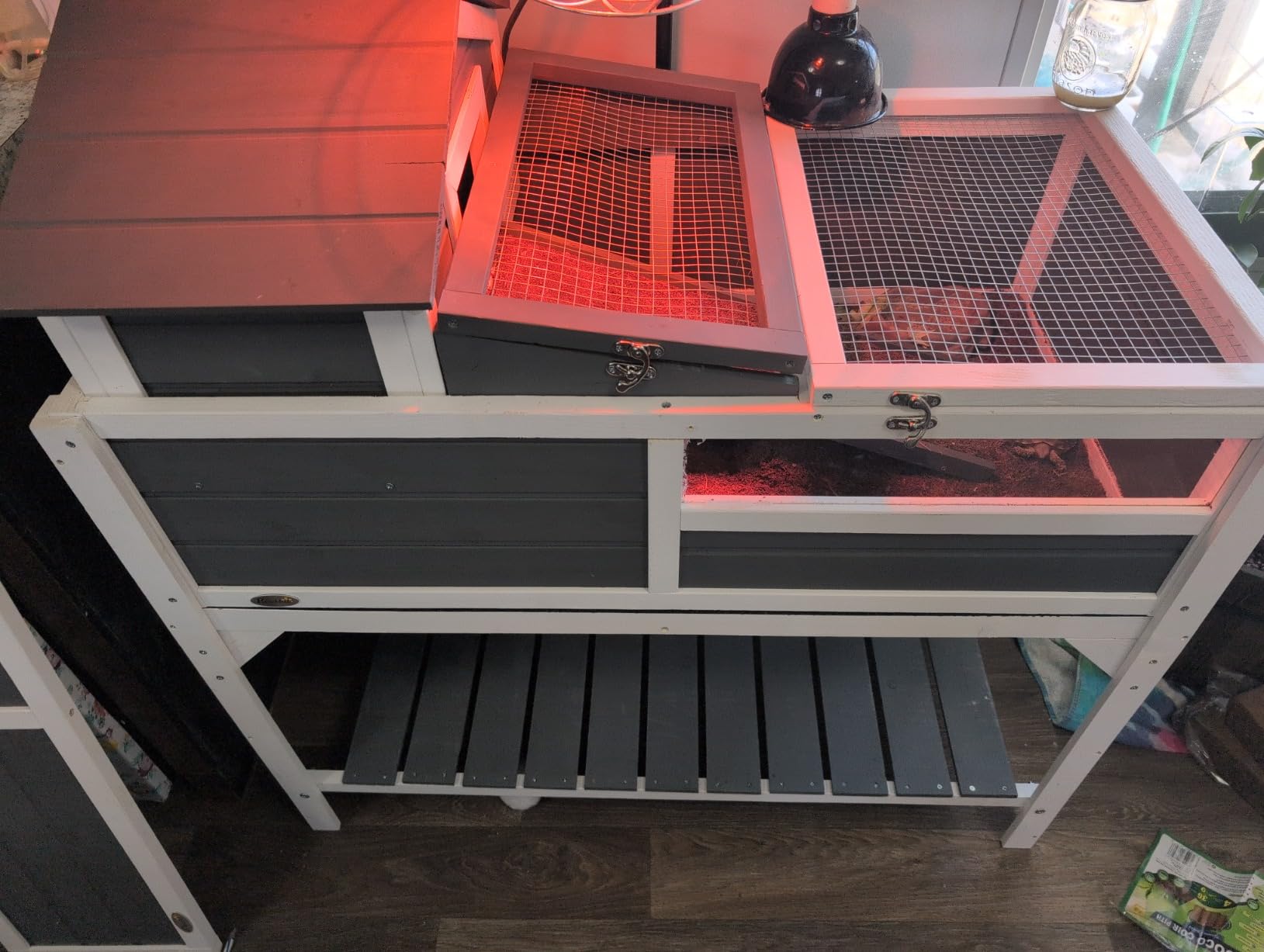
Why does wall height matter so much?
Because UVB is only useful at a certain distance from the basking surface. Too close and it is ineffective. Too far and your tortoise has to climb to reach it. Most enclosed wooden houses are 12 to 14 inches, which is not enough to hang a UVB fixture inside the box at a workable height.
At 40.9 inches overall, this enclosure lets you mount a fixture well above the animal, which is the cleanest solution to the problem short of using an open-topped table with an external lamp stand.
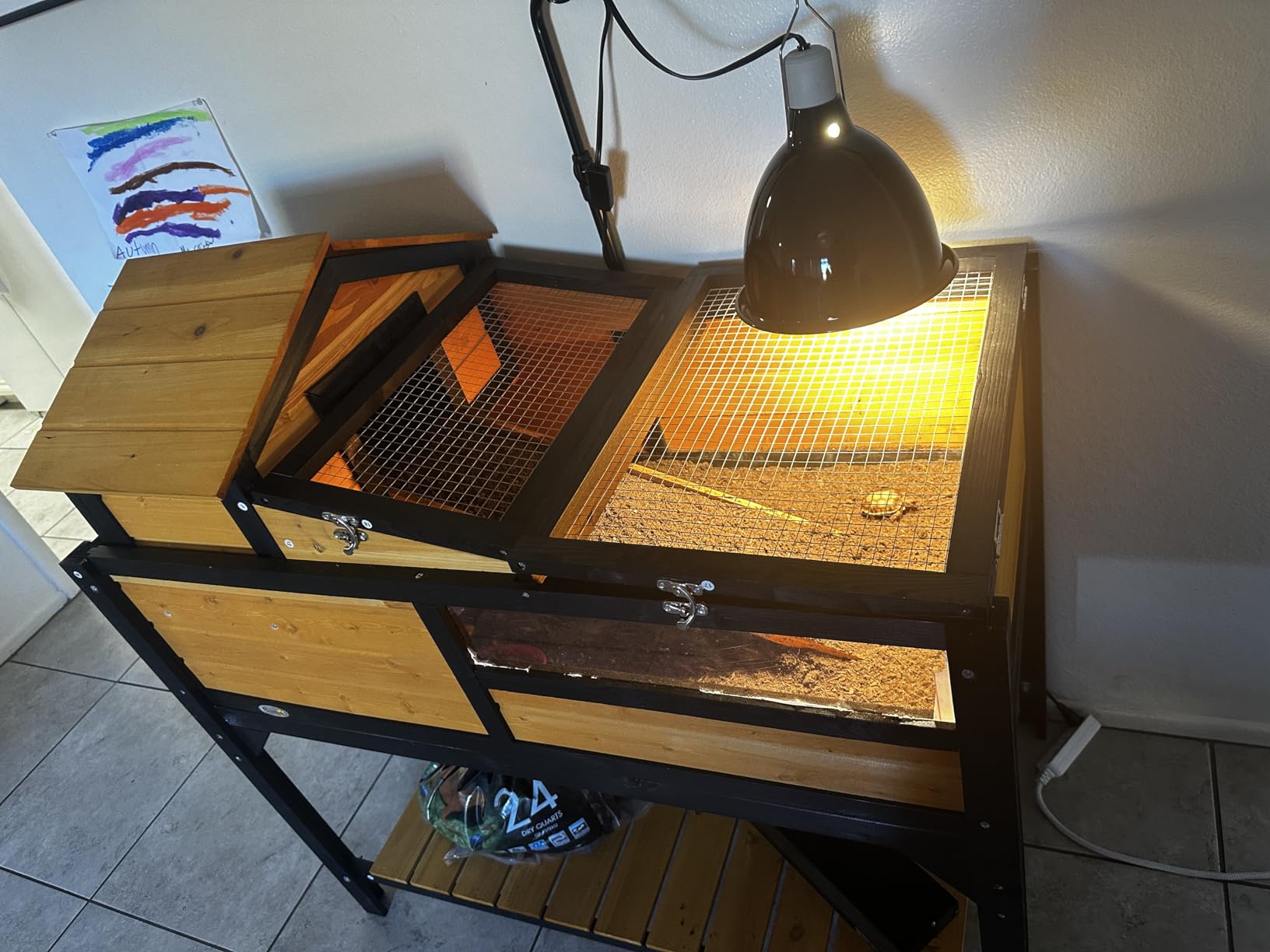
What are the husbandry drawbacks?
The open top cannot hold humidity. Owners keeping tropical species report this as the main limitation, and it is a structural one rather than a fixable accessory problem unless you add your own partial cover.
The ramp is also mounted in the centre rather than against a wall, and it is not lift-out, so cleaning beneath it takes extra effort. Minor, but it adds up in a weekly routine.
11. FunXplore Tortoise Enclosure – Best for Climate Monitoring
Tortoise Enclosure Turtle Cage Indoor Reptile for Small Animals Lizards
38 x 23.8 x 32.1 in
Hygrothermograph included
Adjustable lamp stand
24.78 lb
Pros
- Hygrothermometer included so you can read conditions from day one
- Lamp stand adjusts in both length and height
- Two-room layout with a private sleeping area
- Tray unscrews completely for cleaning
Cons
- Interior room width is slightly under several rivals in the same size class
- Small feedback base at 48 reviews to draw on
The thing that separates this enclosure from the crowd is the included hygrothermograph, a small dial gauge that reads both temperature and humidity. Two enclosures in this roundup bundle one, and both are worth a look if you want day-one readings without buying a separate meter.
That is genuinely useful. The first month with any new indoor setup is spent learning what your enclosure actually holds, and having a readable gauge from hour one removes a step. The alternative is buying a separate hygrometer anyway, which most owners do regardless.
The build is 38 by 23.8 by 32.1 inches at 24.78 pounds, with a two-room layout, detachable legs, and an adjustable lamp stand running 13 to 21.1 inches long and 11 to 31 inches tall. That lamp range is comparable to the Aivituvin and better than most.
At 4.4 stars with roughly three quarters of reviews at five, this sits alongside the Magazoopet for the strongest rating in the roundup, though written feedback was thinner than the rating suggests. Owners highlight the bundled hygrothermograph, the two-room layout, and the adjustable lamp stand as the features that set it apart.
Is the bundled hygrothermograph accurate enough to trust?
It is a dial gauge, so treat it as a general indicator rather than a precision instrument. It is good enough to tell you that your enclosure is at 70 percent humidity instead of 50, which is the level of detail most indoor keepers need day to day.
Owners who want real numbers add a separate digital meter with a remote probe. The bundled gauge is a useful starting point and a good backup, not a replacement for a probe thermometer placed at animal height.
What are the trade-offs?
Interior room width is slightly under several rivals in the same size class, so a tortoise has a bit less turning room in the sleeping room. It is still a comfortable 3 by 2 foot class footprint.
The small review base is the other thing to weigh. Forty-eight reviews gives a good read on first impressions and none at all on how the housing holds up after a few humid winters, which is when enclosure material and joint quality start to show.
12. Luyitton Wooden Habitat with Adjustable Lamp Stand – Best for Hatchlings
Tortoise Enclosure Indoor Wooden Tortoise Habitat, Adjustable Lamp Stand
38 x 23.79 x 32 in
Four triangle anti-tip supports
Adjustable lamp stand
25 lb
Pros
- Dark enclosed sleeping area suits hatchling behaviour
- Hygrothermograph included for day-one readings
- Light enough at 25 lb to move for cleaning
- Four triangle supports reduce tipping risk
Cons
- Misaligned screw holes can stop assembly entirely
- Thin wood can crack in the legs when the unit is moved
For a hatchling under three inches of shell, this is a well-proportioned first enclosure. At 38 by 23.79 by 32 inches it gives a young animal room to establish itself, and the dark enclosed sleeping area supports the hiding behaviour hatchlings need most. It also comes with a hygrothermograph in the box, so you can read conditions from the first day.
The four triangle supports are a small design detail that addresses a real problem. A lightweight wooden box with detachable legs and a water bowl on top is tippy, and a tortoise that leans into a wall while climbing can bring the whole thing down. The supports widen the base.
With 31 reviews at 4.4 stars, the ratings are strong but the sample is small, so read them as a signal rather than proof. Owners like the size for young animals, the quick build, the light weight, and the adjustable lamp stand that angles easily into position.
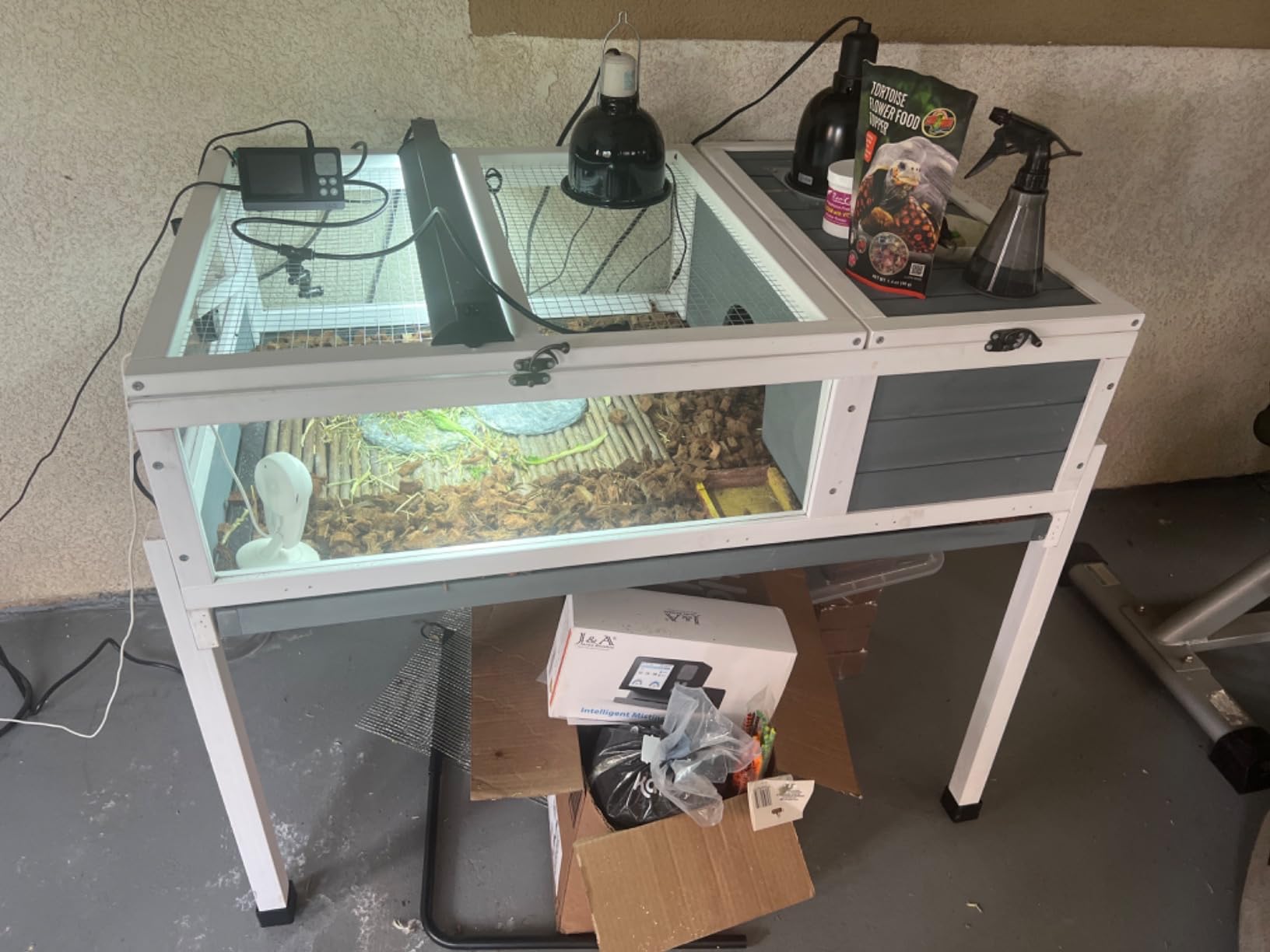
Is this a good first enclosure for a hatchling?
Yes, and the reasons are the ones that matter at that stage: a genuinely dark hide, enough floor to make choices, and a light enough weight that you can lift the whole thing to clean it without help.
Plan to move up within a year or two. A hatchling in this enclosure will outgrow it, so treat it as a first step and think ahead to a larger space rather than buying twice.
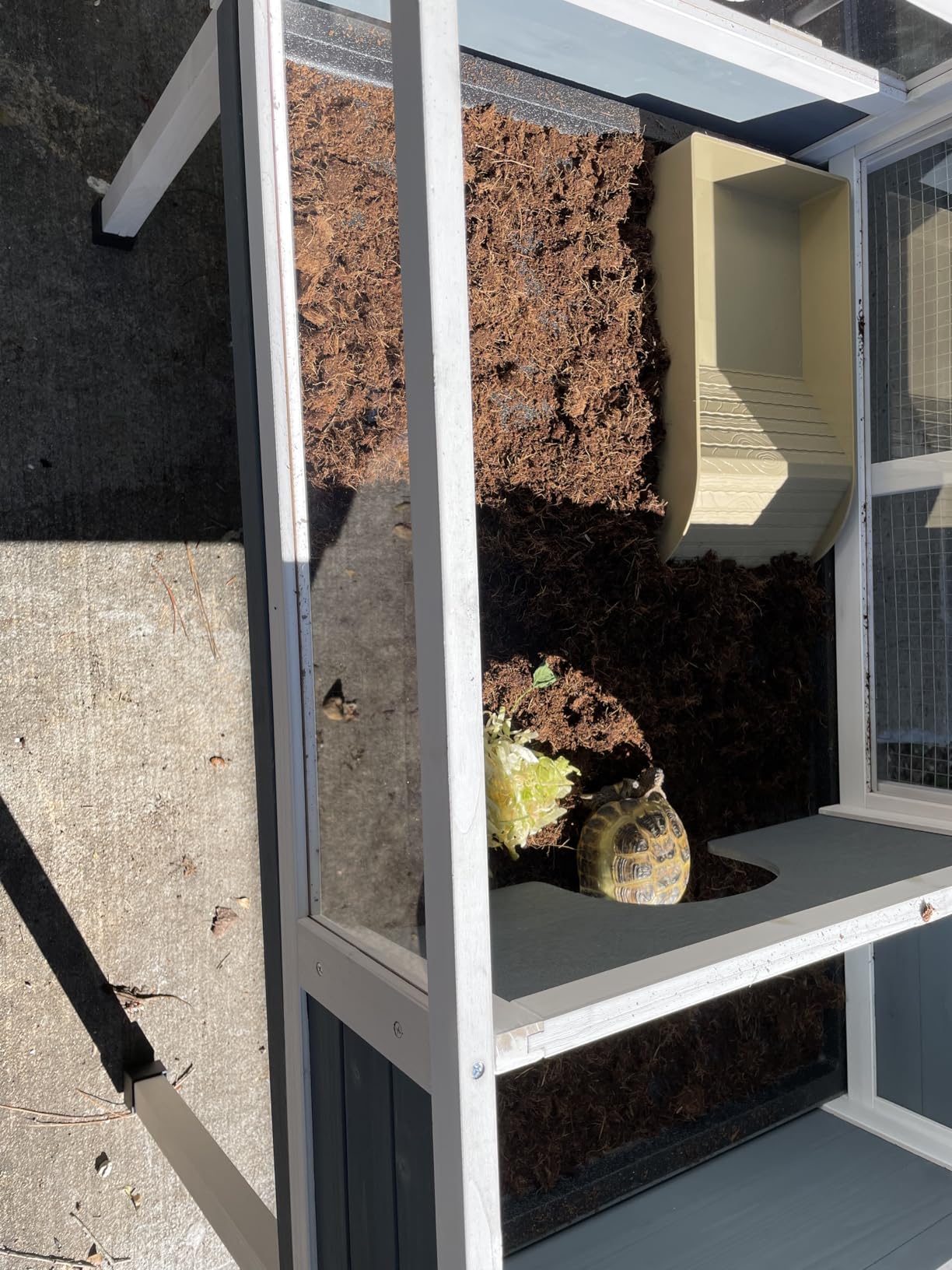
What about the assembly complaints?
Misaligned screw holes are the most serious issue reported, and a few owners say they could not complete the build at all. Others received wrong-size doors or incorrect leg parts, which is a packing problem rather than a design flaw.
Inspect every panel against the manual before you start driving screws, and have the parts laid out and counted. Thin wood is also reported to crack in a leg when the enclosure is moved by two people, so lift it rather than drag it.
Indoor Tortoise Enclosure Buying Guide
Choosing well here is mostly a matter of reading a product page correctly. The dimensions on a listing, the material, the wall height, and the size of the hide are the four numbers that decide whether an enclosure works, and every one of them is either missing or misleading on some listing you will find.
How Big Should an Indoor Tortoise Enclosure Be?
An indoor tortoise enclosure should give at least 4 by 8 feet of usable floor for a single adult of any small species, and a hatchling can start at 3 by 2 feet. The 4 by 8 figure is the long-standing consensus on TortoiseForum and it is the number to plan your purchase around, even though almost nothing you can buy today comes close to it.
The 8 by 4 shell-length rule circulates among breeders as a companion guideline: an enclosure eight shell lengths long by four shell lengths wide for the first animal, doubled for each additional tortoise. For a 6 inch Hermann’s, that means 4 feet by 2 feet as a starting point, which lines up with the 4 by 8 minimum once you apply it to the larger shell length in the animal.
Here is the size reference we use, covering every species in this guide:
Hermann’s tortoise – typical adult shell 6 to 8 in; minimum floor space 4 x 8 ft; good, permanent indoor housing possible.
Russian tortoise – typical adult shell 7 to 10 in; minimum floor space 4 x 8 ft; good, tolerates cool indoor conditions.
Greek tortoise – typical adult shell 6 to 9 in; minimum floor space 4 x 8 ft; good, needs strong basking heat.
Red-footed tortoise – typical adult shell 10 to 14 in; minimum floor space 8 x 10 ft or more; mixed, works best with supplemental outdoor time.
Marginated tortoise – typical adult shell 8 to 12 in; minimum floor space 8 x 8 ft; poor for permanent indoor only.
Leopard tortoise – typical adult shell 12 to 18 in; minimum floor space 10 x 10 ft or more; not suitable for permanent indoor housing.
Sulcata tortoise – typical adult shell 18 to 30 in; out of indoor range; not suitable for indoor housing.
Hatchling, any small species – typical adult shell under 4 in; minimum floor space 3 x 2 ft; good, grow out to adult space by 12 months.
Read that last entry carefully. Nearly every enclosure in this roundup is a hatchling and juvenile box. That is not a criticism of the products, it is a mismatch with the advertising, and it is the single most common source of disappointment in this hobby.
Why Every Enclosure on This List Is Too Small for an Adult
Because the market sells hatchling boxes. The largest footprint here is 44 by 25.6 inches, which is just under 8 square feet including the stand. The consensus minimum for an adult is 32 square feet. No single commercial enclosure closes that gap.
So what do keepers actually do? The most common approach, and the one discussed repeatedly on forums, is joining two commercial enclosures side by side. Several of the wooden houses in this roundup are designed to be connected, and owners report using the connecting instructions in the manual to approximate a larger pen. If you go this route, buy two of the same model and brace them together so they cannot separate.
The other approach is to treat the indoor table as seasonal housing, which is what Russian and Hermann’s owners in cold states do. Keep the tortoise indoors for the winter months with a proper basking zone, then move it outside when the weather permits. That is a defensible strategy for species that tolerate temperature swings, and it is not the same thing as permanent indoor keeping.
Tortoise Table vs Vivarium vs Plastic Tote vs Utility Tub
Four enclosure formats come up in every indoor discussion, and each fails in a different way. The tortoise table wins on lighting, the vivarium wins on containment, the tote wins on nothing except cost, and the deep utility tub wins on size and durability.
Wooden tortoise table – floor space 3 x 2 ft to 4 x 3 ft typical; UVB mounting is good because low walls keep the lamp close; main weakness is that it is too small for an adult and wood can warp.
Glass vivarium – floor space 3 x 2 ft to 4 x 2 ft; UVB mounting is poor because the fixture must sit outside the glass; main weakness is light loss through glass and a mesh top.
Plastic tote – floor space 4 x 2 ft to 4 x 3 ft for a large tote; UVB mounting is poor because high walls block light; main weakness is sealed plastic with no ventilation and no hide.
Deep utility tub – floor space 4 x 3 ft and up; UVB mounting is excellent thanks to the open top and high walls; main weakness is weight, hard cleaning, and the need for modification.
Keepers generally prefer tables over vivariums for indoor keeping because a UVB lamp has to sit outside a vivarium and the light is lost through the glass and mesh. A low-walled open table keeps the lamp close to the basking zone, which is what the animal actually needs.
The deep utility tub is the option most often suggested for people who can commit to modification. It is large, it is inexpensive compared with wood, and the walls are high enough to mount lighting. It also weighs a great deal empty, has no hide built in, and needs a substrate tray fabricated underneath before it is usable.
Which Tortoise Species Are Best for Indoor Keeping?
Hermann’s, Russian, and Greek tortoises are the realistic choices for indoor housing. All three tolerate a controlled indoor environment well and none requires the constant outdoor access that larger tropical species do.
Large species are simply not suitable for permanent indoor living. Leopard and Sulcata tortoises in particular are active, and owners who try to keep them inside report constant attempts to escape and stress behaviour that outdoor housing resolves. If you have one of those, solve the outdoor pen problem rather than the enclosure problem.
Red-footed and marginated tortoises sit in between. They tolerate indoor time but genuinely benefit from supplemental outdoor access, and a table in the roundup works better as a winter setup than as a year-round home for them.
Wall Height and UVB Lamp Distance: The Spec Buyers Miss
A basking zone of 90 to 95 degrees Fahrenheit with a cool zone around 75, controlled by a thermostat and checked with a probe thermometer at animal height, is the target every enclosure in this roundup is built to support. A hygrometer or hygrothermograph tells you where the humidity sits.
Now the part that costs people money. A T5 HO UVB fixture needs to sit roughly 12 to 18 inches above the basking surface to deliver useful output. Most commercial wooden enclosures give you 12 to 14 inches of interior wall. Hang a UVB lamp inside one of those and it is too close to be safe, so many owners end up removing the lamp frame entirely and mounting above.
Before you buy, check the interior wall height in the listing, not the total height. Then decide where the lamp goes. If the wall is short, an external lamp stand above an open top is the correct setup, and it works with every enclosure here.
What Every Working Indoor Setup Also Needs
The enclosure is roughly a third of what a working indoor habitat requires. Owners who budget only for the box are the ones who abandon the project halfway, so here is what else goes on the list: a basking lamp with a dimmable bulb, a T5 HO UVB fixture with a reflector, a probe thermometer, a hygrometer if the enclosure does not include one, a thermostat if the species needs close control, and a hide object if the built-in dark room is not large enough.
Substrate is the other line item people forget. A 3 to 4 inch depth is what most indoor keepers use, and that is a lot of weight on a wooden table with a plastic tray. Check that the tray is supported at the perimeter before you fill it.
We are deliberately not putting numbers on any of this. Prices move daily and the Check Latest Price buttons are the only place to read current ones.
Substrate, Cleaning and Common Problems
For substrate, the options that work indoors are coconut coir mixed with orchard bark for a Mediterranean species, or a soil-sand mixture for burrowing species. Avoid reptile carpet, which traps waste and gets ingested, and avoid gravel, which can cause impaction if swallowed.
On a daily basis, remove droppings, check water, and confirm your thermostat reading. Weekly, sift the substrate for debris and do a partial water change. Monthly, pull the tray and wash it fully.
The three problems we see most: overheating hotspots from a lamp in a small sealed wooden box, solved by cutting ventilation holes or raising the lamp; mold and odor from a sealed tray, solved by washing more often and improving airflow; and substrate falling through tray seams, solved with foam tape along the edges.
What Not to Buy for Indoor Use
Skip glass turtle tanks sold as tortoise housing. They are inadequate on floor space, and the necessary fixture outside the glass loses much of the light. Skip anything under 3 by 2 feet of usable floor. Skip wire or mesh floors. Skip enclosures with no enclosed dark area, because tortoises need a proper hide to sleep.
Skip cedar, and skip any listing that will not tell you the wood species. And skip outdoor-only construction marketed for indoor use without checking the finish, because untreated pine warps in a heated indoor room faster than it does outdoors.
For broader housing guidance across reptile species, our reptile enclosure roundup covers the formats this article compares, and our guide to tortoise turnout control covers the outdoor half of a seasonal indoor setup.
Frequently Asked Questions
What is the best indoor enclosure for a tortoise?
The GEGURI two-room fir wood habitat is the best indoor tortoise enclosure in our testing, with the largest owner feedback base and a removable pull-out tray. Whatever you choose, an adult needs at least 4 by 8 feet of usable floor, an enclosed dark hide, a waterproof tray, and enough wall clearance to hang a UVB lamp at a safe distance.
How big should an indoor tortoise enclosure be?
At least 4 by 8 feet of usable floor for a single adult of any small species such as Hermann’s, Russian, or Greek. A hatchling can start at 3 by 2 feet but should be moved up within about a year. The 8 by 4 shell-length rule means eight shell lengths long by four shell lengths wide, which lines up with the same minimum for a typical adult.
How big should my tortoise table be?
Big enough that your tortoise cannot reach both ends while walking quickly. For an adult, that means 4 by 8 feet. Most commercial wooden tables top out around 3 by 2 to 4 by 3 feet, so joining two matching enclosures side by side is the common workaround. For a hatchling, a 3 by 2 foot table with an enclosed hide is plenty for the first year.
Can a tortoise live in a tortoise table?
Yes, and a low-walled wooden tortoise table is the preferred format for indoor keeping because it keeps the basking lamp close to the animal. What a table cannot solve on its own is size, since almost nothing commercially available reaches adult minimums. You either join two matching enclosures or use it as seasonal winter housing.
Do tortoise tables need a top?
Most tortoise tables are open topped so heat and UVB fixtures can sit close to the basking zone, and ventilation is usually better without a lid. Lidded units exist and help contain humidity for tropical species, but they trap heat and need more ventilation. If you keep a high-humidity species, add a partial cover rather than sealing the whole top.
Which small tortoise breed is best for an indoor enclosure?
Hermann’s, Russian, and Greek tortoises are the realistic choices for indoor housing, and all three tolerate a controlled indoor environment well. Large species such as leopard and Sulcata are not suitable for permanent indoor living and need outdoor space. Red-footed and marginated tortoises work indoors seasonally but benefit from supplemental outdoor access.
Which Indoor Tortoise Enclosure Should You Buy in 2026?
For most people, the best tortoise enclosure for indoor use is the GEGURI two-room fir wood habitat. It carries the largest base of owner feedback here at 507 reviews, has a genuine enclosed sleeping area and detachable legs, and the light weight makes it the one we can move for deep cleanouts without recruiting help.
Buy the Aivituvin instead if lighting is your main worry, because its adjustable metal lamp holder solves the UVB distance problem better than anything else here. Buy the PawHut D40-012 instead if you have a dog or young children and need the lockable latches. Buy the ZENTAVO if you want the most floor space and vertical enrichment, and buy the Magazoopet if you want the widest lamp adjustment range and can accept a newer product with a shorter track record.
Whatever you pick, remember the size floor: 4 by 8 feet for an adult, an enclosed dark hide, a waterproof tray, and enough wall clearance to hang your UVB fixture at a safe distance. None of these enclosures reaches adult minimums on its own, so plan to join two matching enclosures or use the table as seasonal winter housing alongside outdoor time.