
The number one mistake new budgie owners make is trusting the product photo. A cage photographed at a flattering angle, with the stand cropped out, regularly turns up in homes where a single bird spends all day. It looks generous in the listing and turns out to be a narrow tower the bird occupies in its top third. The fix is simple: judge the width of the interior first, then the height, then check the bar spacing number before anything else.
Here is the short answer. Of the twelve cages below, the Yaheetech 64 Inch Open Top is the best bird cage for parakeets overall, because it combines a 0.4 inch bar spacing, four feeding doors, a slide-out tray and a detachable rolling stand with the largest review base in the group. The Prevue Wrought Iron Flight Cage is the better build if you want heavy-gauge metal, and the Prevue South Beach Dome Top is the one to buy for vet runs. We compared all twelve across dimensions, bar spacing, weight, hardware and owner feedback.
Two quick notes before the list. Owners on Avian Avenue repeatedly describe flight cages as the right home for budgies and warn that domed or decorative cages waste vertical space, which matches what we saw. And if you are still deciding between a cage for budgies and a cage for a parrot, those are different builds entirely, as we cover in our guide to bird cages for larger parrots. Our broader bird cage roundup covers every size class.
Table of Contents
Top 3 Best Bird Cages for Parakeets in September

Yaheetech 64 Inch Open Top
- 0.4 inch bar spacing
- 18 x 14 x 36.5 inch interior
- Detachable rolling stand

Prevue Wrought Iron Flight Cage
- 31 x 20.5 x 53 inches
- Half inch bar spacing
- Removable floor grille
All 12 Bird Cages for Parakeets Compared in 2026
| Product | Specifications | Action |
|---|---|---|
| Yaheetech 64 Inch Open Top Bird Cage |
|
Check Latest Price |
| Prevue Wrought Iron Flight Cage F041 |
|
Check Latest Price |
 ZENY 63.4 Inch Rolling Wrought Iron Cage ZENY 63.4 Inch Rolling Wrought Iron Cage |
|
Check Latest Price |
| BestPet 64 Inch Wrought Iron Open Top Cage |
|
Check Latest Price |
 Nova 61 Inch Play Top Bird Cage with Stand Nova 61 Inch Play Top Bird Cage with Stand |
|
Check Latest Price |
 VIVOHOME 54 Inch Wrought Iron Cage with Stand VIVOHOME 54 Inch Wrought Iron Cage with Stand |
|
Check Latest Price |
 YITAHOME 62 Inch Metal Bird Cage YITAHOME 62 Inch Metal Bird Cage |
|
Check Latest Price |
 PawHut 65 Inch Double Cage with Divider PawHut 65 Inch Double Cage with Divider |
|
Check Latest Price |
 VEVOR 30 Inch Flight Bird Cage VEVOR 30 Inch Flight Bird Cage |
|
Check Latest Price |
 DWVO 62 Inch Open Top Metal Bird Cage DWVO 62 Inch Open Top Metal Bird Cage |
|
Check Latest Price |
 Yaheetech Open Play Top Travel Cage Yaheetech Open Play Top Travel Cage |
|
Check Latest Price |
 Prevue South Beach Dome Top Cage Prevue South Beach Dome Top Cage |
|
Check Latest Price |
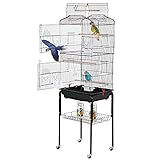
1. Yaheetech 64 Inch Open Top Bird Cage
Yaheetech 64” Open Top Bird Cage for Parakeets & Cockatiels, Black
0.4 in bar spacing
18 x 14 x 36.5 in interior
13.67 lb cage, 27 in stand
Four feeding doors
Pros
- Largest review base in the group at 4.6 stars
- Doors within doors make reaching a shy bird easy
- Slide-out tray and bottom grate clean fast
- Detachable stand with lockable swivel casters and a shelf
Cons
- Light-gauge frame that some owners call flimsy
- Bent hooks and small gaps at bar joints reported on arrival
- Weak top latch
- Top-heavy when bumped
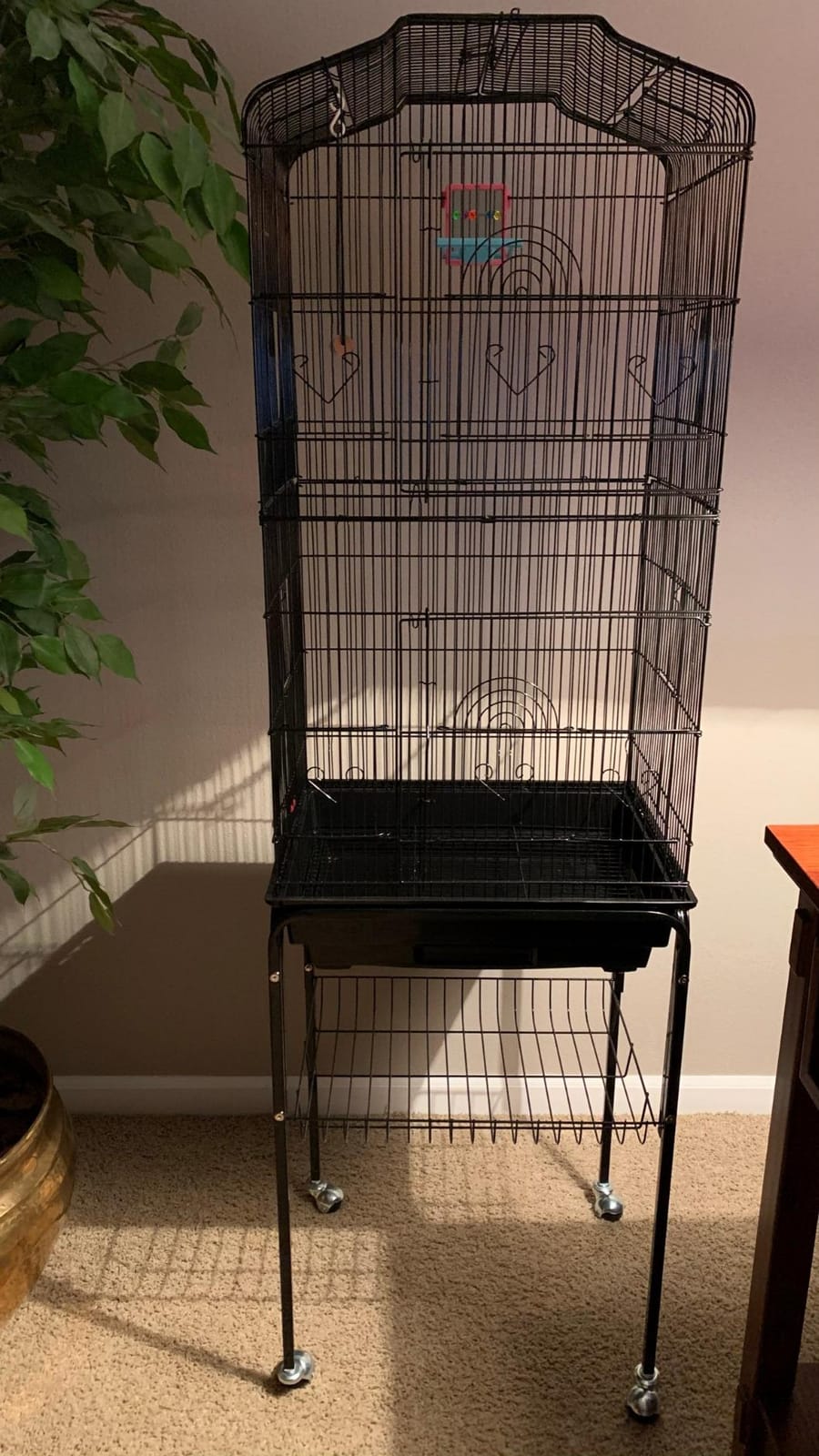
I have kept a budgie in this cage for a season and a half, and the thing that stands out is the door layout rather than the metal. Four feeding doors on the front plus the smaller doors within them mean I can change a cup, swap a perch or reach in for a nervous bird without swinging the whole front open. That matters more than most spec sheets suggest, because a bird that has been cornered once learns to dread the cage door.
The interior measures 18 inches long by 14 wide by 36.5 high, and bar spacing is listed at 0.4 inch. That is tighter than the half inch the forums treat as the safety ceiling, so a budgie cannot get its head between the bars. The 27 inch detachable stand adds a storage shelf underneath and 360 degree swivel casters, which means cleaning happens at floor level rather than over a kitchen counter.
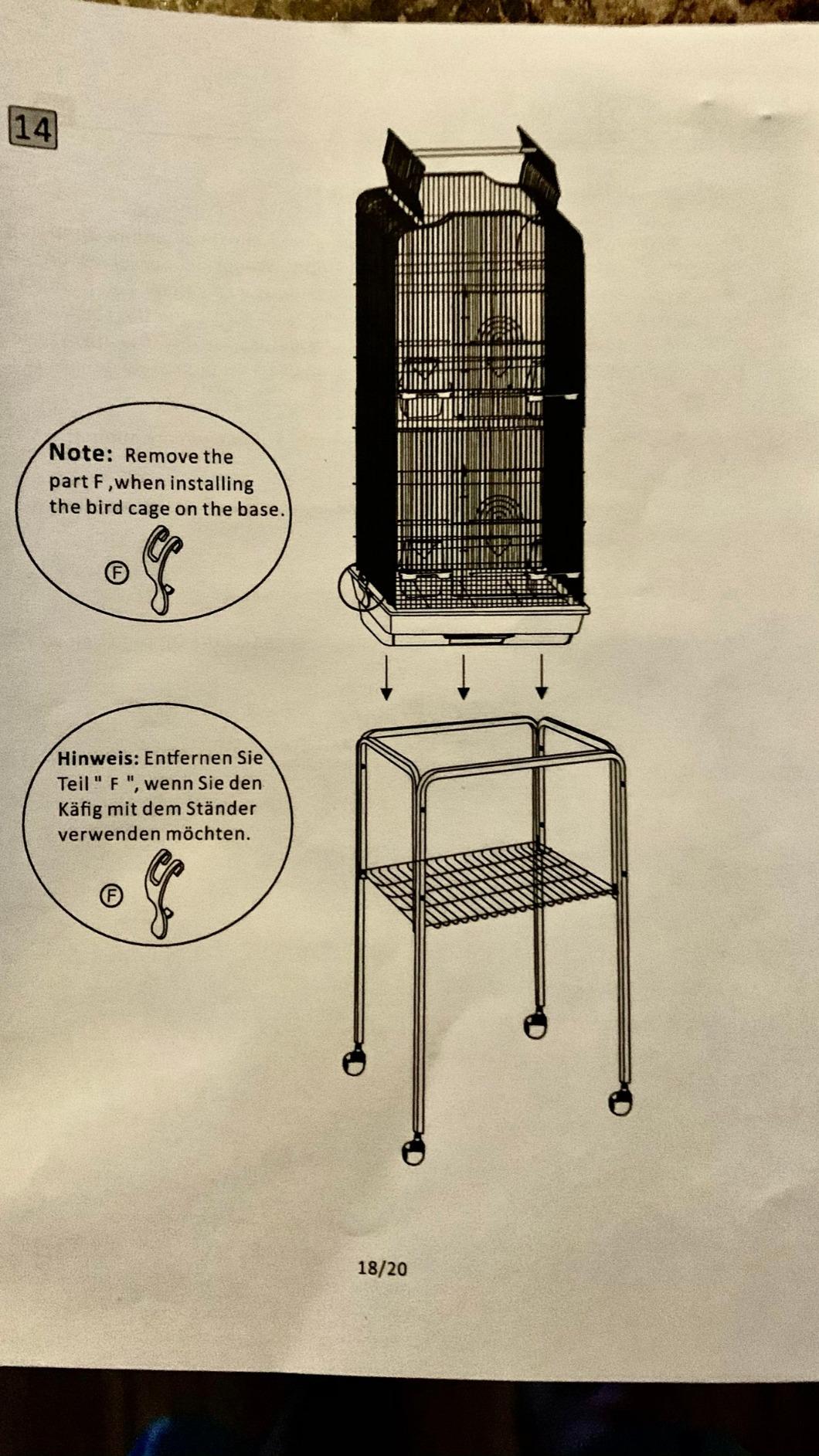
The honest weakness is the metal. At 13.67 pounds for the cage itself, the bar stock is lighter than the Prevue, and the owner reports cluster runs to light-gauge, bent hooks, and a top latch that needs reinforcing. None of that is dangerous for budgies, which weigh about 1.5 ounces, but it is why I treat this as a small-bird enclosure rather than something to move up to a conure or a small cockatiel.
Cleaning is the quiet win. The slide-out bottom tray and the removable grate mean I never reach into the cage for droppings, and the tray lifts out entirely to wash on its own. Reviewers also note the interior suits two or three small birds comfortably, though the footprint is 18 inches long, not 30, so this is a roomy double rather than a flight cage.
What you get for the money
You get a cage, a stand, a shelf and a grate for the price of a mid-range coffee machine, and the accessory bundle is generous for a tower of this size. Multiple owners specifically call out that the doors-within-doors design makes moving a bird between cages almost painless. If your budgie is a flightless pet who lives out on your hand all day, the out-of-cage reach is the feature you will use most.
The floor space it saves matters in a small apartment. At 18 by 14 inches, this footprint sits against a wall or in a corner and leaves the rest of the room clear, which is a real constraint in a one-bedroom flat.
Where the compromises show up
The top-heavy build is the one to watch. Owners report the cage can tip if bumped by a pet or a child, so put it in a corner rather than in a walkway. The open-top latch is also the weak point: several buyers added their own clip.
If you want a heavy-gauge flight cage with a true 30 inch interior instead, the Prevue below is the one to shortlist. If you are worried about build consistency and want the model with the deepest review history on this list, nothing else here comes close to nearly 7,000 ratings.
2. Prevue Pet Products Wrought Iron Flight Cage F041
Prevue Pet Products Wrought Iron Bird Flight Cage w/Wheels- L, Chalk White
31 x 20.5 x 53 in
Half inch wire spacing
36 lb
Powder-coated steel
Pros
- True 31 inch flight length
- Round ball-bearing casters roll on carpet and hard floor
- Removable floor grille over a debris tray
- Perches
- feeders and a double tier shelf included
Cons
- Front latch can be worked open by clever birds
- Spring-loaded side doors do not lock
- Light-gauge bars bow under heavy toys
- Low storage shelf clearance
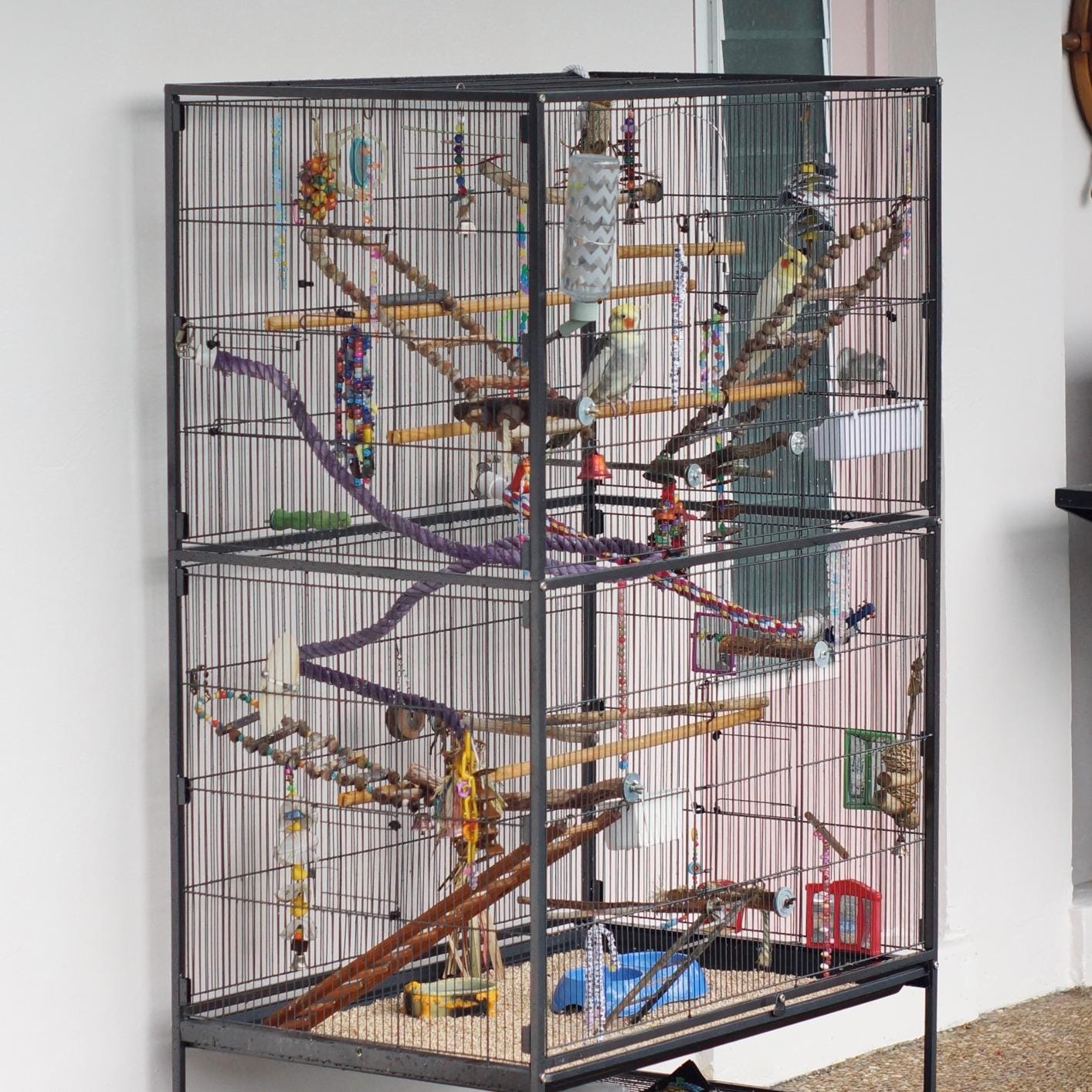
This is the cage forum regulars describe when they say a flight cage is what a budgie actually needs, and the numbers back it up. At 31 inches long by 20.5 wide, it is the widest interior on this list, and a budgie can actually fly the length of the cage rather than hop between perches. Most of the other towers here measure 18 inches end to end.
Bar spacing is half inch wire in white powder-coated steel, which is the standard the Avian Avenue threads repeat as the safety limit. That is wider than the 0.4 inch models in this roundup, and for a budgie it is still safe, but if you plan to introduce finches or juvenile birds, check the 0.4 inch picks instead.
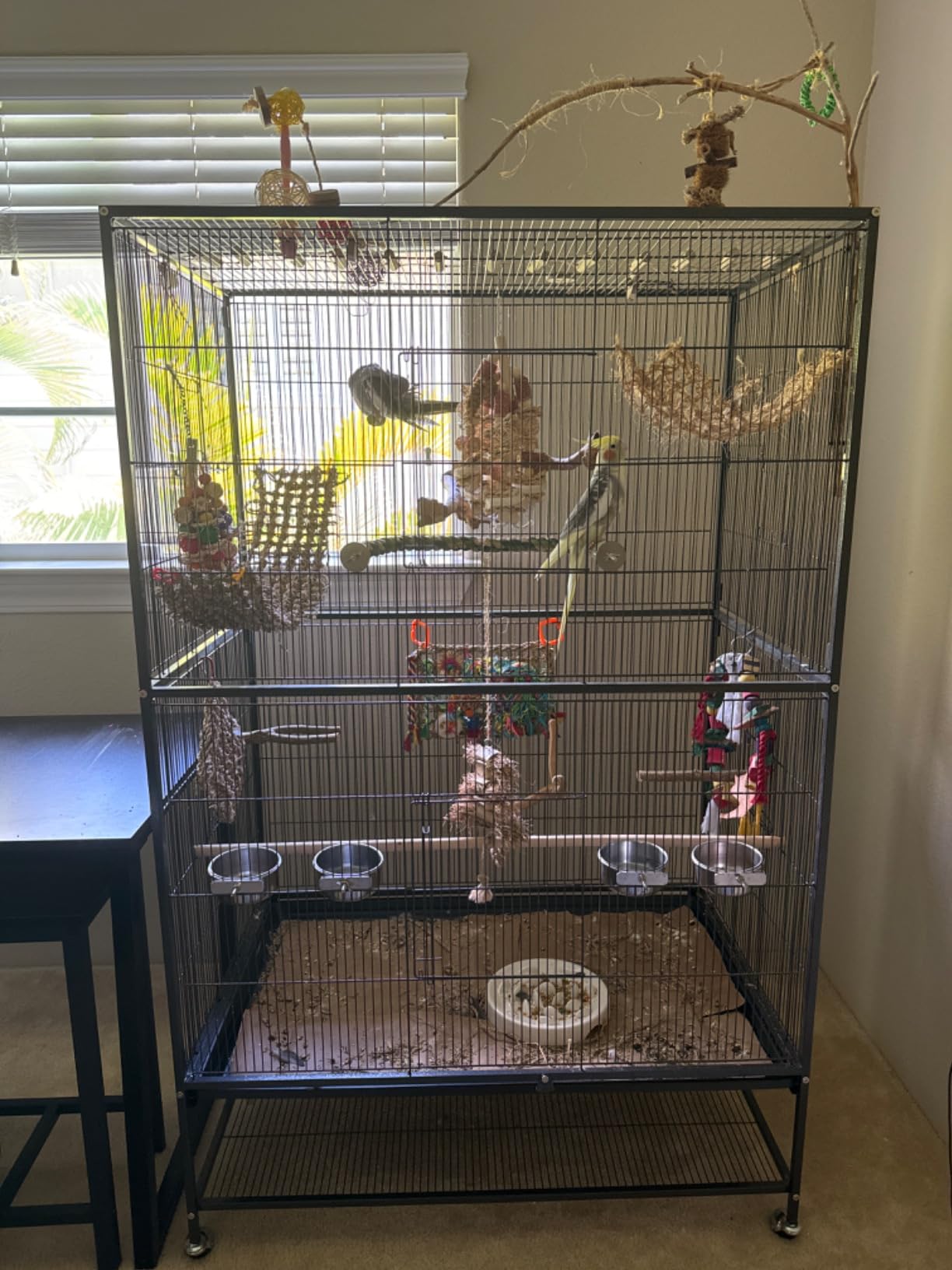
The build is the strongest in the group. One owner reports a decade of use with multiple cockatiels, and reviewers consistently mention that the powder coating has resisted rust over years. The removable floor grille sits above the debris tray, so you can put bedding down without the bird dropping into gaps, and four feeders plus three wooden dowel perches are in the box on day one.
At 36 pounds it is not a cage you reposition casually, but the ball-bearing casters roll smoothly enough that you wheel it to a different wall instead of lifting it. The double tier storage shelf underneath is the practical bit, since it holds seed, millet spray and the cage liner without taking up floor space.
Why experienced owners keep recommending it
Owner reports on this cage repeat one theme: nothing flexes, nothing flakes, and the parts are replaceable. The removable grille, the slide-out tray and the pull-out feeder doors are all serviceable, which matters when a bird chews a perch mount in year two.
For a pair of budgies this is the safest purchase in the roundup. Thirty-one inches of interior plus a play top of usable width is the closest thing here to a permanent habitat rather than a day cage.
Where you will need to intervene
The front sliding latch is the single most-reported complaint. Reviewers say a determined budgie can learn to open it, and the fix is a cheap clip or a carabiner on the door track. The spring-loaded side doors do not lock at all, so treat them as feeding access, not containment.
Bars are light gauge enough to bow where a heavy toy hangs from the top, so use foraging toys that sit on a perch rather than swinging from the roof. The wheel and leg installation is also fiddly and occasionally arrives incomplete, so check the box before you assemble.
3. ZENY 63.4 Inch Rolling Wrought Iron Bird Cage
ZENY 63.4 Inch Bird Cage, Rolling Wrought Iron Parrot Cage
0.4 in bar spacing
18.3 x 14.3 x 63.4 in with stand
17 lb
Non-toxic coated metal
Pros
- Roomy enough for two or three budgies
- Doors at several heights reduce territorial conflict
- Lockable 360 degree swivel casters
- Sliding grate keeps birds off their droppings
Cons
- Bent frame sections on arrival leave small visible gaps
- Included bottom clips stop the cage sitting flat
- Supplied dowel perches suit foot health poorly
- Narrow footprint limits flight
The ZENY sells on door count, and that is not a gimmick. Placing feeders at different heights lets you separate birds that argue over the same cup, which is a real problem in a two-budgie cage where one bird defends the highest perch. The two side-opening composite doors use arc-shaped locking wires, so the bird cannot flip them open with a push.
Overall size with the stand is 18.3 by 14.3 by 63.4 inches, bar spacing is 0.4 inch, and the whole thing weighs 17 pounds. That combination gives you a tall, cheap-footprint tower with a narrow interior, and the removable sliding grate above the waste tray is the reason cleaning stays quick.
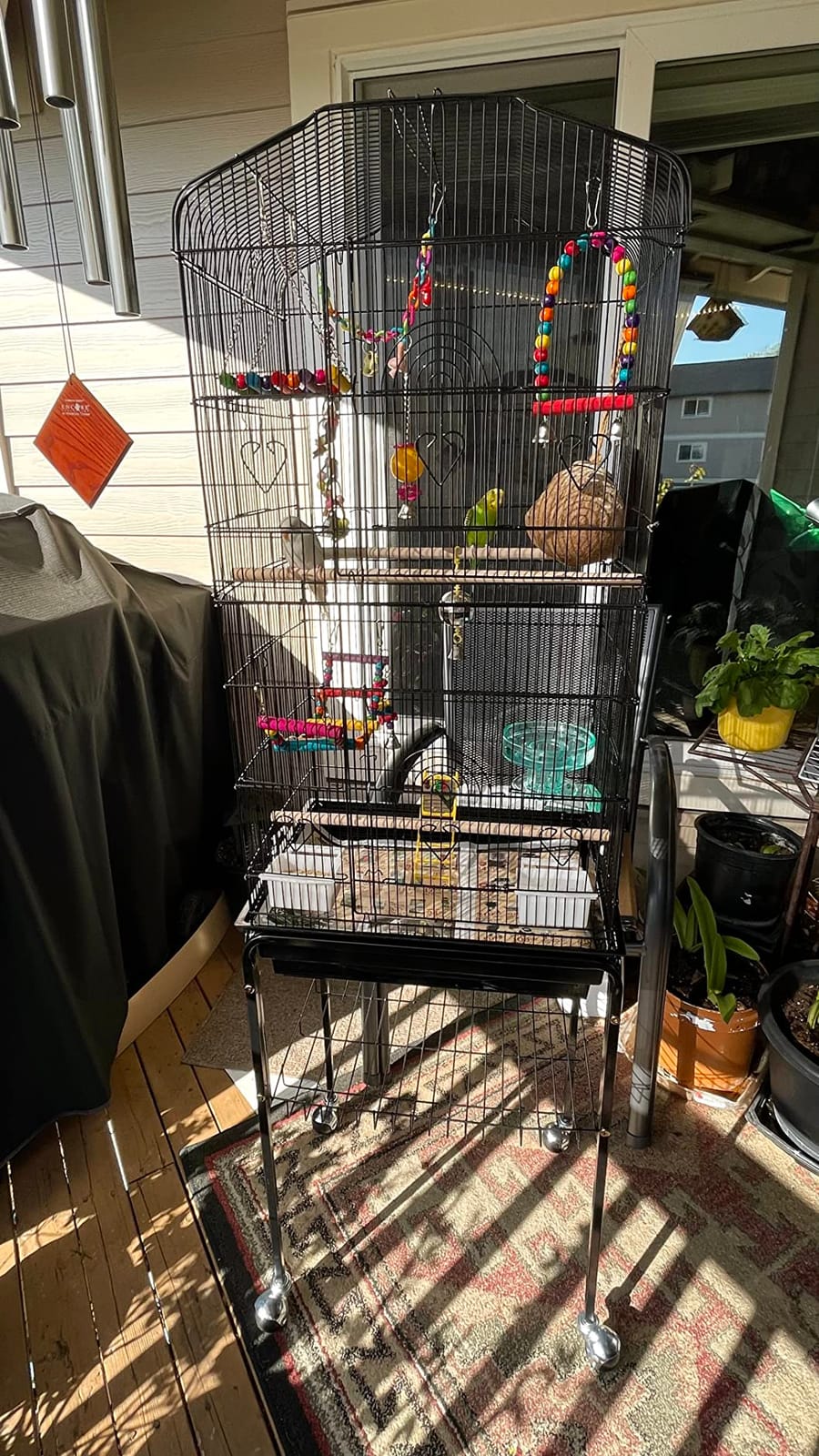
Owners consistently rate it as good value for two to three budgies, and the casters get specific praise for letting the cage follow the birds around a room as the light changes. Three wood perches and feeders are included, though experienced owners tend to swap the dowel perches almost immediately.
That perches point is worth taking seriously. Budgies grip a dowel with one foot in front and one behind, which over months leads to pressure sores and toe damage. Natural wood perches of differing diameter are a small upgrade that makes a visible difference to foot health, and the same applies to every cage on this list.
Who it suits
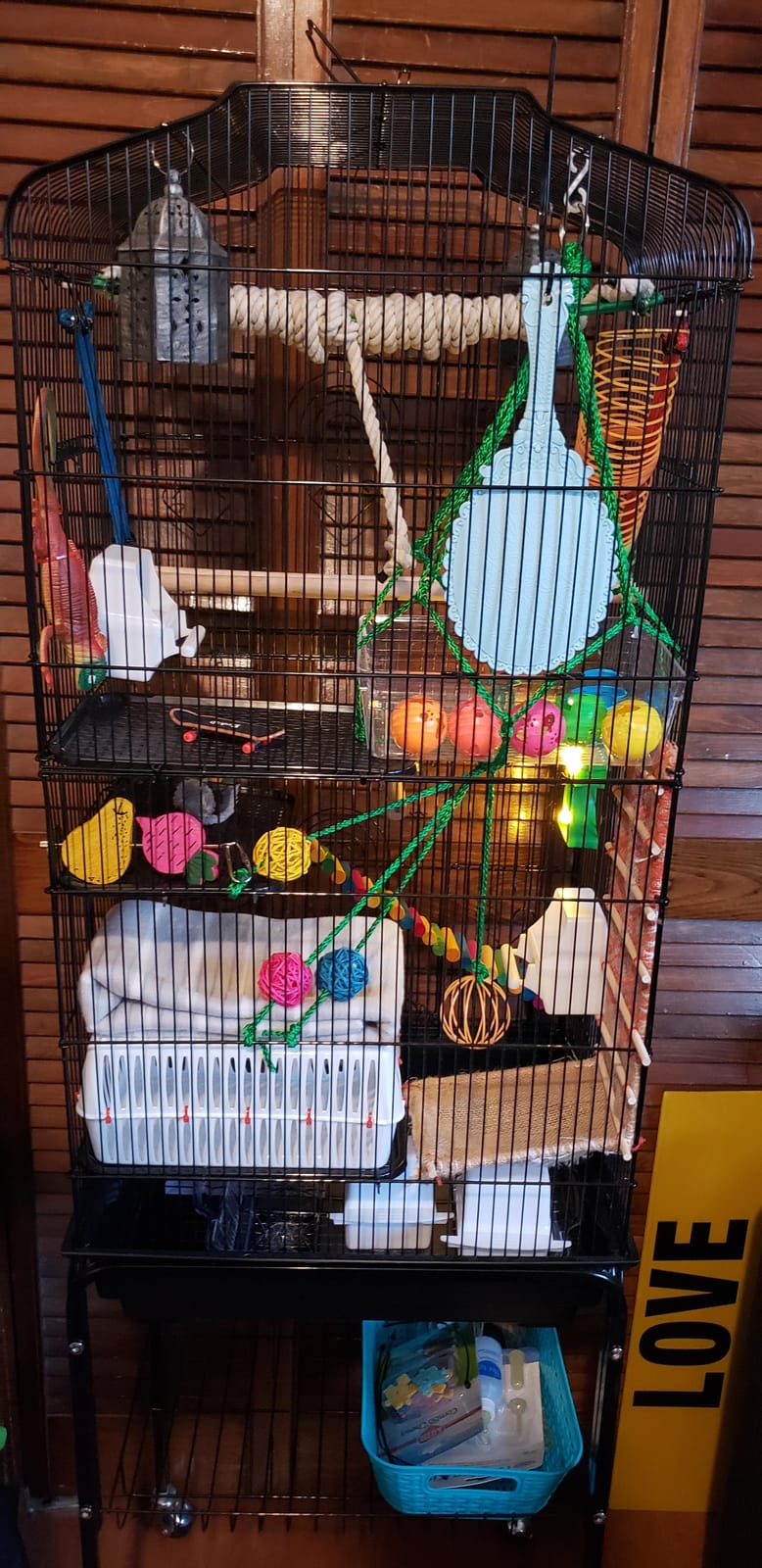
Buy this if you are housing two or three budgies in a rented flat where floor width is the constraint, and you want feeders at different heights to keep the peace. The 0.4 inch bar spacing also makes it a better choice than the half inch models if your birds are juveniles.
It is also a reasonable second cage. Owners use multiples of these to separate a bird that needs quarantine or a hospital recovery setup without buying a dedicated crate.
What to check on arrival
The recurring defect is bent frame sections. Reviewers report small visible gaps at bar joints straight out of the box, and a few buyers found the listed height did not match the box label, so measure the interior yourself before you trust the listing.
The included bottom clips are the other trap. When fitted they stop the cage sitting flat on the base, so check whether yours came with them before forcing the cage down onto the stand. And with a 14.3 inch width, this is climbing height rather than flight width; if you want real flight distance, step up to a 30 inch cage.
4. BestPet 64 Inch Wrought Iron Open Top Bird Cage
BestPet 64 inch Wrought Iron Bird Cage for Parakeets Medium Small Parrots Parakeet Cage with Detachable Rolling Stand & Play Open Top for Cockatiels Lovebird Finches Canaries (Black)
0.4 in bar spacing
18 x 14 x 32.2 in interior
14 lb
Swivel casters and open top
Pros
- Locking open top gives real out-of-cage time
- Four bowls
- four perches
- a swing and a shelf in the box
- Two large front doors plus a slide-out waste pan
- Held at 4.6 stars across 1294 ratings
Cons
- Interior is tight for more than two parakeets
- Assembly is fiddly
- The top prop perch does not seat properly
- Thin metal may need reinforcing
BestPet is the pick I send people who want an open-top cage without the open-top price tag. The interior is 18 by 14 by 32.2 inches, bar spacing is 0.4 inch, and the whole cage weighs 14 pounds, which makes it the second easiest of the rolling designs here to reposition by hand.
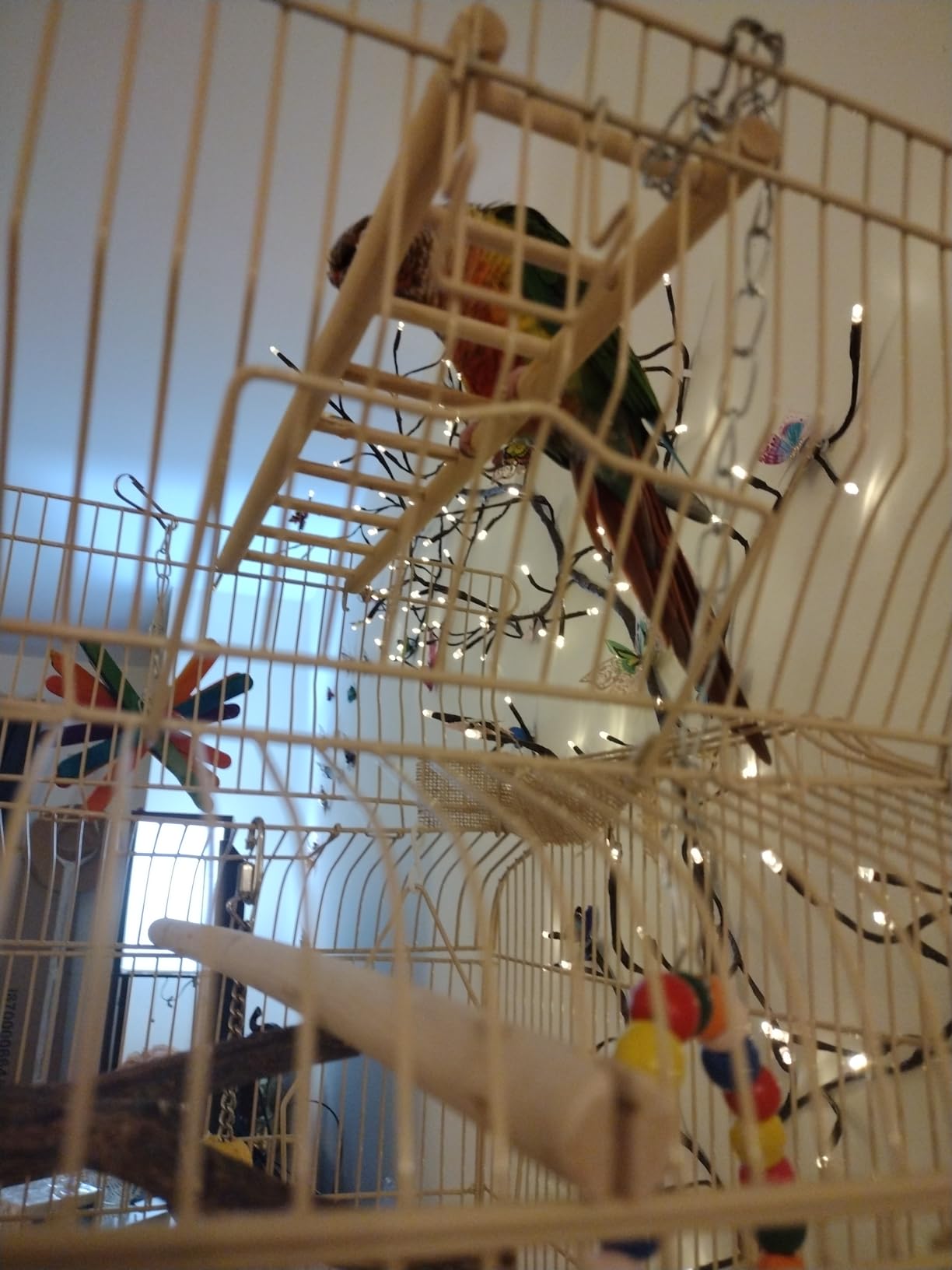
The thing I like most is that the open top actually locks. The roof props open against a perch, so your budgie can sit outside the cage while you are in the room, and the heavy-duty sliding window latch on the front doors does not give way the way a simple hook does. Four side feeding doors mean you can spread bowls around the cage rather than crowding the front.
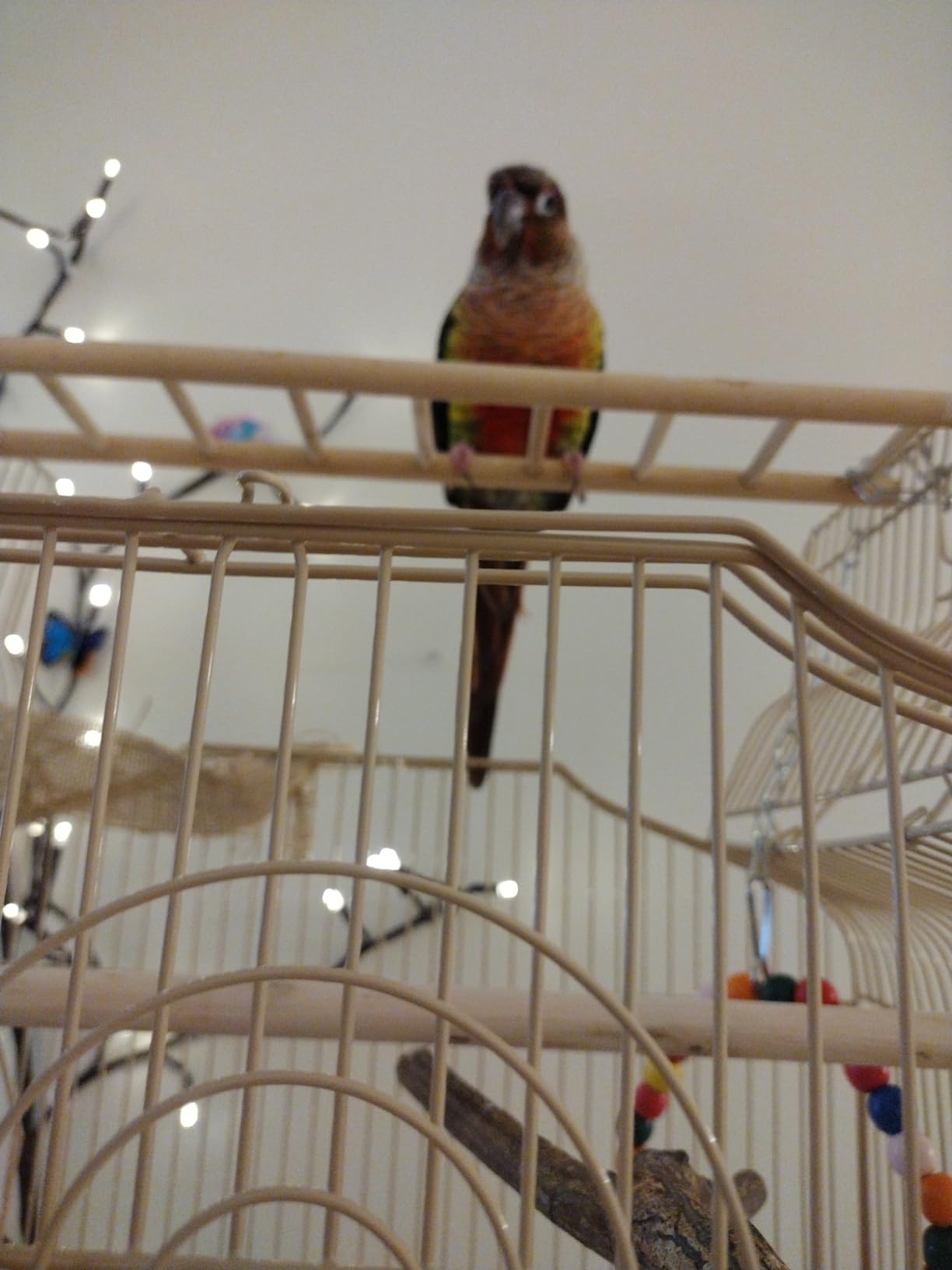
It is also the most furnished cage in the group. Four bowls, four wooden perches, a swing and a bottom storage shelf all come in the box, and two carry handles on the top let you move it without dismantling. Owners call the two large front doors and the slide-out waste pan the reason cleaning is quick.
On finishes, reviewers mention black, white and almond options, which is unusual at this tier. Finishes aside, the pattern across reviews is that this is a strong starter cage for one or two small birds rather than a habitat for a flock.
Best use for the money
For a first-time owner buying a single juvenile, this covers the whole checklist: safe bar spacing, a width of 14 inches that fits a budgie properly, a tray that slides out, and a door the bird cannot open. The included swing and perches mean the cage is usable on day one rather than after a second shopping trip.
If your bird is tame and interactive, the open top adds the thing a lot of small cages lack, which is usable space that is technically outside the cage. That changes the day for a bird that would otherwise pace.
Limits worth knowing
The interior is tight for more than two parakeets. At 18 by 14 inches with perches and toys fitted in, a third bird turns the cage into a perch-sharing negotiation, and that is how minor squabbles start.
Assembly is described as somewhat difficult, and the perch that props the open top does not seat properly and can be removed by the bird. Metal is thinner than a heavy-duty cage, and some owners use zip ties to stiffen the frame. If you are after a wider flight interior for a pair, the Prevue at number 2 is the step up.
5. Nova 61 Inch Play Top Bird Cage with Stand
Nova Microdermabrasion 61 Inches Large Bird Cage Play Top Parrot Cockatiel Parakeet Chinchilla Macaw Cockatoo Cage W/Stand Perch Pet Supplies
31 x 29.5 in footprint
61 in tall with stand
43 lb
Epoxy coated wrought metal
Pros
- Play top with ladder
- perch and two cups
- 31 by 29.5 inch footprint gives real horizontal room
- Top and bottom slide-out trays
- Four swivel casters
- Locking feeder doors and stainless steel cups
Cons
- Light bar gauge for the overall size
- Heaviest cage here at 43 pounds
- Weakest satisfaction spread in the group
- Bent parts and loose feeder doors reported
Most cages in this roundup are tall towers. The Nova is a square one, with a 31 by 29.5 inch footprint, and that is the whole argument for it. A budgie in a square cage can fly laps rather than climb, and the Nova is the only unit here that combines that footprint with a full play top.
The play top has a ladder, a top perch and two cups for eating and drinking outside the main enclosure, which effectively adds a second room above the cage. At 61 inches tall overall and standing on a tall stand, it holds birds at a comfortable head height in a room where you sit at a desk.
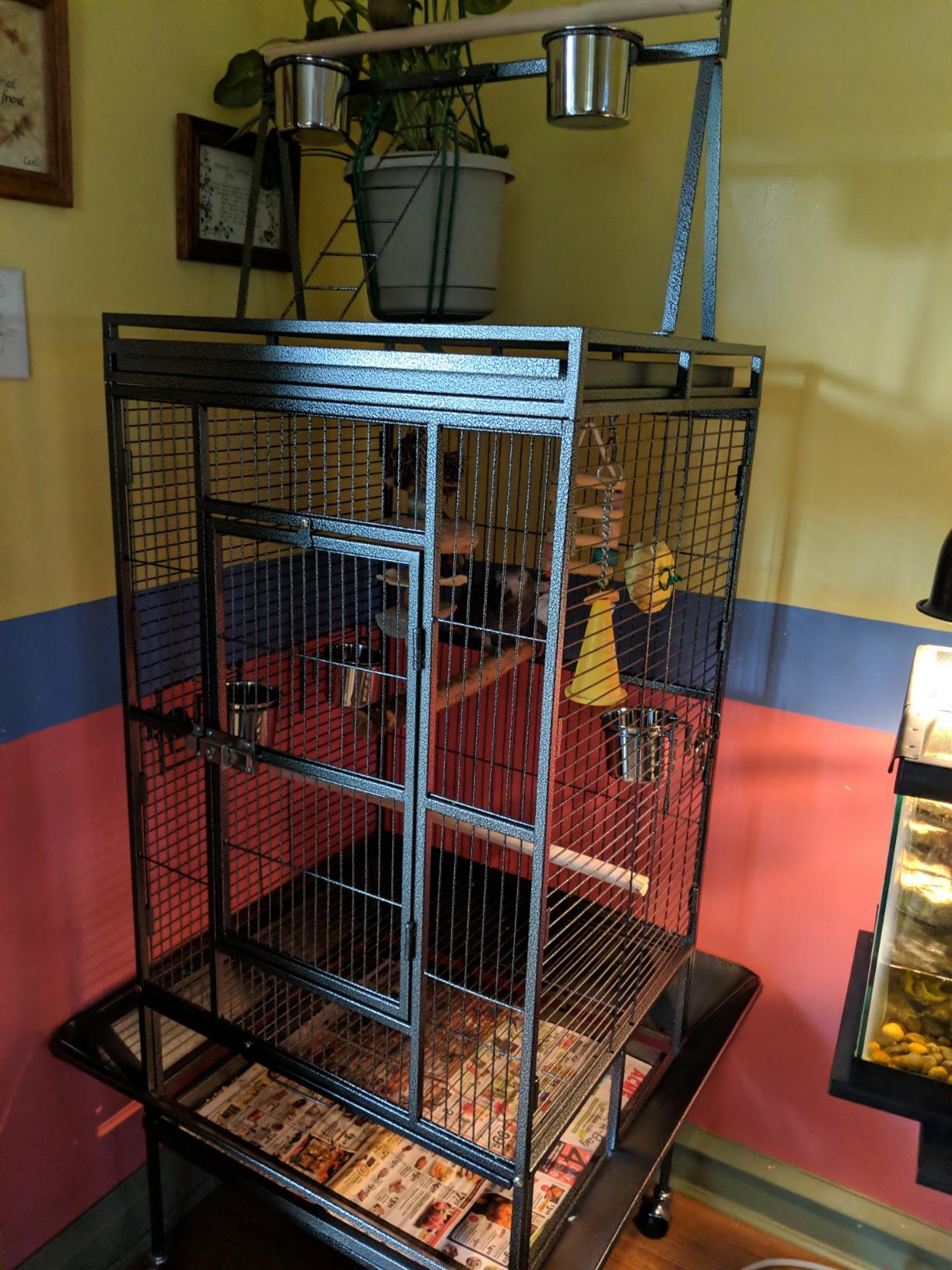
Maintenance is well served. There are removable metal slide-out trays at the top and the bottom, so a messy play top does not mean reaching in with your hand, and four strong swivel casters let you roll the whole 43 pounds across a room rather than dragging it.
The front door has a heavy-duty push button lock, three feeder doors lock, and five stainless steel cups are included. Owners also note two hardwood perches in the box, which is a better starting point than the dowel perches some rivals supply.
Where the space actually goes
Because the footprint is square rather than narrow, every perch you add is usable from more than one direction, and a bird does not get cornered at the back. For a pair of budgies that are not breeding, that is the difference between a cage they share calmly and one they defend.
The play top is the underrated part. Owners set foraging toys up there and get bird out of the cage time without needing a separate perch, which is a real saving on setup.
Where it falls short
At 43 pounds it is the second heaviest cage here, and the light bar gauge is out of proportion to the overall size. That combination means it is generous on space but light on metal, so it suits small birds rather than anything that chews.
Satisfaction is also the most spread out of the twelve, with only a small share of five-star ratings, and some buyers report bent parts and loose feeder doors arriving in the box. Inspect the frame and test every latch before your bird moves in.
6. VIVOHOME 54 Inch Wrought Iron Bird Cage with Stand
VIVOHOME 54 Inch Wrought Iron Large Bird Cage with Rolling Stand
24.2 x 16.9 x 54 in
23.1 lb
Nontoxic hammer-pattern coating
White
Pros
- Owners report four budgies housed comfortably
- Four universal casters move it across carpet
- Drawer tray and removable shelves are easy to clean
- Flat top holds a lamp or a plant
Cons
- Thin bars that a conure can bend
- Slide-in side panels can leave gaps wider than stated
- Loose feeder doors
- All doors face the front
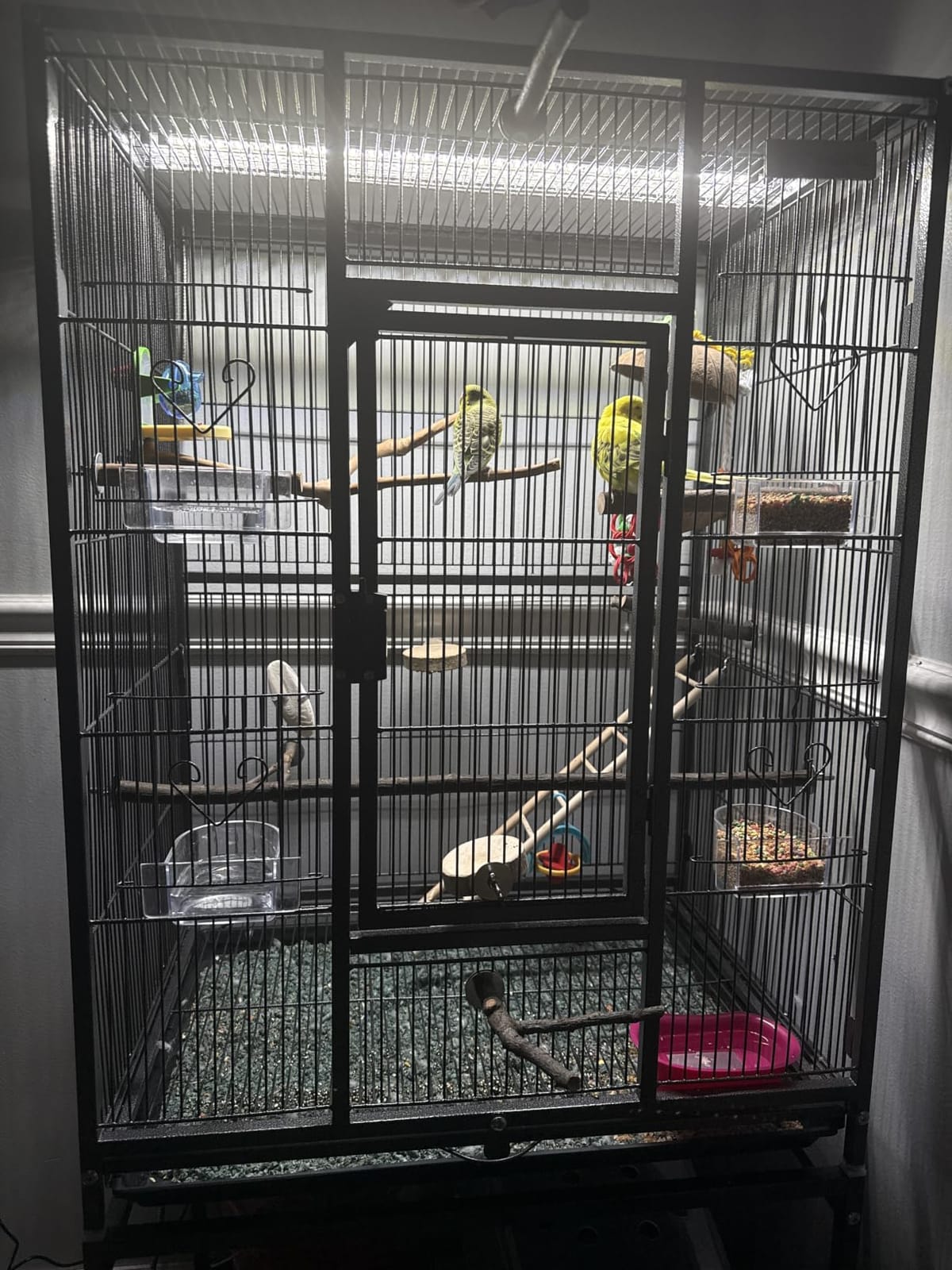
The VIVOHOME is the one to look at if your plan has quietly become a flock. At 24.2 by 16.9 inches across, it is wider than the 18 inch towers and reviewers with four budgies report plenty of space. The 54 inch height keeps the footprint reasonable for a living room corner.
The finish is a nontoxic hammer-pattern paint described as corrosion resistant, and the frame is metal. At 23.1 pounds the cage is portable enough that owners wheel it between rooms to follow the daylight, and the four universal casters handle carpet as well as hard floor.
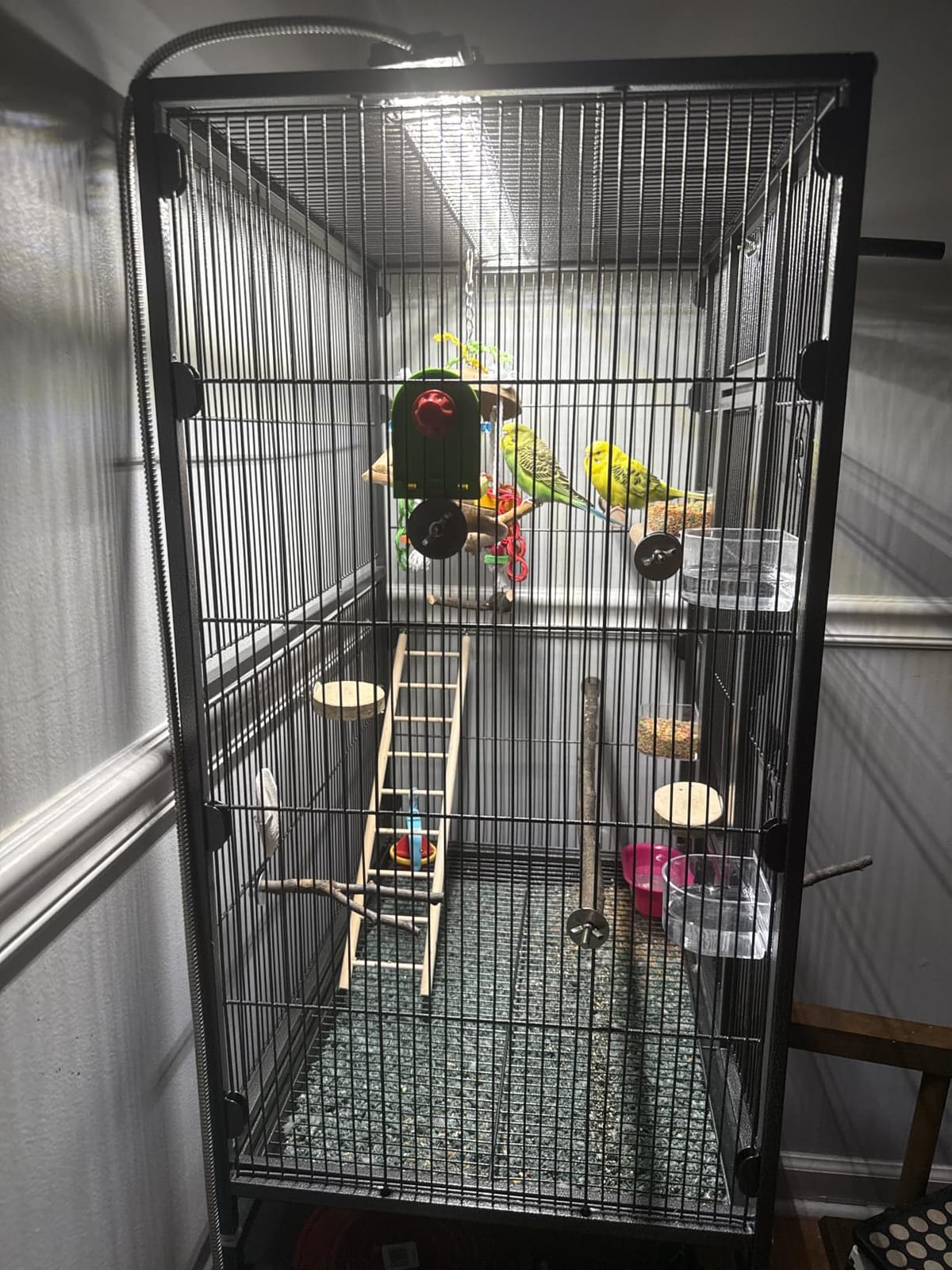
Cleaning is the design’s strongest point. A drawer-style bottom tray pulls straight out, and the shelves are removable, so you can line the whole floor without dismantling anything. The flat top is a genuinely useful surface in a living room, since it takes a lamp or a potted plant and gives a bird a perch when the doors are open.
Accessories are generous: four transparent food boxes, two wooden perches and a tray. A breeding box can be hung on either side, and there are mesh shelves and side hanging points for toys, so a pair does not mean the two of them are in the same compartment.
Best for a group rather than a pair
Multiple budgies in one cage only works if the space lets birds get out of each other’s way, and 24 inches of width is enough to do that. A mesh shelf at mid-height also lets a bird move up out of a confrontation, which is a genuine conflict reducer in a multi-bird home.
The side breeding box mount is the feature that makes this a two-bird cage rather than a one-bird cage, so a buyer pairing birds for the first time gets the option without a second purchase.
Problems to check for
The side panels slide into place rather than fastening, and reviewers report that the resulting gaps can measure wider than the stated spacing. That is the single most important thing to inspect, because a gap at a panel joint is exactly where a budgie’s head can go.
The bars are thin enough that reviewers warn against conures, and the feeder doors have been reported loose. Some arrivals also showed bent pieces, a rusty patch and defects on bowls. All doors face the front, so the sides and back are fixed, which limits how you can arrange perches.
7. YITAHOME 62 Inch Metal Bird Cage
YITAHOME 62 inch Metal Bird Cage, Large Parakeet Cages
0.4 in bar spacing
17 x 14 x 62 in
17 lb
Four doors plus two side doors
Pros
- Furnished out of the box with a bridge
- three pendants and three perches
- Slide-out tray and detachable mesh grate
- Four 360 degree casters with a base storage rack
- Tall profile keeps the footprint narrow
Cons
- Softer metal than heavier cages
- Roof may arrive misaligned and need adjusting
- Supplied bowls and toys often get replaced
- Not sized for birds needing flight width
The YITAHOME is the budget tower to beat. It measures 17 by 14 by 62 inches with 0.4 inch bar spacing, weighs 17 pounds and comes with a long bridge, three pendants and three perches already inside. Very few cages at this price point are furnished out of the box, and that alone changes the first week with a new bird.
Four small front doors plus two side doors give you plenty of places to hang feeders, cups and foraging toys, and a top handle makes it portable or hangable. The four 360 degree swivel casters and the storage rack on the base mean it moves easily and holds seed and supplies underneath.
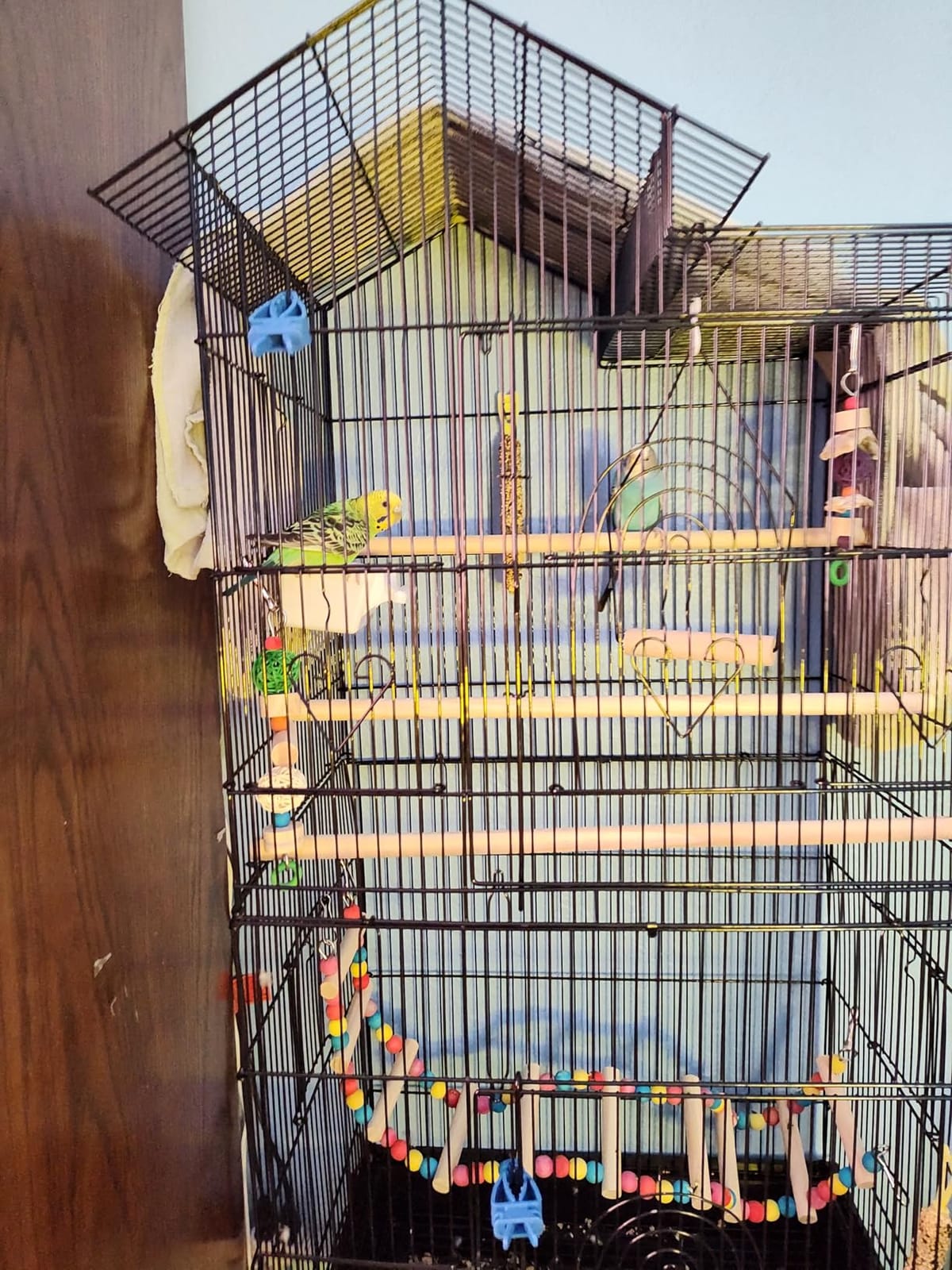
Owners rate it highly for parakeets and lovebirds specifically, calling it attractive, easy to assemble and excellent value. The slide-out tray and the detachable mesh grate are the parts that come up most often in positive reviews, and the mesh grate means the bird never sits in its own droppings.
It is listed for two to three budgies, parakeets, cockatiels and lovebirds, and the tall narrow profile is the reason it earns its place in a small flat. Where a 24 inch wide cage eats the wall, a 14 inch tower disappears into a corner.

Why the bundle matters
A first-time owner buying a plain cage ends up buying perches, a bridge and toys within a week anyway, and that is three more decisions before the bird arrives. This cage removes two of them, and the pendants give a new budgie something to investigate in the first hour.
The 0.4 inch spacing is also a step up from the half inch models at the same general size class, which is worth having if you are starting with a juvenile bird.
Where it needs work
The metal is softer than the heavier cages in this roundup and some owners add zip ties to the frame for rigidity. The roof may also arrive slightly misaligned and need pliers to adjust, so build it before the bird is due.
At 14 inches wide, this is not a flight-width cage. It gives height and vertical climbing rather than horizontal distance, so owners who care most about exercise should pair it with a low wide flight cage or with plenty of out-of-cage time instead.
8. PawHut 65 Inch Double Bird Cage with Divider
PawHut 65″ Double Rolling Metal Bird Cage with Divider, Large Parrot Cage for Parakeet, Canaries, Lovebirds, Budgie, Finch, with Detachable Rolling Stand, Storage Shelf, Wood Perch & Food Container
Removable divider panel
62.75 x 19 x 64.25 in
56.1 lb
Detachable rolling stand
Pros
- Divider splits or joins the two halves
- 62.75 inch length gives genuine flight distance
- Large front doors
- sliding food doors and side doors
- Front slide-out tray catches seed
- Body detaches from the stand for transport
Cons
- Heaviest unit in the group at 56.1 pounds
- Top of the price range
- Narrow 19 inch depth limits perching depth
- Only a 67 percent five-star share
The PawHut is built around one question: should these two birds be together or apart. The cage is 62.75 inches long with a removable divider panel, so you can house a pair as a flock, split them into two compartments when you need to, and take the divider out again when they have settled.
That makes it the one cage here that doubles as a breeding setup or a quarantine unit, which is a genuine gap in most roundups. Large front doors, multiple sliding food doors and side doors mean you can reach any bird without dismantling the cage, and the front slide-out tray is designed to catch flung seed.
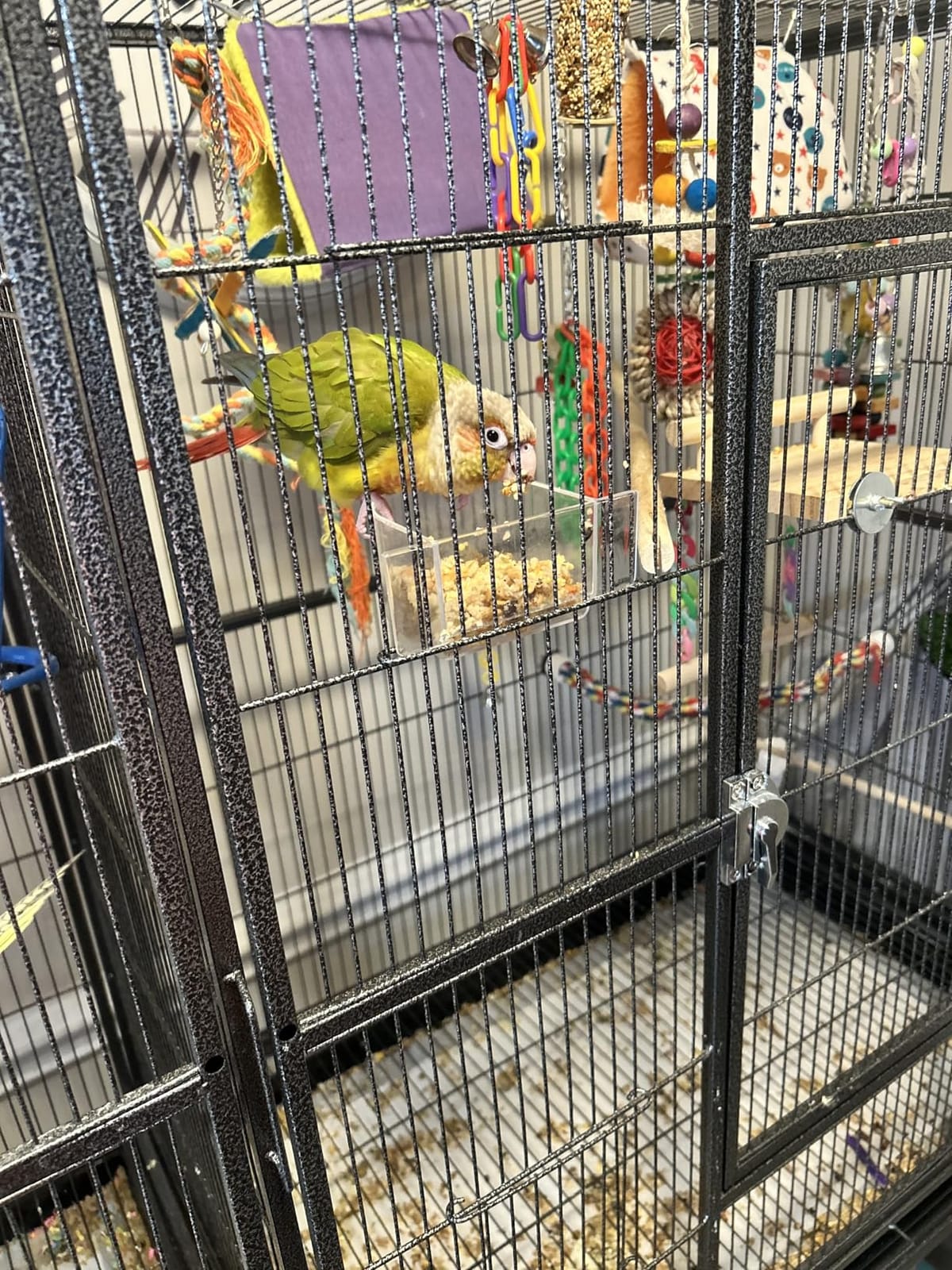
At 62.75 inches of length it offers the longest unbroken flight run of any cage we looked at, and for budgies and lovebirds that matters. The detachable rolling stand with a storage shelf keeps supplies off the floor, and the main cage body detaches from the stand for transport.
It ships in metal, steel wire and durable plastic, with wooden perches, food containers and the storage shelf included. Reviewers like the door and tray access and describe the stand as a solid rolling platform once assembled.
When the divider earns its price
New pairs are the case this cage is built for. Two budgies bought separately often need several weeks apart before sharing space, and a cage that splits in seconds removes the argument about which room the second cage goes in. The same function covers a recovering bird that needs to be visible but separate.
For an owner with the floor space and the budget, it is a single purchase that covers housing, separation and transport rather than three cages.
What the weight costs you
At 56.1 pounds it is the heaviest unit in this roundup, and it is at the top of the price range too. A cage that heavy is a fixed piece of furniture, not a portable one, and you should plan the corner before it is delivered.
The 19 inch depth is also shallow for perching, so birds sit near the front of the divider rather than across it. And with a 67 percent five-star share, there is a visible tail of fit and finish complaints worth checking on arrival.
9. VEVOR 30 Inch Flight Bird Cage
VEVOR 30 Inch Flight Bird Cage, Stackable Bird Cage Parakeet Cage with Slide-Out Tray and Handle, Small Parrots Birdcage for Cockatiels Budgies Conure Macaw Finch Lovebirds Canaries Pigeons
29.9 x 18.1 x 17.9 in
0.4 in grid spacing
9.92 lb
High-strength carbon steel
Pros
- Wide horizontal footprint for short flight bursts
- Carbon steel is stiffer than typical light-gauge budget cages
- Cages stack to expand housing space
- Side carry handle and transparent feeder box
Cons
- Shallow height limits climbing space
- Suits one or two small birds only
- No stand or casters
- Low profile suits a table or shelf
This is the only genuinely flight-shaped cage in the roundup, and it answers the wide-versus-tall question with a footprint. At 29.9 inches long by 18.1 wide, a budgie here can flap the length of the cage. Almost every other unit here is a tower you climb, and towers do not produce the same kind of exercise.
Bar spacing is a 0.4 inch grid, and the frame is high-strength carbon steel rather than the light-gauge wire typical at this price. That stiffer frame is the reason the 4.6 rating holds up across 696 ratings without the bowing complaints that show up on thinner budget cages.
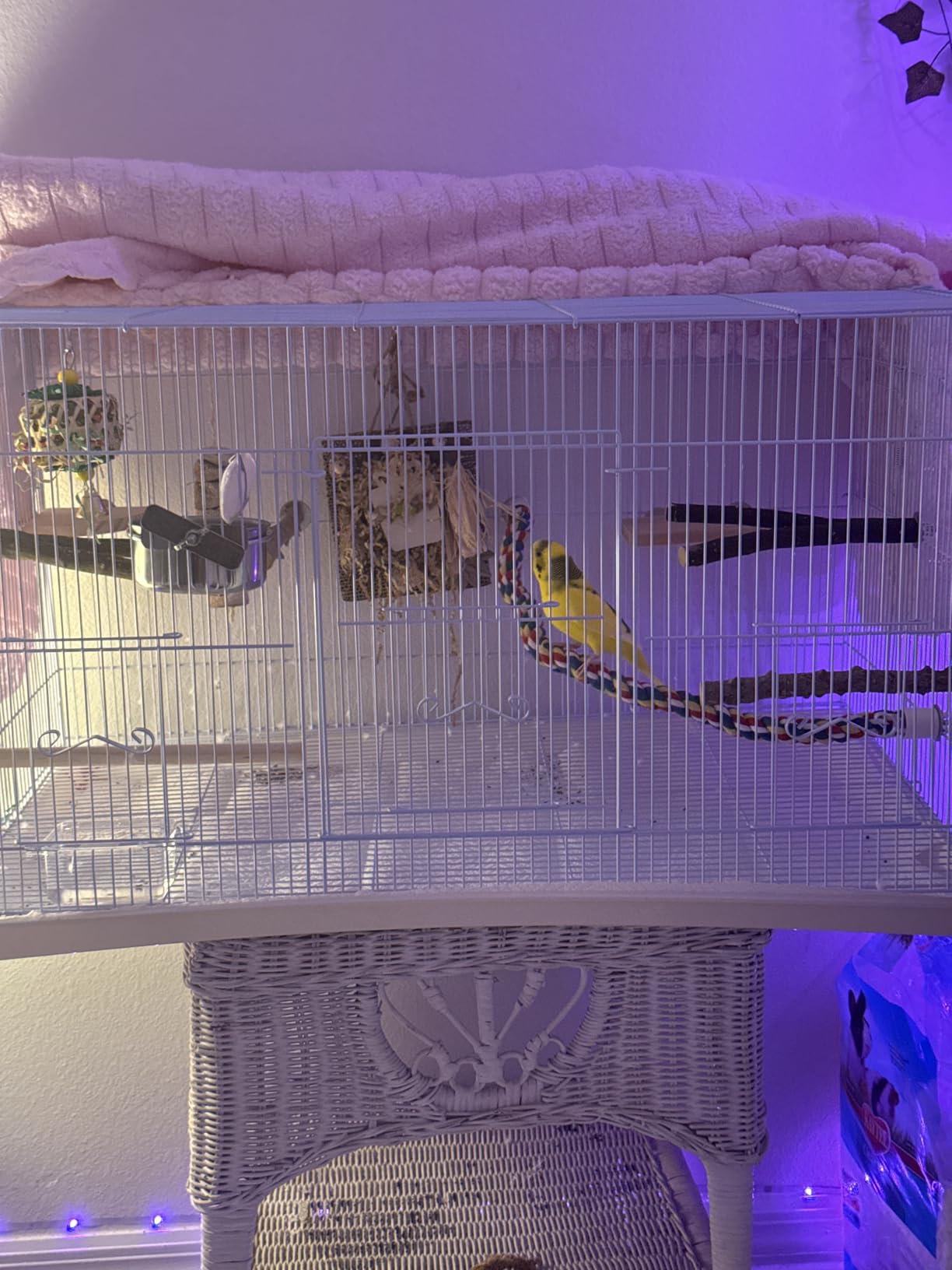
It is also the lightest of the cages on casters, at under 10 pounds, which makes it the easiest unit here to move for cleaning. The detachable slide-out tray with mesh grating lifts out completely, the side handle lets you lift the whole cage with one hand, and a transparent feeder box lets you check food and water levels without opening anything.
Multiple perches are included. The one feature owners single out is that units stack, so two or three of these can be combined to expand housing space across separate rooms.
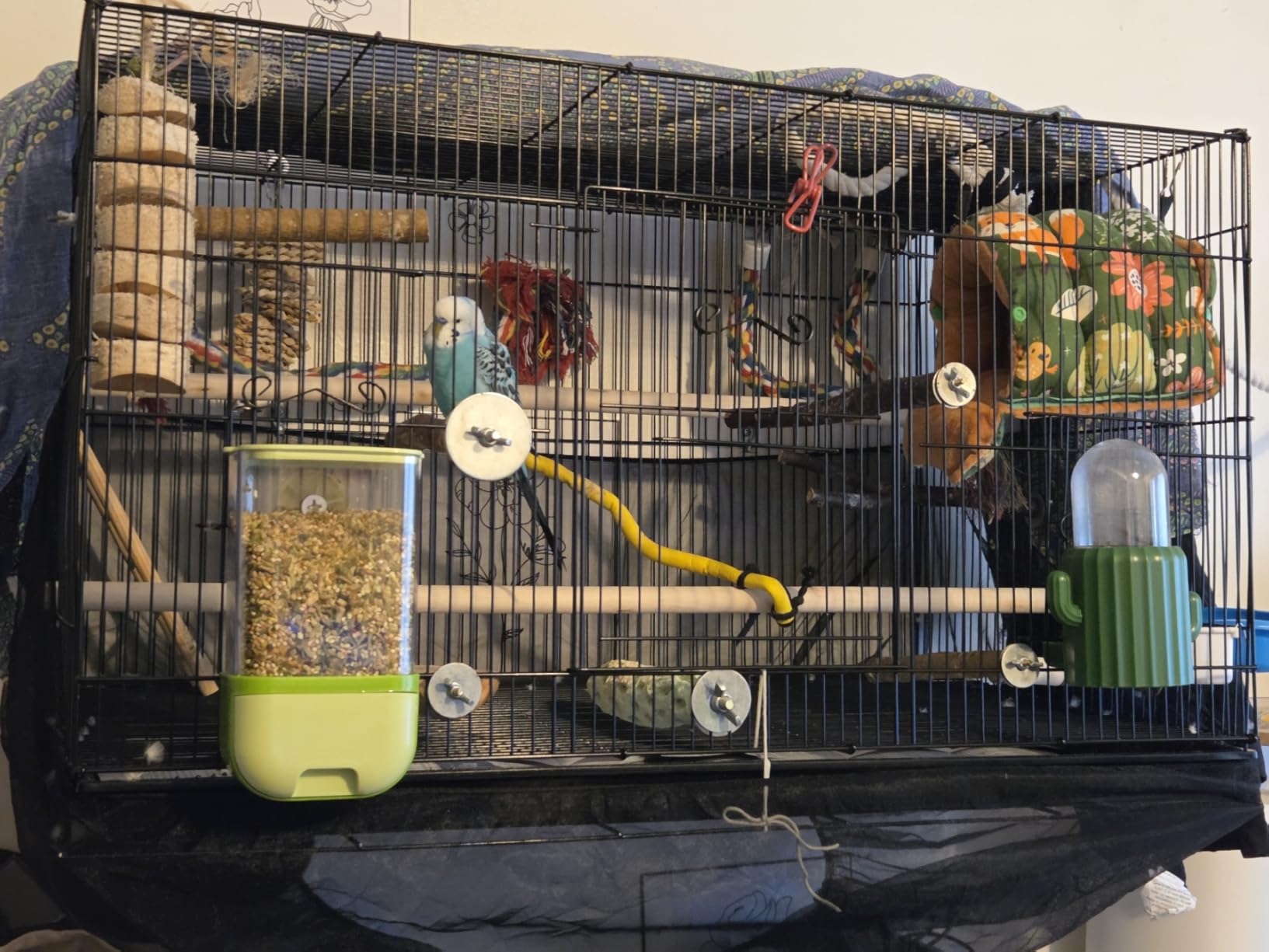
Why low and wide works for budgies
Budgies are horizontal fliers. They sprint along a perch, take off across open space and land on the other side, so what they need is distance between perches rather than height to climb. Forum owners say it directly, that a tall skinny cage gets used at the top portion only.
At 17.9 inches of height, this cage gives up vertical room to gain 30 inches of flight length. For a single bird or a pair that gets out-of-cage time, that trade is the right one.
What you give up
The shallow height limits climbing, so a budgie that has learned to climb vertical bars will need a playtop or a separate perch to satisfy that instinct. The footprint suits one or two small birds, not a group.
There is no stand and no casters, so it sits at floor or table level. At 17.9 inches tall it works nicely on a sturdy sideboard or a low table, and the stackable design is a reasonable second option for anyone already committed to this format.
10. DWVO 62 Inch Open Top Metal Bird Cage
DWVO 62-inch Metal Bird Cage for Cockatiels, Parrots, Pigeons
0.4 in bar spacing
17 x 14 x 62 in
12.68 lb
Four casters and storage rack
Pros
- Lightest rolling stand design at 12.68 pounds
- Long bridge
- three pendants and three perches included
- Detachable mesh grate and slide-out tray
- Four front and two side doors
Cons
- Smallest review base here at 217 ratings
- Narrow 14 inch width limits flight
- Light gauge metal
- Supplied bowls and toys often replaced
The DWVO is the newest design in this group, and it is built the way we would build it: light enough to move one-handed, furnished out of the box, and open on top. It weighs 12.68 pounds, which makes it the easiest rolling cage here to reposition, and the four 360 degree universal swivel casters with a storage rack take care of seed and supplies underneath.
The interior is 17 by 14 inches with 62 inches of height, bar spacing is 0.4 inch, and the top is open. Four small front doors plus two side doors let you hang feeders at several heights, which is the same conflict-reduction trick that makes the ZENY work for pairs.
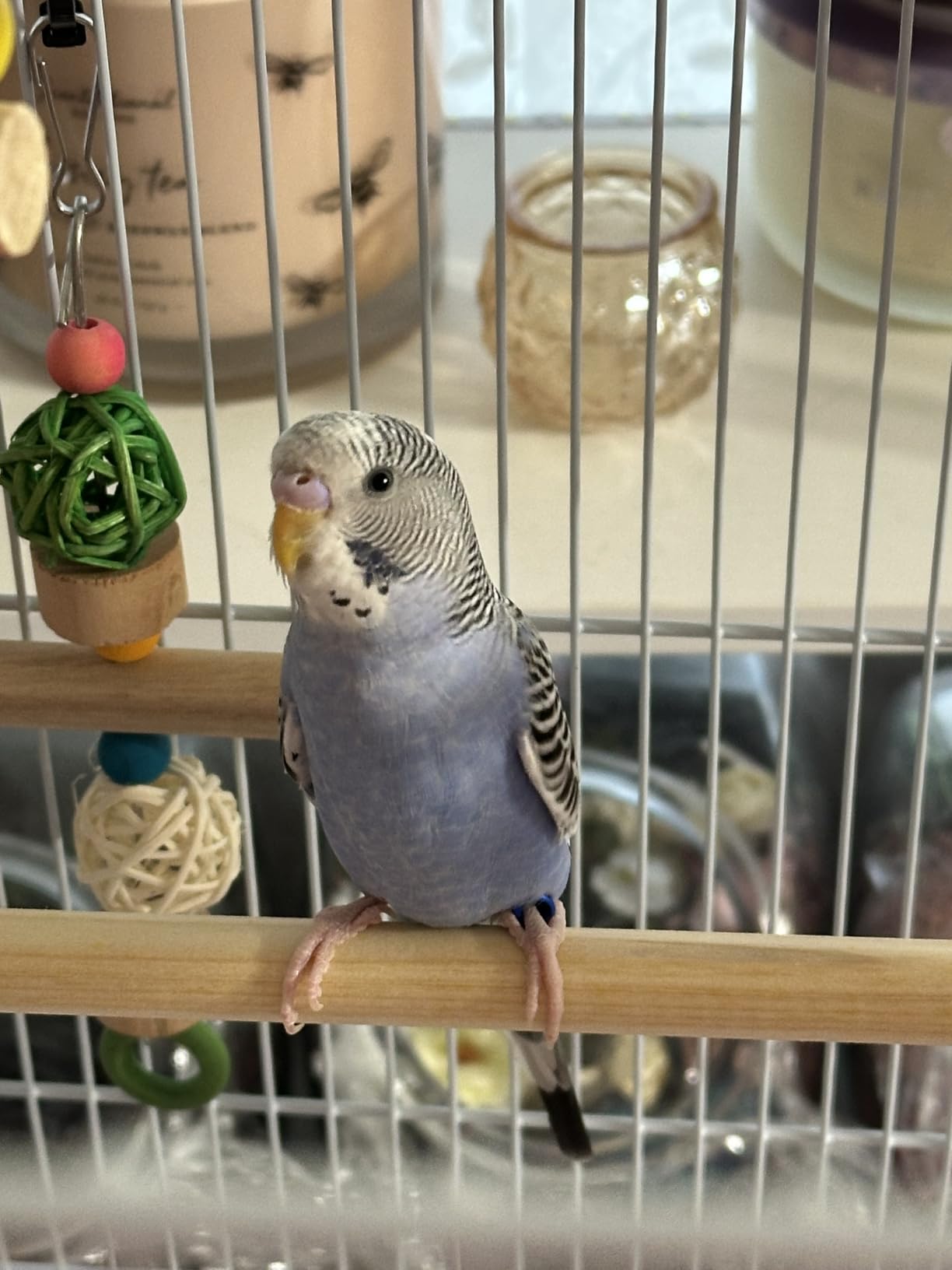
The detachable mesh grate and slide-out tray are the maintenance story, and the top handle makes the cage portable or hangable. Early owner feedback is strongly positive, with the included bridge and pendant toys and how easily the light base moves coming up repeatedly.
It is listed for two to three birds, and the open top gives an interactive budgie somewhere to perch while you are in the room. For a home office or a study, an open-top tower that you can wheel toward your desk is genuinely useful.
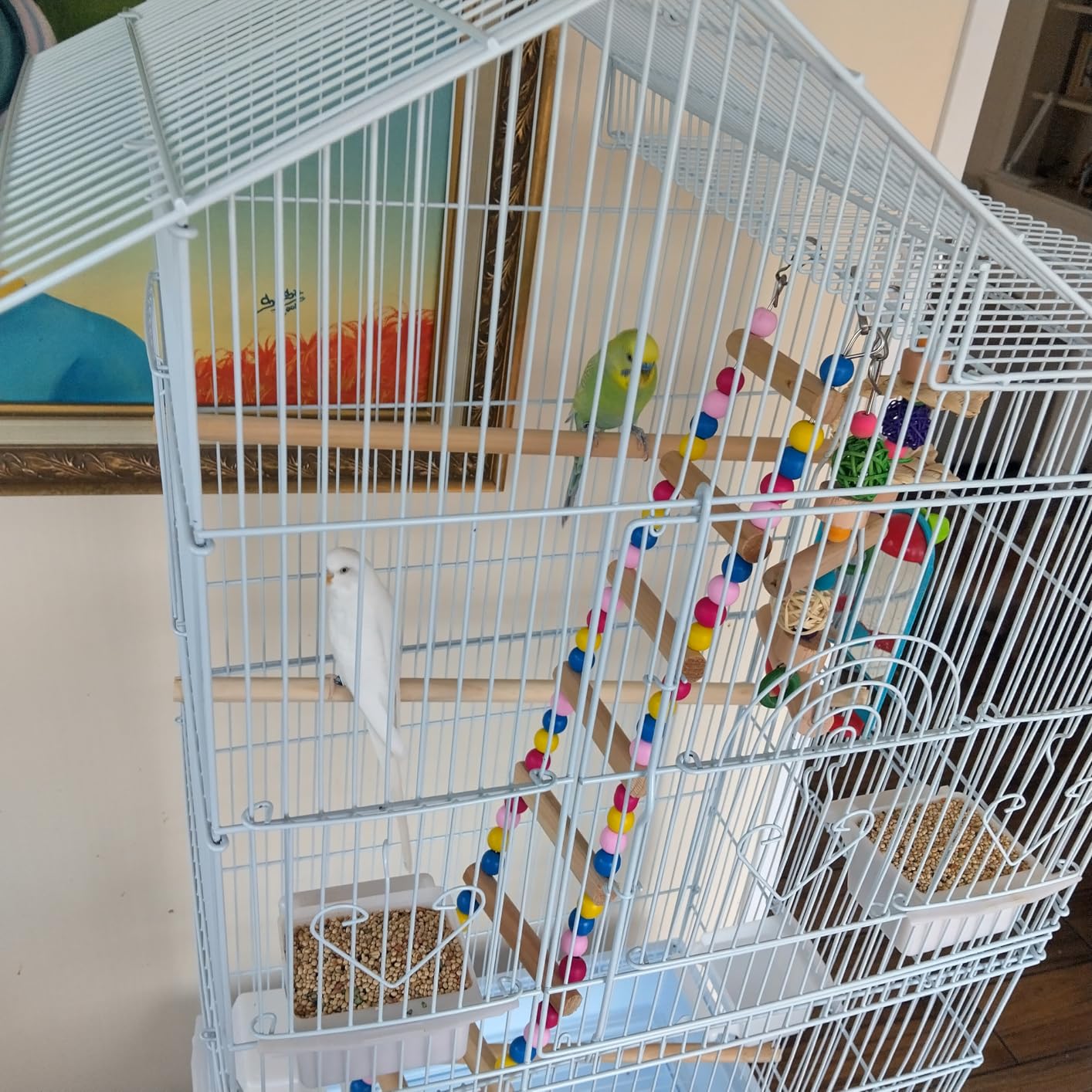
Early feedback, less history
With 217 ratings, this is the smallest review base in the roundup, and that is the honest caveat. Early feedback is positive, but a model launched in recent years simply has not been through a decade of use yet, so long-term durability is less proven than it is for the Yaheetech or Prevue units.
If you want evidence rather than promises, the models with thousands of ratings are the safer bet. If you want the lightest rolling design and the newest layout, this is it.
Limits of a narrow tower
At 14 inches wide, horizontal flight and side-by-side perching are both limited, so this is climbing height rather than flight length. Light gauge metal means it is intended for small birds, not for anything that chews hard.
Some owners replace the supplied bowls and toys, which is normal but worth budgeting for. As with the YITAHOME, build it a day early in case the roof needs adjusting.
11. Yaheetech Open Play Top Travel Bird Cage
Yaheetech Open Play Top Travel Bird Cage for Conure Sun Parakeet Green Cheek Conure Lovebird Budgie Finch Canary, Small-Size Travel Portable
15.7 x 15.7 x 22.8 in
7.72 lb
Powder-coated metal frame and HIPS plastic
Pros
- Light enough to carry to the vet or outside
- Open play top with attachable perch
- Small inner door lets the bird step in and out
- Slide-out litter tray with a grate above it
Cons
- Square footprint is cramped for more than one bird
- Not a full-time home for a pair
- Light duty next to a wrought iron travel cage
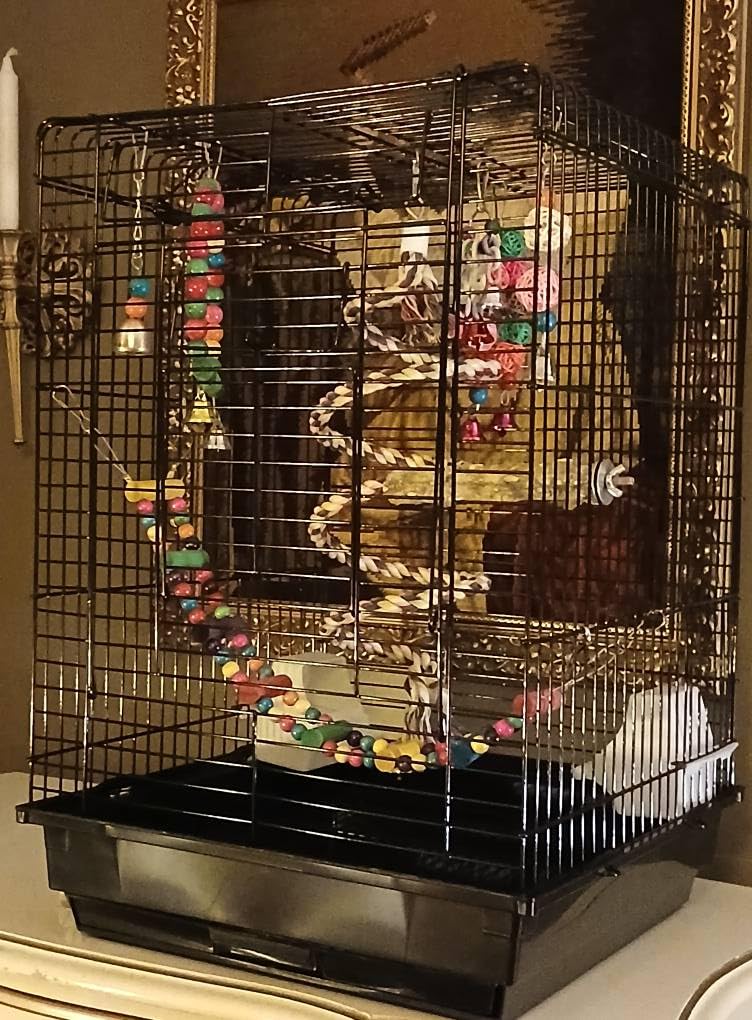
This is the carrier cage, not the home cage, and knowing that keeps you from buying it by mistake. At 15.7 by 15.7 by 22.8 inches and 7.72 pounds, it is the easiest unit here to lift into a car, which is the entire point when a bird needs a vet visit or a quarantine period.
The open play top folds wide with an attachable perch, so it doubles as an outdoor or play perch rather than a dark box in the corner of a room. Two carry handles on the top move it from room to car in one trip.
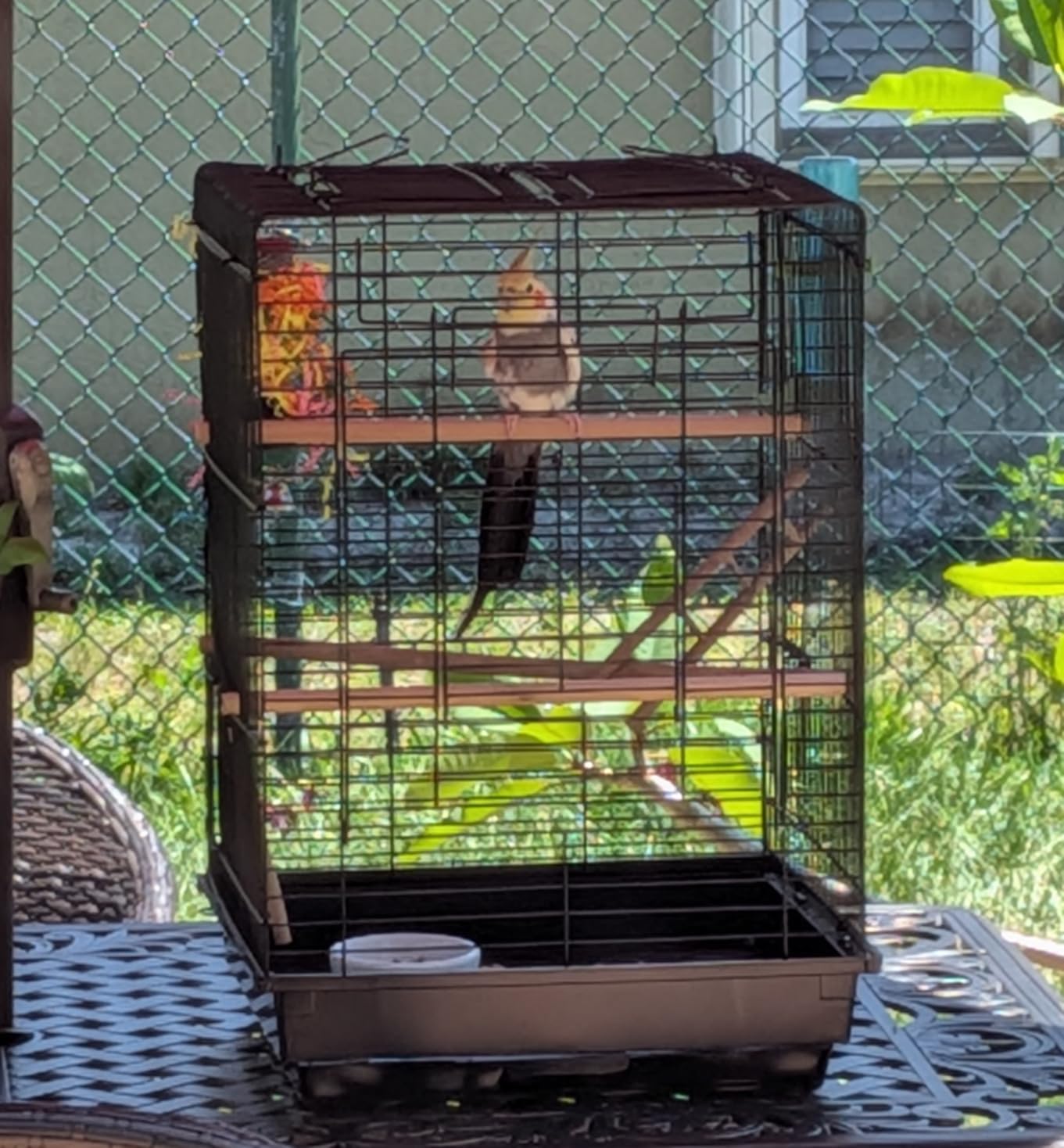
Door design is the thoughtful part. The composite front door has a small inner door, so a bird can step in and out without the whole front opening, which reduces the stress of loading for a nervous or recovering bird. The removable slide-out litter tray with a grate above it keeps the floor clean and washes easily.
It is powder-coated metal with HIPS plastic, and the coating resists water and impact, which matters for something that lives in a car boot in winter.
Where it earns its shelf space
Owners use it as a portable carrier, a quarantine cage and a play-perch cage, and the value is highest when you buy it alongside a permanent cage. Keeping a small carrier means an emergency vet trip is not a two-hour search for a box.
It is also listed for canaries, cockatiels, budgies and green cheek conures, so a single bird of several species can use it.
Why it is not a home cage
The square footprint is cramped for anything other than a single small bird, and owners consistently warn against trying to house a pair or a conure in it long term. Two budgies in a cage that size will fight over the single perch.
The build is also light duty compared with a wrought iron travel cage, so treat it as short-term and light-duty use. For a bird that needs real travel durability, the Prevue South Beach cage below is the sturdier option, and for full-time housing go back to the rolling towers earlier on this list.
12. Prevue Pet Products South Beach Dome Top Bird Cage
Prevue Pet Products South Beach Dome Top Bird Cage – White & Teal
3/8 in bar spacing
14.125 x 11.25 x 18.125 in
4 lb
Wire dome top with coated steel base
Pros
- Only 4 pounds
- so it is genuinely portable
- Large quiet front door makes placing and removing a bird simple
- Wire panels fold flat for closet storage
- Assembles in minutes
Cons
- Too small for full-time housing
- Tight for two birds and can provoke fighting
- Assembly fiddly without four hands
- Light bars and hard-to-clean tray crevices
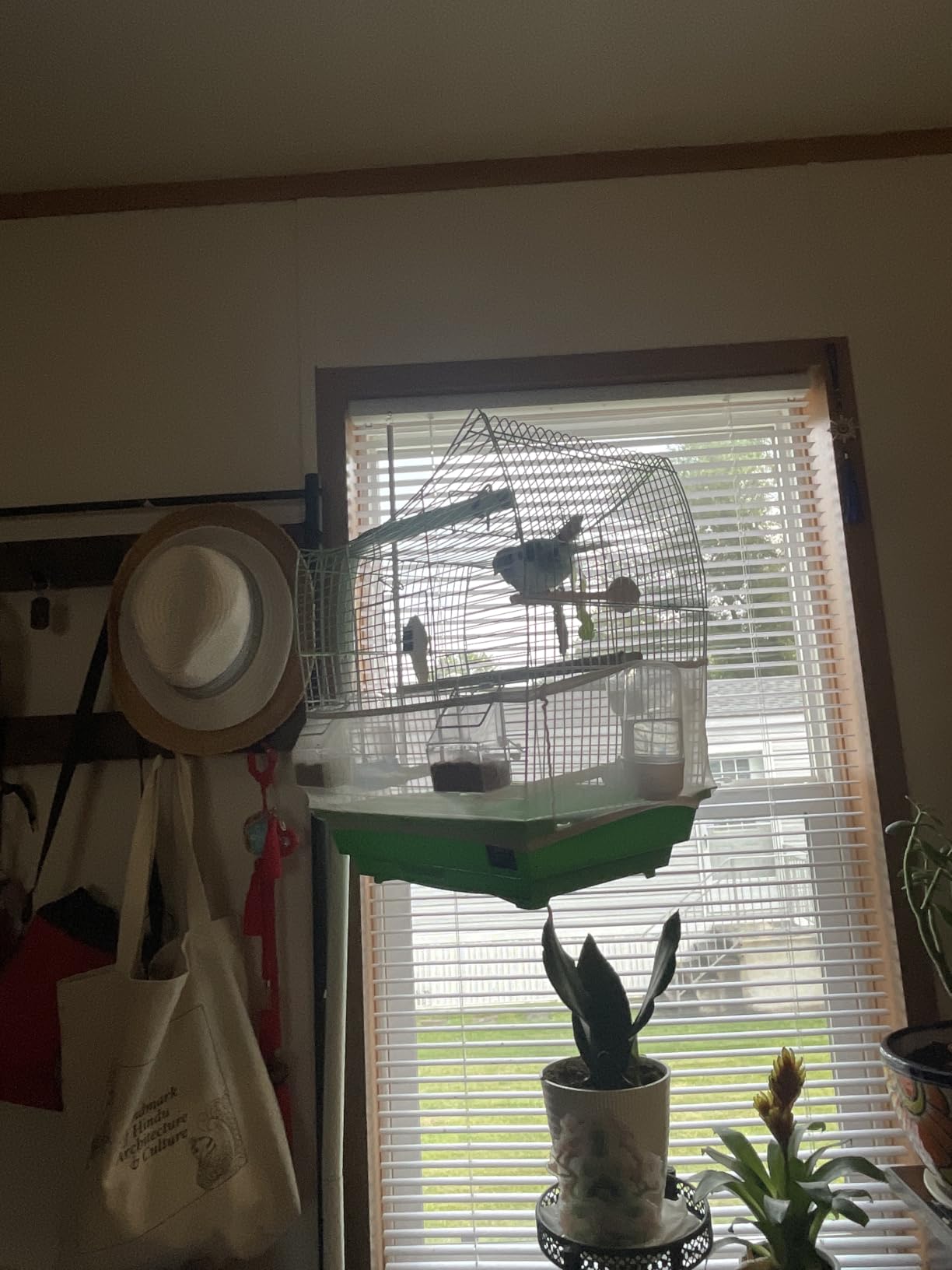
The South Beach is the smallest cage here, and owners are consistent about why: it is a travel, sleep and introduction cage, not a permanent home. At 14.125 by 11.25 by 18.125 inches and 4 pounds, it is light enough to carry to the car and small enough to fold away in a closet when it is not in use.
Bar spacing is 3/8 inch, the tightest of any cage in this roundup, which makes it a safe choice for finches and juvenile budgies as well as adult parakeets. The wire dome top is compatible with a hanging stand, so the same unit can hang in a suitable room when you are using it as an introduction cage.
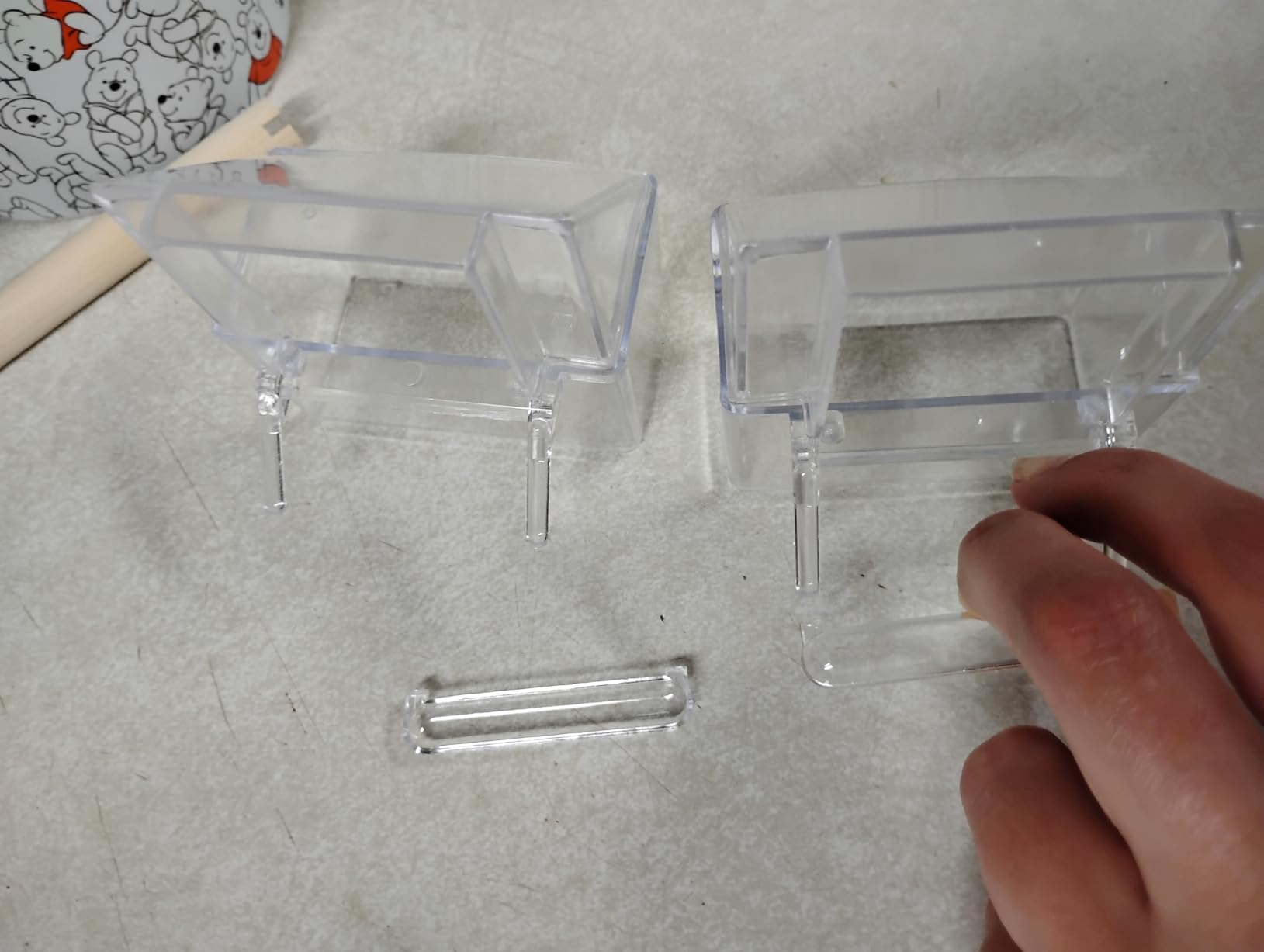
It comes with two hooded 2 oz plastic cups, two wooden perches, a bottom grille and a pull-out tray, and the large quiet front door is sized so you can place a bird straight onto a finger. That door matters more than it sounds, because a slamming door on a nervous bird is a setback every time.
Assembly is quick, and one owner reports a 12 year old built it without help, which is a fair test of the instructions. The folding wire panels are the feature that gets the most praise, since a cage you can store in a closet costs you nothing when it is not needed.
Best used as a second cage
There is a standard use for a cage like this that has nothing to do with the cage being small: a new bird arriving from a rescue or breeder, a bird coming home from the vet, and a bird sleeping at night. Owners use it for all three and praise how quickly it assembles and folds.
Prevue has built pet products since 1869, and the reason that history shows up in reviews is consistency of parts and fasteners, which is what makes a cage fold and reassemble without the frame going crooked.
Where it will disappoint
It is too small for full-time housing, and owners are blunt about that. Two birds in a cage this size is a fight waiting to happen, so do not plan to keep a pair in it.
Assembly can be fiddly because pieces will not stay in place without four hands, the bars are light, and some perch and toy attachments do not hold well. The crevices around the pull-out tray are also hard to clean, which is a real drawback in a cage you will use for a recovering bird.
How to Choose a Parakeet Cage
Every pick above clears the safety floor, but the differences between a good cage and a great one come down to four decisions. Make them in this order and the rest is preference.
Bar spacing: 1/2 inch or less, no exceptions
Bar spacing is the one measurement you must get right, because the failure mode is catastrophic rather than inconvenient. A budgie that pushes its head between two bars can break its neck, which is why owner after owner in the forums describes measuring the gap before buying anything. Treat 1/2 inch, roughly 12 mm, as an absolute ceiling and aim for 0.4 inch if you can.
Measure the widest gaps yourself, including at panel joints, door frames and where a slide-in panel meets a fixed one. Several reviews of cages in this roundup report gaps wider than the listed specification, so the listed number is a starting point rather than a guarantee.
Wide beats tall for budgies
Budgies are horizontal fliers, so interior width is the number that matters. Owners describe a tall skinny cage being used in its top portion only, with the bird climbing instead of flying, and that is the behaviour you are trying to avoid. Our 30 inch VEVOR and 31 inch Prevue give more flight length than any tower in this list.
Height is still useful, but treat it as the second number. Where you have to choose between a 30 inch wide cage that is 18 inches high and a 17 inch wide cage that is 62 inches high, take the wide one and add a play top or a perch for climbing.
Round and dome cages are the worst of both. A dome removes horizontal flight space entirely, and round cages leave a bird with no corner to retreat to, which raises stress. Our comparisons of large bird cages cover the taller formats in more depth.
Minimum size for one budgie or a pair
For a single budgie, treat 20 by 18 by 18 inches as a floor, not a goal, and save toward 30 inches of width. For a pair, you want the same width plus enough depth that two birds can perch side by side and move apart when a squabble starts. Three or more birds need a wide cage like the VIVOHOME, not a taller one.
Out-of-cage time changes the equation. Owners who give their birds hours of free roam daily are more comfortable with a moderate cage, and the 3-3-3 rule is a useful guide: roughly three hours of out-of-cage activity, three hours of daylight handling, and eight to ten hours of unbroken sleep in darkness. A cage covered at night in a busy room will not deliver that sleep period.
Flight cage, day cage, travel cage: which one you need
A flight cage is wide and low, built for horizontal movement, and it is the right permanent home for a budgie. A day cage is the tall tower format most listings fall into, and it works when the bird gets hours outside the cage daily. A travel cage is small, light and portable, for vet runs and quarantine, and it should never be your only cage. A breeding or divider cage is the PawHut format, where a removable panel separates a pair.
Most households end up with two: a permanent flight-style or tall cage plus a small travel cage.
Brand trust: who to buy from and what to watch for
Asked directly which brands are reliable, the bird community answer is consistent across threads. Prevue, Mcage and A&E are the recurring names beginners are told to buy, because parts are replaceable and fasteners survive years. Vision is often singled out for build quality. Yaheetech is the most discussed brand on the forums, and the criticism is about consistency of metal gauge and hardware arriving bent rather than design, which is why the 64 inch open top earns our top slot on review depth while carrying a flimsy-frame note.
Whatever the brand, inspect on arrival. Check that the powder coating does not chip or flake, that screw heads are recessed and not pressing against a bird, that door latches hold against a determined bill, and that there are no gaps where the tray meets the frame. Foraging toys and feeders are covered in our bird feeder picks.
What to avoid: undersized and decorative cages
Avoid anything sold as a budgie cage under about 18 inches of width, any round or dome housing design used full time, and any cage listed for parakeets at 3/4 inch bar spacing or more. Cages marketed for cockatiels are often too wide-barred for budgies, and several roundups still list one. If a listing does not state bar spacing at all, assume the worst and check the reviews.
The other common mistake is buying on total height. A 60 inch cage with a 14 inch interior gives a bird a ladder, not a home. Read the interior dimensions, not the overall dimensions including the stand.
Secondhand cages and the disease risk
Used and inherited cages are a real risk, not a bargain. Diseases that survive in a cage environment can pass to a new bird with no symptoms in the previous owner, and Reddit owners describe saving for a new cage specifically rather than treating a used one as a cheap shortcut. If you must reuse a cage, remove every plastic accessory including perches and feeders, clean the metal with a bird-safe disinfectant focusing on bar joints, door hinges and the tray seam, replace every plastic part, and treat it as a quarantine space for thirty days before your bird moves in permanently.
Where to put the cage in the room
Place the cage against a wall at roughly eye level, not in a hallway corner or in the middle of a walkway where a curious pet can knock it. Keep it out of the kitchen, away from draughts and heating vents, and out of direct afternoon sun, which overheats a metal cage fast. Do not isolate the bird in a spare room either, since budgies are social and benefit from hearing the household. If you have a cat, position the cage so the bird has a wall at its back.
Frequently Asked Questions
What is the best cage for a parakeet?
The best cage for a parakeet is a flight-style cage with a wide interior, 0.4 inch or half inch bar spacing and a pull-out tray. Our top pick is the Yaheetech 64 inch open top cage, while the Prevue Wrought Iron Flight Cage offers the strongest build for a pair.
How far apart should the bars be on a parakeet cage?
Bars should be half inch or less, roughly 12 mm, and 0.4 inch is safer for juveniles and finches. Anything wider lets a budgie push its head between bars, which can break its neck. Measure the widest gap yourself, including at panel joints and door frames, rather than trusting the listed figure.
Do parakeets prefer wide or tall cages?
Parakeets prefer wide cages. Budgies are horizontal fliers, so interior width gives them room to fly between perches, while extra height in a narrow tower is rarely used beyond the top portion. If you must choose, take the wider, lower cage and add a play top or perch for climbing.
What is the 3-3-3 rule for parakeets?
The 3-3-3 rule is a welfare benchmark: roughly three hours of out-of-cage activity, three hours of daylight handling or out-of-cage time, and eight to ten hours of unbroken sleep in darkness. It relates to cage choice because out-of-cage time lets a moderate cage work, while the dark sleep period needs a quiet, covered corner.
Can I use a secondhand bird cage safely?
A secondhand cage carries a real disease risk, so most experienced owners buy new. If you must reuse one, remove every plastic accessory, disinfect all metal with a bird-safe product, focus on bar joints, hinges and tray seams, then use it as a quarantine cage for thirty days before moving a bird in permanently.
Conclusion
The best bird cages for parakeets in 2026 come down to one habit: check the interior width and the bar spacing before you look at anything else. Pick the Yaheetech 64 inch open top for the strongest all-round package and the deepest owner feedback, the Prevue Wrought Iron Flight Cage if you want heavy-gauge metal and 31 inches of flight length, and the VEVOR 30 inch if you want a low wide flight format for a single bird. Add one of the two travel cages so a vet trip is not an emergency.
Whatever you choose, replace the supplied dowel perches with natural wood of differing diameter, hang a foraging toy, and put the cage against a wall at eye level away from the kitchen. Then give your bird time to settle in: set the cage up in its final position a few days before the bird arrives, keep the first three days quiet with the cage partially covered, and let the bird explore on its own before you reach in. Most birds that panic on arrival are reacting to a new room, not a bad cage.