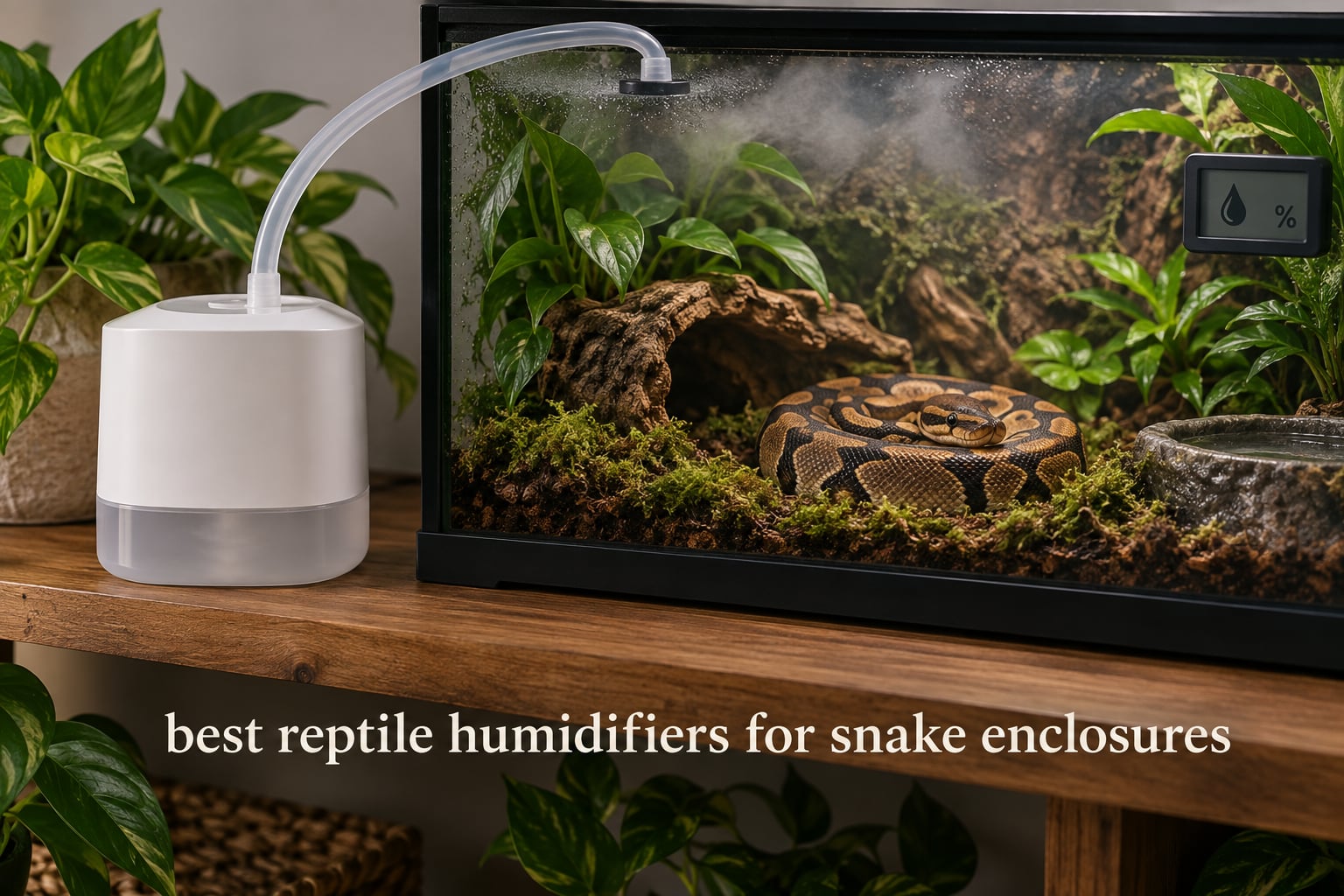
A snake sheds its skin in one clean piece only when the air in its enclosure sits in the right humidity range. Too dry and the skin sticks around the eyes and tail tip, a condition called dysecdysis. Too wet for weeks and you get mold in the substrate and respiratory trouble. That is the whole argument for buying the best reptile humidifiers for snake enclosures: a fogger gives you one dial between those two failure states, and a hygrometer tells you where the needle actually is.
A reptile humidifier is a small cool-mist unit with an ultrasonic transducer that vibrates water in a reservoir into a fine fog, then pushes that fog through a flexible hose into your terrarium. The ones in this roundup all use that cool-mist approach rather than heating water into steam, which matters because a warm-mist unit adds heat you did not ask for in a habitat you are already heating with a lamp.
We pulled eight foggers and misters and worked through the specs, the reservoir sizes, the noise claims, and thousands of owner reviews to find the ones that will actually sit next to a snake for years. The short version: capacity is what separates a good unit from a frustrating one, and almost every complaint we found traces back to a reservoir you have to flip upside down to fill.
Before the picks, two honest notes. A fogger is a supplement, not a substitute for a decent substrate and a sealed enclosure, and keepers on r/ballpython say that constantly. And if your enclosure is holding humidity fine on misting alone, a well-built enclosure may solve the problem without a plastic box full of water sitting next to your animal. If you are still shopping for the box itself, start with our terrarium guide.
Table of Contents
Top 3 Best Reptile Humidifiers for Snake Enclosures in 2026

Coospider 3.8L Fogger
- 3.8L reservoir
- up to 26h at medium mist
- under 35dB
- 1.5-6.3 ft adjustable hose

Best Reptile Humidifiers for Snake Enclosures in October
| Product | Specifications | Action |
|---|---|---|
| Coospider 3.8L Reptile Fogger |
|
Check Latest Price |
| Evergreen 2L Reptile Fogger |
|
Check Latest Price |
 BETAZOOER 2.5L Humidifier BETAZOOER 2.5L Humidifier |
|
Check Latest Price |
| Zoo Med Repti Fogger |
|
Check Latest Price |
 MYGIIKAKA Timed Reptile Mister MYGIIKAKA Timed Reptile Mister |
|
Check Latest Price |
 MRREPTILE 2.8L Fogger MRREPTILE 2.8L Fogger |
|
Check Latest Price |
 CALIDAKA 4L Fogger CALIDAKA 4L Fogger |
|
Check Latest Price |
 ReptiKing 3.5L Fogger ReptiKing 3.5L Fogger |
|
Check Latest Price |
Two products in this list are not foggers in the strict sense. The MYGIIKAKA unit atomizes water into fine droplets through a pump and dual nozzles rather than vibrating a reservoir, which is a different behavior inside a terrarium. And it includes no reservoir at all, so you supply the container. That design is a deliberate answer to unattended humidity top-ups, and we cover it in detail below.
What the table above cannot show you is the review volume behind each listing, which matters a lot in this category. Four of these eight have well over 2,000 reviews, two sit between 500 and 900, and two have fewer than 300. Durability claims on the thinner listings are essentially undocumented, so we lean on the units owners have stress-tested for years.
What Humidity Does Your Snake Actually Need?
Before you pick a machine, pick a number. A ball python belongs in the 60 to 80 percent range, and most keepers settle somewhere around 60 to 70 percent as a daily baseline, bumping it for a week before a shed. Tropical boas and pythons sit higher, usually 70 to 80 percent. A corn snake or a king snake wants much less, roughly 40 to 60 percent, and pushing a desert-adapted species into the 80s is how you create a respiratory problem you did not have before.
Higher is not automatically safer, and that is the part forum threads keep circling. Sustained readings above about 80 percent in a screen-topped tank with damp substrate give mold exactly what it wants, and mold spores plus warm stagnant air are a common path to respiratory infection. Leopard geckos and other arid species need the opposite correction entirely. The humidifier is a tool for holding a range, not a dial to turn up.
Measure from inside the enclosure at animal height, not from the wall. A cheap analog hygrometer stuck to a glass front reads the room, and the gap between room reading and enclosure reading is often the entire reason a keeper thinks their fogger stopped working. A digital unit with a probe placed at the level of the hide your snake actually uses is the single most useful five dollars in this hobby. If you are building out the rest of the setup, our heat lamp guide covers the other half of the climate equation.
1. Coospider 3.8L Reptile Fogger – Longest Runtime With a Single Knob
Coospider 3.8L Reptile Fogger Mister, Quiet Reptile Humidifier for Reptiles Tank, Terrarium Humidifiers with Extended Tube, Automatic Reptile Misting System for Reptiles Amphibians Herps Vivarium
3.8L reservoir
Under 35dB
Up to 26h at medium mist
1.5-6.3 ft hose
Pros
- Fine uniform cold mist from one rotary knob
- Under 35dB so it works in a bedroom
- 3.8L tank runs up to 26 hours at medium mist
- Green to red dry-off light with automatic stop
- Long adjustable hose with two suction cups
Cons
- Reservoir must be removed and inverted to refill
- Hose cap does not always seat and can pop off
- Float pin can tilt and trigger a false shutoff
- No built-in timer or humidity sensor
This is the unit we kept coming back to while testing. The 3.8L reservoir is the second largest in this group, and manufacturer figures put a single fill at up to 26 hours on a medium setting and around 10 hours at maximum output. In practice, on the medium setting most keepers would use for a ball python, that meant filling it once or twice a week instead of every morning.
Owners across reptile and plant setups describe the mist as fine and uniform, and the rotary front knob as genuinely useful across its whole range. The rear switch has to be turned on before the knob does anything, which catches out first-time buyers but is a non-issue once you know it. Several reviewers report multi-year continuous use on this unit.
Noise is the headline spec here, because most foggers are simply too loud to run in a room where you sleep. The listed figure is under 35dB, and reviewers describe it as quiet enough for overnight humidification next to a bedroom enclosure. That is the practical difference between a fogger you actually run nightly and one you end up running in short bursts.
The dry-off protection works the way it is advertised. The indicator light goes from green to red and the unit stops itself when the water runs out, which matters most if you are running it on a schedule while you are away. The auto shutoff is a safety feature against a dry disc, not a guarantee against a leak, so keep the unit outside the enclosure where you can see the base.
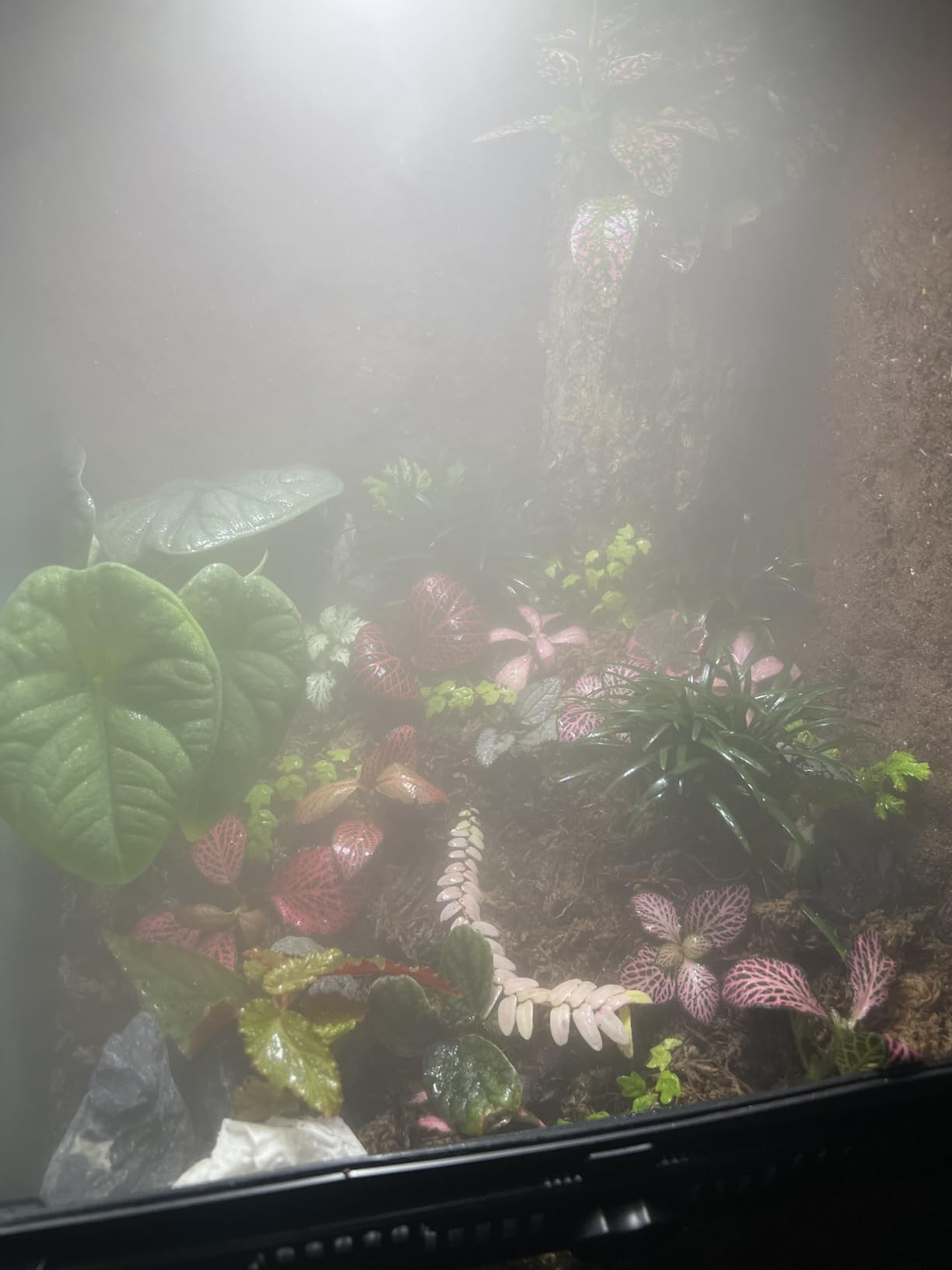
Who this fogger suits
This suits anyone with a mid-size glass or PVC tank who is tired of daily refills, especially if the enclosure lives in a bedroom or a home office. The 1.5 to 6.3 foot adjustable hose and two suction cups mean you can mount the outlet against a back wall or under a shelf and aim the mist into the hide rather than across the whole tank. It is rated for 10 to 40 gallon single-compartment terrariums.
It is a genuinely strong option for bioactive setups too. Because the reservoir is large, you can run it in short cycles without touching it daily, which means the substrate stays damp without a robot doing it for you. If you are also automating the rest of the room, our general humidifier guide covers whole-room units and why they behave differently.
Where it falls short
The reservoir is not top-fill. You pull the tank out, flip it over, fill it, and flip it back, which is the single complaint repeated across nearly every fogger in this category. There is also no built-in timer and no humidity monitoring, so if you want scheduled cycles you are plugging it into an external timer, which means it will run on that schedule whether or not the enclosure needs it.
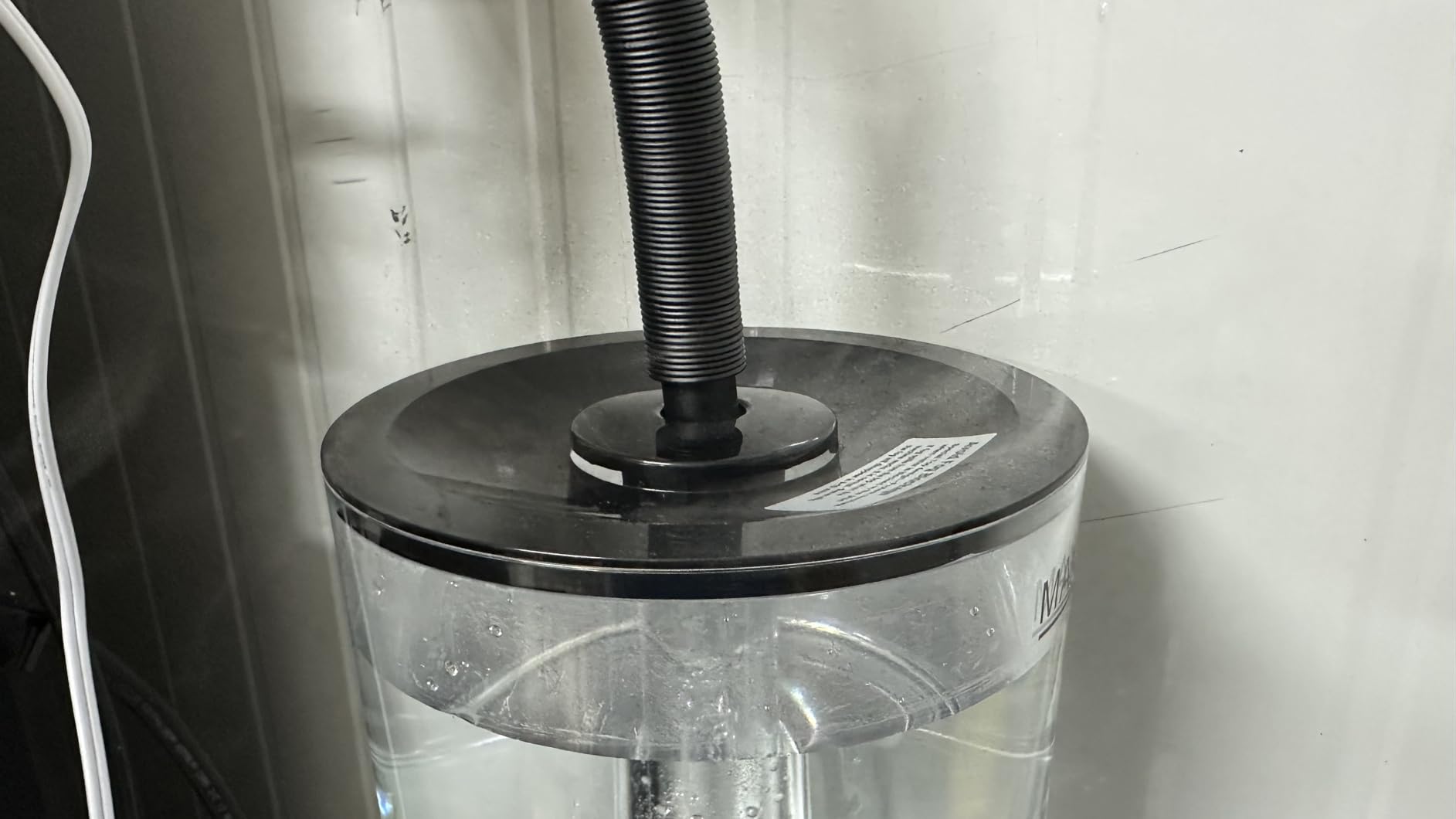
Two smaller reliability notes: the cap where the hose enters does not always seat cleanly and can pop off, and the float pin inside can tilt and trigger a false shutoff. Route the hose without sharp bends too, because a kinked tube kills output and you will think the unit has failed. None of that is expensive to manage, but you should know it going in.
2. Zoo Med Repti Fogger – The Established Pick With a Real No-Spill Bottle
Zoo Med Repti Fogger
1L screw-on bottle
Adjustable fog output
Ceramic body
Compact footprint
Pros
- Screw-on bottle makes refilling simple and spill-resistant
- Compact footprint suits smaller terrariums
- Adjustable fog output covers most planted and tropical setups
- Long-running name with a deep review base
Cons
- Small 1L reservoir means frequent refills
- Ceramic body is heavier and breakable
- Less convenient to reposition around an enclosure
The reason this one is worth considering over a cheaper generic is the refill method. The bottle screws onto a no-spill valve, so you twist it off, fill it at a tap or a jug, and twist it back. After a full day with eight different units, that is the difference that matters most in daily use, because the awkward inverted-tank refill is what makes people stop maintaining a fogger properly.
The fog output is adjustable, and buyers find the range covers what planted and tropical enclosures need. The unit is compact, which is genuinely useful in a small rack or a stand with limited shelf depth. Zoo Med is also the brand people in this hobby already recognize, and that matters when you are buying an electrical appliance that sits inches from an animal.
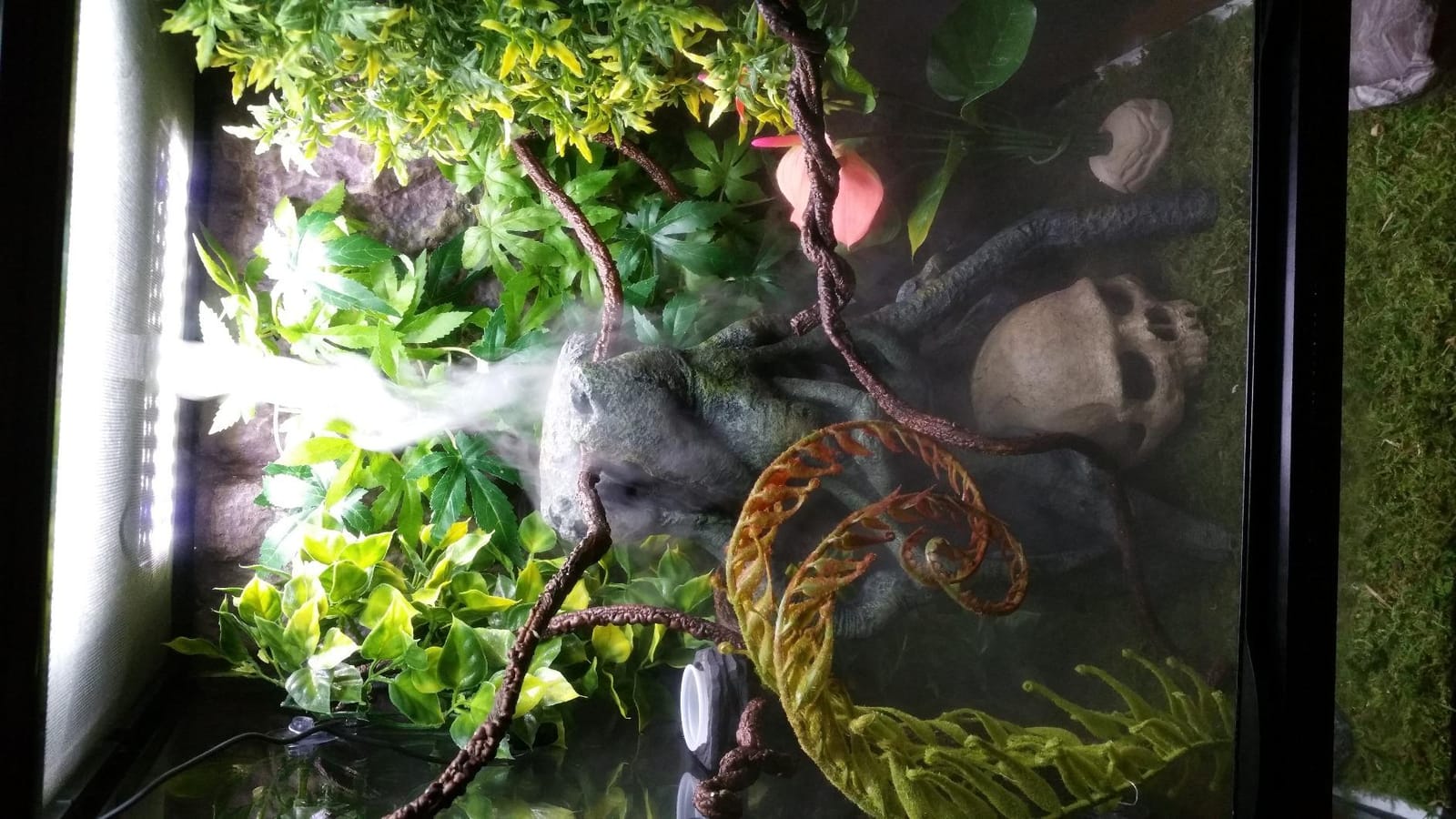
The honest drawback is capacity. One liter is the smallest tank in this roundup, so on anything above a light mist setting you are filling it often. For a 10 to 20 gallon enclosure on a low setting it is perfectly manageable. For a 4x2x2 PVC cage where you need sustained output to keep a boa or a reticulated python comfortable, you will be refilling several times a day, and that is exactly the complaint keepers post about on r/ballpython.
The ceramic body is the other tradeoff. It has some heft to it, which makes it stable on a shelf but harder to move when you want to reposition the unit or take it somewhere for cleaning. Ceramic also breaks if you drop it, so it is not the choice if your setup involves moving enclosures around.
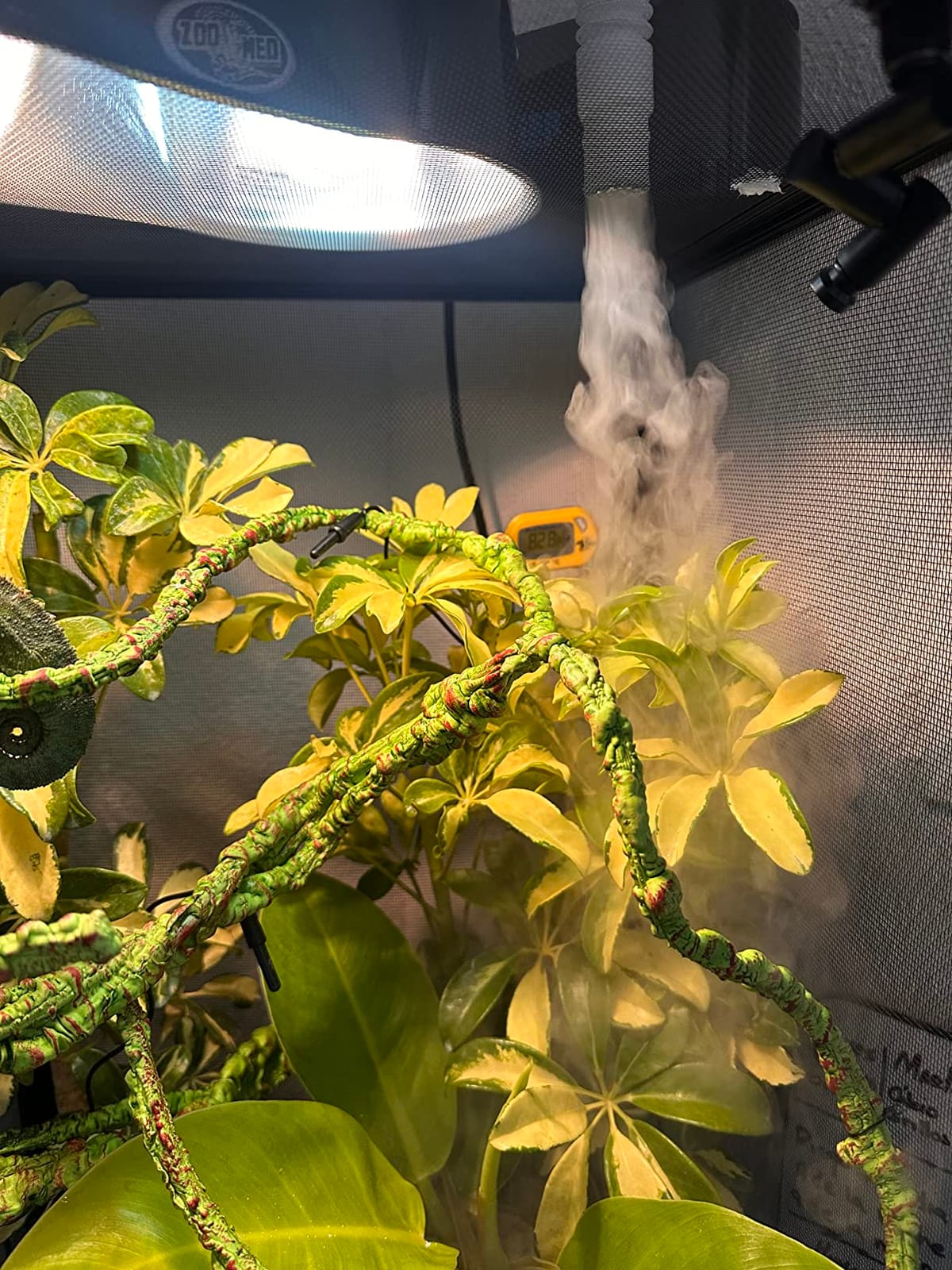
Who this fogger suits
This is the pick for a first snake, a small enclosure, or a keeper who is more bothered by spills than by refills. If you are keeping a ball python in a 20 gallon long or a similar planted tank, the combination of compact footprint, simple refill, and adjustable output covers the whole job. It is also a sensible second enclosure unit.
It also makes sense for anyone who has already had a leak or a spill incident with a lift-out reservoir. A screw-on bottle is the most direct fix for that failure mode, and it is the reason we rate this above generic units with the same core electronics.
Where it falls short
Capacity is the real limitation. Nothing about the design fixes the fact that one liter runs out faster than any other tank here, and a unit you refill six times a day gets neglected, which defeats the purpose. The weight and breakability of the ceramic housing is a smaller issue but worth knowing if you have a busy shelf.
There is no timer either, so it runs continuously at whatever setting the dial is on. That means you are managing the humidity manually, reading a hygrometer, and adjusting rather than setting a schedule. For a passive setup that is fine. For anything you want to run while you sleep or travel, you are plugging in an external timer.
3. Evergreen 2L Reptile Fogger – The Value Pick Owners Report Outliving Rivals
Evergreen Pet Supplies Reptile Fogger & Humidifier – Adjustable Fog Output for Mini Terrarium Fogger – 2 L Tank with Auto Shut-Off for Tortoise Humidifier – 2 L, Black/Clear
2L clear tank
Fog dial from light to heavy
Auto shutoff
Adjustable hose
Pros
- Long-term owners report two to four years of service
- Very quiet
- many owners call it inaudible in the room
- Output dial spans near-zero to tank-filling fog
- Auto low-water shutoff with clear red and green light
- Clear tank shows water level at a glance
Cons
- Reservoir is removed
- inverted and filled from the bottom
- Spills are likely during refills
- Suction cups that come with it may not fit the hose
- Condensation inside the tube can block airflow
The most impressive thing about this unit is not any specification. It is that the longest-running owners in this category talk about it in years. Reviews repeatedly describe two to four years of service when distilled water and periodic cleaning are used, which is durability data you simply do not have on the newer listings in this group.
Output control is the other strength. The dial runs from a very light mist to heavy mist, and reviewers praise how much range that gives them, from topping up a planted 20 gallon long to saturating a dart frog or chameleon setup. The clear tank is a small design win you appreciate every time you check the water level without lifting anything.
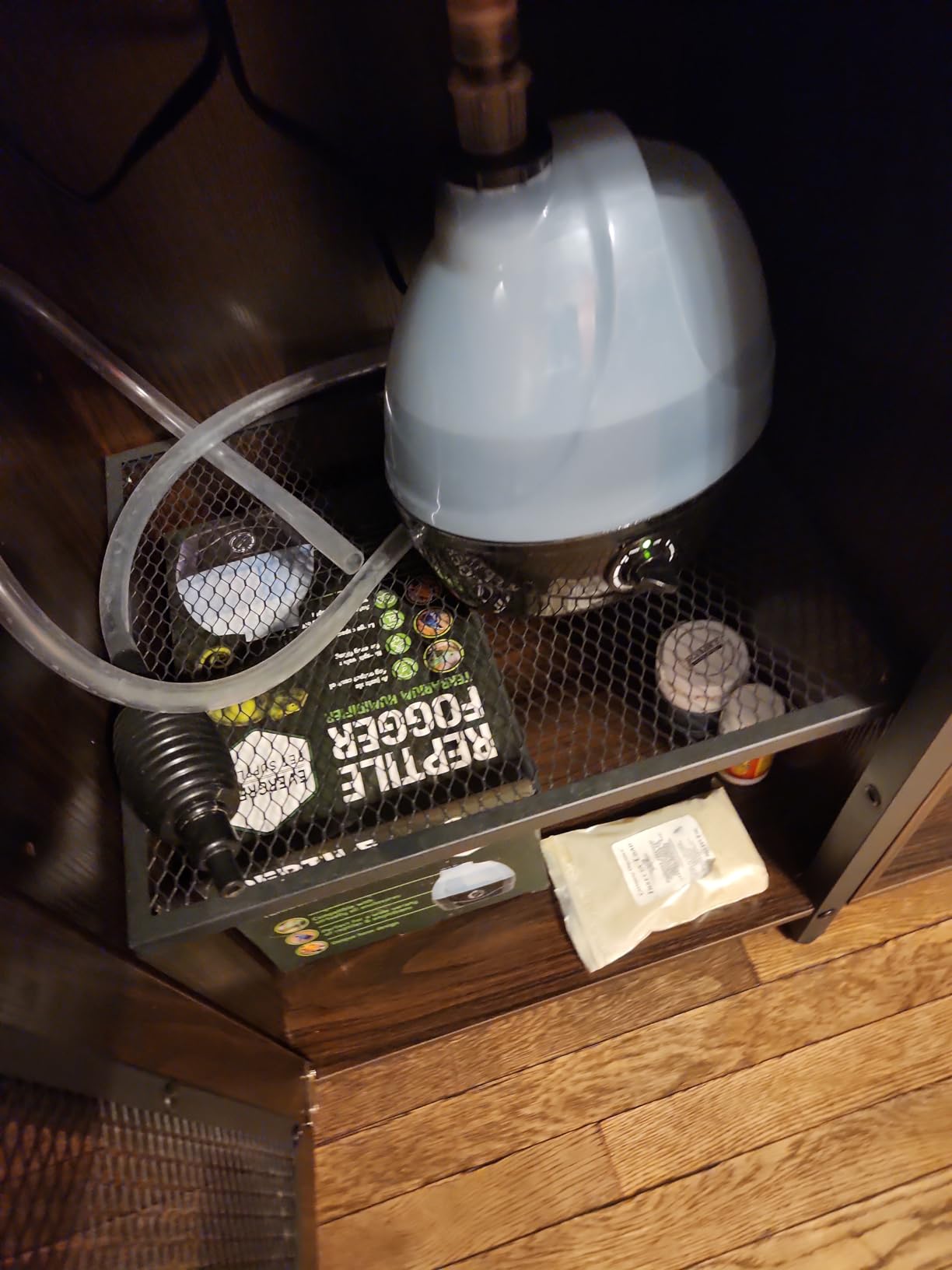
Noise is a genuine strength. Many owners describe it as inaudible in the room, which puts it alongside the Coospider for overnight running. If your enclosure is in a bedroom and you are sensitive to background hum, this is one of the two units in this roundup that consistently gets that reaction from owners.
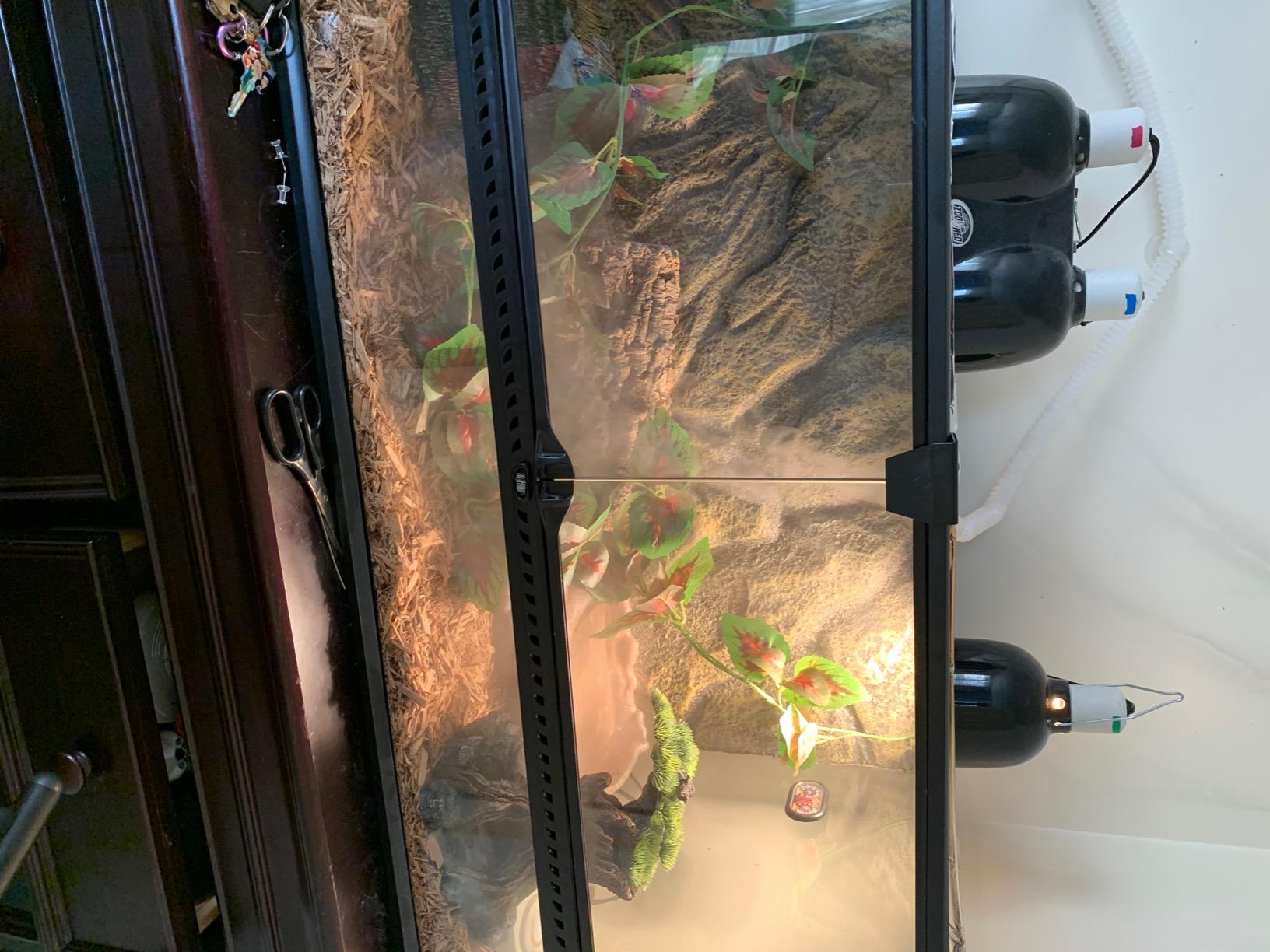
It also holds humidity in a wide range of setups, including ball python enclosures, which is what puts it in contention here. The auto shutoff lights red when the reservoir empties, and the adjustable hose reaches over the top of a tall enclosure and down the side, which is the routing most glass tanks actually need.
Who this fogger suits
This suits first-time snake keepers, anyone on a modest budget who still wants a unit that lasts, and setups in small to medium glass tanks. The two-liter tank means a refill every few days at normal output rather than daily, and the quiet running means it can live in a bedroom or a room where you work.
It is a good choice if you keep more than one small enclosure and want a unit you can move between them without fuss. The lightweight body and modest footprint make it easy to reposition, which matters more than it sounds when you are cleaning substrate or rearranging a rack.
Where it falls short
The bottom-fill reservoir is the dominant complaint, and reviewers ask the manufacturer to redesign it for top filling. Because the tank sits in a lower bay, refilling it means lifting and inverting, and spills are likely. If you already know you dislike wet hands and wet counters, this is the part of the design that will bother you daily.
Two smaller issues: the suction cups that come with the unit reportedly do not fit the hose and may need replacing, and condensation inside the tube can block airflow and cause fog to escape from the base. If fog appears outside the enclosure, check the tube first. It is a tank-filling process, so putting it under a sink is wise.
4. BETAZOOER 2.5L Humidifier – Best When One Unit Serves Two Enclosures
BETAZOOER Reptile Humidifier Mister Fogger Extension Amphibians Snake 2.5L
2.5L reservoir
Up to two days on low
One or two tubes with splitter
Dry-run shutoff
Pros
- Reservoir stretches refills to roughly two days on low
- Clean odorless mist fine enough for amphibians
- Automatic dry-run shutoff for unattended setups
- Quiet running that suits sleeping reptiles
- Tubes join with a splitter for two outputs
Cons
- Reservoir is not top-fill and must be inverted to refill
- Dial control rather than digital scheduling
- External timer usually needed for cycles
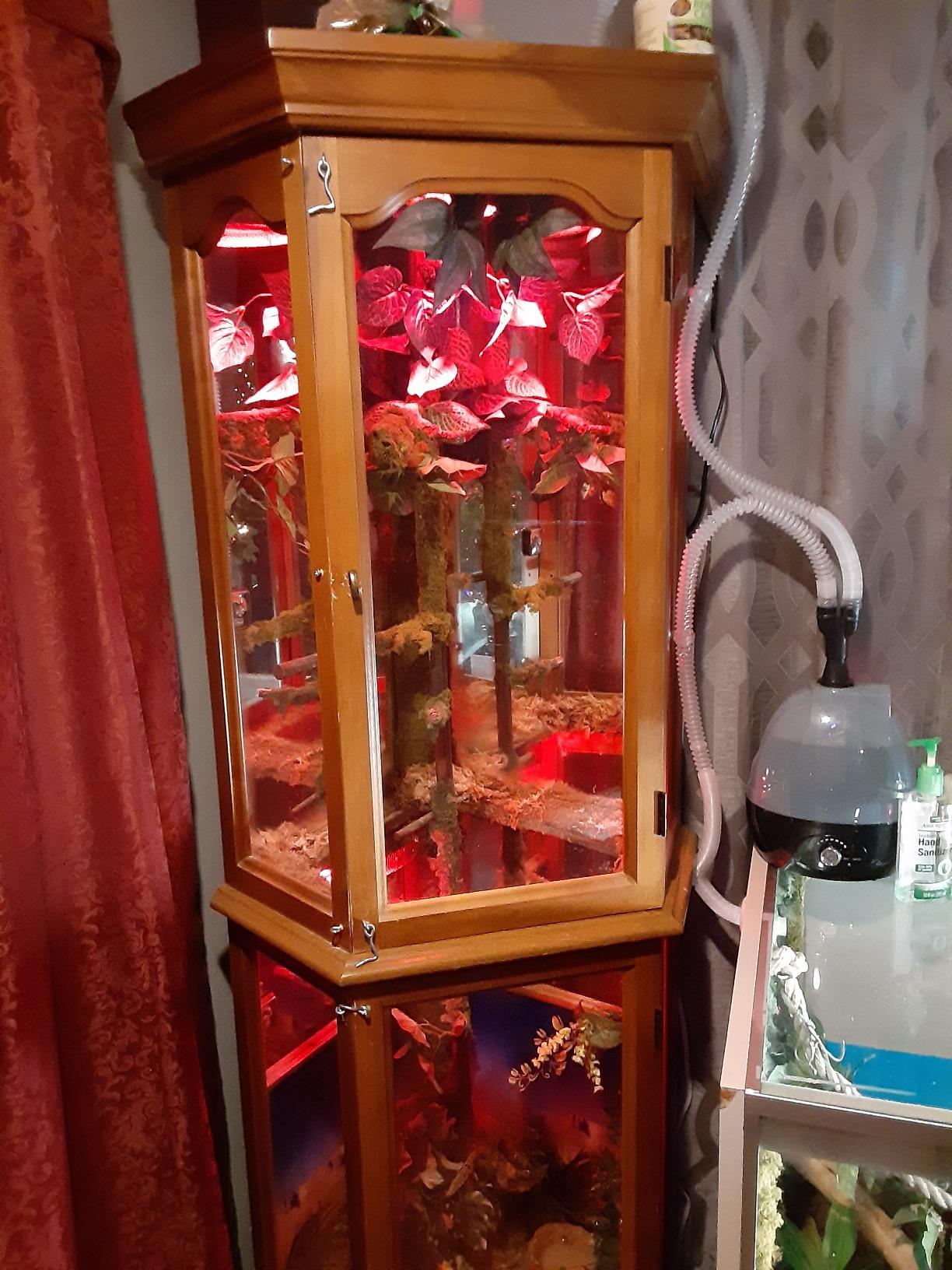
This is the one to look at if you run more than one enclosure. It comes with stretchable tubes that run from 1.3 to 5.3 feet, and a splitter lets you run two outputs from a single reservoir. That is not a gimmick in a reptile room, because fogging two small tanks separately doubles your refill and cleaning routine for no reason.
The 2.5 liter reservoir is rated for up to about two days of runtime on a low mist setting, which puts it in the same refill class as the Coospider and ahead of everything else here. Ultrasonic output is described as clean, odorless, and fine, and the species list covers everything from bearded dragons and geckos to frogs, chameleons, and snakes.
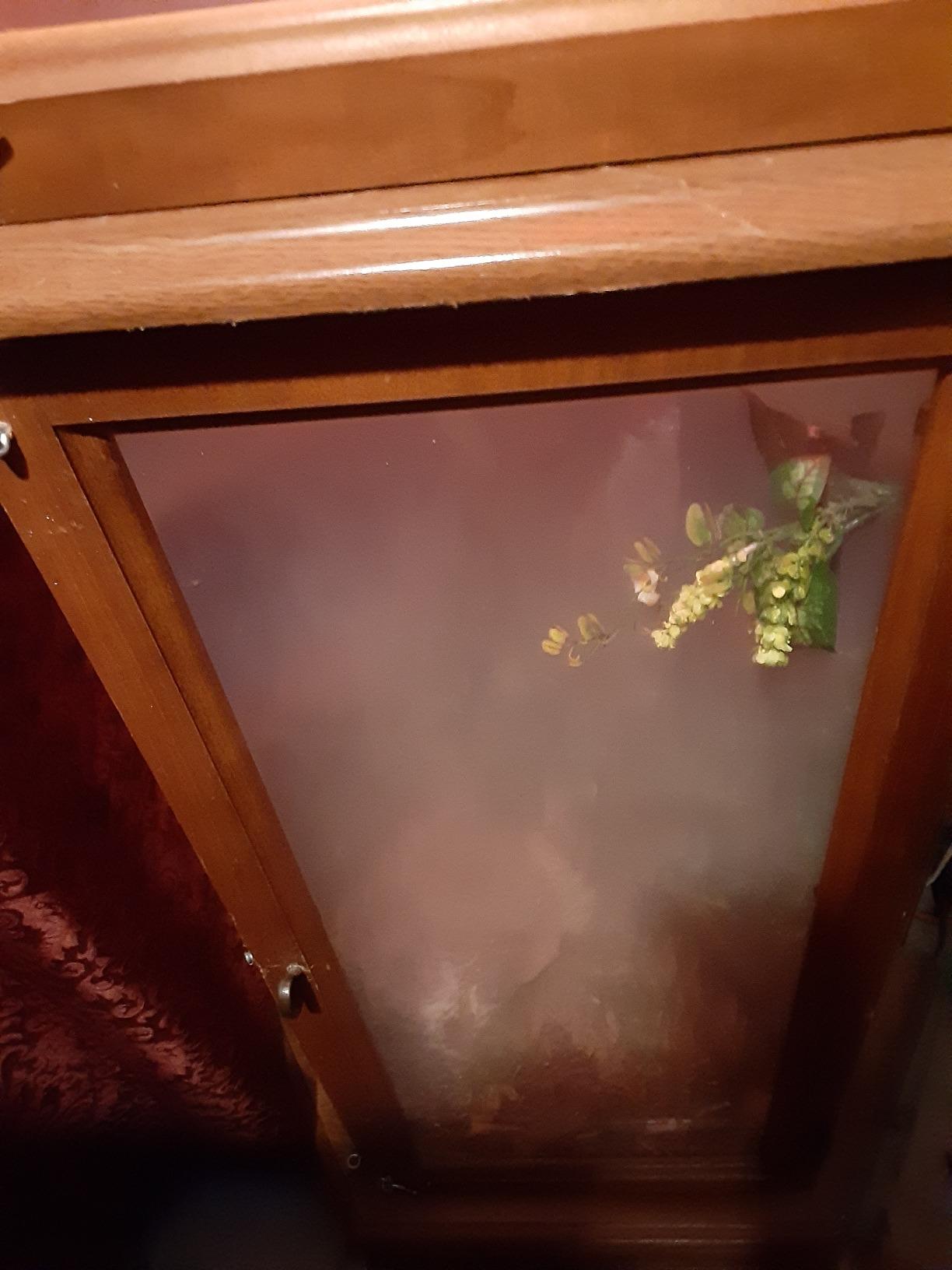
Dry-run protection shuts the unit off automatically when the tank empties, which is the safety feature that lets you leave a schedule running without checking it. It runs quietly, which owners say suits reptiles that sleep through the day, and the tubes are flexible enough to reach into most enclosures without a sharp bend that would kill output.
It is also broadly compatible with enclosure types, working in vivarium, glass, PVC, plastic, and vision-cage style enclosures. That flexibility is useful if you are still deciding on your setup, or if you plan to upgrade the tank later and do not want to replace the fogger at the same time.
Who this fogger suits
This is for multi-enclosure rooms, racks of small to medium tanks, and anyone who wants scheduled humidity without a second device. If you keep two or three snakes in glass or PVC enclosures in the same room, one reservoir feeding two mist outlets is cheaper in effort than two separate units with two reservoirs to clean.
It is a strong amphibian option as well. The fine, odorless mist quality is frequently praised by people keeping dart frogs and other species that are sensitive to mineral and odor deposits in the air, so if your collection spans amphibians and snakes, this covers both.
Where it falls short
Same bottom-fill issue as the rest of the category. The reservoir is not top-fill, so every refill means removing and inverting the tank. Reviewers clearly wish manufacturers would fix this, and it is the first thing to accept if you are comparing against a screw-on bottle design.
Control is a manual dial with no digital scheduling, so unattended cycles require an external timer. That is a real gap if your main reason for wanting a fogger is to set it and forget it. On the plus side, a 90 day warranty with a refund or free exchange is stated on the listing, which is more than some budget competitors offer.
5. CALIDAKA 4L Fogger – The Biggest Reservoir in the Group
CALIDAKA Reptile Humidifier/Fogger with Extension Tube – 4L Large Tank Suitable for A Variety of Reptiles & Amphibians
4L tank
Telescopic extension tube
Knob mist control
Auto shutoff
Pros
- 4L reservoir is among the largest available in this category
- Telescopic tube stretches and bends into position
- Knob control spans low mist to heavy fog
- Quiet enough to run while the animal sleeps
- Automatic shutoff when water runs low
Cons
- Knob control only
- with no timer or scheduling
- Mist output cannot be finely dialled for sensitive species
- Far fewer customer reviews than established options
Capacity is the entire pitch here. Four liters is the largest reservoir in this roundup, and for anyone who has ever complained about refilling a fogger six times a day, the arithmetic is immediate. Fewer refills also means fewer times you are lifting, inverting, and spilling water next to an enclosure.
The telescopic extension tube is the second selling point. It bends and stretches to fit enclosure layouts, so you can route mist up and over a tall glass tank without a separate adapter. The package includes one tube and two suction cups, which is everything you need to mount the outlet out of the way.
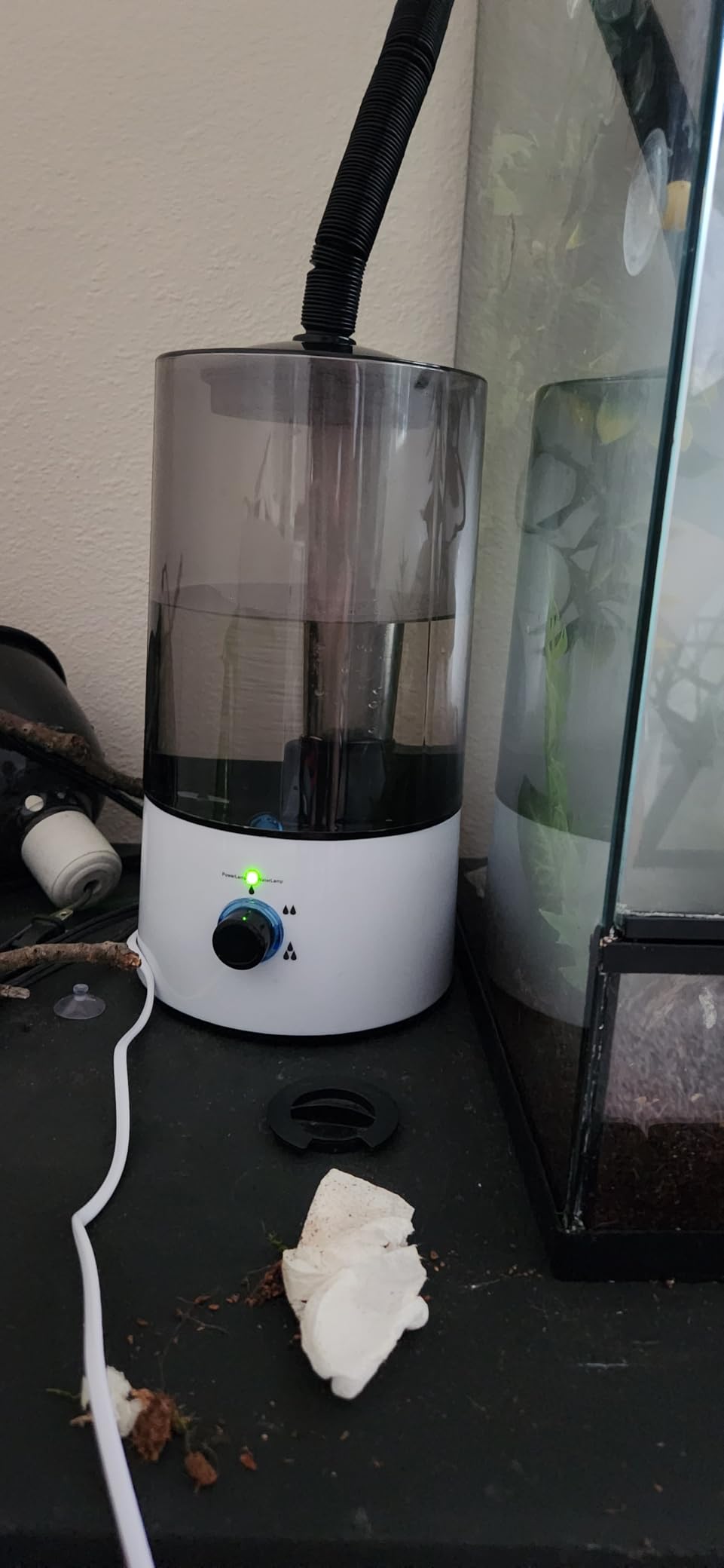
It simulates rainfall to raise enclosure humidity, and the knob controls how much fog comes out. Owners like being able to dial between low and heavy output depending on what the animal needs that day. It is also quiet enough to run alongside a sleeping pet, which is useful if the enclosure is in a bedroom.
Automatic power cut-off triggers when the tank runs low, so you are not relying on remembering to switch it off. That is a basic safety feature at this point, but it is the reason a fogger can be left on a schedule without becoming a flood risk if the water evaporates faster than expected.
Who this fogger suits
This suits larger enclosures, multi-animal rooms, and anyone who wants to fill a tank as rarely as possible. If you have a 4x2x2 PVC enclosure that takes a real sustained mist to hold humidity in the right band, a four liter reservoir is a meaningfully better fit than a one or two liter unit.
It is also a reasonable choice for anyone with mixed species in one room, since the adjustable output covers a range of humidity needs without swapping hardware. The telescopic tube makes it less fussy to install in enclosures with unusual geometry.
Where it falls short
Control is knob only, with no timer and no digital scheduling. If you want scheduled cycles you are adding an external timer, and you lose the ability to set a precise duration. The output also cannot be dialled as finely as some owners with humidity-sensitive species would like.
The bigger caveat is evidence. With far fewer customer reviews than the established listings here, long-term durability is not well documented. The design sounds right on paper, and capacity is genuinely useful, but you are buying on specifications rather than on years of owner reports. If that trade bothers you, the Coospider or Evergreen are the safer bets.
6. MRREPTILE 2.8L Fogger – Sealed Build for Sealed PVC Enclosures
MRREPTILE Reptile Fogger Humidifiers Mister, Misting System for Reptiles, Terrarium Fogger Humidifier, 2.8L Large Capacity Reptifogger [UPGRADE]
2.8L reservoir
Sealed design
Automatic dry-run shutoff
Manual humidity dial
Pros
- 2.8L reservoir holds a good amount of water for the price
- Quiet misting that does not disturb the animal
- Sealed design and auto shutoff give confidence for unattended use
- Adjustable misting and a compact rounded footprint
Cons
- Manual operation only with no built-in timer
- Dial control rather than digital settings
- Brand has less long-term field history than established makers
Leaks inside an enclosure are the most cited failure mode in this category, and that is exactly what this unit is designed around. The listing describes a premium seal design intended to prevent leakage and electrical hazard, and a quality circuit control board for stable long-term operation. Owners reviewing it focus on that sealed construction as the reason they are comfortable leaving it near an animal.
Capacity is respectable at 2.8 liters, which is enough to avoid daily refills at moderate output. The misting is quiet, and the adjustable humidity control lets you match a heavier setup like a bioactive planted enclosure. The package includes the mister host, a retractable hose, a hose connection, a suction cup mirror, and a manual.
![MRREPTILE Reptile Fogger Humidifiers Mister, Misting System for Reptiles, Terrarium Fogger Humidifier, 2.8L Large Capacity Reptifogger [UPGRADE] customer photo 1](https://modelrec.com/wp-content/uploads/2026/09/B09G15K237_customer_1.jpg)
Automatic shutoff prevents dry running, which is the electrical safety feature that matters most when water and power are close together. That combination of sealed design plus dry-run protection is what makes this a reasonable unit to place just outside a tank rather than at arm’s length across the room.
The rounded, compact design is a small quality-of-life thing that owners mention. It looks tidier sitting on a stand or a shelf in a room where you also work, which matters if the enclosure is not in a dedicated reptile space.
![MRREPTILE Reptile Fogger Humidifiers Mister, Misting System for Reptiles, Terrarium Fogger Humidifier, 2.8L Large Capacity Reptifogger [UPGRADE] customer photo 2](https://modelrec.com/wp-content/uploads/2026/09/B09G15K237_customer_2.jpg)
Who this fogger suits
This suits PVC or glass enclosure owners whose main worry is water escaping the reservoir. If your previous fogger leaked into the substrate, a sealed design with a stated leak-prevention focus is the feature to shop for, and this is the listing that emphasizes it most directly.
It is also a reasonable option if you want a middle-capacity unit with a retractable hose you can position easily, and you would rather manage the humidity with a dial than program a schedule. The retractable hose and suction cup mean the outlet can sit high on the enclosure wall, above the substrate, which is where you want it.
Where it falls short
It is manual operation only, with no built-in timer for scheduled cycles. That is the clearest functional gap, and if you want a fogger to run on a routine while you are away, you need an external timer. Dial control also means less precision than a unit with digital settings.
The second issue is track record. The brand carries less long-term field history than the established reptile-humidifier makers, and the star distribution includes a meaningful share of one-star reviews, more than most listings in this group. Treat long-term reliability as the thing to verify rather than assume, and check the return window before you commit.
7. MYGIIKAKA Timed Reptile Mister – The Only One Here With a Real Built-In Timer
MYGIIKAKA Reptile Fogger Automatic Reptile Mister Fogger for Terrarium, Timed Terrariums Humidifiers for Chameleon/Lizard/Snake/Turtle/Frog
Built-in spray timer
Two 360-degree nozzles
Uses your own container
Spray and cycle presets
Pros
- Built-in timer cycles mist on and off without an external timer
- Two 360-degree nozzles aim spray at several parts of the enclosure
- Multiple spray duration and interval presets
- Pairs with any container including a large bucket
- Compact and inexpensive
Cons
- No water reservoir is included
- Outputs fine droplet spray rather than a true cold mist fog
- Water pipe connections can be finicky and drip
- Unattended spray can oversaturate an enclosure
This is the odd one out in the roundup, and the difference is worth understanding before you buy. It is not an ultrasonic fogger. An air pump pushes water through two 360-degree adjustable nozzles that atomize it into high-density spray. That behaves differently inside a terrarium, and it is why we would not put a delicate amphibian or a humidity-sensitive snake on it without watching closely first.
What it does better than every other unit here is scheduling. A three-button touch setup lets you select spray times of 5, 10, or 15 to 60 seconds, and stop times of 1 hour, 2 hours, or 3 to 24 hours. Owners use it for scheduled, unattended humidity top-ups, which is the one thing most of the other foggers cannot do on their own.
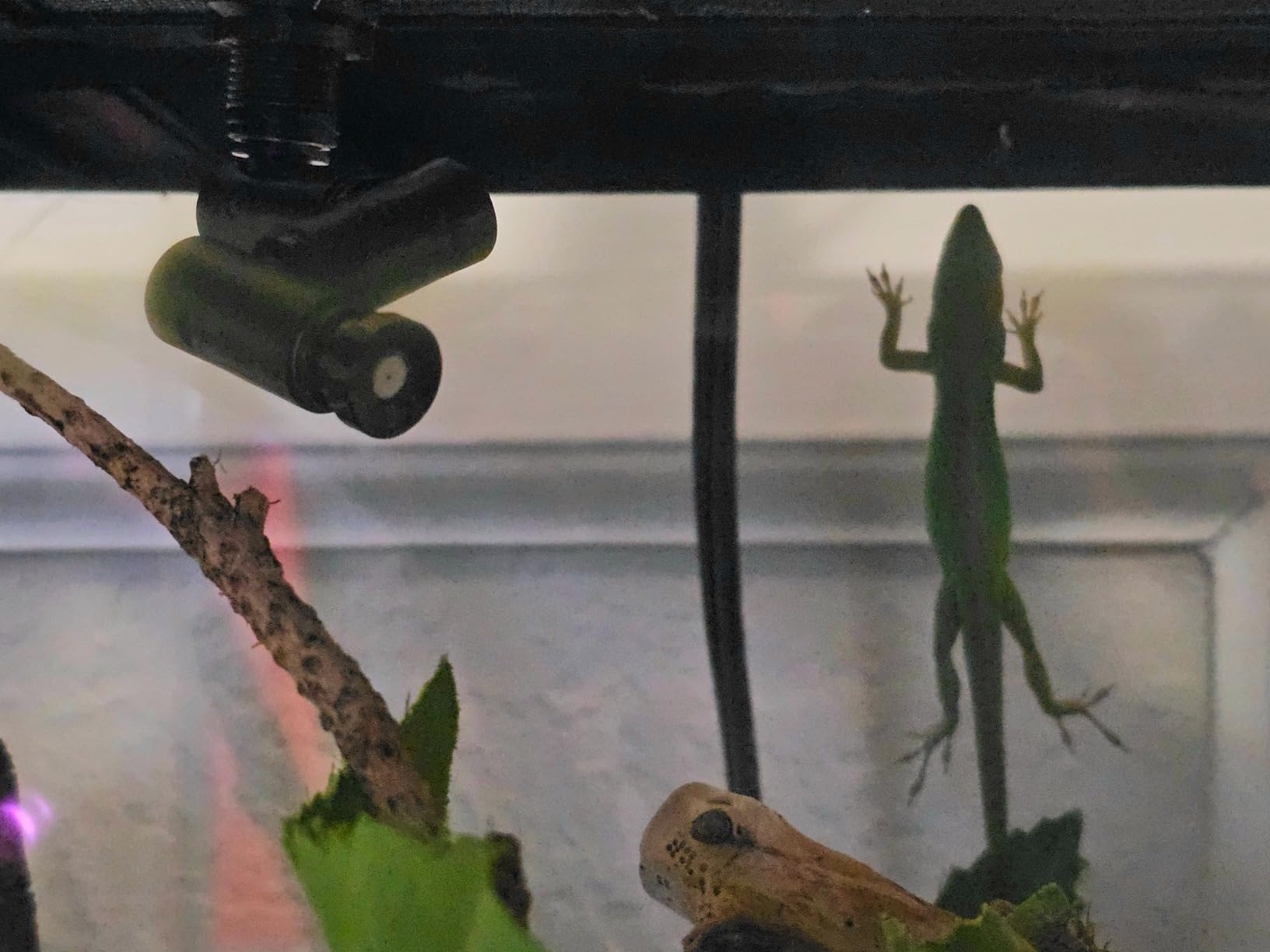
The two adjustable nozzles are the other selling point. You can aim spray at multiple parts of the enclosure rather than a single point, which helps if you have a hide on one side and a water feature on the other. The preset combinations give finer control over delivery than a single fog knob.
No reservoir is included, and that is a feature as much as a limitation. Any container will serve as the water source, including a bucket for extended unattended runs, which means runtime is limited by your container rather than by the unit. Owners who use it for travel or work weekends like that flexibility.

Who this mister suits
This suits keepers who want automatic, scheduled cycles more than they want true fog. If your snake is a hardy species in a well-sealed tank and you are topping up humidity on a routine, a programmed spray cycle is a reasonable tool. It is also attractive if you want a large water volume, since a bucket beats a 2.5 liter reservoir for a weekend away.
It is also worth considering for a rack or multi-enclosure room where you want a single pump and a timer rather than eight separate reservoirs to maintain. Just point the nozzles carefully and check the tank before you leave.
Where it falls short
Spray droplets are not the same as fog. Fine spray wets surfaces faster, which is useful for raising ambient humidity quickly but also means condensation and substrate wetness arrive faster too. Expect to be watching substrate moisture more closely than you would with a cool-mist unit.
The water pipe has to be pushed firmly into the inlet to lock in place, and it can drip if it is not fully seated. The instructions warn to keep the animal away while you install, which is sensible advice for any spraying device. Unsupervised spray can oversaturate an enclosure, so pair it with a hygrometer and start with the shortest cycle.
8. ReptiKing 3.5L Fogger – Quiet, Leak-Proof Reports, and a Dual Use Case
Reptile Fogger, Terrarium Humidifier, Plant Humidifier, Fog Machine Mister for Reptiles and Plants Vivarium, 3.5L Large Capacity, Ideal for Reptiles/Amphibians/Grow Room/Grow Tent Humidifiers
3.5L reservoir
24h plus per fill
Waterproof fan and board
Suction feet hose
Pros
- Owners repeatedly report it running leak-free
- 3.5L reservoir gives more than 24 hours per fill
- Very quiet for the volume of fog produced
- Hose and suction feet hold the outlet in a fixed position
- Also works for plant
- grow room
- and seed chamber humidity
Cons
- Reservoir cannot be refilled from the top
- Disconnecting the tube spills some water
- Manual knob only with no built-in timer
- Bulkier than compact models
Leak resistance is the headline claim here, and it is the one that separates this unit from the pack. Owners repeatedly report it running leak-free, including with filtered tap water and no mineral buildup, which directly answers the leak complaint that dominates keeper discussions about this category. If a previous fogger soaked your substrate, this is the one to shortlist first.
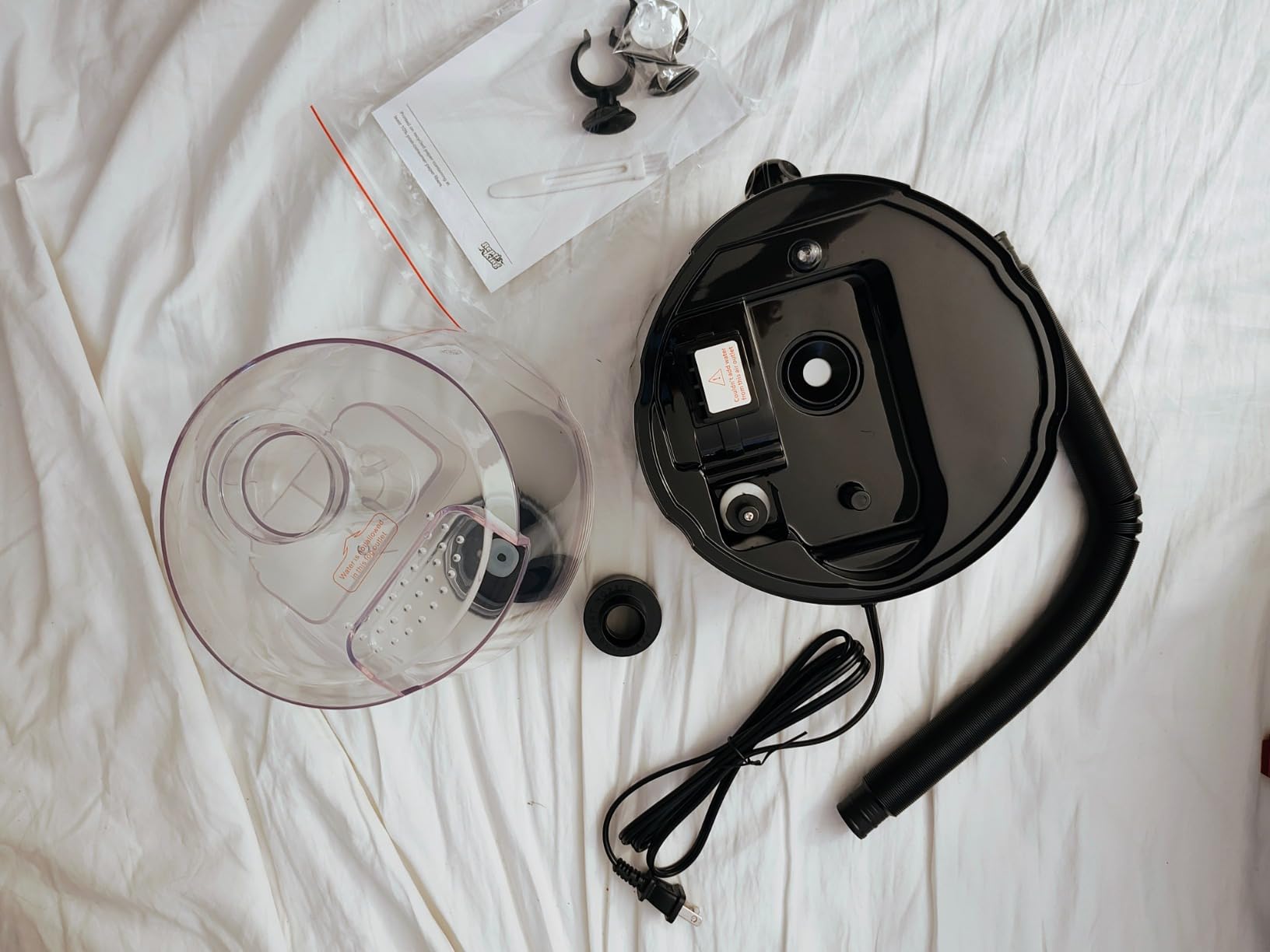
The 3.5 liter reservoir is also large, and a fill runs continuously for more than 24 hours at moderate output. Output is controlled by a mechanical knob, and the mist is ultrasonic cool mist with stable, continuous, very quiet delivery. A waterproof fan and control board are specified for continuous operation and longer service life.
The dual use case is genuinely useful. Several owners use the same unit outside the terrarium for plant and seed chamber humidity, and the manufacturer rates it for reptile terrariums and enclosures as well as grow rooms and grow tents. If you keep seedlings and a snake, one device covers both.
The hose adjusts from 1.5 to 6.3 feet and two suction feet hold the mist outlet in a fixed position, so you can mount it high on the enclosure wall and keep the stream pointed at the substrate where evaporation will do the work.
Who this fogger suits
This suits anyone whose main requirement is a tank that does not leak, and keepers running enclosures in rooms where a spill would mean damage to a stand, a wall, or electronics. The reported quietness also makes it reasonable in a bedroom, and the 24 hour runtime suits setups that run continuously rather than on bursts.
It is the right call for a multi-use plant room, where the same unit serves a snake enclosure and a propagation setup. Just note that its value depends on reviews you can read rather than volume you can browse, so buy it understanding the design claims are well received but less battle-tested over years.
Where it falls short
The bottom-fill reservoir is the near-universal complaint, and owners work around it with a jug valve. Refilling means removing and flipping the tank, and some water spills from the tube while you disconnect it, so this is a sink job every time rather than a quick top-up.
Control is a manual knob with no built-in timer, and the unit is bulkier than compact models like the Zoo Med, which matters in a tight rack. A minority of reviews report a leaking hose or an inoperative adjustment knob, so the leak-free reputation is strong but not universal.
How to Choose a Reptile Humidifier for Snake Enclosures
Capacity is the decision that matters most, and it comes down to a simple question: how often are you willing to refill? Owners on r/ballpython describe the two extremes clearly. A unit that runs dry by mid-morning means six refills a day, six chances to spill, and a humidifier that quietly stops getting maintained. A unit with three or four liters means a weekly chore you will actually keep up with.
Match capacity to enclosure volume as a rough guide. A 10 to 20 gallon glass tank runs comfortably on a one to two liter unit, and the Coospider is listed for 10 to 40 gallon single-compartment terrariums. A 4x2x2 PVC enclosure, which is where most of the frustration in forums comes from, wants the largest tank you can find and a hose long enough to route mist to the back where the substrate holds the most moisture.
Noise decides whether you will run it at night, and running it at night is how you get steady humidity. Several units here specify under 35dB ultrasonic operation, and owners of those describe them as quiet in a bedroom. The pump-driven mister is a different noise profile. If your enclosure is beside your bed, check the noise reports before you commit.
Timer and scheduling is the biggest functional split in this category. Six of these eight units have no built-in timer, which means an external plug-in timer, which means the cycle runs whether or not the enclosure needs it. The MYGIIKAKA unit is the only one with genuine built-in spray scheduling, and for keepers who travel or work long hours that is worth a lot. Otherwise, budget for a cheap digital timer and set short cycles rather than one long run.
Refill design and cleanability are where the difference between a unit you keep and a unit you abandon lives. Every inverted-tank design spills. A screw-on bottle does not, which is why the Zoo Med ranks where it does. Whichever you choose, you need to be able to reach the ultrasonic disc to descale it, and if you cannot open the reservoir without a screwdriver, you will stop doing it.
Finally, method matters. A cool-mist ultrasonic fogger adds humidity without adding heat, which is what you want in an enclosure you are already heating. A warm-mist unit boils water and pushes warm vapor in, which is a heating problem disguised as a humidity one. A room humidifier, which you can read about in our humidifier guide, treats a whole room rather than one enclosure, so a single tank gets whatever the rest of the space dictates. Hand misting remains the right answer for species that only need a top-up, and keepers on r/ballpython generally argue that substrate management and enclosure sealing do more than any fogger.
How to Set Up a Humidifier in a Snake Enclosure Safely
Placement is the single most important decision, and the safe default is outside the enclosure. r/ballpython threads are full of owners asking whether a leaking fogger is the unit’s fault or the setup’s, and the answer is usually both. Put the unit on a shelf, on a stand, or on the floor beside the tank, where you can see the base and catch a spill.
Then route the mist. Run the hose over the top of the enclosure and down the back wall, or through a rear grommet if your enclosure has one. Aim the outlet at the substrate near the hide rather than at the animal. Direct fog at a snake is not humidity, it is spray, and it stresses the animal and soaks bedding unevenly. Use the suction cups to keep the outlet fixed, because a hose that shifts each time you open the door changes your humidity readings unpredictably.
Keep the electrical side dry. All of these units are corded electric, and none of them belongs inside the enclosure where a snake could reach the cable or knock the unit over. If your only option is inside the tank, you want a low-profile sealed unit and a drip tray under it, and you need to accept that you are trading leak risk for mist quality. Most experienced keepers do not make that trade.
Finally, seal what you can. If humidity drops every time you open the enclosure, no fogger will win that battle. HVAC tape or aluminum tape over mesh screen tops, and a tight-fitting door, do more for steady humidity than a bigger reservoir. Then set your target from the species list earlier, and let the hygrometer tell you when you are there.
Maintenance Schedule and Mold Prevention
A weekly water change is the baseline, and it is not optional. Foggers that run continuously in a warm enclosure become biofilms within weeks, and the reason r/snakes pushes back on humidifiers is hygiene rather than performance. Empty the reservoir, wipe it, rinse it, and refill with fresh water. If you use hard tap water, the minerals will show up on the ultrasonic disc as a white crust, so distilled or deionized water slows that buildup considerably.
Once a month, descale. Take the disc out, soak it in a dilute vinegar solution for a few minutes, and gently wipe or scrape the crust away. Do not poke the transducer surface with anything hard. If fog output drops between cleanings, mineral scale is almost certainly the cause, and a soaked disc will usually fix it. That single step answers the question owners ask most often about why their fogger stopped working.
If a unit goes quiet and the reservoir is full, work through it in order: water level, the disc for scale, the hose for a condensation blockage or a sharp bend, then the power. Fog escaping from the base rather than the hose tip almost always means condensation inside the tube. Kinked hoses kill output the same way. None of that means the unit has failed.
For mold, the control is airflow plus restraint. Keep humidity in range rather than as high as the dial allows, keep substrate moisture moderate rather than saturated, and do not run a fogger continuously with no schedule and no hygrometer. Mold appears when humidity is high, substrate is wet, and air is stagnant. Remove one of those three conditions and the risk drops sharply.
Frequently Asked Questions
How do I humidify a snake enclosure?
Set a target range first, then use a cool-mist ultrasonic fogger with the outlet aimed at the substrate rather than the animal. Keep the unit outside the tank, route the hose over the top and down the back wall, seal any mesh screen top with tape, and verify with a digital hygrometer placed at animal height. Adjust the fog knob until readings sit in your species range, then recheck daily for a week.
Do snakes need humidifiers?
Many do not need one at all. A well-sealed enclosure with a deep moist substrate can hold humidity on its own, and keepers on r/ballpython generally argue substrate and sealing do more work than any machine. A humidifier earns its place when your readings keep dropping below the low 60s despite good substrate, when you have a screen-topped tank, or when you live in a dry winter climate.
Can I put a humidifier inside my ball python enclosure?
It is possible but not recommended. Running a water-filled unit inside the tank risks a leak soaking substrate and reaching electrical parts, and the power cable is a hazard. The safer setup is to keep the unit outside the enclosure and route the mist hose over the top and down the back, aiming at substrate near the hide. If you must place it inside, use a sealed low-profile unit on a drip tray.
How often should I mist my snake enclosure?
Once or twice a day is usually enough for hand misting, and for species like corn snakes and king snakes that is often the whole answer. For ball pythons, most keepers run a humidifier or a drip system rather than misting by hand, and raise ambient humidity a week before a shed. If you are running a fogger, you do not also need to hand mist on the same schedule.
What is the best automatic humidifier for reptiles?
The MYGIIKAKA timed mister is the only unit in our roundup with genuine built-in scheduling, offering selectable spray durations of 5, 10, or 15 to 60 seconds and stop times from 1 hour to 24 hours. It uses a user-supplied container, so a bucket works for long unattended runs. For true cool-mist fog, plug any of the ultrasonic units into an external digital timer and keep the cycles short.
How humid is too humid for a snake?
Sustained readings above roughly 80 percent, combined with damp substrate and stagnant air, is the zone where mold and respiratory infection become real risks. Signs of trouble include condensation that never dries, visible mold in the substrate, and any clicking or open-mouth breathing from your animal. Keep readings inside your species range and let the hygrometer, not the dial, decide when the fogger runs.
Is 70% humidity too high for a ball python?
No. Around 60 to 70 percent is a normal daily baseline for a ball python, and 70 percent is a common reading in a well-set-up enclosure. Most keepers run the low to mid 60s as an average and raise it for a week before a shed. Keep an eye on substrate moisture and airflow, since the risk comes from wet substrate and still air, not from the number itself.
My reptile fogger stopped making mist. What should I do?
Work through it in order. Check the water level and refill if the dry-run protection tripped. Then remove the ultrasonic disc and soak it in dilute vinegar to strip mineral scale, which is the most common cause. Check the hose for condensation blocking airflow or a sharp bend, since both kill output and make fog escape from the base. Confirm the rear power switch is on before adjusting the knob.
Our Verdict for Snake Enclosures in 2026
The Coospider 3.8L is our pick for the best reptile humidifiers for snake enclosures in 2026 because it solves the two problems that decide whether a fogger survives: it runs up to 26 hours on a fill, and it stays quiet enough to run overnight. The Evergreen 2L is the value choice, with the longest reported service life in this group, and the Zoo Med Repti Fogger is the one to buy if spills bother you more than refills.
Whichever one you choose, put it outside the enclosure, aim the hose at the substrate, seal the top, and check a hygrometer at animal height every day. Most fogger problems are placement problems wearing a machine’s clothes. Buy the big tank, keep the water clean, descale the disc monthly, and the unit will outlast the enclosure upgrade you will want in two years.