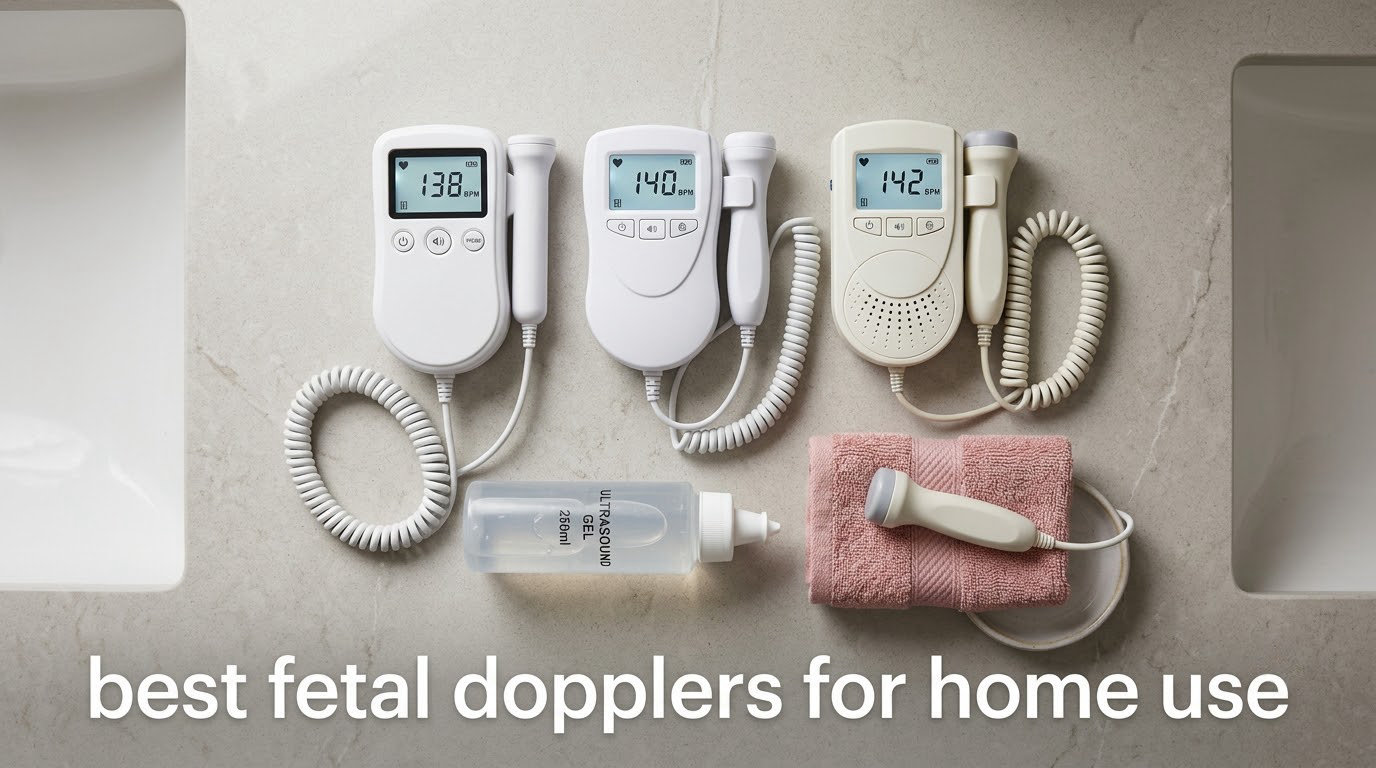
The best fetal dopplers for home use are acoustic Pinard horn fetoscopes, and the one I recommend first is the Dixie EMS Fetal Stethoscope. It has the largest body of verified owner feedback of any home listener we analyzed, it works with no batteries, no gel and no charging, and it reliably picks up fetal tones from roughly 20 weeks once you learn the technique. A second device, the Wusic Pregnancy Bundle, is the pick if you want a heartbeat monitor and a belly speaker in one box.
I want to be straight about something first, because most roundups on this topic skip it. The FDA classifies fetal Doppler ultrasound devices as prescription devices, and health systems including the NHS advise against untrained parents using them, for one specific reason: an untrained listener frequently hears their own pulse or the placenta and believes it is the baby. That single failure mode causes more anxiety than the device relieves.
So the honest framing of this list is narrower than the marketing on the box. None of the ten devices below replaces prenatal appointments, kick counts from 28 weeks, or any measurement your midwife or doctor takes. What they do well is let you and your partner hear something together in a quiet room, and that is a real benefit even when it tells you nothing medically. If you want a second read on the category, our roundup of user-reviewed fetal dopplers covers the electronic ultrasound side in more depth.
Table of Contents
Top 3 Picks for Best Fetal Dopplers for Home Use in 2026
Dixie EMS Fetal Stethoscope
- Pinard horn bell
- Latex-free with soft earbuds
- No batteries or gel
Wusic Pregnancy Bundle
- Bluetooth belly speaker
- Heartbeat monitor included
- App and voice control

Skywin Fetal Heartbeat Monitor
- Non-invasive Pinard horn
- Battery-free operation
- Works from about 24 to 30 weeks
One note on ratings before you read on. The three-star and four-star scores above look unimpressive next to a typical consumer electronics roundup, and that is the honest picture: a fetoscope is a technique instrument, not a gadget. A skilled owner gets clear results, a first-time owner under 24 weeks often hears nothing, and that gap lands in the star average.
All 10 Fetal Dopplers Compared Side by Side in October
| Product | Specifications | Action |
|---|---|---|
| Dixie EMS Fetal Stethoscope with Pinard Horn |
|
Check Latest Price |
| Wusic Pregnancy Bundle Heart Monitor Pack |
|
Check Latest Price |
| Skywin Fetal Heartbeat Monitor |
|
Check Latest Price |
 AAProTools Pinard Stethoscope Aluminum AAProTools Pinard Stethoscope Aluminum |
|
Check Latest Price |
 Garneck 2-Piece Fetal Stethoscope Garneck 2-Piece Fetal Stethoscope |
|
Check Latest Price |
 MALUGOGO Aluminum Fetal Stethoscope MALUGOGO Aluminum Fetal Stethoscope |
|
Check Latest Price |
 SECFOU Pregnancy Stethoscope for Fathers SECFOU Pregnancy Stethoscope for Fathers |
|
Check Latest Price |
 MUSISALY Fetal Heartbeat Sound Horn MUSISALY Fetal Heartbeat Sound Horn |
|
Check Latest Price |
 Abaodam Fetal Stethoscope Blue Abaodam Fetal Stethoscope Blue |
|
Check Latest Price |
 Ipetboom Aluminum Fetal Stethoscope Ipetboom Aluminum Fetal Stethoscope |
|
Check Latest Price |
How to Use a Home Fetal Doppler Without Fooling Yourself
Nearly every complaint we read about these devices is a technique complaint, not a hardware complaint. The horn is not broken, you are just listening in the wrong place, at the wrong time, without enough couplant, or for too long to tell one sound from another. Fix those four variables and most of the disappointment disappears.
Seven steps that improve your odds of finding the heartbeat
First, have a half-full bladder. A full bladder acts as a fluid window and pushes the uterus up out of the pelvis, which makes the fetal position easier to reach. Emptying yourself completely does the opposite and makes a hard search much harder.
Second, lie down if you can, and give yourself a minute to settle. A calm room with the hum of a refrigerator running nearby is more useful than a silent room, because a steady low background noise makes the fast fetal rhythm easier to pick out.
Third, use gel. Standard ultrasound gel is the right couplant, and plain aloe vera gel is the substitute that expectant parents mention most often in forums. Water on its own gives you static, which sounds like a fault in the device but is not one.
Fourth, place the horn wide and low, near the pubic bone, then move upward in very small steps. The movement should be a slow sweep about a centimeter at a time, not a hunt across the belly.
Fifth, lean on it. Firm, steady pressure improves the seal between the horn and your skin. A light, tentative touch produces mush.
Sixth, listen for twenty to thirty seconds at each stop before moving. Fetal tones sweep in and out, and people frequently sweep right past them because they are listening for a continuous sound.
Seventh, cap the session. A five to ten minute attempt, once or twice a week, is what experienced users report settling on, and it is the limit we would suggest. Longer sessions add nothing except frustration, and none of the devices here need to be run for a set length to work.
Five sounds that are not your baby’s heartbeat
Your own pulse is the big one. It is slower than you expect, because the blood moving toward the horn is at maternal rate, and it gets louder the harder you press because you are compressing your own vessels. The baby is faster. If you are unsure, count both.
The placenta gives a soft whooshing or swishing noise rather than a distinct beat. The umbilical cord can produce a soft, pulsed whoosh, especially if the baby is moving at the time. Bowel gas produces irregular gurgles that fool people regularly in early pregnancy.
Finally, movement itself. A kick or a roll against the probe makes a loud thud that is easy to mistake for a strong signal once you are hoping to hear something.
When a home listener stops being useful
If you have an anterior placenta, the placenta sits between the probe and the baby and absorbs the signal. Owners with an anterior placenta frequently report that they can only ever pick up their own pulse, and there is no technique that reliably fixes it.
Reduce movement first, change position, and empty the bladder before concluding the device is not working. If you still find nothing after two calm, unhurried attempts, stop looking. Continued searching with a consumer device is where false reassurance and unnecessary alarm both come from, and your provider can do in ten seconds what an hour at home cannot.
1. Dixie EMS Fetal Stethoscope for the Long Wait to 20 Weeks
Dixie EMS Fetal Stethoscope for Baby’s Heartbeat Detection, Latex-Free Fetoscope with Pinard Horn and Soft Earbuds, 22”
Pinard horn fetoscope for fetal tones
Usable from about 20 weeks
Latex-free, 7.83 oz
Pros
- Works once you learn the technique
- No batteries gel or charging
- Owners say it beats pricier clinical stethoscopes
- Sturdy storage box included
Cons
- Heart tones are faint and muffled
- Needs a very quiet room and patience
- No amplification and no digital display
The Dixie EMS fetoscope is the only device in this roundup with well over two thousand written owner reports, and that is why it leads. When several trained reviewers, including a midwife and a registered nurse, say they located fetal tones quickly with it, that is worth more than any specification on a listing.
It is a 22-inch latex-free fetoscope with a cone-shaped Pinard horn bell, a chin and forehead rest for steady pressure, and soft earbuds. Nothing about it is electronic. There is no display, no memory, no number to read off a screen.
What you are listening for is real acoustic sound, which means volume is entirely in your control and entirely dependent on technique. Owners who succeed describe sweeping slowly from the pubic bone upward with firm pressure, and they describe the sound arriving in and out rather than continuously.
The construction matters more than the electronics because there are no electronics. The lumen tubing and horn are what a midwife would recognise, and several clinical reviewers said it outperformed expensive professional stethoscopes on fetal tones specifically. A few buyers reported the plastic deforming after a month of use, which is the one hardware complaint that repeats.
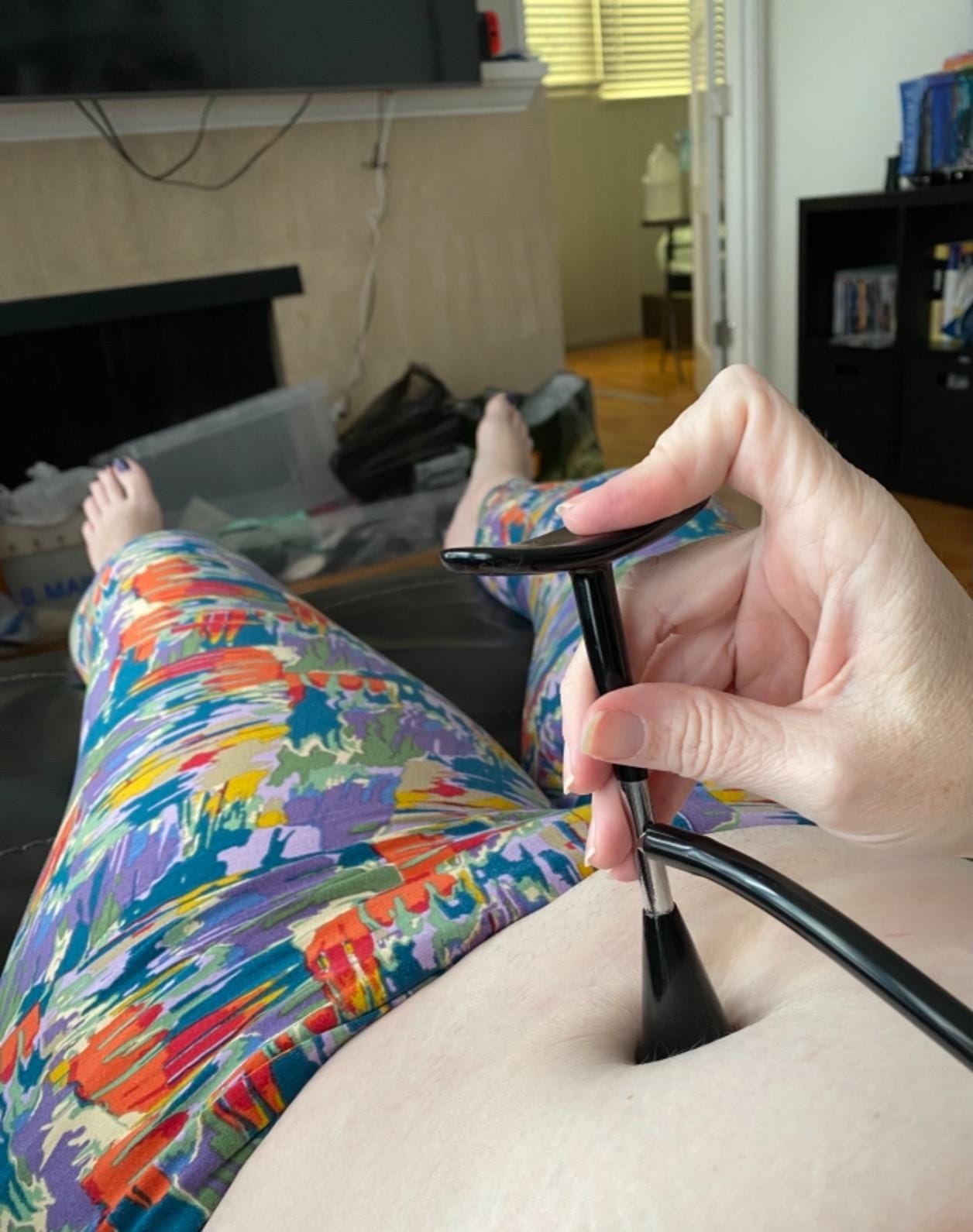
For whom this fetoscope works best
It works best for parents past the 20 week mark who have a quiet room and can commit to one patient ten-minute attempt a week. It works particularly well for partners who want to be involved, because you can pass the earbuds mid-session without unplugging anything.
It also works best for people who enjoy the hunt. Owners who describe it as magical are almost always the ones who learned to use it. Owners who describe it as useless are almost always in week 12 with a hard belly and no technique yet.
For whom this fetoscope is the wrong choice
It is the wrong choice if you need reassurance, because a faint unamplified signal in a noisy home tells you very little either way. It is also the wrong choice with an anterior placenta, where it will frustrate you repeatedly.
It is wrong for anyone who cannot manage a firm, steady hold for several minutes. The device is small and light, but the listening is not, and that is the trade you accept when you choose a purely acoustic tool.
2. Wusic Pregnancy Bundle for Two-in-One Play and Listening
Wusic Pregnancy Bundle – Bluetooth Belly Speaker and Heartbeat Monitor Pack
Bluetooth belly speaker plus monitor
Battery powered, 1 inch speaker
FCC and Bluetooth certified
Pros
- Two functions in one box
- Easy pairing and app control
- Good gift packaging with pouch
- Music usable from about 16 weeks
Cons
- Speaker audio is grainy
- Audio splitter disconnects often
- Bulky enough to remove your phone case
The Wusic bundle is the only electronic product we analyzed, and it is a different idea from everything else here. You strap a Bluetooth belly speaker to your bump and play music or voice messages to the baby, and the same box includes a monitor for listening to and recording sounds in the last trimester.
It carries the highest owner rating in the roundup at 4.1 out of 5, and owners consistently describe the emotional value rather than the technical value. People like being able to do something for the baby rather than only something to the baby.
Set-up is genuinely simple. The speaker pairs to a smartphone, tablet, laptop or television through Bluetooth, it is controlled by an app with voice control support, and it carries FCC and Bluetooth certification for prenatal use. It is not water resistant, which matters more than it sounds if you plan to use it in a bathroom.
The recurring complaints are all about audio hardware rather than concept. Owners describe grainy speaker output, a splitter that disconnects frequently, and a unit bulky enough that a phone case may have to come off first. A minority reported premature failure within a few months of light use. None of that touches the monitor, which owners treat as the useful half.
For whom this bundle works best
It suits expectant parents in the second trimester who want an interactive gift rather than a diagnostic tool. Playing a voice message at 18 weeks and arguing about whether the baby heard it is exactly the kind of session this is built for.
It also suits gifting. The bundle comes with a carrying pouch and is packaged in a way that survives being handed to someone at a shower, which is more than most of these products manage.
For whom this bundle is the wrong choice
It is the wrong choice if audio quality matters to you, because the grainy speaker and flaky splitter are consistent complaints rather than isolated ones.
It is also the wrong choice if you are shopping strictly for a heartbeat listener. The monitor half is useful, but the speaker half is the reason most buyers chose this box, and the speaker half is where the complaints sit.
3. Skywin Fetal Heartbeat Monitor for a Simple Battery-Free Check
Fetal Heartbeat Monitor, Fetoscope Heart Beat Monitors – Blue
Non-invasive Pinard horn device
No batteries or electronics
Detection typically from 24 to 30 weeks
Pros
- Compact and easy to share
- Battery-free so always ready
- Several owners found tones with patience
- Guide included for positioning
Cons
- Very faint audio with no amplification
- Needs firm semi-hard pressing
- Earbuds can hurt over longer sessions
The Skywin monitor is a plastic Pinard horn fetoscope that is compact enough to fit in a coat pocket and simple enough that you can hand it to a visiting relative without instructions. It needs no batteries, no electronics and no gel, and it comes in several colours so you can tell two apart in a drawer.
Owners report the manufacturer states detection typically starts around 24 to 30 weeks, with the best odds between 30 and 36 weeks. That expectation is more honest than the 8 to 12 week claims on electronic dopplers, and it is the single most useful thing on this listing.

The audio is the problem. Owners describe it as very faint, and say it is hard to hear even an adult heartbeat through the earbuds. Several buyers say the earbuds become uncomfortable during a longer session, and that you need firm, semi-hard pressure against the belly to get any signal at all.
The pattern in the reviews is unusually clear: successes cluster in the 19 to 30 week window with patience and practice in a silent room, and failures are concentrated among buyers under 24 weeks or buyers who wanted an amplified reading. A clinical buyer and an OB nurse both failed to locate heart tones, and one doctor compared it unfavourably to a better-built professional instrument.

For whom this monitor works best
It works best for a parent past 24 weeks who wants something small, light and always ready, and who is not expecting a number or a display. There is nothing to charge, nothing to break electronically and nothing to pair.
It also works best for shared listening, since the small size makes passing it around a circle of family far easier than a 22 inch clinical stethoscope.
For whom this monitor is the wrong choice
It is the wrong choice in the first trimester, when it will simply return nothing and take the joy out of the day. It is also the wrong choice if you are sensitive to earbud pressure, because the audio is quiet enough that you will want the volume as high as it goes.
Several buyers and clinicians described the build as cheap, so treat it as a disposable-feeling seasonal purchase rather than a keepsake.
4. AAProTools Pinard Fetal Stethoscope for Nursing Students
AAProTools Pinard Fetal (Embryo) Stethoscope in Lightweight Aluminum
Traditional milled Pinard horn
Silver aluminum and steel build
No power source required
Pros
- Sturdy milled construction built to last
- Works once positioning is correct
- Nothing to charge or pair
- Excellent training and practice tool
Cons
- Smaller than the listing photos suggest
- One unit arrived contaminated in the bag
This is the instrument you will have practised on if you trained as a midwife or a nurse, and buyers who know the technique rate it highly for exactly that reason. It is a milled aluminium and steel Pinard horn, silver in finish, and it is sold to students as much as to parents.
The build is the argument for it. Owners describe it as something that will last decades, it does not bend in a bag, and it cleans easily. There is no electronics, no battery, no pairing and no firmware to think about.
The reviews confirm it transmits fetal heart tones once you have it in the right place. There is no amplification, so the technique requirement is the same as any other horn, and the owners who succeed are the ones who already know where to put it.
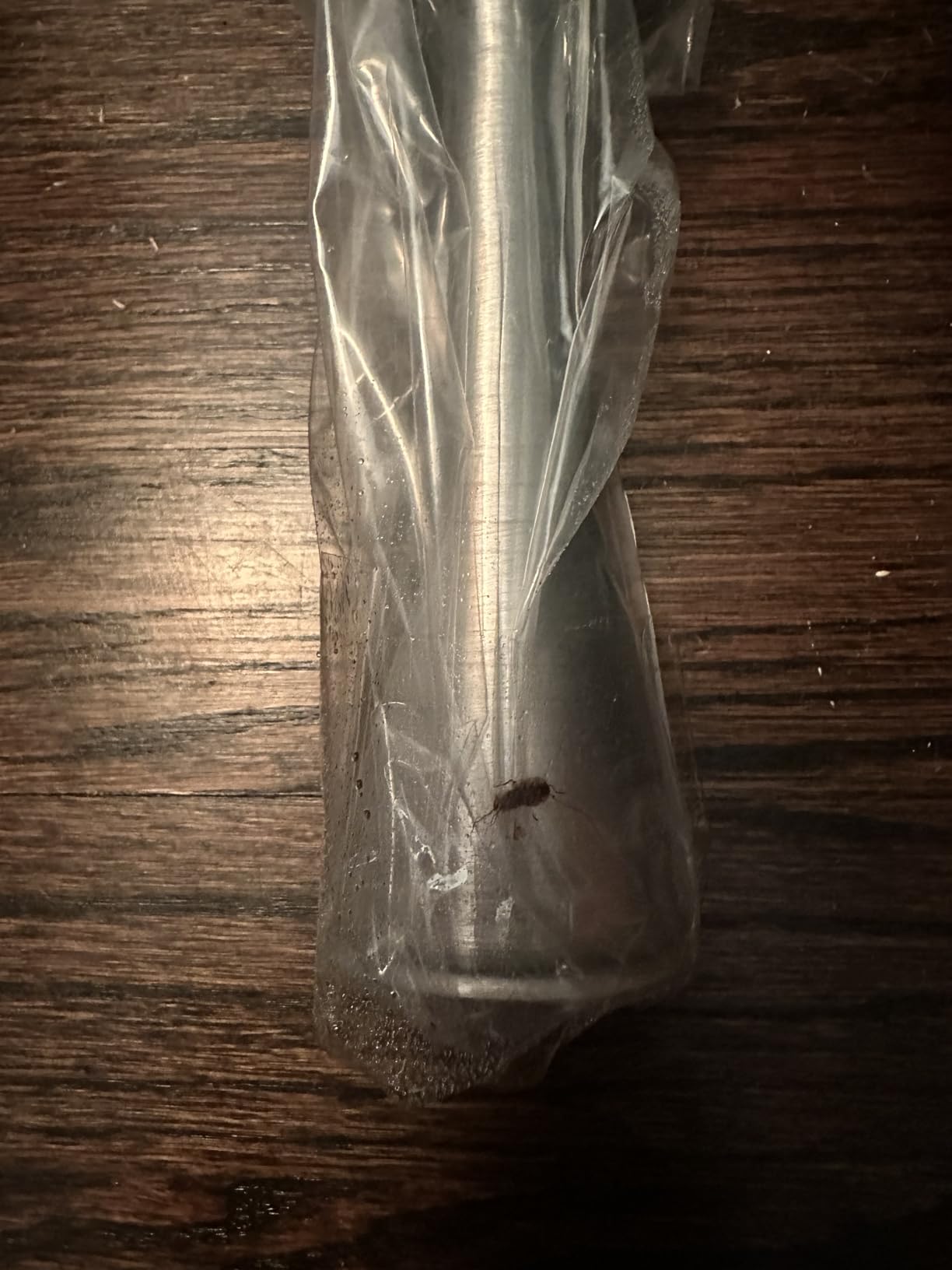
Two drawbacks come up repeatedly and they are worth weighing. The first is size: buyers say the real thing is noticeably smaller than the listing photographs suggest, which matters if you were picturing a full-size stethoscope. The second is a quality control report of a unit that arrived with a dead insect in the bag, which is unpleasant rather than dangerous, but is a reminder to inspect the package on arrival.
For whom this stethoscope works best
It works best for students and for anyone who has already been taught auscultation. The tiny review count is not a sign of a poor product, it is a sign of a narrow one, and the people who do buy it are mostly training.
It also works best for a household that wants one instrument to last the whole pregnancy and keep afterwards, since nothing about it wears out.
For whom this stethoscope is the wrong choice
It is the wrong choice if you have no technique background and no patience to learn one, because there is no help built in. It is also the wrong choice if you need a partner or relative to use it without supervision.
It is the wrong choice for early reassurance in particular, since it is a non-amplifying instrument and everything depends on your ears and your hand.
5. Garneck 2-Piece Fetal Stethoscope for Listening With a Partner
Garneck 2pcs Lightweight Plastic Fetal Stethoscope for Pregnancy with High-Sensitivity Heartbeat Detection Portable Prenatal Rate Device for Expecting Parents Accurate Home Health Tracking
Two lightweight plastic fetoscopes
Held-phone style sound sharing
Weighs 2.08 oz per set
Pros
- Two pieces so both partners can listen
- Very light and easy to carry
- Noise-reducing ergonomic contours
- Ready for spontaneous checks anywhere
Cons
- No owner reviews to draw on yet
- No verified data on real detection performance
The Garneck set is the simplest idea in this roundup and the one that fits a specific need. You get two lightweight plastic fetal stethoscopes, which means two people can listen at the same time without passing earbuds back and forth mid-session.
Each unit uses a telephone-style receiver so the sound can be shared with a partner, and the contours are described as noise-reducing so external sound interferes less. At 2.08 ounces and measuring 6.77 by 1.77 inches, they are the most pocketable devices here.
I have to be careful with this one, because the listing has no posted customer reviews and no owner performance history. What I can say is what the design implies, and the two-piece format does genuinely solve the turn-taking problem that makes shared listening sessions stall.
For whom this set works best
It works best for households where both parents want to hear the heartbeat at the same moment, which is usually the whole emotional point of the session. It also works best for people who travel, because the weight and footprint are minimal.
It works best as a shared item rather than a personal one, since you get no benefit from owning a second identical horn.
For whom this set is the wrong choice
It is the wrong choice if you want a verified track record, because there is no customer feedback at all on this listing. Nothing has been proven about its sensitivity in real use.
It is also the wrong choice as a first purchase, since two untested devices is a bigger gamble than one. Start with an instrument that has a few thousand owner reports behind it instead.
6. MALUGOGO Aluminum Fetal Stethoscope for a Heavier Travel Horn
Silver Aluminum Alloy Fetal Stethoscope for Expectant Mothers
Aluminum alloy horn construction
Battery-free, ready to use
Weighs 7.36 oz
Pros
- Ready for routine or urgent checks any time
- Aluminum alloy feels sturdy
- High-sensitivity horn claim
- No charging or pairing
Cons
- No owner reviews to draw on yet
- No verified data on sound clarity
The MALUGOGO is an aluminium alloy horn-style fetoscope weighing 7.36 ounces, and the heavier metal body is the point. Compared with the plastic horns, it feels more like an instrument and less like a novelty, and at under eight ounces it is still light enough to carry in a bag without thinking about it.
It is battery-free and ready to use, so it works for a routine check or an anxious one at any hour. The listening tube and grip are described as ergonomic for extended sessions, which matters more than it sounds when you are hunting for a faint sound.
Like the Garneck, this listing has no posted customer reviews, so there is no independent performance history to draw on. The manufacturer claims high-sensitivity acoustic detection, and that claim is currently untested by anyone but the manufacturer.
For whom this stethoscope works best
It works best for someone who prefers a solid metal instrument to a plastic one, and who will keep it in a bag or a coat pocket for occasional checks. The weight reads as durability rather than burden at this size.
It works best once you are past the stage where detection is realistic, because the design gives you nothing extra to compensate for being early.
For whom this stethoscope is the wrong choice
It is the wrong choice if you need proven results, because the listing has no owner feedback and therefore no evidence about its real sensitivity.
It is also the wrong choice for sharing with a relative who has never listened before, since there is no instruction material in the specification and you will be doing the coaching yourself.
7. SECFOU Pregnancy Stethoscope for Dads
Pregnancy Stethoscope for Expectant Father Sound Amplifier, Aluminum Alloy
Aluminum alloy sound horn with earpiece
Noise-filtering design
Weighs 3.84 oz
Pros
- Lightest metal option in the roundout
- Noise filtering for a cleaner signal
- Ergonomic grip and earpiece for long sessions
- Marketed for partners to use
Cons
- No owner reviews to draw on yet
- No verified data on real sensitivity
The SECFOU is built and marketed for the expectant father, and the design decisions follow from that. It is an aluminium alloy horn with an earpiece, a noise-filtering design aimed at clearing up background household sound, and an ergonomic grip intended to reduce hand fatigue over a longer listening session.
At 3.84 ounces and 6.81 by 1.77 by 1.54 inches, it is among the lightest metal options here, which matters if the intended user has larger hands and is holding it for several minutes on a firm belly.
The honest limitation is the same as the previous two picks. There are no customer reviews on this listing, so nobody outside the manufacturer has yet confirmed that the noise filtering does what the specification says or that the horn is sensitive enough to be useful.
For whom this stethoscope works best
It works best for the partner who wants a dedicated device of their own rather than borrowing an earbud tube. A weight and grip designed for extended hold is a real consideration for a first-time listener.
It also works best in a home with typical background noise, since noise filtering is the specific claim here rather than an incidental benefit.
For whom this stethoscope is the wrong choice
It is the wrong choice if you need a verified track record, because there is no owner feedback on this listing to check.
It is also the wrong choice if you are the type to give up after one fruitless session, because without an owner’s guide or an established technique the first attempt may well be silent.
8. MUSISALY Fetal Sound Horn for Handing to a Non-Expert
Pregnancy Stethoscope Aluminum Alloy Device Portable for Fetal Heartbeat
Portable aluminum alloy sound horn
Noise filtering, no setup
Weighs 3.84 oz
Pros
- Simple enough for any family member
- No training needed to operate
- Noise filtering for clearer audio
- Lightweight aluminum body
Cons
- No owner reviews to draw on yet
- No verified detection performance data
The MUSISALY is a portable aluminium alloy sound horn with a deliberately simple structure, specified as usable by non-medical partners. That is the appeal. You can hand it to your mother, your partner or a friend mid-pregnancy and they can start pressing and sweeping without a briefing.
It shares the 3.84 ounce weight and the 6.81 by 1.77 by 1.54 inch footprint common to several of the metal horns in this roundup, and it includes background noise filtering plus an ergonomic grip and earpiece for longer sessions.
As with the SECFOU and MALUGOGO, this listing carries no customer reviews, so we have no independent read on its detection performance. The design intent is clear; the results are not yet documented by owners.
For whom this horn works best
It works best when a whole household wants to take turns, because there is no setup to explain. A single horn and one set of earbuds means the only thing standing between a relative and a listening session is knowing where to place it.
It also works best for travel, given the low weight and the lack of anything that can fail electrically.
For whom this horn is the wrong choice
It is the wrong choice if you need an amplified or numeric reading, since there is no electronics involved at all and you are relying purely on your ears.
It is the wrong choice if you want a device with a proven history, because nothing on this listing has owner feedback behind it yet.
9. Abaodam Fetal Stethoscope as a Compact Blue Gift
Fetal Stethoscope for Pregnancy Blue Aluminum Alloy
Blue horn-style aluminum alloy body
Weighs 3.84 oz, 6.8 in long
No setup required
Pros
- Neat colour and size for a shower gift
- Lightweight and easy to hold
- No setup or power of any kind
- Shape designed to cut hand strain
Cons
- No owner reviews to draw on yet
- No verified data on sound clarity
The Abaodam is a blue aluminium alloy horn, and among the untested listings here it is the one that most obviously reads as a present. A single blue piece, 6.8 by 1.8 by 1.5 inches and 112 grams, with no batteries and no assembly.
Specification-wise it is unremarkable in a useful way. An ergonomic shape is intended to reduce hand strain over repeated use, and the horn style matches the classic Pinard form that every trained listener already recognises.
There are no customer reviews on this listing, so we cannot tell you whether the sound clarity holds up in practice. Treat it as a well-presented instrument with an unproven sensitivity rather than a known performer.
For whom this stethoscope works best
It works best as a shower or baby-shower gift, where the presentation and the colour matter as much as the function. A small, complete, ready-to-use object is easier to give than a device with a charger and a manual.
It also works best for a relative who lives far away and wants to take part without much instruction, since there is no setup to walk them through.
For whom this stethoscope is the wrong choice
It is the wrong choice if you are buying for yourself and want a proven instrument, since there is no owner feedback on this listing to support the sensitivity claims.
It is also the wrong choice if you already own any horn, because functionally it is the same instrument in a different colour and a second one rarely beats practising with the first.
10. Ipetboom Fetal Stethoscope for Midwife and Clinic Use
Ipetboom Aluminum Alloy Fetal Stethoscope for Pregnancy Fetal Sound Detector Portable Pregnancy Heartbeat Listening Device Midwife Sound Hearing Tool for Expectant Mothers
Aluminum alloy sound trumpet
Battery-free, weighs 7.36 oz
Noise-minimizing design
Pros
- Works immediately with no charging
- Sturdy alloy body for frequent use
- Noise-minimizing audio design
- Positioned for parents and midwives
Cons
- No owner reviews to draw on yet
- No verified sensitivity data
- Heavier than the lighter alloy horns
The Ipetboom is an aluminium alloy sound trumpet at 7.36 ounces, positioned for both parents and professional listeners, and the listing names midwife and professional use directly. If you are a student or a practitioner rather than a parent, this is the one in the roundup written with you in mind.
The specification describes noise minimization for clearer audio, enhanced sensitivity for subtle fetal heartbeats, and ergonomic listening features for comfort in longer sessions. It is battery-free, so it functions immediately whether the check is routine or urgent.
As with the other unrated listings, there is no customer feedback here, so nobody has yet independently verified the sensitivity claim. As a professional-grade aluminium trumpet at just under eight ounces, the design is plausible, but plausible is not proven.
For whom this stethoscope works best
It works best for students, midwives and anyone who wants a spare instrument that survives being thrown in a clinical bag. The metal body and immediate operation suit an environment where devices get used by many people in rotation.
It also works best for a parent who already has a sense of where the fetus usually sits, since that knowledge is what turns a passive horn into an effective one.
For whom this stethoscope is the wrong choice
It is the wrong choice for a first-time listener with no technique, because a professional specification is not a substitute for teaching. It is also heavier than the lighter alloy horns, which adds fatigue in a long session.
It is the wrong choice if you need a review-backed recommendation, since this listing has no posted owner feedback.
What to Look for Before You Buy
Most of the decision comes down to three things, and none of them is a specification number. Here is how we would think about each one, and where the product data actually supported a call.
Acoustic fetoscope or electronic doppler
These are different instruments and only one of them appeared repeatedly in the lineup we analyzed. An acoustic fetoscope is a horn that channels body sound to your ear. Nothing is amplified, nothing is digitised, and there is no number to misread.
An electronic doppler sends ultrasound into the belly, detects the reflected echo and amplifies it, often with a display and sometimes with heart rate numbers. That is the category brands advertise with 8 to 12 week detection claims, and it is the category the FDA restricts as a prescription device.
Our honest read: the acoustic devices in this roundup are legitimate instruments used by midwives, and the electronic ones are useful earlier but come with a false-reassurance risk. If you want the electronic category, buy it through a clinician who will teach you to tell the sounds apart.
Build quality and the size of the horn
Material tells you more than marketing language. Milled aluminium and steel, as on the AAProTools, is an instrument that will outlive the pregnancy. Plastic bodies are lighter and cheaper and, on the Skywin, drew repeated comments about feeling cheaply made.
Size is the detail buyers most often get wrong. The AAProTools owners specifically reported the real thing is smaller than the listing photos suggest, and the Dixie at 22 inches is a genuinely long tube designed to be shared. Check the listed dimensions before you picture it in your hand.
Weight also tells you about intended session length. Three-and-a-half ounce designs are built for a partner holding the horn in one hand for several minutes, while seven-ounce aluminium bodies suit a firmer, more anchored hold.
Shareability, because half the point is company
Most of these devices are used by two people, not one, and that changes the purchase. A 22 inch tube with soft earbuds is shareable mid-session, which is the Dixie’s strongest structural advantage. A two-piece set is shareable simultaneously, which is the Garneck’s whole argument.
A single compact horn is shareable only by passing it around, which works but creates turn-taking friction. If a baby shower is your actual buying occasion, that friction matters more than any spec.
Finally, expect disappointment in the first trimester. Every product here is late-second-trimester or later. If the emotional goal is a heartbeat in week 11, the honest answer is that no device in this roundup is designed for that, and the ones claiming otherwise are the ones the FDA and the NHS warn about.
Frequently Asked Questions
Do at home fetal dopplers really work?
They work, but not the way advertising suggests. A home fetoscope or doppler can detect a fetal heartbeat in a settled parent, usually from around 20 weeks for acoustic devices and earlier for electronic ultrasound units. The catch is that untrained listeners very often pick up their own pulse, the placenta or the umbilical cord instead. That is why the NHS and the FDA both caution against unsupervised home use. A device is a bonding tool, not a monitoring one.
Which brand fetal doppler is best?
Among the devices we analyzed, the Dixie EMS Fetal Stethoscope leads because it has the deepest body of verified owner feedback and clinical reviewers confirm it transmits fetal tones once positioned correctly. The AAProTools Pinard is the pick for nursing and midwifery students because of its milled construction. The Wusic bundle is the pick if you also want a Bluetooth belly speaker. For electronic ultrasound models, buy through a clinician rather than a marketplace.
Why don’t they sell fetal dopplers anymore?
They are still sold, but the regulatory position changed. The FDA classifies fetal Doppler ultrasound devices as prescription devices, which means a manufacturer cannot market them directly to consumers the way it could before 2014. That is why prescription-gated models now appear through online storefronts that verify a script, and why you may be asked for provider verification. The NHS goes further and advises against home use because untrained users cannot reliably distinguish fetal, maternal and placental sounds.
Is 7 weeks too early for a fetal doppler?
Yes, for a home device. The earliest fetal heart activity appears on a clinic ultrasound around six to seven weeks, but the embryo is a few centimetres long and there is nothing for a home probe to lock onto. Brands claiming 8 to 12 week detection describe a marketing figure rather than a typical result. Experienced users and midwives put realistic acoustic detection at 16 to 20 weeks and electronic detection at 10 to 12 weeks for well-positioned pregnancies.
Can I trust a fetal doppler reading?
Do not treat it as data. The fastest way to tell the sounds apart is speed: a fetal heart rate runs roughly 120 to 160 bpm and is faster than you expect, while your own pulse is slower and gets louder when you press harder. The placenta produces a soft whoosh, the cord a pulsed swish, and bowel gas irregular gurgles. If a reading makes you worried, treat that as a reason to contact your provider rather than reason to keep searching at home.
Should I pee before using a fetal Doppler?
Have a half-full bladder rather than an empty one. A partially filled bladder acts as a fluid window and lifts the uterus out of the pelvis, which makes the fetus easier to locate. Emptying yourself completely makes a hard search much harder. Other things that help more than people expect: standard ultrasound gel or plain aloe vera, lying down for a minute first, and sweeping the horn in small steps from low and wide, staying put for twenty to thirty seconds at each stop.
This article is for general information and cannot replace medical advice. If you have concerns about your pregnancy, your baby’s movement or anything a home device has shown you, contact your midwife, obstetrician or maternity care team directly. In the United Kingdom and elsewhere, the NHS advises against home fetal dopplers for exactly this reason.
The Verdict on the Best Fetal Dopplers for Home Use
After comparing ten home listeners side by side, the Dixie EMS Fetal Stethoscope takes the top spot for the best fetal dopplers for home use. It has the largest body of verified owner reports, clinical reviewers confirm it transmits fetal tones, and it asks nothing of you except patience and a quiet room.
Take the Wusic bundle if you want a gift that does two things, the AAProTools Pinard if you are a student or want a metal instrument that lasts, and the Skywin if you want something small that is always ready with nothing to charge. Everything else in this roundup is a reasonable metal horn with no owner history yet, and we would not fault you for choosing one on weight, colour or price.
None of them is a medical device you should rely on. Listen for joy, learn to tell the sounds apart, and let your appointments and your kick counts do the actual monitoring.