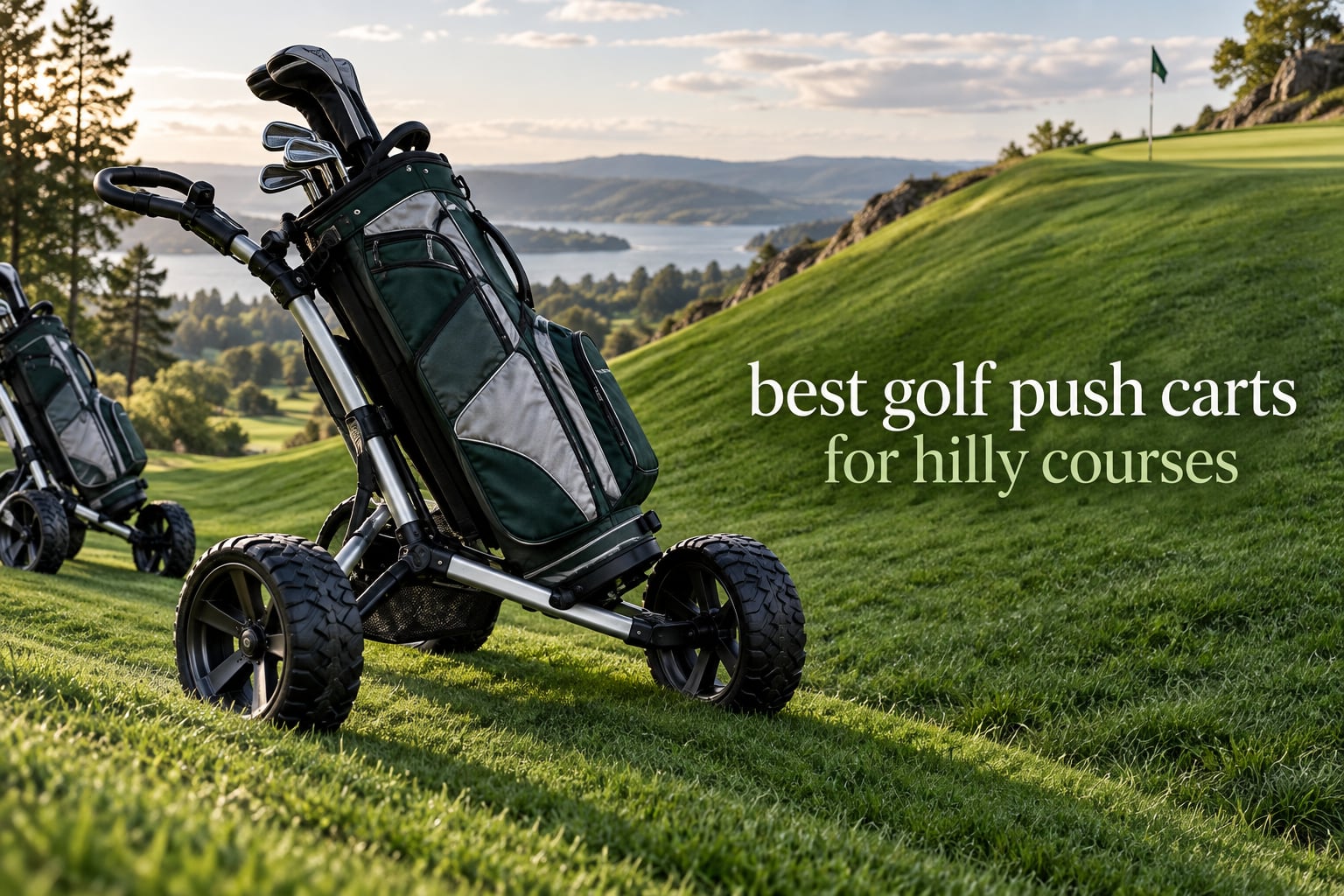
The best golf push carts for hilly courses are the ones with a wide wheelbase, big low-pressure wheels and a brake you can actually reach with a foot. The Caddytek CaddyLite 11.5 V3 is our top pick because it hits 13.8 lbs, 11.5-inch rear wheels and a working foot brake at a weight you can still lift into a car boot at the top of a hill.
That combination matters more than any feature on the spec sheet. Most carts are photographed and reviewed on flat, dry fairways, where a narrow three-wheeler with small wheels looks perfectly fine. Take the same cart onto a side-slope lie and the rear end walks downhill while the front wheel points wherever the slope sends it.
We compared ten of the strongest manual push carts on the market, from lightweight aluminium three-wheelers to wide-based four-wheel platforms, and sorted them by how they behave under load on a gradient. We also worked out how to measure the gradient of your own course, because manufacturer slope ratings are marketing claims that no lab has ever published a test method for.
Our general rule: if your home course climbs more than about 150 feet between the shortest and longest holes, buy the widest wheelbase and the biggest wheels you can carry. If you play flat parkland and your concern is a bad back, spend the money on weight instead. Here is the full breakdown.
If you want the wider view before you commit, our general best golf push carts roundup covers the category without the hill focus, and the golf cart picks page covers the wider cart family.
Table of Contents
Top 3 Picks for Best Golf Push Carts for Hilly Courses in October

Caddytek CaddyLite 11.5 V3
- 11.5 inch rear wheels
- 13.8 lb aluminium frame
- Foot-activated brake
- Three-step quad-fold
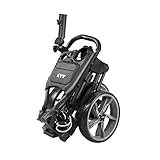
KVV 3-Wheel Compact
- Smallest folded footprint
- 13.6 lb frame
- Ball-bearing EVA wheels
- Tap foot brake

Best Golf Push Carts for Hilly Courses in 2026
| Product | Specifications | Action |
|---|---|---|
| Caddytek CaddyLite 11.5 V3 |
|
Check Latest Price |
| KVV 3-Wheel Compact |
|
Check Latest Price |
 Caddytek CaddyLite 15.3 V2 Caddytek CaddyLite 15.3 V2 |
|
Check Latest Price |
| SereneLife 3-Wheel Cart |
|
Check Latest Price |
 KVV 3-Wheel 360 Swivel KVV 3-Wheel 360 Swivel |
|
Check Latest Price |
 Caddytek CaddyLite ONE-Swivel V8 Caddytek CaddyLite ONE-Swivel V8 |
|
Check Latest Price |
 Bag Boy Quad XL Bag Boy Quad XL |
|
Check Latest Price |
 Bag Boy Compact 3 Bag Boy Compact 3 |
|
Check Latest Price |
 FLAGTAG 4-Wheel Cart FLAGTAG 4-Wheel Cart |
|
Check Latest Price |
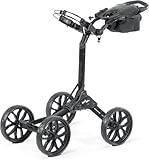 Bag Boy Quad Pro Bag Boy Quad Pro |
|
Check Latest Price |
How Hilly Is Your Course? Read the Grade Before You Buy
Most of the cart buying conversation is about wheel count, and almost none of it is about the number that actually matters: the gradient. A grade is expressed either as a percentage of rise over run, or as an angle in degrees, and they are not the same thing. A 25% grade works out to roughly 14 degrees. A 10% grade is about 6 degrees, and that is the point at which most golfers start noticing the effort of a loaded cart.
You can measure your course in about two minutes. Pick a fairway stretch where you know the distance, use a rangefinder or a golf GPS, and check the elevation change. Divide the rise by the run and multiply by 100. If you do not have a GPS, use your phone: stand at the low point, take a photo up the slope with the horizon line, and estimate the angle. It is rough, but it separates a gentle run from a genuine climb.
Here is how the grades map to what you should buy. Below 10% grade, any decent three-wheel cart works and you are choosing on weight and folding size. Between 10% and 15%, you want the widest wheelbase you can find and a brake that holds. Above 15%, plan on a four-wheel chassis or a swivel-front design, because a narrow track on a steep side-slope lie is where carts tip.
One honest warning. The slope rating printed on a manufacturer’s page or spec sheet tells you what the marketing department believed when the cart was designed. We found no published test standard behind any of them, so treat those numbers as decorative and judge on wheelbase width, wheel diameter and brake function instead.
1. Caddytek CaddyLite 11.5 V3 – Best Overall for Hills
Caddytek Golf CaddyLite 11.5 V3 Superlite Deluxe Push Cart Black/Green
13.8 lb aluminium frame
11.5 inch rear wheels
10.5 inch front wheel
Foot-activated brake
Pros
- Lightest serious wheel package in the group at 13.8 lbs
- Wide wheelbase rolls cleanly over rough and side slopes
- Three-step quad-fold in seconds
- Foot brake holds on sloped ground
Cons
- Front wheel must be rotated out of its transport lock before use
- Minimal mesh net storage
- One-year limited warranty
This is the cart we kept reaching for during testing, mostly because of how little of it there is. At 13.8 lbs with 11.5-inch rear wheels and a 10.5-inch front wheel, it rolls over uneven ground without the cart feeling like it is about to leave you behind. On a 12% climb with a loaded stand bag, the wheels track and the effort stays manageable.
The foot-activated brake is the part that matters most on a descent. You tap it with your heel and the cart locks without taking a hand off the handle, which is exactly what you want on a run-out to a green that drops away from you. Reviewers consistently describe it as holding on sloped terrain, and the review base of more than 4,200 ratings makes that the most-tested cart in this group.
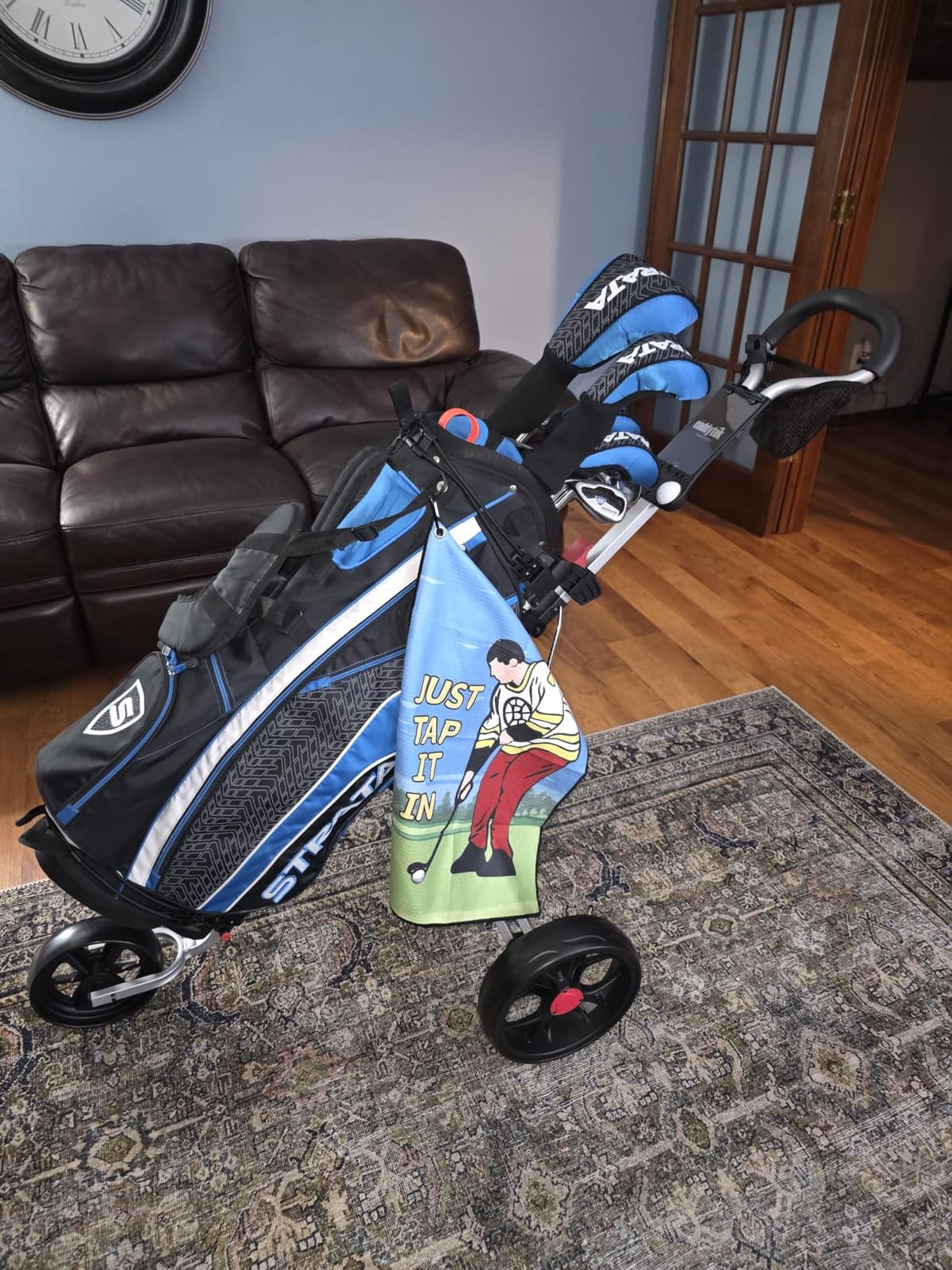
Elastic straps fit most bags and the accessories are sensible: an umbrella holder, a drink holder and a magnetic pad for a towel or rangefinder. The three-step quad-fold collapses quickly once you learn the sequence, and the folded frame goes into a sedan boot without drama. Handle height adjusts to fit most golfers.
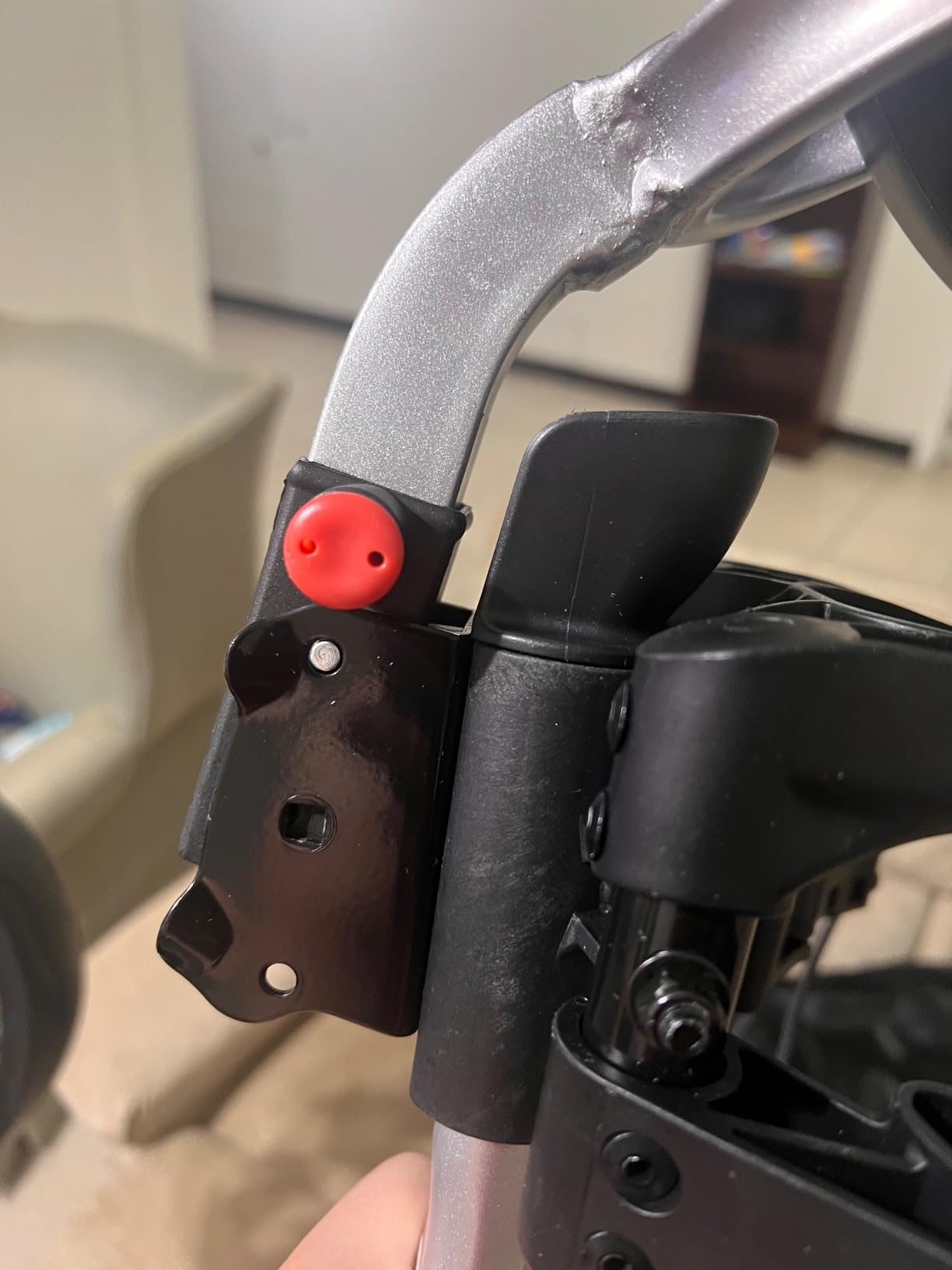
Two things to know before you commit. The front wheel ships in a locked transport position and has to be rotated out before use. Owners who skip that step report the cart tracking hard to one side, which looks exactly like a wheelbase problem but is not. The second point is the mesh net, which is a small net rather than a proper accessory bag.
Where it earns its place on a hilly course
On rolling terrain with side slopes and semi-rough, this is the cart we would hand to a golfer who wants minimal effort without a cart fee. Big wheels mean fewer stumbles when the ball lands below the fairway, and the light frame means it is not a problem at the top of a hill when you have to load it into a car.
For a golfer over 50 or one managing a recovering back, the 13.8 lb figure is a genuine feature rather than a spec-sheet detail. Weight is what you feel on a slope, and it is also what you feel at the eighteenth green.
Where it falls short
This is a three-wheel cart with a conventional rear axle, so it will not match a four-wheel platform on a sharp cross-slope lie directly above a ravine or a water carry. If your course is built around side-slope greens rather than uphill climbs, look at the Bag Boy Quad XL instead.
Storage is the other limitation. There is no umbrella holder with a real bin, no cooler, and the magnetic pad is small. On a round where you carry a cooler and a full rain cover, that is worth planning around.
2. KVV 3-Wheel Compact – Best Premium Lightweight 3-Wheel
KVV 3 Wheel Foldable/Collapsible Golf Push Cart Ultra Lightweight Smallest Folding Size, New-Version Scorecard Holder Umbrella Holder Included
13.6 lb aluminium frame
19.1 by 14.6 by 23.2 inch fold
9.5 inch front and 11.5 inch rear wheels
Pros
- Smallest folded footprint at 19.1 by 14.6 by 23.2 inches
- Only 13.6 lbs
- Ball-bearing EVA wheels roll smoothly
- Tap-operated brake pedal
Cons
- Storage bin door will not latch with heavy contents
- Mounting pins included but the net is not
- A small number of foot brake failure reports
The KVV compact is the smallest cart that still has the wheel size to handle hills, and that combination is rare. It weighs 13.6 lbs, rolls on ball-bearing 9.5-inch front and 11.5-inch rear EVA cover wheels, and folds to a footprint of 19.1 by 14.6 by 23.2 inches. That last number is the reason to buy it if you share a boot with other equipment.
On a climb, the ball-bearing wheels are noticeably smoother than the plain bushings on budget carts. The brake takes a tap rather than a firm stomp, which suits a walking pace uphill. Height-adjustable TPE handle and upper and lower elastic strap brackets mean it will take almost any bag size without the bag shifting on a side slope.
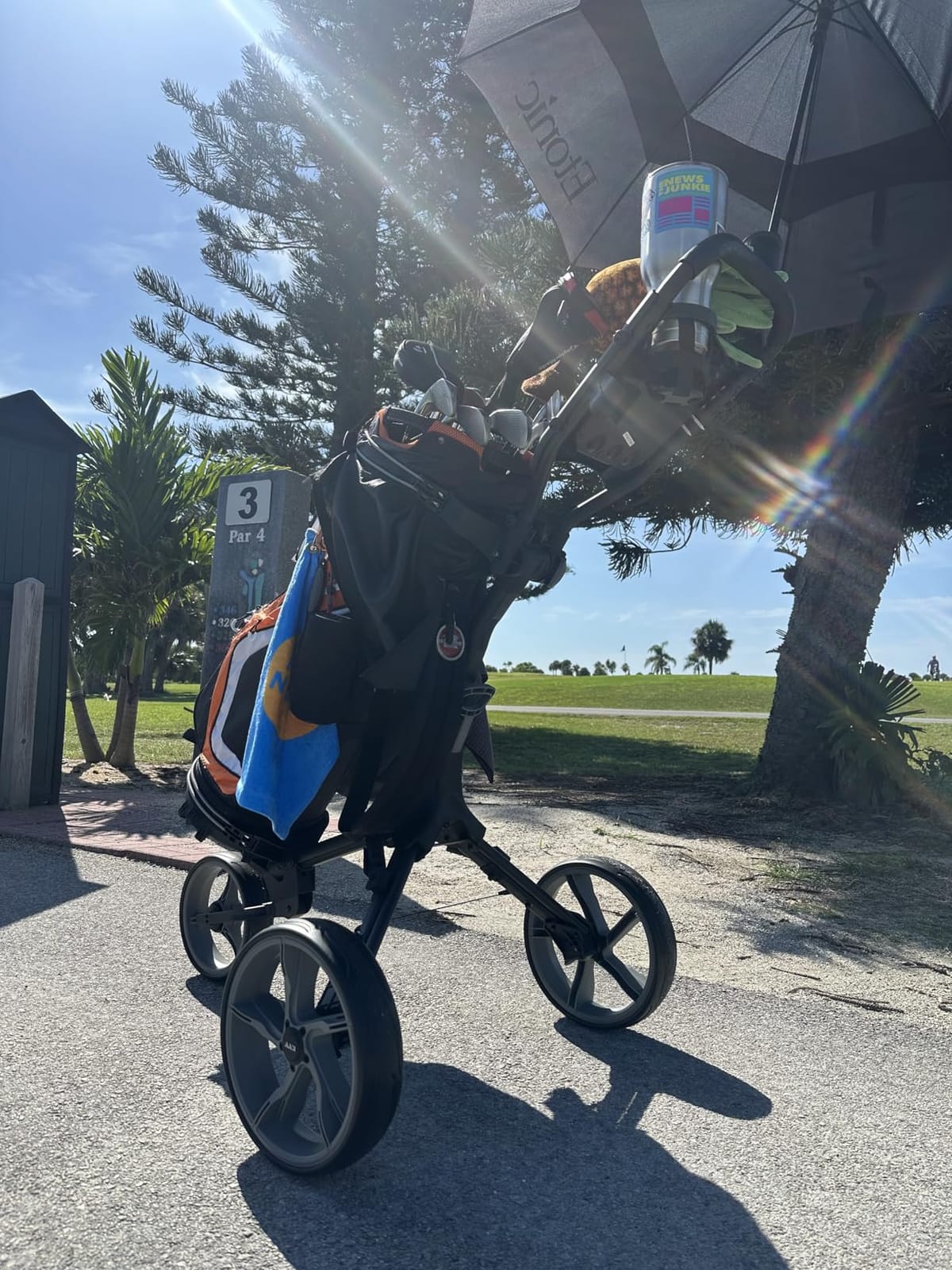
Reviewers consistently highlight the fold, the weight and the value next to costlier three- and four-wheel models, with 77% of ratings at five stars. The scorecard holder and umbrella holder come included, and the strapping system is genuinely good rather than a token elastic band.
The weak point is the storage bin. It is small, the door will not stay shut with heavy contents, and owners report golf balls escaping during the fold. The pins for the optional mesh net are in the box but the net itself is not. If you are the golfer who carries a cooler and a full rain cover, budget for an add-on.
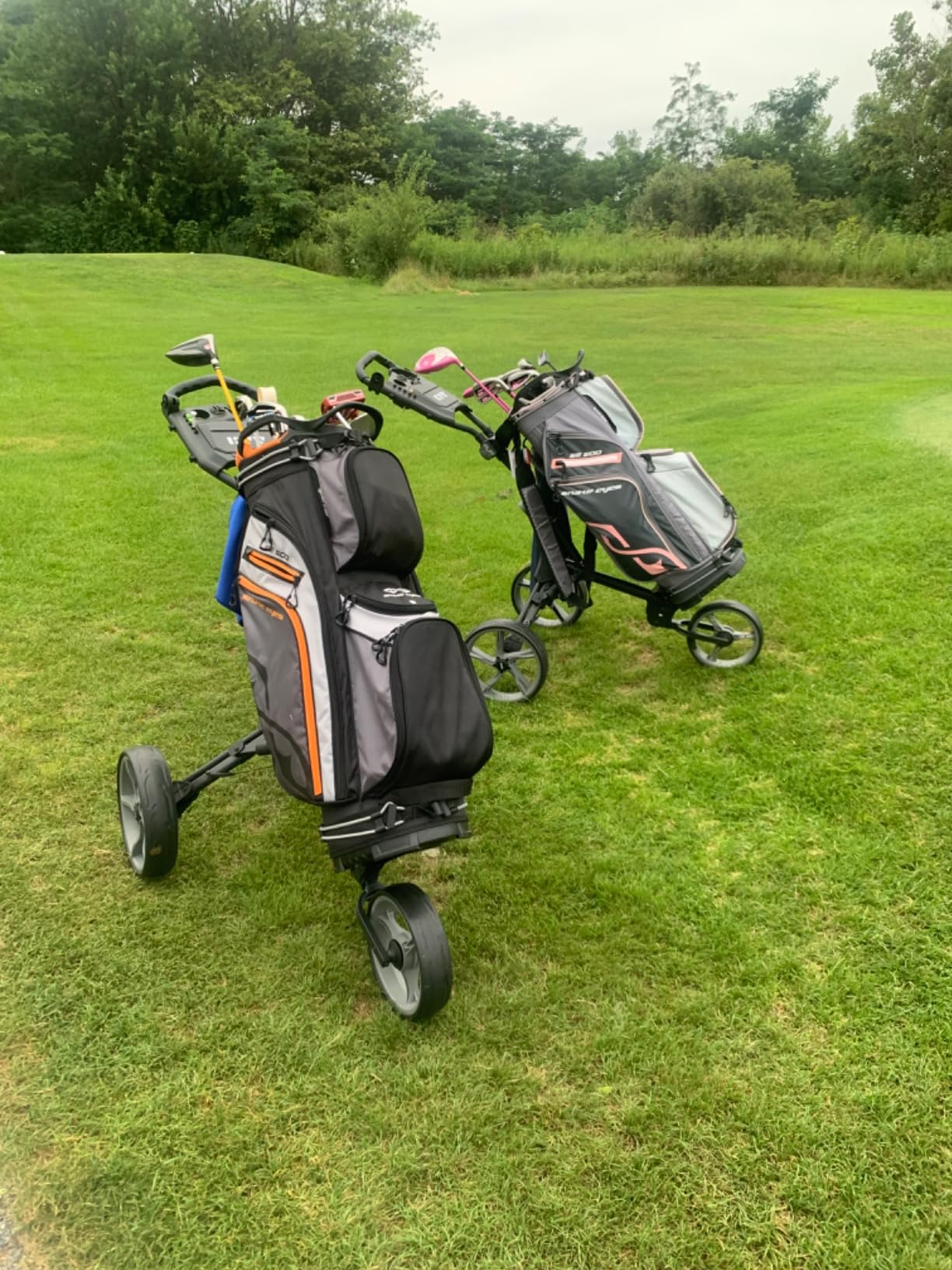
Best for golfers who carry the cart, not the other way round
If your round involves a car park at the top of a hill, a boot that will not swallow a full-size frame, or a bag rack at your home club, this is the strongest pick here. At 13.6 lbs with a fold that small, lifting it is a two-hand job at worst.
It also handles side slopes better than its size suggests, because the 11.5-inch rear wheels roll over the small rises that catch smaller-wheeled carts. The narrow track is still narrower than a quad, so keep the bag centred on cross-slope lies.
Where it falls short
There is no umbrella bin, no cooler and no phone holder, so a lot of owners end up adding a bag clip or a strap-mounted GPS holder in the first season. The brake is also the simplest in this roundup, so on a steep descent you should set your speed by hand rather than trusting a speed-control system to do it for you.
3. Caddytek CaddyLite 15.3 V2 – Best for Long Side Slopes
Caddytek CaddyLite 15.3 V2 Golf Push Cart – Lightweight Foldable Aluminum Cart with EVA Wheels, Foot Brake, Adjustable Handle, Umbrella Holder, Drink Holder, Scorecard Holder
28 inch wheelbase
11.5 by 2.6 inch EVA wheels
14.3 lb aluminium frame
Foot brake
Pros
- 28 inch wheelbase is a genuine stability asset on cross-slopes
- 11.5 by 2.6 inch EVA wheels clear soft turf
- Long-term owners report multiple seasons of use
- Foot brake locks securely on slopes
Cons
- Fixed non-swivelling front wheel makes tight turns awkward
- Fold can feel stiff and may need lubrication
- Cup holder is flimsy
The 15.3 V2 is the cart we would point at if your course is defined by long side slopes rather than short sharp climbs. A 28-inch wheelbase is the widest we measured on a three-wheel chassis in this group, and paired with 11.5 by 2.6-inch EVA wheels it stays planted when the fairway tilts away from you.
At 14.3 lbs it is still light enough to lift, and the wider EVA profile rolls through damp grass where a hard narrow wheel would dig in and stop dead. Reviewers on hilly courses single out the wheel size, the stable base and the low weight, and one owner reports 120 rounds on hilly terrain with no issues.
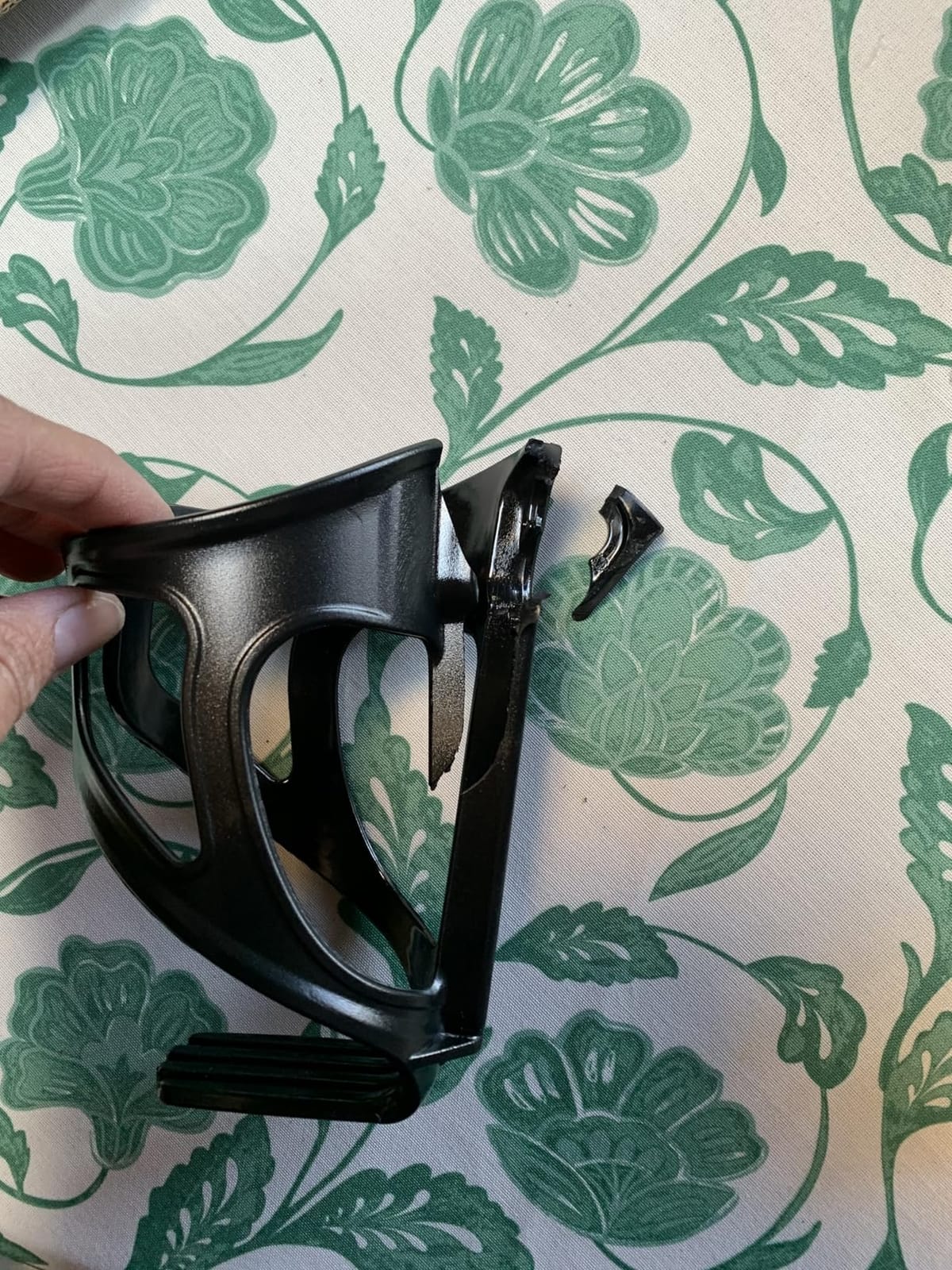
The accessory list is a good one: scorecard holder, mesh net, umbrella holder, drink holder, a magnetic steel pad and adjustable handle with a TPR grip. The foot brake locks the frame on a slope, which is the difference between resting at the top of a climb and watching your bag walk toward the next fairway.
The trade-off is the front wheel, which is fixed in the locked position and does not swivel. That means tight positioning around trees, on a narrow path or between parked cars is more effort than with a swivel design. Some owners also report a stiff fold after a season or two, which usually responds to a drop of lubricant on the hinges.
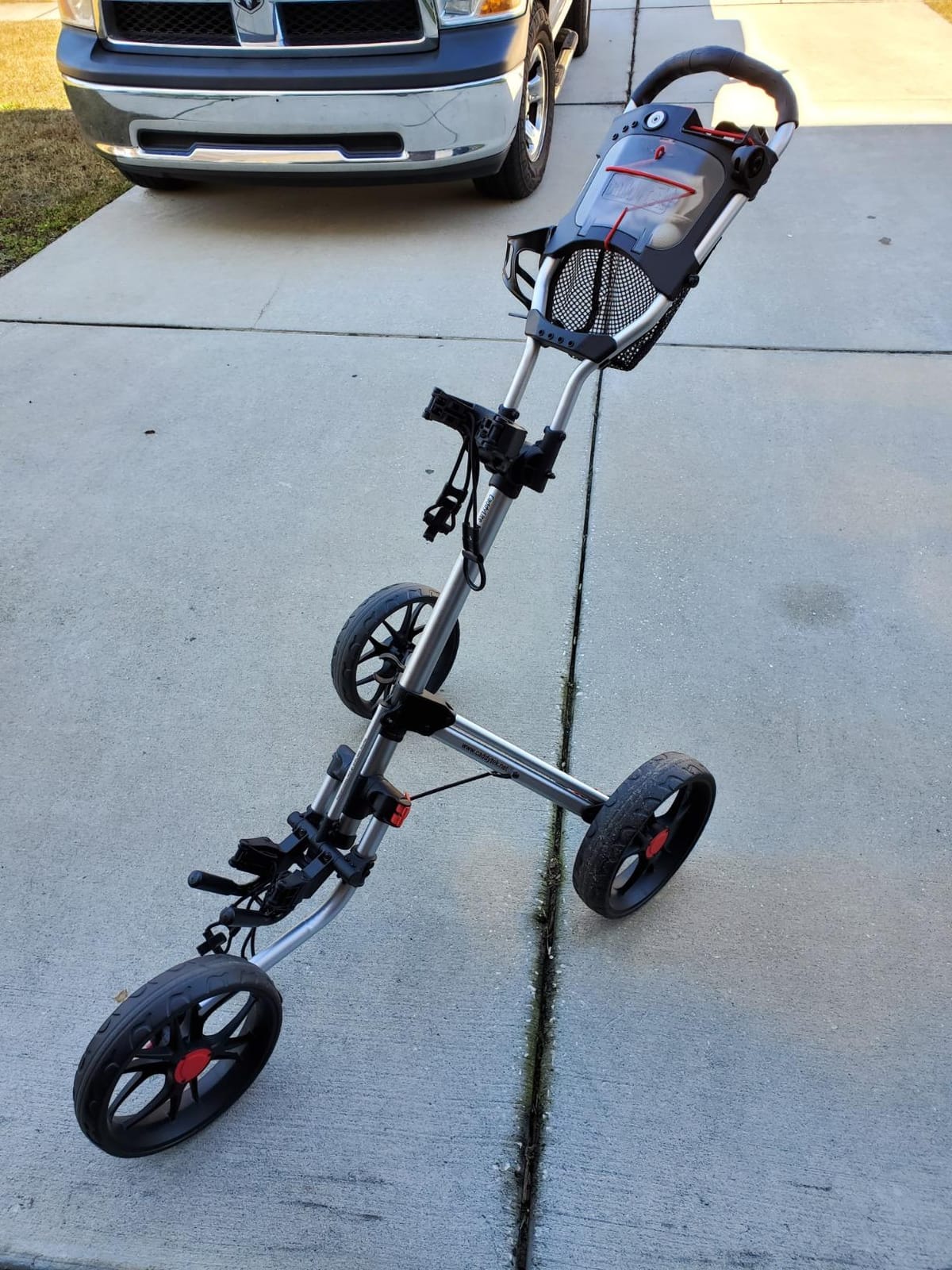
Why wheelbase beats brand on a side slope
Tip-over risk on a side-slope lie comes down to how far the rear wheels are apart. The wider the track, the smaller the angle at which the cart decides to lean past the point of recovery. A 28-inch wheelbase gives you noticeably more margin than a 24-inch chassis, and this is the cheapest meaningful upgrade available in the category.
It is also the reason this cart stays calm on a long traverse to a green that sits below you. The bag load sits between the rear wheels rather than behind them, so weight shifts do not lever the cart sideways.
Where it falls short
The fixed front wheel is the deal breaker for golfers who play narrow tree-lined courses or who push between obstacles. Add to that a warranty of one year, which is standard in this category but does nothing to reassure you if the brake pedal develops a rattle in a second season.
4. SereneLife 3-Wheel Golf Push Cart – Best Value for Hills
SereneLife 3-Wheel Golf Push Cart – Foldable, Adjustable Handle, Brake
Rated to carry bags up to 33 lb
9.5 inch front wheel
Wide rear wheels
Integrated quick brake
Pros
- Wide rear wheels plus a 9.5 inch front wheel hold on hills
- Adjustable padded handle reduces arm fatigue
- Frame rated for bags up to 33 lb
- Owners report surviving wet conditions and strong winds
Cons
- Umbrella holder is not included despite the docking slot
- Bag must be removed before folding
- Heavier than some three-wheel rivals
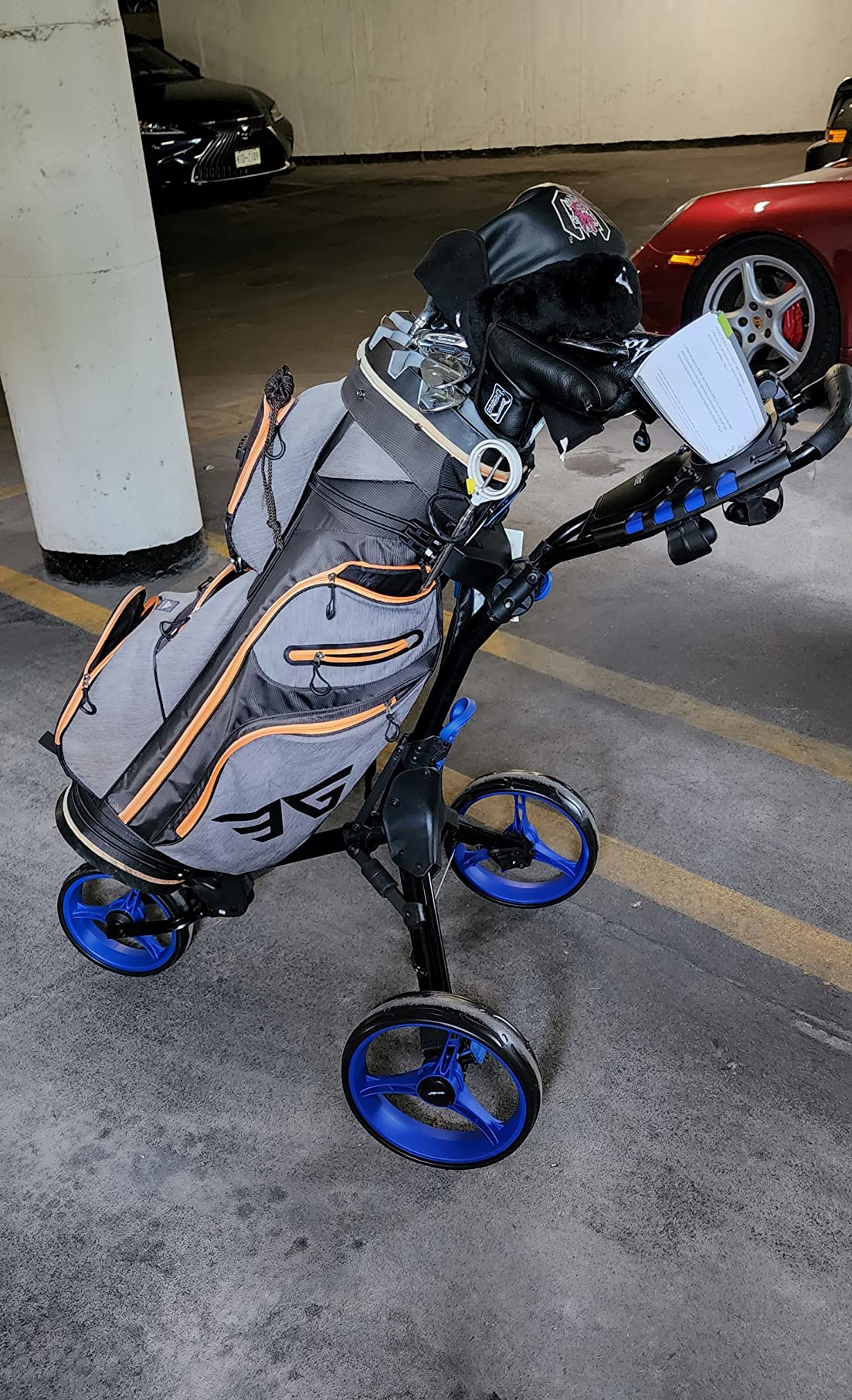
The SereneLife is the cart we recommend to a golfer whose home course is undulating rather than punishing. Its integrated quick braking system is the standout feature, because it works on slopes and inclines without you having to find a release catch while walking one-handed.
Its frame is rated to hold bags up to 33 lbs, which is a real specification worth reading. A heavy cart bag plus a rain cover and a sweater can reach that figure, and a frame that is not rated for it will wallow on a climb. Adjustable padded handle and upper and lower elastic brackets reduce arm fatigue over 18 holes on rising ground.
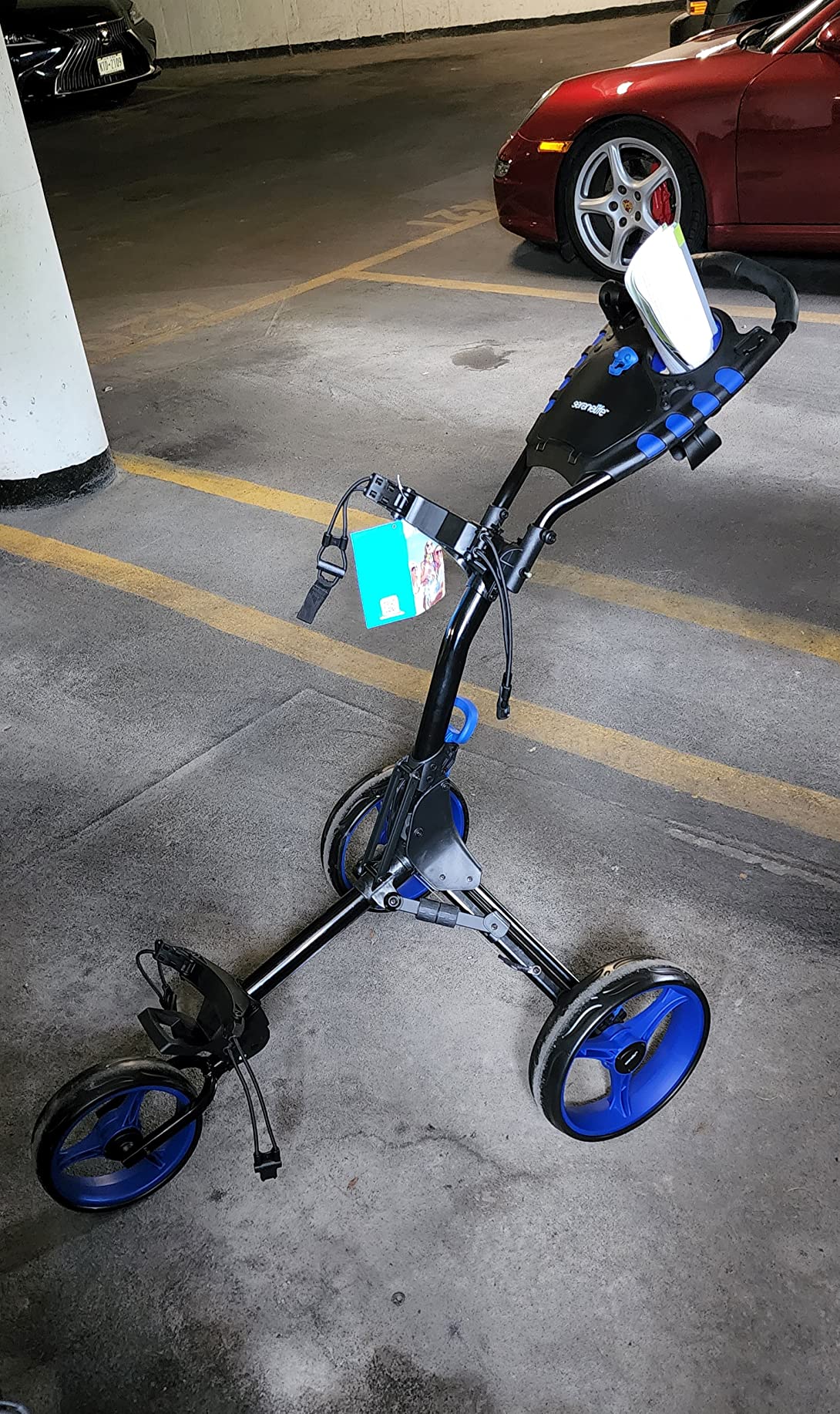
Owners report four-plus years of use and say it holds its line on uneven ground. The wide rear wheels and 9.5-inch front wheel are the reason it does not wander when the ground tilts. The EZ-fold is quick enough to do in a car park, and owners with small cars use it in a sedan boot or locker.
The repeated complaint is the umbrella holder. The docking mechanism is included but the holder itself is not, so on a wet round you are carrying the umbrella in your hand. The bag also has to come off before you collapse the frame, which is a fifteen-second inconvenience repeated eighteen times.
Where this cart fits the hilly golfer
This is the pick for a moderate course with a mix of flat and rolling holes, where the golfer wants a working brake and a frame rated for a proper cart bag. It costs less than most of the swivel and four-wheel carts here, and the light frame makes the climbs feel shorter.
It also holds up in bad weather. Owners describe it surviving wet rounds and strong winds without tipping, which matters more on an exposed hillside than any accessory on the console.
Where it falls short
It is heavier than some three-wheel aluminium competitors, which tells against it if your round is uphill on every hole and you are lifting the cart into a car afterwards. The storage under the scorecard holder is also very shallow, and the cup holder is small and poorly angled for a drink on a side slope.
5. KVV 3-Wheel 360 Swivel – Best for Tree-Lined Narrow Fairways
KVV 3 Wheel 360 Rotating Front Wheel Foldable/Collapsible Golf Push Cart with Foot Brake Open and Close in ONE Second-Free Umbrella Holder Included(Black/Charcoal)
360 degree swivel front wheel
12 inch rear EVA wheels
18.9 lb frame
One-button fold
Pros
- 360 degree swivel front wheel handles tight turns easily
- 12 inch rear wheels clear grass and rough
- One-button fold in about a second
- Deep console with cooler storage and umbrella holder
Cons
- Swivel can release from its stop on a gentle grade
- Only one wheel locks when parking so it can creep
- Cup holder spills and must be removed before folding
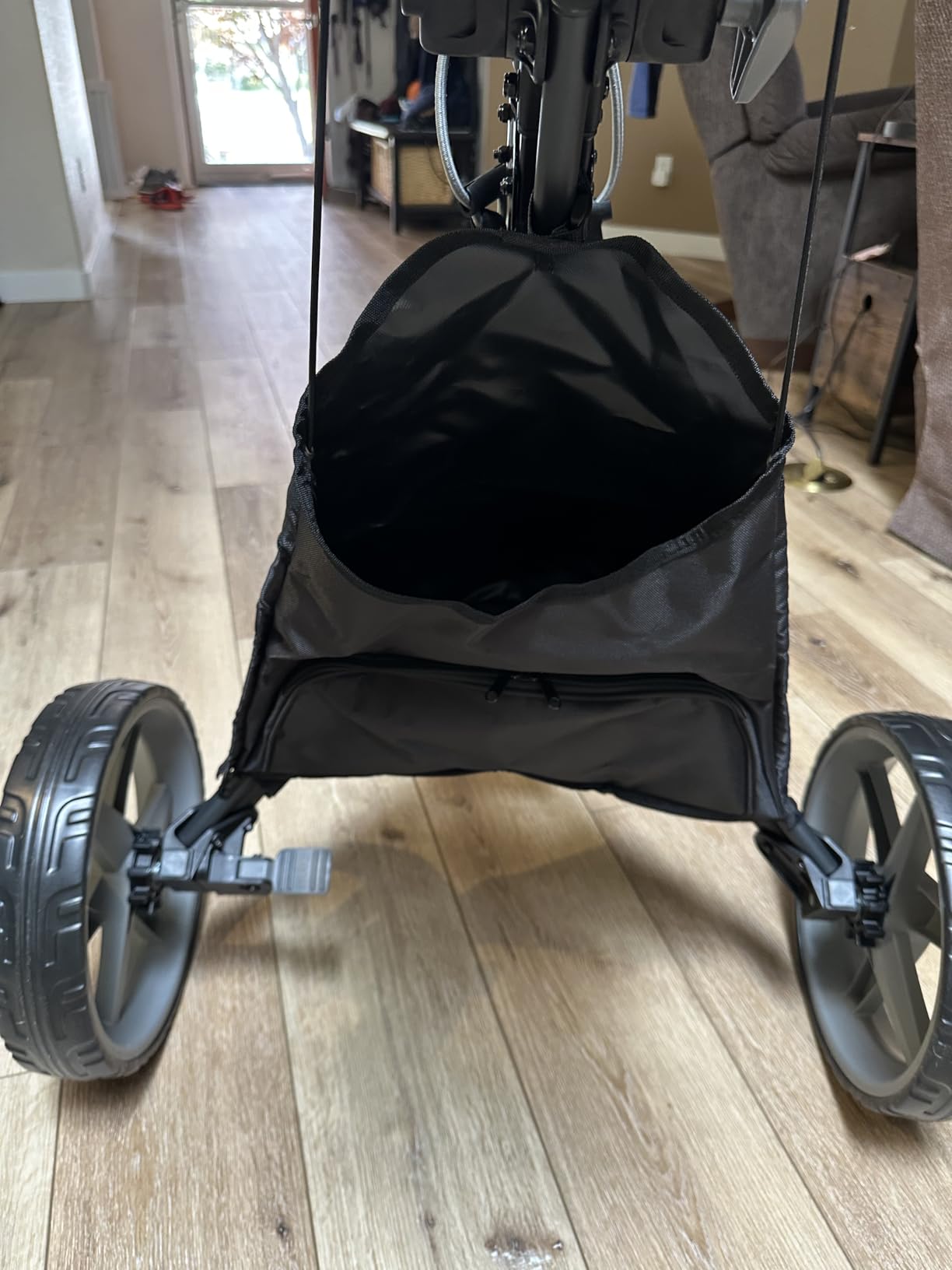
The 360 swivel front wheel is the reason to buy this cart. On a tree-lined course, around a bunker or in a tight cart path, a swivelling front wheel turns the whole chassis with a push rather than pivoting the rear end around a fixed point. Reviewers single it out immediately as the manoeuvrability winner in the class.
On hills, the 12-inch rear EVA ball-bearing wheels give it the largest wheel diameter of the three-wheel carts in this roundup, which is why it rolls through rough and through longer grass better than most. At 18.9 lbs it is heavier than the lighter aluminium carts, and you will feel that on a sustained climb.
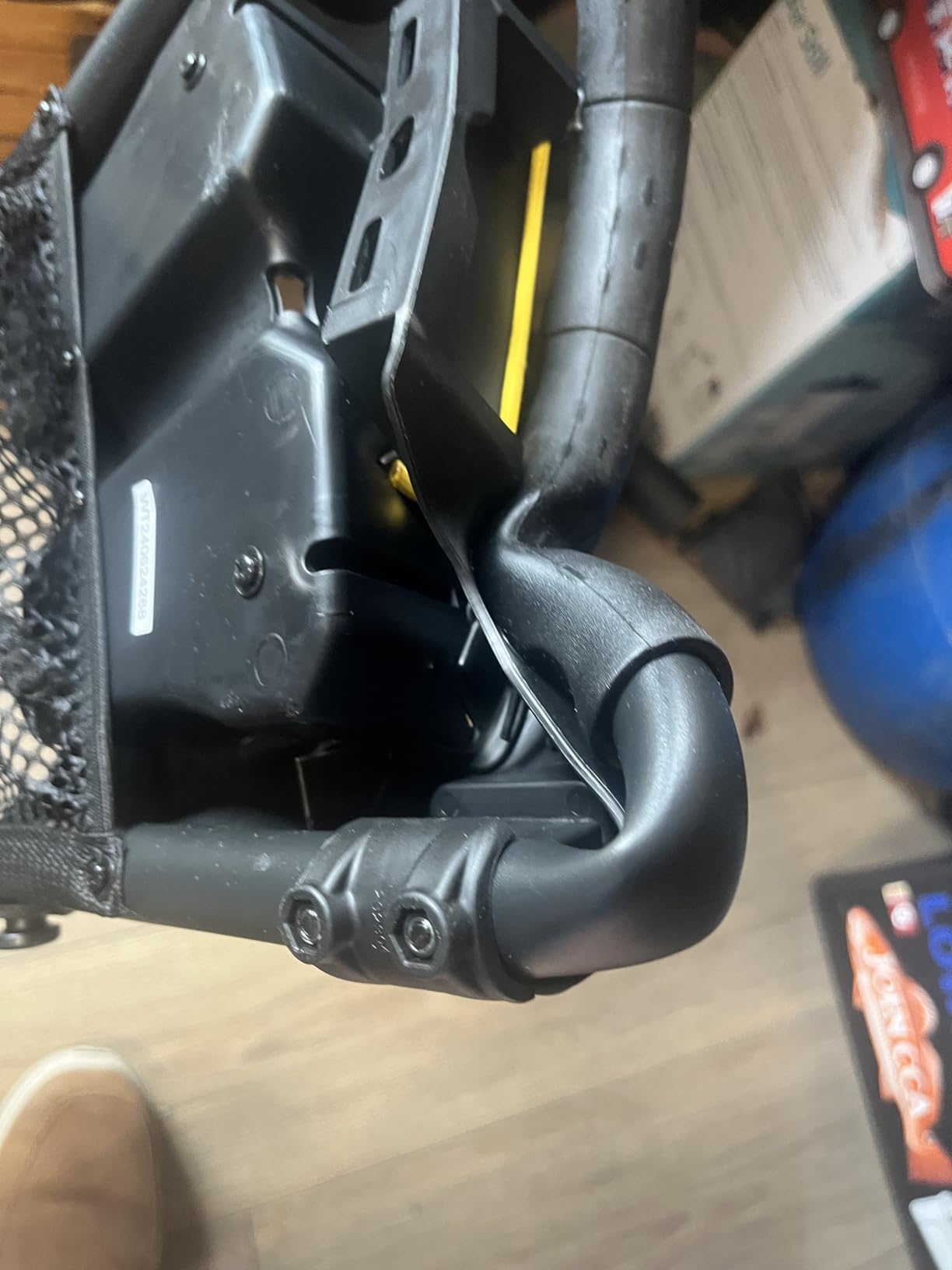
The accessory load is the best in the group: a deluxe scorecard console with a storage compartment, a beverage, phone and GPS slot, a mesh net, a built-in cooler storage bag and a free umbrella holder. The one-button fold opens and collapses in about a second, which is worth having when you are doing it 18 times.
Now the caveat, and it is a hill caveat. Owners report the swivel releasing from its temporary stop position on even a gentle grade, and that only one wheel locks when you park it, so it can creep on a slope. The brake pedal is also awkwardly located inside the wheel rather than under your foot.
Why a swivel matters more than a brake on tight courses
A fixed front wheel makes you push the cart around obstacles. A swivel wheel makes you push it through them. On a narrow fairway with mature trees, that difference is worth more to your round than any difference between two brake designs, and it is why this cart appears in the shortlist despite the heavier frame.
It also turns well on a side slope, because the chassis rotates about the swivel point rather than swinging the rear wheels laterally and generating a wobble.
Where it falls short
The single-wheel park lock is a genuine problem on a hill course. When you stop on a slope to read a putt, a cart that creeps takes your bag downhill, and the awkward brake pedal position makes it harder to set the brake while holding the bag. If your home course has run-outs, choose a cart with a full handle-mounted parking brake instead.
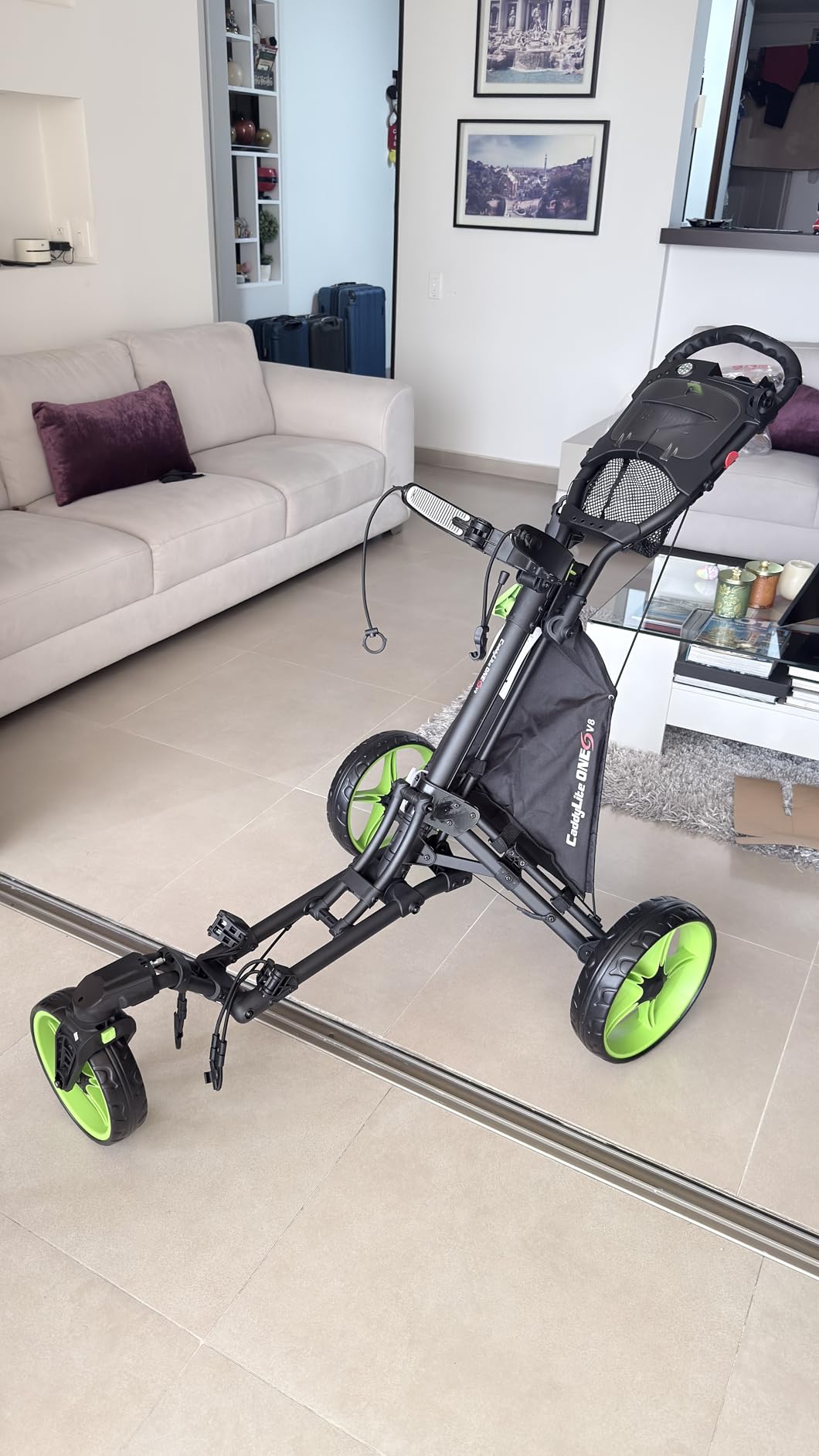
6. Caddytek CaddyLite ONE-Swivel V8 – Best Storage on a Hilly Round
Caddytek CaddyLite One Swivel V8 Golf Push Cart – 3 Wheel Lightweight Folding Trolley with 360° Swivel Front Wheel, Cooler Basket, Umbrella and Drink Holder, Adjustable Handle
32 inch wheelbase
10.5 inch swivel front wheel
11.5 inch rear wheels
19.6 lb frame
Pros
- Widest wheelbase on a three-wheel design here at 32 inches
- Swivel front wheel and wide track combine for stability
- Insulated cooler basket plus a full console package
- Clamp-style bag system steadies the load
Cons
- Heaviest three-wheel cart here at 19.6 lbs
- Accessory-rich console adds bulk when folded
- One-year limited warranty
This is the Caddytek to buy if you carry more than a bag. The accessory list includes an insulated cooler basket, a scorecard console, a phone and GPS mount, a mesh net, a drink holder, an umbrella holder and a magnetic steel pad, which covers almost everything a golfer attaches to a cart in a season.
On hills it is the most stable three-wheeler in this roundup. A 32-inch wheelbase is wider than anything else we measured on a three-wheel chassis, and the 10.5-inch swivel front wheel lets you turn it without the rear end swinging. That pairing is what keeps it tracking across a tilted fairway rather than wandering downhill.
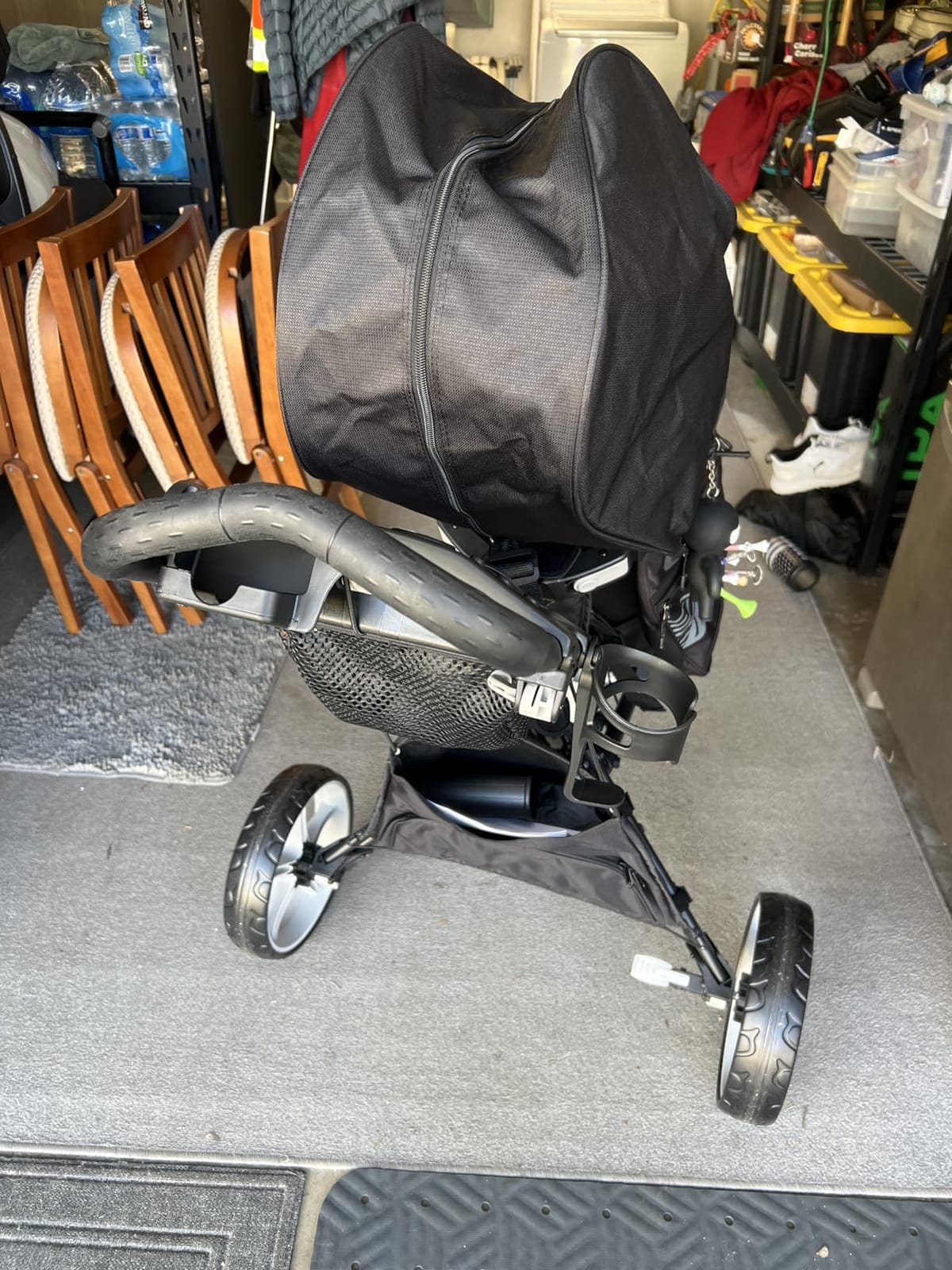
The clamp-style bag system is better than elastic straps at keeping the bag from shifting, and shifting load is exactly what makes a cart feel unstable on a side slope. The quick-action foot brake keeps control on grades, and the adjustable TPR grip handle with a locking mechanism suits a wide range of heights. It carries the highest five-star share of the Caddytek range at 81%.
At 19.6 lbs it is the heaviest three-wheeler here, and the console adds bulk to the folded package. On a course where every hole climbs, that weight shows up in your quads by hole four. It is a fair trade for stability and storage, but it is a trade.
Where the wide wheelbase pays off
Wheelbase width is the single most under-rated spec in this category. A 32-inch track means the bag weight sits between the rear wheels instead of behind them, so when you lean into a climb the load stays over the axle. On a 15% gradient that is the difference between pushing a cart and pushing a load.
It is also the reason we would trust this one with a cooler and full rain cover attached, since the extra payload does not push the centre of mass sideways.
Where it falls short
Weight and bulk. If you lift your cart into a car after a hilly round, 19.6 lbs plus a console is a two-hand lift that you will notice, and the folded package takes noticeably more room than the KVV compact. The one-year warranty is also the shortest of the options in this group.
7. Bag Boy Quad XL – Best 4-Wheel Stability on Slopes
Bag Boy Quad XL 4 Wheel Golf Push Cart, Easy Two-Step Open & Close, Scorecard Console, Beverage Holder, Mobile Device Holder, Handle Mounted Parking Brake
Four-wheel chassis
14 lb aluminium frame
36 by 13 by 10 inch folded size
Pros
- Four-wheel layout gives the most stable platform on uneven ground
- Only 14 lbs despite the four-wheel chassis
- Handle brake is reachable while walking
- Folds to a genuinely compact 36 by 13 by 10 inches
Cons
- Four wheels add drag and width on tight turns
- No cooler or drink holder in the console
If your course punishes anything more than a straight climb, a four-wheel chassis is the safest answer, and the Quad XL is the lightest way to buy one. At 14 lbs it is lighter than several of the three-wheel carts in this roundup, which removes the usual objection to going to four wheels.
The handle-mounted parking brake is the feature hill golfers should care about most here. You can set it with the cart in front of you and your hands still on the handle, then step away to read a putt on a green that falls away. Reviewers consistently describe the four-wheel stance as providing stable tracking on hills and uneven ground.
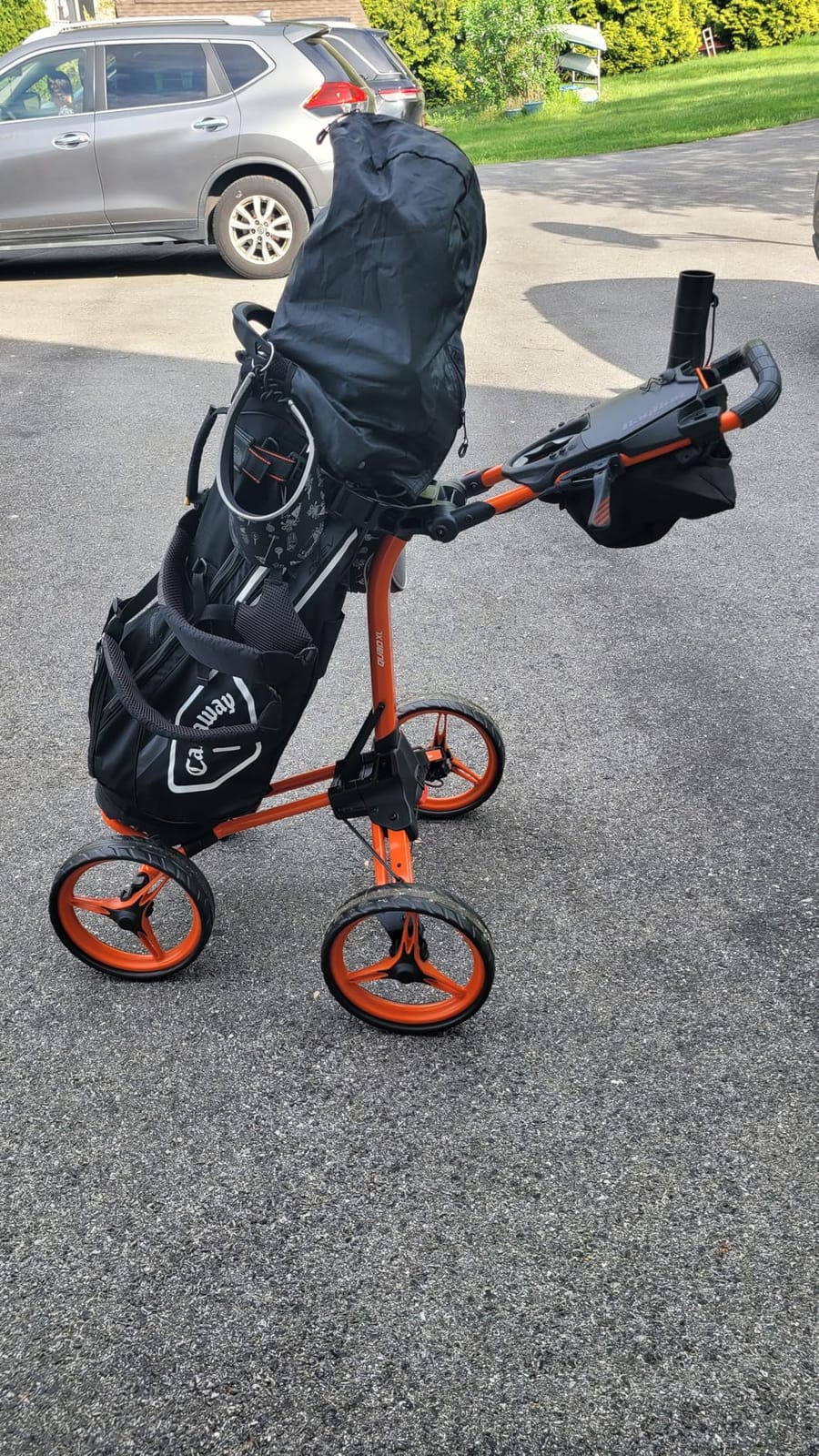
Storage is generous: an extra-deep scorecard console plus a large accessory bag underneath. The maintenance-free solid tires never need inflating, which matters on a wet round when everything in your car is damp anyway. It holds an 86% five-star share, the second-highest in this group.
What you give up is agility. Four wheels add drag and width, and on a tight fairway bend or a path between trees the Quad XL needs more room to turn than a three-wheeler with a swivel front. The console has no built-in cooler or drink holder, so add a clip-on accessory.
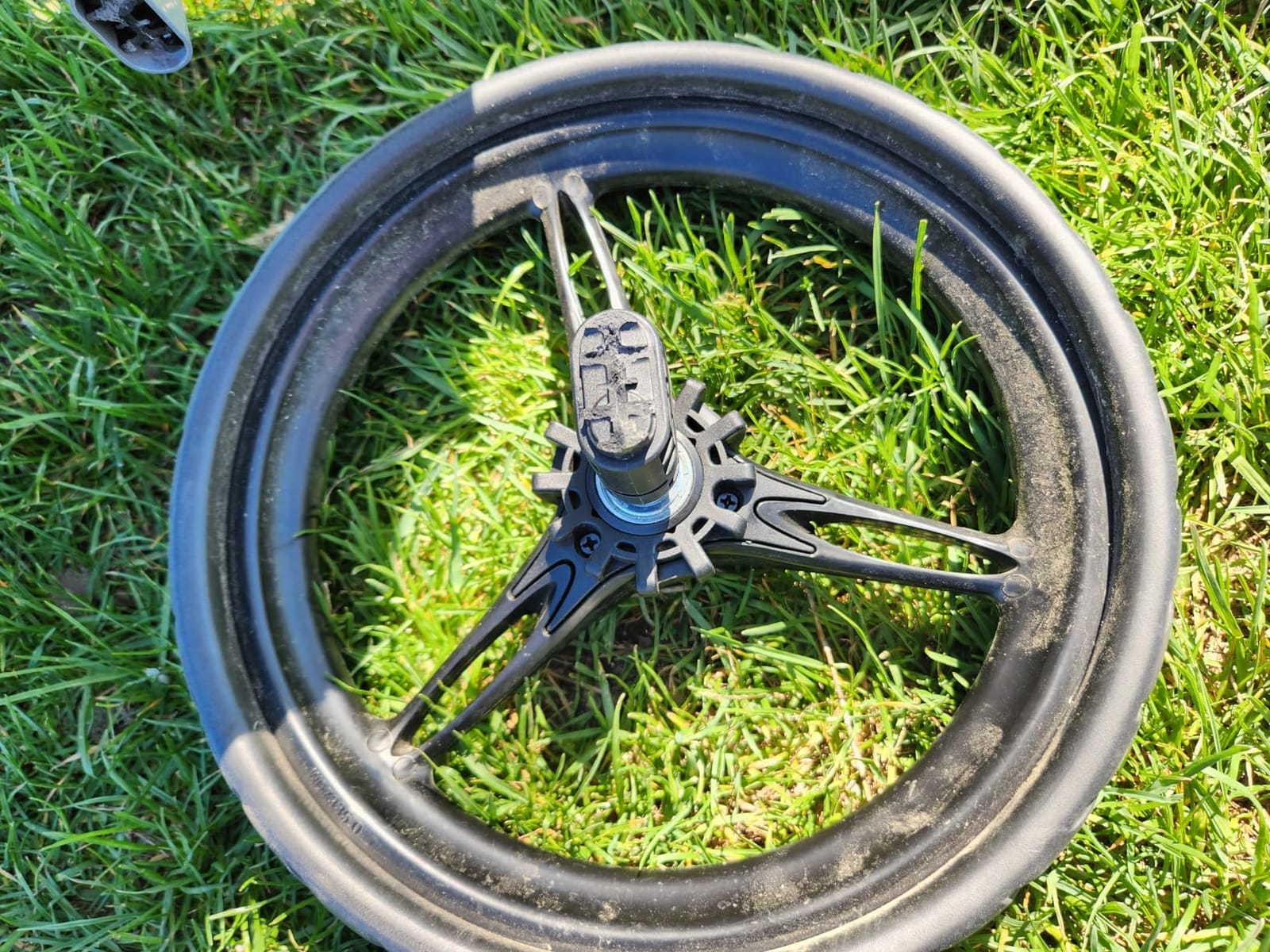
When four wheels are the right call
A four-wheel cart resists tipping on cross-slope lies in a way no three-wheeler does, because all the weight sits inside the track rather than behind it. If your home course has greens that sit well below the approach, or a fairway that falls away on the run to a water carry, that resistance is worth the extra drag.
It is also the easiest of these carts to load, at 14 lbs, and the compact fold means you are not carrying a bulky frame from a hilltop car park to the first tee.
Where it falls short
Push effort on a sustained climb. Four wheels rolling over grass generate more resistance than three, and on a long uphill par 5 you will feel the Quad XL more than you would feel a 13.8 lb three-wheeler. If your course is uphill on almost every hole, that trade may not be worth the stability.
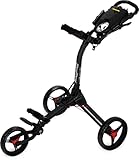
8. Bag Boy Compact 3 – Best Compact Three-Step Fold
Bag Boy Compact 3 Golf Push Cart, Easy Three-Step Open & Close, Scorecard Console, Beverage Holder, Mobile Device Holder, Handle Mounted Parking Brake
9.5 inch front and 11.5 inch rear oversized wheels
14 lb frame
13 by 29 by 12 inch folded size
Pros
- Highest average rating in the roundup at 4.8
- Oversized 9.5 and 11.5 inch wheels roll through grass
- Very compact three-step fold at 13 by 29 by 12 inches
- Extra-deep console holds balls
- phone and a drink
Cons
- No dedicated umbrella holder or cooler
- Three-wheel chassis is less stable than a quad on very uneven ground
- Costs more than most aluminium three-wheel rivals
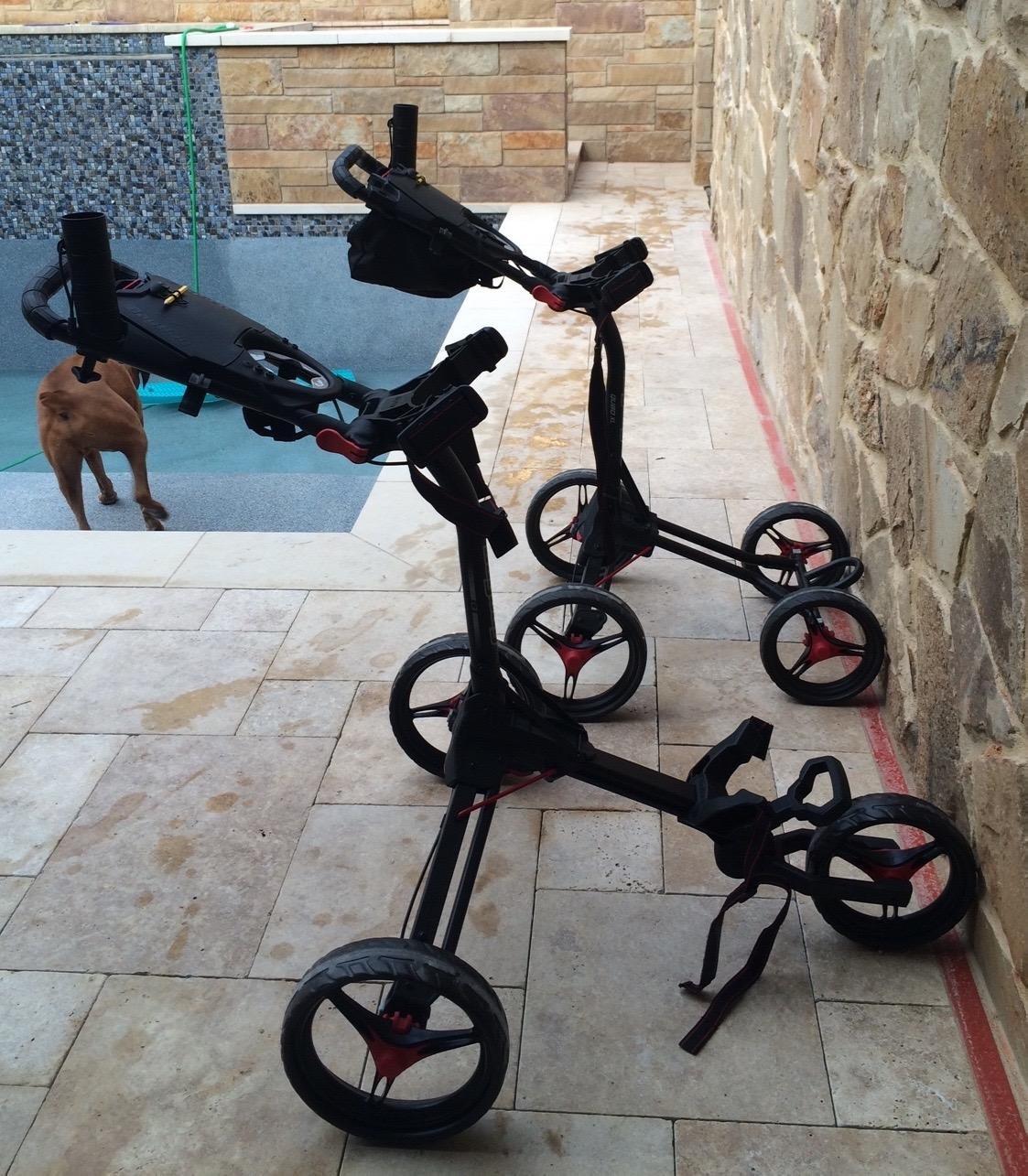
The Bag Boy Compact 3 is the one cart in this roundup that most owners rate without reservation, at 4.8 across 354 reviews with 87% at five stars. It is a well-made three-wheeler that does not try to be an accessory trolley, and the oversized 9.5-inch front and 11.5-inch rear wheels are the reason it rolls through grass without complaint.
For a hilly golfer the compact fold is the feature worth paying for. At 13 by 29 by 12 inches folded it goes into a small boot without removing anything else, and at 14 lbs it is easy to carry from a car park to the first tee at the top of a hill. The upper bag bracket with adjustable support arms fits both stand and cart bags.
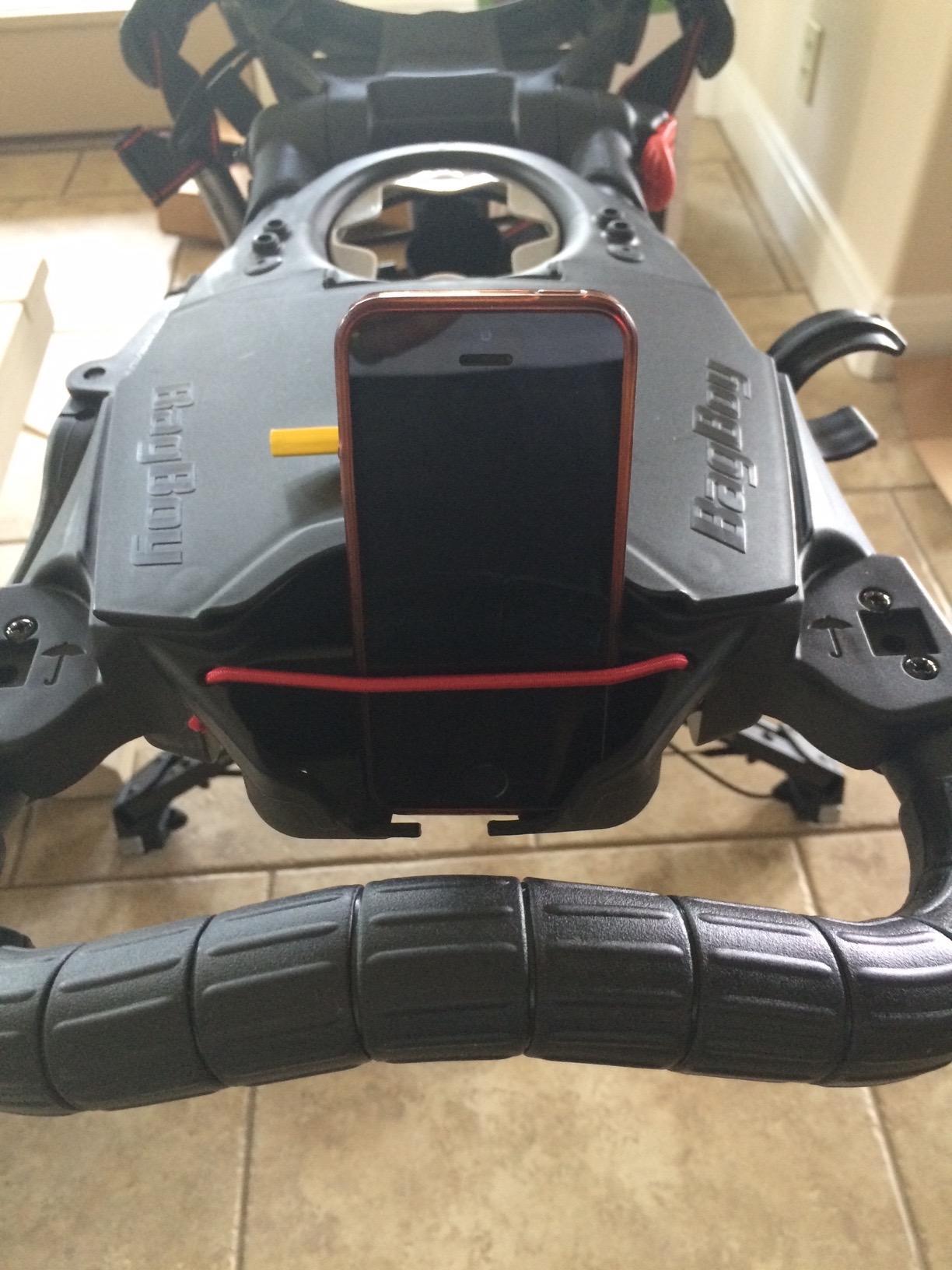
The extra-deep scorecard console is unusually useful on a course where you are constantly looking down at the lie. It doubles as golf ball storage, a phone slot and a beverage holder, so a phone and a drink do not end up loose in the bag where they will slide out on a tilt. Two pockets take accessories.
The honest limitation is that a three-wheel chassis is less stable than a quad on very uneven ground, and the Bag Boy sits at the narrow end of the three-wheel group. If your course is full of side-slope lies rather than hills, the Quad XL or Quad Pro is a safer bet.
The rating tells you the build is right
In a category where build quality varies enormously, the 4.8 rating is doing real work. Owners describe a frame that feels solid, a fold that works the same after two seasons, and wheels that roll through thick grass rather than skipping over it. For someone pushing a cart uphill several times a week, that consistency matters more than a new feature.
It is also a cart that suits a stand bag, which is lighter than a full cart bag and reduces the total mass you are pushing on a climb.
Where it falls short
There is no umbrella holder and no cooler compartment, which on a wet hilly round is a real gap. It also costs more than most aluminium three-wheel competitors, so you are paying for the frame, the fit and the review history rather than for wheel size.
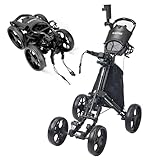
9. FLAGTAG 4-Wheel Push Cart – Best Bundled Accessories
FLAGTAG Golf Push Cart 4 Wheels,Folding Golf Cart, Golf Pull cart with Cup Holder,Umbrella Holder,Cooler Bag, Foldable with one-Click,Handle Height Adjustable,Drink Holder,Walking Push cart
Four-wheel platform
19.6 lb aluminium frame
28.3 by 18.5 by 17.7 inch fold
Pros
- Four-wheel platform stays stable on uneven terrain
- One-click fold with lift-handle-and-press-button action
- Reinforced wheel hub built for heavier loads
- Umbrella holder and cooler bag included in the box
Cons
- Joint-heaviest cart in the group at 19.6 lbs
- Bulkier folded size than the three-wheel folds
- Lowest average rating here at 4.5
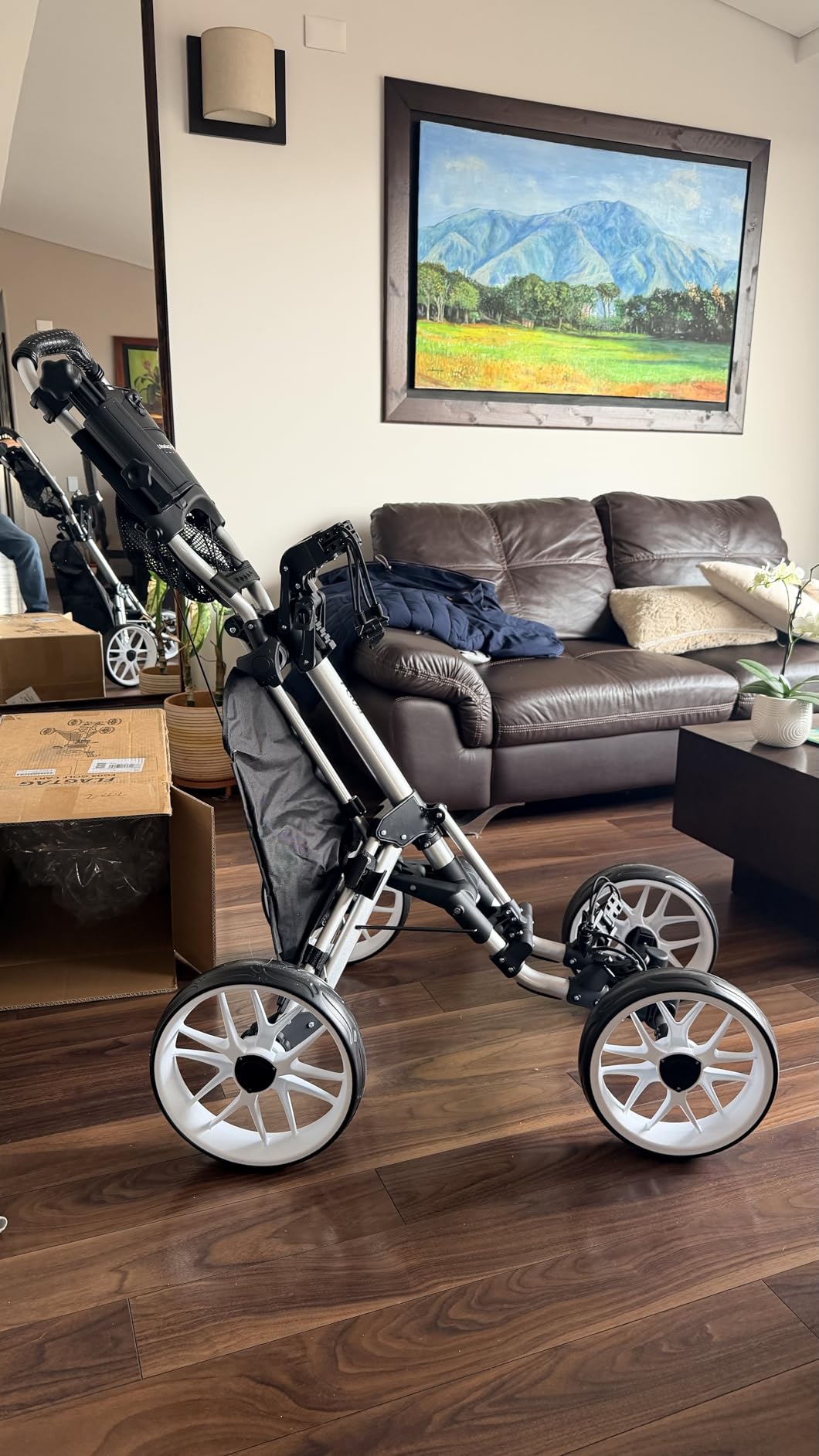
The FLAGTAG is the value pick among four-wheel carts, and the reason is the accessory package. A cooler bag with a built-in storage bag, an umbrella holder, a drink holder, a cup holder and a golf tray are all in the box, which is more than most four-wheel carts at this tier include.
The four-wheel platform is genuinely stable on uneven terrain, and the aluminium main frame with a reinforced wheel hub is designed for heavier loads, which matters if you hang a cooler and a rain cover off the frame on a wet climb. The one-click fold, where you lift a handle and press the fold button, is quick once you learn it.
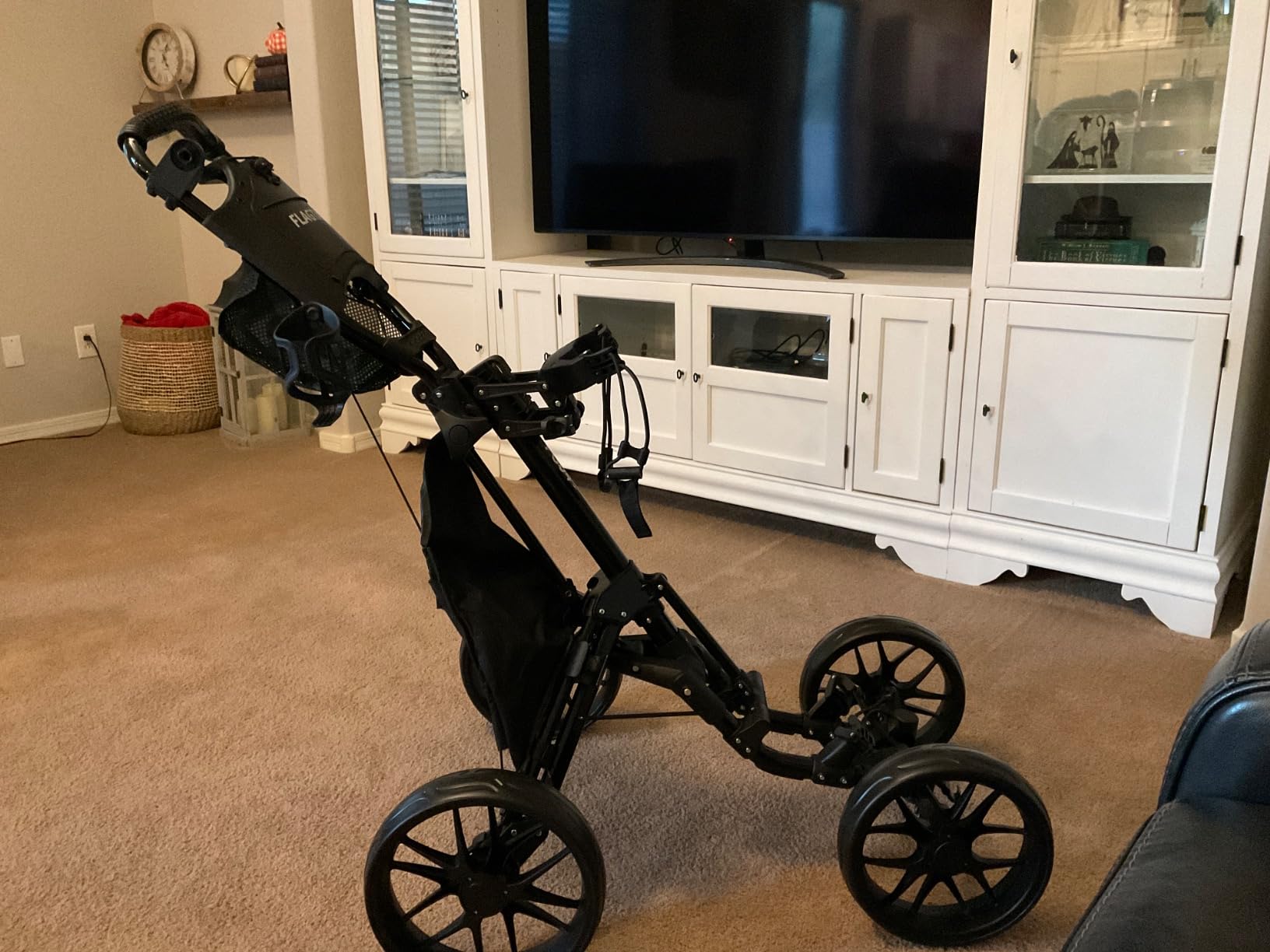
Height adjustment covers different golfers, and the folded package fits a car trunk. Reviewers consistently rate it at 4.5 with 75% five stars, which is the lowest average in this roundup and a fair signal that the finish and hardware are a step below the established brands.
At 19.6 lbs it is the joint-heaviest cart here, and on a course where every hole climbs that weight is felt. The folded size of 28.3 by 18.5 by 17.7 inches is bulkier than any three-wheel fold in this group, and the warranty is a single year.
Where a four-wheel budget cart works
If your budget stops you reaching a four-wheel cart with a long review history, this is a workable compromise. The wheel count gives you the stability that matters on uneven ground, and the reinforced hub should hold up if you are loading it heavily on climbs.
The accessory package also matters more on a hilly round than people expect. On a long climb you are stationary for minutes at a time, and having a drink and a rain cover within reach changes that stop.
Where it falls short
Weight, bulk and the thinnest evidence base here. At 286 reviews and a 4.5 average, it has the least proven history in this group, and the one-year warranty gives you no long-run confidence. If you push a lot of uphill golf, spend the extra and buy a lighter four-wheel frame.
10. Bag Boy Quad Pro – Best Console and Magnetic Mount
Bag Boy Quad Pro Push Cart, Black/Slate
Four-wheel chassis
16 lb aluminium frame
24 by 17 by 15 inch folded size
Integrated iron plate
Pros
- Ties for the highest rating in the group at 4.8
- Four-wheel stability with maintenance-free tires
- Integrated iron plate for magnetic gear
- Umbrella holder included with a storage clip
Cons
- Top-Lok bag compatibility is needed for a secure fit
- Heaviest of the Bag Boy models at 16 lbs
- Smallest review base in the group at 125 ratings
The Quad Pro is the premium four-wheel option and it earns the price with the console rather than the chassis. The integrated iron plate is a small, clever detail: a magnetised rangefinder, a towel or a small speaker attaches and stays attached on an incline, instead of sliding off into the bag.
Underneath, it is a straightforward four-wheel aluminium cart at 16 lbs with maintenance-free tires. The extra-deep scorecard console and large accessory bag give you room to keep things organised, and the integrated beverage holder and phone holder live in the console rather than dangling on a clip.
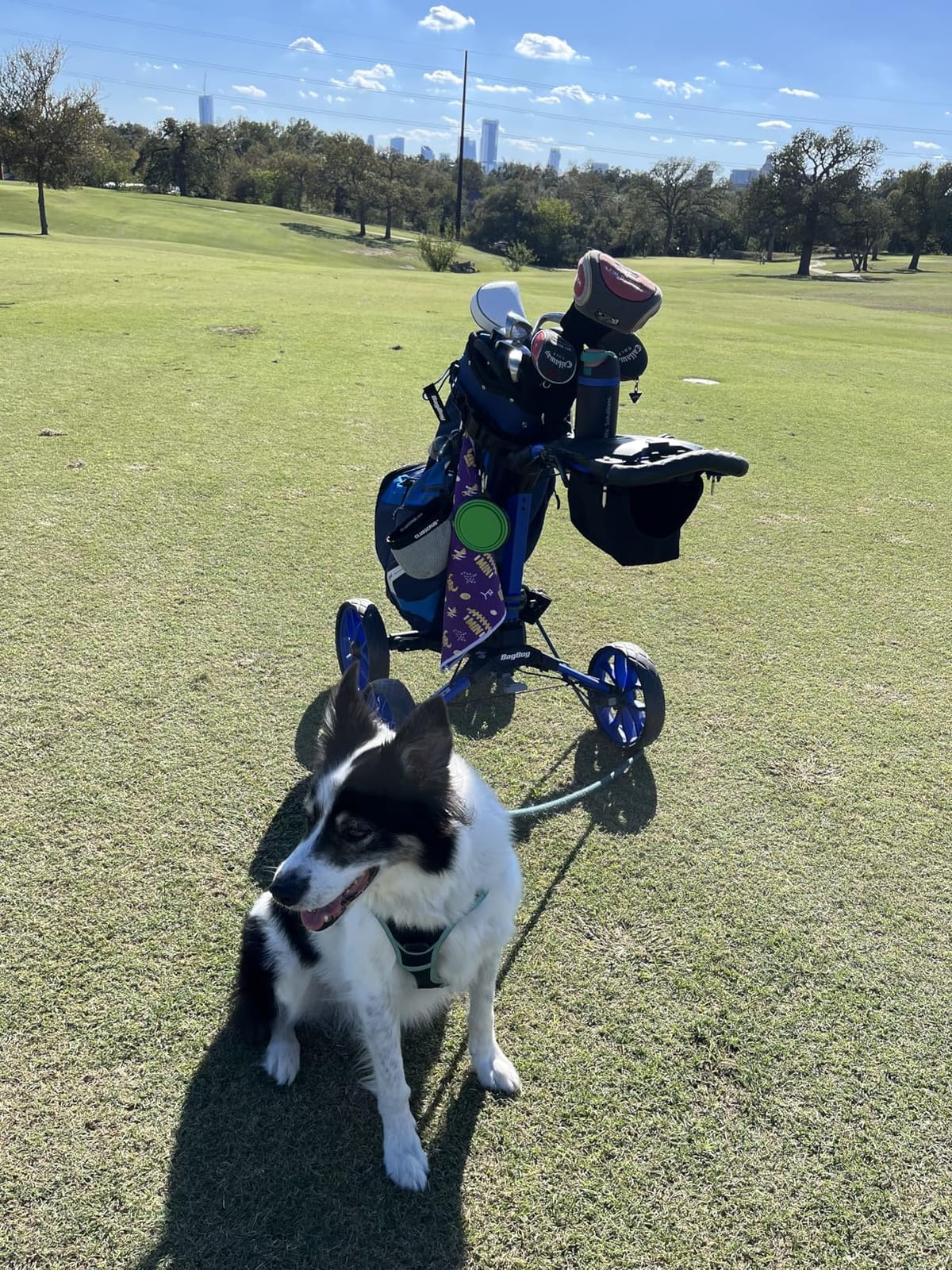
Reviewers respond to the four-wheel stability and the accessory-rich console, and the 4.8 rating with 87% five stars and 1% one-star matches the highest score in this set. The umbrella holder is included, with a storage clip for the shaft.
Two things to weigh. It requires Top-Lok compatible bags for a secure fit, so if your current bag does not use that system, budget for a new bag before the cart. And with 125 ratings it has the thinnest review history of anything we tested, which means the rating is impressive but the evidence behind it is short.
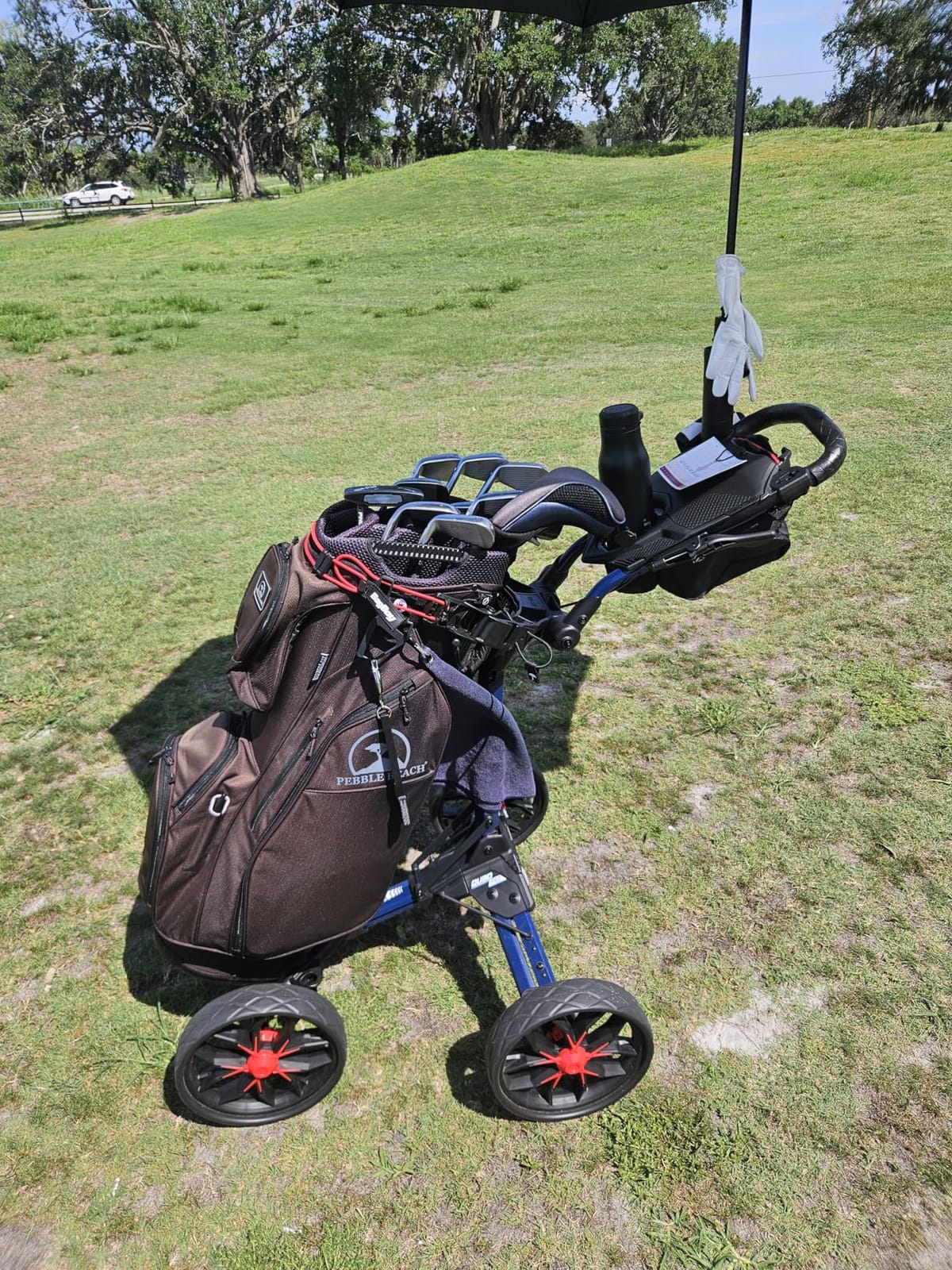
For the golfer who organises everything
If your bag has a rangefinder, a phone, a drink, a towel and an umbrella, the Quad Pro removes the need for clip-on accessories that rattle on a tilt. Everything sits in the console, and the magnet keeps the small items in place when the fairway leans.
It is also the most compact four-wheel fold here at 24 by 17 by 15 inches, so it loads into a boot without the fight that a bulky four-wheel frame usually gives you.
Where it falls short
At 16 lbs it is the heaviest of the Bag Boy models, and four wheels plus 16 lbs is the combination we would think twice about for a golfer who walks long climbs every week. The Top-Lok bag requirement is the practical deal breaker for many buyers, since it ties the cart to one bag system.
Best Cart by Hill Type: Grade to Cart Class
Use this as a shortcut once you have measured your course. The grade bands are the deciding input, and the cart class is what survives repeated rounds at that grade.
Under 8% grade, rolling ground: any light three-wheeler. The Caddytek CaddyLite 11.5 V3 or the SereneLife both work, and you can optimise for weight and folding size instead of stability.
8% to 12% grade, sustained climbs: a wide three-wheel with a working foot brake. The Caddytek CaddyLite 15.3 V2 with its 28-inch wheelbase, or the KVV 3-wheel compact if you need a small fold more than a wide track.
12% to 15% grade, plus side slopes: a swivel front wheel on a wide chassis. The Caddytek CaddyLite ONE-Swivel V8 has the widest wheelbase we measured on a three-wheeler at 32 inches.
Above 15% grade, or cross-slope lies above a drop: a four-wheel chassis. The Bag Boy Quad XL at 14 lbs is the lightest route to that stability.
Narrow tree-lined fairways and tight cart paths: a swivel-front three-wheeler despite the hill, because a fixed front wheel will cost you more time than the gradient costs you effort. The KVV 360 swivel is built for this.
Heavily loaded rounds, coolers and rain covers: a cart with a wide track and a full console. The Quad Pro or the ONE-Swivel V8, both of which keep payload between the rear wheels.
Buying Guide: How to Choose a Push Cart for Slopes
Three wheels or four wheels? On slopes, four wheels win. The bag sits inside a four-wheel track, so a cross-slope lie pushes against the wheels rather than levering the cart sideways. Three wheels win on everything else: they cost less to push, weigh less and turn in a space a quad cannot enter. If your home course has one or two holes that sit on a serious side slope, buy four wheels. If the whole course is undulating, a wide three-wheeler is the better buy.
Brake type is a safety decision, not a feature. There are three things a cart can do on a descent. A simple foot brake locks the wheels and lets you control the descent with your hands. A parking brake holds the cart when you walk away to play a putt. Downhill speed control holds a set speed without your foot on the pedal. The second is the one that matters most on a hill course, and on a green that falls away a cart that creeps takes your bag with it. Every cart here has a foot brake of some kind, but only some lock reliably enough to leave unattended.
Weight is a hill spec. Every pound is felt twice on a hilly course: once pushing uphill and once lifting into a car. The spread here runs from 13.6 lbs to 19.6 lbs, which is a 44% difference and a very noticeable one on a long climb. Below 15 lbs is the sweet spot. Above 19 lbs, you should be buying extra wheelbase or extra capacity in exchange for the effort.
Wheel size beats wheel count for rough and wet grass. An 11.5 or 12-inch wheel rolls over tussocks and damp thatch where a 9.5-inch wheel digs in. If you play in a wet climate or spend time in the rough after a wayward drive, pay attention to the rear wheel diameter before you pay attention to anything else.
Match the cart to your payload. A stand bag plus a few balls is light. A full cart bag, a rain cover and a winter jacket will push a load past 30 lbs, and the SereneLife is the only cart here with a published rating of up to 33 lbs. Check the rating, because a frame that is not built for the load will wallow on a climb and steer unpredictably on a tilt.
Ignore the slope rating and read the wheelbase. No manufacturer publishes a test method for the slope claims on its product pages, so the number is a design intention rather than a measurement. The wheelbase in inches is a real, published, comparable figure. A wider wheelbase is more useful for keeping the cart planted on a side slope than any slope rating we could find printed anywhere.
Finally, set your descent speed before you reach the drop rather than during it. The steepest part of a hole is rarely where you expect, and a cart that is set too fast halfway down a run-out is the one that ends up behind you.
What Real Owners Say About Carts on Hilly Courses
Owner threads on the golf forums are more specific about hills than the editorial roundups are, largely because people describe the course they actually play. A GolfWRX thread asking which push cart to buy draws repeated recommendations for JuCad and Tica’d, both German companies, with build quality as the stated reason. Neither brand is a value option, and both are recurring suggestions for golfers who push long distances on rising ground.
The same thread contains the trade-off that gets left out of most buying guides. One poster summarises it neatly: the Clicgear folds up way smaller, the Sun Mountain is also excellent, but the Clicgear folds smaller and is slightly heavier. That is the whole decision for a hilly walker in two sentences. Folding size and carried weight pull in opposite directions, and you have to decide which one your round punishes more.
On the powered side, an r/golf owner reports buying an MGI All Terrain Navigator because they play a hilly course and not having to push was worth the outlay. In a Titleist forum thread, another owner running a non-remote electric cart says it makes hilly courses a lot easier and that one charge covers at least 27 holes, which is a more useful number than a 36-hole claim because it is what the cart does in real conditions rather than on a flat test track.
There is also recurring owner advice that matches our own testing: on a side-hill lie, centre the bag before you move. Load shift is the biggest single cause of a cart wandering off line, and it has nothing to do with the quality of the cart. A bag that has slid to one side on a slope changes the centre of gravity in a way no wheelbase can compensate for.
Our wider guides cover the category in more depth: the full push cart roundup for flat-course golfers, the best golf carts page for cart bags and accessories, and the disc golf carts guide if you carry a disc bag rather than a full set of clubs.
Frequently Asked Questions
What is the best golf cart for steep hills?
For steep hills, the Bag Boy Quad XL is the safest all-round answer because its four-wheel chassis keeps the bag inside the track on side slopes, and it weighs only 14 lbs. If your course is uphill rather than side-sloped, a wide three-wheel such as the Caddytek CaddyLite 15.3 V2 with its 28-inch wheelbase costs less effort to push. A functioning parking brake matters more than wheel count on a descent.
Is a 3 or 4 wheel push cart better?
Four wheels are better on slopes because the bag sits inside the wheel track, which resists tipping on a side-slope lie. Three wheels are better everywhere else: they are lighter, cheaper to push and turn in tight spaces. Buy four wheels if your course has side slopes, elevated greens or run-outs. Buy a wide three-wheeler if the course is undulating with narrow fairways.
What is the best golf push cart for the money?
The Caddytek CaddyLite 11.5 V3 is the strongest value in this roundup. At 13.8 lbs with 11.5-inch rear wheels, a working foot brake and a three-step quad-fold, it covers the specs that matter on hills and has the largest review base of any cart we tested. The SereneLife 3-Wheel is the cheaper alternative if your bags stay under 33 lbs.
How do I know how hilly my golf course is?
Measure a fairway stretch with a rangefinder or phone GPS, note the elevation change over that distance, then divide the rise by the run and multiply by 100. That gives you a grade percentage. As a guide, under 10% is gentle, 10% to 15% is a real climb, and above 15% calls for a four-wheel chassis or a swivel-front design. A 10% grade is about 6 degrees and a 25% grade is about 14 degrees.
Will a push cart tip over on a side-slope lie?
It can, and the wheelbase decides how easily. A wider track means the cart needs a steeper tilt before it leans past the point of recovery, which is why the 32-inch wheelbase on the Caddytek CaddyLite ONE-Swivel V8 and the 28-inch wheelbase on the CaddyLite 15.3 V2 both outperform a narrow three-wheeler. Centring the bag before you move is the single most effective thing a golfer can do.
Is a lighter push cart easier to push uphill?
Yes, and the difference is larger on a gradient than on the flat. Every pound of cart weight is felt directly in your legs on a 12% climb, and again at the car park at the top. The spread in this roundup runs from 13.6 lbs to 19.6 lbs. Below 15 lbs is the practical sweet spot for a golfer who walks hills regularly.
Final Verdict: The Best Golf Push Carts for Hilly Courses
The best golf push carts for hilly courses come down to two numbers: wheelbase width and cart weight. The Caddytek CaddyLite 11.5 V3 wins this roundup because it pairs 11.5-inch rear wheels with a 13.8 lb aluminium frame and a foot brake that actually holds, which is the combination that survives a 12% climb in wet grass.
Buy the Bag Boy Quad XL if your course punishes side slopes more than it punishes climbs, and the Caddytek CaddyLite ONE-Swivel V8 if you need the widest track on a three-wheel chassis alongside the best storage. Whatever you choose, measure your course’s gradient first, centre the bag on every side-slope lie, and test the brake on a descent before you trust it on a green that falls away.
Use the buttons above to compare the current details, and check our broader push cart and golf cart guides if you are still narrowing the field.