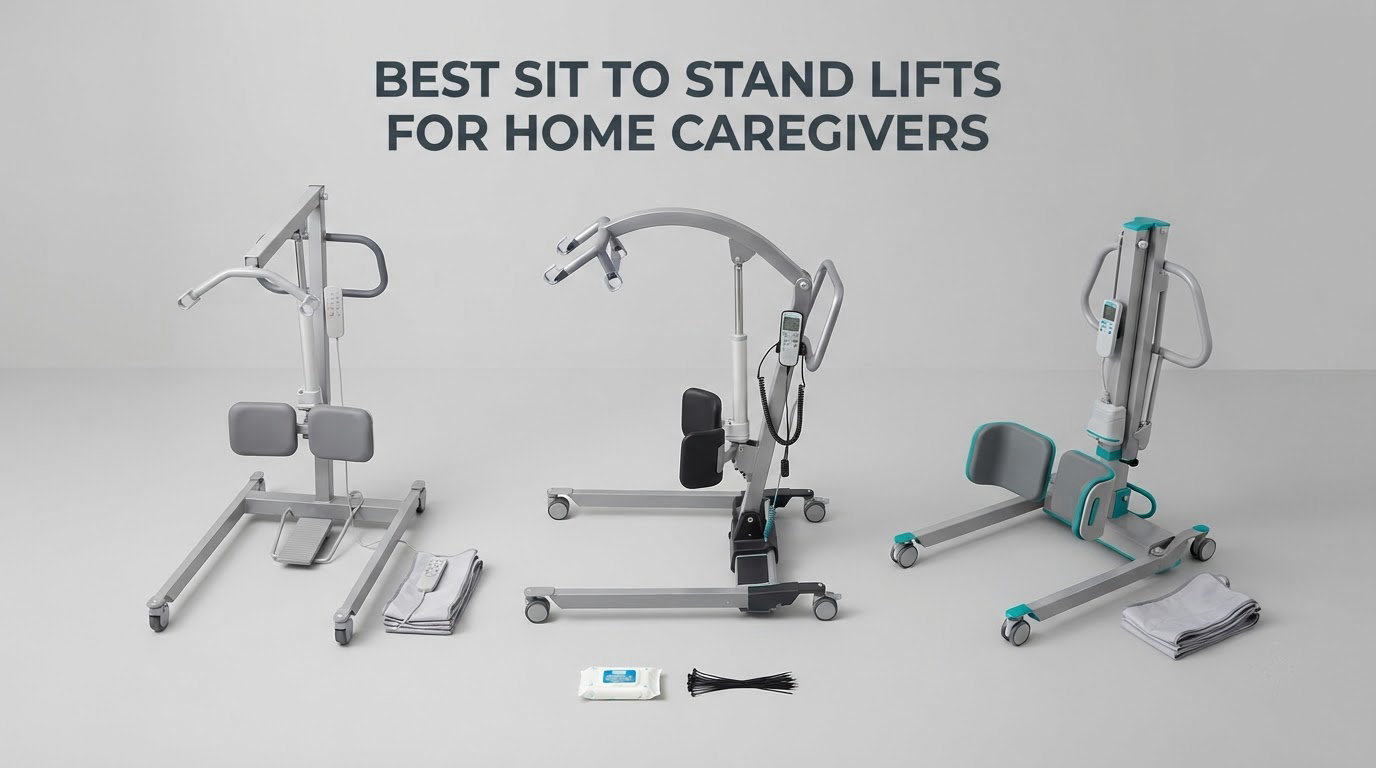
A sit-to-stand lift is a wheeled device with a padded seat, knee pads and handgrips that helps someone who can still bear some weight rise from a bed, sofa or wheelchair into a supported standing position, then lowers them safely back down. The caregiver works the controls and never has to take the patient’s full weight. If you are searching for the best sit to stand lifts for home caregivers, the difference between a good lift and a frustrating one comes down to base width, floor clearance and how much the user is asked to do.
These lifts only work when the person using them can bear roughly 60-70% of their own body weight, can grip the handrails and can follow a simple two-step cue. That is the single most important eligibility rule, and it is the one most first-time buyers get wrong. Someone who cannot lift their own feet off the floor needs a full-body patient lift instead, and we cover that routing later in this guide.
Why this matters for you: more than half of all muscular and skeletal injuries among caregivers happen during lifting and moving patients. A mechanical sit-to-stand lift lets one person handle a toileting or bed-to-chair transfer without twisting, overreaching or taking a load they were never built to carry. Caregivers on nursing forums describe electric sit-to-stand models as the single biggest reducer of transfer injury on the floor, and our own comparisons follow that logic.
We compared 10 of the most-reviewed sit-to-stand lifts available for home setups, weighing published specifications, safe working load, base dimensions, caster braking, and what actual owners report after months of daily transfers. If you need a full-body lift rather than a stand-assist device, our patient lift roundup covers those separately.
Table of Contents
Top 3 Picks for Best Sit to Stand Lifts for Home Caregivers in October
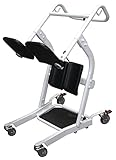
Lumex LF1600 Stand Assist
- 400 lb capacity
- Supports users 5 foot 1 to 6 foot 6
- Steel frame with padded seat
- Manual stand-assist operation

Vive Mobility Sit to Stand Lift
- 400 lb capacity
- 26 inch base width
- Dual locking brakes
- 2-year guarantee

VOCIC Sit to Stand Lift
- 400 lb capacity
- Low-profile base slides under furniture
- 2-level knee pad adjustment
- Dual-lock casters
All 10 Best Sit to Stand Lifts for Home Caregivers in 2026
| Product | Specifications | Action |
|---|---|---|
| Lumex LF1600 Stand Assist |
|
Check Latest Price |
| Vive Mobility Sit to Stand Lift |
|
Check Latest Price |
 Invacare GHS350 Hydraulic Lift Invacare GHS350 Hydraulic Lift |
|
Check Latest Price |
| VOCIC Sit to Stand Lift |
|
Check Latest Price |
 ELENKER Stand Assist Lift ELENKER Stand Assist Lift |
|
Check Latest Price |
 PERLECARE Sit to Stand Lift PERLECARE Sit to Stand Lift |
|
Check Latest Price |
 WHLICKS Upgraded Sit to Stand Lift WHLICKS Upgraded Sit to Stand Lift |
|
Check Latest Price |
 PIDOSO Stand Assist Lift with Belt PIDOSO Stand Assist Lift with Belt |
|
Check Latest Price |
 Molift Raiser Pro Molift Raiser Pro |
|
Check Latest Price |
 ProTraverce Sit to Stand Lift ProTraverce Sit to Stand Lift |
|
Check Latest Price |
1. Lumex LF1600 Stand Assist – Best Overall for Daily Transfers
Lumex LF1600 Stand Assist, Sit to Stand Patient Lift for Elderly Seniors, Chair Transfer & Standing Support Aid
Capacity: up to 400 lbs
User height: 5 ft 1 to 6 ft 6
Unit weight: 61 lb
Frame: heavy-duty steel
Pros
- Largest review base in the category at over 1000 ratings
- Cushioned knee pads and ergonomic handbars
- Steel frame rated to 400 lb
- Works for users 5 ft 1 to 6 ft 6 tall
Cons
- 61 lb frame is heavy for one-person repositioning
- Base footprint may not clear tight bathrooms
- User must retain partial weight-bearing ability
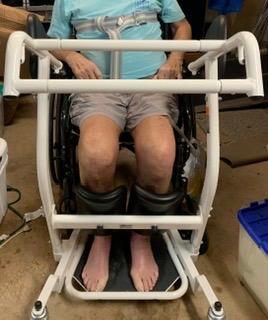
The Lumex LF1600 is the model we keep coming back to, and the reason is boring in the best way: it has been in continuous production since 2005 and carries more than a thousand ratings averaging 4.6 stars. Owners repeatedly describe the same three things as the strengths, namely sturdy steel construction, comfortable padding and transfers that feel smooth rather than alarming for the person being moved.
In practice this is a manual stand-assist device. There is no motor and no battery, which means nothing to charge and no motor to fail, and the caregiver raises the patient with a hand pump while the user pulls on the handgrips and pushes through their legs. Families recovering from hip or knee replacement surgery often find that tradeoff worthwhile, because the user is doing real work and rebuilding lower extremity strength rather than being hoisted passively.

The seat is padded, the knee pads are cushioned and the handbars are shaped for a closed-hand grip, which matters more than it sounds when the patient’s hands are shaking or arthritic. The published user height range of 5 ft 1 to 6 ft 6 is broad enough that you are unlikely to fall outside it, and the 400 lb capacity covers the large majority of home users.
The honest drawback is weight. At 61 pounds this is not a lift one person casually drags from the bedroom to the bathroom, and owners mention that point directly. Our advice is to commit to one primary transfer zone, usually the bathroom or the bedside, and treat repositioning as a two-person job or a job for a second piece of equipment. Before you buy, tape out the base footprint and confirm it fits where you plan to use it.
Who this lift works well for
It suits a long recovery where the goal is to rebuild leg strength, and it suits households that want a mechanical device with no battery to maintain. If your loved one can follow a cue, grip the bars and push through their feet, the LF1600 handles toileting, bed-to-chair and sofa transfers with a single caregiver.
It is also the pick when durability evidence matters more than features. When a manufacturer has a thousand reviews and an eight-decade-old product line, you can see how the frame ages in real homes rather than inferring it from a spec sheet.
Who should skip it
Skip it if your home has genuinely tight doorways or a bathroom with no maneuvering room, because the base is not narrow. Also skip it if the patient is entirely non-weight-bearing; a manual stand-assist cannot create the lift that the legs are not producing.
If a single caregiver must move the unit between rooms several times a day, look at a lighter design further down this list instead. The difference in convenience is meaningful over a year of daily use.
2. Vive Mobility Sit to Stand Lift – Best Value with a Two-Year Guarantee
Vive Mobility Sit to Stand Patient Lift for Handicapped – Stand Assist Lift
Capacity: up to 400 lbs
Base width: 26 inches
Unit weight: 60 lb
Base material: steel
Pros
- Backed by a 2-year guarantee
- Designed for users bearing 60-70% of body weight
- Four swivel casters cross multiple flooring types
- Dual locking brakes
- Strap hooks for side support
Cons
- 26 inch base will not clear narrow doorways
- User needs upper-body strength to pull up
- 60 lb is heavy for one-person repositioning
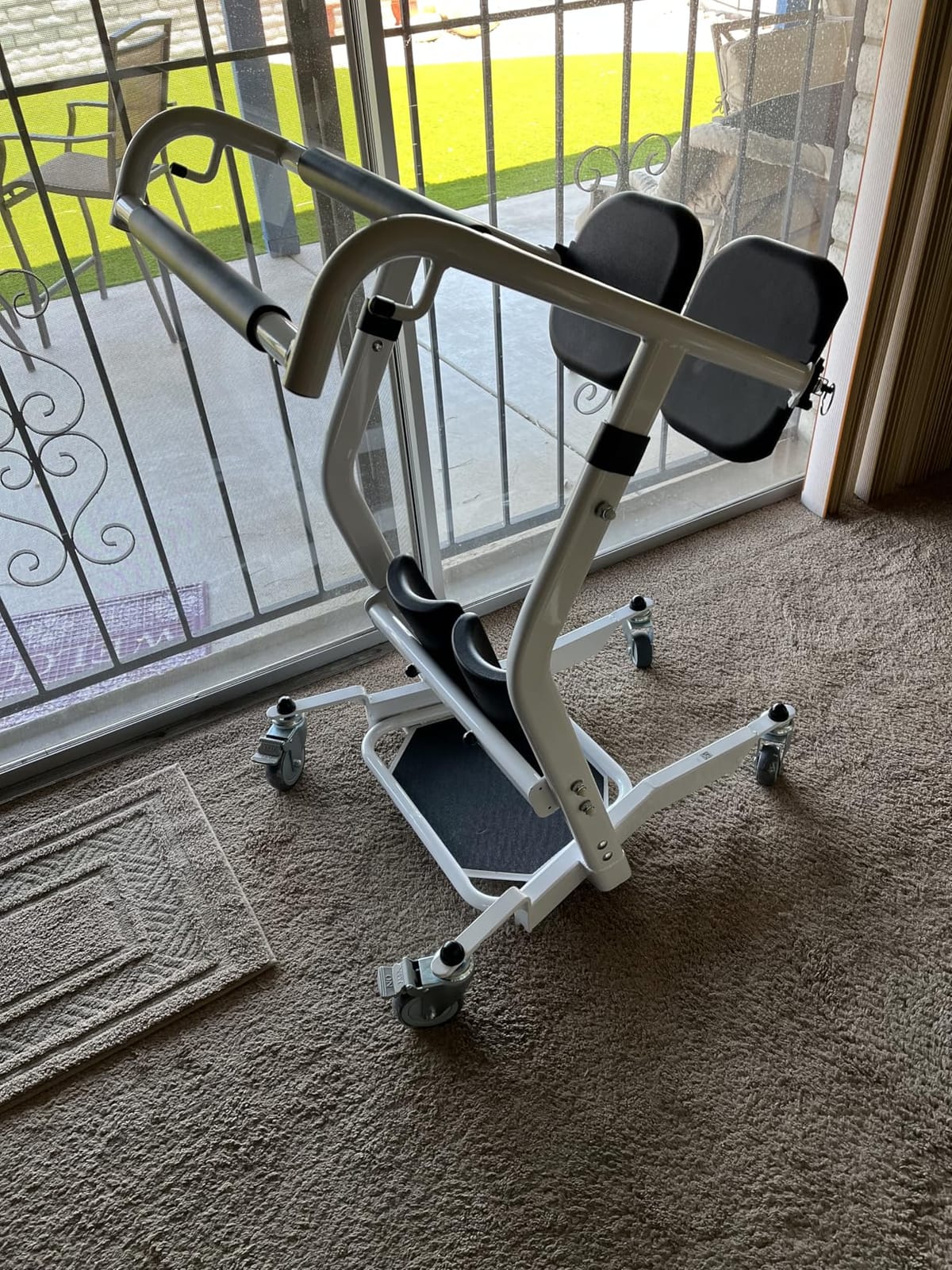
The Vive Mobility lift earns its place because it is one of the few in this group with a two-year manufacturer guarantee attached, and warranties on durable medical equipment are rare outside professional dealer channels. Buyers rate it 4.3 stars across more than 560 reviews, and the review text is consistent: people like the foam grips, they like the braking, and they like that transfers feel controlled.
The design targets users who can bear 60 to 70% of their own weight, which is the same eligibility band most of these lifts assume. Foam-wrapped handrails reduce the pain of gripping during a shaky pull-up, and the cushioned shin rests plus split seat pads spread pressure across the backs of the legs during the standing phase.
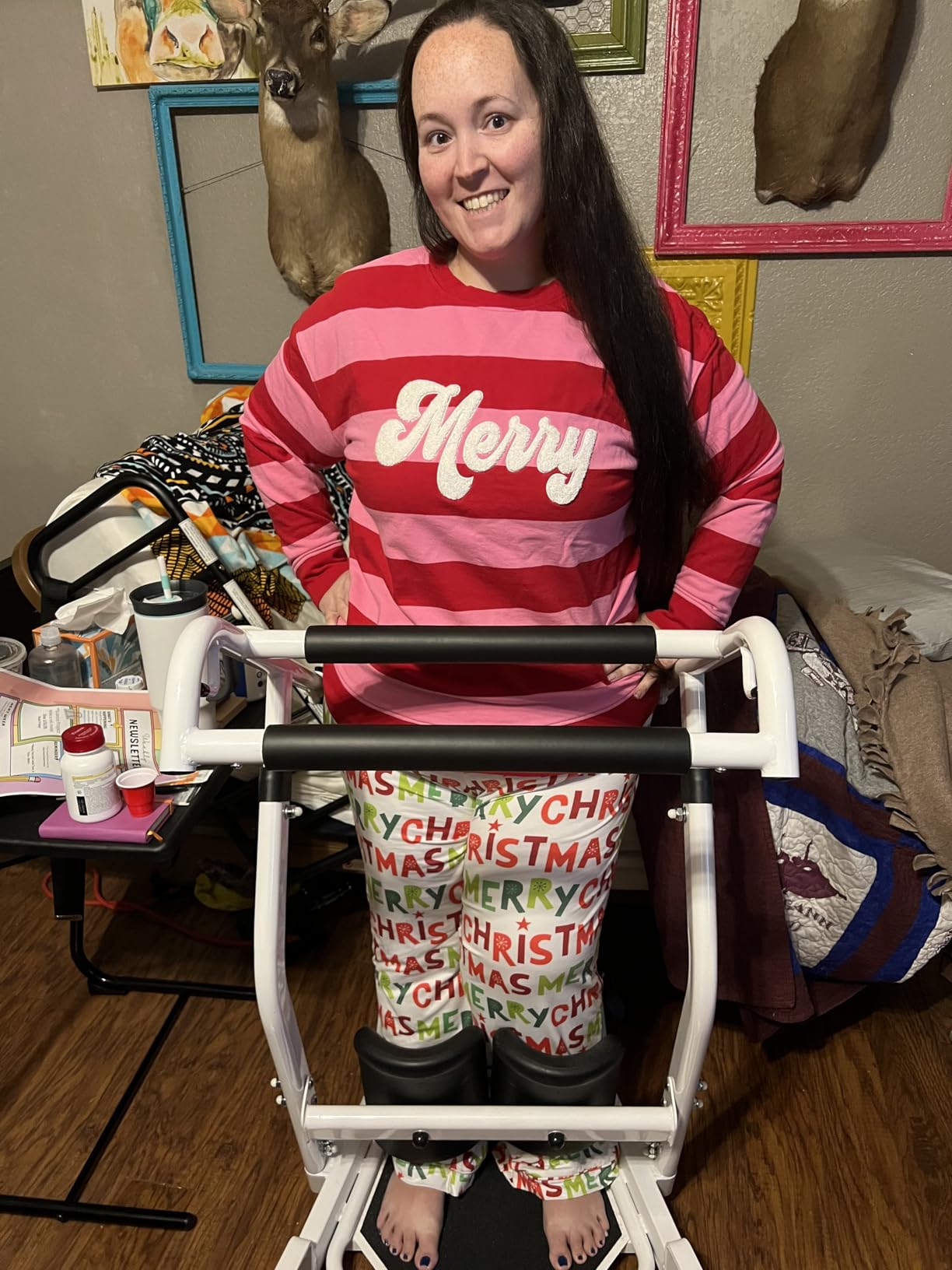
Dual locking brakes are a real feature rather than a marketing line here, because the brake holds the frame steady while the patient pushes up. Four swivel casters let you glide the unit across tile, wood and low-pile carpet without wrestling it. Hooks for side support straps let a caregiver add a secondary support if the user needs one.
Measure before you commit. The widest part of the base is 26 inches, and the manufacturer says so plainly on the listing. That clears a standard interior door but will not pass a narrow doorway or a tight bathroom with a pedestal sink. Owners also emphasize that the user must have real upper-body strength, so this is a poor fit for someone with a weak grip after a shoulder injury.
What makes it the value pick
The warranty is the headline. A two-year guarantee on a steel transfer frame means a hardware failure is not automatically a total loss, which is rarely true of budget imports in this category. Combined with dual brakes and a stated 400 lb capacity, it is the most complete package for a mid-range budget.
It is also a good first lift to rent or buy used, because the replacement parts involved are mostly caster, brake and pad components. If your needs change in two years, you have not locked into an expensive proprietary system.
Where it falls short
The 26 inch base is the constraint that decides this one for most homes. Measure every door on the route from bed to bathroom, not just the bedroom door, because the narrowest point on the path is what matters.
At 60 pounds it is no lighter than the Lumex, so the same caveat applies about moving it between rooms. Plan one dedicated transfer station rather than expecting a mobile device.
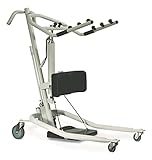
3. Invacare GHS350 Hydraulic Lift – Best for Sling-Based Transfers
Invacare Sit to Stand Lift for elderly, Hydraulic Stand Assist Lift Aid for Patient, Lift Assist Transfer Device for Elderly Seniors, Adults & Disabled, FSA & HSA eligible
Capacity: sling use up to 350 lb
Clearance: 4.5 inch
Unit weight: 88 lb
Hydraulic rotating pump
Pros
- 4.5 inch clearance fits most homecare beds
- Works with Invacare multi-function slings
- Adjustable leg pad and retractable footplate
- Low-friction casters roll easily indoors
Cons
- Heaviest unit here at 88 lb
- Non-locking casters need a service kit in some settings
- Hydraulic pump must be cycled by the caregiver
The Invacare GHS350 is the only lift on this list that takes a full multi-function sling, and that single design choice changes who it suits. Where most stand-assist devices rely on the patient gripping handgrips and pushing up, a sling transfers load through fabric, which helps users with weaker arms, poor balance or a temporary inability to bear weight on one leg.
It has been on the market since 2008 and holds a 4.0 star average from 267 reviews. Owners credit it with dependable hydraulics and easy bed clearance. The rotating pump handle is the power source, so there is no battery, no charging routine and no motor to wear out, but the caregiver does physically pump through each lift cycle.

The 4.5 inch clearance figure is the number that wins hospital and homecare comparisons. A lift that cannot slide under the bed cannot do a bed transfer, and this one fits most homecare beds. The adjustable contoured leg support pad and retractable non-slip footplate adapt across different body sizes, which reduces the leg discomfort that makes patients dread stand-assist devices.
Weight is the real trade. At 88 pounds this is the heaviest unit in the group by a wide margin, and owners call that out as the main drawback alongside the pump learning curve. In a home setting that generally means the unit lives in one location, and moving it takes two people or a plan. The non-locking casters are intentional so the lift can find a new center of gravity as weight shifts, but a locking caster service kit is available if your floor surface demands it.

When a sling changes everything
Choose this model when the patient cannot reliably grip, when one leg is weaker after surgery, or when toileting transfers need trunk support. The sling carries load that handgrips cannot, and that is often the difference between a successful transfer and an aborted one.
It also suits households that already own or will buy compatible Invacare slings, since accessories from a single manufacturer tend to fit predictably. Sling compatibility is a recurring source of returns in this category, and staying within one system avoids it.
Where it does not work
Skip it for a short-term rental-style recovery where hauling an 88 pound frame around the house is a burden, and skip it if you want a device one caregiver can roll from room to room. The weight is not a minor spec detail; it decides how the rest of your care routine looks.
Also note the 350 lb sling ceiling. If your patient is close to 400 lb, verify the specific sling and leg support combination you plan to use rather than relying on the frame rating alone.
4. VOCIC Sit to Stand Lift – Best Low-Profile Base for Low Furniture
VOCIC Sit to Stand Lift, Patient Lift Chair Transport Unit with Wheels
Capacity: 400 lb
Base height: 6 cm
Widest dimension: 17 in
Unit weight: 58 lb
Pros
- Low base slides under most furniture
- Rated to 400 lb on a reinforced frame
- Two-level adjustable knee pad
- Dual-lock brakes on rear and front casters
Cons
- No safety belt restraint included
- Aluminum frame lighter than steel rivals at 400 lb
- Narrow 17 inch width may not clear wide wheelchairs
The VOCIC lift solves a specific household problem: furniture that sits too low for a taller base. Its low-profile base, listed at 6 cm, is what lets the frame slide under a sofa or low bed rather than stopping at the frame. For families whose loved one transferred on a standard hospital bed and then came home to a low platform bed, that difference decides whether the device is usable at all.
Ratings land at 4.4 stars from 191 reviews, which is a strong showing. The 400 lb capacity comes from reinforced high-grade steel with a thickened frame, and the two-level adjustable knee pad spans a 51 to 56 cm range so you can line the knee block up with the user’s leg length rather than working around a fixed position.
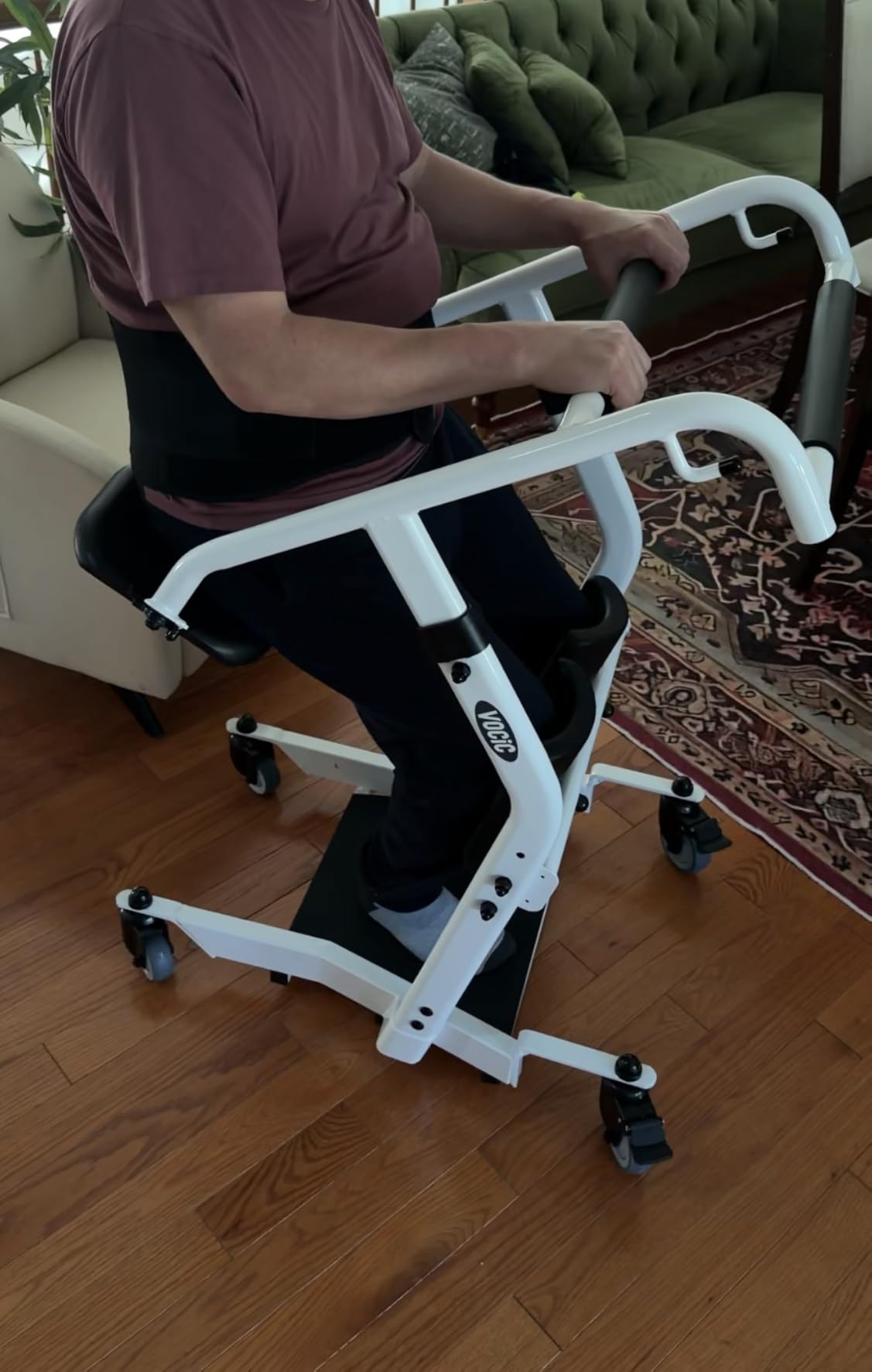
Braking is the sleeper feature. It uses a dual-lock system with rear 3-inch and front 4-inch casters, so both ends of the frame hold during positioning. Foam-wrapped handgrips, integrated shin pads and a split seat cushion cover the contact points that usually cause discomfort. The package arrives as a kit with tools and assembly instructions.
Two things to weigh carefully. This is an open design with no safety belt restraint, and the manufacturer is explicit that it suits users who can sit up and support their own upper body. If you need a restraint, this is the wrong category entirely. Second, the 17 inch width is narrow, which helps in tight rooms but means the frame may not align with a wider wheelchair or recliner without modification.
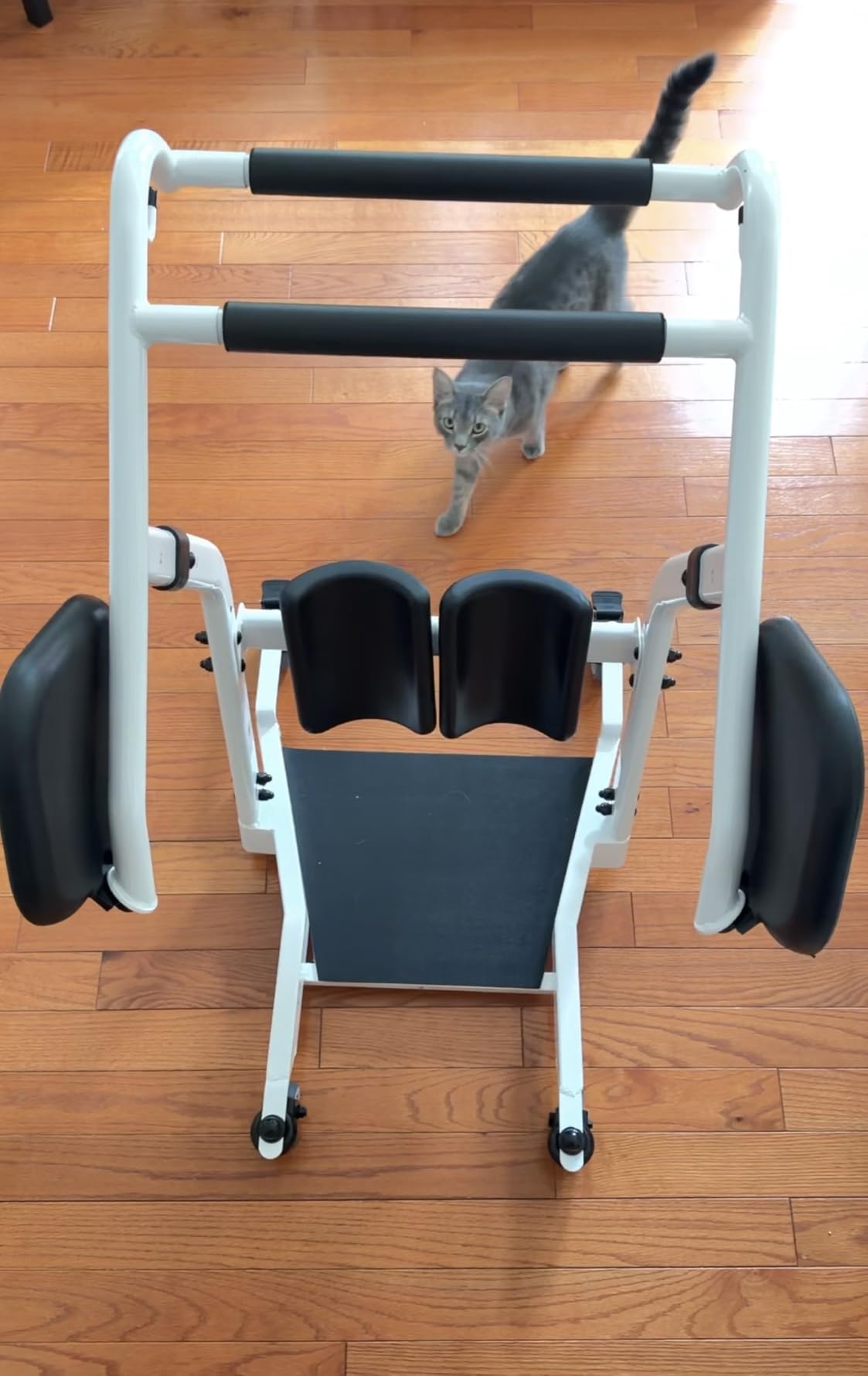
Best for low-clearance homes
If your transfer surfaces are low, this is the pick. The base height matters more than most buyers expect, because a frame that cannot slide under the target surface cannot be used for that transfer at all. A 2-level knee pad also makes it easier to fit a user with shorter legs than a fixed-position block allows.
The dual-lock braking on both ends of the frame gives a caregiver a stable platform, and owners mention smooth movement across the floor despite the 58 pound frame weight.
Where it does not work
Skip it for anyone who needs a restraint belt, and skip it if your wheelchair or recliner is much wider than 17 inches at the base. An open frame is a deliberate design choice here, not an oversight, but it is a real limit on who can use it safely.
It is also not the choice if you want the security of a sling. There is no sling attachment, so patients with weak upper bodies should look at the Invacare instead.
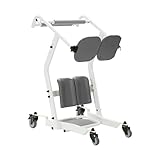
5. ELENKER Stand Assist Lift – Compact Frame That Clears Most Doorways
ELENKER Stand Assist Lift – Sit to Stand Lift Patient Transport Unit for Elderly – Patient Lift for Home Care Use- 400 Pound Weight Capacity. Widest Size is 25 inches
Capacity: 400 lb
Widest point: 25 inches
Unit weight: 61 lb
Frame: low center of gravity
Pros
- 25 inch widest point passes through most doorways
- Full-body design with low center of gravity
- Cushioned knee pads and foam handrails
- Two locking rear casters
Cons
- 15 percent of ratings are 1-star
- Front casters are not locking
- User must bear partial weight
The ELENKER’s pitch is clearance. The manufacturer states the widest point is 25 inches, and that number is the reason to keep it on the shortlist when doorways and bathroom layouts are tight. At 4.0 stars from 83 reviews it sits mid-pack on ratings, but the frame geometry is genuinely useful in small homes.
Unlike a cantilevered stand-assist, this is a full-body design with a low center of gravity, which is why it does not feel tippy when the patient leans forward during the standing phase. Cushioned knee pads, a padded seat and foam-encased handrails cover the three contact points that matter. Rear locking casters hold the frame on varied flooring while the transfer happens.
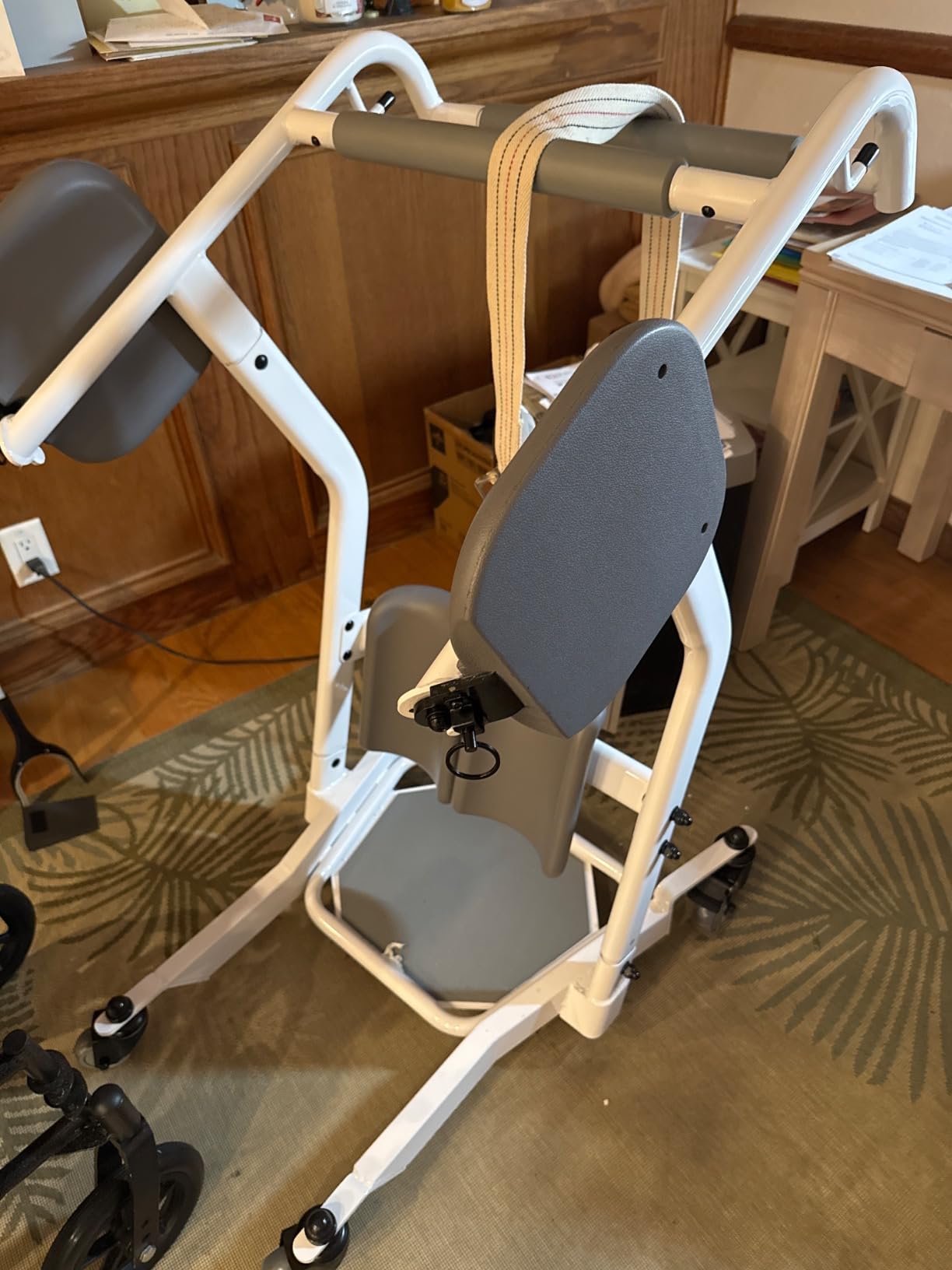
Where we want to be straight with you is the review distribution. Of 83 ratings, 61% are five stars and 16% are four stars, but 15% are one star, and those reviews repeatedly mention assembly and component fit problems. That is a meaningfully higher failure share than the Lumex, and it is the single reason this model does not rank higher despite the useful footprint.
Also note that only the rear casters lock. During positioning the front wheels stay free, which is by design for rolling, but it means the caregiver has to be deliberate about the approach angle. Plan the transfer path and approach the chair square rather than at an angle.

Who it suits
Choose it when doorway width is the binding constraint and the alternative is a device that will not leave the bedroom. It is built to work between wheelchair, bed, sofa and commode positions, and the low center of gravity makes it feel stable during assisted standing.
It is a reasonable second option for post-surgical recovery when the user can bear partial weight and the home is compact.
Who should skip it
We would steer cautious buyers away, or at least toward a model with a longer track record, if you cannot tolerate a service call in the first months. The one-star share points at fixable assembly and component issues rather than a fundamentally unsafe design, but it is a support risk that a thousand-review product does not carry.
It is also the wrong pick for a user who cannot participate at all, since partial weight-bearing is required to complete the lift.
6. PERLECARE Sit to Stand Lift – Best Adjustable Fit and Included Safety Strap
PERLECARE Sit to Stand Lift for Elderly with Safety Belt and Casters
Capacity: 400 lb
Width: 26.5 in
Unit weight: 64.6 lb
Height options: 3 seat, 2 knee
Pros
- Three seat height and two knee pad options
- Included additional safety strap
- Quick-install seat needs no pull rings
- Lockable rear casters on four casters
Cons
- Some owners report brakes slipping after months of use
- Base may not slide under low recliners
- Harder to push over thick carpet
The PERLECARE stands out for the most thorough height adjustment in this group. It offers two knee pad options and three seat height positions, and that combination is what lets you line up the patient’s hips and knees correctly. Getting that alignment right is the difference between a smooth stand and a transfer the person dreads, and it is the part caregivers most often get wrong with a fixed-height frame.
It also includes an additional safety strap for transfer support, which matters when the patient is not yet fully seated or has a moment of hesitation mid-lift. The strap is not a restraint system, but it gives a caregiver something to hold that is not the patient’s arm. Caregivers rate it 4.2 stars from 75 verified reviews and describe it as a genuine improvement for back safety.
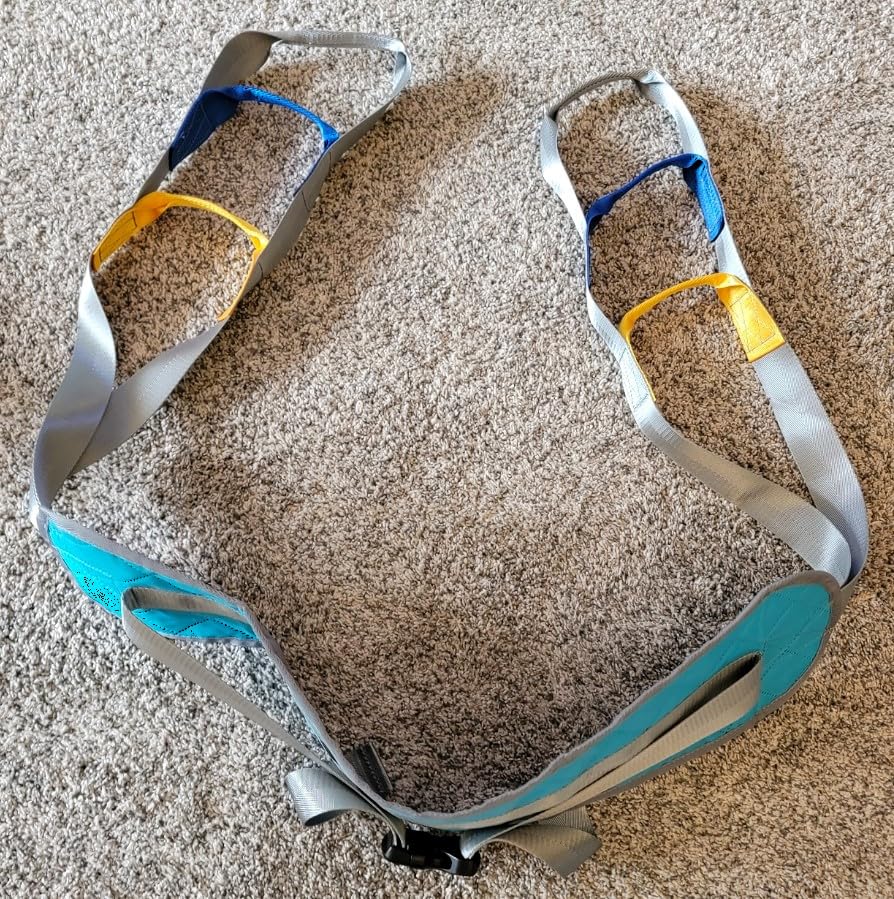
Two design touches stand out. The quick-install seat uses no pull rings, which removes a hand-injury risk during setup, and the upgraded frame with an integrated base is meant to resist tilting. Four casters with lockable rear brakes make it straightforward to move between bed, toilet, wheelchair and sofa.
The honest issue is brake durability. Some owners report the caster brakes beginning to slip after several months of daily use, which is exactly the component you cannot afford to lose mid-transfer. Owners also note the base may not slide under low-profile wheelchairs, recliners or sofas, and that thick carpet resists the casters. Check your floors before choosing.
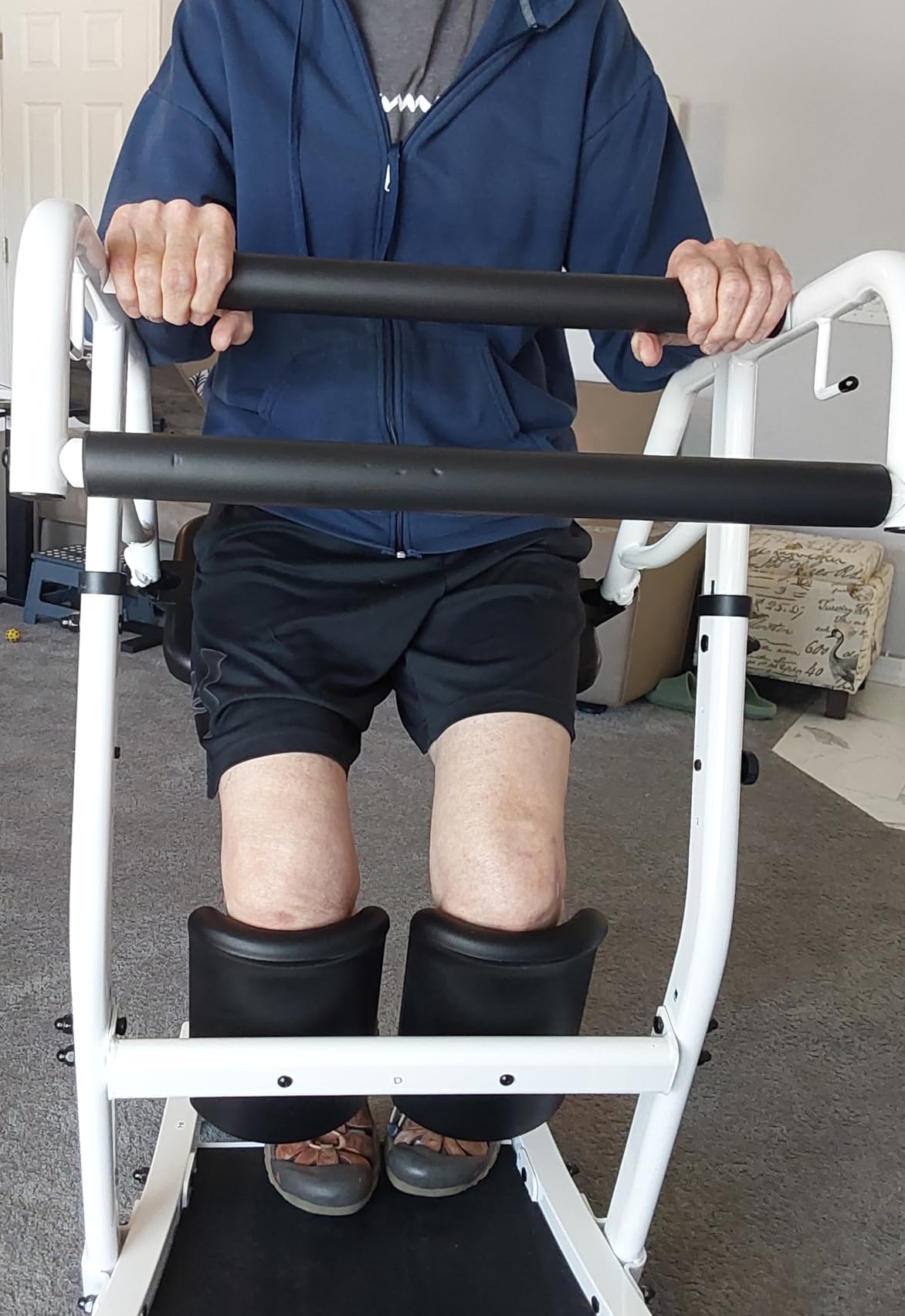
When the height adjustment matters
Choose this lift if the user is tall, short, or simply in the middle of a recovery where their effective sitting height changes week to week. Being able to reset the seat without tools as the patient progresses is a real advantage over a fixed frame, and it extends the usable life of the purchase.
The included strap and ring-free seat assembly also make it a good pick for a household where the caregiver is doing daily transfers and wants fewer pinch points.
Where it does not work
Skip it if your route to the bathroom crosses thick carpet or if the main transfer target sits very low. Brake reports are isolated rather than widespread, but they cluster around the kind of daily, multi-transfer use most home caregivers have in mind, so it is worth asking the seller about replacement casters before committing.
It also requires meaningful upper-body strength from the patient, so it is not a fit for a fully non-weight-bearing user.
7. WHLICKS Upgraded Sit to Stand Patient Lift – Best for Fine Height Tuning
WHLICKS Upgraded Sit to Stand Patient Lift, One-Step Stand Assist Lift for Elderly,Lift Assist Transfer Device with Wheels, Home Care Use Transport Chair Stand Assist for Seniors, Adults & Disabled
Capacity: 400 lb
Height levels: 5
Minimum doorway: 24 in
Unit weight: 59.5 lb
Pros
- Five height levels and two leg pad positions
- Single-action swivel seat repositioning
- 3-year manufacturer warranty
- Replacement parts shipped quickly after a failure
Cons
- Published width understates real clearance
- Seat bushing can crack with heavy daily use
- Knee pad attachment uses a single screw
The WHLICKS offers the most granular adjustment we found: five height levels plus two leg pad positions, covering users from 5 ft 1 to 6 ft 6 tall. For someone who is regaining strength after a knee replacement, being able to fine-tune the seat height over a recovery arc rather than setting it once is a meaningful advantage.
The single-action swivel seat is the feature that gets noticed in use. It repositions the seat in one motion and supports the patella and tibia during the rise, which spreads load across a wider area than a simple flat pad. The high-tensile alloy steel frame is rated to 400 lb and owners report no lateral sway once locked. The manufacturer also lists a 3-year warranty.
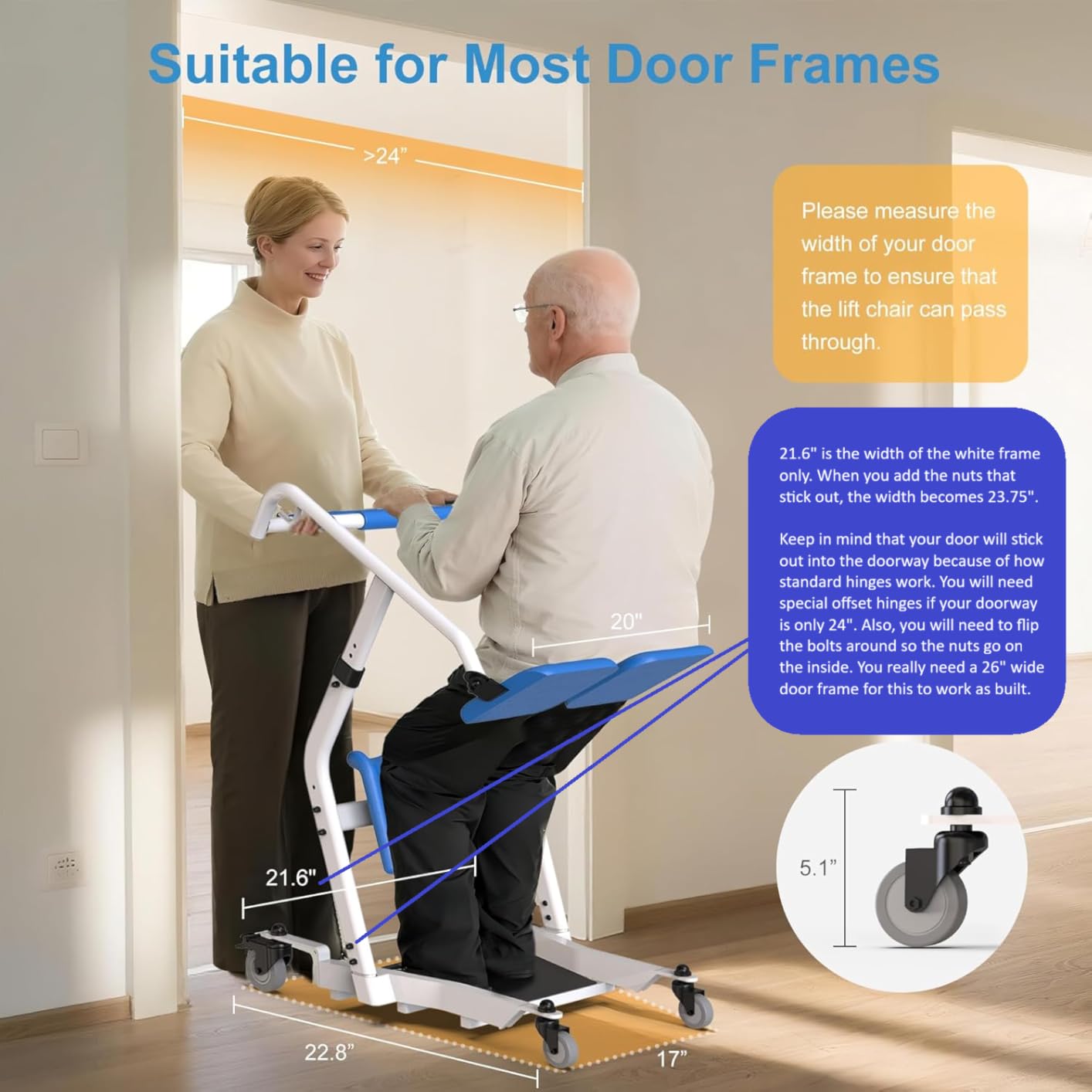
Buy with eyes open on the width, though. The listing states a 22.6 inch width and a 24 inch minimum doorway, but owners report that protruding cap nuts push the real minimum to about 23.75 inches, which is a gap that matters in a narrow hall. Measure the narrowest point and add a margin rather than trusting the published figure.
Two component concerns appear in reviews. The seat bushing can crack under heavy daily use, leaving the seat loose, and the knee pad attachment uses a single screw that can loosen over time. On the positive side, the manufacturer shipped replacement parts quickly after a warranty failure, which is the part that decides how bad a component problem actually is.
Who it fits
Pick it for a long rehabilitation where the user is between 5 ft 1 and 6 ft 6 and you expect to keep retuning the height. The swivel seat and shin support make long therapy sessions more tolerable, and the 3-year warranty is longer than most in this category.
It is also a reasonable choice for standard-width hallways where a 24 inch minimum doorway is genuinely available.
Who should skip it
Skip it in a home with tight doorways, because the real clearance requirement is wider than the published number and you will be measuring with the truth, not the listing. If your patient is very tall, verify fit in person if you can, since the five levels still have to accommodate their leg length.
For a household expecting heavy daily transfers over many years, check whether the seat bushing is a stocked replacement part before you buy.
8. PIDOSO Stand Assist Lift with Belt – Best for Post-Surgery Recovery
PIDOSO Sit to Stand Lift, Stand Assist Lift for Elderly, Patient Transfer Assist Devices with Belt for Home Care Use, 400 lbs Capacity
Capacity: 400 lbs
Unit weight: 73 lb
Frame: full body, low center of gravity
Brakes: both rear casters
Pros
- Full-body low center of gravity design
- Hooks accept an equipped transfer sling
- Brakes on both rear casters
- Height-adjustable knee pads and foldable cushions
Cons
- Seat and back pad pull cords are hard to operate
- One report of parts not fitting during assembly
- 73 lb is heavy and not foldable
The PIDOSO is the one we would look at first for a defined post-surgical window. Caregivers describe it as sturdy and stable, and several reviewers credit it specifically with post-stroke and post-amputation care where the goal is a fixed recovery period followed by a decision about what comes next. A 4.3 star average from 30 reviews is a small sample, so treat the sentiment as directional.
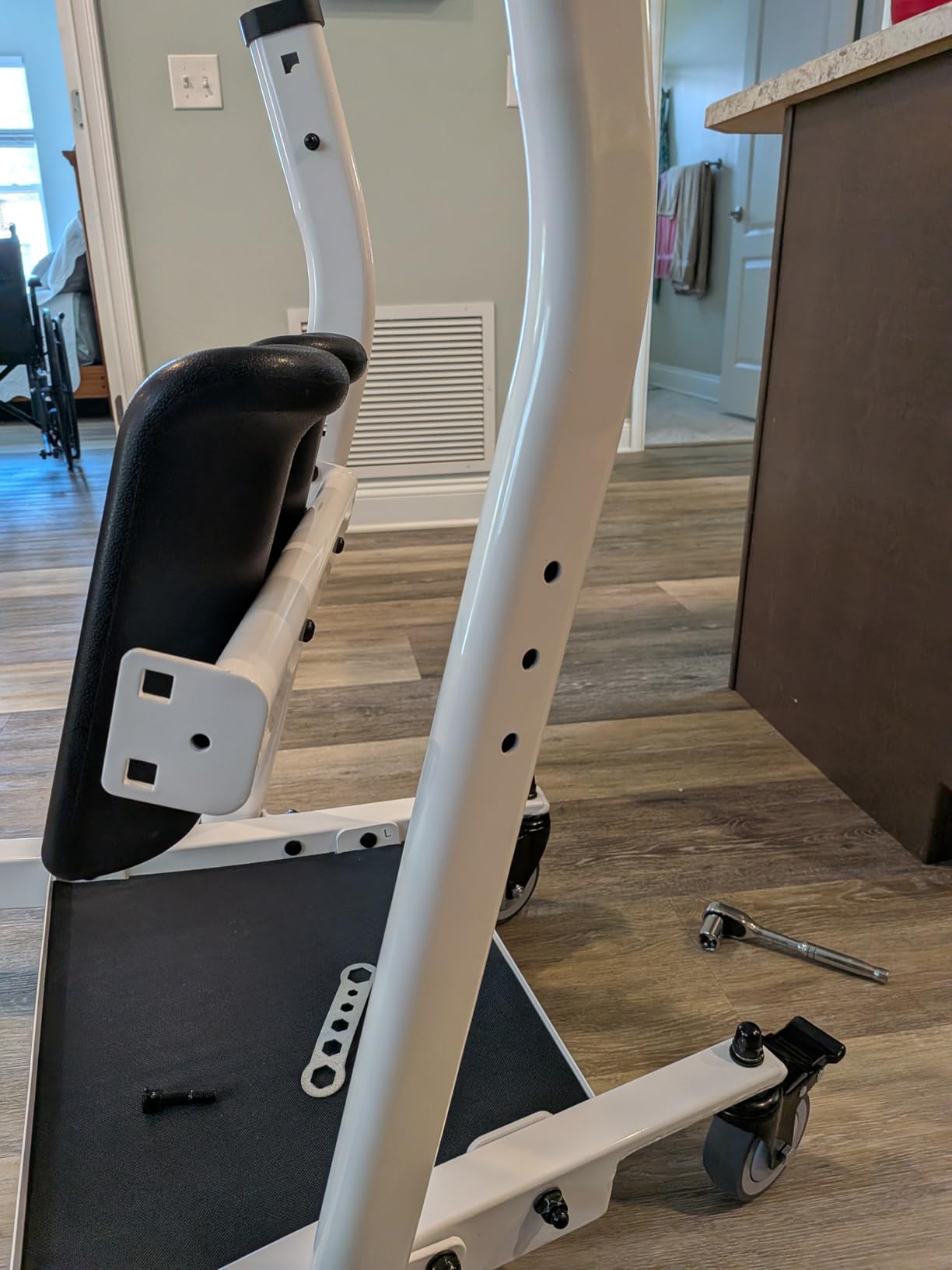
Structurally it is a full-body design with a low center of gravity, which resists tipping when the patient leans forward. Height-adjustable knee pads and foldable seat cushions let you fit different leg lengths and give the user somewhere to shift back against, and foam-padded armrests give a second handhold when the patient’s grip fails mid-pull.
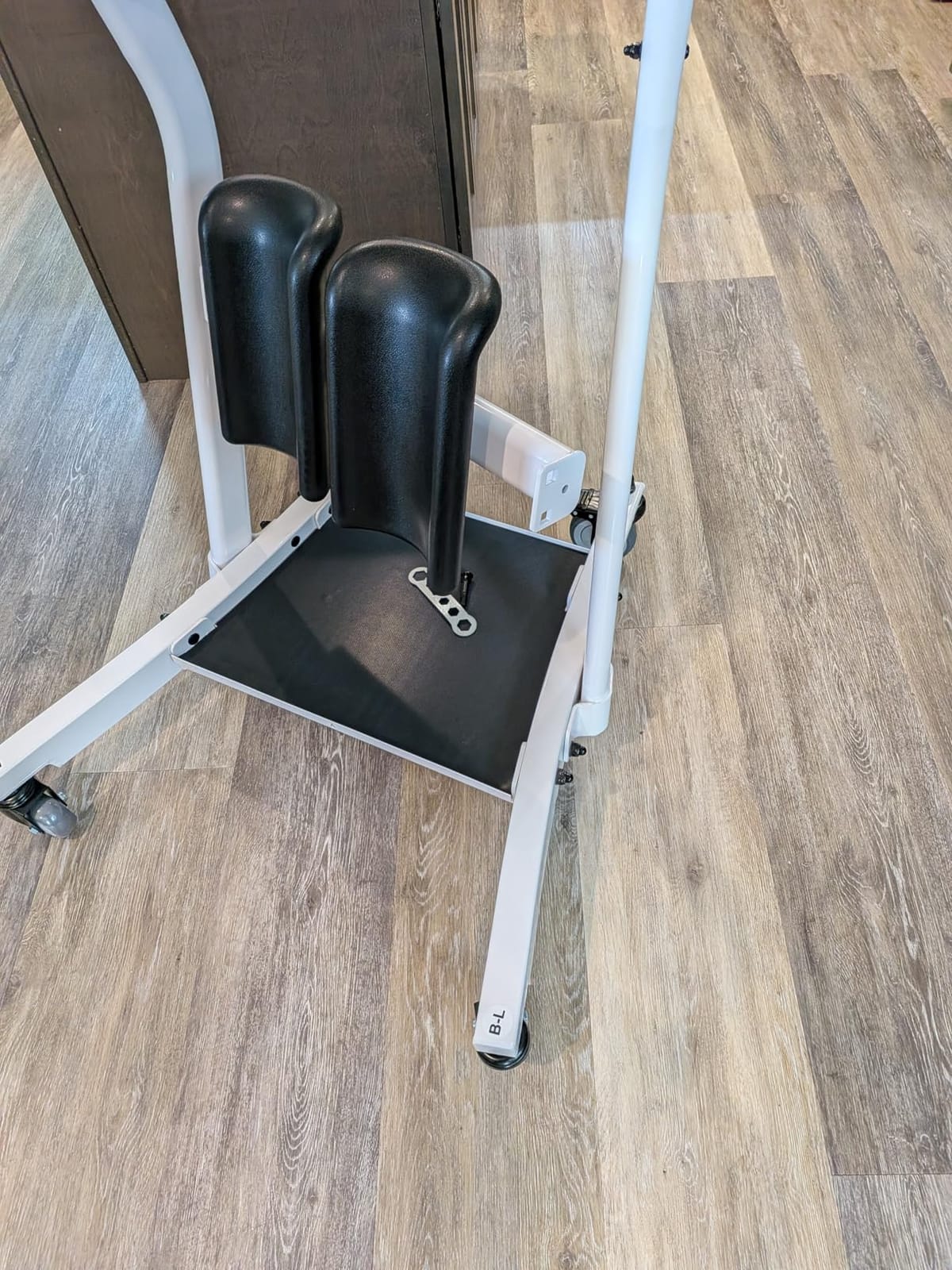
Two additions make it versatile. Hooks are provided to support an equipped transfer sling, so you can add upper-body support when needed, and the braking system on both rear casters holds the unit before a transfer begins. The non-slip base is useful on smooth floors, and the compact footprint is stated to fit through most doorways.
The drawbacks are specific. Reviewers complain that the seat and back pad pull cords are difficult to operate and can break, which is a real problem because those cords are touched several times a day. One review reports parts that did not fit together during assembly. And at 73 pounds with no folding design, this is a unit that stays where you put it rather than traveling between homes.
Where it earns its place
Choose it for a recovery period where the patient has partial weight-bearing ability but needs stability, and where a full-body frame is preferable to a cantilevered design. The sling hooks give you an upgrade path if the patient’s upper body strength declines during recovery.
Users report it performing like far costlier institutional units, which is a fair summary for a fixed-location home device.
Where it does not work
Skip it if you need a portable lift, because 73 pounds and a non-folding frame make it effectively a single-room device. Also weigh the pull cord complaints if the caregiver has limited hand dexterity, since that cord is used constantly.
With only 30 reviews, we would also want confirmation that replacement parts are readily available before committing, particularly for the pad and cord assemblies.
9. Molift Raiser Pro – Lightest Pick for Tight Rooms
Molift Raiser Pro Sit to Stand Lift for Elderly, Portable Stand Assist
Safe working load: 375 lb
Base height: 1.4 in
Unit weight: 28.75 lb
Braking: one-touch central
Pros
- Lightest frame here at 28.75 lb
- 1.4 inch base fits very tight spaces
- One-touch central brake locks both wheels
- Six-wheel design rolls smoothly on hard floors
Cons
- 375 lb safe working load is below the 400 lb norm
- Narrow footplate and knee cushion can feel cramped
- Lifting strap sold separately
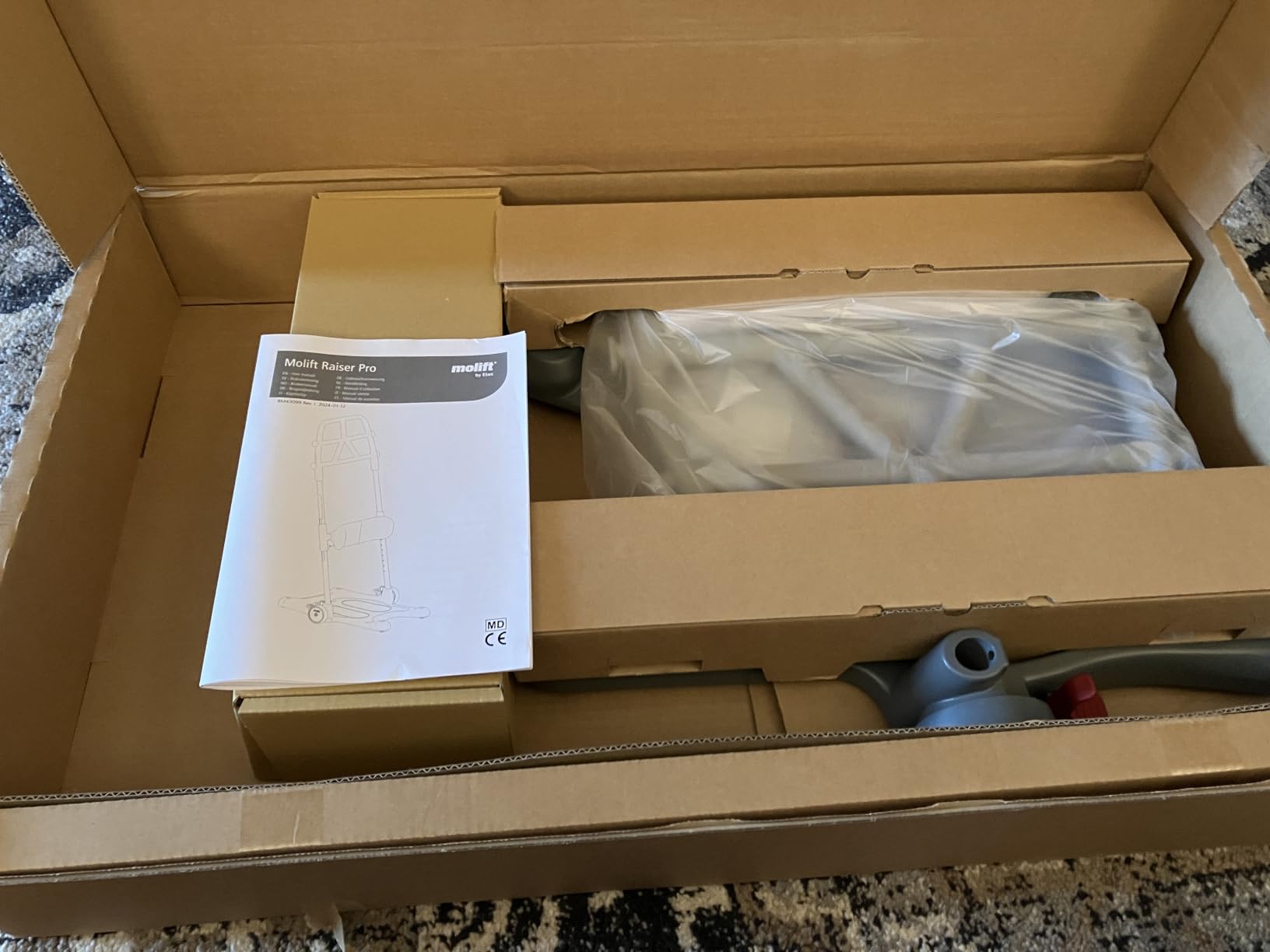
The Molift Raiser Pro changes the portability question. At 28.75 pounds it is less than half the weight of most frames in this list, which means one caregiver can genuinely reposition it rather than planning a two-person move. If your transfers happen in more than one room, that difference changes your daily routine more than any feature on the spec sheet.
The 1.4 inch base is also the lowest profile here, and it slides under furniture that stops every other model we examined. Padded, laterally stabilized leg supports and a soft-touch handle with multiple grip positions handle wide feet and larger frames well. Wheels roll smoothly over hard floors and thin carpet, according to owners.
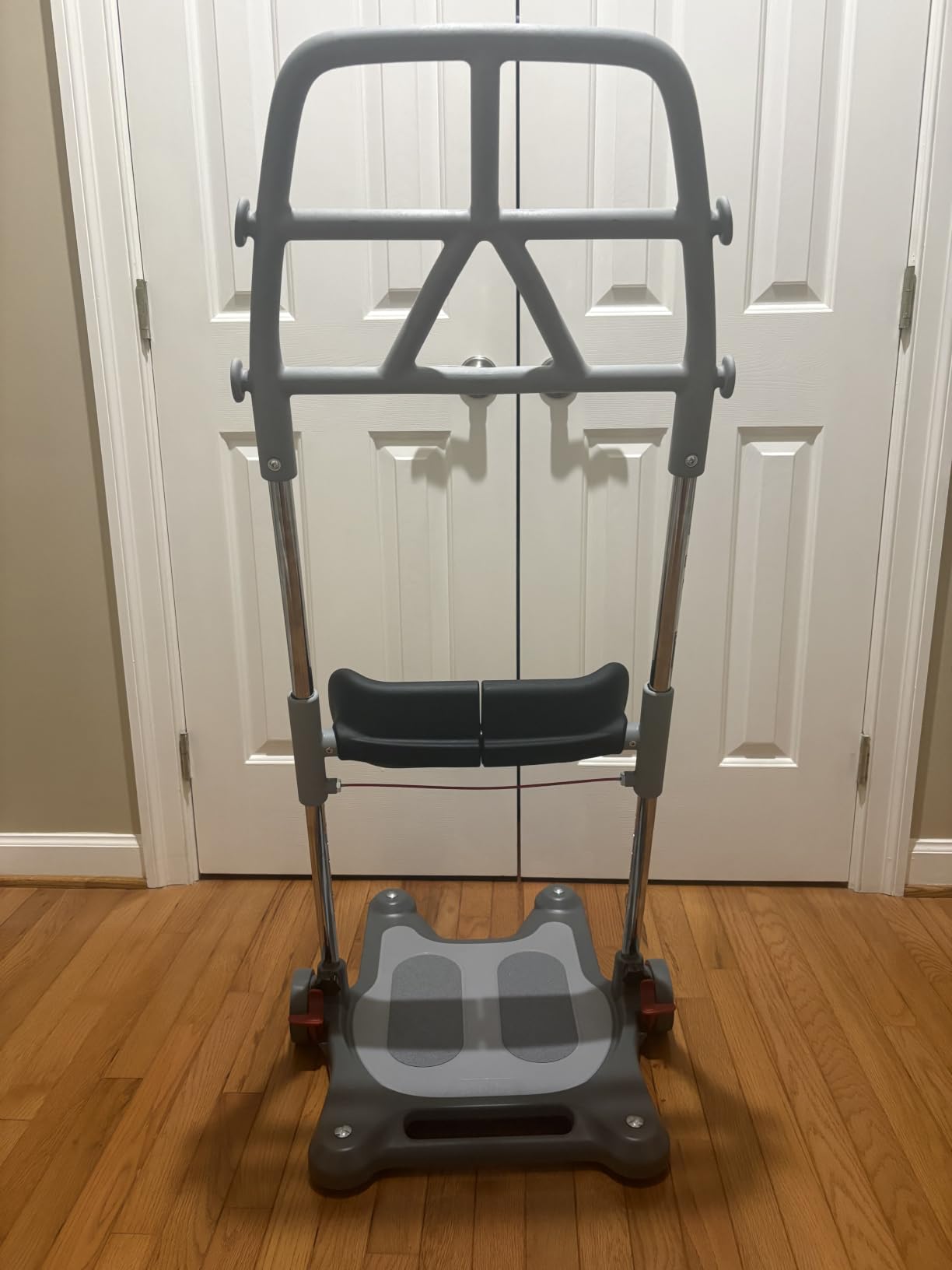
The one-touch central braking system is a genuinely smart piece of design. A single press locks both wheels from either side, so the caregiver does not have to walk around the frame or crouch down to find two separate brake pedals. It is the kind of detail that shows up in the first week and is quietly appreciated every day after.
Two limitations are real. The safe working load is 375 lb, below the 400 lb that nearly every other lift here is rated to, so a patient near the upper end of the range may not fit your needs. And the narrow footplate and knee cushion width can feel cramped for larger users. The optional lifting strap is also sold separately, which is a cost buyers should plan for rather than discover later. One reviewer also had to repair a mis-threaded screw hole during assembly.
Why weight matters more than it sounds
Frame weight determines whether a lift is a fixed piece of furniture or a working tool. At 28.75 pounds, one caregiver can move this from the bedroom to the bathroom without help, which is the difference between a device that gets used daily and one that sits in a corner because relocating it is too much effort.
The 1.4 inch base and central brake make it the pick for very tight rooms where every other frame will not fit or cannot be repositioned.
Where it does not work
Skip it if the patient is above the 375 lb safe working load, or if the user is a larger-framed person who will find the narrow footplate and knee cushion cramped. Those are stated dimensional limits, not judgement calls, and pushing past them produces an uncomfortable and less stable stand.
Also factor in the separately sold lifting strap if you want the extra support option, and note the small review base of 15 ratings, which means less long-term data than the higher-volume picks offer.
10. ProTraverce Sit to Stand Lift – Best for Adjustable Base Width
ProTraverce Sit to Stand Patient Lift, Stand Assist Transfer Aid with Adjustable Height & Adjustable Base for Elderly Seniors, Home Care Mobility Transport Assist Device, 400 lbs Capacity,Black
Capacity: 400 lb
Base width: 25.5 in adjustable
Height levels: 5 and 2 knee positions
Unit weight: 68.8 lb
Pros
- Foot-pedal width adjustment matches different chairs
- 400 lb reinforced heavy-gauge steel frame
- 25.5 inch base fits most doorways
- Backed by a 3-year guarantee
Cons
- Small review base limits long-term data
- 68.8 lb is heavy for one person
- User must bear 60-70% of body weight
The ProTraverce solves a mismatch that quietly ruins a lot of transfers. Rather than a fixed base width, it uses foot-pedal control to widen or narrow the base in a single step, letting you line the frame up with a narrow wheelchair, a wide recliner or a bedside clearance area. Most competing frames force you to commit to one width and work around it.
It carries a 4.6 star average from 15 reviews with no one-star ratings at all, and the frame is reinforced heavy-gauge steel rated to 400 lb with no reported lateral sway. Five height levels and two knee pad positions cover users from 5 ft 1 to 6 ft 6. The 3-year guarantee is tied for the longest in this group.
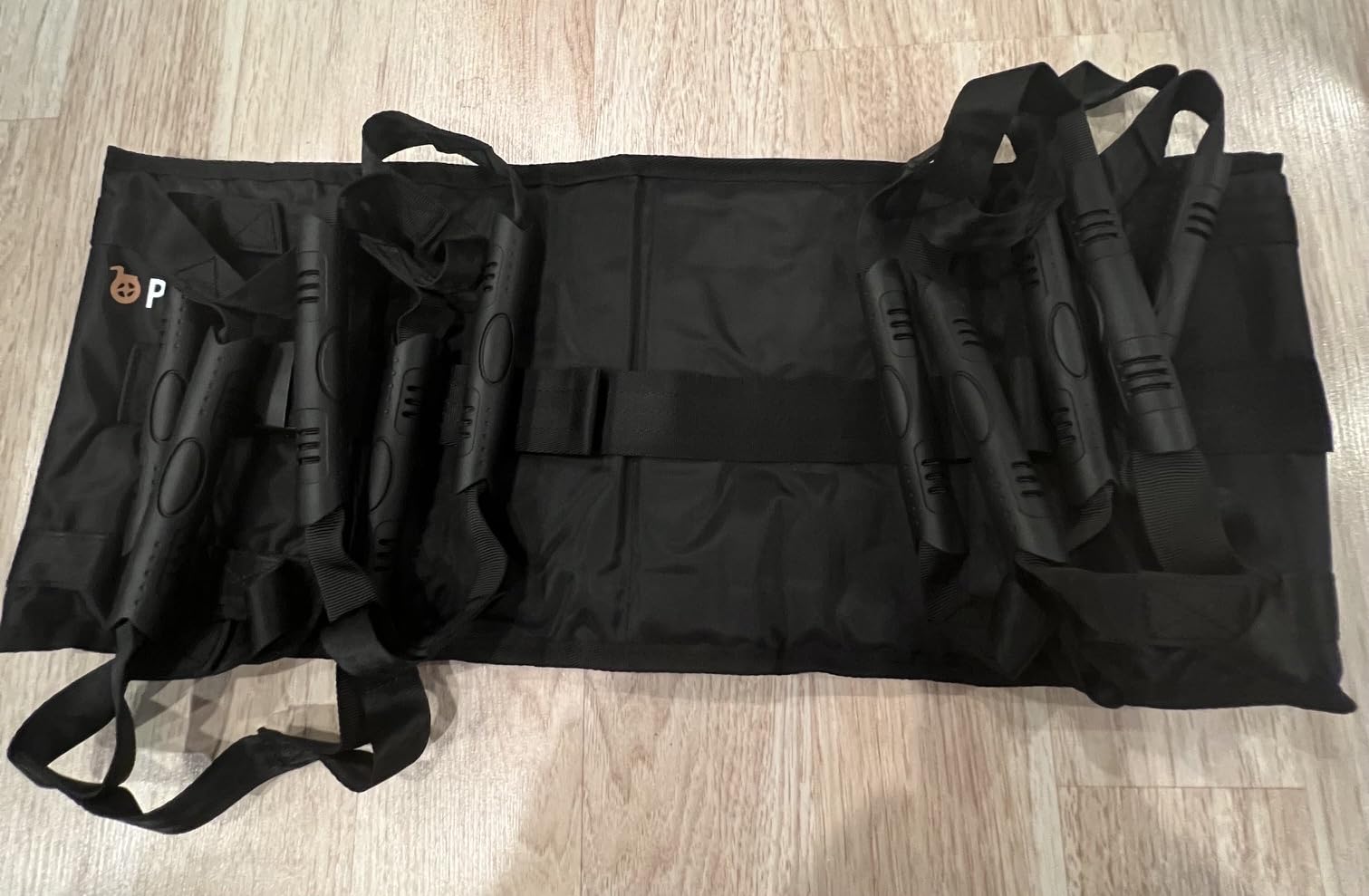
Comfort details are handled properly: foam-wrapped handrails, thickened shin pads and a split-seat design spread pressure across the leg and thigh during the standing phase, which is where patients report discomfort on cheaper frames. The 25.5 inch base fits most standard doorways, and the package includes a tool kit and instructions.
Two things temper the rating. The review base is only 15 ratings, so there is very little long-term durability data compared with a thousand-review product, and at 68.8 pounds this is a heavy frame for a single caregiver to move between rooms. Design quality and independent testing data are two different things, and this model currently has the first without much of the second.
When a variable base helps
Choose it if you move between a narrow wheelchair, a standard armchair and a bedside position. The foot-pedal adjustment takes seconds, so the base can match the target instead of forcing every transfer into a compromise position, and that reduces the trial and error that leads to falls.
It is also a good fit for a user between 5 ft 1 and 6 ft 6 who needs fine height tuning across a rehabilitation period.
Where it does not work
Skip it if you want a long-proven track record. Fifteen ratings tell you that early buyers are satisfied; they do not tell you how the frame looks after four years of daily transfers, and this is a category where that matters.
At 68.8 pounds it is not a one-person portable device, so plan a single dedicated transfer station. And as with the rest of this category, it requires the user to bear 60-70% of their own weight.
Sit-to-Stand Lift vs. Hoyer Lift vs. Stand-Assist Frame
Naming confusion is the single most common source of wasted purchases in this category, so it is worth sorting out before anything else. A sit-to-stand lift keeps the patient seated in a padded cradle throughout the transfer. A stand-assist frame is the manual, floor-level cousin of the same idea. A full-body patient lift uses a sling to raise someone clear of the bed entirely. And a sit-to-stand lift chair is a completely different product: a powered recliner that helps someone stand up out of the seat.
One more correction that matters: Hoyer is a brand name, not a category. It is frequently used as shorthand for any patient lift, which is why so many people search for the difference between a sit-to-stand lift and a Hoyer lift and find confusing answers. The useful question is not what it is called but whether the user bears weight during the transfer.
If the person can push through their legs and hold the handgrips, a sit-to-stand lift is the right family of device. If they cannot, you need a full-body sling lift, and no amount of adjustment will change that. Our full patient lift guide covers that category in detail.
How to Choose a Sit to Stand Lift: 6 Decisions That Matter
1. Manual or electric. Manual hydraulic frames have no battery to charge and nothing to fail electrically, and they let the patient do more of the work, which is useful in rehabilitation. Electric units do the lifting for the caregiver, which matters if you are tired, in a hurry, or assisting someone with a temporary weakness. Experienced caregivers in nursing forums consistently report that powered units are the easiest on the helper, and manual ones are harder on whoever is pumping.
2. Capacity and safe working load. Buy against the patient’s current weight, not a hoped-for future weight. Nine of the ten lifts here are rated to 400 lb, and the Molift Raiser Pro is rated to a 375 lb safe working load, which is lower than the category norm. Leave headroom, and check whether an accessory such as a sling has its own lower rating than the frame.
3. Base width and doorway clearance. This is where most surprise deliveries happen. Measure the narrowest doorway on the full route from bed to bathroom, and measure with the lift actually in the room, not from a listing. The Vive Mobility base is 26 inches, the PERLECARE is 26.5 inches, the ProTraverce is 25.5 inches and adjustable, the ELENKER is 25 inches, and the WHLICKS publishes 24 inches but measures closer to 23.75 inches in practice.
4. Floor clearance. Can the base slide under the bed, the sofa or the recliner you actually transfer on? A lift that cannot get under the surface cannot be used on it. The VOCIC with its 6 cm base and the Molift at 1.4 inches were designed around this, and the Invacare states a 4.5 inch clearance that fits most homecare beds.
5. Height range and adjustability. Seat height, knee pad height and leg length all affect whether the patient can plant their feet and generate a stand. More positions cost nothing at purchase time and save an enormous amount of frustration across a recovery. The PERLECARE, WHLICKS and ProTraverce offer the most adjustment in this group.
6. Buying channel and rental. Specialist durable medical equipment dealers provide setup guidance, white-glove delivery and warranty service, which matters for a frame you will use daily. Marketplace listings give you broader review counts and often lower entry points, but thin review counts on budget imports are a real trust gap, and so is discovering that replacement parts are unavailable later.
For bathroom transfers specifically, a dedicated device is often the better purchase than forcing a bedroom lift into a wet room. Our bath lift roundup covers that decision, and a good pair of slip-resistant shoes for caregivers does more for your own safety than most buyers expect.
Will Medicare or Insurance Pay for a Sit to Stand Lift?
Original Medicare coverage for sit-to-stand transfer equipment is limited, and families are often surprised by this. Durable medical equipment is covered under specific HCPCS codes, and the relevant ones for standing and transfer aids are E0630, E0631, E0635 and E0637. Which code applies depends on the device and the documentation your supplier provides, so the coverage decision follows the code and the medical necessity statement, not the product name.
There is a separate and important distinction involving CMS National Coverage Determination 376, which addresses power seat elevation systems. A power seat lift function in a recliner is treated differently from a transfer device that helps a person stand for a transfer. If you have seen claims that a lift chair is covered, that is a different benefit pathway from a sit-to-stand patient lift, and mixing the two leads to denials.
Lower-cost alternatives have clearer coverage in some situations. A raised toilet seat with arms is frequently the more realistic covered option for toileting support, and commode chairs, shower chairs and transfer benches can sometimes be covered when a sit-to-stand lift is not. If coverage matters to your household, ask a supplier for the exact HCPCS code they intend to bill before you buy, and get the answer in writing.
Medicaid, veterans’ benefits, long-term care insurance, workers’ compensation and auto insurance have different rules and often cover durable medical equipment more generously than Original Medicare. Ask your case manager, and check whether your state has a Medicaid durable medical equipment program for homebound recipients. If you are renting for a short recovery, the supplier usually handles the paperwork.
How to Use a Sit to Stand Lift Safely: 7 Steps
One trained caregiver can operate these devices safely. The protocol below is the sequence that reduces the risk of a fall or a dropped patient, and the hardest part for most families is step four, not the machine.
1. Lock the environment. Clear the path, remove rugs and cords, and set up the target chair or bed with its brakes on and positioned square to the lift.
2. Set the brakes. Engage the caster locks before the patient sits. On a one-touch central brake system a single press locks both wheels; on split designs, confirm both rear casters are locked rather than assumed.
3. Position the user. Have the patient sit fully back into the seat, with the backrest against their spine and the buttocks all the way to the rear. This is the step caregivers most often rush.
4. Align the knee pads. Set the knee pad so it rests against the lower shins, not on the thighs, and confirm the feet are flat on the floor or on the footplate. Misalignment here is the most common cause of a failed stand.
5. Cue the hands. Ask the patient to grip the handgrips and then follow a simple two-step cue: pull up, then push through the feet. Avoid a single complex instruction, and wait for confirmation before starting.
6. Raise slowly. Lift in stages rather than one continuous pull, and stop if the patient stalls or shifts. Never pull on a patient who is not participating.
7. Pivot and lower. Once balanced, move the base with small steering inputs, align the target, and lower the patient slowly into the chair. Release only after their weight is fully on the seat.
If a patient with dementia resists or becomes confused, the device is rarely the problem. Caregivers on dementia forums describe the difficulty as behavioral rather than mechanical, and report that a fixed routine, a calm cue and a second helper during the transition period matter more than any model change. Training and practice do more here than shopping does.
When a Sit to Stand Lift Is the Wrong Choice
The best lift for a patient who cannot stand is not a sit-to-stand lift. If the person cannot bear any weight, cannot follow a cue, or cannot hold their head and trunk steady, a stand-assist device will not lift them; it will tip or drop them. A full-body sling patient lift, and for long-term care a floor or ceiling-mounted lift, is the correct family of device.
Signs you have the wrong category include repeated failed attempts that leave the patient sliding forward, an inability to reach the floor with the feet, a patient who becomes distressed or unresponsive mid-transfer, and a caregiver who is bracing the patient’s weight with their own body. None of those are problems a different model in this category will solve.
Moving to the wrong category is also how people get hurt. If you suspect the patient has crossed from partial to no weight-bearing ability, ask an occupational or physical therapist to reassess before buying anything.
Frequently Asked Questions
Does Medicare pay for sit-to-stand lifts?
Original Medicare coverage for sit-to-stand transfer equipment is limited. Durable medical equipment falls under specific HCPCS codes, with E0630, E0631, E0635 and E0637 being the ones most relevant to standing and transfer aids. Coverage follows the code and a medical necessity statement rather than the product name, so ask a supplier which code they plan to bill before you buy. Medicaid, veterans’ benefits and long-term care insurance often cover more.
What is the best sit-to-stand lift?
The best sit-to-stand lift depends on your doorway width, floor clearance and how much weight the user can bear. Our overall pick is the Lumex LF1600 for its large review base and consistent owner feedback. The Vive Mobility unit is the strongest value with a two-year guarantee, the VOCIC suits low furniture, and the Molift Raiser Pro is the lightest for repositioning between rooms.
Can one caregiver operate a sit-to-stand lift alone?
Yes, provided the user has partial weight-bearing ability, can grip the handgrips and can follow a two-step cue. Experienced caregivers report that a mechanical sit-to-stand lift lets one person toilet and transfer a patient independently. Move the unit in stages, confirm the brakes are locked, and stop if the patient stalls. A patient who is entirely non-weight-bearing needs a full-body lift instead.
What are some good electric sit-to-stand lifts for home use?
Most lifts in this roundup are manual or hydraulic rather than electric, which is why no motor or battery appears in most specifications. Caregivers consistently report that electric units are the easiest on the helper because the machine does the lifting. If your priority is reducing caregiver effort rather than having the patient build leg strength, look for a powered sit-to-stand lift from a durable medical equipment dealer.
What is the difference between a sit-to-stand lift and a Hoyer lift?
A sit-to-stand lift keeps the user seated in a padded cradle while a caregiver and the patient raise them to standing. A full-body patient lift raises someone clear of the bed using a sling. Hoyer is a brand name often used as a synonym for any patient lift. If the user can push through their legs, a sit-to-stand lift is appropriate; if not, a sling lift is the correct device.
The Verdict: Which Sit to Stand Lift Should You Buy in 2026?
For most home caregivers, the Lumex LF1600 is the pick: the largest review base in the category, comfortable padding, and predictable behavior after years of real use. Buy the Vive Mobility if you want a manufacturer guarantee behind the frame. Buy the VOCIC if your furniture sits low, the Molift Raiser Pro if one caregiver needs to move the lift between rooms, the Invacare GHS350 if the patient needs a sling, and the ProTraverce if the base must match different chair widths.
Before any of them, measure the narrowest doorway on the transfer route and the height of the surface you are transferring on. Those two numbers eliminate more wrong purchases than any spec sheet. If the patient cannot bear 60-70% of their own weight, stop and look at a full-body patient lift instead. This guide is educational information and not medical advice; a clinician or occupational therapist should confirm that a sit-to-stand lift is appropriate before you buy.