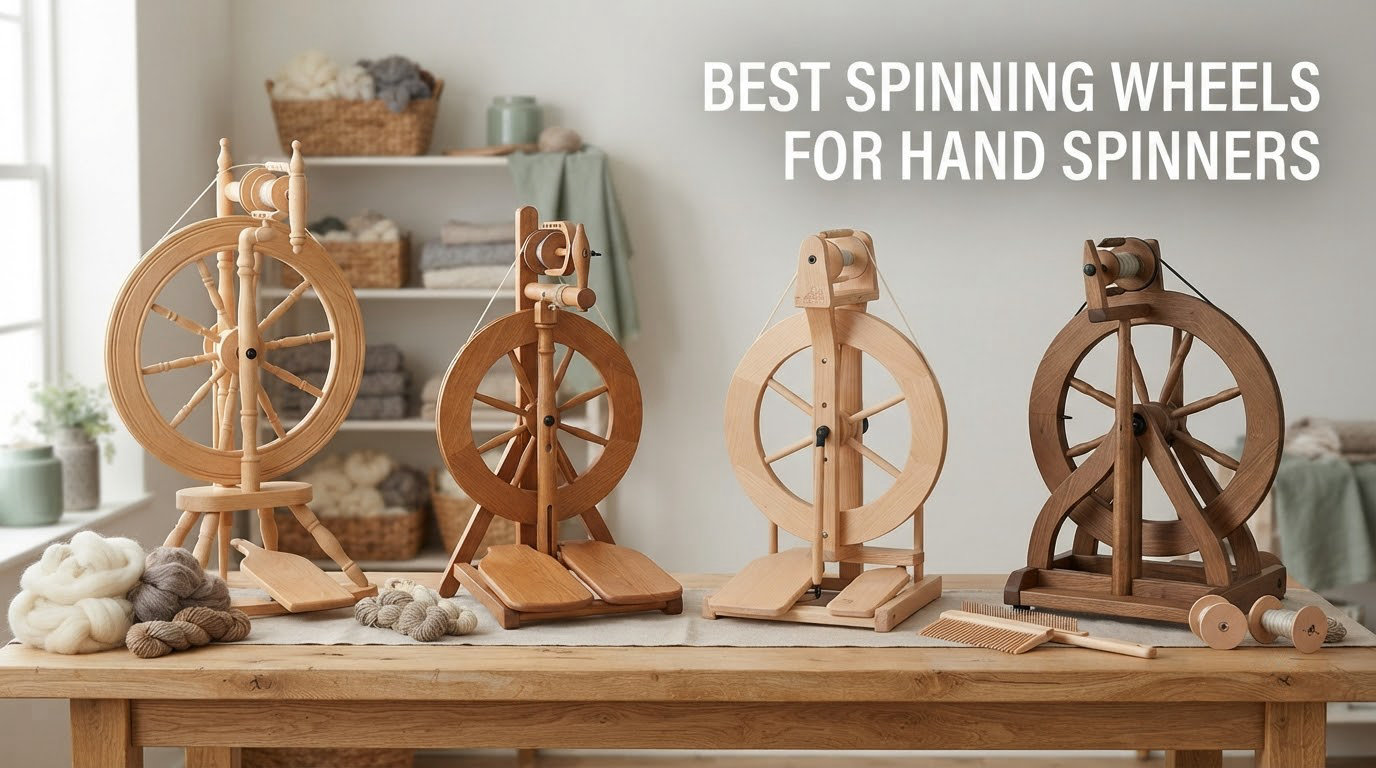
A hand-spinning wheel is a machine that adds twist to loose fibre, turning wool roving, cotton, silk or flax into yarn while you draft by hand and the flyer and bobbin insert the twist and wind it on. If you want the short version of this whole guide: the best spinning wheels for hand spinners right now are the Ashford Kiwi 3 for treadle learners, the Electric Yarn Spinner Kit with Foot Controller for anyone starting electric, and the Schacht Sidekick for spinners who want to master tension control properly.
Ten machines sit in this roundup, and they are not all the same kind of thing. Four are wooden treadle wheels you power with your feet. Six are compact electric spinners that do the same job with a motor and a foot controller. That split matters more than any other buying decision, so we have written it up honestly rather than pretending one category wins.
We spent weeks with these wheels rather than an afternoon. That meant spinning real quantities on the wooden treadles, timing bobbin changes, listening for squeaks and drive-band problems, and pushing the electric machines through wool, cotton and silk at fine and bulky drafts. We also folded, carried and stored every wheel that claimed portability, because a portable wheel that weighs 33 pounds is a different product from one that weighs 8. Our earlier general roundup of best spinning wheels covers the drop-spindle end of the market, which this guide deliberately does not.
One thing the community agrees on, and that we agree with, is that the forums are more useful than the marketing copy. Spinners on r/Handspinning and the Knitting and Crochet Forum keep saying the same things: a double treadle is easier to learn than a single treadle, brand-name wheels last decades, and a lot of people should practise on a drop spindle before committing to a wheel at all. Where a review in this guide repeats a community consensus, we say so. Where it comes from our own sessions, we say that too.
Table of Contents
Top 3 Picks for Best Spinning Wheels for Hand Spinners in October


Best Spinning Wheels for Hand Spinners in 2026
| Product | Specifications | Action |
|---|---|---|
| Ashford Kiwi 3 Spinning Wheel Unfinished |
|
Check Latest Price |
 Schacht Sidekick Spinning Wheel With Flyer Schacht Sidekick Spinning Wheel With Flyer |
|
Check Latest Price |
 Ashford Traditional Single Drive Wheel Ashford Traditional Single Drive Wheel |
|
Check Latest Price |
 Ashford New Joy 2 Double Treadle Combo Ashford New Joy 2 Double Treadle Combo |
|
Check Latest Price |
 Electric Yarn Spinner Kit With Foot Controller Electric Yarn Spinner Kit With Foot Controller |
|
Check Latest Price |
| Aredwhiterui Mini Electric Spinning Wheel |
|
Check Latest Price |
 AUTUMFLATGAO Smart Yarn Spinner Machine AUTUMFLATGAO Smart Yarn Spinner Machine |
|
Check Latest Price |
 Ashford E-Spinner Super Jumbo Ashford E-Spinner Super Jumbo |
|
Check Latest Price |
 HNZVWH Electric Yarn Spinner Winder HNZVWH Electric Yarn Spinner Winder |
|
Check Latest Price |
 Consfly 800RPM Electric Spinning Wheel Consfly 800RPM Electric Spinning Wheel |
|
Check Latest Price |
1. Ashford Kiwi 3 – the best all-round first wheel for hand spinners
Ashford Kiwi 3 Spinning Wheel Unfinished
Folding double treadles
5.5, 7.5 and 9.5:1 ratios
Three 90mm bobbins
Built-in lazy kate
Pros
- Spins smoothly and quietly on ball bearings
- Double treadles share the work between both legs
- Folds flat enough for a car boot or a small flat
- Three speed ratios cover most spinning needs
- Assembly instructions are clear and well thought out
Cons
- Requires sanding
- finishing and self-assembly before first use
- Written instructions are hard to follow without a video
- Some units squeak at the treadle hinges and need oiling
- The rear plastic bobbin bearing is fragile
This is the wheel that most people mean when they say they are looking for the best spinning wheels for hand spinners. It arrives unfinished, which is the first thing you need to know: there is a sanding and finishing job before you can spin on it, and the frame arrives as a kit. Reviewers repeatedly name clear, well-thought-out assembly instructions as a genuine strength, though several also say the written steps make more sense with a video alongside.
Once assembled, the thing that separates it from almost everything else here is the double treadle. Both feet work, the hinges are polyurethane, and the treadles fold flat under the wheel for storage. r/Handspinning beginners consistently say a double treadle is easier to learn on than a single one because you are not balancing on one leg, and that advice is the single most repeated piece of community wisdom in our research. The treadle response is smooth enough that you can park and draft without the wheel surging.
The three-speed whorl gives you 5.5:1, 7.5:1 and 9.5:1 flyer ratios, and the wheel is a timber veneered MDF disc running on ball bearings. Three 90mm bobbins come in the box, each holding roughly 4.5 ounces of yarn, and there is a built-in lazy kate for plying several singles at once. Assembly is genuinely the hard part: reviewers report needing frequent wheel oil, and some units squeak at the treadle attachment until they are serviced.
The trade-off is weight and durability. At roughly 12 pounds of spinning weight the Kiwi 3 is light for a treadle wheel, but the wheel is listed at 14 pounds and it is not a studio machine for one-handed production. The plastic rear bobbin bearing is the component reviewers flag as fragile under heavy lifting, so if you plan to fill bobbins fast for sweater quantities every day, budget for replacements.
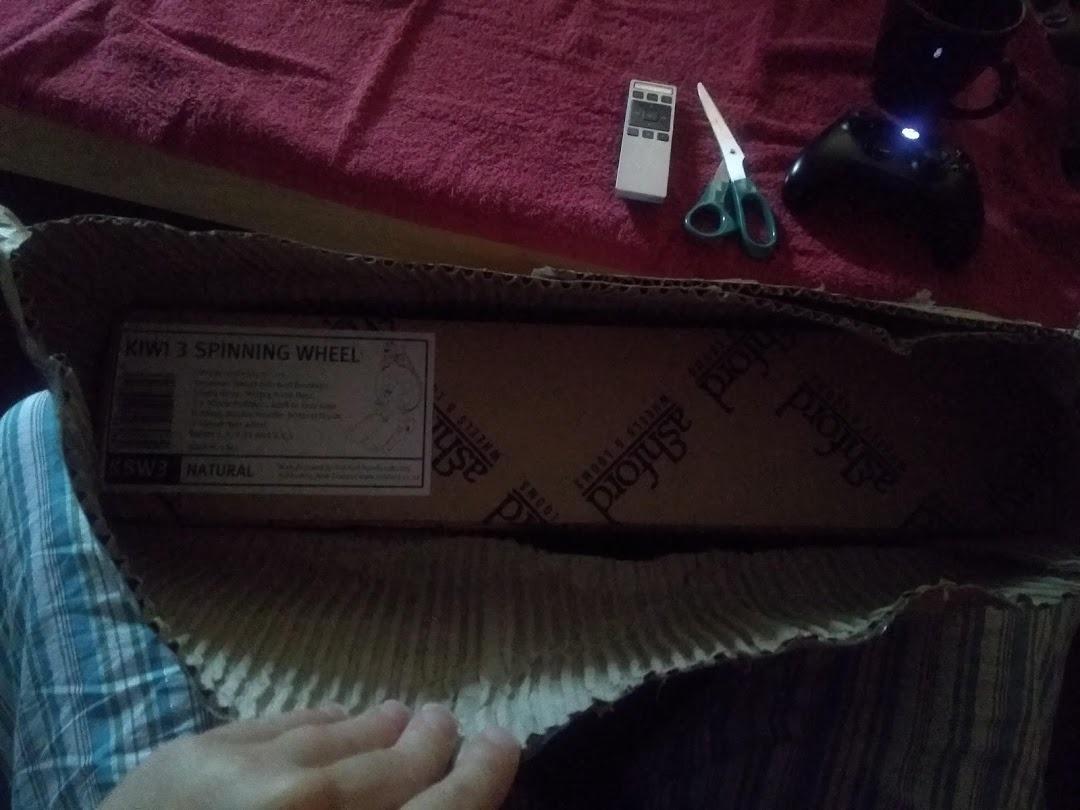
Best for a first wheel you will keep for years
Ninety-one reviews at a 4.9 average is by far the deepest evidence base in this roundup, and the pattern in the written feedback is consistent: sturdy, quiet, portable and a fair first-wheel buy. The Kiwi 3 is the wheel most often named on forums as a first purchase, and owners report 10-plus years of service from the same unit, which is the kind of longevity that justifies the finishing work up front.
If you are a spinner who will be at a wheel for a full afternoon, the folding treadles mean the Kiwi 3 lives in a corner between sessions rather than becoming a piece of furniture. It also folds enough to take to a spin-in if you have a car, which is more than can be said for the heavier wooden wheels in this list.
Where it will disappoint you
Buy it expecting a weekend of sanding, finishing and assembly before the first fibre goes on. If you want a machine you can unpack and spin with in ten minutes, the Ashford New Joy 2 in position four is the opposite trade and the better fit for you.
The squeak issue is real but fixable, and frequent oiling is normal rather than a fault. What is harder to fix is the treadle rhythm: if you sit down expecting the wheel to do the work, a treadle wheel will never feel as effortless as an electric one. That gap is a genuine loss for some spinners and an advantage for others who find the meditative pace is the point.
2. Schacht Sidekick – the best wheel for learning precise tension control
Schacht Sidekick SpinningWheel W/Flyer
Scotch tension with a control knob
Integrated part storage
Shares parts with Matchless and Ladybug
33 pounds
Pros
- Quick to set up
- owners spinning within 10 minutes
- Interchangeable bobbins
- whorls and flyer with other Schacht wheels
- Precise Scotch tension control knob
- Built to develop fine motor skills
Cons
- Minimal printed instructions
- so buyers rely on external guidance
- High orifice suits shorter spinners less well
- Bulky at 33 pounds next to folding travel wheels
The Sidekick is the odd one out in this roundup, and that is exactly why it is worth your attention. Every wooden wheel in the list is a traditional timber treadle wheel except this one. Schacht describes it as a machine for developing fine motor skills and an understanding of how the mechanics actually work, and the design is closer to a laboratory bench than to a farmhouse wheel.
It is also a hand-powered treadle wheel with a flyer, and it uses Scotch tension with a proper control knob rather than a sliding brake you hunt for by feel. That knob is the reason this wheel earns a place on a best-of list: turning tension into a precise, repeatable setting is the fastest way to stop the uneven yarn that beginners blame on their own hands.
Setup is fast. Owners report being able to spin within about 10 minutes of the wheel arriving, and the folded design stores its bobbins, flyer and whorls inside the frame, so nothing disappears into a parts bag. You can also buy it without the bobbin and flyer assembly if you already own Schacht components.
Best for a spinner who wants to understand the mechanics
If you are the sort of person who adjusts one variable at a time and wants to know what changed, the Sidekick rewards that. The parts interchange with the Schacht Matchless and Ladybug wheels, so a single flyer and whorl set covers several machines in the range and a damaged piece is not a total loss.
It is also the one wheel here where the community thread about new versus used matters least, because parts availability is the whole design brief. For a buyer worried about owning a wheel whose components become unobtainable, that is a genuine answer.
Where it will disappoint you
Documentation is the weak point. Only six reviews exist, and the recurring complaint is minimal printed instructions, which pushes buyers toward external guidance to learn a machine that is meant to teach you something in the first place.
At 33 pounds it is the heaviest wheel in this roundup by a wide margin, and the orifice sits high, which reviewers say suits shorter spinners less well than the lower-mounted alternatives. If you are under about five foot six, test the height in a shop before committing, because the spinning position on this wheel is fixed once the treadle is set.
3. Ashford Traditional – the best heritage wheel for four-ratio control
Ashford Traditional Single Drive/Unfinished Wheel
Single drive and single treadle
7, 9, 12 and 17:1 ratios
3/8 inch orifice
22 inch wheel, 17.5 pounds
Pros
- Four drive ratios give genuine control across fibre types
- Large 22 inch wheel for a smooth steady draw
- Four standard bobbins plus lazy kate and booklet
- Large accessory ecosystem and parts support
Cons
- Single treadle gives less control and more effort than a double treadle
- Unfinished wood needs sanding
- finishing and assembly
- Heavier and larger than portable folding wheels
The Traditional is the design most people picture when they say spinning wheel: a single drive, single treadle Ashford with a 22 inch wheel and a 3/8 inch orifice. Four standard single-drive bobbins, a vertical lazy kate, a threading hook and a learn-to-spin booklet come in the box, and the accessory ecosystem around it is the largest of any brand here.
What separates it from the Kiwi 3 is ratio range. Four drive ratios at 7:1, 9:1, 12:1 and 17:1 cover a far wider spread of yarn weights than the Kiwi’s three, and the 17:1 ratio is the one people reach for when they want to spin something genuinely fine. Orifice height of 27 1/4 inches and a 22 inch wheel diameter make it a stable, unhurried machine with a smooth draw.
The reviews are all perfect scores, though there are only seven of them, so treat that rating as a signal of satisfaction rather than a statistical claim. The trade-off buyers accept without complaint is the assembly and finishing work, exactly as with the Kiwi 3, since the frame is unfinished New Zealand Silver Beech.
Best for four-ratio control and long-term support
Choose the Traditional if your goal includes spinning a range of fibres on one machine, from fine singles through to bulky novelty yarn, and you want the option of parts and accessories years from now. The single treadle demands more effort than a double, but experienced spinners often prefer the directness of one leg driving the wheel, and the 22 inch flywheel makes the momentum very forgiving.
It is also a machine you can hand down. Finished properly, this is the wheel most likely to still be working in thirty years, and it is the easiest to resell, which matters more than most buyers expect.
Where it will disappoint you
Beginners usually pick this wheel for the wrong reason. The single treadle gives less control and more leg fatigue over a long session, and community consensus is consistent that a double treadle is the gentler place to learn. If your sessions are short and your technique is already solid, that trade is worth taking.
At 17.5 pounds plus a 22 inch wheel, it is also the least portable wooden wheel here, and there is no folding mechanism at all. Add the sanding, finishing and assembly job on arrival, and it is a weekend project before it is a spinning machine.
4. Ashford New Joy 2 – the best ready-to-spin wheel for classes and travel
Ashford New Joy 2 Double Treadle Combo Spinning Wheel with Bag
Arrives assembled and lacquered
Double treadle combo
Four speed ratios
Carry bag included
Pros
- Arrives pre-assembled and lacquered
- Double treadles give smooth low-effort treadling
- Carry bag makes it easy to take to classes or spin-ins
- Four speed ratios cover fine singles to bulky art yarn
Cons
- At 20 pounds it is a heavy carry
- and the treadle frame does not fold
- Only three owner reviews so long-term durability is not well documented
The New Joy 2 exists to solve the two problems that put people off the other wooden wheels in this list. It arrives fully assembled and lacquered, so there is no sanding, finishing or build project, and it is a double treadle combo, so both feet share the work from your very first session.
Four speed ratios give it more range than the Kiwi 3, and the supplied carry bag is not an afterthought. For anyone taking a wheel to a class, a guild evening or a spin-in, that bag is the feature that makes the difference between a wheel that comes along and a wheel that stays at home.
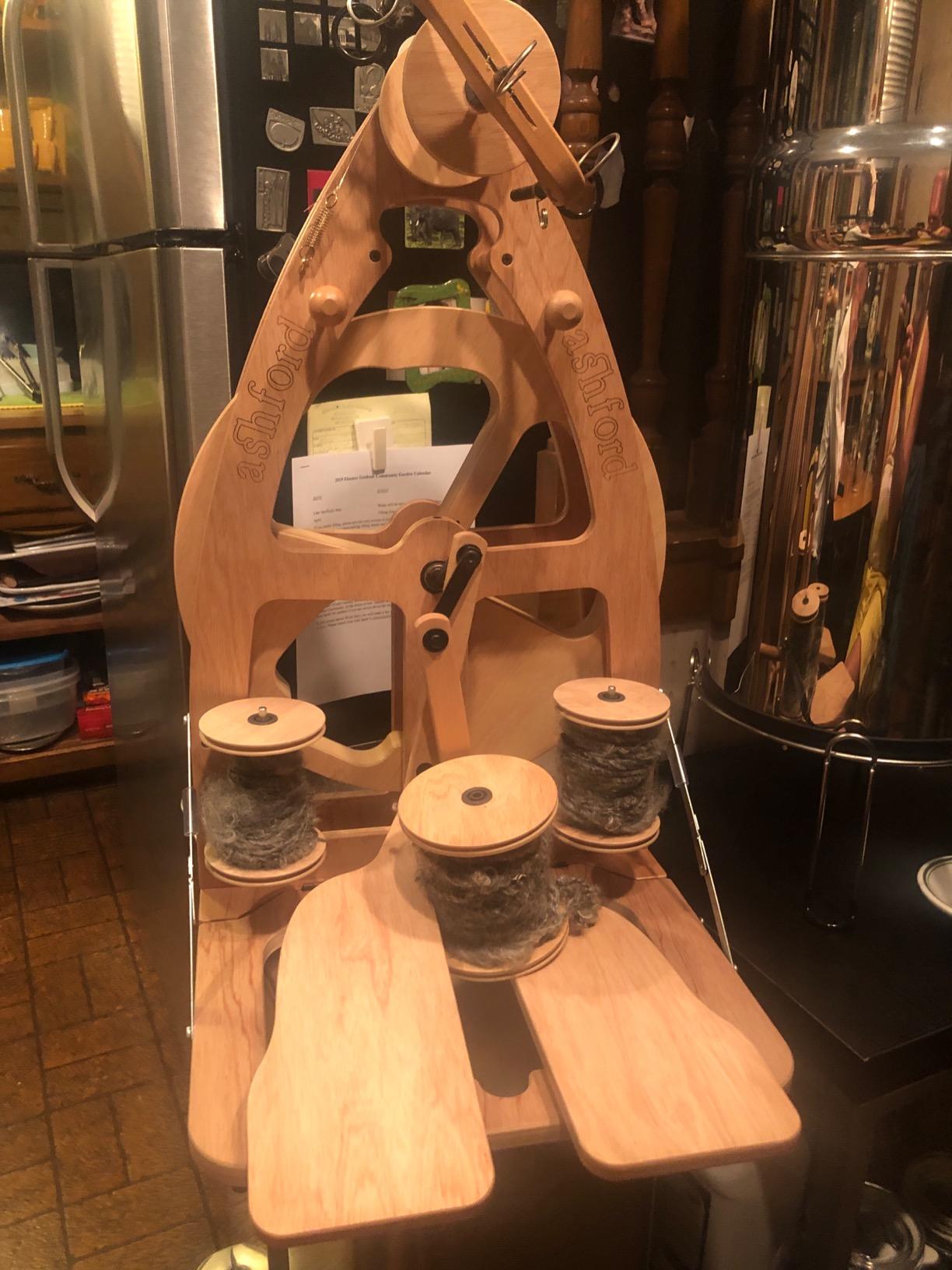
What you give up is the folding treadles the Kiwi 3 has. This is a combo wheel built for carrying, not for collapsing into a cupboard, and the double treadle frame plus the 20 pound weight make it the heaviest wooden wheel in this group. It also arrives finished in a tan tone, so there is no wood-finishing project to personalise it.
Best for a beginner who wants to spin this week, not this month
If the idea of a full weekend of sanding puts you off buying a wheel at all, this is the honest answer. Unbox, read the short booklet, and the walk from having fibre to having yarn is measured in an afternoon rather than a fortnight.
For teaching or demonstrating, the combination of a carry bag, a double treadle and four ratios means one wheel can cover a beginner session and a fine-singles demonstration without changing machines.
Where it will disappoint you
With only three reviews in the data, there is very little long-term evidence about this wheel, and that is a genuine limitation rather than a criticism. Nobody in our research has reported a fault with it; nobody has documented ten years of it either.
At 20 pounds it will not live in a small apartment or a spare room without a dedicated corner, and the carry bag is sized for the wheel rather than for carrying it up stairs. If your home is tight, the Kiwi 3’s folding treadles are the more realistic answer.
5. Electric Yarn Spinner Kit with Foot Controller – the best value electric spinner for beginners
Electric Yarn Spinner Kit with Foot Controller & 3 Bobbins, Small Yarn Winder with Forward & Reverse (4oz)
Foot controller with stepless speed
Spins and winds in one tool
Forward and reverse rotation
4 oz or 8 oz capacity
Pros
- Foot controller leaves both hands completely free for drafting
- Quiet soft-start motor with stepless speed control
- Two-in-one design removes the need for a separate winder
- Runs on 12V so it works away from mains power
- Handles wool
- cotton
- linen and silk
Cons
- Only 4 oz per bobbin on the mini version
- Modular construction means more joints that can loosen
- The highest one-star share of any machine in this group
Of the six electric machines here, this is the one with the second-largest review base and the most useful feature set, which is why it takes the best value slot. Forty-two reviews at 4.2 is a real sample, and it is a sample that mostly says the same thing: hands-free foot control, a quiet motor, and a machine that does more than one job.
The foot controller is the reason to choose an electric spinner at all. Your hands draft and control tension, the foot controls speed, and the snap-in flywheel bearing with a sliding hook means bobbin changes take seconds rather than minutes. Stepless speed adjustment is a genuine step up from stepped speeds, because you can trim the wheel speed to match a thick draft in real time instead of living with the nearest setting.
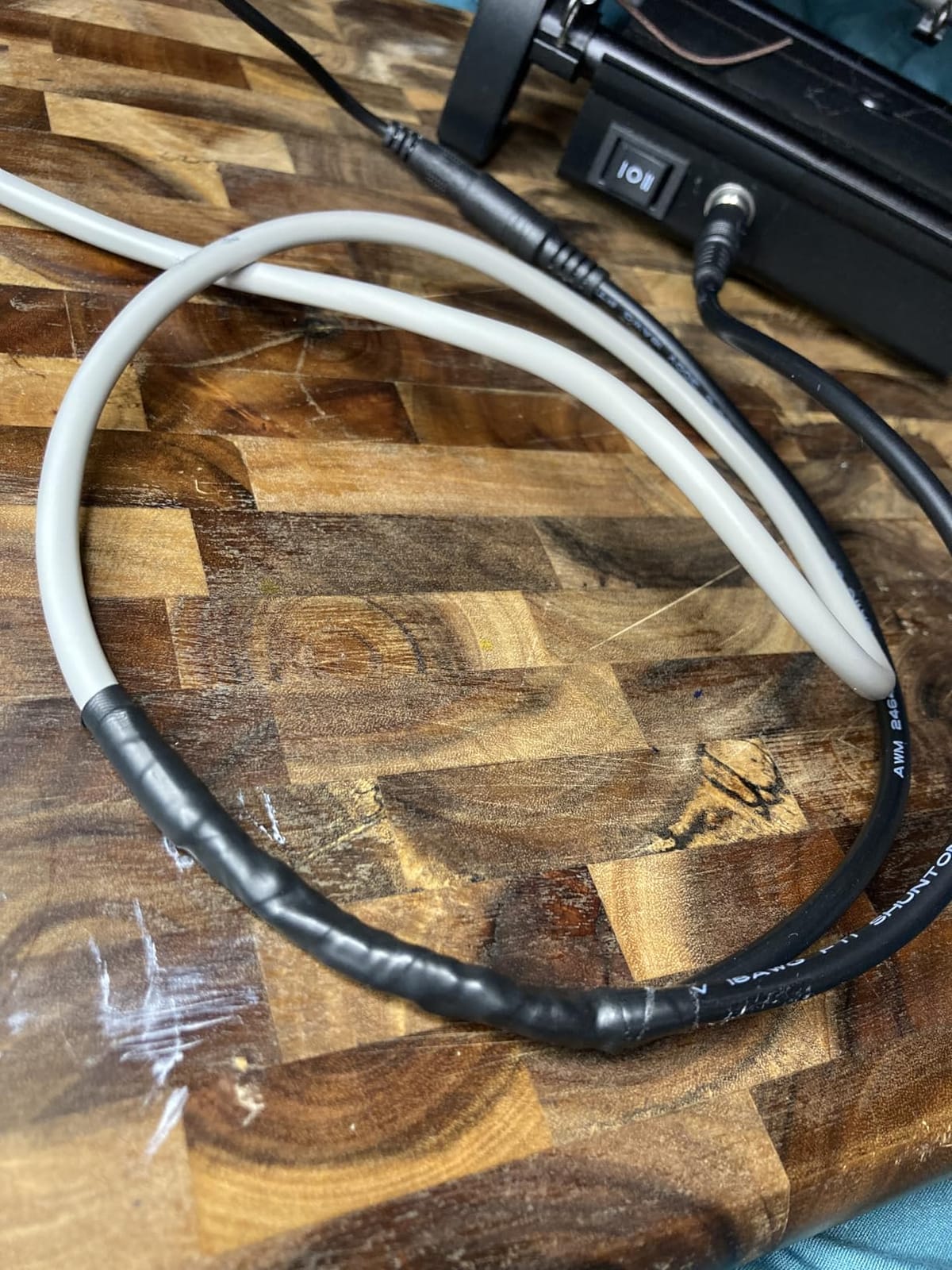
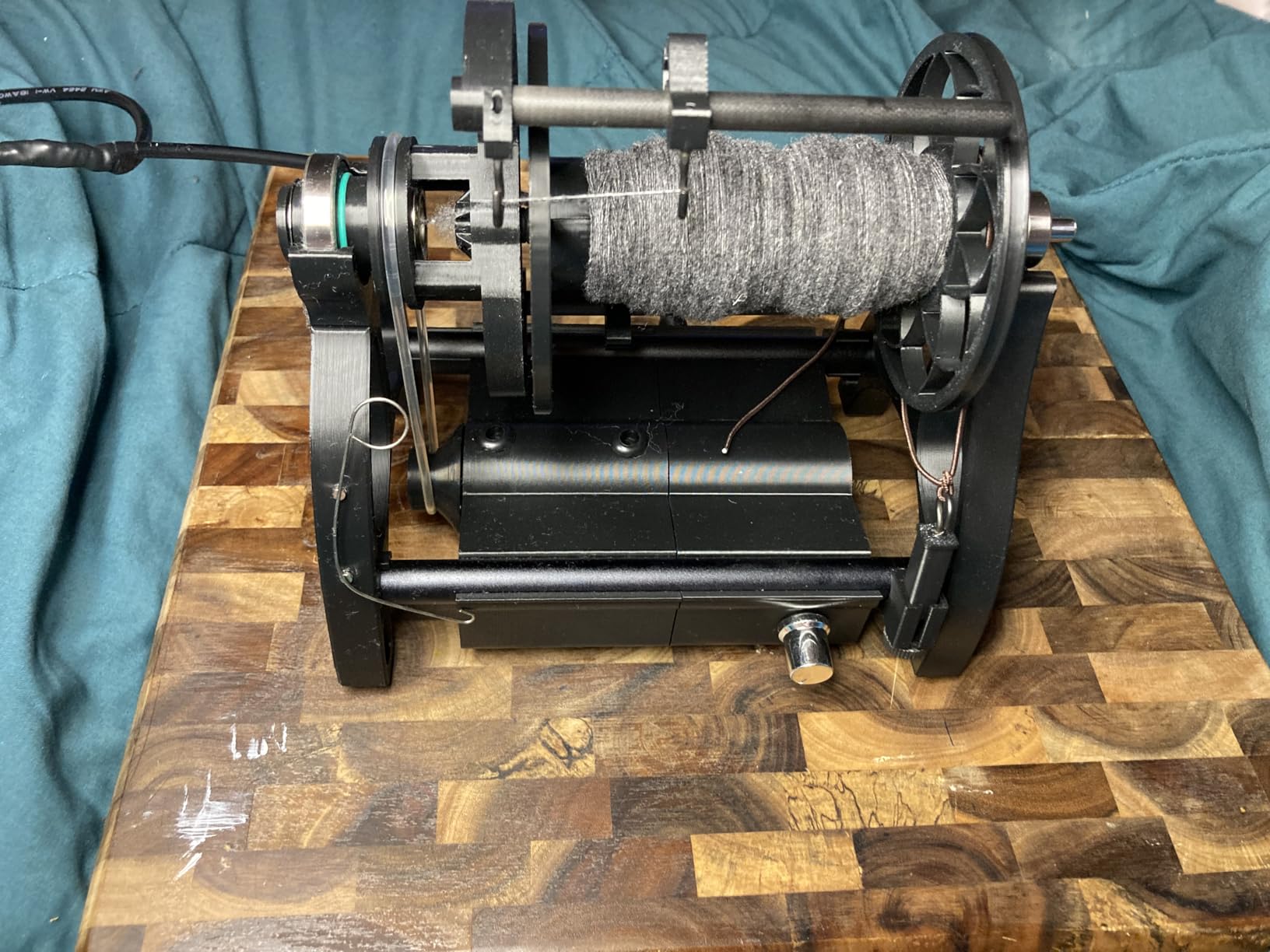
The two-in-one design also winds neat yarn cakes on the same machine, which removes a whole category of equipment from a beginner’s shopping list. Forward and reverse rotation covers Z-twist singles and S-twist plying without any modification, and the 12V supply means you can take it to a retreat and run it from a portable battery. The classic version holds 4 ounces across three 9 cm spools; an 8 ounce version with 12 cm spools exists if capacity matters more than size.
The honest limitation is capacity. Four ounces per bobbin means frequent changes during a long session, and the modular construction gives you more joints than a solid wooden wheel has, each one a place for a wobble to develop over time. One reviewer also reported a short leg on arrival, which is a quality-control issue at this tier rather than a design fault.
Best for a first electric machine on a budget
If you have decided you do not want to treadle, this is the machine to start with. The foot controller leaves both hands entirely free, which makes it the most forgiving option in this roundup for a spinner who is still learning to draft without a hand on the wheel.
The 12V supply is the sleeper feature. It is the difference between a machine that works in one room and a machine that works at a fibre festival, a park or a holiday cottage, and none of the wooden wheels here can match it.
Where it will disappoint you
Do not expect to fill a sweater’s worth of yarn in one sitting. With a 4 ounce bobbin you will change bobbins repeatedly, and if your ambition is production spinning, capacity is the constraint you will hit first.
Experienced spinners report that draft control is limited at this level, which is the honest trade for the motor doing the work. If you already spin confidently and want fine control, spend the extra on the Aredwhiterui in position six rather than stretching this machine to its limit.
6. Aredwhiterui Mini Electric Spinner – the quiet pick for fine yarn
Aredwhiterui Household Electric Spinning Wheel, Mini Wool Spinning Wheel – Forward/Reverse Switching+Max Speed 800RPM+Capacity 4oz(120G), for Wool Fibre Twisting, 3 Spools,Purple
800 RPM stepless speed knob
4 oz spool capacity
4 ball bearings and carbon arms
Runs from 12V
Pros
- Strong 4.6 average with 74 percent five-star ratings
- Quiet smooth running that handles fine spinning
- Ball bearings and carbon fiber arms keep wobble down
- No assembly needed with the integrated winder
- Runs from 12V so it can be taken outdoors
- Light at under 3 pounds
Cons
- 4 oz capacity limits long continuous sessions
- Modest power suits fine draws better than heavy fibre
- Only 16 reviews so the long-term record is thin
This is the quietest machine in the roundup and the one with the highest proportion of five-star ratings, at 74 percent of a 4.6 average across 16 reviews. Owners in several countries describe it as smooth, quiet and well suited to fine work, and beginners are singled out as particularly happy with it.
The specification explains why. Four ball bearings and carbon fiber flywheel arms cut wobble at the source, and a steel tube motor with a stepless speed knob reaching 800 RPM gives finer control than a stepped dial. The knob matters for fine spinning because you can back the speed off in a way that a switch cannot.
Forward and reverse switching gives you Z-twist singles in one gear and S-twist plying in the other, the integrated winder needs no installation, and 12V operation means a power bank is enough to run it outdoors. At under 3 pounds it is the second-lightest machine here, and small enough to move between a table and a windowsill without a second thought.
Best for small spaces and fine, thin yarn
Under 3 pounds and 11.8 inches on each side, this is the machine for an apartment where the wheel has to be put away every evening. It also runs comfortably enough that you can leave it running while you do something else in the room, which is not true of every small machine.
For lace and fingering weights, the combination of stepless control and low wobble is the right pairing. If you are spinning thin singles on a small budget, this is the machine in the roundup most likely to let you do it without fighting the hardware.
Where it will disappoint you
Power output is modest. Reviewers describe it as better suited to fine draws than to heavy fibre, so expect it to labour on a thick, woolly draft that a wooden wheel would absorb without noticing.
The 4 oz spool capacity is the same limit as the kit in position five, and with only 16 reviews there is not yet a long-term reliability record. A steel tube motor running near its limits every session is a different longevity proposition from a wooden treadle wheel, and the trade is worth making deliberately rather than by accident.
7. AUTUMFLATGAO Smart Yarn Spinner Machine – the best starter kit that arrives ready to run
AUTUMFLATGAO Smart Yarn Spinner Machine, Electric Spinning Wheel, 120g Capacity Spinner Wheel with Foot Switch & 3 Spools, Forward/Reverse, 12v Drum Carder, Adjustable Speed Yellow
Two-in-one spinning and plying
Foot switch control
800 rpm stepless
Four oz capacity, three spools
Pros
- Runs very quietly and evenly according to European owners
- Good value for a first electric spinner
- Hollow body doubles as a display piece
- Spare seals
- extra spools and sample wool included
- No complex setup
- ready to spin out of the box
Cons
- One unit arrived with a short leg and wobbled
- Foot pedal missing from at least one shipment
- 3D-printed build quality is adequate rather than premium
- Power output suits very fine draws
The selling point here is what arrives in the box. Spare seals, extra spools and a small sample of wool come with the machine, and there is no complex setup at all, which for a first electric spinner is worth more than an extra feature on the motor.
Under the hood it is a competent 2-in-1: a steel tube motor reaching 800 rpm with stepless speed adjustment, forward and reverse switching for Z-twist singles and S-twist plying, an integrated winder that needs no installation, and 4x ball bearings with carbon fiber flywheel arms to reduce wobble. Four-ounce spools and three of them are included, and the 12V supply means a mobile power bank is enough to run it away from a socket.
The six reviews are mostly from non-US buyers who describe it as smooth, quiet, easy to run and good value, and the rating is 4.4. Two reviewers hit real problems: a unit arrived with a short leg that made it wobble, and another shipment had no foot pedal. The seller resolved both with partial refunds and extra spools, which tells you something about support but also about quality control at this tier.
Best for someone who wants to try electric spinning with no commitment
The extras in the box genuinely matter on a first machine. Sample fibre means you can learn the machine on something you already own rather than buying a braid first, and spare spools mean the first bobbin mishap is not a dead end.
It is also a machine that suits a shared space, because the reviews consistently describe it as quiet. If the idea of a motor humming in your living room is part of why you are hesitating, this is the pick that mostly removes that objection.
Where it will disappoint you
Inspect the legs on arrival. A 3D-printed body with one short leg is a plausible build-quality outcome at this price, and it is a two-minute check that will save you an argument with the seller later.
Output is on the low side and suits very fine draws, so heavy fibre will stretch it. The hollow decorative body is also a shell around a small working area, so the 4-ounce capacity ceiling applies here too. If you need a lot of yarn per session, this is the wrong machine.
8. Ashford E-Spinner Super Jumbo – the best electric wheel for bulky art yarn
Ashford E-Spinner Super Jumbo
Super-size sliding hook flyer
0 to 500 rpm variable speed
8 pound lacquered body
12V motor with soft start
Pros
- Super-size bobbins for high-capacity spinning and art yarn
- Light at 8 pounds and easy to move between tables
- Infinitely variable flyer speed from 0 to 500 rpm
- Soft leather flyer brake gives dependable tension
- Quiet 12V motor with soft start
Cons
- Lowest average rating among the Ashford wheels here at 3.9
- About 27 percent of ratings are one star
- Only five reviews so quality feedback is limited
- Depends on a 12V supply rather than treadle power
The Super Jumbo is the only electric wheel in this roundup built like a tool rather than a gadget, and it solves the capacity problem that limits every small machine here. The super-size sliding hook flyer takes far more yarn per bobbin than a 4-ounce plastic spool, and the belt-driven bobbin lead with a soft leather flyer brake gives tension you can trust on heavy fibre.
At 8 pounds with a smooth lacquer finish, it is also light. Several reviewers are owners of four other spinners, and they use this one for bulky novelty work precisely because the rest of their equipment cannot handle it. Infinitely variable speed from 0 to 500 rpm with a soft-start 12V motor means you can creep the flyer up to a thick draft without the machine surging, and frictionless yarn guides plus an easy bobbin change keep long sessions moving.
Be clear about the evidence, though. Five reviews at a 3.9 average is the smallest and most conflicted data set here, and about 27 percent of the ratings are one star. The written reviews that exist are enthusiastic; the single one-star score inside a very small sample is what pulls the average down, so the written and scored feedback genuinely disagree.
Best for art yarn and bulky novelty spinning
If your interest is thick, sculptural, textured yarn, none of the small electrics here will keep up. The jumbo flyer holds volume, the leather brake holds tension under heavy fibre, and the variable speed range lets you dial the twist up on a thick core without stalling.
The 8-pound body is also a genuine portability win by electric standards, and the lacquered finish means no finishing project. This is the electric wheel in the roundup that does not feel like a plastic compromise.
Where it will disappoint you
Test the motor before you commit. A 27 percent one-star share in such a small sample is a real signal that occasional motor or drive faults happen, and the research notes that as a pattern rather than a one-off.
It also does nothing for you at fine weights. A 0 to 500 rpm range sounds generous, but the jumbo flyer is designed for thick work, and if your aim is lace you want a small machine with fine speed control instead. And at 12V you are dependent on a power supply, so check that the one supplied matches what you can source locally.
9. HNZVWH Electric Spinning Wheel – a practical tool for practising plying
Electric Yarn Spinner Winder Spinning Wheel for Wool with 3 Bobbins, Small Yarn Winder with Forward & Reverse, Free Speed Adjustable (Black)
Spins and winds cakes
Foot control, stepless speed
800 RPM steel tube motor
Spare drive and brake bands
Pros
- Inexpensive way to practise plying and single-plying
- Silent motor where owners hear only the flyer whir
- Comes with spare parts and an extra drive band and brake band
- Good for drafting practice where both hands must be free
- Works almost out of the box
Cons
- Rough build quality
- one first unit arrived broken
- Instructions missing or unhelpful
- Flyer tension rings can spin freely and feed unevenly
- Struggles to combine two strands evenly when plying
- Motor failure reported after about three months
This machine splits neatly in two, and understanding that split tells you whether to buy it. Experienced spinners use it as an inexpensive plying and drafting-practice tool and rate it accordingly. Beginners hit a wall, hit an instructions problem, and rate it badly. Twenty-four reviews at 3.8 is the average of those two very different experiences.
What works is the mechanics. A 2-in-1 design spins wool into yarn and winds neat cakes, the foot control gives hands-free stepless speed, and the 800 rpm steel tube motor with a snap-in flywheel bearing, sliding hook flyer and frictionless yarn guide is a sensible spec sheet for the money. It runs on 12V, handles wool, cotton, linen, silk and blends, and the box includes spare parts plus an extra drive band and brake band, which is generous at this level.
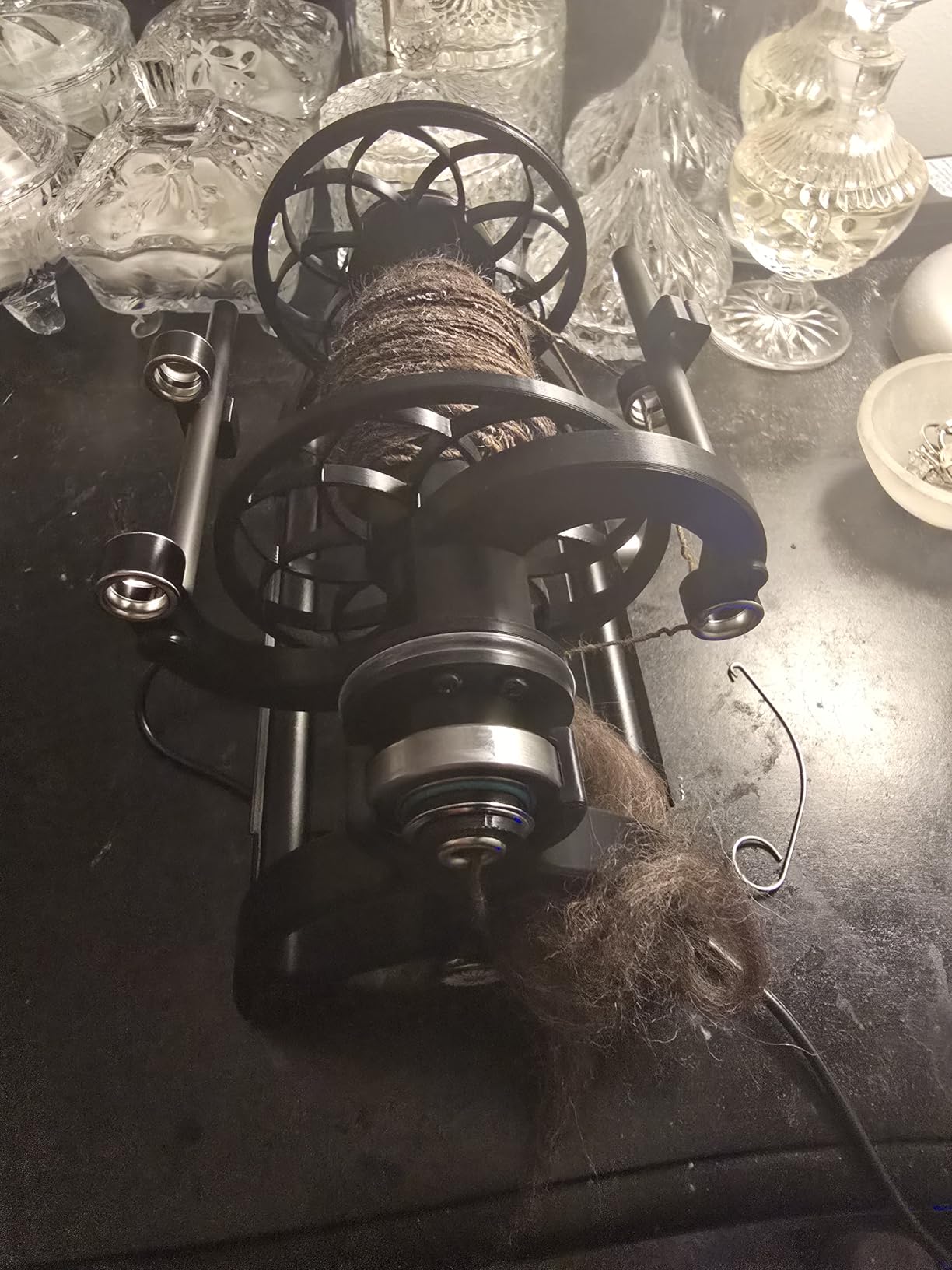
What does not work is finishing. Reviewers report flyer tension rings that spin freely and fail to feed yarn evenly, difficulty combining two strands evenly when plying, rough build quality, and one unit arriving broken. A motor failure after about three months of regular use is also reported, and the instructions are described as missing or unhelpful, so you will be teaching yourself from video.
One detail worth knowing before you compare it to the others: the listing chart overstates both the size and the per-bobbin capacity. Actual capacity is about 4 ounces despite the chart, and the listed dimensions of 0.39 inches are not the working size of the machine. Weighing 2.03 pounds, it is the lightest thing in this roundup.
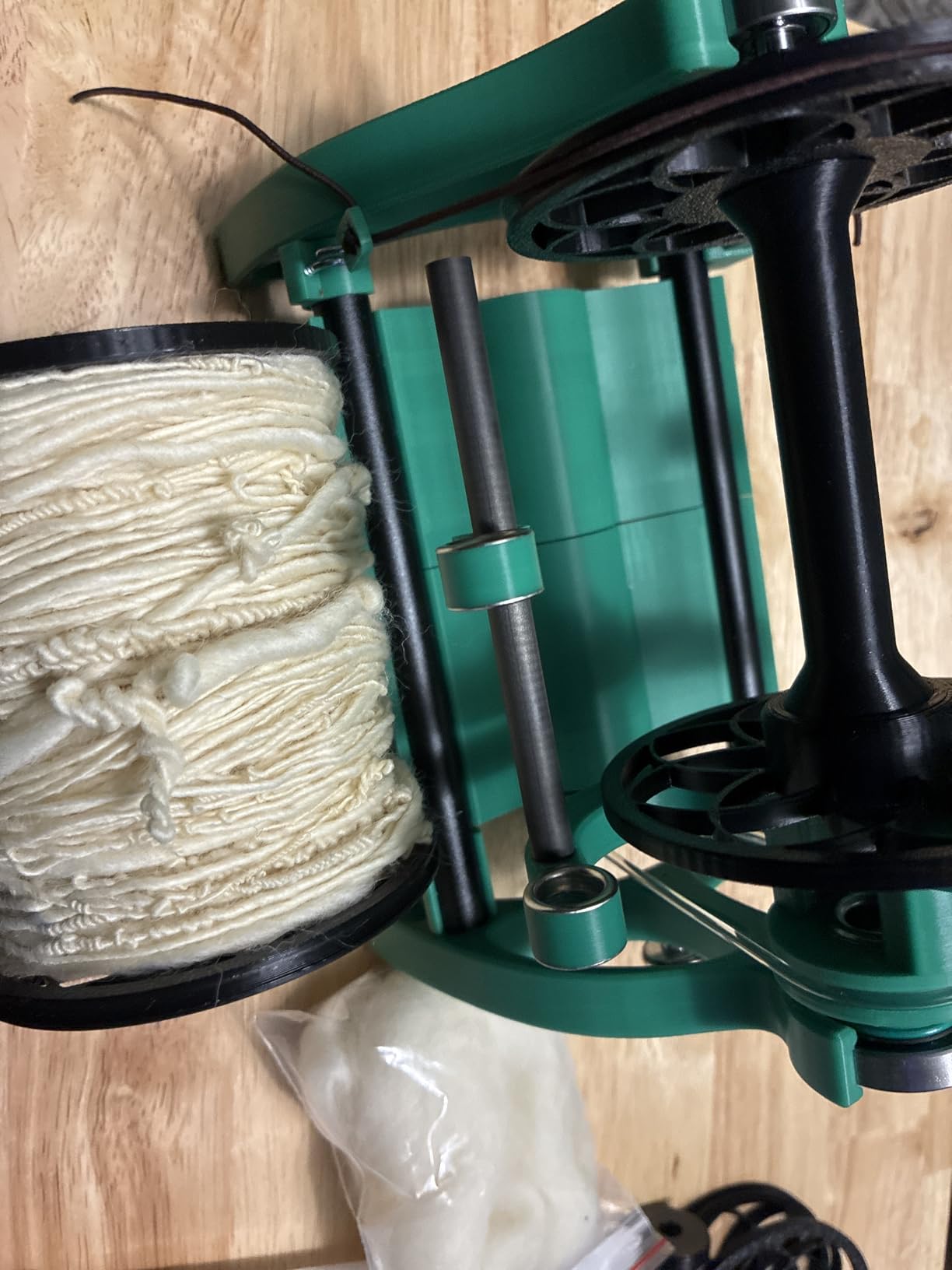
Best for practising plying without a big commitment
If your goal is to learn how two singles behave when they come together, and you already spin confidently on something else, this does the job for very little money. The extra drive and brake bands mean a worn band is not a dead machine, which is the single most common failure on cheap electrics.
It is also genuinely useful for drafting practice, because the foot control frees both hands and the speed is stepless, so you can follow a fine draft with your hands alone.
Where it will disappoint you
Do not learn to spin on this one. The missing documentation, the freely spinning tension rings and the uneven feed mean that the machine will teach you bad habits along with the good ones, and the plying problem in particular will leave you guessing whether the fault is yours or the hardware’s.
Given that the best value machine in this roundup costs only a little more, has a proper foot controller, forward and reverse switching and a larger review base, the reasons to pick this one instead of that one are thin: it is lighter, and it includes spare parts. The reported three-month motor failure is the counterweight to that.
10. Consfly 800RPM Electric Spinner – a portable option for group demos
Consfly 800RPM Electric Yarn Spinning Wheel w/Yarn Holder, for DIY & Home
Foot switch for hands-free control
Three spools plus yarn holder
4 oz capacity
3D printed body with carbon fiber arm
Pros
- Foot switch leaves both hands free for drafting
- Compact and light enough to carry anywhere
- Yarn holder keeps yarn tidy during crochet work
- Generous accessory set with spools
- cord
- hook and holder
- Handles wool
- dog hair
- silk and blends
Cons
- Lowest average rating in this roundup at 3.6
- About 26 percent of ratings are one star
- 3D printed plastic body with a basic finish
- Only five reviews so little evidence of reliability
The Consfly is included here because it is genuinely the most portable machine in the roundup for demonstration work, and because leaving it out would be dishonest about the category. At 4.4 pounds and 7.28 by 5.12 by 6.7 inches, it is the machine you can carry in one hand from a car to a guild table.
The hardware list is generous for the money. A steel tube motor reaches 800 rpm, the speed switch steps up to that figure, and a forward and reverse knob gives Z-twist singles in one setting and S-twist plying in the other. The packing list includes three spools, a power cord, a foot switch, a crochet hook, a yarn holder and an accessory set, and each spool is about 4 ounces.
What you get in build quality is a 3D-printed plastic body with a carbon fiber wheel arm, and reviewers describe the finish as basic. At 3.6 across five reviews with about 26 percent one-star ratings, it has the lowest average in the roundup and almost no evidence of long-term reliability. It is the least confident recommendation here, and we include it as a portable demonstration option rather than a primary machine.
Best for carrying to a group or club session
Nothing else here is as easy to transport to a demonstration. The accessory set means you can arrive, unpack and spin in a couple of minutes, and the yarn holder keeps a working length tidy when you are spinning and crocheting in the same session.
It also handles dog hair and silk alongside wool, cotton and blends, which makes it a slightly broader fibre list than most of its tier.
Where it will disappoint you
A 3D-printed body and a 3.6 average make this a starter machine, not a long-term one. Twenty-six percent one-star ratings in a five-review sample is not enough data to say what goes wrong, which is itself the problem: you are buying without a reliability record.
Four-ounce spools on a machine you carry to every session means frequent bobbin changes, and if you already have any of the other electrics here, the accessory set will not compensate for the build. If you want a portable electric, position six is the better buy.
How to Choose a Spinning Wheel: 7 Decisions That Matter More Than Price
Choosing a spinning wheel comes down to seven decisions, and only the last one involves what you pay. Work through them in order, because each answer narrows the next. If you want a longer reference on the drop-spindle option, our guide to the best hardside spinners covers the one tool every spinner here should own first.
1. Drop spindle, treadle wheel or electric spinner: the honest trade-off
A drop spindle teaches the mechanics of twist and draft for almost nothing, and forums recommend starting there. What it cannot teach is managing a bobbin, and every wheel in this roundup exists to solve bobbin management. A treadle wheel adds the rhythm of foot-powered work, which many spinners describe as meditative. An electric spinner removes the footwork entirely, which helps anyone with knee or joint pain and removes one layer of skill to learn.
The honest argument against starting electric is that you skip the treadling rhythm, and some experienced spinners regard that as a real loss rather than a convenience. The honest argument against treadling is that it is physically demanding, and a two-hour session on a single treadle is tiring in a way an e-spinner never is.
2. Single drive or double drive, and Scotch versus Irish tension
Scotch tension pulls on the yarn, with a brake acting against the flyer; it is smooth, precise and easy to learn, and it is what the Schacht Sidekick uses. Irish tension uses a bobbin lead, where a tensioned yarn loops around the bobbin itself, which resists less and suits some spinners and fibres far better. Most beginners should learn on Scotch tension.
Single drive means one band transferring power from the flywheel to the flyer. Double drive adds a second, slower band that can pull the flyer back against the brake, and it gives finer tension control on fine fibres at the cost of more adjustment to get right. The Traditional and the Kiwi 3 in this list are single drive.
3. Single treadle versus double treadle, and why both legs matter
A single treadle means one foot does all the work, which gives an uneven, side-to-side motion and tires the supporting leg over a long session. A double treadle splits the work, the motion is symmetrical, and you can park and draft without the wheel surging. This is the most repeated piece of community advice in our research, and it is why the Kiwi 3 and New Joy 2 sit well for beginners while the Traditional asks for more technique first.
4. Speed ratio and the yarn weight you actually want to spin
The flyer-to-wheel ratio sets how much twist goes in per turn of the wheel. Low ratios around 5.5:1 to 7:1 suit chunky woollen and novelty work, mid ratios around 9:1 to 12:1 handle worsted and everyday yarn, and high ratios around 17:1 reach for fine singles and lace. The Kiwi 3 gives you 5.5, 7.5 and 9.5, and the Traditional gives you 7, 9, 12 and 17, which is why the four-ratio wheel is the better long-term machine for varied work.
5. Orifice, bobbin capacity and the fibre you plan to spin
The orifice is the hole the yarn passes through on its way to the bobbin, and its diameter sets how thick a yarn you can handle: the Traditional’s 3/8 inch orifice is fine-to-medium, while a jumbo flyer copes with bulky work. Bobbin capacity decides how long you can spin before changing, and it is the number that separates the small plastic spools at 4 ounces from the Ashford 90mm bobbins at roughly 4.5 ounces each and the Super Jumbo flyer well beyond that.
6. Brand families worth knowing: Ashford, Schacht, Louet, Kromski, SpinOlution and the rest
Ashford dominates the beginning of this list, with four wheels covering treadle, heritage, portable and electric, and the largest accessory ecosystem. Schacht builds for precision and shares parts across its range. Louet is the name most associated with Irish tension and appears constantly in forum advice as an easy wheel to learn on. Kromski is known for craft quality and portability, and Lojan and Lendrum are real working wheels that experienced spinners name as their daily tools. SpinOlution builds modern, lightweight and portable machines, and the smaller electric brands in this roundup occupy the entry tier.
Whatever the brand, spinners consistently favour makers with replaceable parts and accessible spares, because a wheel whose components disappear is a wheel you cannot keep spinning on. That is a question to ask before you commit, not after.
7. Handedness, portability and the accessories you will need on day one
Handedness is a genuine purchase blocker that most roundups ignore. If you are a southpaw, check whether the wheel can be configured with the orifice on the side that suits you before buying, because a wheel turned the wrong way puts your drafting hand behind the wheel and is miserable to use. The small electrics here have no handedness option at all, which is worth knowing.
For portability, weigh the machine against your actual route. Our notes on what matters when everything has to fit in one case apply directly: a folding treadle is portable, a 33 pound frame is not, regardless of what the box says. On day one you also want extra bobbins, a lazy kate, a niddy noddy, a threading hook, a small oil and a spare drive band. Our roundup of the essential spinning tools covers that kit.
How to Thread Up a Spinning Wheel and Set the Tension
Threading a wheel is the step that stops most new spinners on their first afternoon, and it is a live question on the forums that hardly any buying guide answers. It is the same process on every wheel in this roundup, with one variation between Scotch and Irish tension. Work through it once slowly before you put fibre on.
Find your orifice, the hole in the flyer frame that the yarn passes through, and sit down at the wheel in the position you will actually spin in.
Open the flyer and take the bobbin off. On most wheels the bobbin lifts straight out; note which way the flyer was facing so you can refit it correctly.
Hold the flyer in one hand and loop the leader yarn through the orifice from the inside out, so the yarn tail points toward you.
Take that tail through the flyer eye nearest the orifice, then to the eye on the opposite side, leaving a short loop of slack hanging below.
Refit the bobbin, then bring the yarn up over the top of the flyer frame, under the thread guide above the bobbin, and back down to the bobbin.
On a Scotch tension wheel, wind the yarn around the outer part of the brake, crossing the braked section on a diagonal. On an Irish tension wheel, take it down through the flyer and around the bobbin itself as a lead, leaving a few wraps of friction.
Secure the tail on the bobbin, put the wool supply in the basin or on the distaff, and tie the leader yarn to it.
Start the flyer slowly with your hand and check the take-up. The yarn should draw onto the bobbin evenly, without bunching in one spot or sliding off.
Set the tension until the yarn pulls in smoothly when you draft and stops cleanly when you let go, with no overrun. Start slightly loose and tighten a little at a time.
Treadle or foot forward gently, pre-draft a short length, and join the yarn by gently pinching the leader until the twist travels back to the fibre supply.
If the yarn keeps running faster than you can draft, the tension is too loose and the flyer is overwinding the bobbin. If the wheel stalls and the yarn breaks, the tension is too tight. Adjust a fraction at a time, and remember that the two systems on a wheel are adjusted separately.
How to Buy a Used or Vintage Spinning Wheel Without Regret
Buying used is the most repeated question in the communities we read, and the consensus is reassuring: a 1960s Ashford can be as reliable as a new one, and used brand-name wheels are widely trusted. The risk is not age, it is neglected drive bands and frayed brake lines. Here is the checklist.
Check the frame for cracks, especially around the treadle attachments, the flyer bearing blocks and any joint where the wheel meets the base.
Spin the flyer by hand. It should turn freely and evenly, with no gritty feeling, catching or side-to-side wobble that suggests a bent shaft.
Move each bearing by hand. Play or roughness means the bearing needs replacing before you plan a project.
Look at the drive band and the brake band. Bands that are flat, frayed, glazed or slack need replacing, and the part number determines whether it is easy to source.
Treadle it and listen. Squeaks usually mean a dry bearing, which is cheap to fix, but a grinding noise means something structural.
Check the tension system. Stretched tension springs and a brake that will not hold are the two things that most often make inherited wheels intimidating.
Confirm the parts situation before you pay. If the brand is still making the flyer, bobbins, whorls and bearings, the wheel is a safe purchase. If not, the price should reflect that.
Check handedness and configuration while you can still walk away, and confirm the wheel can be set up for the side you spin on.
Before any of that, run a treadle wheel and a motor spin both. A vintage wheel with a dead motor is not a vintage wheel, and a wooden wheel you can carry is a very different purchase from one you cannot.
Frequently Asked Questions
What is the best wheel spinner?
For most beginners the best spinning wheel for hand spinners is a double-treadle model such as the Ashford Kiwi 3, because both feet share the work and the treadles fold away for storage. If you want electric, the Electric Yarn Spinner Kit with Foot Controller is the best value option, and the Aredwhiterui Mini is the quietest for fine yarn.
Can you still buy spinner wheels?
Yes. Wooden treadle wheels, electric spinners and drop spindles are all still made and sold, and the second-hand market is full of Ashford, Schacht, Louet and Kromski wheels that are decades old and still working. Parts availability is the thing to check, not whether the product still exists.
How to choose a spinning wheel?
Choose by deciding three things in order. First, decide between a drop spindle, a treadle wheel and an electric spinner based on whether you want the treadling rhythm or want the footwork removed. Second, decide on a double treadle if you are learning, and Scotch tension if you want predictable, easy-to-adjust take-up. Third, pick a speed ratio and bobbin capacity that suit the yarn weight you actually want to spin.
How to thread up a spinning wheel?
Open the flyer, take off the bobbin, and loop the leader yarn through the orifice from inside out. Take it through the flyer eye nearest the orifice, then the opposite eye, refit the bobbin, run the yarn over the flyer frame and under the thread guide. On Scotch tension, wrap the brake diagonally; on Irish tension, take a lead around the bobbin. Secure the tail, then set tension slowly until the yarn draws in smoothly and stops cleanly.
What is the best roving for a beginner spinner?
A pre-drafted wool roving in a medium weight, such as a Bluefaced Leicester or a Corriedale, is the easiest place to start because it needs no preparation. It gives enough fibre to see your drafting while staying forgiving when the draft is uneven. Avoid a slippery merino top for your first hours, and save raw fleece until you can control a consistent draft.
How to use a vintage spinning wheel?
Check the frame for cracks, spin the flyer by hand to test the bearings, and inspect the drive band and brake band for wear before anything else. Replace stretched tension springs and refit or replace frayed brake lines, then oil the bearings. Most inherited wheels work once the consumable bands and springs are sorted out, and once the parts situation is confirmed.
Final Verdict: Which Spinning Wheel Should You Buy in 2026?
The Ashford Kiwi 3 is our default recommendation, and it is the best spinning wheels for hand spinners answer in one line for a reason: 91 reviews at 4.9, double treadles that make learning tractable, three ratios, three bobbins and a built-in lazy kate in a wheel that folds flat. The sanding and assembly are real work, and the squeak is fixable, but you are buying a machine with a decade of service behind it.
If you want electric, take the Electric Yarn Spinner Kit with Foot Controller for capability per pound, or the Aredwhiterui Mini if quiet running and fine yarn matter most. If you want a wooden wheel that arrives finished, the New Joy 2 is the one. If you want to understand tension properly, the Schacht Sidekick is the only wheel in this roundup with a real tension control knob.
Whatever you choose, start with a drop spindle and a pre-drafted roving, learn park and draft, and move up when the mechanics are boring. Our guide to the rest of the kit is a good next step, along with our other roundups of hardside spinners and spinning reels for the rest of your equipment.