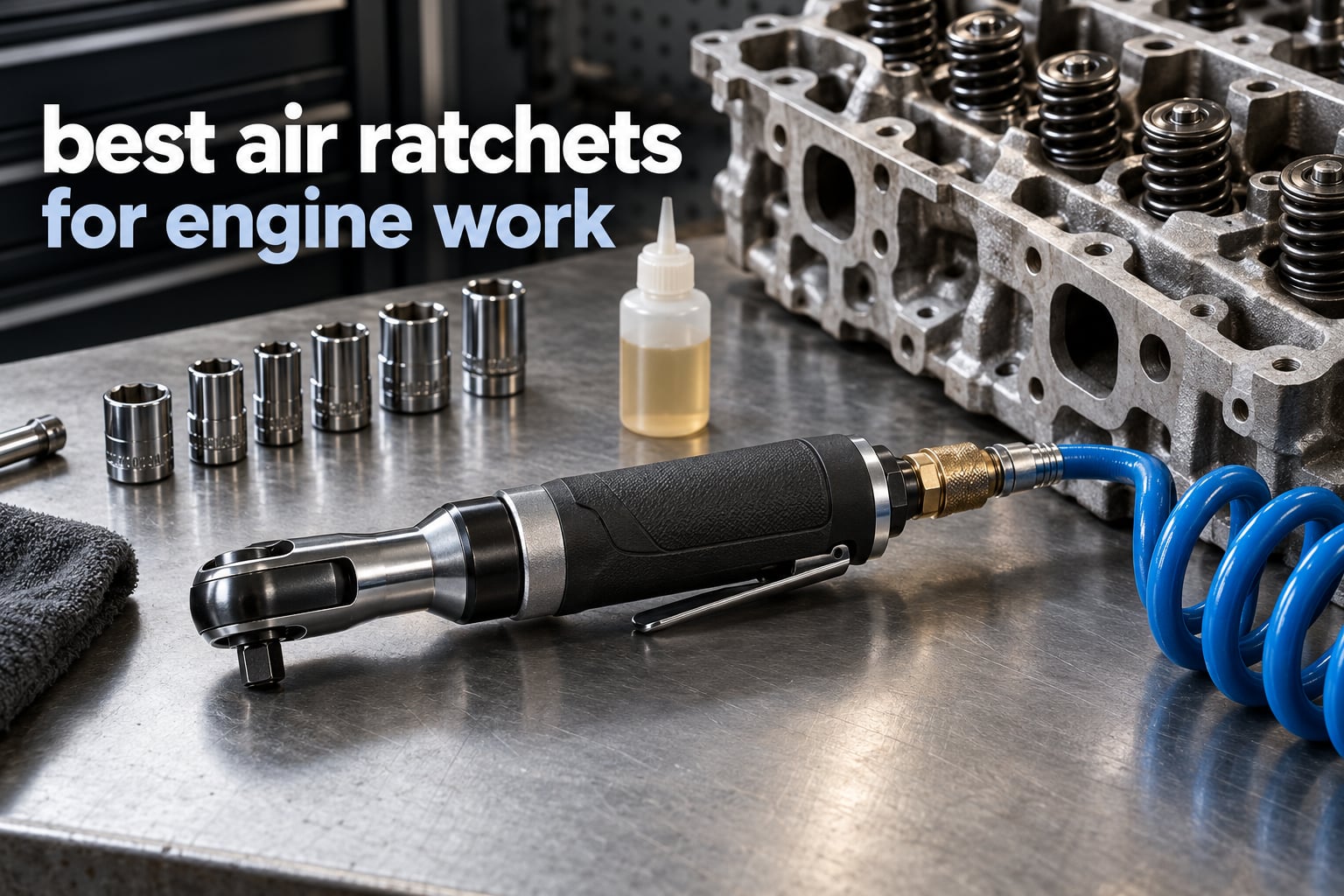
An air ratchet wrench is a pneumatic speed handle that spins a socket at roughly 150 to 300 RPM without pulling the fastener off the bolt head. That combination of breakaway torque and control speed is exactly why the best air ratchets for engine work sit in almost every professional technician’s tool cart.
Engine jobs are volume jobs. A valve cover alone can hide a dozen fasteners, a timing belt service can put three of them, and a long overdue oil pan can hide twenty corroded bolts that a hand ratchet will not break. An air ratchet removes small engine fasteners several times faster than your arm can crank them, while still letting you feel the bolt and stop the moment it breaks free.
We compared ten pneumatic ratchets across torque, free speed, drive size, head design, exhaust routing and air consumption to build this guide. Most of the credit for the picks goes to real user sentiment gathered from mechanic forums, where the consensus is blunt: 3/8 drive is the sweet spot, reaction-less clutch matters more than any other feature, and head bulk decides whether you can actually reach the bolt.
If you are still deciding between air and battery, our general air ratchet roundup covers the format in broader terms, and we compare the two power sources in the buying guide below. For the workshop side of the job, see our engine stand picks and engine hoist picks.
Table of Contents
Top 3 Picks for Best Air Ratchets for Engine Work in 2026

Ingersoll Rand 170G 3/8 inch
- 55 ft-lb torque
- 170 rpm free speed
- Heat-treated ratchet head
- Ergonomic grip
AIRCAT 805-HT 3/8 inch
- 130 ft-lb max torque
- 180 rpm
- 84 dBA tuned exhaust
- Variable speed trigger

Dynamic Power 3/8 inch
- 45 ft-lb max torque
- 160 rpm free speed
- 6 CFM at 90 PSI
- Reversible function
Quick Comparison of Every Air Ratchet in This Guide in October
The table below is the fastest way to scan the whole field. Torque is the breakaway figure published by each manufacturer, and free speed is the no-load RPM with the trigger held down.
| Product | Specifications | Action |
|---|---|---|
| Ingersoll Rand 170G 3/8 inch Air Ratchet |
|
Check Latest Price |
| Dynamic Power 3/8 inch Air Ratchet |
|
Check Latest Price |
| AIRCAT 805-HT 3/8 inch High Torque Ratchet |
|
Check Latest Price |
 AIRCAT 802 3/8 inch Composite Ratchet AIRCAT 802 3/8 inch Composite Ratchet |
|
Check Latest Price |
 Ingersoll Rand 107XPA 3/8 inch Air Ratchet Ingersoll Rand 107XPA 3/8 inch Air Ratchet |
|
Check Latest Price |
 CRAFTSMAN 3/8 inch Air Ratchet CRAFTSMAN 3/8 inch Air Ratchet |
|
Check Latest Price |
 BORNTUN 1/2 inch Air Ratchet BORNTUN 1/2 inch Air Ratchet |
|
Check Latest Price |
 Astro 1119A 3/8 inch Mini Wobble Ratchet Astro 1119A 3/8 inch Mini Wobble Ratchet |
|
Check Latest Price |
 Dynamic Power 1/2 inch Air Ratchet Kit Dynamic Power 1/2 inch Air Ratchet Kit |
|
Check Latest Price |
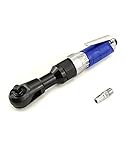 QWORK 3/8 inch Super Fast Air Ratchet QWORK 3/8 inch Super Fast Air Ratchet |
|
Check Latest Price |
1. Ingersoll Rand 170G 3/8 inch Air Ratchet – the Proven Daily Driver
Ingersoll Rand 170G 3/8″ Drive Air Ratchet Wrench
55 ft-lb torque
170 rpm free speed
1.2 kg
Heat-treated ratchet head
Pros
- Over 1000 owner reviews to draw on
- 55 ft-lb handles routine engine fasteners
- Heat-treated head for longevity
- Ergonomic grip cuts fatigue on long teardowns
Cons
- Fixed square drive has no angular socket access
- Modest torque ceiling on high-torque fasteners
The 170G is the tool I keep reaching for first on a teardown. It publishes 55 ft-lb of torque and 170 rpm of free speed, which is more than enough to spin off valve cover bolts, intake fasteners and fuel rail hardware without a fight.
What makes it the safest recommendation here is volume of long-term feedback. It carries a 4.6 average across more than a thousand reviews, and 78% of buyers give it five stars. That consistency is rare in a category where budget tools often collect a loyal group and an angry tail.
The manufacturer calls out general engine repair as a primary application, and heat treating on the ratchet head is the detail that matters for longevity. A treated head resists the wear that flat-head ratchets pick up when you run a socket sideways against a casting.
The ergonomic grip is the other quiet win. On a long oil pan or a full valvetrain job, hand comfort decides whether you notice fatigue, and this is the tool I notice least in the hand.
What the 170G handles well in an engine bay
Routine fastener removal across the top of an engine, where access is good and bolts are spec torque on and off. The 55 ft-lb figure is a breakaway number, and for small engine bolts that figure is far more headroom than you need.
It also works well as a second ratchet for transmission and under-dash work, where the fixed square head is not a problem because the bolts face you straight on. A long slender body suits fasteners that sit deep in a housing.
Where the 170G falls short
The fixed square drive gives you no wobble or angular socket position, so any fastener that sits at an angle to your approach path will not seat properly. On tight engine bays with cast brackets in the way, that limitation shows up quickly.
Torque is the second ceiling. At 55 ft-lb, this is not the ratchet you want on a seized exhaust manifold stud or anything that has been sitting since the last decade. For those, step up to the AIRCAT 805-HT.
2. Dynamic Power 3/8 inch Air Ratchet – Best Value for a Home Garage
DYNAMIC POWER 3/8 inch Professional Air Ratchet, Green&Black
45 ft-lb max torque
160 rpm free speed
6 CFM at 90 PSI
2.6 pounds
Pros
- Covers a wide range of routine fastening tasks
- 6 CFM consumption works with modest compressors
- Non-slip ergonomic handle improves control
- Reversible for tightening and loosening
Cons
- 45 ft-lb torque is low for engine block work
- 160 rpm free speed is unhurried
This is the ratchet I recommend to someone building a first compressor setup. It runs on 90 PSI, pulls 6 CFM average, and delivers 45 ft-lb of maximum torque at 160 rpm free speed. Those are honest, modest numbers that map cleanly onto a small shop compressor.

The published spec sheet is unusually complete for this class of tool. Working pressure, free speed and air consumption are all stated, which tells you the manufacturer expects buyers to match the tool to a compressor rather than guessing.
Owners rate it 4.5 across 919 reviews, with 73% five-star ratings. Durability and control are the two things buyers mention most often, which makes sense for a reversible design with a non-slip ergonomic handle.
Where this ratchet earns its place
Routine engine work where the bolts are small and plentiful: valve covers, intake runners, coil and plug brackets, timing covers. At 45 ft-lb you have enough to break a typical 10 to 15 ft-lb fastener with plenty of margin.
It is also a good first shop tool because the air demand is predictable. You will not find yourself waiting on a tank refill every few bolts, which is the classic complaint with small compressors and thirsty tools.
Where it runs out of road
Forty-five ft-lb is genuinely low compared with the rest of this field. It is not a tool for head-bolt work, engine block hardware or anything corroded. Owners repeatedly flag torque headroom as the ceiling, not the motor.
Free speed of 160 rpm is also unhurried. On a teardown where you want to run bolts off rather than back them on, the faster AIRCAT 802 saves real minutes.
3. AIRCAT 805-HT 3/8 inch High Torque Ratchet – Most Torque in the Group
AIRCAT 805-HT 3/8″ High Torque Ratchet Wrench, 180 RPM
130 ft-lb max torque
180 rpm
84 dBA exhaust
1.45 kg
Pros
- 130 ft-lb is the highest output in this group
- Patented exhaust cuts noise to 84 dBA
- Variable speed trigger gives fine control
- Two-year warranty with proof of purchase
Cons
- Single pawl reverses slower than twin pawl designs
- Heaviest 3/8 inch body here at 1.45 kg
When a bolt has been sitting for a decade, the 805-HT is the answer. It publishes 130 ft-lb of maximum torque at 180 RPM, which is more than double what most 3/8 drive ratchets in this guide offer and the highest torque figure here by a wide margin.
It also holds the highest average rating in the group at 4.7 across 731 reviews, with 84% five-star. Torque output and the quiet exhaust are the two satisfaction drivers buyers name again and again.
The patented tuned exhaust drops noise to 84 dBA, which matters more than most people expect when you are stripping an engine in a residential garage or inside a closed shop. Our general air ratchet guide covers noise handling in more depth.
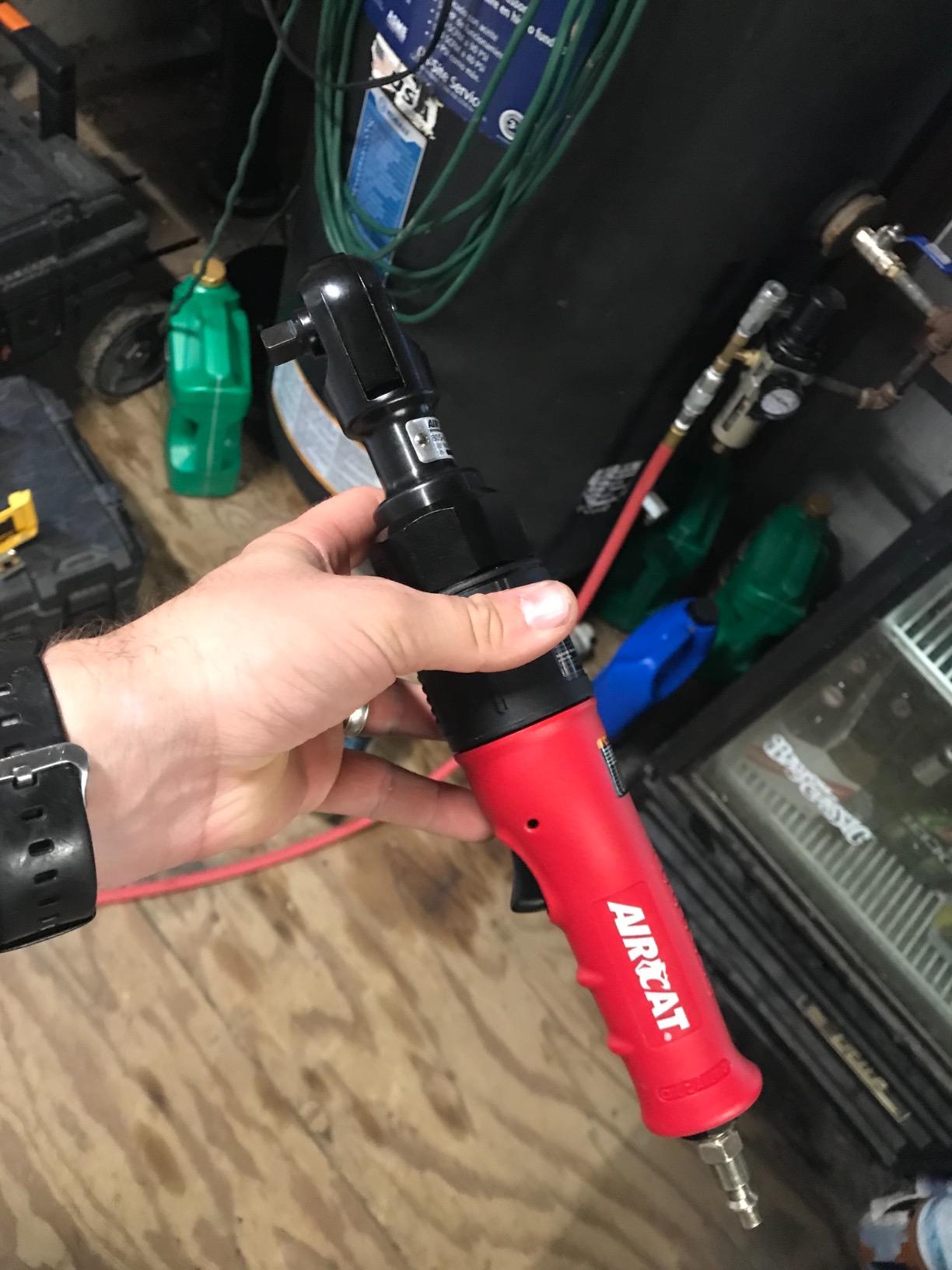
A rapid response variable speed trigger lets you feather the tool down as a fastener breaks free, which is the difference between spinning a bolt off cleanly and rounding a head. Mechanics on r/Tools and r/MechanicAdvice frequently recommend breaking a bolt by hand and then spinning it off with air for exactly this reason.
Where the 805-HT earns its torque
Seized and rusty fasteners: exhaust manifold hardware, oil pan bolts that have welded themselves to the pan rail, alternator and bracket bolts, and anything that has been through one winter without oil.
It is also useful as a dedicated high-volume rundown tool. At 180 RPM with a variable trigger, you can run a soft head off the bolt and back it on to spec in one continuous motion without lifting the tool away.
Where it costs you
The single pawl design is slower to reverse than twin pawl heads. Mechanics who work direction changes constantly on smaller fasteners will notice the slower swap on the reversing lever compared with the AIRCAT 802.
At 1.45 kg it is also the heaviest 3/8 inch body here. For a shop that likes it, that weight buys durability. For overhead work under a dash with a wrist at the limit, it is a lot of tool for the job.
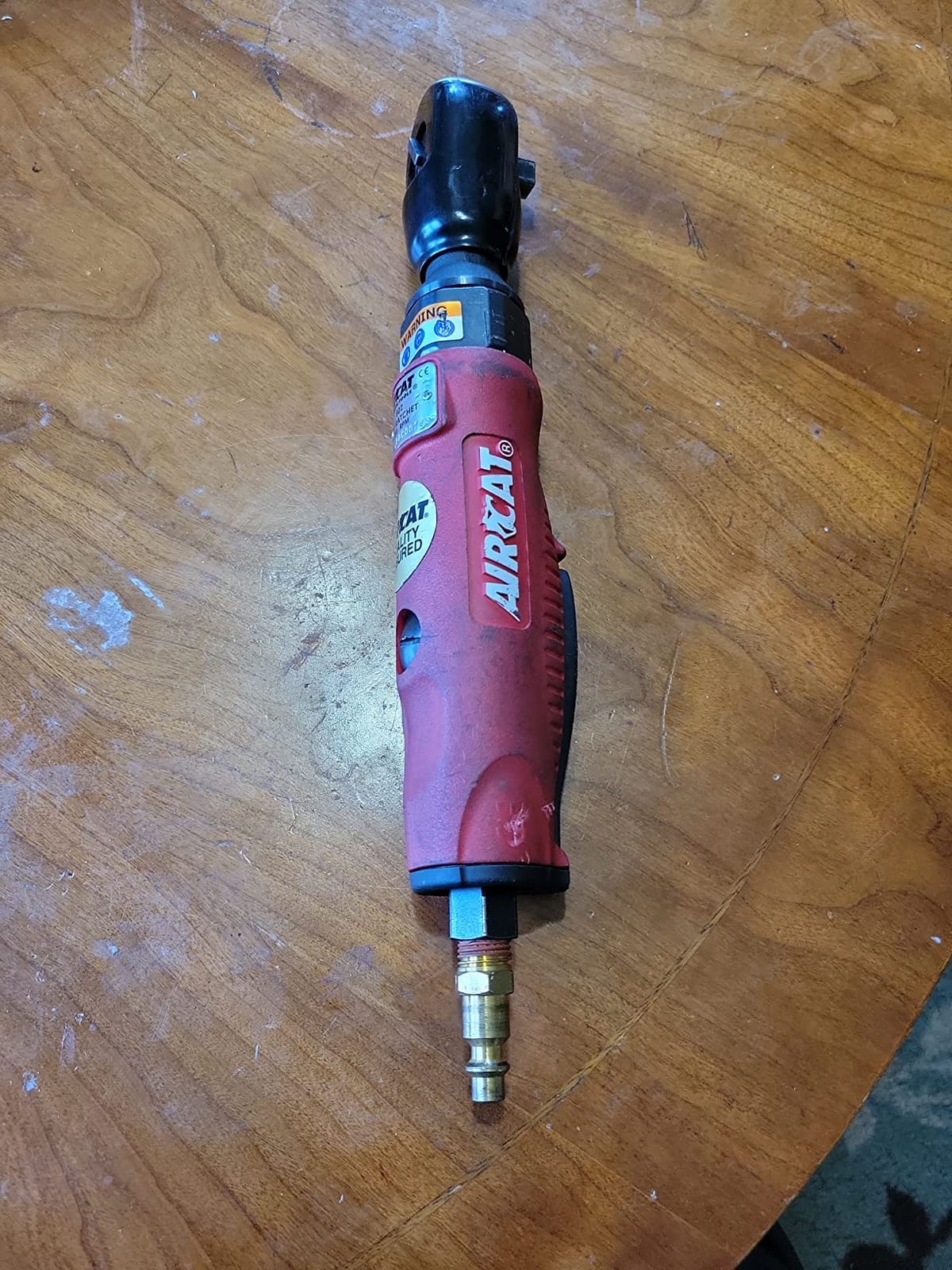
4. AIRCAT 802 3/8 inch Composite Ratchet – Fastest Free Speed Here
AIRCAT 802 3/8″ Composite Ratchet, 70 ft-lbs Max Torque, Feather Trigger
70 ft-lb max torque
280 rpm
82 dBA exhaust
10.5 inches long
Pros
- 280 rpm is the quickest free speed in this group
- Twin pawl head improves power and reversal speed
- Quietest tuned exhaust here at 82 dBA
- Composite handle stays comfortable
Cons
- 70 ft-lb sits far below the 805-HT
- Composite body is harder to repair than metal
Where the 805-HT wins on torque, the 802 wins on speed. At 280 RPM it turns a socket faster than anything else in this group, and paired with 70 ft-lb of torque it is the most productive combination for running bolts off and back on.
The twin pawl mechanism is the design detail technicians care about here. Twin pawls share the load and reverse instantly, which improves both drive power and head reliability compared with the single pawl design used in the 805-HT.
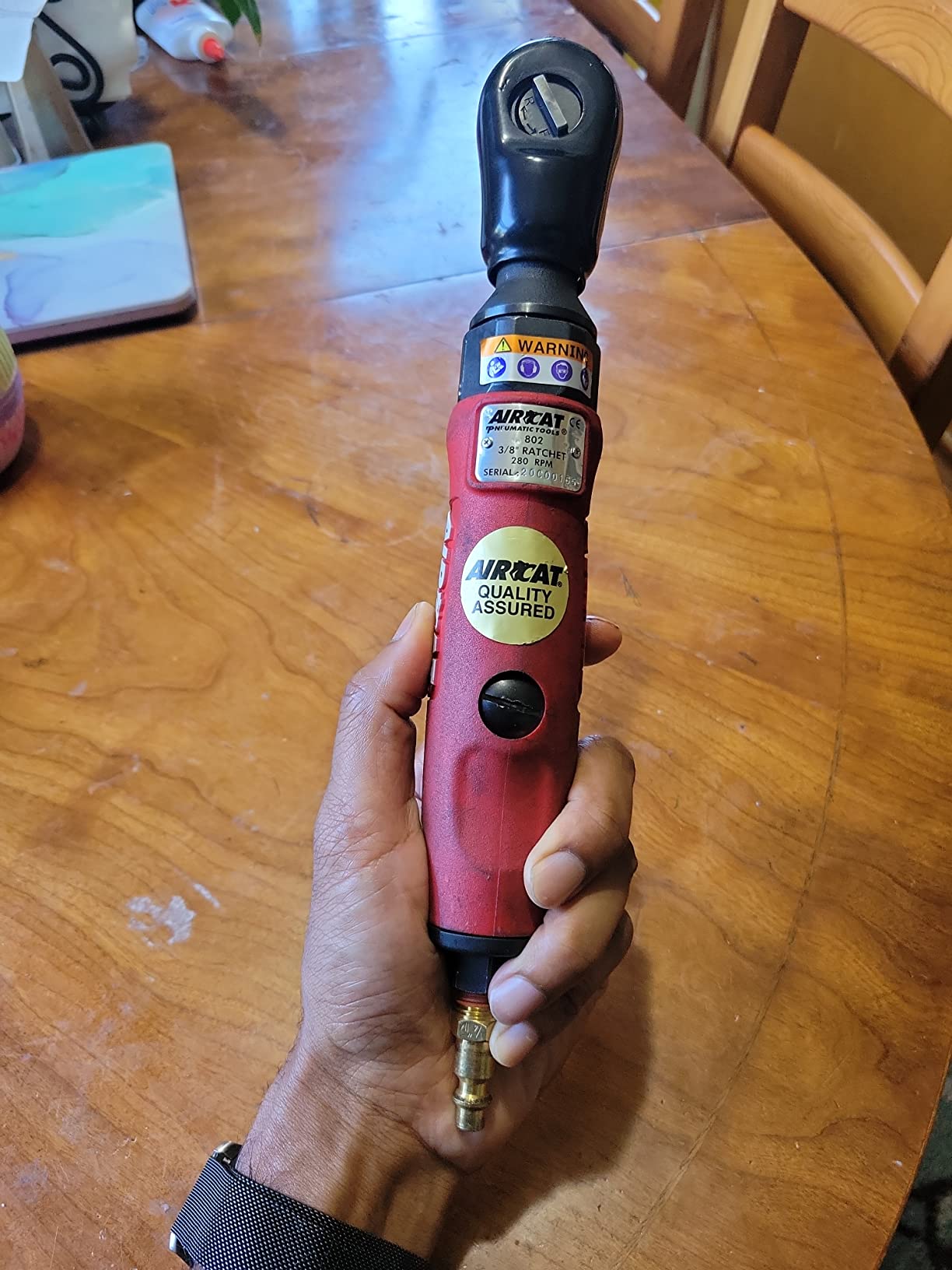
Its patented tuned exhaust holds noise to 82 dBA, the quietest figure published by any ratchet in this guide. On a home garage build that matters, because engine work happens in whatever room the engine is in.
It sits at 4.6 stars from 612 reviews with 76% five-star ratings. Speed and quiet operation drive repeat satisfaction, and the torque ceiling is the tradeoff owners name most.
Where the 802 fits best
Rebuild jobs where fasteners go on and come off multiple times: head reassembly, intake manifold work, timing belt service and any job where you want the socket spinning rather than your arm cranking.
The composite handle stays comfortable through long sessions and does not carry the cold of an all metal body in winter. If your engine work happens in an unheated space, that is a real quality of life difference.
Where it falls short
Seventy ft-lb is a step below what a stubborn bolt can demand. This is not the tool for a seized manifold stud or heavily corroded hardware, where the 805-HT has the headroom to keep working.
A composite body is also less repairable than an all metal head. When something fails inside, the metal option can often be serviced and the composite one usually cannot.
5. Ingersoll Rand 107XPA 3/8 inch Air Ratchet – Reach and Directed Exhaust
Ingersoll Rand 107XPA 3/8” Air Ratchet Wrench, Heavy Duty, 54 ft lbs Max Torque Output, Variable Speed Lever Style Throttle, 360 Degree Adjustable Exhaust
54 ft-lb max torque
360 degree exhaust
Power regulator
11 inches long
Pros
- 360 degree exhaust keeps air off your face and the bench
- Power regulator gives real speed control
- Flat head reaches deep fasteners
- Long established platform with strong durability
Cons
- 54 ft-lb torque is modest for assembly work
- Flat head articulates less than a wobble anvil
The 107XPA is the tool for the fastener that is genuinely deep. Its flat head design gives more reach into hard-to-access spaces, and the 11 inch body adds to that reach without turning unwieldy.
The 360 degree adjustable exhaust is the feature owners mention first. Directing air away from your face and away from the work surface matters when you are lying under a dash or holding a ratchet over an engine bay that is already dusty.
A power regulator on the handle gives graduated control rather than a single on or off position. That lets you creep a bolt loose instead of hitting it with full speed and rounding the fastener.
Why technicians keep it on the cart
Deep and awkward fasteners: transmission mounts, under-dash hardware, brackets that sit behind structural members. The reach gets the socket on the fastener when a stubby head cannot.
It is a 4.6-star tool across 531 reviews with 78% five-star. Owners value the directed exhaust and the control lever, and they name the torque cap as the limit.
Where the flat head works against you
A flat head gives less socket articulation than a wobble-style anvil, so a bolt that is not square to your approach still causes the same problem as any fixed square drive. If your engine bay is full of angled access, the Astro 1119A solves that instead.
At 54 ft-lb it is fine for removal and installation of small engine fasteners, but it will not break a heavily corroded bolt. Buy it as a reach tool, not a strength tool.
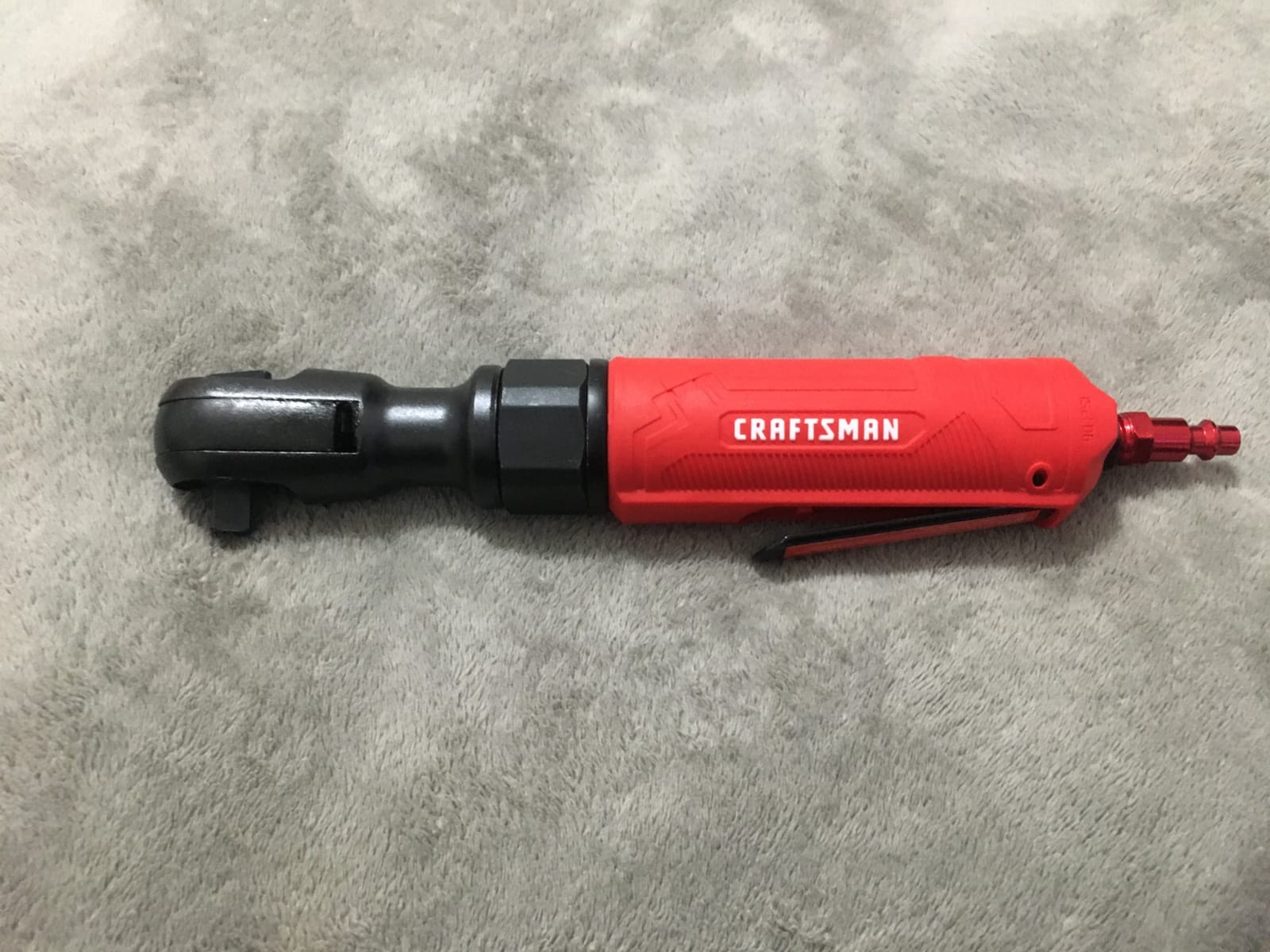
6. CRAFTSMAN 3/8 inch Air Ratchet – Gentlest on Small Compressors
CRAFTSMAN 3/8-in Air Ratchet Wrench, Maximum Torque 50 ft-lbs, Insulated Handle, Easy Access Switch, 4.4 SCFM at 90 PSI
50 ft-lb max torque
4.4 SCFM at 90 PSI
2.5 pounds
9.88 inches long
Pros
- Lowest air consumption in the group at 4.4 SCFM
- Insulated non-slip grip stays secure when greasy
- Head mounted forward reverse switch
- Built-in muffler for quieter running
Cons
- 50 ft-lb limits it to lighter fasteners
- Quick connect air plug is not included
Air consumption is the number that decides whether a small compressor can keep up. At 4.4 SCFM average at 90 PSI, this is the most efficient ratchet in the guide, and that is a genuine advantage on a 2 or 3 gallon portable tank.
The insulated handle is a nice piece of engineering for engine work. It is covered in a textured TPE sleeve that stays secure when your hands are greasy or wet, and it keeps cold hands away during extended use.
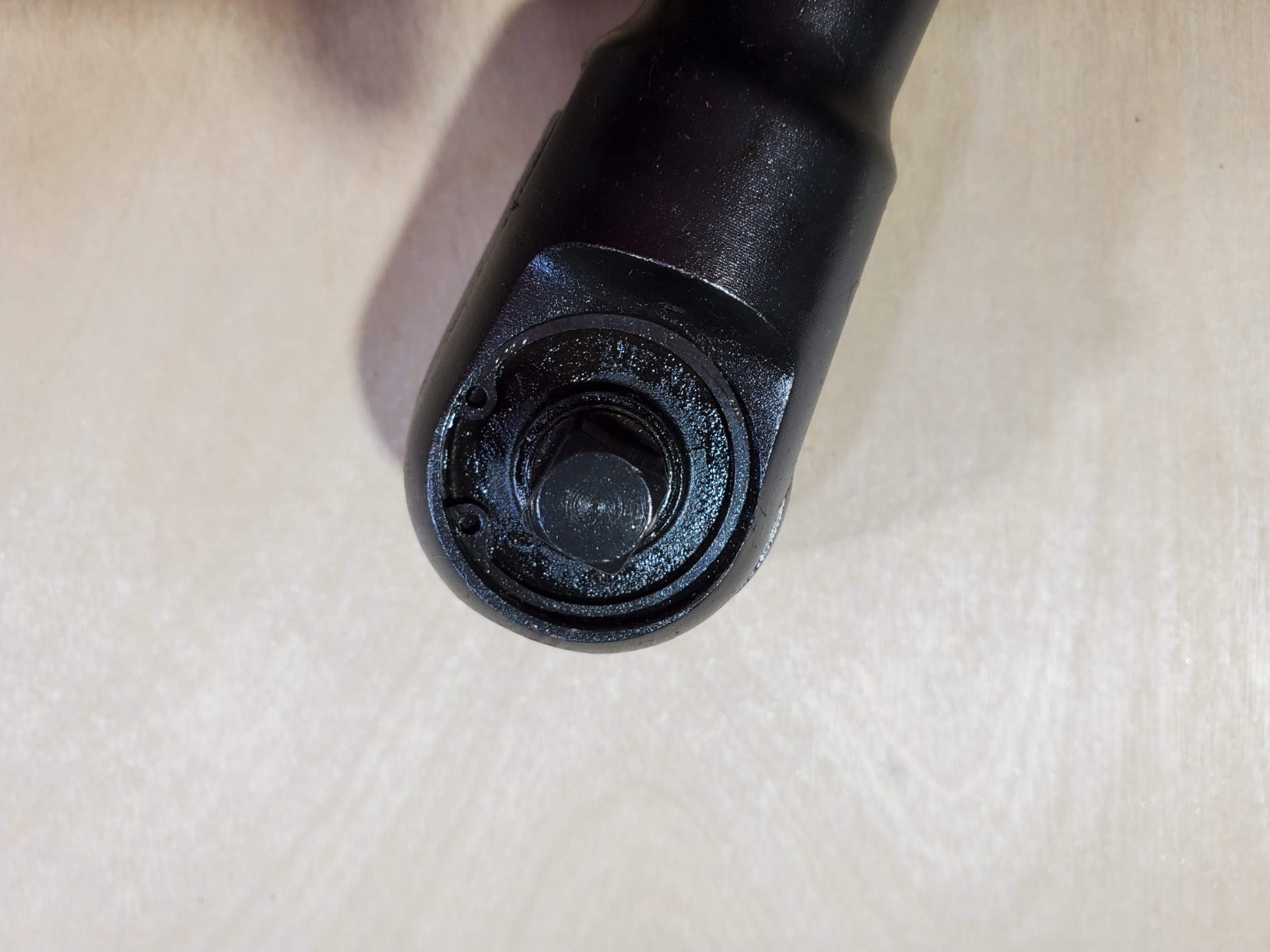
The forward and reverse switch sits on the ratchet head, so you can flip direction without regripping or pulling the tool off the fastener. Mechanics working under a hood with gloves on appreciate that more than the specification sheet suggests.
It holds 4.5 stars across 250 reviews with 73% five-star ratings, and the insulated grip, easy access switch and efficient consumption are what buyers call out. There is also a three-year warranty against material and workmanship defects.
Why home garages like this one
Home compressors are the weak link in most pneumatic setups. A tool that demands 6 CFM will visibly bog a small tank, while a 4.4 SCFM tool lets you work through a drain cycle without losing speed.
The built-in muffler reduces shop noise without needing a separate inline silencer, which is useful if you work in a shared space or at night.
What to check before you buy
Fifty ft-lb covers small and medium fasteners but stops well short of corroded hardware. If your engine work includes disassembly of long-neglected fasteners, this is the wrong tool for that portion of the job.
The quick connect air plug is not included, and the inlet is a standard 1/4 inch NPT. Budget for a plug if your hose uses quick connects, and make sure you seal the threads.
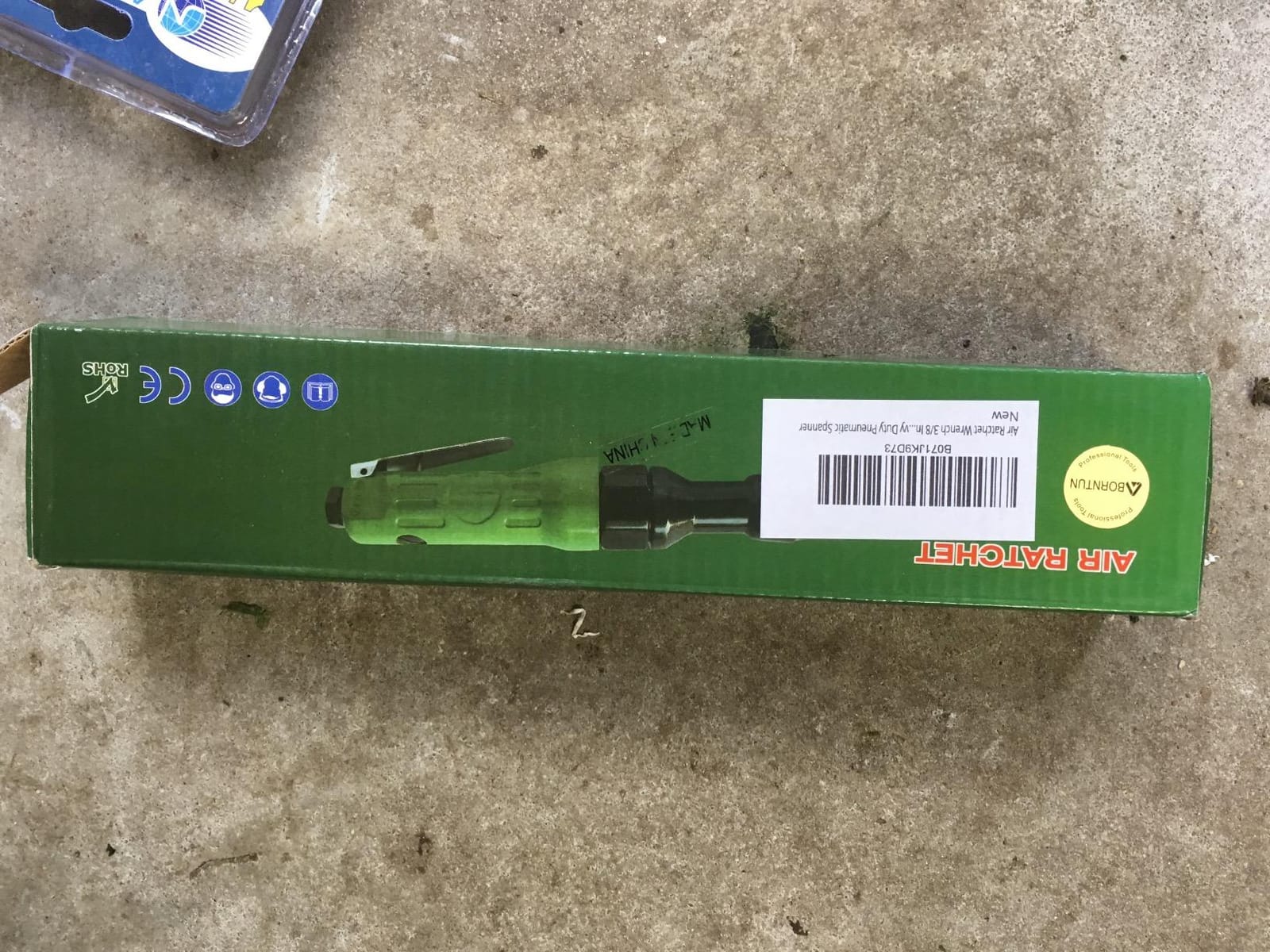
7. BORNTUN 1/2 inch Drive Air Ratchet – Torque Without the Reach Penalty
BORNTUN Air Ratchet Wrench 1/2 Inch Inch Pneumatic Impact Spanner Heavy Duty Torque Drive (1/2 Inch)
1/2 inch square drive
70 ft-lb torque
1.1 kg
26 cm long
Pros
- Only 1/2 inch drive option in this group
- 70 ft-lb in a compact easy to handle body
- All metal single-piece construction
- Light at 1.1 kg
Cons
- Fixed square head has no angular socket access
- Rating trails the branded ratchets in this group
Most engine fasteners live on a 3/8 drive, but 1/2 inch drive is still the right answer for larger hardware: motor mounts, transmission and diff bolts, heavy truck and equipment work. This is the only 1/2 inch drive ratchet in the guide, and it does that job at 70 ft-lb.
The single-piece all metal construction is straightforward and durable in a way composite bodies are not. At 1.1 kg it is also the lightest tool in the roundup, which matters on long sessions.
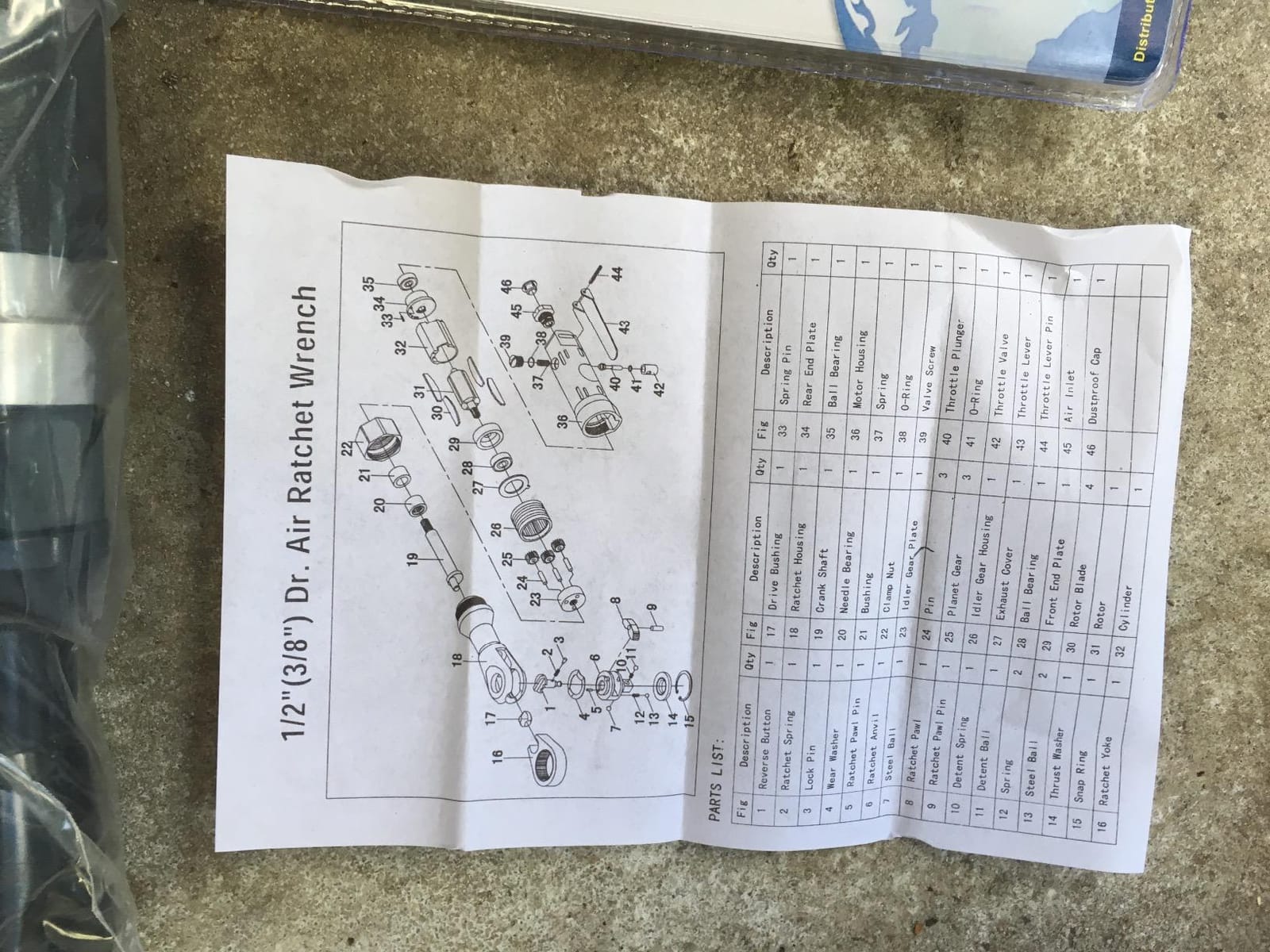
Both metric and SAE measurement standards are supported, and the 26 cm body is compact enough to keep in a small bag rather than a full size tool cart.
The rating spread is wider than the branded tools here, at 4.3 stars across 218 reviews with 64% five-star. That distribution is the reason it sits lower in the ranking despite a reasonable torque figure.
When 1/2 inch drive earns its slot
Larger engine and truck fasteners that will not fit a 3/8 socket, and work where you already own a 1/2 inch set. Adding a 1/2 drive ratchet means keeping two socket ecosystems, so buy it for a specific job rather than by default.
It also works well as a breakaway handle for medium torque hardware where you want to feel the fastener before the tool spins it.
Where it falls short
The fixed square head offers no angular socket access, so it cannot substitute for a wobble anvil in a cramped engine bay. Keep it for straight-on access.
Torque is fine rather than strong. Seventy ft-lb will not break a stubborn seized bolt, and nothing about the drive size makes up for that.
8. Astro 1119A 3/8 inch Mini Wobble Ratchet – the Access Specialist
Astro Pneumatic Tool 1119A ONYX 3/8″ Drive Mini Wobble Air Ratchet
Wobble head anvil
1.12 pounds
5.5 inch body
Rear exhaust silencer
Pros
- Wobble anvil is the only angular head in the group
- Extremely compact and light for confined spaces
- Rear exhaust with silencer keeps noise down
- Needle bearing construction supports long life
Cons
- Low torque will not break tight fasteners
- Needs regular oiling to keep the gears smooth
- One-year warranty is the shortest here
The Astro 1119A solves a problem no other ratchet here addresses: angular socket access. Its wobble head anvil lets the socket move off the square axis, so you can drive a fastener that is not aligned with your approach.
At 5.5 by 1.6 by 1.6 inches and 1.12 pounds, it is the smallest and lightest tool in the guide. Under-dash work, interior brackets and buried engine bay fasteners are where it earns its keep.
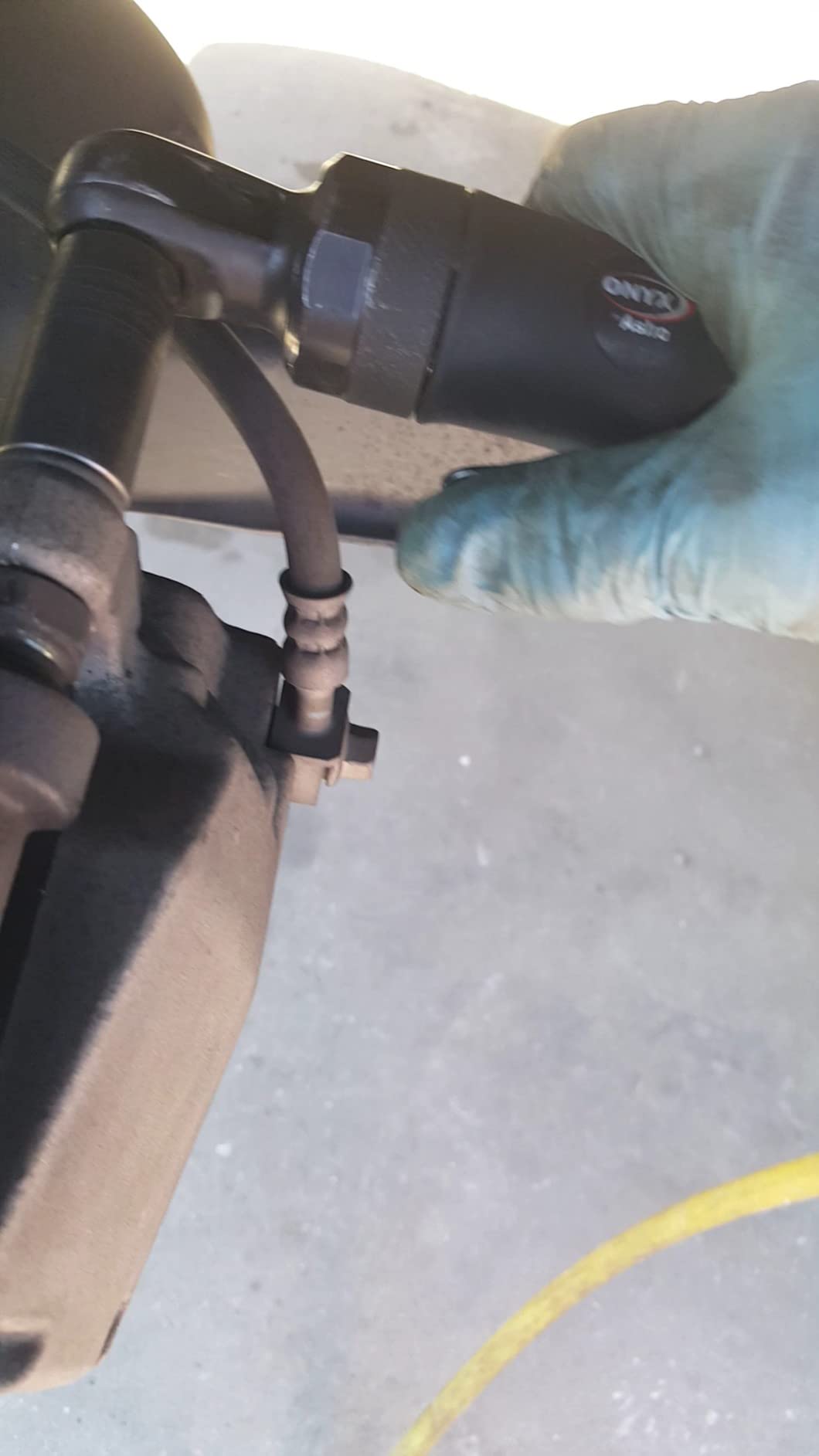
Needle bearing construction is the detail that separates this from a cheap generic ratchet. It supports smooth, prolonged life, and the rear exhaust with silencer keeps it quiet enough for interior work.
Mechanics on mechanic forums consistently describe it as a second ratchet rather than a primary one. That matches our own read: use it when access is the problem, not when torque is.
Where the wobble head changes the job
Fasteners that approach at an angle: a bracket behind a crossmember, a hidden bolt on the side of a transmission housing, dash fasteners that face across the cabin. No amount of torque helps if the socket will not seat.
It also handles confined engine bay work where a full-length ratchet body simply will not fit between the engine and the fender.
What you give up for access
Torque is the trade. Owners report it will not break very tight fasteners, so it is a removal and installation tool for light hardware rather than a breakaway tool.
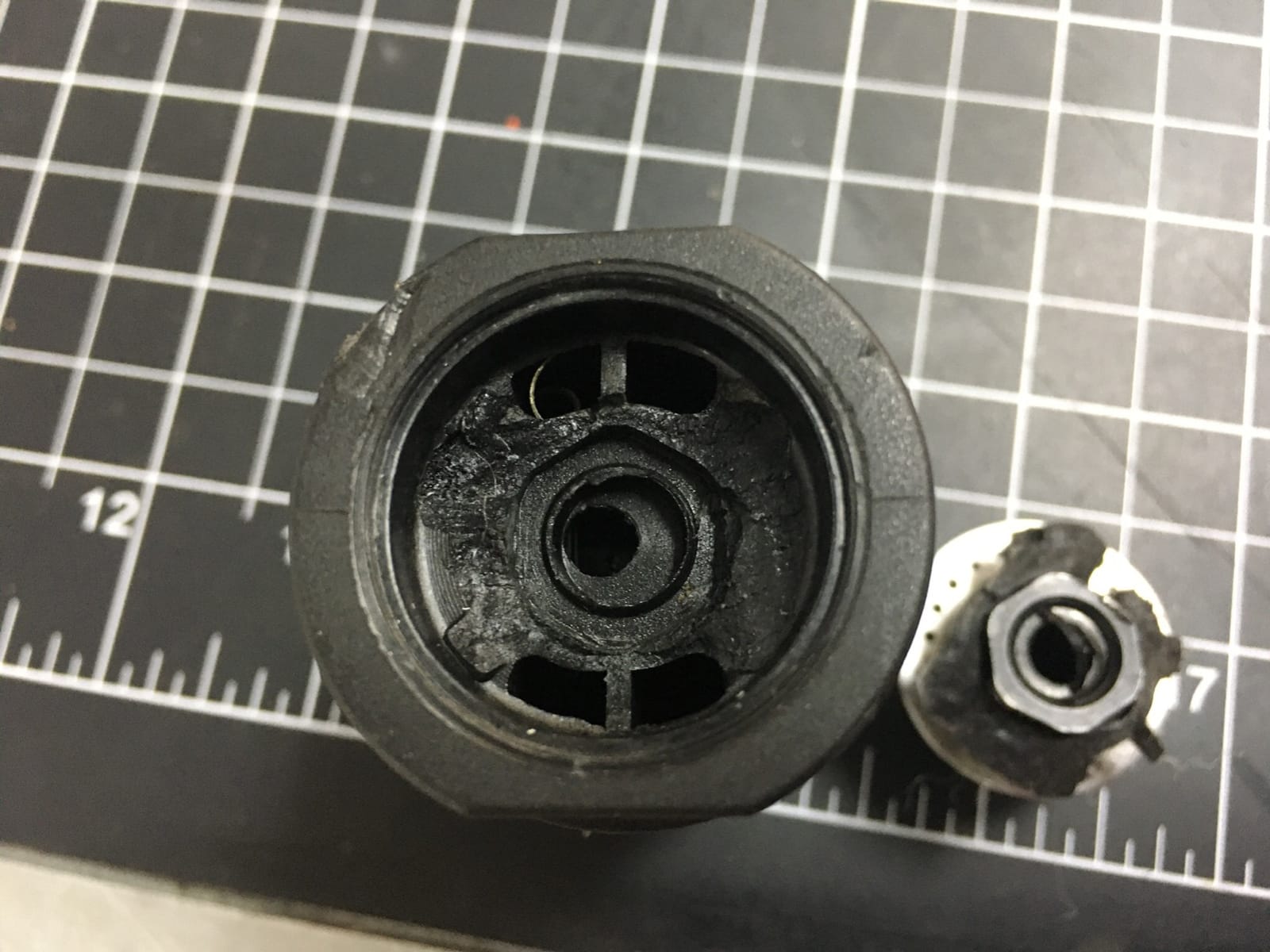
Regular lubrication matters more here than on the other ratchets, and several reviewers note units arriving without factory grease. A drop of air tool oil in the head before each use prevents gear wear. The one-year warranty is also the shortest in this group.
9. Dynamic Power 1/2 inch Air Ratchet Kit – Sockets Included
DYNAMIC POWER Professional 1/2″ Air Ratchet Wrench Kit
70 ft-lb torque
150 rpm free speed
1/2 inch drive
4.8 pounds
Pros
- Includes four 1/2 inch impact sockets at 11 12 13 14 mm
- 70 ft-lb covers routine engine work
- Forward reverse switch with no stage change
- Everything needed in one package
Cons
- Weakest rating distribution with 8% two-star
- 150 rpm is the slowest free speed in the group
- 4.8 pounds is heavy for a ratchet
This kit bundles a 1/2 inch air ratchet with a four piece impact socket set at 11, 12, 13 and 14 mm. If you are building out a metric side to your tool collection, the included sockets remove a real purchase decision.
The ratchet itself delivers 70 ft-lb at 150 rpm, and the forward and reverse switch changes direction without going through a neutral stage. That no-stage-change design speeds up removal and installation cycles.
Suited to automotive work, pipeline disassembly and scaffolding, the kit is a reasonable entry point for someone who wants 1/2 inch drive capability without buying sockets separately.
Why the included sockets matter
Impact sockets are designed to survive hammer-driven loads, which makes them useful with any high torque tool. Starting with a matched set at common metric sizes means you can do real work on the first afternoon rather than waiting on a socket order.
The stated applications are broad enough that it works as a general shop ratchet, not just an engine bay tool.
What the ratings tell you
At 4.3 stars across 211 reviews, 63% are five-star, but 8% are two-star. That low-end tail is heavier than any standalone ratchet in this guide, which points at finish and consistency rather than headline specs.
At 4.8 pounds it is the heaviest item here, and 150 rpm is the slowest free speed. Buy it for the package value, not for speed or lightness.
10. QWORK 3/8 inch Super Fast Air Ratchet – Rotating Head on a Budget
QWORK Air Ratchet Wrench, 3/8″ Super Fast Heavy Duty Air Ratchet, 65ft-lbs
65 ft-lb torque
160 rpm at 90 PSI
1.26 kg
360 degree head
Pros
- 360 degree rotating head improves socket alignment
- Reinforced PLA housing keeps weight down
- Rear exhaust keeps debris off the work surface
- 1/4 inch NPT inlet fits standard shop hose
Cons
- Highest one-star share in the group at 11%
- Composite housing is less durable long term
- Needs pre-oiling before each use
A rotating head is a different idea from a wobble anvil, and the QWORK uses it well. The 360 degree rotating head lets you align the socket more freely in tight engine bay spaces, which is the problem most fixed square drives create.
Specs are 65 ft-lb of torque and 160 RPM at 90 PSI, with a reinforced PLA housing that cuts weight while holding industrial strength. Rear exhaust keeps dust and debris off the work surface rather than blowing them across it.
Connection is a 1/4 inch NPT inlet with a recommended 3/8 inch hose, which matches standard shop hose. The manufacturer also specifies pre-oiling the tool with two to three drops before each use, and that advice is worth following.
Where a rotating head helps
Tight engine bay access where you are approaching a fastener from an awkward angle but still need more torque than the Astro mini provides. Sixty-five ft-lb is a useful midpoint between a light access tool and a high torque one.
Rear exhaust is a real advantage when you are working on an engine with residual dirt, since it does not blow debris back onto a cleaned surface.
Where durability concerns show up
This is the lowest rated ratchet in the guide at 4.2 stars from 234 reviews. Seventy-two percent are five-star, but 11% are one-star, and durability around the composite housing is the recurring complaint.
Composite housings are lighter and cooler to hold but generally less repairable than metal. If you buy it, oil it regularly and treat it as a secondary tool rather than the one you reach for every day.
How to Choose an Air Ratchet for Engine Work
Drive size is the first decision and the one most people get right by accident. The forum consensus is consistent: 3/8 drive is the sweet spot for engine work because it covers the bulk of engine fastener sizes, 1/4 drive suits very tight access, and 1/2 drive is rarely needed unless you work on trucks, heavy equipment or large drivetrain hardware. If you want the broader picture on socket selection, our air ratchet comparison goes deeper on drive sizing.
Torque is the second decision, and two numbers get quoted: breakaway torque, which is the maximum the tool can deliver on a stuck fastener, and working torque, which is what it delivers continuously without stalling. For engine bolts sized between 8 and 20 ft-lb, anything in the 50 to 70 ft-lb range covers the job. Corroded hardware is a different category entirely, and that is where a 130 ft-lb tool earns its place.
Reaction-less clutch is the safety feature technicians argue about most. A reaction-less tool leaks air through the clutch instead of driving back through the socket, so a seized bolt cannot kick the tool into your hand. Worth noting for this group: none of the ten ratchets in this guide publish a reaction-less rating, so treat kickback control as something you manage with technique and speed rather than a specification you can filter on.
Speed in RPM matters more than raw torque for the bulk of engine work. Once a bolt is broken, you want it spinning fast so you can run it off in seconds. The AIRCAT 802 at 280 RPM is built for exactly that, while 150 to 180 RPM tools are breakaway tools first and rundown tools second.
Compressor requirements decide whether any of this works at all. You want roughly 90 PSI at the tool and at least 4 CFM of reserve air, a 1/4 inch NPT inlet, and a 3/8 inch minimum hose. A small tank below 4 CFM will starve a thirsty ratchet, which is why the CRAFTSMAN at 4.4 SCFM is a smart pick for home setups.
Head design and reach decide whether you can physically reach the bolt. Fixed square drives cannot angle, wobble anvils can, and flat heads reach further into deep pockets. On an engine bay where the intake runner sits above the valve cover bolt, that choice is the difference between finishing the job and pulling the manifold.
Air Ratchet vs Cordless Ratchet vs Impact Wrench
An impact wrench breaks bolts loose with a hammering action and does not hold the fastener, so you cannot feel thread engagement or torque it to spec. An air ratchet keeps the socket engaged the whole time, which makes it the right tool for installation and for anything where you want control.
Cordless ratchets win on portability. There is no hose, no compressor, and no trip up the driveway. They lose on sustained high-volume work because the battery is the limiting factor, and forum users routinely report that battery ratchets lack the breakaway torque to free rusted fasteners.
The practical split most shops use: air on the ratchet, cordless for mobile calls and remote jobs. Our cordless ratchet guide covers that side in detail if you are building both halves of a kit.
You can run regular chrome sockets on any air ratchet at these torque levels. Impact-rated sockets are a different product built for hammer loads, and using the wrong type under a high torque air ratchet is what causes socket cracking. Match the socket rating to the tool.
Air Ratchet Maintenance Basics
Put two or three drops of air tool oil in the ratchet head before each use. This is the single highest-return habit, and manufacturers including QWORK and Astro call for it explicitly because dry gear sets wear out fast.
Run an inline filter on your hose so moisture and scale stay out of the motor, and drain the receiver before you start. Water in the head of an air tool turns grit into paste and destroys the gear set.
Check the swivel and the seal on the head occasionally, and keep the trigger mechanism clean. A ratchet that leaks down mid-job is usually a dirty or worn seal rather than a motor problem.
Frequently Asked Questions
What brands of air ratchets are best?
Ingersoll Rand, AIRCAT, Astro and Chicago Pneumatic carry the strongest reputations for long-term durability in shops. Mechanic forum consensus repeatedly names Ingersoll Rand and AIRCAT as the daily-use standards, and Astro as the specialist in compact access tools. Budget brands can handle routine work, but torque ratings and finish consistency are less predictable.
Is a 72 tooth or 90 tooth ratchet better?
A 90 tooth ratchet turns the socket in a smaller arc, which helps in tight spaces and gives finer control at slow speeds. A 72 tooth ratchet is quicker and holds up better under repeated high load. On an air ratchet the tooth count matters less than head diameter and whether the head can articulate, so pick based on access first.
Are air ratchets better than electric ratchets?
Air ratchets win for sustained, high-volume engine work because they run continuously with no battery limit and hold more breakaway torque on corroded fasteners. Cordless ratchets win for portability, quiet operation and mobile work with no compressor nearby. Most technicians keep both, using air in the shop and cordless on the road.
What is the best air pressure for an air ratchet?
Run your ratchet at about 90 PSI with a regulator set as close to the tool as practical. Low pressure cuts speed and torque, while excess pressure adds noise and accelerates wear. Pair that with at least 4 CFM of reserve air, a 1/4 inch NPT inlet and a 3/8 inch minimum hose so the tool does not starve mid-bolt.
Who makes the best air ratchet for engine work?
For most engine jobs the Ingersoll Rand 170G is the safest all-round choice thanks to its 55 ft-lb rating and a large body of long-term owner feedback. For stubborn corroded bolts the AIRCAT 805-HT wins on torque at 130 ft-lb, and for fast rundown work the AIRCAT 802 leads at 280 RPM. Access problems call for the Astro 1119A mini wobble instead.
Who Should Buy Which Air Ratchet
The Ingersoll Rand 170G is our pick for the best air ratchets for engine work overall. It is the only tool here with more than a thousand reviews behind it, its 55 ft-lb and 170 rpm cover routine teardowns, and the heat-treated head is built for the number of cycles an engine job generates.
Add the AIRCAT 805-HT if your work includes seized hardware, since 130 ft-lb is the difference between a bolt coming loose and a trip to the extractor. Add the AIRCAT 802 if you want speed on reassembly, and keep the Astro 1119A in the bag for anything the other three cannot reach.
For a first shop compressor, start with the CRAFTSMAN at 4.4 SCFM or the Dynamic Power 3/8 inch at 6 CFM, both of which publish honest consumption figures. Whichever you choose, oil the head, run an inline filter, and keep a hand ratchet nearby for final torque and thread checks.
We keep this guide updated through 2026 as new models land, so check back before your next engine build.