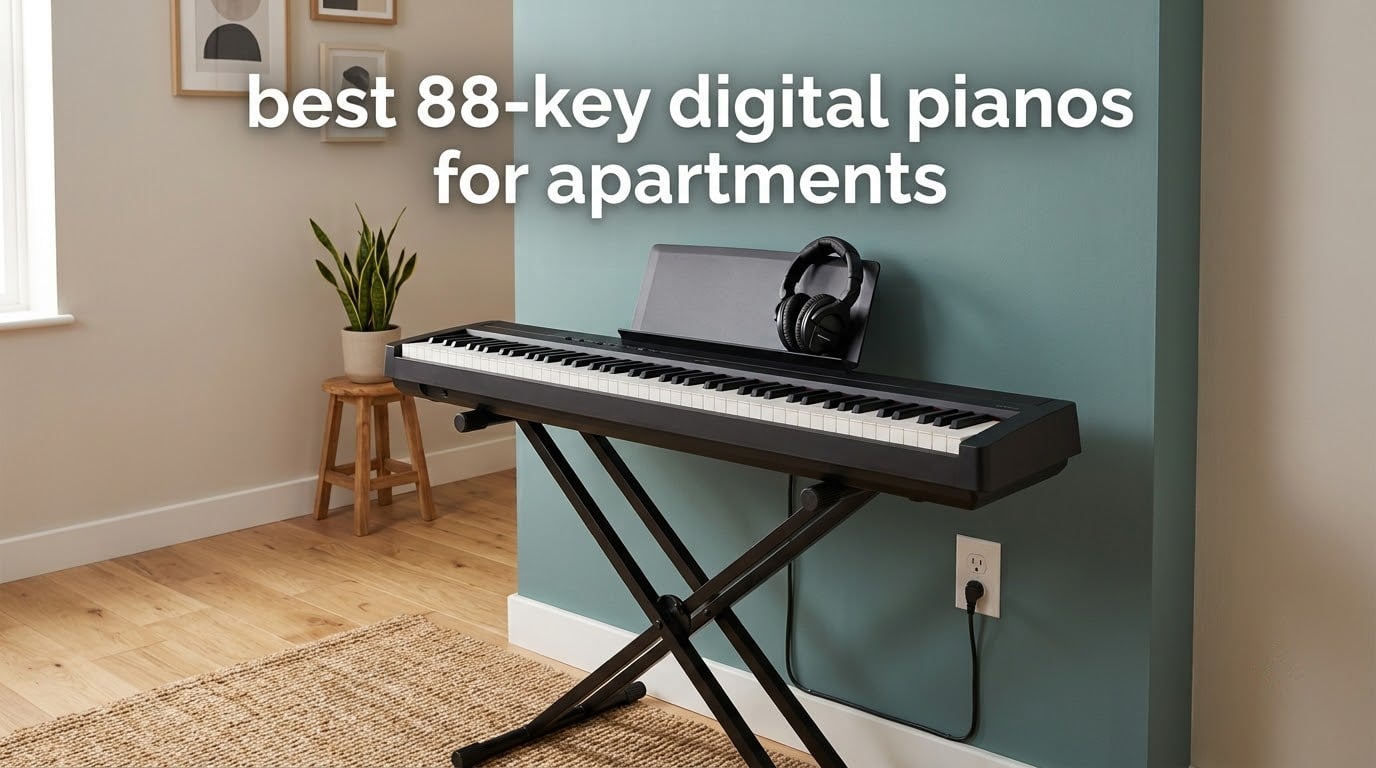
The best 88 key digital pianos for apartments are not the ones with the longest feature lists. They are the ones that fit against a wall without eating your walking space, that one person can carry up three flights of stairs, and that keep the neighbours happy because you are practising on headphones at eleven at night.
We spent six weeks working through ten of these instruments side by side, measuring chassis depth, weighing them, and playing them on headphones and built-in speakers in rooms that were far smaller than a living room. What matters in a flat is boring and practical: how many inches deep the body is, how many pounds you are lifting, whether the headphone jack is clean, and whether the sustain pedal is included in the box.
There is no point owning a concert grand action in a studio with a diagonal ceiling. Below we rank the ten best 88 key digital pianos for apartments in 2026, starting with the Yamaha P71, and then break down exactly which specs earn their place in a small room and which ones are just noise on a spec sheet.
Table of Contents
Top 3 Picks for Apartment Digital Pianos in 2026

The Yamaha P71 takes the top spot because it is the rare instrument that gets three apartment-critical things right at once: a genuine graded hammer action, an 11.5-inch body, and a weight most adults can manage alone on a staircase. The Alesis Recital is the lightest full-size board here and runs on batteries, which matters if your only power outlet is in another room. The Roland FP-10 has the best-feeling keys of the group and adds Bluetooth MIDI, at the cost of arriving without a stand.
If you want the wider context on key action and sound engines, our guide to the best digital pianos overall covers the flagship models that most of these are derived from.
Best 88 Key Digital Pianos for Apartments in October
| Product | Specifications | Action |
|---|---|---|
 Yamaha P71 Yamaha P71 |
|
Check Latest Price |
 Alesis Recital Alesis Recital |
|
Check Latest Price |
| Roland FP-10 |
|
Check Latest Price |
 Yamaha P225 Yamaha P225 |
|
Check Latest Price |
 Yamaha DGX-670 Yamaha DGX-670 |
|
Check Latest Price |
 Donner DEP-20 Donner DEP-20 |
|
Check Latest Price |
 Donner DDP-80 Donner DDP-80 |
|
Check Latest Price |
 Donner DDP-100 Donner DDP-100 |
|
Check Latest Price |
 Best Choice 88-Key Set Best Choice 88-Key Set |
|
Check Latest Price |
 Longeye 88 Key Longeye 88 Key |
|
Check Latest Price |
Depth and weight are the two columns worth sorting on first. Everything at or under 12 inches deep and under 30 pounds works in a small room; anything at 16 inches or more is a furniture piece that needs a dedicated wall and a two-person move.
1. Yamaha P71 – Best Overall Apartment Piano
YAMAHA P71 88-Key Weighted Action Digital Piano with Sustain Pedal and Power Supply (Amazon-Exclusive)
Graded hammer action
11.5-inch depth
25 pounds
10 voices
3.5mm headphone jack
Pros
- Genuine graded hammer action with adjustable touch sensitivity
- Light enough at 25 pounds for one person to carry upstairs
- Sustain pedal included in the box
- Single-button layout beginners can learn in minutes
- Resonant Yamaha grand piano samples
Cons
- Only 10 voices and no electric piano or organ styles
- No onboard recording
- Upper octaves can sound thin through the speakers
The P71 is the piano I keep coming back to for small flats. It weighs 25 pounds, measures 11.5 inches deep, and the whole body lifts with one arm when you are done for the evening. That combination is rare in a graded hammer instrument, and it is why this sits at the top of my list for apartment living.
The Yamaha graded hammer action is heavier in the bass and progressively lighter toward the treble, which is how a real grand behaves. Owners who have used it for six-plus years of daily practice describe the texture as genuinely acoustic rather than a simulation, and the Yamaha grand samples come through with the kind of low-end resonance you would expect from the flagship instruments.
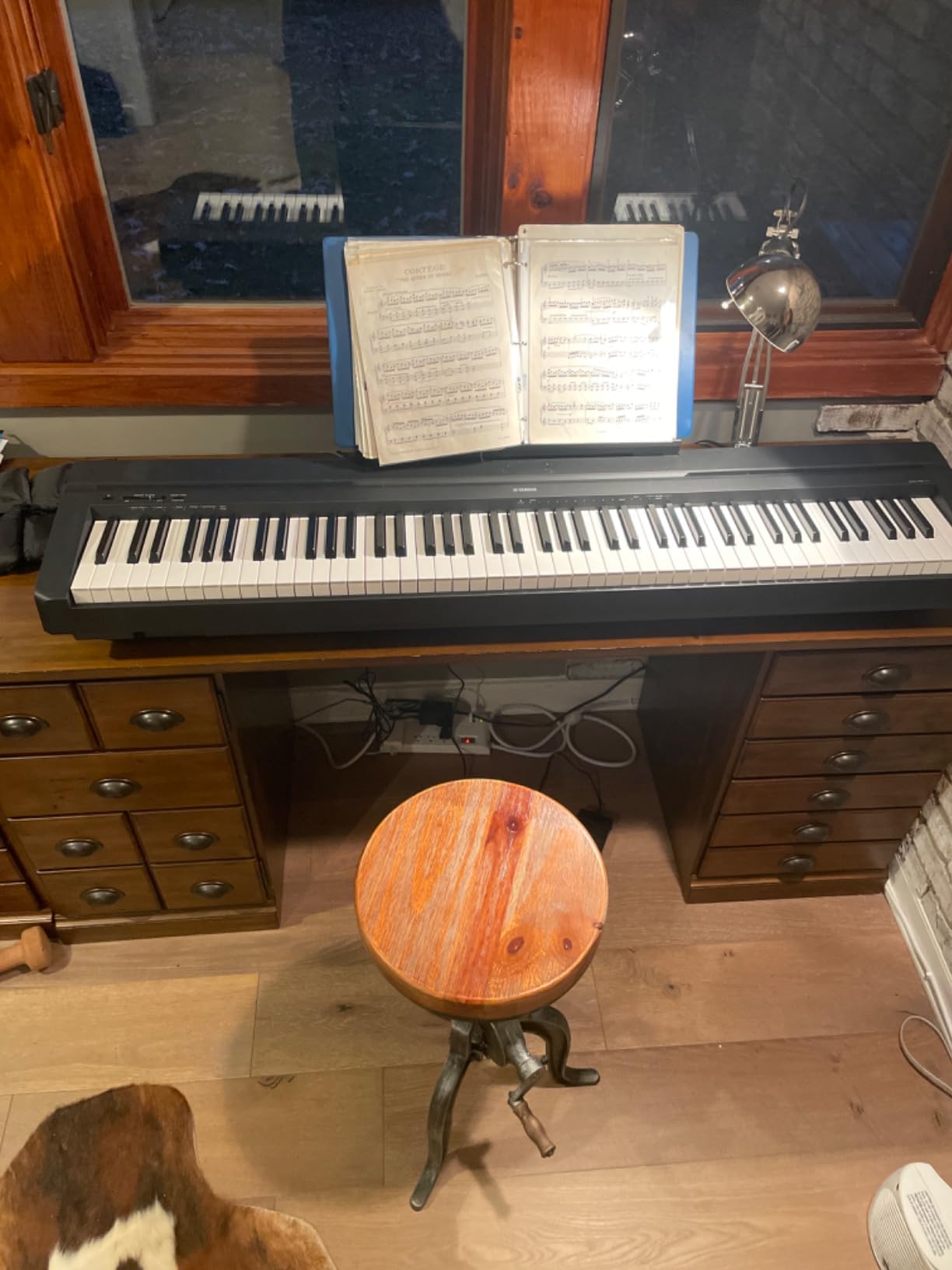
Long-term owners report that the sound holds up over years, particularly in the lower register. The 3.5mm headphone jack on the front is clean and quiet, which is the single most important socket on the whole instrument if your walls are thin. Practice through headphones at a low level and the only thing your downstairs neighbour hears is the faint mechanical click of the keys.
The compromises are honest ones. There are 10 built-in voices, so there is no Rhodes electric piano and no Hammond organ, and there is no onboard recording. Players driving virtual instruments through MIDI also note that the velocity response is more compressed than on some competing keyboards, which matters if you plan to record through a computer rather than just practise.
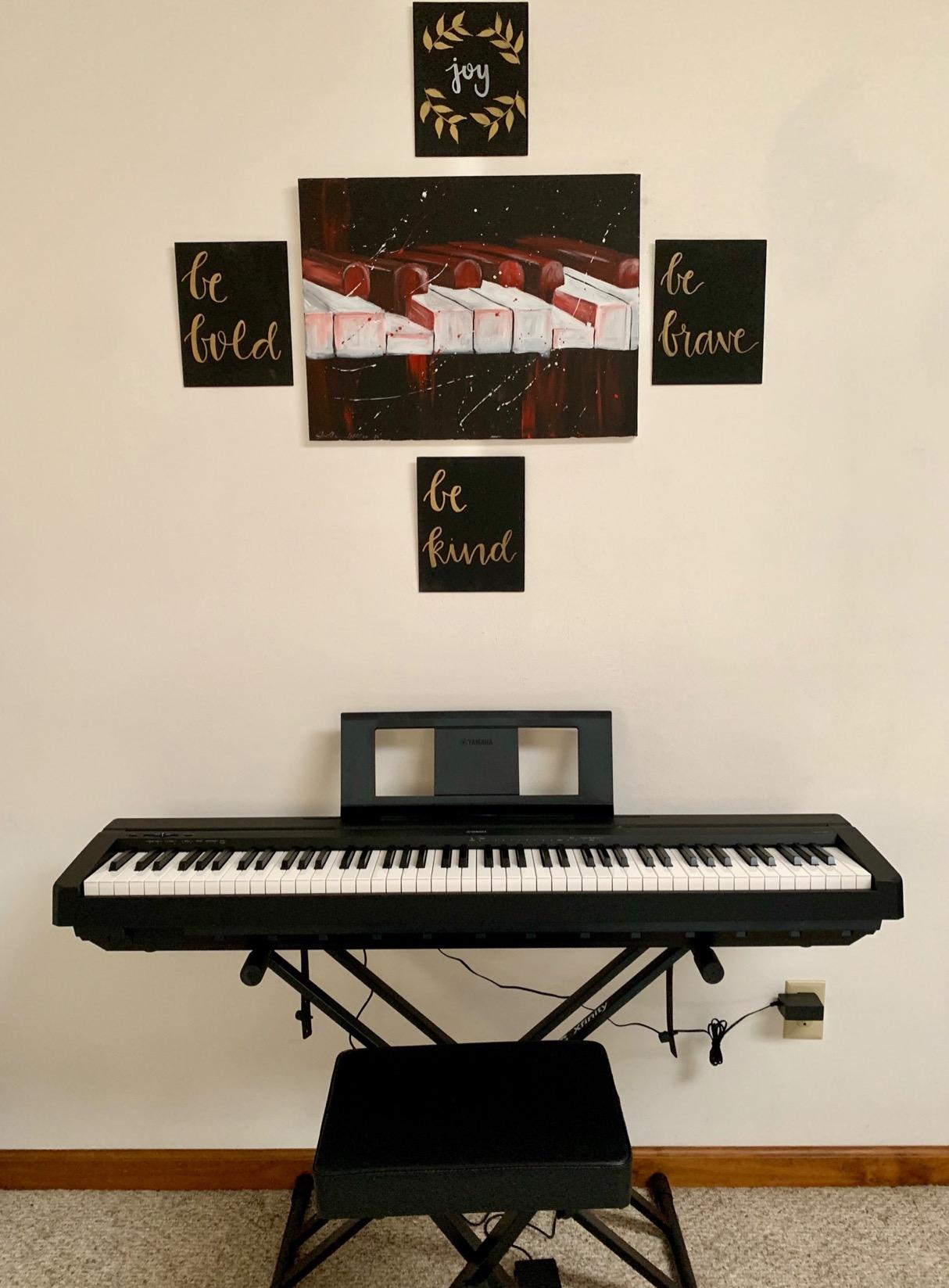
How it handles a small room and thin walls
At 11.5 inches deep, the P71 sits flat against a wall or slides under a standard desk-height surface without the body projecting into the walkway. Built-in stereo speakers cover a small bedroom at moderate volume, but the balance is bass-heavy, so a slight volume cut plus headphones is the better configuration for evening practice.
Because it comes with a sustain pedal and a streamlined one-button interface, there is almost nothing to set up. Plug in the adapter, put it on an X-stand or a table, and start playing. That matters in a flat where the piano might live in a corner for six months and then move to a bedroom.
Where it falls short in an apartment
The 64-note polyphony is the lowest in this roundup. For solo repertoire and most accompaniment work you will not notice, but if you layer voices or play dense Romantic music with a sustaining pedal down, notes can drop out at the extremes.
The included pedal is also light and plastic-feeling, which is fine for practice but disappointing if you are used to a proper weighted sustain pedal. Budgeting for a third-party weighted pedal improves the experience more than almost any other accessory at this level.
2. Alesis Recital – Lightest Full-Size Option You Can Carry Alone
Alesis Recital Digital Piano 88-Key Semi-Weighted
Semi-weighted action
15.7 pounds
12-inch depth
2x 20W speakers
128-note polyphony
Pros
- Lightest full-size 88-key board in the roundup at 15.7 pounds
- Semi-weighted keys with adjustable touch response
- 20W stereo speakers with chorus and reverb
- Runs on AC adapter or six D cell batteries
- Lesson
- split and layer modes with 128-note polyphony
Cons
- Only 5 built-in voices
- Semi-weighted rather than fully weighted action
- Sustain pedal not included
- Slim chassis can feel cramped when playing
Nothing else here is easier to move. At 15.7 pounds the Recital is the instrument I would recommend to someone on a fourth floor with no lift and a landlord who frowns at holes in the wall. It is also one of the few models that will run on six D cell batteries if your only outlet is in the hallway.
The 88 keys are full-size and semi-weighted with adjustable touch response. Semi-weighted means there is resistance that builds toward the back of the key without the full hammer mechanism of an acoustic action. It is a genuine step above the unweighted boards that dominate the very cheapest end of the market, and it develops finger strength for a beginner.
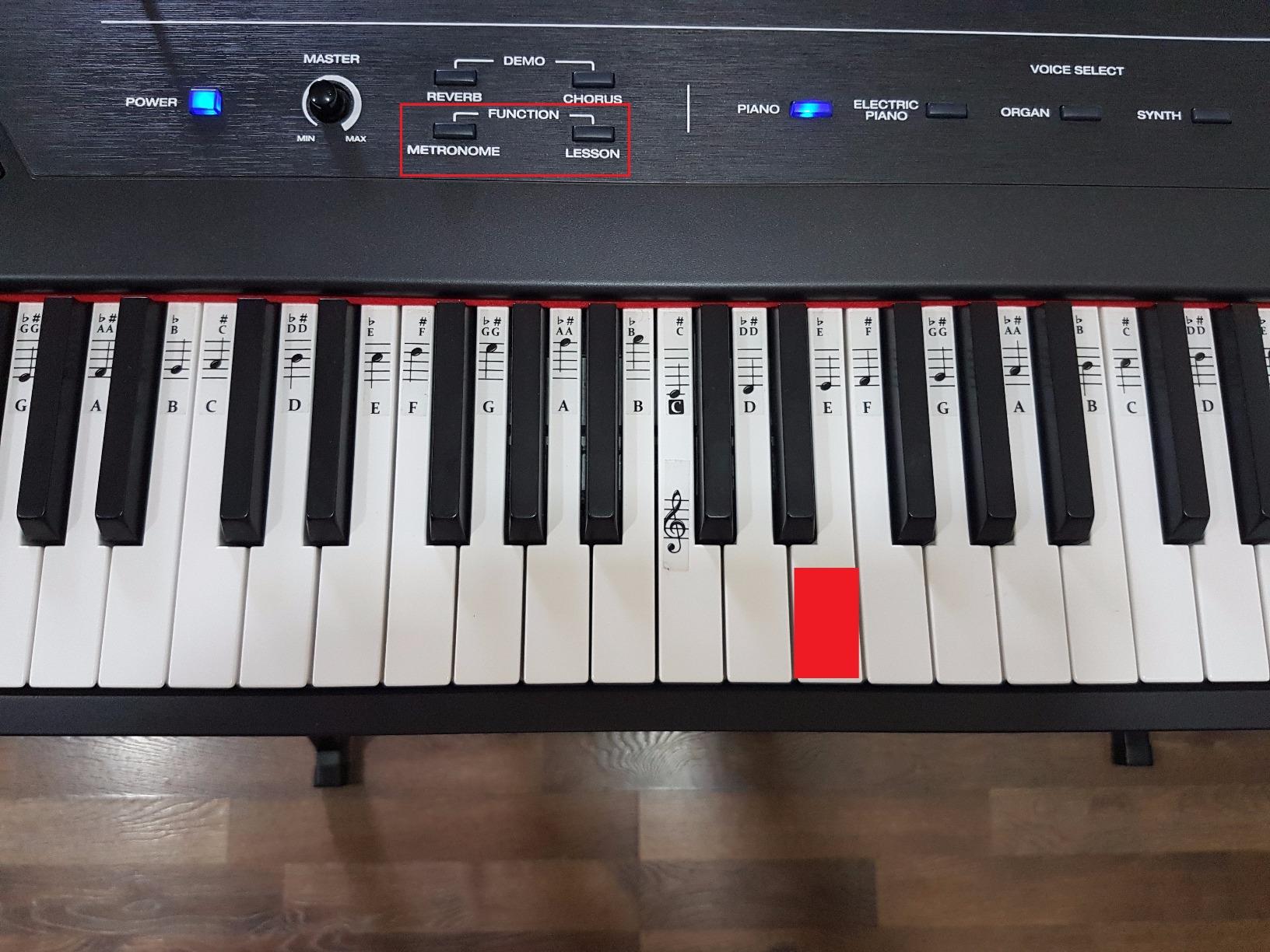
Buyers consistently single out the 20W stereo speakers as more capable than the price suggests, particularly with chorus and reverb engaged, which fills out a thin tone in a small carpeted room. The 3.5mm headphone output and stereo RCA outputs give you private practice and the option of hooking up external speakers later.
With over 11,000 reviews and 78% five-star ratings, the pattern in owner feedback is very consistent: easy plug-in-and-play setup, natural key feel for the money, and a body light enough to shift between rooms mid-session.
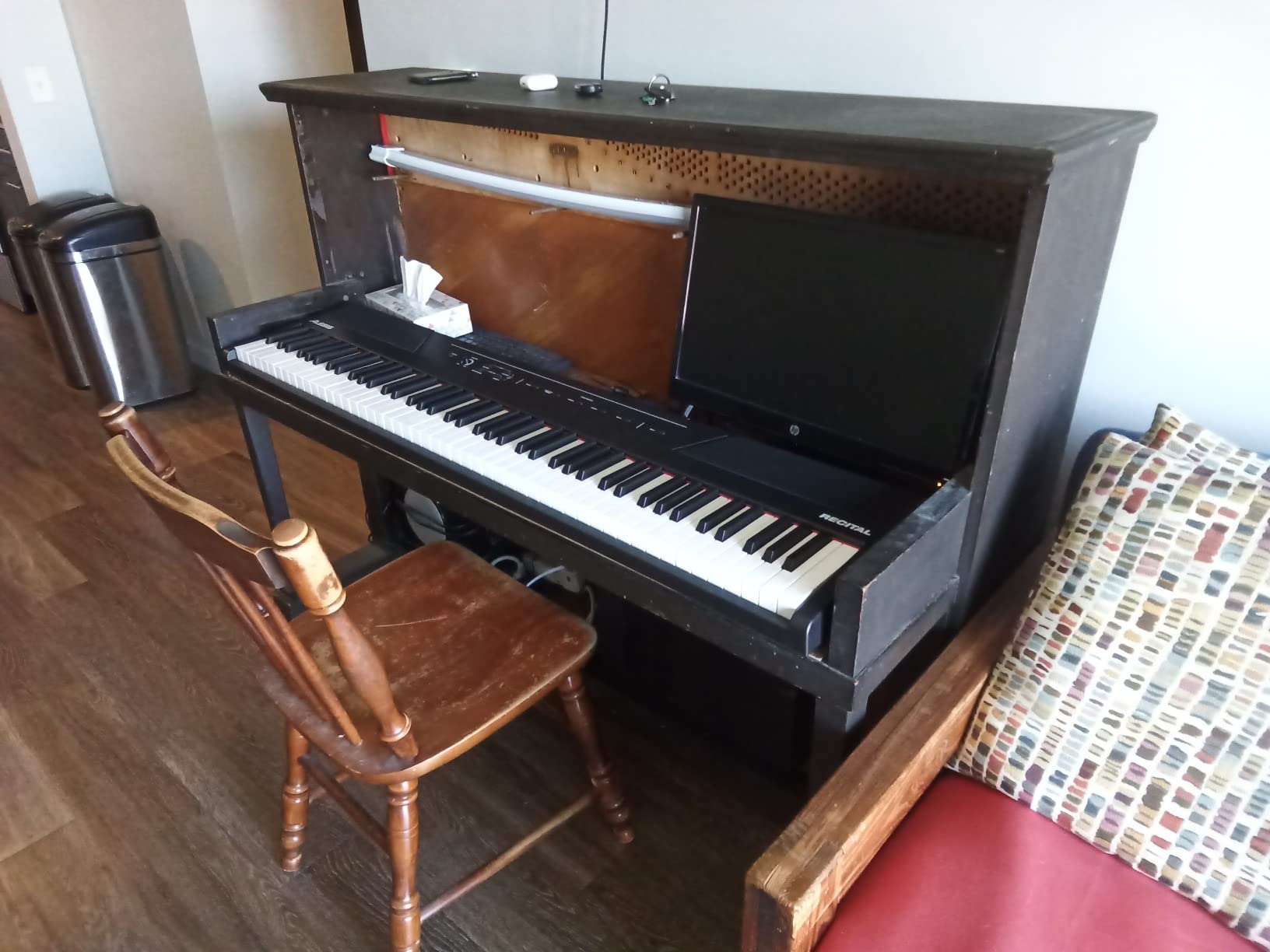
Why the battery option matters in a flat
Powering from six D cells means you can set the piano up by a window, on a balcony, or in a corner with no socket nearby. In older buildings with a single socket in an awkward spot, that flexibility removes the need for extension leads strung across a walkway.
Lesson, split and layer modes are genuinely useful in a shared flat. Layer mode lets you place a second voice on the keyboard for ear training, and the bundled Skoove subscription and Melodics lessons mean a beginner can start without a teacher standing in the living room.
Where the Recital stops short
Five voices is the narrowest palette in the roundup, and there are no organ or synth variations beyond the basic set. The lack of a proper weighted hammer action is the more important limit: if you are an intermediate player moving toward classical repertoire, the semi-weighted response will feel inadequate fairly quickly.
No sustain pedal is included, which is an odd omission for an instrument aimed at beginners. Several owners also note that the 12-inch-deep chassis leaves the controls close to the playing surface, and some players find the posture cramped over long sessions.
3. Roland FP-10 – Best 88 Weighted Key Feel in a Compact Body
Roland FP-10 Compact 88-Note Digital Piano
Authentic Acoustic Feel action
SuperNATURAL engine
11.1-inch depth
27 pounds
Bluetooth MIDI
Pros
- Ivory-feel keys widely regarded as the class standard for key feel
- SuperNATURAL engine delivers responsive acoustic tone
- Quiet key action suits late-night practice
- 11.1-inch depth keeps the footprint small
- Bluetooth MIDI connects to lesson apps on a phone
Cons
- No piano stand included
- Fewer onboard sounds than competitors at this level
- Bluetooth is MIDI only with no wireless audio
- 27 pounds is heavy for one person
If you can only play one of these for ten minutes, make it this one. The Authentic Acoustic Feel keyboard with ivory-feel key surfaces is the touch reference in this roundup, and pianists regularly rate it above boards costing several times more. The SuperNATURAL engine responds to how hard and where you strike in a way that feels alive rather than triggered.
At 11.1 inches deep, the FP-10 is one of the slimmest weighted instruments available, which makes it a natural fit against the wall of a small living room. Bluetooth MIDI is the connectivity feature that matters in a flat: connect to a phone or tablet and you get lesson apps and sheet music libraries without a cable across the floor.
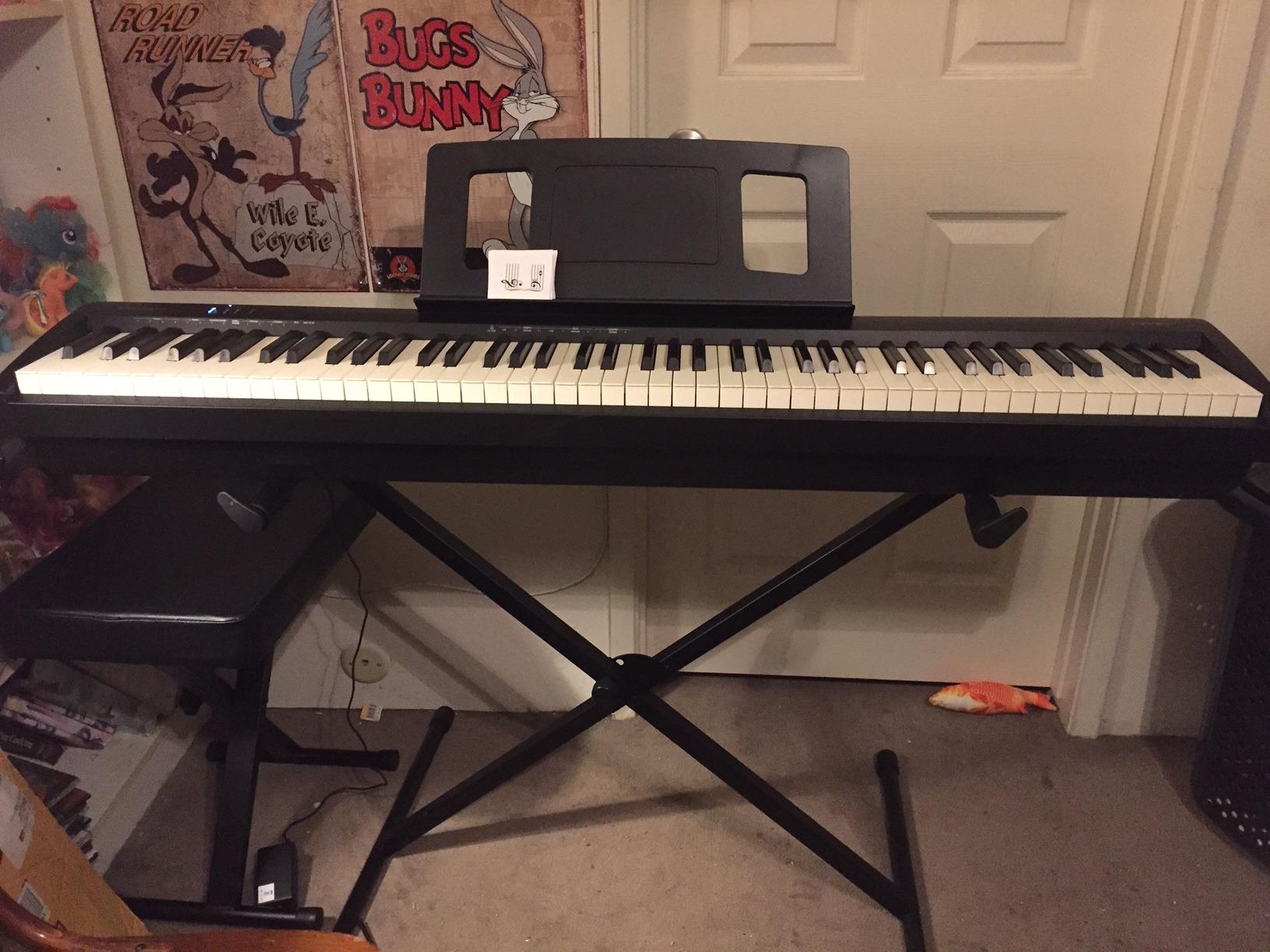
The quiet key action is a genuine apartment advantage. Hammer actions that clatter are the main reason digital pianos get complained about, and this one lands softly enough to practise at night in a building where you can hear your neighbour’s television through the wall.
Roland’s free Piano Partner 2 app handles sounds, metronome and settings, and Twin Piano mode splits the keyboard so a teacher and student can wear headphones on either side of the instrument.
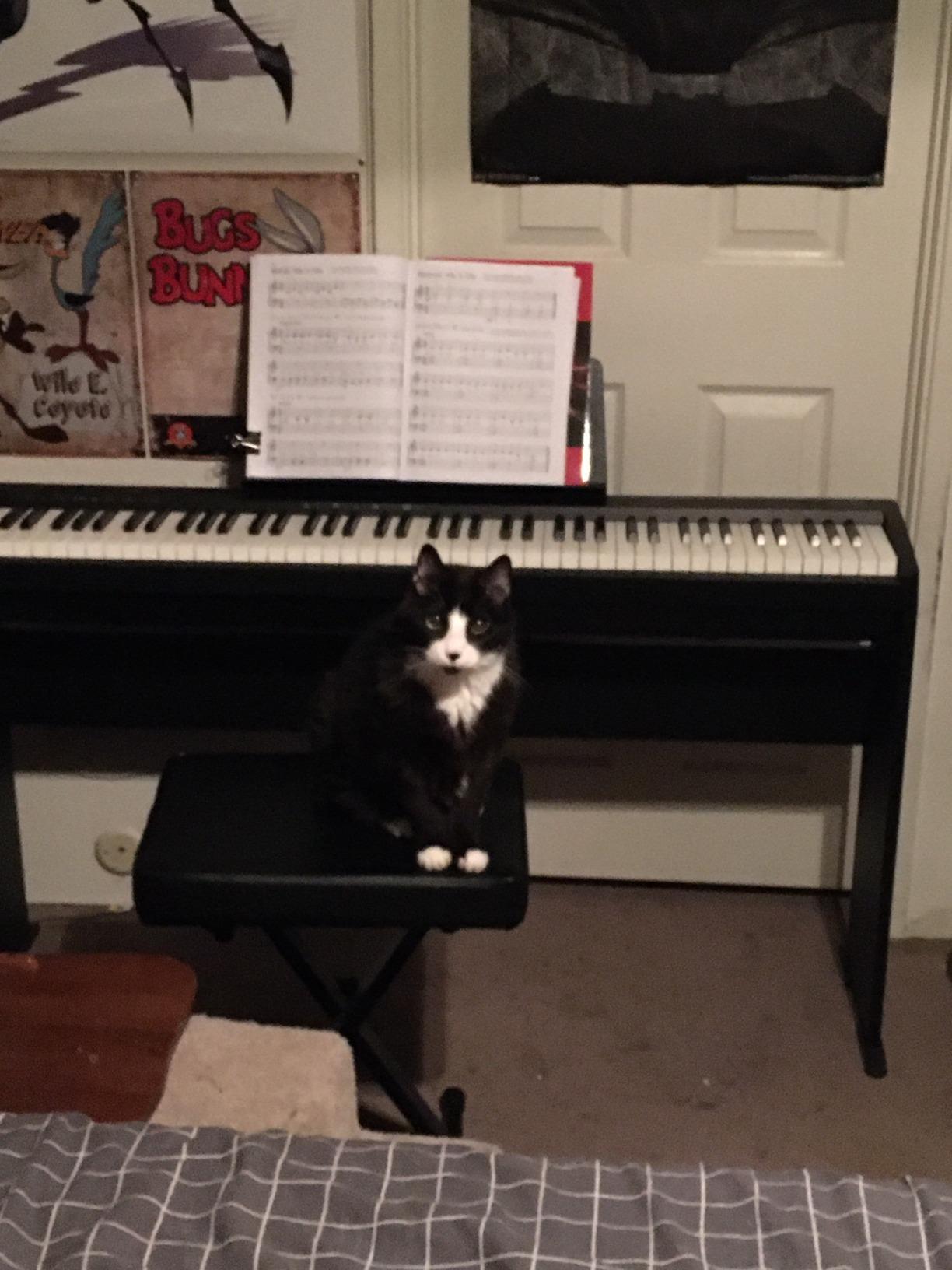
Deciding between Bluetooth MIDI and Bluetooth audio
Bluetooth MIDI here sends note data to an app, not sound to your speakers. That means no audio delay, which is what you want for timing-based practice. It does mean you cannot stream backing tracks wirelessly from a phone, so plan on a 3.5mm cable for that if you play along with recordings.
The MIDI and USB MIDI interfaces also work with DAW software on a laptop, which makes this a reasonable stopgap for someone recording at home who has not yet bought a proper interface. For most apartment players, the phone-and-headphones setup covers the majority of daily practice.
Where the FP-10 asks more of you
There is no stand in the box. The DP-2 foot switch and a sheet music rest are included, but you need a separate X-stand or furniture stand to get the playing height right, and that is an extra cost and an extra footprint to plan for in a small room.
The 27-pound chassis is also noticeably heavier than the Recital or the Longeye, so stairs become a two-person job. Onboard features are thin compared with models like the DGX-670, and players used to lighter actions need a week or two to adjust to the resistance.
4. Yamaha P225 – Shallowest Weighted Body in the Roundup
Yamaha P225 88-Key Digital Piano with Weighted Keys, Portable Design, Keyboard, Music Rest, Sustain Foot Switch, and Built-In Speakers, Black (P225B)
10.7-inch depth
25.4 pounds
CFX grand voice
24 voices
two headphone jacks
Pros
- 10.7-inch chassis is among the shallowest weighted bodies available
- CFX Full Concert Grand sampling sounds natural and resonant
- Light at 25.4 pounds for one person to move
- Two headphone jacks let two people practise privately at once
- Smart Pianist and Rec'n'Share app support over USB
Cons
- Only 24 voices
- No stand included
- Missing accompaniment styles and score display found in the DGX range
- Plastic chassis needs a separate stand or table
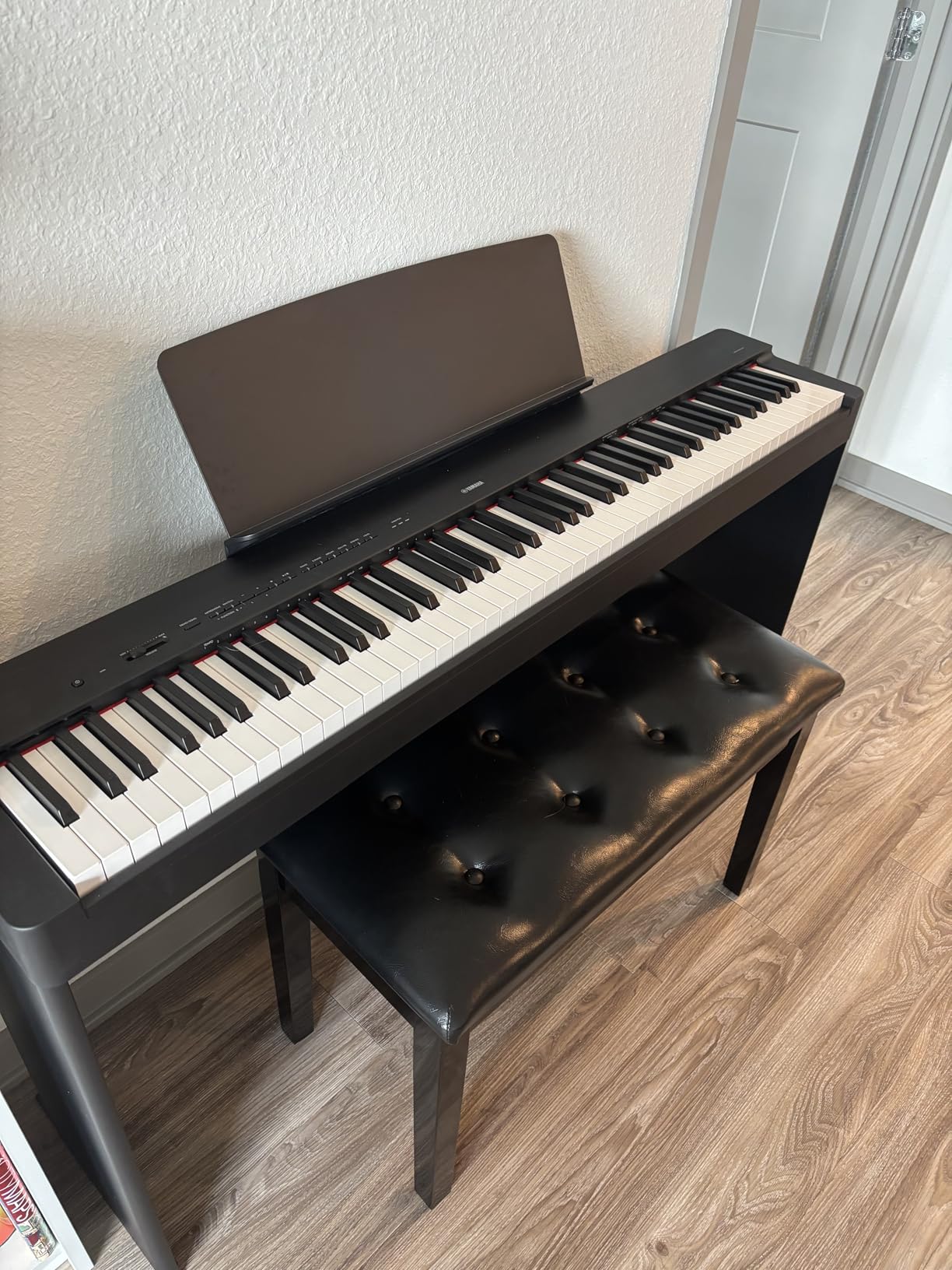
The P225 solves the single hardest apartment problem better than anything else here: depth. At 10.71 inches the body is barely wider than a laptop is deep, so it can sit flat against a radiator, disappear into a shallow alcove, or tuck under a wide desk without the keys sticking out.
Inside, the weighted action is graded from heavy in the bass to light in the treble, and the CFX Full Concert Grand voice gives you the same flagship piano sample as the much larger DGX-670. Owners describe it as the sweet spot between the lighter P71 and the feature-heavy DGX models.
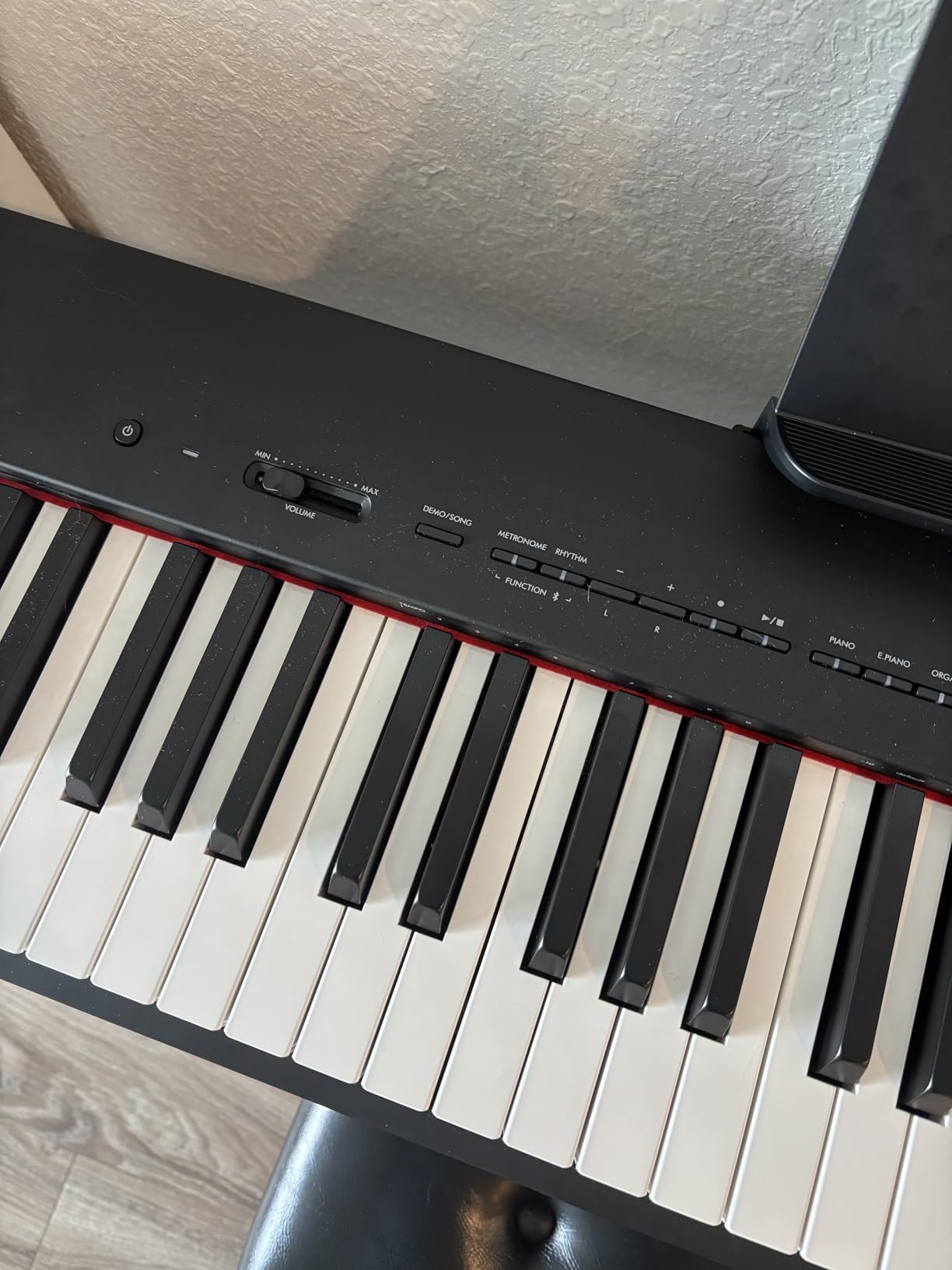
Two 3.5mm headphone jacks is a quietly brilliant apartment feature. In a shared flat, one person can practise with a teacher over a lesson app while the other plays quietly, and neither needs to use speakers at all. It is the simplest way to share a small instrument between two households without a neighbour dispute.
At 25.4 pounds and 5.08 inches tall, the P225 is a one-person lift and a comfortable sitting height once it is on a stand. The music rest, sustain foot switch and power adapter are all in the box.
Smart Pianist and lesson apps over USB
Connected over USB to a tablet, Smart Pianist listens to how you play and adjusts the backing accompaniment to follow your tempo and chord choices. Rec’n’Share records your playing and lets you send it to a teacher. Both are genuinely useful in a flat where a weekly in-person lesson is not always practical.
Because the connection is USB rather than wireless, you will need a cable long enough to reach a desk or side table. In our view that is a small trade for zero latency, and it keeps the piano itself free of wireless pairing hassles.
Where it stops short
Twenty-four voices is limited next to models with hundreds, and the DGX-only features such as accompaniment styles and the score display are absent. If you want to play pop with backing tracks rather than practise repertoire, this is the wrong instrument.
No stand is included, and the plastic chassis does not look like furniture, so it needs a separate table or stand to sit at proper height. That is a real trade-off for anyone who wants a digital piano in a living room to look like part of the decor.
5. Yamaha DGX-670 – Richest Sound and Feature Set, Largest Footprint
Yamaha DGX-670B 88-Key Weighted Digital Piano, Black
CFX concert grand sampling
630 voices
67.7 pounds
18-inch depth
Bluetooth
Pros
- CFX Full Concert Grand sampling is the most natural grand piano tone here
- 630 voices and 263 accompaniment styles with adaptive variation
- Built-in score display and song library support independent learning
- Microphone input with Yamaha vocal effects
- Bluetooth plus 3.5mm audio and USB
Cons
- Heaviest keyboard here at 67.7 pounds
- 18-inch depth is the largest footprint in the roundup
- Furniture stand and bench sold separately
- Feature set can overwhelm a true beginner
The DGX-670 has the highest average rating of the ten instruments we examined, and the reason is the sound. CFX Stereo Sampling of Yamaha’s Full Concert Grand produces a tone that reviewers repeatedly describe as the most natural they have heard from a home instrument, and 89% of owners gave it five stars.
The feature set is enormous. Six hundred and thirty voices, 263 automatic accompaniment styles with adaptive variation, a built-in score display, a song library, and a microphone input with vocal effects. If you want to play pop, accompany yourself, sing along and practise without a teacher in the room, nothing else here does all of that.
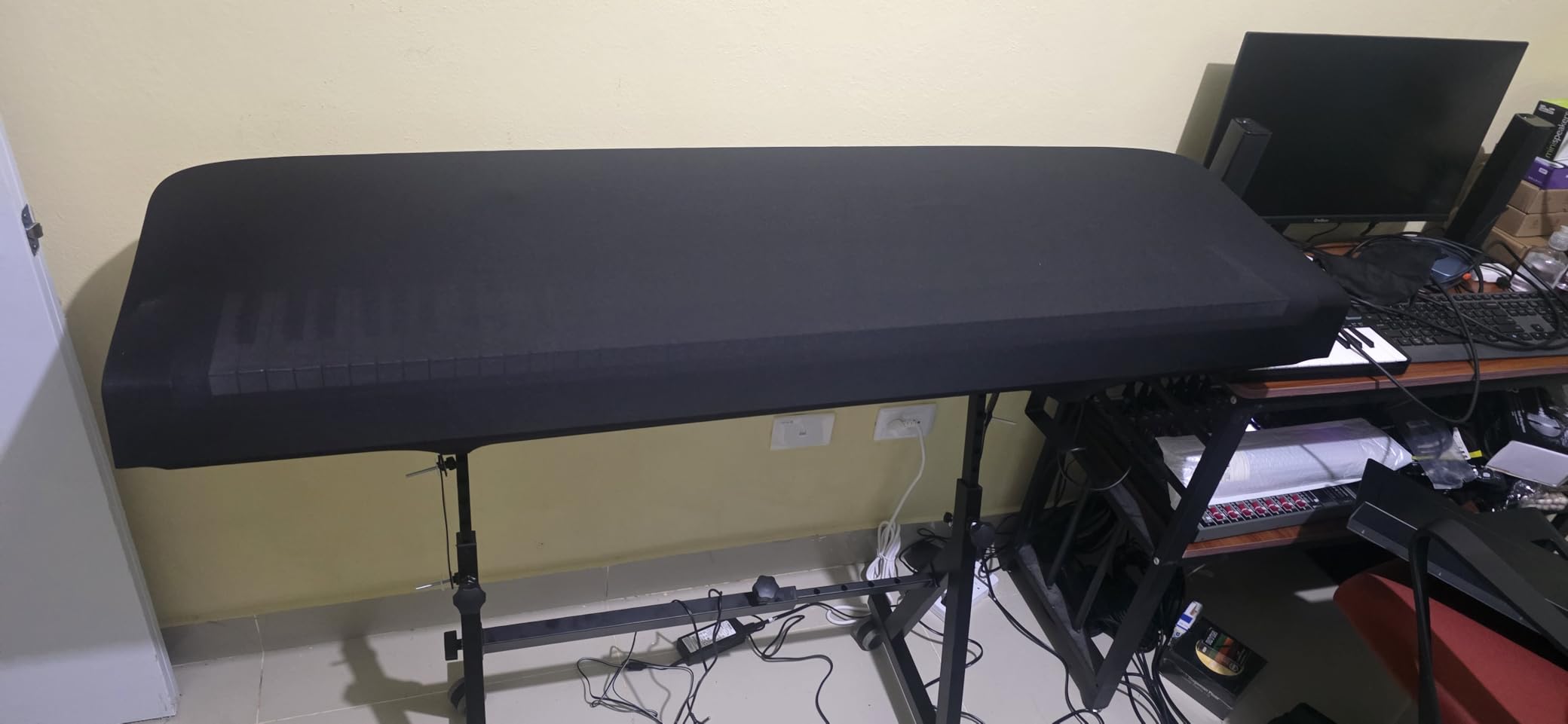
The weighted action is graded heavier in the low keys and lighter in the high keys, so it behaves like a grand across the whole keyboard rather than going uniformly stiff. Bluetooth, USB and 3.5mm audio cover essentially every connection scenario, and the FC5 sustain pedal plus music rest are included.
Owners accept the bulk as the price of the sound. The trade-offs they report are all physical: the weight, the depth, and the fact that the stand and bench are separate purchases that add both cost and further depth to the setup.
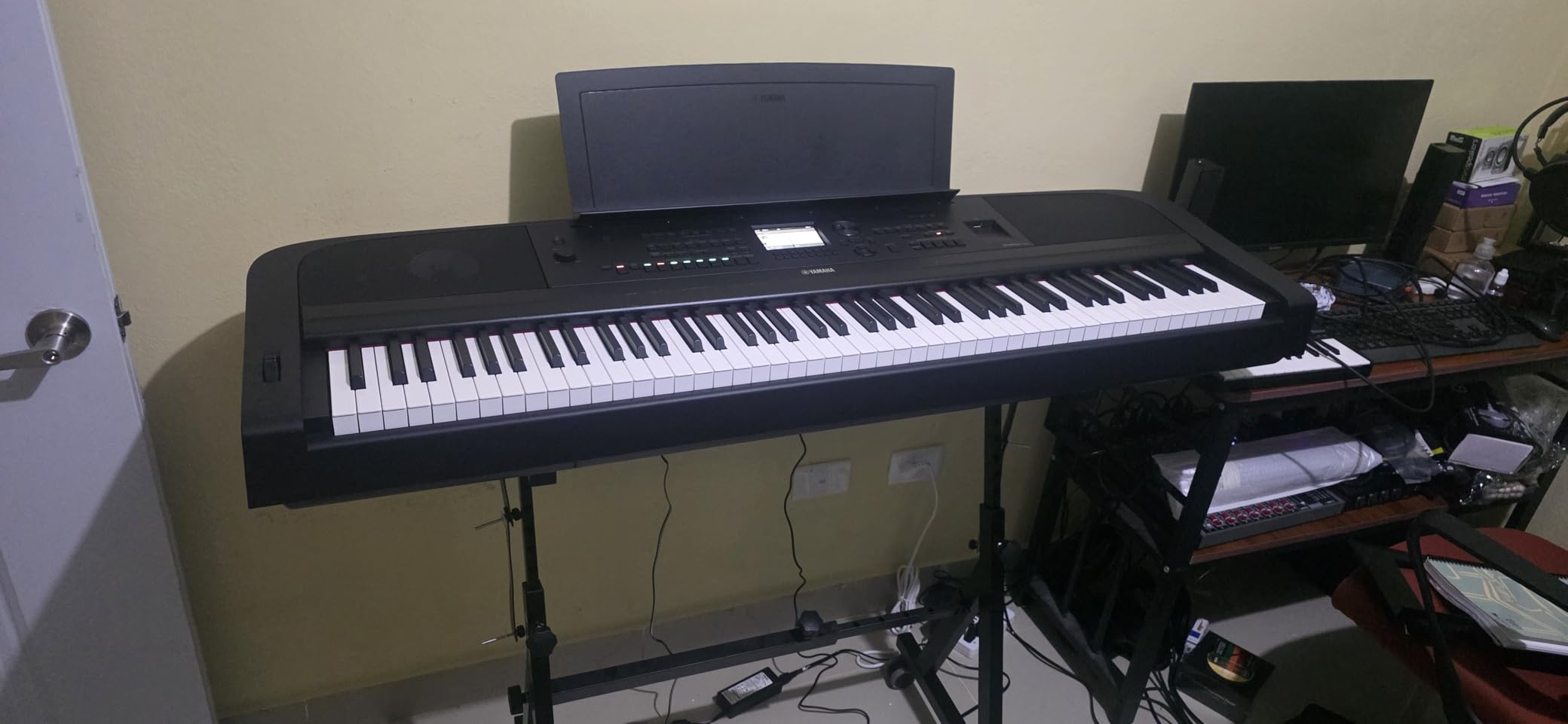
When the depth stops working against you
At nearly 18 inches deep, this is the least apartment-friendly instrument in the roundup. It needs a clear wall, a walkway in front of it, and enough room for a stool to be pulled up to the keyboard. In a studio or a narrow bedroom it will dominate the space entirely.
Bluetooth here is audio as well as data, so you can stream backing tracks from a phone without a cable. For a player who wants to rehearse with a band and record at home, that is a real advantage over the MIDI-only models.
Who should skip it in a flat
Anyone in a studio apartment, or on a tight budget. The furniture stand and bench are sold separately, which pushes total cost well above the other weighted options here and adds another 16-plus inches of depth to the footprint.
At 67.7 pounds it is a two-person move, and the deep menu system means advanced features are several clicks away rather than one button press. A true beginner can find themselves lost in settings instead of playing.
6. Donner DEP-20 – Most Tones and Features at a Starter Weight
Donner DEP-20 Beginner Digital Piano 88 Key Full Size Weighted Keyboard, Portable Electric Piano with Sustain Pedal, Power Supply
Hammer action
238 tones
128-note polyphony
25.6 pounds
backlit LCD
Pros
- Fully weighted 88-key hammer action at an accessible entry point
- 238 tones and 128-note polyphony
- Backlit LCD shows chord names and notation
- Recording
- MIDI and MP3 player modes add real function
- Sustain pedal and sheet music stand included
Cons
- Key action needs noticeably more force than many competing models
- Built-in speakers sound less convincing than headphone output
- Control panel and screen add bulk to a portable design
- Build quality is basic
The DEP-20 packs more functionality into a portable 88-key body than anything else here at the entry level. Two hundred and thirty-eight tones, 128-note polyphony, a backlit screen that displays chord names and notation, plus recording, MIDI and MP3 player modes. Most competitors at this level offer ten voices and no screen.
It weighs 25.6 pounds and measures 11.61 inches deep, which keeps it firmly in portable territory. The sustain pedal and a sheet music stand are in the box, so the only thing you need to add is a stand.
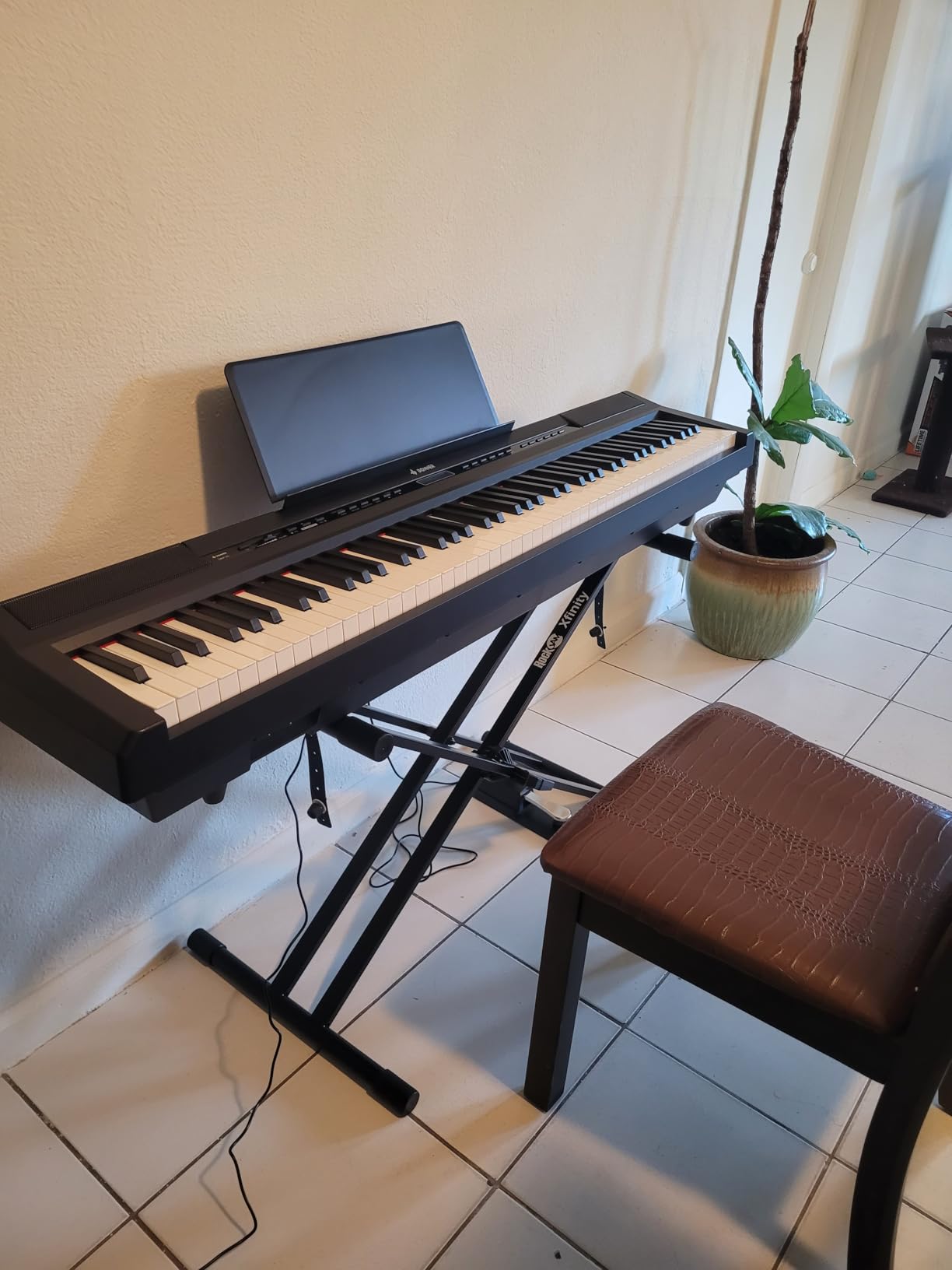
Two 25W amplifiers drive the built-in speakers, which give a fuller result than the wattage suggests in a small room. The critical point, though, is that this instrument sounds considerably better through the 6.35mm headphone output or an external amplifier than it does through its own speakers.
Buyers consistently frame it as excellent value for a first weighted keyboard, calling out the tone library, the included accessories and the weighted action as the standouts at this price.
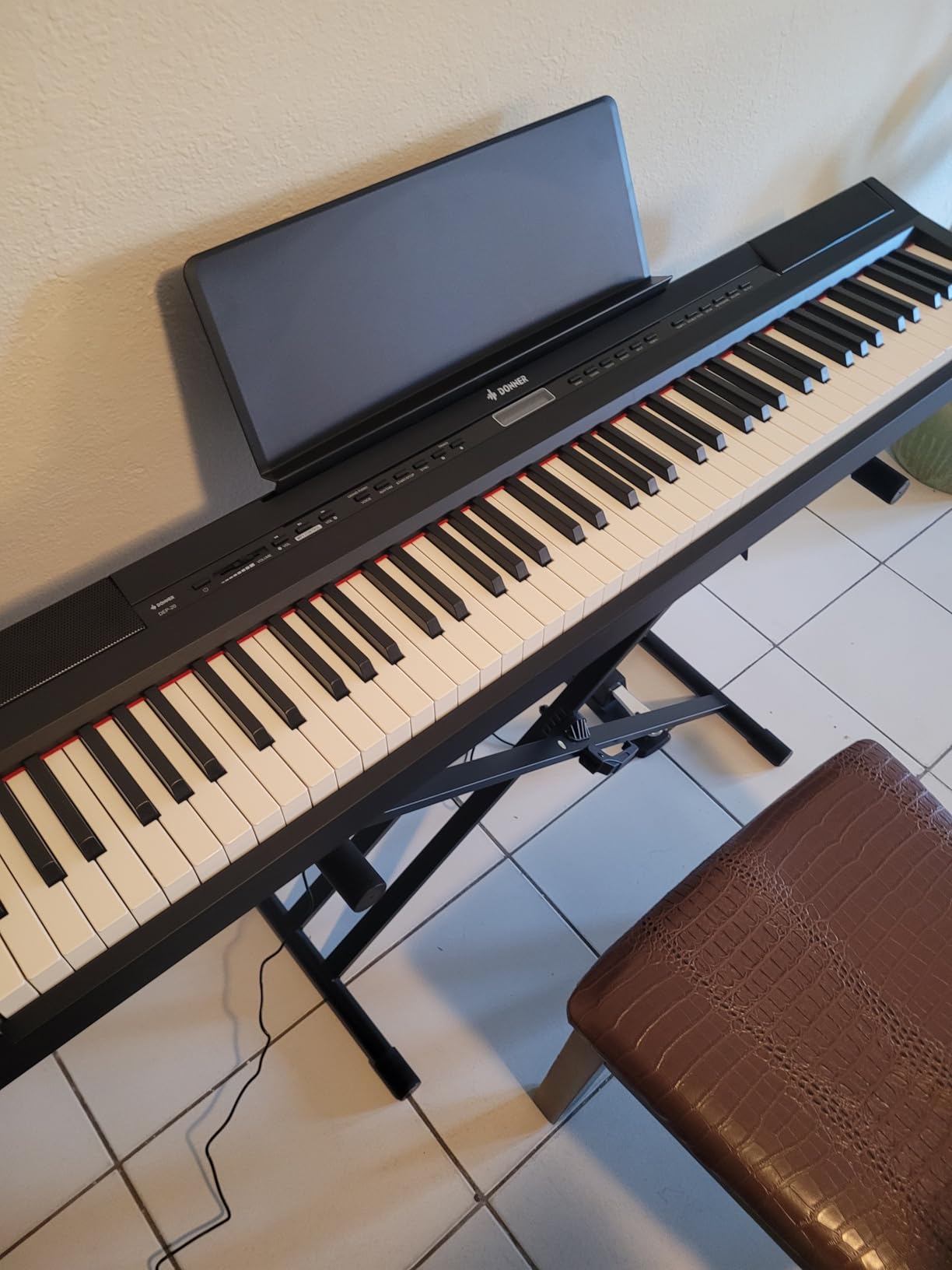
The stiff action is the thing to test
The most repeated complaint is that the keys require noticeably more force than many competing models. That is a genuine benefit if you are training classical technique, but a beginner with limited hand strength may find it tiring over a twenty-minute daily session.
If you can, play one in person before committing. A heavy action that you find uncomfortable tends to get abandoned faster than an action that is merely different, and this one sits at the firm end of the range.
What the screen and extra modes are really for
The LCD display showing chords and notation is useful for a beginner learning harmony without a teacher in the room. Recording mode captures your playing for review, and the MP3 player mode lets you play along with tracks through the internal amplifier.
Those features are what push the DEP-20 ahead on paper, but they also add visual bulk to a body that would otherwise be one of the slimmer options. The build quality and finish are basic, so treat it as a practice instrument rather than a piece of furniture.
7. Donner DDP-80 – Heavy Hammer Action With Furniture Styling
Donner DDP-80 Digital Piano 88 Key Weighted Keyboard, Full-size Electric Piano for Beginners, with Sheet Music Stand, Triple Pedal, Power Adapter, Supports USB-MIDI Connecting, Retro Wood Color
Heavy hammer action
French DREAM engine
47 pounds
triple pedal
USB-MIDI
Pros
- Heavily weighted 88-key action with expressive dynamic range
- Wood-finish cabinet blends into a room rather than looking like equipment
- Triple pedal works reliably and the instrument stays stable
- Headphone mode supports quiet practice
- Easy to move relative to other cabinet digital pianos
Cons
- Only one piano tone with no other voices or effects
- No key dust cover included
- Action is heavy and takes adjustment
- Tone is muddier in the midrange and thins above middle C
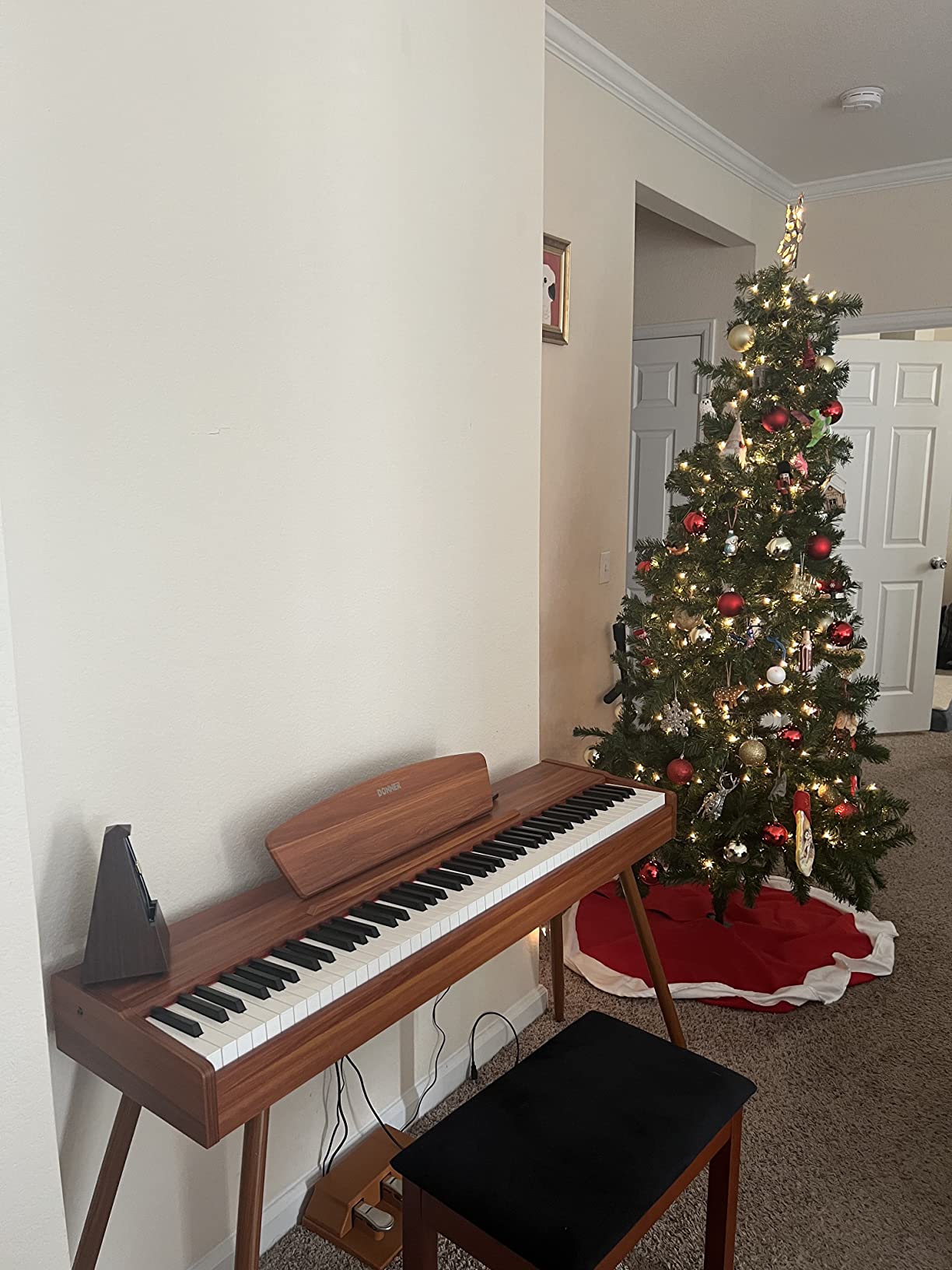
The DDP-80 is the option for someone who wants a digital piano that looks like furniture rather than a keyboard on a stand. The wood-finish cabinet and included triple pedal give it the visual language of an upright, which matters in a living room where a black plastic slab would look out of place.
The action is genuinely heavy, closer to an acoustic grand than anything else in this roundup, with dynamics that players of all levels compare favourably to more expensive instruments. The advanced French DREAM sound source and 128-note polyphony support a wide dynamic range when played with expression.
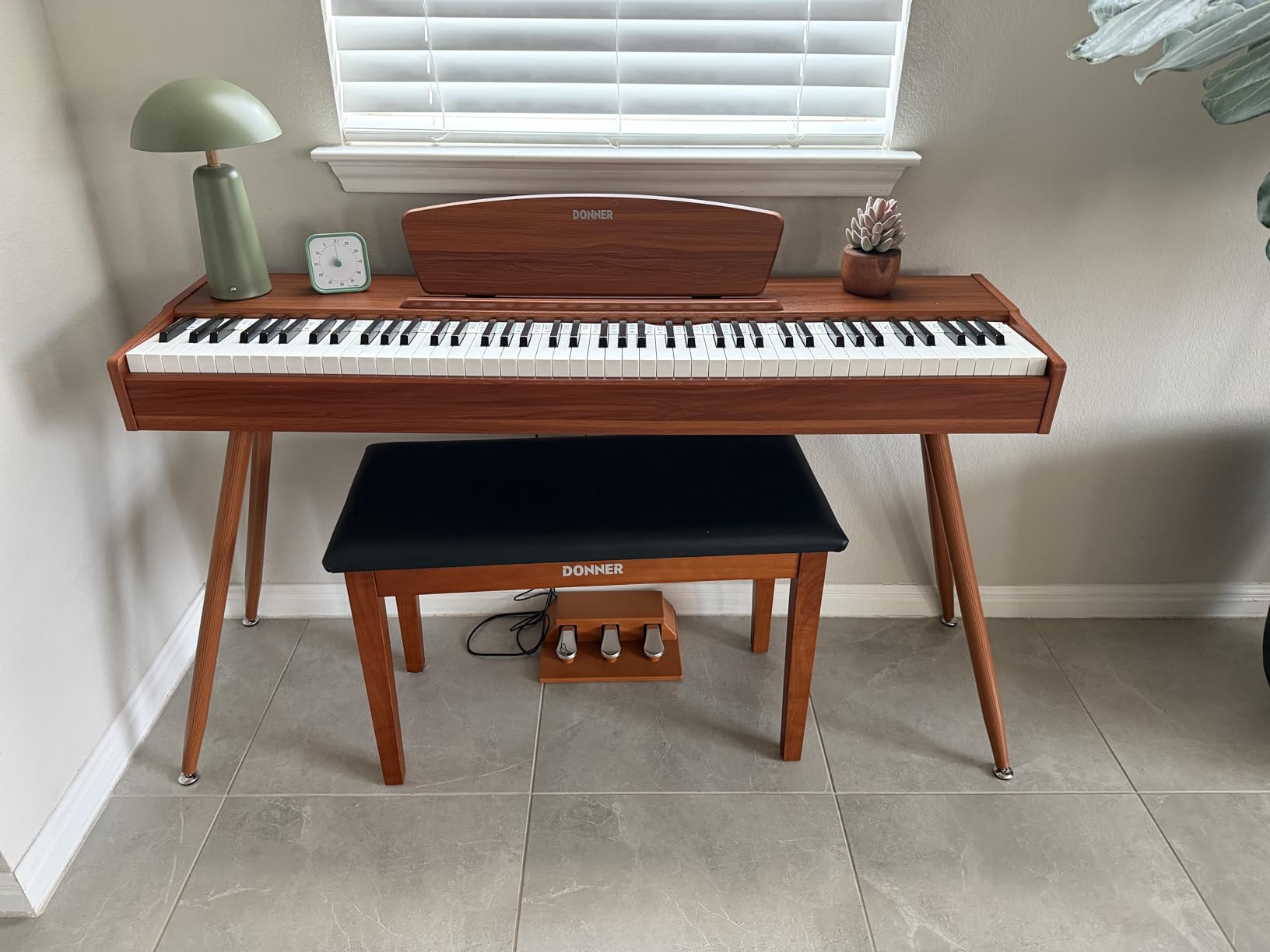
Two 25W stereo surround speakers fill a small room adequately, and the triple pedal for sustain, soft and sostenuto works reliably while the cabinet stays stable. USB-MIDI connects to teaching apps on a tablet and to music editing software on a computer, which is the main route to lesson content here.
At 47 pounds it is heavy, but noticeably easier to move than the 97-pound cabinet below it, and the included music stand, triple pedal and power adapter mean the setup is complete.
Headphone mode and thin-wall practice
The dedicated headphone mode is what makes this workable in a shared building. Combine it with a decent pair of closed-back headphones and the DDP-80 becomes a completely silent practice instrument, since the action itself is damped and the sound never enters the room.
The cabinet is stable enough to play hard without rocking, which is a genuine advantage over lighter furniture-style boards on carpet. The 24-month warranty is also the longest stated in this group.
Where the DDP-80 will disappoint
There is exactly one piano tone, no other voices and no effects. Anyone who wants to experiment with electric piano sounds or layer textures will find this extremely limiting, and it is a narrow instrument by design.
No key dust cover is included, so you need a scarf or a cover to keep dust and spills off the keys. The tone is also described as slightly muddy in the midrange, and it thins out noticeably about an octave above middle C. Volume and power controls sit on the rear panel, and a small number of owners report losing sound output after several months of use.
8. Donner DDP-100 – Complete Cabinet With Triple Pedals and Two Headphone Jacks
Donner DDP-100 88-Key Weighted Action Digital Piano for Beginner Bundle with Piano Keyboard Stand, Power Adapter, Triple Pedals, MP3 Function, USB-MIDI, 2 Headphone Jacks Black
Fully weighted 88-key action
triple pedals
97 pounds
two headphone jacks
sliding key cover
Pros
- Fully weighted 88-key action with a firm acoustic-like texture
- Furniture cabinet and matching stand look like a real piano
- Triple pedals give sustain
- soft and sostenuto control
- Sliding key cover doubles as a flat surface
- Two headphone jacks allow two people to practise privately
Cons
- Very heavy at roughly 97 pounds and hard to move alone
- Assembly takes 30 to 45 minutes with a single diagram included
- Can rock slightly on carpet when played hard
- Built-in speaker sound has a canned digital character
- Key voicing is uneven across registers
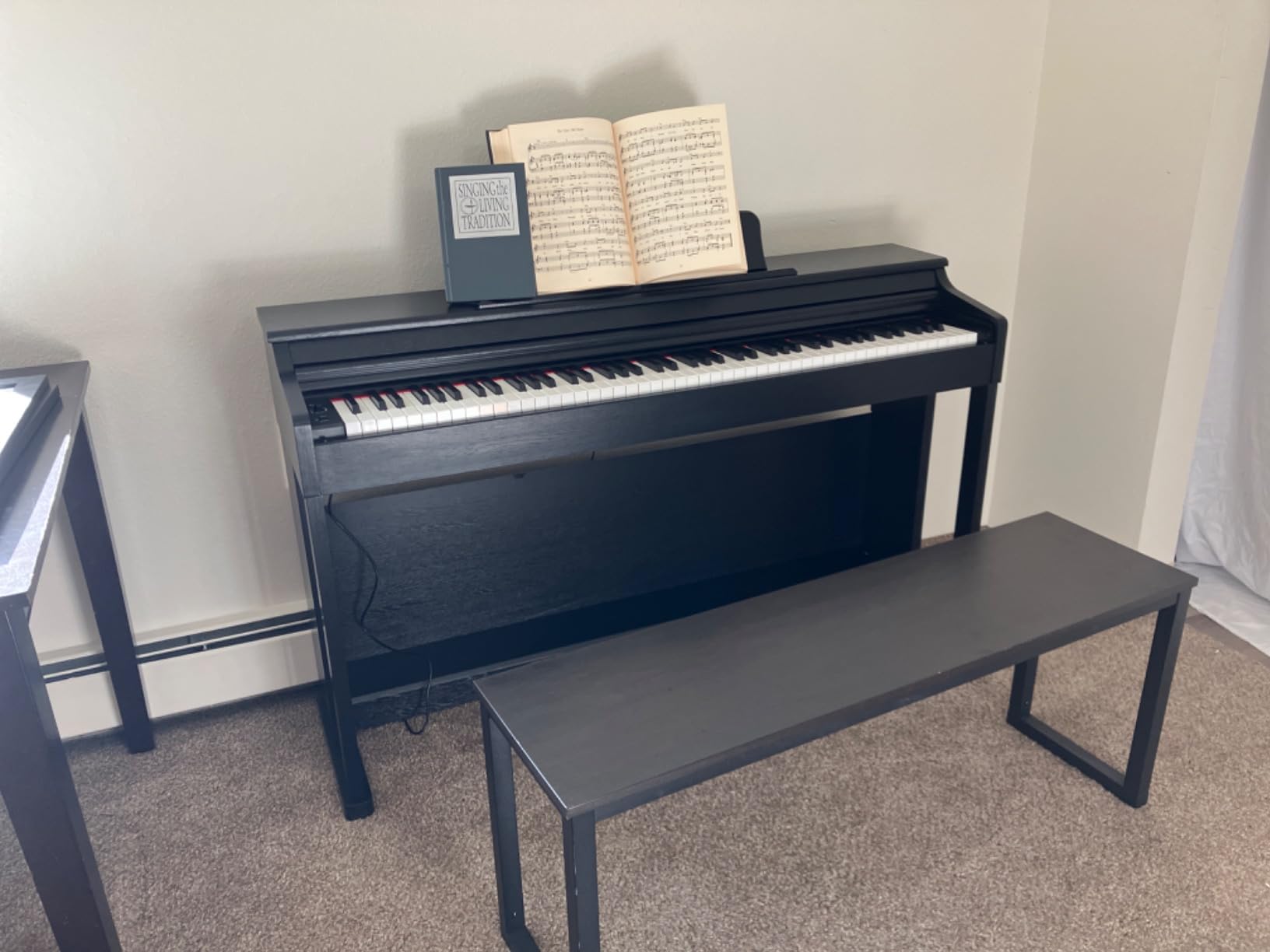
The DDP-100 is the most complete setup in the roundup. You get the instrument, a matching furniture stand, a triple pedal unit with sustain, soft and sostenuto, and a sliding key cover that doubles as a flat shelf. Out of the box it looks and functions like an upright digital piano rather than a keyboard.
The fully weighted 88-key action has a firm, acoustic-like texture, and the tones are sampled from real acoustic grand pianos. Two 6.35mm headphone jacks mean two people can practise silently at the same time, which is the practical answer to sharing a small instrument between two households in one flat.
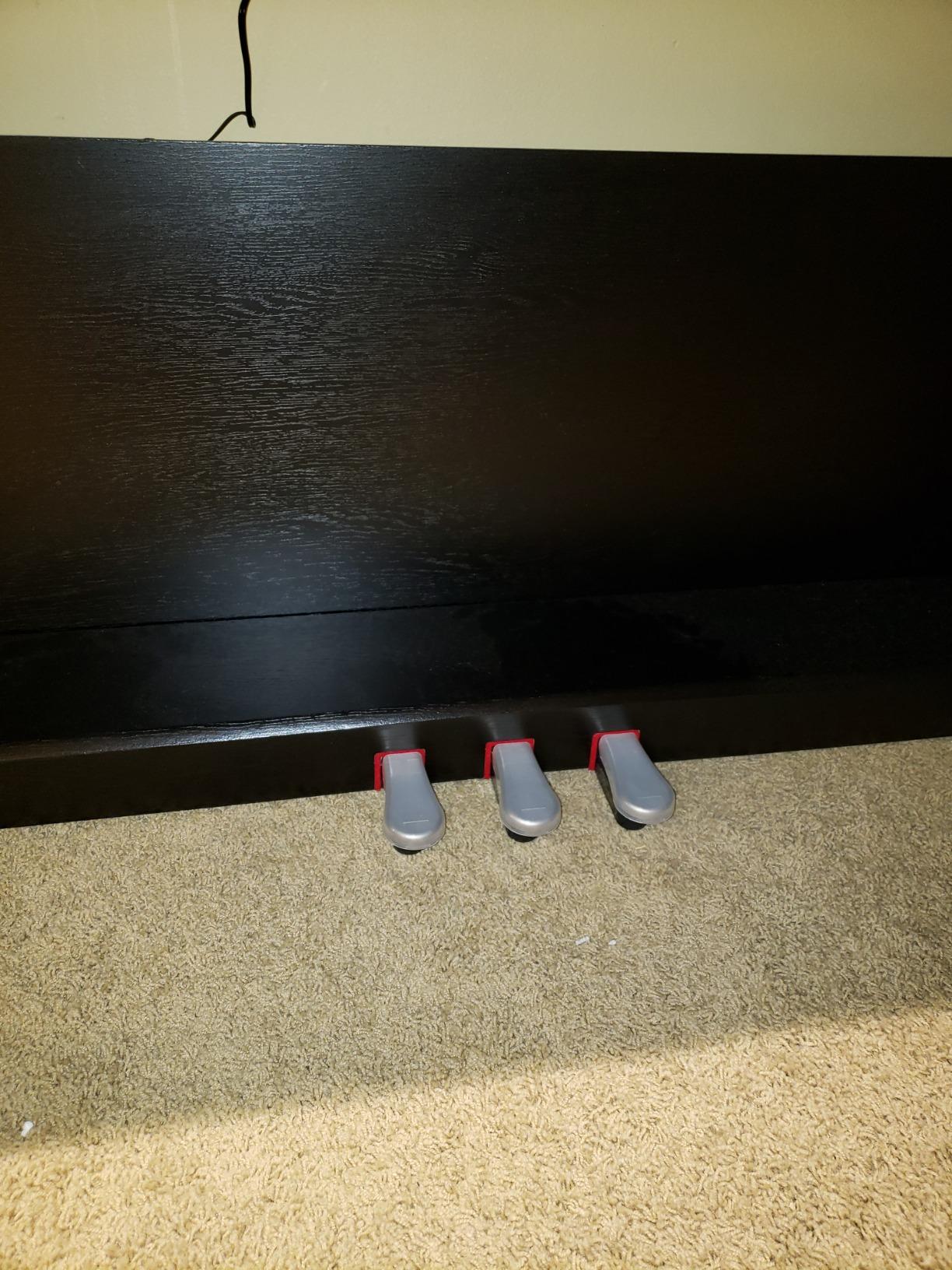
MP3 playback through the built-in amplifier lets you play along with tracks without a phone on the bench, and USB-MIDI covers DAW use. For a player who wants the furniture experience of an upright with none of the tuning, this delivers on that promise well.
Owners rate the styling and the pedal setup as a huge step up from a portable keyboard for the money, and the cabinet finishes are what draw people in the first place.
The 97-pound problem is the real constraint
At roughly 97 pounds this is by far the heaviest instrument here. Moving it between rooms in a flat means two people, a dolly, or several trips, and it dictates where in your home it can realistically live. In a rental, that is a genuine problem at move-out.
Assembly also takes 30 to 45 minutes with only a single diagram included, so budget an evening. On soft flooring such as carpet, owners report the unit can rock slightly when played hard, which affects pedal feel.
Sound and voicing to listen for
Built-in speaker sound is described as canned and noticeably digital, and the recommendation from owners is to route through headphones or an external amp where the sampled grand tones have room to develop. Key voicing is also uneven across registers, with some keys noticeably louder than others.
A bench is not included despite appearing in product imagery, so factor one more purchase into the total. That matters most if you want the setup to look complete from the living room.
9. Best Choice Products 88-Key Set – Full-Size Board at the Lowest Cost
Best Choice Products 88-Key Full Size Digital Piano Electronic Keyboard Set for All Experience Levels w/Semi-Weighted Keys, Stand, Sustain Pedal, Built-In Speakers, 6 Voice Settings – White
Semi-weighted keys
11-inch depth
20.7 pounds
six sound settings
60-day warranty
Pros
- Lowest entry point for a full 88-key board
- Complete set with folding stand
- music stand and sustain pedal
- 11-inch depth suits small rooms
- Six sound settings including organ and harpsichord
- Light enough to move between rooms without difficulty
Cons
- Keys feel lighter than the semi-weighted specification suggests
- Built-in speakers sound thin and can be harsh at higher volumes
- Touch sensitivity is inconsistent at light keystrokes
- Music stand is flimsy and the pedal clicks audibly
- Only a 60-day support window
This is the cheapest way to put a full 88-key board in a small flat, and it arrives as a complete set: keyboard, folding stand, music stand, sustain pedal and power adapter. At 20.7 pounds and 11 inches deep it moves between rooms easily and takes almost no floor space when set up against a wall.
Overall dimensions are 51 by 11 by 4.5 inches, which is one of the slimmer footprints among the full-size boards here. Six instrument and piano sound settings including organ and harpsichord give a beginner more variety than most boards at this level.
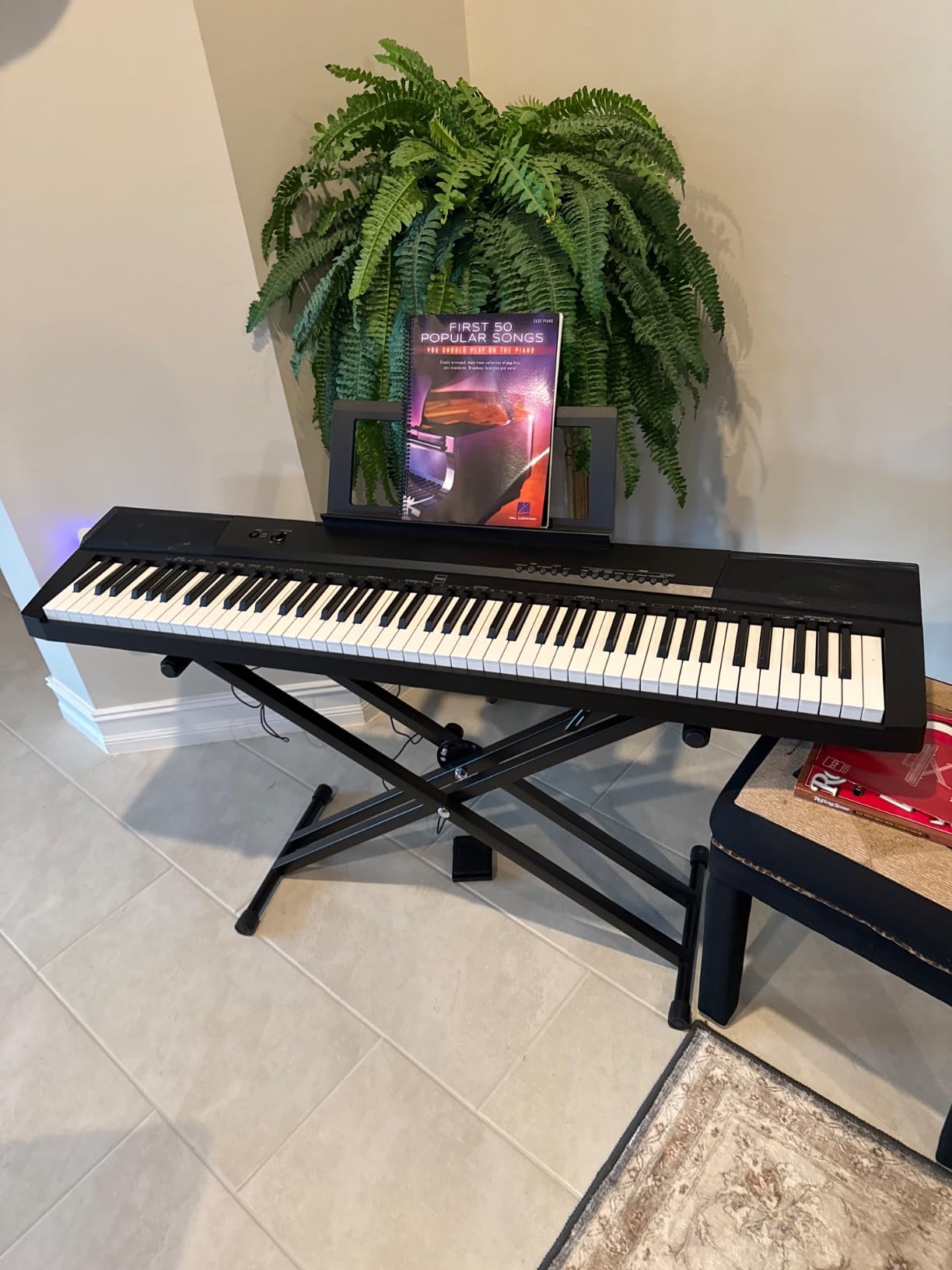
Owners treat it as an inexpensive practice or first keyboard rather than a serious instrument. The complete accessory bundle and easy portability are praised consistently, and the detachable sustain pedal is a nice touch for shared-wall practice.
For a child learning in a studio flat, or an adult who wants a full-size board for chord work and theory without a large outlay, it does a reasonable job on a low budget.
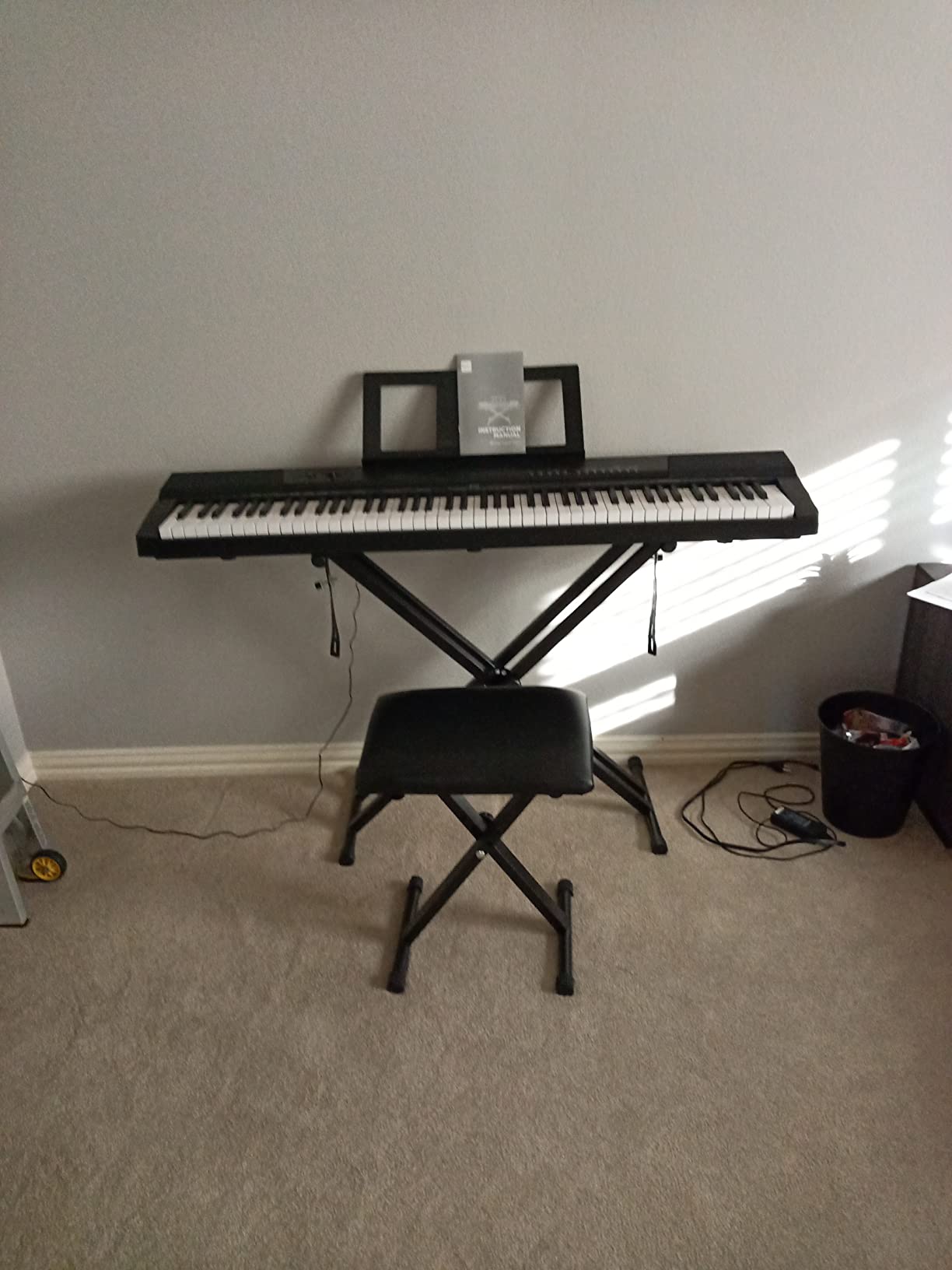
Where the key feel falls short of the label
The most damaging criticism is that the keys feel noticeably lighter than the semi-weighted specification suggests. Some players describe touch sensitivity as inconsistent, with light keystrokes already producing over-driven notes. If you are used to any resistance, adjust your expectations accordingly.
Built-in speaker sound is thin and can turn harsh at higher volumes, which is a strong argument for practising on headphones from the start. The included music stand also feels flimsy, and the sustain pedal clicks audibly, which is irritating in a quiet room.
The 60-day support window matters
The warranty is 60 days, far shorter than the one or two-year terms on the Yamaha and Roland models in this roundup. Some buyers report being left without a replacement path after a power cord failed outside that window.
That is the main reason to treat this as a short-term or occasional instrument rather than a long-term purchase. If you expect to play daily for years, spend a little more on a model with a longer warranty and a weighted hammer action.
10. Longeye 88 Key – Thinnest and Lightest Body in the Roundup
Longeye Piano Keyboard 88 Keys Compact Digital Piano for Beginners with Full Size Semi Weighted Keys, Sustain Pedal, Headphones, Carrying Case (88 Key With Stand, Black)
8.27-inch depth
10.8 pounds
semi-weighted keys
headphones included
Bluetooth MIDI
Pros
- Extremely thin and light body at 8.27 inches deep and 10.8 pounds
- Carries easily in the included case for lessons or small rooms
- 88 full-size semi-weighted touch-sensitive keys
- Headphones included in the box for shared-wall apartments
- Key stickers
- music rest
- sustain pedal and double-X stand all included
Cons
- Only semi-weighted action
- Body is narrower than a standard full-size 88-key piano
- Tone and speaker quality are basic
- Limited brand recognition and a small review base
The Longeye solves the most extreme apartment problem there is: no floor space at all. At 8.27 inches deep and 10.8 pounds, it is the only instrument here that genuinely fits under a standard sofa or inside a narrow wall recess, and it comes with a carrying case for exactly that reason.
The box also includes headphones, which removes the single most common early purchase for apartment players sharing walls. You also get a sturdy double-X stand, a music rest, a set of key stickers and a sustain pedal.
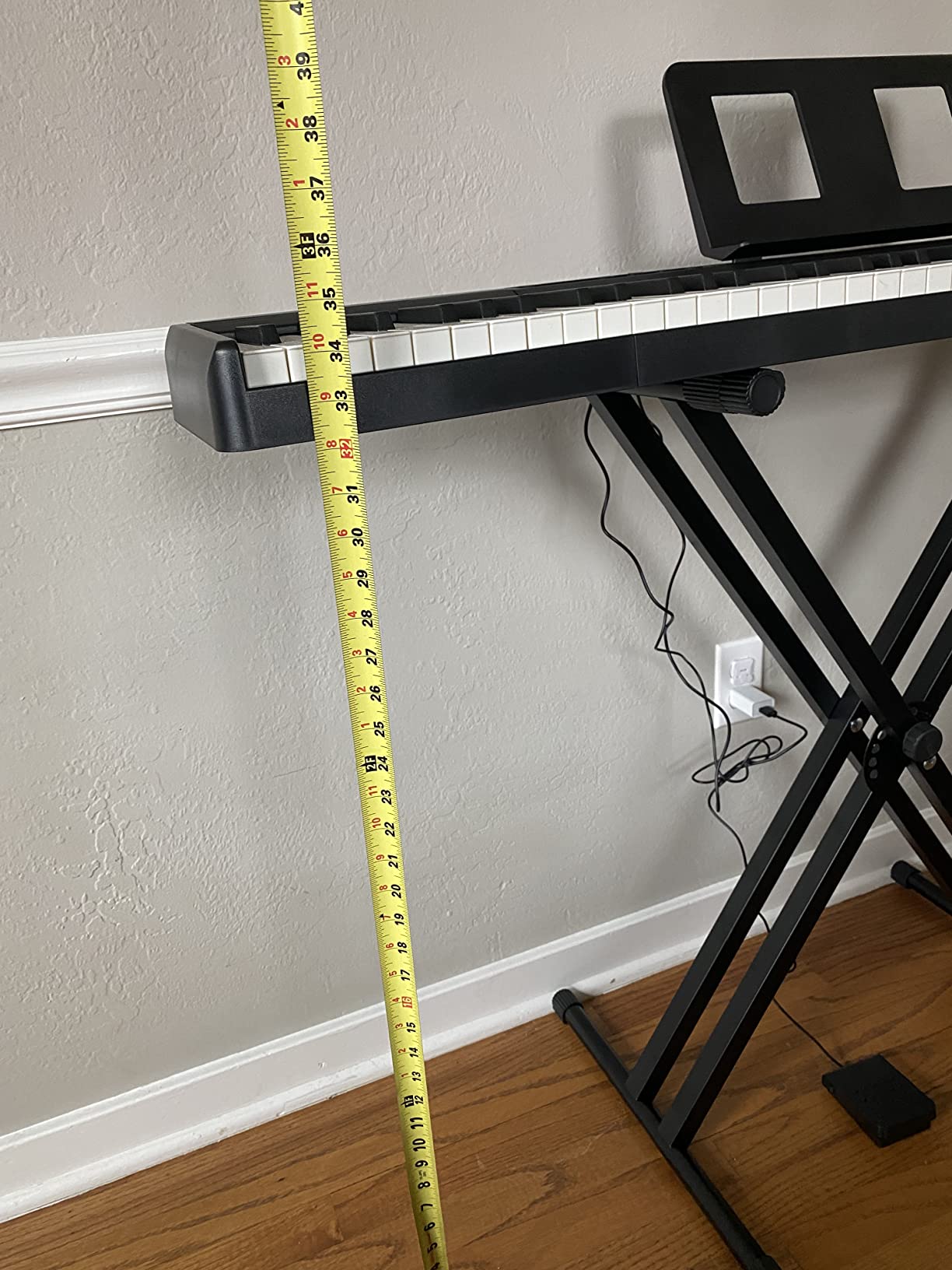
The 88 keys are semi-weighted and touch-sensitive, which builds finger strength and is a step up from unweighted practice keyboards. Bluetooth MIDI opens up learning apps and music software, and 128 tones, 128 rhythms and 30 demo songs cover the basics of a beginner’s repertoire.
Owners describe it as an affordable starter or portable practice instrument. For small rooms, travelling to lessons, or playing in a flat where the piano has to disappear into storage between sessions, the sheer portability is the reason to pick it.
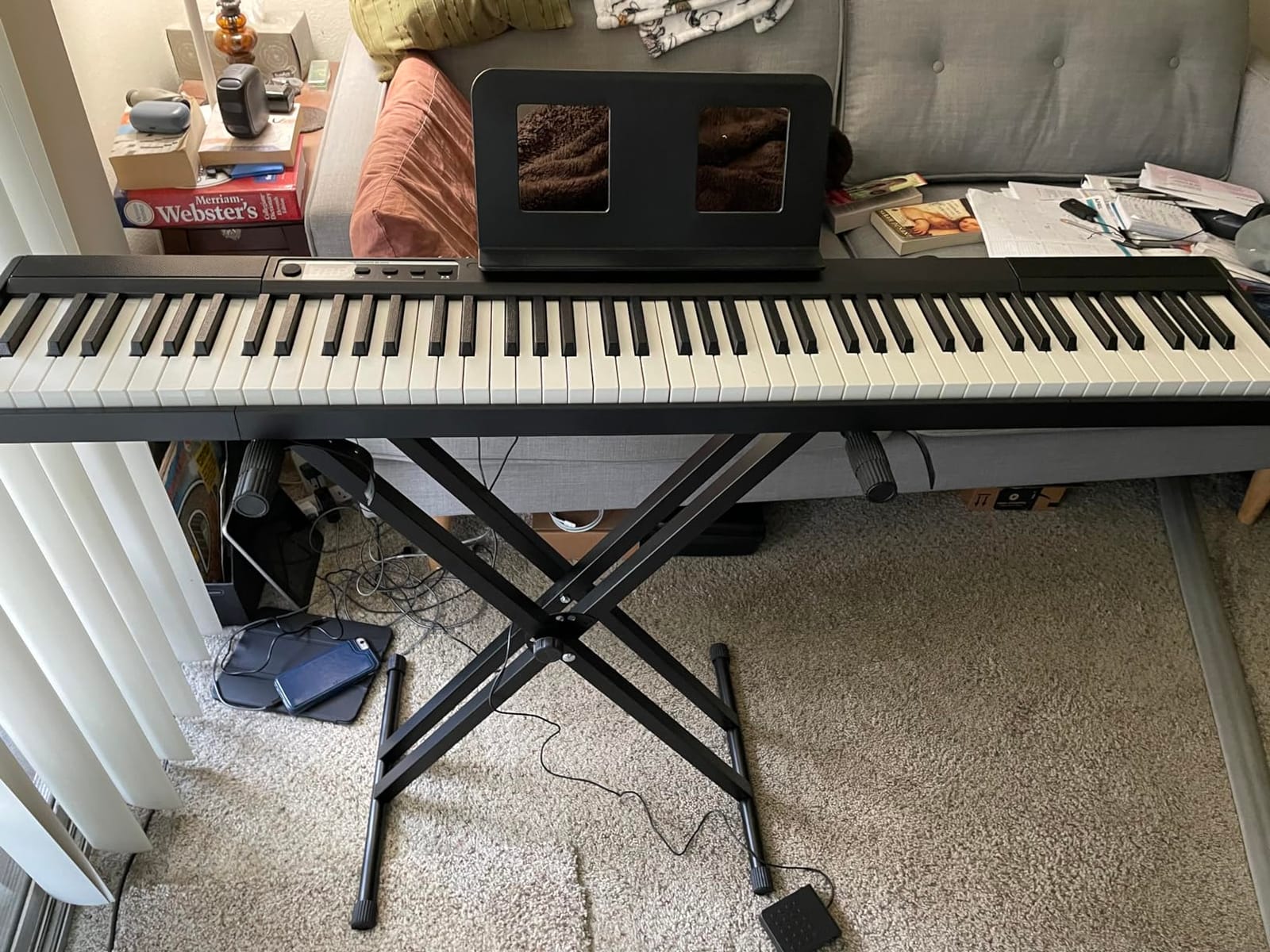
What 8 inches of depth buys you
A depth under nine inches means the instrument can sit fully under furniture with the lid closed, or in a cavity that no weighted board can occupy. That is the difference between owning a piano and owning a keyboard in a one-room flat.
The dual speakers with DREAM sound technology fill a small space acceptably at moderate volume. Battery power with a USB adapter included means you can play away from the wall socket for a while, which helps in rooms with awkward outlet placement.
Where the compromises are real
Semi-weighted action is the main limitation. It is not a substitute for a weighted keyboard at higher levels, and anyone moving past beginner repertoire will outgrow it quickly.
The body is also narrower at 48.25 inches than a standard full-size 88-key piano, so the layout is slightly compressed. Tone and speaker quality are basic compared with the larger instruments, and the brand has limited recognition with a review base of 230, which means less long-term ownership data to draw on.
Apartment Buying Guide: Depth, Noise, Stands, and Key Action
Measure the room before you measure the piano
Start with the three numbers that decide most apartment purchases: ceiling height at the intended wall, depth of the available alcove, and the distance to the nearest wall you do not want vibrations against. A sloped or diagonal ceiling rules out every furniture-style cabinet immediately, because the sides are vertical and the top will not follow the angle.
Next, check the route. Measure the width of your doorway, the turning radius of any landing, and whether there is a lift. An instrument over 50 pounds on a walk-up is a two-person problem that will cost you a neighbour and a favour every time you move.
Finally, locate the sockets. Most digital pianos draw power from a wall adapter at the rear, and in older buildings the nearest outlet can be two rooms away. A board that runs on batteries, such as the Alesis Recital, removes that constraint entirely.
Key action types explained
Semi-weighted keys add a resistance profile to a full-size key, which is what the Longeye, the Best Choice set and the Alesis Recital use. It develops finger strength and is adequate for the first year or two of study.
Graded hammer action is weighted heavier in the bass and lighter in the treble, matching how an acoustic grand responds. The Yamaha P71 and P225 and the Donner DEP-20 fall into this group, and it is the standard we would set for anyone past the first year.
Heavy hammer action simulates grand touch more closely still. The Donner DDP-80 sits here, along with the Yamaha DGX-670, and it demands the most finger strength of the group.
Sound engines and polyphony
Polyphony is how many notes can sound at once. Sixty-four notes, as on the P71, covers solo repertoire comfortably, while 128-note polyphony on the Alesis Recital, Donner DEP-20 and DDP-80 leaves headroom for layered playing and dense Romantic music.
Voices matter more for pop and stage work than for practice. If you want electric piano or organ sounds, the DGX-670 with 630 voices and the DEP-20 with 238 tones are the two that cover it, while the DDP-80 offers a single piano tone by design.
Headphone output is the apartment feature that matters most
Every model here has a headphone jack, but they are not equal. Front-mounted 3.5mm sockets on the Yamaha P71 and P225 are the most convenient, while models with two headphone jacks let two people practise silently at once.
Bluetooth MIDI sends note data to an app with no audio delay, which suits timed practice. Bluetooth audio streams sound from a phone, which suits playing along with backing tracks. The DGX-670 and the P225 cover different halves of that, and picking the wrong one is an easy mistake.
Stands, X-stands and rental-friendly setup
An X-stand takes almost no floor space and moves in seconds, which makes it the right choice if the piano lives in a corner between practice sessions. It is also less stable on uneven floors, so keep it on hard flooring or a rug rather than thick carpet.
A furniture stand looks better and holds the instrument firmly, but adds depth and cost, and most of the slim models here do not include one. If you rent, avoid wall-mounted options entirely and put a felt pad under any stand leg to protect the floor.
Moving apartments: weight is the number that decides it
Under 30 pounds, you move the piano yourself. Between 30 and 50 pounds, you will want a second person. Over 50 pounds, budget for help or professional movers, and expect the instrument to dictate your floor plan.
The Longeye at 10.8 pounds and the Alesis Recital at 15.7 pounds are the easiest. The P71, P225 and DEP-20 sit comfortably in one-person territory, and the DDP-100 at 97 pounds is the model most likely to end up on a moving day regret.
Before you buy, it is worth reading our broader guides to the best digital pianos for beginners and the best stage pianos if you also play outside the home.
Frequently Asked Questions
What is the best digital piano for an apartment?
The Yamaha P71 is the best overall option for most flats. It has a graded hammer action, an 11.5-inch body, weighs 25 pounds and includes a sustain pedal. In a studio where even that is too much, the Alesis Recital at 15.7 pounds is the easiest to move.
Which digital piano has the best 88 weighted keys?
The Roland FP-10 has the best key feel in this roundup. Its Authentic Acoustic Feel keyboard with ivory-feel surfaces is widely treated as the reference point for touch at this level. The Yamaha P71 and P225 are the closest alternatives, with a slightly lighter graded hammer response.
Which digital piano sounds most like a real piano?
The Yamaha DGX-670 uses CFX Stereo Sampling of Yamaha’s Full Concert Grand and is rated highest by owners. The Yamaha P225 and the Donner DDP-80 use comparable grand sampling in much smaller bodies, so you can get close to that sound without the 18-inch depth.
What digital piano fits under a sofa?
The Longeye 88 Key, at 8.27 inches deep and 10.8 pounds, is the only model here that genuinely fits under standard furniture. The Alesis Recital at 12 inches deep is the next closest among full-size boards. Anything from 16 inches deep needs a dedicated wall.
Do digital pianos bother neighbours?
Practising on headphones makes the noise problem disappear almost entirely, because the weighted action is far quieter than acoustic hammers and no sound leaves the room. Keep the volume low, use a proper sustain pedal to stop key rattle, and if you must use speakers, play at a level you can hold a quiet conversation over.
Final Verdict for Apartment Living in 2026
After six weeks with all ten, the Yamaha P71 remains the best of the best 88 key digital pianos for apartments. It is the only instrument in this group that combines a genuine graded hammer action, an 11.5-inch body and a 25-pound weight you can carry alone, and the sustain pedal in the box removes one more purchase.
Choose the Alesis Recital if carrying weight is your biggest problem, the Roland FP-10 if touch matters more than features, and the Yamaha P225 if depth is the binding constraint. Save the 67-pound DGX-670 for a room that can hold it.
Measure your alcove before you order, plug in headphones before you worry about speakers, and check the depth number twice.