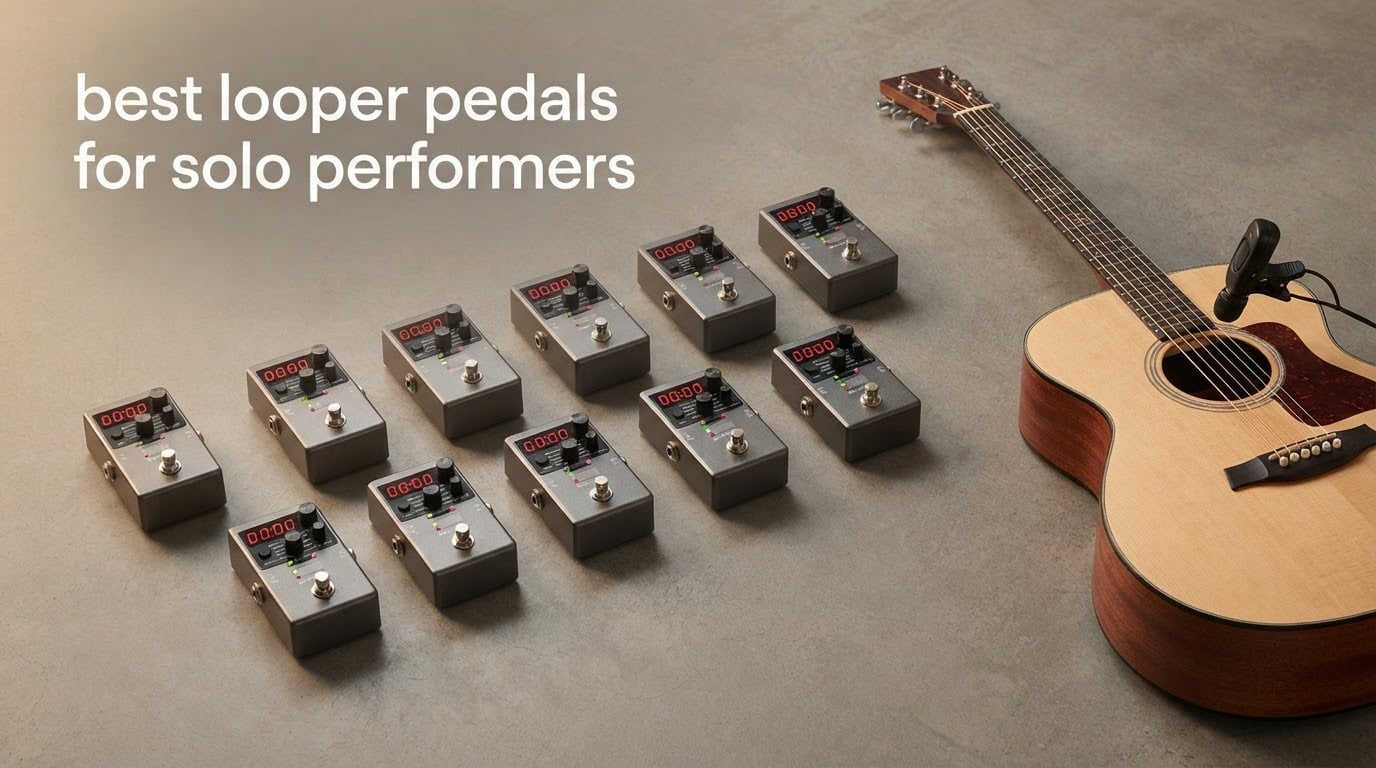
A looper pedal records a short phrase of your playing — a riff, a chord progression, a vocal line — and then repeats it in time so you can perform over it, adding overdubs on top to build a full arrangement by yourself. For a solo performer, that is the difference between playing a song and playing a band.
These are the best looper pedals for solo performers in 2026. We looked at ten of them with a single question: can a person standing alone on a dark stage, with no screen they can read and no second pair of hands, get a usable loop out of this thing? Everything below is judged on live usability first, audio quality second, and feature count a distant last.
That ordering matters, because the loudest voices in looper discussions chase specs. A pedal with 160 minutes of memory is useless if you cannot see where you are in the phrase. A pedal with pristine 24-bit converters is wasted if you cannot stop the loop cleanly on the beat. We read the owner reviews closely on three specific points that show up again and again for people playing alone: whether there is a real stop control, whether the loop stays clear once five or six layers are stacked, and whether the thing still works when there is no mains socket nearby.
One thing to say up front, because it is the most common piece of bad advice in this category: buy less than you think you need. The overwhelming forum consensus is to start with a simple single-loop pedal, learn the mechanics in a bedroom for a few months, and upgrade when you know exactly what you cannot do. We have a section on that further down, and we think it is the single most useful thing in this guide.
If you are still narrowing the field, our general best loop pedal round-up covers the wider category, and our honest looper pedal reviews go deeper on the headline models.
Table of Contents
Top 3 Best Looper Pedals for Solo Performers in October

BOSS RC-1 Loop Station
- 12 minutes of stereo recording
- Single footswitch workflow
- 9V battery included
- Phrase kept after power off

TC Electronic Ditto Looper
- 5 minutes of looping
- True bypass
- Analog dry-through
- Undo and redo

LEKATO 9-Loop Looper
- 9 slots and 40 minutes of recording
- 48K/24-bit uncompressed
- Built-in tuner
- USB file transfer
Those three cover most solo situations: the RC-1 is the pedal almost every loop-first player ends up on, the Ditto is the cheapest honest way to start, and the LEKATO 9-Loop is the one to buy if you want a library of saved songs rather than one empty memory.
All 10 Looper Pedals at a Glance in 2026
| Product | Specifications | Action |
|---|---|---|
| BOSS RC-1 Loop Station |
|
Check Latest Price |
| TC Electronic Ditto Looper |
|
Check Latest Price |
| LEKATO 9-Loop Looper |
|
Check Latest Price |
 MOOER Groove Looper MOOER Groove Looper |
|
Check Latest Price |
 Donner Circle Looper Donner Circle Looper |
|
Check Latest Price |
 Donner Triple Looper Donner Triple Looper |
|
Check Latest Price |
 FLAMMA FS21 FLAMMA FS21 |
|
Check Latest Price |
 LEKATO Mini 5-Minute Looper LEKATO Mini 5-Minute Looper |
|
Check Latest Price |
 LEKATO Loop Auto LEKATO Loop Auto |
|
Check Latest Price |
 Electro-Harmonix 720 Stereo Looper Electro-Harmonix 720 Stereo Looper |
|
Check Latest Price |
Two details in that table change everything for a solo act, and neither is about sound. The first is storage: seven of these ten hold multiple loops, which means you can prepare a set in advance instead of building every song from nothing in front of an audience. The second is power: only the BOSS RC-1 and the Electro-Harmonix 720 are documented as running on a 9V battery, and that single fact decides which pedals you can take to a street corner.
1. BOSS RC-1 Loop Station – Best Overall for Solo Performers
BOSS RC-1 Loop Station Pedal
12 minutes of stereo recording
24-segment LED loop indicator
Stereo inputs and outputs
9V battery included
Pros
- Exceptionally simple footswitch workflow that suits a solo performer
- Clean recorded sound with no hiss reported by owners
- Rock-solid BOSS build quality
- Phrase retained in memory after power off
- 9V battery included for battery-only playing
Cons
- Loop audio is fairly compressed and level balance is hard to dial in
- Single loop layer only with no drum machine or backing track
- Needs practice to nail record start and stop timing
The RC-1 is the pedal the forum consensus keeps pointing first-time players toward, and after reading several thousand owner reviews, we agree with them. It does one thing — record a phrase, play it, dub over it — and it does it with a single footswitch that you learn in about ten minutes. For a solo performer working out how looping feels under pressure, that simplicity is worth more than every feature on the other nine pedals combined.
What you get is 12 minutes of stereo recording with unlimited overdubs, stereo inputs and outputs, and a 24-segment LED ring that shows you exactly where you are in the phrase. That ring matters more than it sounds. There is no screen and no menu, so the LED is your only position reference — and it is bright enough to read from a standing position on a dim stage, which several owners single out as the reason they can play with it live at all.
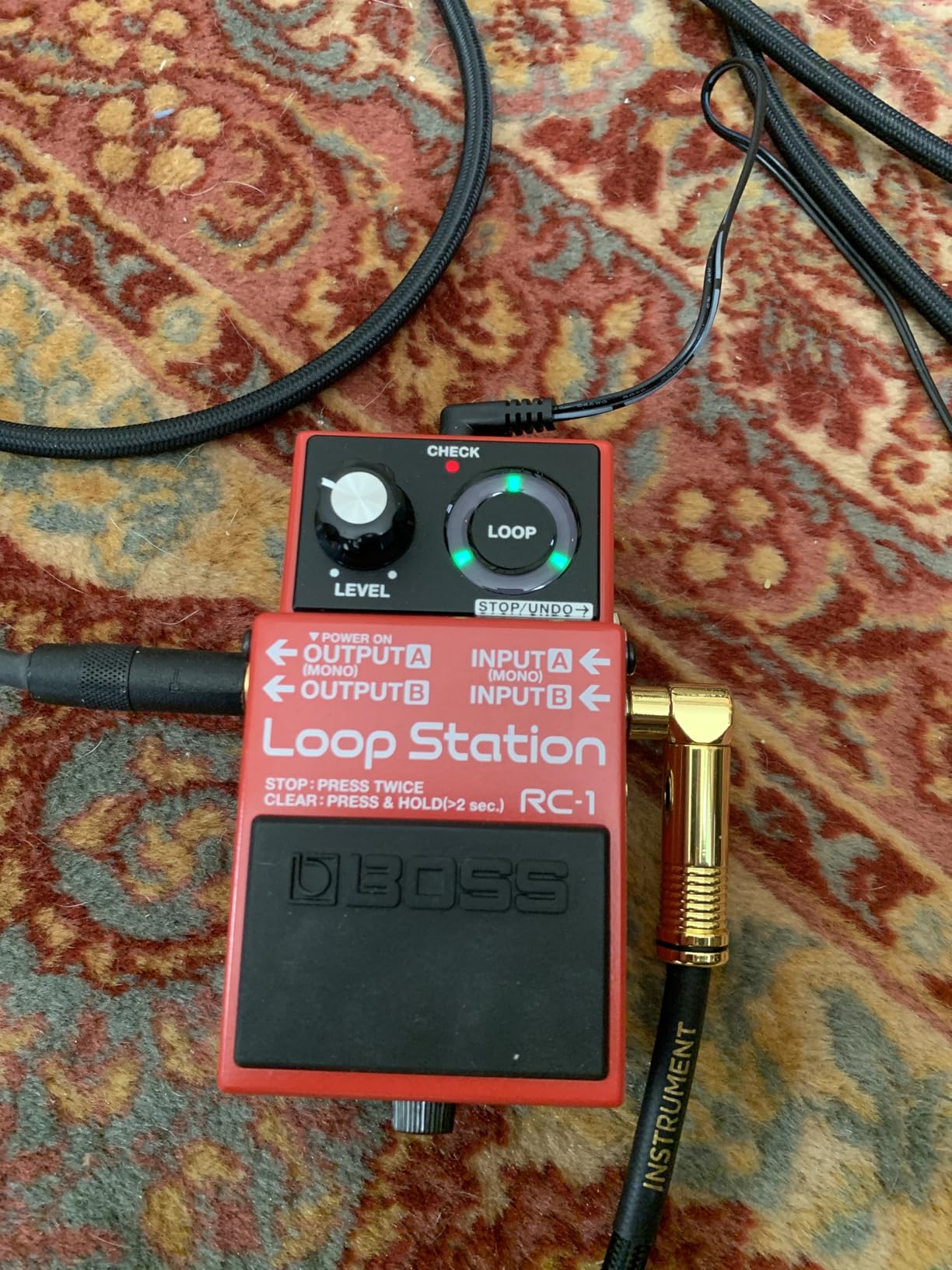
Two details separate it from the cheap alternatives. The recorded phrase survives power off, so you can build a loop at home on Tuesday and play it on Thursday without rebuilding it. And a 9V battery is in the box, with roughly four and a half hours of running time, which makes it one of only two pedals here that works with no mains power at all.
On the audio side, owners report a clean recorded sound with no hiss, which is not always a given at this level. The honest criticism is that the loop audio is fairly compressed and the level balance between your dry playing and the loop is hard to set precisely. If you are layering acoustic guitar against a loud loop, expect to spend real time on that one knob.
The bigger limitation is scope. There is one loop, no drum machine, no backing track loading, and mode switching between pause, stop and delete takes some experimentation to internalise. Nobody should buy the RC-1 to build a five-part arrangement. Buy it to learn the mechanic, to write at home, or to run a two-part loop on a small stage — and it will do all three extremely well for years.
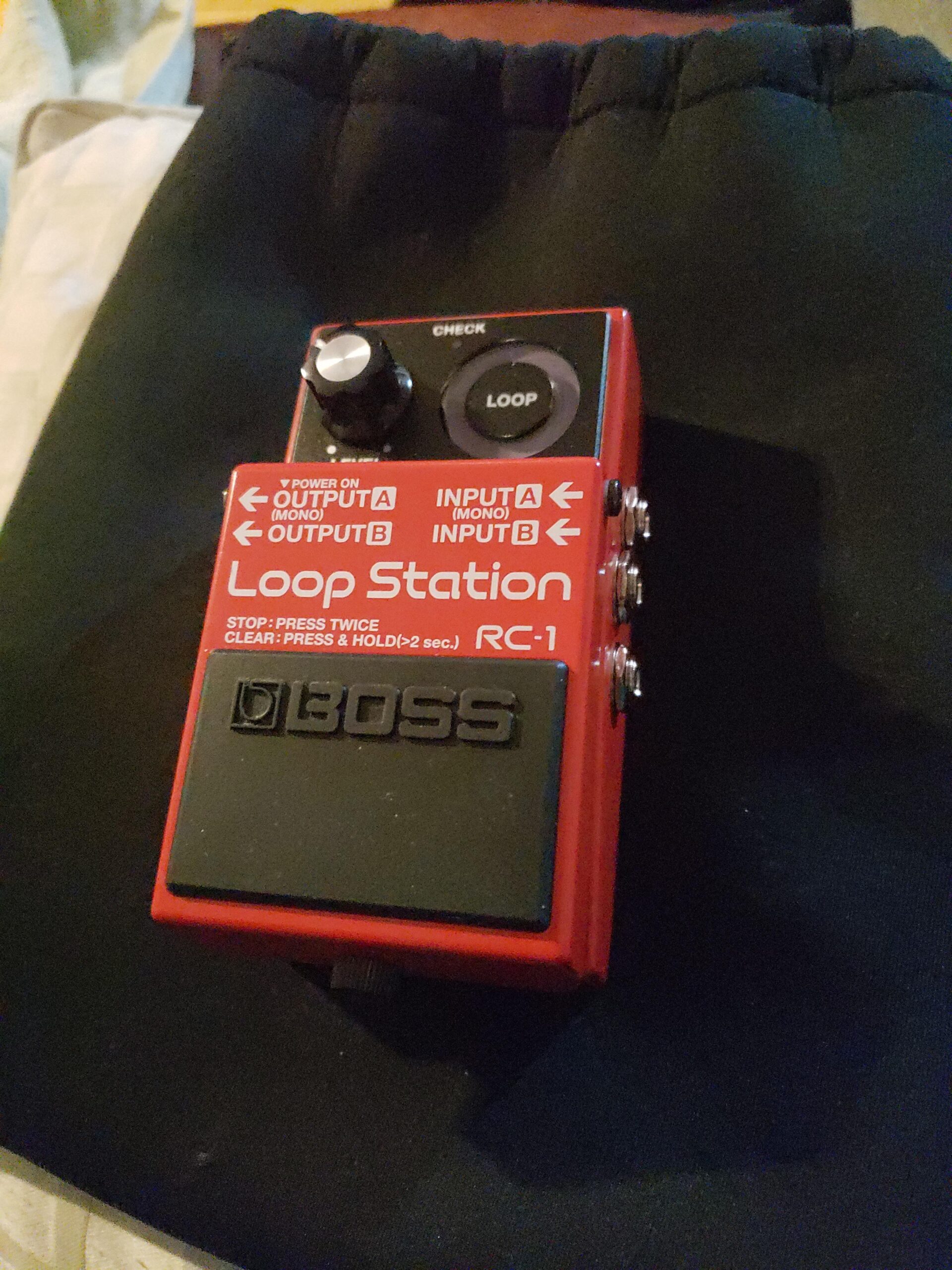
What the RC-1 does better than every other pedal here
Time-to-first-loop. On the Ditto and the RC-1 it is roughly the same, but the RC-1 wins on what happens after: the 24-segment LED gives a much clearer read of the loop position, and stereo I/O means a second instrument or a mic can be captured without halving your loop time. If you play a one-man-band setup where you change instruments mid-song, that stereo capability is the reason to choose this over the Ditto.
Its build is the same die-cast BOSS shell used across their pedal range, and the footswitch is a mechanical BOSS unit rated for the kind of repeated stomping a touring solo act puts through it. For a pedal you will kick on and off two hundred times a night, that mechanical certainty is worth real money.
Where the RC-1 will let a solo performer down
It will not grow with you past a certain point. There is one loop and no storage for multiple songs, so a full set means clearing and rebuilding between numbers. The single footswitch also has no true dedicated stop — you use a double-tap to end a loop — and while plenty of players do that cleanly at home, the stop is the single most-cited live frustration among owners of single-switch loopers.
Level balancing is the other soft spot. When you add a fifth or sixth overdub, the loop level and your live level drift apart, and the RC-1 gives you very coarse control over that relationship. If your act depends on dense six-layer arrangements, move up to something with multiple independent loops and clearer metering.
2. TC Electronic Ditto Looper – Best for Practice and Songwriting
TC Electronic DITTO LOOPER Highly Intuitive Looper Pedal with 5 Minutes of Looping Time, Analog-Dry-Through and True Bypass
5 minutes of looping time
Unlimited overdubs with undo and redo
True bypass
Analog dry-through signal
Pros
- Extremely intuitive one-button workflow
- Transparent analog dry-through signal
- True bypass keeps untouched tone when off
- Compact enough for a crowded pedalboard
- Unlimited overdubs with undo and redo
Cons
- Only 5 minutes of loop time which limits full songs
- Single loop with no memory slots for multiple songs
- Requires an external 9V supply that is not included
The Ditto is the pedal people mean when they say a looper pedal should just get out of the way. One footswitch, one knob, and a control scheme that guitarists apparently helped design, because the record-play-dub-click pattern feels natural within a couple of attempts. For writing songs at home or running a stripped-back two-part loop in a small room, it is genuinely hard to argue with.
The signal path is the reason owners stay loyal. True bypass means that when the pedal is off, your guitar sees nothing but wire, and the analog dry-through keeps your live signal clean and unaffected while a loop is running. Several reviews make the specific point that they can hear no tone change between playing with the Ditto engaged and pulled out of the chain, which is not something you can say about every looper at this level.
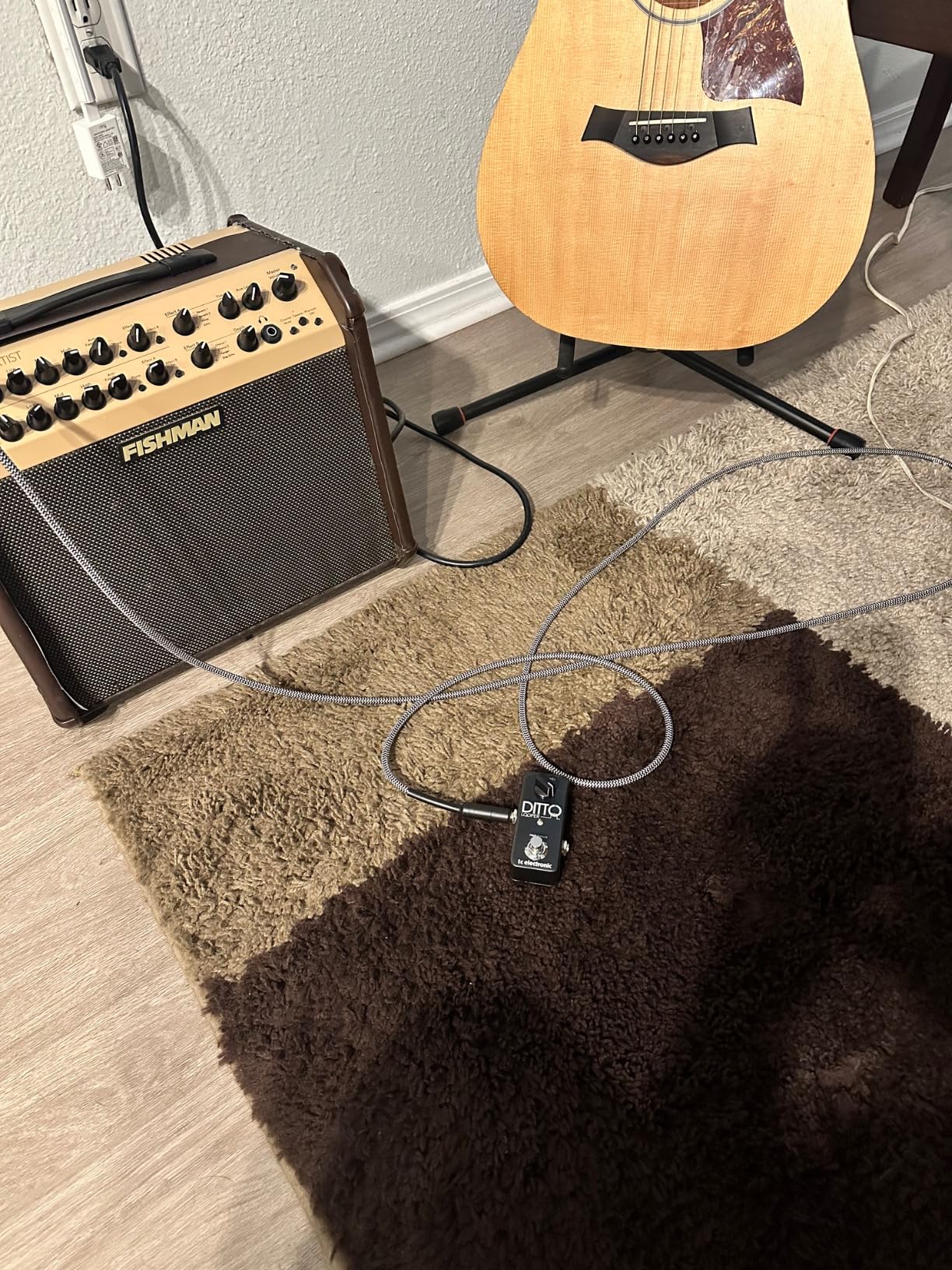
Where it stops is capacity. Five minutes of loop time is the hard limit, and that rules out any song with a long instrumental section or a full arrangement with an intro and an outro. There is one loop and no memory slots, so a set of five songs means five fresh recordings, every time. For a bedroom songwriter this is a non-issue; for a gigging solo act it is the whole problem.
One practical note before you buy: the Ditto does not ship with a power supply. It needs a 9V adapter delivering 100mA or more, and the barrel connector is on the left side of the enclosure, which is awkward on a pedalboard. Add that to your build list on day one rather than discovering it at the first rehearsal.
Owners also report the sound being a touch compressed on playback — a fair trade for the simplicity. Our take is that if your plan is to stack many layers, the RC-1’s longer loop time and LED ring will serve you better; if your plan is one riff, one vocal line, or a practice tool, the Ditto is the better buy.
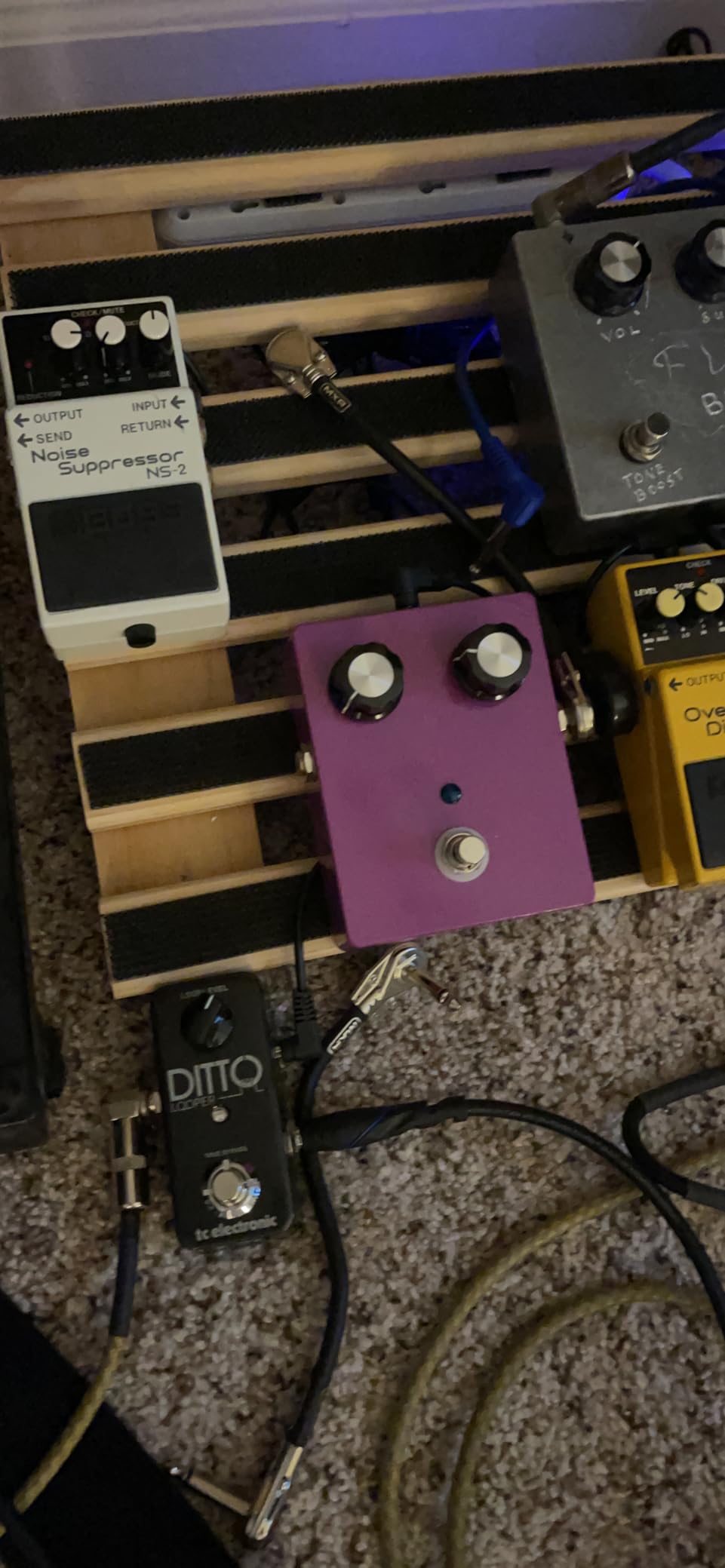
Why the Ditto still earns a place in 2026
Simplicity that does not feel like a compromise. The footswitch logic is the same family as the RC-1, so anything you learn transfers, and the small aluminium footprint leaves room on a crowded board. The undo and redo function means a bad overdub takes one press to remove rather than a full re-record, which is the feature that most saves a take mid-song.
It is also the most transferable of the group. Because there is one loop and one knob, the muscle memory you build on the Ditto applies to almost every pedal on this list. That makes it the lowest-risk first purchase, and the safest place to find out whether live looping suits you at all.
Where the Ditto falls short
Five minutes, one loop, no storage, no drum machine, no USB. The moment you want a second song preloaded for a set, you are starting from zero. The missing power supply is a small but real annoyance, and the loop audio is more compressed than the RC-1’s, which shows when you stack a lot of overdubs on the same phrase.
It is also not a busking pedal out of the box. Without a battery in the box, you need a mains supply or a separate battery adapter before it can work somewhere without a socket.
3. LEKATO 9-Loop Looper – Best for Nine Saved Songs and File Transfer
LEKATO Looper Guitar Pedal Guitar Loop Pedal Tuner Pedal 9 Loops 40 Minutes Record Time Unlimited Overdubs for Electric Guitar Bass (Black)
9 loop slots with up to 40 minutes total
48K/24-bit uncompressed recording
Built-in non-interrupting tuner
USB import and export of WAV files
Pros
- Nine loop slots with up to 40 minutes of total record time
- 48K/24-bit uncompressed recording with analog dry-through
- Built-in tuner that switches without interrupting phrases
- USB import and export of WAV loop files
- Visual loop progress indicator and external pedal support
Cons
- Loop length is fixed by the first recording so overdubs must match exactly
- Per-loop volume cannot be adjusted live without reaching the knob
- Bundled software is rough and the manual is hard to read
This pedal answers a very specific solo-performer need: having a library of finished loops rather than one empty memory. Nine slots, up to ten minutes each and 40 minutes of total record time, plus USB transfer so you can build loops in a DAW and load them in, or pull performances off the pedal afterwards. For storage per pound, nothing else in the roundup comes close.
The audio specification is the other headline. 48K/24-bit uncompressed recording with an analog dry-through path means the live signal is untouched while a loop runs, and the loop itself is not being thrown away by aggressive compression. Owners comparing it against more expensive units report that the sound quality is not the compromise they expected it to be.
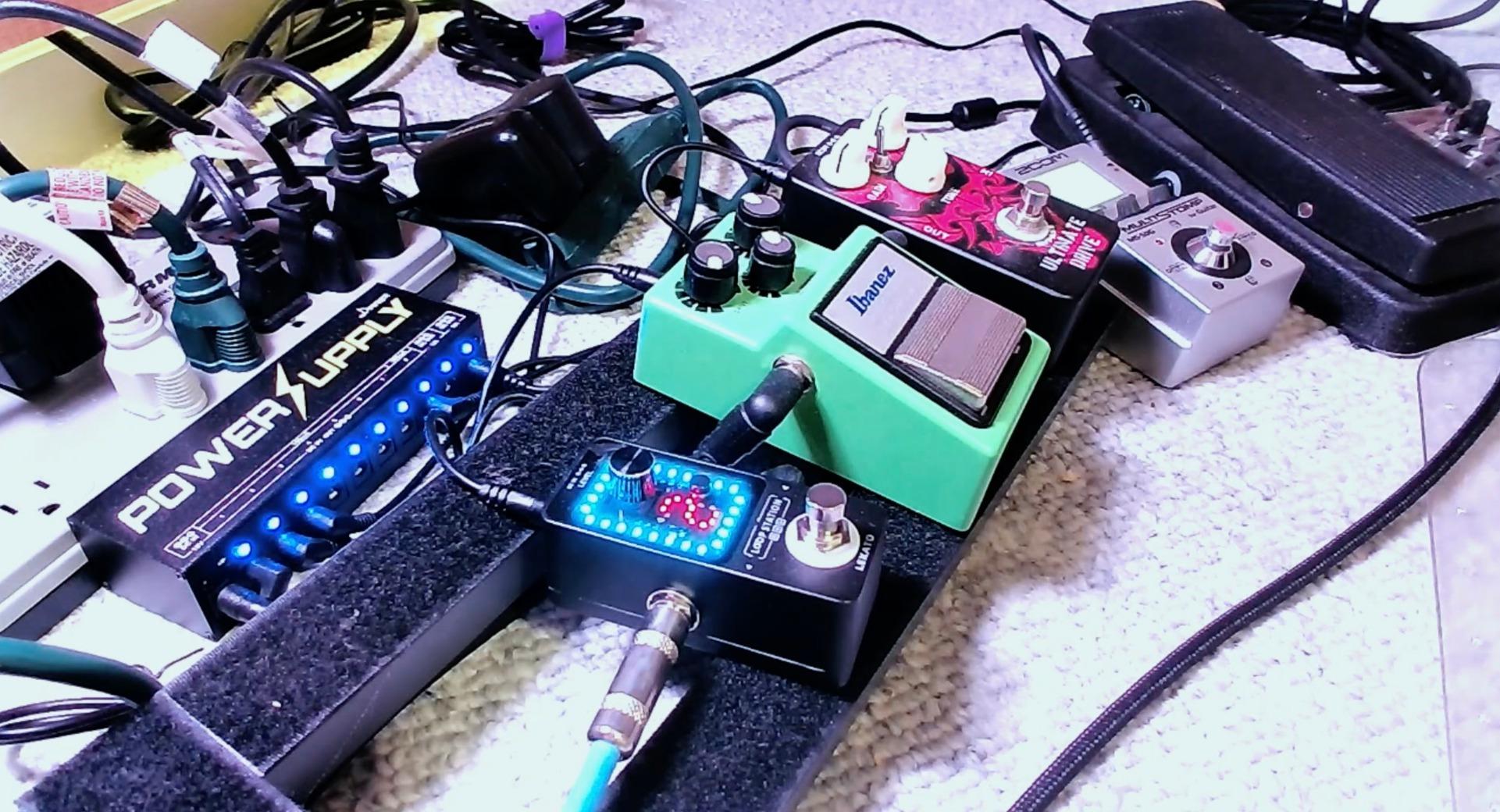
Two features make it more than a storage box. The built-in high-sensitivity tuner switches in without interrupting the playing phrase, which is a small thing that saves a solo performer an entire second pedal on the board. And there is a visual time indicator for loop progress, so you can see the loop position without counting bars in your head.
The one structural quirk that catches people out is this: the length of your loop is fixed by the first recording, and every overdub has to match it exactly. That is fine if you write deliberately. It is a real problem if you plan to record a phrase, then decide later that the second verse needs a different length.
There is also no live per-loop volume control. The single knob sets overall loop playback volume, so balancing an individual layer means bending down to the pedal. For a songwriter building arrangements at home, that is an irritation. For a busker on a street corner, it is a genuine limitation, because that is exactly the situation where you need to duck a loop mid-phrase.
The bundled editor software draws consistent complaints about being unintuitive, and the printed manual is small and vague. Budget an evening with YouTube rather than the booklet. Power can also come from USB, which is genuinely useful for a small rig, though you will still want a 9V option for busking.
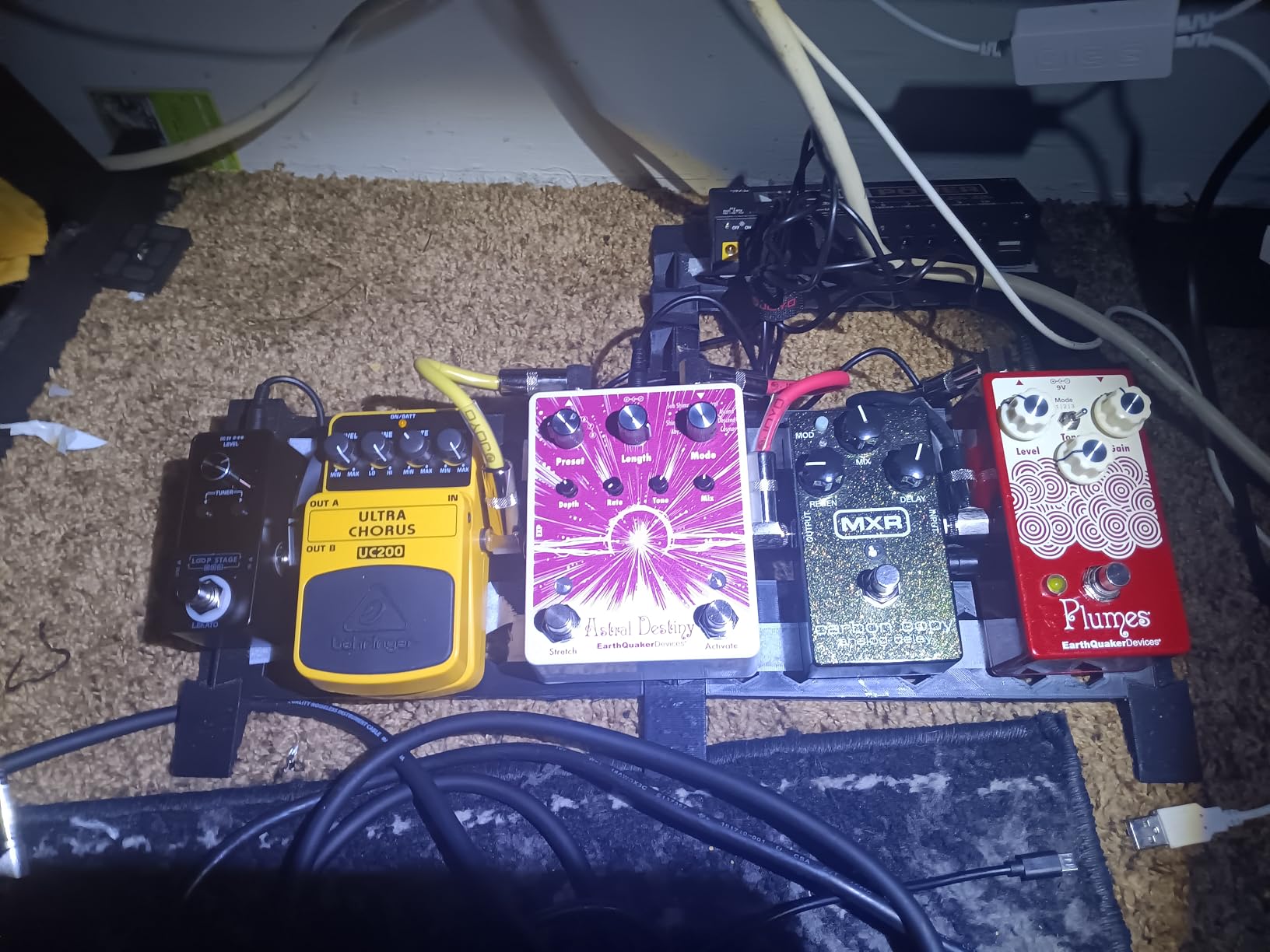
When this pedal changes how you work
Preparation. With nine slots and USB file transfer, a solo act can build an entire set’s worth of loops in advance, then perform them without building anything live. That is a different performance model from the RC-1, where the loop is part of the act. For a nervous first-timer playing a 30-minute street set, having the arrangement already sitting in memory is a confidence-changing upgrade.
It also scales the practice room. Because the audio is uncompressed, you can loop a bass line, then a chord part, then a melody on top, and hear the difference between them — which is a much better songwriting tool than a compressed practice looper.
Where it frustrates a gigging player
Reaching down to adjust a single loop is not workable in front of an audience, and the fixed first-loop length removes the flexibility to change a section’s length mid-song. There is no drum machine, so you are still supplying your own rhythmic bed — either recorded or played — rather than getting a groove box in the same enclosure.
Slow footswitch action is another recurring note, and it matters more live than at home. If you are building layers while singing, a switch that takes a moment to respond breaks the flow of the song.
4. MOOER Groove Looper – Best Looper and Drum Machine in One Box
MOOER Groove Looper Pedal Drum Machine Stereo Guitar Loop Recorder Pedals
140 minutes across 14 save slots
121 drum grooves in 11 genres
44.1kHz/24-bit stereo
Desktop editor software included
Pros
- 140 minutes of stereo recording across 14 slots
- 121 drum grooves with direct genre and pattern knob selection
- Looper and drum outputs route separately for better mixing
- Justify function locks the groove and loop together
- Count-in
- automatic and normal recording modes
Cons
- Knob arrows do not line up with the printed numbers
- Precise BPM entry is limited and tap tempo is inconsistent
- Some units report drums cutting out mid-loop
The MOOER Groove is the pedal for a solo performer who needs a rhythm section and does not want a second box. It combines a stereo looper with a drum machine holding 121 grooves across 11 genres, and at 140 minutes of recording across 14 save slots it has more capacity than everything else on this list except the Donner Circle and the FLAMMA. The inclusion of free desktop editor software for importing MP3, WAV, FLAC and APE files makes it the most flexible workflow of the drum-equipped options.
What makes it genuinely useful live is the routing. The looper and the drum machine can be sent separately, so you can put the drums straight to a PA or mixing desk and keep your guitar loop in the amp. Several owners note that this produces a better result than summing everything and hoping the balance works out, and it is the feature that makes a one-person arrangement sound like a band rather than a wall of noise.
The Justify function is the other quiet winner. It locks the drum groove and the loop together so they cannot drift apart over a long performance, which addresses the single most common failure of two independent machines playing at once. Count-in, signal-detected automatic mode and normal mode give you three different ways to start a loop, which is more flexibility than most competitors offer.
Owners repeatedly single out the drums as better sounding than expected — a real change from the low-fi onboard rhythms most manufacturers ship, which several forum users dismiss as practice-only. Time-stretch playback that changes speed without altering pitch is useful for slowing a phrase down while you work out a solo over it.
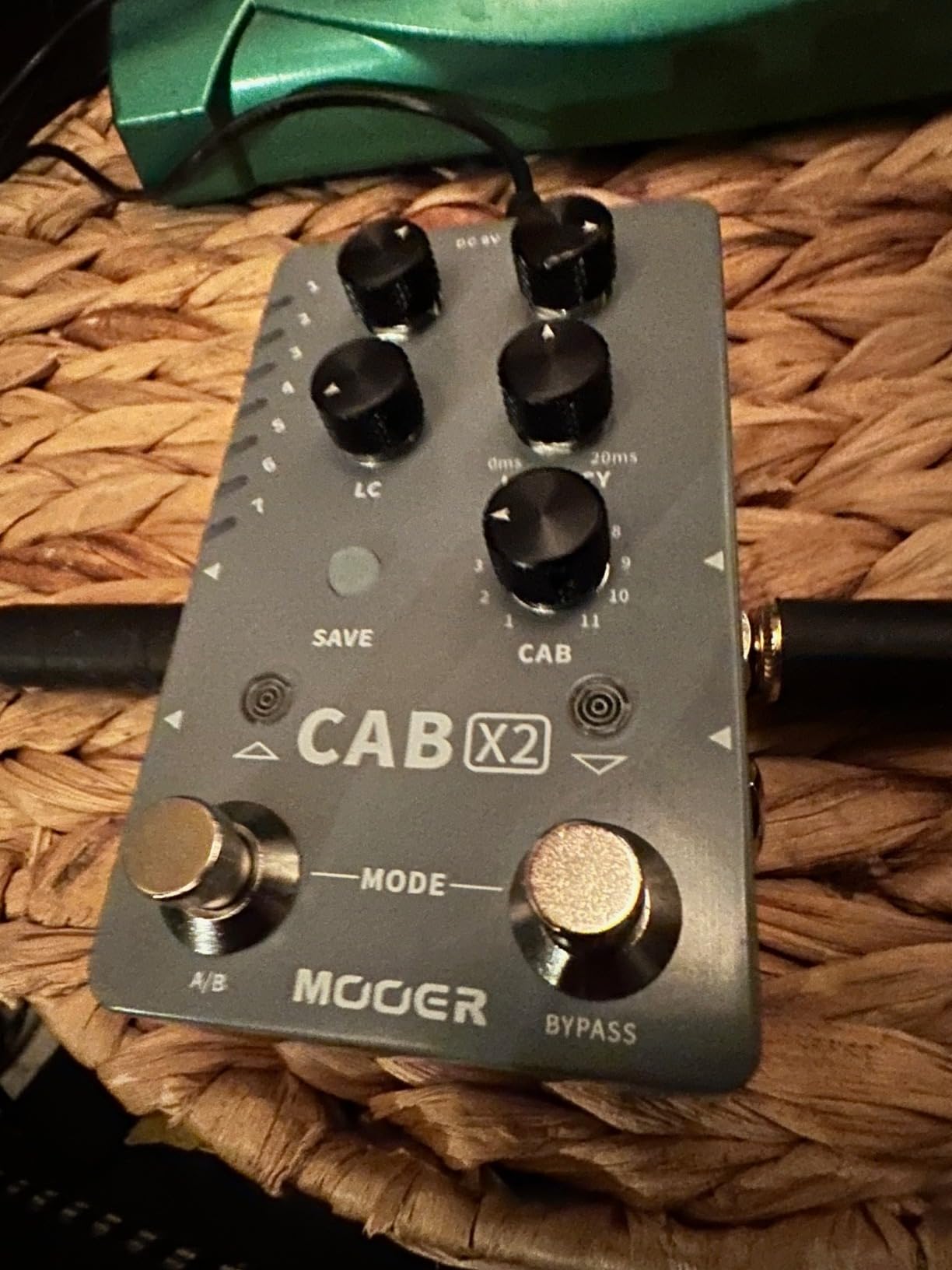
The interface is where it stumbles. The arrows printed around the GENRE and PATTERN knobs do not line up with the numbers beneath them, so on a dark stage you are guessing which way to turn to reach the groove you want. Pattern numbering has no logical order either, which makes browsing a real chore mid-set. This is the same class of problem as a screen you cannot read: the feature is there and the access to it is poor.
There are also some control-flow quirks. Precise BPM entry is limited, and tap tempo does not land consistently for every player. Some units need a power cycle to move between certain modes, and a small number of owners have had one pedal where the drums dropped out partway through a loop. On balance this is a capable pedal with an interface that needs a rehearsal period to learn.
Who this pedal is genuinely for
Multi-instrumentalists and one-man bands who have run out of room for a separate drum machine. Fourteen save slots means you can hold several complete arrangements, and the editor software means you can import properly recorded drum loops rather than relying on the onboard grooves — which addresses the most common complaint about manufacturer drum patterns directly.
It is also a strong choice for home arrangement work, because the automatic recording mode can start a loop the moment it detects your input. That means no missed downbeats when you are playing to yourself and not watching your foot.
Where a solo act will struggle with it
One footswitch does everything, and the pedal is physically larger than the mini loopers, so it claims real estate on a small board. The learning curve is the highest of the entry pedals on this list — owners describe sparse instructions and a menu system that takes real time to internalise. That is fine at home and a liability on a street corner with a queue forming.
If you have never looped before, this is not the pedal to learn on. Learn the mechanic on something simpler, then move up to this once you know how many tracks you actually need.
5. Donner Circle Looper – Best for Beginners Who Want a Readable Screen
Donner Circle Looper Pedal Drum Machine, 2 in 1 Drum Looper Stereo Guitar Loop Pedals, 40 Slots 160 mins Loop with 110 Drum Grooves, Tap Tempo, Fade Out
40 memory slots with 160 minutes total
110 drum grooves plus 10 metronome settings
44.1kHz/24-bit stereo
External footswitch supported
Pros
- Understandable in about five minutes compared with complex loopers
- 110 drum grooves and 10 metronome settings that sound better than expected
- 40 slots with up to 4 minutes each and auto-save at power off
- Merge function round-stops to the nearest bar
- Bright readable screen showing mode
- time and progress
Cons
- No power switch so you must unplug the adapter to power down
- Stopping a loop drops into overdub and captures unwanted tail sounds
- Internal clock drifts so it cannot hold sync with other external gear
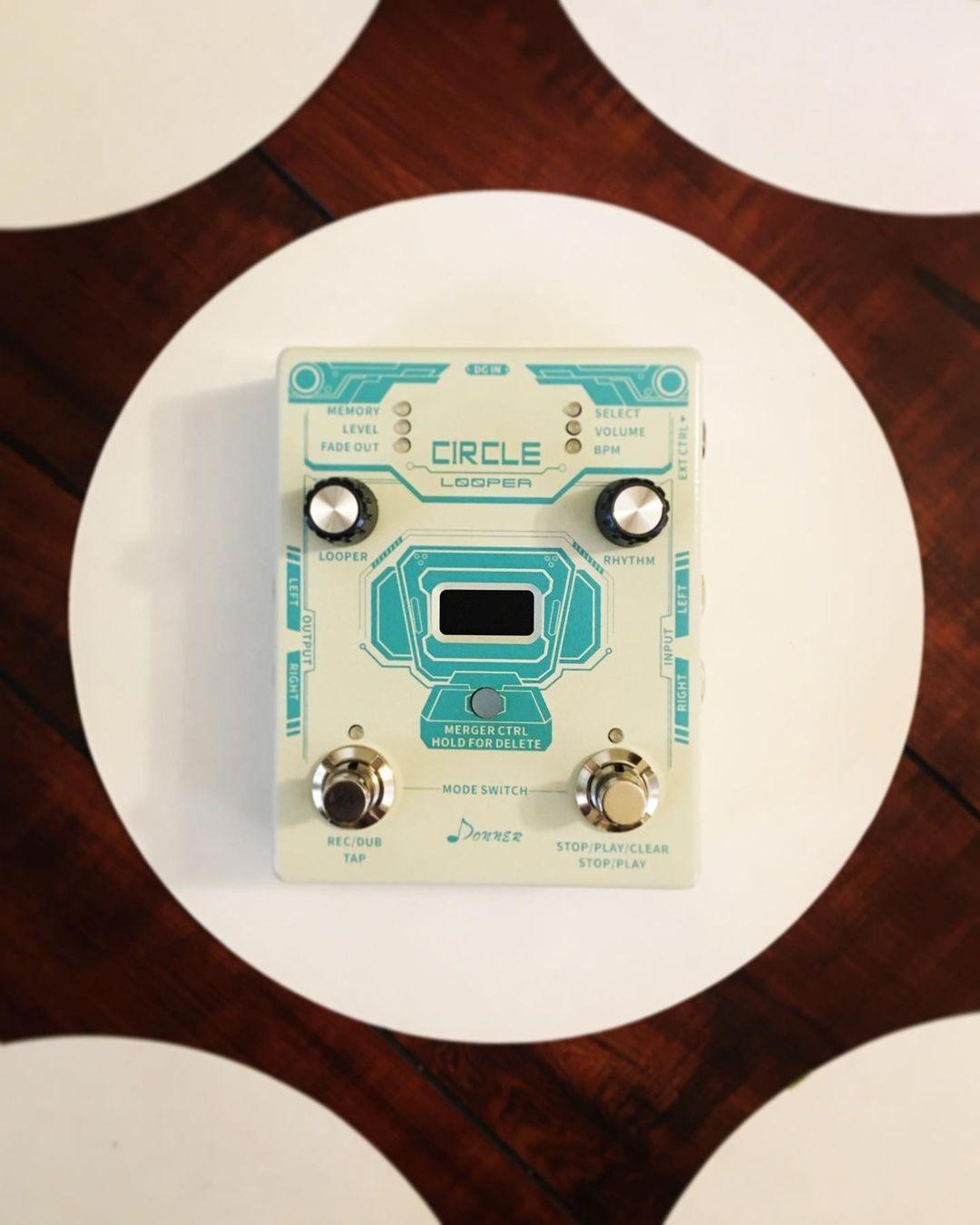
The Donner Circle solves a specific beginner problem well: you cannot see what the pedal is doing. It has a genuinely bright screen showing loop mode, elapsed time and a progress indicator, and that single feature removes most of the guesswork from building your first loop. Owners who bounced off menu-heavy loopers describe exactly that relief — readable, immediate, and understandable in about five minutes.
It is also one of the more capable units in the roundup on paper: 40 memory slots at up to four minutes each for 160 minutes of total capacity, 110 drum grooves across 11 styles, 10 metronome settings, 44.1kHz/24-bit stereo looping, and USB import and export so you can load real backing tracks to jam over. The Merge function round-stops your loop to the nearest bar, which quietly keeps beginner recordings in time.
Forgiving loop triggering is the other thing owners mention. It is more tolerant of a slightly late start than most, which matters when you are the only person on stage and there is nobody to wait for you to settle.
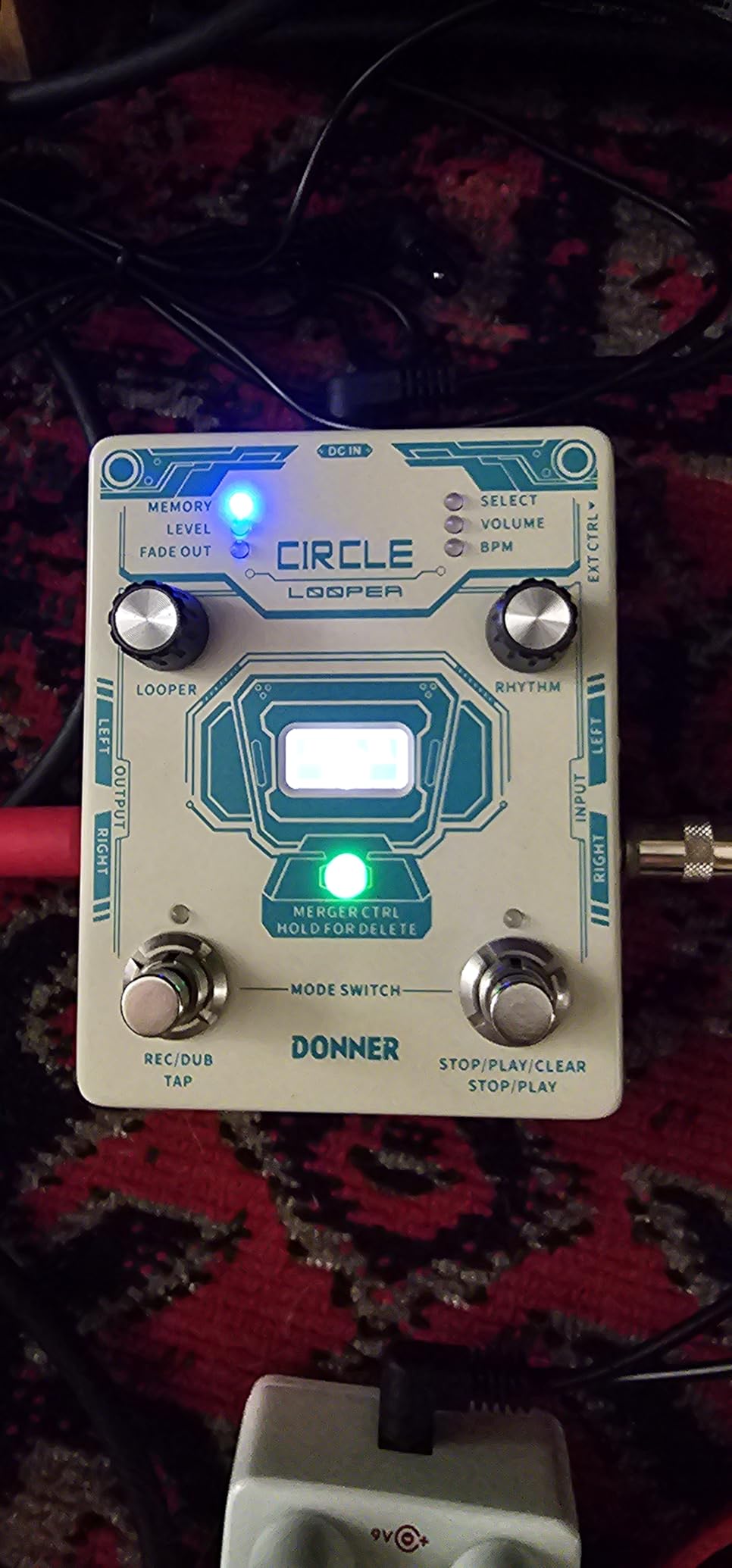
Now the honest list of problems. There is no power switch, so to power the pedal down you unplug the adapter — which in practice means yanking a cable at the end of a set rather than flipping a switch. That is a habit worth changing early rather than letting it become normal.
More significant for a live act: stopping a loop drops you into overdub by default, which captures the tail of the sound you were playing into the next layer. Several owners describe this as catching a ring-out or a stray note at the end of a take. The Merge function and careful phrasing mitigate it, but it is a behaviour you have to design around rather than one that works out of the box.
Lastly, the internal clock drifts, so you cannot hold sync with other external gear. That is fine if the loop is the timekeeper, which it usually is for a solo act. If you are running backing tracks from another machine, do not expect these to stay locked together for a full set. Memory slots also cannot be named, which gets confusing fast across a 40-slot library.
What makes this the easiest looper to use
Visibility, plainly. Every time a single-button looper frustrates someone, it is usually because they cannot tell where they are in the phrase. The Circle answers that with a screen you can read at a glance, and for a performer who is also singing or playing a melody, that removes an entire layer of cognitive load.
The drum machine helps too, and against the general scepticism about onboard rhythms, owners of this one report the grooves and metronome settings sounding better than expected. Having a usable metronome alone saves solo players from a separate pedal.
Where a gigging player will notice it
The stop-into-overdub behaviour is the one to think about hard before this becomes your only live pedal. On a slow ballad it will ruin takes; on a fast, busy arrangement you will not hear it. Test it against your actual material rather than a single open chord progression.
It needs a 9V DC centre-negative supply at 500mA, and that adapter is not included. A few owners have had one pedal fail after a few months, so if you are gigging regularly and this is your main looper, keep a known-good simple pedal as a backup.
6. Donner Triple Looper – Best for Pre-Prepared Live Loop Sets
Donner Triple Looper Guitar Pedal, 3 Loops 90 mins Looping Time Loop Pedal with Screen Unlimited Overdubs Undo/Redo for Electric Guitar Bass, True Bypass
3 independent slots of up to 30 minutes
True bypass
Bright screen with progress ring
Auto-save at power off
Pros
- Three independent 30-minute slots with 90 minutes total
- High-visibility screen with a progress ring
- One footswitch using familiar click patterns
- True bypass for pure tone when off
- Unlimited overdubs with undo and redo
Cons
- Slots are independent so you cannot dub between them
- Slight loss of level and fullness after looping
- Some buyers report units with a recorded chirping noise
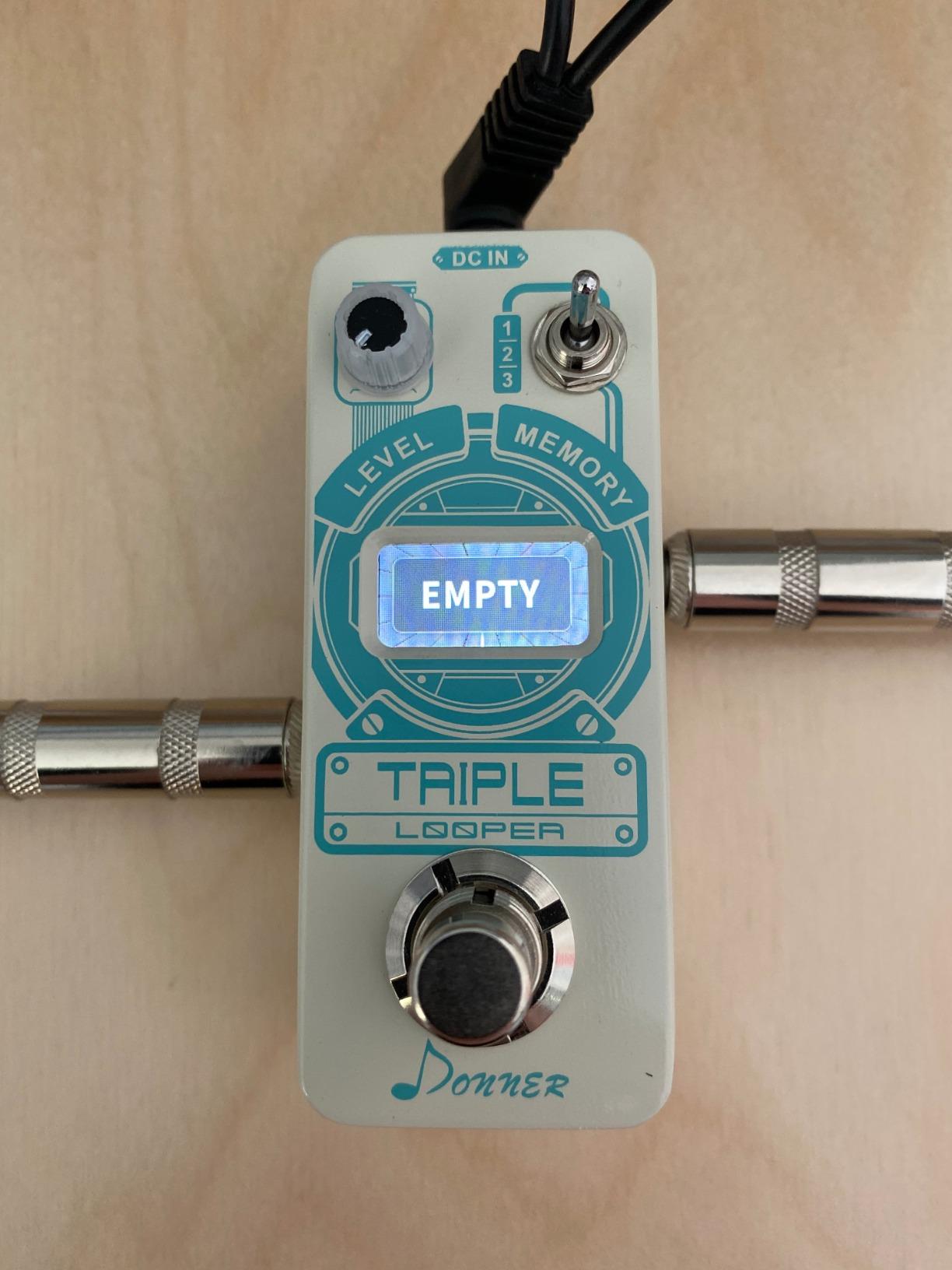
The Triple Looper is a different proposition from everything else here. Thirty minutes per slot across three independent slots means you could load an entire 45-minute set’s worth of pre-built loops and perform over them without touching record. For a solo act that has already worked out its arrangements and wants playback rather than live building, that is a legitimately useful tool that the other pedals on this list do not offer at this level.
It is also one of the better-executed budget pedals. Owners report no audible clicks or pops when starting, dubbing or stopping playback, which is more than several competitors manage. The screen has a progress ring that shows your position in the loop, the single footswitch uses the familiar Ditto-style click patterns so it is quick to learn, and the true bypass keeps your signal clean when the pedal is off.
At 175g in a compact metal enclosure, it is also light and small enough not to fight for board space. That combination of capacity, click-free operation and footprint is why we rate it as the best pedal here for a prepared set.
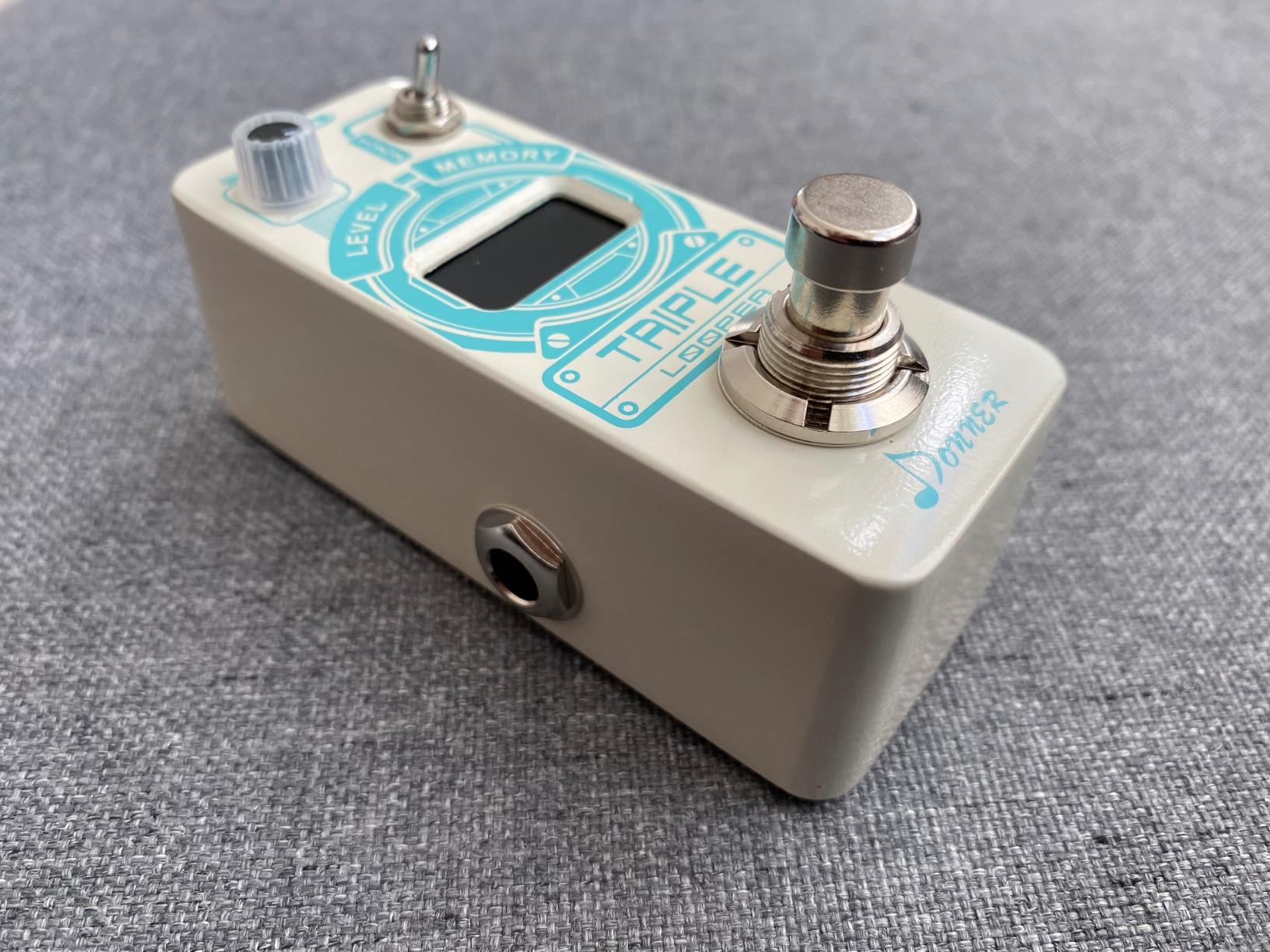
The critical limitation is that the three slots are fully independent. You cannot overdub from slot one onto slot two, and you cannot move content between them. So you choose a slot per song rather than layering a multi-part arrangement across three tracks. For a set of three prepared loops, that is exactly right. For building an arrangement, it is the wrong shape of tool entirely.
Owners also note a slight loss of signal level and fullness once you are looping compared with the dry path, and the looped signal sits a little quieter than your live playing. The sound is described as slightly compressed on playback. None of that is severe, but it is consistent enough that it is worth hearing the pedal in your own rig before committing.
Two smaller notes: the screen is small and dim enough to be hard to read on a dark stage, and a small number of buyers have had one pedal where a recurring digital chirping noise got recorded into their loops. That last one is a quality-control issue rather than a design flaw, but if you record a lot, check your loops before you rely on them.
Why prepared sets are a legitimate performance style
Playing over pre-built loops is not a lesser form of looping — it is what a lot of professional solo performers actually do, because it removes the risk. Nothing goes wrong live that you have not already heard a hundred times, the arrangement is identical every night, and the pedal becomes a backing track player rather than a collaborator.
Thirty minutes per slot is generous for that job. A full arrangement with a verse, a chorus and an outro rarely exceeds four or five minutes, so you could load two or three complete arrangements per slot and move between them with the single footswitch.
Where it will not take you
Layering is out. If you want to build a song in front of an audience, the independent slots stop you dead. The dim screen is a genuine issue on a stage with minimal light, and the slightly compressed looped signal means dense arrangements lose a little air.
Treat it as a playback machine with live overdub on top of a single phrase, not as a multi-track looper. That framing is what makes it excellent rather than a compromise.
7. FLAMMA FS21 – Best for Two-Switch Live Control
FLAMMA FS21 Stereo Guitar Looper Pedal & Drum Machine 2-in-1 with160 Minutes Loop Recording Capacity 100 Drum Grooves 10 Metronome Support Software Editing
Dual footswitches for looper and drums
160 minutes across 40 slots
100 drum grooves
44.1kHz/24-bit looping
Pros
- Dual footswitches give separate control of looper and drum machine
- 160 minutes of capacity across 40 memory slots
- 100 drum grooves plus 10 metronome settings
- Rhythm switching completes the current bar first
- Auto-save on power loss and a fade-out setting
Cons
- Instructions are vague and the menus take time to learn
- No drum fill function and some patterns are weak
- External footswitch not included and hard to source
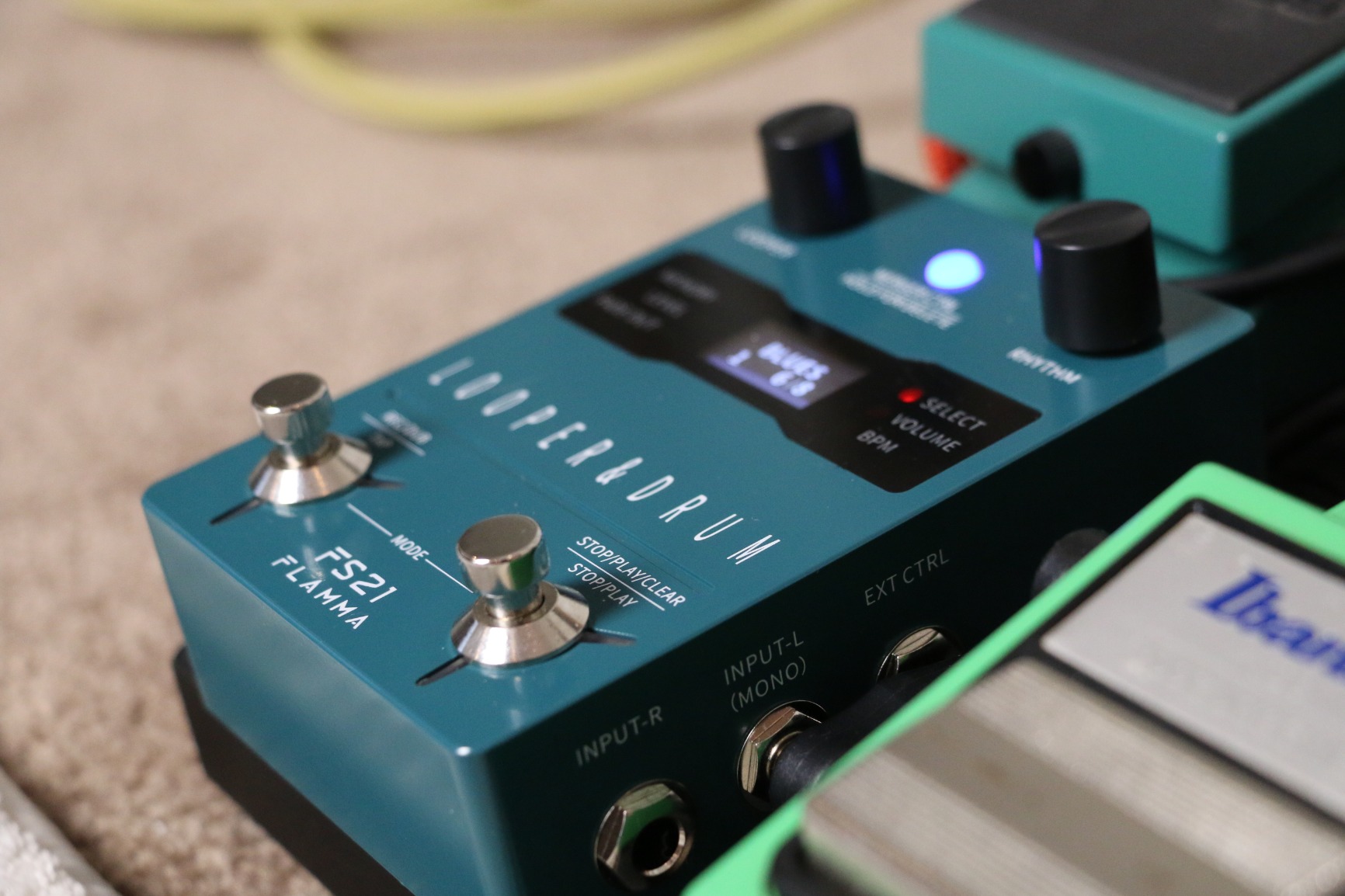
The FLAMMA FS21 is the only pedal in this roundup with two footswitches, and for a solo performer that changes the ergonomics of a whole set. One switch runs the looper, the other runs the drum machine, so you can start or change the groove without interrupting the loop, and vice versa. Several owners who came from single-switch drum-equipped pedals describe this as the feature that made their arrangements start to lock together.
The capacity is class-leading for the price: 40 memory slots at four minutes each, 160 minutes total, with everything auto-saving on power loss. Add 44.1kHz/24-bit looping, 100 drum grooves across 10 styles, 10 metronome settings and fade-out for cleanly ending a track, and you have a serious all-in-one for building a song alone.
Sound quality draws consistent praise, with multiple owners comparing it favourably to more expensive loopers on both the loop audio and the drums. The stereo in and out works well inside an amp effects loop, and the build and switch feel are described as solid. A power supply and USB cable are included, which saves a trip to the accessory drawer.
Where it needs work is documentation. The instructions are vague enough that owners describe a real learning curve to understand the menus, and the pattern editing options are limited — there is no drum fill function, and some of the grooves are weak enough to be unusable in a live arrangement. If you are picky about drum sounds, you will end up loading your own through the USB editor.
There is an EXT CTRL jack for an external footswitch, which would be genuinely useful for a two-switch pedal that lacks a dedicated stop — but the switch is not included and is reportedly hard to source. That is a frustrating gap on a pedal that otherwise gets the two-switch logic exactly right.
Two more practical warnings: the editor software is blocked by macOS and Windows as an unverified developer, so you have to override a security prompt before it will run, and it uses mini-USB rather than USB-C and is not recognised on Linux. The tap tempo is also difficult for some players to get accurate.
Why two footswitches matter for solo work
Because your hands and eyes are already committed. On a single-switch pedal, every change to the arrangement requires a specific tap pattern, and if you are mid-vocal it takes attention away from the singing. With one switch per function, you can make each decision without memorising a sequence, which is a meaningful reduction in cognitive load for a one-person band.
It also solves a specific arrangement problem. The rule that switching rhythms finishes the current bar first means you can call the groove change on the beat rather than mid-bar, so your loop and your drums stay aligned instead of fighting each other.
Where the FS21 frustrates a performer
The documentation gap is the big one. A pedal this capable should not require reverse-engineering its menus, and if you are performing in two days rather than two weeks, that cost is real. The missing external footswitch means you still cannot get a clean dedicated stop without sourcing extra hardware.
A small number of buyers have had one pedal where the second switch stopped responding after a while, so if it becomes your main live pedal, test both switches regularly rather than discovering the problem mid-set.
8. LEKATO Mini 5-Minute Looper – Best for Travel and Busking Kit Bags
LEKATO Guitar Looper Effect Pedal Loop Pedal 5 Minutes Looping Time Looper Pedal ONE Looper Unlimited Overdubs
24-bit uncompressed recording
Ultra-mini aluminium enclosure
Power supply and USB cable included
5 minutes with unlimited overdubs
Pros
- 24-bit uncompressed recording with analog dry-through
- Ultra-compact aluminium mini enclosure
- Power supply
- USB cable and manual all included
- USB import and export of WAV loop files
- Simple single-knob operation
Cons
- Only 5 minutes and a single loop with no memory slots
- No screen or visual timing indicator
- No drum machine
- metronome or tempo function
The LEKATO Mini is the pedal to buy when the constraint is space, weight and what you can carry. At 0.3kg in an aluminium mini enclosure, it takes up almost nothing on a board, and everything you need is in the box: the pedal, a USB cable, a manual and a power supply. For a busker with a soft case and a long walk, that completeness matters more than any feature on the list.
Despite the tiny chassis, the audio is 24-bit uncompressed with an analog dry-through path, so your live signal is unaffected and the loop is not heavily compressed. Owners treat it as a dependable entry looper for practice, quick ideas and travel, and the small footprint means it will fit on a board that is already full.
Operation is single-knob with foot commands for record, undo, redo, stop and erase, and there is external pedal support if you want to add a second switch. USB import and export of WAV files means you can move ideas between the pedal and a computer.
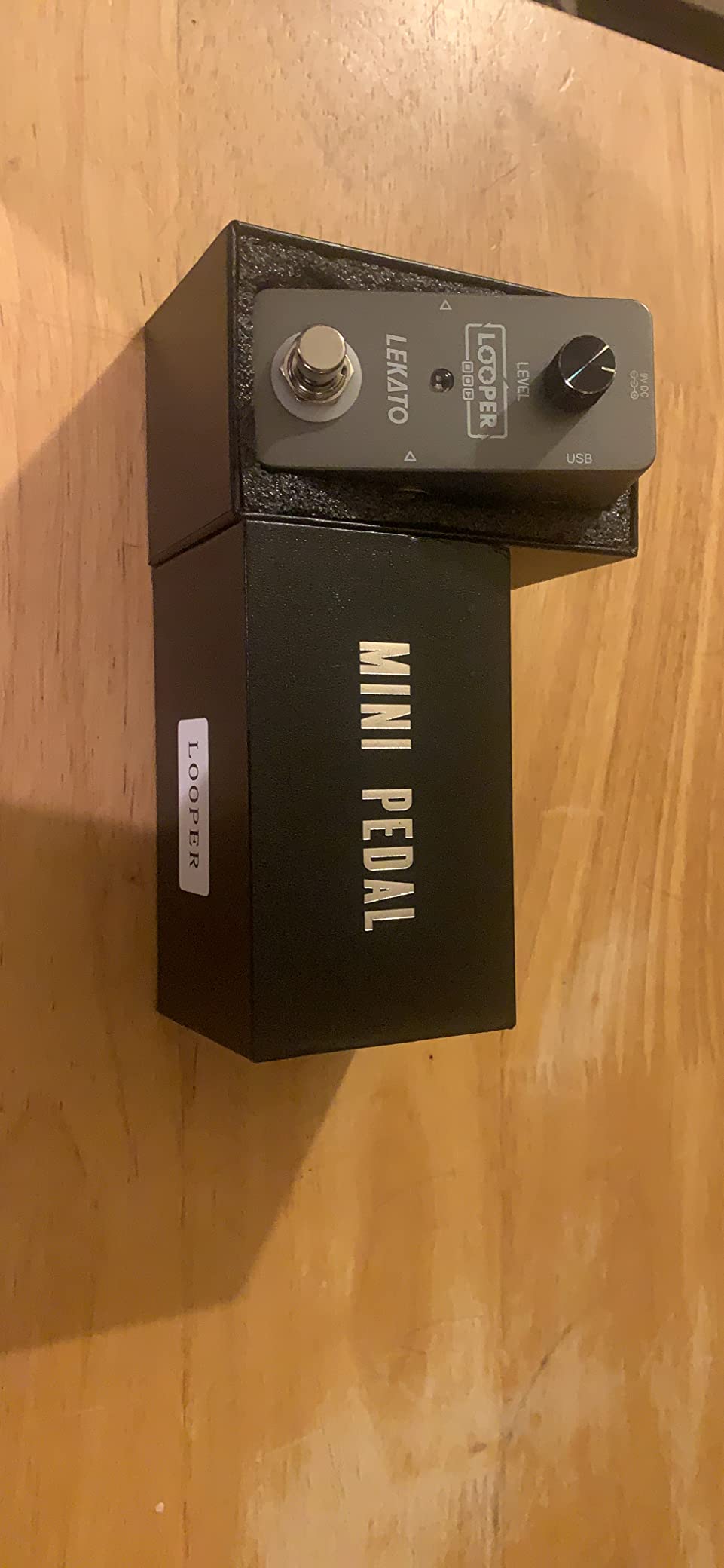
What it cannot do is the list. Five minutes of single-loop recording, no memory slots, no screen and no visual timing indicator, no drum machine, no metronome. For a busker working a two-part riff in a public space, that is genuinely workable — you do not need a screen if your loop is short and you have rehearsed it.
For anything else, it is too basic. Without a screen or timing light, you are counting bars in your head, and that becomes unreliable the moment a passer-by stops to ask where the bus stop is. And building a full arrangement is out of the question with a single five-minute loop.
The file transfer uses a Micro-B USB connector, which is fussy to source a cable for if you lose the included one. Everything else in the box means it is genuinely turnkey, which is a real advantage over the Ditto that needs a supply you have to buy separately.
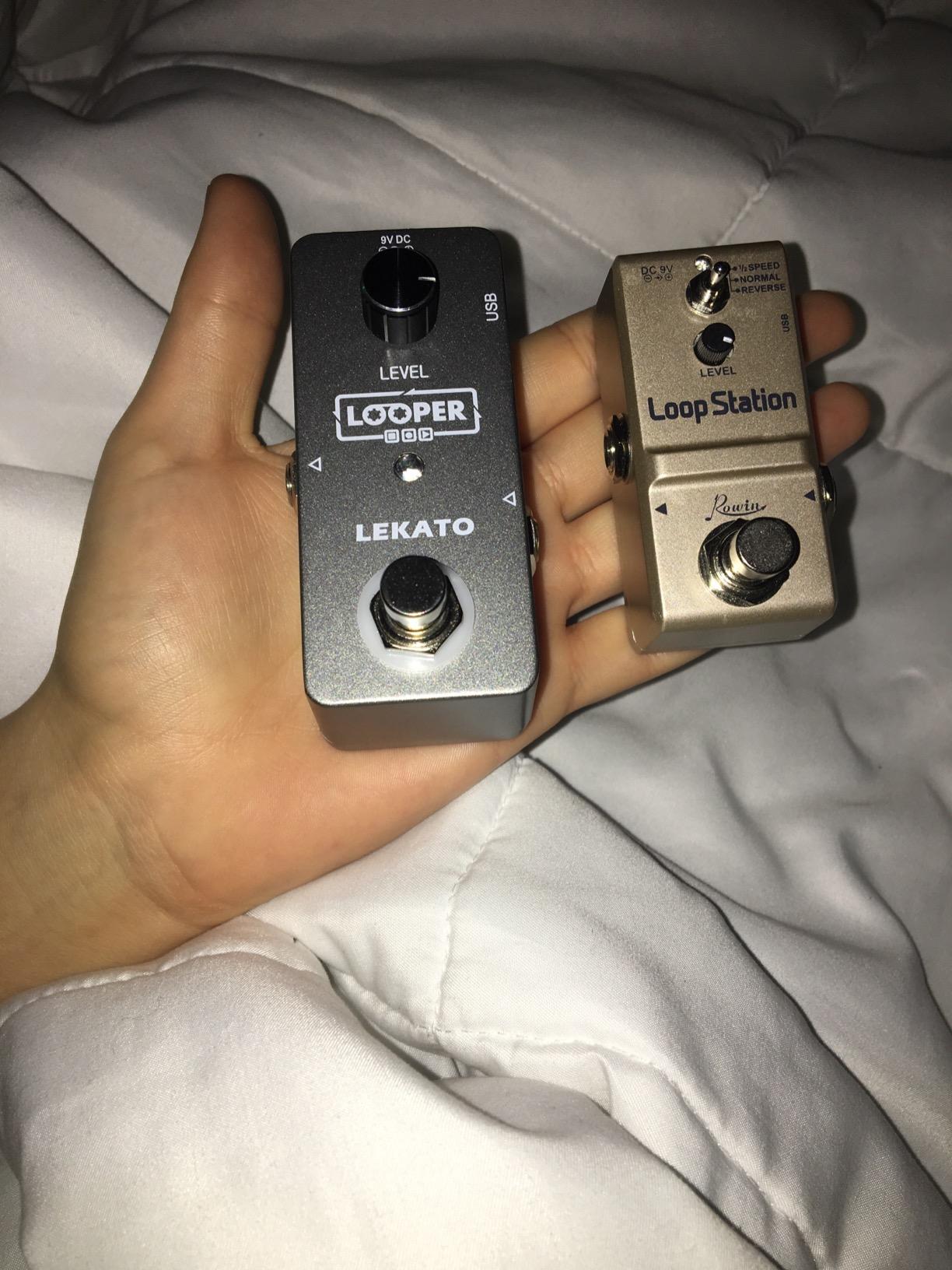
What this pedal is for
Travel and street work. A minimal kit, minimal power needs and no menu to navigate in bad light. Because the power supply is included and the enclosure is aluminium, it is also a sensible backup pedal to carry in a bag — small enough to take everywhere, simple enough that you could hand it to another player in a jam and they would have a loop in under a minute.
The uncompressed 24-bit recording is the quiet win here. At this size and simplicity, you would normally accept compressed audio as part of the trade, and this one does not ask you to.
Where it stops being enough
One loop, five minutes, no timing reference. Any performance that involves more than a single phrase, or any situation where you lose count of where you are, will expose the missing screen immediately. There is no way to save loops between songs either, so a two-song set means rebuilding from scratch.
Buy it as a travel and practice tool, or as a first looper you can genuinely afford to lose. Do not build a live set around it.
9. LEKATO Loop Auto – Best for Sync Recording and Tuning on Stage
LEKATO Looper Pedal,Guitar Looper Pedal for Electric Guitar&Bass Loop Pedal with SYNC & Tuner Function Triple Effect Guitar Looper with LED Screen Unlimited Overdubs 3 Loops 18 Minutes Record Time
Synchronous recording mode
3 loop slots with 18 minutes total
Built-in non-interrupting tuner
48K/24-bit uncompressed audio
Pros
- Sync mode lets you drop into recording mid-playback
- Built-in tuner switches without interrupting the phrase
- 3 loop slots with 18 minutes of record time
- 48K/24-bit uncompressed audio with analog dry-through
- USB import and export with auto-save at power off
Cons
- Loop length is fixed by the first recording so overdubs must match exactly
- 9V power supply is not included
- LED screen is small and shows progress only
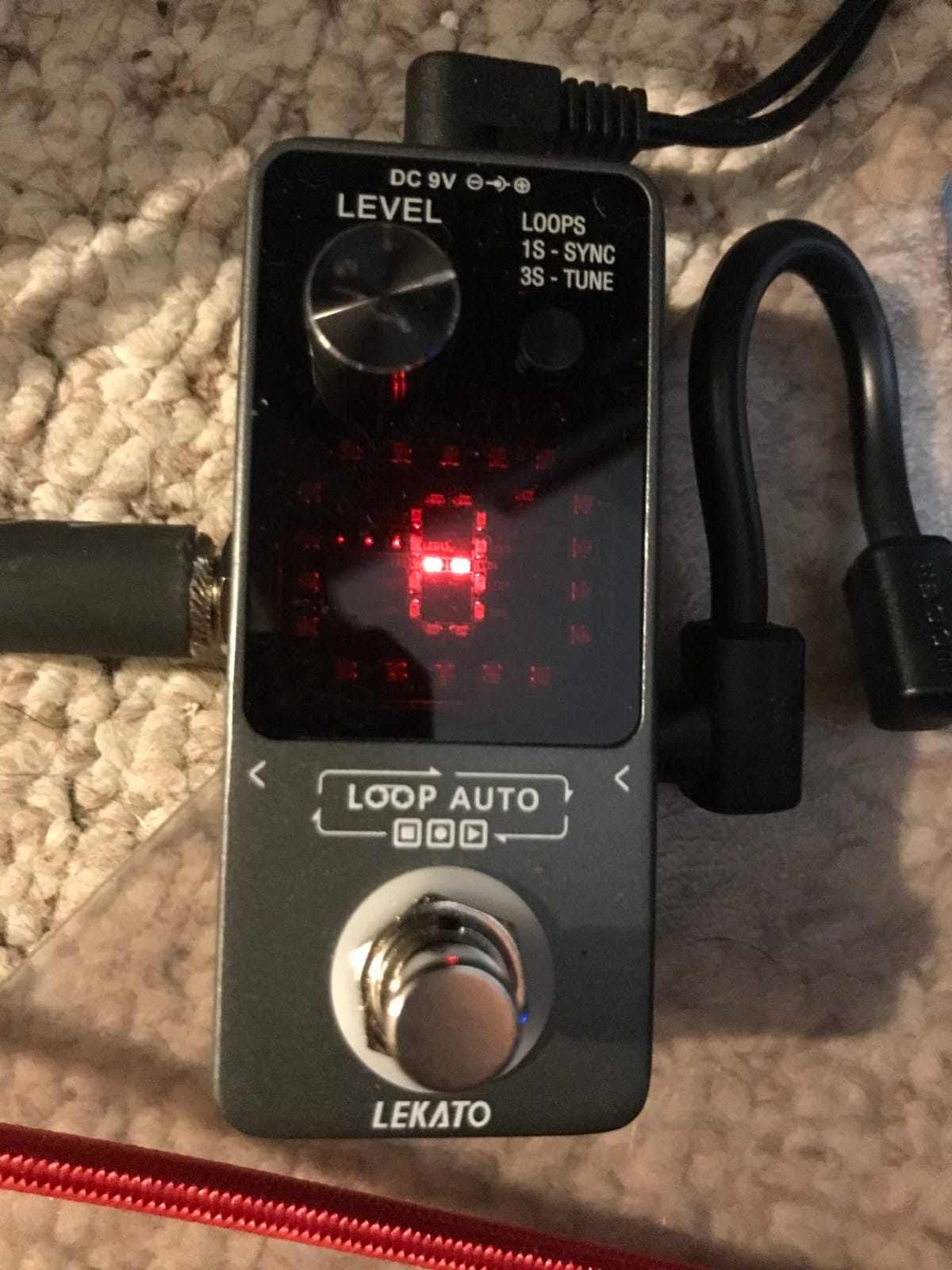
The Loop Auto’s defining feature is synchronous recording, and for a solo performer it solves a specific, real problem. Instead of requiring you to catch a downbeat to start a loop, sync mode lets you begin recording at any point in the playback and the pedal will keep everything aligned. When you are playing a melody over an existing loop, that is the difference between catching a loop cleanly and missing it because the phrase came round at an awkward moment.
Everything else here is solid for a budget pedal: three loop slots with six minutes each for 18 minutes of total record time, a visual progress indicator, 48K/24-bit uncompressed recording with analog dry-through, USB import and export of WAV files, and auto-save at power off. That is more capability than most of the entry-level competition manages.
The integrated high-sensitivity tuner is the feature that saves board space. It switches in without interrupting the playing phrase, so a solo performer who changes tuning mid-set can tune without dropping the loop. For a one-person act covering songs in different keys, that is worth a dedicated second pedal by itself.
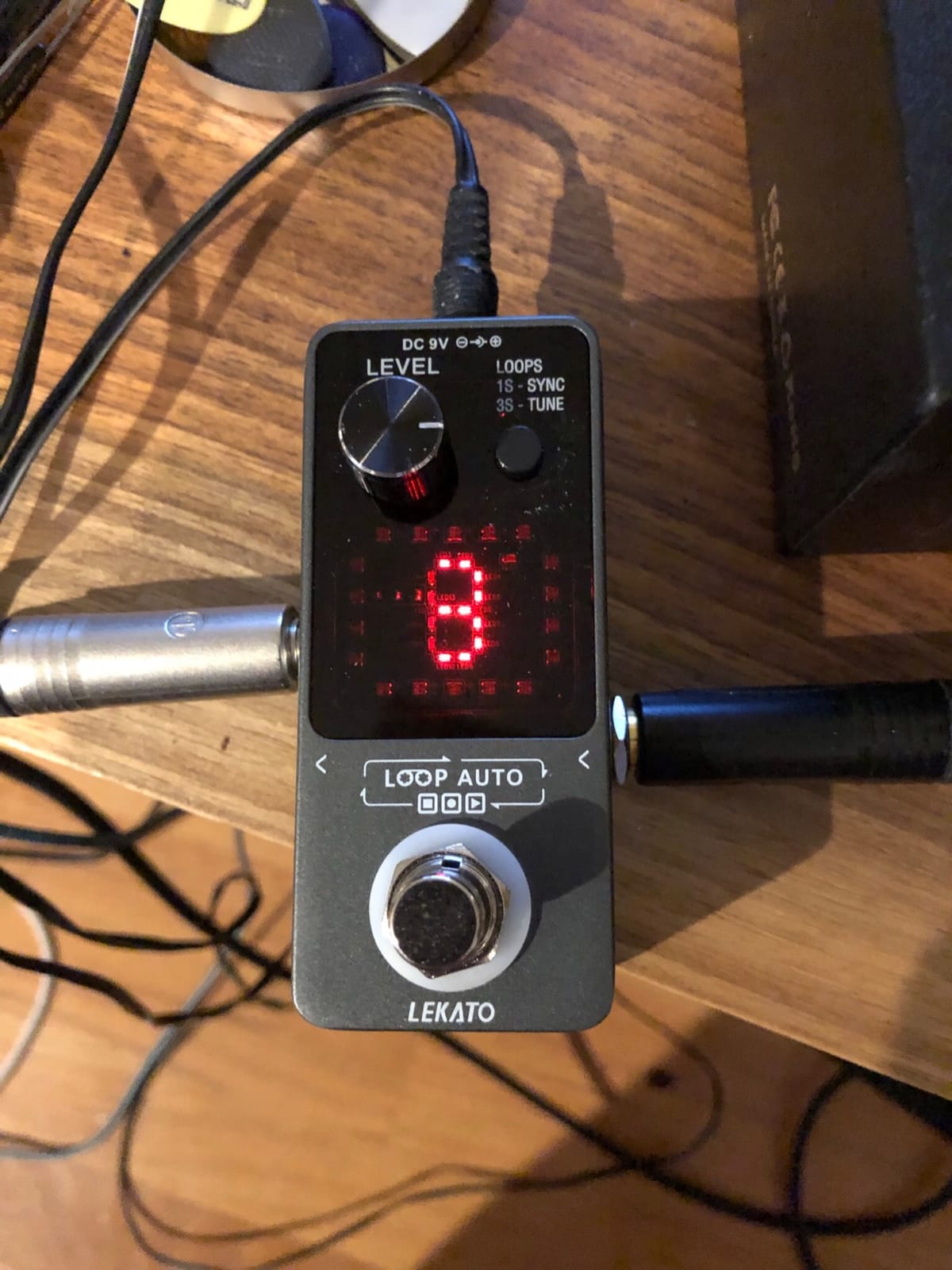
There is single-knob loop volume and external pedal support, which means you can add a second switch for stop control if you want it — a cheaper route to the dedicated-stop problem than buying a whole new pedal. The compact metal build is understated but solid, and reviewers consistently describe it as feature-packed for what it costs.
Shared with the larger LEKATO on this list, the loop length is fixed by your first recording and every overdub has to match exactly. That constrains arrangement writing, because you cannot change a section’s length later. The LED screen is small and only shows progress rather than a menu, which is fine for the intended use and unhelpful if you get lost in a settings tree.
The 9V centre-negative power supply is not included, and some users find the menus and the small manual take practice to understand. There is no drum machine and no metronome, so you are still providing the rhythmic reference yourself.
When sync mode genuinely earns its place
During a live build, when you are layering a harmony or a counter-melody over a phrase that is already running. The alternative — waiting for a bar line you can hear clearly — works when the loop is short and you know the arrangement cold. It fails the moment you are improvising, which is exactly when a solo performer most wants to add a layer.
It is also the answer to the anxiety problem. Knowing you can enter at any point removes the pressure to watch your foot at all times, which lets you look up and play the part you actually care about.
Where you will run out of pedal
Three slots is thin for anyone playing a full set, and the fixed loop length removes the flexibility to restructure a song. The small screen is only a problem if you go looking for settings mid-performance, and the missing power supply is a simple but annoying first-day item to source.
For live layering, the Donner Circle or the FLAMMA FS21 give you far more memory and drum support; for a busker or a songwriter who wants sync and a tuner and nothing else, this does the job at a fraction of the cost.
10. Electro-Harmonix 720 Stereo Looper – Best for Uncompressed Stereo Loops
Electro-Harmonix 720 Stereo Looper Pedal
10 loops with 720 seconds of stereo recording
24-bit A/D/A at 44.1kHz
Uncompressed audio
Reverse, half-speed and undo/redo
Pros
- 12 minutes of stereo recording across 10 independent loops
- Uncompressed 24-bit A/D/A converters at 44.1kHz
- Stereo in and out lets you record two instruments at once
- Reverse
- half-speed and undo-redo available instantly
- Battery powered with silent footswitches
Cons
- Bulkier and heavier than mini loopers
- No drum machine
- metronome or USB workflow
- Menu-driven interface takes more practice than a one-button looper
The 720 Stereo Looper is the audio-quality answer to this whole question. It uses uncompressed 24-bit A/D/A converters running at 44.1kHz, which means what goes in comes back without the compression that makes budget loop layers sound thin and lifeless once you stack them. If you are layering five or six parts and want the arrangement to stay open rather than turn to mud, this is the pedal built for that.
It also gives you ten independent loops and 12 minutes of stereo recording time, so you can store several complete songs. Stereo in and out means you can record two instruments at once — a genuine capability for a one-man band that switches between, say, an acoustic guitar part and a bass line in the same song.
The performance features are unusual in this category. Undo-redo, reverse and half-speed loop effects are available at the touch of a button mid-phrase, which turns the pedal from a recorder into an instrument. The footswitches are silent, which is a real consideration in a small room or a busking spot, and the controls are large and easy to read.
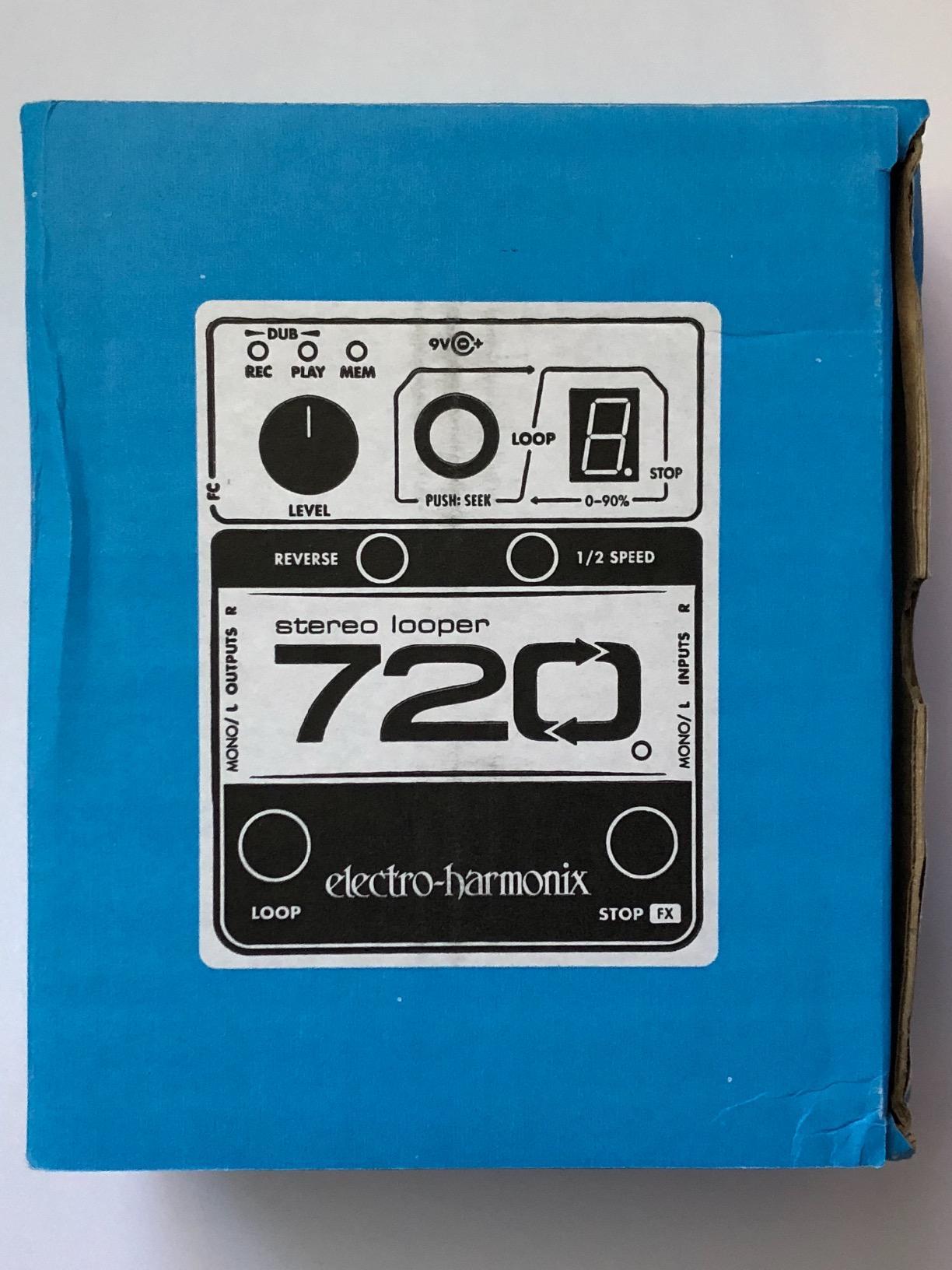
It is also one of only two pedals here documented as battery powered, alongside the RC-1, with a 9.6V power supply included in the box for when you have mains. That makes it a legitimate busking option despite its size, which is rarer than it should be in this category.
What you give up is convenience. At 0.75kg in a 7.25 by 6.2 by 3.25 inch chassis, it is by far the largest pedal in this roundup, and it will take a meaningful slice of a small board. There is no drum machine, no metronome, no USB import and export, and no way to load pre-made backing tracks — so you are recording everything yourself, every time.
The interface is menu-driven and takes more practice than a single-footswitch looper, and the review count here is much lower than the other nine, so the volume of owner feedback is thinner. For a performer who values the recorded sound above everything else and plays a larger board, those are reasonable trades.
Who should pay for uncompressed audio
Multi-instrument solo performers capturing more than one source at a time. The stereo I/O is the headline — you can lay down a guitar part and a bass or vocal part in the same loop without either one being summed down to mono before it is recorded, and the layers stay distinct as the stack grows.
It is also the right choice for anyone building dense arrangements. Reverse and half-speed applied live to a finished loop are effects you cannot get from any of the nine other pedals on this list, and they are the sort of thing that makes a solo performance sound considered rather than assembled.
Where it is the wrong purchase
Board space and weight, first. If you are running a compact board and playing small rooms, this is a big commitment. Second, the absence of a drum machine and any USB workflow means there is no shortcut into an arrangement — everything has to be played in, which is either exactly what you want or an unnecessary constraint.
Finally, the menu-driven interface has a steeper learning curve than a one-button looper. If you have never looped before, this is a demanding way to find out whether you like it.
How to Choose a Looper Pedal for Your Solo Setup
Most looper buying advice is written for guitarists with a pedalboard and a practice amp. If you are performing alone — busking, playing a coffee house, working a solo acoustic set — the decision points are different, and they mostly come down to what you can see, what you can stop, and whether there is a power socket.
1. Loop time is a hard ceiling, not a feature
Check the loop time against the longest thing you actually play. A five-minute loop (the Ditto, the LEKATO Mini) will not hold a full song with an intro, two verses, a chorus and an outro. Twelve minutes (the RC-1, the Electro-Harmonix 720) covers most songs comfortably. Per-slot capacity of 30 minutes (the Donner Triple) is for pre-built arrangements rather than live building. Getting this wrong means the pedal cannot do the job no matter how good it sounds.
2. One button or two is less important than a real stop
Single-footswitch loopers use tap patterns: tap once to play, twice to dub, double-tap to stop. Learnable, but every action competes for the same switch. Two footswitches (the FLAMMA FS21) separate looper and drum control, which genuinely reduces the cognitive load when you are also singing.
The more important question is whether you can end a loop cleanly on the beat. None of the ten pedals here has a truly dedicated stop switch, and this is the single most-repeated live complaint among solo performers. The workaround is an external footswitch, and five of these ten support one — the LEKATO 9-Loop, the Donner Circle, the FLAMMA FS21, the LEKATO Mini and the LEKATO Loop Auto all have an external pedal connection, though the FLAMMA’s switch is not included.
3. Screen or LED: pick for the darkest stage you play
There are three visibility tiers here. Best is a bright readable screen: the Donner Circle. Middle is a progress ring or LED display: the Donner Triple and the LEKATO 9-Loop. Worst is nothing to read: the RC-1, the Ditto and the Electro-Harmonix rely on indicator lights or memory of the arrangement. If you play venues with minimal lighting, a screen is worth a lot; if you always have stage wash, an LED ring can be enough.
4. Audio resolution matters more the more layers you stack
Compressed loop audio is fine for two layers and genuinely muddy at six. The Electro-Harmonix 720 (uncompressed 24-bit A/D/A) is the reference point for clarity, and the LEKATO pedals (48K/24-bit uncompressed) come close. The budget drum-equipped units record at 44.1kHz/24-bit, which is respectable. The RC-1 and Ditto are the most compressed of the group, which is a fair trade for their simplicity.
5. Storage decides live or prepared
One loop (RC-1, Ditto, LEKATO Mini) means every song is recorded live, every night. Multiple saved slots mean you can prepare a set in advance. For a confident performer, live building is the more interesting choice. For a nervous first-timer or a long set, prepared loops are the safer one — and the Donner Triple with three 30-minute slots is built specifically for that.
6. Power source is a busking decision
Only the BOSS RC-1 and the Electro-Harmonix 720 are documented as battery powered. Several others run from USB power or a standard 9V supply, which is fine at home and useless at a busking spot with no socket. Check the box contents before you commit, because the Ditto and both Donner loopers do not include a power supply.
7. Do you need a drum machine inside the pedal?
If you want a groove box as well as a looper, three pedals here do both: the MOOER Groove (140 minutes, 121 grooves), the Donner Circle (160 minutes, 110 grooves) and the FLAMMA FS21 (160 minutes, 100 grooves). Separate routing of drums and loops, which the MOOER and the FLAMMA both offer, makes a big difference to how a one-person arrangement sounds through a PA. Forum feedback is consistent that manufacturer drum grooves are good enough for practice and often not for a stage — loading your own samples through USB solves that.
For full control over which layers you are listening to while you build, a pedal that keeps every layer on its own track beats a single compressed stack. Layer clarity is where budget loopers give out first, and a few more from our compressor pedal picks can help hold a dense arrangement together.
8. Honest advice: buy less than you think
The most common regret we see in owner reviews is buying too much too soon. A single-loop pedal teaches you the mechanic in a weekend; a multi-track workstation with a screen and a menu tree will still be confusing until you have built ten loops. Start with the RC-1 or the Ditto, play with it for a few months, and only upgrade when you can name exactly what you cannot do.
If you are building out the rest of the board, our octave pedal round-up covers the other pedal solo performers reach for constantly to thicken a single line, and our rudder pedal round-up covers the part of a live setup that depends on having nothing to think about but the loop.
Busking and Battery Power: What Changes Away From Mains
Busking is the purest solo-performer situation and the one that breaks the most pedals, and it is almost entirely a power problem. A street corner has no mains socket, and a pedal that needs a 9V adapter and 300mA of clean supply is a pedal you cannot use. Of the ten here, the BOSS RC-1 and the Electro-Harmonix 720 are documented as battery powered, which puts them in a category of one when you add the requirement of loop storage.
The RC-1 is the practical answer, with a 9V battery included and roughly four and a half hours of running time. The trade-offs are real but survivable: one loop, no storage, and a fair amount of planning per song. The Electro-Harmonix 720 also runs on battery and gives you ten stored loops, but at 0.75kg it is a heavy thing to carry between pitches.
Several of the others can be made to work with an extra battery adapter or a USB power bank, and the LEKATO pedals are explicitly noted as able to run from USB. That is genuinely workable for a busker with a power bank already in their bag, and it widens the field considerably. What you cannot do is assume a pedal will run for an afternoon on a battery nobody told you to bring.
Volume discipline matters as much as power. A loop pedal on a street corner is not about being loud — it is about being the least annoying thing in earshot. Keep the loop level well under your live playing so the passers-by hear the melody first, and consider assigning an expression pedal to loop volume so you can duck everything with your heel when someone stops to talk to you.
Durability is the third consideration. Nothing on this list is weatherproof, and a pedal that lives in a rucksack in October rain will not be working in November. Whatever you choose, treat the looper as the one thing that does not go in the bag at the bottom.
One busking habit worth adopting early: build your loops at home and use the saved-slot models (LEKATO 9-Loop, Donner Circle, MOOER Groove, Electro-Harmonix 720) rather than recording live in a noisy street. Forum users who made that switch report far more reliable sets, because you are not fighting traffic noise to catch a downbeat.
Where Your Looper Goes in the Signal Chain
Placement is the one free decision that changes how a looper sounds, and almost every beginner gets it wrong by default. The general rule: the looper records what reaches its input, so anything before it ends up baked into your loop permanently. Anything after it stays live and adjustable.
Put your gain, tone and volume pedals before the looper, and your modulation and time-based effects after it. That way a loop records your clean guitar tone rather than a smeared delay, and a chorus or reverb applied afterwards is heard live but never trapped in the loop. A looper is the boundary between the two halves of your pedalboard.
If your amp has an effects loop, this gets more interesting. Running the looper inside the FX loop means it records after your amp’s preamp distortion, so a loop recorded with a dirty preamp is dirty by nature and you cannot clean it up afterwards. Recording in front of the amp gives you a clean loop you can re-amp with whatever tone you want on the night. For most solo performers, recording in front of the preamp is the more flexible choice.
One more thing the looper interacts with: volume. If a solo act runs a backing loop and a live guitar through the same amp, the loop needs to sit under the playing rather than with it. Set the loop volume lower than you think is reasonable, then raise it slightly, and you will find the level that works for a room in about ten minutes of trial and error. The pedal knobs will get you there faster than any EQ.
Fixing the Four Loop Failures That Ruin a Solo Set
These four problems account for almost every complaint we found in owner reviews and forum threads. None of them is a fault in the pedal; all of them have a fix.
Muddy stacks after five or six overdubs
Almost always three causes stacking together. The first is that your loop level is too high relative to your live playing, so each new layer is recorded louder than the last and the mix closes up. The second is distortion before the looper, so every overdub compounds the previous layer’s harmonics rather than adding to them. The third is the audio compression in cheaper loopers, which throws away the headroom that dense arrangements need.
Fix all three: keep the loop volume low, put your gain and drive pedals after the looper so they are not recorded into it, and on pedals with a dry-path level control use it to give the loop proper headroom. If you are stacking past six layers regularly, that is when the uncompressed options like the Electro-Harmonix 720 or the LEKATO models start to earn their place.
A gap or glitch when the loop repeats
A click or a dropout at the loop point means your first press and your second press are not exactly the same length apart. The pedal closes the loop with a splice, and if the splice does not land at the same sample position you recorded, you hear it. The usual cause is starting the loop a fraction late and stopping it a fraction late by a different amount, so the loop is slightly shorter or longer than the take you are playing over.
Practise the double-tap until the gap disappears at low volume, then raise the volume. Pedals with a longer loop time give you more tolerance here, which is one quiet argument for the RC-1 over a five-minute pedal. The Donner Circle’s Merge function helps by round-stopping to the nearest bar, which is worth having if loops sound ragged.
The stop press lands in the wrong place
On single-footswitch loopers, stopping is a double-tap, and both taps have to be a set distance apart. Rush it and you get a stop then an immediate restart; hesitate and the loop runs on. The Donner Circle adds a specific twist — stopping drops you into overdub by default, which captures the tail of whatever you were playing. Plan your phrasing so the last note of a phrase has already decayed before you stop.
The reliable long-term fix is an external footswitch. Several pedals here support one, and turning your most-used stop command into a dedicated switch removes the timing guesswork entirely. It is the single best upgrade a solo performer can make to a two-switch looper, and it costs less than replacing the pedal.
Loops drifting out of time with your backing track
If the looper is your only timekeeper, this never happens. If you are also running a backing track or a drum machine from another device, the internal clock in several units drifts and the two fall apart over a long set. The Donner Circle is explicitly reported to drift in this way. If you need true lock, you need a pedal that takes MIDI clock — and none of the ten listed here advertises MIDI, which is a genuine limitation of this roundup rather than an oversight.
The practical workaround is to let the looper own the time entirely: build the whole arrangement inside one pedal, including the drums if you need them, rather than trying to synchronise two independent machines. The MOOER Groove and the FLAMMA FS21 both exist to make that a one-box solution.
Looper Terms Worth Knowing
Overdub — recording a new layer on top of a loop that is already playing, so the arrangement grows without stopping.
Loop time — the maximum length of a single recorded phrase. Every pedal has a hard ceiling here, and it is the most important number to check before buying.
Loop slot — one saved position in memory. A pedal with nine slots holds nine separate loops; one with a single slot holds one.
Multi-track looper — a looper where each loop is on its own track and can be started, stopped and overdubbed independently, rather than everything stacking into one.
Undo / redo — removes or restores the last overdub in a single press. Essential on stage, since re-recording a layer live is not an option.
Dedicated stop footswitch — a second switch whose only job is ending a loop. None of the ten pedals here has one built in, which is why external footswitches come up so often in discussions.
External footswitch — a second pedal you plug into the looper to add stop or undo control, usually for less than the cost of a new looper.
Quantize / loop snap — trimming or aligning a loop to the nearest beat so it stays in time. Useful on drum-driven pedals, and capable of ruining a loop when it guesses wrong.
Backing track — a pre-recorded audio file loaded into the pedal to play under you, as opposed to a loop you recorded yourself.
Buffered bypass — the pedal routes your signal through its own electronics even when off, which can change the tone slightly but keeps the signal at a consistent level.
True bypass — a relay connects your signal directly to the output when the pedal is off, so the tone is exactly untouched.
Tone suck — the audible loss of clarity or level when a pedal is engaged, usually caused by an impedance mismatch or a poorly buffered signal path.
Bit depth and sample rate — 24-bit and 44.1kHz or 48kHz describe how much detail is captured. Higher is better, and uncompressed recording preserves the detail a looper is capturing.
Latency — the delay between playing a note and hearing it back. Loopers that also process your dry signal add latency; analog dry-through loopers like the RC-1 and Ditto do not.
Expression pedal — a pedal you rock with your foot rather than stomp. Assigning one to loop volume lets a solo performer duck an entire arrangement without bending down.
Phantom power — the low-level power a condenser microphone needs. None of the ten pedals here has a mic input, so anyone looping vocals needs a separate DI or interface.
Song mode — a looper feature that stores a whole arrangement as a song with sections, rather than as separate loops you trigger yourself. None of the ten here advertises it.
Auto-save — the pedal storing its recordings when you power it down, so your loops survive between songs and between gigs. Six of these ten do it.
Frequently Asked Questions
What is the best looper for live solo playing?
The BOSS RC-1 is the best looper for most solo performers because one footswitch runs record, play and overdub with no menu, a 24-segment LED ring shows loop position on a dark stage, and a 9V battery is included so it works without mains power. For solo acts who want to build denser arrangements, the MOOER Groove Looper adds 140 minutes of storage, 121 drum grooves and separate routing for drums and loops in one box.
What is the easiest looper pedal to use?
The Donner Circle Looper is the easiest, because its bright screen shows loop mode, elapsed time and progress instead of hiding everything behind a mode LED. Owners report understanding it in about five minutes. The TC Electronic Ditto Looper is a close second — one footswitch and one knob, with no screen to decode at all — but its 5-minute loop time and lack of memory slots limit it to shorter work.
Do I need a looper with a dedicated stop button?
For live solo playing, yes — a dedicated stop is close to essential, because stopping a loop by double-tapping a single footswitch is the most common live frustration and the easiest thing to rush. None of the ten pedals in this roundup has a true dedicated stop built in. The fix is an external footswitch: the LEKATO 9-Loop, Donner Circle, FLAMMA FS21, LEKATO Mini and LEKATO Loop Auto all support one, and it costs far less than replacing the pedal.
Can I use a looper pedal with an acoustic guitar?
Yes, and for most solo acoustic singer-songwriters it is the main use case. The RC-1, the Ditto and the LEKATO pedals all use an analog dry-through path, so your live acoustic signal passes through unaffected while a loop plays. Watch two things: put the looper before any compression or drive so the loop is not recorded already squashed, and expect loop audio to be more compressed than your live tone on the budget models, so keep the loop level under your playing.
Why do my loops sound muddy?
Three causes stack up: your loop level is too high relative to your live playing, distortion sits before the looper so every overdub compounds the last, and cheaper loopers compress the audio and throw away the headroom a dense arrangement needs. Move gain and drive pedals after the looper so they are not recorded in, drop the loop volume until the layers stop closing up, and if you regularly stack more than six layers move to an uncompressed model such as the Electro-Harmonix 720.
Can I busk with a pedal looper?
Yes, but only with a pedal that can run without mains power. Of the ten here, the BOSS RC-1 and the Electro-Harmonix 720 are documented as battery powered, and the LEKATO pedals can be powered by USB, so a power bank covers those. Keep the loop level well below your live playing so passers-by hear the melody first, and consider building your loops at home into saved slots rather than recording live in street noise.
Where does a looper pedal go in the signal chain?
Put your gain, tone and volume pedals before the looper so the loop records a clean signal, and your modulation and time-based effects after it so they stay live and are never baked into the loop. Inside an amp effects loop, the looper records after the preamp distortion, so a loop made there is permanently dirty — recording in front of the amp gives you a clean loop you can re-amp to taste.
What does Ed Sheeran use for looping?
Ed Sheeran has historically performed with a Boss RC-30-style loop station and a multi-loop setup, and his technique is built on stacking many short layers from a large screen-equipped unit rather than a single-loop pedal. What is copyable at an ordinary budget is the principle, not the rig: build a verse as one loop, add a layer that continues into the chorus, and use a looper with several memory slots so you can prepare layers in advance. The LEKATO 9-Loop and Donner Triple give you that structure without the price.
The Verdict: Which Looper Pedal I Would Buy
If you are buying one of the best looper pedals for solo performers and you can only choose one, take the BOSS RC-1. It is the simplest to learn, the most reliable to play live, the only one in this roundup that combines 12 minutes of stereo recording with a battery in the box, and it has the largest body of owner feedback of anything here — 3123 ratings averaging 4.6 out of 5. For a busker, a bedroom songwriter or a first-time solo act, it is the pedal with the fewest ways to disappoint you.
Add a TC Electronic Ditto Looper if your work is practice and songwriting rather than a set, and the LEKATO 9-Loop if you want nine saved songs and uncompressed audio with a tuner built in. Move up to the MOOER Groove Looper only when you are ready to build full arrangements with a drum bed, and to the Electro-Harmonix 720 only when recording fidelity and stereo capture matter more to you than board space and menus.
Whatever you choose, buy the external footswitch at the same time. It is the cheapest meaningful upgrade available to a solo performer and it fixes the single problem that shows up in every thread about live looping. And give it a month at home before it goes anywhere near a stage.
For the wider picture, our rudder pedal round-up covers another part of the live setup that solo performers rely on, and our loop pedal guide goes further into the category.