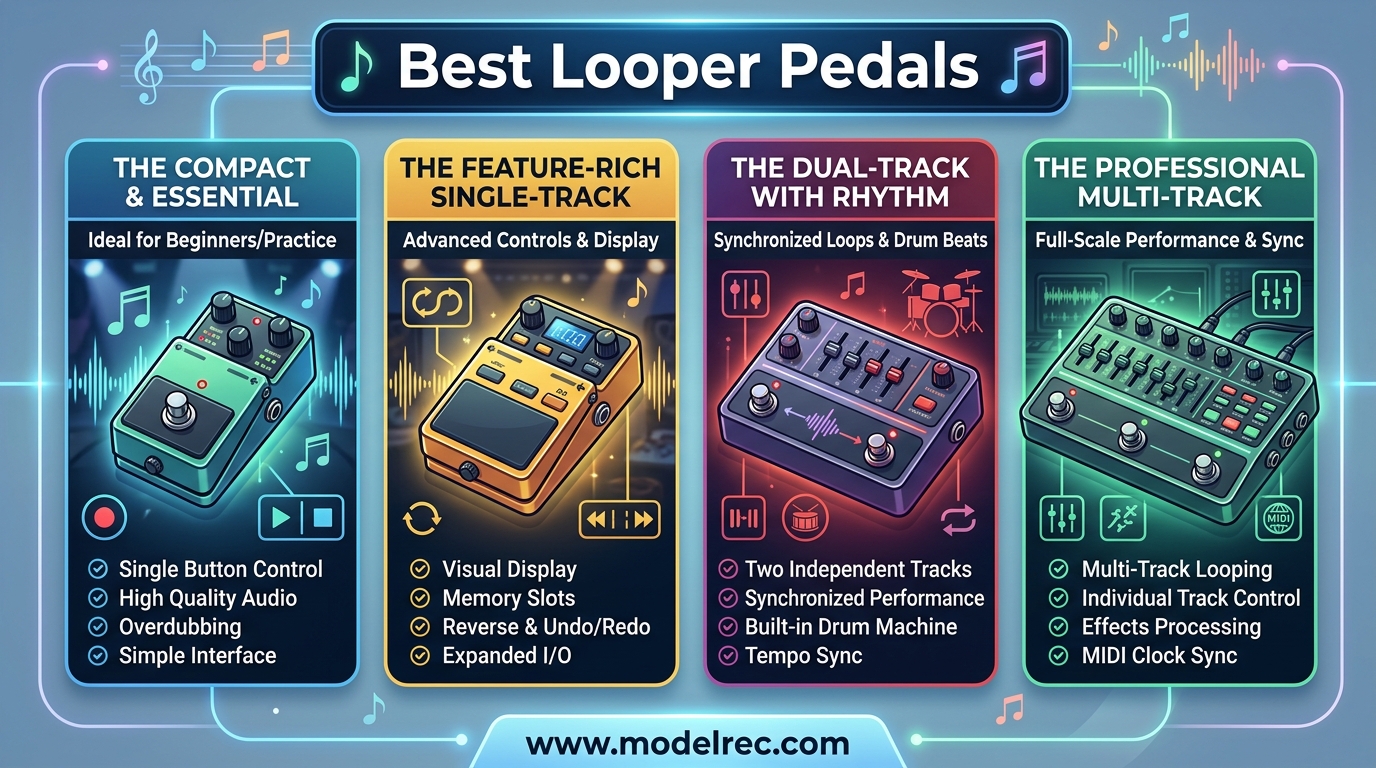
If you have ever watched a solo guitarist build an entire song from scratch on stage, you have seen a looper pedal in action. These compact devices record your playing and play it back in a continuous loop, letting you layer chords, melodies, and rhythms into a full-band sound with just your guitar. Whether you want a practice partner that never gets tired, a songwriting scratchpad, or a live performance powerhouse, the best looper pedals open up creative possibilities that no other piece of gear can match.
Our team tested 10 of the most popular looper pedals on the market to find the ones worth your money. We spent months running these pedals through practice sessions, live gigs, and studio experiments to evaluate sound quality, ease of use, feature depth, and real-world reliability. From sub-$50 budget picks to flagship floor stations, we covered every price tier and use case.
The Boss RC-5 Loop Station stands out as the best all-around looper pedal for most guitarists. It pairs 32-bit audio quality with 99 phrase memories, 57 built-in rhythms, and a clear LCD screen in a compact stompbox format. For budget shoppers, the LEKATO 9-Loop Looper delivers incredible value at under $50. And for beginners who just want something dead simple, the Boss RC-1 remains an industry standard.
Table of Contents
Top 3 Picks for Looper Pedals
These three pedals represent the best options across different budgets and skill levels. Each one earned its spot through consistent performance in our testing.

BOSS RC-5 Loop Station
- 32-bit audio quality
- 99 phrase memories
- 57 built-in rhythms
- USB and MIDI connectivity

10 Best Looper Pedals in 2026
Before we get into the individual reviews, here is a quick comparison of all 10 pedals we tested. This table gives you a bird’s-eye view of the key specs so you can narrow down your options fast.
| Product | Specifications | Action |
|---|---|---|
| BOSS RC-5 Loop Station |
|
Check Latest Price |
| BOSS RC-1 Loop Station |
|
Check Latest Price |
 TC Electronic Ditto+ TC Electronic Ditto+ |
|
Check Latest Price |
 LEKATO Looper (9 Loops) LEKATO Looper (9 Loops) |
|
Check Latest Price |
 TC Electronic Ditto Looper TC Electronic Ditto Looper |
|
Check Latest Price |
 BOSS RC-600 Loop Station BOSS RC-600 Loop Station |
|
Check Latest Price |
 EHX Nano Looper 360 EHX Nano Looper 360 |
|
Check Latest Price |
 Donner Triple Looper Donner Triple Looper |
|
Check Latest Price |
 MXR Clone Looper MXR Clone Looper |
|
Check Latest Price |
 LEKATO ONE Looper LEKATO ONE Looper |
|
Check Latest Price |
1. BOSS RC-5 Loop Station – The Best All-Around Looper Pedal
BOSS RC-5 Loop Station
32-bit AD/DA processing
13 hours stereo recording
99 phrase memories
57 built-in rhythms
MIDI I/O and USB connectivity
Pros
- Class-leading 32-bit sound quality with no hiss or degradation
- 13 hours of stereo recording time is incredibly generous
- 99 phrase memories let you store and recall loops
- 57 built-in rhythms with A/B variations for practice
- Multicolor LCD screen makes loop status easy to read
- USB connectivity for backing up loops to computer
Cons
- Steep learning curve for all the advanced features
- Single footswitch limits live use without external controller
- 9V batteries drain in a couple hours without adapter
The Boss RC-5 is the pedal I keep coming back to after testing everything on this list. It sits in that sweet spot where professional-grade features meet a compact stompbox format that fits on any pedalboard. The 32-bit AD/DA and floating-point processing deliver the cleanest loop audio I have heard from a pedal in this size class. There is zero hiss, no signal degradation even after stacking multiple overdubs, and the playback sounds identical to your original performance.
What really sets the RC-5 apart is the depth of features packed into its compact body. You get 99 phrase memories, which means you can store entire setlists worth of loops and recall them instantly. The 57 built-in rhythms cover everything from basic rock beats to Latin patterns, each with A and B variations plus seven drum kits. I found myself using the rhythm tracks constantly during practice sessions to work on timing.
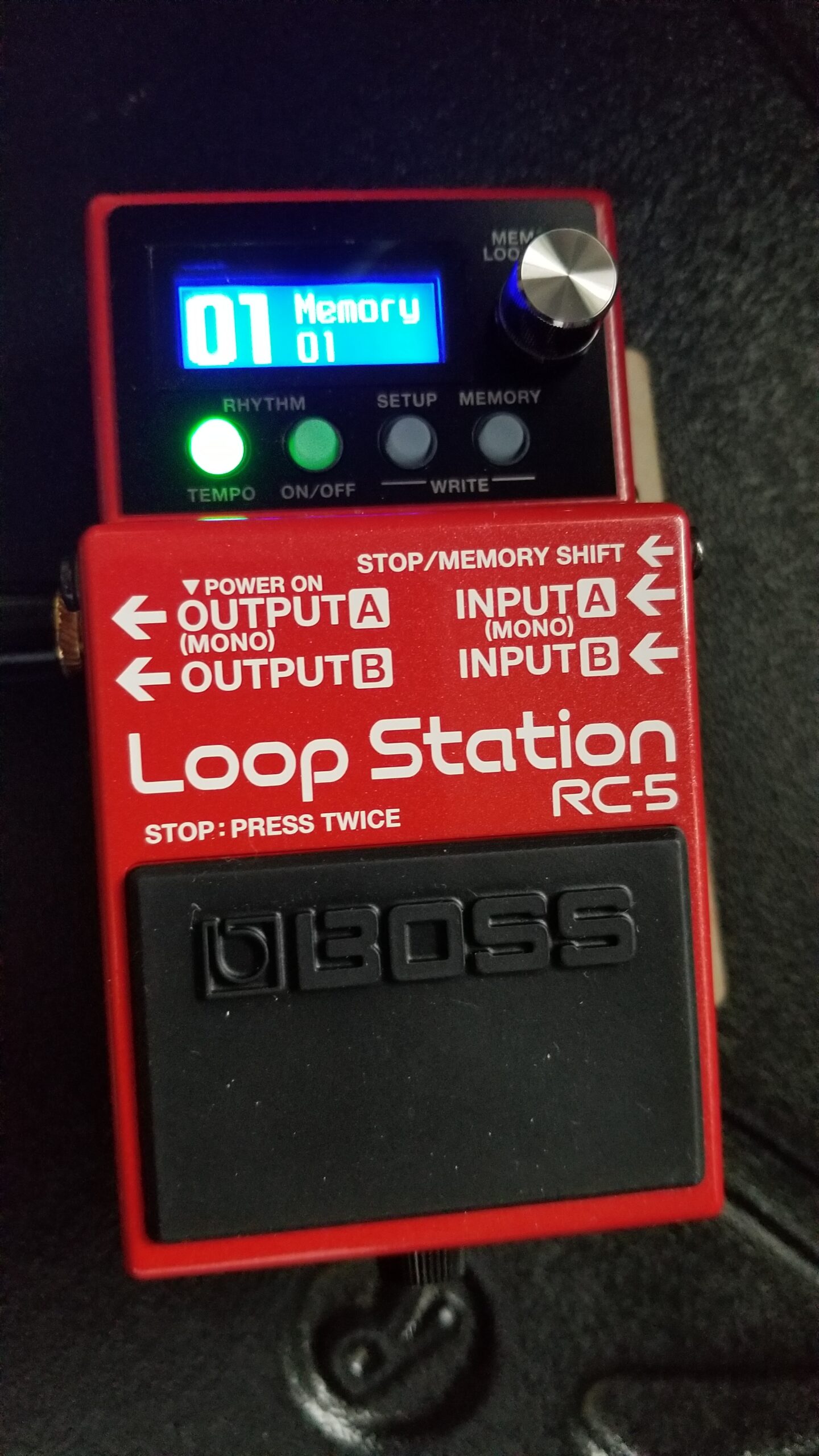
The multicolor LCD screen is a genuine upgrade over older Boss loopers. Instead of guessing where you are in a loop, you can see the current phrase, memory slot, and timing information at a glance. The reverse function adds creative possibilities for ambient textures and experimental sounds. USB connectivity means you can transfer loops to your computer, import WAV backing tracks, and even load full songs to solo over.
The main trade-off is the learning curve. Boss packed an enormous amount of functionality into a single-footswitch design, which means many features require combinations of button presses or menu navigation. For basic recording and overdubbing, it is straightforward. But tapping into MIDI control, rhythm customization, and memory management takes time to master. I also found that relying on 9V batteries is impractical for anything beyond quick practice. The RC-5 draws 300mA, so batteries last only a couple of hours.
Who Should Buy the Boss RC-5
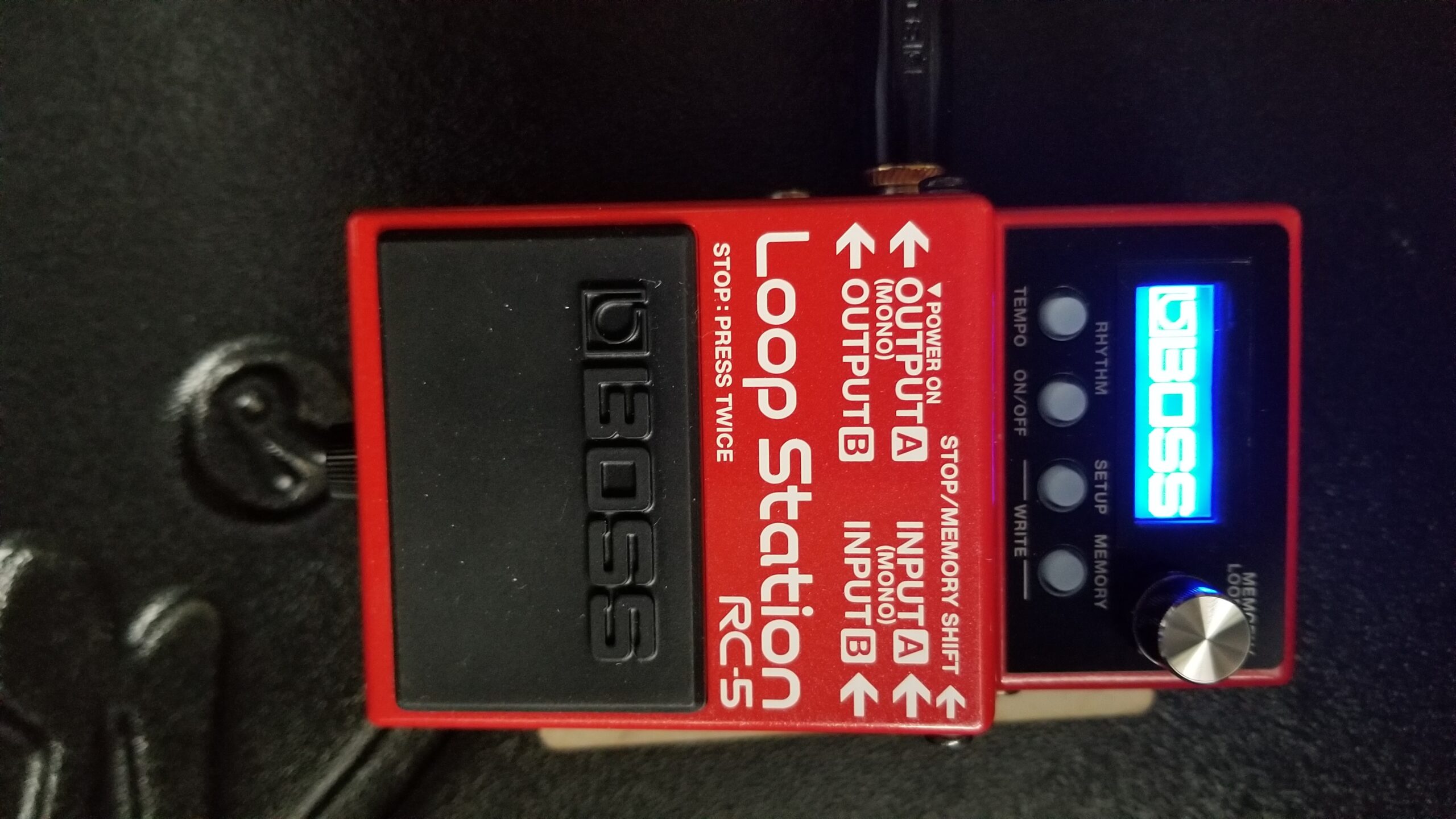
This is the best looper pedal for intermediate to advanced players who want professional features without stepping up to a full floor unit. If you write songs at home, record demos, or perform live with moderately complex loops, the RC-5 gives you everything you need. The 99 memories and rhythm tracks make it especially valuable for solo performers and singer-songwriters who need pre-built backing loops for gigs.
Things to Consider Before Buying
The single footswitch is the biggest limitation for live performers. If you need hands-free control over start, stop, undo, and clear functions simultaneously, you will want to add the Boss FS-7 or FS-5U external footswitch. Also, note that the RC-5 handles overdubs on a single track rather than discrete multi-track layers. For true multi-track looping, consider the Boss RC-600 instead.
2. BOSS RC-1 Loop Station – Best Looper Pedal for Beginners
BOSS RC-1 Loop Station Pedal
Stereo looping
12 minutes record time
24-segment LED indicator
Record, overdub, undo/redo
Level control knob
Pros
- Dead simple to use right out of the box
- Classic Boss build quality that lasts for years
- Clean sound with no hiss or tone coloration
- 24-segment LED ring gives clear visual loop feedback
- Works with guitar
- bass
- keyboards and more
- Nearly 3800 reviews and 4.6-star average
Cons
- Only 12 minutes of recording time
- No built-in rhythms or drum patterns
- Power adapter sold separately
- Single footswitch limits advanced live control
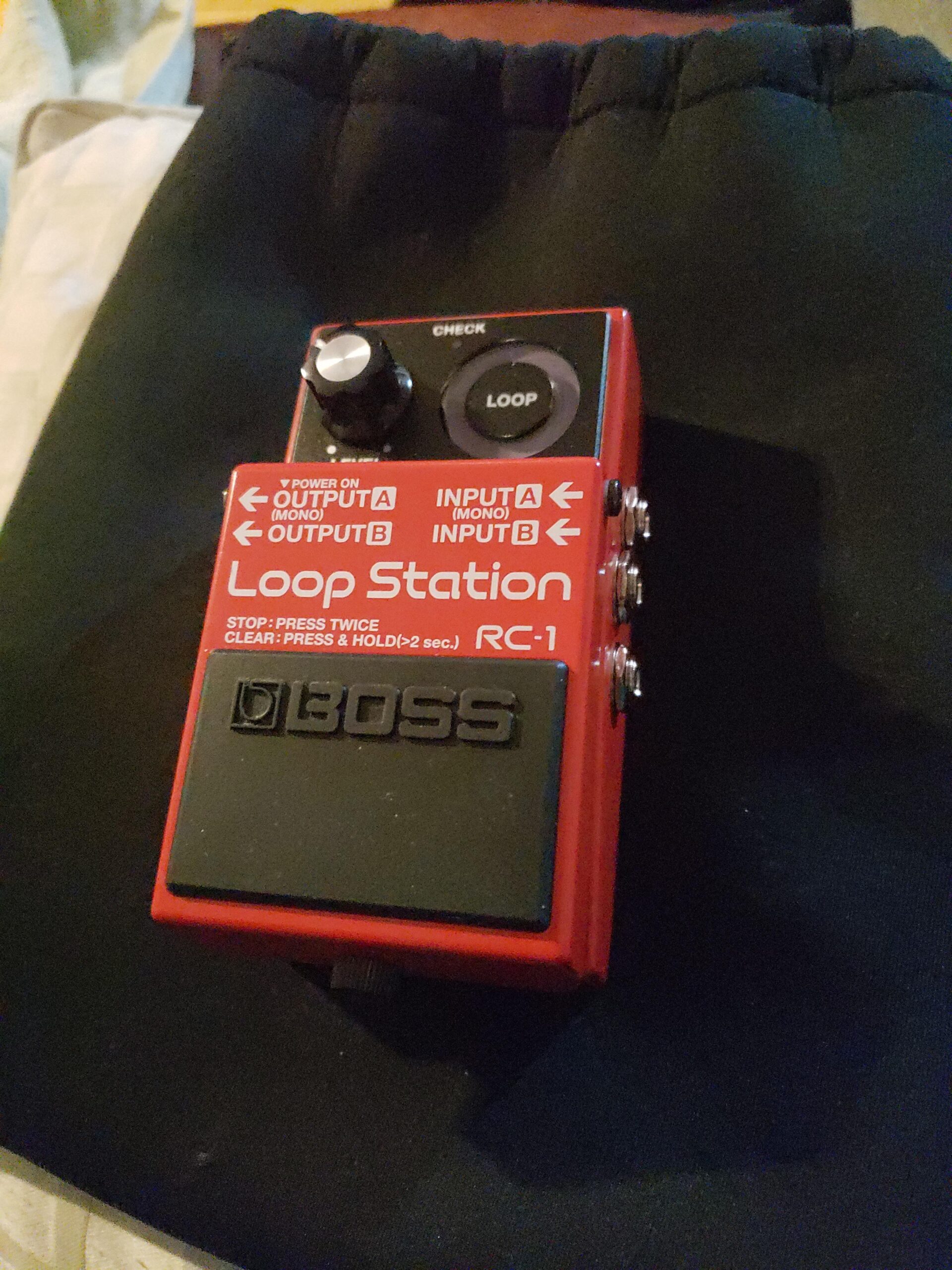
The Boss RC-1 is the looper pedal I recommend to every guitarist buying their first loop station. It does the fundamentals perfectly without overwhelming you with menus, modes, or features you may never use. Step on the footswitch to record, step again to play it back, step again to overdub. That simplicity is exactly what beginners need while developing their looping technique and timing skills.
Boss built this pedal to their trademark tank-like construction standards. The metal chassis, heavy-duty footswitch, and protected jacks mean this pedal will survive years of stomping. The sound quality is clean and transparent, with no audible hiss or signal degradation through my test rig. The 24-segment LED indicator ring is surprisingly helpful, giving you a clear visual representation of loop progress so you always know where you are in the phrase.
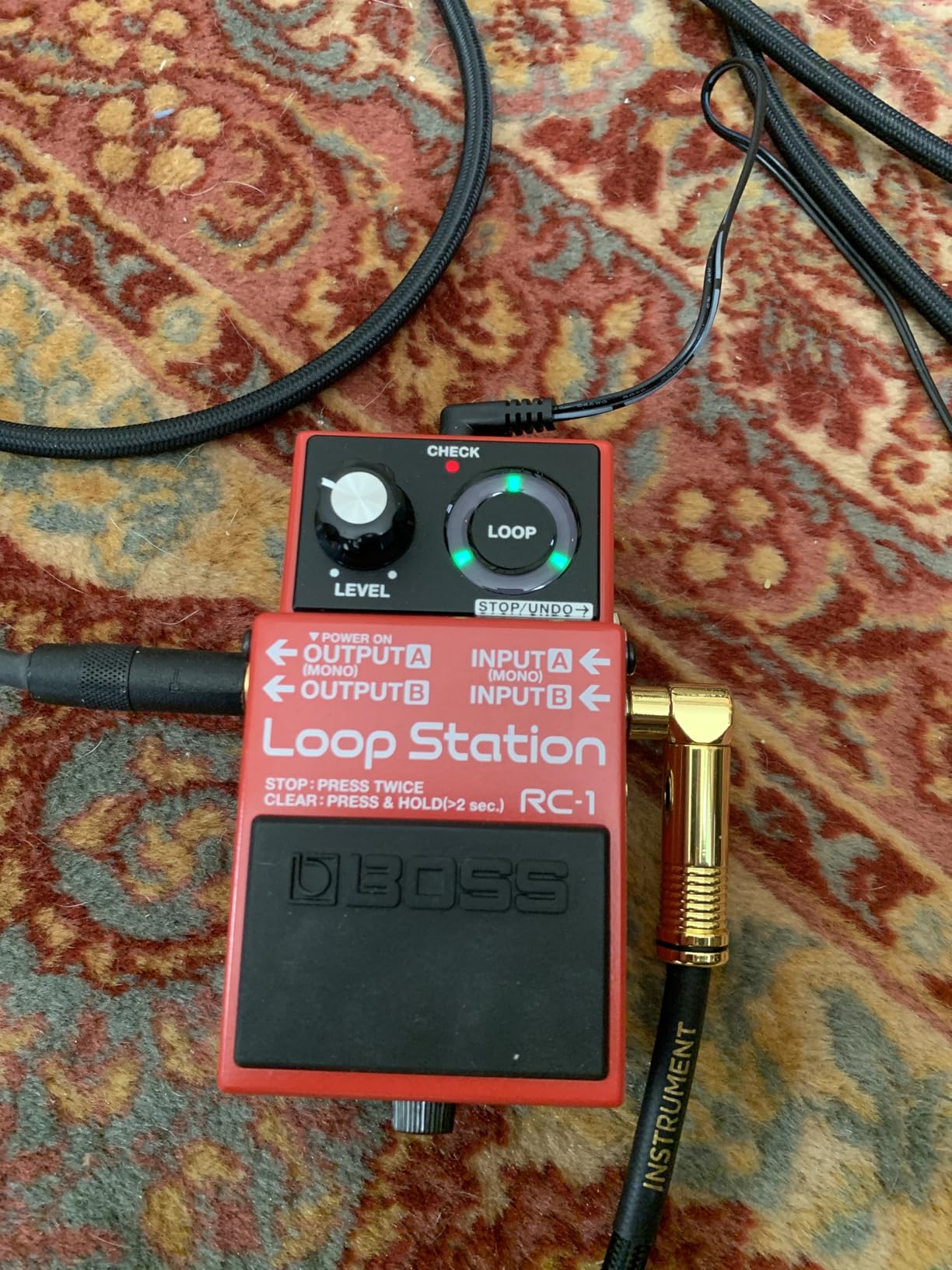
Stereo looping sets the RC-1 apart from many budget single-switch loopers. If you run a stereo rig with two amps or a stereo delay pedal, the RC-1 preserves your stereo image through the loop. The 12-minute recording time is adequate for most practice and songwriting scenarios, though it will feel limiting if you are building long, complex arrangements. The USB port lets you back up loops to your computer.
What holds the RC-1 back from a higher ranking is its lack of features compared to similarly priced pedals. There are no built-in rhythms, no memory slots for storing multiple loops, and no advanced functions like reverse or half-speed. For the same price, the TC Electronic Ditto+ offers 99 loop slots and extended looping mode. But none of those pedals match the RC-1’s combination of build quality, stereo I/O, and bulletproof reliability.
Who Should Buy the Boss RC-1
This is the ideal first looper pedal for guitarists who want something simple, reliable, and built to last. If you are just learning to loop, the RC-1’s intuitive operation lets you focus on your playing rather than navigating menus. It is also a solid choice for experienced players who want a dependable backup looper or a no-frills practice tool.
Things to Consider Before Buying
The 12-minute limit is the main constraint. If you plan to build extended compositions or layer many overdubs, you may hit the ceiling quickly. Also factor in the cost of a power adapter, since Boss does not include one in the box. Finally, the single footswitch means all functions share one button, which takes some practice to master for live use.
3. TC Electronic Ditto+ Looper – Best Premium Compact Looper
TC Electronic Ditto+ Looper Pedal
24-bit sound quality
99-loop stage capacity
Extended looping mode
True bypass switching
USB file management
Pros
- Transparent 24-bit audio with no degradation
- 99-loop bank storage for organizing phrases
- Extended looping mode for multi-bar layering
- True bypass preserves original tone
- Compact form factor fits tight pedalboards
- USB for importing and exporting WAV files
Cons
- No manual included
- Level knob has limited range
- Stop function unreliable for live use
- Cycling through 99 banks is cumbersome
- No power supply included
The TC Electronic Ditto+ takes the beloved Ditto formula and adds just enough features to justify its premium positioning. The 24-bit audio quality is pristine, with loops sounding virtually identical to your dry signal. I stacked five overdubs in testing and heard zero degradation or buildup of noise. The true bypass switching means your tone stays completely untouched when the pedal is disengaged.
The standout feature is the 99-loop stage capacity with bank storage. Unlike the original Ditto, which erased your loop the moment you started a new one, the Ditto+ lets you save and recall up to 99 different phrases. This is a meaningful upgrade for songwriters who want to capture ideas and come back to them later. The extended looping mode lets you create multi-bar loops that go beyond simple phrase repetition.
The design philosophy here is minimalism done right. There is a single knob for level control and a single footswitch for all operations. The hi-resolution display is small but shows you what is happening without clutter. I also discovered the hidden PONG game easter egg on the display, which is a fun touch that shows TC Electronic’s personality.
However, the Ditto+ has some frustrating limitations. The most significant is the unreliable stop function, which requires a fast double-click that is difficult to execute consistently during live performance. The level knob has a narrow useful range, and cycling through 99 banks to find a specific saved loop is tedious. TC Electronic also provides no manual, so you will need to rely on YouTube tutorials to learn the foot command patterns.
Who Should Buy the TC Electronic Ditto+
This pedal is perfect for tone-conscious guitarists who want pristine audio quality in a compact, true-bypass format. The 99-loop storage makes it especially appealing for songwriters and idea-capturers who want to build a library of phrases. It bridges the gap between ultra-simple single-loop pedals and feature-heavy workstation loopers.
Things to Consider Before Buying
The stop function reliability is the biggest concern for live performers. If you need precise, hands-free control over starting and stopping loops on stage, the single-footswitch design may frustrate you. Also, the extended loop mode can only extend once, not infinitely, so very long arrangements are not possible. Budget for a power supply since one is not included.
4. LEKATO Looper Pedal (9 Loops) – Best Budget Looper Pedal
LEKATO Looper Guitar Pedal Guitar Loop Pedal Tuner Pedal 9 Loops 40 Minutes Record Time Unlimited Overdubs for Electric Guitar Bass (Black)
9 loop memory slots
40 minutes total recording
48K/24bit lossless audio
Built-in tuner
USB WAV import/export
Pros
- Outstanding value at under $50
- Solid all-metal construction
- 9 memory slots with 40 minutes total recording
- 48K/24bit audio quality is impressive for the price
- Built-in tuner eliminates need for separate pedal
- USB file transfer requires no special software
- Includes power supply and USB cable
Cons
- LED indicator lights are blindingly bright
- Loop length is fixed by first loop
- Sound quality slightly below premium loopers
- Single-button controls require memorization
The LEKATO 9-Loop Looper is the pedal that genuinely surprised me during testing. At this price point, I expected compromises in build quality, sound, or features. Instead, I found a pedal that ranks as the number one bestseller in Amazon’s Guitar Loopers category and delivers capabilities that rival pedals costing three times as much. The all-metal construction feels solid underfoot, and the footswitch has a satisfying, positive click.
Nine memory slots with 40 minutes of total recording time give you real flexibility for practice and performance. I was able to store chord progressions for an entire set of songs and switch between them during a mock gig. The 48K/24bit sampling rate produces clean, lossless audio that holds up well through multiple overdubs. Is it as pristine as the Boss RC-5’s 32-bit processing? No. But the difference is subtle enough that most players will not notice in a mix.
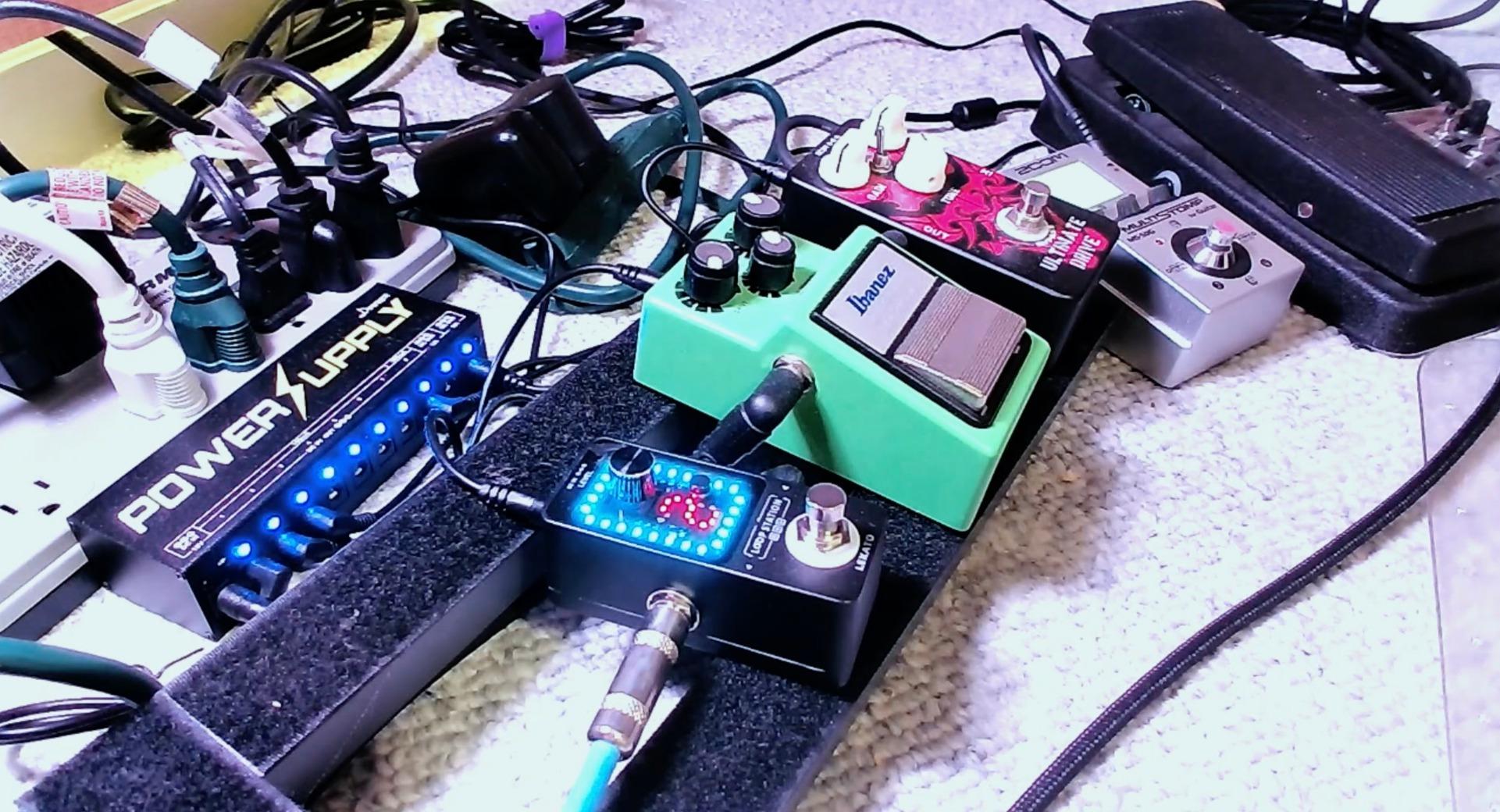
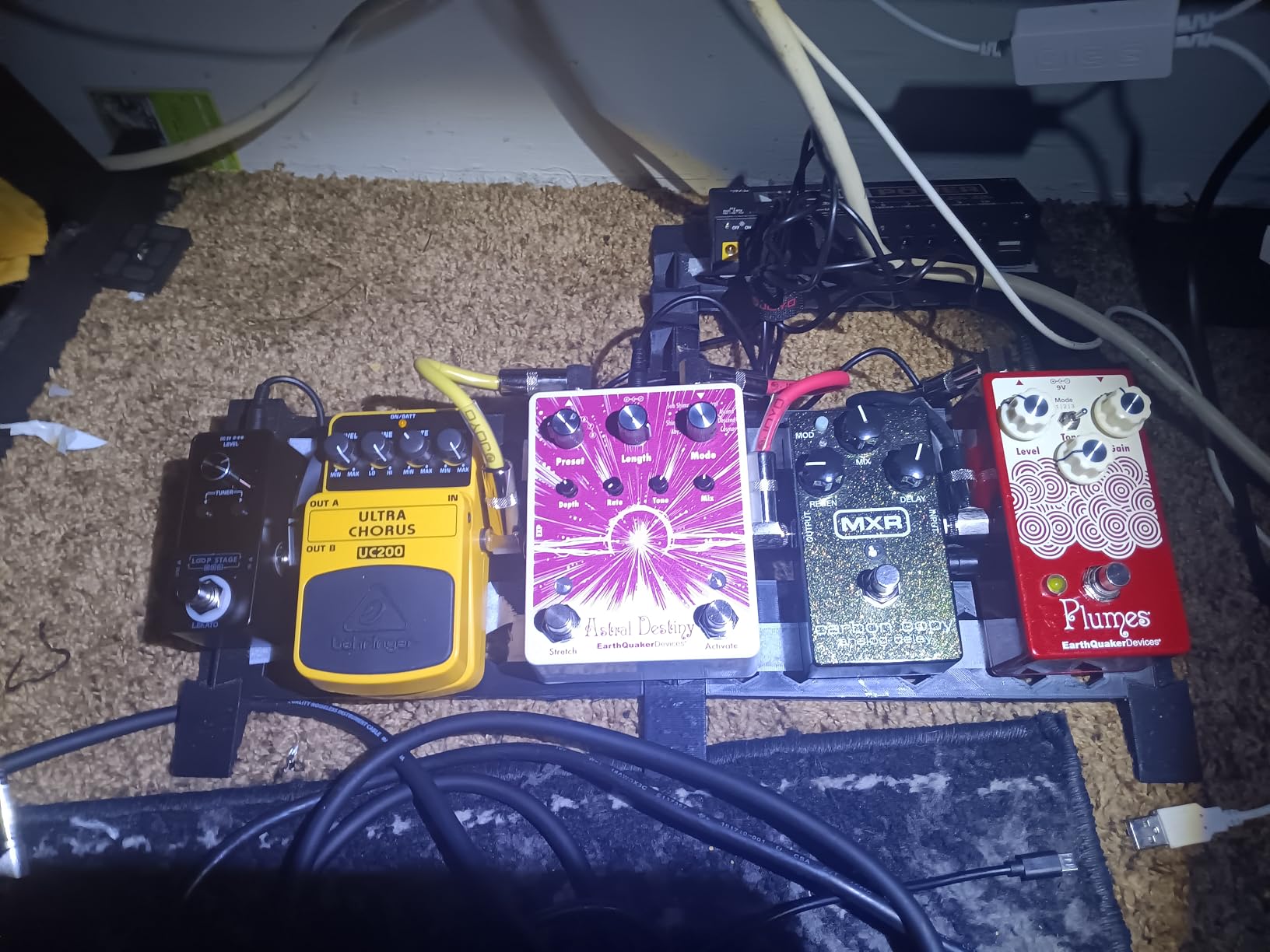
The built-in tuner is a genuine bonus that saves pedalboard space and money. It is accurate enough for stage use, and the high-sensitivity pickup responds well even to bass strings. USB connectivity lets you import and export WAV files without any special software, which is remarkable at this price. The included power supply and USB cable mean you have everything you need right in the box.
The main trade-offs are typical of budget pedals. The blue LED indicator lights are so bright that I had to cover them with tape to avoid being blinded on a dark stage. The loop length is determined by your first recording, so if you start with a short phrase, every subsequent overdub is locked to that length. The single-button foot command system requires memorizing tap patterns for record, undo, redo, stop, and erase.
Who Should Buy the LEKATO 9-Loop Looper
This is the best looper pedal for budget-conscious beginners, students, and practice-focused players who want maximum features per dollar. The 9 memory slots and built-in tuner make it punching well above its price class. It is also a great backup pedal for gigging musicians who want a reliable spare without spending a fortune.
Things to Consider Before Buying
Quality control is the biggest variable with LEKATO pedals. While most units perform flawlessly, there are scattered reports of defective units and open-box returns. Buy from a seller with a good return policy to protect yourself. Also, the analog-dry-through design means your dry signal stays analog, but the looped audio has a slightly different character than premium 32-bit loopers.
5. TC Electronic Ditto Looper – The Original Mini Looper
TC Electronic DITTO LOOPER Highly Intuitive Looper Pedal with 5 Minutes of Looping Time, Analog-Dry-Through and True Bypass
5 minutes loop time
Unlimited overdubs
True bypass switching
Analog-Dry-Through
Single-knob control
Pros
- Transparent sound that matches your original tone
- Dead simple one-button operation
- True bypass preserves signal integrity
- Analog-Dry-Through for pure dry signal
- Ultra-compact and lightweight design
- 2700+ reviews from satisfied users
Cons
- Only 5 minutes of loop time
- No quantize feature means timing must be precise
- Can clip with too many high-gain overdubs
- No display or LED for loop status
- No memory slots for storing loops
The original TC Electronic Ditto Looper is the pedal that proved a looper could be simple, small, and sound great. With over 2,700 reviews and a loyal following, it remains one of the most popular loop pedals ever made. The philosophy is pure minimalism: one knob, one footswitch, five minutes of looping. That is it, and for many players, that is all they need.
The sound quality is where the Ditto shines. The analog-dry-through design means your unlooped signal passes through entirely in the analog domain, so there is zero tone coloration when the pedal is bypassed. The looped audio is transparent enough that listeners cannot tell when the loop kicks in. I found the unlimited overdub function clean for the first few layers, though high-gain sounds can start to clip after stacking four or five layers.
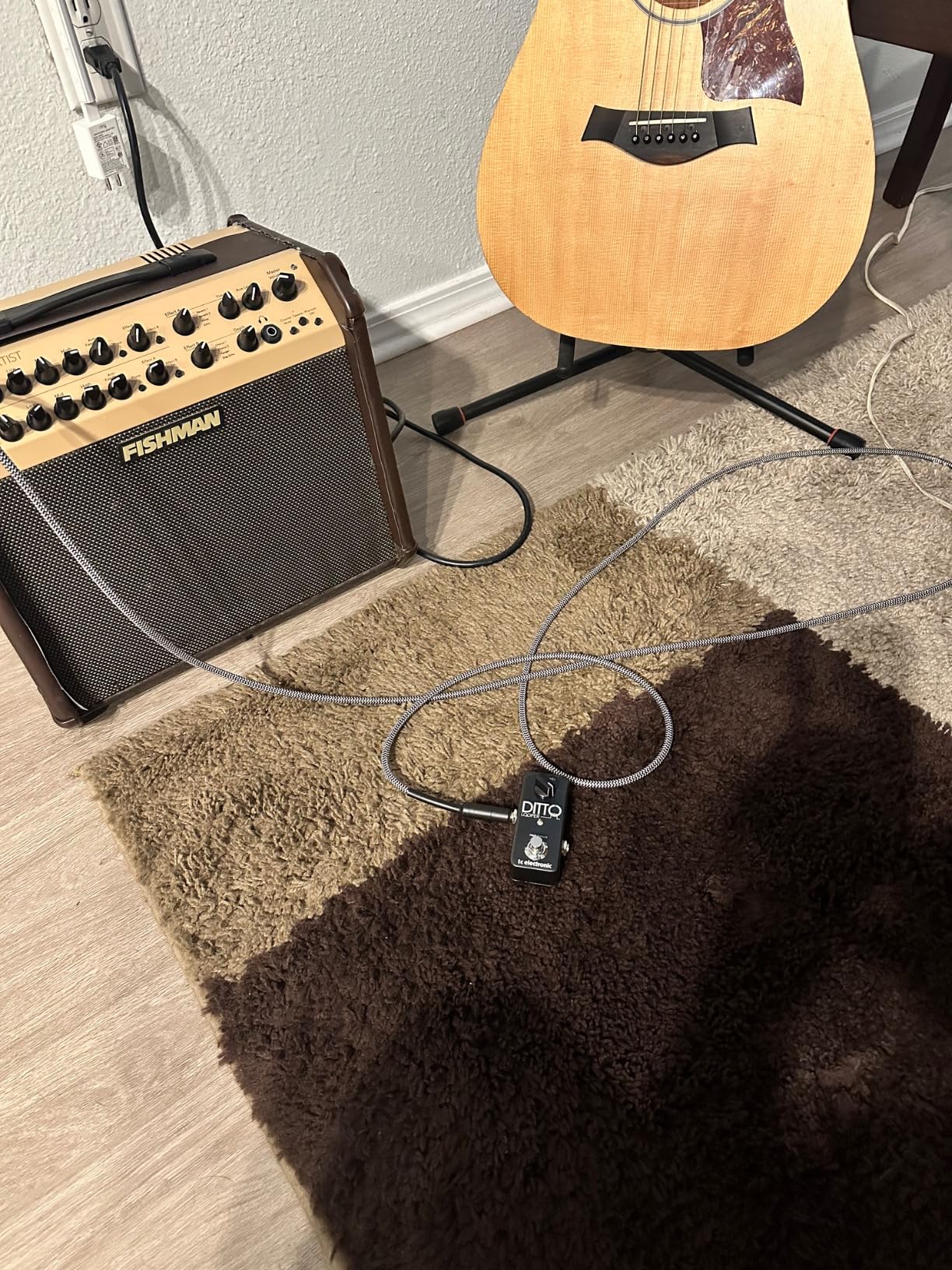
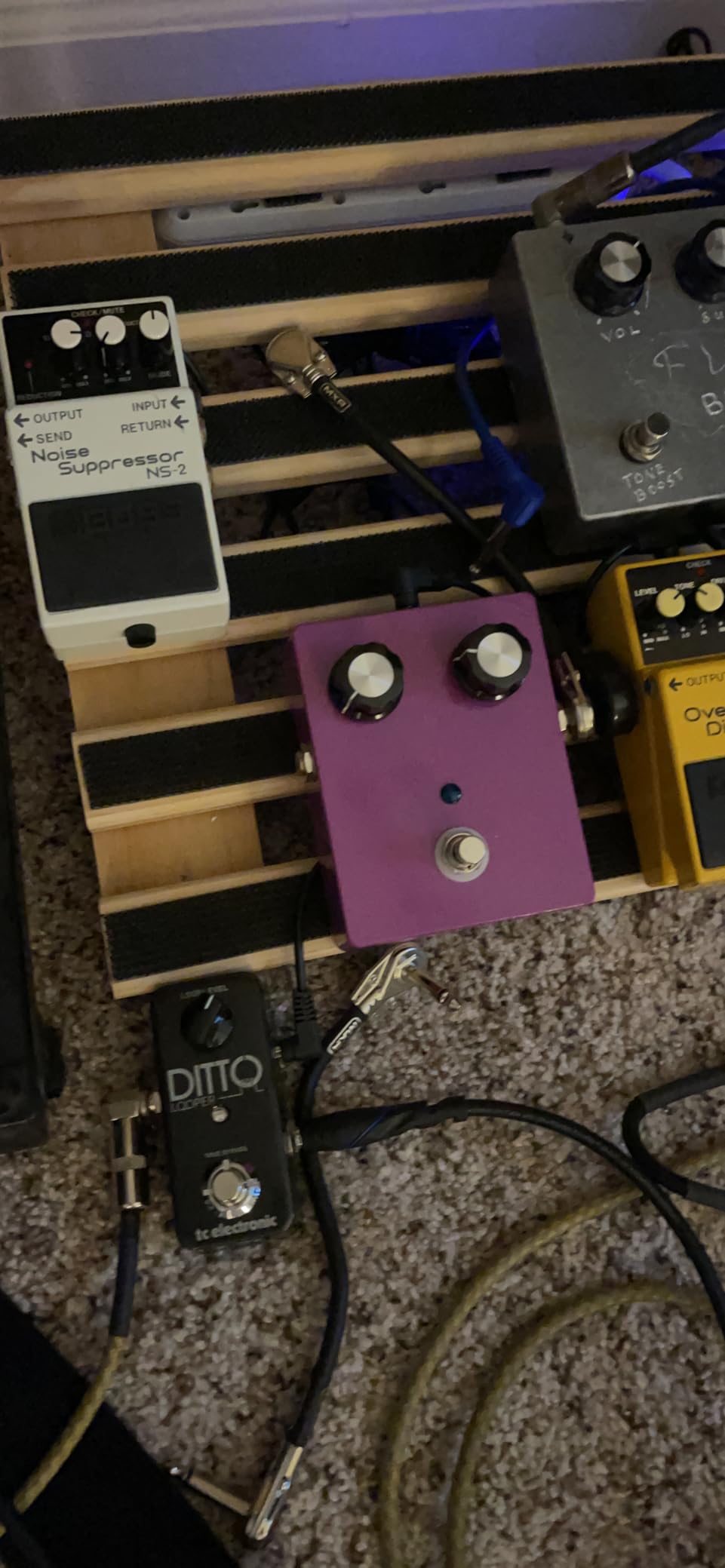
The soft-touch footswitch is a pleasure to use, with a quiet, positive action that makes precise loop timing easier than stiffer switches. True bypass switching means the Ditto disappears from your signal chain completely when off. The compact size takes up minimal pedalboard real estate, and the lightweight construction makes it barely noticeable on a board.
The five-minute loop time is the obvious limitation. For practicing licks over a chord progression, five minutes is plenty. But for building complex, evolving arrangements, you will hit the ceiling fast. There is also no quantize or snap feature, so your timing has to be precise. Any timing errors compound with each overdub, leading to phasing issues. The lack of any display or LED indicator for loop position means you are looping by feel alone.
Who Should Buy the TC Electronic Ditto Looper
This pedal is ideal for guitarists who want the simplest possible looping experience with excellent sound quality. If you just want to record a chord progression and solo over it, the Ditto does that beautifully with zero learning curve. It is also a great choice for players with crowded pedalboards who need a looper with a tiny footprint.
Things to Consider Before Buying
The five-minute limit and lack of memory slots are the main constraints. If you need to store and recall multiple loops, the Ditto+ or Boss RC-5 are better choices. The single-footswitch operation also means that stopping a loop requires a specific tap pattern that can be tricky in live situations. Consider the Ditto X2 variant if you need a dedicated stop switch.
6. BOSS RC-600 Loop Station – Best Looper Pedal for Live Performance
BOSS RC-600 Floor-Based Loop Station for Looping Musicians
6 stereo phrase tracks
32-bit AD/DA processing
49 Input FX and 53 Track FX
9 assignable footswitches
Built-in drum machine
Pros
- Six simultaneous stereo tracks for maximum flexibility
- Class-leading 32-bit sound quality
- Massive effects section with 49 input and 53 track FX types
- Nine freely assignable footswitches with three modes
- Individual track volume control
- Built-in drum machine for practice and composition
Cons
- Steep learning curve with complex interface
- Very expensive investment
- Nine configurable buttons can overwhelm beginners
- Takes significant time to master all features
The Boss RC-600 is the most powerful floor-based looper pedal I have ever tested. It is designed for serious looping musicians who need to build entire songs live, with six independent stereo tracks running simultaneously. The 32-bit AD/DA and floating-point processing deliver sound quality that matches studio-grade equipment. Through a quality PA system, the playback is indistinguishable from the original performance.
The effects section alone justifies a significant portion of the price. You get 49 input FX types that process your signal before it hits the looper, and 53 track FX types that process the looped audio. You can use four effects simultaneously in each section, which means you can have compression, reverb, and modulation on your input while adding delay and filter effects to your looped tracks. This is essentially having a full multi-effects unit built into your looper.
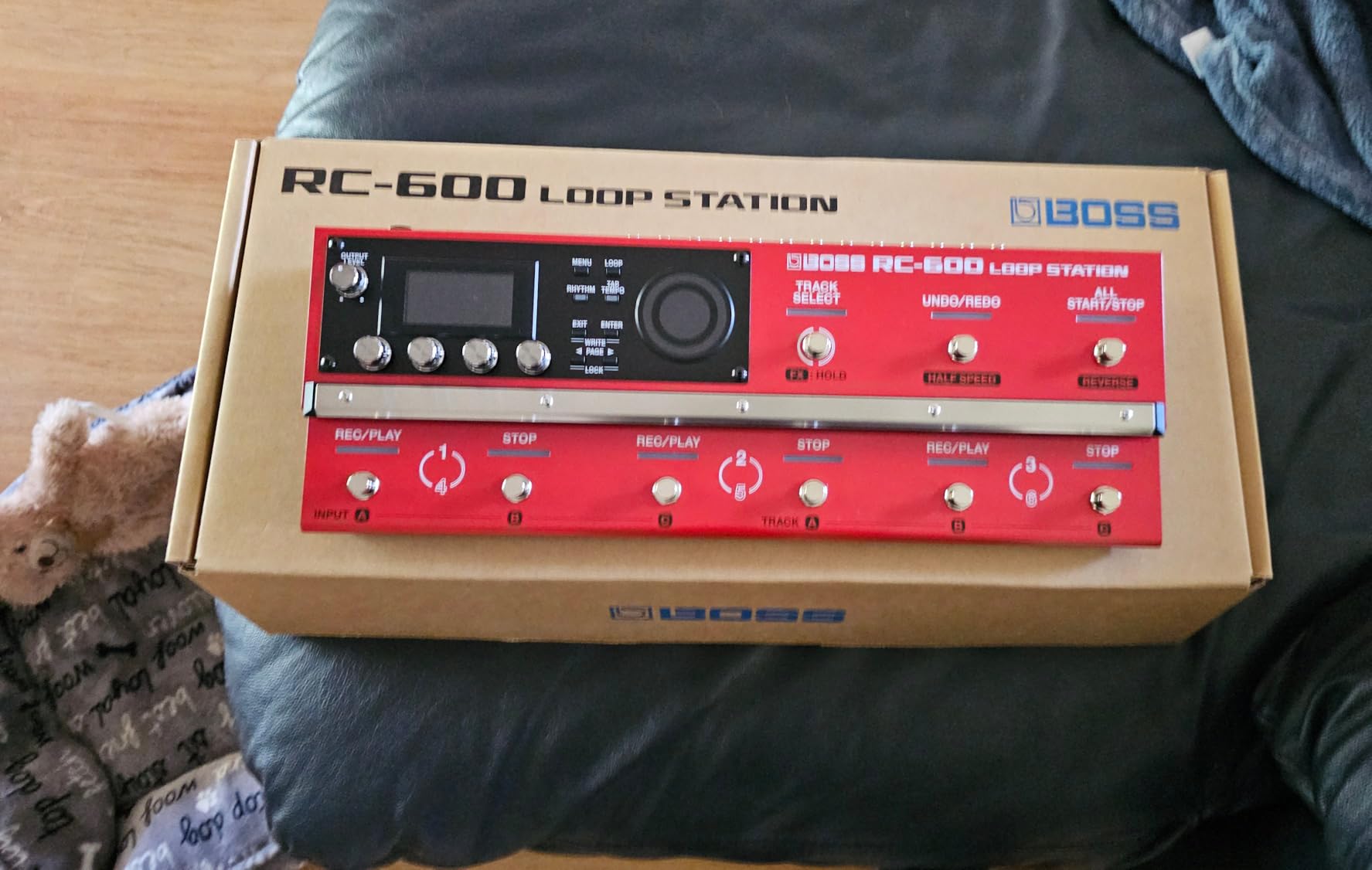
The nine freely assignable footswitches are what make the RC-600 a true live performance tool. You can configure each switch to control any function you need, from track selection to effects toggles to tempo control. The three pedal modes let you switch between different footswitch assignments on the fly. I was able to set up a configuration where I could record, overdub, stop, and switch tracks without ever touching a button by hand.
The built-in drum machine provides rhythm tracks for practice and composition. Having drums integrated into the looper means you can build a complete backing track with groove, chords, and melody all from a single unit. Individual track volume control lets you balance your layered parts without reaching for a mixer.
The trade-off is complexity. The RC-600 has a steep learning curve that can overwhelm players who just want basic looping. The nine configurable buttons and three modes give you enormous power, but configuring them requires time with the manual and experimentation. This is not a pedal you can master in an afternoon. And the price puts it in investment territory that may be hard to justify for casual home use.
Who Should Buy the Boss RC-600
This pedal is built for performing musicians, composers, and one-person-band artists who need to build complex, multi-layered arrangements live. If you gig regularly and your show depends on looping, the RC-600 is the professional tool that will not let you down. It is also excellent for studio musicians who want to sketch out full arrangements quickly.
Things to Consider Before Buying
The learning curve is real. Plan to spend several weeks with the manual and tutorial videos before you feel comfortable with the RC-600’s full capabilities. The unit is also large and heavy at over 8 pounds, so it requires dedicated floor space. The 1100mA power draw means you need a robust power supply, and budget adapter bricks will not handle it.
7. Electro-Harmonix Nano Looper 360 – Great for Home Practice
Electro-Harmonix Nano Looper 360 Looper Pedal
11 loop storage banks
360 seconds total recording
24-bit A/D/A at 44.1kHz
Silent momentary footswitch
Power adapter included
Pros
- High quality 24-bit sound with no degradation
- 11 loop storage banks for organizing phrases
- Power adapter included in the box
- Silent momentary footswitch for quiet operation
- Simple layout easy for beginners to learn
- Durable construction from a respected brand
Cons
- Only 360 seconds shared across 11 banks
- Slight playback delay reported by some users
- Non-standard power polarity
- Some signal volume reduction
- Not ideal for professional live performance
The Electro-Harmonix Nano Looper 360 is a compact, straightforward looper that excels as a practice and learning tool. EHX designed this pedal with a focus on simplicity and sound quality rather than feature count. The 24-bit A/D/A conversion at 44.1kHz sample rate produces clean, uncompressed audio that holds up well through multiple overdubs with no degradation in fidelity.
The 11 loop storage banks are generous for a pedal in this price range. You can store different chord progressions, riff ideas, or practice exercises in separate banks and switch between them as needed. The total recording time of 360 seconds is shared across all banks, which means you get roughly 30 seconds per bank if you use all 11. In practice, most users will use fewer banks with longer recordings.
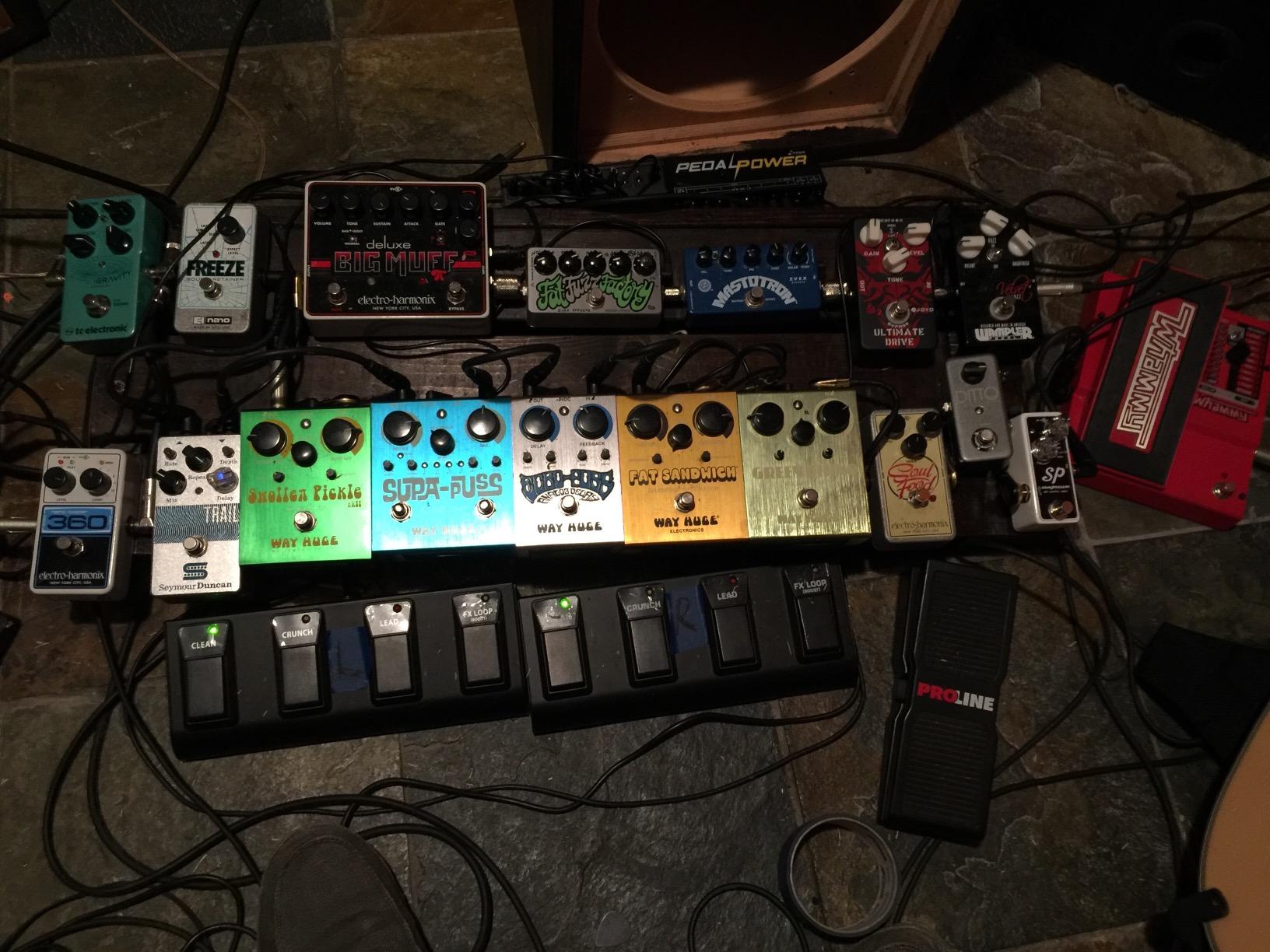
The silent momentary footswitch is a nice touch that sets the Nano Looper apart from some competitors. The switch action is quiet and precise, which matters when you are recording loops in a quiet home studio environment. Electro-Harmonix includes a power adapter in the box, which is a welcome change from pedals that require a separate purchase.
The user-friendly layout makes recording, overdubbing, undo, redo, and erasing quick and intuitive. I was up and running within minutes of unboxing, without needing to consult the manual. The construction feels durable and well-suited to regular use. EHX also backs this pedal with a one-year warranty that covers defects in materials and workmanship.
The main limitations are the shared recording pool and the footswitch behavior. With 360 seconds divided across up to 11 banks, you are limited to relatively short loops per bank. Some users report a slight playback delay or repeat pause between loop iterations, which can disrupt the flow of complex arrangements. The power jack uses positive tip polarity, which is non-standard and means you cannot use most common pedal power supplies without an adapter cable.
Who Should Buy the EHX Nano Looper 360
This pedal is ideal for hobbyists, bedroom players, and students who want a reliable practice looper with decent sound quality and enough storage for everyday use. The included power adapter and simple operation make it a great first looper for players who find even the Boss RC-1 slightly intimidating.
Things to Consider Before Buying
The shared 360-second recording pool is the primary constraint. If you need long loops or want to store many different phrases simultaneously, you will outgrow this pedal. Some users report slight volume reduction in the looped signal compared to their dry tone. And the non-standard power polarity means you need the included adapter or a compatible replacement.
8. Donner Triple Looper – Best Budget Looper with a Screen
Donner Triple Looper Guitar Pedal, 3 Loops 90 mins Looping Time Loop Pedal with Screen Unlimited Overdubs Undo/Redo for Electric Guitar Bass, True Bypass
3 loop slots with 90 min total
Visual screen display
Auto-save functionality
True bypass switching
Unlimited overdubs
Pros
- Three independent loop slots with 30 minutes each
- High-visibility screen shows loop status and timing
- Auto-save preserves loops when powered off
- True bypass maintains original tone
- Metal enclosure feels solid and durable
- Incredible value for the price
Cons
- Power supply not included
- Quality control issues in some units
- Slots are independent with no bounce function
- Minor signal volume reduction reported
- Some reliability concerns
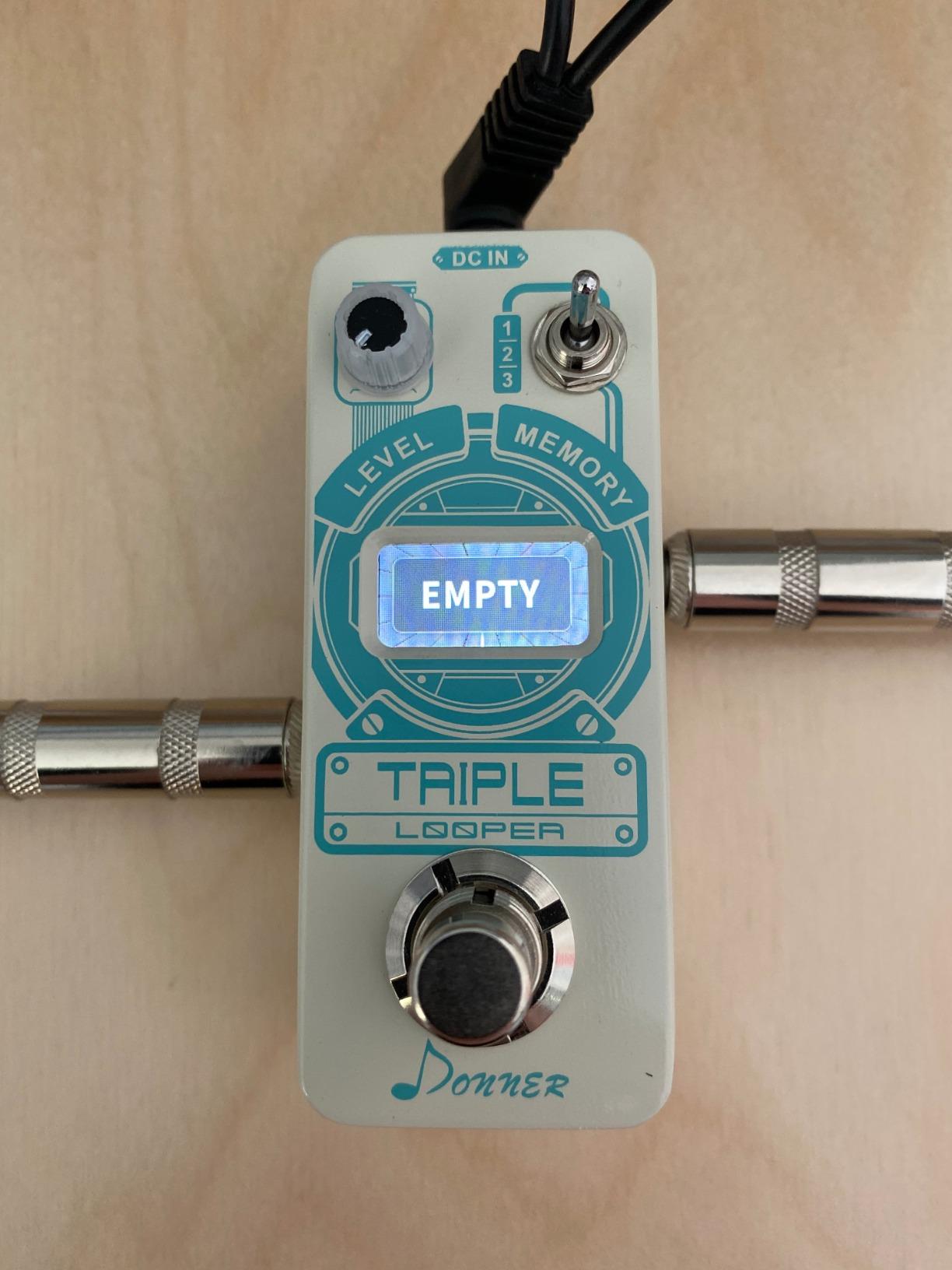
The Donner Triple Looper offers something rare at this price point: a visual screen that shows loop status, recording progress, and timing. For beginners who struggle with loop pedals that give no visual feedback, this display is a meaningful upgrade. I found the visual indicator ring showing loop progress during playback genuinely helpful for staying oriented within a phrase.
Three independent loop slots give you 90 minutes of total recording time, with 30 minutes per slot. This is significantly more than most pedals in this price range. The auto-save functionality means your loops persist even when you power off the pedal, so you can turn it back on the next day and pick up where you left off. True bypass switching keeps your original guitar tone intact when the looper is disengaged.
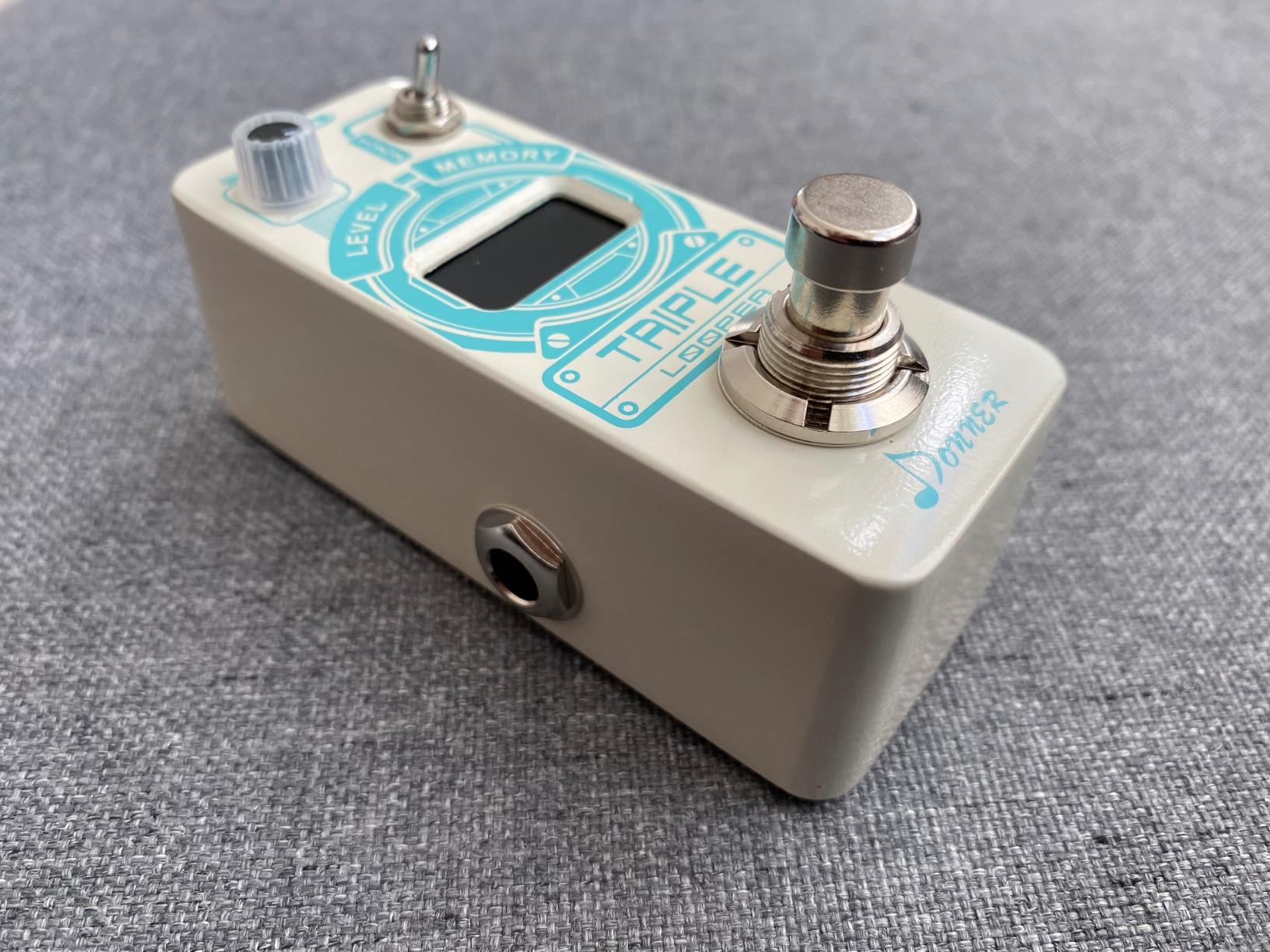
The single-knob design is extremely intuitive for beginners. The footswitch handles recording, playback, overdubbing, stopping, and clearing through different tap patterns. The metal enclosure feels solid and well-constructed, with no flex or creaking. I experienced no audible clicks or pops during loop playback transitions, which is impressive for a budget pedal.
The trade-offs are mostly in quality control and feature depth. A notable minority of users report hardware defects, particularly digital chirping or beeping sounds in defective units. Donner’s customer service has been described as responsive in resolving these issues, but it is something to be aware of. The three slots are independent, meaning you cannot bounce or transfer audio between them. And some users note minor signal volume reduction compared to Boss loopers.
Who Should Buy the Donner Triple Looper
This pedal is perfect for beginners and budget-conscious players who want visual feedback and multiple loop slots without spending over $60. The screen makes it especially beginner-friendly, as you can see exactly what is happening rather than guessing. It is also a solid practice tool for players who want to store a few different chord progressions for daily practice.
Things to Consider Before Buying
Buy from a seller with a good return policy to protect against quality control issues. The power supply is not included, so budget for a 9V DC center-negative 500mA adapter. Also, note that isolated reports exist of units arriving with pre-recorded content from previous users, which suggests some quality control gaps in the supply chain.
9. MXR Clone Looper Pedal – Best Compact Looper for Tone Purists
MXR® Clone Looper™ Pedal
6 minute loop time
Unlimited overdubs
Reverse and half-speed modes
88.2kHz storage rate
External EXP jack control
Pros
- Excellent sound reproduction better than cheaper loopers
- Compact footprint ideal for pedalboards
- Reverse
- double-speed and half-speed playback modes
- Loop storage up to 88.2kHz handles high-gain well
- Solidly built tank-like construction
- Expandable with MXR accessories and EXP pedal
Cons
- Button mapping is confusing and unintuitive
- Steep learning curve despite simple appearance
- Holds last loop audio while clearing
- No screen or visual feedback
- Relatively expensive for basic looping
The MXR Clone Looper is the pedal for players who prioritize sound quality above all else. MXR engineered this looper with loop storage rates up to 88.2kHz, which means it handles high-gain distortion and complex harmonics better than most loopers in its size class. In my testing, heavily distorted rhythm parts retained their clarity and punch through the loop with minimal coloration.
The creative playback modes set the Clone Looper apart from basic loopers. Reverse mode flips your loop backward for ambient and experimental textures. Double-speed and half-speed modes change the tempo and pitch of your loop, which opens up creative possibilities for creating bass lines from guitar parts or vice versa. The onboard volume control lets you balance loop level without reaching for your mixer.
The EXP jack is a thoughtful addition that adds real flexibility. You can connect an external DVP volume pedal for hands-free loop level control, or an MXR tap tempo switch for play-once mode. This expandability means the Clone Looper can grow with your needs rather than being replaced when you want more control.
The build quality is exactly what you expect from MXR. The die-cast housing is compact, solid, and built to withstand years of gigging. At just 4.25 x 2.25 x 2 inches and half a pound, it takes up minimal pedalboard space while delivering capabilities that rival larger loopers.
The main frustration is the button mapping. MXR’s control scheme does not follow the conventions that most other two-button loopers use. Users expect standard behavior from the play and stop buttons, but the Clone Looper’s modes are layered on top of each other in ways that are not immediately intuitive. The learning curve is steeper than it should be for a pedal that appears simple on the surface.
Who Should Buy the MXR Clone Looper
This pedal is ideal for tone-conscious players who run high-gain rigs and need a looper that preserves their sound without muddying it. The compact size makes it perfect for pedalboards where space is at a premium. Players who enjoy creative manipulation through reverse and speed modes will find plenty to love here.
Things to Consider Before Buying
The unintuitive button layout is the primary barrier to enjoyment. Plan to spend time with the manual learning the control scheme before expecting to use it live. The 6-minute loop time is adequate but not generous. And the lack of any screen or visual feedback means you are working entirely by ear and memory, which some players will find limiting.
10. LEKATO ONE Looper – Best Ultra-Budget Looper Pedal
LEKATO Guitar Looper Effect Pedal Loop Pedal 5 Minutes Looping Time Looper Pedal ONE Looper Unlimited Overdubs
5 minutes looping time
24-bit uncompressed audio
USB WAV transfer
Auto-save
Ultra-compact mini size
Pros
- Ultra-compact size fits in your palm
- 24-bit uncompressed audio quality
- USB for importing and exporting WAV files
- Auto-save preserves loops when powered off
- Includes USB cable and power supply
- Excellent value for under $40
Cons
- Button press noise can be captured in loop
- Not suitable for professional live performance
- Inverted power polarity requires adapter cable
- Very short battery life
- Only one loop slot with no multi-bank storage
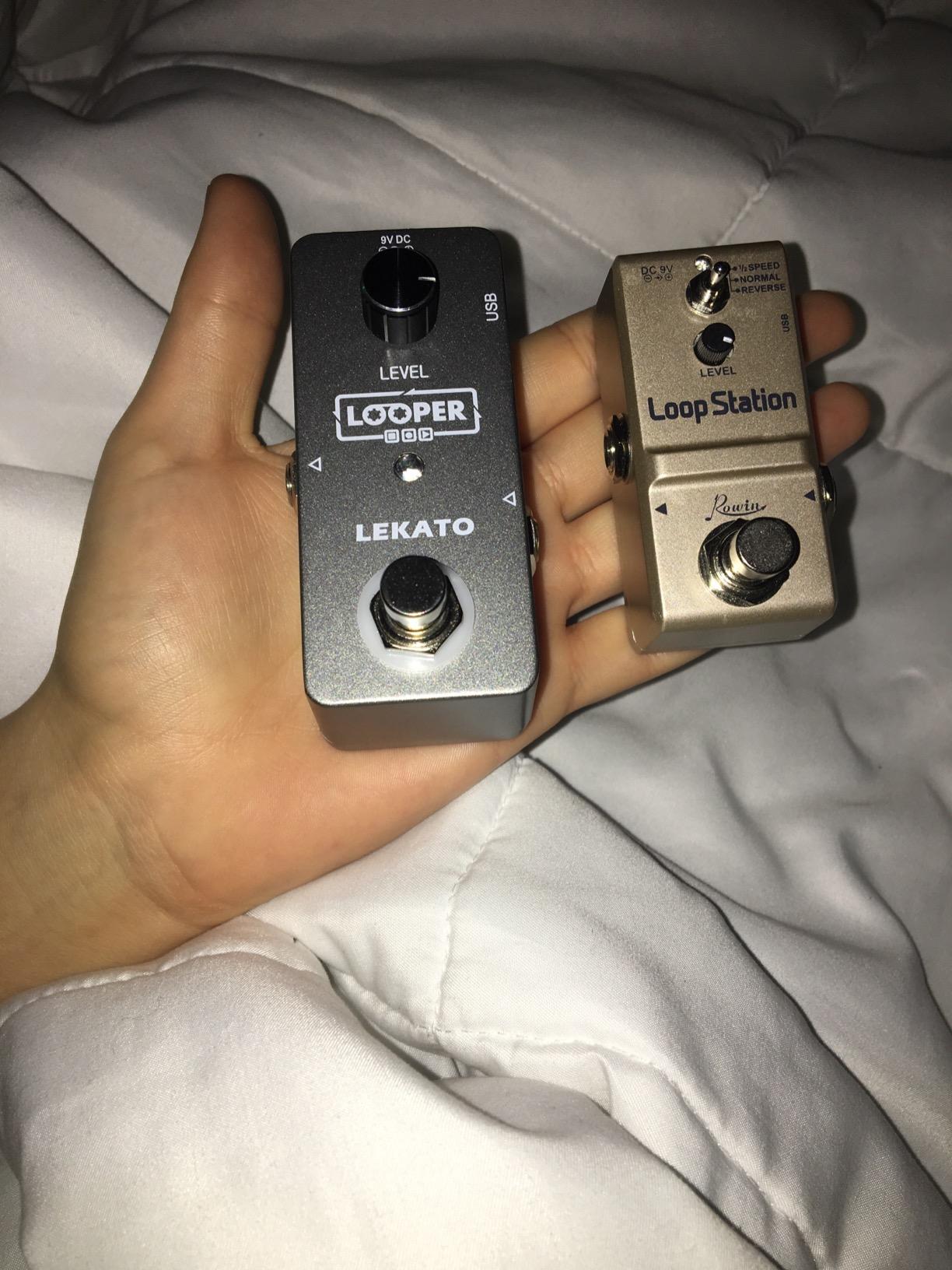
The LEKATO ONE Looper is the most affordable pedal on this list, and for under $40, it delivers a surprisingly competent looping experience. The ultra-compact aluminum alloy housing is the smallest pedal I tested, measuring just 1.95 x 1.57 x 1.95 inches. It literally fits in the palm of your hand. Despite its size, the construction feels solid with no flex or rattling.
The 24-bit uncompressed audio quality exceeds expectations for this price tier. The analog-dry-through design keeps your unlooped signal purely analog, which means no tone coloration when the pedal is bypassed. Loop playback is clean enough for practice and learning purposes. USB connectivity lets you transfer WAV files to and from your computer without any special software or drivers.
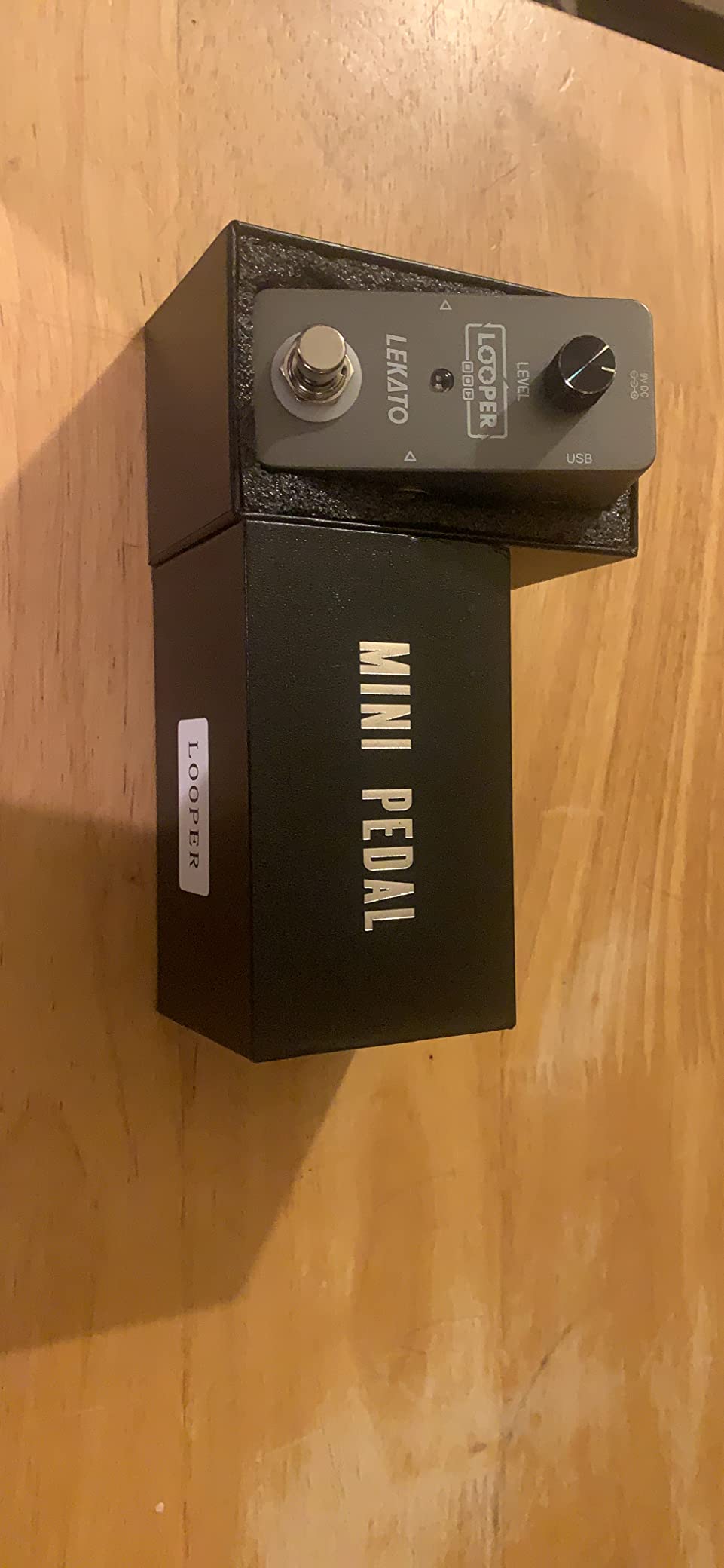
The auto-save functionality is a thoughtful feature that preserves your loop even when you power off the pedal. This means you can record a practice progression, turn off your pedalboard, and come back the next day to find your loop waiting. The included USB cable and power supply mean you have everything you need right out of the box.
The trade-offs at this price are expected. The single-button foot command system captures button press noise in the loop recording, which is noticeable with quiet phrases or clean tones. The power adapter uses inverted polarity compared to most pedals, so you will need an adapter cable if you want to use a standard pedal power supply. Battery life is very short, and the pedal drains 9V batteries rapidly.
Who Should Buy the LEKATO ONE Looper
This pedal is ideal for absolute beginners, students, and casual players who want to try looping without making a significant investment. It is also a good choice for guitar teachers who need a simple practice tool for lessons. The ultra-compact size makes it easy to toss in a gig bag for travel.
Things to Consider Before Buying
The button press noise issue is the most significant drawback for tone-conscious players. If you plan to record quiet, clean loops, the mechanical noise from the footswitch will be audible. The single loop slot means no multi-bank storage, so you are limited to one loop at a time. And the inverted power polarity is an inconvenience if you use a standard daisy-chain power supply.
How to Choose the Best Looper Pedals?
Choosing the right looper pedal comes down to matching features to your specific needs. After testing 10 pedals across every price tier, here are the factors that matter most.
Loop Time and Memory Slots
Loop time determines how long your recorded phrase can be. For practicing short riffs and chord progressions, 5 to 12 minutes is plenty. For building complex, evolving arrangements or storing entire songs, look for pedals with 30 minutes or more. Memory slots let you store multiple loops and recall them later. The Boss RC-5 offers 99 phrase memories, while budget options like the LEKATO 9-Loop give you 9 slots. If you perform live or write songs, memory slots are worth paying for.
Audio Quality and Bit Depth
Bit depth directly affects how your loops sound. Premium loopers like the Boss RC-5 and RC-600 use 32-bit AD/DA processing, which delivers studio-grade clarity with zero noise buildup across overdubs. Mid-range pedals like the TC Electronic Ditto+ use 24-bit processing, which is excellent for most applications. Budget loopers typically use 16-bit or lower quality audio, which can introduce a slightly compressed or lo-fi character. If tone is your top priority, aim for 24-bit or higher.
Footswitch Count for Live Performance
Single-footswitch loopers are affordable and compact, but they require memorizing tap patterns for different functions. This can be tricky during live performance when you need to stop or undo a loop quickly. Multi-footswitch pedals like the Boss RC-600 with its nine assignable switches give you dedicated controls for every function. If you plan to loop on stage, look for at least two footswitches or plan to add an external controller.
Built-In Rhythm Tracks and Drums
Some loopers include built-in drum patterns and metronomes, which are invaluable for practice and solo performance. The Boss RC-5 offers 57 rhythms with A/B variations, while the RC-600 includes a full drum machine. Budget loopers typically lack rhythm features. If you practice alone or perform as a solo act, built-in drums eliminate the need for a separate rhythm device.
Connectivity: USB, MIDI, and SD Card
USB connectivity lets you transfer loops to and from your computer, which is essential for backing up phrases and importing backing tracks. MIDI I/O allows you to synchronize your looper with other MIDI-equipped gear like drum machines and sequencers. SD card storage, found on some advanced loopers, provides nearly unlimited storage expansion. For basic practice, USB is usually sufficient. For studio and stage use, MIDI sync can be a game-changer.
True Bypass vs Buffered Bypass
True bypass means your signal passes through the pedal completely untouched when it is off, which preserves tone in simple signal chains. Buffered bypass includes an active buffer circuit that drives your signal through long cable runs, which is better for large pedalboards. Players with short cable runs and few pedals generally prefer true bypass. Players with extensive pedalboards benefit from buffered bypass to prevent signal degradation.
Signal Chain Placement
Where you place your looper in your signal chain affects what gets recorded. Placing the looper after your dirt and modulation pedals means it records your effected sound, which is what most players want. Placing it before your time-based effects like delay and reverb means those effects process both your live and looped signal. Experiment with placement to find the sound that works for your style. Most players put the looper last in the chain, after all other effects.
FAQs
Is it worth getting a looper pedal?
Yes, a looper pedal is worth getting for almost any guitarist. Loopers serve as tireless practice partners, letting you play lead over your own chord progressions. They are essential tools for songwriting, letting you hear how parts work together without a band. For solo performers, a looper can transform a single guitar into a full-band sound. Even budget loopers under $50 deliver enough functionality to dramatically improve your practice routine.
What is the easiest looper pedal to use?
The TC Electronic Ditto Looper is the easiest looper pedal to use, with a single footswitch and one volume knob. You step once to record, step again to play, and step again to overdub. The Boss RC-1 is similarly straightforward with its intuitive stompbox operation. For absolute beginners, these single-switch pedals have the lowest learning curve of any looper on the market.
What does Ed Sheeran use for looping?
Ed Sheeran uses custom-built looper stations from Sheeran Loopers, specifically the Sheeran Looper X model. His setup is a professional-grade looping system that goes far beyond what standard guitar pedals offer, with multiple synchronized loop tracks designed specifically for his live performance style. For guitarists wanting to approximate his sound, the Boss RC-600 with its six stereo tracks is the closest mainstream pedal equivalent.
What famous musicians use looper pedals?
Famous musicians who use looper pedals include Ed Sheeran with his custom Sheeran Looper X, KT Tunstall known for her live looping performances, Andrew Bird who loops violin and vocals, Buckethead for extended guitar compositions, and Phil Keaghy for solo acoustic arrangements. These artists demonstrate how loopers can create everything from pop songs to experimental soundscapes in a live setting.
Do I need a looper pedal with drums?
You need a looper pedal with drums if you practice alone, perform solo, or want to develop your rhythm and timing skills. Built-in drum patterns provide a rhythmic foundation to play against, which is especially valuable for guitarists who do not have a drummer available. The Boss RC-5 offers 57 rhythms, while the RC-600 includes a full drum machine. If you only plan to loop chord progressions for lead practice, drums are helpful but not essential.
How do I place a looper in my signal chain?
Place your looper at the end of your signal chain, after all your other effects pedals. This ensures the looper records your fully effected guitar sound. If you place the looper before your delay or reverb pedals, those effects will process both your live playing and your looped playback, which can create interesting ambient textures but may also muddy your sound. Most players prefer the looper last so the recorded loop matches what they hear live.
Final Thoughts on the Best Looper Pedals
The best looper pedals transform how you practice, write, and perform music. After testing 10 pedals across every price tier, the Boss RC-5 Loop Station stands out as the best all-around choice for most guitarists, combining 32-bit sound quality, 99 memories, and 57 rhythms in a compact format. For budget shoppers, the LEKATO 9-Loop Looper and Donner Triple Looper deliver remarkable value under $60. And for live performers who need maximum power, the Boss RC-600 is the professional standard.
Whatever your budget or skill level, there is a looper pedal on this list that will match your needs. The most important thing is to choose one that fits your playing style and start building layers. Your guitar will thank you.