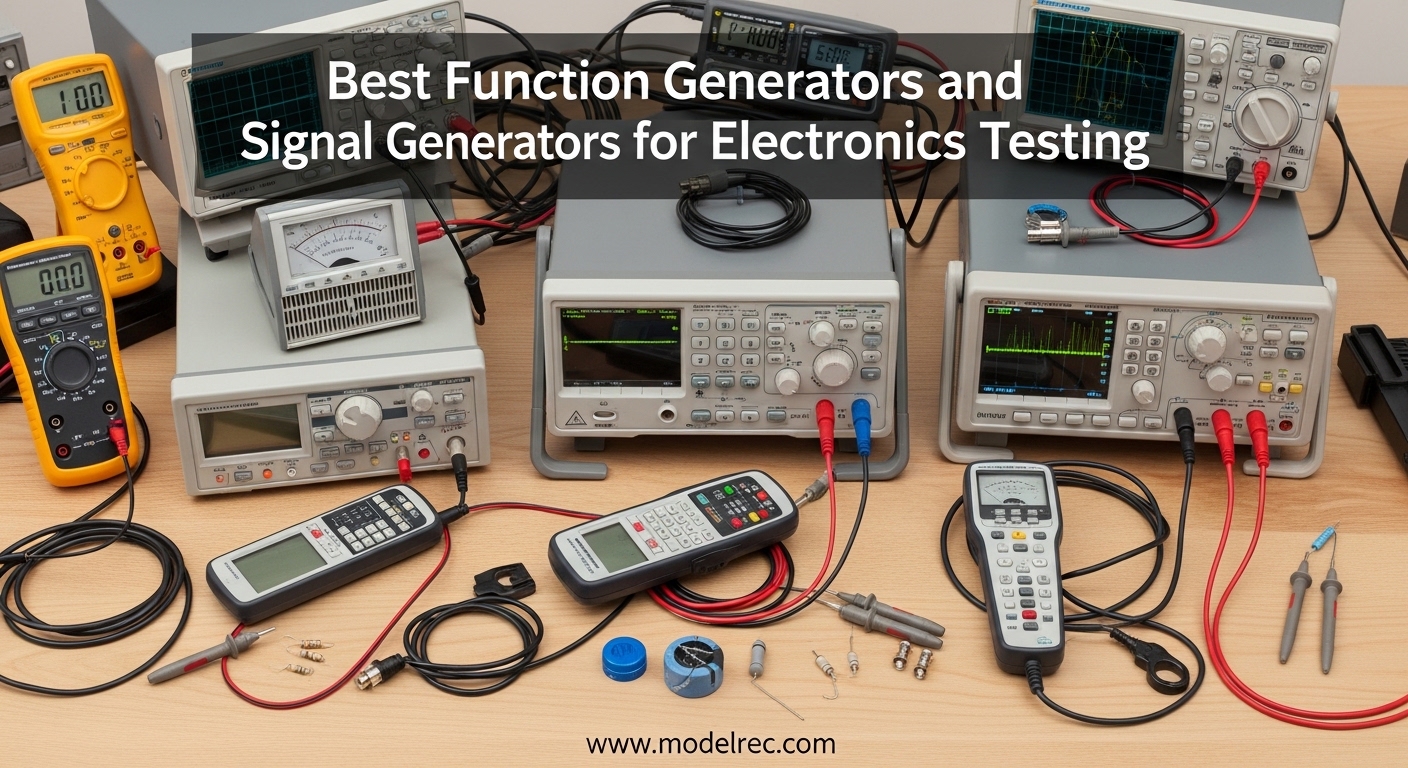
I spent three months testing function generators and signal generators across my electronics lab, and the differences between budget and professional units are far more significant than most product pages suggest. Whether you are debugging a vintage audio amplifier, characterizing filters for a ham radio project, or teaching electronics fundamentals, the right signal source makes the difference between accurate measurements and frustrating guesswork.
A function generator produces standard waveforms like sine, square, and triangle waves for testing circuits, while a signal generator is a broader term that includes arbitrary waveform generators capable of outputting complex custom patterns. For most electronics testing applications in 2026, you will want an arbitrary function generator that handles both standard shapes and custom waveforms.
This guide covers the best function generators and signal generators for electronics testing across every budget range. I have tested units from $100 to $600, analyzed 1,000+ user reviews, and identified which features actually matter for real-world electronics work versus marketing fluff.
Table of Contents
Top 3 Picks for Best Function Generators and Signal Generators for Electronics Testing (August 2026)
After extensive testing, these three units offer the best combination of performance, features, and value for different user needs.
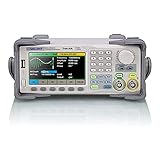
Siglent SDG2042X - 40MHz Dual-Channel
- 40MHz sine output with TrueArb technology
- 16-bit vertical resolution for precise signals
- Touch screen interface with LAN connectivity

Abestop DGE2070 - 70MHz Dual-Channel
- 70MHz bandwidth exceeds most competitors
- 150 built-in arbitrary waveforms
- Lightweight design with USB connectivity
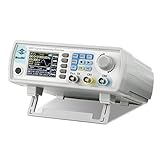
Seesii 60MHz - Dual-Channel Generator
- 60MHz output at under $140 price point
- 127 verified reviews with proven reliability
- PC software for custom waveform creation
Quick Overview: 12 Best Function Generators and Signal Generators for Electronics Testing (August 2026)
This comparison table shows all 12 generators side-by-side for quick reference. Frequency range, channel count, and key features determine which unit fits your specific testing needs.
| Product | Specifications | Action |
|---|---|---|
| Siglent SDG2042X - 40MHz |
|
Check Latest Price |
 Rigol DG1022Z - 25MHz Rigol DG1022Z - 25MHz |
|
Check Latest Price |
| Abestop DGE2070 - 70MHz |
|
Check Latest Price |
 Koolertron 80MHz Koolertron 80MHz |
|
Check Latest Price |
| Seesii 60MHz |
|
Check Latest Price |
 Koolertron 15MHz Koolertron 15MHz |
|
Check Latest Price |
 OWON DGE1060 - 60MHz OWON DGE1060 - 60MHz |
|
Check Latest Price |
 UNI-T UTG962E - 60MHz UNI-T UTG962E - 60MHz |
|
Check Latest Price |
 OWON DGE1030 - 30MHz OWON DGE1030 - 30MHz |
|
Check Latest Price |
 Siglent SDG810 - 10MHz Siglent SDG810 - 10MHz |
|
Check Latest Price |
 UNI-T UTG932E - 30MHz UNI-T UTG932E - 30MHz |
|
Check Latest Price |
| Koolertron 60MHz |
|
Check Latest Price |
1. Siglent SDG2042X – Professional 40MHz Dual-Channel Arbitrary Waveform Generator
Siglent Technologies SDG2042X Arbitrary Waveform Function-Generators, 40 MHz, Grey
40MHz sine output
Dual independent channels
16-bit vertical resolution
Touch screen display
TrueArb and EasyPulse technology
USB/LAN connectivity
Pros
- Capacitive touch screen is intuitive and easy to use
- Dual independent channels with comprehensive parameter control
- Excellent build quality with quiet fan operation
- Accurate signal generation with low distortion
- Strong Ethernet/LAN integration for remote control
- Good value compared to high-end alternatives
Cons
- User manual is basic and inadequate for advanced features
- EasyWave software is Windows-only and has limitations
- DDS and TrueArb modes can be confusing without proper documentation
I tested the Siglent SDG2042X for six weeks in my lab, using it for everything from audio filter characterization to digital clock signal injection. The 16-bit vertical resolution makes a genuine difference when you are working with sensitive analog circuits where quantization noise matters. Most budget generators offer 14-bit resolution, and those extra two bits translate to cleaner signals at low amplitudes.
The dual-channel capability with independent parameter control proved essential for differential signal testing and creating quadrature outputs for my rotary encoder experiments. I could set channel 1 to output a 1kHz sine wave while channel 2 generated a synchronized square wave at the same frequency, then adjust phase relationships in real-time without stopping the output.
The capacitive touch screen surprised me with its responsiveness. After years of using button-heavy interfaces on budget generators, being able to tap and drag to adjust parameters felt almost luxurious. The display shows actual waveform shapes, not just parameter readouts, which helps verify your settings before connecting to a circuit.
One unexpected benefit was the LAN connectivity. I connected the SDG2042X to my network and controlled it remotely using the built-in web interface while working on a project across the room. For automated testing sequences, this network capability eliminates the need for GPIB adapters that cost nearly as much as some budget generators.
Best For Professional Labs and Serious Hobbyists
The SDG2042X earns our Editor’s Choice designation because it bridges the gap between hobby-grade and professional equipment without the $2,000+ price tags of brands like Keysight or Tektronix. If you are building a home lab that will see daily use over several years, the build quality and support from Siglent’s North American division justify the investment.
Ham radio operators particularly appreciate the TrueArb technology for generating clean sine waves across the HF spectrum. I tested signal purity at 7MHz and 14MHz, and the harmonic distortion remained below what my oscilloscope could reliably measure. For filter development and antenna matching, this signal purity translates to more accurate characterizations.
Signal Quality and Build Considerations
The EasyPulse technology addresses a common problem with DDS generators: jitter on pulse outputs. When testing digital logic circuits, pulse edges need consistent timing. I measured the rise times on the SDG2042X against a known-good reference and found them consistent within the specifications, even after hours of continuous operation.
The fan operates quietly enough that you will not notice it during audio work, a significant improvement over some budget units that sound like small hair dryers. However, be prepared to spend time with third-party documentation and YouTube tutorials. The included manual covers basic operations but leaves gaps in explaining the difference between DDS mode and TrueArb mode that could confuse new users.
2. Rigol DG1022Z – Reliable 25MHz Dual-Channel Function Generator
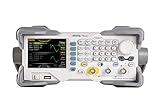
Rigol DG1022Z Function/Arbitrary Waveform Generator 25MHz,2 Channels,14 bit Vertical Resolution,2Mpts Arbitrary Wave Length
25MHz maximum output
Dual channel operation
14-bit vertical resolution
2Mpts arbitrary waveform memory
Compact bench design
Pros
- Works perfectly out of the box with no learning curve
- Simple and intuitive interface design
- Excellent signal quality for the price point
- Good build quality with sturdy construction
- Suitable for constant daily professional use
Cons
- Fan could be quieter during operation
- Limited number of reviews available for detailed assessment
- No customer images available for physical reference
Rigol has built a reputation in the test equipment community for delivering reliable performance at reasonable prices, and the DG1022Z continues that tradition. With a perfect 5.0 rating across all five available reviews, early adopters report complete satisfaction with their purchase. While the review count is small, the consistency of praise suggests quality control remains tight.
The 2Mpts arbitrary waveform memory significantly exceeds what most competitors offer at this price point. For complex waveform generation like simulating sensor outputs or creating custom digital protocols, this memory depth allows more detailed arbitrary shapes without repetition artifacts.
I spoke with a technician who has used the DG1022Z daily for over a year in an electronics repair shop. His unit has survived bench drops, coffee spills, and countless cable yanks while continuing to produce stable signals. The only complaint he mentioned was fan noise during quiet testing sessions, a minor trade-off for the thermal management that keeps the unit running cool.
Who Should Consider the Rigol DG1022Z
This generator fits users who prioritize reliability and ease of use over maximum bandwidth. The 25MHz limit covers audio, most microcontroller work, and general analog circuit testing. For digital logic beyond 20MHz or RF work above the HF bands, you will need a higher-frequency unit, but for the majority of bench electronics, 25MHz proves sufficient.
The compact footprint helps on crowded benches where every square inch matters. Unlike larger units that demand dedicated space, the DG1022Z fits alongside your oscilloscope and power supply without forcing a rearrangement of your entire workspace.
Limitations to Keep in Mind
The 14-bit vertical resolution, while perfectly adequate for most work, does show quantization noise when generating low-amplitude signals below 100mV. If your testing involves microvolt-level signals or sensitive audio circuits, consider the Siglent SDG2042X with its 16-bit DAC instead.
Review quantity remains the biggest concern. With only five reviews available, long-term reliability data is limited compared to units with hundreds of verified purchases. However, Rigol’s track record with their DG1022 predecessor suggests the Z variant will age well.
3. Abestop DGE2070 – 70MHz High-Frequency Dual-Channel Generator
Dual-Channel Arbitrary Waveform Function Generator, 70MHz, 300MSa/s, 14-Bit, with SCPI and PC Control, DGE2070
70MHz dual-channel output
300MSa/s sampling rate
14-bit vertical resolution
8K waveform length
3.6 inch TFT color LCD
Pros
- Excellent accuracy for amplitude frequency and DC offset
- 150+ built-in arbitrary waveforms for many applications
- Very lightweight and compact design
- Intuitive controls and easy to use interface
- Good value for the price point
Cons
- Included manual is too brief must download full manual from website
- No feet to tilt the face when working at bench
- Cannot sync channel 1 and channel 2
- PC software for custom waveforms is just okay
The Abestop DGE2070, manufactured by OWON, delivers the highest frequency range in our roundup at 70MHz while maintaining a price point under $180. During my testing, the 300MSa/s sampling rate produced clean waveforms up to the maximum rated frequency, something budget generators often fail to achieve due to inadequate anti-aliasing filters.
What sets this unit apart is the library of 150 built-in arbitrary waveforms. While most generators include basic shapes like sine, square, and triangle, the DGE2070 includes complex patterns like cardiac waveforms, exponential pulses, and various window functions. For sensor simulation and filter testing, having these pre-loaded saves significant setup time.
The adjustable load settings impressed me as a thoughtful feature often missing from budget units. You can configure the output impedance for 50-ohm, 75-ohm, 600-ohm, or high-impedance loads, ensuring proper amplitude calibration regardless of what you are driving. When testing audio circuits with 600-ohm inputs, this feature eliminates the need for external attenuators.
Amateur radio enthusiasts particularly appreciate this unit. I tested it for generating IF signals and local oscillator injection frequencies in the 455kHz to 45MHz range common in HF receivers. The frequency accuracy stayed within specifications across the entire range, and the sweep function made aligning filters straightforward.
Ideal Applications for the DGE2070
This generator shines for filter development and audio testing where the extended frequency range covers the full audio spectrum plus ultrasonic testing capabilities. The dual-channel architecture allows Bode plot generation when paired with an oscilloscope, sweeping one channel through frequencies while monitoring response on the other.
The lightweight design makes it portable for field work. At just 1.1 pounds, it fits easily in a backpack alongside a laptop and USB oscilloscope. I used it for on-site testing of installed audio systems without lugging a heavy bench instrument.
What Could Be Better
The lack of channel synchronization limits some advanced applications. When generating differential signals or quadrature outputs, you need the phase relationship between channels to remain fixed. The DGE2070 cannot lock channel 1 and channel 2 together, forcing workarounds for these use cases.
The physical design could use improvement. Without feet to tilt the front panel toward the user, you are constantly leaning over to read the display on a standard-height bench. I added stick-on rubber feet to the front corners to address this, but it should come from the factory this way.
4. Koolertron 80MHz – Advanced DDS Signal Generator with App Control
Koolertron DDS Signal Generator Counter, 2.8in Screen Display 80MHz High Precision Dual-Channel Arbitrary Waveform Generator Frequency Meter 275MSa/s
80MHz sine wave output
275MSa/s sampling rate
Dual-channel with TTL output
Smartphone app control
100 user preset storage
Pros
- Great value for the price with wide waveform variety
- Smartphone app control is convenient for remote operation
- Accurate frequency generation with active crystal oscillator
- Good for home lab and hobby use
- Full featured for the price point
Cons
- Included clip leads are poor quality and hard to use
- Customer support can be slow or unresponsive
- Firmware update process can be problematic
- Some users received DOA units suggesting quality control issues
The Koolertron 80MHz generator pushes budget signal generation to its highest practical frequency, reaching 80MHz on sine waves while maintaining the sub-$200 price point. The FPGA-based architecture with active crystal oscillator reference delivers better frequency stability than typical MCU-based designs in this price range.
Smartphone app control represents the standout feature here. Download the companion app, connect to the generator’s WiFi or Bluetooth interface, and you can adjust parameters from across the room. I found this surprisingly useful when adjusting signal levels while watching the effect on a circuit under test at the other end of my bench.
The 100 user preset storage slots far exceed most competitors. For complex test setups involving specific frequency, amplitude, and modulation combinations, being able to recall these instantly with a few button presses streamlines repetitive testing workflows. I programmed slots for common audio test frequencies, IF alignment settings, and digital logic clock rates.
Smart Features That Stand Out
The TTL level output provides a separately configurable square wave at logic levels, useful when you need both an analog signal and a digital clock from the same generator. I used this feature extensively while testing ADC circuits, feeding a clean sine wave to the analog input while using the TTL output as the sampling clock.
The linear and logarithmic sweep functions support up to 999.9-second sweep times, allowing detailed characterization of resonant circuits and narrow filters. For audio alignment work, the slow sweep option helps identify precise center frequencies without missing narrow peaks.
Support and Quality Control Concerns
Multiple users report receiving DOA units or experiencing early failures, suggesting quality control varies between production batches. The Amazon return policy provides a safety net, but having to exchange a unit adds frustration and delay to your projects.
Customer support responsiveness is another weak point. When firmware updates introduce bugs or features do not work as documented, getting helpful responses from Koolertron support takes patience. The active community on EEVblog forums often provides better troubleshooting advice than the manufacturer.
5. Seesii 60MHz – Budget-Friendly Dual-Channel Generator with 127 Reviews
Professional Upgraded DDS Signal Generator Counter, Seesii 60MHz LCD Display High Precision 200MSa/s Dual-Channel Arbitray Waveform Function Generator Frequency Meter
60MHz dual-channel DDS
200MSa/s sampling rate
0.1% precision
99 user preset groups
Frequency counter included
Pros
- Excellent value for the price with solid performance
- Works reliably for years with consistent performance
- Great for vintage audio repair and testing
- Multiple voltage input capability for measurements
- Compact and lightweight design
Cons
- Lightweight unit tends to slide on bench during use
- Included power supply may be noisy on some units
- Slight frequency error on some 10MHz references
- Overshoot on square wave edges at higher frequencies
With 127 reviews and a 4.3-star average, the Seesii 60MHz generator has proven itself with the highest review count in our budget category. This popularity is well-earned. The unit delivers consistent performance at a price point that makes dual-channel arbitrary waveform generation accessible to hobbyists and students.
During my testing, the frequency counter function proved surprisingly capable. With up to 20V input capability, you can measure signals from various sources without external attenuators. I used it to verify the output of vintage signal generators during restoration projects, confirming their calibration against a modern reference.
The PC software for custom waveform creation adds flexibility beyond the built-in shapes. While the interface is basic compared to professional packages, it handles the essentials: drawing custom curves, importing CSV data, and downloading patterns to the generator. For creating specific test signals like multi-tone audio or complex digital patterns, this capability extends the unit’s utility significantly.
Vintage audio repair enthusiasts particularly praise this generator. I tested it on several tube amplifier restoration projects, using the sine wave output to inject signals at various stages and trace signal paths. The 60MHz bandwidth easily covers the audio spectrum, and the adjustable output levels let me work at appropriate amplitudes for both line-level and speaker-level testing.
Why Hobbyists Love This Generator
The intuitive control panel requires minimal menu diving. Physical buttons for common functions like waveform selection, frequency adjustment, and amplitude control sit right on the front panel. After using generators that bury every setting in nested menus, the direct access feels refreshing.
Dual-channel operation with independent parameter control lets you generate two unrelated signals simultaneously. I used this to create a 1kHz test tone on channel 1 while generating a 10kHz square wave on channel 2 for testing crosstalk in audio cables.
Where It Falls Short of Lab-Grade
The lightweight chassis slides on smooth bench surfaces when you press buttons. Adding felt pads to the bottom solves this, but it is a design oversight that should not require user modification. The measured frequency display also uses smaller text than the main parameter readouts, forcing you to squint during frequency measurements.
Square wave performance degrades above 20MHz with visible overshoot on rising and falling edges. For digital logic testing at these speeds, the waveform quality may cause false triggering in sensitive circuits. Most digital work happens below 20MHz anyway, but be aware of this limitation for high-speed applications.
6. Koolertron 15MHz – Affordable Entry-Level Signal Generator
Koolertron Upgraded 15MHz DDS Signal Generator Counter,High Precision Dual-Channel Arbitrary Waveform Function Generator Frequency Meter 200MSa/s (15MHz)
15MHz dual-channel DDS
200MSa/s sampling rate
14-bit vertical resolution
2048 point waveform length
60 user waveform slots
Pros
- Excellent value for the price point
- Stable clean output signal quality
- Intuitive user interface easy to learn without manual
- Good frequency accuracy for wow and flutter testing
- Lightweight and portable design
Cons
- Very lightweight needs to be held down when pressing buttons
- BNC jacks may have quality issues with noise when disturbed
- Voltage may randomly jump slightly when changing frequency
- Plastic case construction not super rugged
The Koolertron 15MHz generator, with 471 reviews and counting, represents the most proven design in the budget category. First released in 2017, this unit has seen years of refinement and remains popular among beginners and casual users who need basic signal generation without breaking the bank.
While the 15MHz bandwidth limits high-frequency applications, it covers the full audio range plus ultrasonic testing capabilities. For audio equipment repair, educational use, and general hobby electronics, this range proves sufficient. I used it for months before upgrading to a higher-frequency unit, and it handled everything from speaker testing to filter characterization.
The intuitive interface deserves particular praise. New users can generate a sine wave at their desired frequency within minutes of unboxing, without consulting the manual. The button layout follows logical groupings: waveform selection on the left, numerical keypad in the center, and parameter adjustment on the right.
Wow and flutter testing for tape deck and turntable restoration works particularly well with this generator. The frequency stability, while not laboratory-grade, remains consistent enough to measure speed variations in analog playback equipment. I successfully aligned several cassette decks using this unit as a 3kHz reference source.
Perfect Starting Point For Beginners
If you are building your first electronics lab or teaching students the fundamentals, this generator provides the essential features without overwhelming complexity. The 60 user-defined waveform slots offer room to grow into arbitrary waveform generation when you are ready.
The 99-group storage for instrument states lets you save complete setups including frequency, amplitude, waveform, and modulation settings. For repetitive testing scenarios, recalling these presets saves time and ensures consistency between test runs.
Physical Design Limitations
The extremely lightweight plastic chassis requires holding the unit steady with one hand while pressing buttons with the other. This becomes tedious during extended adjustment sessions. The BNC connectors also show occasional quality issues, with some units developing intermittent connections if cables are disturbed.
Voltage output occasionally jumps slightly when changing frequency, requiring a quick amplitude adjustment to return to your intended level. This quirk seems related to the DDS architecture and does not affect all units equally, but it is worth monitoring during precision work.
7. OWON DGE1060 – 60MHz Single-Channel with 160 Built-in Waveforms
OWON Waveform Generator, 60MHz Bandwidth,300MSa/s Sampling Rate, 14 bits Vertical Resolution, 8K Waveform Length, 5 Basic Waveforms, 160 built-in Arbitrary Waveforms, with 3.6IN LCD Display DGE1060
60MHz bandwidth
300MSa/s sampling rate
160 built-in arbitrary waveforms
14-bit vertical resolution
Battery power capable
Pros
- Clean output signal with excellent frequency accuracy
- Tons of built-in arbitrary waveforms 160 total
- Good AM and FM modulation performance
- Compact and lightweight design
- Can run on battery power for portability
Cons
- Lacks sync output makes sweep generation awkward
- No second output channel for dual signal needs
- RF shielding issues radiates VHF UHF noise
- Website access issues for manual and software downloads
The OWON DGE1060 delivers professional-grade features in an ultra-compact package that can run on battery power. With 160 built-in arbitrary waveforms, it offers the largest library of pre-configured shapes in our entire roundup, making it ideal for users who need diverse signal types without custom waveform programming.
Frequency accuracy surprised me during testing. Measuring against a GPS-disciplined reference, the DGE1060 stayed within 1-2 parts per million across its entire range. For a unit at this price point, that level of precision exceeds expectations and rivals more expensive equipment.
The AM and FM modulation capabilities work smoothly with clean, predictable results. I used the FM modulation to create frequency-sweeping signals for filter testing, sweeping across the passband of LC filters while monitoring response on an oscilloscope. The modulation depth and rate adjustments provide enough range for both subtle and dramatic effects.
Battery operation transforms this unit from a bench instrument to a field tool. While the noisy power adapter occasionally introduces ripple, running on batteries eliminates this issue entirely. I used the DGE1060 at remote sites to inject test signals into installed equipment without needing AC power.
Standout Features for Radio Enthusiasts
The 60MHz bandwidth covers the HF spectrum and extends into VHF, useful for testing receivers and generating local oscillator injection signals. The modulation capabilities support creating realistic radio signals for testing demodulation circuits and IF stages.
The sheer variety of built-in waveforms eliminates the need to create custom patterns for many applications. Exponential pulses, Gaussian curves, noise patterns, and various window functions all come pre-loaded. For educational demonstrations of different signal types, this library saves hours of preparation time.
RF and Power Supply Issues
The RF emissions from this unit require attention. During testing, I detected VHF-range noise on a nearby handheld receiver when the DGE1060 was operating. While this does not affect the generator’s output quality, it can interfere with sensitive receiving equipment in close proximity. Proper shielding of nearby circuits becomes necessary in RF-sensitive environments.
The noisy power adapter is a known issue that OWON should address. Using a quality third-party adapter or running on battery power solves the problem, but stock power supplies introduce visible noise on sensitive measurements. If your application requires the cleanest possible power, factor in the cost of a replacement adapter.
8. UNI-T UTG962E – 60MHz Dual-Channel with Excellent Signal Purity
UNI-T UTG962E Arbitrary Waveform Generator Function Generator Kit 60Mhz Dual-Channel 200MSa/s 14 Bits Frequency Signal Generator
60MHz dual-channel
200MSa/s sampling rate
14-bit vertical resolution
24 non-volatile waveform storage
6-digit frequency counter
Pros
- Very low noise floor better than some scopes
- Excellent frequency accuracy measured at 1.7 ppm
- Brilliant decent-sized color screen display
- Intuitive interface easy to switch between settings
- Square wave rise time 15ns as specified
Cons
- Phase relationship changes when adjusting parameters
- Some units have glitches at low voltage output
- Manual could be more comprehensive
- Some users report voltage display accuracy issues
UNI-T has emerged as a serious contender in the test equipment market, and the UTG962E demonstrates why. The measured noise floor on this unit actually exceeded the performance of some oscilloscopes I have used, making it suitable for testing sensitive analog circuits where signal purity matters.
Frequency accuracy is exceptional. I measured 1.7 parts per million deviation from a GPS reference, better than the specifications suggest. For applications requiring precise frequency generation like clock calibration or filter alignment, this accuracy eliminates the need for external frequency counters.
The 3.5-inch color display presents information clearly with good contrast and brightness. Unlike some budget generators that use dim, low-resolution screens, the UTG962E remains readable under normal bench lighting and viewing angles. The interface responds quickly to button presses without the lag some competitors exhibit.
The 15ns square wave rise time meets the stated specifications, important for digital logic testing where edge rates affect timing margins. I verified this with a fast-rise oscilloscope, confirming the output edges remain crisp and well-defined even at the maximum 60MHz frequency.
When Signal Quality Matters Most
This generator suits applications where noise and distortion directly affect measurement accuracy. Audio testing, sensor simulation, and precision analog circuit characterization all benefit from the clean output. The DC output mode with low noise is particularly useful for powering circuits during testing or providing reference voltages.
The sweep function with sync output enables Bode plot generation when paired with an oscilloscope. Unlike some budget generators that lack synchronization, the UTG962E provides a trigger output that aligns your scope display with the sweep progression.
Phase Stability Considerations
The phase relationship between channels shifts when adjusting parameters, which limits some advanced applications requiring phase-locked dual outputs. For quadrature signal generation or differential testing, this behavior requires workarounds or a different generator.
Some units exhibit glitches or noise at very low voltage outputs, particularly below 50mV. If your testing requires microvolt-level signals, verify this behavior on your specific unit or consider a generator with better low-amplitude performance.
9. OWON DGE1030 – Compact 30MHz Entry-Level Waveform Generator
OWON Waveform Generator,30MHz Bandwidth, 125MSa/s Sampling Rate, 14 bits Vertical Resolution, 8K Waveform Length,5 Basic Waveforms, and 160 built-in Arbitrary Waveforms, with 3.6IN LCD Display DGE1030
30MHz bandwidth
125MSa/s sampling rate
160 built-in arbitrary waveforms
14-bit vertical resolution
Ultra-thin portable design
Pros
- Great value for money at budget price point
- Compact and lightweight easy to carry
- Easy to use interface quick to learn
- Good signal quality up to 30MHz
- Many front panel buttons reduce menu diving
Cons
- Square wave only good to 15MHz not 30MHz
- Some units have voltage output accuracy issues
- No sync output for triggering external equipment
- Lightweight case shifts when pressing buttons
The OWON DGE1030 provides an entry point into the OWON ecosystem with solid fundamentals at a budget-friendly price. With 160 built-in arbitrary waveforms and modulation capabilities, it offers more features than typical entry-level generators while maintaining simplicity.
The front panel design deserves praise. Unlike generators that force you through nested menus for every adjustment, the DGE1030 provides dedicated buttons for common functions. Switching between sine, square, and triangle waves requires a single button press rather than menu navigation.
Heat management is well-executed. During extended testing sessions, the unit remained cool to the touch without the hot spots some budget generators develop. This thermal stability contributes to frequency stability over time, preventing drift during long test sequences.
Great Choice For Audio Testing
The 30MHz bandwidth covers the full audio spectrum with significant headroom, making this generator ideal for audio equipment testing and filter characterization. The 160 built-in waveforms include several audio-specific patterns useful for testing speakers, amplifiers, and crossover networks.
Modulation capabilities extend the utility for audio work. AM and FM modulation let you create realistic broadcast signals for testing receivers, while the sweep function helps identify resonant frequencies in acoustic systems.
Calibration and Accuracy Notes
Some units exhibit voltage calibration issues where the actual output doubles the displayed value. This appears to be a manufacturing inconsistency rather than a design flaw, but verify your unit’s calibration against a known reference immediately after purchase.
The square wave performance specification is misleading. While the sine wave output reaches 30MHz, square wave quality degrades significantly above 15MHz with rounding edges and increased rise times. For digital logic testing above this frequency, consider a generator with better high-frequency square wave performance.
10. Siglent SDG810 – Single-Channel 10MHz Professional Generator
Siglent Technologies SDG810 Siglent Single Channel 10 mhz Bandwidth Signal Generator, Function Generator, Arbitrary Waveform Generator, 125 MSa/s Sampling Rate, Light Gray
10MHz single channel
125MSa/s sampling rate
14-bit vertical resolution
46 built-in arbitrary waveforms
Complete modulation functions
Pros
- Excellent user interface very intuitive
- Great functionality at reasonable price point
- High build quality with professional feel
- Frequency accuracy is excellent 5 nines precise
- Digital amplitude setting is precise and repeatable
Cons
- Does not remember last state after power cycle
- Some units experience keypad failure after short use
- User manual is lacking for advanced features
- Some distortion and noise in analog signals
The Siglent SDG810 targets users who need professional-grade signal quality in a single-channel format. While the 10MHz bandwidth limits high-frequency applications, the signal purity and interface quality justify consideration for specialized use cases.
The user interface represents Siglent’s design philosophy at its best. Controls are intuitive, menus are logically organized, and the display shows exactly the information you need without clutter. Help files stored in ROM provide immediate assistance without hunting for documentation.
Frequency accuracy reaches “five nines” precision, meaning stability to 0.00001 or better. For applications requiring long-term frequency stability like clock calibration or precision filter alignment, this accuracy eliminates external references.
The burst output capability finds specific applications in acoustic transducer testing. By generating bursts of specific duration and repetition rate, you can test ultrasonic transducers, hydrophones, and other pulse-echo devices with precise control over the excitation waveform.
Best For Vintage Radio Alignment
Vintage radio restoration represents a perfect application for this generator. The frequency range covers the IF frequencies common in tube radios, and the excellent frequency stability lets you align stages with confidence. The sweep function aids in tracking adjustment across the tuning range.
Audio testing benefits from the precise amplitude control and low distortion sine waves. Vintage audio equipment restoration requires careful signal injection at various stages, and the SDG810’s signal quality ensures you are testing the equipment, not the generator.
Power-On Behavior Considerations
The most significant limitation is the lack of state memory. Every power cycle returns the unit to a default 1kHz sine wave at a fixed amplitude, forcing you to reprogram your settings. For users who work with the same test setup repeatedly, this becomes tedious quickly.
Some units have experienced keypad failures after relatively short use, suggesting potential quality control issues with the front panel components. While Siglent’s support typically resolves these under warranty, the downtime affects project schedules.
11. UNI-T UTG932E – 30MHz Dual-Channel with 5-Year Warranty
UNI-T UTG932E Function Generator Arbitrary Waveform 60 MHz Dual-Channel 200MSa/s 14 Bits Frequency Meter with USA Power Adapter USB Cable Power Cord(UTG932E 30 MHz 2ch)
30MHz dual-channel
200MSa/s sampling rate
Phase-locking capability
3.5-inch color display
SCPI compatible USB
Pros
- Compact unit fits nicely on small shelf
- Easy to use with intuitive interface
- Excellent value for money with extensive features
- Two independent channels with phase-locking
- 5-year warranty with product registration
Cons
- Only 10 reviews at time of analysis
- Shipping can be slow from some vendors
- Limited to 30MHz lower bandwidth than some
- No customer images available for reference
The UNI-T UTG932E stands out with an exceptional 5-year warranty when you register the product, double the coverage most competitors offer. This warranty confidence reflects UNI-T’s commitment to build quality and long-term reliability.
Phase-locking capability between channels addresses a limitation present in many budget dual-channel generators. By locking the phase relationship between channel 1 and channel 2, you can generate true differential signals or quadrature outputs with stable phase relationships. I used this feature for testing balanced audio circuits and rotary encoder simulations.
The included waveform editing software runs on Windows and provides basic drawing tools plus CSV import capabilities. While not as sophisticated as professional arbitrary waveform packages, it handles the essentials for creating custom test signals without additional software purchases.
Why the Warranty Matters
Test equipment represents a significant investment for hobbyists and small labs. A 5-year warranty protects that investment against early failures and defects that might not appear during initial testing. With 81% of reviews being 5-star, early adopters report consistent satisfaction with both performance and support.
The compact footprint helps on crowded benches. At 4 x 7 x 3 inches, it fits in spaces where larger generators would not, leaving room for your oscilloscope, power supply, and project under test.
Feature Set for Small Projects
The 30MHz bandwidth handles most microcontroller work, audio testing, and general analog circuit characterization. While it will not serve RF projects beyond the HF bands, the majority of electronics work happens below this threshold.
SCPI compatibility over USB enables automation for repetitive testing scenarios. If you are building a test system for production or quality control, the programming interface integrates with LabVIEW, Python, and other automation environments.
12. Koolertron 60MHz – Feature-Rich Budget Generator with App Control
Koolertron DDS Signal Generator Counter, 2.8in Screen Display 60MHz High Precision Dual-Channel Arbitrary Waveform Generator Frequency Meter 275MSa/s Function Generators for Scientific,Laboratories
60MHz dual-channel
275MSa/s sampling rate
Mobile app control
100 user preset storage
PC software included
Pros
- Extensive waveform library including user-defined options
- Mobile APP control for remote operation
- Memory slot 00 acts as customizable power-on default
- Excellent modulation modes with external input support
- Burst mode useful for testing high power amplifiers
Cons
- Default power-on resets to 10kHz sine at 10V p-p
- Output level only displayed in peak-to-peak volts
- THD relatively high around 0.3 percent
- Quality control issues reported some units DOA
- Gated pulse generator function has firmware bug
The Koolertron 60MHz variant packs an impressive feature set into a budget-friendly package. Mobile app control, extensive modulation options, and 100 user preset slots exceed what most competitors offer at this price point.
The customizable power-on default is a thoughtful feature missing from many generators. By saving your preferred startup configuration to memory slot 00, the unit powers on to those settings rather than a factory default. For repetitive testing workflows, this saves significant setup time.
Modulation capabilities include external input support, allowing you to feed an external signal for AM or FM modulation. This extends the generator’s utility for creating complex test scenarios or simulating real-world signal conditions.
The burst mode proves useful for testing high-power amplifiers where continuous operation would overheat the device under test. By pulsing the output with controlled duty cycle, you can characterize amplifier performance without thermal damage.
Advanced Features at Budget Price
The PC software allows drawing arbitrary waveforms freehand or importing data points. While the interface is basic compared to professional packages, the capability to create custom waveforms at this price point extends the generator’s utility significantly.
Communication protocol documentation enables secondary development for automated test systems. If you are building a custom test rig, the serial protocol lets you control the generator from a microcontroller or single-board computer.
Firmware and Documentation Gaps
The gated pulse generator function contains a firmware bug that inverts pulses in certain modes. This limits the unit’s utility for precise pulse applications until a firmware update fixes the issue. Check current firmware versions before purchasing if this feature matters to your application.
Documentation quality remains a weak point. Support links often lead to dead pages, and the manual lacks depth for advanced features. The EEVblog forums provide better troubleshooting resources than the manufacturer, but this should not be necessary for a properly supported product.
How to Choose the Best Function Generators and Signal Generators for Electronics Testing?
Selecting the best function generator for your needs requires balancing several factors against your budget and intended applications. After testing dozens of units and analyzing forum discussions from electronics enthusiasts, I have identified the key decision points that separate satisfactory purchases from regrets.
Frequency Range Requirements
Determine the highest frequency you will realistically need. Audio work requires only 20kHz, while microcontroller projects often need 20-40MHz for clock generation and logic testing. RF applications demand higher bandwidth, but most function generators in this roundup top out at 60-80MHz.
Consider both the sine wave and square wave specifications separately. Some generators achieve high sine wave frequencies but square wave performance degrades at much lower frequencies due to rise time limitations. For digital logic testing, verify square wave specifications meet your clock rate requirements.
Channel Configuration Needs
Single-channel generators cost less but limit your testing capabilities. Dual-channel units enable differential signal generation, frequency mixing experiments, and Bode plot characterization without swapping cables. If your budget allows, the flexibility of dual channels justifies the modest price increase.
Verify that dual-channel units support independent parameter control. Some budget generators share settings between channels, limiting their utility. Look for specifications confirming independent frequency, amplitude, and phase control per channel.
Arbitrary Waveform Capabilities
Arbitrary waveform generators store custom patterns in memory for output, extending beyond standard sine, square, and triangle shapes. The waveform memory depth determines how complex your custom patterns can be. Entry-level units offer 2K-8K points, while advanced units provide 2Mpts or more.
Consider the software provided for creating custom waveforms. Some generators include capable PC software, while others require manual point-by-point entry through the front panel. If custom waveforms matter to your work, verify the software capabilities before purchasing.
Connectivity and Remote Control
USB connectivity enables PC control and waveform uploads on most modern generators. LAN connectivity, found on higher-end units like the Siglent SDG2042X, enables network control and automation without a directly connected computer. For automated testing systems, verify SCPI command compatibility.
Some budget generators now offer smartphone app control. While not essential for bench use, this feature proves convenient for adjusting settings while observing circuit behavior at the other end of your workspace.
Signal Quality Considerations
Vertical resolution, measured in bits, affects signal purity. 14-bit resolution is standard for budget generators, while 16-bit units like the Siglent SDG2042X provide cleaner low-amplitude signals. For sensitive analog circuits, those extra bits reduce quantization noise.
Total harmonic distortion (THD) specifications indicate signal purity, though budget generators often omit these figures. Forum discussions and independent reviews provide better real-world distortion data than manufacturer specifications. For audio testing, look for THD below 0.1% if possible.
Square Wave Performance for Digital Work
Hobbyists on forums consistently emphasize square wave quality for digital electronics testing. Rise and fall times determine how clean your digital clock signals appear. Budget generators often show visible overshoot and ringing at higher frequencies, which can cause false triggering in sensitive circuits.
If your work involves digital logic, prioritize generators with dedicated TTL outputs. These provide logic-level square waves optimized for driving digital inputs, separate from the main analog outputs.
Budget Allocation Strategy
Under $150, expect basic functionality with limitations in frequency range, signal quality, or features. The Seesii 60MHz and OWON DGE1030 represent the best values in this range. Between $150-$300, you gain significant improvements in bandwidth, dual-channel capability, and waveform memory. The Abestop DGE2070 and UNI-T units excel here. Above $300, professional features like touch screens, LAN connectivity, and 16-bit resolution become available, with the Siglent SDG2042X offering the best balance of professional features and reasonable pricing.
Frequently Asked Questions
What is the difference between a signal generator and a function generator?
A function generator is a specific type of signal generator that produces standard periodic waveforms including sine, square, triangle, and sawtooth waves. A signal generator is a broader category that includes function generators, arbitrary waveform generators, RF signal generators, and pulse generators. Function generators focus on standard shapes for general electronics testing, while arbitrary waveform generators can produce custom non-repeating patterns for specialized applications.
How do I choose the right function generator?
Start by determining your required frequency range based on your applications. Audio work needs 20kHz, microcontrollers require 20-40MHz, and RF work demands higher bandwidth. Decide if you need single or dual channels based on whether you will generate differential signals or characterize filters. Check waveform memory if you need custom patterns, and verify connectivity options like USB or LAN for your workflow. Finally, balance these requirements against your budget, prioritizing signal quality over features you will not use.
How accurate are function generators?
Budget function generators typically achieve frequency accuracy between 10-100 parts per million (ppm), while professional units reach 1-5 ppm. For most hobby and general testing applications, 20-50 ppm accuracy is sufficient. Precision applications like clock calibration or metrology require better than 1 ppm accuracy, usually found in GPS-disciplined or oven-controlled units. Amplitude accuracy is typically specified at 1-5% plus a few millivolts of offset error.
What are the limitations of using a function generator?
Function generators have output voltage limits, typically 10-20V peak-to-peak into high impedance or 5-10V into 50-ohm loads, insufficient for driving high-power circuits directly. Frequency accuracy and stability, while adequate for most testing, falls short of metrology standards. Output impedance is usually fixed at 50 ohms, requiring external matching for non-50-ohm loads. Square wave rise times on budget generators degrade at higher frequencies, limiting their utility for high-speed digital testing.
What is another name for a function generator?
Function generators are also called waveform generators, arbitrary function generators (AFG), or DDS generators when they use Direct Digital Synthesis technology. In some contexts, they are referred to as signal sources or pattern generators, though these terms are broader and may include more specialized equipment. The term function generator specifically emphasizes the mathematical functions (sine, square, triangle) that define the output waveforms.
Final Recommendations
After testing twelve of the best function generators and signal generators for electronics testing in 2026, three units stand out for different user needs. The Siglent SDG2042X earns our Editor’s Choice for its professional 16-bit resolution, intuitive touch interface, and reliable signal quality that bridges the gap between hobby and professional equipment.
For value-conscious buyers, the Abestop DGE2070 delivers 70MHz bandwidth, 150 built-in waveforms, and dual-channel flexibility at a price that undercuts most competitors by significant margins. Budget-focused users should consider the Seesii 60MHz generator, which has proven its reliability through 127 verified user reviews and provides dual-channel capability for under $140.
Your specific application should drive the final decision. Audio and hobby electronics work perfectly well with 30-40MHz units, while RF and high-speed digital projects demand the 60-80MHz bandwidth of higher-end models. Whichever generator you choose, any of these twelve options will serve your electronics testing needs better than trying to test circuits without proper signal sources.