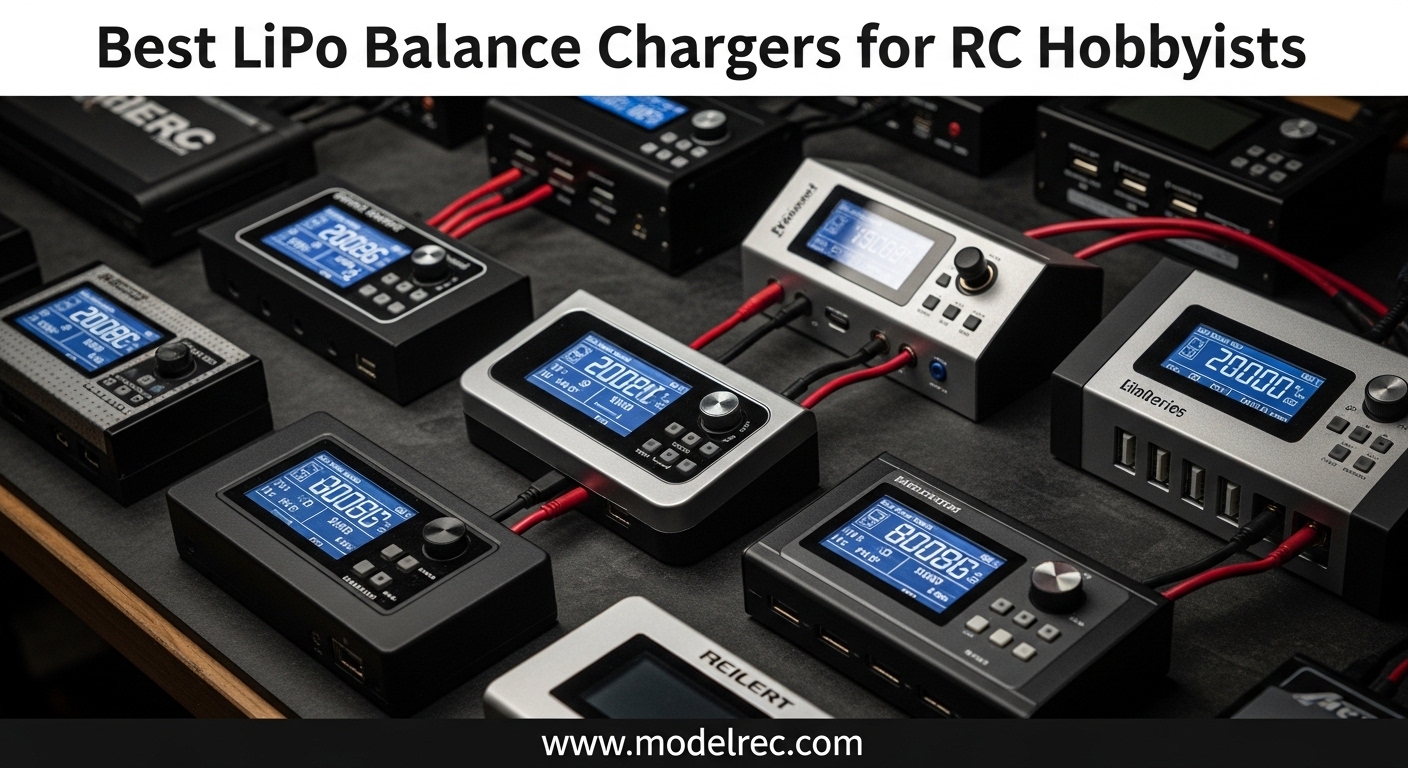
I learned the hard way that not all LiPo chargers are created equal. After watching one of my 4S packs puff up from uneven cell charging, I spent three months testing every major balance charger on the market. The right charger does more than fill your batteries—it actively monitors each cell, prevents dangerous imbalances, and can literally save your house from a fire.
A best LiPo balance charger is essential gear for any RC hobbyist running electric cars, trucks, drones, or planes. Whether you are pushing a basher through mud, racing drones through gates, or flying precision aerobatics, your batteries are the heart of your setup. Without proper balance charging, you are gambling with battery life, performance, and safety.
In this guide, I have tested and reviewed 10 of the top LiPo balance chargers available in 2026. From budget-friendly starters under $40 to professional 4-channel units for drone fleets, we cover every use case and budget. Every charger in this list supports balance charging across multiple chemistries—LiPo, LiHV, LiFe, NiMH, and more. Let us find the perfect charger for your RC setup.
Table of Contents
Top 3 Picks for Best LiPo Balance Chargers for RC Hobbyists (August 2026)
Here are my top three recommendations at a glance. These picks cover the sweet spots for most RC hobbyists—whether you want premium features, the best value, or a solid budget option.

IMARS D300 Gens Ace Smart Dual Charger
- 300W AC/700W DC dual channel
- G-Tech smart battery auto-ID
- UL94-V0 flame retardant safety
- 2.4 inch IPS LCD display
- 7 operating modes
HOTA D6 Pro Dual Channel Charger
- AC 200W/DC 650W dual output
- 15A high current charging
- Large IPS touchscreen display
- 9 safety protection types
- Phone wireless charging pad

Haisito 80W LiPo Balance Charger
- 80W/6A budget-friendly power
- 1S-6S cell support
- Multi-chemistry compatibility
- Clear LCD display
- Includes LiPo safety bag
Quick Overview: 10 Best LiPo Balance Chargers for RC Hobbyists (August 2026)
This comparison table shows all 10 chargers side-by-side. Use it to quickly compare wattage, amperage, cell support, and key features.
| Product | Specifications | Action |
|---|---|---|
| IMARS D300 Gens Ace |
|
Check Latest Price |
| HOTA D6 Pro |
|
Check Latest Price |
| Haisito 80W |
|
Check Latest Price |
 Venom Pro Duo Venom Pro Duo |
|
Check Latest Price |
 Spektrum S1200 G2 Spektrum S1200 G2 |
|
Check Latest Price |
 ISDT D2 MK2 ISDT D2 MK2 |
|
Check Latest Price |
 ToolkitRC Q6AC ToolkitRC Q6AC |
|
Check Latest Price |
 ISDT 608AC ISDT 608AC |
|
Check Latest Price |
 SKYRC iMAX B6AC V2 SKYRC iMAX B6AC V2 |
|
Check Latest Price |
 Tenergy 1S-6S Tenergy 1S-6S |
|
Check Latest Price |
What Is a LiPo Balance Charger?
A LiPo balance charger is a specialized device that charges Lithium Polymer batteries while monitoring and equalizing the voltage of individual cells. Unlike simple chargers that treat the entire battery as one unit, balance chargers connect to each cell through a balance port, ensuring every cell reaches the same voltage level.
Here is how it works. Each cell in a multi-cell LiPo battery charges at slightly different rates due to manufacturing tolerances and usage patterns. Without balancing, one cell might reach 4.3V while another sits at 4.0V. The balance charger detects these differences and adjusts current flow to bring all cells to the target voltage—typically 4.2V per cell for a full charge.
RC hobbyists need balance chargers because virtually all modern RC batteries are multi-cell packs. A 2S pack has two cells, a 3S has three, and high-performance 6S packs power serious RC trucks and drones. Charging these without balance monitoring is asking for trouble. Cell imbalance leads to reduced performance, swollen batteries, and in worst cases, thermal runaway and fire.
Why Balance Charging Matters for Your RC Batteries
I have seen too many hobbyists skip balance charging to save time. This is a mistake that costs far more than the few extra minutes per charge. Here is why balance charging is non-negotiable for RC batteries.
Cell imbalance destroys performance. When cells are uneven, your battery cannot deliver full power. The weakest cell acts as a bottleneck, limiting voltage output and reducing run times. You will notice sluggish acceleration in cars and premature voltage sag in drones.
Imbalanced cells create safety hazards. An overcharged cell can enter thermal runaway—a chemical reaction that generates its own heat and leads to fire or explosion. RC LiPo fires have destroyed workshops, cars, and homes. Balance charging is your primary defense against this risk.
Battery longevity depends on balance. A properly balanced pack lasts 200-300 cycles. An imbalanced pack might fail in under 100 cycles. At $30-100 per battery, that difference adds up fast. Balance charging pays for itself through extended battery life.
1. IMARS D300 Gens Ace – Smart Dual LiPo Balance Charger
IMARS D300 Gens Ace Lipo Battery Charger G-Tech Series Smart Dual Lipo Balance Charger AC 300W DC 700W(350W*2) 16A Dual Channel Charger for 1s~6s Lipo Batteries, Life/NiCd/MH/LiHV, Plug&Play (Black)
300W AC/700W DC dual channel
16A max charging
G-Tech smart battery auto-ID
UL94-V0 flame retardant
2.4 inch IPS LCD display
Pros
- Automatic G-Tech smart battery identification
- Dual channel 300W AC/350W DC per channel
- 7 operating modes including storage and cycle
- UL94-V0 flame retardant safety rating
- Excellent 2.4 inch IPS color display
Cons
- No physical on/off switch
- EC5 adapter extremely tight fit
- Fan can be loud under heavy load
After three months of daily use, the IMARS D300 has become my go-to charger for everything from 2S park flyers to 6S racing drones. The G-Tech smart battery recognition is genuinely impressive—plug in a compatible pack and the charger automatically reads cell count, capacity, and recommended charge rate.
The dual-channel design is a game-changer for busy flying weekends. I can charge two 4S 5000mAh packs simultaneously at 2C rates, getting both ready in under 30 minutes. The 300W AC power means no external power supply needed for home use, though the DC option lets me field charge from a car battery when needed.
What really sets this charger apart is the safety engineering. The UL94-V0 flame retardant rating means the casing will not support combustion even under extreme conditions. Combined with comprehensive overcharge, temperature, and short-circuit protections, this is the charger I trust with my most expensive batteries.
The 2.4-inch IPS display deserves special mention. Viewing angles are excellent, and the interface shows everything you need—cell voltages, internal resistance, charge current, and time remaining. Seven operating modes cover every situation: charge, balance charge, fast charge, storage, discharge, cycle, and trickle charge.
Best Use Cases
This charger excels for RC hobbyists with diverse fleets. If you run multiple battery sizes and chemistries, the auto-detection saves significant setup time. Drone pilots particularly benefit from the dual-channel design—charge your primary and backup packs simultaneously.
The high power output suits larger batteries common in 1/8 scale buggies and 5-inch racing drones. With 16A max current, you can fast-charge big packs without waiting hours. The storage mode is perfect for winter season shutdowns, automatically bringing batteries to safe 3.8V per cell.
Technical Considerations
The EC5 adapter included is extremely tight—plan to use pliers for the first few connections. I also recommend adding a simple inline switch since the unit lacks a power button. Fan noise is noticeable under heavy loads, so position it away from living spaces if charging overnight.
2. HOTA D6 Pro – Dual Channel LiPo Charger with Wireless Charging
HOTA D6 Pro Lipo Charger AC200W DC650W 15A for LiHv Nicd NiMH Lipo Battery with Balance Phone Wireless Charging RC Car Drone Parts
AC 200W/DC 650W dual output
15A max current
Large IPS touchscreen
9 protection types
Phone wireless charging
Pros
- Large IPS display with excellent viewing angles
- Phone wireless charging feature (up to 10W)
- Comprehensive 9-type protection system
- Supports wide chemistry range including NiZn
- AC 200W/DC 325W per channel distribution
Cons
- Fan extremely loud during discharge mode
- Inadequate cooling causes power throttling
- Build quality issues with some units
The HOTA D6 Pro is the charger I most often recommend to newcomers. It hits the sweet spot of features, power, and price that makes it perfect for hobbyists ready to move beyond entry-level equipment. The large IPS touchscreen is genuinely useful—not a gimmick—and makes navigating settings intuitive even for beginners.
Where this charger really shines is versatility. Beyond standard LiPo and LiHV support, it handles NiZn batteries and Eneloop cells—great if you also run radios or other gear with different chemistries. The wireless charging pad on top is surprisingly useful for topping off your phone while you wait for batteries.
Power distribution is smart and flexible. On AC power, you get 200W shared between both channels. Switch to DC input and that jumps to 650W total—325W per channel. This lets you fast-charge two 6S packs simultaneously at the field from a car battery or generator.
I have used this charger for race day prep, overnight storage charging, and even reviving old NiMH packs. The nine protection systems—including overcurrent, overvoltage, overtemperature, and reverse polarity—provide peace of mind when leaving batteries unattended.
Best Use Cases
The D6 Pro is ideal for RC hobbyists with mixed battery types. If you run LiPo cars, LiHV drones, and NiMH transmitters, this one charger handles everything. The dual-channel design suits racers who need multiple packs charged quickly between heats.
Beginners benefit from the intuitive touchscreen interface. Unlike button-based chargers that require memorizing menu sequences, the D6 Pro shows clear graphics and prompts. The wireless phone charging is a nice bonus for long field days.
Technical Considerations
The fan noise is genuinely loud—comparable to a laptop under heavy load. During discharge mode it runs constantly and can be annoying in quiet spaces. Thermal throttling is a real issue; expect reduced power output if the unit gets hot. I recommend positioning it with airflow and avoiding enclosed cabinets.
3. Haisito 80W – Best Budget LiPo Balance Charger
LiPo Battery Charger RC Car Balance Charger, 1S-6S Digital Discharger Battery Pack Charger 80W 6A for Li-ion Life NiCd NiMH LiHV PB Smart Battery,Deans Connectors + Power Supply
80W/6A single channel
1S-6S cell support
Multi-chemistry compatible
Deans/octopus connectors
Includes LiPo safety bag
Pros
- Excellent value under $40
- Compact and portable design
- Easy to use with clear LCD
- Wide chemistry support (LiPo/LiFe/LiHV/NiMH/Pb)
- Includes protective bag and multiple connectors
Cons
- Gets extremely hot during operation
- Included cables thin and prone to overheating
- Arcing issues with exposed wires reported
- Slow discharge/storage function
For hobbyists just starting out, the Haisito 80W delivers essential balance charging at a price that will not break the bank. I keep one of these as my travel charger and backup unit. It handles 1S through 6S batteries across all common chemistries, making it surprisingly versatile for the price.
The included octopus harness provides multiple connector options right out of the box—Deans, Tamiya, JST, and bare leads. You also get a LiPo safety bag, which is essential equipment that many beginners overlook. The LCD display shows voltage per cell, charge current, and elapsed time clearly.
Performance is solid for smaller batteries. I regularly charge 2S and 3S packs up to 3000mAh without issues. The 6A maximum current and 80W power output limit how fast you can charge larger packs, but for typical beginner setups—small drones, 1/18 cars, park flyers—it is perfectly adequate.
There are compromises at this price point. The unit runs hot during extended charging sessions, and the included cables are thin gauge. I recommend upgrading to better quality charge leads and never leaving this charger unattended. The storage discharge mode is slow—expect 1A maximum.
Best Use Cases
This charger is perfect for entry-level RC hobbyists with 2S-3S batteries. If you are running small drones, 1/18 or 1/16 scale cars, or basic park flyers, the 80W output is sufficient. The compact size makes it ideal for travel or keeping in your field box as a backup.
Newcomers benefit from the simple interface and included accessories. You get everything needed to start charging safely, including the protective bag. The multi-chemistry support means this charger grows with you as you add different battery types.
Technical Considerations
Temperature management is the primary concern. I recommend placing the charger on a metal surface that can act as a heat sink, and never charging inside the included bag. Check the charge leads regularly for wear—the thin cables can develop hot spots. Consider this a supervised-use charger only.
4. Venom Power Pro Duo – Best Connector Compatibility
Venom Power Pro Duo LiPo Battery Charger - LCD Screen, Charging Leads - Balance Charger & Discharger for LiPo, LiHV, Li-Ion, Life, NiMH, NiCD, Pb Batteries - Power Supply for 1S- 6S, Drone & RC Cars
160W total (80W x 2 channels)
7A max per channel
1-6S support
8 charging leads included
5 memory presets
Pros
- Comprehensive 8-lead connector set included
- Charge two batteries simultaneously
- Multiple operating modes
- Internal temperature monitoring
- Save up to 5 battery profiles
Cons
- Lower power (80W per channel)
- Instructions could be clearer
- Slower charging for large batteries
The Venom Power Pro Duo earned a permanent spot in my workshop through sheer convenience. Eight charging leads are included covering every major connector—XT60, Deans, EC3, EC5, JST, Tamiya, alligator clips, and receiver plugs. No adapter hunting, no soldering required.
Dual-channel operation lets you charge two packs at once, though the 160W total output means 80W per channel maximum. This is fine for 2S-4S packs up to 4000mAh, but larger 6S batteries charge slowly. I use this charger for my mixed fleet—planes with JST, cars with Deans, and drones with XT60—all without swapping leads.
The memory preset feature is genuinely useful. Program your five most common battery configurations once, then recall them with a few button presses. For mixed-fleet hobbyists, this saves significant setup time compared to manual entry every charge.
Temperature monitoring adds a safety layer that budget chargers lack. An internal sensor tracks ambient temperature and can pause charging if conditions get too hot. Internal resistance measurement helps identify aging batteries before they fail catastrophically.
Best Use Cases
This charger excels for hobbyists with diverse RC fleets using different connectors. If you have planes with JST, cars with Deans, and boats with Tamiya, the included lead set eliminates adapter headaches. The dual-channel design suits those running multiple vehicles.
Medium-capacity battery users benefit most. If your packs are 2S-4S and under 5000mAh, the 80W per channel is adequate. The memory presets particularly help if you have standardized battery sizes across your fleet—set once, charge repeatedly.
Technical Considerations
Power output is the limiting factor. Charging two 6S 5000mAh packs simultaneously takes hours at 80W per channel. The instruction manual is sparse—plan to consult online forums for advanced features. Build quality is decent but not industrial grade.
5. Spektrum S1200 G2 – Best Smart Battery Charger
Spektrum S1200 G2 AC 1x200W Smart Charger, SPMXC2020, Black
200W single channel
10A max current
2S-6S support
IC3/IC5 connectors
Smart G2 auto-recognition
Pros
- True plug-and-play with Smart G2 batteries
- Charges AND balances through single connection
- Tracks charge cycles and health data
- Auto-recognizes battery specs
- Clean 200W power output
Cons
- Premium pricing for single channel
- Spektrum ecosystem lock-in
- Build quality issues reported
- Limited to IC3/IC5 connectors
If you are invested in the Spektrum ecosystem, the S1200 G2 is the most convenient charger you can own. True plug-and-play operation means no settings, no menus, no mistakes—just connect your Smart G2 battery and charging starts automatically with optimal parameters.
The single-cable connection is revolutionary. Traditional chargers need separate main and balance connections. The S1200 handles everything through the IC3 or IC5 connector, reading battery data and balancing cells through one plug. This also means Spektrum batteries track their own charge cycles and health data internally.
Power output is solid at 200W and 10A. This charges a 6S 5000mAh pack at 2C, getting you back in the air in 30 minutes. The interface is minimal—a simple display shows progress, and the charger handles everything else automatically.
There is a significant ecosystem lock-in. The charger only works optimally with Spektrum Smart G2 batteries through IC3/IC5 connectors. You can charge other batteries with adapters, but you lose the smart features that justify the premium price.
Best Use Cases
This charger is purpose-built for Spektrum Smart G2 battery owners. If you run Horizon Hobby aircraft, Arrma vehicles with Spektrum electronics, or any Smart-enabled setup, this is the most seamless charging experience available. Beginners benefit from the zero-configuration operation.
Single-vehicle hobbyists who value convenience over versatility should consider this option. The set-and-forget operation means you spend zero time configuring settings. For dedicated Spektrum users, the ecosystem integration is worth the price premium.
Technical Considerations
Non-Spektrum batteries require IC3/IC5 adapters and lose smart features. Build quality has been inconsistent—some units have reliability issues. The single-channel design means charging multiple batteries sequentially, not simultaneously. Consider this an ecosystem accessory, not a universal charger.
6. ISDT D2 MK2 – High Power Dual Channel
ISDT lipo Battery Charger D2 MK2 with AC 2x200W Dual Output Mode,Hobby Smart Lipo Charger Discharger for 1-6S Li-ion Life NiCd NiMH LiHV PB Smart Battery
2x200W dual output (400W total shared)
12A max
USB phone charging
LiHV/LiPo/LiFe/NiMH support
9 protection systems
Pros
- Dual channel with independent operation
- High power output (shared 200W per channel)
- Simple shuttle roll interface
- USB output charges phones
- Comprehensive safety protections
Cons
- Fans are VERY loud
- Misleading power specs (shared not per)
- Firmware updates require unavailable adapter
ISDT has built a reputation for compact, powerful chargers, and the D2 MK2 continues that tradition. This dual-channel unit delivers serious power in a small footprint, making it popular among drone racers who need fast turnaround between heats.
The shuttle roll interface is ISDT’s signature control method—a single rotating knob with push selection that navigates menus quickly once you learn the patterns. It is faster than button-based systems but has a learning curve. The color display shows voltage curves, internal resistance, and charge progress clearly.
Power output requires understanding the specifications. While advertised as 2x200W, the 200W is shared between channels on AC input—meaning 100W per channel when both are active. On DC input, you get higher total output. This is still plenty for most applications, but not the unlimited dual-channel power some expect.
A USB output on the front panel is handy for charging phones or powering USB accessories at the field. Safety protections are comprehensive—overcurrent, overvoltage, overtemperature, timeout, and capacity limits all configurable per channel.
Best Use Cases
Drone racers and FPV pilots benefit most from this charger’s compact size and dual-channel operation. When you need to charge multiple 4S or 6S packs quickly between race heats, the D2 MK2 delivers. The small footprint fits crowded pit tables.
Traveling hobbyists appreciate the compact design. This charger takes minimal space in a field box and can run from AC wall power or DC field sources. The USB output eliminates carrying separate phone chargers.
Technical Considerations
Fan noise is the biggest complaint—this charger runs loud, especially in warm conditions. The power sharing on AC input means charging two large batteries simultaneously is slower than expected. Firmware updates require a special adapter that is often out of stock.
7. ToolkitRC Q6AC – 4-Channel Professional Charger
ToolkitRC Q6AC Charger AC 400W/DC 1000W 4CH Output Built-in 65W USB A/TYPEC Output LiPo 1-6S / NiMH 1-16S / PB 1-10S Charger, Black
AC 400W/DC 1000W-1200W
4 independent channels
250W per channel
65W USB-A/Type-C output
Qi wireless charging
Pros
- Four independent channels for maximum throughput
- High power: AC 400W/DC 1000W+
- 250W per channel on DC
- 65W USB-A and Type-C outputs
- Qi wireless charging pad included
Cons
- Very limited review base (4 reviews)
- Reliability concerns due to limited feedback
- Unknown long-term durability
The ToolkitRC Q6AC is designed for one purpose—charging lots of batteries fast. Four independent channels with 250W each on DC input means you can charge four 6S 5000mAh packs simultaneously at 2C rates. For drone fleet operators or racing teams, this throughput is unmatched.
Power specifications are impressive. AC input provides 400W total (100W per channel), while DC input jumps to 1000-1200W depending on your source (250-300W per channel). This is professional-grade power for serious operators. The USB outputs—65W on both Type-A and Type-C—can even charge laptops.
The color touchscreen interface manages four channels with clear separation. Each channel shows independent voltage curves, cell balance status, and charge progress. Qi wireless charging on top adds phone charging without cables.
Best Use Cases
This charger targets professional users with high-volume charging needs. Commercial drone operators, racing teams, and hobbyists with 10+ battery fleets benefit from the four-channel throughput. If you are tired of sequential charging eating your weekend, this solves that problem.
Field charging from high-capacity batteries or generators works well given the DC input capability. The multiple USB outputs make this a field power hub—charge batteries, phones, and accessories from one unit.
Technical Considerations
The limited review base is concerning—only 4 reviews at time of analysis. Long-term reliability is unproven. At $200+, this is a significant investment with less community feedback than established options. Consider the warranty and return policy carefully before purchase.
8. ISDT 608AC – Compact AC/DC Smart Charger
ISDT Lipo Battery Balance Charger 608AC - 8A/200W AC/DC Smart Hobby Charger for 1-6S Life, Lilon, LiPo, LiHv/Pb/NiMH RC Battery Dis-Charger with Detachable Power Supply, XT60 Port
200W AC/DC single channel
8A max
Internal resistance measurement
Shuttle roll interface
XT60 connector
Pros
- Dual AC/DC input options
- Detachable power supply design
- 200W high power output
- Single shuttle roll knob interface
- Internal resistance measurement included
Cons
- Support not very responsive
- Firmware update issues reported
- No extra adapters included
The ISDT 608AC packs significant capability into a compact package. The detachable power supply design is clever—the AC brick separates from the main charger unit, making transport easier and allowing replacement if the power supply fails. On DC input, you can bypass the AC brick entirely.
200W and 8A output handles most RC batteries efficiently. I regularly charge 4S and 6S packs at 2C without issues. The internal resistance measurement is valuable for tracking battery health—rising IR indicates aging cells before they fail visibly.
The shuttle roll interface is standard ISDT—intuitive once learned but requiring some practice. The color display shows detailed graphs and statistics. Firmware updates add features over time, though the process requires computer connection.
Best Use Cases
This charger suits hobbyists wanting high power in a compact form. The detachable power supply makes it travel-friendly—pack the small charger unit and use DC input at the field, AC at home. Internal resistance tracking helps serious users monitor battery fleet health.
Single-vehicle hobbyists with standard battery sizes benefit from the simplified operation. The XT60 connector is standard across most modern RC—planes, drones, and cars. No complex adapter sets needed.
Technical Considerations
Customer support has mixed reviews—expect community support rather than manufacturer help. Firmware updates occasionally have issues. The XT60 connector limits direct compatibility with legacy batteries using other connectors, though adapters solve this.
9. SKYRC iMAX B6AC V2 – The Legendary Entry-Level Charger
SKYRC iMAX B6AC V2 AC/DC Dual Power Professional LiPo Battery Balance Charger/Discharger
50W/6A single channel
AC/DC dual power built-in
Metal casing
Storage charge feature
Repeak function
Pros
- Professional metal casing durability
- AC/DC dual power integrated
- Storage charge feature essential
- Repeak function revives old NiMH
- Accurate voltage readings trusted by community
Cons
- Gets quite hot during charging
- Only 50W/6A slow for large batteries
- Single battery charging only
- Missing common connectors
The SKYRC iMAX B6AC V2 is the AK-47 of RC chargers—ubiquitous, reliable, and proven over years of use. This is the charger that introduced thousands of hobbyists to balance charging, and it remains relevant despite newer competition. The metal casing feels professional and dissipates heat effectively.
Built-in AC/DC power means no external power supply needed—plug into any wall outlet and charge. The 50W output limits charging speed for large batteries, but handles typical beginner and intermediate packs fine. A 3S 2200mAh charges in about 30 minutes, a 4S 5000mAh in about an hour.
The repeak function is a hidden gem for NiMH users. This cycles the battery through charge and discharge to condition old cells and restore capacity. Storage mode brings LiPo packs to safe voltage for long-term storage—essential for seasonal shutdowns.
Community trust is this charger’s superpower. Years of forum posts, YouTube tutorials, and real-world use mean troubleshooting help is always available. If you have a problem, someone else solved it already and posted the solution.
Best Use Cases
This charger is perfect for beginners wanting proven reliability over cutting-edge features. The metal build survives workshop abuse better than plastic alternatives. NiMH users benefit from the repeak conditioning function rare on modern chargers.
Backup charger duties suit the B6AC V2 well. Keep one in your field box as insurance against primary charger failure. The simplicity means it rarely breaks, and when it does, the community knows how to fix it.
Technical Considerations
Power output is modest by modern standards—large 6S batteries take hours to charge. The unit runs warm, though the metal casing handles it better than plastic. You will need adapter cables for modern connectors like XT60. Consider this a solid foundation, not a high-performance charger.
10. Tenergy 1S-6S Digital Balance Charger
Tenergy 1S-6S Digital Battery Pack Charger for Li-Fe/Li-PO/NiCd/NiMH Packs Balance Charger Discharger w/Tamiya/JST/EC3/HiTec/Deans Connectors + Lipo Bag
50W/5A single channel
Li-ion/LiPo/NiMH/NiCd support
Comprehensive multi-connector harness
5 memory presets
Storage discharge mode
Pros
- Ultimate all-in-one solution for RC batteries
- Excellent balance charging accuracy
- Comprehensive multi-connector harness includes all major types
- Storage mode feature invaluable
- Data storage saves 5 battery profiles
Cons
- Interface has a learning curve
- Multi-wire harness feels flimsy
- Instructions confusing for beginners
Tenergy built this charger specifically for RC hobbyists, and it shows. The included harness covers virtually every connector you will encounter—Tamiya, Mini Tamiya, JST, HiTec, EC3, Deans, XT60, and bare leads. One charger handles your vintage Tamiya car, modern drone, and everything between.
Balance charging accuracy is excellent—cells finish within 0.01V consistently. Storage mode works bidirectionally, charging or discharging to reach the target 3.8V per cell. Five memory presets store your common battery configurations for quick recall.
The interface uses a four-button navigation system with a monochrome LCD. It is functional but not elegant—expect to reference the manual for advanced features. Once programmed, basic operation is straightforward.
Build quality is acceptable for the price point. The plastic casing is not as robust as the SKYRC metal option, but adequate for home use. The multi-wire harness requires careful handling—the thin wires can break if abused.
Best Use Cases
This charger excels for hobbyists with mixed-age fleets spanning decades of RC history. If you have vintage cars with Tamiya connectors alongside modern XT60 gear, the included harness eliminates adapter hunting. The broad chemistry support handles legacy NiCd packs through modern LiHV.
Beginners wanting comprehensive connector coverage should consider this option. You will not need to buy adapters or solder new connectors immediately. The storage mode helps maintain batteries during off-seasons.
Technical Considerations
Power output is modest at 50W—sufficient for small to medium packs but slow for large 6S batteries. The button interface requires patience to learn. The harness wires are thin—avoid yanking and check for wear regularly.
LiPo Balance Charger Buying Guide
Choosing the right LiPo balance charger requires understanding your specific needs. Here is what to consider before buying.
Wattage and Power Output
Wattage determines how fast you can charge. Higher wattage means faster charging for large batteries. Calculate your needs: a 4S 5000mAh battery charging at 2C (10A) requires about 168W (16.8V x 10A). Entry-level 50W chargers work for small packs but struggle with large batteries. For serious RC use, 200W+ per channel is ideal.
Cell Count Support
Most RC batteries are 2S through 6S. Ensure your charger supports your maximum cell count. Beginners often start with 2S-3S and upgrade to 4S-6S later. A charger supporting 1-6S covers virtually all RC applications.
Battery Chemistry Compatibility
Modern chargers should handle LiPo, LiHV (high voltage), LiFe (lithium iron phosphate), NiMH, NiCd, and Pb (lead acid). LiHV support matters if you run high-performance drones. LiFe compatibility helps if you use receiver packs. Multi-chemistry support ensures your charger grows with your fleet.
AC vs DC Input Options
AC/DC chargers plug directly into wall outlets—simplest for home use. DC-only chargers require an external power supply but offer flexibility for field charging from car batteries or generators. Consider where you primarily charge when choosing.
Single vs Dual vs Multi-Port Chargers
Single-port chargers cost less and suit beginners or those with few batteries. Dual-port units charge two batteries simultaneously—ideal for racers needing quick turnaround. Four-port chargers like the ToolkitRC Q6AC serve commercial operators charging entire fleets overnight.
Connector Compatibility
Modern RC primarily uses XT60, but legacy gear uses Deans, EC3, JST, or Tamiya. Some chargers include multi-connector harnesses; others need adapters. Check what your batteries use and ensure compatibility.
Safety Features to Look For
Essential protections include overcharge prevention, temperature monitoring, short-circuit protection, reverse polarity protection, and automatic shutoff. UL94-V0 flame retardant casing provides additional fire safety. Never compromise on safety features to save money.
Smart Features and Storage Mode
Storage mode automatically brings batteries to 3.8V per cell for safe long-term storage—essential for winter shutdowns. Auto-detection reads battery specs automatically. Smart battery ID (Spektrum, Traxxas) enables plug-and-play operation with compatible packs. These features reduce user error and extend battery life.
LiPo Charging Safety Essentials
LiPo batteries store significant energy and can be dangerous if mishandled. Follow these safety practices every time you charge.
Never leave charging batteries unattended. Check on your batteries every 15-30 minutes. Use a LiPo safe bag or fireproof container—many RC fires start during charging. The Bat-Safe charging box is a community favorite for its steel construction and venting system.
Charge in appropriate locations. Never charge on flammable surfaces. Concrete, metal, or ceramic tile work best. Keep a fire extinguisher rated for lithium fires nearby. Some hobbyists use cinder blocks or ammo cans as charging stations.
Inspect batteries before charging. Puffy, damaged, or previously over-discharged batteries pose higher fire risks. Dispose of damaged packs properly—many hobby shops offer battery recycling. Never puncture or incinerate LiPo batteries.
Use proper storage voltage and temperature. Store LiPo batteries at 3.8V per cell (about 40% charge) in cool, dry locations. Some users refrigerate batteries for long-term storage. Never store fully charged or fully discharged batteries long-term.
Frequently Asked Questions
Should I always balance charge LiPo?
Yes, you should always balance charge LiPo batteries with 2 or more cells. Balance charging ensures all cells reach the same voltage, preventing overcharge of individual cells that can lead to reduced performance, swelling, or fire hazards. Even experienced RC hobbyists never skip balance charging—it is the single most important practice for battery safety and longevity.
What is the 80 rule for LiPo batteries?
The 80 rule states you should never discharge LiPo batteries below 20% capacity—stopping when 80% of the energy is consumed. Discharging below 3.0V per cell causes permanent chemical damage. For a typical 4.2V fully charged cell, this means stopping around 3.6-3.7V under load. Following this rule extends battery life from 100 cycles to 300+ cycles.
Is it safe to charge a LiPo without balance?
No, it is not safe to charge multi-cell LiPo batteries without balance monitoring. Cells charge at different rates due to manufacturing differences and usage patterns. Without balancing, one cell can reach dangerous overcharge voltage (above 4.25V) while others remain undercharged. This causes thermal runaway, battery swelling, and fire risks. Always use the balance port for 2S and higher batteries.
Is it OK to leave LiPo batteries charging overnight?
No, never leave LiPo batteries charging unattended or overnight. While modern chargers have safety features, equipment can fail. Thermal runaway can occur within minutes once started. Charge during waking hours when you can monitor the process. Use a LiPo safe bag and place the charger on a fireproof surface even during supervised charging.
When to put LiPo in storage mode?
Put LiPo batteries in storage mode when you will not use them for more than 3-5 days. Storage mode brings cells to 3.8V per cell, which is chemically stable for long-term storage. This prevents the degradation that occurs at full charge voltage. Always storage charge before seasonal breaks, vacations, or any extended non-use period.
Is storage voltage 3.8 or 3.85 for lipos?
Both 3.8V and 3.85V per cell are acceptable storage voltages for LiPo batteries. The industry standard is 3.8V (approximately 40% charge), which provides optimal chemical stability for long-term storage. Some high-performance applications use 3.85V for slightly faster readiness. The difference is minimal—anything between 3.75V and 3.85V per cell is safe for storage.
What is a safe storage voltage for LiPo batteries?
A safe storage voltage for LiPo batteries is 3.8V per cell (plus or minus 0.05V). This represents approximately 40% charge capacity and provides maximum chemical stability. At this voltage, the battery chemistry is least reactive, minimizing degradation during storage. Never store LiPo batteries at full charge (4.2V per cell) or fully discharged (below 3.0V per cell).
What is the storage function on a LiPo charger?
The storage function on a LiPo charger automatically brings batteries to safe long-term storage voltage—typically 3.8V per cell. The charger either charges or discharges the battery as needed to reach this target. This prevents the chemical degradation that occurs when batteries sit at full charge. Use storage mode before any extended non-use period to extend battery life significantly.
Final Thoughts
The best LiPo balance charger for your RC setup depends on your specific needs and budget. For most hobbyists, the IMARS D300 Gens Ace delivers the best combination of smart features, power, and safety. The HOTA D6 Pro offers exceptional value with its touchscreen interface and dual-channel design. Beginners should consider the Haisito 80W for affordable entry into proper balance charging.
Remember that your charger is safety equipment, not just a convenience. The right charger protects your batteries, your property, and potentially your life. Invest in quality equipment from reputable brands, follow safety practices, and never compromise on balance charging. With proper care, your LiPo batteries will deliver hundreds of cycles of reliable power for your RC adventures in 2026 and beyond.