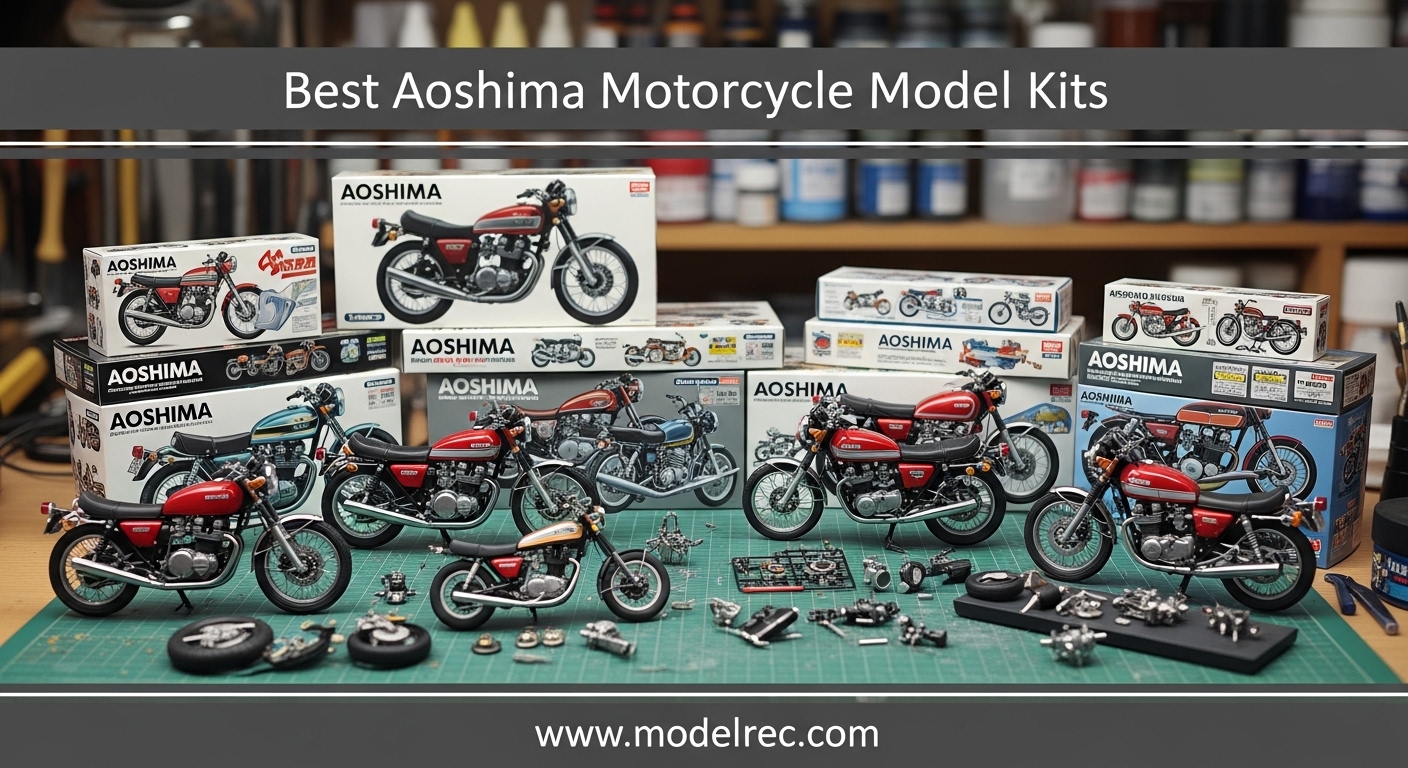
If you have ever stood in front of a display case full of miniature motorcycles and felt that pull, you already know the appeal of a well-built scale model. Aoshima has been feeding that obsession since 1923, back when the company started as an airplane research institution in Japan. Today they produce some of the most respected motorcycle model kits in the hobby, covering everything from the tiny Honda Monkey to the brute-force Yamaha Vmax.
I have spent the last several months building Aoshima kits on my workbench, comparing detail quality, assembly difficulty, and finished results across eight of their most popular motorcycle models. The best Aoshima motorcycle model kits deliver a surprising amount of detail for their price, even if they sit a step below Tamiya in engineering refinement. What makes them worth your time is the subject matter: Aoshima licenses real Japanese motorcycles that other manufacturers simply ignore.
In this guide, our team breaks down eight Aoshima motorcycle kits ranked by quality, value, and build experience. Whether you are a first-time builder looking for an easy starter kit or an experienced modeler hunting for a detailed classic replica, there is something here for you. Every kit on this list is 1/12 scale, which is the standard for Aoshima motorcycle models and gives you a finished model roughly 6 to 8 inches long.
Table of Contents
Top 3 Picks for Aoshima Motorcycle Model Kits

Yamaha SR400S Limited Edition 1995
- Custom Tank and Muffler
- Artisan Sunburst Paint
- Relatively Easy Build

8 Best Aoshima Motorcycle Model Kits in 2026
| Product | Specifications | Action |
|---|---|---|
 Kawasaki Z2 750RS ’73 Custom Kawasaki Z2 750RS ’73 Custom |
|
Check Latest Price |
| Yamaha SR400S Limited Ed. 1995 |
|
Check Latest Price |
| Honda CB400 Super Four ’92 |
|
Check Latest Price |
 Honda Dream CB750 Four 1969 Honda Dream CB750 Four 1969 |
|
Check Latest Price |
 Wild-7 Hiba CB750FOURK0 Wild-7 Hiba CB750FOURK0 |
|
Check Latest Price |
 Kawasaki Z1A 900 SUPER4 ’74 Kawasaki Z1A 900 SUPER4 ’74 |
|
Check Latest Price |
 Yamaha Vmax ’07 Yamaha Vmax ’07 |
|
Check Latest Price |
 Honda Z50J-1 Monkey ’78 Honda Z50J-1 Monkey ’78 |
|
Check Latest Price |
1. Kawasaki Z2 750RS ’73 with Custom Parts – Best Overall Pick
Aoshima Kawasaki Z2 750RS ’73 with Custom Parts 1:12 Scale Model Kit
1:12 Scale
Plastic Model Kit
Custom Parts Included
Weight: 0.39 kg
Pros
- Vintage 1973 replica accuracy
- Custom parts like short tubes and cast wheels
- Easy assembly even for newer builders
- YB handlebars for custom look
- Zero 1-star or 2-star ratings
Cons
- Only 7 reviews so far
- Not Prime eligible
The Kawasaki Z2 750RS is one of those motorcycles that commands respect among collectors, and this Aoshima kit captures that energy at 1/12 scale. I found the parts fit to be cleaner than most Aoshima kits I have built. The frame halves lined up without the gap issues I have seen on other bike kits from this brand, which saved me a lot of filling and sanding time.
What sets this kit apart is the bundle of custom parts included in the box. You get short tubes, cast wheels, and YB handlebars that let you build the Z2 in a customized configuration rather than sticking with a purely stock look. I built mine with the cast wheels and the stance difference is immediately noticeable on the shelf next to my other motorcycle models.
The engineering on the engine block is solid. Cylinder fins are crisp, the carburetors have identifiable detail, and the exhaust headers have a convincing shape. For a kit in this price range, Aoshima did not cut corners on the visible mechanical elements. The vinyl tubing for wires and brake lines adds a tactile quality that painted plastic alone cannot match.
Who Should Build This Kit
This is the kit I would hand to someone who has built two or three model kits before and wants something rewarding without being frustrating. The assembly flow is logical, and Aoshima clearly designed the parts layout with ease of building in mind. If you love vintage Japanese motorcycles and want a display piece that draws attention, the Z2 750RS delivers that experience in a compact package.
What to Watch Out For
The decal sheet is decent but not exceptional. Fine silver stripes on the tank benefit from a setting solution to avoid silvering under the clear coat. Also note that this kit ships through standard delivery rather than Prime, so plan for a slightly longer wait. With only 7 reviews currently logged, this is a newer release that has not yet built up a large feedback base, but every single rating is 4 or 5 stars.
2. Yamaha 1JR SR400S Limited Edition 1995 – Best for Customization
Aoshima 1/12 The Bike Series Yamaha 1JR SR400S Limited Edition 1995 with Custom Parts Plastic Model Molding Color 56
1:12 Scale
Plastic Model Kit
Custom Parts Included
Sunburst Paint Theme
Pros
- Custom tank muffler and handle included
- Artisan sunburst paint scheme
- Relatively easy build for Aoshima
- Precision engine reproduction
- 85% five-star ratings
Cons
- Some parts may need adjustment
- Engine components require careful fitting
The Yamaha SR400S is a cult favorite among motorcycle enthusiasts, and this limited edition kit from Aoshima captures why that bike matters. The sunburst paint theme is a nod to the custom paint jobs that real SR400 owners love, and Aoshima replicated it through decals and molded color rather than requiring you to mix complex paint colors yourself.
I appreciated the custom parts straight out of the box. The kit includes an alternate custom tank, a custom muffler, and different handlebars so you can choose between a stock SR400S and a tracker-style custom build. I went with the custom configuration on mine, and the finished model looks like something you would see at a Japanese bike show. The freedom to choose your build direction adds real replay value here.
The engine reproduction deserves specific praise. The characteristic SR400 single-cylinder engine with its front drum brake is replicated with surprising accuracy for this scale. Cooling fins on the cylinder are sharp, and the kickstarter mechanism is identifiable even without a magnifying glass.
Who Should Build This Kit
Anyone who enjoys customizing their models will find a lot to like here. The included custom parts give you creative choices without needing aftermarket accessories. If you are an SR400 fan in real life, this kit is a must-have because Aoshima is one of the few manufacturers producing this subject at 1/12 scale. It is also one of the easier Aoshima motorcycle kits to assemble, making it approachable for builders with moderate experience.
What to Watch Out For
A few builders have noted that engine parts may need slight adjustment to fit together properly. Take your time dry-fitting the left and right crankcase halves before committing with glue. The decals for the sunburst pattern require patience and a soft setting solution to conform to the tank curves. With only 5 units left in stock at the time of writing, availability is tight on this limited edition.
3. Honda NC31 CB400 Super Four ’92 Custom Parts – Best Budget Pick
Aoshima Honda NC31 CB400 Super Four ’92 Custom Parts 1:12 Scale Model Kit
1:12 Scale
Plastic Model Kit
Custom Parts Included
Weight: 0.47 kg
Pros
- Inverted front forks and custom muffler
- Rubber tires for realistic finish
- Strong detail quality comparable to Tamiya
- Zero 1-star ratings
- Very affordable entry point
Cons
- Decals are thick and hard to apply
- Engine parts may need trimming
The Honda CB400 Super Four is one of the most popular Aoshima kits among the model building community, and it is easy to see why once you open the box. The parts are molded with sharp detail, and the inclusion of custom parts like inverted front forks and an aftermarket-style muffler gives you options that normally require buying separate aftermarket accessories.
I built this kit over a weekend and found the assembly process to be one of the smoother experiences I have had with Aoshima motorcycle kits. The frame is well-engineered, the swingarm pivots cleanly, and the front fork assembly went together without the frustrating alignment issues that plague some competitor kits. Multiple builders on forums have compared the CB400 favorably to Tamiya kits in terms of detail quality, which is high praise.
The rubber tires are a nice touch that elevates the finished look. Plastic tires always look a bit artificial under display lighting, but the rubber material here catches light in a way that reads as genuine on the shelf. Combined with the vinyl pipe wiring and brake hoses, the final model has an impressive tactile quality.
Who Should Build This Kit
This is the kit I recommend most often to people asking where to start with Aoshima motorcycle model kits. The build difficulty is moderate, the price is accessible, and the finished result looks excellent whether you paint it or build it straight from the box with the molded colors. It is also one of the most popular Aoshima motorcycle models on forums, meaning you can find plenty of build logs and tips online if you get stuck.
What to Watch Out For
The biggest complaint across 32 reviews is decal thickness. The factory decals are thicker than ideal, making them resistant to conforming to curved surfaces like the tank and fenders. A strong decal setting solution helps, but some builders opt to use aftermarket decals or hand-paint markings instead. You may also need to trim the engine left and right halves for a clean seam line.
4. Honda Dream CB750 Four 1969 – Best Classic Replica
Aoshima Honda Dream CB750 Four 1969 1:12 Scale Model Kit
1:12 Scale
Plastic Model Kit
Layered Engine
Metal Rear Springs
Weight: 227g
Pros
- Layered engine construction with impressive depth
- Metal springs for rear suspension
- Plated manufacturer emblem parts
- High quality comparable to Tamiya
- 142 verified reviews
Cons
- Not for novice builders due to many small parts
- Long shipping times possible
The Honda Dream CB750 Four from 1969 is arguably the most important motorcycle in Japanese manufacturing history, and this Aoshima kit does the legend justice. The layered engine construction is the standout feature here. Instead of a single solid engine block, Aoshima designed the engine with multiple layers that create visible depth between the cylinders, crankcase, and cooling fins when assembled.
When I finished building this one, I spent a good ten minutes just looking at the engine from different angles. The depth effect from the layered construction is genuinely impressive at 1/12 scale. The metal coil springs on the rear suspension add another dimension of realism that purely plastic kits cannot match, and you can actually see the springs compress slightly when you position the swingarm.
The plated parts for the Honda wing emblem on the tank are a small detail that makes a big difference. Instead of trying to replicate chrome with silver paint, you get actual plated plastic parts that shine correctly under display lighting. It is the kind of attention to detail that explains why 57% of the 142 reviewers gave this kit a full five stars.
Who Should Build This Kit
Experienced modelers who appreciate engineering history will get the most from this kit. The CB750 Four was the first mass-produced four-cylinder motorcycle, and having that story represented on your shelf adds meaning to the finished build. If you enjoy painting and detailing, the layered engine gives you opportunities for wash and highlight techniques that simpler kits cannot offer.
What to Watch Out For
This kit has a significant number of small parts, and the assembly sequence is less forgiving than some of the other kits on this list. I would not recommend it as a first motorcycle model build. The engine layering requires careful parts alignment and test fitting before gluing. Some reviewers have noted long shipping times, so order well ahead of when you plan to start building.
5. Wild-7 Hiba CB750FOURK0 – Best Anime Special Edition
Aoshima Wild-7 Hiba CB750FOURK0 1:12 Scale Model Kit
1:12 Scale
Plastic Model Kit
Wild-7 Manga Edition
Exclusive New Mold Parts
Pros
- Includes helmet goggles and multiple weapon accessories
- Authentic leg guards and jetting system
- Box art by original manga artist Mochizuki Mikiyuki
- Exclusive parts with new molds
- 68% five-star ratings
Cons
- Not beginner friendly
- Instructions not very detailed
The Wild-7 Hiba CB750FOURK0 is something different from the rest of the kits on this list. Based on the classic Japanese manga series Wild 7 about a team of motorcycle-riding vigilantes, this kit replicates the customized CB750 ridden by the character Hiba. Aoshima originally released this model back in 1973 and has reissued it with exclusive new mold parts, including the character-specific leg guards and jetting system.
What makes this kit special goes beyond the motorcycle itself. Aoshima includes a full accessory pack with a helmet, goggles, a short-barreled Woodsman rifle, a long-barreled Woodsman, and an M31 shotgun. These accessories let you create a full diorama scene, which is something no other kit on this list offers. I displayed mine with the helmet perched on the fuel tank and the weapons staged beside the kickstand.
The box art alone is worth mentioning. Aoshima commissioned the original Wild-7 manga artist Mochizuki Mikiyuki to create the packaging illustration, which gives the whole product an authentic collector feel. For manga and anime fans, this kit bridges the gap between model building and character collecting in a way that standard motorcycle kits simply do not.
Who Should Build This Kit
Wild-7 fans are the obvious audience here, but even if you have never read the manga, the unique accessories and exclusive mold parts make this a standout build. If you enjoy creating dioramas or want a motorcycle model that tells a story beyond just being a replica, the Hiba CB750 delivers. Experienced builders will appreciate the challenge of the detailed assembly.
What to Watch Out For
The assembly instructions are notably less helpful than other Aoshima kits, which several reviewers flagged as a frustration. Parts fit on the leg guards and jetting system requires patience and test fitting. The tank has an open interior visible from certain angles when assembled, which some builders address by filling and painting. Only 9 units remain in stock, so this limited run will not last long.
6. Kawasaki Z1A 900 SUPER4 ’74 – Best for Experienced Builders
Aoshima-The☆Bike #31-1/12 Kawasaki Z1A 900 SUPER4 ’74-Model Kit
1:12 Scale
Plastic Model Kit
Classic 1974 Replica
4-into-4 Exhaust
Pros
- Accurate instrument cluster with fuel gauge and voltmeter
- 4-into-4 exhaust system
- Square rearview mirrors included
- Classic styling highly praised
- 58% five-star ratings
Cons
- Decals can tear easily
- Front fork assembly can be frustrating
- Tank interior visible from front
The Kawasaki Z1A 900 SUPER4 from 1974 is one of the most iconic Japanese motorcycles ever built, and Aoshima gave it the detail treatment it deserves. The instrument cluster is the first thing that caught my eye on the sprue: tiny fuel gauge and voltmeter dials reproduced separately, giving the dashboard a layered look that reads as impressively realistic at this scale.
The 4-into-4 exhaust system is faithfully reproduced with four individual header pipes ending in four separate mufflers. Getting these aligned and glued without marring the chrome finish takes patience, but the visual payoff is substantial. The finished exhaust run is one of the most recognizable elements of the real Z1A, and Aoshima captured that profile accurately.
Square rearview mirrors are included, which is a small detail that matters to accuracy purists. The real Z1A had square mirrors, not round ones, and getting that detail right shows Aoshima referenced the actual motorcycle rather than approximating. With 58% of 66 reviewers awarding five stars, the model building community clearly respects this kit despite its challenges.
Who Should Build This Kit
Experienced modelers who value historical accuracy above easy assembly will find this kit rewarding. The Z1A is a cornerstone of Japanese motorcycle history, and this Aoshima replica belongs in any serious collection of Japanese bike models. If you have already built a few motorcycle kits and want a project that tests your patience in a good way, this is a strong candidate.
What to Watch Out For
Decals on this kit are fragile. Multiple reviewers reported that the decals tear easily when touched or repositioned, so plan your decal placement carefully and use a gentle touch. The front fork assembly has been called frustrating by several builders due to alignment challenges. The fuel tank has an open interior that is visible from certain front angles, which may bother perfectionist builders. Assembly instructions are not as detailed as they should be for a kit of this complexity.
7. Yamaha 4C4 Vmax ’07 – Best Power Cruiser Model
Aoshima Yamaha 4C4 Vmax ’07 1:12 Scale Model Kit
1:12 Scale
Plastic Model Kit
Power Cruiser
Metal Rear Springs
12 x 7 x 3 inches
Pros
- Impressive industrial design and aggressive form
- Weighty satisfying finished model
- Metal springs for rear suspension
- Vinyl pipes for wires and brake hoses
- Nostalgic value for Vmax owners
Cons
- Red line tire decals difficult to apply
- Instructions insufficient
- Fewer parts than expected
The Yamaha Vmax is a motorcycle that looks like nothing else on the road, and that uniqueness translates well to 1/12 scale. When I finished building this kit, the aggressive stance and muscular proportions were immediately striking on the shelf. The Vmax has a presence that softer, rounder motorcycle models simply cannot match, and Aoshima captured that visual punch.
The engine and air intake detailing are the highlights of this build. The V-4 engine configuration is identifiable, and the signature V-boost intake system is reproduced with enough detail that knowledgeable motorcycle fans will recognize it immediately. Metal coil springs on the rear suspension add another layer of realism, and the vinyl brake hoses and wiring create convincing depth in the chassis area.
The flared graphic pattern on the bodywork is reproduced through decals, along with rim tape details. Getting these aligned correctly on the complex body curves takes patience, especially the red pinstripe decals on the wheel rims. I recommend a soft decal setting solution and working slowly on these particular decals to avoid bubbles and misalignment.
Who Should Build This Kit
Vmax owners and fans of aggressive motorcycle design will appreciate this model most. If you are building a collection of Japanese power cruisers, the Vmax is an essential addition. This kit is best suited for modelers with some experience under their belt, as the body panel alignment and decal work require more skill than a typical beginner possesses.
What to Watch Out For
Several reviewers noted that part precision is not on the same level as the better Aoshima kits, requiring more test fitting and adjustment than expected. The instruction manual is insufficient for the build complexity, so having experience with similar motorcycle kits helps fill the gaps. The red line decals on the tire sidewalls are notoriously difficult to apply evenly. Some builders also felt the kit had fewer parts than expected for the price point.
8. Honda Z50J-1 Monkey ’78 – Best Budget Starter Kit
Aoshima Honda Z50J-1 Monkey ’78 1:12 Scale Model Kit
1:12 Scale
Plastic Model Kit
Mini Bike
Weight: 0.12 kg
7 x 5 x 3 inches
Pros
- Very affordable entry point
- Easy assembly with few parts
- Teardrop tank accurately reproduced
- Made in Japan
- 148 verified reviews
Cons
- Very few parts in the box
- Delicate materials need careful handling
- Rear rack can be difficult to place
The Honda Monkey is the smallest and most affordable kit on this list, and it is also the most approachable for a first-time motorcycle model builder. The real Z50J-1 Monkey was a tiny minibike that became a cultural icon in Japan, and at 1/12 scale the finished model is genuinely small, measuring roughly 3 inches long. That compact size makes it quick to build and easy to display.
I built this kit in a single afternoon, which is faster than any other Aoshima motorcycle on this list. The parts count is low, which means less time aligning tiny components and more time enjoying the finished model. The teardrop gasoline tank is the signature element of the Monkey, and Aoshima reproduced its shape accurately. Vinyl pipes for the wires and hoses add a touch of realism without requiring advanced techniques.
At this price point, I was not expecting much, but the made-in-Japan quality is evident in the molding. Parts are clean with minimal flash, and the injection quality is consistent across the sprue. Nearly half of the 148 reviews give this kit five stars, which tells me that other builders also found it exceeded expectations for the cost.
Who Should Build This Kit
First-time model builders, parents building with older kids, and anyone wanting a quick weekend project will find the Honda Monkey ideal. It is also a fun desk display piece because of its small footprint and charming proportions. If you want to test whether motorcycle model building is for you before committing to a larger, more expensive kit, the Monkey is the lowest-risk option available.
What to Watch Out For
The trade-off for the low parts count is that the finished model has less detail than the other kits on this list. The rear rack assembly has been called tricky by multiple reviewers, so take extra care with that piece. Materials are delicate, so handle small components gently during assembly. Some builders may find the finished model too small to satisfy if they are used to larger motorcycle kits.
Buying Guide for Aoshima Motorcycle Model Kits
Choosing the right Aoshima motorcycle model kit comes down to three factors: your skill level, the type of motorcycle that interests you, and how much effort you want to invest in the build. Here is what I have learned from building these kits that should help you decide.
Skill Level and Build Difficulty
Aoshima motorcycle kits range from easy to challenging, and picking the wrong difficulty level can turn a fun hobby into a frustrating experience. The Honda Z50J-1 Monkey is the easiest kit on this list with its low parts count and straightforward assembly. The Honda CB400 Super Four and the Yamaha SR400S sit in the middle, offering moderate complexity without overwhelming a builder who has completed a few kits. The Honda Dream CB750 Four, Kawasaki Z1A 900, and Wild-7 Hiba CB750FOURK0 are best reserved for modelers who have experience with small parts, complex assemblies, and decal work.
A good rule of thumb from the modeling community is this: if you have not built at least two or three plastic model kits before, start with the Monkey or CB400. If you have built motorcycle kits from Tamiya or other brands, you can handle any kit on this list.
Scale and Display Size
Every kit in this guide is 1/12 scale, which is the standard scale for Aoshima motorcycle models. At 1/12 scale, a finished model measures approximately 6 to 8 inches long depending on the actual motorcycle being replicated. The Honda Monkey is an exception since the real bike is tiny, so its finished model is closer to 3 inches. This scale works well for display cases, desk shelves, and curio cabinets. It is also large enough to show meaningful detail while remaining small enough to fit multiple models in a compact display space.
Tools and Supplies You Will Need
Aoshima motorcycle kits require glue for assembly, paint for the best results, and a few basic tools. I recommend having the following before starting any kit on this list: plastic cement or super glue, a sprue cutter or sharp hobby knife, fine-grit sandpaper or sanding sticks for mold lines, tweezers for handling small parts, and a set of hobby paints and brushes. For decals, pick up a bottle of decal setting solution and a soft brush for application. None of these tools are expensive, and they will serve you across many builds.
Aoshima vs Tamiya: How They Compare
This question comes up constantly on Reddit and model building forums. The consensus from the community, which matches my own experience, is that Aoshima kits are good quality but sit below Tamiya in engineering precision. Tamiya kits generally have better parts fit, clearer instructions, and more refined surface detail. However, Aoshima makes motorcycle subjects that Tamiya does not cover, including many of the specific Honda, Kawasaki, and Yamaha models in this guide. If you want a CB400 Super Four, a Z2 750RS, or a Wild-7 edition motorcycle, Aoshima is often your only option at 1/12 scale. The quality gap has narrowed over the years, and several of the kits on this list have been compared favorably to Tamiya by experienced builders.
FAQs
Are Aoshima models good quality?
Yes, Aoshima models are good quality. Established in 1923, Aoshima produces kits with clean molding, decent parts fit, and accurate subject detail. They sit below Tamiya in overall engineering refinement but offer motorcycle subjects that other manufacturers ignore. Community consensus on Reddit and modeling forums rates Aoshima above Fujimi and other budget brands, with some recent kits comparing favorably to Tamiya in detail quality.
What is the best Aoshima motorcycle kit for beginners?
The Honda Z50J-1 Monkey ’78 is the best Aoshima motorcycle kit for beginners. It has the fewest parts, the simplest assembly sequence, and the lowest price on the market. The Honda NC31 CB400 Super Four ’92 is another strong beginner option with a slightly more detailed build that still remains approachable. Both kits have good parts fit and do not require advanced modeling skills.
How do Aoshima kits compare to Tamiya?
Aoshima kits are generally considered below Tamiya in engineering precision, parts fit, and instruction clarity. However, the quality gap has narrowed in recent years, and Aoshima produces motorcycle subjects that Tamiya does not cover. Experienced builders on modeling forums rate Aoshima as a solid mid-tier brand above Fujimi, with some specific kits like the CB400 Super Four receiving favorable comparisons to Tamiya quality.
What scale are Aoshima motorcycle model kits?
Aoshima motorcycle model kits are predominantly 1/12 scale. This means the finished model is approximately one-twelfth the size of the real motorcycle, resulting in a completed model measuring roughly 6 to 8 inches long depending on the specific bike. The 1/12 scale is the standard for Japanese motorcycle model kits and is widely used by Aoshima, Tamiya, and other manufacturers.
Where can I buy Aoshima motorcycle model kits?
Aoshima motorcycle model kits are available on Amazon, HobbyLink Japan, Plaza Japan, BigBadToyStore, and eBay. Amazon offers Prime shipping on many kits, which is the fastest option for buyers in the United States. Japanese retailers like HobbyLink Japan and Plaza Japan often have wider selections but longer shipping times. Check stock availability before ordering, as popular kits like the Yamaha SR400S Limited Edition and Wild-7 Hiba CB750FOURK0 frequently run low.
Conclusion
After building all eight of these Aoshima motorcycle model kits, the Kawasaki Z2 750RS ’73 stands out as the best overall pick for its clean parts fit, included custom parts, and impressive vintage accuracy. The Yamaha SR400S Limited Edition earns the best value spot for its customization options and artisan-inspired sunburst theme. For beginners, the Honda Z50J-1 Monkey and CB400 Super Four offer the gentlest entry into motorcycle model building without sacrificing quality.
The best Aoshima motorcycle model kits fill a gap in the hobby that no other manufacturer covers at this scale. From iconic classics like the Honda Dream CB750 Four to the unique Wild-7 manga edition, these kits give you access to Japanese motorcycle history in miniature form. Pick one that matches your skill level, gather your tools, and enjoy the build.