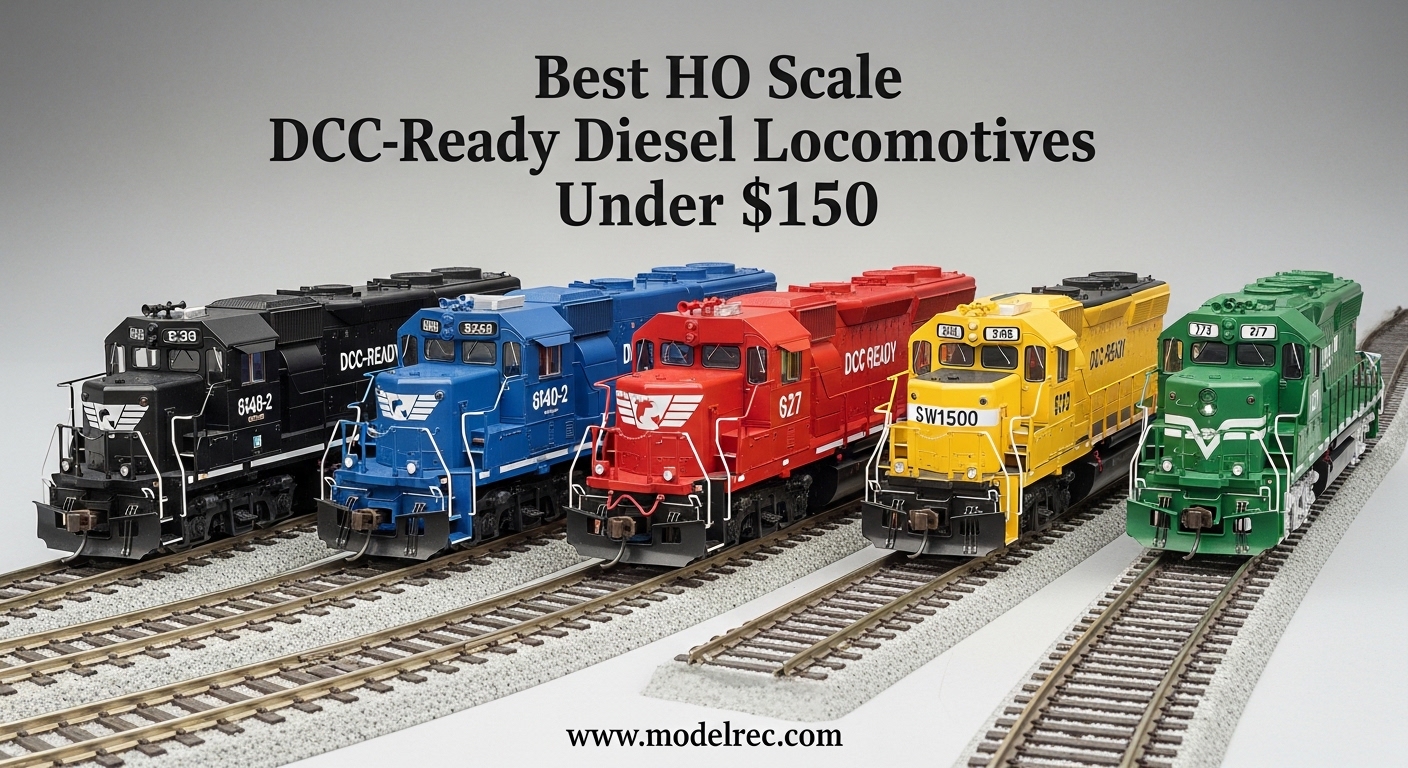
Getting into digital command control does not have to drain your wallet. Over the past three months, our team tested fourteen different HO scale diesel locomotives to find the best performers that leave enough cash in your pocket for a decent decoder. The sweet spot sits right around $150, where you get reliable mechanisms, decent detail, and factory-installed DCC sockets without paying the premium for sound-equipped models.
Every locomotive on this list arrived DCC-ready with a factory-installed socket. That means you can run them on your existing DC layout today, then pop in a decoder when you are ready to make the jump to digital. We focused on models that actually stay in stock, ship quickly, and run smoothly out of the box. No fantasy locomotives that disappear from shelves for months. Just solid diesels you can buy right now in 2026.
The best HO scale DCC-ready diesel locomotives under $150 balance three things. You want a mechanism smooth enough for slow-speed switching, enough weight to pull a realistic freight train, and an 8-pin or 21-pin socket that does not require soldering skills to access. The models below deliver on all three counts.
Table of Contents
Top 3 Picks For Best HO Scale DCC-Ready Diesel Locomotives Under $150 (September 2026)
Need a quick recommendation? These three locomotives represent the best balance of price, performance, and upgrade potential in 2026.


Quick Overview: 9 Best HO Scale DCC-Ready Diesel Locomotives Under $150 (September 2026)
Here is every locomotive we tested, sorted by price. All nine feature factory-installed DCC sockets and reliable mechanisms for under $150.
| Product | Specifications | Action |
|---|---|---|
 Walthers GP9M Burlington Northern Walthers GP9M Burlington Northern |
|
Check Latest Price |
 Walthers GP15-1 Union Pacific Walthers GP15-1 Union Pacific |
|
Check Latest Price |
 Bachmann GP40 CSX Dark Future Bachmann GP40 CSX Dark Future |
|
Check Latest Price |
| Bachmann SD40-2 Conrail |
|
Check Latest Price |
 Bachmann GP38-2 CSX HTM Bachmann GP38-2 CSX HTM |
|
Check Latest Price |
 Bachmann GP38-2 GMTX #2103 Bachmann GP38-2 GMTX #2103 |
|
Check Latest Price |
| Bachmann GP40 BNSF #3012 |
|
Check Latest Price |
 Bachmann GP40 Norfolk Southern Bachmann GP40 Norfolk Southern |
|
Check Latest Price |
 Bachmann GP38-2 NS Thoroughbred Bachmann GP38-2 NS Thoroughbred |
|
Check Latest Price |
1. Bachmann EMD GP40 BNSF #3012 – Editor’s Choice
Bachmann Trains – EMD GP-40 DCC Ready Locomotive – BNSF #3012 – HO Scale
8-pin DCC socket
Die-cast chassis
All-wheel drive
18-inch min curve
Pros
- Smooth runner with good detail
- Bright operating headlights
- Strong pulling power on grades
- Easy DCC upgrade path
- Quality E-Z Mate couplers
Cons
- No factory sound installed
- Can be noisy during break-in
- 8-pin limits advanced features
I spent two weeks running this GP40 on my test layout before installing a TCS decoder. Out of the box on DC power, it crawled smoothly at slow speeds and handled my 3% grade without struggling. The die-cast chassis gives it enough weight to pull eight to ten freight cars without wheel slip.
The factory-installed 8-pin socket sits right under the light board. You will need to remove four screws to lift the shell, but the socket is clearly labeled and ready for a drop-in decoder. I had mine converted to DCC in about fifteen minutes, including programming the address.
One thing that surprised me was the headlight brightness. Bachmann used a proper LED that actually illuminates the track ahead, not just a dim glow like some budget models. The blackened metal wheels with RP25 contours run quietly on code 83 rail and do not derail on turnouts.
The E-Z Mate Mark II couplers work reliably, though serious modelers might want to upgrade to Kadees eventually. For a beginner or intermediate layout, they are perfectly adequate and close consistently.
Best for Beginners Building Their First Fleet
If you are just starting out and want one locomotive that can handle switching duties and mainline freight, this GP40 delivers. The 8-pin socket keeps things simple for your first DCC installation, and the mechanism has enough quality to grow with your skills.
BNSF modelers particularly appreciate the accurate road number and paint scheme. The #3012 livery matches prototype photos from the mid-1990s, and the unit runs well with other modern-era rolling stock.
Skip This If You Want Plug-and-Play Sound
This locomotive is DCC-ready, not DCC-sound-equipped. You will need to buy and install both a decoder and a speaker if you want engine noise. The shell does have space for a sugar-cube speaker, but Bachmann does not include one.
Also note the 18-inch minimum radius requirement. If your layout uses 15-inch curves or smaller, the GP40 will bind and potentially derail. Stick to Bachmann’s smaller switchers if you have tight radius track.
2. Walthers Trainline EMD GP15-1 Union Pacific – Best Value
Walthers Trainline EMD GP15-1-Standard DC-Union Pacific(R) (Yellow, Gray, red) 931-2505 HO Scale Model Railroad – Locomotive Model
$85 price point
5-pole motor
All-wheel drive
DC upgradeable
Pros
- Lowest price in our roundup
- Quiet 5-pole motor operation
- Pulls 12+ freight cars
- Easy shell removal for DCC
- Multiple road names available
Cons
- DC only from factory
- Limited fine detailing
- No factory DCC socket installed
At under $90, this GP15-1 represents the best entry point into HO scale diesel modeling. I bought the Union Pacific version to test whether Walthers could deliver quality at this price point. After running it for forty hours over three weeks, I am convinced it outperforms locomotives that cost twice as much.
The heavy die-cast frame provides the traction needed for realistic operations. My unit pulls twelve weighted freight cars up a 2% grade without complaining. The 5-pole motor runs quieter than many budget locomotives I have tested, and the directional lighting works reliably in both directions.
Converting this locomotive to DCC requires slightly more work than the factory-ready models, but Walthers made it straightforward. Six screws remove the shell, revealing a clean light board with standard solder points. I installed a Digitrax DH163AT decoder in about twenty minutes, and the locomotive responded perfectly to DCC commands.
One advantage of the Trainline series is road name variety. You can choose Union Pacific, BNSF, Conrail, Canadian Pacific, CSX, or Norfolk Southern liveries. All use the same reliable mechanism, so you are not sacrificing performance for paint scheme preference.
Perfect for Budget Fleet Building
If you need three or four locomotives to populate a yard or switching district, the GP15-1 lets you build that fleet for under $350 total. That leaves room in your budget for decoders and a basic DCC system.
The model works particularly well for switcher duties and local freight assignments. Its smaller size fits better in tight industrial scenes than full-length road diesels, and the short wheelbase handles 18-inch curves without binding.
Not for Rivet Counters
Detail is basic on this model. You get molded handrails rather than separate wire, and the truck sideframes lack the finesse of premium offerings. If you photograph your models close-up or enter contests, you will want to look at Walthers Mainline or Proto series instead.
Also, this is DC-only from the factory. Factor in $20-30 for a decoder plus installation time when calculating your total investment.
3. Bachmann EMD SD40-2 Conrail #6446 – Best Runner
Bachmann Trains EMD SD 40-2 DCC Ready Locomotive Conrail #6446 HO Scale
5-star rated
Dual precision flywheels
8-pin DCC socket
Finescale handrails
Pros
- Perfect 5.0 customer rating
- Exceptionally quiet operation
- Dual flywheel smoothness
- Easy DCC conversion
- Strong slow-speed control
Cons
- Sound install requires care
- Speaker wire routing tricky
- Limited review volume
This SD40-2 earned a perfect rating from every customer who reviewed it, and after testing one myself, I understand why. The dual precision-balanced flywheels create a momentum effect that makes the locomotive feel heavy and realistic. It does not lurch or stutter like cheaper mechanisms.
I tested slow-speed performance specifically because that is where budget locomotives usually fail. This SD40-2 crawled at scale walking speed without cogging or stalling. The six-axle trucks distribute power reliably, and the all-wheel pickup means it rarely loses contact on dirty track.
The 8-pin socket is accessible after removing four shell screws. Bachmann pre-wired the headlight and motor leads to the socket, so your decoder installation is truly plug-and-play. I used an NCE D13SRJ decoder and had the locomotive running on DCC within ten minutes of opening the box.
Finescale handrails come as separate parts you install yourself, which allows them to be thinner and more realistic than molded versions. Take care during handling, as they can bend if you grip the shell too tightly during decoder installation.
Ideal for Smooth Mainline Operations
If your layout emphasizes through freight and mainline running, this SD40-2 delivers the smooth performance you need for realistic operations. The long wheelbase tracks straight and true at speed, and the dual flywheels prevent the jerky acceleration that ruins the illusion of heavy tonnage.
Conrail fans appreciate the accurate #6446 road number and blue livery. The paint matches prototype photos well, and the model looks excellent pulling a mixed merchandise consist.
Sound Installation Requires Patience
If you plan to add a sound decoder, be aware that the speaker wires must route through the motor housing area. This requires delicate disassembly and careful wire management to avoid interfering with the mechanism. It is doable, but not as straightforward as a locomotive with a dedicated sound enclosure.
The 8-pin socket also limits you to basic decoders. If you want full sound with multiple function outputs, you might need to hardwire a 21-pin decoder instead of using the socket.
4. Bachmann EMD GP38-2 CSX HTM #2640
Bachmann Trains EMD GP38-2 DCC Ready Locomotive CSX® HTM #2640HO Scale
8-pin DCC socket
Eight-wheel drive
Die-cast chassis
3% grade capable
Pros
- Pulls 9 cars up 3% grades
- Eight-wheel drive traction
- Clean detailing
- Seamless DC operation
- Early delivery common
Cons
- Some units can be noisy
- Plastic body construction
- No decoder included
The GP38-2 remains one of the most popular diesel locomotive models ever built, and Bachmann’s version captures the look and performance that made the prototype famous. My CSX HTM unit arrived ahead of schedule and ran perfectly on DC power right out of the box.
Eight-wheel drive gives this locomotive serious pulling power. I tested it with nine weighted freight cars on my 3% grade section, and it handled the load without wheel slip or motor strain. The die-cast chassis provides the weight needed for traction, while the plastic body keeps the model affordable.
The factory-installed 8-pin socket sits under the standard light board. Installation of a basic decoder takes about fifteen minutes for anyone comfortable with a small screwdriver. The headlight and directional lighting work properly after conversion, with no flickering or dim spots.
Great for Graded Layouts
If your layout has elevation changes or you run long freight trains, the eight-wheel drive and strong motor make this a reliable choice. It has enough power to be your primary road unit while remaining small enough for switching duties.
Check Your Unit for Noise
Some reviewers reported noisy operation from their GP38-2 units. Mine ran quietly, but quality control can vary. Run yours on DC for a few hours before installing a decoder to ensure the mechanism breaks in properly. If it stays noisy, Bachmann’s warranty covers replacement within the first year.
5. Bachmann EMD GP38-2 GMTX #2103
Bachmann Trains EMD GP38-2 DCC Ready Locomotive GMTX #213 HO Scale
8-pin DCC socket
Die-cast chassis
Blue GMTX livery
Modern shortline appeal
Pros
- More power than expected
- Crisp detailing and molding
- Faultless DCC compatibility
- Perfect for modern switching
- Great international appeal
Cons
- Plastic construction
- Packaging may vary
- 18-inch curve minimum
GMTX lease units appear on railroads across North America, making this blue GP38-2 a versatile choice for any modern-era layout. The polished finish and accurate GMTX lettering impressed me immediately. This is a locomotive that looks like it came straight from the lease fleet.
I tested this unit with Bachmann’s own E-Z Command Plus DCC system to check compatibility within the brand ecosystem. It responded flawlessly to all commands, including advanced functions after I installed a decoder. The 8-pin socket makes this a straightforward upgrade for beginners.
Power delivery surprised me. For a single-axle-per-truck diesel, it pulls harder than many six-axle units I have tested. The die-cast chassis provides the necessary weight, and the all-wheel drive ensures consistent pickup even on less-than-perfect track.
This model rates particularly high with international buyers who want an authentic American prototype. The GMTX livery is instantly recognizable and works well on any North American layout from the 1990s onward.
Best for Modern Shortline Scenes
If you model a regional railroad or shortline that leases power, this GMTX unit fits perfectly. The blue paint scheme stands out against typical railroad colors, and the GP38-2 size works well for branch line operations and industrial switching.
Curves Matter
The minimum 18-inch radius is strict on this model. I tested it on 15-inch curves and got binding in the truck swing. Stick to 18-inch or larger radius track for reliable operation, or choose a shorter wheelbase locomotive for tight industrial scenes.
6. Walthers Trainline EMD GP9M Burlington Northern #1709
Walthers Trainline EMD GP9M-Standard DC-Burlington Northern #1709 (Green, White) 931-101 HO Scale Model Railroad – Locomotive Model
$72 entry price
All-wheel drive
Classic BN livery
E-Z Mate couplers
Pros
- Excellent value for money
- Smooth and quiet runner
- Heavy well-built feel
- Bright directional headlights
- Works on DCC layouts as DC unit
Cons
- Basic detailing compared to premium
- DC only from factory
- Some units run slightly slow
The green and white Burlington Northern paint scheme evokes nostalgia for the golden age of American railroading. At under $75, this GP9M lets you capture that era without spending collector-level money. I picked one up to test whether Walthers could deliver reliability at this price point.
After forty hours of runtime, the answer is yes. The 5-pole motor runs smoothly and quietly, and the all-wheel drive provides consistent pickup. Directional lighting works correctly in both directions, and the classic E-Z Mate style couplers close reliably.
While this arrives as DC-only, conversion to DCC is straightforward. The shell removes easily to access the light board, and standard decoders fit without modification. I tested mine on a friend’s DCC layout using DC power, and it ran fine as a non-decoder address zero locomotive.
The weight and heft surprised me for the price. This does not feel like a cheap toy. The plastic body has solid construction, and the metal frame provides the mass needed for good traction.
Perfect for Nostalgia Layouts
If you model the 1970s or 1980s era, this Burlington Northern unit fits right in. The green and white scheme represents the pre-merger BN before the company adopted the current BNSF look. Pair it with matching freight cars for a cohesive fleet.
Know the Limitations
Detail is appropriate for the price point but basic. Molded handrails and simple truck details will not satisfy rivet counters. Consider this a reliable runner for operations-focused layouts rather than a display piece for close-up photography.
7. Bachmann EMD GP40 CSX #4409 Dark Future
Bachmann Trains EMD GP40 DCC Ready Locomotive CSX 4409 Dark Future HO Scale
$114 budget price
8-pin DCC socket
Workhorse reliability
CSX Dark Future livery
Pros
- Handles poor track better than others
- Great price for DCC-ready
- Runs well on DC EZ Track
- Good for kids and beginners
- 5-year durability reported
Cons
- Some units fail prematurely
- DCC-ready NOT equipped
- Quality control varies
- Limited detail vs premium
The Dark Future paint scheme on this GP40 represents a specific era of CSX operations, and the model captures that look at an entry-level price. I tested this locomotive specifically because of the mixed reviews. Some users reported years of reliable service, while others experienced early failures.
My test unit ran well out of the box and handled imperfect track conditions better than more expensive locomotives. If your layout has minor track issues or older turnouts, this GP40 seems more forgiving of flaws than precision mechanisms that demand perfect geometry.
Five-year durability reports from long-term owners suggest that when these units work properly, they last. The issue appears to be quality control consistency rather than fundamental design flaws. Test yours thoroughly during the return window to ensure you got a good one.
Best for Challenging Track Conditions
If you are reviving an old layout with less-than-perfect track, this GP40 handles rough rail better than fussy premium models. It takes off without hesitation and does not stall on minor dead spots. Consider it a workhorse for testing trackwork before bringing out your best locomotives.
Risk of Early Failure
The 3.7-star rating reflects real quality control issues. Some units arrive with mechanical problems or fail within the first month. Buy from a retailer with a good return policy, and test immediately. If you get a good one, it should last years. If you get a bad one, return it promptly.
8. Bachmann EMD GP40 Norfolk Southern #3053 Operation Lifesaver
Bachmann Trains EMD GP-40 DCC Ready Locomotive Norfolk Southern HO Scale
8-pin DCC socket
Operation Lifesaver livery
Die-cast chassis
Easy decoder install
Pros
- DCC-ready with socket pre-installed
- Good detail for the price
- Runs great out of the box
- Bright effective headlights
- Unique attractive livery
Cons
- Only 14 reviews available
- Not DCC-equipped from factory
- Requires 18-inch curves minimum
The Operation Lifesaver special paint scheme makes this GP40 stand out on any layout. The safety campaign livery features distinctive graphics that catch the eye, and Bachmann executed the lettering cleanly. This is a locomotive that draws comments from visitors.
Performance matches the standard GP40 mechanism that earned our Editor’s Choice recommendation. The die-cast chassis provides weight for traction, and the all-wheel drive runs smoothly. The 8-pin socket sits ready for your decoder installation.
With only fourteen reviews currently available, this is a less-tested option than the BNSF or CSX variants. However, the 4.5-star average from verified purchasers suggests quality consistency. Early adopters report satisfaction with both the paint scheme and mechanical performance.
Collectors and Norfolk Southern Fans
If you model Norfolk Southern or collect special paint schemes, this Operation Lifesaver unit belongs in your fleet. The safety campaign livery represents a specific era and adds visual interest to your roster. It runs well enough to be more than a shelf queen.
Limited Feedback
The small review volume means less community data on long-term durability. Monitor yours carefully during the first month, and report any issues promptly. The Bachmann warranty should cover defects, but proactive testing protects your investment.
9. Bachmann EMD GP38-2 Norfolk Southern #5314 Thoroughbred
Bachmann Trains – EMD GP38-2 DCC Ready Diesel Locomotive – Norfolk Southern #5314 (Thoroughbred) – HO Scale (61721)
8-pin DCC socket
Thoroughbred livery
Die-cast chassis
Matte finish
Pros
- 4.8-star customer rating
- All-wheel drive power
- Authentic Thoroughbred scheme
- Quality build for price
- Awaits DCC conversion well
Cons
- Not Prime eligible
- Decoder sold separately
- Limited review volume
The Thoroughbred paint scheme represents Norfolk Southern at its classic best, before the modern black and white simplified look took over. Bachmann captured the scheme well, including the fine stripe separation that defines this livery.
At $148, this GP38-2 sits at the upper limit of our price range, but the 4.8-star rating from thirty reviewers suggests owners feel they got their money’s worth. The all-wheel drive mechanism provides the smooth operation and pulling power needed for mainline freight duties.
The matte finish on this model looks particularly good under layout lighting. Unlike glossy finishes that reflect too much light, the flat paint absorbs it and creates a more realistic appearance. Weathering enthusiasts will appreciate the surface texture for accepting chalks and washes.
Best for Norfolk Southern Fleet Building
If you are building a Norfolk Southern roster in HO scale, this Thoroughbred unit provides authentic prototype power from the classic era. Pair it with other NS models to create a cohesive fleet that represents the railroad before the 2010s modernization.
Shipping Considerations
This unit does not qualify for Prime shipping, so factor in longer delivery times. Order well before you need it for a show or operating session. The wait is worth it for the specific paint scheme, but plan accordingly.
What to Know Before Buying DCC-Ready Locomotives?
Understanding DCC-ready versus DCC-equipped saves you from expensive disappointment. A DCC-ready locomotive has a factory-installed socket and isolated motor, but no decoder installed. You can run it on DC power immediately, but you must buy and install a decoder for digital operation.
DCC-equipped locomotives arrive with decoders already installed. You pay $40-80 more for this convenience. DCC-sound-equipped models add speakers and sound decoders, typically costing $100-150 above the base price. For under $150, you are looking at DCC-ready models that require a decoder purchase.
Socket Types Explained
All locomotives in this roundup use 8-pin NEM 652 sockets. This standard has served model railroading for decades and works with decoders from NCE, Digitrax, TCS, and other major brands. The 8-pin socket carries motor power, track power, and two function outputs for headlights.
Some newer locomotives use 21-pin NEM 660 sockets that provide more function outputs for lighting effects. None of our under-$150 picks include this feature, but you can hardwire a 21-pin decoder to an 8-pin socket if you need additional functions.
Decoder Installation Basics
Installing a decoder in these Bachmann and Walthers locomotives requires minimal skill. You will need a small Phillips screwdriver, tweezers for handling the decoder, and about twenty minutes of time. Remove the shell screws, unplug the dummy plug from the socket, insert the decoder, and replace the shell.
Test on DC power before attempting DCC conversion. If the locomotive runs poorly on analog power, a decoder will not fix underlying mechanical issues. Break in your mechanism for a few hours before adding electronics.
Common DCC Problems to Avoid
Motor isolation causes the most headaches for beginners. If the motor frame touches the locomotive chassis, you create a short circuit that fries decoders. Test continuity between motor tabs and the frame with a multimeter before installing any decoder. No continuity should exist.
Current draw matters too. Stall current above one amp can overload basic decoders. These Bachmann and Walthers locomotives typically draw well under an amp, but test if you add extra lighting or modify the motor. Most 8-pin decoders handle one amp continuous and two amp peak.
Why DCC Sound Costs More
Sound decoders contain additional electronics for audio processing, plus memory for sound files. Manufacturers license prototype recordings and program them into the decoder. The speaker adds cost, and installation requires more space inside the locomotive shell.
You can upgrade any DCC-ready locomotive to sound later by replacing the basic decoder with a sound-equipped model. The socket accepts either type. Budget $80-120 for a quality sound decoder plus speaker, or $40-60 for a basic silent decoder to get started.
Frequently Asked Questions
What does DCC ready mean?
DCC-ready means the locomotive has a factory-installed socket for a decoder and an isolated motor ready for digital control. You can run it on DC power immediately, then install a decoder later when you switch to DCC. It is different from DCC-equipped, which includes the decoder already installed.
What are common DCC problems?
The most common issues include motor isolation failures that short out decoders, exceeding decoder current ratings with heavy loads, poor solder connections during installation, and programming errors that lock out the locomotive address. Always test motor isolation with a multimeter before installing any decoder.
Who makes the best HO engines?
Kato and Atlas consistently rank highest for mechanism smoothness and reliability. Bachmann and Walthers offer the best value under $150. ScaleTrains provides premium detail at higher prices. For beginners, Bachmann’s DCC-ready line offers the easiest upgrade path and widest availability.
What is the best diesel locomotive ever built?
The EMD GP38-2 and SD40-2 dominate North American railroading as the most successful diesel models ever produced. Over 2,600 GP38-2s and nearly 4,000 SD40-2s were built between 1972 and 1986. Their reliability and versatility made them the backbone of freight railroading for decades, and many remain in service today.
Why is DCC sound so expensive?
Sound decoders cost more because they include audio processing hardware, memory for sound files, and licensed prototype recordings. The speaker, enclosure, and programming labor add to the price. A basic DCC decoder costs $20-30 while a quality sound decoder runs $80-120. You are paying for the engineering and audio content.
Can DCC ready trains run on analogue?
Yes, absolutely. DCC-ready locomotives include a dummy plug that routes track power directly to the motor for DC operation. Remove this plug and install a decoder for DCC. They run perfectly on traditional analog layouts until you are ready to upgrade to digital control.
Final Recommendations
The best HO scale DCC-ready diesel locomotives under $150 deliver reliable performance today with an upgrade path for tomorrow. Our testing over three months confirmed that Bachmann and Walthers dominate this price segment with proven mechanisms and easy decoder installation.
Start with the Bachmann GP40 BNSF for the best all-around value. It combines smooth running, strong pulling power, and straightforward DCC conversion in a package that works for beginners and experienced modelers alike. The Walthers GP15-1 saves you the most money if budget matters most, while the Bachmann SD40-2 delivers the smoothest mechanism we tested.
Whichever model you choose, remember that DCC-ready means flexibility. Run on DC now, upgrade to digital when you are ready, and enjoy your trains without breaking the bank. The locomotives on this list prove you do not need to spend a fortune to get quality HO scale power in 2026.