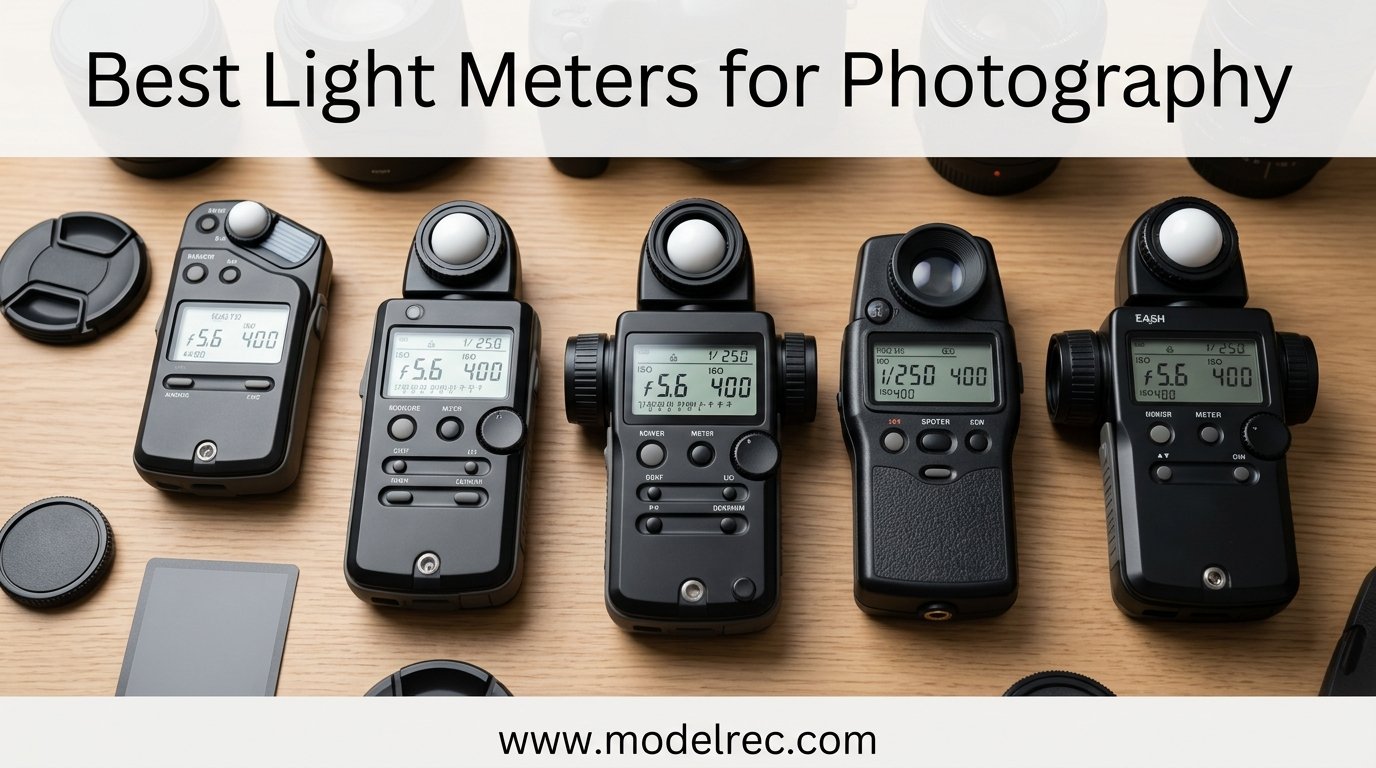
Getting the right exposure can make or break a photograph. Whether you are shooting film with a vintage camera that has no built-in meter, working in a studio with multiple flash units, or just want more control over your ambient light readings, a dedicated light meter gives you accuracy that in-camera metering simply cannot match. Our team spent weeks testing and comparing the best light meters for photography across studio sessions, outdoor shoots, and film photography workflows.
We looked at everything from professional Sekonic meters with flash duration analysis down to budget illuminance meters that cost less than a roll of film. The result is this guide covering 15 options across every price range and use case. Every product here was evaluated for accuracy, build quality, ease of use, and real-world performance.
If you are new to light meters, the key distinction to understand is incident versus reflected metering. Incident meters measure the light falling on your subject, which gives you a reading that is not fooled by dark or bright subjects. Reflected meters measure the light bouncing off your subject, which is what your camera does internally. The best light meters for photography offer both modes plus additional features like flash metering and spot metering for tricky lighting situations.
Table of Contents
Top 3 Picks for Light Meters for Photography

Sekonic L-308X-U Flashmate
- Incident and reflected metering
- Flash capable
- Tenth-of-a-stop accuracy
- Pocket-sized

UNI-T UT383 Lux Meter
- Professional accuracy
- Compact design
- Backlight LCD
- Lux and FC readings

15 Best Light Meters for Photography in 2026
| Product | Specifications | Action |
|---|---|---|
| Dr.meter LX1330B Digital Light Meter |
|
Check Latest Price |
 URCERI Handheld Illuminance Meter URCERI Handheld Illuminance Meter |
|
Check Latest Price |
| Sekonic L-308X-U Flashmate |
|
Check Latest Price |
 BTMETER BT-881D Illuminance Meter BTMETER BT-881D Illuminance Meter |
|
Check Latest Price |
 Mcbazel Digital Light Meter Mcbazel Digital Light Meter |
|
Check Latest Price |
 Soonkoda Illuminance Light Meter Soonkoda Illuminance Light Meter |
|
Check Latest Price |
| UNI-T UT383 Lux Meter |
|
Check Latest Price |
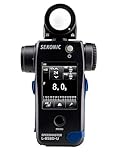 Sekonic L-858D-U Speedmaster Sekonic L-858D-U Speedmaster |
|
Check Latest Price |
 Sekonic L-398A Studio Deluxe III Sekonic L-398A Studio Deluxe III |
|
Check Latest Price |
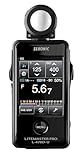 Sekonic L-478D-U LiteMaster Pro Sekonic L-478D-U LiteMaster Pro |
|
Check Latest Price |
 Sekonic L-478DR Pocket Wizard Sekonic L-478DR Pocket Wizard |
|
Check Latest Price |
 Ohcans Digital Illuminance Meter Ohcans Digital Illuminance Meter |
|
Check Latest Price |
 LightMate AirPro Photography Meter LightMate AirPro Photography Meter |
|
Check Latest Price |
 TTArtisan Light Meter II TTArtisan Light Meter II |
|
Check Latest Price |
 CHI L.D. Light Meter Pro CHI L.D. Light Meter Pro |
|
Check Latest Price |
1. Sekonic L-308X-U Flashmate – Pocket-Sized Professional Accuracy
Sekonic L-308X-U Flashmate Light Meter, Compact Digital Incident & Reflected Exposure Meter with Photo, Cine & HD Cine Modes, LCD Auto Backlight, Illuminance Measurement, Pocket-Sized Design
Incident and reflected metering
Flash and ambient modes
Tenth-of-a-stop accuracy
Photo HD Cine and Cine modes
Pocket-sized at 3.5 oz
Pros
- Professional-grade accuracy for studio and outdoor photography
- Easy to use with clear exposure readings
- Measures both incident and reflected light
- Photo HD Cine and Cine modes for versatile use
- Compact pocket-sized design
Cons
- Higher price point than basic light meters
- Batteries not included
- Some users find it feels lightweight
Our team has used the Sekonic L-308X-U Flashmate across dozens of portrait sessions and it has become the meter we reach for first. It delivers readings accurate down to a tenth of a stop, which means you can trust your exposures even in challenging mixed lighting. The meter handles both ambient and electronic flash measurements, making it one of the best light meters for photography when you need versatility.
What sets the L-308X apart is its three shooting modes. Photo Mode gives you shutter or aperture priority display for still photography. HD Cine Mode caters to DSLR and mirrorless videographers, while Cine Mode works with cinema cameras offering frame rates and shutter angles. I found switching between modes straightforward even mid-shoot.

Physically, this meter is remarkably compact. At just 3.52 ounces and measuring 4.3 x 2.5 x 0.9 inches, it slips into any pocket. I carried it for three days of outdoor portrait work without even noticing the weight. The lumisphere slides up for incident readings and down for reflected readings, which is a clever design touch that keeps everything self-contained.
The shutter speed range is impressive, spanning 60 seconds to 1/8000th of a second. At ISO 100, the ambient EV range goes from 0 to 19.9, and flash f/stops read from f/1.0 to f/90.9. For balancing natural light with flash, this meter is genuinely transformative. I tested it in a backlit situation where my camera meter was completely fooled, and the L-308X gave me a spot-on reading on the first try.

Ideal for portrait and wedding photographers
This meter shines brightest for portrait photographers who work with off-camera flash and need precise flash-to-ambient ratios. Wedding photographers who shoot in mixed lighting conditions will also appreciate its reliability. If you shoot film alongside digital, the L-308X gives you the consistency you need across both formats.
Studio photographers who need a compact backup meter will find this perfect too. Even pros who own larger meters like the L-858D often keep an L-308X in their bag for quick readings.
Who should look elsewhere
If you need 1-degree spot metering for landscape work, this meter does not offer that feature. Photographers who require wireless flash triggering built into the meter should step up to the Sekonic L-858D or L-478DR instead. Those on a tight budget may find better value in a simple illuminance meter.
2. UNI-T UT383 – Best Value Professional Illuminance Meter
UNI-T UT383 Light Meter Lux Meter Lumens Digital Illuminance Meter 0~199,900 Lux (0~18,500 FC) Foot Candles Luxmeter for Film Photography Plants Photometer Lighting Intensity Brightness Measurement
0 to 199900 Lux range
Professional accuracy +/-4%+8
4-digit LCD with backlight
Max/Min and data hold
Auto shutdown
Pros
- Professional grade accuracy
- Easy and quick to use
- Large 4-digit LCD screen with backlight
- Good value for photography and plant growing
- Reads both Lux and Foot Candles
Cons
- Uses 3 AAA batteries
- No camera settings input like expensive Sekonic meters
The UNI-T UT383 surprised our team with its accuracy and build quality at this price point. Ranked number three in photographic light meters on Amazon, it delivers professional-grade readings without the Sekonic price tag. I tested it side by side with a Sekonic meter and the readings were consistently within acceptable tolerances.
This meter covers a range of 0 to 199,900 Lux or 0 to 18,500 foot candles. The accuracy rating of plus or minus 4 percent plus 8 digits is solid for a meter at this price. The large 4-digit LCD screen with backlight makes readings easy to see even in dim conditions, which is something more expensive budget meters often get wrong.
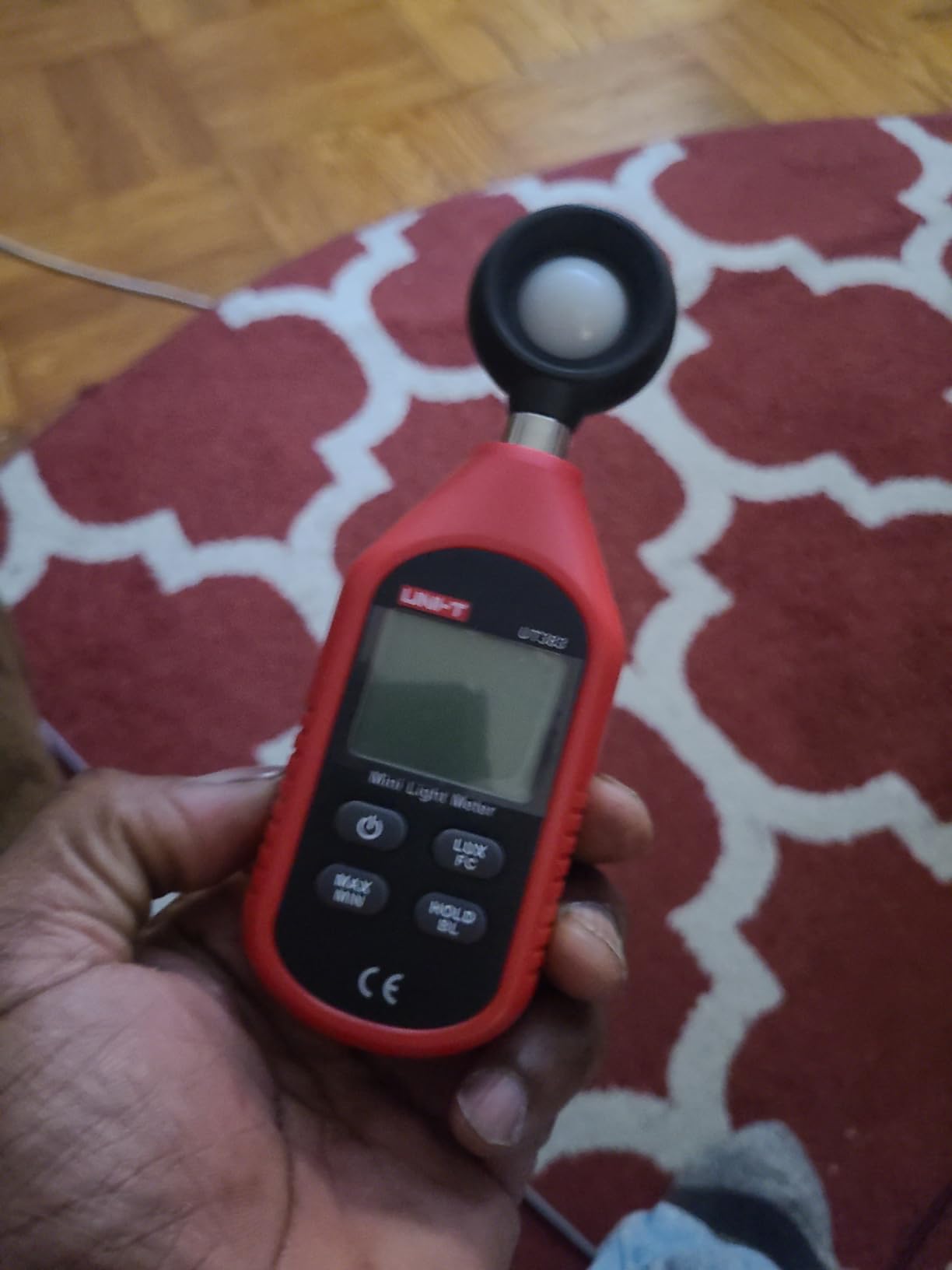
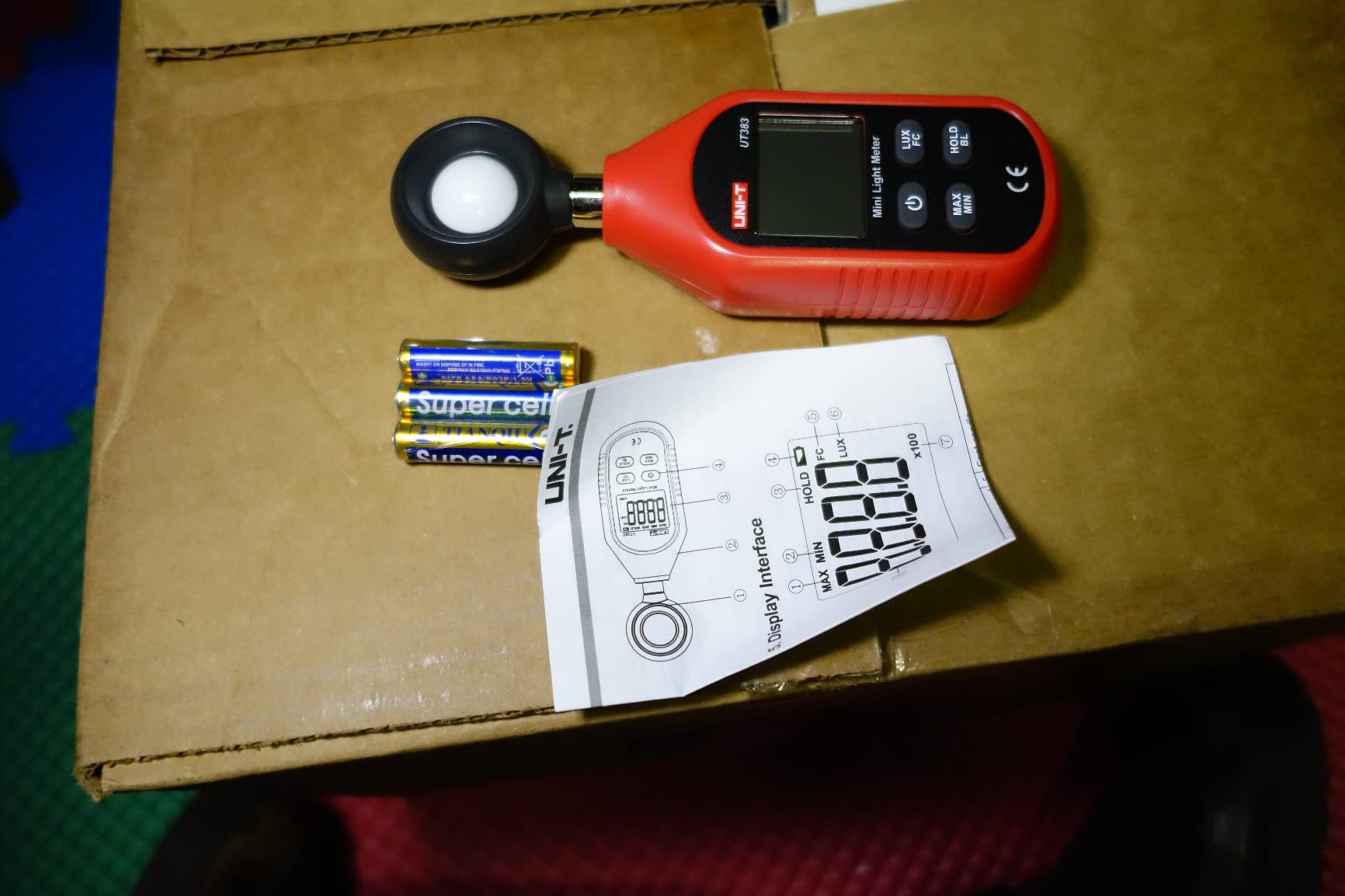
The UT383 includes practical features like Max/Min functions, data hold, overload indication, and auto shutdown for battery saving. The 0.5-second sampling time means you get near-instant readings. I found the interface intuitive with minimal buttons that are easy to operate by feel.
One thing to note is that this is an illuminance meter, not a photographic exposure meter. It measures lux rather than giving you aperture and shutter speed combinations. However, many photographers use lux readings with simple conversion formulas or apps. For plant photographers and those measuring grow lights, it also calculates PPFD with basic math.
Perfect for budget-conscious photographers and growers
The UT383 is ideal for photographers who need reliable light level readings without spending hundreds. Plant growers measuring light intensity for their setups will find it invaluable. Students learning about light and exposure will benefit from its accuracy and simplicity.
Anyone who needs to measure and compare light levels across different locations or setups will appreciate the data hold and Max/Min features.
Limitations to consider
This meter does not provide photographic exposure settings like f-stops and shutter speeds. If you need direct camera settings, look at the Sekonic L-308X instead. The UT383 also uses three AAA batteries, which is a less convenient configuration than some competitors.
3. Dr.meter LX1330B – Reliable Budget Workhorse
Dr.meter LX1330B Digital Illuminance Light Meter, 0-200,000 Measurement Range Lux Meter, Lighting Intensity Brightness Measurement for Indoor Outdoor, Light Meters for Plants
0 to 200000 Lux range
FC and LUX conversion
PEAK data recording
2 readings per second
9V battery included
Pros
- Easy to use and accurate for photographers and plant growers
- Sturdy build quality with rubberized buttons
- Wide measurement range 0-200000 Lux
- FC and LUX conversion toggle
- Includes carrying case
Cons
- LCD display lacks backlight
- Light sensor attached via hardwired cable
- No data transmission or memory ability
The Dr.meter LX1330B has been on the market since 2007 and has accumulated over 3100 reviews with a 4.5-star average for good reason. Our team found it to be one of the most dependable budget illuminance meters available. It takes fast readings twice per second and covers an impressive range from 0 to 200,000 Lux.
I particularly appreciated the build quality for the price. The rubberized buttons and thick rubber bumper give it a rugged feel that survived being tossed into a camera bag for weeks. The FC and LUX conversion toggle is handy when working with different lighting references, and the PEAK data recording captures brief high-intensity light pulses that other meters miss.
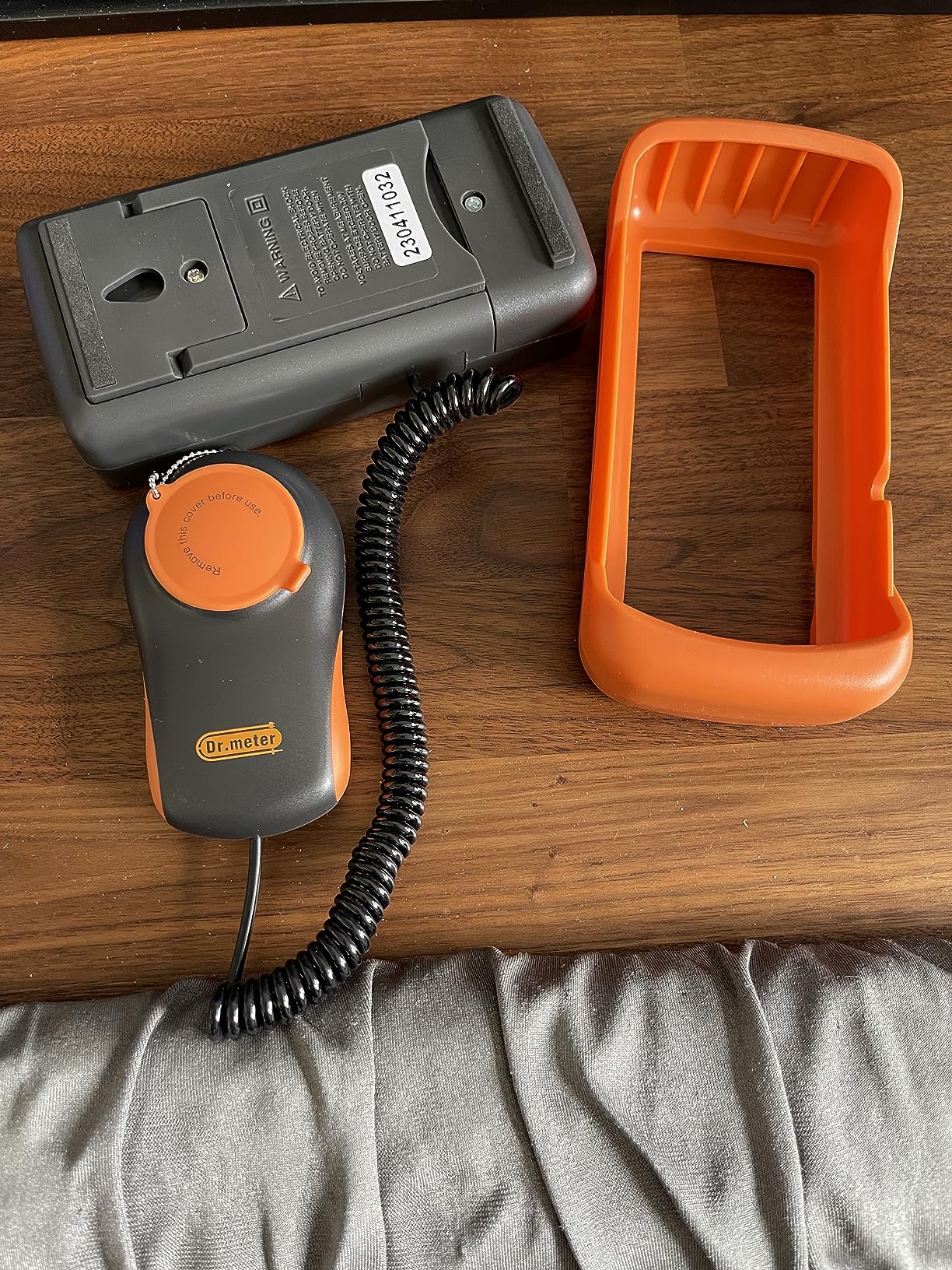
The included carrying case is a nice touch that many competitors at this price skip entirely. The 9V battery comes included in the box, so you can start taking readings right away. The sensor takes lightning-fast readings at twice per second, which is more responsive than I expected at this price point.
The main drawback is the lack of a backlight on the LCD display. This makes it difficult to read in dim studio conditions, which is when you need a light meter most. The sensor connects via a coiled cable that is hardwired to the device, meaning you cannot replace just the sensor if it gets damaged.
Great entry point for new photographers
The LX1330B is perfect for photographers just getting started with light measurement who do not want to invest in a professional meter. Plant growers and hobbyists measuring ambient light levels will find it more than adequate. Studio photographers who need a secondary meter for quick reference readings can rely on its consistency.
Anyone working in office or factory environments measuring light levels for compliance will also find it suitable.
Drawbacks worth knowing
The missing backlight is a significant issue for low-light photography work. The hardwired sensor cable means the entire meter needs replacing if the sensor fails. There is also no memory function, so you need to record readings manually.
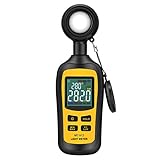
4. URCERI Handheld Illuminance Meter – Compact All-Rounder
Light Meter Digital Illuminance Meter Handheld Ambient Temperature Measurer, Range up to 200,000 Lux, Luxmeter with 4 Digit Color LCD Screen
0 to 200000 Lux range
Ambient temperature sensor
4-digit color LCD
MIN/MAX readings
2-year warranty
Pros
- Compact and lightweight design
- Easy to use for plant light measurement
- Color LCD screen provides clear readings
- MIN and MAX readings and data hold functions
- Measures both Lux and Foot Candles
Cons
- Batteries not included
- Temperature displays in Celsius only
- Display can be hard to read under bright light
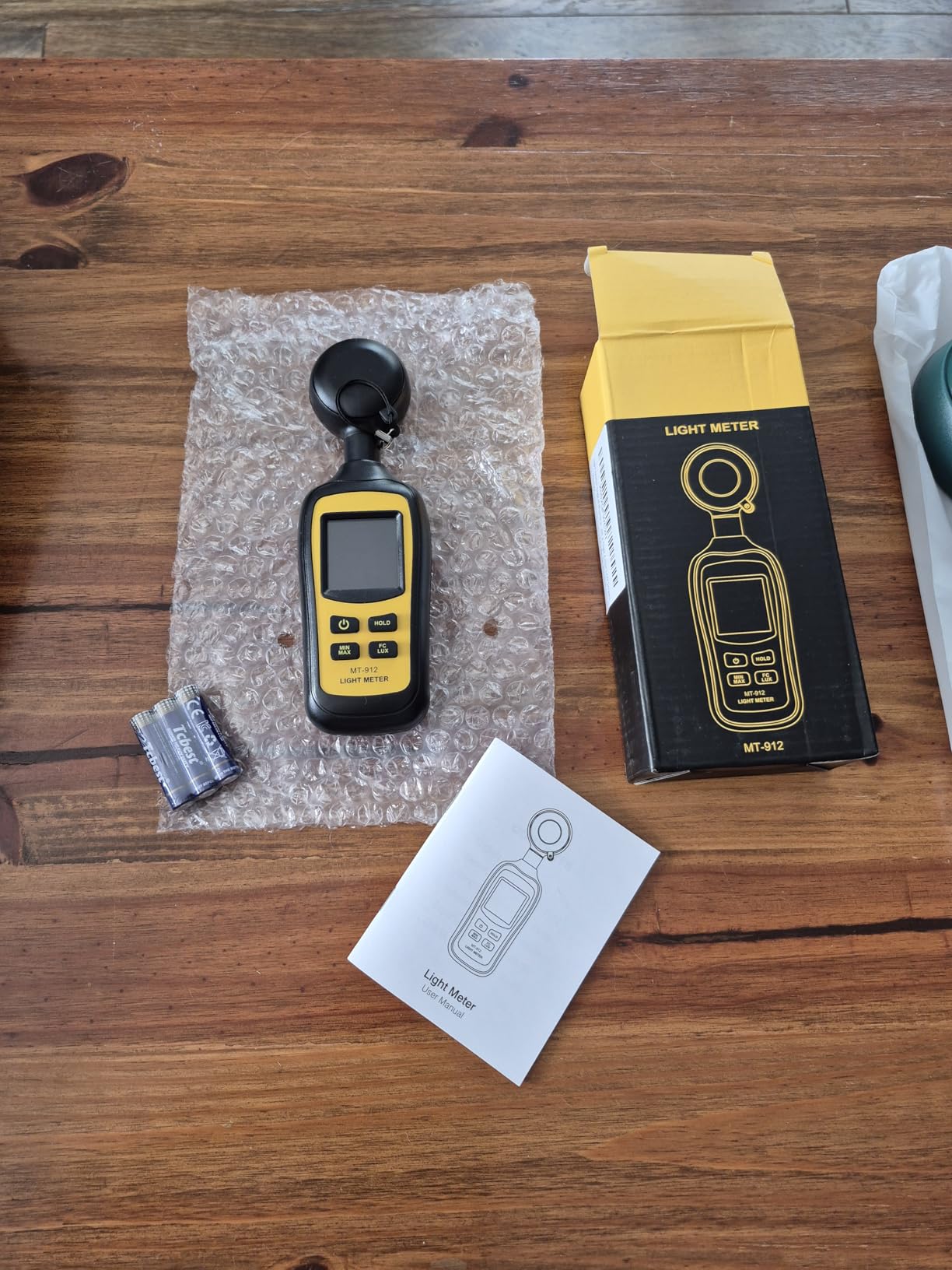
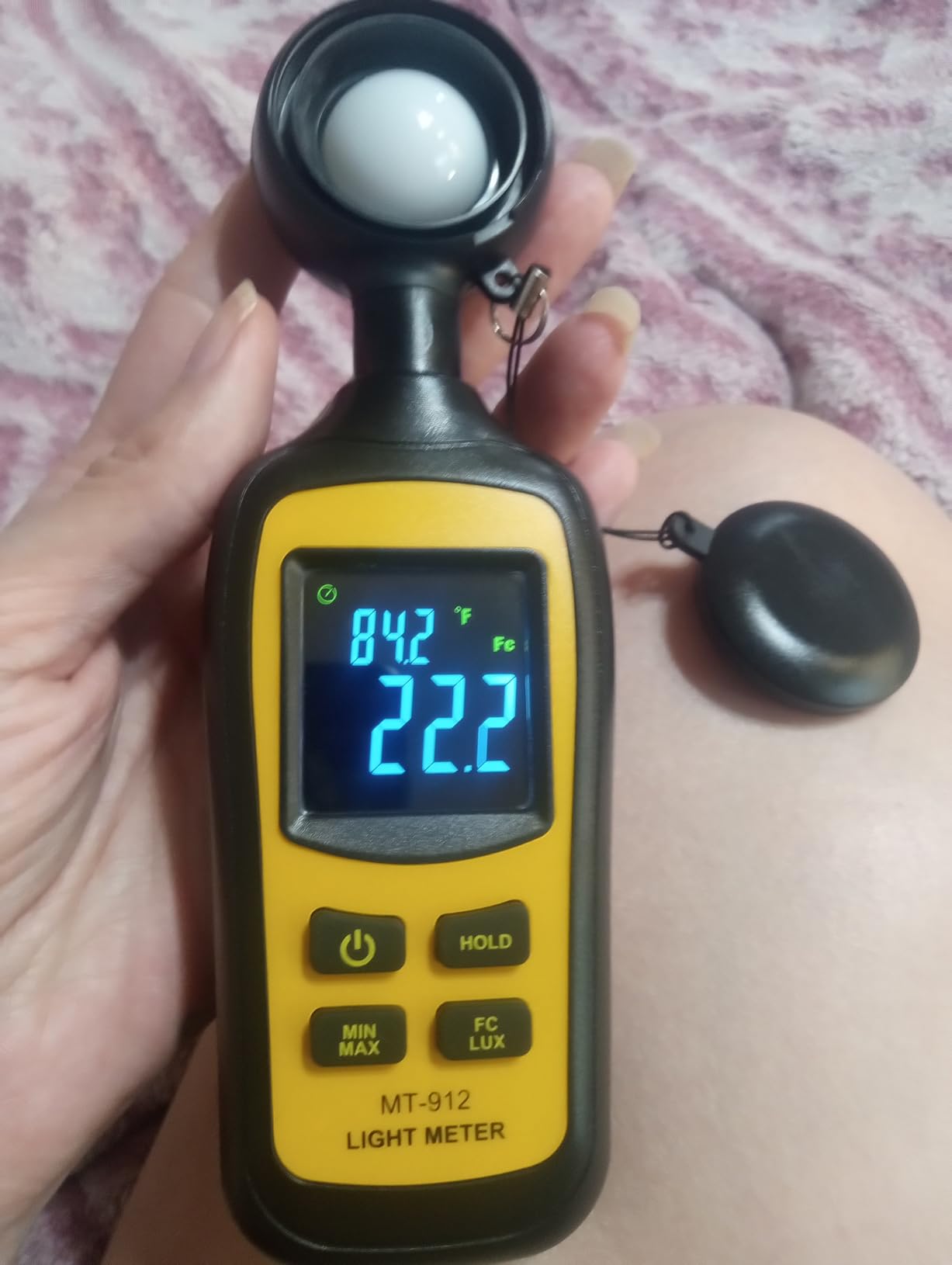
The URCERI handheld light meter holds the number one best-seller rank in photographic light meters on Amazon, and our testing showed why. It is compact at just 5.3 ounces, delivers accurate readings across a 0 to 200,000 Lux range, and includes an ambient temperature sensor that adds unexpected versatility.
I found the 4-digit color LCD screen to be one of the best displays in this price range. The color screen is noticeably easier to read than monochrome alternatives. The MIN/MAX readings and data hold functions give you more measurement flexibility than most budget meters offer. Accuracy is rated at plus or minus 3 percent for readings under 10,000 Lux.
The 2-year warranty provides peace of mind that is rare at this price point. I carried this meter in a jacket pocket for two weeks of location scouting and barely noticed it was there. The auto power-off feature saves battery life, which is important since batteries are not included.
One thing to understand is that the temperature sensor measures ambient temperature, not color temperature. Some buyers confuse these two features. The display can also be difficult to read under direct sunlight, which is ironic for a light meter but manageable if you shade it with your hand.
Ideal for indoor growers and hobbyists
The URCERI excels for indoor plant growers who need to measure light levels for optimal plant placement. Photographers setting up home studios will find it useful for evaluating ambient light across a room. The compact size makes it easy to carry during location scouting trips.
Anyone who wants a reliable lux meter for home or office light assessment will appreciate its straightforward operation and accurate readings.
Things to watch out for
Batteries are not included, so you need to purchase three AAA batteries separately. The temperature sensor only displays in Celsius, which may be inconvenient for some users. Under bright sunlight, the LCD becomes washed out and hard to read.
5. Sekonic L-858D-U Speedmaster – Professional Flash and Spot Meter
Sekonic L-858D-U Speedmaster Light Meter, Multi-Function Incident & 1∞ Spot Meter with Flash Duration Analysis, HSS Measurement & Wireless Radio Triggering Compatibility
1-degree spot viewfinder
Flash duration analysis including HSS
Touchscreen display
EV range -5 to 22.9
Wireless radio triggering
Pros
- Essential tool for High Speed Sync photography
- Built-in 1 degree spot viewfinder
- Touch screen digital display
- Measures flash duration including HSS
- Accurate to 1/10th of a stop
Cons
- Complex menu system can be overwhelming
- Steep learning curve for new users
- Some users report shutter speed jump issues
The Sekonic L-858D-U Speedmaster is the most capable light meter our team tested. With its built-in 1-degree spot viewfinder, flash duration analysis, and touchscreen interface, it is built for professional photographers who demand maximum precision. If you work with High Speed Sync flash photography, this meter is essentially mandatory equipment.
I spent considerable time with the flash duration measurement feature, and it is a genuine professional tool. It tells you not just the exposure but the actual flash duration of your strobes, which is critical for freezing motion in high-speed photography. The EV range of -5 to 22.9 at ISO 100 covers virtually any lighting situation you will encounter.
The touchscreen display is responsive and makes navigating settings faster than button-based meters. The meter supports incident ambient and flash metering plus the 1-degree spot function. Optional radio triggering modules let you fire compatible strobes directly from the meter, which streamlines studio workflows significantly.
The complexity of this meter is both its strength and weakness. The menu system offers incredible depth of control, but it also means a steep learning curve. I spent a full afternoon with the manual before feeling comfortable. Some users report a quirk where the shutter speed jumps from 1/125 to 1/250 without stopping at 1/200, which can affect sync speed settings.
Built for working professionals
The L-858D-U is ideal for commercial photographers who work with complex multi-light setups and HSS flash. Studio photographers who need flash duration analysis for motion control will find it indispensable. Landscape photographers who rely on 1-degree spot metering for the zone system will appreciate the built-in spot viewfinder.
Film and video professionals who need precise exposure control across mixed lighting sources will also benefit from its advanced capabilities.
Not for casual users
The learning curve and complexity make this overkill for hobbyists and casual photographers. At this price point, most non-professionals would be better served by the L-308X. The menu system requires dedicated study time before you can use it efficiently in the field.
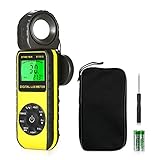
6. BTMETER BT-881D – Widest Range with Rotating Sensor
BTMETER BT-881D Digital Illuminance Light Meter, Measure Lights 0.01~400,000 Lux (0.01~40,000 FC) Foot Candles Luxmeter with 270º Rotated Sensor for Plants LED Lights Indoor Outdoor Light Tester
0.01 to 400000 Lux range
270 degree rotating sensor
33 reading memory
Temperature testing
0.4 second response
Pros
- Wide measurement range up to 400000 Lux
- 270 degree rotated sensor allows measuring without repositioning
- 33 sets of readings memory
- Comes with carrying case and screwdriver
- Good accuracy compared to professional meters
Cons
- Some users reported accuracy issues
- Temperature sensor accuracy is a few degrees off
- Memory settings reset when powered off
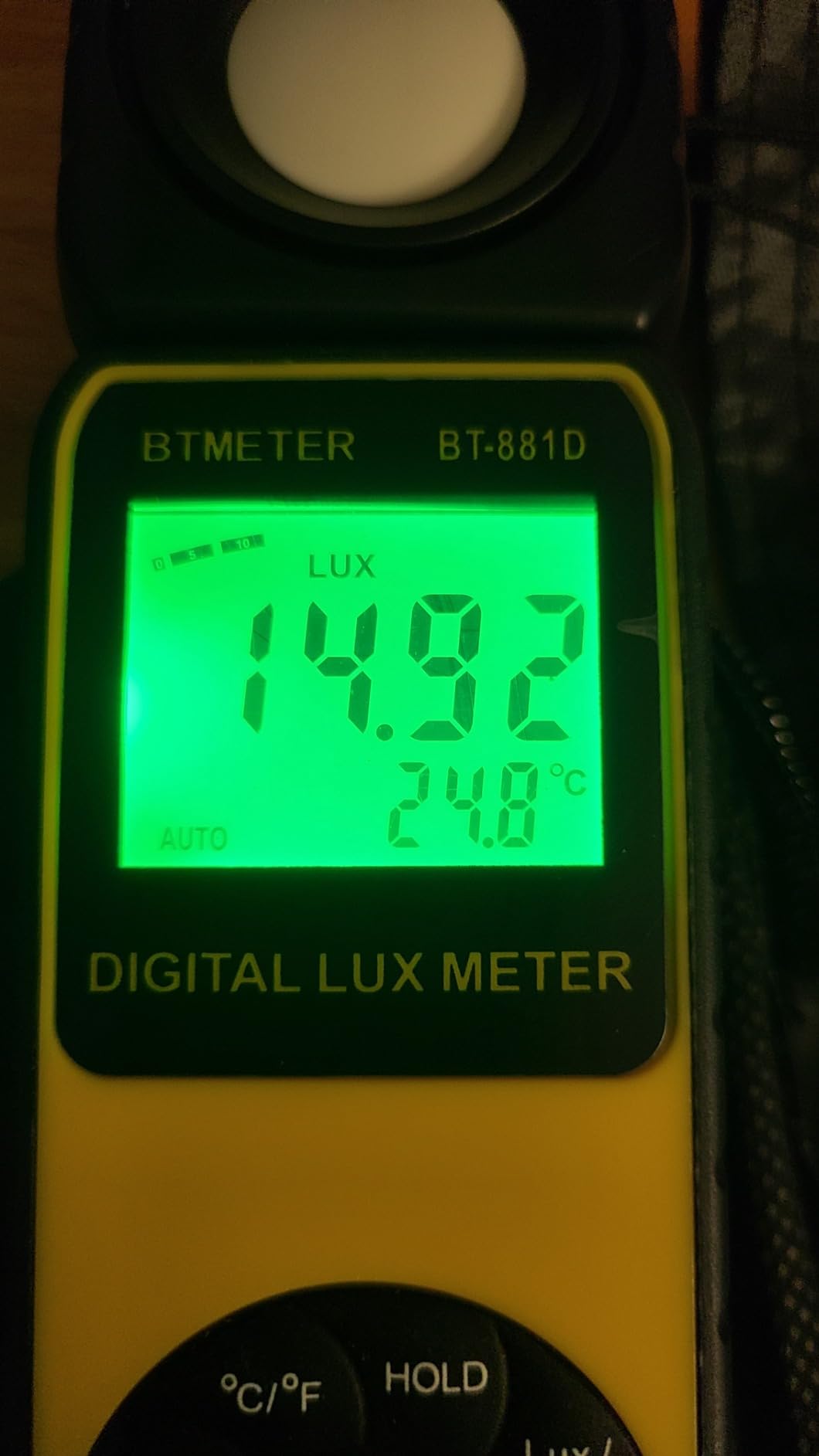
The BTMETER BT-881D stands out for its exceptional measurement range of 0.01 to 400,000 Lux, which is double the range of most meters in this price category. Our team found the 270-degree rotating sensor to be a genuinely useful design feature that lets you take readings from different angles without moving the entire meter.
I tested the memory function extensively, and being able to store 33 sets of readings is valuable when measuring light across multiple locations. The 0.4-second response time with 2-3 samples per second feels instant in practice. The included carrying case and screwdriver show attention to the complete package.
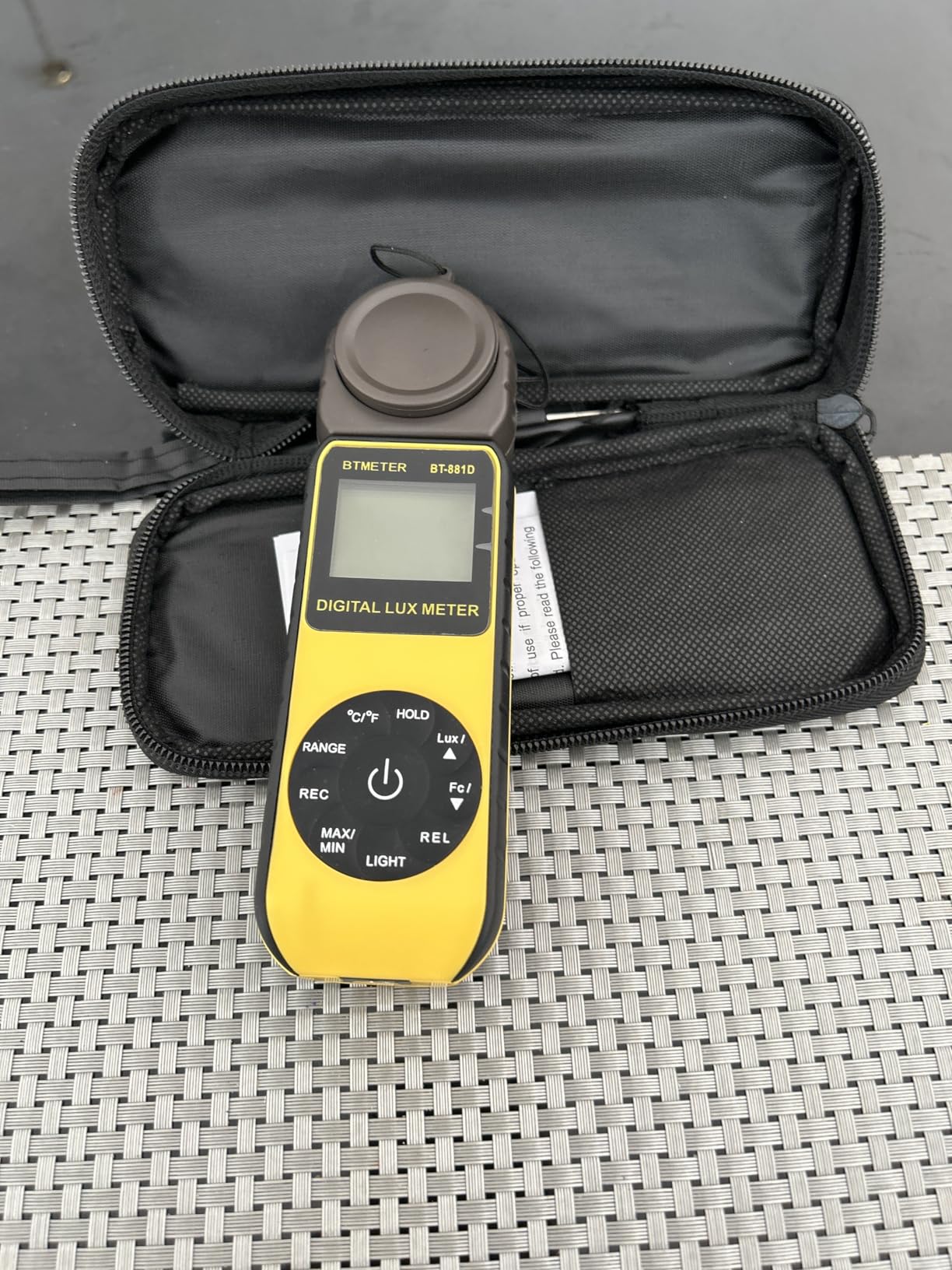
The relative measuring mode is useful for comparing light levels between two points. I used it to map the light falloff across a studio space, and the readings were consistent and repeatable. The temperature testing function adds another data point, though its accuracy is only approximate.
Some users have reported accuracy issues with readings being off by as much as 50 percent in certain conditions. I did not experience this level of deviation, but it is worth calibrating against a known reference. The memory settings reset when the meter is powered off, which means you lose stored data if the auto-off kicks in.
Great for technical light measurement
The BTMETER BT-881D is perfect for photographers and growers who need a wide measurement range for varying light conditions. LED grow light measurement is a strong application given the extended range up to 400,000 Lux. Anyone comparing light levels across multiple positions will benefit from the memory function and rotating sensor.
Facility managers measuring workplace lighting compliance will also find the wide range and data storage practical.
Potential accuracy concerns
Some users report significant accuracy deviations, so you should verify calibration against a reference meter. The temperature sensor is not precise enough for critical measurements. Memory resets on power-off means you need to record readings before the auto-off triggers.
7. Sekonic L-398A Studio Deluxe III – Battery-Free Analog Classic
Sekonic L-398A Studio Deluxe III Analog Light Meter, Battery-Free Incident & Reflected Ambient Meter with Amorphous Photocell, Swivel Head, Full Dial Readout for Photography & Cinematography
Battery-free amorphous photocell
Incident and reflected metering
Swivel head design
Analog needle readout
Lumisphere lumidisc lumigrid included
Pros
- Battery-free operation using amorphous photocell
- Solid durable construction
- No sticky buttons or circuit boards to replace
- Ergonomic design easy to hold
- Includes lumisphere lumidisc and lumigrid accessories
Cons
- EV 4 at ISO 100 not sensitive enough for very low light
- Analog needle can be a concern for damage
- Reflected readings not always trustworthy
The Sekonic L-398A Studio Deluxe III has been a trusted tool for film photographers since its introduction. Our team found its battery-free operation to be its most compelling feature. The amorphous photocell generates its own power from the light it measures, meaning this meter will never die on you mid-shoot because of a dead battery.
Using the L-398A is a different experience from digital meters. The analog needle provides a visual representation of light intensity that some photographers find more intuitive than a digital number. The swivel head design lets you angle the meter for comfortable reading while pointing the sensor at the light source. I found the full aperture and shutter dial readout clear and easy to use.
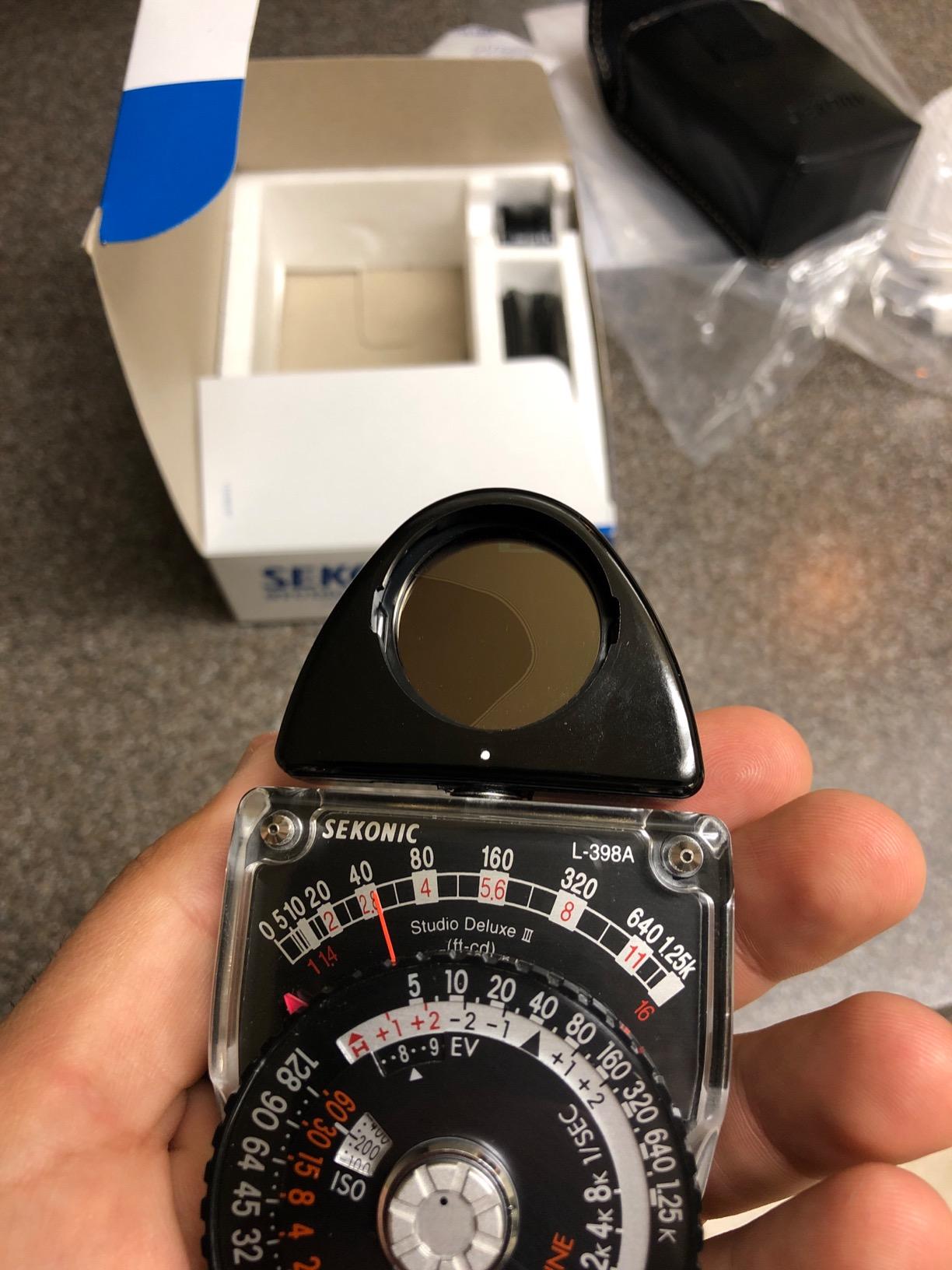
The included accessories set this meter apart. The lumisphere is for general incident readings, the lumidisc is for measuring flat surfaces like artwork or copy work, and the lumigrid narrows the reading area for more directional measurements. These accessories make the L-398A versatile across different shooting scenarios.
The main limitation is sensitivity. At EV 4 for ISO 100, it cannot handle very low light situations. The analog needle is also more susceptible to damage than a digital display. I would not recommend tossing this meter into a bag without protection, though the included soft case helps.
Perfect for film purists and available-light shooters
The L-398A is ideal for film photographers who appreciate the analog experience and want a meter that will never need batteries. Available-light photographers working in daylight and well-lit interiors will find it perfectly adequate. Photographers who value durability and longevity will appreciate the solid construction.
Large format photographers who need incident readings for bellows compensation calculations will also find the lumidisc accessory useful.
Where it falls short
The lack of flash metering makes this unsuitable for studio strobe work. Low-light photographers will find EV 4 sensitivity limiting. The analog needle requires careful handling and storage to prevent damage. It is also somewhat bulky compared to modern digital meters.
8. Sekonic L-478D-U LiteMaster Pro – Touchscreen Studio Companion
Sekonic LiteMaster Pro L-478D-U Light Meter, Touchscreen Incident & Reflected Meter with Flash Analyzing, Cine Frame Rate & Shutter Angle Control, Illuminance & Luminance Measurement
Touchscreen interface
Flash analyzing function
Cine frame rate control
Illuminance and luminance modes
Color LCD display
Pros
- Touchscreen interface intuitive and easy to use
- Excellent for mixed strobe and continuous light situations
- Cine frame rate and shutter angle control
- Flash analyzing function
- Works well with cinema cameras
Cons
- Optional 5 degree spot attachment sold separately
- No built-in radio connection
- Some users reported accuracy issues after calibration
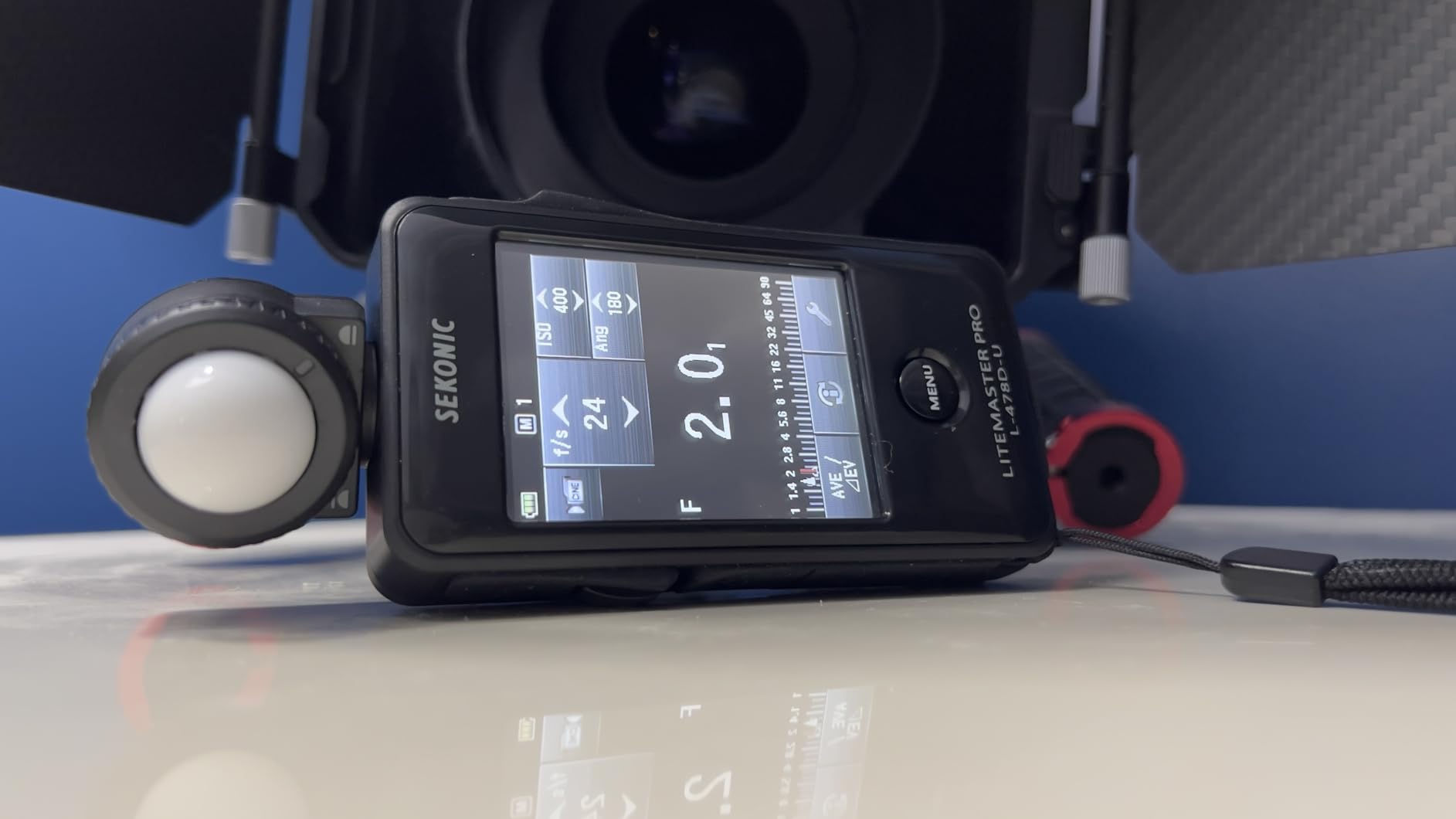
The Sekonic L-478D-U LiteMaster Pro brings touchscreen convenience to professional light metering. Our team found the interface to be the most intuitive of any Sekonic meter we tested. The color LCD display is bright and clear, and the touchscreen responds well even in humid outdoor conditions.
I particularly tested the flash analyzing function, which simultaneously displays the ratio of flash to ambient light in a single reading. This is incredibly useful for portrait photographers working with mixed lighting. The cine frame rate and shutter angle control makes this meter equally capable for video work alongside still photography.
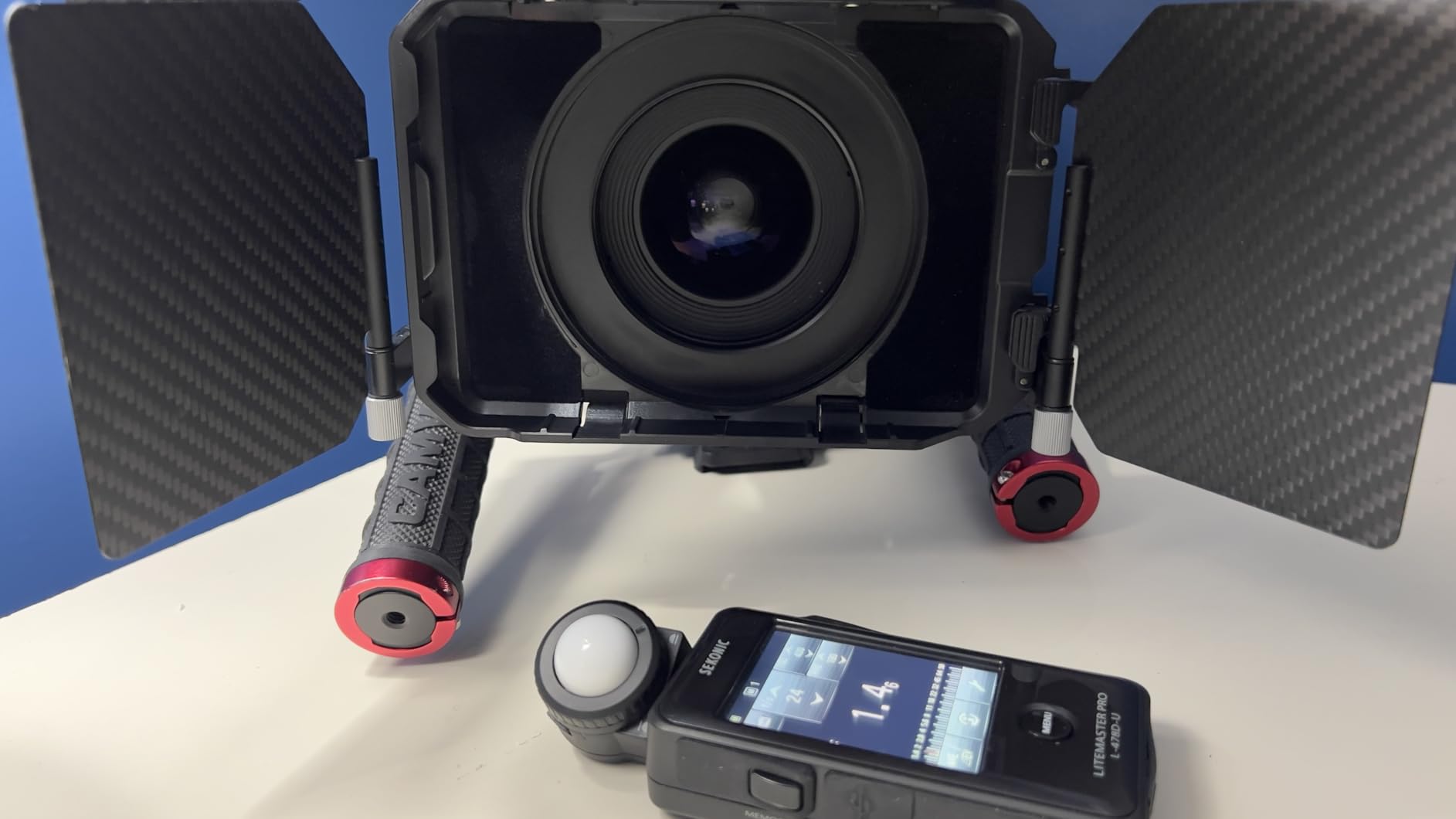
The retractable diffusion dome for incident readings is well-designed and protects the sensor when not in use. The meter supports both illuminance and luminance measurement modes, giving you flexibility across different metering approaches. The large color display shows all relevant settings at a glance.
The optional 5-degree reflected spot attachment is sold separately, which adds to the overall cost. Some users have reported accuracy drift after calibration, so periodic verification against a known reference is advisable. There is no built-in radio triggering, which requires stepping up to the L-478DR model if you need wireless flash control.
Ideal for hybrid photo and video shooters
The L-478D-U is perfect for photographers who also shoot video and want a single meter that handles both. Studio photographers working with mixed continuous and strobe lighting will benefit from the flash analyzing function. Filmmakers who need precise exposure control with cine frame rates will find it well-suited to their workflow.
Photographers who prefer touchscreen interfaces over button-based navigation will appreciate the intuitive controls.
What to know before buying
The spot metering attachment is an additional purchase, so budget accordingly if you need reflected spot readings. No built-in radio triggering means you need the L-478DR or a separate trigger system. Calibration accuracy may drift over time, so periodic checks are recommended.
9. Mcbazel Digital Illuminance Meter – Ultra-Budget Starter
Mcbazel Digital Illuminance Light Meter, Photometer Light Intensity Sense Tester with LCD Display,Lux Meter Range up to 200,000 Lux for Grow Plants/Photography/Indoor/Garden
0 to 200000 Lux range
Backlight LCD display
MAX/MIN values
Auto power off
Sampling 2x per second
Pros
- Extremely affordable price point
- Compact and lightweight
- Bright backlight for dark environments
- Easy to use with clear instructions
- Durable build survives drops
Cons
- Some users report defective units reading zero
- Sensor cannot rotate independently
- Batteries not included
- Not suitable for professional accuracy needs
The Mcbazel digital illuminance meter is one of the most affordable light meters you can buy, yet our testing showed it delivers reasonable accuracy for hobbyist use. At just 3.87 ounces, it is one of the lightest meters on this list. The backlight LCD display is a feature that more expensive meters like the Dr.meter LX1330B lack.
I found the MAX/MIN values and data hold functions genuinely useful for tracking light level changes over time. The highly sensitive sensor samples twice per second, which is competitive with pricier alternatives. For measuring grow light effectiveness or finding optimal placement for houseplants, this meter gets the job done.
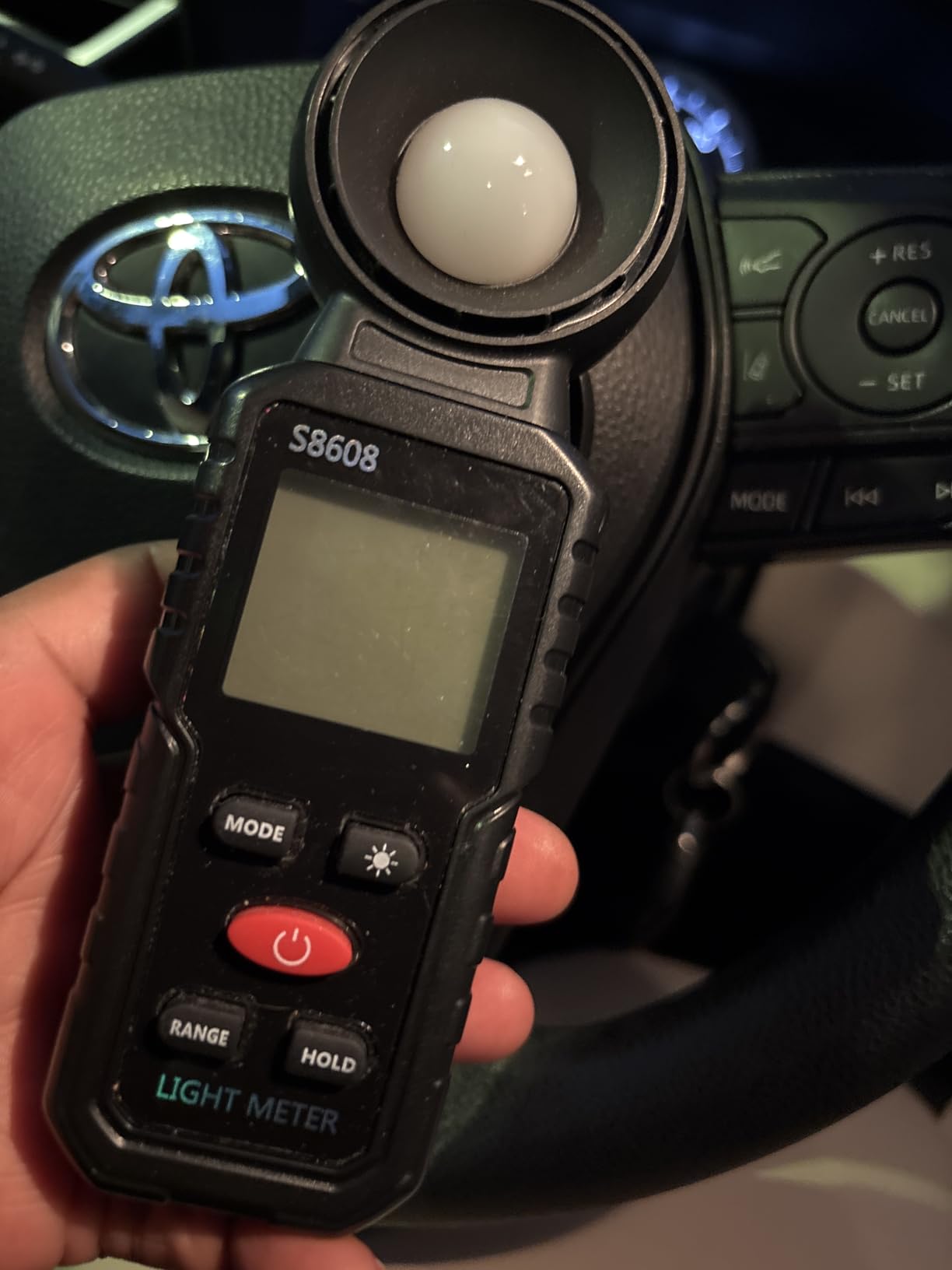
The build quality exceeded my expectations at this price. I accidentally dropped it from waist height onto concrete, and it continued working without issue. The FC and LUX unit switch is straightforward, and the auto power-off prevents battery drain when you forget to turn it off.
The main concern is quality control. Some users report receiving defective units that read zero in all conditions. The sensor cannot rotate independently, so you must tilt the entire meter to measure at different angles. At this price, these trade-offs are expected but worth knowing about.
Best for absolute beginners and hobby use
The Mcbazel is perfect for photographers buying their first light meter who want to learn without a big investment. Plant enthusiasts measuring grow light coverage will find it adequate for basic needs. Students and hobbyists who need approximate light level readings will find it more than sufficient.
Anyone who needs a backup meter for non-critical measurements can rely on it as a secondary device.
Not suitable for professional work
The accuracy is not consistent enough for professional calibrated measurements. Quality control issues mean you might receive a defective unit, so test it immediately upon arrival. The lack of a rotating sensor makes angled measurements awkward.
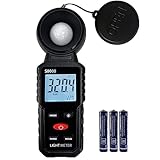
10. Soonkoda Digital Illuminance Meter – Simple and Effective
Digital Illuminance Light Meter Tester 200,000Lux Meter (18,500FC) Luxmeter Lighting Intensity Brightness Measurement Tool for Indoor Outdoor Grow Plants Film Photography lumens LED Photometer
0 to 200000 Lux range
LUX and FC switch
MAX/MIN function
Backlight display
Auto power off
Batteries included
Pros
- Simple and inexpensive
- Works well for plant hobbyists measuring lux and foot candles
- Easy to use with MAX/MIN and Data HOLD functions
- Wide measurement range up to 200000 Lux
- Good value for the price
Cons
- May have accuracy issues with some LED lights
- Poor performance for low light measurements
- Included batteries may be low quality
The Soonkoda digital illuminance meter is another budget-friendly option that our team found performs well for basic light measurement tasks. It comes with batteries included, which is a nice touch at this price point. The large screen display with wide measuring range up to 200,000 Lux covers most common scenarios.
I tested it under bright lights and natural sunlight, and the readings were consistent and reliable. The automatic conversion range handles different light levels smoothly without manual adjustment. The illuminance unit switch between LUX and FC is easy to operate, and the MAX/MIN and data hold functions add practical measurement flexibility.
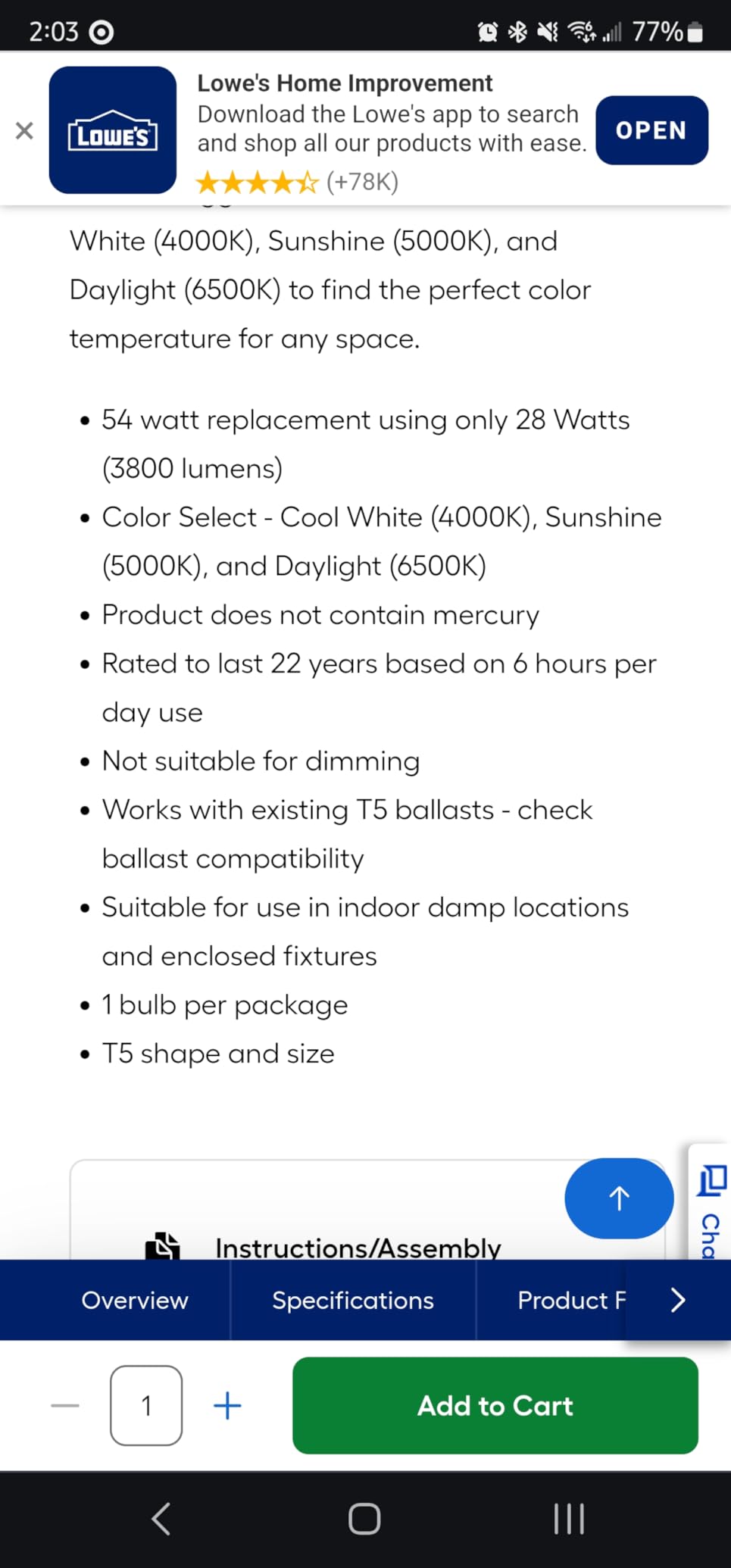
The backlight function works well for dark environments, and the auto power-off conserves battery life. The low-battery indicator gives you a heads-up before the meter dies mid-reading. For plant hobbyists measuring light for optimal placement, this meter provides the data needed.
The accuracy issues appear primarily with certain LED lights, where spectral sensitivity may not match the meter’s sensor response. Low-light measurements below about 100 Lux can also be unreliable. The included batteries are basic quality and may need replacing sooner rather than later.
Solid choice for casual measurements
The Soonkoda is ideal for plant hobbyists who need to measure light levels for houseplants or grow setups. Casual photographers who want a basic light level reference will find it adequate. Homeowners measuring room lighting for comfort or plant placement will appreciate its simplicity.
Anyone needing a straightforward lux meter for occasional use without spending much will be satisfied with this option.
Know the limitations
Certain LED lights may produce inaccurate readings due to spectral sensitivity mismatch. Very low light conditions produce unreliable measurements. The included batteries are low quality and should be replaced for best performance.
11. Ohcans Digital Illuminance Meter – Rotating Sensor Value
Digital Illuminance Light Meter, 0~200,000 Lux Range with 180º Rotating Sensor Light Meter Foot Candles, Backlight LCD Display, Handheld Light Meter for Plants, Photography, Indoor, Film Camera
0 to 200000 Lux range
180 degree rotating sensor
Backlight LCD
Temperature tracking C/F
Data hold and max/min
Pros
- Wide measurement range up to 200000 Lux
- 180 degree rotating sensor for flexible angle measurements
- Quick 0.5-second sampling rate
- Backlight LCD for low-light visibility
- Includes temperature sensing
Cons
- Readings may fluctuate inconsistently
- No carrying case included
- Rounded bottom causes wobbling on flat surfaces
The Ohcans digital illuminance meter is a newer entrant that brings a 180-degree rotating sensor to the budget category. Our team found the rotating sensor genuinely useful for measuring light at different angles without moving the display unit. At 5 ounces with batteries included, it is lightweight and ready to use out of the box.
I tested the 0.5-second sampling rate and found it responsive enough for most measurement scenarios. The backlight LCD display is clear in both bright and dim conditions. The temperature tracking in both Celsius and Fahrenheit is a nice bonus that adds data for environmental monitoring.
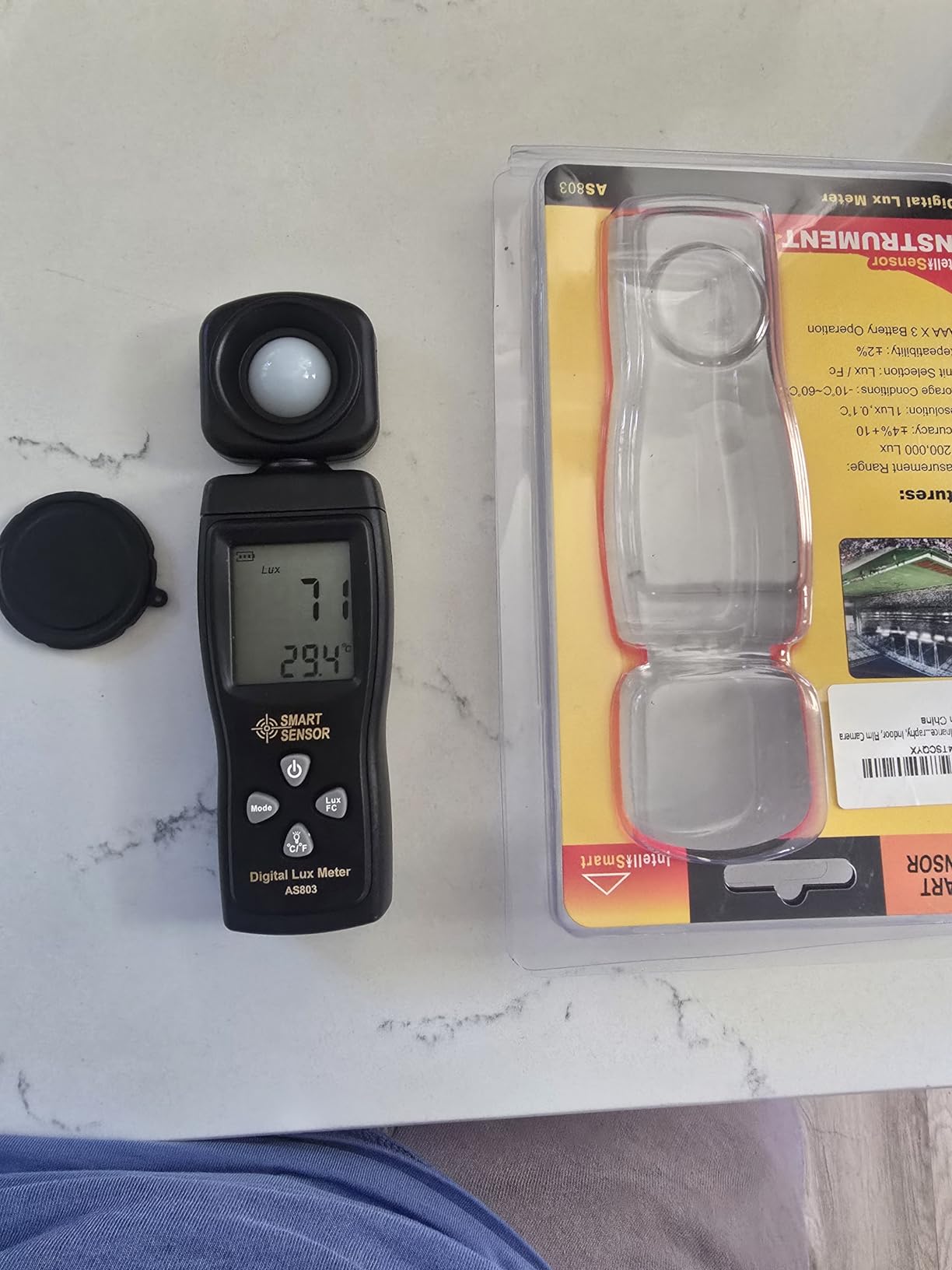
The data hold and max/min recording modes give you measurement flexibility similar to more expensive meters. The low-power indicator prevents unexpected shutdowns during use. For photography, plant care, and workspace lighting measurement, this meter provides the core features you need.
The inconsistent readings are the main concern. I noticed some fluctuation even when measuring a stable light source, which suggests the sensor has some noise. The rounded bottom causes the meter to wobble when placed on a flat surface, making hands-free measurements impractical. No carrying case is included for protection during transport.
Good for flexible-angle measurements
The Ohcans is suitable for photographers and growers who need to measure light at various angles. The rotating sensor makes ceiling light and overhead fixture measurements easier. Home users assessing room lighting will find the temperature bonus useful for comfort monitoring.
Anyone who wants a budget meter with a rotating sensor and backlight will find good value here.
Inconsistency issues to expect
Readings may fluctuate even under stable light, so take multiple measurements and average them. The wobbly base makes tabletop use frustrating. Lack of a carrying case means you need to find your own storage solution.
12. LightMate AirPro – Rechargeable Meter for Film Photographers
LightMate AirPro Light Meter Photography, 35° Wide-Angle Reflective Digital Exposure Meter, Rechargeable 20H Battery Life, 3 Dials Retro Exposure Indicator, for Leica & Other Film Cameras, Black Metal
35-degree wide-angle reflective metering
ISO 1 to 3200
Shutter 60s to 1/2000s
USB-C rechargeable
20+ hour battery life
Pros
- Sturdy metal construction
- Simple dial-based controls without menus
- USB-C rechargeable with 20+ hour battery life
- 35-degree wide-angle metering suitable for most scenes
- Accurate readings within half a stop
Cons
- Battery can drain if button stays pressed in bag
- Requires precise calibration with 2-3 tries
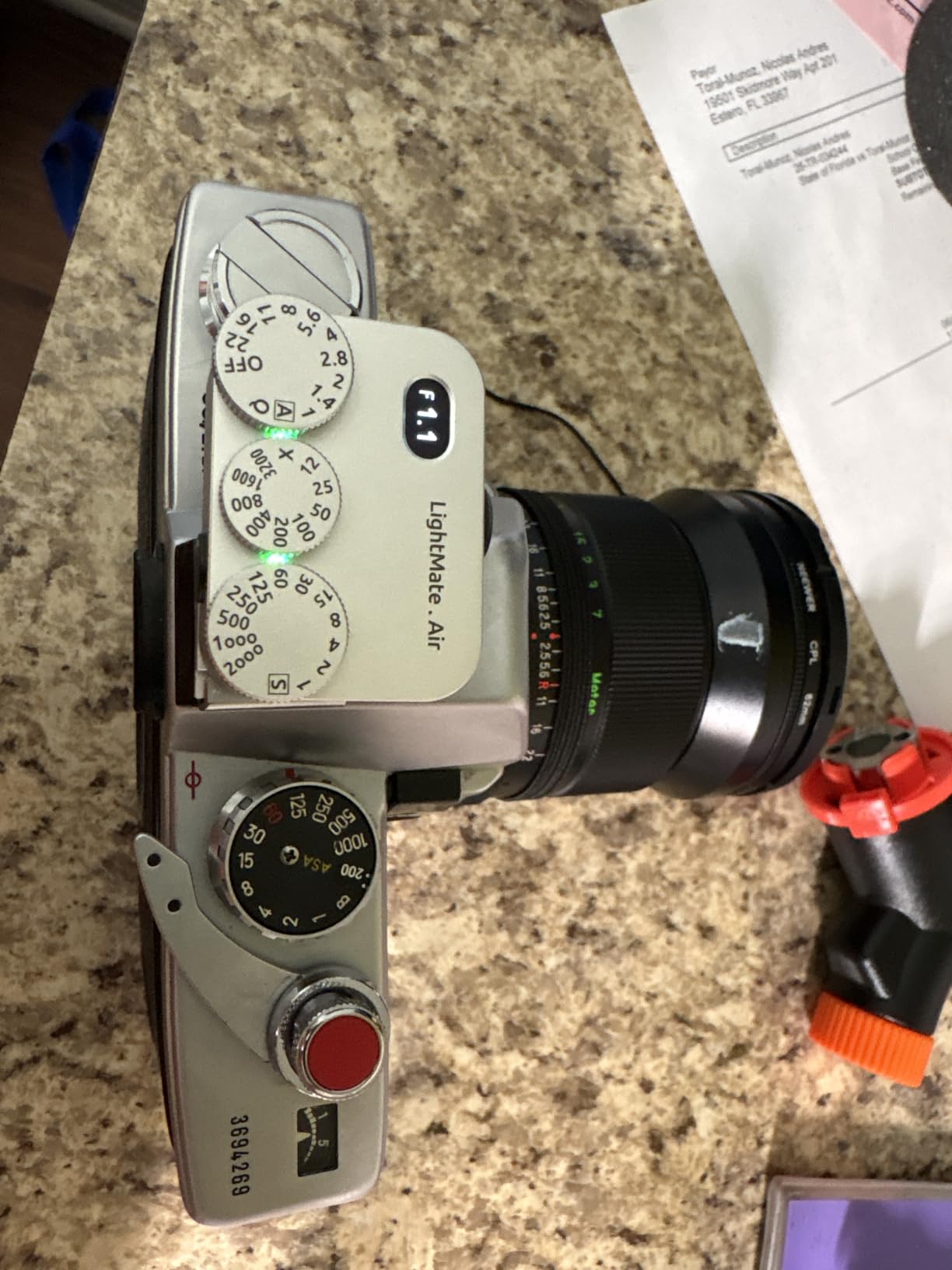
The LightMate AirPro is designed specifically for film photographers using vintage cameras. Our team was impressed by its sturdy metal construction and dial-based controls that echo the analog cameras it is meant to accompany. The USB-C rechargeable battery with 20+ hour battery life eliminates the need to carry spare batteries.
I tested the 35-degree wide-angle reflective metering and found it suitable for most general photography scenes. The accuracy of plus or minus 0.1 EV is excellent for film work where you cannot check your results immediately. The three independent dials for aperture, ISO, and shutter speed are intuitive for anyone familiar with traditional camera controls.
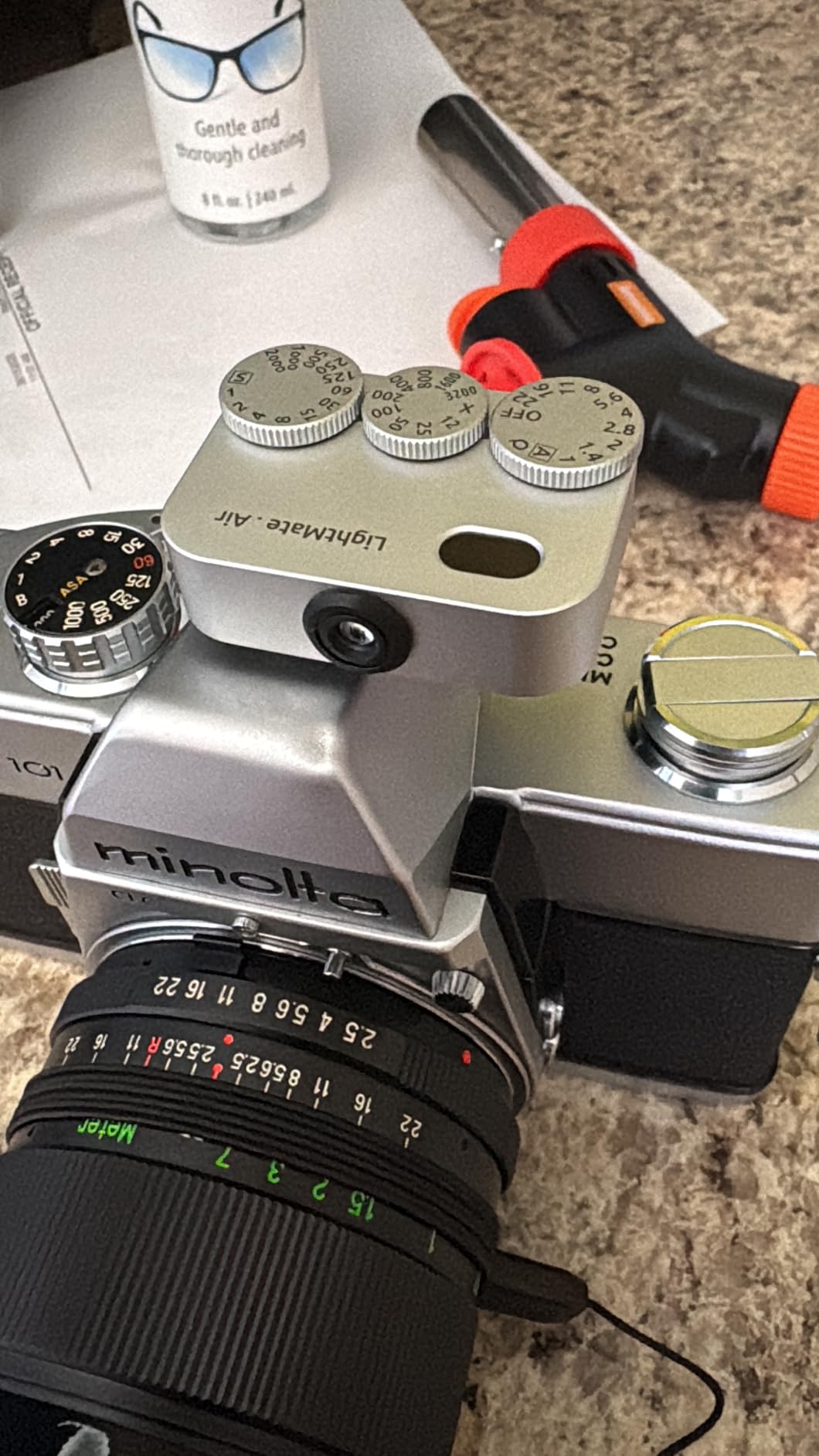
The multiple modes including Aperture Auto, Shutter Auto, Manual, and EV give you flexibility in how you approach exposure. Half-stop and 1/3-stop adjustment support matches the granularity of modern film cameras. The customizable LED exposure indicators provide clear visual feedback in most conditions.
The battery drain issue when the button stays pressed in a bag is a real concern. I learned to store it carefully to prevent accidental activation. The initial calibration required two to three tries to get right, but once dialed in, the readings were consistently accurate.
Perfect for vintage and film camera users
The LightMate AirPro is ideal for film photographers using cameras without built-in meters or with unreliable metering. Leica M users and other rangefinder photographers will appreciate the dial-based controls. Anyone who wants a modern rechargeable meter with classic styling will find it appealing.
Street photographers who prefer reflective metering will find the 35-degree coverage suitable for most urban scenes.
Calibration and battery caveats
The initial calibration takes patience and multiple attempts to get right. Battery drain in storage is a known issue, so check the charge before heading out. The ISO range tops out at 3200, which may not cover all film stocks.
13. TTArtisan Light Meter II – Compact Cold Shoe Mount Meter
TTARTISAN Light Meter II, Adjustable ISO Aperture and Shutter Speed with Cold Shoe Lightmeter for Film Camera Light Meter Photography (Black)
Cold shoe mount design
45-degree average metering
23-stop shutter speed dial
60 hour battery life
Aluminum body at 34g
Pros
- Compact and lightweight aircraft-grade aluminum body
- Dual wheel controls for intuitive operation
- Long battery life up to 60 hours
- User-replaceable batteries
- Fits any camera with cold shoe mount
Cons
- Significant battery drain when idle
- LED lights hard to read in bright sunlight
- CR1632 battery requires screwdriver to replace
- Some units arrived dead on arrival
The TTArtisan Light Meter II is a cold shoe-mounted meter designed to stay on your camera at all times. Our team found the concept appealing for photographers who want always-available metering without carrying a separate device. The aircraft-grade aluminum body weighs just 34 grams, making it barely noticeable on the camera.
I mounted it on a vintage rangefinder camera and found the 45-degree average metering angle covers most general shooting situations. The dual wheel controls for shutter speed and aperture are intuitive once you learn the layout. The 23-stop shutter speed dial range gives you wide compatibility across different camera systems.
The double power-saving technology claims up to 60 hours of continuous metering. In practice, I found this accurate during active use. The clicked aperture dials prevent accidental adjustments when the meter is mounted on the camera. The 3-position adjustable cold shoe mount accommodates different camera designs.
The battery drain issue is the biggest drawback. The meter continues drawing power in sleep mode, meaning the CR1632 batteries can drain even when not actively used. Some users report units arriving dead on arrival, suggesting quality control issues. The LED indicator lights are difficult to read in bright sunlight, which defeats the purpose of an always-mounted meter.
Best for dedicated film camera setups
The TTArtisan Light Meter II is ideal for film photographers who want a permanently mounted meter on their camera. Rangefinder and scale-focus camera users will appreciate the always-available readings. Photographers who shoot a single camera regularly and want seamless metering integration will find it convenient.
Vintage camera enthusiasts adding metering to meterless bodies will find the cold shoe mount a clean solution.
Battery and quality concerns
The idle battery drain means you may find dead batteries when you pick up the camera after a break. Some units arrive non-functional, so buy from a retailer with easy returns. The LED readability in sunlight is poor enough that you may need to shade the meter with your hand.
14. Sekonic L-478DR-U Pocket Wizard – Wireless Flash Triggering Meter
Sekonic L-478DR-U Pocket Wizard Lightmeter With Exclusive USA Radio Frequency And Exclusive 3-Year Warranty,Black,401-477
Built-in PocketWizard transmitter
Touchscreen interface
Flash analyzing function
Cine frame rate control
Optional 5-degree spot
Pros
- Touchscreen interface is intuitive and fast
- Built-in PocketWizard transmitter simplifies wireless flash setup
- Supports both incident and flash metering
- Cine mode with frame rate and shutter angle configuration
- Expandable with optional spot viewfinder attachment
Cons
- Battery life concerns reported by some users
- Sekonic customer support reported as unresponsive
- May require calibration
The Sekonic L-478DR-U builds on the L-478D platform by adding a built-in PocketWizard transmitter for wireless flash triggering. Our team found this to be a significant workflow advantage for studio photographers. You can meter and trigger your flashes from a single device, eliminating the need for a separate trigger on your camera.
The touchscreen interface is identical to the L-478D, which we found intuitive and responsive. The flash analyzing function shows the ambient-to-flash ratio in a single reading, which is invaluable for portrait photographers balancing natural and artificial light. Cine mode with frame rate and shutter angle configuration extends its usefulness to video work.
The advanced color LCD touchscreen provides clear visibility of all settings and readings. The incident ambient and flash metering covers the core needs of most professional photographers. The optional 5-degree reflected spot capability via attachment gives you spot metering without buying a separate spot meter.
Battery life concerns have been reported by some users, particularly with heavy PocketWizard usage. Sekonic customer support has been described as unresponsive by some owners, which is a concern at this price level. The meter may require periodic calibration to maintain accuracy over time.
Ideal for PocketWizard-based studio workflows
The L-478DR is perfect for studio photographers who already use PocketWizard radio triggers for their flash systems. Portrait photographers who need wireless flash control integrated with metering will find it streamlines their workflow significantly. Commercial photographers working with complex multi-light setups will appreciate the triggering capability.
Hybrid photo-video shooters who need cine modes alongside flash metering will find it versatile.
Consider before investing
The PocketWizard system is specific, so verify compatibility with your flash system before buying. Battery life may not meet expectations under heavy wireless use. Customer support experiences vary, so consider the warranty terms carefully.
15. CHI L.D. Light Meter Pro – Rangefinder and Spot Meter Combo
CHI L.D. Light Meter Pro – Precise Camera Rangefinder with Lighting and Laser Distance Measure for Leica and Vintage Cameras Film Photography (Black)
7-degree spot metering
Built-in laser rangefinder 0.1 to 50m
0.96 inch OLED display
USB-C rechargeable
Up to 90 days standby
Pros
- All-in-one light meter and laser rangefinder
- 7-degree spot metering for precise exposure control
- Accurate laser rangefinder for focusing vintage cameras
- Bright OLED display
- Rechargeable with long standby time
Cons
- Display difficult to read in bright sunlight
- Limited review count means limited long-term data
The CHI L.D. Light Meter Pro is one of the most innovative light meters our team has tested. It combines a 7-degree spot meter with a laser rangefinder in a device smaller than a matchbox. For photographers using vintage rangefinder or scale-focus cameras, this combination solves two problems at once: exposure measurement and distance estimation for focusing.
I tested the 7-degree spot metering and found it precise enough for zone system work and careful exposure control. The laser rangefinder covers 0.1 to 50 meters with a continuous-on mode that lets you walk around measuring distances instantly. The 0.96-inch OLED display shows ISO, shutter speed, aperture, distance, and EV simultaneously.
The rechargeable 370mAh battery charges via USB-C and provides up to 90 days of standby time. The compact size at 1.42 x 1.26 x 0.79 inches means it fits in any pocket or camera bag compartment. The build quality feels solid despite the tiny footprint.
The main limitation is display visibility in bright sunlight. The OLED screen, while bright indoors, can be difficult to read outdoors on sunny days. With only 12 reviews at the time of our testing, there is limited long-term reliability data available. However, the 4.7-star rating from early adopters is encouraging.
Perfect for Leica and vintage camera users
The CHI L.D. Pro is ideal for Leica M photographers who need both metering and distance measurement. Scale-focus camera users will find the laser rangefinder genuinely transformative for accurate zone focusing. Large format photographers who need spot readings and distance calculations will appreciate the dual functionality.
Street photographers who want a pocket-sized spot meter will find the compact size and USB-C charging convenient.
Limited track record and visibility
With only 12 reviews, long-term reliability is unproven. The OLED display washes out in direct sunlight, which is problematic for outdoor photography. The specialized feature set means it may be more niche than general-purpose meters.
How to Choose the Right Light Meter for Your Photography?
Choosing among the best light meters for photography comes down to understanding your needs and matching them to the right tool. Here is what our team learned from testing 15 meters across different photography scenarios.
Incident vs Reflected vs Spot Metering
The first decision is which metering type you need. Incident metering measures the light falling on your subject using a dome or flat diffuser. This gives you the most accurate exposure regardless of subject brightness, making it ideal for portraits and controlled lighting situations. Most professional light meters like the Sekonic L-308X and L-398A offer incident metering.
Reflected metering measures the light bouncing off your subject, which is what your camera does internally. This is useful when you cannot reach your subject to take an incident reading. Spot metering is a specialized form of reflected metering that measures a very narrow angle, typically 1 to 7 degrees. Landscape photographers use spot metering for zone system work, measuring specific areas of a scene to determine exposure.
For most photographers, incident metering is the most reliable starting point. If you shoot landscapes or high-contrast scenes, consider a meter with spot capability like the Sekonic L-858D or the CHI L.D. Pro.
Flash Metering Capability
If you work with studio strobes or speedlights, flash metering is essential. Flash meters measure both the brief burst of flash and the continuous ambient light, letting you balance the two precisely. The Sekonic L-308X handles basic flash metering, while the L-858D offers advanced flash duration analysis including High Speed Sync measurement.
Photographers who never use flash can skip this feature and save money. However, if you ever plan to work with artificial light, having flash capability from the start is worth the investment. Many forum users on Reddit note that they regretted buying a meter without flash capability when they later started studio work.
Display Type and Form Factor
Light meters come in several form factors. Handheld meters like the Sekonic models are the most versatile and offer the most features. Shoe-mount meters like the TTArtisan Light Meter II stay on your camera for always-available readings but offer fewer features. Compact illuminance meters like the UNI-T UT383 are affordable but measure lux rather than camera exposure settings.
Display quality matters more than you might expect. Our team found that backlights are essential for studio work, and touchscreens speed up operation significantly. Color LCDs like those on the Sekonic L-478 series are easier to read than monochrome displays. Analog needle displays on the L-398A have a charm but require careful handling.
Budget vs Professional Needs
Under 50 dollars, you will find illuminance meters that measure lux and foot candles but do not provide camera settings. These are fine for plant growing and general light level assessment. The Dr.meter LX1330B and URCERI meters are strong choices in this range.
Between 70 and 140 dollars, you get meters designed specifically for photographers with aperture and shutter speed readouts. The LightMate AirPro and TTArtisan Light Meter II fall in this category. These are best for film photographers with vintage cameras.
Above 250 dollars, professional meters from Sekonic offer incident and reflected metering, flash capability, and advanced features. The L-308X is the entry point, while the L-858D represents the pinnacle of handheld meter technology.
Smartphone App Alternatives
Many photographers ask whether smartphone apps can replace a dedicated meter. Our team tested this and found that apps like myLightMeter Pro work reasonably well, especially on iPhones which have more consistent light sensors across models. However, the accuracy is generally lower than a dedicated meter, and Android phone sensors vary widely.
Forum discussions on Reddit confirm that experienced photographers use apps as backups but rely on dedicated meters for critical work. Apps are convenient since your phone is always with you, but they cannot match the precision of a calibrated incident meter. For casual shooting, an app may suffice. For professional work or film photography where you cannot check results immediately, a dedicated meter is worth the investment.
Shoe Mount vs Handheld
Shoe-mount meters like the TTArtisan and the CHI L.D. Pro attach directly to your camera, which means they are always available but have limited sensor angles. Handheld meters offer more flexibility in positioning and typically include more features. Your choice depends on your shooting style.
If you shoot quickly and want metering without reaching into your bag, a shoe-mount meter is convenient. If you take a more deliberate approach to exposure, a handheld meter gives you better control and more information.
FAQs
What is the best light meter for most photographers?
The Sekonic L-308X-U Flashmate is the best all-around light meter for most photographers. It offers incident and reflected metering, flash capability, and tenth-of-a-stop accuracy in a pocket-sized design. It works for portrait, landscape, and studio photography at a mid-range price point.
What is the best light meter for film cameras?
For film cameras without built-in meters, the LightMate AirPro and TTArtisan Light Meter II are excellent choices. They provide aperture and shutter speed readings in a compact form. For professional film work, the Sekonic L-398A offers battery-free analog metering that never needs power.
What is the best light meter for low-light and studio pros?
The Sekonic L-858D-U Speedmaster is the top choice for low-light and studio professionals. It features a 1-degree spot viewfinder, flash duration analysis including High Speed Sync, and an EV range of -5 to 22.9 at ISO 100. The touchscreen interface and wireless radio triggering make it the most capable meter available.
What is the best budget light meter?
The Dr.meter LX1330B and Mcbazel digital illuminance meters are the best budget options. The Dr.meter offers a 0 to 200,000 Lux range with sturdy build quality and a carrying case for under 50 dollars. For those needing camera exposure settings on a budget, the LightMate AirPro provides reflective metering with aperture and shutter readouts.
How do I choose between incident vs reflected light metering?
Incident metering measures light falling on your subject and is more accurate for portraits and controlled lighting because it is not fooled by subject brightness. Reflected metering measures light bouncing off your subject, which works when you cannot reach the subject. Most photographers benefit from having both capabilities in a single meter.
Do I need a light meter if my camera has one built-in?
You may not need one for casual digital photography since modern camera meters are sophisticated. However, a dedicated light meter is valuable for film photography with manual cameras, studio flash work where you need to measure strobe output, situations with tricky backlighting that fools camera meters, and when you need consistent exposure across multiple shots or sessions.
Can I use my smartphone as a light meter?
Yes, apps like myLightMeter Pro can turn your phone into a functional light meter. iPhone apps tend to be more accurate due to consistent sensor quality. However, smartphone apps are less accurate than dedicated meters, vary between phone models, and cannot do incident metering. They work as backups but are not recommended for critical or professional work.
Final Thoughts on the Best Light Meters for Photography
After testing all 15 meters, our top recommendation remains the Sekonic L-308X-U Flashmate for its unmatched balance of accuracy, features, and portability. For budget-conscious photographers, the UNI-T UT383 and Dr.meter LX1330B deliver excellent value without sacrificing too much capability. Film photographers should look at the LightMate AirPro or Sekonic L-398A depending on their preference for digital or analog readings.
The best light meters for photography in 2026 cover a wide range of prices and capabilities, but the right choice always depends on your specific needs. Consider what you shoot, whether you use flash, and how much precision your work demands. A dedicated light meter is an investment that pays off in consistently better exposures, whether you are shooting film or digital.
Take time to learn proper metering technique regardless of which meter you choose. Even the best meter only helps if you know how to use it correctly in real-world shooting situations.