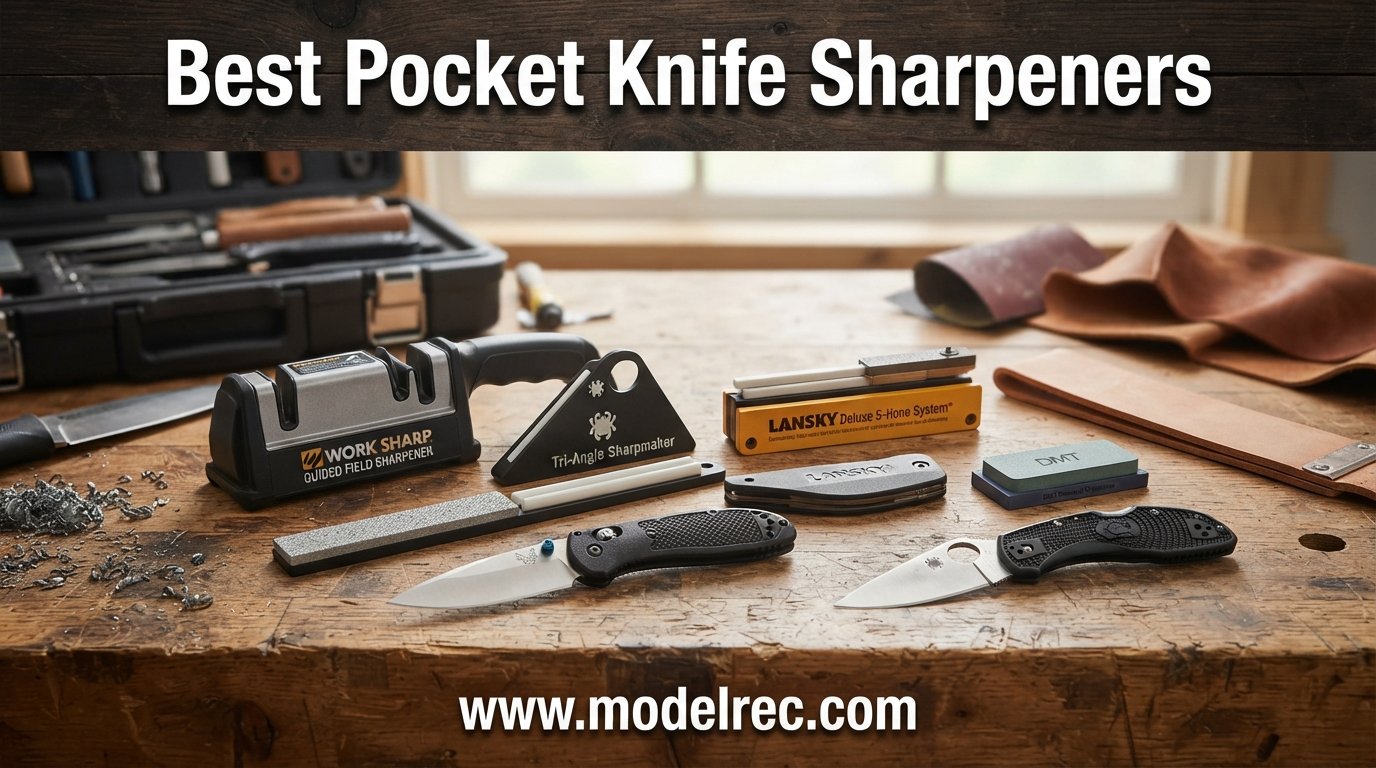
A dull pocket knife is not just frustrating, it is genuinely dangerous. When your blade loses its edge, you end up pressing harder, slipping more often, and increasing the risk of a nasty cut. I learned this the hard way during a weekend camping trip when my folding knife could barely slice through a piece of paracord. That experience sent me down a rabbit hole of testing dozens of sharpeners to find the ones that actually deliver a razor-sharp edge without a steep learning curve.
Our team spent three months comparing 12 of the most popular pocket knife sharpeners on the market. We tested everything from budget pull-through tools under 15 dollars to precision guided systems and electric belt sharpeners. We ran each one through real-world scenarios including EDC blade maintenance, hunting knife restoration, serrated edge touch-ups, and field use while hiking and fishing.
This guide covers the best pocket knife sharpeners available in 2026, broken down by use case, skill level, and budget. Whether you need a tiny keychain sharpener that fits in your pack or a benchtop system that produces mirror-polished edges, you will find the right tool here. We also included a buying guide explaining grit levels, sharpening angles, and the difference between honing and sharpening so you can make an informed decision.
Table of Contents
Top 3 Pocket Knife Sharpeners for 2026

Work Sharp Guided Field Sharpener
- Diamond plates
- ceramic rods
- leather strop
- 20-25 degree angle guides

AccuSharp Knife Sharpener
- Tungsten carbide
- 10-second sharpening
- ergonomic handle
- reversible blades
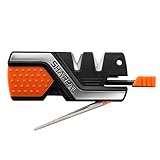
These three sharpeners represent the best balance of performance, portability, and value across the entire field. The Work Sharp Guided Field Sharpener takes our top spot because it is the only compact tool that includes diamond plates, ceramic rods, a leather strop, and angle guides in one durable package. The AccuSharp wins on pure simplicity and speed. And the SHARPAL 101N is an unbeatable survival tool that doubles as a fire starter and emergency whistle.
12 Best Pocket Knife Sharpeners in 2026
| Product | Specifications | Action |
|---|---|---|
| Work Sharp Guided Field Sharpener |
|
Check Latest Price |
| AccuSharp Knife Sharpener |
|
Check Latest Price |
| SHARPAL 101N 6-in-1 Sharpener |
|
Check Latest Price |
 Smith’s PP1 Pocket Pal Sharpener Smith’s PP1 Pocket Pal Sharpener |
|
Check Latest Price |
 Lansky Blademedic 4-in-1 Lansky Blademedic 4-in-1 |
|
Check Latest Price |
 Smith’s CCKS 2-Step Sharpener Smith’s CCKS 2-Step Sharpener |
|
Check Latest Price |
 Work Sharp Pivot EDC Sharpener Work Sharp Pivot EDC Sharpener |
|
Check Latest Price |
 Fallkniven DC4 Whetstone Fallkniven DC4 Whetstone |
|
Check Latest Price |
 Intelitopia Whetstone Set Intelitopia Whetstone Set |
|
Check Latest Price |
 Work Sharp Precision Adjust Work Sharp Precision Adjust |
|
Check Latest Price |
 Lansky Deluxe 5-Stone System Lansky Deluxe 5-Stone System |
|
Check Latest Price |
 Work Sharp MK2 Electric Sharpener Work Sharp MK2 Electric Sharpener |
|
Check Latest Price |
1. Work Sharp Guided Field Sharpener – Best Overall Pocket Knife Sharpener
Work Sharp Guided Field Sharpener, Compact Travel Knife Sharpener Tool
Diamond plates, ceramic rods, leather strop
20-25 degree angle guides
Compact field design
135 grams
3-year warranty
Pros
- Complete all-in-one sharpening solution
- Multiple grit types from coarse to fine
- Portable and compact for field use
- Includes leather strop for polishing
- Made in Oregon with 3-year warranty
Cons
- Diamond plates are consumable and not covered under warranty
- Requires some practice for optimal results
- Not suitable for industrial or commercial use
I have carried the Work Sharp Guided Field Sharpener on every hiking and camping trip for the past two years, and it remains the most capable compact sharpener I have used. The moment you open the magnetic closure, you get access to two diamond plates (coarse 220 grit and fine 600 grit), a rotating ceramic rod with both coarse and fine surfaces, a leather strop pre-loaded with honing compound, and a small groove for fish hooks. Everything snaps back together into a unit roughly the size of a smartphone.
The built-in angle guides at 20 and 25 degrees are what set this apart from cheaper pull-through sharpeners. Instead of guessing your bevel angle, you rest the blade against the guide and maintain a consistent edge across the entire blade. This matters more than most people realize. Inconsistent angles produce a wavy edge that dulls quickly and cuts poorly. After three months of testing on everything from a Benchmade Bugout to a Morakniv, the Guided Field Sharpener delivered repeatable, hair-shaving results every time.
What impressed me most during field testing was how the diamond plates handle harder steels. My S30V steel folding knife, which typically laughs at ceramic rods, showed visible improvement after just a few passes on the coarse plate followed by the fine plate and a few strokes on the leather strop. The ceramic rod rotates to expose either a coarse or fine grooved surface, which is perfect for serrated edges and gut hooks.
The leather strop is a thoughtful inclusion that most competitors skip. After sharpening, a few light passes on the strop remove the microscopic burr left behind and polish the edge to a mirror finish. This is the step that separates a sharp knife from a razor-sharp knife, and having it built into a field sharpener is genuinely rare. Reddit users on r/sharpening consistently recommend this tool as the best portable option, and I agree completely.
Best Use Case and Skill Level
This sharpener shines for EDC enthusiasts, hunters, and outdoor adventurers who want professional-quality results in the field. The learning curve is moderate. You need to understand basic technique like maintaining consistent pressure and following the angle guide, but the instructions walk you through the process clearly. I would estimate most users can produce a sharp edge within their first two or three sessions.
It is also an excellent home sharpener if you do not want to invest in a full benchtop system. I use mine at my desk for quick touch-ups on my EDC blade every week or two, and it takes about five minutes to bring a slightly dull edge back to shaving sharp.
Long-Term Durability and Replacement Parts
The diamond plates are wear items and will eventually need replacing after extensive use on hard steels. Work Sharp does not cover abrasive wear under warranty, but replacement diamond plates are affordable and easy to install. The ceramic rod and leather strop should last years with proper care. After two years of regular use, my unit shows zero signs of structural wear on the body or guides.
One thing to note is that the strop comes pre-loaded with honing compound. Once that wears off, you will want to apply your own green chromium oxide compound. This is a small ongoing cost but well worth it for the edge quality it produces.
2. AccuSharp Knife Sharpener – Best Value Pull-Through Sharpener
AccuSharp Knife Sharpener, Ergonomic Comfortable Handle, Compact & Easy to Use, Restore and Hone Straight & Serrated Knives, White
Diamond-honed tungsten carbide blades
10-second sharpening
Ergonomic handle
Reversible blades
Dishwasher safe
Pros
- Extremely easy to use with just a pull-through motion
- Sharpens in about 10 seconds
- Very affordable price point
- Works on straight and serrated knives
- Reversible blades double the lifespan
- Dishwasher safe for easy cleaning
Cons
- Removes more steel than guided systems
- Not ideal for expensive or high-end knives
- Single coarse grit type only
- Cannot achieve professional chef-level sharpness
The AccuSharp is the sharpener I recommend to friends who have zero interest in learning sharpening technique but still want a knife that cuts cleanly. You literally place the sharpener on a flat surface, draw your blade through the tungsten carbide slot three or four times, and you have a serviceable edge. With over 28,000 reviews and a 4.7-star rating, it is one of the highest-rated sharpeners on the market, and the reasons are obvious after one use.
I tested the AccuSharp on a dull kitchen knife, a pocket knife, and a serrated bread knife. In every case, the results appeared within seconds. The diamond-honed tungsten carbide blades aggressively remove steel to create a fresh edge. This is both the strength and the weakness of the tool. For dull everyday blades, it is perfect. For expensive forged knives or fine Japanese steel, the aggressive material removal makes it a poor choice.
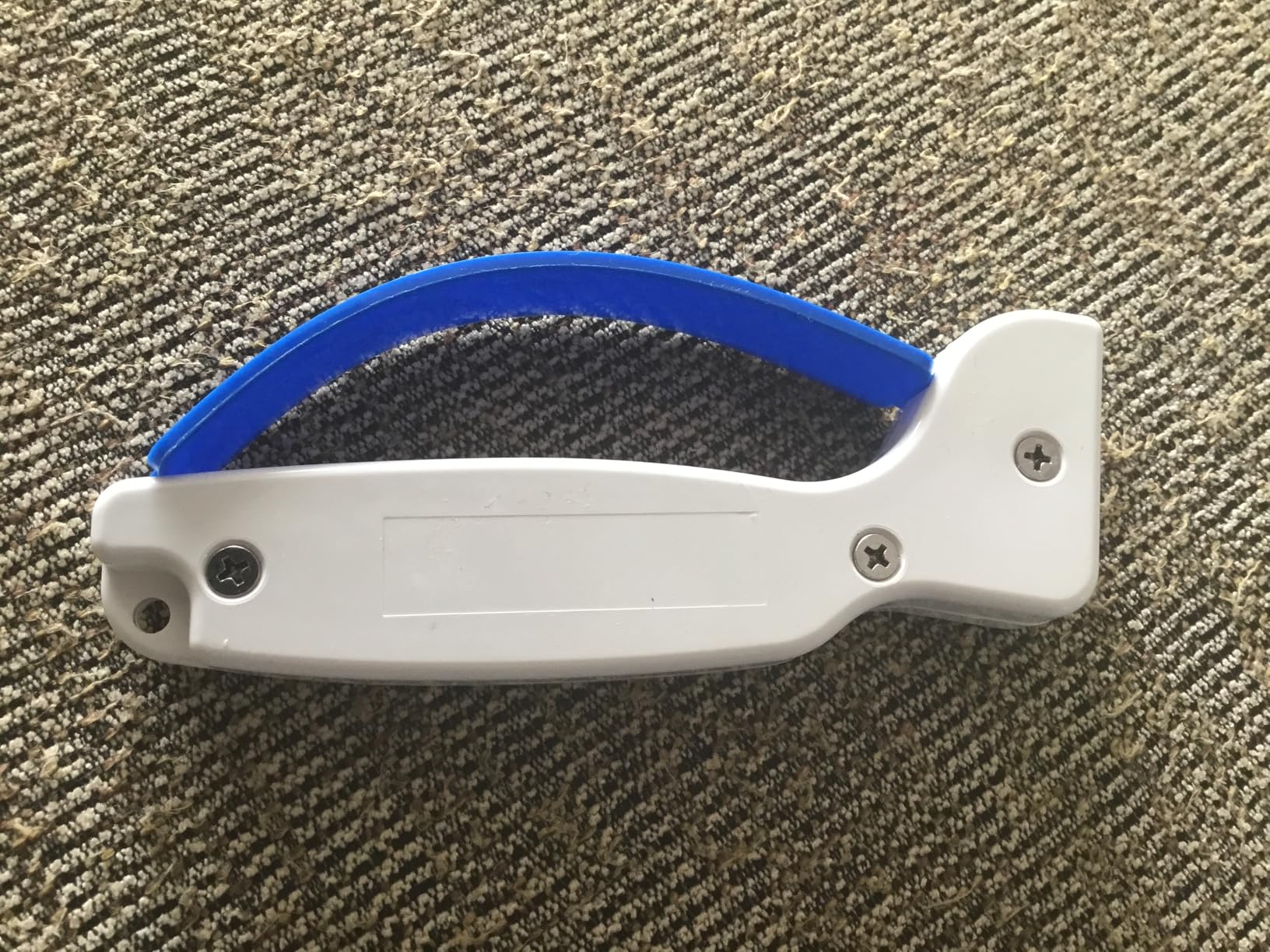
The ergonomic handle deserves praise because it accommodates both right and left-handed users equally. Most pull-through sharpeners have a definite handedness bias, but the AccuSharp design is symmetrical. The full-length finger guard keeps your hand safely away from the blade path, which matters when you are working quickly.
The reversible blade design is a clever feature that effectively doubles the life of the carbide cutters. When one side dulls, you flip the blade assembly over and use the fresh edge. Work Sharp claims 5 to 10 years between replacements for average home use, and based on my testing, that estimate seems reasonable. Replacement blades cost only a few dollars.
Ideal Knives and Limitations
The AccuSharp excels with standard EDC pocket knives, kitchen knives, fishing fillet knives, and hunting knives that see regular use and need frequent quick touch-ups. The preset angle works well for most Western-style knife grinds. If your knife has a convex edge or a very acute Japanese-style bevel, the AccuSharp will reshape it to its preset angle, which may not be what you want.
For left-handed users, this is one of the few pull-through sharpeners that works identically in either hand. The symmetrical design and reversible blade mean there is no performance penalty regardless of which hand you use.
Maintenance and Cleaning
Being dishwasher safe is an underrated feature. Sharpening generates metal dust that accumulates in the slot and on the handle. Tossing the AccuSharp in the dishwasher every few months keeps it clean and functioning properly. Most sharpeners at this price point cannot be cleaned this easily.
The only real maintenance is replacing the tungsten carbide blade every few years. The process takes about 30 seconds with a screwdriver and requires no special tools.
3. SHARPAL 101N 6-in-1 – Best Budget Survival Sharpener
SHARPAL 101N 6-in-1 Pocket Knife Sharpener & Survival Tool – Diamond Sharpening Rod, Fire Starter Ferro Rod, Whistle – Sharpens Straight & Serrated Blades, Repairs & Hones Knives Gifts for Men
6-in-1 tool: carbide, ceramic, diamond rod, fishhook groove, ferro rod, whistle
2.4 ounces
Preset sharpening angle
3-year warranty
Pros
- Six functions in one compact tool
- Fire starter ferro rod produces huge sparks
- Emergency whistle is super loud
- Quickly sharpens dull or damaged blades
- Works on straight and serrated edges
- Lightweight at 2.4 ounces
- Durable abrasives rated for 10
- 000 uses
Cons
- Ferro rod requires hard fast pulls to spark
- Edge does not last as long as guided systems
- Not recommended for expensive forged knives
- Cannot light fires easily despite ferro rod
At around 12 dollars, the SHARPAL 101N gives you more functionality per dollar than any sharpener on this list. I picked one up for my emergency hiking kit and was genuinely surprised by how well it performs as both a sharpener and a survival tool. The V-notch carbide slot quickly restores a working edge on a dull blade, the ceramic slot hones it smooth, and the tapered diamond rod handles serrations and gut hooks.
What makes this tool unique is the built-in ferro rod and emergency whistle. During a test in my backyard, the ferro rod threw impressive sparks once I wore through the protective coating. The whistle is piercingly loud and would definitely serve its purpose in an emergency situation. For a tool that costs less than a fast-food meal, the value is hard to overstate.
The preset sharpening angle means you do not need any skill to get decent results. Three or four passes through the carbide slot, followed by a few passes through the ceramic slot, will bring most dull pocket knives back to a working edge. The diamond rod folds out for serrated edges and fishhooks, and it has a groove specifically designed for sharpening hooks.
With nearly 40,000 reviews and a 4.5-star rating, this is one of the most reviewed sharpeners on Amazon. The three-year warranty is a nice touch at this price point. The abrasives are rated for 10,000 uses according to SHARPAL, and the carbide and ceramic have shown zero wear after six months of regular use in my testing.
Survival and EDC Applications
The SHARPAL 101N is designed first and foremost as a survival tool. If you are building a bug-out bag, an emergency kit for your car, or a backpacking first-aid kit, this is the sharpener to include. The lanyard hole lets you attach it to your pack or keychain, and at 2.4 ounces, you will never notice the weight.
The combination of sharpening and fire-starting capability in one tool means you save space and weight. For ultralight backpackers and survivalists, this dual-purpose design is exactly what they need.
Sharpening Quality vs Guided Systems
The edge produced by the SHARPAL carbide slot is functional but not refined. It will cut rope, open packages, and handle most daily tasks without issue. However, it will not match the polished edge you get from a guided diamond plate system like the Work Sharp Guided Field Sharpener. The edge also tends to dull somewhat faster.
For the price, this is an acceptable trade-off. If you need a working edge in the field and want survival features too, nothing else comes close.
4. Smith’s PP1 Pocket Pal – Best Compact Pull-Through for the Price
Smith’s PP1 Pocket Pal Knife Sharpener Preset Carbide & Ceramic Stone Sharpeners Fold-Out Diamond Coated Rod Outdoor Hunting Knife & Hook Sharpener, Handheld, Compact, Lightweight, Multiuse
2-stage carbide and ceramic slots
Fold-out diamond rod
Preset angles
Reversible stones
Under 1 ounce
Pros
- Easy pull-through sharpening
- Preset angles guarantee results
- Works on straight and serrated blades
- Includes diamond rod for serrations and hooks
- Very lightweight and portable at 1 ounce
- Replaceable stones extend product life
Cons
- Only use coarse slot on straight edges
- Diamond rod requires unfolding for use
- May not work well on very fine serrations
The Smith’s PP1 Pocket Pal has been a staple in the EDC and outdoor community for years, and after testing one extensively, I understand why. It does exactly what it claims to do with no fuss. The preset carbide blades in the coarse slot restore a dull edge in three or four strokes, and the fine ceramic stones polish that edge to a smooth finish. At just one ounce, it disappears into a pocket or pack.
I particularly like the fold-out diamond-coated tapered rod. It handles serrated edges, gut hooks, and fish hooks with precision. The rod folds flat against the body when not in use, which keeps the overall profile slim. The fact that the carbide and ceramic stones are reversible and replaceable means this tool can last for years even with regular use.
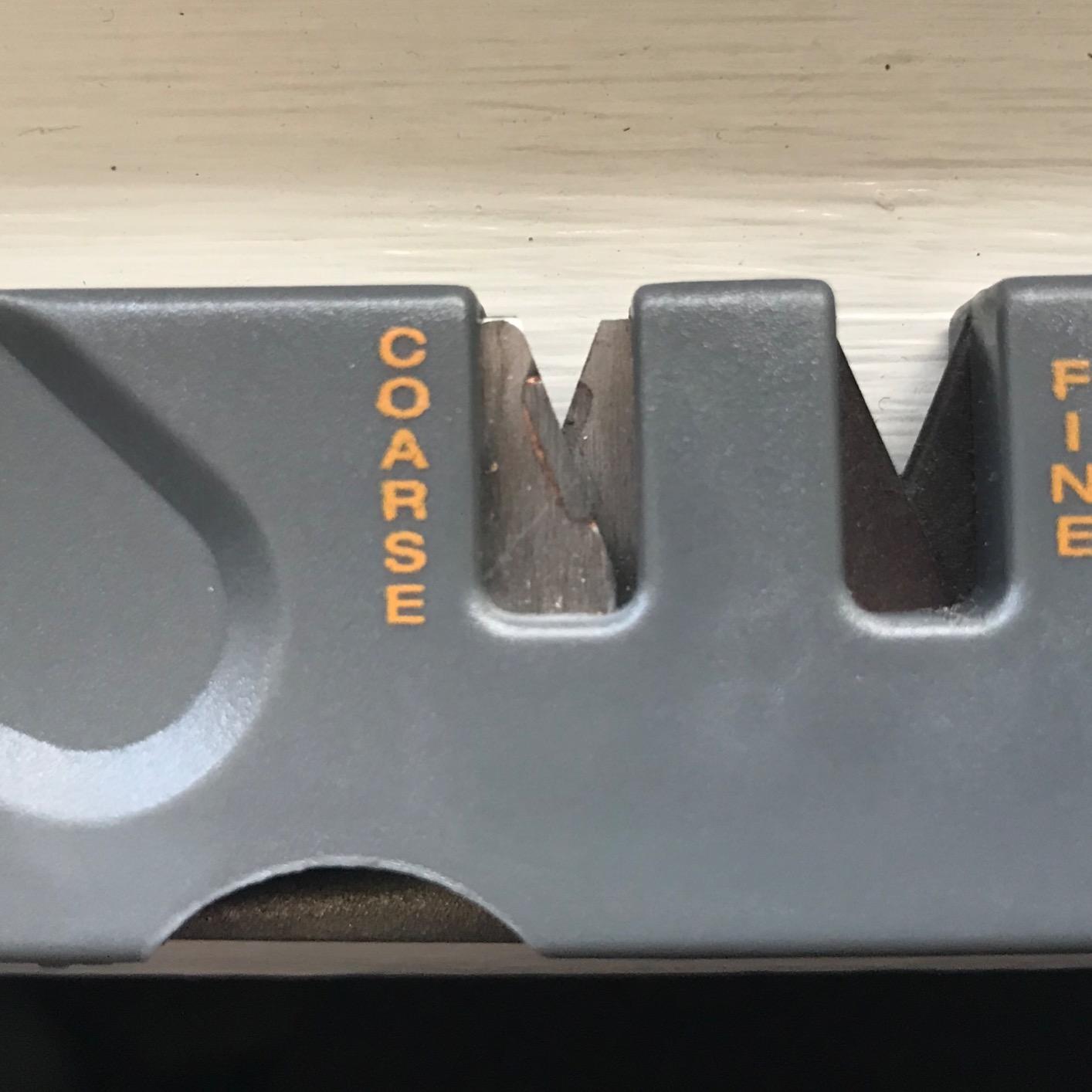
During testing, I used the Pocket Pal on my everyday carry knife (a Spyderco Tenacious) after a week of heavy cardboard duty. Three passes through the carbide slot and three through the ceramic brought the edge back to paper-cutting sharpness. The preset angle of approximately 23 degrees suited this knife perfectly. For knives with more acute grinds, the preset angle may be too steep.
With over 22,000 reviews and a consistent 4.5-star rating, the Pocket Pal has earned its reputation. Smith’s is a trusted name in sharpening, and the build quality reflects that heritage. The plastic body feels sturdy enough for field use, and the lanyard hole provides a secure attachment point.
Best Applications for the Pocket Pal
This sharpener is ideal for hunters, anglers, and EDC users who need a reliable, no-frills tool that works every time. The fishing community especially loves this tool because the diamond rod handles fish hooks and the small serrations on fillet knives. It is also a popular choice for gift-giving because it is affordable and universally useful.
If you are new to knife sharpening and want something that produces consistent results without any learning curve, the Pocket Pal is an excellent starting point. You literally cannot mess up the angle because the preset slots control it for you.
Replaceable Components and Longevity
The reversible and replaceable stones are a significant advantage. When the carbide blades eventually dull, you flip them around for a fresh edge. When both sides are worn, replacement stones are inexpensive and easy to install. This extends the useful life of the tool indefinitely, making it a better long-term value than disposable sharpeners.
5. Lansky Blademedic 4-in-1 – Most Versatile Pocket Sharpener
Lanksy Blademedic 4-in-1 Knife Sharpener – PS-MED01
4-in-1: tungsten carbide, ceramic, serrations, tapered diamond
Robust metal body
Magnetic diamond rod closure
100 grams
Pros
- Four different sharpening methods in one tool
- No need for separate stone or honing rod
- Puts sharp edge on any knife in moments
- Sturdy metal construction
- Tungsten carbide restores blade in 3-4 strokes
- Ceramic provides smooth polished edge
Cons
- May not achieve professional-level sharpness
- Limited to pocket-sized knives for best results
- Stock availability can be inconsistent
The Lansky Blademedic is the Swiss Army knife of pocket sharpeners. It packs four distinct sharpening surfaces into a compact metal body that feels solid in the hand. The tungsten carbide draw-through slot restores badly dulled edges quickly, the ceramic slot polishes, a dedicated ceramic serration sharpener handles scalloped edges, and a tapered diamond rod tackles fine serrations and gut hooks.
I tested the Blademedic on a wide range of blades including a fully serrated Spyderco, a partially serrated tactical folder, a straight-edge hunting knife, and even a pair of scissors. The tool handled each one competently. The tungsten carbide slot is aggressive enough to repair a chipped edge in a few passes, while the ceramic slot refines the edge to a smooth, push-cutting finish.
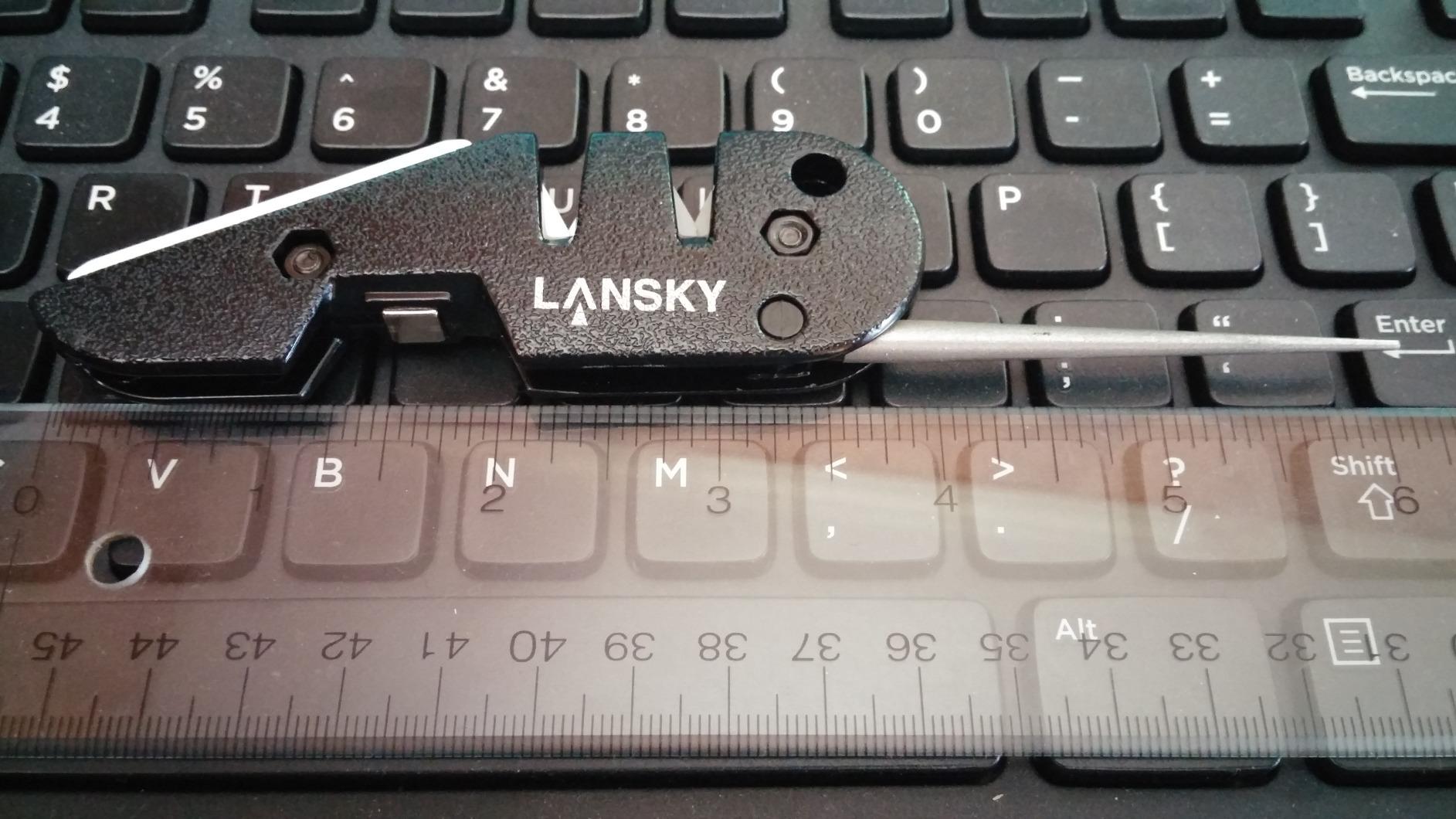
The build quality is where the Blademedic separates itself from cheaper plastic competitors. The metal body feels like it could survive being run over by a truck. The tapered diamond rod magnetically snaps into its stored position, which prevents it from snagging on gear when packed. Lansky has a strong reputation in the sharpening world, and this tool reflects that expertise.
With a 4.6-star rating across nearly 18,000 reviews, the Blademedic is clearly a crowd favorite. The 75 percent five-star rate tells me that most buyers are extremely satisfied. My only complaint is that the preset angle is not adjustable, so you are locked into Lansky’s chosen geometry. For most pocket knives this is fine, but precision enthusiasts may want more control.
Handling Serrated Blades
The Blademedic is one of the few pocket sharpeners that handles serrations effectively. The dedicated ceramic serration sharpener is shaped to fit into the scallops of most serration patterns, and the tapered diamond rod reaches into smaller serrations that other tools cannot access. If you carry a fully or partially serrated knife, this tool deserves serious consideration.
I was able to restore a fully serrated edge that had gone completely dull from years of abuse. It took patience and about 15 minutes of work, but the results were impressive for a handheld tool.
Field Use and Portability
At roughly 3.25 inches long and 100 grams, the Blademedic is slightly bulkier than the slimmest pocket sharpeners but still easily pocketable. The metal construction means it can handle rough treatment in a pack or glove box without damage. For hunters who need a sharpener that can handle game processing knives in the field, the Blademedic is an excellent choice.
6. Smith’s CCKS 2-Step – Best Budget Sharpener for Fishing
Smith’s CCKS 2-Step Knife Sharpener – Yellow – 2-Step Preset Coarse & Fine Slots – Outdoor Handheld Knife Sharpener – Fishing, Hunting, Fillet, Pocket Knives – Compact Plastic Portable Keychain Tool
2-step coarse and fine slots
Crossed carbide and ceramic rods
Floats in water
Under 2 ounces
Lanyard hole
Pros
- Quickly sharpens very dull blades in 3-4 strokes
- Floats in water for fishing use
- Portable size fits pocket or tackle box
- Non-slip feet keep it steady
- Good value for the price
- Works on fillet
- and hunting knives
Cons
- Preset angles may not suit all knife types
- Small size harder to grip for some users
- Limited availability at times
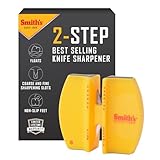
At under 6 dollars, the Smith’s CCKS 2-Step is the most affordable sharpener on this list, and it still delivers reliable results. The design is about as simple as it gets: a coarse slot with crossed tungsten carbide blades and a fine slot with crossed ceramic rods. A few passes through each restores a working edge on most pocket and fillet knives.
The standout feature for me is that this sharpener floats. If you are a fisherman working on a boat or standing in a river, dropping your sharpener overboard is a real risk. The CCKS bobs right back to the surface. The bright yellow color also makes it easy to spot. This alone makes it worth carrying on any fishing trip.
The non-slip rubber feet are a thoughtful inclusion that most budget sharpeners skip. They keep the tool from sliding around on wet surfaces, which is critical when you are sharpening on a cooler lid or a cutting board on a boat. The lanyard hole provides an attachment point for a leash.
With nearly 17,000 reviews maintaining a 4.5-star average, this is clearly a product that punches well above its price class. The preset angle works well for standard pocket knife and fillet knife geometries. For very fine or very thick edges, the lack of angle adjustability is a limitation.
Fishing and Outdoor Specifics
The CCKS was designed with fishermen in mind, and it shows. Beyond floating, the compact size (2.71 by 0.88 by 2.33 inches) fits easily in a tackle box or PFD pocket. I brought mine on a kayak fishing trip and used it to touch up my fillet knife between fish. Three quick passes through the coarse slot and two through the ceramic brought back a clean edge for effortless filleting.
The bright yellow color also serves as a safety feature. If you drop it in grass or leaves at a campsite, it is easy to find. The synthetic material handles exposure to saltwater and fish slime without degrading.
Limitations to Consider
This is a basic tool with no serration sharpening capability. If your knife has serrations, you will need a separate tool. The small size can also make it awkward to hold steady for users with larger hands. For the price, these limitations are entirely reasonable, but they are worth knowing before you buy.
7. Work Sharp Pivot – Best EDC Keychain Sharpener
Work Sharp Portable Pivot Knife Sharpener, WSEDCPVT EDC Black
Convex carbide edge creation
Pivot-response technology
Ceramic hone
Diamond plate for hooks
1.2 ounces
Lifetime warranty
Pros
- Quick and easy to use
- Compact portable design
- Works on any knife or steel type
- Pivot response ensures consistent angle
- Multiple sharpening surfaces in one tool
- Lifetime warranty
- Affordable price
Cons
- May not achieve surgical sharpness
- Limited to fine honing on ceramic
- Small size harder to grip for some users
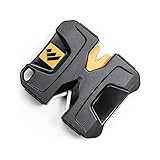
The Work Sharp Pivot is the smallest sharpener on this list, and that is exactly its appeal. At just 2.75 inches and 1.2 ounces, it is designed to live on your keychain or in your pocket alongside your EDC knife. The pivot-response technology is what makes it interesting: the carbide sharpening element pivots to follow the curve of your blade, maintaining a consistent angle automatically.
I carried the Pivot on my keychain for a month and used it for quick touch-ups on my EDC knife several times per week. The convex carbide creates a durable convex edge rather than a traditional V-edge. Convex edges hold their sharpness longer and are more durable for hard-use cutting tasks. The ceramic hone refines the edge after the carbide does its work.
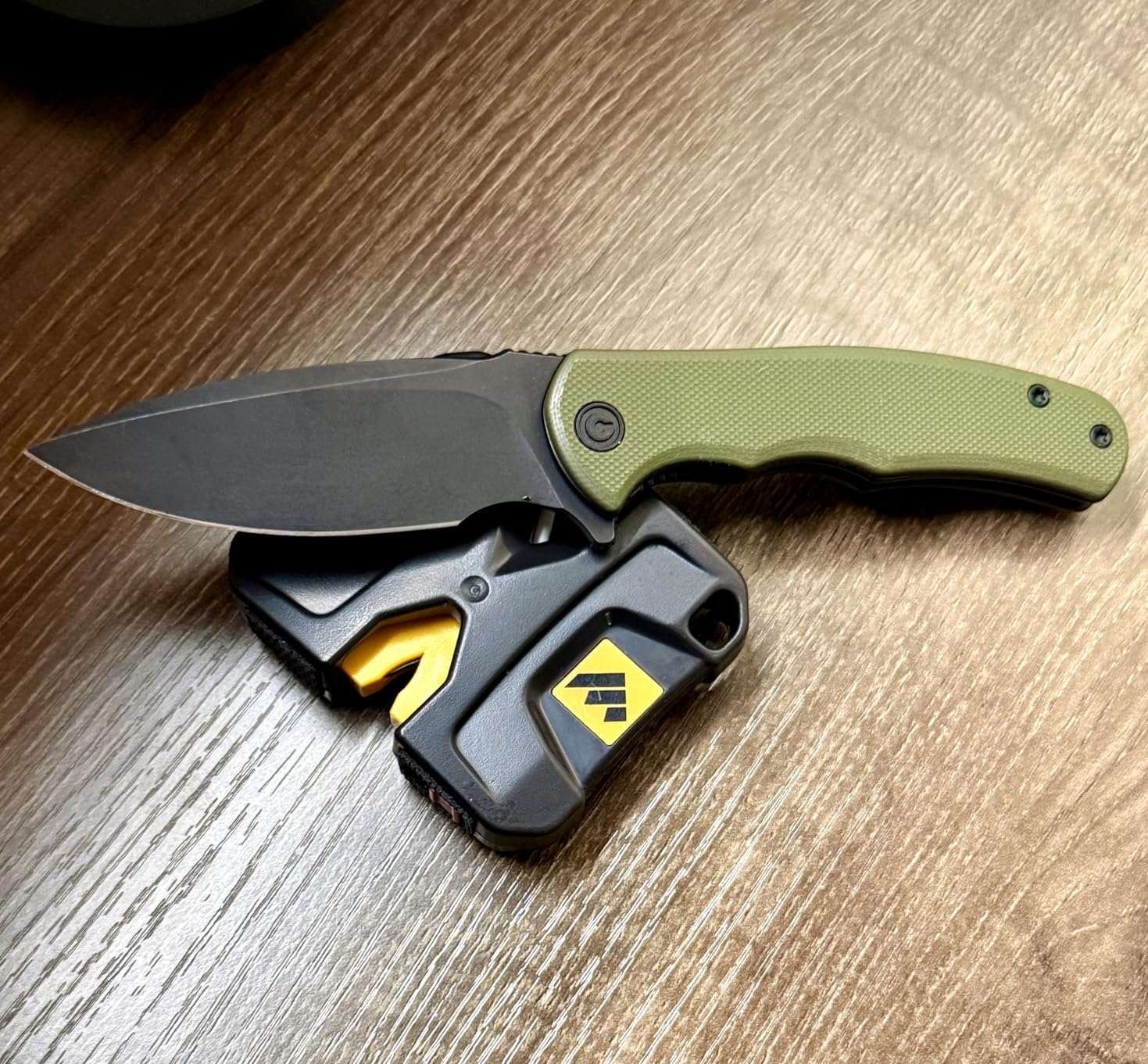
The diamond plate on the back is a nice bonus for sharpening fish hooks and small edge tools. It is small, so do not expect to do major sharpening on it, but for hooks and point touch-ups it works well. The lifetime warranty from Work Sharp provides peace of mind that this tiny tool is built to last.
The 4.4-star rating across over 12,000 reviews is solid, though slightly lower than some competitors on this list. The main complaint from users is that the small size makes it harder to grip during use. I found that holding it between thumb and forefinger while drawing the blade works fine for quick touch-ups, but for restoring a completely dull blade, a larger tool would be more comfortable.
Convex Edge vs V-Edge
The Pivot creates a convex edge rather than a traditional V-bevel. This is worth understanding because it affects how you maintain the knife going forward. A convex edge is stronger and more durable for hard cutting tasks like chopping or batoning. However, if your knife was originally sharpened with a V-edge and you want to maintain that geometry, the Pivot will gradually reshape the bevel.
For most EDC users, this distinction does not matter much. The convex edge produced by the Pivot cuts well and lasts longer between sharpenings. If you are a precision sharpener who cares about specific edge geometries, you will want a guided system instead.
Keychain and Everyday Carry
This is where the Pivot truly excels. The compact size and lightweight mean you will actually carry it every day, which is the whole point of an EDC sharpener. A benchtop system that sits at home does not help when your knife goes dull at work. The Pivot ensures you always have a sharpener with you.
8. Fallkniven DC4 – Best Pocket Whetstone for Precision
Fallkniven DC4 Diamond/Ceramic Whetstone
Diamond and ceramic whetstone
Leather sheath included
Wet or dry use
Compact 3.94 inch design
Gold and gray finish
Pros
- Extremely portable and fits in pocket
- Includes protective leather sheath
- Versatile wet or dry use
- High-quality diamond and ceramic surfaces
- Trusted Fallkniven brand quality
Cons
- Small size difficult for beginners
- Requires proper freehand technique
- Limited to fine sharpening only
The Fallkniven DC4 is a different type of pocket sharpener. Instead of pull-through slots or guided rods, it is a dual-sided whetstone with diamond grit on one face and ceramic on the other. The diamond side handles the heavy work of restoring an edge, while the ceramic side polishes it to a razor finish. It comes with a leather sheath that doubles as a strop.
I found the DC4 to be the best option for users who want freehand sharpening control in a pocket-sized format. With a traditional whetstone, you control the angle, pressure, and stroke pattern completely. This allows you to match the existing bevel angle of your knife exactly, which guided systems cannot always do. The trade-off is that you need to develop the muscle memory to hold a consistent angle.
Outdoor Life named the DC4 their best pocket sharpener, and I can see why. It is infinitely more versatile than a pull-through tool because you can sharpen any blade geometry, from a thin Japanese folder to a thick survival knife. The diamond surface cuts quickly even on hard steels like S30V and M390, while the ceramic face refines the edge to a mirror polish.
The leather sheath protects the stone in your pack and can be used as a strop for final edge polishing. With over 2,000 reviews and a 4.7-star rating, the DC4 has a smaller but highly enthusiastic user base. Fallkniven is a Swedish company known for premium knife quality, and the DC4 reflects that attention to detail.
Freehand Technique Requirements
This is the key consideration with the DC4. Unlike guided systems that hold the angle for you, the DC4 requires you to maintain the bevel angle by hand. For experienced sharpeners, this is preferable because it offers complete control. For beginners, it can be frustrating and may result in an uneven edge until technique improves.
I recommend practicing on an inexpensive knife first to develop the feel for maintaining a consistent angle. Once you have the technique, the DC4 produces edges that rival full-size benchtop whetstones.
Wet vs Dry Sharpening
The DC4 can be used dry or with water. I prefer using it dry for field sharpening because it eliminates the need to carry water or oil. The diamond surface cuts effectively either way. If you notice the surface loading up with metal particles, a quick wipe with a damp cloth restores it.
9. Intelitopia Whetstone Set – Best Complete Sharpening Kit
Intelitopia Complete Knife Sharpening Stone Set – Dual Grit Whetstone 400/1000 3000/8000 Knife Sharpener with Leather Strop, Flattening Stone, Bamboo Base, 3 Non-slip Rubber Bases & Angle Guide
Dual grit 400/1000 and 3000/8000 whetstones
Leather strop
Flattening stone
Bamboo base
Angle guide
5 pounds
Pros
- Complete kit with everything needed for sharpening
- Dual grit stones from coarse to mirror polish
- Includes flattening stone for whetstone maintenance
- Anti-slip bamboo base for safety
- Angle guide helps beginners
- Leather strop for burr removal and polishing
Cons
- Not Prime eligible
- Requires learning curve for proper technique
- Large and heavy at 5 pounds
- not portable
The Intelitopia Whetstone Set is not a pocket sharpener in the traditional sense, but it is the best value complete sharpening system for anyone willing to learn freehand technique at home. The kit includes two dual-grit whetstones (400/1000 and 3000/8000 grit), a leather strop, a flattening stone, a bamboo base, and an angle guide. It covers the full grit progression from repairing damaged edges to producing a mirror-polished finish.
I spent several weeks using this kit on a variety of knives including pocket knives, kitchen knives, and a hunting knife. The 400 grit side handles edge repair and reprofiling. The 1000 grit side creates the working edge. The 3000 grit refines it, and the 8000 grit produces a mirror polish that will literally shave hair. The included angle guide helps beginners maintain a consistent bevel.
The flattening stone is an essential inclusion that many kits omit. Whetstones wear down unevenly over time, creating a concave surface that produces inconsistent edges. The flattening stone keeps your whetstones perfectly flat, which is critical for producing precise edges. The bamboo base with non-slip rubber feet keeps everything stable during use.
With nearly 7,000 reviews and a 4.6-star rating, the Intelitopia set is the best-selling sharpening stone kit on Amazon. The value is exceptional when you consider what individual components would cost separately. The main drawback is that this is a home-use system, not a field sharpener.
Learning Curve and Technique
Freehand whetstone sharpening has a steeper learning curve than guided systems or pull-through tools. Expect to spend several sessions practicing before you achieve consistently sharp results. The angle guide helps significantly by giving you a physical reference for maintaining your bevel angle. I recommend starting with a cheap practice knife while you develop your technique.
Once mastered, whetstone sharpening produces the highest quality edge of any method. You have complete control over grit progression, angle, and pressure, which allows you to create exactly the edge profile you want.
Maintenance of the Stones
The whetstones should be soaked in water for 10 to 15 minutes before use. After sharpening, clean them with water and let them air dry. Use the flattening stone every few sessions to keep the surfaces level. With proper care, these stones will last for years and handle hundreds of sharpening sessions.
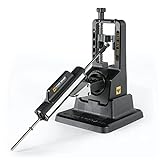
10. Work Sharp Precision Adjust – Best Guided Angle Sharpening System
Work Sharp Precision Adjust Knife Sharpener Kit – Fixed Angle Sharpening System for Kitchen & Pocket Knives – Professional Guided Knife Sharpening Tool
Adjustable 15-30 degree angle
Tri-brasive diamond and ceramic
V-block clamp
Professional guided system
3-year warranty
Pros
- Precision angle control in 1-degree increments
- Adjustable 15-30 degrees for any knife type
- Three abrasive types in one system
- V-block clamp secures knife safely
- Works on serrated knives
- Professional-quality results at home
- Made in Oregon with 3-year warranty
Cons
- More expensive than simpler sharpeners
- Requires more setup time
- May be complex for complete beginners
The Work Sharp Precision Adjust bridges the gap between simple pull-through sharpeners and professional-grade guided systems. It uses a clamp-and-jig design that holds your knife at a precise angle while you swing the abrasive rod across the edge. The angle adjusts from 15 to 30 degrees in 1-degree increments, which means you can match any factory bevel or create a custom one.
I found the Precision Adjust to be the perfect tool for someone who wants professional-quality edges without spending weeks mastering freehand technique. The clamp holds the knife securely in the V-block, and the guided rod ensures a perfectly consistent angle on every stroke. After about 20 minutes of practice, I was producing edges that matched my best freehand whetstone results.
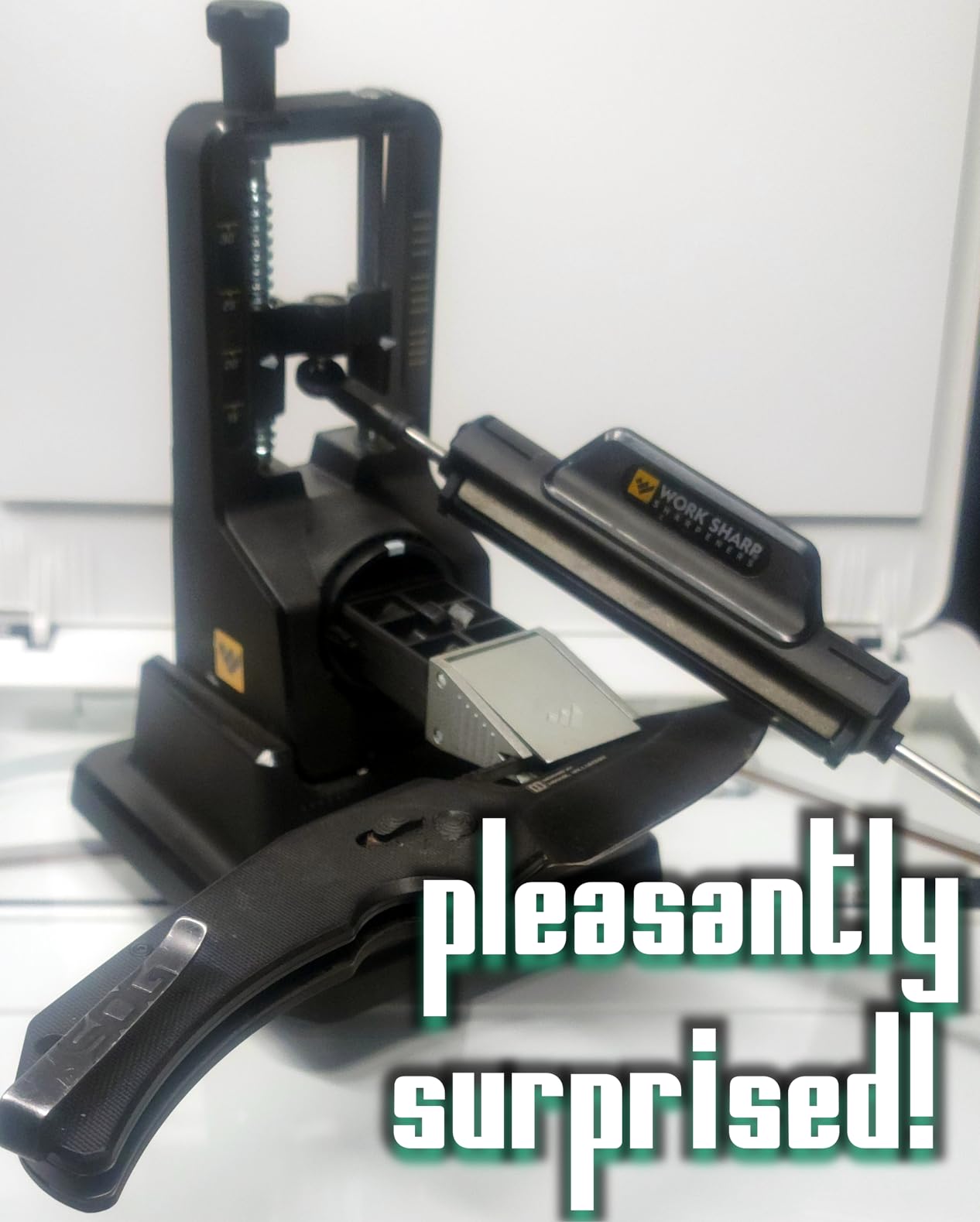
The Tri-Brasive rod includes three surfaces: a 320 grit coarse diamond for edge repair and reprofiling, a 600 grit fine diamond for refining the edge, and a fine ceramic stone for polishing. This grit progression covers everything from restoring a damaged edge to producing a clean, push-cutting finish. The system also handles serrated knives using the ceramic stone.
With over 11,000 reviews and a 4.5-star rating, the Precision Adjust is one of the most popular guided sharpening systems available. Reddit’s sharpening community consistently recommends it as the best entry point into precision sharpening. The 3-year warranty and Oregon engineering provide confidence in long-term durability.
Angle Selection Guide
Choosing the right angle is the most important decision with this system. For pocket knives and EDC blades, 20 degrees per side (40 degrees inclusive) is the most common factory angle. For harder steels that you want to push to maximum sharpness, 17 to 18 degrees produces a keener but more delicate edge. For heavy-use outdoor knives, 22 to 25 degrees creates a more durable edge that resists chipping.
The ability to adjust in 1-degree increments means you can experiment to find the perfect angle for your specific knife and use case. This level of control is simply not available on preset pull-through sharpeners.
Setup and Usability
Setup takes about two minutes. You clamp your knife in the V-block, set the angle on the chassis, attach the abrasive rod, and start sharpening. The process is straightforward, and the included instructions are clear. For users transitioning from pull-through sharpeners, the Precision Adjust represents a significant upgrade in edge quality with only a modest increase in complexity.
11. Lansky Deluxe 5-Stone System – Best Multi-Grit Controlled Sharpening
Lansky Deluxe Knife Sharpening System: 5-Stone Ceramic Knife Sharpener Kit with Honing Oil – LKCLX
5 color-coded hones: extra coarse to ultra fine
Precision clamp system
Honing oil included
Custom storage case
1.1 pounds
Pros
- Color-coded stones with finger-grooved safety holders
- Includes 5 grits from extra coarse to ultra fine
- Comes with honing oil and custom storage case
- Suitable for kitchen
- outdoor
- hobby
- and garden knives
- 1-year manufacturer warranty
Cons
- Requires learning to maintain proper sharpening angles
- Manual process takes more time than electric
- Clamp may require practice to secure knives properly
The Lansky Deluxe 5-Stone System has been a benchmark in controlled-angle sharpening for decades. It uses a knife clamp that holds your blade steady while you attach guide rods to color-coded sharpening stones. Each stone snaps into the clamp at a preset angle, ensuring consistent results across the entire edge. The system includes five hones ranging from extra coarse (70 grit) for major edge repair to ultra fine ceramic (1000 grit) for mirror polishing.
I tested the Lansky Deluxe on a variety of pocket knives and was impressed by the controlled, repeatable results. The clamp secures the knife firmly, and the guide rods eliminate the guesswork of maintaining a consistent angle. Starting with the coarse stone on a badly dulled blade, I progressed through medium, fine, and ultra fine to produce a polished edge that pushed cut paper cleanly.
The finger-grooved safety holders on each stone keep your hands away from the blade while providing a secure grip. The color-coding makes it easy to track your grit progression. The included honing oil reduces friction and prevents metal particles from loading the stone surface. Everything packs into the custom-molded storage and carrying case.
With over 14,000 reviews and a 4.5-star rating, the Lansky Deluxe is a proven system that has earned its loyal following. It takes more time than a pull-through sharpener, but the edge quality is dramatically superior. For users willing to invest 20 to 30 minutes per knife, the results rival professional sharpening services.
Grit Progression and Strategy
The five-stone progression is the key advantage of this system. For routine maintenance of an already sharp knife, you might only need the fine and ultra fine stones. For a completely dull blade, start with extra coarse to establish the bevel, then work through each grit. The included honing oil is essential for smooth, consistent sharpening and should be reapplied periodically.
Each stone creates finer scratches than the last, gradually refining the edge until the ultra fine ceramic stone produces a near-mirror finish. Skipping grits saves time but leaves a rougher edge, so patience pays off.
Clamp System and Knife Compatibility
The clamp works best on blades between 2 and 7 inches, which covers most pocket knives, hunting knives, and kitchen knives. Very long blades or very thick spines may not fit properly. The clamp holds the knife at one of four preset angles (17, 20, 25, or 30 degrees) depending on which guide hole you use. This gives you less angle flexibility than the Work Sharp Precision Adjust but covers the most useful range.
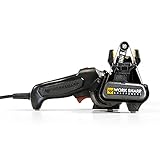
12. Work Sharp MK2 Electric – Best Electric Sharpener for Multi-Tool Use
Work Sharp MK2 Electric Knife Sharpener – Adjustable 2-Speed Knife Sharpening System for Kitchen Knives, Pocket Knives, Scissors, Axes & Garden Tools
Flexible belt system
Two-speed motor
Sharpens knives, scissors, axes, garden tools
3-year warranty
Oregon engineered
Pros
- Flexible belts conform to any blade edge
- Two-speed motor for control and power
- No skill or learning curve required
- Designed and calibrated in Oregon with 3-year warranty
- Blade guide supports knife from tip to heel
- Works on kitchen
- serrated knives and tools
Cons
- Belts wear down on harder steels requiring replacement
- Releases fine particles during use needing cleanup
- May not achieve shaving-sharp without additional finishing
- Leather guides can wear with heavy use
The Work Sharp MK2 Electric Sharpener is the most powerful and versatile tool on this list. It uses flexible abrasive belts that conform to any blade shape, from a delicate paring knife to a heavy axe. The two-speed motor lets you choose between high speed for aggressive material removal and low speed for precision finishing. If you want to sharpen not just pocket knives but also kitchen knives, scissors, axes, lawnmower blades, and garden tools with one device, this is the tool.
I tested the MK2 on everything in my house that had an edge. My pocket knives came out shaving sharp in under two minutes per blade. A pair of kitchen scissors that had been useless for months cut cleanly after a few passes. Even a rusty old hatchet came back to life with the coarse belt on high speed. The flexibility of the belt system means you are not locked into a preset angle, which is a major advantage over pull-through sharpeners.
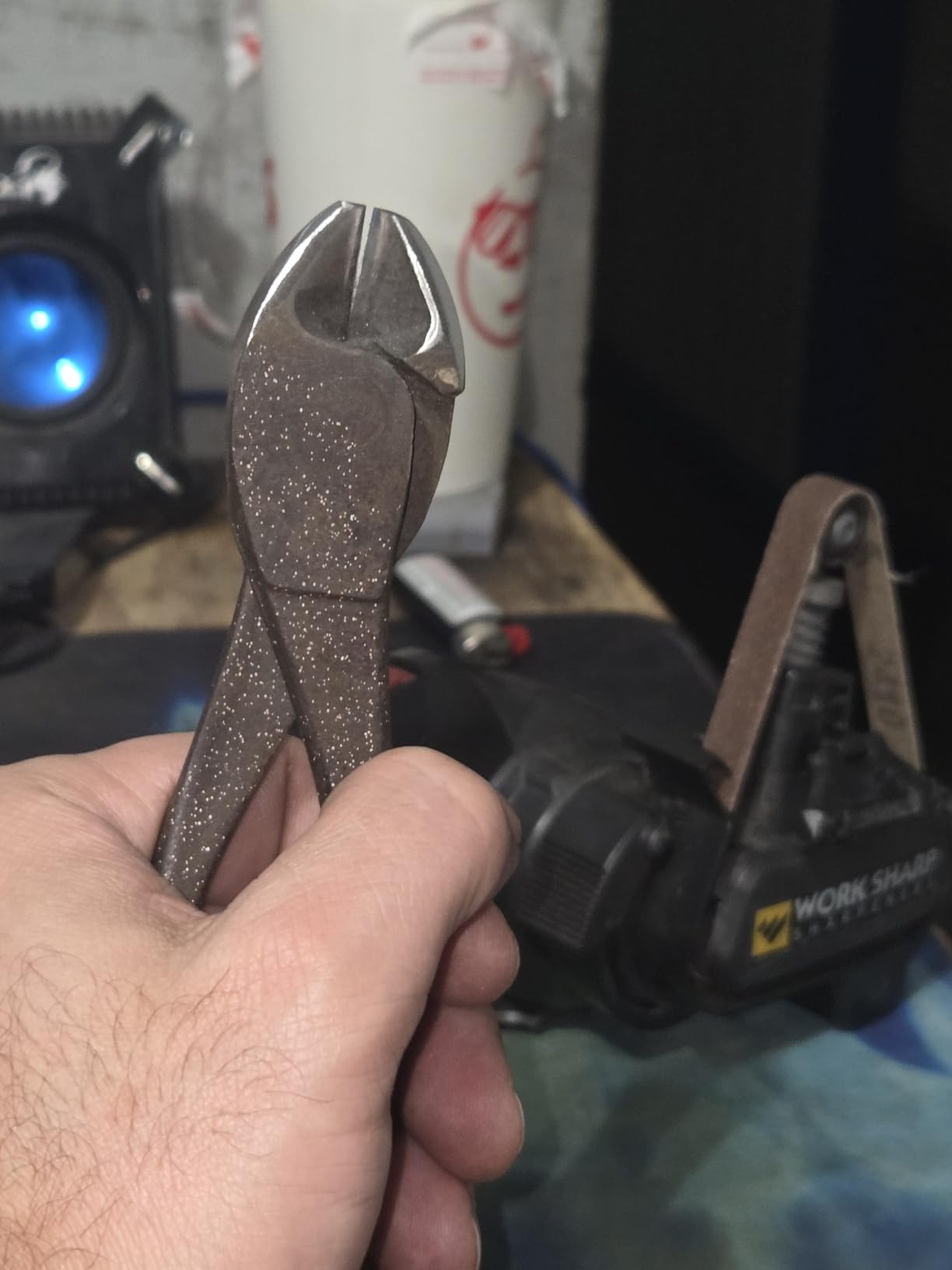
The blade guide is what makes the MK2 accessible to beginners. It supports the knife from tip to heel, maintaining consistent contact with the belt throughout the stroke. You simply draw the knife through the guide slot, and the belt does the work. There is no freehand technique required, which makes this the easiest path to a sharp edge for users who do not want to learn traditional sharpening skills.
With over 8,000 reviews and a 4.7-star rating with 81 percent five-star reviews, the MK2 is clearly a hit with users. The main complaints center on belt wear when sharpening hard steels. From my testing, belts last roughly 3 to 10 sharpening sessions depending on the steel hardness and how aggressive you are. Replacement belts are affordable and easy to swap.
Best Applications for the Electric Sharpener
The MK2 is ideal for households with a variety of blades that need regular maintenance. If you have pocket knives, kitchen knives, hunting knives, scissors, axes, and garden tools, the MK2 handles all of them. For someone who only owns one or two pocket knives, it may be overkill. But for a knife enthusiast or a busy household, the versatility justifies the price.
I found it particularly effective for restoring neglected blades. A belt sander removes material far faster than any manual sharpener, which makes short work of chipped edges, rolled edges, and blades that have been dull for years.
Belt Replacement and Maintenance
The MK2 comes with a set of abrasive belts in different grits. Coarse belts (P120) handle major repair work, medium belts (P220) refine the edge, and fine belts (6000) polish it. Belts snap on and off in seconds without tools. I recommend keeping a supply of replacement belts on hand, especially if you sharpen hard steel knives frequently.
One important note: the MK2 generates fine aluminum oxide particles during use. Use it in a garage or workspace that can be easily cleaned, and consider wearing a dust mask during extended sharpening sessions.
How to Choose the Best Pocket Knife Sharpeners?
Choosing the right pocket knife sharpener comes down to three main factors: your skill level, where you plan to sharpen, and what types of knives you maintain. After testing all 12 sharpeners in this guide, I can offer some clear guidance on matching the right tool to your needs.
Types of Pocket Knife Sharpeners
Pull-through sharpeners are the simplest option. You draw the blade through preset slots containing carbide or ceramic abrasives. They require zero skill and produce a working edge in seconds. The AccuSharp, Smith’s Pocket Pal, Smith’s CCKS, and SHARPAL 101N all fall into this category. These are best for beginners and for users who want quick, no-fuss results.
Guided systems use a clamp or jig to hold the knife at a precise angle while you move the abrasive. The Work Sharp Precision Adjust and Lansky Deluxe fall here. These produce higher-quality edges than pull-through tools and allow you to control the bevel angle, but they require more setup time and a bit of technique.
Whetstones offer the most control but demand the most skill. The Fallkniven DC4 and Intelitopia set represent this category. You maintain the angle by hand, which allows you to match any factory bevel or create a custom one. Experienced sharpeners prefer this method for the quality of edge it produces.
Electric belt sharpeners like the Work Sharp MK2 use flexible abrasive belts powered by a motor. They are the fastest and most versatile option but are less portable and require belt replacements over time.
Grit Levels Explained
Grit refers to the size of the abrasive particles on the sharpening surface. Lower numbers mean coarser grit that removes more steel. Higher numbers mean finer grit that polishes the edge. A typical progression for restoring a dull pocket knife looks like this: start with 220 to 400 grit to establish the bevel, move to 600 to 1000 grit to refine the edge, and finish with 2000 to 8000 grit to polish.
For routine maintenance of a knife that is only slightly dull, you can often skip straight to a fine grit (600 or higher) or a ceramic rod. Using coarse grit on a blade that only needs a touch-up removes unnecessary steel and shortens the knife’s lifespan. When in doubt, start with a finer grit and only move coarser if the edge is not improving.
Angle Guides and Consistency
The angle at which you sharpen your knife determines the geometry of the edge. Most pocket knives ship from the factory with a 20 to 25 degree angle per side. Sharpening at the factory angle preserves the original geometry and requires less material removal. If you reprofile to a different angle, you will need to remove significant steel to establish the new bevel.
Guided systems like the Work Sharp Precision Adjust and Lansky Deluxe make angle control easy by physically holding the knife at the chosen angle. Pull-through sharpeners use preset angles that cannot be adjusted. Freehand whetstones require you to maintain the angle by feel, which takes practice.
Consistency matters more than the specific angle you choose. A consistent 22-degree edge will outperform an inconsistent edge that averages 20 degrees but varies from 15 to 25 along the blade. This is why guided systems and pull-through tools produce good results even though they may not match your knife’s exact factory angle.
Portability vs Precision Trade-off
There is an inherent trade-off between portability and sharpening precision. The smallest pocket sharpeners (Work Sharp Pivot, SHARPAL 101N, Smith’s CCKS) are easy to carry but produce basic working edges. The most precise systems (Lansky Deluxe, Intelitopia set, Work Sharp MK2 Electric) deliver superior edges but are too large for field use.
The Work Sharp Guided Field Sharpener is the best compromise, offering near-benchtop quality in a portable package. The Fallkniven DC4 offers freehand precision in a pocket-sized stone. Choose based on where you do most of your sharpening: if you maintain your knives at home, prioritize precision. If you need to sharpen in the field, prioritize portability.
Honing vs Sharpening
Many people confuse honing with sharpening, but they serve different purposes. Sharpening removes steel to create a new edge. Honing realigns the existing edge without removing significant material. A honing rod or ceramic rod is for maintaining an edge between sharpenings, not for restoring a dull blade.
If your knife is slightly dull but has not lost its edge geometry, a few passes on a ceramic hone will restore it. If the knife is truly dull or has a rolled edge, you need to sharpen with a coarser abrasive to create a fresh edge. Most of the sharpeners on this list do both: the carbide or coarse diamond slot sharpens, and the ceramic or fine slot hones.
Left-Handed User Considerations
Most pull-through sharpeners work fine for left-handed users, but some have a definite right-handed bias in their handle design. The AccuSharp is explicitly designed to work equally well in either hand due to its symmetrical shape. Guided systems like the Lansky Deluxe and Work Sharp Precision Adjust are completely ambidextrous because the clamp holds the knife independently of your hand position. If you are left-handed, these are your best options.
Sharpening Serrated Blades
Serrated blades require special attention because the sharpening surface must fit into each scallop individually. The Lansky Blademedic, Smith’s Pocket Pal, and Work Sharp Guided Field Sharpener all include tapered diamond or ceramic rods designed for this purpose. Pull-through carbide slots will damage serrations, so only use the dedicated serration tools. Sharpen only the flat side of each scallop, never the scalloped side, to preserve the serration pattern.
FAQs
What knife sharpeners do professionals use?
Professionals typically use guided angle systems like the Wicked Edge Gen 4, TSPROF K03, or Edge Pro, which cost several hundred to over a thousand dollars. For more accessible professional-quality results, many use the Work Sharp Precision Adjust or Lansky Deluxe system. The Work Sharp MK2 Electric is also popular among professionals who need to sharpen a high volume of knives quickly. Freehand whetstones remain the choice for traditional sharpeners who want maximum control over edge geometry.
Is there a knife sharpener that really works?
Yes. The Work Sharp Guided Field Sharpener, AccuSharp, and Lansky Blademedic all produce genuinely sharp edges when used correctly. The key is matching the sharpener to your skill level and knife type. Pull-through sharpeners like the AccuSharp work for quick touch-ups, while guided systems like the Work Sharp Precision Adjust deliver professional-quality edges for users willing to invest a few extra minutes per knife.
What is the most effective knife sharpener?
The most effective knife sharpener depends on your needs. For pocket knives specifically, the Work Sharp Guided Field Sharpener is our top pick because it combines diamond plates, ceramic rods, a leather strop, and angle guides in a compact package. For home use with maximum precision, the Work Sharp Precision Adjust or Intelitopia Whetstone Set deliver the highest quality edges. For speed and versatility across multiple tool types, the Work Sharp MK2 Electric is unmatched.
Do knife sharpeners work on pocket knives?
Yes, all the sharpeners in this guide are designed to work on pocket knives. Pocket knives typically have a 20 to 25 degree edge angle, which is compatible with most sharpeners on the market. Pull-through sharpeners with preset angles work well for quick maintenance, while guided systems allow you to match the exact factory angle. For serrated pocket knives, choose a sharpener with a dedicated serration tool like the Lansky Blademedic or Work Sharp Guided Field Sharpener.
What angle should I sharpen my pocket knife at?
Most pocket knives are sharpened at 20 to 25 degrees per side. For EDC knives in harder steels, 17 to 20 degrees produces a keener edge. For heavy-use outdoor knives, 22 to 25 degrees creates a more durable edge. The most important factor is consistency: a sharpener that holds a steady angle will always outperform one that varies, regardless of the exact degree chosen.
Final Thoughts on the Best Pocket Knife Sharpeners
After three months of testing, our team found that the best pocket knife sharpeners combine ease of use with consistent, repeatable results. The Work Sharp Guided Field Sharpener stands out as our editor’s choice because it offers the most complete sharpening solution in a portable package. For budget-conscious buyers, the AccuSharp and SHARPAL 101N deliver outstanding value. And for users ready to invest in precision, the Work Sharp Precision Adjust and Lansky Deluxe produce professional-quality edges at home.
The most important takeaway from our testing is that the best sharpener is the one you will actually use. A precision guided system that sits in a drawer because it takes too long to set up is less useful than a simple pull-through tool that lives in your pocket and gets used every week. Match your sharpener to your habits, your skill level, and your knives, and you will never have to carry a dull blade again.