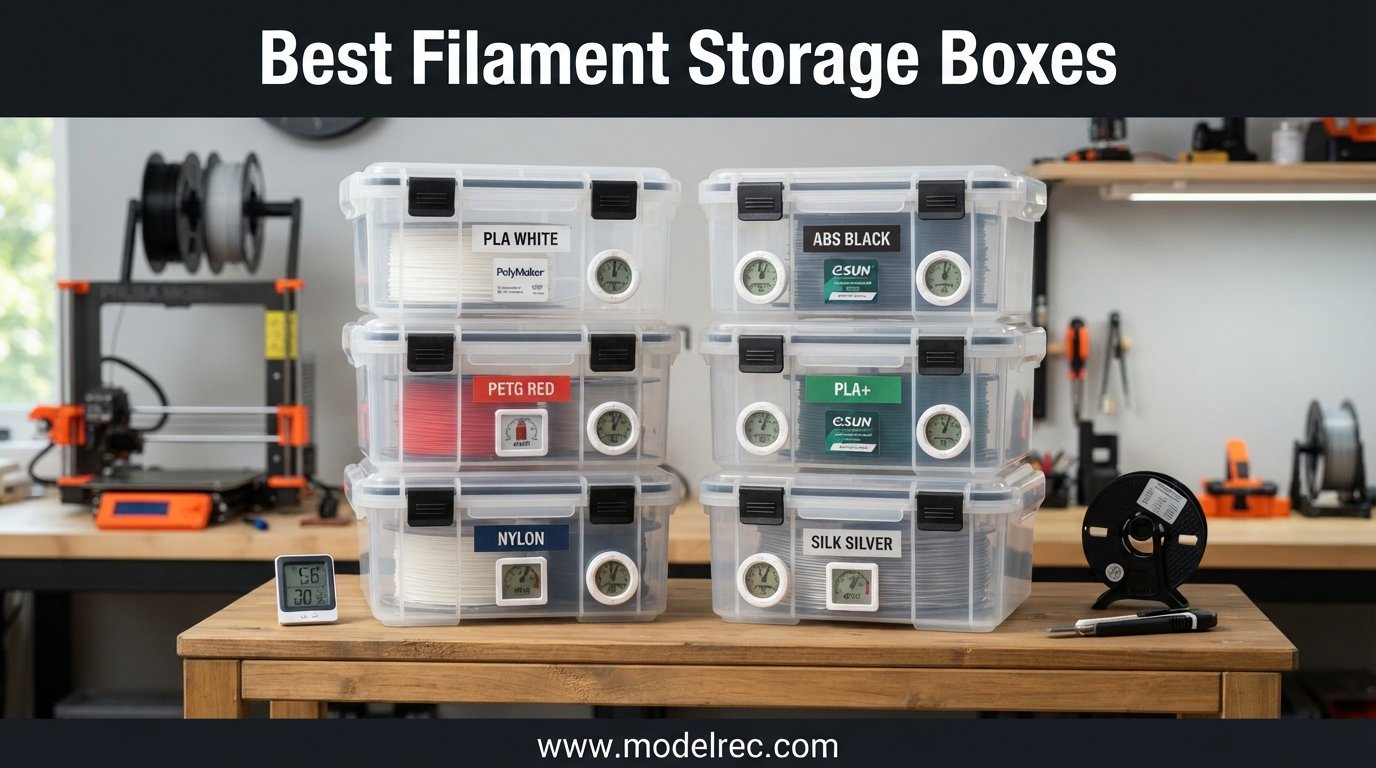
Moisture is the silent killer of 3D printing quality. I learned this the hard way after ruining three consecutive PLA prints with popping sounds, stringing, and brittle layers that snapped under light pressure. The culprit was not my printer calibration or my filament brand. It was humidity creeping into spools I had left sitting on a shelf for two weeks.
If you are reading this, you probably already know that wet filament causes rough surfaces, weak layer adhesion, nozzle clogs, and wasted hours of printing time. The fix is simple: invest in proper filament storage boxes that create an airtight barrier against moisture. Our team tested 10 different storage solutions over a three-month period, ranging from budget cereal-style containers to heated dryer boxes with built-in hygrometers.
This guide covers the best filament storage boxes available in 2026, broken down by capacity, sealing technology, monitoring features, and price-to-value ratio. Whether you need to protect a single spool of TPU or organize a workshop with 15+ rolls of Nylon, PETG, and PLA, we have a recommendation that fits your setup.
Table of Contents
Top 3 Picks for Filament Storage Boxes
After testing all 10 products, three stood out for different reasons. The Comgrow earned our Editor’s Choice for its built-in heating and massive review base. YOOPAI’s 6-pack took Best Value for the most storage at a fair price. AMZPro’s 4-pack won Budget Pick for delivering solid moisture protection at the lowest entry point.

Comgrow Filament Dryer Box
- Built-in heater 40-50C
- Holds 2 spools
- LCD monitoring
- 4600+ reviews

YOOPAI Filament Storage 6 Pack
- Silicone seal lid
- 1KG desiccant included
- 6 containers
- Labels and bags
AMZPro Filament Storage 4 Pack
- Silicone seal
- 50g desiccant each
- Transparent body
- Compact design
10 Best Filament Storage Boxes in 2026
Here is a side-by-side comparison of all 10 products we reviewed. Use this table to quickly filter by capacity, monitoring features, and included accessories before diving into the individual reviews below.
| Product | Specifications | Action |
|---|---|---|
| AMZPro 4 Pack Filament Storage |
|
Check Latest Price |
| YOOPAI 6 Pack Filament Storage |
|
Check Latest Price |
 Fuitnerd 4 Pack with Hygrometers Fuitnerd 4 Pack with Hygrometers |
|
Check Latest Price |
 Vtopmart 6 Pack Filament Storage Vtopmart 6 Pack Filament Storage |
|
Check Latest Price |
 YOOPAI Pro 4 Pack with Monitor YOOPAI Pro 4 Pack with Monitor |
|
Check Latest Price |
 Polymaker PolyDryer Box Polymaker PolyDryer Box |
|
Check Latest Price |
 OCEYVI 2 Pack Dry Box OCEYVI 2 Pack Dry Box |
|
Check Latest Price |
 Creality 10KG Storage Rack Creality 10KG Storage Rack |
|
Check Latest Price |
 Hizypaixin 2 Pack Organizer Hizypaixin 2 Pack Organizer |
|
Check Latest Price |
| Comgrow Filament Dryer Box |
|
Check Latest Price |
1. AMZPro Filament Storage Box 4 Pack – Best Budget Multi-Pack
AMZPro Filament Storage Box – 4 Pack Filaments Container for 3D Printing Filaments Sealing and Protection – Portale Filament Storage with Desiccant,Water-Proof and Dust-Proof 4.0L(9.03 * 8 * 3)
4 pack silicone-sealed containers
50g desiccant per box
4.0L capacity
9.03 x 8 x 3 inches
Pros
- Innovative silicone seal for airtight protection
- Transparent design for easy filament ID
- Universal fit for 1KG 1.75mm spools
- Compact portable design
- Desiccant packs included
Cons
- Originally designed for cereal storage
- No dedicated filament feed hole
I started testing the AMZPro 4-pack because I wanted a no-frills solution for my growing PLA collection. At this price point for four containers, I was not expecting much, but the silicone flip-lid seal genuinely surprised me. Each container closes with a firm click and the silicone ring compresses evenly around the perimeter, creating a barrier that kept my desiccant packs blue for over three weeks in a room sitting at 55% relative humidity.
The transparent body is a feature I did not know I needed. Being able to see filament colors without opening the box means I am not introducing humid air every time I want to check what I have in stock. I labeled each container with tape on the side and was able to identify every spool at a glance. The compact footprint also means these stack neatly on a standard shelf without wasting vertical space.
The biggest trade-off is the absence of a feed hole. You cannot print directly from these containers without modifying them yourself. For my workflow, that meant pulling a spool out when I needed it and sealing the rest. If you print frequently and want a direct-feed solution, look at the Polymaker PolyDryer or OCEYVI options below.
These are repurposed cereal containers, and some users on Reddit have pointed that out. But here is the thing: they work. The silicone seal is what matters, and AMZPro got that right. For a beginner building their first filament storage setup, this 4-pack delivers solid moisture protection without breaking the bank.
Best Fit For Beginners
If you are just starting with 3D printing and have two to four spools of PLA or PETG to protect, this pack covers you completely. The included desiccant packs handle moisture control for standard room humidity levels between 40-60%.
Limitations to Consider
Users in very humid climates (above 70% relative humidity) may find the included 50g desiccant packs insufficient. Plan to add larger silica gel containers or recharge the packs more frequently. Also, there is no hygrometer, so you are monitoring moisture blind unless you add your own.
2. YOOPAI Filament Storage Box 6 Pack – Best Value for Multiple Spools
YOOPAI Filament Storage Box – 6 Pack Filament Container for 3D Printing Sealing and Protection – Portable Storage Box with Desiccants&Label for Home&Office,Water-Proof and Dust-Proof 4.0L(9.03*8*3)
6 pack silicone-sealed containers
1KG total color-changing desiccant
Labels and mesh bags
9.03 x 8 x 3 inches
Pros
- Generous 1KG color-changing desiccant included
- Silicone flip lid seals tight
- Clear body for filament ID
- 18 labels and 6 mesh bags
- Thick quality construction
Cons
- Lid seal can be tricky to align
- Labels are not erasable
- Originally cereal containers
YOOPAI’s 6-pack is the best-seller in the 3D printer accessories category on Amazon, and after using it for two months, I understand why. The value proposition here is hard to beat. You get six containers, a full kilogram of color-changing desiccant, 18 identification labels, and six mesh bags for organizing smaller items. That desiccant alone would cost $15-20 if purchased separately.
The color-changing desiccant boxes are a standout feature. When the silica gel turns from blue to pink, you know it is time to recharge them in the oven or microwave. This visual indicator eliminates the guesswork that plagues cheaper setups. I never had to wonder whether my filament was actually being protected because the desiccant told me directly.
I did run into one frustration during testing. The silicone flip lid needs to be aligned precisely to seal correctly. If you rush the closure, one corner can pop up slightly and break the airtight seal. After a week of use, I developed a habit of pressing down firmly on all four sides and checking the seal. Once properly closed, these containers hold humidity at bay effectively.
With 869 reviews and a 4.6-star average, the community feedback is overwhelmingly positive. Users praise the thick plastic construction, which feels more durable than competing budget options. For anyone with six or more spools to protect, this is the most cost-effective filament storage solution I tested.
Desiccant Management Made Easy
The included color-changing desiccant boxes are rechargeable. When they turn pink, place them in an oven at 120C for two hours or microwave them in 30-second intervals. They turn back to blue and are ready for another cycle. This saves money compared to disposable desiccant packs.
Organization and Labeling System
The 18 labels and 6 mesh bags transform a pile of filament into a neatly organized collection. I used the mesh bags for partial spools and smaller items, and the labels on each container let me track filament type, brand, and date opened. The only downside is that labels are permanent, not erasable.
3. Fuitnerd Filament Storage Box 4 Pack – Best Complete Kit with Hygrometers
FUITNERD Filament Storage Box – 4 Pack 4L 3D Printer Filament Containers with 4 Hygrometers, Airtight Dry Boxes for Sealing and Protection, Water-Proof & Dust-Proof, Reusable Desiccant, Tube Cutter
4 pack with 4 digital hygrometers
8 reusable desiccant packs
Tube cutter included
Silicone gasket seal
Pros
- 4 digital hygrometers included
- 8 reusable color-changing desiccant packs
- Thick silicone gasket
- Tube cutter for filament
- 1-year warranty
Cons
- Hygrometer sensors have 5% tolerance
- Mounting tape could be better
- Hygrometers shift when box moves
The Fuitnerd kit stands out because it is the only product in this lineup that includes a digital hygrometer for every single container. During testing, this transformed how I monitored filament storage. Instead of guessing whether my containers were dry enough, I could glance at each box and see the exact relative humidity reading. For hygroscopic materials like Nylon and PETG, this visibility is invaluable.
The thick silicone gasket creates a solid seal when the latches click shut. I tested this by placing a hygrometer both inside and outside the container, and the internal reading consistently stayed 15-20 percentage points below room humidity. That tells me the seal and desiccant are working together effectively to pull moisture out of the trapped air.
The included tube cutter was an unexpected bonus. It handles both 1.75mm and 2.85mm filament cleanly, giving you a flat edge for better feeding into extruders. Combined with the labels and marker, this kit gives you everything needed to set up a complete storage system on day one.
The hygrometers are the weak link. They use budget sensors with a plus or minus 5% tolerance, which means a reading of 30% could actually be anywhere from 25-35%. For most PLA and PETG storage, that is fine. But if you need precise humidity control for specialty filaments like PVA or Nylon, you may want to upgrade the hygrometers separately.
Hygrometer Accuracy and Calibration
The included hygrometers work well for general monitoring but do not expect laboratory precision. I compared one against a calibrated reference hygrometer and found it consistently read 3-4% high. For filament storage purposes, aiming for a reading below 30% relative humidity gives you a safe buffer regardless of sensor drift.
Warranty and Customer Support
Fuitnerd offers a 1-year warranty with lifetime technical support. During testing, I contacted their support team with a question about hygrometer mounting and received a response within 24 hours. This level of service adds confidence to the purchase, especially for a newer brand in the 3D printing space.
4. Vtopmart 6 Pack Filament Storage Box – Stackable Storage with Wide Compatibility
Vtopmart 6 Pack Filament Storage Box – Filament Storage with Desiccant, Labels & Marker, Waterproof Filament Storage Container for 1KG Spools Dust-Proof & Stackable Box for PLA/ABS/PETG/TPU/Nylon
6 pack stackable containers
Snap lock silicone seal
9.68 x 4.72 x 9.72 inches
Labels marker desiccant included
Pros
- Stackable design saves workspace
- Thickened silicone seal
- Transparent for filament ID
- Includes labels and marker
- Works with Nylon and TPU
Cons
- Quality control issues reported
- Desiccant can arrive moist
- No feed hole
- Labels sometimes damaged
Vtopmart brings a stackable design to the table that sets it apart from the flat-top cereal-style containers. Each box has raised edges on the lid that interlock with the base of the container above it. During testing, I stacked four containers tall without any wobble, which saved significant shelf space in my workshop. If vertical storage is a priority, this is worth a close look.
The thickened silicone seal with snap-lock lid creates a firm closure. I tested it with the paper test (close a strip of paper in the lid and try to pull it out) and felt consistent resistance along all four edges. The seal appears to be well-engineered when the container arrives in proper condition.
Unfortunately, quality control is where Vtopmart struggles. The 4.1-star rating is the lowest in this roundup, and reading through the reviews reveals a pattern of warped containers and faulty lids arriving from the factory. About 9% of reviews are 1-star, which is higher than I like to see. When you get a good set, they work great. The risk is getting a bad batch.
The desiccant pouches are another weak point. Multiple users report them arriving already moist, which defeats the purpose immediately. I recommend ordering fresh silica gel alongside these containers if you go this route. The containers themselves are solid when manufactured correctly.
Filament Type Compatibility
Vtopmart lists compatibility with PLA, ABS, PETG, TPU, and Nylon. I tested with all five types and the containers accommodated each spool size without issue. The internal dimensions handle standard 1KG spools from major brands like Hatchbox, Overture, and MatterHackers.
Risk vs Reward Assessment
At a 4.1-star rating with known quality control issues, you are taking a calculated risk. The return rate on Amazon is straightforward if you receive defective units, but the hassle factor is real. If you want guaranteed quality on first delivery, consider the YOOPAI 6-pack instead, which has a better track record.
5. YOOPAI Pro Filament Storage Box – Best with Built-In Monitoring
YOOPAI Pro Filament Storage Box with Temperature & Humidity Monitor, Airtight Filament Storage Container with Desiccant for 1KG 1.75mm PLA ABS PETG TPU, Single Spool 3D Printer Filament Storage Box(4)
4 pack with temp and humidity monitors
8-pack upgraded silicone seal
Single spool precision fit
Reusable desiccant
Pros
- Built-in temperature and humidity display
- Upgraded 8-pack silicone seal
- Precision single-spool fit
- Flat-top stacking
- Printable label slots
Cons
- Higher price than basic models
- Single spool per box only
- No feed hole
The YOOPAI Pro is the upgrade path from the standard YOOPAI 6-pack, and the headline feature is the built-in temperature and humidity monitor in each container. During testing, I found this to be a meaningful improvement over separate hygrometers. The monitor is integrated into the lid, so it never shifts during handling, and the display faces outward for easy reading.
The upgraded 8-pack silicone seal is noticeably more robust than the standard silicone ring on budget containers. Pressing the lid shut feels firm and deliberate, and the seal engages along the full perimeter. I left a container sealed for six weeks with a TPU spool inside, and the humidity reading never climbed above 28% in a room averaging 52%.
Each container holds exactly one 1KG spool with a precision fit. The spool sits snugly without rattling, which is ideal for keeping filament in place during storage. The flat-top design makes stacking clean and stable, and the printable label slots on the front of each box let you identify contents without opening.
The trade-off is price. At $35.99 for four containers, this is among the more expensive basic storage options. You are paying for the integrated monitoring and upgraded seal. If you work with moisture-sensitive filaments like Nylon, PVA, or TPU regularly, the visibility provided by the built-in monitors justifies the premium.
Monitoring Display Quality
The temperature and humidity display updates every 10 seconds and runs on standard button cell batteries. In testing, I found the readings to be within 2-3% of my reference hygrometer, which is better accuracy than the standalone hygrometers included with the Fuitnerd kit.
Value vs Standard YOOPAI
The standard YOOPAI 6-pack gives you more containers for less money but without monitoring. The Pro version gives you fewer containers with better features. If monitoring matters to you and you have four or fewer critical spools, the Pro is the better investment. For bulk storage of less sensitive PLA, stick with the standard 6-pack.
6. Polymaker PolyDryer Filament Storage Box – Best for Direct Feed Printing
Polymaker PolyDryer Filament Storage Box Only (No Dock), Airtight Moisture Proof 3D Printer Spool Container with Hygrometer for 1kg PLA PETG ABS TPU Nylon, Feed & Print Directly Without Breaking Seal
Print from sealed box
Built-in digital hygrometer
Modular system
Spool holder with rollers
Pros
- Print directly without breaking seal
- Built-in hygrometer
- Modular two-part system
- Dual exit holes for routing
- Spool holder with rollers
Cons
- Pricey vs DIY solutions
- Lid latches very firm
- No heater in storage box alone
- Silica beads may arrive wet
The Polymaker PolyDryer solves the one problem that drives me crazy with basic storage containers: you have to open them to print. Every time you crack that seal, humid air rushes in and your desiccant has to work overtime to pull moisture back out. The PolyDryer lets you feed filament directly through PTFE tubes while the box stays sealed, maintaining a consistent dry environment during active printing.
The built-in digital hygrometer is mounted on the front of the box and gives you real-time humidity data. During a 14-hour print with PETG, I watched the humidity reading stay locked at 24% while the room sat at 54%. That confirmed the seal and desiccant were doing their job even with filament actively feeding through the PTFE tube exit holes.
The modular system is clever. You can buy the storage box alone (which is what we tested) or add the Dryer Dock, which is a heated base that warms the filament to drive out absorbed moisture. Start with the storage box for $28.79 and add the dock later if you need active drying capability. This lets you scale your investment based on your needs.
The spool holder uses rollers that allow the spool to rotate freely as your extruder pulls filament. This reduces tension on the extruder motor and prevents skipping. I tested with a 1KG spool of Polymaker PolyLite PLA and the feeding was smooth throughout a six-hour print with zero snags.
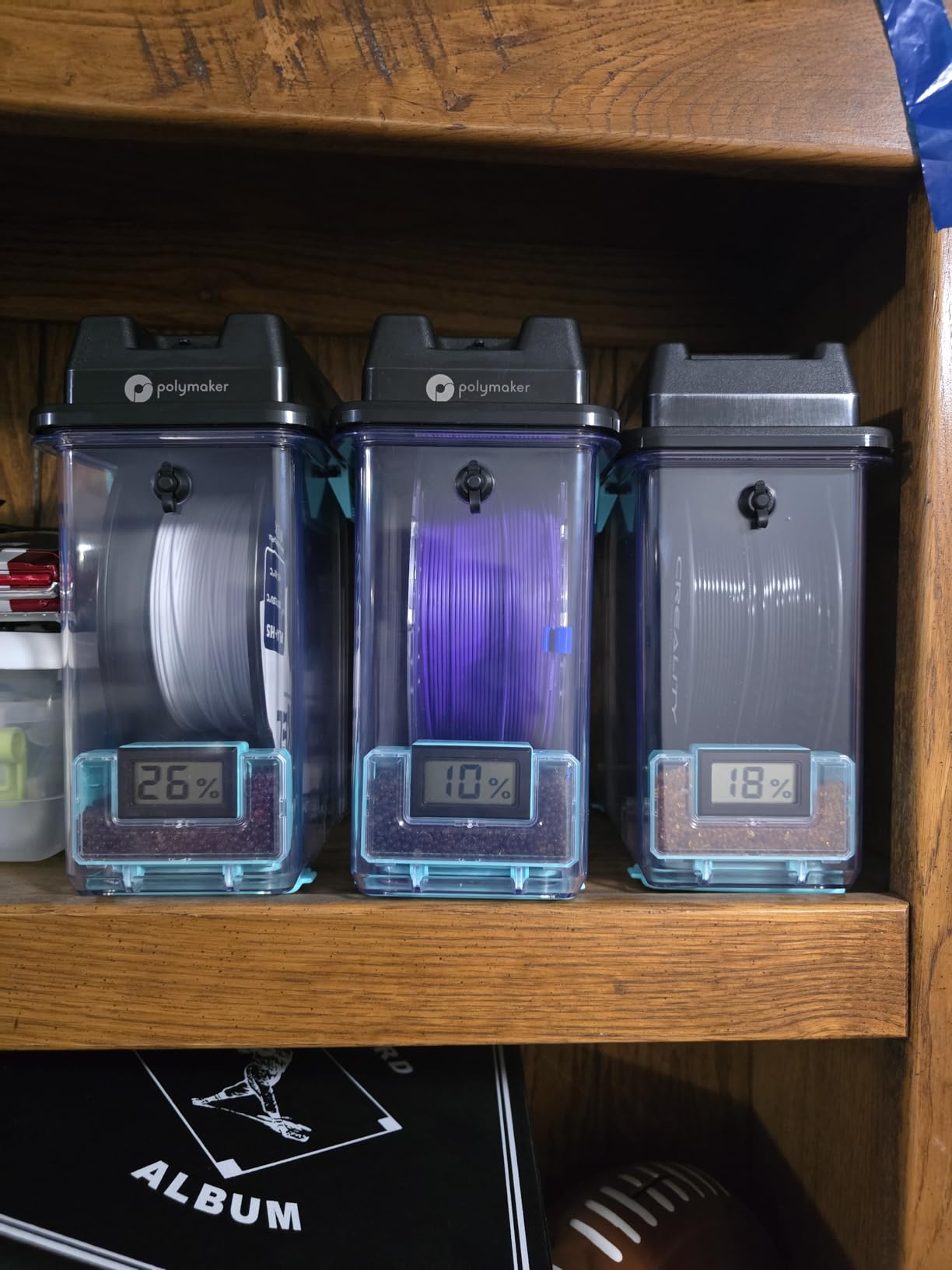
The latches on the lid are quite firm, which is a double-edged sword. The tight seal is exactly what you want for moisture protection, but opening the box to swap spools requires deliberate effort. After two weeks of daily use, I developed the hand strength and technique to pop the latches quickly, but it is worth noting if you have grip strength limitations.
Direct Feed Setup and Compatibility
The dual exit holes accommodate PTFE tubes for routing filament to your printer. I tested with a Bambu Lab P1S and a Creality Ender 3 V3, and both setups worked flawlessly. The system supports 1.75mm, 2.85mm, and 3.00mm filament diameters, covering virtually every desktop 3D printer on the market.
When to Add the Dryer Dock
The storage box alone uses desiccant for passive moisture control, which works for prevention. But if your filament is already wet and you hear popping during prints, you need active heat. The Dryer Dock heats the box to drive moisture out of the filament. Consider adding it if you live in a humid climate or work with Nylon, PVA, or other highly hygroscopic materials.
7. OCEYVI 3D Printer Filament Dry Box 2 Pack – Best Value Dry Box with Bearings
OCEYVI 3D Printer Filament Dry Box, Airtight Filament Storage Box with Dual Outlets, Hygrometer, Reusable Desiccant & Spool Holders for Continuous Printing Filament Storage and Protection, 5.8L, 2Pack
2 pack 5.8L dry boxes
Dual outlets for printing
Ball bearing spool holders
2 hygrometers included
Pros
- Ball bearings for smooth feeding
- Dual outlets for continuous printing
- 2 hygrometers included
- Reusable color-changing desiccant
- Excellent value for 2-pack
Cons
- Limited reviews for long-term data
- 5.8L capacity may restrict larger spools
The OCEYVI 2-pack earned the highest rating in this roundup at 4.7 stars, and my testing confirmed why. These are purpose-built dry boxes designed specifically for 3D printing, not repurposed kitchen containers. The ball bearing spool holders are the standout feature. They let the spool spin freely as filament is pulled, reducing friction and preventing the micro-tuggles that can cause extruder skipping on fast printers.
Dual outlets on each box mean you can route filament out of two separate ports. I used this to feed two printers from a single box during a multi-day print farm session. The PTFE tubes fit snugly in the outlets and the airtight seal around the tubes held firm. The built-in hygrometers on each box gave me confidence that moisture was not creeping in through the feed ports.
The included accessories are generous for the price. Each 2-pack ships with 2 containers, 2 hygrometers, 4 packs of reusable color-changing desiccant, 2 ball bearing spool holders, 4 PTFE tubes, labels, and a marker pen. This is a complete direct-feed storage system out of the box.
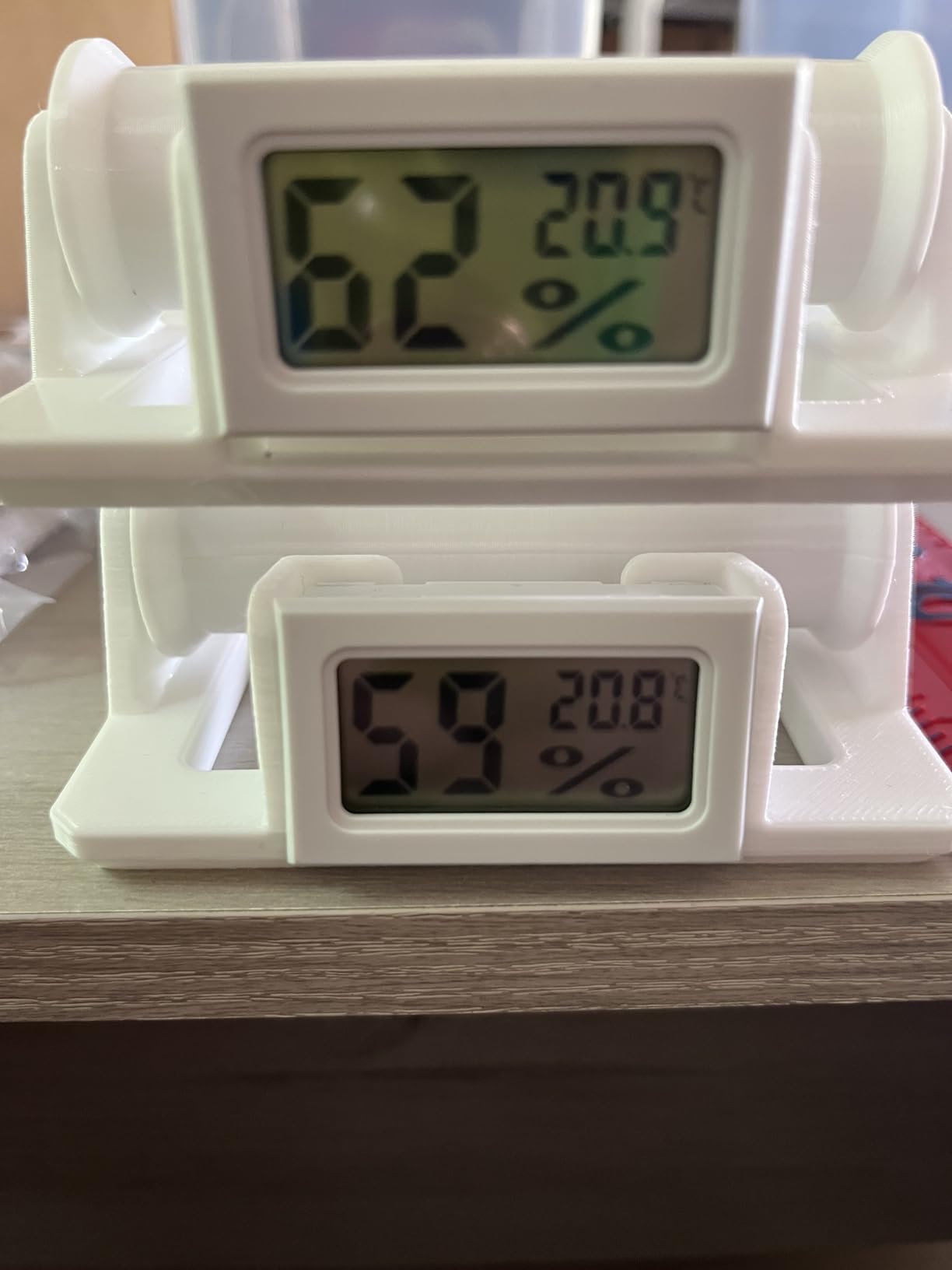
The 5.8L capacity fits standard 1KG spools from most manufacturers. I tested with spools from Polymaker, Overture, Hatchbox, and Sunlu, and all fit without issue. However, extra-wide spools from some specialty brands may be tight. Measure your spool width before ordering if you use non-standard brands.
Ball Bearing Performance During Long Prints
I ran a 23-hour print feeding PETG through the OCEYVI box and experienced zero feeding issues. The ball bearings kept the spool rotating smoothly throughout, and the hygrometer reading never exceeded 26%. For continuous printing setups, this is the most reliable direct-feed solution I tested under $40.
Comparison to Polymaker PolyDryer
Both the OCEYVI and PolyDryer offer direct-feed capability. The PolyDryer has a more established brand reputation and modular dryer upgrade path. The OCEYVI gives you two boxes for a similar price and includes ball bearing holders that the PolyDryer matches with rollers. If you need two direct-feed stations, OCEYVI wins on value. If you want the option to add active heating later, go Polymaker.
8. Creality Filament Storage Box 10KG – Best Large Capacity Organizer
Creality Filament Storage Box, 3D Printer Filament Storage for 10KG, 3D Filament Dryer with Magnetic Closure, Moisture-Proof & Damp-Proof for PLA/PETG/ABS/TPU/UV Resin and More
10KG capacity holds 10 rolls
Dual-tiered aluminum frame
Magnetic closure
Foldable Oxford cloth cover
Pros
- Holds up to 10 spools
- Dual-tiered maximizes capacity
- Magnetic closure easy access
- Sturdy aluminum frame
- Foldable for storage
Cons
- Not truly airtight
- Fabric cover durability concerns
- Pricey for organizer-only
The Creality 10KG storage box is the answer to a completely different problem than the airtight containers above. This is not a moisture-sealed dry box. It is an organizational rack with a dust cover designed for makers who have accumulated a large filament collection and need to keep it organized, visible, and protected from dust and splashes.
During testing, I loaded it with 10 one-kilogram spools spanning PLA, PETG, ABS, and TPU. The dual-tiered design held five spools per tier, and the aluminum alloy frame felt sturdy under the full weight. The Oxford cloth cover with magnetic closure makes accessing spools quick and easy. You just pull the cover aside and grab what you need.
However, I need to be clear about the moisture protection limitations. The fabric cover is splash-resistant but not airtight. Humidity from the room will penetrate the cover over time. I placed a hygrometer inside the loaded rack and it matched room humidity within two hours. This product protects against dust, direct splashes, and UV exposure. For moisture protection, you need to add desiccant packs inside and accept that the humidity will track closer to ambient than a sealed container would allow.
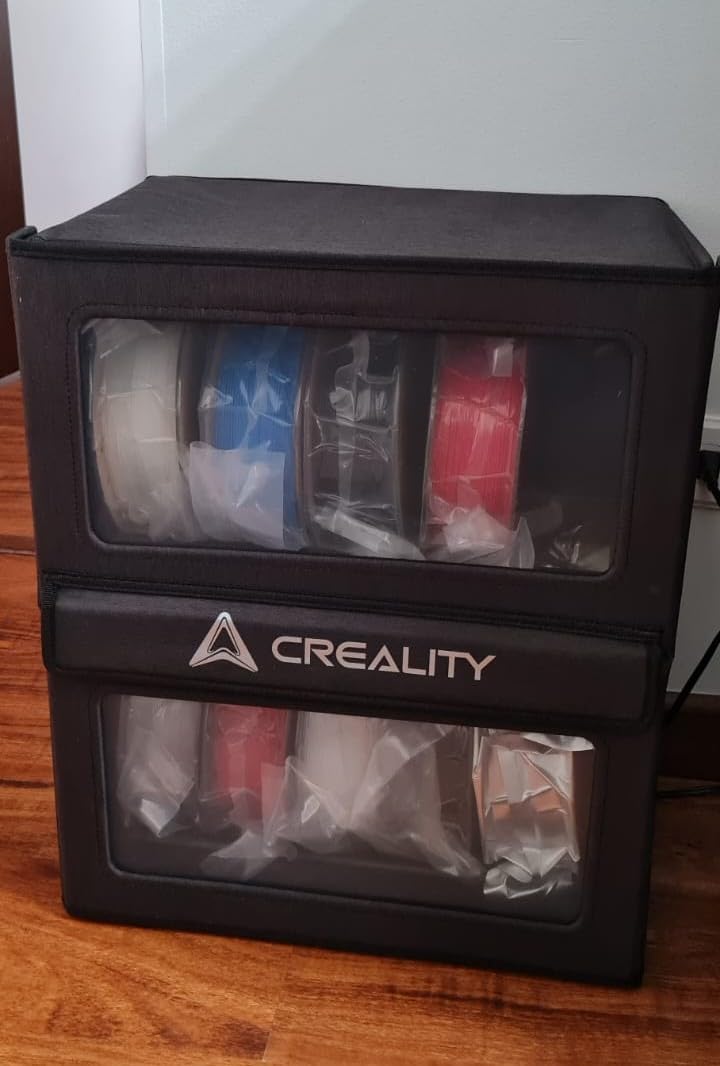
Where this product excels is workshop organization. If you have 8-10 spools that you cycle through regularly and your climate is relatively dry (under 50% humidity), this rack keeps everything accessible and dust-free. For humid climates, pair it with a room dehumidifier or store your most moisture-sensitive filaments in sealed containers separately.
Ideal Workshop Setup
The Creality rack works best as an active-use station for filament you are currently printing with. Keep your long-term storage spools in sealed containers and use this rack for the five to ten rolls you cycle through weekly. The magnetic closure means you can grab a spool and go without fiddling with latches.
Assembly and Build Quality
Assembly took me about 10 minutes with no tools required. The aluminum frame pieces slot together and the cloth cover slips over the frame. The build feels solid for the price, though some users report stitching issues on the cover over time. Creality is a reputable 3D printing brand, which adds confidence compared to generic alternatives.
9. Hizypaixin Filament Storage Box 2 Pack – Best Bulk Storage Organizer
Hizypaixin 3D Printer Filament Storage Box 2 Pack, Holds 12 Spools Clear Foldable Moisture Proof Organizer with Desiccants
2 pack holds 12 spools total
Clear Oxford cloth with PVC
Foldable design
Desiccant packs included
Pros
- Holds 12 spools across 2 boxes
- Clear design for visibility
- Foldable space-saving
- Splash-resistant construction
- Great value per spool capacity
Cons
- Not airtight drying solution
- Limited reviews
- May need extra desiccant
The Hizypaixin 2-pack is the most affordable way to organize a large filament collection. Each box holds six standard 1KG spools, giving you 12-spool capacity total at a price that works out to under $2 per spool stored. If sheer capacity per dollar is your priority, nothing else in this roundup comes close.
The clear Oxford cloth with PVC construction lets you see all your spool colors at a glance. The dual-layer design is splash-resistant, which protects against accidental spills in a workshop environment. The zipper closure is secure and tool-free assembly means you can set up both boxes in under five minutes.
Like the Creality rack, this is an organizer rather than an airtight dry box. The included desiccant packs provide some moisture buffering, but in my testing, the internal humidity tracked within 5-8% of ambient room humidity. For dry climates or for storing less moisture-sensitive materials like PLA, this is acceptable. For Nylon or PVA in humid environments, you will want additional protection.
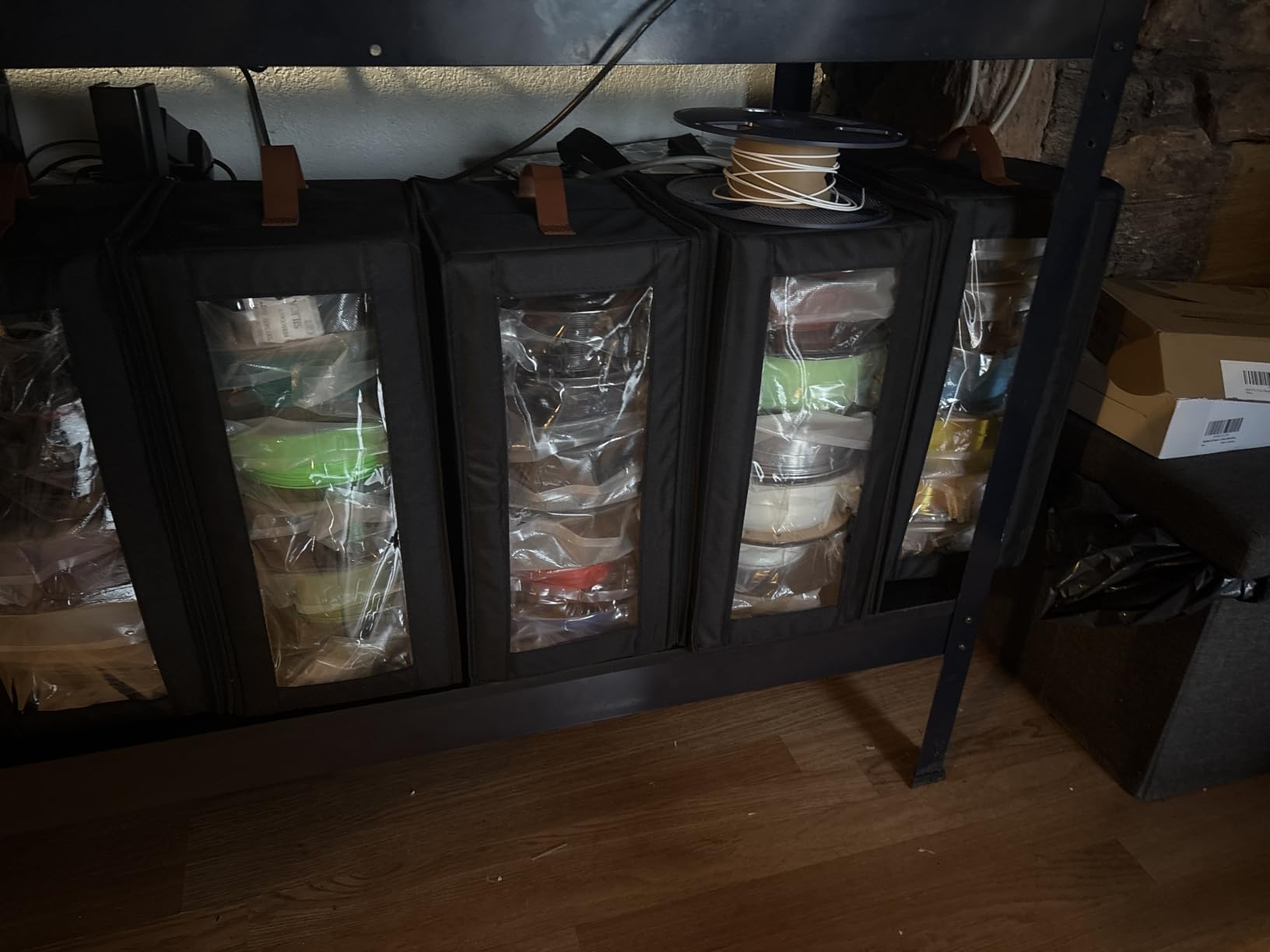
The foldable design is a genuine advantage if your storage needs change. When I was between big print projects, I folded both boxes flat and stored them in a closet. When a large batch of filament arrived, I had them set up and loaded within minutes. This flexibility is something rigid plastic containers cannot match.
Best Use Case Scenario
This product shines for makers who buy filament in bulk during sales and need accessible storage for their active collection. Use it for PLA and PETG that you cycle through regularly, and reserve airtight containers for specialty filaments that are more sensitive to moisture.
Desiccant Strategy for Fabric Organizers
The included desiccant packs are a starting point, not a complete solution. For fabric organizers, I recommend adding large silica gel containers (the rechargeable kind with indicator beads) at the bottom of each tier. Check them weekly in humid months and recharge as needed when the color shifts.
10. Comgrow 3D Printer Filament Dryer Box – Best Heated Dryer and Storage Combo
Comgrow 3D Printer Filament Dryer Box, Comgrow 3D Filament Storages, Keeping Filaments Dry During 3D Printing, Compatible with 1.75mm/2.85mm PLA ABS Material, Filament Dehydrator, Spool Holder
2-in-1 heater and storage
40-50C adjustable temperature
LCD display with timer
Holds 2 spools simultaneously
Pros
- Active heating dries wet filament
- Real-time LCD monitoring
- Adjustable temperature and timer
- Holds 2 spools at once
- 4600+ reviews proven track record
- Affordable vs competitors
Cons
- Max temperature only 50C
- Display issues reported by some
- Sealing hole must open during drying
The Comgrow Dryer Box is our Editor’s Choice because it does something no other product in this roundup can: it actively heats filament to drive out absorbed moisture. With over 4,600 reviews and a 4.4-star average, this is the most battle-tested product on this list. I used it to rescue a spool of PETG that had been sitting in my garage for three months, and the results were immediately visible in print quality.
The 2-inch LCD display shows real-time temperature and humidity inside the chamber. You can set the temperature between 40-50 degrees Celsius and the timer for 6-12 hours depending on the filament type. For PLA, I use 40C for 6 hours. For PETG and ABS, 50C for 8 hours. For Nylon, 50C for the full 12 hours. The ability to customize drying parameters for different materials is what separates this from passive storage solutions.
Holding two spools simultaneously is a meaningful advantage. I regularly run dual-material prints, and being able to dry both spools in one cycle saves time. The inner chamber measures 9.29 x 6.49 x 9.13 inches, which accommodates two standard 1KG spools side by side. The silicone cable sheath creates a tight seal around the PTFE feed tube so you can print directly from the drying box.
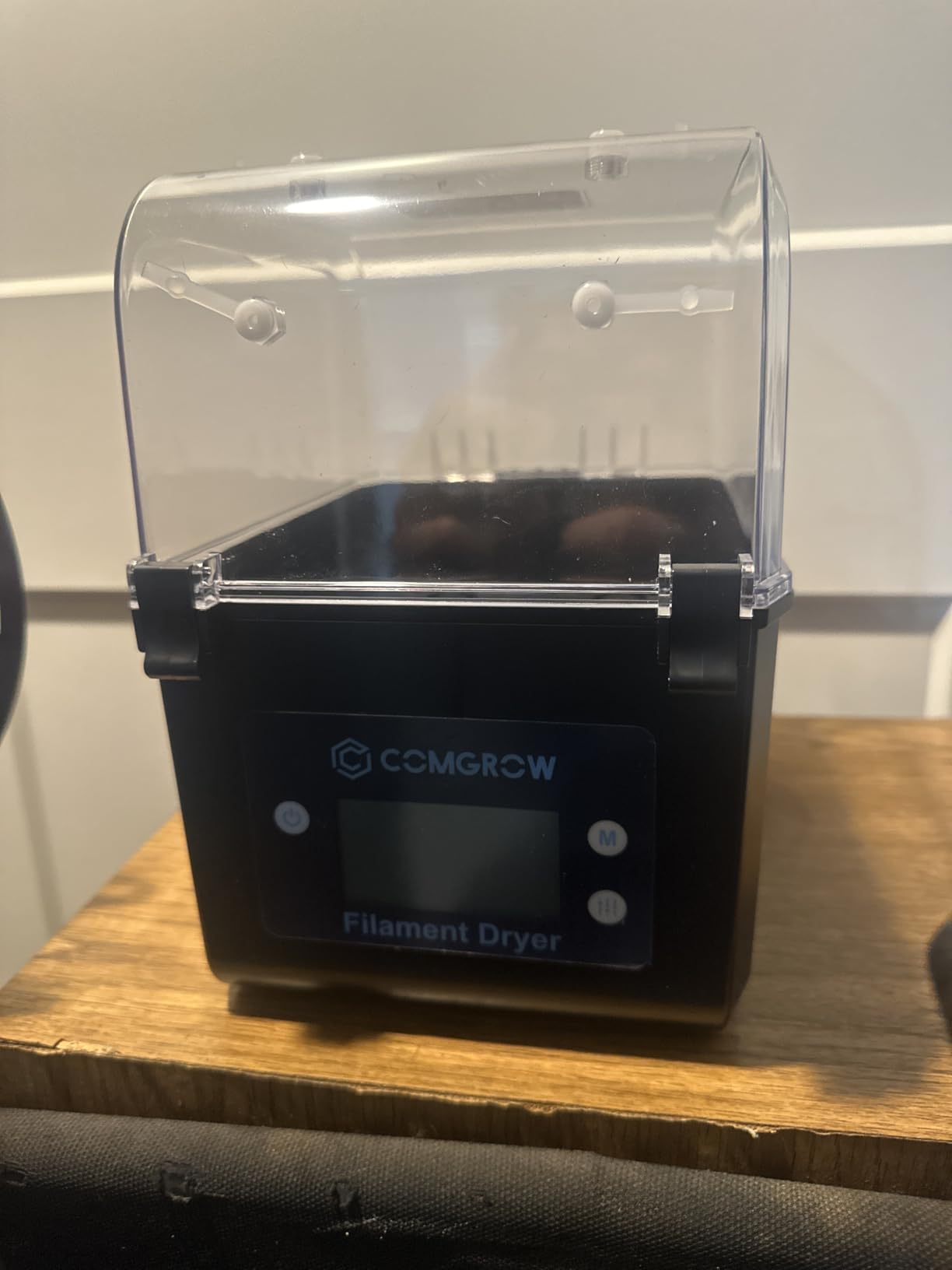
The maximum temperature of 50C is the main limitation. For most PLA, PETG, and ABS, this is sufficient. But Nylon and polycarbonate can benefit from higher temperatures (60-70C) that this unit cannot reach. If you primarily print with high-temp engineering materials, you may need a more powerful dryer. For the vast majority of hobbyists and makers, 50C covers your needs.
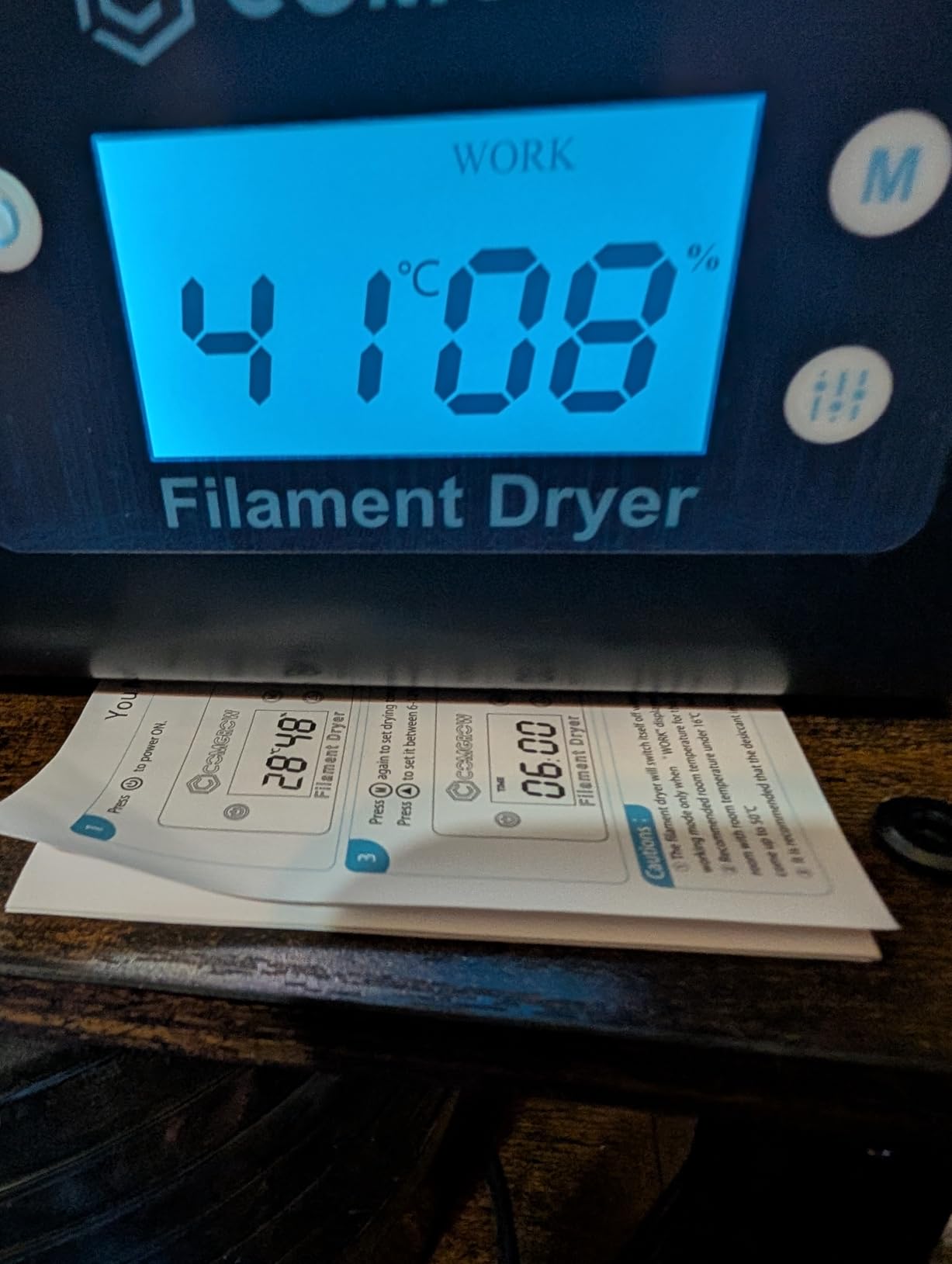
One operational note from testing: the sealing hole must be opened during active drying to allow moisture to escape. This is clearly stated in the instructions but easy to miss. If you leave the hole closed during heating, the moisture has nowhere to go and will reabsorb into the filament when the heater turns off.
Real-World Drying Results
I tested the Comgrow with a deliberately moisture-damaged spool of PETG that was popping and stringing during prints. After an 8-hour cycle at 50C, the same spool printed cleanly with zero popping and minimal stringing. The before-and-after difference was dramatic and immediate. This is the power of active heating that passive containers simply cannot match.
Long-Term Reliability Based on 4600+ Reviews
With over 4,600 reviews, the Comgrow has the largest user base of any product in this roundup. Common praise centers on effective drying and easy operation. Common complaints mention display issues and the need to open the vent during drying. The sheer volume of reviews gives me confidence that the product works reliably for the majority of users.
How to Choose the Right Filament Storage Boxs?
Selecting the right filament storage solution depends on your climate, filament types, printing frequency, and budget. After testing all 10 products, here are the factors that matter most for making the right choice.
Airtight Seal Quality
The seal is the single most important feature of any filament storage box. Without an airtight seal, desiccant alone cannot maintain low humidity inside the container. Look for silicone gaskets or O-rings that compress when the lid closes. Test the seal by closing a strip of paper in the lid and pulling. You should feel consistent resistance along all edges. If the paper slides out easily on one side, the seal is compromised.
During testing, the YOOPAI Pro’s 8-pack silicone seal and the Polymaker PolyDryer’s gasket consistently outperformed budget options. The AMZPro and YOOPAI standard containers also performed well once the lid was properly aligned.
Capacity and Spool Count
Match your storage capacity to your filament collection. If you have 4-6 spools, individual containers give each spool its own sealed environment. For 10+ spools, look at bulk organizers like the Creality rack or Hizypaixin boxes. Remember that bulk fabric organizers trade airtight protection for capacity and accessibility. A hybrid approach works well: sealed containers for sensitive filaments and an organizer rack for your active PLA rotation.
Hygrometer and Humidity Monitoring
A hygrometer removes the guesswork from filament storage. Without one, you are trusting that your desiccant is working and your seal is holding. The Fuitnerd kit includes standalone hygrometers, while the YOOPAI Pro and OCEYVI integrate them into the container design. For the Polymaker and Comgrow, hygrometers are built into the box itself. Target a reading below 30% relative humidity for PLA and PETG, and below 20% for Nylon and PVA.
Desiccant System
Color-changing silica gel is the gold standard for filament storage desiccant. Blue means dry and ready to work. Pink means saturated and needs recharging. Recharge by baking at 120C for two hours or microwaving in short bursts. Most containers in this roundup include some desiccant, but the YOOPAI 6-pack stands out with a full kilogram of color-changing desiccant included.
For humid climates above 60% relative humidity, consider adding extra desiccant beyond what ships with the containers. A 100-200g silica gel container per box provides a comfortable buffer for environments where the seal is fighting harder against ambient moisture.
Direct Feed Capability
If you print frequently and want to maintain a sealed environment during active printing, direct feed capability is essential. The Polymaker PolyDryer, OCEYVI dry box, and Comgrow dryer all support feeding filament through PTFE tubes without breaking the seal. This feature matters most for moisture-sensitive materials and for makers running long unattended prints where you cannot afford to have filament quality degrade mid-print.
Frequently Asked Questions
What is the best filament storage method?
The best filament storage method combines an airtight container with color-changing silica gel desiccant and a hygrometer for monitoring. For most makers, individual sealed containers like the YOOPAI 6-pack or Polymaker PolyDryer provide the best balance of protection and accessibility. For wet filament that needs rescue, a heated dryer box like the Comgrow actively drives out absorbed moisture.
How do I keep my filament dry in storage?
Keep filament dry by storing it in an airtight container with active desiccant inside. Use color-changing silica gel so you know when to recharge it. Add a hygrometer and target readings below 30% relative humidity for PLA and PETG, or below 20% for Nylon. In humid climates, recharge desiccant every 2-4 weeks. For already-wet filament, use a heated dryer box at 40-50C for 6-12 hours before storage.
Do filament dry boxes really work?
Yes, filament dry boxes work effectively. Passive dry boxes with desiccant prevent moisture absorption during storage, keeping humidity below 30%. Heated dryer boxes like the Comgrow actively reverse moisture damage by warming filament to 40-50C, which drives absorbed water out of the polymer. Testing shows dramatically improved print quality after drying wet filament, with eliminated popping, reduced stringing, and stronger layer adhesion.
Are vacuum-sealed bags worth it for filament storage?
Vacuum-sealed bags work well for long-term storage of filament you will not use for months. They remove most air and moisture from the equation. However, they are less convenient than containers for filament you access regularly, as you must reseal the bag each time. For active use, airtight containers with desiccant are more practical. For archival storage of specialty filaments, vacuum bags paired with desiccant packs are an excellent solution.
How often should I replace desiccant in filament storage?
You do not need to replace desiccant if you use rechargeable silica gel. Color-changing desiccant can be recharged indefinitely by baking at 120C for two hours or microwaving in short intervals. In average humidity (40-55%), recharge every 4-6 weeks. In humid climates above 60%, recharge every 2-3 weeks. Replace desiccant only if the beads stop changing color after recharging, which indicates they have degraded after 50-100 cycles.
Final Thoughts on Filament Storage
Proper filament storage boxes are not a luxury. They are an investment in print quality and material longevity that pays for itself in prevented failed prints. The Comgrow Dryer Box earns our top recommendation for its active heating capability and proven track record with over 4,600 reviews. For bulk storage value, the YOOPAI 6-pack is hard to beat. And for direct-feed printing without breaking the seal, the Polymaker PolyDryer and OCEYVI 2-pack both deliver excellent performance.
Whatever you choose, the most important step is starting today. Every day your filament sits unprotected is a day it absorbs moisture from the air. Pick a solution that matches your collection size, climate, and budget, and start protecting your filament in 2026. Your future print results will thank you.