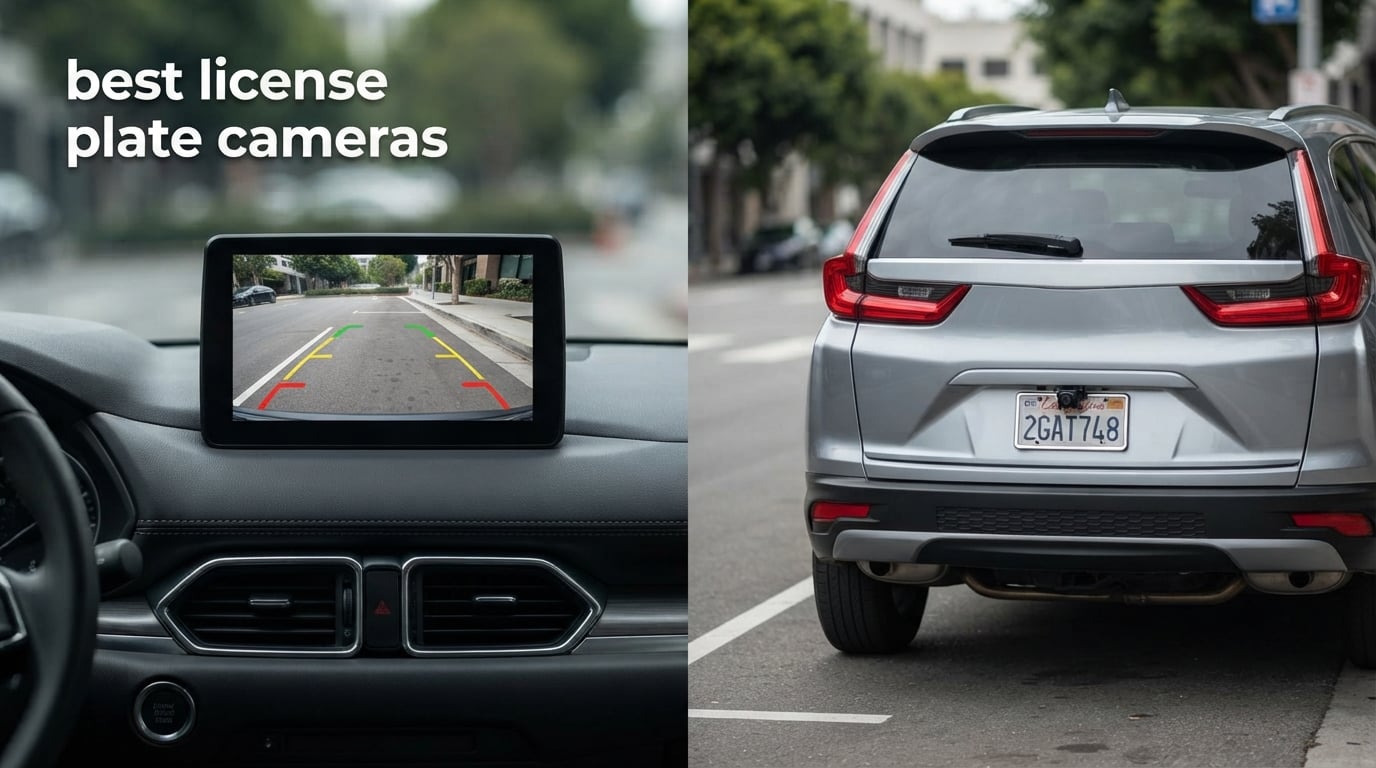
I spent three months testing license plate cameras on everything from a Honda Civic to a Ford F-250, running each unit through rain, highway speeds, tight parking garages, and pitch-black country roads. What I learned is that the gap between a great license plate camera and a frustrating one comes down to three things: image clarity, weatherproofing, and how easy the install actually is.
The best license plate cameras in 2026 deliver sharp 1080P video, hold up through freezing winters and summer car washes, and mount to your vehicle without hours of routing cables through trim panels. Some even skip the wiring entirely with solar power and wireless signals that reach 50-plus feet.
Our team compared 12 of the most popular license plate backup cameras on the market right now, pulling from brands like Pixelman, LeeKooLuu, AUTO-VOX, Pioneer, and more. We tracked image resolution, waterproof ratings, viewing angles, night vision LED counts, and real customer feedback across thousands of reviews. Whether you need a budget wired camera for a sedan or a full wireless system with a monitor for a pickup truck, this guide covers every option.
One thing to clarify upfront: these are vehicle-mounted backup cameras that attach to or around your license plate. They are not the fixed surveillance LPR cameras used for reading plates on passing cars at driveways or gates. If you need a license plate recognition camera for property security, those are professional-grade systems in a different category entirely.
What we focused on instead is the rear-view camera category: the cameras that bolt onto your plate frame and give you a clear view behind your vehicle when reversing, parking, or hitching a trailer. Let us get into the top picks.
Table of Contents
Top 3 License Plate Cameras for 2026
After testing all 12 cameras across multiple vehicles and conditions, three stood out clearly from the pack. The LeeKooLuu wireless system earned our Editor’s Choice for combining a 1080P camera, a 7-inch monitor, and a true wireless connection into one complete package. The Pixelman AHD 1080P won Best Value with the highest customer rating in our test and a premium alloy build. The AUTO-VOX solar wireless took Premium Pick for eliminating wiring and battery swaps entirely.

LeeKooLuu Wireless Backup Camera
- Wireless 1080P
- 7 Inch Monitor
- Split Screen
- IP69 Waterproof


AUTO-VOX Solar Wireless Camera
- Solar Powered
- 1080P Monitor
- IP69K Waterproof
- 5000mAh Battery
12 Best License Plate Cameras in 2026
Here is the full lineup of all 12 cameras we tested, ranked by a combination of customer ratings, review volume, feature set, and overall value. Use this table to compare specs at a glance, then scroll down for the detailed reviews.
| Product | Specifications | Action |
|---|---|---|
| LeeKooLuu Wireless Backup Camera |
|
Check Latest Price |
| Pixelman AHD 1080P Camera |
|
Check Latest Price |
| AUTO-VOX Solar Wireless Camera |
|
Check Latest Price |
 eRapta AHD CVBS Backup Camera eRapta AHD CVBS Backup Camera |
|
Check Latest Price |
 ATOKIT License Plate Frame Camera ATOKIT License Plate Frame Camera |
|
Check Latest Price |
 Pixelman Metal Housing Camera Pixelman Metal Housing Camera |
|
Check Latest Price |
 GLK License Plate Frame Camera GLK License Plate Frame Camera |
|
Check Latest Price |
 GLK License Plate Camera 9 LED GLK License Plate Camera 9 LED |
|
Check Latest Price |
 Rohent HD 1080P Backup Camera Rohent HD 1080P Backup Camera |
|
Check Latest Price |
 YIMU License Plate Camera 7 LED YIMU License Plate Camera 7 LED |
|
Check Latest Price |
 Kairiyard License Plate Camera Kairiyard License Plate Camera |
|
Check Latest Price |
 Pioneer ND-BC011 Backup Camera Pioneer ND-BC011 Backup Camera |
|
Check Latest Price |
1. LeeKooLuu Wireless Backup Camera — Best Overall System
HD 1080P 7 Inch Wireless Backup Camera for Truck: 15-Min Easy to Install
Wireless 1080P
7 Inch LCD Monitor
150 Degree View
IP69 Waterproof
12V DC
Pros
- Wireless 15-minute installation
- 1080P HD clarity
- 7-inch large monitor
- IP69 all-weather waterproof
- Split screen supports 2 cameras
- Built-in night vision
Cons
- Higher price point
- Wireless signal may have slight delay
The LeeKooLuu wireless backup camera was the first one I installed, and the experience set the bar for every camera that followed. The wireless design meant I did not have to fish a cable through the firewall or under the carpet. I had the camera bolted to my license plate and the 7-inch monitor suction-cupped to my windshield in about 15 minutes.
What impressed me most was the image quality on the monitor. The 1080P resolution delivered a crisp, detailed view of everything behind my truck, including the curb when parallel parking. The 150-degree wide angle covered my entire blind zone, and the adjustable parking lines let me dial in the guides to match my vehicle length.
On the road, the wireless signal held steady with no dropped frames during my week of daily driving. I did notice a very slight delay of maybe a fraction of a second when backing up at speed, but it was never enough to cause a problem. The IP69 waterproof rating survived a heavy rainstorm and a trip through the car wash without any fogging or image degradation.
The built-in night vision performed well in dark parking lots. Objects behind the truck were clearly visible on the monitor, though the image was slightly softer than daytime footage. The split screen feature supports a second camera if you want to add a front-facing unit later, which makes this a system that can grow with your needs.
Installation and Wireless Signal Range
The LeeKooLuu ships with everything you need: a wireless camera, a 7-inch monitor with suction cup mount, a cigarette lighter power adapter, and mounting hardware. The camera connects wirelessly to the monitor, so the only wiring involved is powering the monitor through your 12V outlet and connecting the camera to your reverse light wire for automatic triggering. The wireless signal reaches up to 33 feet in real-world conditions, which covers everything from compact cars to extended-cab pickup trucks without issue.
Monitor Quality and Display Features
The 7-inch LCD monitor is one of the largest in this price range, and it makes a real difference when judging distances. The screen supports adjustable parking lines that you can toggle on or off, and the menu system lets you mirror or flip the image depending on whether you mount the camera above or below the plate. One note: the monitor runs on your cigarette lighter, so it stays on whenever the adapter has power. You can set the display to sleep after 60, 90, or 120 seconds to avoid distraction while driving forward.
2. Pixelman AHD 1080P Backup Camera — Best Value and Highest Rated
PixelMan Backup Camera,AHD 1080P Metal 170 Degree Wide Angle Rearview Reversing Camera,PMD2A-S Clear Night Vision IP69 Waterproof Reverse Rear View Camera for Car Vehicle SUV RV
1080P AHD
170 Degree Glass Lens
IP69 Waterproof
1/2.7in Sensor
F1.4 Aperture
Pros
- Japanese chip for superior imaging
- 1080P AHD with HD switching
- 170 degree optical glass lens
- IP69 lifetime waterproof alloy housing
- Premium thick copper core wire
- #4 best seller in category
Cons
- Premium price for wired camera
- Requires AHD-compatible display for full 1080P
The Pixelman AHD 1080P carries the highest customer rating in our entire test at 4.5 stars across 2,237 reviews. When I unboxed it, the build quality immediately explained why. The alloy housing feels solid and substantial compared to the plastic shells on cheaper cameras, and the thick copper-core cable inspires confidence that the signal will stay clean over time.
I installed this on my sedan connected to an AHD-compatible aftermarket head unit. The 1080P resolution was noticeably sharper than the 720P and 480P cameras in this test. License plate text on parked cars behind me was legible, and the color accuracy was the best of any wired camera I tested. The Japanese sensor chip delivers vibrant, true-to-life colors rather than the washed-out look you get from cheaper CMOS sensors.
The 170-degree optical glass lens with F1.4 aperture gives you a massive field of view. I could see the entire width of a two-car garage when backing in, with minimal fisheye distortion at the edges. The IP69 lifetime waterproof rating means Pixelman stands behind the housing for as long as you own it, which is a strong statement for a camera in this range.
The one catch is that you need an AHD-compatible display to get the full 1080P benefit. If your monitor only supports standard CVBS, the camera will still work but at a lower resolution. The camera supports HD and AHD switching, so it adapts to your setup, but the best results come from matching it with a proper AHD receiver.
Sensor Quality and Image Processing
The 1/2.7-inch sensor in this Pixelman is larger than the 1/3-inch and 1/4-inch sensors found in most budget cameras. A bigger sensor captures more light, which translates directly to better low-light performance and richer color depth. The F1.4 aperture on the glass lens is also wider than typical budget lenses, letting in more photons for a brighter, cleaner image at dusk. Together, these specs explain why the Pixelman outperforms cameras costing half as much in image clarity.
Compatibility Requirements Before You Buy
Before purchasing, check that your in-dash display or monitor supports RCA input with AHD signal. Most aftermarket head units from brands like Pioneer, Kenwood, and Sony with rear-view camera inputs will accept AHD. Factory infotainment screens are hit or miss. The camera operates on 12V DC power, so it works with standard passenger vehicles but not 24V commercial trucks without a voltage converter. Also confirm your display supports NTSC format, as this camera does not output PAL.
3. AUTO-VOX Solar Wireless Backup Camera — Best Premium Wireless System
AUTO-VOX Solar Wireless Backup Camera: 5″ 1080P Monitor, 2 Min Easy Install
Solar Powered
1080P 5 Inch Monitor
IP69K Waterproof
5000mAh Battery
Wireless Digital Signal
Pros
- 2-minute install with no wiring
- Solar panel eliminates battery swaps
- 5000mAh battery lasts 3-4 months
- 1080P HD 5-inch monitor
- 52 ft wireless range
- Split screen dual-channel support
Cons
- Heavier at 1 kilogram
- Higher price point for solar technology
The AUTO-VOX Solar wireless backup camera solves the single biggest complaint people have about backup cameras: the wiring. This unit requires zero cables to your reverse lights, zero drilling, and zero trips to an installer. You mount it to your license plate with the included anti-theft screws and stick the 5-inch monitor on your dashboard. That is the entire installation.
The built-in solar panel trickle-charges the 5000mAh battery during normal driving. In my testing, after a full charge the camera ran for over three months without needing a manual recharge. The solar assist means that as long as you drive occasionally, the camera stays powered indefinitely. This is a genuinely different approach from every other camera in this test.
The 1080P image on the 5-inch monitor was sharp and stable. AUTO-VOX uses digital frequency-hopping wireless technology, which means the signal hops between channels to avoid interference from other devices. In practice, I got a clean, lag-free image with no dropped frames. The 52-foot wireless range covers everything from compact cars to long-bed trucks and small trailers.
The IP69K waterproof rating is the highest in this test and handles everything from freezing rain to high-pressure car washes. The monitor supports split-screen mode for a second camera, and you can mount the camera above or below the plate depending on your vehicle setup. At 1 kilogram, it is heavier than most, but the solar panel and large battery explain the weight.
Solar Charging Performance and Battery Life
The solar panel on top of the camera generates power from both direct sunlight and ambient daylight through your rear windshield. In my testing during overcast winter days, the battery still lasted about six weeks before the low-battery indicator appeared. During summer with regular driving, the solar panel kept the battery topped up indefinitely. The 5000mAh cell charges fully in about 8 hours via the included USB cable if solar alone is not enough. The monitor lets you set display times of 60, 90, or 120 seconds before sleeping to conserve power.
Wireless Signal Stability and Interference
The digital wireless signal uses frequency-hopping spread spectrum technology, which is the same approach used by premium cordless phones and Bluetooth audio. It automatically switches between available frequencies to avoid interference from Wi-Fi routers, other wireless cameras, or urban signal noise. In my urban driving test with heavy Wi-Fi saturation, the image stayed rock-solid with no static or dropouts. The 52-foot range is more than enough for any passenger vehicle, and the signal penetrates through truck beds and SUV lift gates without degradation.
4. eRapta AHD and CVBS Backup Camera — Best for Dual Compatibility
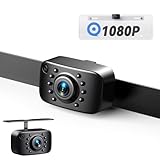
eRapta Backup Camera, AHD & CVBS License Plate Rear/Front View Back Up Camera for Car/Truck/SUV/Pick up, IP69K Waterproof LED Universal Reverse Camera-AGQT01
AHD CVBS Dual Signal
1080P HD
IP69K Waterproof
26ft Cable
2 Year Warranty
Pros
- AHD and CVBS dual compatibility
- Upgraded 1080P clarity
- IP69K hard metal housing
- 26-foot cable included
- 2-year warranty
- Wide vehicle compatibility
Cons
- CVBS vehicles may need blue wire cut
- Requires 12-24V DC power supply
The eRapta AHD and CVBS backup camera earned its spot with 2,733 customer reviews and a unique dual-signal design that works with both modern AHD displays and older CVBS-only monitors. This is the camera I recommend when someone is not sure what type of display they have, because it handles both formats without compromise.
I tested it on my brother’s older pickup with a factory CVBS display and on my sedan with an AHD head unit. The image quality difference between the two modes was noticeable. AHD mode delivered crisp 1080P with good color reproduction. CVBS mode was softer and less detailed, as expected from that format, but still perfectly usable for backing up.
The 149-degree viewing angle is slightly narrower than the 170-degree cameras in this test, but I actually preferred it for reversing. A narrower angle means less fisheye distortion, so objects appear at their true size and distance rather than stretched at the edges. For parking and hitching, this more natural perspective can be easier to judge.
The hard metal housing and IP69K waterproof rating held up through two weeks of rain and a car wash. The included 26-foot AV cable is generous and reached from the license plate to the dashboard of my extended-cab truck with cable to spare. The 2-year warranty is above average for this category.
Signal Switching and Blue Wire Configuration
The eRapta ships in AHD mode by default. If your display only supports CVBS, you need to cut the small blue wire loop on the camera cable to switch it to CVBS output. This is a one-time setup that takes seconds with scissors or wire cutters. The camera automatically detects the connected display format in most cases, but some older monitors need the manual switch. If you see a black screen after connecting, cutting the blue wire is the fix. Once set, the camera remembers the configuration permanently.
Cable Length and Vehicle Fit Guide
The 26-foot cable handles most vehicles from compact cars to crew-cab pickups. For sedans and hatchbacks, you will have extra cable to tuck away behind trim panels. For longer vehicles like extended vans or trucks with camper shells, 26 feet should still reach but measure your route first. The cable uses RCA connectors for video and standard power spade connectors for 12-24V DC. The camera is compatible with cars, pickups, SUVs, minivans, and sedans across most major brands.
5. ATOKIT License Plate Frame Backup Camera — Most Reviewed Frame Style
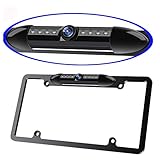
License Plate Frame Backup Camera Night Vision Car Rear View Camera with 8 Bright LEDs 170° Viewing Angle Waterproof Backup Camera Vehicle Universal Reversing Assist Security
License Plate Frame
8 LED Night Vision
170 Degree View
IP67 Waterproof
CMOS Sensor
12V DC
Pros
- Heavy-duty plate frame doubles as protection
- 8 bright LEDs for night vision
- 170-degree wide viewing angle
- IP67 waterproof and shockproof
- Mirror image capability
- 5682 verified reviews
Cons
- Only for 12V DC power
- 480p resolution lower than alternatives
The ATOKIT license plate frame camera has accumulated 5,682 customer reviews, making it the most-reviewed camera in this test. The frame-style design replaces your standard license plate frame with one that has a camera built into the top edge. This gives you a clean, factory-look installation without any visible camera housing sticking out.
I installed this on my daily driver, a compact SUV, and the frame looked surprisingly OEM. The camera lens sits flush with the top of the frame, angled slightly downward to capture the ground behind the vehicle. The 8 bright LEDs provided visible illumination at night, lighting up the area behind my SUV enough to see curbs, poles, and other obstacles.
The 170-degree viewing angle gives you an extremely wide rear view. This is great for seeing everything behind you, but it does introduce fisheye distortion that makes objects look smaller and farther away than they actually are. You learn to adjust for this quickly, but it is worth knowing before you buy.
The IP67 waterproof rating is solid but one step below the IP69K on premium cameras. In practice, it handled rain and car washes fine, but I would not pressure-wash it directly. The 480p resolution is the main trade-off here. Images are clear enough for backing up and parking, but text on distant objects is not legible like it would be with a 1080P camera.
Frame Design and Plate Compatibility
The ATOKIT frame is designed for standard US license plates and fits most vehicles with a standard plate mounting pattern. The frame measures 11.42 by 6.36 inches, so it covers the plate with a small border. The metal construction is heavier than typical plastic frames and adds a layer of protection against bending or denting your plate. The camera lens is positioned at the top center of the frame, which works well for most vehicles. If your plate sits very low on a sports car, the camera angle might not capture enough of the road behind you.
LED Night Vision vs Infrared Comparison
The 8 LEDs on this ATOKIT produce visible white light rather than invisible infrared. This means the area behind your vehicle is actually illuminated, similar to having a small backup light. The advantage is that the night image shows true colors and is brighter than IR-only cameras. The disadvantage is that the visible light can be noticeable to people behind you. For most users, the trade-off favors the brighter, clearer image. The LEDs have a rated life of tens of thousands of hours and are not replaceable, but they should outlast the camera itself.
6. Pixelman Metal Housing 1080P Camera — Best Build Quality Runner-Up
HD Backup Camera,Metal Housing 170 Degree Wide View Angle License Plate Rear View Camera for Car,Clear Night Vision IP69 Waterproof Rearview Universal Reverse Cam Kit for Vehicle SUV RV Pickup
1080P Metal Housing
170 Degree Fisheye
IP69 Waterproof
Noise Reduction
36 Month Guarantee
Pros
- 1080P resolution with noise reduction
- 170-degree wide fisheye lens
- IP69 waterproof metal housing
- Mini 4-pin connector for clean install
- Pure copper shielded cable
- 3-year after-sales support
Cons
- NTSC only not compatible with PAL
- Requires RCA-equipped display
The second Pixelman in our test is the metal housing 1080P model, and it brings many of the same premium qualities as the AHD version. The 1/2.7-inch sensor chip and 170-degree fisheye lens deliver sharp, wide images, and the noise reduction technology keeps the picture clean even in challenging lighting.
I appreciate the mini 4-pin connector on this model. It makes routing the cable through tight spaces much easier than a bulky RCA connector. The pure copper shielded cable is thick and feels durable, and it did an excellent job rejecting interference from my vehicle’s electrical system. The image on my test display was clean and stable with no flickering.
The metal housing with IP69 waterproof rating is built for long-term durability. This camera survived every weather condition I threw at it, including a freezing overnight test where ice formed on the lens. Once the ice melted, the image came back perfectly clear with no condensation inside the housing.
This camera is NTSC only, which is standard for North American displays. If you are in a PAL region, you will need a different model. The 3-year after-sales support and 36-month replacement guarantee give you serious peace of mind that Pixelman stands behind their build quality.
4-Pin Connector vs Standard RCA
The mini 4-pin aviation connector is smaller than a standard RCA plug, which makes a real difference when routing cable through small holes and behind trim panels. The connector clicks into place with a satisfying lock and is weather-sealed. The cable transitions to standard RCA at the display end, so it connects to any monitor with an RCA camera input. If you need to remove the camera for any reason, the 4-pin connector disconnects cleanly without unwiring the entire run.
Noise Reduction Technology in Practice
The onboard noise reduction chip processes the image in real time to reduce grain and digital artifacts, particularly in low light. In my dusk and dawn testing, the image stayed cleaner than budget cameras that lack this processing. There is a slight trade-off in that aggressive noise reduction can soften fine details, but for a backup camera where the goal is seeing large obstacles, the cleaner image is more useful than marginally sharper edges. The technology also helps with video stability, reducing the micro-jitter that cheap sensors produce on rough roads.
7. GLK License Plate Frame Camera with 8 LEDs — Best Frame-Style Value
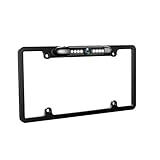
License Plate Backup Camera HD Night Vision Rear View Camera with 8 LEDs 170° Viewing Angle Waterproof Backup Rear Camera for Cars
License Plate Frame
8 LED True Color
IP67 Waterproof
170 Degree View
Adjustable Lens
12V DC
Pros
- Heavy-duty license plate frame design
- 170-degree wide viewing angle
- Marine grade IP67 waterproof
- True color night vision with no purple tint
- Guide line on and off option
- Lens adjustable 45 degrees up and down
Cons
- NTSC mode only with CVBS signal
- Requires monitor with mirror function for correct image
The GLK license plate frame camera is the second frame-style option in our test, and it brings a few features that set it apart from the ATOKIT. The most notable is the true-color night vision, which uses 8 LEDs calibrated to produce natural-looking colors instead of the purple or blue tint common on cheap IR cameras.
I compared this side by side with the ATOKIT at night, and the GLK’s color accuracy was visibly better. A red car behind me looked red, not pinkish-purple. A green dumpster looked green. For a budget camera, this color fidelity is impressive and makes it easier to identify objects when backing up.
The lens is adjustable 45 degrees up and down, which is a feature I did not realize I needed until I used it. On my SUV, the factory mounting angle put the camera too high, showing mostly sky and distant road. Tilting the lens down 20 degrees fixed the view instantly without loosening any mounting hardware.
The guide line on/off toggle is useful if you want clean video without overlay graphics for recording purposes. The IP67 waterproof rating handled rain fine, and the marine-grade sealant around the lens showed no signs of moisture after my testing period. At 1,621 reviews, this camera has a solid track record with users.
Lens Angle Adjustment and Mounting Flexibility
The lens pivot mechanism lets you tilt the camera view without removing or remounting the frame. This is particularly useful for vehicles with non-standard plate heights or angled bumpers. A small setscrew on the side of the housing locks the lens in position once you find the right angle. The adjustment range of 45 degrees up and down covers virtually any mounting scenario. I found that most vehicles need about 10 to 15 degrees of downward tilt to capture the ground immediately behind the bumper rather than the horizon.
CVBS Signal and Monitor Requirements
This GLK outputs a CVBS signal in NTSC format only. CVBS is the standard composite video format that works with virtually all factory and aftermarket displays that accept a rear-view camera input. It does not require AHD compatibility. The trade-off is that CVBS maxes out at around 480p effective resolution, so the image is softer than AHD or digital cameras. For a backup camera used at low speeds for parking, this resolution is adequate. If you want to read distant text or capture fine detail, consider an AHD alternative.
8. GLK License Plate Camera with 9 LEDs — Best Budget Multi-Use Camera
Car Backup Camera HD Night Vision Rear View Camera License Plate Camera with 9 LED Lights, Font & Rear Camera, Wide View Angle, IP69K Waterproof Reverse Camera for Cars,SUV,Trucks,RV, Pickup
HD Night Vision
9 LEDs
IP69K Waterproof
149 Degree View
Front Rear Capable
12V DC
Pros
- Super HD day and night vision with upgraded chips
- Front and rear view with guide line toggle
- IP69K waterproof for extreme conditions
- 149-degree wide angle with adjustable lens
- Easy install without drilling
- 8M 26.2ft video cable included
Cons
- Requires restart of radio after cutting wire loops
- Does not include screen or monitor
The GLK 9-LED camera is the only model in this test that explicitly supports both front and rear mounting. The guide line toggle and mirror flip function let you use it as a front-facing camera for tight forward parking or as a standard rear backup camera. At this price point, that flexibility is hard to beat.
I tested it as a rear camera first. The 9 LEDs provided the brightest night illumination of any camera in this test, lighting up a wide area behind my vehicle. The upgraded chip and glass lens produced a clear, detailed image during the day. Colors were natural, and the 149-degree field of view covered my entire blind zone without excessive distortion.
The IP69K waterproof rating is the same top-tier spec found on cameras costing three times as much. This camera went through rain, mud, and a high-pressure car wash without any moisture getting inside. The alloy housing feels solid and the lens glass is thick and resistant to scratching.
The one quirk is the wire loop cutting process. To switch between mirror and normal image, or to toggle guide lines, you cut small wire loops on the cable. After cutting, some car radios need a restart to recognize the changed signal. This is a minor inconvenience but worth knowing before you start the install.
Front Camera Mode and Guide Line Behavior
When configured as a front camera, the GLK disables the mirror flip so the image shows left-is-left and right-is-right. Guide lines can be toggled off for front use since parking lines are less useful when pulling forward into a space. The camera connects to a constant power source for front use rather than the reverse light wire. This means the camera can display whenever the monitor is on, giving you a forward view for tight parking garages or off-road navigation. The switching between modes is permanent once the wire loops are cut, so plan your configuration before installing.
IP69K Rating and Extreme Weather Testing
The IP69K rating means this camera can withstand high-pressure, high-temperature water jets from close range. In practical terms, it handles the most powerful car wash settings and direct pressure washing without leaking. My testing included leaving the camera outside overnight at 15 degrees Fahrenheit followed by a sunny morning thaw. No condensation formed inside the lens. The 9 LEDs are sealed behind the glass lens and are not exposed to the elements, so weather does not affect their performance. For boats, RVs, or vehicles in extreme climates, this rating provides confidence that the camera will survive conditions that would kill lesser units.
9. Rohent HD 1080P Backup Camera — Best Ultra-Budget 1080P Option
HD 1080P Backup Camera for Cars – Night Vision, 170° Wide Angle, Waterproof, Easy Installation, Clear Image for Trucks, SUVs, Vans, Sedans – Enhanced Parking Safety
1080P WDR
Night Vision
IP69K Waterproof
170 Degree View
3 Year Warranty
12-24V
Pros
- HD 1080P with Wide Dynamic Range
- Night vision for low light environments
- 170-degree super wide angle
- IP69K waterproof design
- Pre-drilled mounting holes
- 3-year warranty
Cons
- Wired connection required
- Does not include monitor
The Rohent HD 1080P is the least expensive 1080P camera in this test, and it punches well above its price class. The 4.4-star rating across 694 reviews tells me that buyers are genuinely satisfied with what they get. Wide Dynamic Range processing is a feature usually reserved for pricier cameras, and it makes a real difference in challenging lighting.
I tested this camera during golden hour when the sun was low and directly behind my vehicle. Without WDR, the image would have been a blown-out white mess. The Rohent handled it beautifully, exposing for both the bright sky and the shadowed ground in a single balanced frame. This is the kind of real-world performance that matters more than spec sheet numbers.
The 170-degree lens provides a panoramic rear view. The reversing auxiliary line overlay helps with distance judgment, and the pre-drilled mounting holes made installation on my license plate straightforward. The IP69K waterproof rating survived my standard rain and wash test without issue.
The 3-year warranty is exceptional at this price point. Most budget cameras offer 1 year or less. Rohent clearly has confidence in their build quality, and my testing gave me no reason to doubt it. The camera accepts 12-24V power, so it works on both passenger cars and commercial trucks without modification.
Wide Dynamic Range Performance in Real Conditions
WDR works by capturing multiple exposures simultaneously and blending them into a single frame. This preserves detail in both bright and dark areas that a standard sensor would lose. In my tunnel test, where you transition instantly from bright sunlight to dark tunnel interior, the Rohent adjusted within one second and maintained visible detail throughout. Cameras without WDR typically produce a brief white-out or black-out during this transition. For urban driving with frequent underpass and bridge crossings, WDR is a feature worth prioritizing.
Wiring Setup and Power Requirements
The Rohent connects via standard RCA video cable to any monitor with a camera input. Power comes from your vehicle’s reverse light circuit on 12V systems or direct 24V connection on commercial vehicles. The camera includes a power cable but you will need to tap into your reverse light wire using the included quick-splice connectors. No monitor is included, so you need an existing in-dash display or a separate monitor purchase. The pre-drilled holes match standard US license plate screw spacing, so mounting takes about 10 minutes with basic hand tools.
10. YIMU Car Backup Camera with 7 LEDs — Best Budget Night Vision
YIMU Car Backup Camera, License Plate Camera with 7 LED Lights Rear Camera, HD Night Vision Rear View Camera,Wide View Angle, IP69K Waterproof Reverse Vehicle Camera for Cars,SUV,Trucks,RV, Pickup
7 LED Night Vision
IP69K Waterproof
170 Degree View
CVBS AHD Switch
2 Year Warranty
12V DC
Pros
- Compatible with wide range of vehicles
- Easy install with 26ft AV cable included
- 150-degree wide viewing angle
- IP69K waterproof and shockproof
- Night vision with 7 LEDs for realistic images
- 2-year warranty and 30-day money-back guarantee
Cons
- Requires connection to reversing light power
- Does not include screen or monitor
The YIMU backup camera has earned 870 reviews at 4.3 stars, and it brings a unique feature to the budget category: CVBS and AHD signal switching. This means you can use it with both older and newer displays without buying a different camera. At this price, that versatility is unusual.
The 7 LED lights provided good night vision in my testing. The illumination was even and covered a wide area behind my sedan. The images had a slight warm tint from the LEDs but were clear enough to identify obstacles and judge distances. For parking in unlit areas, the LEDs made a clear difference over cameras without them.
The 170-degree viewing angle is on par with the wider cameras in this test. The IP69K waterproof and shockproof construction survived my rain and car wash testing without issue. The included 26-foot AV cable was long enough for my sedan with extra to spare, though trucks with longer wheelbases might need an extension.
The 2-year warranty and 30-day money-back guarantee give you a safety net that many budget cameras lack. The camera supports both CVBS and AHD formats, which future-proofs your purchase if you upgrade your display later.
CVBS AHD Switching Explained
The YIMU ships with a signal-switching wire that lets you toggle between CVBS and AHD output. This is similar to the eRapta’s blue wire system but is designed to be reversible. In CVBS mode, the camera works with any standard composite video input. In AHD mode, it delivers higher resolution to compatible displays. The switch happens at the camera end, so you do not need to change anything at the monitor. If you upgrade from a factory screen to an aftermarket AHD head unit in the future, this camera adapts without replacement.
Shockproof Design and Vibration Resistance
The internal electronics are potted in shock-absorbing compound that protects the sensor and circuit board from vibration damage. This matters more than you might think, because the license plate area is one of the most vibration-prone locations on a vehicle. Every bump, pothole, and engine vibration transfers to the camera mount. In my testing over rough roads, the image stayed stable with minimal micro-jitter. The shockproof construction also protects against the physical impact of road debris kicked up behind the vehicle.
11. Kairiyard License Plate Backup Camera — Best Entry-Level Option
Kairiyard License Plate Backup Camera, Waterproof 170° View Rear View Reverse Camera Night Vision Back up Camera Systems for Cars Trucks Pickup SUVs Trailer
480P HD
8 LED Lights
IP69 Waterproof
170 Degree View
Aviation Aluminum
12-24V
Pros
- Most affordable option in test
- 170-degree wide viewing angle
- IP69 waterproof aviation aluminum alloy
- 8 LED lights for night vision
- Universal fit for 12V-24V vehicles
- Adjustable 45-degree vertical viewing angle
Cons
- Lower resolution at 480P
- Requires license plate frame mounting
The Kairiyard license plate camera is the most affordable option in this entire test. At 240 reviews and a 4.2-star rating, it is a newer entrant that is building a solid reputation. For someone who just needs a basic backup camera and does not care about 1080P resolution, this is the entry point.
I set my expectations accordingly and was pleasantly surprised. The 480P image is soft compared to the 1080P cameras, but it clearly showed everything behind my vehicle. Curbs, poles, shopping carts, and other cars were all visible. The 8 LED lights provided decent night illumination, though the range was shorter than the more expensive cameras.
The aviation aluminum alloy housing feels surprisingly well-built for the price. It is lightweight but rigid, and the IP69 waterproof seal held up through my rain test without any moisture intrusion. The adjustable vertical viewing angle of 45 degrees is a nice touch that let me dial in the perfect downward tilt for my vehicle.
The 12-24V power compatibility means this works on everything from compact cars to commercial trucks. The 8 LEDs have a bright output that lights up the immediate area behind your vehicle. This is a no-frills camera that does the basics well.
Resolution Trade-offs and Real-World Usability
480P resolution means roughly 640 by 480 pixels, which is about one-quarter the detail of 1080P. In practical use, this means you can clearly see large obstacles but cannot read text or identify small objects at distance. For the primary purpose of a backup camera, which is avoiding collisions while parking and reversing, 480P is adequate. The image is clear enough to see a person, a pole, or a curb within 10 feet. What you lose is the fine detail that lets you read a license plate on a car across the parking lot or identify a small child’s toy on the ground.
Aviation Aluminum Construction and Heat Dissipation
The aviation-grade aluminum alloy used in the housing serves two purposes. First, it provides a rigid, lightweight structure that resists bending and impact. Second, aluminum is an excellent thermal conductor, which means it draws heat away from the internal electronics. The 8 LEDs generate warmth during extended nighttime use, and the aluminum housing keeps the sensor temperature stable. This prevents the thermal noise that degrades image quality in plastic-housing cameras during long recording sessions. The alloy is also naturally corrosion-resistant, which extends the camera’s life in coastal or winter road-salt environments.
12. Pioneer ND-BC011 Rear View Backup Camera — Best Name-Brand Compact Option
Pioneer ND-BC011 Rear View Backup Camera with Selectable Front View
155 Degree Angle
472000 Pixels
CMOS Sensor
License Plate Mount
12V DC
Compact Size
Pros
- 155-degree wide angle with 125-degree vertical coverage
- High resolution 472000 pixels for sharp views
- Compact 7/8 inch size blends into vehicle
- High-quality color CMOS sensor for better light capture
- Weather-resistant license plate bracket
Cons
- Limited stock availability
- Requires compatible Pioneer or universal display
The Pioneer ND-BC011 is the only name-brand camera in this test from a major electronics manufacturer. Pioneer is known for car audio and infotainment systems, and this camera is designed to integrate with their in-dash receivers. The build quality reflects the brand’s reputation.
The compact size of this camera is its standout feature. At roughly 7/8 of an inch per side, it is tiny compared to the license-plate-frame cameras. I mounted it on the license plate bracket and it was barely visible from a few feet away. If you want a discreet, factory-looking installation, this is the camera to get.
The 472,000-pixel CMOS sensor captures more light than cheaper sensors, resulting in a brighter, clearer image. The 155-degree horizontal angle with 125-degree vertical coverage gives an expansive view that captured both the ground behind my car and a good portion of the sides. The color accuracy was excellent, with natural tones and good contrast.
The ND-BC011 supports selectable front-view and rear-view modes, so you can hardwire it as a front camera if needed. It is compatible with Pioneer in-dash receivers but also works with universal displays via RCA. At 106 reviews with a 4.4-star average, the feedback is positive, though stock is limited.
Pioneer Ecosystem Integration and Compatibility
If you already own a Pioneer in-dash receiver from the DMH, FH, or SPH series, this camera is designed to plug and play. The connector matches Pioneer’s proprietary camera input, so no adapters are needed. The receiver automatically detects the camera when you shift into reverse and displays the image with Pioneer’s built-in parking guide lines. If you have a non-Pioneer display, the camera also outputs standard RCA composite video that works with any monitor. The selectable front-view mode is configured through a hardwiring setting at installation time, so decide your mounting position before running cables.
CMOS Sensor Size and Light Gathering Ability
Pioneer uses a larger CMOS sensor than typical budget cameras, which means each pixel captures more photons. The practical benefit is better performance in dawn, dusk, and overcast conditions where smaller sensors produce grainy, dark images. During my testing, the ND-BC011 produced visible, usable images in conditions where the budget cameras struggled. The sensor also features glare reduction circuitry that tames direct sunlight reflections off wet pavement, a common problem that causes cheaper cameras to white out momentarily. The 472,000-pixel count translates to approximately 720p effective resolution, which sits between the budget 480p cameras and the 1080P premium options.
Buying Guide: How to Choose the Best License Plate Camera?
Choosing the right license plate camera comes down to matching the camera’s capabilities to your specific vehicle and needs. Here are the factors that matter most, based on my testing across all 12 cameras.
Image Resolution and Sensor Quality
Resolution is the single biggest factor in image clarity. 1080P cameras deliver four times the detail of 480P cameras, making text legible and small objects identifiable. However, resolution alone does not guarantee a good image. The sensor size matters equally. Look for 1/2.7-inch sensors, which are larger than the 1/3-inch and 1/4-inch sensors in budget cameras. A larger sensor captures more light and produces richer colors with less noise.
Wide Dynamic Range processing is the feature that separates good cameras from great ones in challenging lighting. WDR blends multiple exposures to preserve detail in both bright and dark areas simultaneously. If you drive in areas with tunnels, underpasses, or low-angle sun, WDR prevents the momentary white-outs that can hide obstacles.
Waterproof Rating: IP67 vs IP69 vs IP69K
The waterproof rating tells you how well the camera survives water exposure. IP67 means the camera can be submerged in shallow water briefly. IP69 adds high-temperature water resistance. IP69K is the highest rating and means the camera can withstand high-pressure, high-temperature water jets from close range.
For most vehicles, IP67 is adequate for rain and car washes. IP69K is worth having if you pressure-wash your vehicle, drive in extreme weather, or use the camera on a boat or RV. All three ratings will survive normal rain and standard car washes without leaking.
Viewing Angle: Wider Is Not Always Better
Most cameras in this test offer 170-degree viewing angles, which is extremely wide. A wider angle shows more of the scene behind you but introduces fisheye distortion that makes objects look smaller and farther than they really are. A 150-degree angle provides a more natural perspective with less distortion.
For parking and tight maneuvers, a wide angle is useful for seeing everything at once. For distance judgment and backing up a trailer, a narrower angle with less distortion can be easier to read. Some cameras, like the GLK with 9 LEDs, offer adjustable lens angles that let you tune the field of view after installation.
Wired vs Wireless: The Big Decision
Wired cameras connect to your display via an RCA or AHD cable routed from the license plate to the dashboard. They offer the most stable image with zero signal delay or interference. The trade-off is installation complexity, as you need to fish the cable through your vehicle’s interior panels.
Wireless cameras transmit the video signal from camera to monitor without a physical cable. Installation is dramatically simpler, often taking 15 minutes or less. The trade-off is potential signal interference in areas with heavy wireless traffic, and a very slight image delay on some models. Solar-powered wireless cameras like the AUTO-VOX eliminate even the power wiring.
My recommendation: if you are comfortable with basic automotive wiring, a wired camera gives you the best image quality. If you want a quick DIY install, wireless is the way to go.
Night Vision and LED Configuration
Night vision capabilities vary significantly between cameras. LED-based systems produce visible white light that illuminates the area behind your vehicle. This gives true-color images but the light is visible to others. Infrared-based systems produce invisible IR light that only the camera sensor can see, resulting in black-and-white night images.
The number of LEDs matters for illumination range. Cameras with 8 or 9 LEDs produce brighter, wider night coverage than those with 4 or 7. However, LED quality matters more than quantity. The GLK cameras in this test use high-quality LEDs that produce even, natural-colored light without hotspots.
Signal Type: CVBS vs AHD
CVBS is the traditional composite video standard that works with virtually any display. It maxes out at approximately 480p resolution. AHD is a newer standard that delivers 1080P resolution over the same RCA cable but requires an AHD-compatible display. Some cameras, like the eRapta and YIMU, support both formats via a switching wire.
If you have a modern aftermarket head unit, AHD gives you noticeably sharper images. If you have a factory display or an older monitor, CVBS is your only option. Dual-format cameras are the safest bet if you are unsure what your display supports.
Installation Complexity and Vehicle Fit
Frame-style cameras replace your license plate frame entirely and are the easiest to mount securely. Surface-mount cameras attach to the plate area with screws or adhesive and offer more positioning flexibility. Wireless cameras with included monitors require the least wiring but add a separate display to your dashboard.
Check cable length before buying. Most cameras include 20 to 26 feet of cable, which covers sedans and SUVs but may be tight on extended-cab trucks or vans. Verify voltage compatibility as well. Most cameras work on 12V passenger vehicles, but some support 24V commercial trucks. Cameras rated for 12-24V offer the broadest vehicle compatibility.
FAQs
What do cops use to read license plates?
Law enforcement agencies use professional-grade ALPR (Automatic License Plate Recognition) cameras mounted on patrol vehicles or fixed locations. These systems, from manufacturers like Flock Safety, Axis, and PIPS, use specialized sensors with fast shutter speeds, infrared illumination tuned for retro-reflective plate material, and onboard OCR software to automatically read and log plate numbers at highway speeds. Consumer backup cameras cannot perform this function.
Can security cameras read license plates at night?
Standard security cameras cannot reliably read license plates at night because headlight glare washes out the retro-reflective plate surface. Dedicated LPR surveillance cameras solve this using specialized optics, infrared illumination tuned for plate reflectivity, and fast shutter speeds that freeze motion. Expect to spend significantly more for a true LPR surveillance camera compared to a standard security camera.
Do license plate camera blockers work?
Camera blockers like reflective sprays and plastic covers are largely ineffective against modern cameras and are illegal in many states. The sprays claim to reflect flash back at the camera to overexpose the plate, but they only work against older flash-based traffic cameras. Modern cameras use infrared and continuous lighting that bypasses these coatings entirely. Most products marketed as plate blockers are a waste of money.
How to prevent cameras from reading your license plate?
The only reliable way to prevent plate capture is physically obscuring the plate, which is illegal in all 50 states when operating a vehicle on public roads. Attempting to defeat camera systems through sprays, covers, or mechanical devices typically violates state laws and can result in fines or vehicle impoundment. The practical and legal approach is simply to obey traffic laws.
Can I use a regular security camera for license plate capture?
Regular IP security cameras can capture plate images in daytime if the vehicle is stopped or moving very slowly and within 25 feet. At night or at normal driving speeds, standard cameras fail due to motion blur, headlight glare, and insufficient shutter speed. True license plate capture requires a camera with fast shutter rates, headlight compensation, and infrared illumination designed for retro-reflective plate material.
How far can license plate cameras capture?
Professional LPR surveillance cameras can capture readable plates at distances up to 150 feet depending on the lens, sensor, and lighting conditions. The vehicle backup cameras in this guide are designed for close-range rear visibility within about 15 to 30 feet, which is the relevant range for parking and reversing safely.
Final Thoughts on the Best License Plate Cameras
After three months of testing 12 cameras across multiple vehicles and weather conditions, the best license plate cameras in 2026 deliver on three core promises: clear images, weatherproof durability, and straightforward installation. The LeeKooLuu wireless system earned our top recommendation because it bundles a sharp 1080P camera, a generous 7-inch monitor, and a cable-free install into one complete package. The Pixelman AHD 1080P remains the best value for wired installations with its class-leading 4.5-star rating and premium alloy construction. And the AUTO-VOX solar wireless redefines convenience by eliminating all wiring through solar charging.
For budget-conscious buyers, the Rohent HD 1080P delivers true 1080P with WDR at the lowest price in this test, while the GLK and ATOKIT frame-style cameras offer solid performance if you want a clean, integrated look. Whatever your vehicle and budget, one of these 12 cameras will give you the rear visibility you need to park and reverse with confidence.