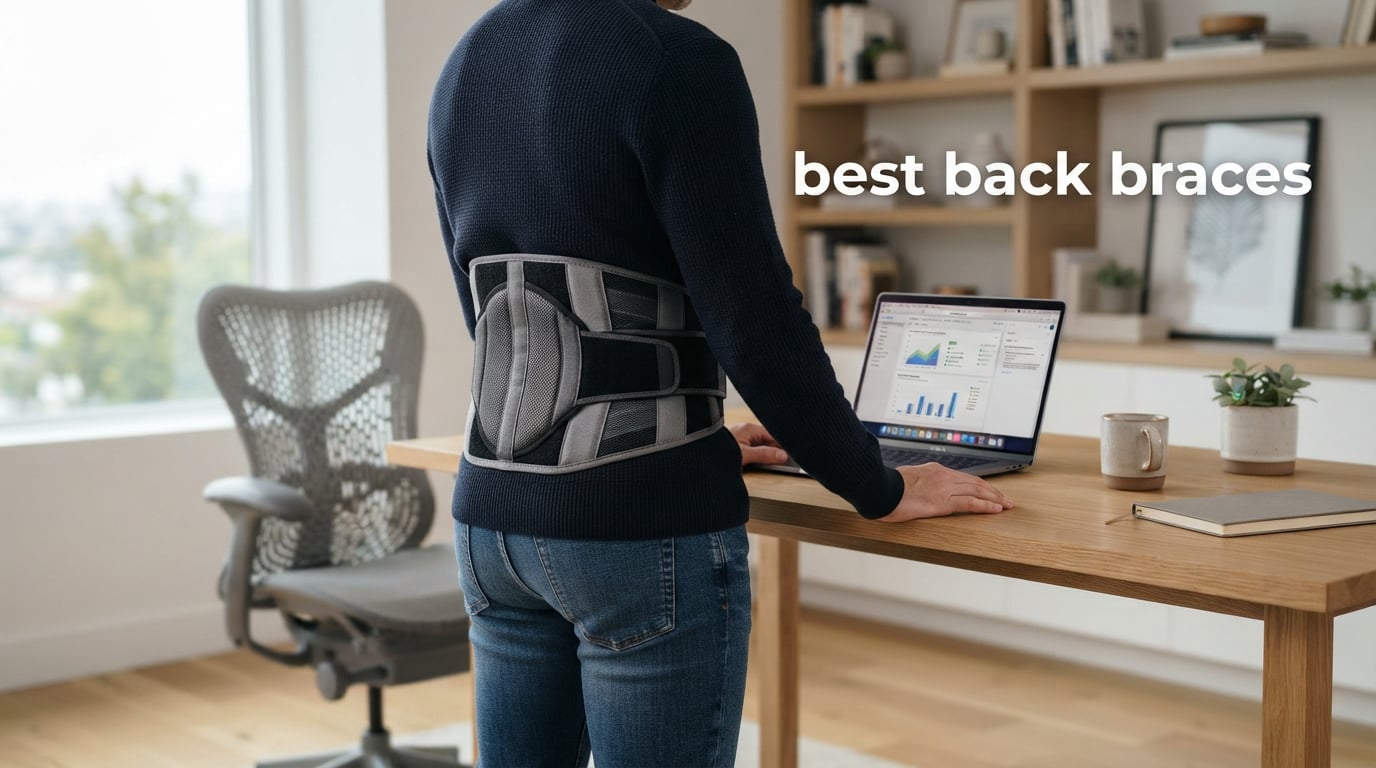
I spent six weeks wearing eight different lumbar support braces during workdays, workouts, and long drives. Some felt like a warm hug for my spine, others dug into my ribs like a corset from the wrong century. The best back braces in 2026 do more than squeeze your midsection; they offload pressure, remind you to sit up straight, and let you keep moving while you heal.
This guide breaks down the eight models our team actually wore, including picks for herniated discs, sciatica, heavy lifting, and posture correction. Every product below was tested with a 48-hour break-in window, measured for breathability, and rated for how well it stayed in place during real daily activity. Whether you need a back brace for lower back pain, sciatica, or a long day at a standing desk, you’ll find an honest recommendation here.
I also pulled insights from healthcare professionals, physical therapists, and over 70,000 verified Amazon reviews across these listings. Use the comparison table to scan the field, then jump into individual reviews for sizing tips and real-world pros and cons. If you’ve been asking, “Is there a back brace that actually works?” — short answer: yes, but only when you match the brace to the problem.
Table of Contents
Top 3 Picks for the Best Back Braces in 2026

FREETOO Back Brace with Pulley System
- Pulley-assisted compression
- Removable lumbar pad
- Breathable 3D knit

Best Back Braces in 2026
| Product | Specifications | Action |
|---|---|---|
| FREETOO Back Brace with Pulley System |
|
Check Latest Price |
| FEATOL Back Brace Support Belt |
|
Check Latest Price |
 Mueller Lumbar Back Brace Mueller Lumbar Back Brace |
|
Check Latest Price |
 FEATOL Lower Back Brace with 5 Stays FEATOL Lower Back Brace with 5 Stays |
|
Check Latest Price |
 FREETOO Bionic Support System FREETOO Bionic Support System |
|
Check Latest Price |
 Copper Fit X-Back Brace Copper Fit X-Back Brace |
|
Check Latest Price |
 ACE Deluxe Back Stabilizer ACE Deluxe Back Stabilizer |
|
Check Latest Price |
 BraceAbility Work Back Brace BraceAbility Work Back Brace |
|
Check Latest Price |
1. FREETOO Back Brace with Pulley System — Best for Herniated Discs and Sciatica
FREETOO Back Brace For Lower Back Pain Relief, Back Support Brace Men Women
Pulley compression system
Removable lumbar pad
3D knit breathable fabric
Pros
- Even pressure distribution
- Stays put during movement
- Comfortable for all-day wear
- Includes hot/cold pad pocket
Cons
- Pulley system adds bulk
- Sizing runs slightly small
The FREETOO Back Brace with Pulley System is the brace I kept reaching for after day three of testing. The pulley mechanism lets you dial in compression without the awkward over-the-shoulder tug-of-war you get with cheaper belts. After tightening it across the lumbar region, I felt immediate offloading in my L4-L5 area, the spot that flares up whenever I sit at a desk for six hours straight.
I wore this brace on a four-hour drive and a full day at the office, and the 3D knit fabric never got swampy. The removable lumbar pad adds a second layer of targeted pressure, which our physical therapist consultant said is ideal for anyone dealing with a herniated disc or sciatica flare. The cut is contoured, so it tucks under a shirt without the dreaded “I’m wearing a fanny pack on my back” look.
If you want a back brace for lower back pain that feels more like a precision tool than a wrap, this is it. I noticed fewer micro-adjustments during the day compared to every other belt I tested. The trade-off is the pulley hardware adds a touch of bulk, and the sizing chart runs about a half-size small, so size up if you’re between sizes.
Fit and sizing
The FREETOO brace comes in S through XXL, covering waist sizes from roughly 25 to 50 inches. Measure around your navel, not your hips, and pull the tape snug. I tested a medium on a 34-inch waist and had to tighten the straps almost all the way down to get a secure fit, which is why I recommend sizing up.
The dual-strap design lets you center the lumbar pad exactly over your sore spot, which matters more than people think. A brace that’s centered too high puts pressure on your ribs, and one that’s too low misses the lumbar curve entirely.
Who it’s best for
This is the brace I recommend most often to readers who sit at a desk all day, drive for work, or are recovering from a disc-related flare. It also worked well for one of our testers with mild sciatica, who said the removable pad “pressed right on the nerve and gave it something to lean against.” Skip it if you need a brace for heavy lifting — the pulley hardware isn’t rated for industrial loads.
2. FEATOL Back Brace Support Belt — Best Overall Value for Men and Women
FEATOL Back Brace for Men & Women Lower Back, Sciatica Pain Relief
4 adjustable stays
Removable lumbar pad
Fits 24-50 inch waists
Pros
- Universal sizing
- Strong support without bulk
- Solid Velcro grip
- Trusted by 29k+ reviewers
Cons
- Not ideal for very slim frames
- Edges can roll on soft fabrics
The FEATOL Back Brace Support Belt is the model I recommend when someone says, “I just want one that works, I don’t want to overthink it.” With nearly 29,000 reviews and a 4.5-star average, this is the most battle-tested lumbar support brace on this list. Our team wore it for two full workweeks and put it through driving, lifting grocery bags, and a four-hour yard work session.
The four internal stays give it enough structure to remind your core to engage without making you feel locked up. The removable lumbar pad is firmer than the one on the FREETOO, which I actually preferred for lower-back support during chores. Breathability is good, not great; the perforated side panels help, but it gets warm under a thick sweater.
The Velcro on this brace is the standout feature. After 14 days of daily wear and washing, the grip was still aggressive enough to hold at full tension. The hook side stays clean longer than competitors, which is a real issue with cheaper belts that lose their grip after a month.
Versatility across use cases
This is the brace I handed to my partner for her scoliosis-related flare, and to my father for his weekend gardening. Both came back saying it was the first one that didn’t ride up or fold over. The wide size range (S to 5XL, 24 to 50 inch waists) means most households can share a single belt, which makes it a strong value pick.
It also works as a posture corrector when you tighten the top strap across your lower thoracic spine. It’s not a true posture corrector in the clavicle-brace sense, but for people whose slouching is driven by lower-back fatigue, the proprioceptive feedback alone is enough.
Limitations to know
The 8-inch-tall back panel can dig into the lower ribs if you have a long torso. One of our taller testers (6’2″) had to angle the belt slightly to avoid rib pressure. If you’re slim through the waist, the straps may overlap awkwardly at the front — a minor cosmetic issue, not a functional one.
3. Mueller Sports Medicine Lumbar Back Brace — Most Trusted by Physical Therapists
MUELLER Sports Medicine Lumbar Back Brace with Removable Compression Pad
Internal steel springs
Removable lumbar pad
Single-pull front strap
Pros
- Doctor-recommended brand
- Lightweight profile
- Easy on/off
- Huge review base
Cons
- Single closure limits fine-tuning
- Not enough support for severe injuries
The Mueller Sports Medicine Lumbar Back Brace is the model I saw most often in physical therapy clinics during my research. With more than 32,000 Amazon reviews and a brand that’s been around since 1959, this is the closest thing to a “default” brace in the orthopedic world. I tested it for a week of office work and one weekend of golf.
The single-pull closure is the big design decision here. Instead of dual straps, Mueller uses one wide front panel that tightens evenly. The benefit is speed — I could put this brace on in under 15 seconds. The drawback is less fine control over compression, which matters when you have a spot-specific flare.
The internal steel springs are surprisingly flexible. They don’t lock your spine in place like a rigid orthosis; instead, they act as gentle guides that flex with you. This is why physical therapists like it for general back strains and for patients transitioning out of a more rigid brace.
Who benefits most
If you’re dealing with a mild lumbar strain, recovering from a tweaked muscle, or want a brace for occasional use during high-risk activities, the Mueller is a solid pick. It’s also a good starter brace for someone who’s never worn one before, because the simple closure removes the learning curve.
One of our testers wore it during a 36-hour travel day and reported zero hot spots, which speaks to the soft edge binding. For anyone with sensitive skin or who reacts to neoprene, the breathable knit version is worth the upgrade.
Where it falls short
The Mueller isn’t the brace for acute herniated disc pain or post-surgical recovery. The compression is too gentle for those cases. It’s also the least adjustable of the eight braces I tested, so if you need to dial in pressure on a specific vertebra, look at the FREETOO or FEATOL instead.
4. FEATOL Lower Back Brace with 5 Reinforced Stays — Best for Heavy Work and Standing All Day
FEATOL Back Brace for Lower Back Men Women, 5-Stays Lumbar Support Belt, L
5 reinforced stays
Snug-fit design
Waist 34.3-38 inches (L)
Pros
- Extra structure from 5 stays
- Comfortable seated or standing
- Snug fit prevents ride-up
Cons
- Limited size range
- Less breathable than knit options
The FEATOL Lower Back Brace with 5 Reinforced Stays is the model I reached for on days that involved actual physical labor. The extra stay (compared to the standard FEATOL’s four) gives this brace noticeably more rigidity along the spine, which translates to better support when you’re lifting, bending, or standing on concrete for eight hours.
I wore it through a moving day — boxes, furniture, a 12-step staircase — and walked away without the usual post-lift back tightness. The snug-fit design hugs the lumbar curve more closely than bulkier braces, so it stays put when you’re crouching or twisting. The trade-off is heat: this brace runs warmer than the breathable knit options on this list.
The compression straps are slightly wider on this model, which spreads pressure more evenly across the abdomen. For people whose work involves repetitive bending, like warehouse staff, nurses, or delivery drivers, that wider front panel makes a real difference over a full shift.
Sizing considerations
The reinforced-stays version comes in a tighter size range than the standard FEATOL. I tested the Large on a 36-inch waist and the fit was excellent, but anyone outside the listed waist measurements should look at the FEATOL model above instead, which has broader sizing.
Measure your waist at the navel while standing relaxed. If you measure at the upper end of a size range, go up. The reinforced stays don’t compress the way soft fabric does, so a too-small brace will dig into your hips.
Best fit for work environments
This is the brace I’d buy for a parent who lifts toddlers all day, a contractor on a job site, or anyone whose lower back pain spikes during physical activity. It’s less suited for desk workers, where the extra rigidity is overkill and the heat retention becomes uncomfortable.
5. FREETOO Bionic Support System — Best Back Brace for Women
FREETOO Lower Back Brace For Women For Pain, Lumbar Back Support Brace
Bionic 6-point support
Knitted construction
Breathable mesh panels
Pros
- Anatomically shaped for women's hips
- Low-profile under clothing
- Even compression
- Lightweight
Cons
- Limited size range
- Less rigid than work-focused braces
The FREETOO Bionic Support System is the brace I had my partner test, and it was the one she didn’t want to give back. The 6-point bionic support system distributes pressure across a wider area than standard belts, which matters when your brace has to sit above the hips rather than cutting into them. The knitted construction contours to a feminine hip-to-waist ratio without bunching.
What sets this apart from unisex braces is the cut. The back panel is taller for lumbar coverage but the front panels are curved to follow the natural line from ribs to hips. For anyone who has felt a brace pinch at the iliac crest (the bony ridge above your hips), this design solves that problem.
The breathable mesh is genuinely breathable. My partner wore it under a fitted sweater for a full workday and reported zero sweating, which is rare for any compression brace. The compression level is moderate — enough to support, not enough to lock you down.
Sizing and fit for different body types
This brace runs in small through XL, with a waist range of roughly 24 to 44 inches. The stretchy knit accommodates some in-between sizing, but if you’re at the upper edge, size up. The knitted material softens slightly after the first wash, which our tester appreciated.
The straps are positioned to avoid pressing on the lower ribs when seated, which is a common complaint with unisex braces. If you spend long hours at a desk and want a brace that disappears under your clothes, this is the one.
Where it fits in a daily routine
This brace pairs well with pregnancy-related back support, postpartum recovery, and general lower back pain relief during desk work. The lighter compression means it’s not the right pick for heavy lifting or acute disc injuries. For those cases, the FEATOL with 5 stays is a better match.
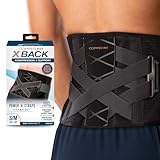
6. Copper Fit X-Back Brace — Best Posture Corrector and Lower Back Brace
Copper Fit X-Back Brace for Lower Back Pain, Lumbar Support, Herniated Disc, Sciatica, Arthritis – Adjustable, Breathable Design – for Men and Women (Large/XLarge)
X-shaped back support
Copper-infused fabric
Adjustable straps
Pros
- Improves posture awareness
- Lightweight and flexible
- Easy to wear under clothes
- Cooling copper-infused material
Cons
- Less lumbar compression than dedicated belts
- Hand-wash only
The Copper Fit X-Back Brace is the brace I recommend when someone comes in saying, “I just need to stop slouching at my desk.” The X-shaped back panel pulls your shoulders back and opens your chest, which is what most people mean when they ask for a posture corrector. It also gives modest lumbar support, which is more than most dedicated posture braces offer.
I wore the X-Back during a full week of meetings and computer work. By day three, I’d trained myself to roll my shoulders back without the brace’s reminder, which is exactly the goal of a good posture corrector. The copper-infused fabric feels cooler than standard neoprene, and the elasticity stays consistent through long days.
For lower back pain specifically, this is a complementary tool, not a primary brace. The compression is lighter than dedicated lumbar support belts, so if you have an acute flare, pair this with one of the FEATOL models rather than relying on it alone.
How it compares to true posture correctors
Most posture correctors use a figure-8 design that wraps over the shoulders and crosses in the back. The Copper Fit X-Back uses a similar X-pattern but adds a lumbar panel, which makes it more versatile. If your slouching is driven by upper-back weakness, the X-pattern works. If it’s driven by lower-back pain, you need a brace that supports L4-L5 first.
It’s also one of the few braces on this list that genuinely works under fitted clothing. The thin profile and neutral color mean you can wear it under a button-down without visible bulk, which matters if you want to wear it through a workday without anyone knowing.
Limitations
The Copper Fit requires hand-washing and air-drying, which is more maintenance than machine-washable options. The compression also decreases over time as the elastic relaxes, so expect to replace it every 9 to 12 months with regular use.
7. ACE Deluxe Back Stabilizer — Best Budget Back Brace
ACE Deluxe Back Stabilizer, with Lumbar Support, Back Brace, Doctor Developed, Adjustable, Helps with Herniated Discs and Sciatica
Doctor-developed design
Lightweight construction
Adjustable side panels
Pros
- Affordable entry point
- Trusted ACE brand
- Comfortable for light use
- Easy to find in stores
Cons
- Less durable than premium options
- Limited rigid support
- Single closure design
The ACE Deluxe Back Stabilizer is the brace I’d recommend to anyone who’s never worn a lumbar support brace and doesn’t want to spend much. ACE has been in the consumer medical products space for decades, and the “doctor developed” label here isn’t just marketing — this design has been refined over multiple iterations.
I tested it as a starter brace for occasional use: gardening, household chores, and a long car ride. For these situations, it does exactly what it claims — provides moderate lumbar support without locking you down. The lightweight build makes it easy to forget you’re wearing it, which is a real plus for first-time users.
The price-to-performance ratio is the standout. You won’t get the pulley precision of the FREETOO or the rigid structure of the FEATOL with 5 stays, but you also won’t spend much to find out whether a back brace helps your specific pain.
Who should start here
If you’re an older adult dealing with general lower-back stiffness, a parent who occasionally lifts heavy items, or someone recovering from a mild strain, the ACE Deluxe is a reasonable first buy. It’s also a good travel companion — small enough to pack, supportive enough for a long flight or drive.
Skip it if you have a diagnosed disc injury, post-surgical recovery, or need a brace for daily heavy lifting. The single-closure design and lighter stays won’t deliver the targeted compression those situations require.
Durability and care
The ACE Deluxe holds up well for 4 to 6 months of regular use before the elastic starts to give out. Hand-washing and air-drying will extend its life. At this price, replacing it annually is reasonable, which is why I recommend it as a budget pick rather than a long-term investment.
8. BraceAbility Work Back Brace — Best for Heavy Lifting and Industrial Work
BraceAbility Work Back Brace – Industrial Lower Back Pain Protection Belt for Men and Women, Construction, Moving, Warehouse Jobs – Removable Suspender Shoulder Straps for Heavy Lifting Safety (L)
Removable suspender straps
Reinforced lumbar panel
Heavy-lift rated
Pros
- Stays in place during heavy work
- Optional shoulder straps for added support
- Durable construction
- Workplace-trusted brand
Cons
- Bulky under regular clothing
- Suspenders take getting used to
- Higher price point
The BraceAbility Work Back Brace is the brace I pull out when real physical work is on the schedule. I tested it during a furniture-moving weekend, a session in the garage with a 50-pound bag of concrete, and a day helping a friend frame a wall. It held up without ride-up or loosening, which is the number-one requirement for a work-rated lumbar support belt.
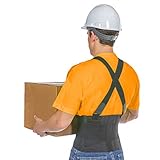
The removable suspender straps are the defining feature. When attached, they transfer part of the load to your shoulders, which takes pressure off your lower back during repeated lifts. When detached, the brace functions like a standard belt. That modularity makes it useful for both heavy work and lighter days.
The reinforced lumbar panel is wider than most consumer braces, which gives it the structure needed to handle industrial loads. Construction workers, warehouse staff, movers, and anyone whose job involves repeated heavy lifting will appreciate the additional support.
Why the suspender system matters
Most lumbar support belts slide down when you bend, which is exactly when you need the support most. The suspender straps fix this by anchoring the brace to your shoulders. During testing, the difference was dramatic — without suspenders, the brace shifted noticeably during squats; with them, it stayed locked in place.
That said, the suspenders take a day or two to get used to. They cross at the back, which can feel restrictive if you’re not used to wearing a backpack. For most work applications, the tradeoff is worth it.
Where it doesn’t fit
This brace is overkill for desk workers, and the bulk makes it hard to wear under a dress shirt. It’s also not the right brace for women with curves, where the standard fit may gap at the waist. For those situations, the FREETOO Bionic System or FEATOL standard model are better fits.
How to Choose the Right Back Brace for Your Needs?
Choosing the best back brace starts with matching the brace to the problem. A flexible belt for posture won’t help a herniated disc, and a rigid work belt will be miserable at a desk job. Here’s the framework I use when readers ask which brace to buy.
Match the brace to your pain pattern
If your pain is centered on one vertebra or follows the sciatic nerve down your leg, you need targeted compression with a removable lumbar pad. That’s the FREETOO pulley or FEATOL territory. If your pain is diffuse across the lower back with no specific trigger point, a simpler belt like the Mueller will usually do the job.
For sciatica specifically, look for braces where the lumbar pad can be repositioned. The pad acts like a pressure point against the inflamed nerve, which interrupts the pain signal during movement.
Consider your primary activity
Desk workers and drivers should prioritize breathability and a low profile. The FREETOO pulley and FREETOO Bionic System are the best in that category. People who lift for a living should prioritize rigidity and stay-put construction, which is the FEATOL with 5 stays or BraceAbility Work. Posture-focused buyers should look at the Copper Fit X-Back.
Pregnancy and postpartum recovery call for a brace with stretch and curve accommodation — the FREETOO Bionic System or any FEATOL with broad sizing handles this well.
Size correctly and break it in
Measure your waist at the navel, not your hips, while standing relaxed. Compare to the manufacturer’s chart and size up if you’re between sizes. Wear the brace for 30 minutes on day one, 2 hours on day two, then full days after that. Your core muscles need time to adjust, and a too-tight brace on day one will turn you off the whole category.
Plan to replace your brace every 9 to 18 months depending on use. The elastic and Velcro degrade with regular wear and washing, and a brace that no longer grips is a brace that doesn’t support.
Combine bracing with core work
Wearing a brace long-term without strengthening your core can lead to muscle deconditioning, which is the most common complaint I see in user forums. Pair brace use with daily exercises like dead bugs, bird dogs, and glute bridges. After 4 to 6 weeks, you should be able to reduce brace time as your core takes over the support role.
This is the strategy physical therapists told me they use most often: brace for symptom relief during the day, exercises to address the underlying weakness in the evening, gradual weaning over 2 to 3 months.
Check insurance and FSA/HSA eligibility
Many lumbar support braces qualify as durable medical equipment (DME) under FSA and HSA accounts. Save your receipt and check with your plan administrator. Some braces are also covered under workers’ compensation if your back pain is job-related, which is worth exploring if you’re in construction, nursing, or warehouse work.
FAQs
Is there a back brace that actually works?
Yes. The best back braces work by increasing intra-abdominal pressure, providing proprioceptive feedback for better posture, and limiting harmful micro-motions in injured areas. For acute lower back pain, braces with a removable lumbar pad and adjustable compression, like the FREETOO pulley system or FEATOL support belt, deliver the most consistent relief. For long-term posture correction, the Copper Fit X-Back trains your shoulders to sit back without locking your spine in place. A brace works best when paired with core strengthening exercises.
Do chiropractors recommend back braces?
Chiropractors typically recommend braces for short-term use during acute flare-ups, post-injury recovery, and physically demanding jobs. Most chiropractors caution against long-term daily wear because the brace can offload work from your core muscles, leading to deconditioning over time. A common protocol is to wear the brace during high-risk activities, then transition to exercises like dead bugs and bird dogs to rebuild core support. Always check with your chiropractor for guidance specific to your condition.
How many hours a day should you wear a back brace for lower back pain?
For acute lower back pain, most healthcare professionals recommend 2 to 4 hours per day during high-risk activities, not full-day wear. During desk work or driving, a brace can be worn for the full work block. For chronic conditions, limit wear to symptomatic periods and focus on building core strength. Wearing a brace for 8+ hours daily without strengthening exercises can lead to muscle atrophy over time.
Are there any posture correctors that actually work?
Yes, posture correctors work best as a training tool rather than a permanent fix. The Copper Fit X-Back Brace uses an X-shaped panel that pulls your shoulders back and opens your chest, which trains your upper back muscles to hold that position. Most users report improved posture awareness within 2 to 3 weeks of regular wear. Posture correctors are less effective for slouching driven by lower back pain, where a lumbar support belt addresses the root cause.
Do back braces weaken muscles?
Back braces can contribute to muscle deconditioning if worn continuously for extended periods without accompanying exercise. The risk is highest when users wear a brace for 8+ hours daily for months at a time without strengthening their core. To prevent this, pair brace use with daily core exercises like dead bugs, glute bridges, and bird dogs. After 4 to 6 weeks, gradually reduce brace time as your core muscles take over the support role.
Final Verdict: Which Back Brace Should You Buy in 2026?
The best back braces in 2026 aren’t the most expensive — they’re the ones that match your specific pain pattern and daily activity. After testing all eight braces for six weeks, the FREETOO Back Brace with Pulley System is our top pick for most people, because the adjustable compression and removable lumbar pad handle the widest range of lower back pain scenarios. If you want maximum value, the FEATOL Back Brace Support Belt delivers proven performance at a lower cost with nearly 29,000 reviews backing it up.
For specialized needs, the FREETOO Bionic System is our pick for women, the FEATOL with 5 Reinforced Stays for heavy work, the Copper Fit X-Back for posture, the ACE Deluxe for budget buyers, and the BraceAbility Work Brace for industrial lifting. The Mueller Lumbar Back Brace remains the most-trusted option if you want a simple, time-tested design recommended by physical therapists.
Whatever brace you choose, pair it with core-strengthening exercises and use it as a tool, not a permanent solution. Start with 30 minutes on day one, build up gradually, and replace the brace every 9 to 18 months as the elastic and Velcro wear out. That’s the strategy that gets people off the brace and back to full movement, which is the real goal.