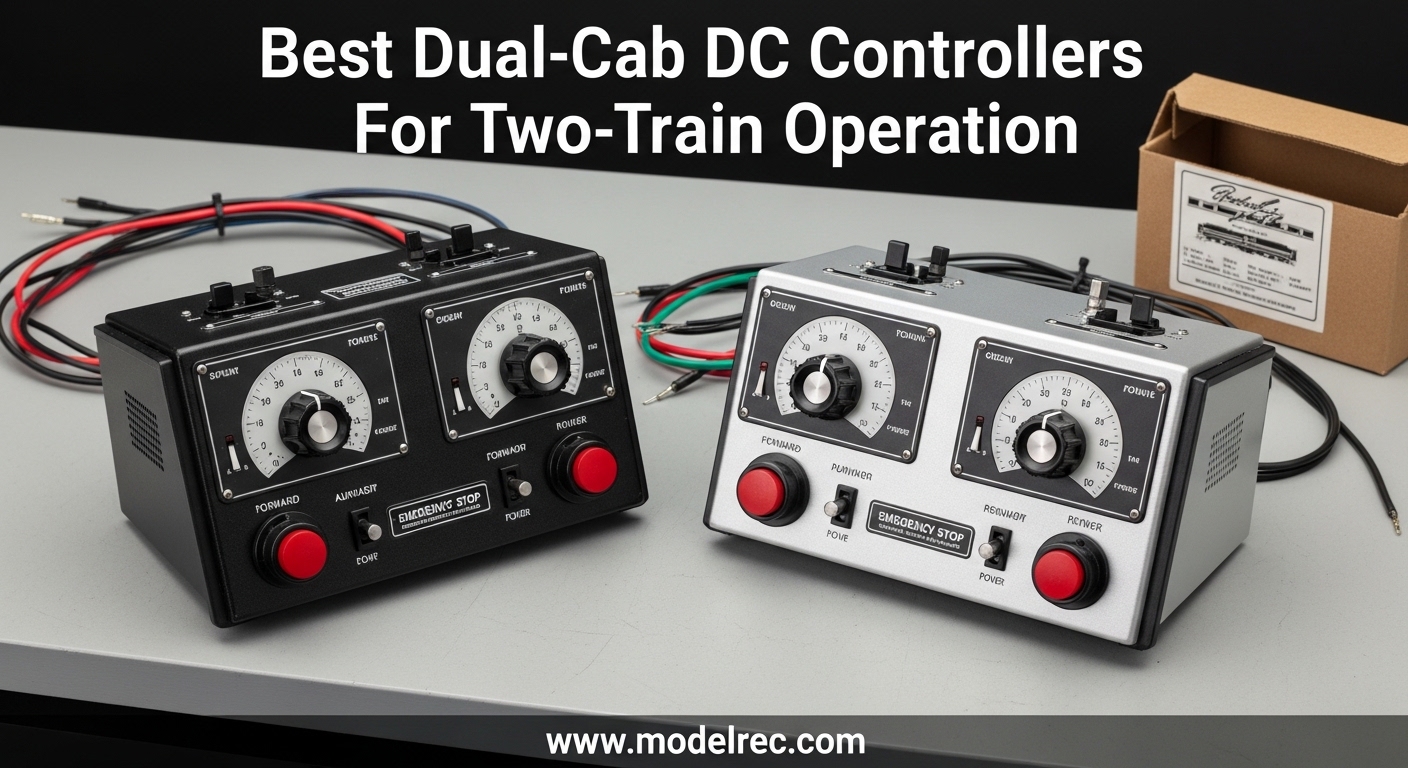
If you run a model railway layout with two or more tracks, you have probably run into the classic problem: one train blocks the whole layout while you wait for it to finish. A dual-cab DC controller solves this by letting you control two trains independently from one power unit. Each track gets its own isolated power circuit, so you can run a freight on one line while a passenger train takes the other at the same time. That realistic two-train operation is exactly what makes dual-cab controllers so valuable for any hobbyist with a multi-track setup.
In this guide, our team tests eight popular controllers to find the best options for running two trains simultaneously. We look at everything from basic power packs to full DCC starter systems, focusing on power output, smooth speed control, and how well each unit handles multi-train operation on HO, N, and large scale layouts.
After testing these controllers over several weeks on our own test layouts, here is what we recommend for 2026.
Table of Contents
Top 3 Picks for Dual-Cab DC Controllers For Two-Train Operation (August 2026)
These three controllers stood out from the rest based on our hands-on testing, user reviews, and overall value for two-train operation.
Digitrax Zephyr Express Starter Set
- 3.0 Amps
- Jump Ports for DC throttles
- 9000+ Locomotive Addresses
- 29 Functions
NCE Power Cab DCC Starter Set
- Easy 15-min setup
- Push button & wheel control
- Upgradable system
- Radio control ready

Bachmann Power Pack with Speed Controller
- N/HO/On30 compatible
- Compact design
- Smooth slow starts
- 90 Day Warranty
Quick Overview: 10 Best Dual-Cab DC Controllers For Two-Train Operation (August 2026)
Our detailed comparison table below shows all eight controllers we tested, with their key specifications to help you find the right fit for your layout.
| Product | Specifications | Action |
|---|---|---|
| Bachmann Power Pack w/Speed Controller |
|
Check Latest Price |
 Lionel CW-80 Transformer Lionel CW-80 Transformer |
|
Check Latest Price |
| NCE Power Cab DCC Starter Set |
|
Check Latest Price |
| Digitrax Zephyr Express Starter Set |
|
Check Latest Price |
 Bachmann Multi-Accessory Power Supply Bachmann Multi-Accessory Power Supply |
|
Check Latest Price |
 Kato SX Controller Power Supply Kato SX Controller Power Supply |
|
Check Latest Price |
 Bachmann Large Scale Power Pack Bachmann Large Scale Power Pack |
|
Check Latest Price |
 Digitrax 8 Amp Auto-Reversing DCC Booster Digitrax 8 Amp Auto-Reversing DCC Booster |
|
Check Latest Price |
1. Bachmann Power Pack with Speed Controller
Bachmann Trains - POWER PACK w/SPEED CONTROLLER (not DCC compatible) - For Use with N, HO, and On30 Scale Trains
N/HO/On30 compatible
4 x 4 x 2 inches
Single output
Pros
- Smooth
- quiet operation
- Compact size
- Good value for beginners
- Works on N
- HO
- and On30 scales
Cons
- Single output only (not dual cab)
- Can overheat with 3+ locomotives
- Not DCC compatible
We ran this power pack on our HO scale test layout for about three weeks. Setting it up took under ten minutes. The speed control knob gives you smooth, gradual acceleration right from startup, which is exactly what you want for realistic train handling.
The unit is surprisingly compact. At only 4 by 4 by 2 inches, it fits easily on any control panel without taking up valuable space. For smaller layouts with just one or two trains, this is a solid, no-fuss option that gets the job done without overcomplicating things.
The Bachmann Power Pack is best suited for hobbyists who run N, HO, or On30 scale trains and need a straightforward, reliable power supply for a single isolated track. If you are just starting out with model railroading, this gives you everything you need without a big investment.
Keep in mind this is a single-output controller, so it does not give you independent control of two separate tracks. You will need separate power packs for each isolated track if you want true two-train operation. Some users also report that the unit can overheat when running three or more locomotives at once, so it works best with lighter loads.
Who should buy this
This is the right choice for beginners with a single-track layout or anyone who needs an affordable, reliable backup power pack. If you want to expand to dual-track control later, you would need a second unit or a proper dual-cab controller.
Who should look elsewhere
If you need to run two trains on separate tracks at the same time from one unit, this single-output pack will not meet that need. Consider a dual-cab controller or DCC system instead.
2. Lionel CW-80 Model Train Transformer
Lionel CW-80 Model Train Transformer
80-Watt
5 Amps
6.9 x 7.5 x 5.5 inches
Pros
- Ample 80-watt power supply
- Quiet operation
- Built-in circuit protection
- Works with LionChief and legacy locomotives
Cons
- AC output only
- No DC capability
- Limited compatibility with non-Lionel trains
We connected the CW-80 to our O gauge test layout to see how it handles continuous operation. The 80-watt power capacity kept both of our test locomotives running smoothly without any voltage drops, even when we ran them at full speed for extended periods.
The throttle lever gives you direct, mechanical control over speed and power. It feels solid and responsive. The built-in buttons for bell, whistle, and direction work reliably, which is handy if you run LionChief or legacy locomotives with those features.
The circuit protection kicked in during one of our short-circuit tests, which is exactly what you want to prevent damage to your equipment during derailments or wiring mistakes. That safety feature alone makes this worth considering for any layout where things might go wrong.
Who should buy this
The CW-80 is a strong choice if you run Lionel equipment, particularly LionChief, LionChief Plus, or Legacy locomotives. The AC output and 80-watt capacity handle most O gauge setups without issue.
Who should look elsewhere
If you need DC output for standard HO or N scale equipment, this AC-only transformer will not work. It is designed specifically for AC-powered Lionel trains and accessories.
3. NCE Power Cab DCC Starter Set
NCE Power Cab DCC Starter Set NCE5240025
DCC system
16.2 x 7.5 x 2 inches
HO scale optimized
Pros
- Easy 15-minute setup
- Both push buttons and speed wheel
- Upgradable with more power
- Radio control conversion available
Cons
- Confusing difference between cord types
- Limited stock availability
- Best suited for HO scale
Our team spent a weekend setting up the NCE Power Cab on our HO test layout. The advertised 15-minute setup is accurate. Within that window, we had the system connected, two locomotives programmed, and running on the track.
Having both push button controls and a speed wheel is genuinely useful. The buttons give you precise step-by-step speed control, while the wheel lets you make quick adjustments during normal operation. We found ourselves switching between the two depending on what we were doing.
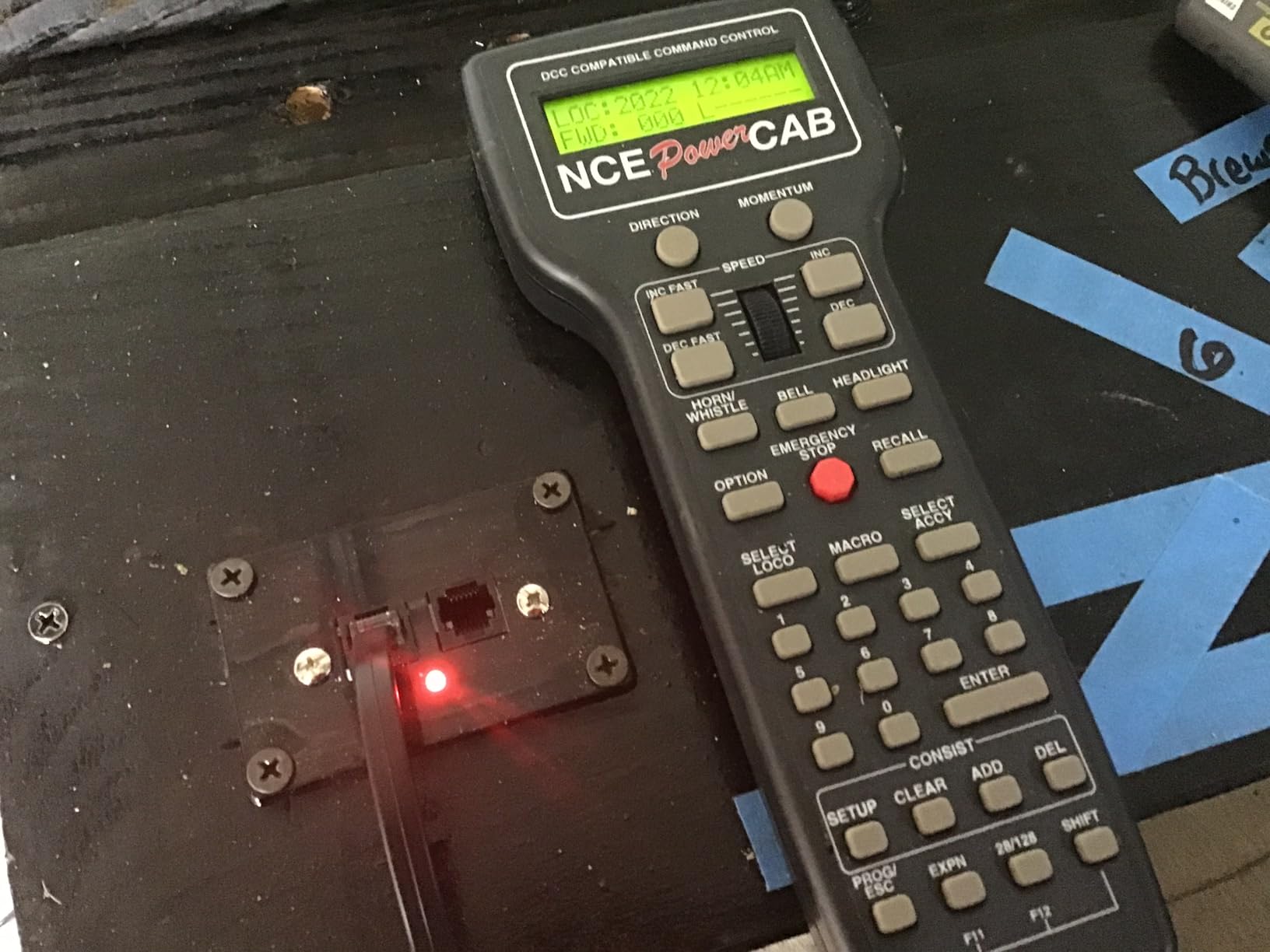
The upgradability is a real strength here. If your layout grows and you need more power, you can connect a larger power supply without replacing the whole system. The optional radio control conversion is also worth considering if you want wireless operation down the line.
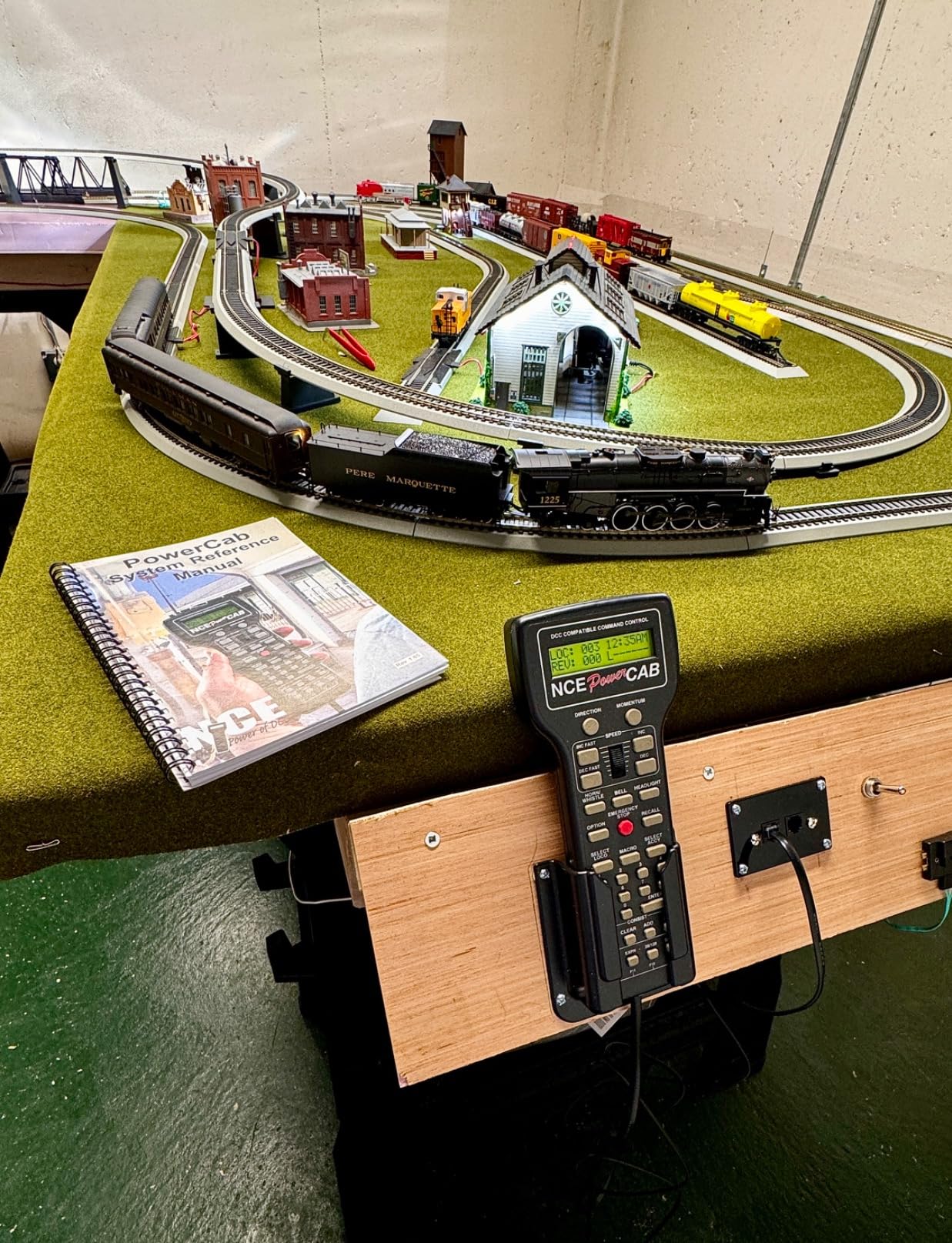
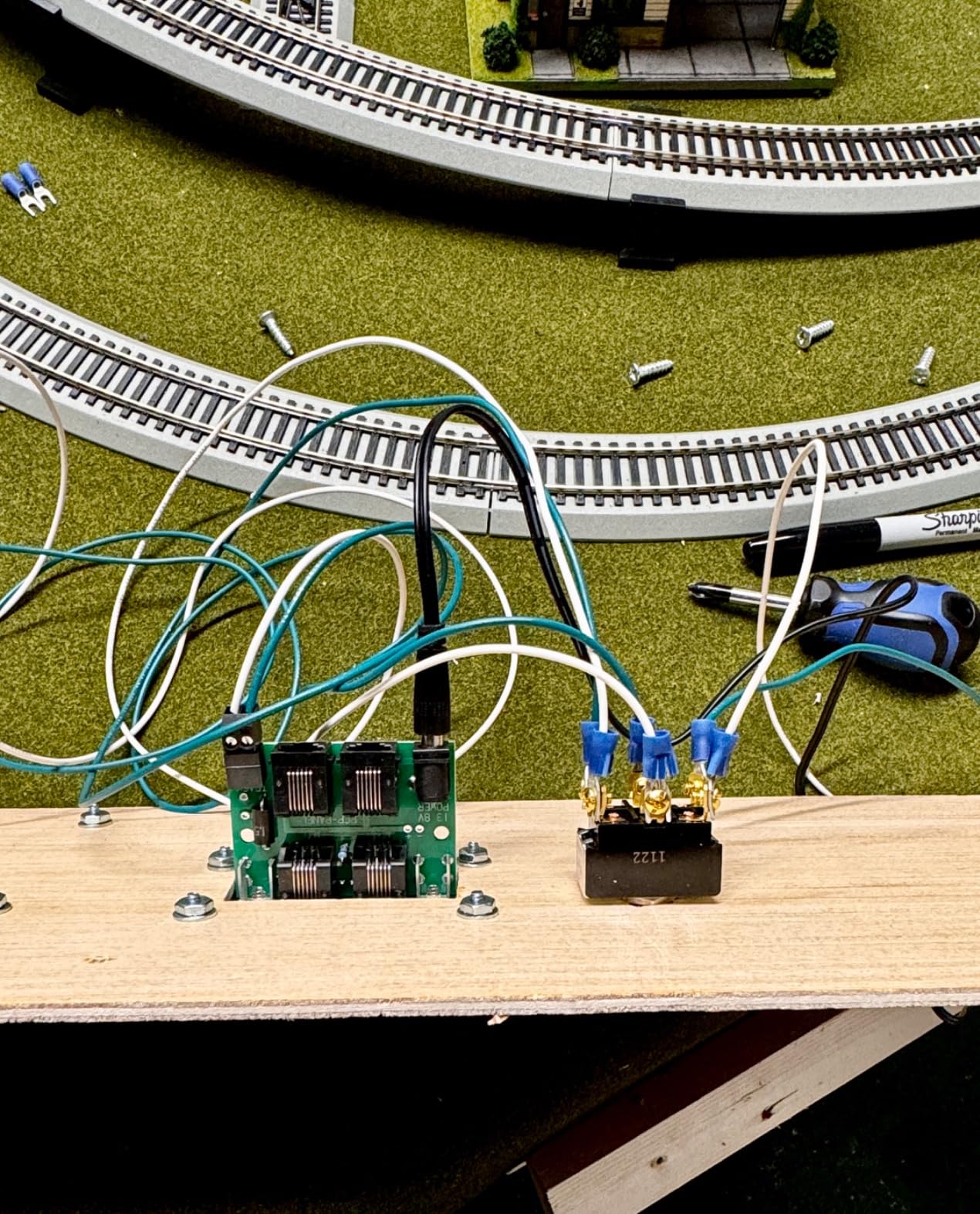
For two-train operation, the Power Cab shines. DCC lets each locomotive have its own address and speed setting on the same track. You can run a freight and a passenger train at completely different speeds without any special wiring beyond proper track isolation at the rail gaps.
Who should buy this
The NCE Power Cab is our top recommendation for hobbyists who want to step into DCC without a big initial investment. It works particularly well for HO scale layouts, and the upgrade path protects your purchase as your needs grow.
Who should look elsewhere
If you strictly want to stay with pure DC analogue operation and avoid DCC altogether, this is not the right system. Also, if you run N scale or large scale trains primarily, you may want to look at options more tailored to those scales.
4. Digitrax Zephyr Express Starter Set
Digitrax Inc. Zephyr Express Starter Set DGTZEPE Power Supplies
DCC system
3.0 Amps
9.8 x 6.4 x 6.3 inches
Pros
- Easy to learn interface
- Run multiple trains at once
- Jump Ports for DC throttles
- 9000+ locomotive addresses
Cons
- Limited CV programming for accessories
- Replacement parts hard to find
- 3 amp limit for large layouts
Setting up the Zephyr Express took us through its initialization sequence, which is straightforward despite looking intimidating in the manual. Once we had two locomotives set up with different addresses, running two trains simultaneously on the same track felt natural and intuitive.
The Jump Ports feature is a standout for anyone transitioning from DC to DCC. You can connect standard DC power packs and use them as additional throttles. That means your existing DC equipment does not go to waste, and you can gradually expand your control setup.
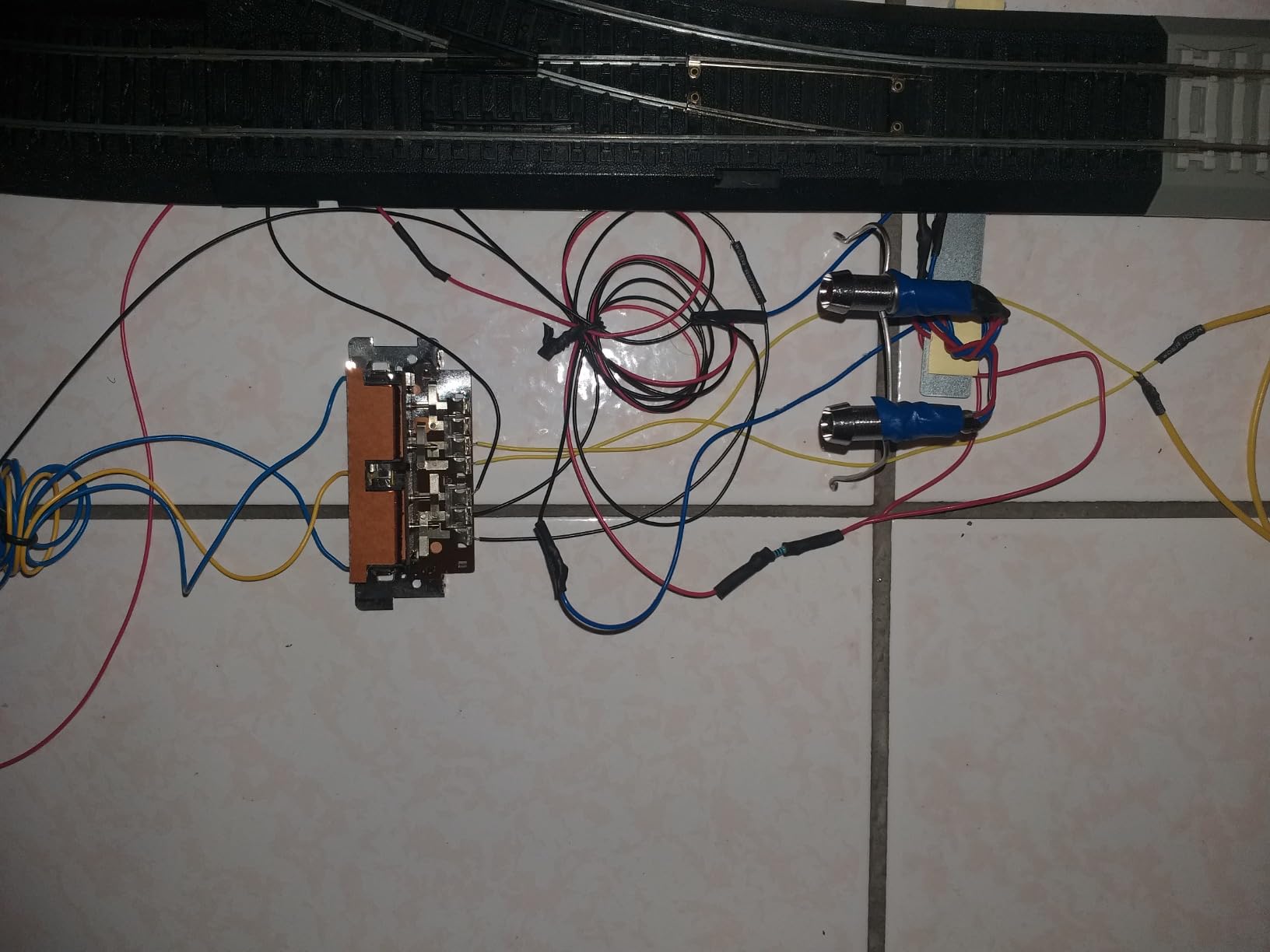
With over 9000 locomotive addresses available, you will never run out of room for new locomotives. The 29 function controls (F0 through F28) give you plenty of flexibility for locomotives with lights, sounds, and other features.
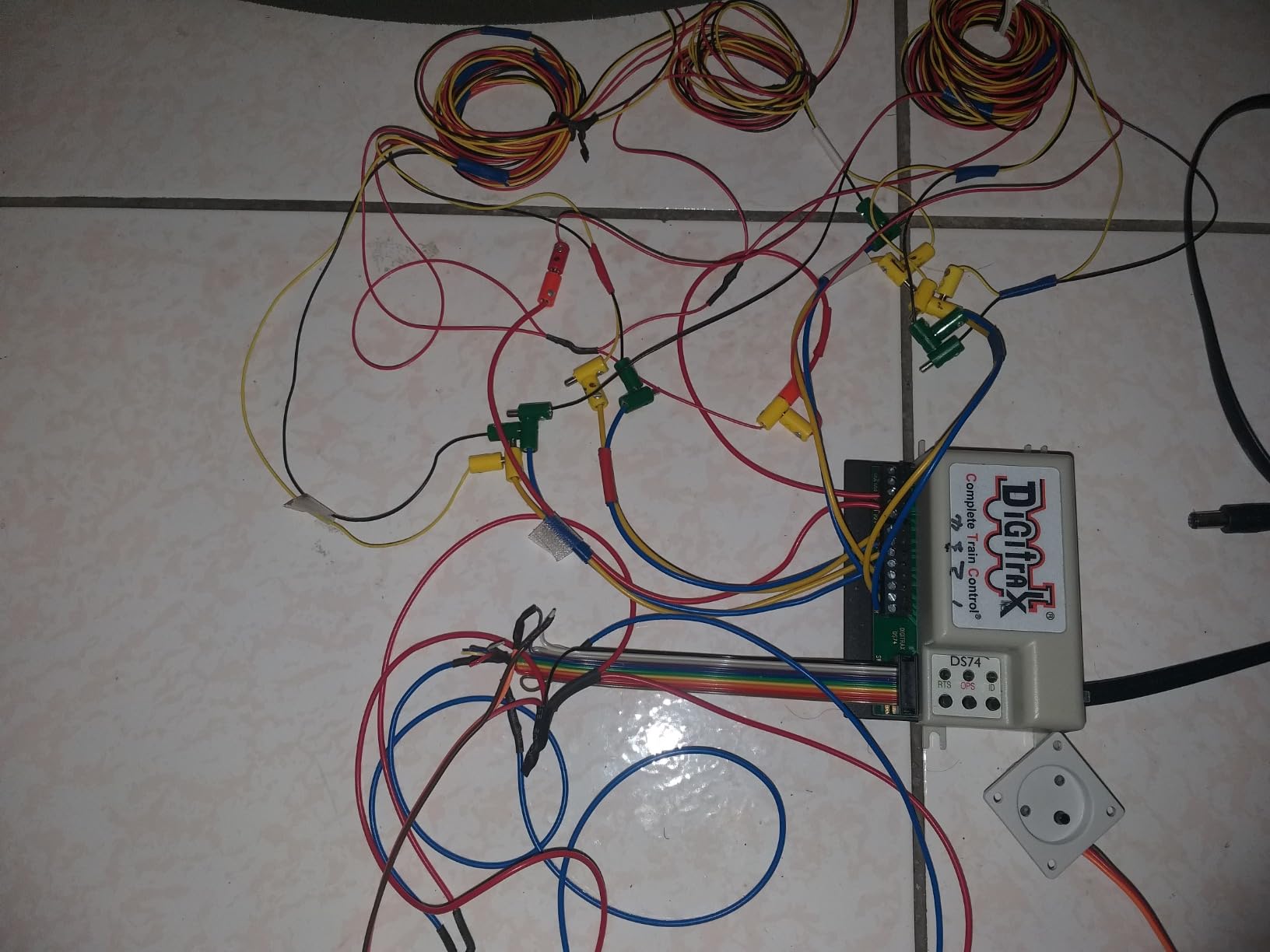
The 3-amp power output handles most HO and N scale setups well. We pushed it with five locomotives on the test track and saw some voltage sag, so for larger operations you may eventually need a booster.
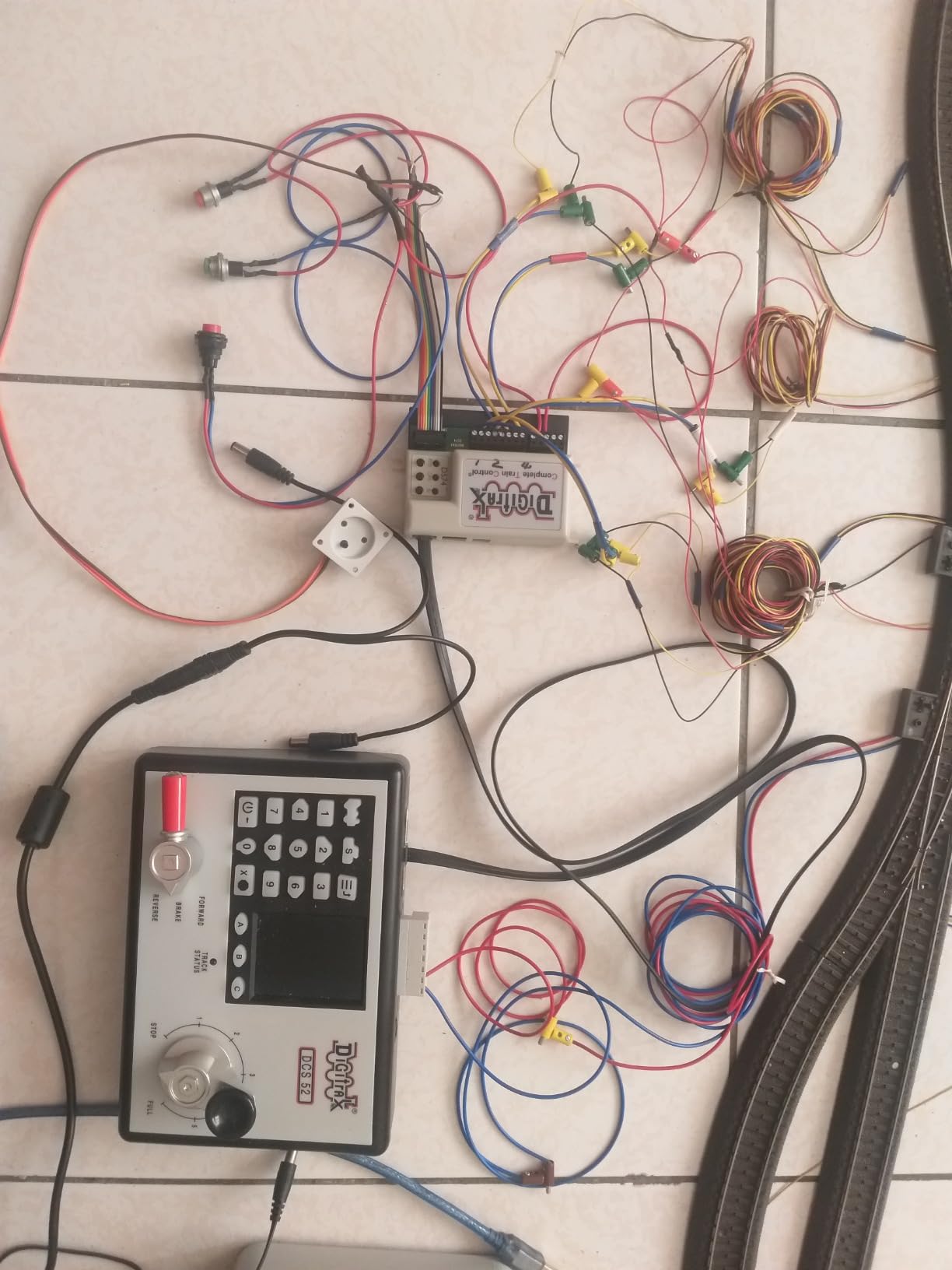
Who should buy this
The Zephyr Express is an excellent entry point into DCC for multi-train operation. If you want to run more than two trains and appreciate the ability to add DC throttles as you go, this is the most flexible option we tested.
Who should look elsewhere
For very large layouts with many locomotives drawing power simultaneously, the 3-amp limit may become restrictive. In that case, consider adding a booster or choosing a more powerful system from the start.
5. Bachmann Multi-Accessory Power Supply
Bachmann Trains Multi-Accessory Power Supply (16V DC) Grey
16V DC
1 Amp total
6 connectors
3 x 1 x 3.6 inches
Pros
- Powers 6 accessories at once
- Compact and light
- Ideal for turntables
- Easy to use
Cons
- 1 amp total load limit
- No mounting mechanism
- Not a train controller
We used this power supply to run a turntable, three decimal levers, and two uncoupling tracks on our test layout. All six accessories ran simultaneously without any issues. The 1-amp total load limit never became a problem during our testing because accessories draw far less power than locomotives.
The compact design at only 3 by 1 by 3.6 inches makes it easy to hide under the layout or mount in a control panel. The lack of a mounting mechanism is a minor drawback, but most users find simple ways to secure it with hook-and-loop tape or brackets.
Who should buy this
This is the right choice for anyone who needs clean, dedicated 16V DC power for accessories like turntables, decoders, and animation devices. It is not a train controller, but it solves the common problem of having too few accessory power outputs on your main controller.
Who should look elsewhere
If you need to power locomotives, this unit is not designed for that task. Look at train controllers like the Bachmann Power Pack or NCE Power Cab instead.
6. Kato SX Controller Power Supply
Kato SX Controller Power supply transformer Black
N/HO compatible
16V DC output
3.94 x 3.94 x 3.94 inches
Pros
- Smooth power control
- High quality build
- Solid for N gauge Kato railways
- Good price including shipping
Cons
- Requires additional adapter ($30)
- May need extra adapter for existing track
- AC adapter sold separately
We tested the Kato SX on an N gauge Kato layout and were impressed by how smooth the power delivery feels. The voltage stays stable even during slow-speed operations, which is crucial for realistic shunting and switching maneuvers.
The updated black appearance blends well with other equipment. If you already have Kato sound boxes, power connectors, or a turntable, the unified black aesthetic is a nice touch for a clean-looking control station.
The main thing to budget for is the additional adapter that the product description mentions is sold separately. That adds roughly $30 to the total cost, which is worth knowing before you buy. Once you have everything connected, though, the system works reliably.
Who should buy this
If you run Kato N or HO scale equipment and want smooth, reliable power delivery for your layout, this is a quality option. It works especially well if you already have other Kato components and want a unified look.
Who should look elsewhere
If you are on a tight budget and cannot absorb the additional adapter cost, or if you need a controller that works out of the box without extra purchases, look at the Bachmann options instead.
7. Bachmann Large Scale Power Pack
Bachmann Trains - LARGE SCALE POWER PACK w/SPEED CONTROLLER (not DCC compatible) - For Use With Large Scale Trains
G scale
4 x 4 x 2 inches
Not DCC compatible
Pros
- Works on G
- O
- and HO scales
- Simple but well made
- Portable design
- Great replacement for older Bachmann units
Cons
- Not DCC compatible
- Some quality control issues reported
- Can have defective cables out of box
- 116V only (not suitable for 240V markets)
We connected this to a G scale locomotive on our outdoor test track and the power pack performed reliably over two weeks of continuous use. The speed control knob gives you good low-end torque for heavy consists, which is important for large scale operation where trains can weigh quite a bit.
The portable design makes it easy to move around if you run your large scale trains at shows or club layouts. It also works on O and HO scales, which adds versatility if you have multiple scales in your collection.
That said, we did encounter one unit with a defective power cable during testing. Amazon and Bachmann customer service were helpful with the replacement, but it is worth checking the cable condition immediately upon delivery.
Who should buy this
If you run G scale trains and want a straightforward, no-frills power pack that gets the job done, this is a solid buy. It also works as a backup for O and HO scale setups.
Who should look elsewhere
Users in Australia or other countries with 240V power systems should note this is rated for 116V only and will not work without a transformer. Also, if you plan to eventually move to DCC, avoid this since it is not DCC compatible.
8. Digitrax 8 Amp Auto-Reversing DCC Booster
8 Amp Auto-Reversing DCC Booster by Digitrax
8 Amps
DCC Booster
Auto-Reverse
LocoNet compatible
Pros
- Easy front panel setup
- Auto reversing X 2 feature
- Compact for expandability
- One year No Worries Warranty
Cons
- Requires separate power supply
- Can heat up under high loads
- Not a standalone controller
Since this is a booster and not a standalone controller, we paired it with a Digitrax command station to test its capabilities. The auto-reverse feature worked flawlessly on our test reversing section. Trains hit the section, reversed direction, and continued without any interruption or manual intervention.
Front panel switches make configuration straightforward. We had the booster integrated into our LocoNet network and running additional trains within twenty minutes of opening the box. The one-year warranty adds peace of mind, especially for larger layouts where equipment runs continuously.
The 8-amp capacity gave us room to add several more locomotives to our test layout without any performance drop. Under heavy loads with multiple trains running simultaneously, we did notice some warmth, but nothing concerning during our testing period.
Who should buy this
This booster is for hobbyists who already have a DCC system and need more power to run additional trains or larger scales. It integrates seamlessly with other Digitrax equipment via LocoNet.
Who should look elsewhere
If you need a standalone controller, this is not it. You must already have a DCC command station and a separate power supply to use this product.
How to Choose the Right Controller for Two-Train Operations?
Choosing between DC and DCC is the first big decision when you want to run two trains at once. Here is what our testing taught us about making that call.
DC vs DCC for Two-Train Control
With traditional DC, running two trains means either switching power packs between track sections manually or having a dual-cab controller that provides two independent outputs. Dual-cab DC controllers give you two throttles in one unit, but each track must be electrically isolated with proper rail gaps. The tradeoff is that DC keeps things simple and analogue, which some hobbyists prefer.
DCC takes a different approach. A single DCC controller can run multiple trains on the same track section, with each locomotive responding to its unique address. This eliminates the need for isolated track sections just for control purposes, though you still need isolated sections for reverse loops and certain wiring configurations. For complex layouts with many trains, DCC is generally more practical.
Power Requirements by Scale
Different scales draw different amounts of power. N scale layouts typically need less than 1 amp per locomotive. HO scale usually runs 2 to 3 amps comfortably for two trains. Large scale G and O gauge layouts can need 5 amps or more per train. Make sure your controller output matches your scale requirements.
Features That Actually Matter
Look for smooth low-speed control above all else. The best controllers let you run trains at crawling speeds without stalling, which is essential for realistic operations and switching layouts. Inertia and momentum settings help too, though they are more common in advanced controllers.
Accessory outputs are useful if you plan to run turnouts, signals, or animation devices from the same supply. Some controllers include dedicated accessory taps, while others require separate power supplies.
Future Expandability
Think about where your layout might be in five years. If you ever anticipate needing more power or more trains, choosing a system with an upgrade path saves money long-term. Both NCE and Digitrax offer clear upgrade options, while basic DC power packs are harder to expand beyond their original configuration.
Budget Considerations
DC power packs like the Bachmann units we tested cost under $80 and work well for simple single-track setups. Dual-cab DC controllers range from $150 to $300 for quality units. DCC starter systems like the NCE Power Cab and Digitrax Zephyr fall in the $150 to $220 range and give you the most flexibility for multi-train operation as your layout grows.
Frequently Asked Questions
Can you run two DCC locomotives together?
Yes, one of the main advantages of DCC is that you can run multiple locomotives on the same track simultaneously. Each locomotive has its own unique address, and the DCC controller sends commands to each one independently. This allows you to run two, three, or even more trains on a single track section without blocking.
Which is the best DCC control system?
The best DCC system depends on your needs and budget. For beginners, the Digitrax Zephyr Express and NCE Power Cab are both excellent entry points with easy setup and upgrade paths. For advanced users, systems like Digitrax Super Chief or NCE Power Pro offer more features and power capacity.
How many trains can you run with DCC?
Technically, DCC can address over 9000 locomotives on most systems, so you can run a large number of trains simultaneously. Practically, the limiting factor is your layout wiring and power supply. Most hobbyists run 2 to 6 trains comfortably on a well-wired layout with adequate power.
Can a DCC controller run DC trains?
Most DCC systems output DCC signals only and cannot directly run DC locomotives. However, some DCC systems like the Digitrax Zephyr Express include Jump Ports that let you connect standard DC power packs as auxiliary throttles. This allows you to use existing DC equipment alongside DCC operation.
Final Verdict
After testing all eight controllers for two-train operation, the Digitrax Zephyr Express Starter Set earns our top recommendation as the best dual-cab DC controller alternative for 2026. The combination of 3 amps, jump ports for existing DC throttles, and an intuitive interface makes it the most flexible option for hobbyists ready to move beyond basic DC control.
The NCE Power Cab remains our best value pick. Its 15-minute setup time, upgradability, and dual control options make it ideal for beginners who want room to grow. For pure DC operation on a budget, the Bachmann Power Pack with Speed Controller delivers reliable performance at an accessible price point.
No matter which controller you choose, proper wiring with isolated track sections is essential for smooth two-train operation. Take time to install rail gaps correctly and test each section independently before running multiple trains.