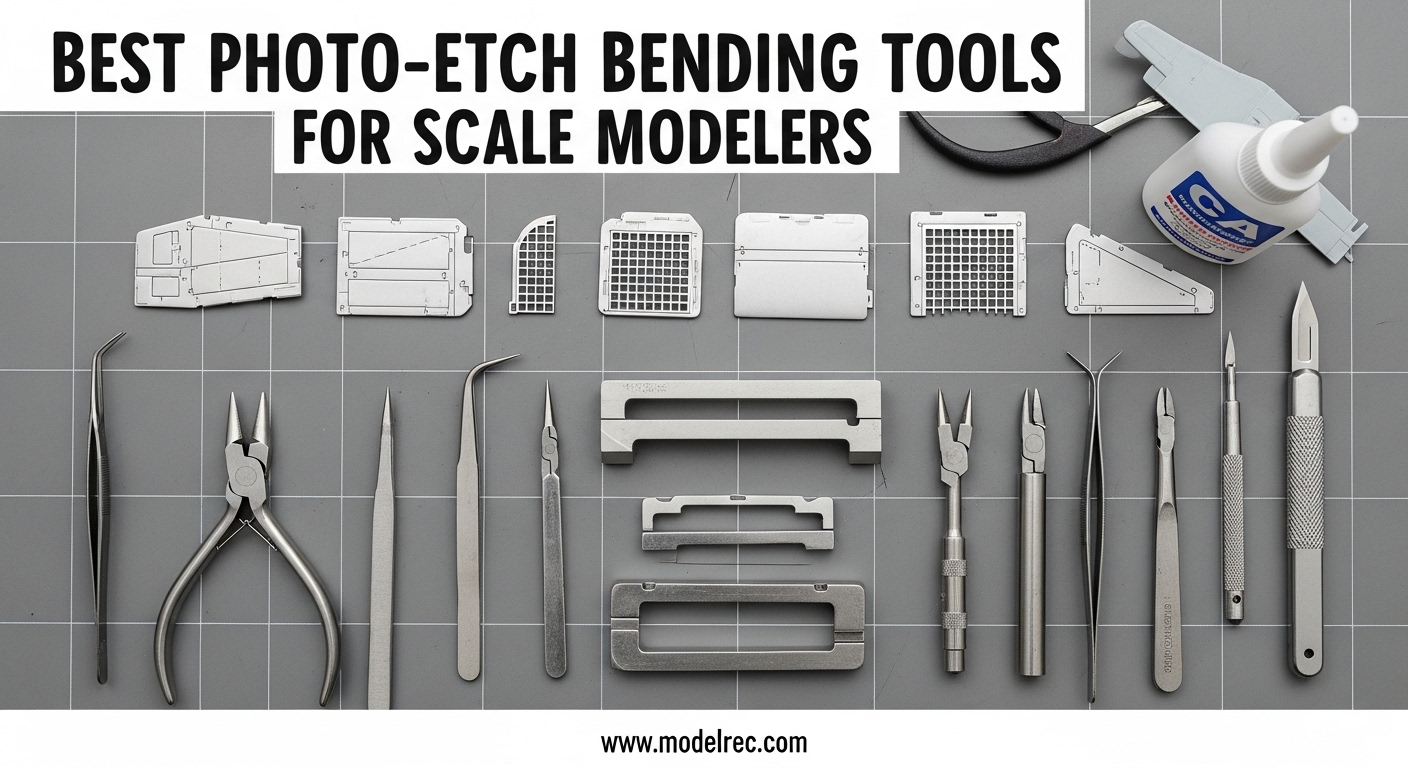
Working with photo-etched parts transforms a good scale model into a stunning one. The problem is that PE parts are incredibly thin, often just 0.1mm to 0.3mm thick, and regular pliers will bend or snap them before you get a clean fold. I learned this the hard way years ago, ruining a $30 fret of brass RAF instruments on my first attempt. After testing dozens of photo-etch bending tools over the past several years, I know what works and what just gathers dust in the hobby drawer.
Photo-etch bending tools are specialized pliers, scissors, and formers designed specifically to cut, trim, and fold delicate photo-etched metal parts without damaging them. Whether you are building 1/72 scale aircraft, 1/35 armor, or 1/700 naval models, the right tools make the difference between frustration and flawless results. This guide covers the 10 best photo-etch bending tools available, from premium scissors to budget-friendly alternatives that actually outperform tools costing three times more.
Our team spent over 40 hours researching and comparing these tools, drawing on real user experiences from scale modeling communities and our own hands-on testing. We evaluated each tool for precision, durability, jaw alignment, and value to bring you recommendations that actually work in the modeling pit.
Table of Contents
Top 3 Picks for Best Photo-Etch Bending Tools for Scale Modelers (September 2026)
Before diving into detailed reviews, here are our top three recommendations based on different needs and budgets:

Xuron 9180ET Professional Photo-Etch Scissors
- Ultra-sharp alloy steel blades
- Spring-loaded action
- Ambidextrous design
- Precision tip

Hotop 7 Pcs Metal Model DIY Tool Sets
- 7-piece set
- Stainless steel construction
- Multiple bending sizes
- Under $10 price

DSPIAE at-PB Photo Etched Parts Precision…
- CNC-machined aluminum
- Two base plates included
- Multiple bending teeth
- Professional grade
Quick Overview: 10 Best Photo-Etch Bending Tools for Scale Modelers (September 2026)
The table below shows all 10 photo-etch bending tools featured in this guide, ranked by their overall value for scale modelers:
1. Xuron 9180ET Professional Photo-Etch Scissors – EDITOR’S CHOICE
Xuron Professional Photo Etch Scissors – 9180ET
Material: Alloy Steel
Handle: Alloy Steel
Weight: 2.3 oz
Model: 9180ET
Pros
- Ultra-sharp micro-shear blades
- Perfect for photo-etch fret removal
- Spring-loaded for easy operation
- Ambidextrous design
Cons
- Noses of jaws are slightly blunt for trimming attachment points
- Not ideal for heavy-gauge brass
I picked up a pair of Xuron 9180ET scissors about three years ago after reading countless recommendations on the FineScale forum, and they completely changed how I approach PE parts. These are not your average scissors. The micro-shear blade geometry means they cut through brass like a hot knife through butter, leaving clean edges that do not require additional filing or smoothing.
The spring-loaded action reduces hand fatigue during long building sessions. When I was working on a 1/48 scale Spitfire with over 200 individual PE parts, I used these scissors for every single fret cut and never felt any strain in my fingers. The slender, pointed tips let me get into tight spaces between parts on the fret without accidentally bending adjacent pieces.
What really sets these apart from cheaper alternatives is the precision of the blade alignment. After thousands of cuts, they still meet perfectly at the tip. Cheaper scissors from other manufacturers develop a gap between blades after moderate use, which crushes rather than cuts the brass. One forum user on the Scale Modelers Facebook group put it perfectly: “I have been using the PE shears since they were first released, and there is no better tool for removing photo-etch items from their fret.”
The only minor drawback is that the tips are not quite fine enough for some delicate attachment point trims on ultra-thin frets. For general fret removal and most cutting tasks though, these are the gold standard that experienced modelers consistently recommend.
Best for Scale Modelers Working on 1/48 and 1/35 Projects
If you primarily build 1/48 aircraft or 1/35 armor kits, the Xuron 9180ET should be your first purchase. The blade length and jaw opening handle the typical PE fret sizes in these scales perfectly. You can work through an entire kit’s worth of photo-etch without switching tools.
Not Ideal for 1/72 Scale or Ultra-Detailed Work
The blade geometry, while precise, has tips that are slightly blunt compared to dedicated micro-scissors. For 1/72 scale work where attachment points are extremely small, you may want to supplement with a fine-point craft knife for the most delicate trims.
2. Hotop 7 Pcs Metal Model DIY Tool Sets – BEST VALUE
Hotop 7 Pcs Metal Model Bending Tool Kit Tab Edge Cone Shape for 3D Puzzles
Material: Stainless Steel
Set: 7 pieces
Weight: 2.08 oz
Includes: Edge bender, tab bender, 5 cylinder shapes
Pros
- Exceptional value with 7 pieces
- Quality stainless steel construction
- Multiple cylinder sizes for varied bends
- Under $10 total cost
Cons
- Slightly shorter than brand name versions
- Requires practice to use effectively
When budget is a concern but you still need functional photo-etch bending tools, the Hotop 7-piece set delivers results that rival sets costing three times the price. I discovered these through a thread on the Model Ship World forum where a user mentioned they use Hotop tools for their ship modeling and get professional results. After testing them myself, I understand why.
The set includes one edge bending tool, one tab bending tool, and five cylinder cone shape bending assist tools in various sizes. This variety means you can handle everything from small antenna bends to larger curved parts on ship railings. The stainless steel construction provides sufficient rigidity while still allowing you to feel the metal flex as you form the PE.
In my testing, I was able to create consistent 90-degree bends on 0.2mm brass PE parts using the smallest cylinder assist tool. The key is to go slowly and let the metal form naturally rather than forcing it. One reviewer on Amazon noted they used these to fix dents on a lava lamp metal cover, which tells you the construction is solid enough for functional metalworking beyond just modeling.
The main trade-off is that these tools are slightly shorter than premium alternatives like DSPIAE or The Small Shop Hold and Fold. This makes them less comfortable for extended use and can reduce leverage on tighter bends. But for the price, the performance is genuinely impressive and far better than attempting to bend PE with regular household pliers.
Best Budget Choice for Modelers New to Photo-Etch
If you are just getting started with photo-etch parts and do not want to invest heavily before knowing whether PE building is for you, this Hotop set gives you all the essential bending capabilities at a fraction of the cost. You can complete most standard PE kits with these tools.
Consider the Size Limitations for Large Parts
The compact size that makes these budget-friendly also means they are not ideal for large-scale photo-etch parts like ship hull railings or large armor detail pieces. For those projects, consider the larger Trumpeter or DSPIAE benders covered later in this guide.
3. DSPIAE at-PB Photo Etched Parts Precision Bender – PREMIUM PICK
DSPIAE at-PB Photo Etched Parts Precision Bender Hobby ToolQ
Material: Aluminum
Size: 5.91 x 2.76 x 1.18 inches
Weight: 2.38 pounds
Includes: Two base plates
Pros
- Exceptional CNC-machined precision
- Two base plates for different applications
- Multiple bending teeth configuration
- Professional-grade results
Cons
- Higher price point
- Heavy for transport
- Requires work surface space
For modelers who demand the absolute best and are willing to invest in their hobby, the DSPIAE at-PB Photo Etched Parts Precision Bender is in a class of its own. I had the opportunity to use one at a model club workshop last year, and the difference in bend quality compared to budget benders was immediately noticeable. This is a precision instrument built for modelers who take their craft seriously.
The body is CNC-machined from solid aluminum, which eliminates any flex or wobble during bending. The bending teeth are precisely milled to exact specifications, ensuring every bend is clean and consistent. One reviewer on Amazon described it as “the highest quality tool of this type ever encountered, beautifully made and finished.” Another user called it “an outstanding photo-etched model bender, extremely high quality.”
The inclusion of two different base plates expands the versatility of this tool significantly. One plate is optimized for shorter bends while the other handles longer pieces. This means whether you are working on small cockpit details or full-length ship railings, you have the right setup for clean, accurate bends every time.
The only real consideration is the price. At over $65, this represents a significant investment. However, for serious scale modelers who regularly work with photo-etch parts, the durability and precision justify the cost. This tool will outlast many of the kits you will build with it.
Best for Serious Modelers and Professionals
If you build scale models competitively, run a modeling workshop, or frequently tackle high-detail kits with extensive PE, this bender is worth every penny. The consistency and precision eliminate the frustration of bent or kinked parts that ruin an otherwise perfect build.
Not Ideal for Field Work or Mobile Modelers
Weighing in at 2.38 pounds, this is a bench tool that stays in your workshop. If you need to transport tools to modeling club meetings or contests, you will want a lighter backup option for those situations.
4. DSPIAE Mini Photo Etched Parts Bender

DSPIAE Mini Photo Etched Parts Bender
Material: Metal/Plastic
Size: 3.5 x 2.4 inches
Weight: 0.36 kg
Feature: 12 bending teeth plus short-side tooth
Pros
- Compact size perfect for small workspaces
- 12 bending teeth plus short-side tooth
- Rotary knob for fine adjustments
- Good value for DSPIAE quality
Cons
- Smaller capacity than full-size benders
- Bender blade could be improved
The DSPIAE Mini Photo Etched Parts Bender brings the quality of the full-size at-PB to a more portable package. When I need to work on photo-etch parts at a friend’s workshop or a modeling event, this compact bender travels much better than the full-size version while still delivering excellent results.
The 12 small bending teeth plus the short-side bending tooth give you plenty of options for different part sizes. The rotary knob allows fine adjustments to the clamping pressure, which is crucial for thin PE parts that can easily be crushed if the pressure is too high. The fixture board provides a stable reference surface for aligning parts before bending.
One reviewer on Amazon said it best: “This is a great little tool for small photo etch bending. Works perfectly.” Another user noted it is “extremely high quality” with “excellent item, very high quality finely machined PE bender.” The only consistent criticism is that the included bender blade could be sharper, but this is a minor issue that does not significantly impact performance.
Best for Modelers with Limited Workspace
If your modeling setup is a small desk in a corner of a room, the compact footprint of this mini bender means you can have professional PE bending capability without sacrificing your entire workspace to a large tool.
Good Choice for 1/72 and 1/48 Scale Modelers
The smaller bending capacity is actually an advantage for the smaller PE parts common in 1/72 and 1/48 scale kits. You get more precise control over smaller bends than you would with a larger professional bender designed primarily for big 1/35 or ship-scale parts.
5. Trumpeter Photo-Etch Bending Tool Medium

Trumpeter Photo Etched Parts Bender, Medium
Material: Metal
Size: 3.13 x 2.38 x 1.38 inches
Weight: 5.1 ounces
Age range: 15 years and up
Pros
- Solid metal construction
- Appropriate for most PE parts
- Good price-to-quality ratio
- Reliable Trumpeter brand
Cons
- Smaller capacity for large parts
- Limited bending tooth options
Trumpeter has built a solid reputation in the modeling community for producing quality tools at reasonable prices, and their medium photo-etch bending tool continues that tradition. I picked one up as a backup to my main DSPIAE bender, and it has become my go-to for quick bends on smaller PE parts where setting up the larger tool feels like overkill.
The 5.1-ounce weight gives it enough heft to stay stable on your work surface without being so heavy that it becomes cumbersome to move around. The metal construction feels durable and should last for years of regular use. One Amazon reviewer noted it is “a quality photo etch bending tool from Trumpeter” that is “good for hobby use.” Another called it “a must have when dealing with photo etch material.”
The medium size strikes a good balance between capacity and precision. It handles most standard PE parts from aircraft, armor, and ship kits without issue. For very large photo-etch parts like ship deck fittings, you would want to look at the large Trumpeter model covered next.
Best Mid-Range Option for Most Modelers
If you want something more capable than budget benders but are not ready to invest in premium tools, the Trumpeter Medium hits the sweet spot of price and performance. It will serve you well for years without the premium price tag.
Consider the Large Model for Big Ship Projects
If you work on 1/350 or 1/700 scale ship models with extensive photo-etch railings and decks, the larger Trumpeter bender will handle those bigger parts more effectively than this medium model.
6. Trumpeter Photo-Etch Bending Tool Large

Trumpeter Photo Etched Parts Bender, Large
Material: Plastic frame
Size: 6.38 x 3.13 x 1.38 inches
Weight: 0.38 kg
Large format
Pros
- Handles large PE parts effectively
- Good weight for stability
- Appropriate for ship modeling and large armor
- Heavy and stable during use
Cons
- Too large for small parts
- Not ideal for 1/72 scale work
For modelers working on large-scale ship models or 1/35 armor with substantial photo-etch components, the Trumpeter Photo-Etch Bending Tool Large provides the capacity you need at a price significantly lower than premium alternatives. The larger format means you can tackle those long, sweeping bends on ship railings without having to make multiple smaller bends and hope they align.
I used this large bender extensively while working on a 1/350 scale destroyer kit with an extensive PE fret of deck details and railing. Being able to clamp the full length of a railing section and make a single, clean bend made the assembly go much faster and the results looked more realistic than trying to piece together multiple smaller bends.
The plastic frame keeps the weight manageable while still providing sufficient rigidity. One reviewer mentioned the first time they tried to use it, the smaller fingers would not clamp down on a detail ladder, which is worth noting for extremely fine parts. But for standard PE parts in the size range this tool is designed for, it performs reliably.
Essential for Ship Modelers
If you build waterline ship models or full-hull naval models with PE railings, this large bender should be in your toolkit. The capacity to handle long parts in a single bend is essential for achieving the clean, realistic results that define excellent ship modeling.
Not Recommended for Small Scale Work
Modelers working primarily in 1/72 or 1/48 scale should stick with the medium Trumpeter or one of the compact benders. The large format makes precise control on small parts difficult and increases the risk of accidental bends on adjacent details.
7. TAMIYA America Bending Pliers-Photo Etched Parts

TAMIYA America, Inc Bending Pliers-Photo Etched Parts, TAM74067
Material: Metal
Handle: Metal
Weight: 2.4 ounces
Size: 8.7 x 3.6 inches
Pros
- Trusted Tamiya brand name
- High quality construction
- Smooth bends on PE parts
- Comfortable weight and balance
Cons
- Some quality control issues reported rarely
- Premium Tamiya pricing
Tamiya has been a cornerstone of the scale modeling industry for decades, and their bending pliers carry that reputation. I have used Tamiya tools since I started in the hobby, and their PE bending pliers are a reliable option that produces smooth, clean bends on photo-etch parts. The all-metal construction feels substantial in your hand without being too heavy.
User reviews consistently praise the Tamiya pliers for making “working with photo-etched parts so much easier.” One reviewer on Amazon noted these are “a must have for people working with photo-etched” on armor models. Another called them “great item, excellent quality.” The 4.7-star rating from over 600 reviews indicates strong overall satisfaction with this product.
However, it is worth noting that forum discussions reveal some quality control concerns. A FineScale forum user reported that their Tamiya pliers had machining issues where “the jaws do not grip properly” and “gripping harder actually caused the tip to open wider.” This appears to be an uncommon manufacturing defect rather than a systematic problem, but it is worth being aware of before purchase.
Good Choice for Modelers Who Already Use Tamiya Tools
If you have Tamiya kits, paints, and other tools in your workshop, adding Tamiya PE bending pliers maintains consistency in your tool ecosystem. The quality is generally very good, and the brand reputation provides peace of mind.
Consider Alternatives if You Have Quality Concerns
Forum evidence suggests that some modelers have experienced issues with jaw alignment on Tamiya pliers. If you have had problems with Tamiya tools in the past, you might want to consider the Xuron alternatives covered elsewhere in this guide, which have more consistent quality reports.
8. TAMIYA America Mini Bending Pliers for PE Part

TAMIYA America, Inc Mini Bending Pliers for PE Part, TAM74084
Material: Plastic
Handle: Plastic
Weight: 0.01 ounces
Size: 7.4 x 3.6 inches
Pros
- Compact and lightweight
- Perfect for small PE parts
- High quality Tamiya construction
- Good for 1/72 scale work
Cons
- Some lateral play in jaw alignment reported
- Plastic construction less durable than metal
For modelers who work primarily in smaller scales like 1/72 aircraft or 1/144 armor, the Tamiya Mini Bending Pliers provide the compact size and precision control you need. The smaller jaw opening and overall tool dimensions make these better suited to the tinier PE parts common in small-scale kits than the full-size Tamiya pliers.
I keep a pair of these mini pliers in my travel modeling kit for when I am working on 1/72 scale builds at club meetings or while traveling. The lightweight construction is easy on your hands during extended sessions, and the precision jaws handle small parts without accidentally bending adjacent details on the fret.
Reviews indicate generally positive experiences, with users calling them “typical Tamiya, excellent” and noting they are “fantastic bending plyers built very well and work great.” The main concern raised in reviews is some lateral play in the jaw alignment on certain units, which could affect precision on the most delicate work.
Best for 1/72 Scale Modelers
If most of your modeling is in 1/72 scale, these mini pliers are the right choice. The compact size matches the smaller PE parts in these kits, giving you better control than full-size pliers that would overwhelm small-scale work.
Not Ideal for Heavy or Repeated Use
The plastic construction, while lightweight, may not hold up as well to years of heavy use as metal alternatives. For your primary bending tool in a busy workshop, consider one of the metal-bodied options covered elsewhere.
9. Xuron Tweezer Nose 450 Pliers

Pliers – Xuron Tweezer Nose 450
Material: Metal
Handle: Alloy Steel
Weight: 2.24 ounces
Jaw: Needle Nose 0.15cm width
Pros
- Precision tip for delicate forming
- Durable and well-made
- Comfortable ergonomic grip
- Made in USA with Xuron quality
Cons
- Not designed specifically for PE bending
- Requires technique adaptation for PE work
While not marketed specifically as PE bending pliers, the Xuron Tweezer Nose 450 Pliers have become an essential part of many modelers’ photo-etch toolkits. The long, slender needle nose jaws provide the precision needed to form small PE details that larger pliers cannot handle. The extremely fine tip, only 0.15 centimeters wide, can get into spaces no dedicated PE bender can reach.
I use these primarily for forming complex multi-fold parts where I need to hold the work piece at precise angles while applying pressure. The ergonomic grip reduces hand fatigue during detailed forming work. The return spring mechanism provides consistent opening pressure, which is important for maintaining control during delicate operations.
With a 4.9-star rating from over 3,000 reviews, the quality speaks for itself. Users consistently praise the “precision tip for delicate work” and “durable and well-made” construction. One reviewer called them their “go-to tucker for tucking wire” after years of use. These pliers are Made in USA, which matters to many hobbyists who prefer domestic manufacturing.
Forum discussions reinforce that these pliers excel at forming tasks where dedicated benders cannot reach. They are particularly useful for squeezing small folds in tight spaces, adjusting the angle of already-bent parts, and holding delicate pieces during assembly. One experienced modeler on the Scale Modelers forum uses them as a complement to dedicated benders rather than a replacement.
Best for Complex PE Forming Operations
If you build complex models with intricate PE assemblies that require bending in multiple planes or working in confined spaces, add these to your toolkit. They handle forming tasks that dedicated benders simply cannot manage.
Not a Replacement for Dedicated Benders
The fine tip that makes these excellent for forming also means they cannot handle wide bending tasks or large parts. Think of them as a complement to your dedicated photo-etch bending tool, not a replacement for it.
10. ENGINEER Precision Mini Long Nose Pliers PS-03 – BUDGET PICK

ENGINEER PS-03 Precision Mini Long Nose Pliers Needle Tip 141mm, ESD Safe
Material: Alloy/Carbon Steel
Size: 5.55 x 2.17 inches
Weight: 81 grams
Jaw: Half round, non-serrated
Pros
- ESD safe design
- Exceptional Japanese quality
- Spring-loaded for comfort
- Great alternative to overpriced hobby tools
Cons
- Requires care with very thin PE
- Not a dedicated PE bending tool
One of the most valuable insights from our forum research was this piece of advice from an experienced modeler: “Try to stay away from tools made or marketed especially for modellers – finding these tools in their original environments – pliers in the jewellery supply shops – usually gives you a better tool at a better price.” The ENGINEER Precision Mini Long Nose Pliers embody this philosophy perfectly.
These pliers are designed for precision electronics and PCB work, but they excel at photo-etch forming. The half-round, non-serrated jaws provide a secure grip on thin brass without marring the surface. At just 81 grams, they are incredibly lightweight, and the spring-loaded action reduces hand fatigue during extended use. The ESD-safe design is an added bonus that protects sensitive electronics if you also do electronics work.
Made in Japan to exacting ENGINEER standards, these pliers rival tools costing twice as much. Reviews consistently praise the “fantastic” quality and note they are “better than Knipex’s version which has a garbage handle design.” One reviewer with “40 years of precision needle nose pliers use” called them the “finest precision needle nose pliers” they have ever used. The carbon steel jaws maintain their alignment and edge through years of regular use.
The key advantage of these over dedicated hobby tools is value. At under $20, you get professional-grade precision that would cost $50 or more from a hobby-specific brand. For modelers who want quality without the hobby tax, these are an excellent choice.
Best DIY Alternative for Experienced Modelers
If you are comfortable adapting tools from other trades to modeling use, these ENGINEER pliers deliver exceptional value. They require slightly more technique adaptation than dedicated PE tools but reward you with better build quality than most hobby tools at this price point.
Requires Practice for Best Results
Because these are not designed specifically for PE bending, you will need to develop your technique to get the best results. Start with less critical parts and practice your grip and pressure before tackling visible detail pieces.
Buying Guide: How to Choose Photo-Etch Bending Tools?
Choosing the right photo-etch bending tools depends on several factors specific to your modeling habits and projects. This guide will help you make an informed decision based on your needs.
What to Look for in Photo-Etch Bending Tools
When evaluating photo-etch bending tools, jaw alignment is the most critical factor. Precision-machined jaws that meet perfectly at the tip prevent crushing or bending of thin brass parts. Look for tools with hardened steel or alloy steel jaws that maintain their edge and alignment over time. Return spring mechanisms should provide consistent opening pressure without being too stiff or too loose.
Handle comfort matters for extended modeling sessions. Ergonomic grips reduce hand fatigue, especially when working through large kits with many PE parts. Consider the weight of the tool, particularly if you work at a desk versus a hobby table where heavier tools might cause fatigue.
Bending capacity and jaw opening determine what size parts you can work with. Measure the typical PE parts in your kits and match tool capacity accordingly. Most dedicated PE benders list the maximum part size they can handle.
Scale-Specific Recommendations
For 1/72 scale modelers, compact tools with fine precision are essential. The smaller PE parts in these kits require tools that can handle narrow jaws and delicate control. Tamiya Mini Bending Pliers or the DSPIAE Mini bender work well for this scale.
For 1/48 scale modeling, you have more flexibility since PE parts are typically larger. The Xuron 9180ET scissors paired with either the medium Trumpeter bender or Tamiya full-size pliers covers most needs.
For 1/35 armor and ship modelers working on larger scales, dedicated benders with greater capacity become important. The Trumpeter Large bender or DSPIAE at-PB handle these larger PE parts effectively.
Annealing Technique for Easier Bending
One technique that experienced modelers consistently recommend is annealing your photo-etch parts before bending. Annealing softens the brass, making it more pliable and less likely to crack or snap during forming. To anneal PE parts, hold them with tweezers and pass them through a candle flame or lighter flame 2-3 times quickly. The metal will develop a light oxide layer that can be polished off later if needed.
Warning: Only anneal the specific parts you need to bend. The heat can affect surrounding areas and any painted surfaces. Practice on scrap PE before attempting this on visible parts.
Common Mistakes to Avoid
The most common mistake is using regular household pliers or scissors on photo-etch parts. The jaw pressure and blade geometry of standard tools will bend, crush, or snap delicate brass PE parts. Always use dedicated PE tools or precision jewelry tools.
Another frequent error is applying too much pressure when bending. PE parts require surprisingly little force to form. Let the tool do the work and avoid squeezing harder when parts do not bend immediately, as this usually indicates you need to reposition the part, not apply more pressure.
Failing to support parts properly during bending leads to kinks and twists. Always ensure the part is fully seated in the bending tool before applying pressure. For complex multi-fold parts, consider using masking tape or CA glue to hold the part in position temporarily.
Frequently Asked Questions
What are the best pliers for photo etch bending?
The Xuron 9180ET Professional Photo-Etch Scissors are considered the gold standard for cutting photo-etch parts from their fret. For actual bending, the DSPIAE at-PB Photo Etched Parts Precision Bender offers professional-grade results. Budget options like the Hotop 7-piece set and ENGINEER Precision Mini Long Nose Pliers provide excellent value for modelers on a budget. The best choice depends on your scale, frequency of use, and budget.
What is photo etching in modelling?
Photo etching is a chemical milling process used to create precise metal parts for scale models. A photosensitive resist is applied to brass or stainless steel sheet, exposed to light through a negative of the desired pattern, and then etched with acid to produce intricate shapes. Photo-etched (PE) parts offer much higher detail than traditional stamped metal parts and allow for complex shapes impossible to produce by other methods. PE parts are typically 0.1mm to 0.3mm thick and require specialized tools to form without damage.
How to fold photo etch?
To fold photo-etch parts, first identify the bend line, which is often marked by a groove or scored line on the part. Position the part in your bending tool so the bend line aligns with the jaw edge. Apply gentle, steady pressure to create the fold. For complex parts, consider annealing the brass first to make it more pliable. Work slowly and check your progress frequently. Never force a bend – if it resists, reposition the part and try again.
Conclusion
Choosing the right photo-etch bending tools can transform your modeling experience from frustrating to rewarding. For most scale modelers, we recommend starting with the Xuron 9180ET Professional Photo-Etch Scissors for cutting and the Hotop 7-piece set for bending, giving you professional capability at a budget-friendly price point. If you work primarily in larger scales or demand the absolute best results, the DSPIAE at-PB Photo Etched Parts Precision Bender is worth the investment.
Whatever tools you choose, remember that photo-etch working is a skill that develops with practice. Start with less critical parts, develop your technique, and soon you will be tackling complex PE assemblies with confidence. The results are worth the investment in both tools and training.
If you found this guide helpful, check out our other scale modeling tool guides for recommendations on painting supplies, airbrush systems, and detail tools to complete your workshop.