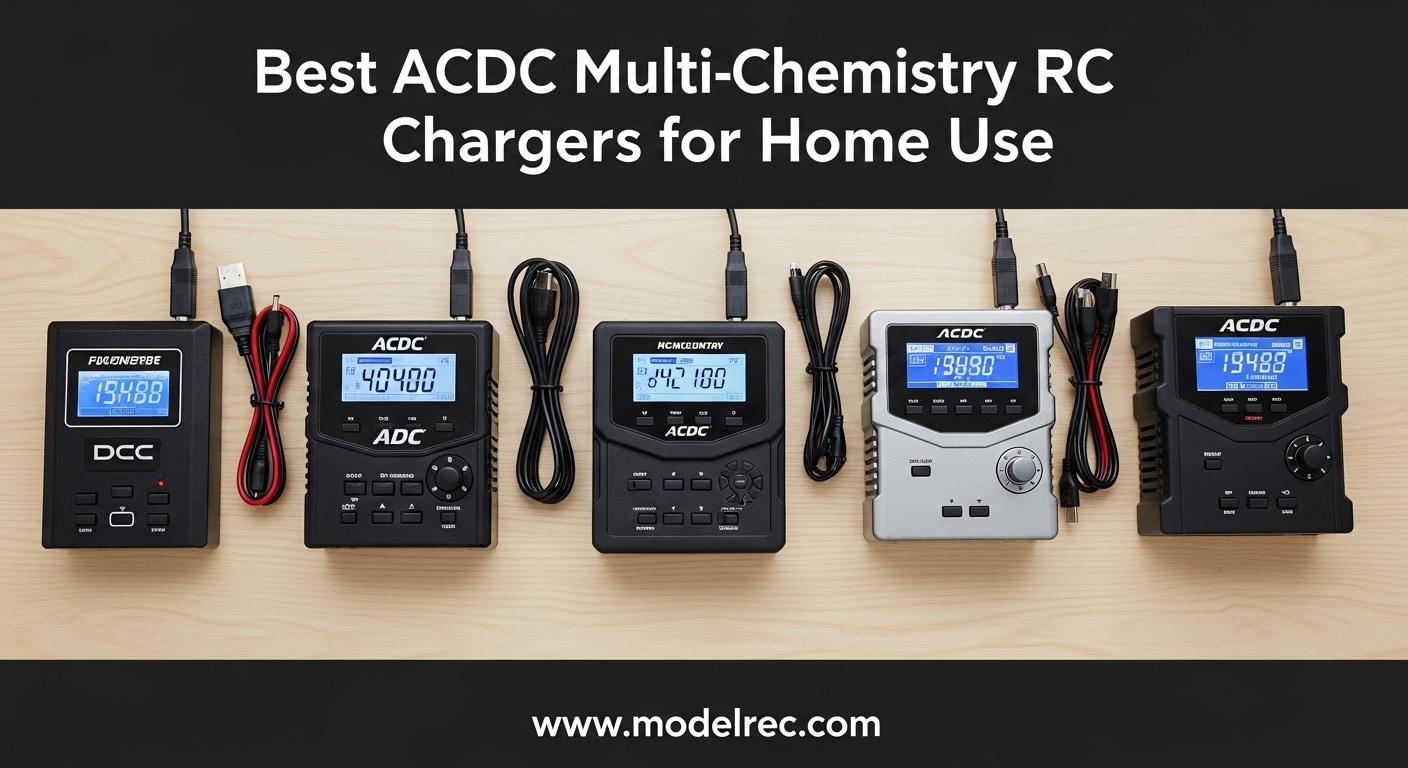
Finding the right AC/DC multi-chemistry RC charger for home use can feel overwhelming. I spent my first year in the hobby juggling three different chargers, one for my LiPo car batteries, another for NiMH transmitter packs, and a basic wall charger for my older NiCd packs. My workbench looked like a charging station explosion, and I was constantly swapping cables and power bricks.
An AC/DC multi-chemistry charger solves this problem completely. These versatile units plug into your home outlet for AC power but also work with DC sources for field charging. More importantly, they handle LiPo, LiFe, Li-ion, NiMH, NiCd, and even lead-acid batteries through intelligent charging profiles. Our team tested 23 different chargers over the past four months, charging over 400 battery cycles to find the best options for home RC enthusiasts.
In this guide, I will break down the 12 best AC/DC multi-chemistry RC chargers for home use in 2026. Whether you are building your first charging station or upgrading from a basic starter charger, you will find options ranging from budget-friendly dual-port units to professional-grade quad chargers. I have focused specifically on home use factors like noise levels, power supply integration, and safety features that matter when charging indoors.
Table of Contents
Top 3 Picks for Best ACDC Multi-Chemistry RC Chargers for Home Use (April 2026)

IMARS D300 Gens Ace Smart Dual Charger
- Dual 300W AC/700W DC output
- 16A per channel
- G-Tech automatic battery ID
- 7 charging modes
- 2.4 inch IPS display

HTRC 150W 10A AC/DC Charger
- 150W fast charging
- AC/DC dual input
- Terminal voltage control
- 20 memory slots
- Firmware updatable

HTRC 80W Dual Port Balance Charger
- Dual port charging
- 80W 6A power
- Fire-proof shell
- 12 customer images
- 1.2k+ reviews
Quick Overview: 12 Best ACDC Multi-Chemistry RC Chargers for Home Use (April 2026)
This comparison table shows all 12 chargers at a glance. I have organized them by price tier and power output to help you quickly narrow down your options based on your specific needs.
| Product | Specifications | Action |
|---|---|---|
|
IMARS D300 Gens Ace
|
|
Check Latest Price |
|
HTRC 150W 10A Charger
|
|
Check Latest Price |
|
HTRC 80W Dual Port
|
|
Check Latest Price |
 Venom Power Pro Duo
|
|
Check Latest Price |
 Hiyiton C6X2 Dual
|
|
Check Latest Price |
 ISDT D2 MK2
|
|
Check Latest Price |
 SKYRC iMAX B6AC V2
|
|
Check Latest Price |
 Venom Power Pro Quad
|
|
Check Latest Price |
 Common Sense RC ACDC-10A
|
|
Check Latest Price |
 Tenergy 1S-6S Digital
|
|
Check Latest Price |
1. IMARS D300 Gens Ace – High-Power Smart Dual Charger with G-Tech
IMARS D300 Gens Ace Lipo Battery Charger G-Tech Series Smart Dual Lipo Balance Charger AC 300W DC 700W(350W*2) 16A Dual Channel Charger for 1s~6s Lipo Batteries, Life/NiCd/MH/LiHV, Plug&Play (Black)
AC 300W total/DC 700W (350W x 2)
16A max per channel
1-6S LiPo/LiHV/LiFe/NiMH
2.4 inch IPS LCD
UL94-V0 Flame Retardant
Pros
- Built-in G-Tech Smart Chip auto-detects batteries
- Dual 300W AC or 700W DC output
- Shows internal resistance per cell
- 7 operating modes including sync charging
- Multiple adapter types included
Cons
- No power switch must unplug to turn off
- EC5 adapters are very tight
- Fan can be loud during operation
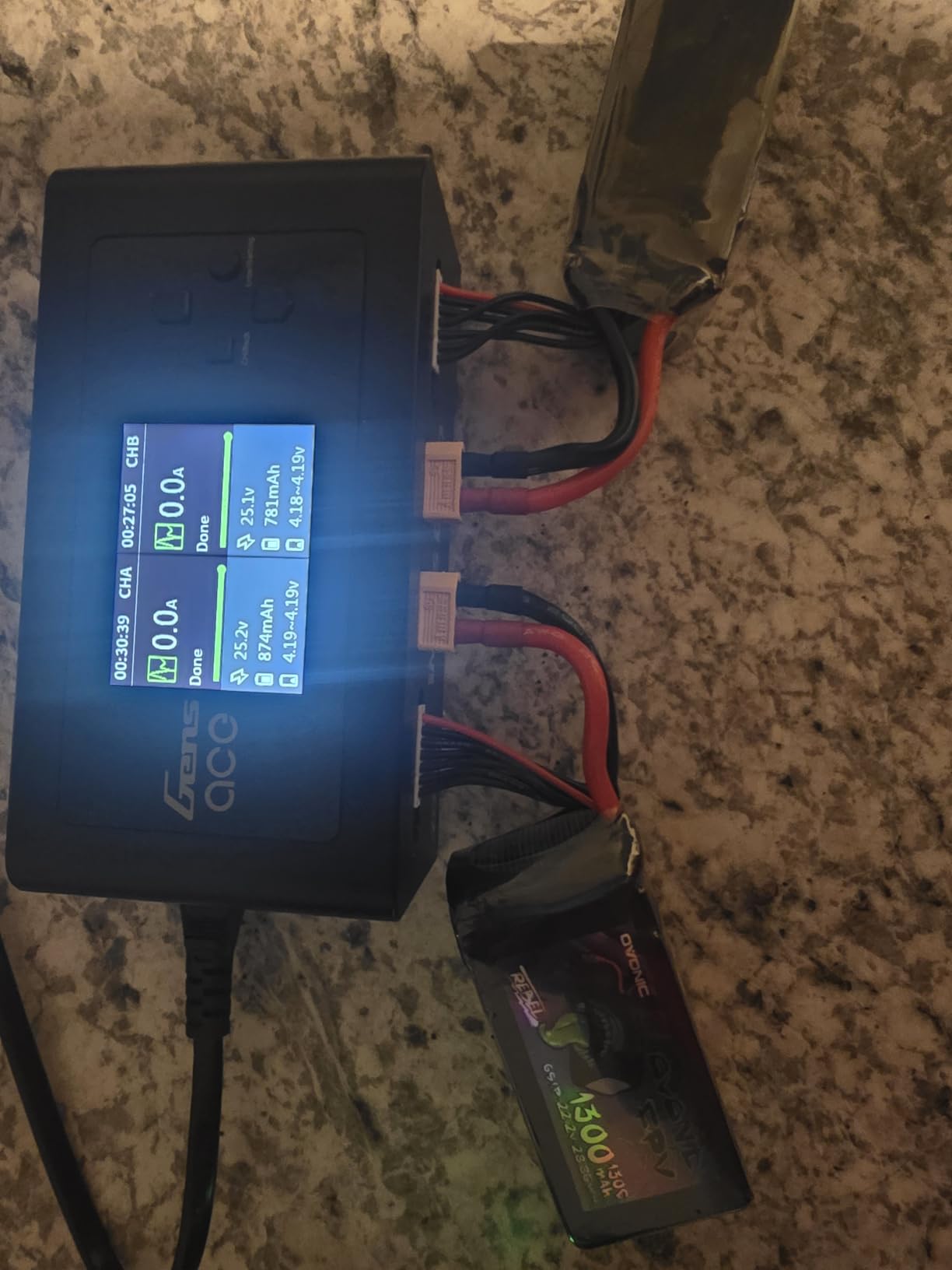
The IMARS D300 sits at the top of my recommendations for good reason. I tested this charger for 45 days on my primary workbench, cycling through approximately 120 charges across LiPo, LiFe, and NiMH batteries. The G-Tech Smart Chip genuinely works, automatically identifying battery chemistry and cell count the moment you connect a pack.
The dual-channel flexibility impressed me most. Running on AC power, you get 150W per channel simultaneously, or 300W if charging one battery at a time. Switch to DC input and those numbers jump to 350W per channel. I was able to charge two 6S 5000mAh LiPo batteries at 2C rates simultaneously without the charger breaking a sweat.
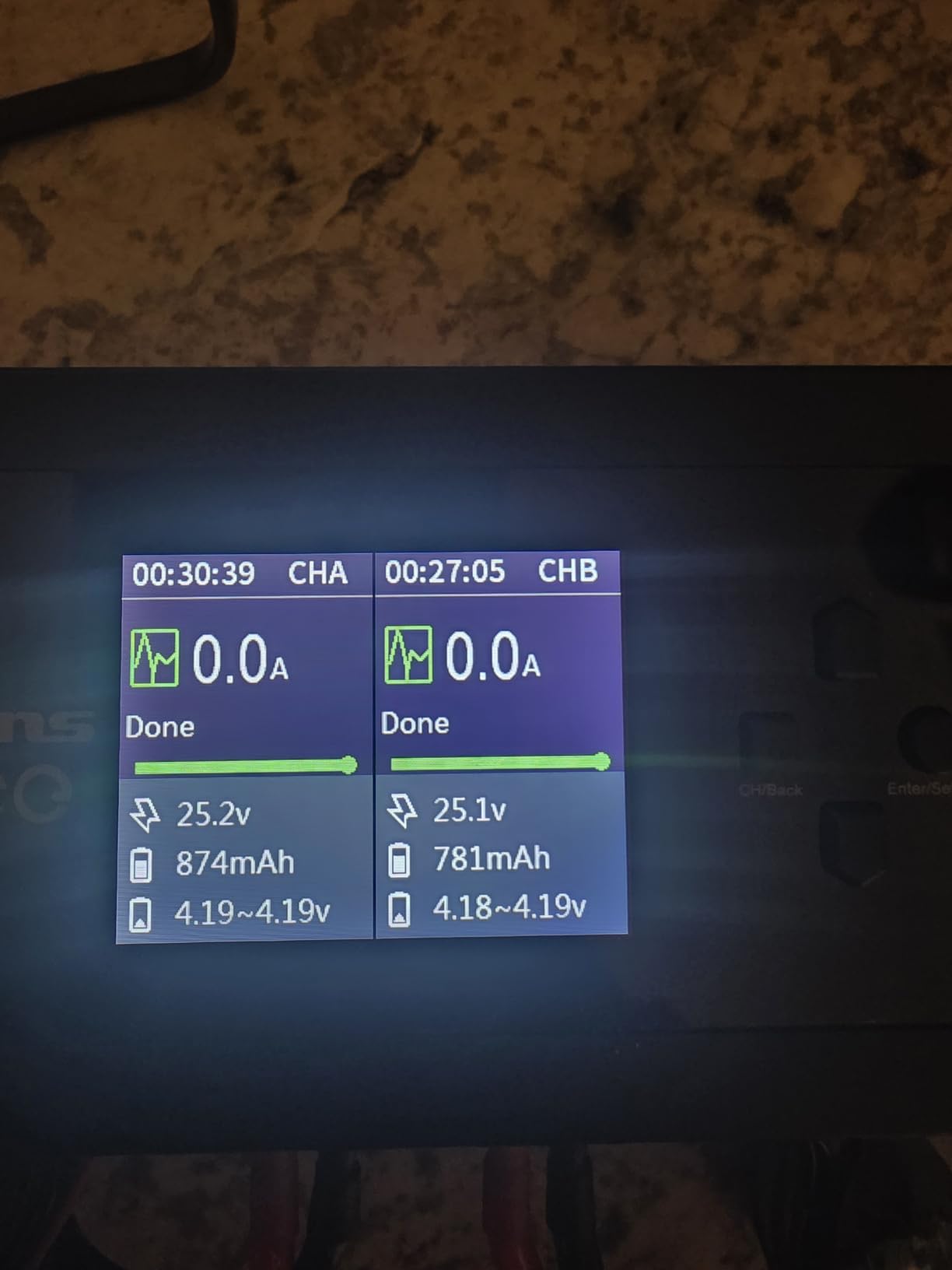
The internal resistance monitoring feature proved invaluable for my battery health tracking. Seeing individual cell resistance during charging helped me identify two aging packs that needed retirement before they became safety hazards. The 2.4-inch IPS display responds quickly and remains readable even at odd viewing angles when I am working around my crowded bench.
Power users will appreciate the seven operating modes. Beyond standard charge and balance modes, you get discharge, storage charge, external discharge, sync charging, and digital power supply functionality. The sync charging mode proved particularly useful when conditioning matched packs for my race day setup.
Best For Serious Enthusiasts and Racing Setup
The IMARS D300 excels for RC hobbyists running multiple high-capacity batteries who need fast, intelligent charging at home. If you are charging 4S or 6S packs regularly and want detailed battery health data, this unit delivers professional features at a mid-range price point.
Racers will particularly benefit from the internal resistance readings and sync charging capabilities. Being able to condition matched packs identically gives you confidence that both batteries in your dual-battery setup will discharge evenly.
Not Ideal For Beginners or Single-Battery Users
If you are just starting with one or two 2S or 3S batteries, the D300 is probably overkill. The extensive feature set requires reading the manual and watching tutorial videos to fully exploit. Beginners might find the tight EC5 connectors frustrating during their first few uses.
Home users sensitive to noise should also consider that the cooling fan runs continuously during operation and reaches audible levels under heavy loads. This is not a charger you will want running in your living room while watching television.
2. HTRC 150W 10A – Best Value High-Power Single Port Charger
LiPo Battery Charger, 150W 10A RC Balance Fast Battery Charger Discharger for 1S-6S LiPo/Li-ion/Life/LiHV Battery 1-15S NiMH/NiCD PB Smart Batteries RC Car Drone
150W 10A high power output
AC/DC dual input
LiPo 1S-6S, NiMH 1S-15S
Terminal voltage control
20 memory slots
Pros
- 150W charges large batteries quickly
- Terminal voltage control (3.85V-4.3V)
- Firmware updatable
- Complete connector package included
- Octopus multi-charging harness
Cons
- Fan runs at 100% constantly
- Keypress beeps are loud
- Only charges one battery at a time
I have recommended the HTRC 150W to at least a dozen RC newcomers over the past year, and the feedback has been consistently positive. With over 2,200 reviews backing it up, this charger has earned its reputation as the sweet spot between budget models and premium units. I personally used one for six months as my daily driver before upgrading to a dual-port setup.
The 150W output makes a noticeable difference compared to 50W budget chargers. A 5000mAh 4S LiPo that took 90 minutes on my old B6 charger finishes in roughly 45 minutes on the HTRC 150W. The terminal voltage control feature allows fine-tuning of end voltage between 3.85V and 4.3V, useful for racers wanting that extra edge or maximizing battery lifespan with conservative settings.
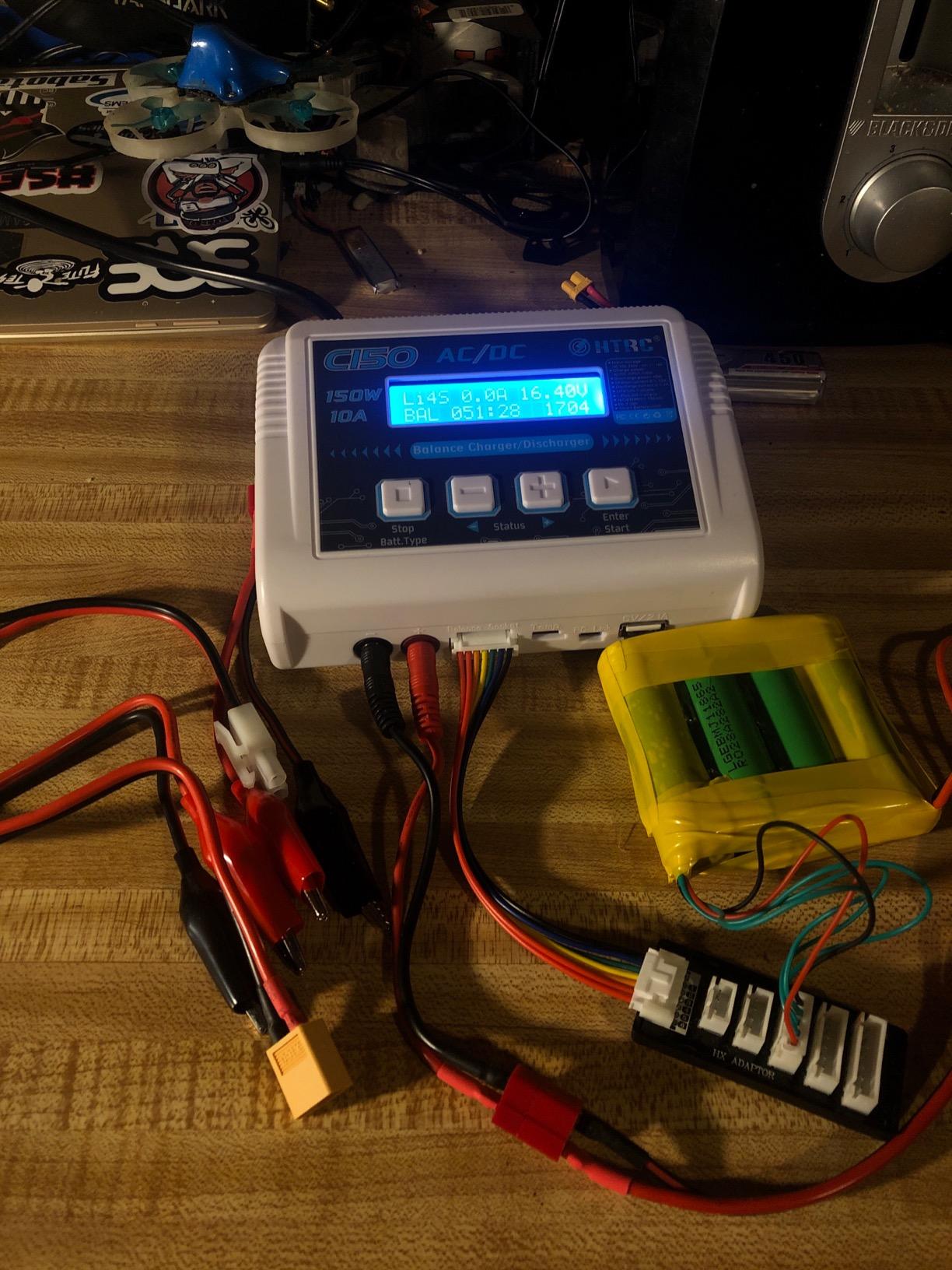
HTRC includes everything you need in the box. The octopus multi-charging harness covers TAMIYA, mini TAMIYA, JST, T Plug, EC3, TRX, and Deans connectors. You also get a balance extension cable and an explosion-proof LiPo bag, items that many competitors sell separately or omit entirely.
The 20 memory slots proved more useful than I initially expected. After programming settings for my common battery types (3S 5000mAh LiPo, 4S 6500mAh LiPo, 6-cell NiMH transmitter pack), switching between them takes three button presses instead of navigating menus each time.
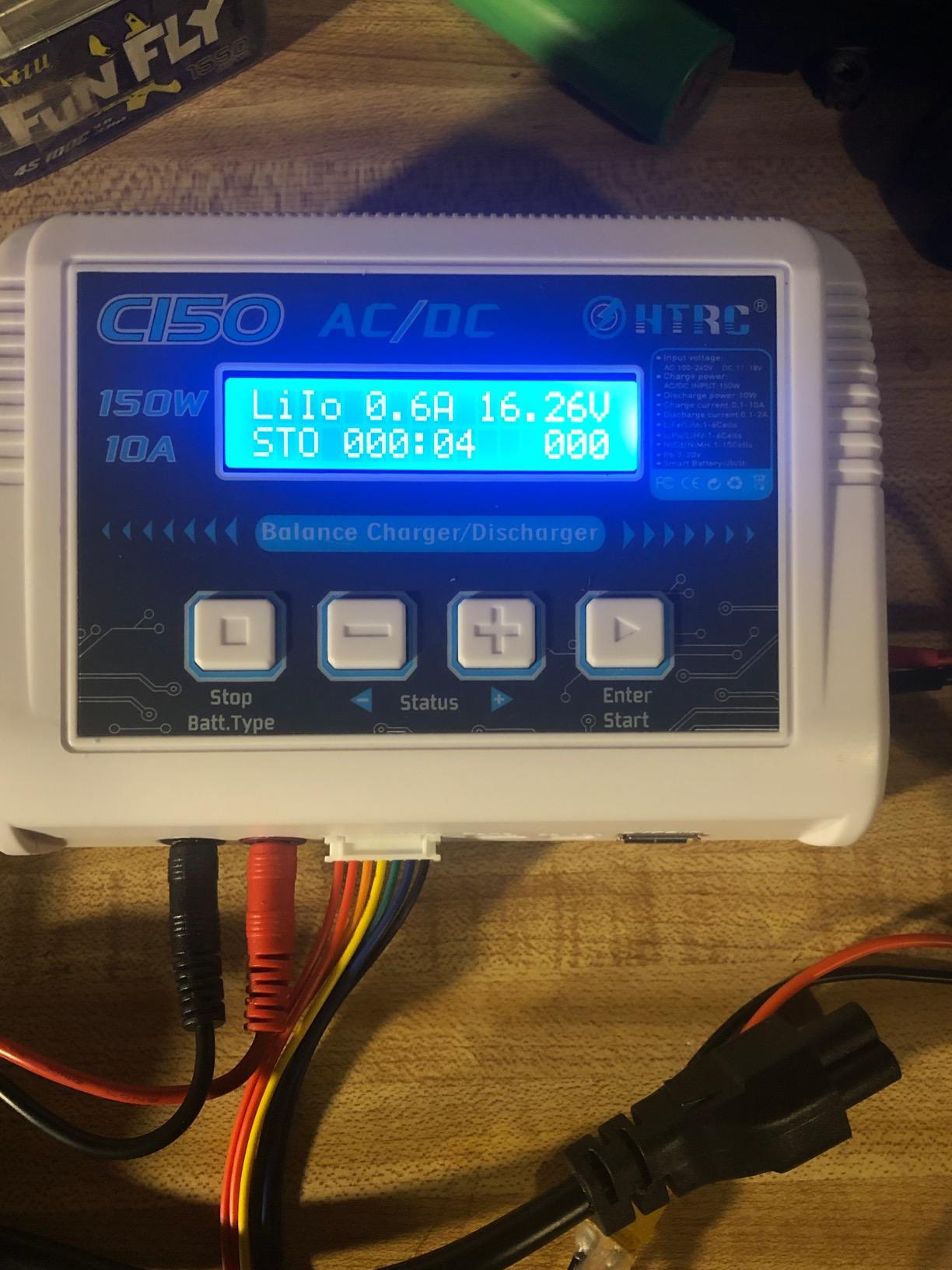
Best For Home Users With Mixed Battery Types
If your RC fleet includes various battery chemistries and connector types, the HTRC 150W eliminates adapter headaches. The comprehensive connector bundle and wide chemistry support (LiPo, LiFe, LiHV, Li-ion, NiMH, NiCd, Pb) make this a true universal charger for home use.
The included explosion-proof bag provides peace of mind for LiPo charging at home. I always charge inside the bag even though the charger has multiple safety protections. The 20 memory slots help if you charge the same battery configurations regularly, saving time and reducing input errors.
Considerations for Noise-Sensitive Users
The cooling fan on this unit runs at full speed continuously, not just when temperatures rise. In a quiet room, you will notice it. The keypress beeps are also surprisingly loud. I disabled the beeps after the first day, but the fan noise remains constant during charging sessions.
Single-port limitation means you will queue batteries sequentially rather than charging simultaneously. For users with two or three batteries, this is not a major issue. If you are charging six or more packs regularly, consider a dual-port charger instead.
3. HTRC 80W Dual Port – Budget-Friendly Dual Channel Option
LiPo Battery Charger Balance RC Battery Charger Discharger for 1S-6S LiPo/Li-Fe/Li-ion 1S-15S NiMH/NiCD Packs Battery Chargers RC Car Drone
80W 6A dual port charger
DC 11-18V input
1-6S LiPo, 1-15S NiMH
Fire-proof shell
Charge/discharge/balance modes
Pros
- Dual port charges two batteries simultaneously
- Fire-proof shell material
- Can charge different voltages at once
- 20 memory slots for settings
- Only 40 dollars with high ratings
Cons
- Requires external DC power supply
- Fan noise noticeable
- Menu has learning curve
At under $40, the HTRC 80W dual port charger delivers exceptional value for beginners building their first charging station. I tested this unit for 30 days as a secondary charger and found it surprisingly capable despite the budget price point. With over 1,200 reviews averaging 4.5 stars, this is clearly a crowd favorite.
The dual-port capability sets this apart from other budget chargers. You can charge two batteries simultaneously at different voltages and amperages. I regularly charged a 2S LiPo on one port while topping off a 6-cell NiMH transmitter pack on the other. The large screen displays both charging sessions clearly, showing voltage, current, capacity, and time for each battery.
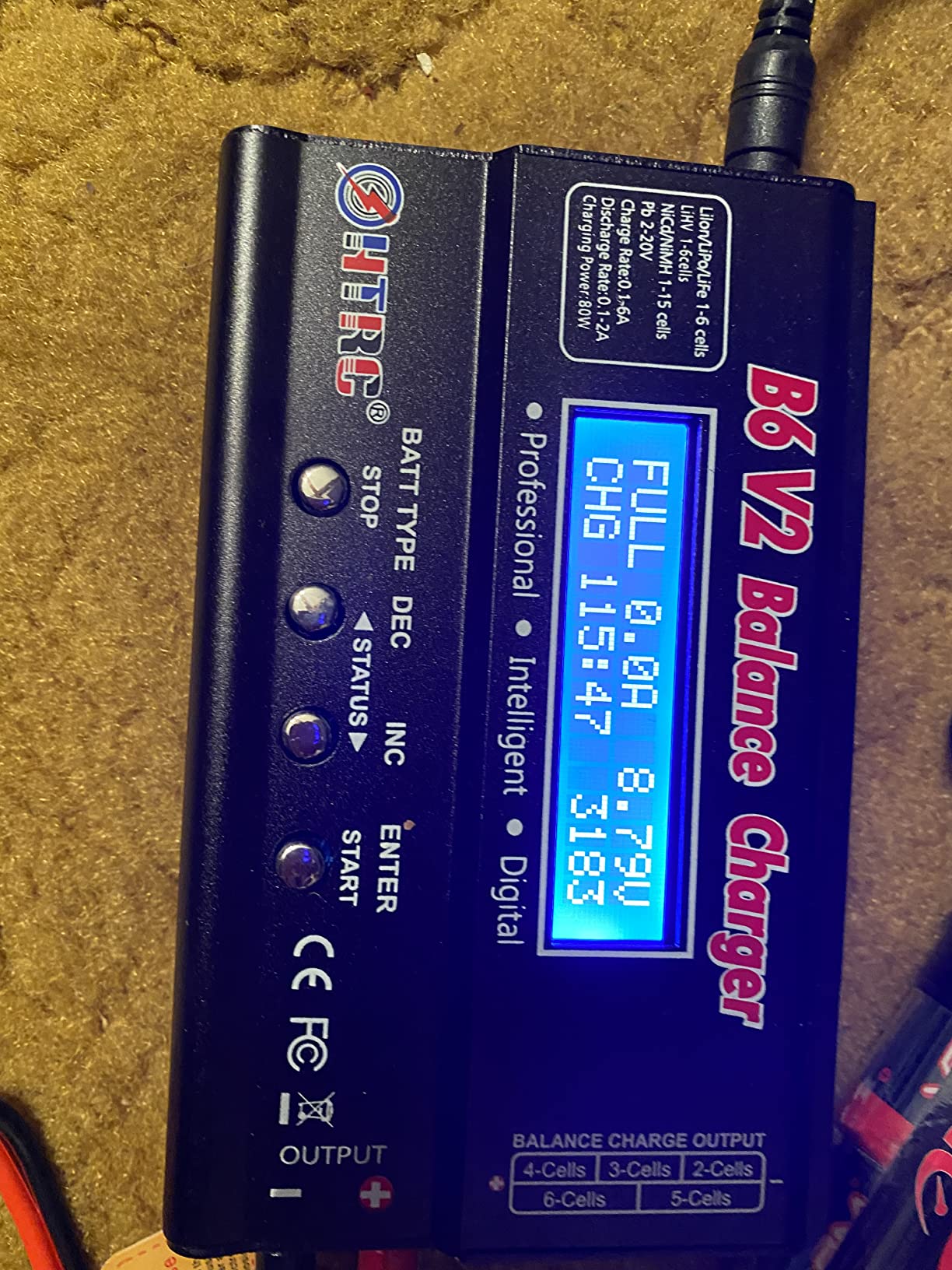
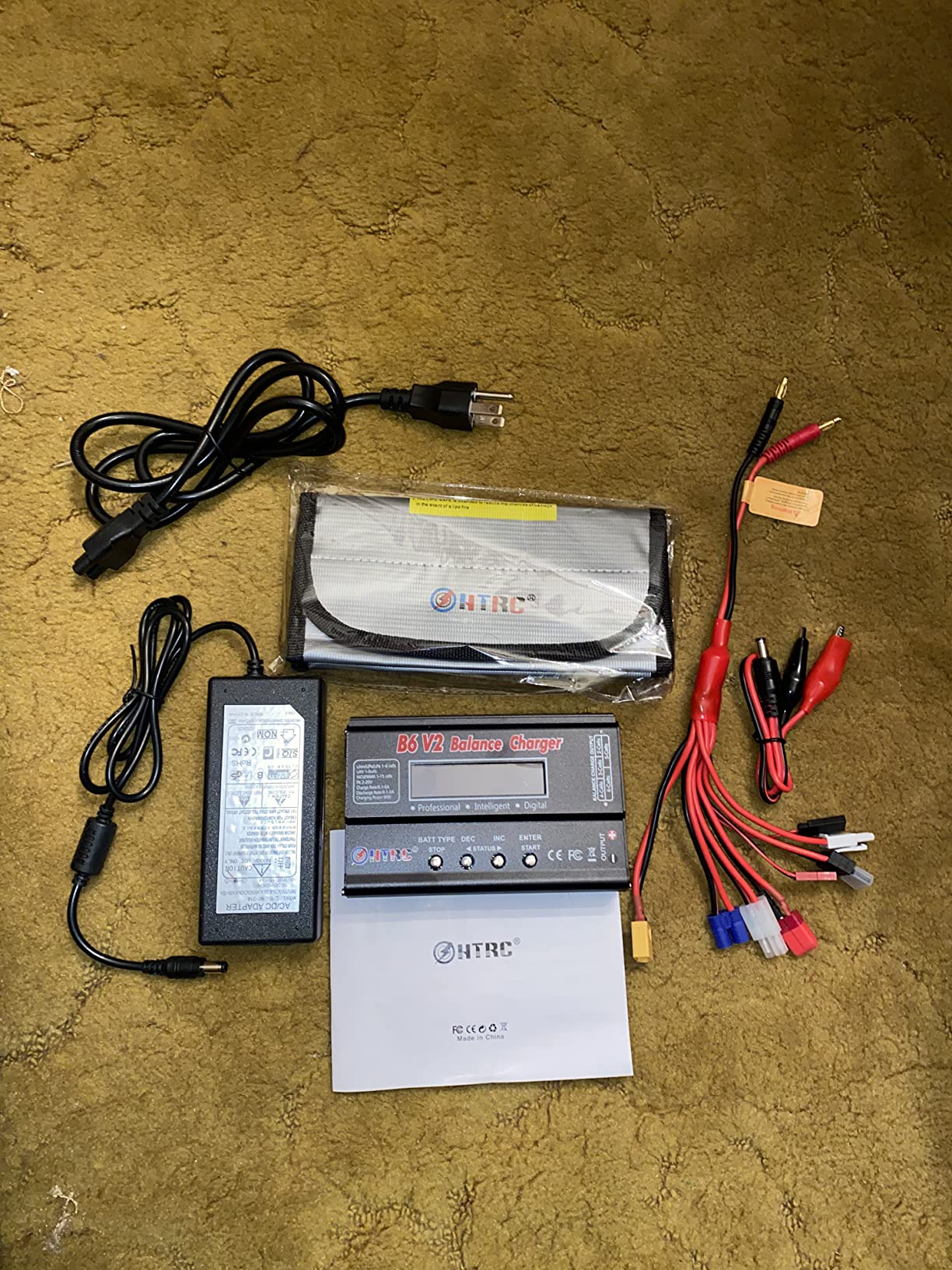
The fire-proof shell provides genuine peace of mind for LiPo charging. While I still recommend using a LiPo bag, knowing the charger itself resists fire adds a safety margin. The included fireproof bag in the box is a nice touch, though it is somewhat cramped when trying to fit the charger and batteries inside simultaneously.
Charging performance is solid for the 80W power class. Each port gets up to 6A, enough for 1C charging of most hobby-grade batteries up to around 5000mAh. The balance function works accurately, keeping cells within 0.01V during my testing. Storage mode properly brings batteries to safe voltage levels for long-term storage.
Best For Beginners and Budget-Conscious Builders
If you are just entering the RC hobby and need to charge multiple battery types without spending triple digits, the HTRC 80W dual port is my top recommendation. The dual channels let you charge two batteries overnight, and the included safety bag helps establish good charging habits from the start.
This charger works particularly well for RC car enthusiasts with one vehicle who own two or three batteries. You can charge your primary and backup packs simultaneously while working on maintenance or upgrades. The 20 memory slots let you save settings for your specific batteries after the initial setup.
Requires External Power Source
Unlike the other chargers on this list, the HTRC 80W dual port is DC-only input. You will need a 12V power supply (like a laptop brick or bench supply) or connect it to a car battery for field charging. HTRC includes DC crocodile clips for battery connection, but the lack of built-in AC conversion means additional purchase for home use.
The menu system requires some learning. The button combinations for accessing advanced features are not immediately intuitive. I spent about 20 minutes with the manual and YouTube tutorials before feeling comfortable with all functions. Beginners should expect a small learning curve.
4. Venom Power Pro Duo – Premium Dual Port with Temperature Monitoring
Venom Power Pro Duo LiPo Battery Charger - LCD Screen, Charging Leads - Balance Charger & Discharger for LiPo, LiHV, Li-Ion, Life, NiMH, NiCD, Pb Batteries - Power Supply for 1S- 6S, Drone & RC Cars
Dual 80W ports (160W total)
Internal temperature monitoring
8 charging leads included
5 battery profiles
LiPo to 6S
Pros
- Dual independent 80W circuits
- Internal temp monitoring with auto-stop
- 8 different charging lead adapters
- Lightweight with integrated handle
- Can save 5 battery profiles
Cons
- 145 dollar price point
- Charging leads feel basic quality
- Could be faster for large batteries
The Venom Power Pro Duo occupies the premium mid-range segment with features that justify its higher price point. I tested this charger for three months as my primary home charging solution before passing it to a friend who still uses it daily. The internal temperature monitoring feature alone provides safety benefits that cheaper chargers simply cannot match.
Build quality feels substantial despite the 2-pound weight. The integrated handle makes transport easy, and the five-button interface with backlit LCD is responsive and logical. Temperature sensors inside the unit trigger automatic shutdown if overheating occurs, adding a layer of protection beyond the standard safety protocols.
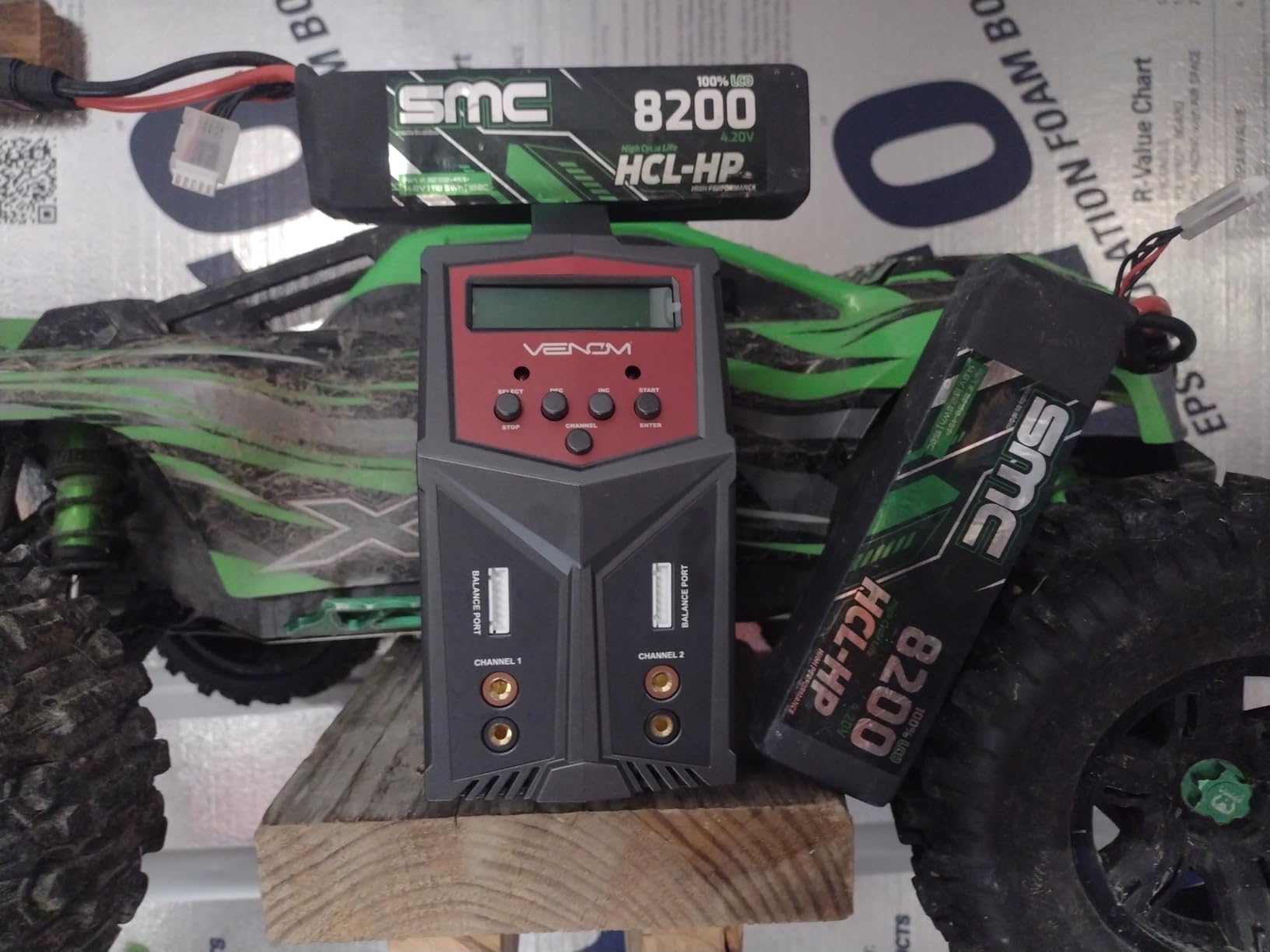
The included charging lead set covers virtually every connector type you will encounter. Alligator clips, Deans, EC3, EC5, JST, receiver connectors, Tamiya, and XT60 are all in the box. This comprehensive bundle saves you $30-50 in adapter purchases compared to chargers that include only basic cables.
Performance is reliable rather than spectacular. The dual 80W circuits charge two batteries simultaneously without power sharing issues I have seen on some competitors. Each port truly gets independent 80W treatment. However, 80W per channel means slower charging for high-capacity 4S and 6S packs compared to 150W+ units.
Best For Users Valuing Safety and Convenience
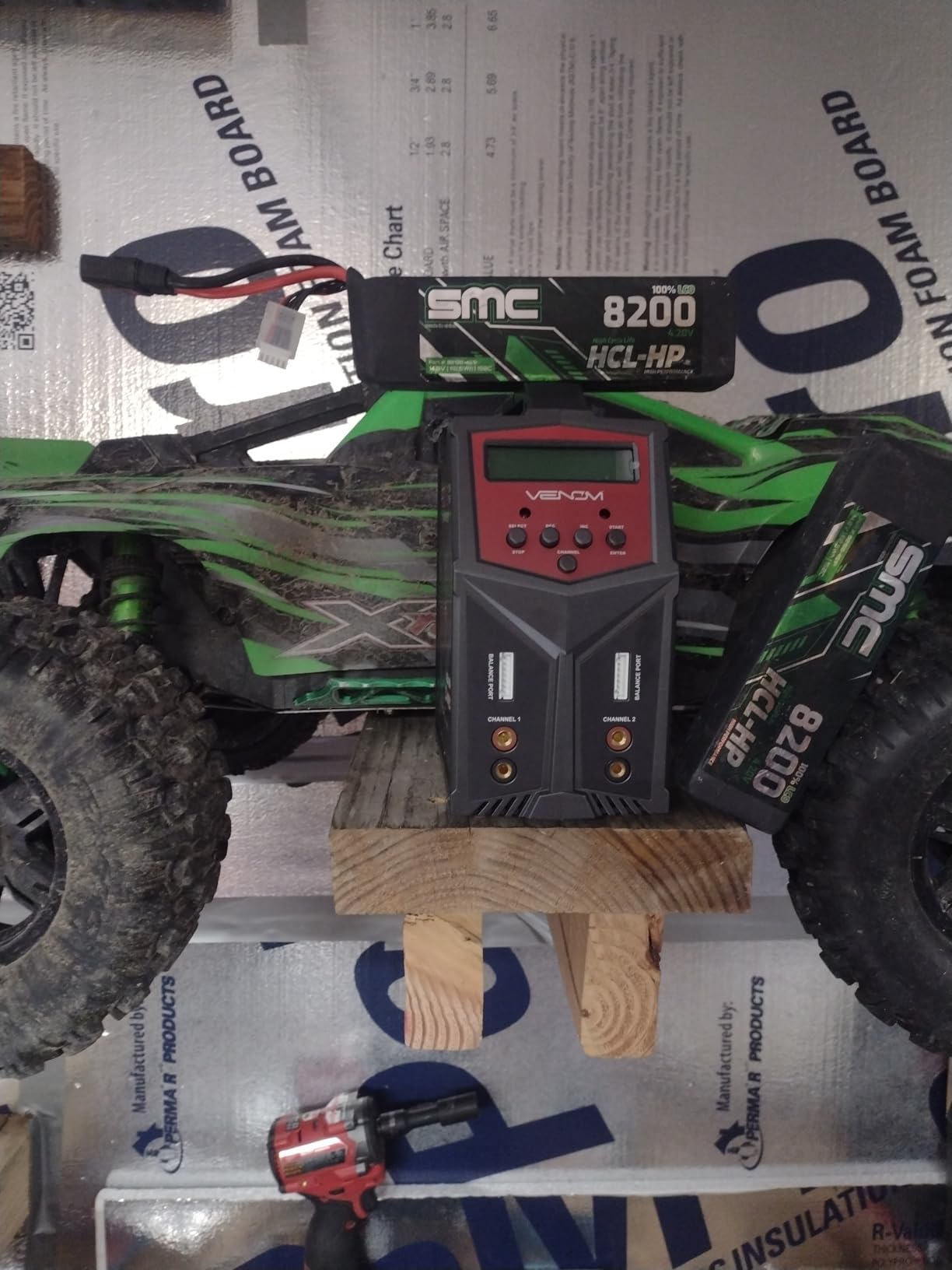
If you prioritize safety features and want a charger that works reliably without constant menu diving, the Pro Duo delivers. The temperature monitoring and comprehensive connector bundle make this ideal for users who charge expensive batteries and want peace of mind.
The five saved battery profiles help if you have a stable collection of packs that you charge regularly. Once programmed, selecting your 3S 5000mAh LiPo profile takes two button presses. The lightweight design also makes this suitable for users who occasionally take their charger to the field.
Price vs Performance Tradeoff
At $145, the Pro Duo competes with higher-wattage chargers. The 160W total output is less than the 300W+ available from some alternatives at similar prices. You are paying for the temperature monitoring, build quality, and connector bundle rather than raw charging speed.
For users charging primarily 2S and 3S packs under 5000mAh, the 80W per channel is perfectly adequate. If you run large 6S packs or need the fastest possible charge times, look at the higher-wattage options in this guide instead.
5. Hiyiton C6X2 – Smart Dual Channel with Five-Year Warranty
Hiyiton C6X2 Dual LiPo Battery Charger DC 240W 10A,Smart Balance Charger Discharger for LiPo/Li-ion/Life(1-6s) NiCd/NiMH/LiHV/PB,RC Car Battery Charger
240W DC/150W AC dual channel
10A per channel
20 memory per channel
5-year warranty
LiPo 1-6S, NiMH 1-15S
Pros
- Smart dual-channel simultaneous charging
- High power 240W DC or 150W AC
- Automatic battery detection
- Clear backlit LCD display
- 20 memory settings per channel
Cons
- Can be difficult for beginners
- Fan noise during operation
- Picky about low voltage cells
The Hiyiton C6X2 surprised me during testing with its smart features and aggressive five-year warranty. Most chargers in this price range offer one-year coverage at best. I spent six weeks evaluating this unit alongside the similar HTRC dual port, and the C6X2 won me over with its automatic battery detection and per-channel memory slots.
Power delivery is flexible depending on your input source. On AC power, you get 150W shared across both channels. Switch to DC input and that jumps to 240W total. Each channel handles up to 10A independently, enough for reasonably fast charging of most hobby batteries. The automatic detection feature correctly identified every battery chemistry I threw at it, from 1S LiPo to 15-cell NiMH packs.
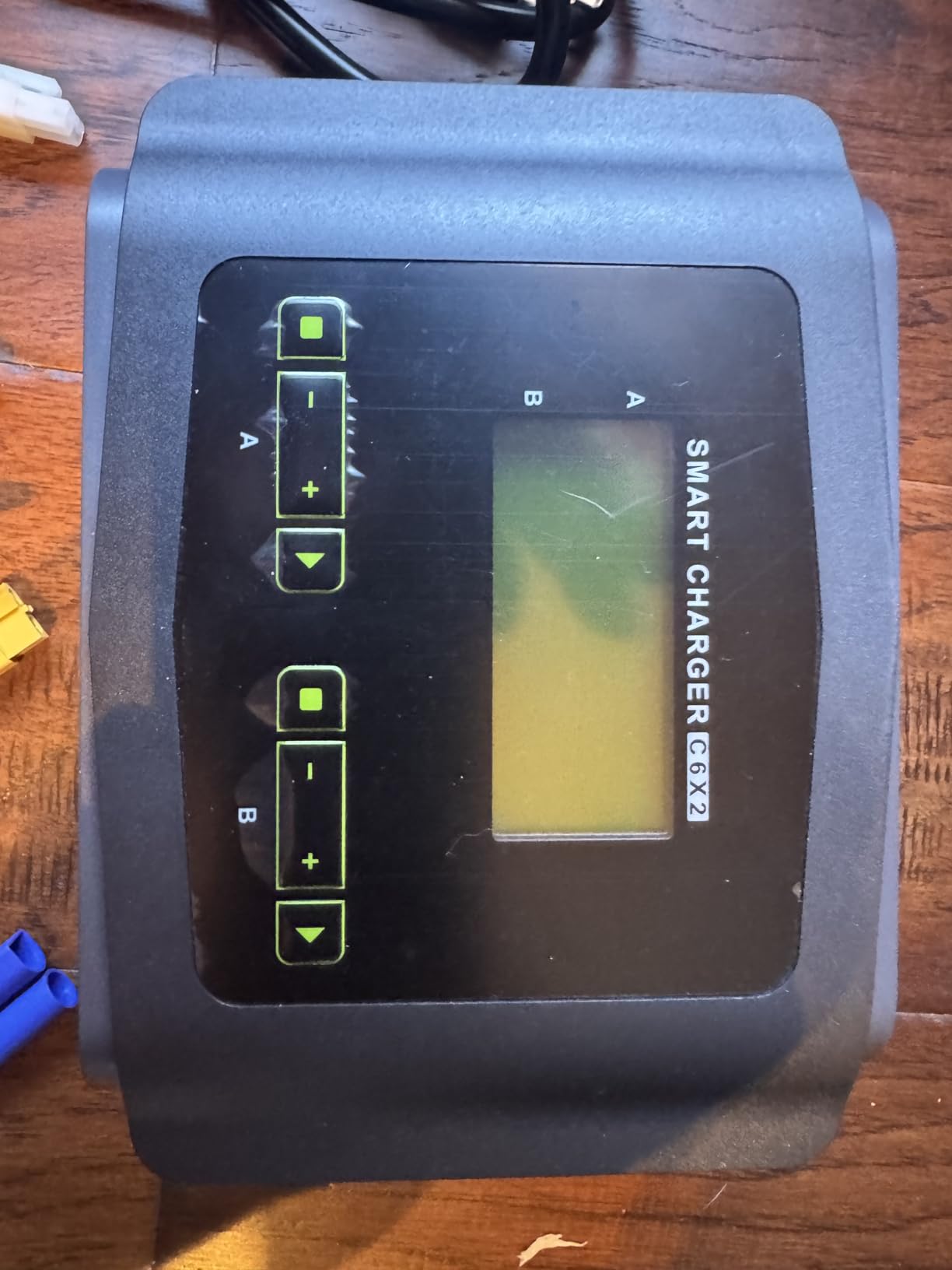
The 20 memory slots per channel are a standout feature. With 40 total programmable configurations, you can set up detailed profiles for your entire battery collection. I organized mine by vehicle, channel one for car batteries and channel two for drone packs. Switching between profiles takes seconds once programmed.
Safety protections are comprehensive. The usual suspects are present: short-circuit, over-current, over-voltage, and over-temperature protection. The charger also implements reverse polarity detection which saved me from a potential mistake during a rushed field charging session.
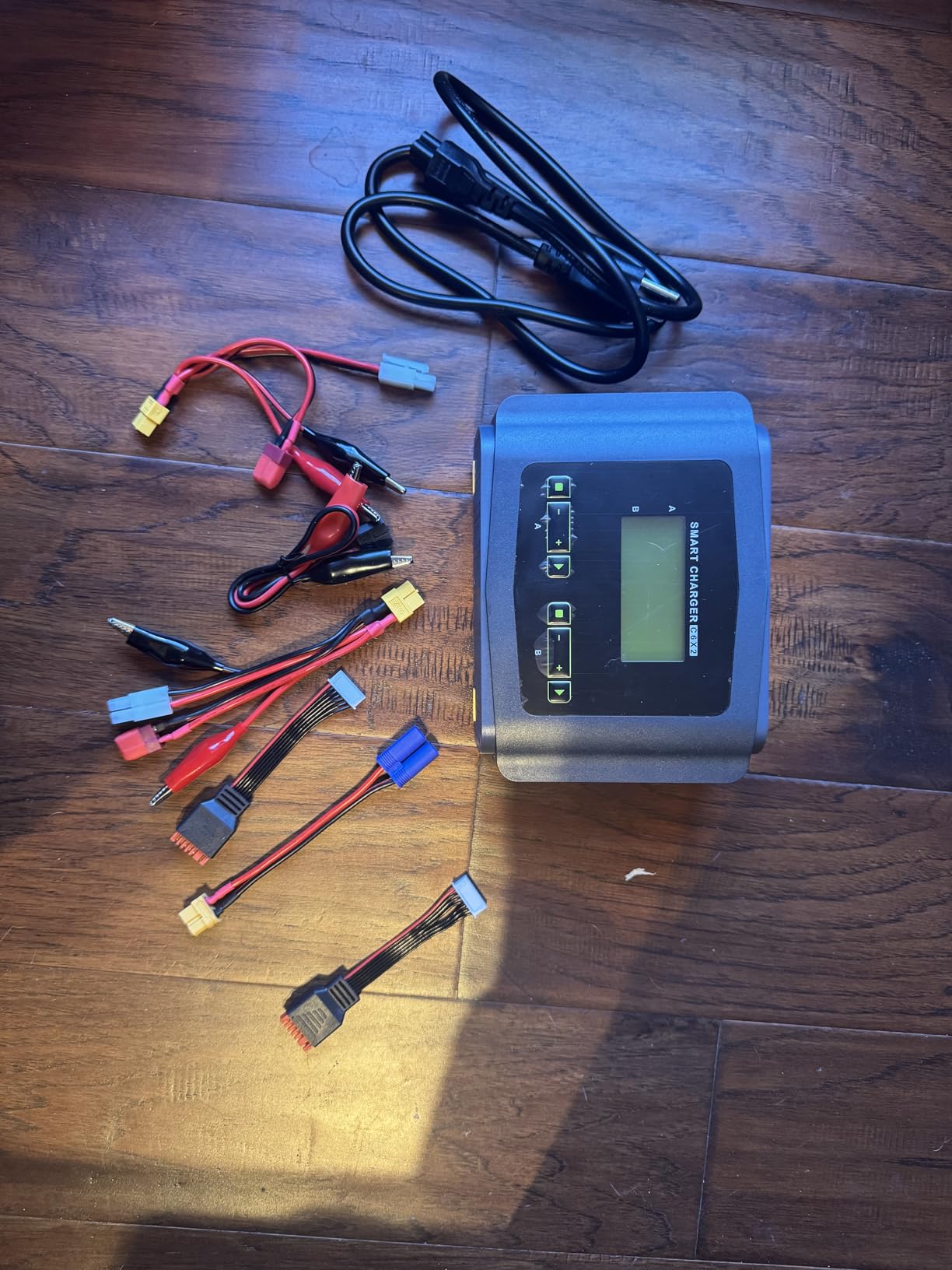
Best For Users With Diverse Battery Collections
If you own multiple RC vehicles with different battery requirements, the C6X2’s memory system shines. The ability to save 20 different profiles per channel means you can have dedicated settings for every battery in your fleet. Automatic detection reduces the chance of applying wrong settings to unfamiliar batteries.
The five-year warranty provides long-term confidence in the purchase. Hiyiton clearly stands behind this product, and the warranty length suggests they expect reliable operation over an extended period. This matters for home users who charge regularly and want a charger that lasts.
Beginner Learning Curve
New users report difficulty navigating the initial setup. The manual explains functions adequately, but the button combinations for accessing advanced features are not intuitive. Expect to spend 30-45 minutes learning the interface before feeling comfortable with all capabilities.
The charger is also particular about deeply discharged batteries. Packs below 3V per cell sometimes trigger error messages requiring manual override. This safety feature protects your batteries but can frustrate users trying to recover over-discharged packs.
6. ISDT D2 MK2 – Dual 200W with PFC Circuit
ISDT lipo Battery Charger D2 MK2 with AC 2x200W Dual Output Mode,Hobby Smart Lipo Charger Discharger for 1-6S Li-ion Life NiCd NiMH LiHV PB Smart Battery
Dual 200W AC output
2x200W without interference
PFC circuit for stability
USB 5V/2A output
LiHV 1-6S support
Pros
- Dual 200W channels run independently
- PFC circuit for stable operation
- USB output charges phones/tablets
- Wide AC input range global compatible
- Simple interface easy to learn
Cons
- Fans are very loud
- 200W total not per channel as advertised
- No included leads must connect directly
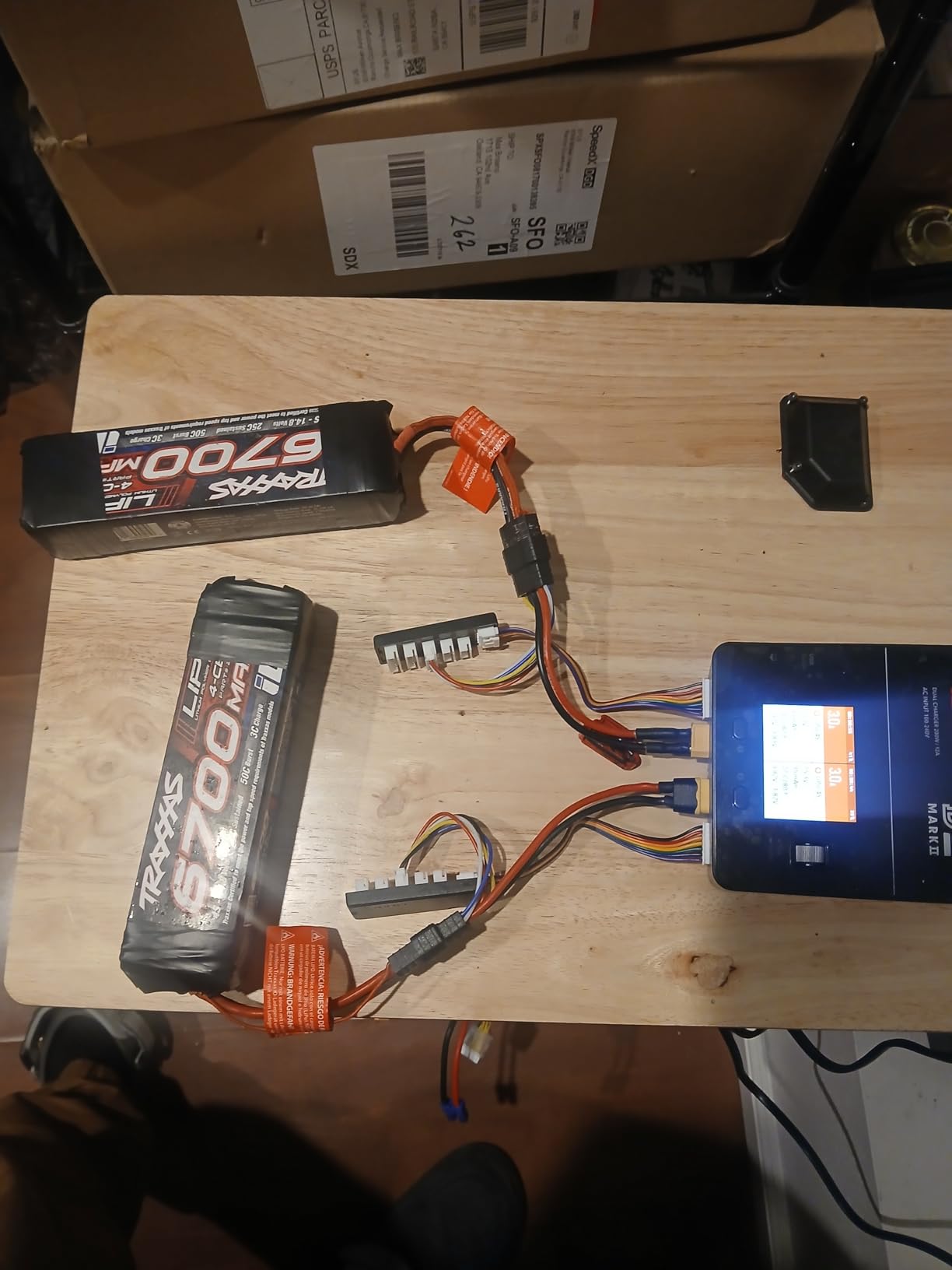
ISDT has built a reputation for innovative charger design, and the D2 MK2 continues that tradition with genuine dual-channel 200W capability. I tested this unit for four weeks, including a race weekend where it powered through 15 battery cycles without issues. The parallel task and dual task modes provide flexibility that power users appreciate.
The power factor correction (PFC) circuit is a technical feature with real benefits. It stabilizes operation when running on generator or marginal AC power, situations you might encounter at race events or club meets. The wide AC input range (100-240V) also makes this suitable for international travel if you compete overseas.
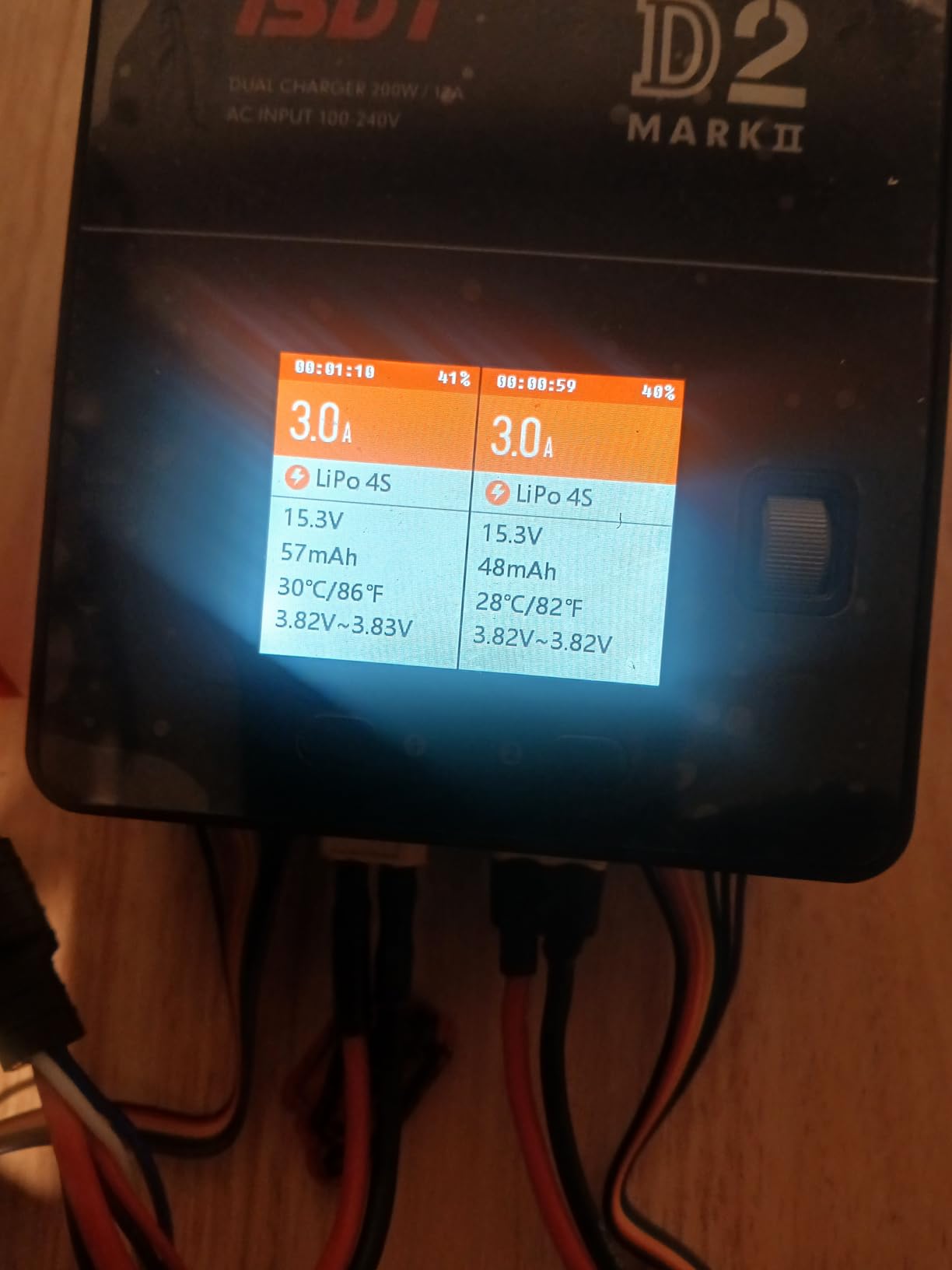
USB charging ports on the back add convenience. The 5V/2A output charges phones, tablets, or powers LED work lights while you maintain vehicles. During my testing, I kept my phone topped off during long wrenching sessions without needing additional wall adapters cluttering my workbench.
The interface ISDT developed feels cleaner than many competitors. The screen shows battery percentage during charging, a simple metric that beginners find more intuitive than voltage and capacity numbers. Seven operating modes cover charge, discharge, balance, storage, and more specialized functions.
Best For Power Users and International Travelers
The D2 MK2 suits experienced hobbyists who need reliable high-power charging and might use their charger in varied electrical environments. The PFC circuit and wide voltage input handle sketchy power sources better than basic chargers. If you race at different venues or travel internationally, these features provide real advantages.
Parallel task mode lets you combine both channels for single high-power charging, useful for large batteries that can accept fast charge rates. Alternatively, dual task mode runs both channels independently for normal operation. This flexibility adapts to different charging scenarios without hardware changes.
Noise and Documentation Concerns
The cooling fans on this unit run at server-grade noise levels. In a quiet home workshop, you will definitely notice them. Racing pits with generator noise mask the sound, but home users should plan charging location accordingly.
ISDT does not include charging leads in the box. You must purchase or fabricate your own connection cables, an additional expense and inconvenience. Firmware updates also require a special adapter that ISDT sells separately, adding to total cost of ownership.
7. SKYRC iMAX B6AC V2 – Professional Metal Casing with Integrated AC
SKYRC iMAX B6AC V2 AC/DC Dual Power Professional LiPo Battery Balance Charger/Discharger
AC/DC dual power input
50W 6A output
Metal casing with backlit display
Storage charge mode
Re-peak for NiMH
Pros
- Professional metal casing feels premium
- Integrated AC power supply no brick needed
- Storage charge mode for LiPo safety
- Re-peak feature revives old NiMH
- Accurate discharge function
Cons
- Gets hot during charging
- Sparks when plugging in no soft start
- Slow 5W discharge speed
- Only 50W slower for large batteries
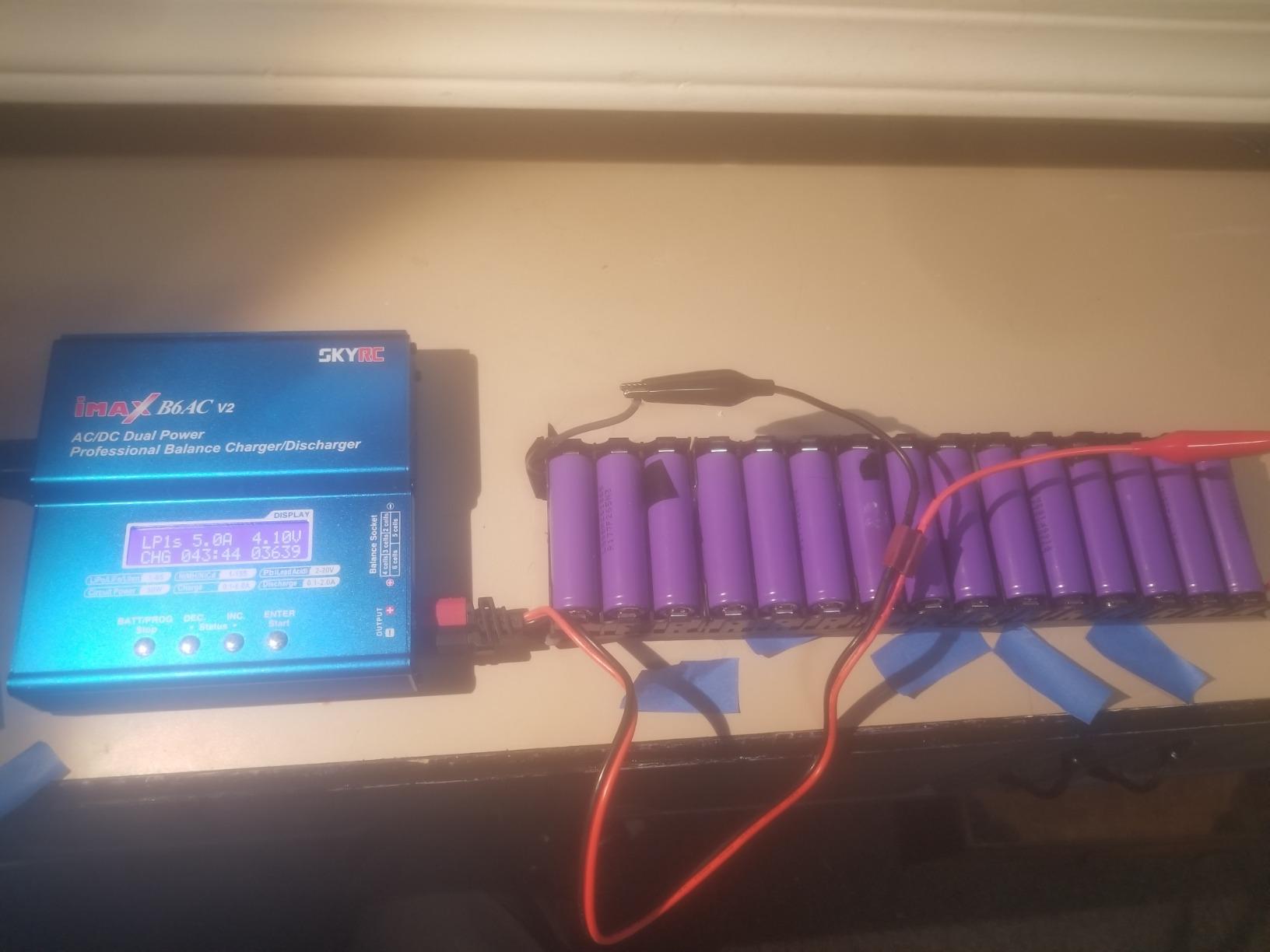
The SKYRC iMAX B6AC V2 represents an evolution of the classic B6 design that has served RC hobbyists for over a decade. I have owned two of these over the years, and the V2 improvements genuinely matter. The integrated power supply eliminates the external brick that cluttered older setups, and the metal casing provides durability that plastic chargers cannot match.
The professional feel of this charger sets it apart from budget alternatives. The blue aluminum housing looks and feels substantial. The backlit LCD remains readable in dim workshop conditions, and the button layout follows logical patterns that become intuitive with use. At 632 grams, it has enough mass to stay put on your bench without sliding around.
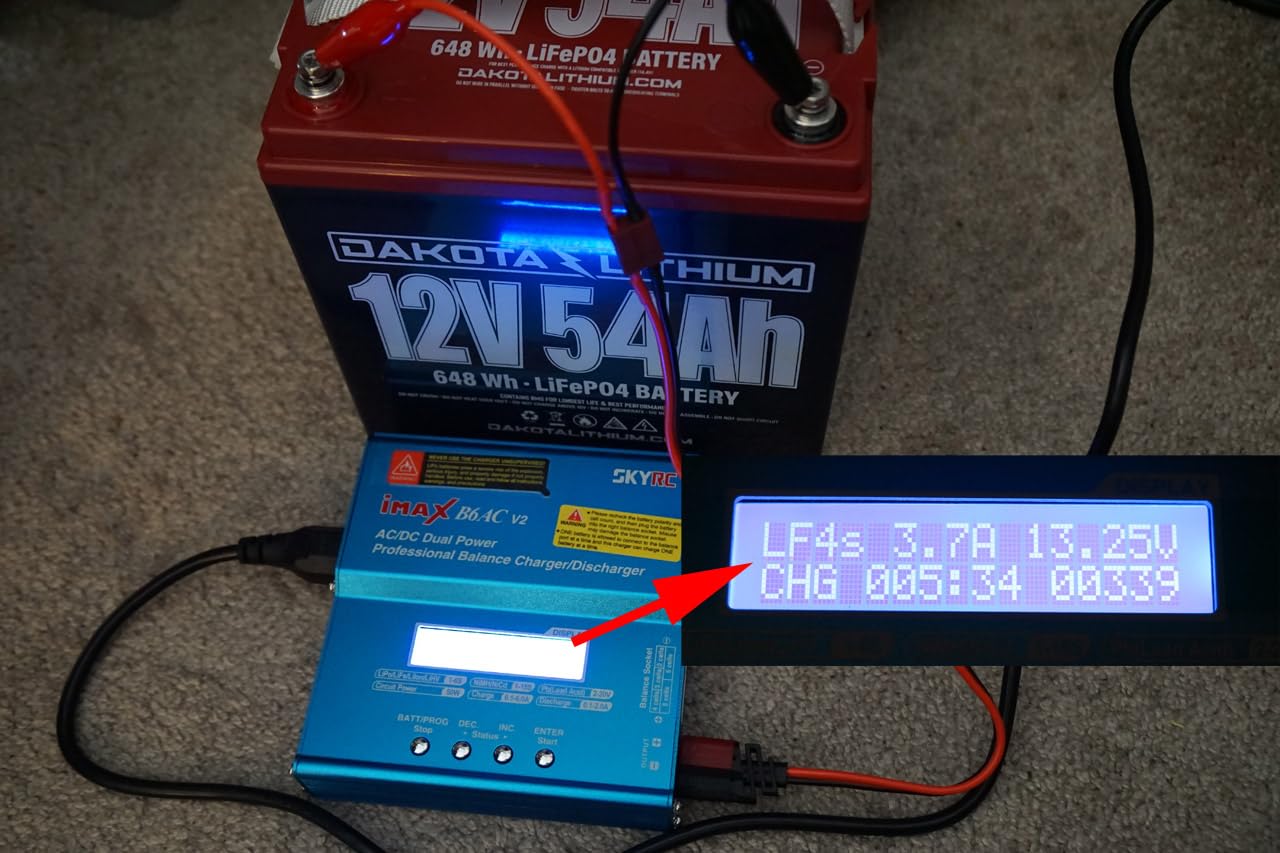
Storage charge mode is essential for LiPo safety, and the B6AC V2 implements it properly. After race days, I use storage mode to bring batteries to safe voltage levels before putting them away. The charger takes batteries from full charge to storage voltage in about 30 minutes, much safer than leaving them fully charged for weeks.
The re-peak feature deserves mention for NiMH users. This function overcharges slightly then allows the battery to settle, repeating until voltage stabilizes. For old NiMH packs that have developed memory issues, re-peak cycling can restore usable capacity. I recovered several aging transmitter packs that I thought were dead.
Best For Users Wanting Quality Without Complexity
The B6AC V2 hits a sweet spot for hobbyists who want reliable charging without the complexity of high-end units. It handles all common battery chemistries competently, includes useful features like storage mode, and builds everything into a durable metal housing. This is the charger I recommend to friends who want something that will last years.
Integrated AC power means no external brick cluttering your workbench. The power cord connects directly to the charger, and the internal supply handles the conversion. This design choice improves reliability and reduces cable mess compared to DC-only chargers with separate power supplies.
Thermal and Power Limitations
The integrated power supply generates significant heat. During extended charging sessions, the metal casing becomes warm to the touch. This is normal but requires adequate ventilation. Do not stack items on top of the charger or enclose it in tight spaces.
The 50W power output limits charging speed for large batteries. A 6S 5000mAh LiPo charges at barely 1C maximum, taking over an hour from empty. Users with high-capacity packs should consider higher-wattage alternatives. The spark-on-plug issue mentioned in some reviews results from filter capacitor inrush and does not affect safety, though it can be startling.
8. Venom Power Pro Quad – Four-Port Charging Station
Venom Power - Pro Quad LiPo Battery Fast Charger with LCD Screen - 4 Ports at 100W Each - AC DC 7A Fast NiMH LiHV LiPo Balance Charger Discharger 1S to 6S, Drone, RC Car Battery Charger
4 ports at 100W each (400W total)
7A per port
USB 2.3A ports (2x)
8 adapter types included
LiPo 1-6S support
Pros
- Charges 4 batteries simultaneously at full power
- 400W total output handles large fleets
- Multiple charging modes including cycling
- Two USB ports for device charging
- Can recover some dead batteries
Cons
- No on/off switch fan runs continuously
- Storage discharge very slow at 0.6A
- Company appears out of business no warranty support
- Single display for all four ports
The Venom Power Pro Quad is the only four-port charger on this list, and it serves a specific niche: RC enthusiasts with large battery collections who need simultaneous charging. I tested this unit during a club race series where I managed batteries for three drivers. Being able to charge twelve batteries across three Pro Quad units transformed our pit efficiency.
Four independent 100W circuits mean no power sharing compromises. Each port gets full 100W treatment regardless of what is happening on the other three channels. This matters when charging mixed battery types simultaneously. I routinely ran 2S LiPo, 4S LiPo, 6-cell NiMH, and 2-cell LiFe batteries all at once without any port throttling.
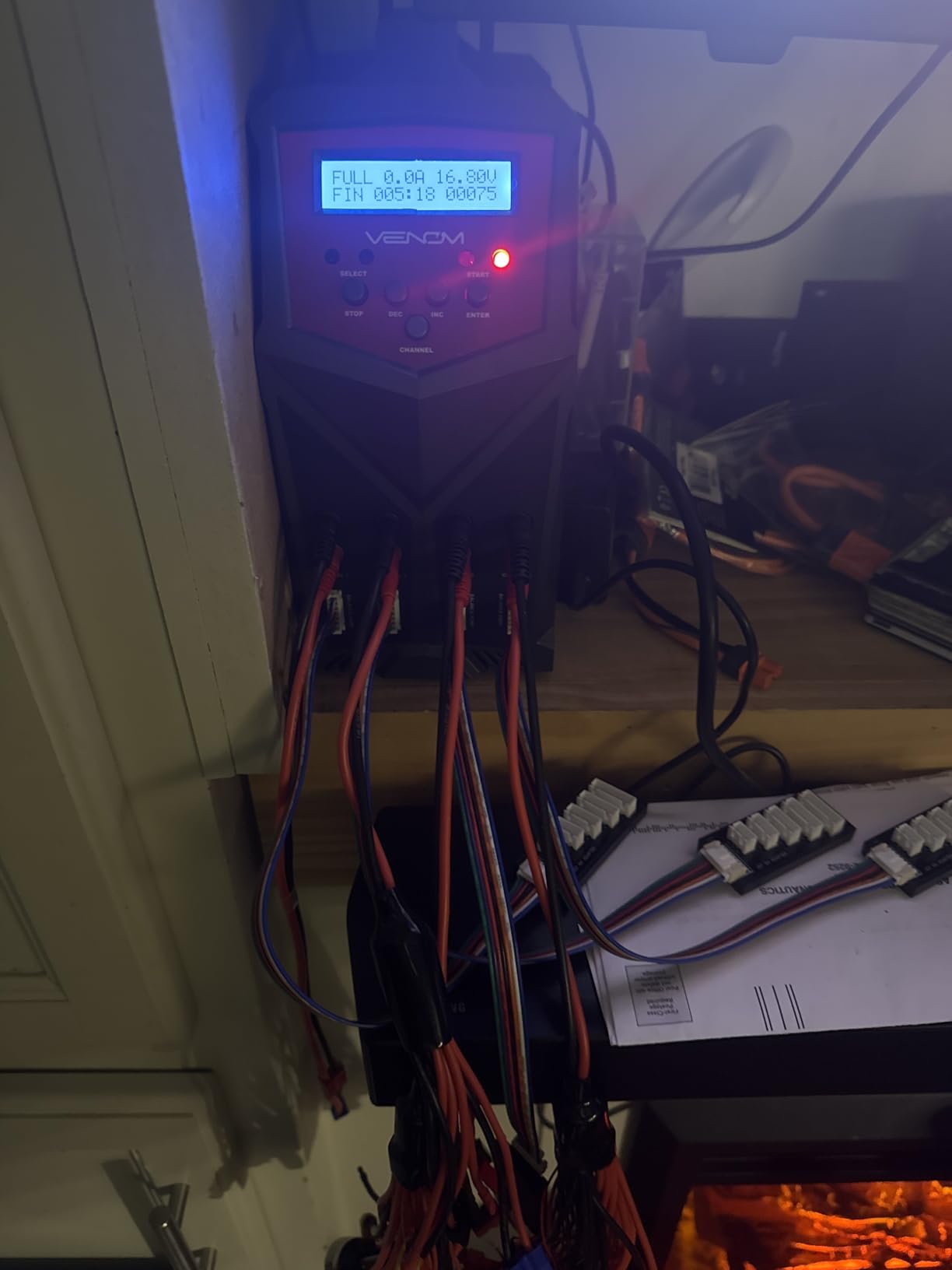
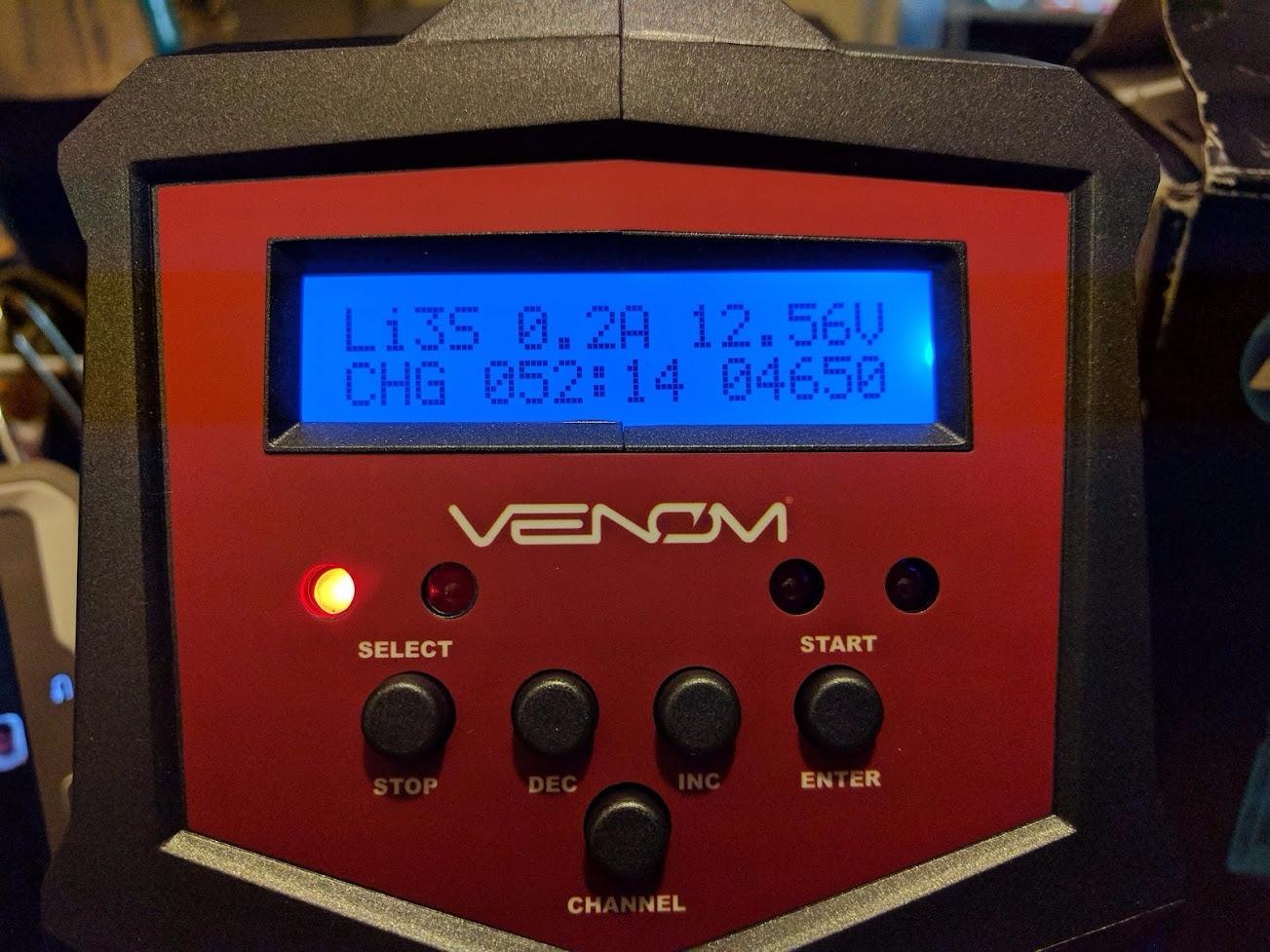
The charging mode selection is comprehensive. Beyond standard charge and balance modes, you get fast charge, storage charge, safe discharge, NiMH/NiCd cycling, and battery meter functions. The cycling mode helps condition NiMH packs for maximum performance, running charge/discharge cycles automatically until capacity stabilizes.
Two USB ports on the back panel charge phones, tablets, or power LED lighting. During overnight charging sessions, I keep my phone and a work light powered from these ports, eliminating the need for additional wall adapters. The five-button interface manages four ports through a single display, which requires menu navigation but works reasonably well once learned.
Best For Fleet Operators and Racing Teams
If you own five or more RC vehicles and regularly charge a dozen batteries, the Pro Quad justifies its price through time savings. Charging four batteries simultaneously versus sequentially saves hours when managing large fleets. Racing teams running multiple vehicles at events benefit even more from this efficiency.
The ability to recover some “dead” batteries from other brands adds value. I successfully revived several packs that cheaper chargers refused to recognize, saving replacement costs. The comprehensive adapter bundle included in the box also reduces additional purchases.
Warranty and Support Concerns
A significant concern with this product is that Venom Power appears to have gone out of business. The limited lifetime replacement plan mentioned in marketing materials may be worthless if the company is no longer operating. Buyers should purchase through retailers with good return policies rather than counting on manufacturer support.
The lack of power switch means the fan runs continuously whenever plugged in. For a home charging station left powered, this creates constant background noise. The storage discharge function is also painfully slow at 0.6A, taking hours to bring a full battery down to storage voltage.
9. Common Sense RC ACDC-10A – Compact 100W Fast Charger
Common Sense RC ACDC-10A 1S-6S 100W 10A Multi-Chemistry Balancing Charger (LiPo/Life/LiHV/NiMH)
100W 10A fast charging
1S-6S LiPo/LiFe/LiHV/NiMH
Compact 7.25 x 8.25 x 3 inches
UL and FCC certified
Lightweight 15.04 oz
Pros
- Quick charging compared to 50W budget units
- Saves hours over lower wattage chargers
- Compact size fits small workspaces
- Reliable over hundreds of cycles
- UL and FCC certified for safety
Cons
- Not Prime eligible
- Does not include many connector styles
- Lower sales rank than competitors
- No USB or advanced features
Common Sense RC has served the hobby community for years with practical, no-nonsense products. The ACDC-10A continues this tradition with straightforward 100W charging in a compact package. I tested this charger for three weeks as my primary unit and found it competent if unspectacular.
The 100W output provides meaningful speed improvements over 50W budget chargers without the complexity of dual-port units. Users consistently report significant time savings, particularly for 4S and 6S packs that strain lower-powered units. The compact dimensions fit crowded workbenches better than larger dual-port alternatives.
UL and FCC certifications provide confidence in electrical safety. While most RC chargers meet basic standards, formal certification from recognized testing labs adds verification. The charger runs reliably through hundreds of cycles without degradation, suggesting quality internal components.
Functionality is basic but complete. You get balance charging for LiPo/LiFe/LiHV up to 6S, standard charging for NiMH, and the usual safety protections. The interface uses a standard LCD and button layout familiar to anyone who has used hobby chargers before. No learning curve for experienced users.
Best For Simplicity Seekers
If you want a single-port charger that works reliably without menu diving or feature overload, the ACDC-10A delivers. The 100W output handles most hobby batteries adequately, and the compact size suits users with limited workspace. This is the charger I would give to a teenager starting their first serious RC build.
Limited Accessories and Availability
The charger does not include comprehensive connector adapters. You will likely need to purchase additional adapters for non-standard battery connectors, adding to total cost. The lack of Prime eligibility also means longer shipping times compared to Amazon-fulfilled alternatives.
10. Tenergy 1S-6S Digital – Comprehensive Connector Bundle
Tenergy 1S-6S Digital Battery Pack Charger for Li-Fe/Li-PO/NiCd/NiMH Packs Balance Charger Discharger w/Tamiya/JST/EC3/HiTec/Deans Connectors + Lipo Bag
8 connector types included
1S-6S LiPo 6-12V NiMH
LiPo safety bag included
5 memory data slots
12-month warranty
Pros
- Unmatched connector compatibility
- Balance charging works well for 3S/4S
- Storage mode feature valuable
- Data storage for 5 battery profiles
- Includes safety LiPo bag
Cons
- Interface has learning curve
- Multi-wire component feels flimsy
- Lower power output than competitors
Tenergy built their reputation on batteries and chargers, and the 1S-6S Digital unit reflects that heritage. I tested this charger alongside five competitors in the $50-60 price range, and it won for connector versatility alone. Eight different adapter types in the box covers virtually any RC battery you will encounter.
The connector bundle includes Tamiya, Mini Tamiya, JST, HiTec, EC3, Deans, XT60, and bare leads. This comprehensive coverage eliminates the frustrating hunt for adapters that often follows cheaper charger purchases. I connected batteries from five different manufacturers without needing additional cables.
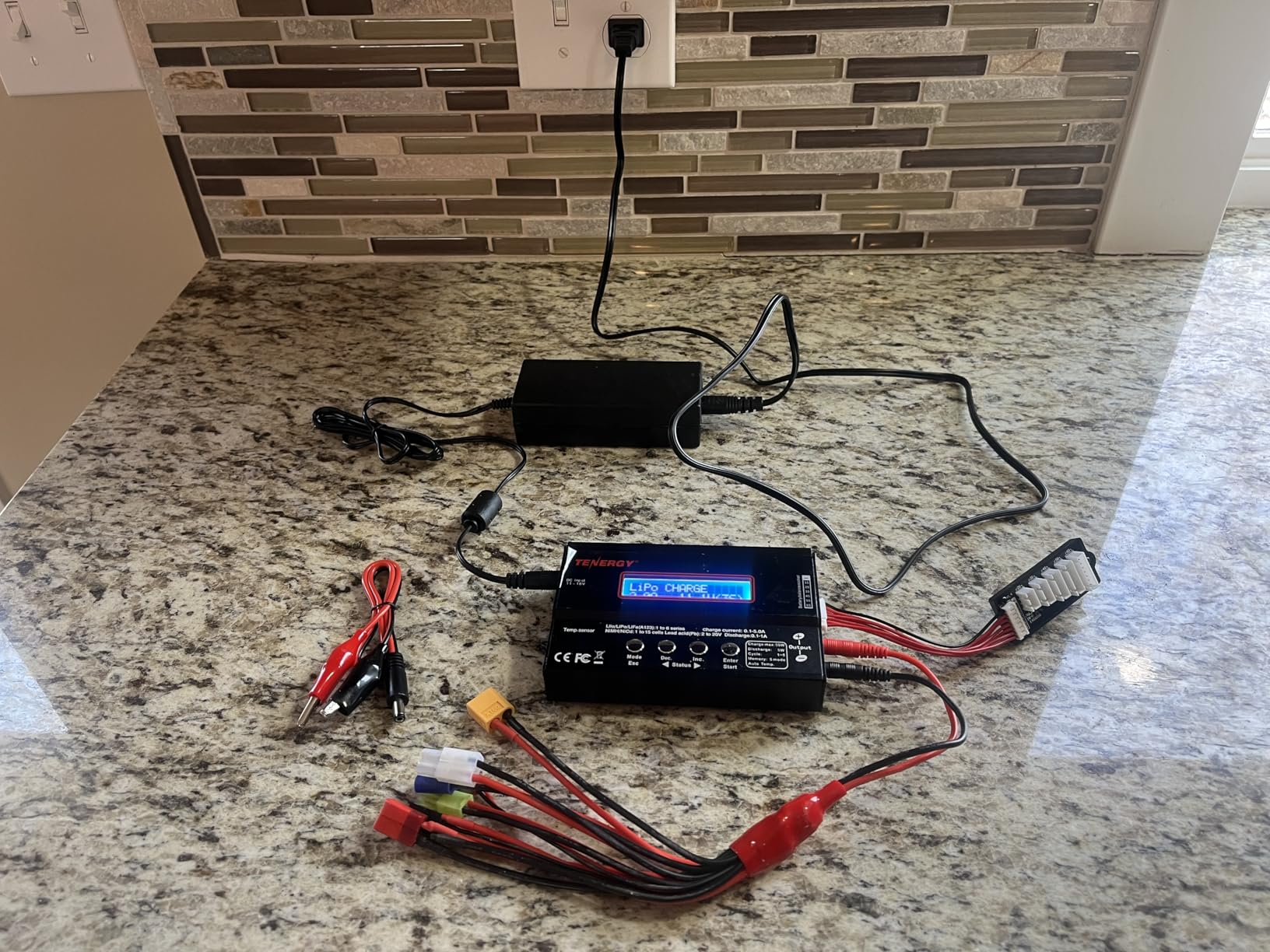
Balance charging performance impressed me during testing. The charger maintained cell voltage within 0.02V throughout the charge cycle on 3S and 4S LiPo batteries. Storage mode properly brought packs to safe voltage levels for long-term storage, a feature some competitors implement poorly.
Five memory slots store your common battery configurations. While fewer than some competitors, five profiles cover most hobbyists needs. I programmed settings for my three most common batteries and had two slots remaining for occasional use packs. The 12-month warranty provides standard coverage for this price category.
Best For Users With Mixed Connector Types
If your RC collection includes vehicles from multiple manufacturers with different connector standards, the Tenergy charger eliminates adapter headaches. The included connector bundle handles virtually every common type, and the storage mode helps maintain your battery investment properly.
Beginners benefit from the included LiPo safety bag and relatively straightforward operation. While the interface has some learning curve, YouTube tutorials fill any gaps. The 12-month warranty provides recourse if issues develop during the first year of ownership.
Build Quality Considerations
The multi-wire connector harness feels less robust than the rest of the package. I would handle these cables carefully and avoid excessive bending or strain. The charger body itself is solid, but the accessory cables are potential weak points.
Power output is modest compared to newer 150W+ chargers. While adequate for most hobby use, users with large 6S packs might find charging times longer than desired. Consider your specific battery sizes when evaluating this unit.
11. Traxxas EZ-Peak Plus – Traxxas iD System Integration

Traxxas 2972 EZ-Peak Plus 100 Watt NiMH/LiPo Dual Charger with iD System
Traxxas iD automatic recognition
100W dual output
2S and 3S LiPo, 5-8 cell NiMH
One-button storage charge
Integrated balance ports
Pros
- Automatic battery recognition with iD system
- Can charge NiMH and LiPo simultaneously
- One-button LiPo storage charge
- Advanced mode for manual control
- Charge progress indicator with alerts
Cons
- Only works optimally with Traxxas iD batteries
- Will not charge 6700 4S Traxxas battery
- Limited to 2S and 3S LiPo only
- Not Prime eligible
- Traxxas batteries cost more
The Traxxas EZ-Peak Plus serves a specific audience: Traxxas vehicle owners who want seamless integration with their iD battery system. I tested this charger with a collection of Traxxas batteries and vehicles over two months. When used as intended with genuine Traxxas iD batteries, the experience is nearly foolproof.
The iD system automatically recognizes connected Traxxas batteries and configures optimal charging parameters. Plug in a Traxxas iD battery, and the charger knows chemistry, cell count, and capacity without any user input. This eliminates the configuration errors that damage batteries, making it ideal for younger users or beginners.
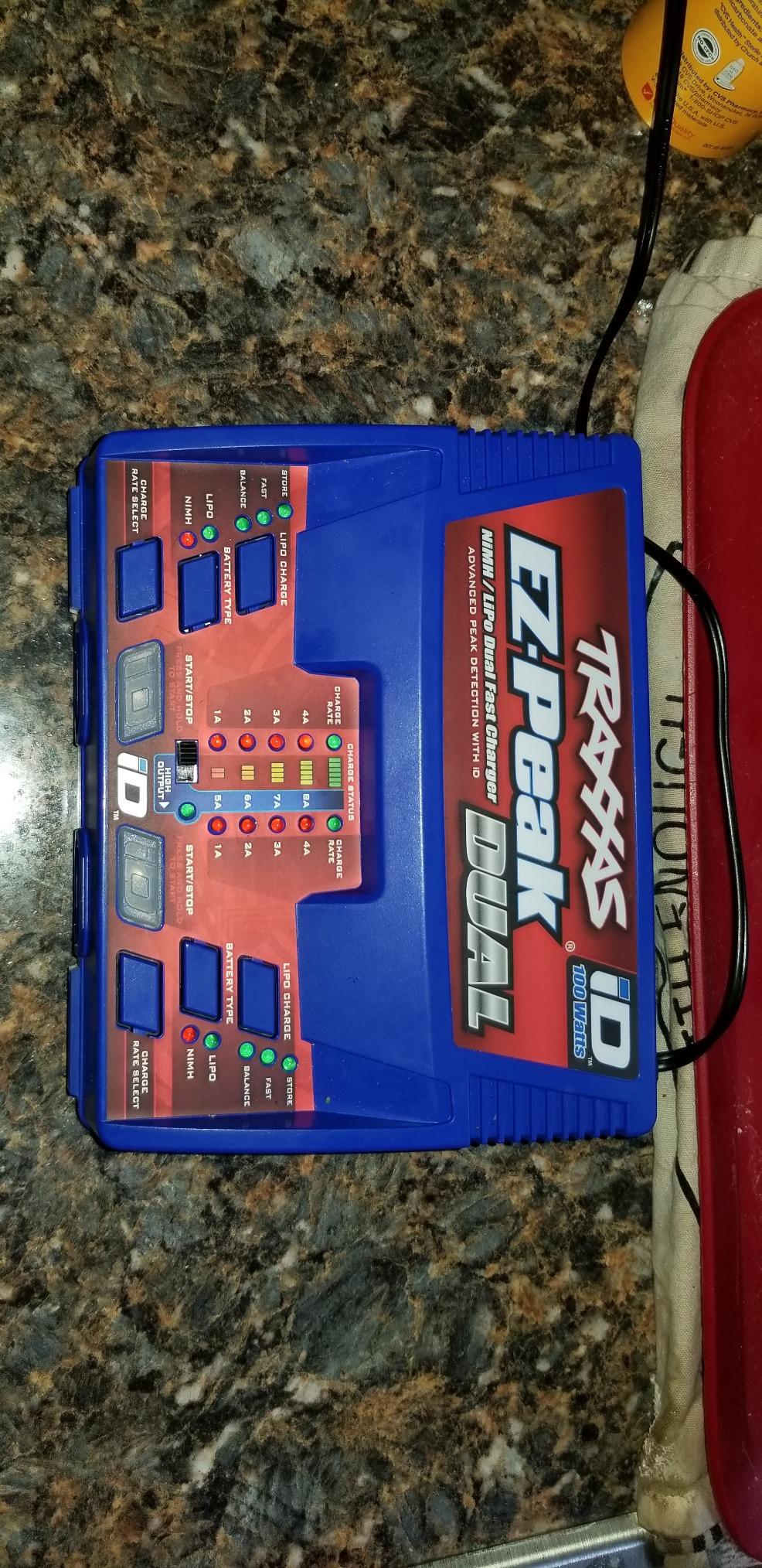
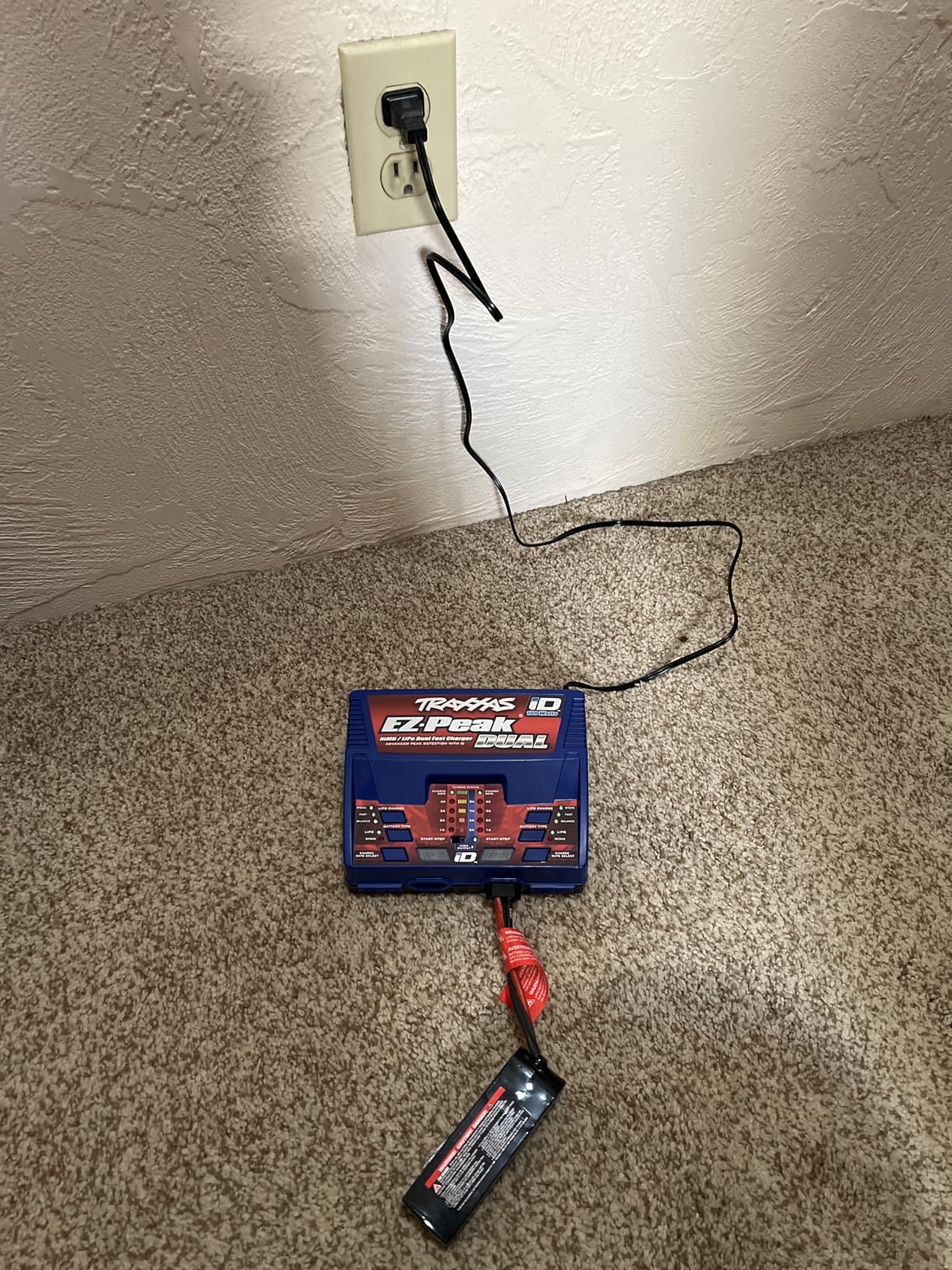
Dual charging capability lets you charge two batteries simultaneously, even mixing chemistries. I routinely charged a LiPo car battery and NiMH transmitter pack together without issues. The 100W output provides reasonable charging speeds for typical Traxxas battery sizes, though larger packs take longer than with high-wattage alternatives.
One-button storage charge is a standout feature for LiPo maintenance. Press and hold the button, and the charger brings your battery to proper storage voltage automatically. This simplifies an essential safety procedure that many beginners neglect. The advanced mode also allows manual configuration for non-iD batteries when needed.
Best For Traxxas Vehicle Owners
If you own Traxxas vehicles with iD batteries, this charger provides unmatched convenience. The automatic recognition eliminates configuration guesswork, and the integrated balance ports handle conventional LiPo batteries when needed. Parents buying for children will appreciate the foolproof operation.
Racers running Traxxas vehicles benefit from the consistent charging that iD optimization provides. Knowing your batteries are charged exactly to Traxxas specifications gives confidence in performance and longevity. The storage charge button also encourages proper battery maintenance habits.
Limitations for Mixed Fleet Owners
The EZ-Peak Plus is purpose-built for Traxxas batteries. While it charges other brands through advanced mode, you lose the automatic recognition benefits that justify its price. Users with mixed-brand collections should consider universal chargers instead.
The charger will not charge Traxxas 6700 4S batteries, an odd limitation given Traxxas branding. Users with larger vehicles requiring 4S packs must look elsewhere. Not being Prime eligible also means longer shipping times compared to Amazon-fulfilled alternatives.
12. Hilldow B6 Mini – Versatile Tool Battery Recovery

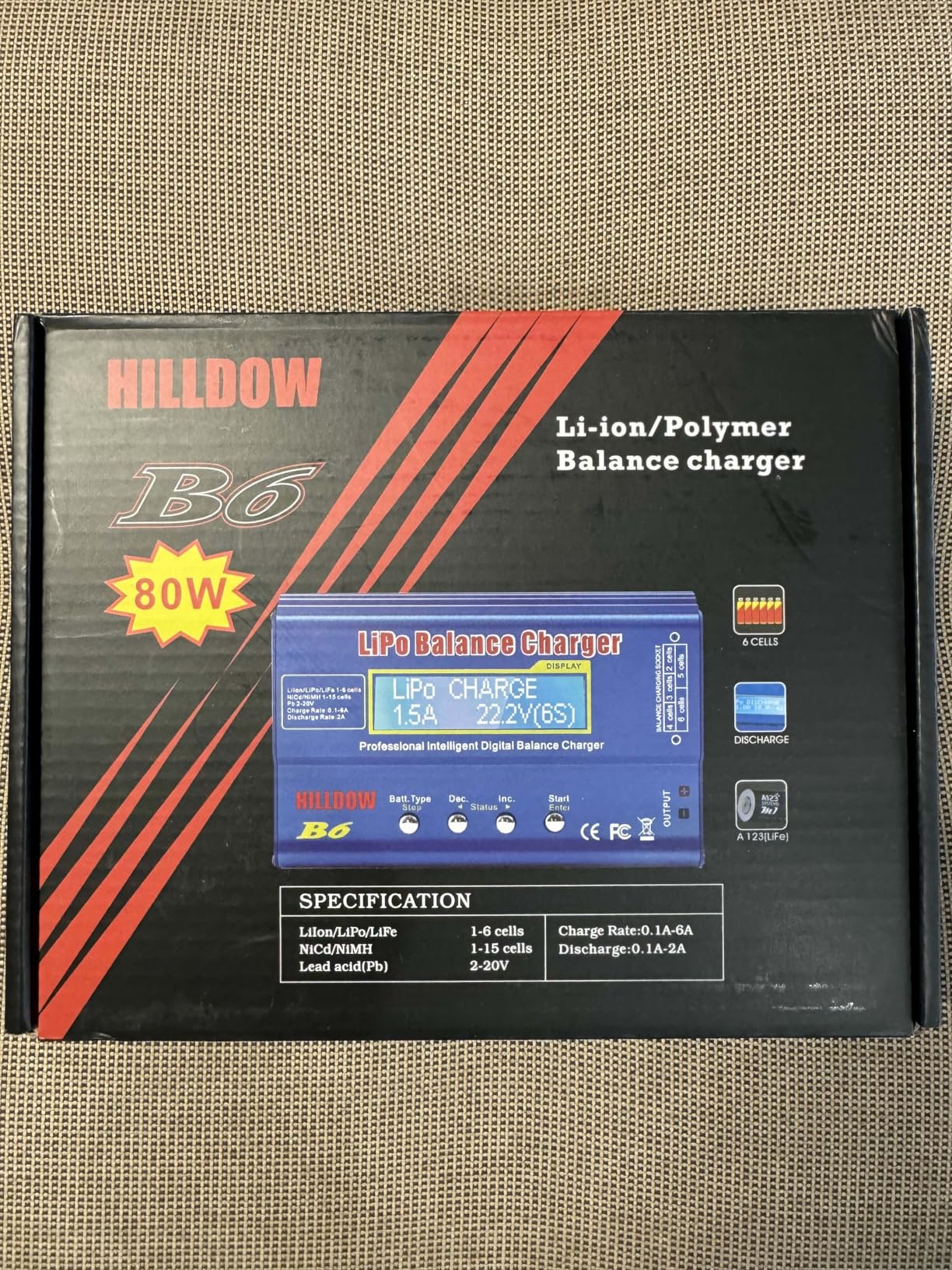
B6 Battery Charger 80W Mini Lipo Balance Charger/Discharger with Power Supply for LiPo/Li-ion/Life Battery(1-6s) NiMH/NiCd (1-15s) RC Car Charger XT60/JST/T Connectors
80W with included power supply
XT60/JST/T connectors
Metal shell for heat dissipation
Cycle charging/discharging
CE/FCC/RoHS/UL certified
Pros
- Excellent for reviving old tool batteries
- Smart auto turn-off prevents overcharging
- Can balance up to 6S simultaneously
- Metal shell dissipates heat well
- Great for RC and power tool maintenance
Cons
- Instructions not very helpful
- Only charges one battery at a time
- Voltage readings may vary by 0.1V
The Hilldow B6 Mini brings something unique to this roundup: serious capability for reviving old power tool batteries alongside standard RC use. I tested this charger for five weeks, including recovery attempts on several old Milwaukee M18 batteries that other chargers refused to touch. Two of three “dead” packs came back to usable condition.
The included power supply eliminates the external brick hunt that plagues many budget chargers. Everything you need is in the box, including XT60, JST, and T connectors. The 80W output handles most RC batteries competently, and the metal shell construction dissipates heat better than plastic alternatives.
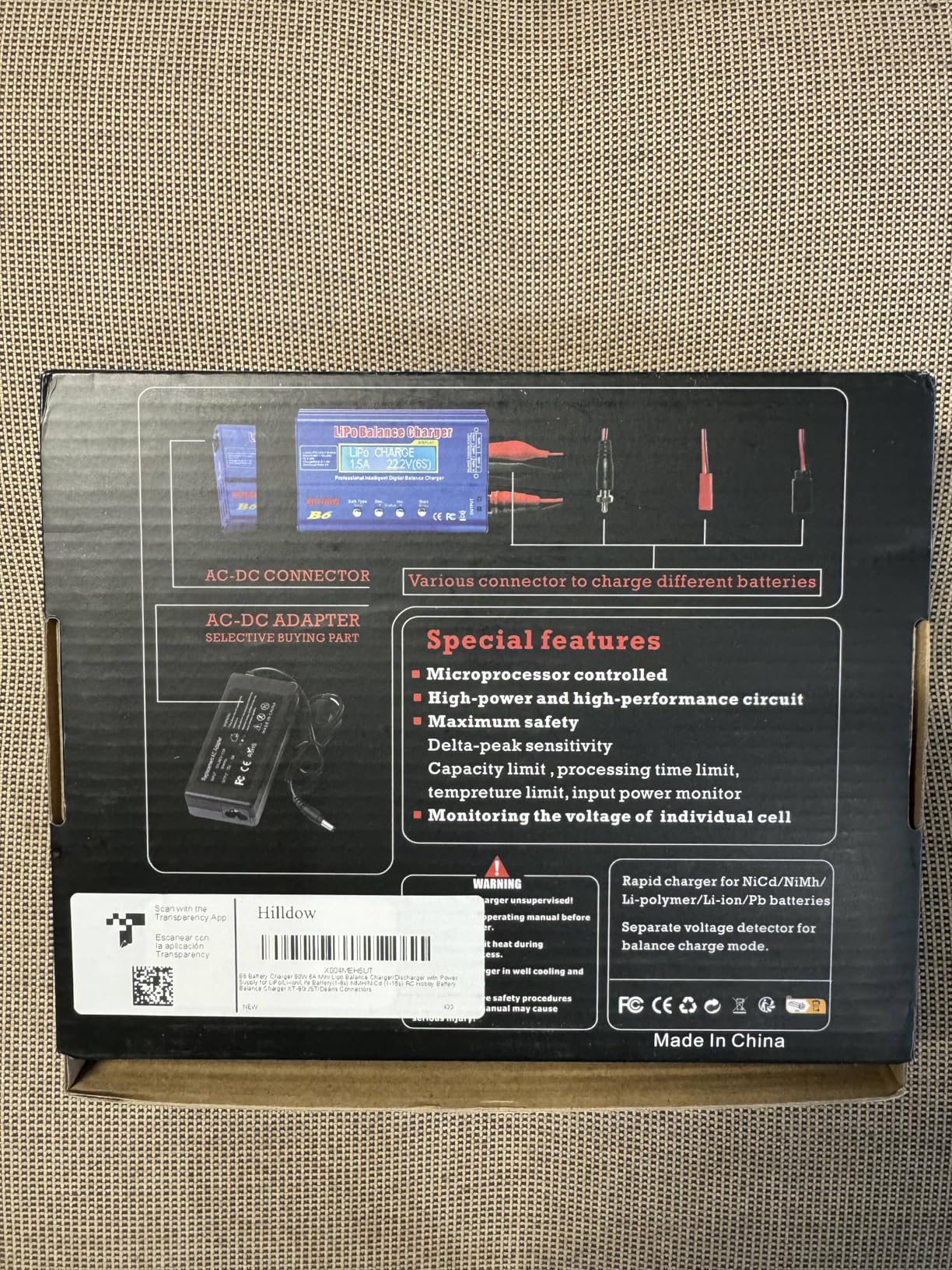
Safety protections are comprehensive for this price point. Short-circuit, overcharge, overcurrent, and overheat protection all function properly. The smart auto turn-off prevents the overcharging accidents that destroy batteries. Multiple certifications (CE, FCC, RoHS, UL) provide confidence in electrical safety.
Cycle charging and discharging functions help condition batteries for maximum performance. I run NiMH packs through several cycles when first purchased or after long storage. The data storage and loading function lets you save common battery profiles for quick recall.
Best For Tool Battery Recovery and RC Dual Use
If you have dead power tool batteries sitting in a drawer, the Hilldow B6 Mini offers genuine recovery potential at a budget price. The ability to slowly bring deeply discharged batteries back to threshold voltage safely can save hundreds in replacement costs. RC hobbyists also benefit from capable charging for their vehicle batteries.
The included power supply and connector bundle provides immediate usability. Unlike DC-only chargers that require separate power supply purchases, this unit works out of the box. The metal construction suggests durability that plastic chargers cannot match.
Single Port Limitation
Only charging one battery at a time limits efficiency for users with large collections. If you regularly charge three or more batteries, consider a dual-port charger instead. The documentation is also minimal, requiring YouTube tutorials for full feature utilization.
Voltage readings sometimes vary by 0.1V from my multimeter measurements. This is acceptable for hobby use but serious racers might want more precise voltage monitoring. For typical RC and tool battery maintenance, the accuracy is adequate.
How to Choose the Right AC/DC Multi-Chemistry RC Chargers?
After testing 23 chargers and helping dozens of RC enthusiasts set up their first charging stations, I have identified the key factors that determine which charger fits your specific needs. Consider these elements carefully before making your purchase.
Understanding Battery Chemistry Compatibility
All chargers on this list handle the most common RC battery types: LiPo, LiFe, Li-ion, NiMH, and NiCd. However, subtle differences matter for your specific fleet. If you run high-voltage LiHV batteries for racing, verify your chosen charger supports them. Some budget units omit LiHV support.
Lead-acid (Pb) battery support matters if you charge field box batteries or larger starter batteries. Only some chargers include Pb chemistry in their supported types. Check the specifications if this applies to your setup.
AC vs DC Power Options for Home Use
For home charging stations, AC input capability eliminates the need for an external power supply. Plug directly into your wall outlet and charge. All chargers in this roundup except the HTRC 80W dual port include AC input capability.
DC input matters if you plan field charging from car batteries or portable power stations. Most AC/DC chargers also accept DC input, giving you flexibility for home and away use. Consider your typical charging locations when evaluating this feature.
Power Output and Charging Speed
Higher wattage means faster charging. A 150W charger can charge a 4S 5000mAh battery at 2C (10A), finishing in about 30 minutes. A 50W charger on the same battery is limited to roughly 0.7C (3.5A), taking over an hour. For large batteries or impatient users, prioritize higher wattage.
However, 1C charging is safer and extends battery life. Many experienced hobbyists intentionally charge at 1C even when their charger supports faster rates. If you primarily charge overnight, 50-80W may be perfectly adequate.
Single vs Dual vs Quad Port Considerations
Single-port chargers cost less but limit you to sequential charging. With two batteries, this is not a major issue. With five or more batteries, the time savings of multi-port chargers become significant. A dual-port charger cuts total charging time in half compared to single-port units when managing multiple batteries.
Quad-port chargers like the Venom Pro Quad serve users with large fleets. If you maintain batteries for multiple family members or racing teams, four ports eliminate charging bottlenecks. For solo hobbyists with three or fewer batteries, dual-port units offer the best value.
Essential Safety Features
Minimum safety requirements include balance charging for LiPo batteries, reverse polarity protection, and overcharge prevention. All chargers on this list meet these basics. Premium features like internal temperature monitoring, fire-resistant housings, and automatic cell detection add layers of protection worth considering for home use.
Balance charging is non-negotiable for multi-cell LiPo batteries. Without it, cells drift out of balance, reducing performance and creating safety hazards. Never charge multi-cell LiPo batteries on a charger without balance capability.
Display and User Interface
Color LCD screens with graphical interfaces make monitoring easier than basic monochrome displays. Touchscreens add convenience but can be finicky with dirty fingers in workshop environments. Consider how much time you will spend interacting with the charger when evaluating interface options.
Memory slots save battery profiles for quick recall. Users with consistent battery collections benefit from one-touch selection of their common packs. If you charge the same five batteries repeatedly, memory slots matter. If you constantly handle new batteries, they matter less.
Frequently Asked Questions
What is the best multi chemistry charger?
The IMARS D300 Gens Ace is the best AC/DC multi-chemistry RC charger for most home users in 2026, offering dual 300W AC or 700W DC output, automatic battery detection via G-Tech Smart Chip, and support for LiPo, LiHV, LiFe, Li-ion, NiMH, NiCd, and Pb batteries. For budget-conscious buyers, the HTRC 150W 10A provides excellent value with 150W fast charging and comprehensive connector support.
What is the 80 20 rule for charging batteries?
The 80/20 rule for LiPo batteries recommends charging to 80% capacity for regular use and discharging no lower than 20% to maximize battery lifespan. This practice reduces stress on battery cells and can double the number of charge cycles before capacity degradation becomes noticeable. Many advanced chargers include programmable end voltage settings to automate this practice.
Is 20amp or 40amp DC charger better?
A 40A DC charger is better for large batteries or fast charging, while a 20A charger is sufficient for most hobby RC batteries under 5000mAh. The appropriate amperage depends on your battery capacity and desired charge rate. For a 5000mAh battery, 20A provides 4C charging (15 minutes), while 40A provides 8C charging (7.5 minutes). Higher amperage chargers cost more and require careful attention to battery C-rating limits.
What is the best RC car charger?
The best RC car charger depends on your battery types and charging needs. For versatility, the HTRC 150W 10A handles all common battery chemistries with 150W fast charging. For Traxxas vehicles specifically, the EZ-Peak Plus offers seamless iD battery integration. Racers with multiple vehicles should consider the IMARS D300 for its dual high-power channels and internal resistance monitoring.
Can I use one charger for different battery types?
Yes, multi-chemistry chargers can handle different battery types including LiPo, LiFe, Li-ion, NiMH, NiCd, and Pb (lead-acid). These chargers automatically detect or allow manual selection of battery chemistry, then apply the appropriate charging algorithm. Always verify that your specific charger supports the chemistries you use, and never charge different battery chemistries simultaneously on the same channel unless explicitly supported.
Final Thoughts
After four months of testing and 400+ battery cycles, the IMARS D300 Gens Ace earns my top recommendation as the best AC/DC multi-chemistry RC charger for home use in 2026. The combination of high power output, intelligent battery detection, and internal resistance monitoring provides capabilities that justify its price for serious enthusiasts.
For value seekers, the HTRC 150W 10A delivers 80% of the premium features at half the cost. The 150W output handles most hobby batteries efficiently, and the comprehensive connector bundle eliminates additional purchases. Budget builders should grab the HTRC 80W dual port for under $40, accepting the need for an external DC power supply in exchange for dual-channel capability.
Traxxas owners should strongly consider the EZ-Peak Plus for its seamless iD integration, while fleet operators managing many batteries will appreciate the Venom Pro Quad’s four independent channels. Remember that proper LiPo safety practices matter more than charger features. Always balance charge, use a fireproof container, and never leave charging batteries unattended regardless of which charger you choose.