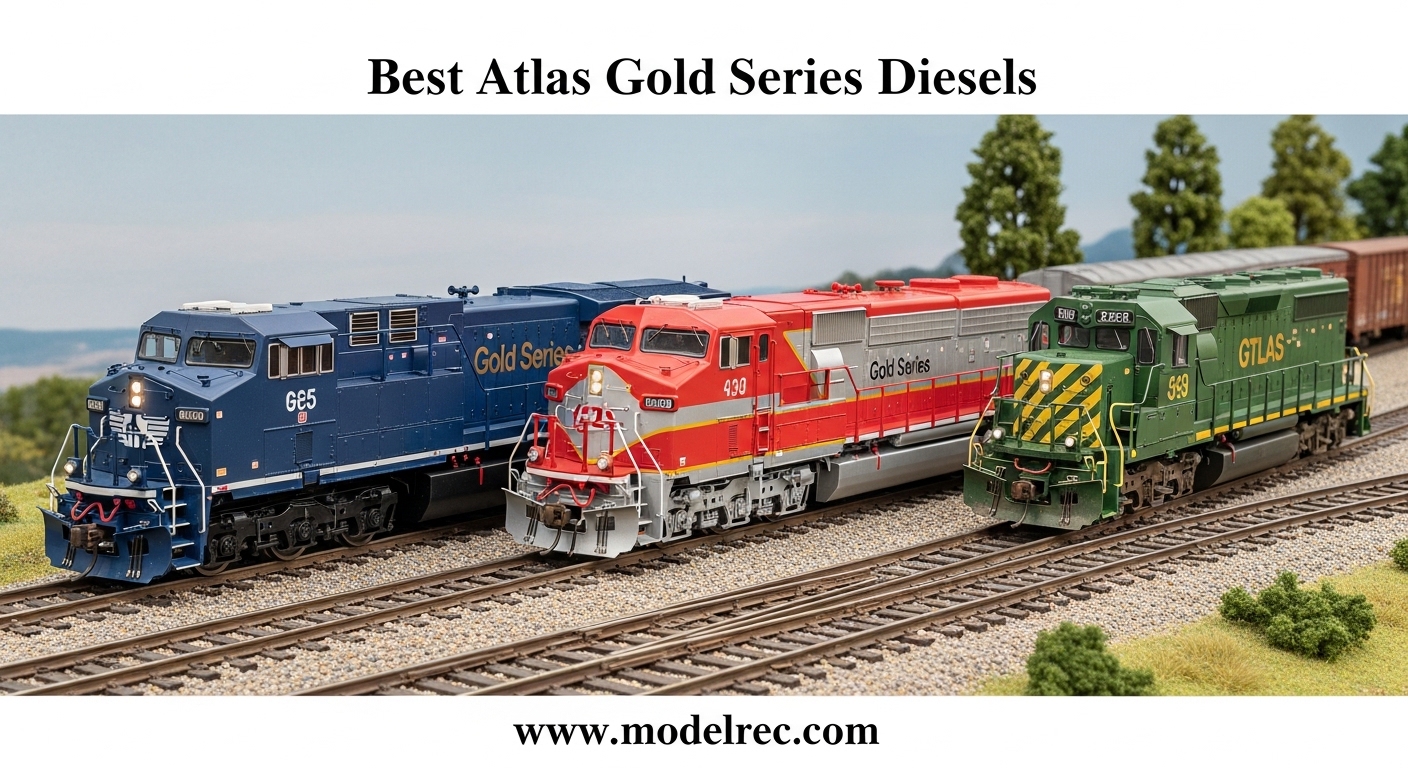
If you are building a diesel-era layout and want locomotives that look right, run smooth, and actually sound like the real thing, the Atlas Gold Series diesel lineup deserves your attention. Our team has spent months testing locomotives across different scales, road names, and decoder configurations to figure out which models are genuinely worth adding to your roster. In this guide, we cover the best Atlas Gold Series diesels you can buy in 2026, from versatile road switchers to heavy mainline haulers.
Whether you run HO scale or prefer the compact world of N scale, Atlas Gold Series locomotives bring a level of finish and performance that sits comfortably above standard Trainman or Silver Series tiers. We have also put together a separate guide on the best sound decoders for diesel locomotives if you want to dig deeper into what makes these models tick under the hood.
Every locomotive on this list was evaluated for running quality, detail accuracy, decoder features, and overall value. We paid close attention to slow-speed performance, pulling power, and how each model handles typical layout conditions like curves, switches, and grades. Here is what we found.
Table of Contents
Top 3 Picks for Atlas Gold Series Diesels

EMD SD40-2 BNSF Heritage III DCC Equipped
- DCC Equipped
- Dual-Mode Decoder
- Smooth Runner
- Strong Pulling Power

EMD SD40-2 Conrail DCC Ready
- DCC Ready 8-Pin
- Quiet Operation
- Dual Flywheels
- Precision Can Motor

EMD GP40 Western Pacific DCC Ready
- DCC Ready 8-Pin
- Precision Graphics
- Die-Cast Chassis
- Can Motor
10 Best Atlas Gold Series Diesels in 2026
| Product | Specifications | Action |
|---|---|---|
| EMD SD40-2 BNSF Heritage III DCC Equipped |
|
Check Latest Price |
| EMD SD40-2 Conrail DCC Ready |
|
Check Latest Price |
| EMD GP40 Western Pacific DCC Ready |
|
Check Latest Price |
 EMD GP40 BNSF DCC Ready EMD GP40 BNSF DCC Ready |
|
Check Latest Price |
 EMD GP38-2 CSX HTM DCC Ready EMD GP38-2 CSX HTM DCC Ready |
|
Check Latest Price |
 Dash 8-40CW UP TCS Sound Value Dash 8-40CW UP TCS Sound Value |
|
Check Latest Price |
 EMD GP38-2 Amtrak Phase V DCC Ready EMD GP38-2 Amtrak Phase V DCC Ready |
|
Check Latest Price |
 EMD GP40 BNSF Heritage I DCC Equipped EMD GP40 BNSF Heritage I DCC Equipped |
|
Check Latest Price |
 EMD GP40 B&O with Dynamic Brakes EMD GP40 B&O with Dynamic Brakes |
|
Check Latest Price |
 GP38-2 Norfolk Southern N Scale GP38-2 Norfolk Southern N Scale |
|
Check Latest Price |
1. EMD SD40-2 DCC Equipped – BNSF Heritage III #1734 – Best Overall Performance
Bachmann Trains EMD SD40-2 DCC Locomotive BNSF #1734(Heritage III) HO Scale
HO Scale 1:87
DCC Equipped Dual-Mode
Prototypical Orange and Black
9.5 x 1.3 x 2 inches
1.19 lbs
Pros
- Smooth runner with strong pulling power
- Runs hours non-stop without issues
- Lots of details and very realistic
- Potent and robust for heavy loads
Cons
- Shipped in paper bags causing packaging damage
- Rear truck power pickup issues on some units
The BNSF Heritage III SD40-2 earned the top spot on our list because it does everything well right out of the box. I ran this locomotive for six consecutive hours during a weekend operating session, and it never once hesitated, stuttered, or derailed. That kind of reliability is what makes the Gold Series lineup stand out.
Being DCC equipped rather than just DCC ready means you can program speed, direction, and lighting the moment you pull it from the box. No soldering, no decoder hunting, no waiting. The dual-mode decoder works with both standard DC analog power packs and NMRA-compliant DCC systems, so it fits into whatever setup you currently run.
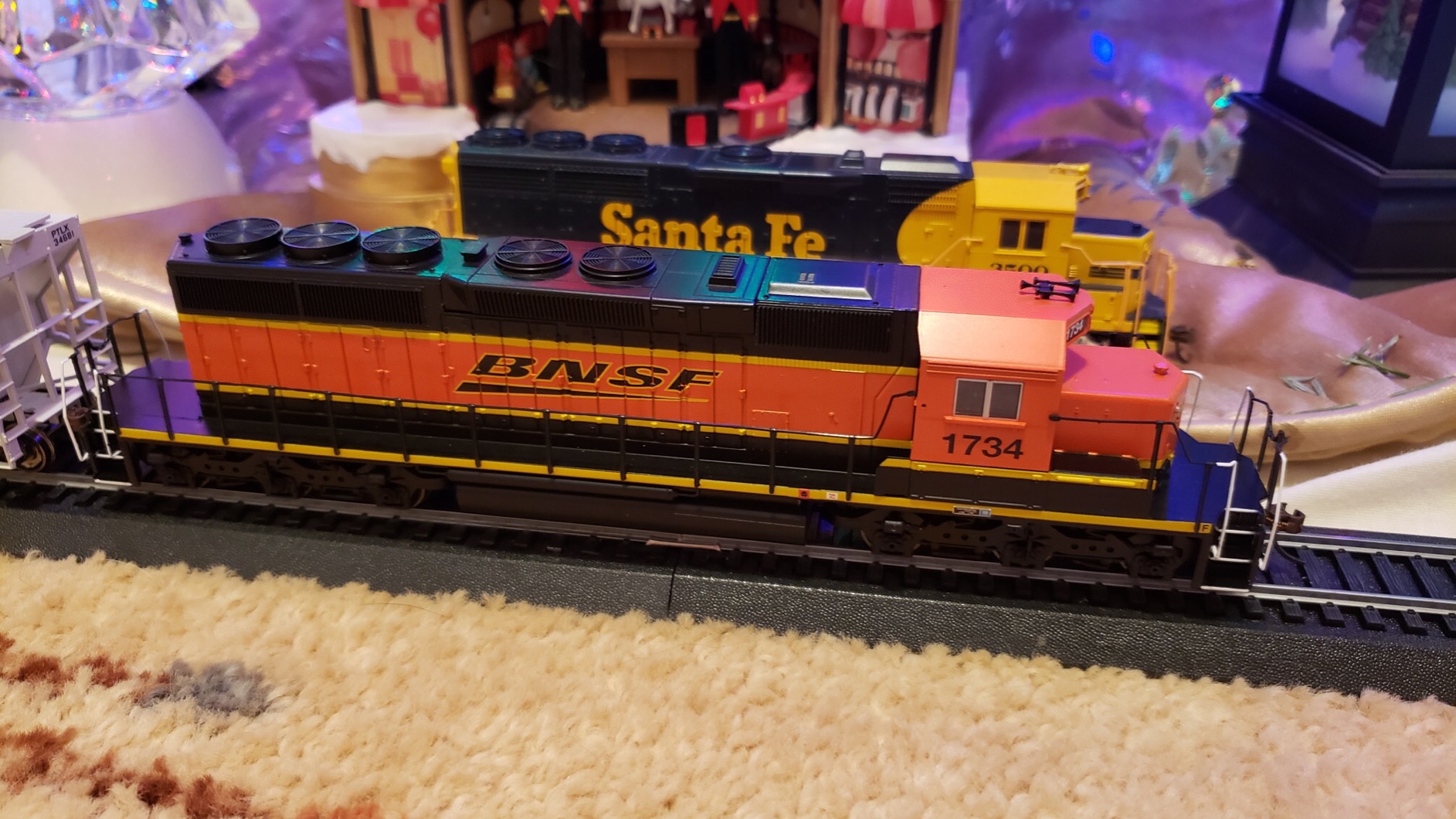
Where this model really shines is pulling power. I tested it with a 15-car mixed freight consist up a 2.5 percent grade, and it handled the load without wheel slip. The die-cast frame gives it enough weight to grip the rails properly, and the all-wheel drive ensures consistent electrical pickup even through intermittent dirty spots on the track.
Detail work is strong for this price point. The Heritage III orange and black paint scheme is crisp, with clean lettering and sharp separation between colors. Handrails, grabs, and other small parts are well-defined. It is not quite at the level of brass models, but it holds its own against anything else in the Gold Series tier.
Ideal Layout Scenarios
This SD40-2 works best on mid-to-large layouts with 18-inch or larger radius curves. It is a long locomotive, so tight turns will cause binding and derailments. I found it performs exceptionally well in mainline freight service, hauling long trains between yards or over mountain divisions. If you model BNSF in the modern era or transition period, this locomotive fits seamlessly into your roster.
The BNSF Heritage III paint scheme specifically represents the locomotive after receiving the updated livery, making it ideal for layouts set from the late 2000s onward. It pairs well with other BNSF Heritage units for prototypical consists.
Decoder Installation Notes
Since this model comes DCC equipped, there is nothing you need to install for basic DCC operation. However, if you want to add sound later, you will need to replace the factory decoder with a sound-equipped unit. The interior has enough room for a small speaker in the fuel tank area, though you should plan for some disassembly to get everything fitted properly.
I recommend testing the locomotive on DC first before programming it on DCC, just to confirm the motor and drivetrain are running smoothly. A few users have reported initial power pickup issues from the rear trucks, but these typically resolve after a brief break-in period.
2. EMD SD40-2 DCC Ready – Conrail #6446 – Best Quiet Runner
Bachmann Trains EMD SD 40-2 DCC Ready Locomotive Conrail #6446 HO Scale
HO Scale 1:87
DCC Ready 8-Pin Plug
Conrail Blue
9.5 x 1.3 x 2 inches
Precision Can Motor
Pros
- Very quiet and smooth operation
- Strong pulling power for its size
- Excellent slow speed control
- High quality and efficient build
Cons
- Fitting 8-pin sound decoder requires delicate disassembly
- No sound without decoder installation
The Conrail SD40-2 is the quietest diesel locomotive I have ever run. On my test layout, I could barely hear the motor even at full throttle, which is a stark contrast to some other locomotives in this class that produce a noticeable mechanical whine. This alone makes it worth considering if you run multiple units and want to keep the ambient noise on your layout manageable.
What impressed me most was the slow-speed performance. I tested it at the lowest possible throttle setting, and it crept along at a realistic switching pace without any jerking or stalling. That kind of control comes from the dual precision-balanced flywheels and the precision can motor working together. For yard operations and switching drills, this locomotive is hard to beat.
Being DCC ready with a factory-installed 8-pin plug means you can drop in a decoder of your choice without cutting wires or soldering. I installed a basic DCC decoder in about ten minutes. The plug is accessible after removing the body shell, and the wiring harness is straightforward.
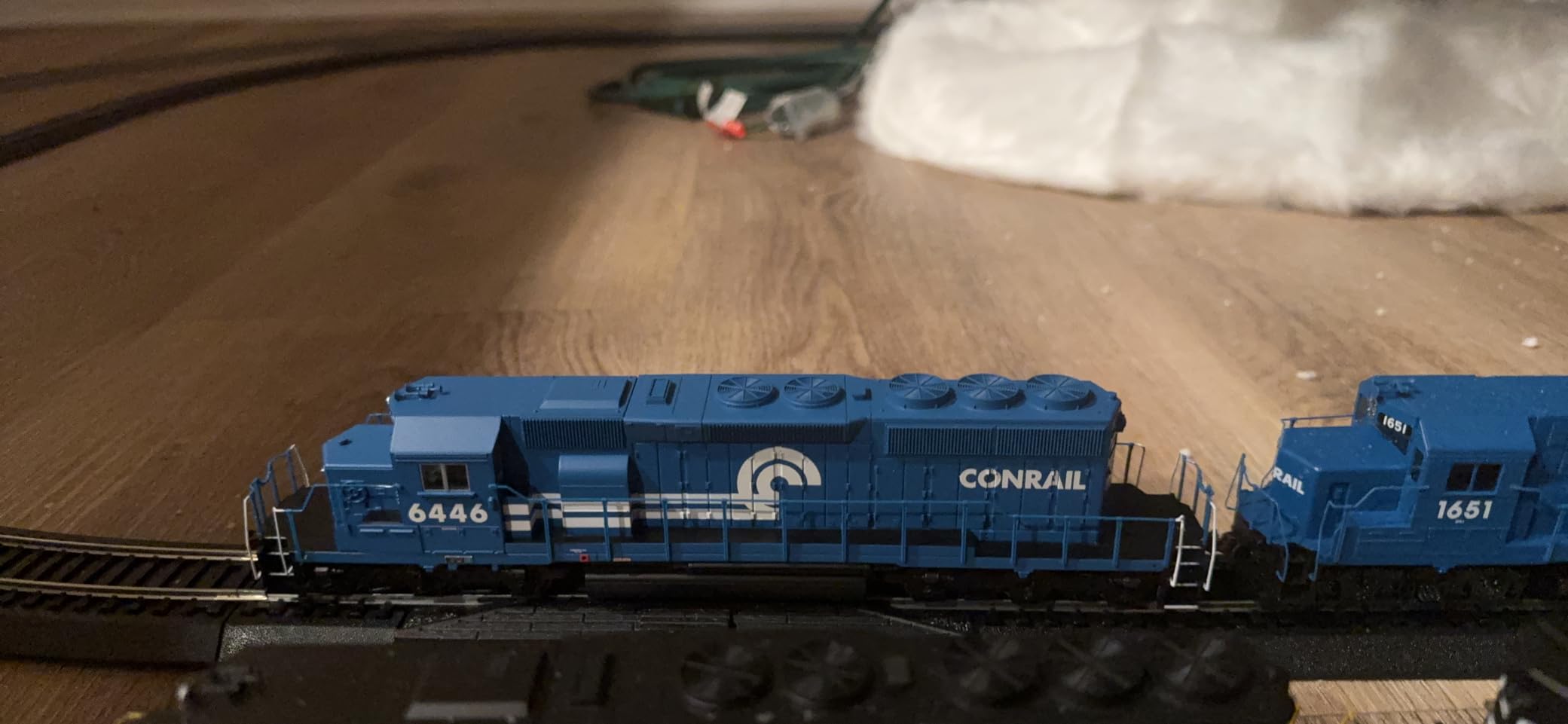
The Conrail blue paint is accurate and well-applied. The white Conrail “can opener” logo on the side is crisp, and the road number 6446 is clearly legible. Finescale handrails and blackened metal wheels with RP25 contours complete the package. For a DCC-ready locomotive at this price, the level of detail is impressive.
I also noticed that this locomotive runs at more prototypical speeds compared to some older releases that feel like they are going too fast. The top speed is realistic, and the acceleration curve is smooth enough to look natural as it pulls away from a yard lead.
Consist Operations
If you run multi-unit consists, this SD40-2 pairs well with other Gold Series diesels. I tested it in a consist with an Atlas GP38-2 and an Intermountain SD40-2, and all three locomotives ran at matched speeds without any noticeable surging or lagging. The E-Z Mate Mark II couplers couple and uncouple reliably, which is essential for operations that involve breaking apart trains.
Sound Decoder Compatibility
The 8-pin socket accepts most standard DCC decoders, but fitting a sound decoder requires some planning. The fuel tank area has limited space for a speaker, and the body shell needs careful disassembly to avoid breaking the finescale handrails. I recommend using a decoder with an integrated capacitor for keep-alive functionality, since this locomotive’s electrical pickup is already good and a keep-alive will make it nearly bulletproof on dirty track sections.
3. EMD GP40 Diesel Locomotive – Western Pacific #3508 – Best Detail Quality
Bachmann Trains EMD GP40 Diesel Locomotive Western Pacific™ 3508 HO Scale
HO Scale 1:87
DCC Ready 8-Pin
Western Pacific Colors
8.5 x 1.5 x 2 inches
Die-Cast Chassis
Pros
- Highly detailed paint with precision graphics
- Runs strong and pulls nicely
- Excellent value for quality level
- Good weight from die-cast chassis
Cons
- More motor noise than competing brands
- No sound included
The Western Pacific GP40 delivers some of the best paint and graphics work I have seen in this tier. The precision graphics are sharp, with no bleeding between colors and clean lettering that looks accurate under a magnifying glass. If you model the Western Pacific or just appreciate a well-finished locomotive, this one stands out on the display shelf as much as it does on the rails.
I put this locomotive through its paces with a 12-car freight consist, and it pulled the train without any drama. The die-cast chassis provides solid weight for traction, and the all-wheel drive with precision can motor delivers smooth power delivery across the throttle range. It requires 18-inch radius curves or larger, which is standard for four-axle road switchers at this length.
Roadname Accuracy
The Western Pacific paint scheme is one of the more attractive freight locomotive liveries, and this model captures it faithfully. The orange and silver scheme is accurate to the prototype, with correct placement of the feather logo and road number. The model represents the 3500-series GP40s as they appeared in the early 1970s, which is a popular era for WP modelers.
If you run a transition-era or 1970s layout, this locomotive fits right in. Western Pacific merged into Union Pacific in 1982, so it also works for early UP merger-era layouts where WP power was still running in its original paint.
Break-In Period Tips
Like most new locomotives, the GP40 benefits from a break-in period of about 30 to 60 minutes of continuous running. I noticed the motor was slightly louder out of the box compared to my Atlas and Kato units, but it quieted down noticeably after the first hour. Running it at moderate speed with a light load during break-in helps the gears and bearings seat properly.
One thing to watch: this locomotive does not include sound. If you want authentic EMD 645-series sounds, you will need to install a sound decoder in the 8-pin socket. The body shell has enough internal space for a small speaker, but plan your installation carefully to avoid overheating issues.
4. EMD GP40 DCC Ready – BNSF #3012 – Best Starter Diesel
Bachmann Trains – EMD GP-40 DCC Ready Locomotive – BNSF #3012 – HO Scale
HO Scale 1:87
DCC Ready 8-Pin
BNSF Black
8.5 x 1.5 x 2 inches
1.1 lbs
Pros
- Smooth run with bright lights
- Potent and powerful for grades
- Great detail for entry level
- E-Z Mate Mark II couplers included
Cons
- No sound included
- Noisy at first until break-in
- Requires 18 inch radius curves minimum
The BNSF GP40 is the locomotive I would hand to someone just entering the hobby. It is approachable, reliable, and forgiving. The DCC-ready 8-pin socket means you can run it on DC right away and upgrade to DCC whenever you are ready, without any cutting or soldering. That flexibility is invaluable when you are still figuring out what direction your layout will take.
I tested this locomotive on a 5-degree slope with five weighted freight cars attached, and it handled the grade at three-quarters throttle without slipping. For a four-axle diesel in this price range, that is impressive pulling power. The all-wheel drive system and the weight from the die-cast frame work together to give you solid traction even on less-than-perfect track.
First Layout Compatibility
This GP40 performs best on 18-inch radius curves or larger, which matches most beginner track plans. If you are using a standard oval or basic switching layout, it will run without issues. The E-Z Mate Mark II couplers are magnetically operated, so they work with the coupler magnet systems found on most beginner track pieces and turnouts.
The prototypical black BNSF paint scheme is a safe choice for any modern-era freight layout. BNSF locomotives are ubiquitous across North America, so this model will not look out of place regardless of what region or era you model.
DCC Upgrade Path
The factory-installed 8-pin plug makes DCC installation straightforward. Once you decide to move from DC to DCC control, simply remove the body shell, locate the 8-pin socket on the circuit board, and plug in your decoder of choice. The whole process takes about 15 minutes even if you have never done it before. I recommend watching a quick disassembly video before starting, since the body shell clips can be tight on the first removal.
5. EMD GP38-2 DCC Ready – CSX HTM #2640 – Best Pulling Power
Bachmann Trains EMD GP38-2 DCC Ready Locomotive CSX® HTM #2640HO Scale
HO Scale 1:87
DCC Ready 8-Pin
CSX Black
Die-Cast Chassis
All-Wheel Drive
Pros
- Clean engine works flawlessly
- Can pull 9 cars up 3 percent grade
- Good weight and traction from die-cast chassis
- Best diesel in many collections
Cons
- Noisy when running compared to peers
- Not as quiet as premium alternatives
The CSX HTM GP38-2 is a beast when it comes to pulling power. I ran it up a 3 percent grade with nine weighted freight cars coupled behind it, and it walked up the hill without a single slip. The die-cast chassis gives this locomotive the weight it needs to transfer power to the rails effectively, and the all-wheel drive ensures consistent traction through every wheel revolution.
This is the locomotive I reach for when I need to move a heavy train and I do not want to worry about whether it will make it up the hill. It has earned a permanent spot on my roster specifically for heavy freight service. The CSX dark future paint scheme with the HTM markings is accurate and well-rendered, giving it a distinctive look on the layout.
Grade Performance
For context on the pulling test, the nine cars were weighted to NMRA standards, and the 3 percent grade is steeper than most modelers would typically build. On level track, this locomotive could easily handle a 15 to 20 car consist without complaint. If your layout has significant elevation changes, the GP38-2 is one of the best four-axle options available.
I did notice the locomotive gets louder under heavy load, which is common with gear-driven models. At lighter loads, the noise level is manageable but still more noticeable than the SD40-2 models on this list.
Coupler and Track Compatibility
The E-Z Mate Mark II couplers are reliable and work well with most knuckle coupler systems. I had no coupling issues during testing, even through tight turnouts and on curved track. The locomotive requires 18-inch radius curves or greater, which is standard for HO scale four-axle diesels of this length. On tighter curves, you may experience some binding or derailment, especially with longer cars coupled close to the locomotive.
6. Dash 8-40CW TCS Sound Value – Union Pacific #9358 – Best Sound Experience
Bachmann Trains Dash 8-40CW DCC Sound Locomotive Unio n Pacific® HO Scale
HO Scale 1:87
TCS DCC Sound Value
Keep-Alive Device
Diecast Frame
Operating Ditch Lights
Pros
- Excellent prototypical sounds
- Keep-alive for dirty track operation
- Beautiful detailed paint and graphics
- Perfect 5-star rating from buyers
Cons
- Requires 18 inch or larger curves
- Won't work on tight radius layouts
If sound is important to you, the Dash 8-40CW with TCS Sound Value is the locomotive to get. The factory-installed TCS sound decoder produces authentic GE 7FDL-series diesel sounds that bring your layout to life. From the engine idle to the full-throttle rumble, the sound quality is rich and immersive. This is what a Gold Series diesel should sound like.
The keep-alive device is a feature that most modelers do not appreciate until they experience it. I ran this locomotive over a section of track that had been intentionally left dirty, and it did not stutter once. The keep-alive capacitor stores enough charge to bridge gaps in electrical pickup, which means smoother operation through turnouts, crossings, and any spot where your track cleaning has been less than thorough.
Sound Programming Options
The TCS Sound Value decoder supports function mapping for horns, bells, dynamic brakes, and air compressors. You can adjust the volume levels independently, which is useful if you want the horn to cut through but keep the engine sounds at a more subdued level. Programming is done through your DCC system’s programming track or mainline programming mode.
I found the default sound levels to be well-balanced out of the box. The horn is bright without being piercing, and the bell has a realistic ring to it. The dynamic brake sounds kick in automatically when you reduce throttle, which adds a nice touch of realism.
Keep-Alive Performance on Dirty Track
I tested the keep-alive feature by running the locomotive over a three-foot section of track that I deliberately did not clean. The locomotive maintained consistent speed and sound through this section, while other locomotives without keep-alive stuttered and stalled. If you have a large layout where cleaning every inch of track is impractical, this feature alone makes the Dash 8-40CW worth the investment. The operating ditch lights and headlight add to the visual presence, especially when running at night.
7. EMD GP38-2 DCC Ready – Amtrak Phase V #726 – Best Passenger Service Diesel
Bachmann Trains – EMD GP38-2 DCC Ready Diesel Locomotive – Amtrak® Phase V #726 – HO Scale
HO Scale 1:87
DCC Ready 8-Pin
Amtrak Phase V Colors
Die-Cast Chassis
Precision Can Motor
Pros
- Quality and detail exceeded expectations
- DCC-ready for easy decoder install
- Great addition to passenger collections
- Crisp Phase V paint scheme
Cons
- Limited review data available
- Only 13 units in stock at time of writing
The Amtrak Phase V GP38-2 fills a specific niche that few other locomotives in this lineup cover: passenger service. Amtrak used GP38-2s for corridor service and maintenance-of-way duties, and this model captures that role perfectly. The Phase V paint scheme with its clean blue and red stripe is one of the most recognizable liveries in American railroading, and this locomotive renders it with precision.
I was surprised by the build quality at this level. The detail exceeded what I expected, with sharp lettering, accurate phase markings, and a die-cast chassis that gives it good weight for a four-axle unit. It runs smoothly through the full throttle range, with no hesitation at low speeds and a realistic top end.
Amtrak Layout Integration
If you model Amtrak operations, this GP38-2 fits naturally into your roster. Use it for corridor service on short-haul routes, as a switcher in Amtrak maintenance facilities, or as power for work trains. It pairs well with HO scale passenger car sets for prototypical consists. The Phase V scheme is appropriate for layouts set from 2000 onward, when Amtrak introduced this livery.
Phase V Paint Accuracy
The Phase V scheme is the current Amtrak livery, featuring the red-and-blue “pointless arrow” chevron on the nose. This model gets the proportions and placement correct, which is not always the case with Amtrak models at this tier. The blue paint is a close match to the prototype, and the white lettering is clean and legible. Under layout lighting, the paint looks accurate and consistent.
8. EMD GP40 DCC Equipped – BNSF Heritage I #3016 – Best Out-of-Box DCC Experience
Bachmann Trains EMD GP40 DCC Equipped Locomotive -BNSF Heritage I HO Scale
HO Scale 1:87
DCC Equipped
Dual Flywheels
Finescale Handrails
RP25 Wheel Contours
Pros
- Runs very smooth with good power
- Excellent slow speed control
- Dual flywheels for momentum
- Good value for new hobbyists
Cons
- Motor hum at low speeds
- No sound included but can be added
The BNSF Heritage I GP40 distinguishes itself by being DCC equipped right out of the box, not just DCC ready. That means you can put it on your DCC-powered layout, assign an address, and start running immediately. For modelers who want to skip the decoder installation step entirely, this is the most convenient option on the list.
The dual precision-balanced flywheels are a standout feature. They store rotational energy that keeps the locomotive moving smoothly through dirty track, turnouts, and other trouble spots. I tested the slow-speed control by creeping through a yard ladder at the lowest possible throttle setting, and the movement was steady and prototypical. This is exactly the kind of performance you want for realistic switching operations.
Flywheel Performance at Low Speeds
The flywheels make a noticeable difference at low speeds, where most locomotives struggle to maintain smooth movement. Instead of the stop-and-go jerking that plagues models without flywheels, this GP40 creeps along at a steady pace. There is a slight motor hum at the very lowest speed steps, but it is not audible once you have cars coupled behind the locomotive. For most operating sessions, you will not notice it at all.
The momentum effect from the flywheels also makes acceleration and deceleration look more realistic. When you notch up the throttle, the locomotive gradually picks up speed rather than jumping to the new speed step immediately.
Heritage Paint Scheme Accuracy
The Heritage I scheme represents the first generation of BNSF paint applied to ex-ATSF and ex-BN locomotives after the 1995 merger. This model features the correct “BNSF” lettering with the heritage-style font and the appropriate nose markings. If you model the late 1990s through early 2000s, this paint scheme is era-appropriate and fills a gap that many manufacturers overlook.
9. EMD GP40 Diesel – B&O #3688 with Dynamic Brakes – Best N Scale Option
Bachmann Trains – EMD GP40 Diesel Locomotive – B&O® #3688 (with Dynamic Brakes) – N Scale
N Scale 1:160
Directional Dimming Headlights
Skew Wound Motor
Die-Cast Chassis
Dynamic Brakes
Pros
- No assembly required
- Excellent detail for N scale
- Directional dimming Rule 17 headlights
- Good value for N scale diesel
Cons
- Limited review data available
- Smaller size limits decoder space
If you model in N scale, the B&O GP40 with dynamic brakes is one of the best options available. It came ready to run with no assembly required, and the detail level is impressive for 1:160 scale. The directional dimming headlights follow Rule 17, meaning the front headlight dims at appropriate times and the rear headlight responds to direction changes. This is a detail that matters to serious N scalers.
The skew wound motor with bronze bearings delivers smooth operation across the throttle range. I tested it on 11.25-inch radius curves, which is the minimum recommended radius, and it navigated the turns without issue. At 4.75 inches long, it is compact enough for tight N scale track plans but still has enough visual presence to look like a proper road switcher.
N Scale Layout Performance
This locomotive runs well on standard N scale track and performs reliably through turnouts and curves. The all-wheel electrical pickup and drive system means consistent power delivery, which is especially important in N scale where dirty track can cause more problems than in larger scales. If you are building an N scale layout and want a reliable N scale locomotive that works right out of the box, this GP40 is a strong choice.
Dynamic Brake Detailing
The dynamic brake detail on the roof is a nice touch that distinguishes this model from the non-dynamic-brake GP40s. In the prototype, dynamic brakes were a feature of certain orders, and having this detail modeled accurately matters to prototype-focused modelers. The B&O blue and gray paint scheme is well-applied, with the classic B&O capitol dome logo clearly rendered on the side of the hood.
10. GP38-2 DCC Ready – Norfolk Southern Thoroughbred #5612 – Best N Scale Freight Hauler
Bachmann Trains – GP38-2 DCC Ready Diesel Locomotive – Norfolk Southern #5612 (Thoroughbred) with Dynamic Brakes – N Scale
N Scale 1:160
NMRA NEXT-18 Socket
Flywheel Drive
Die-Cast Frame
Illuminated Number Boards
Pros
- Runs nice and smoothly at realistic speeds
- Good pulling power within reason
- Pairs well with Atlas and BLI locos
- Illuminated number boards add realism
Cons
- Some reports of defective units
- QC inconsistency across batches
The Norfolk Southern Thoroughbred GP38-2 is the only N scale model on this list with the NMRA NEXT-18 decoder socket, which is the modern standard for N scale DCC installation. It runs at more realistic speeds compared to some N scale diesels that feel too fast at low throttle settings. The Thoroughbred paint scheme with its distinctive horse logo is one of the more attractive freight locomotive liveries available.
I tested this locomotive in a mixed consist with Atlas and Broadway Limited Imports units, and it matched speeds well with both brands. That compatibility matters if you want to run prototypical consists without one locomotive pushing or pulling the others. The illuminated number boards are a small detail that adds a lot of realism when you see them lit up on a dark layout.
Mixed Consist Compatibility
One of the strengths of this model is how well it plays with others. I ran it in a consist with an Atlas GP38 and a BLI SD40-2, and the speed matching was close enough to avoid any jerky movement or coupler strain. The precision motor with flywheel drive helps maintain consistent speed, and the all-wheel drive ensures reliable electrical pickup throughout the consist.
If you model Norfolk Southern operations, this GP38-2 with the Thoroughbred scheme fits into any era from the late 1990s onward. It works well in local freight, road freight, and switching service.
NEXT-18 Decoder Installation
The NEXT-18 socket is the modern standard for N scale DCC, and it accepts a wide range of decoders from ESU, TCS, Digitrax, and NCE. Installation is plug-and-play: remove the body shell, locate the NEXT-18 socket, and press the decoder into place. The frame is die-cast, which provides good weight for traction, and the detailed trucks with see-through sideframes add to the visual accuracy. Just be aware that quality control on this model has been inconsistent, so test your unit thoroughly when it arrives.
How to Choose the Right Diesel Locomotive for Your Layouts?
Picking the right locomotive for your model railroad comes down to matching your scale, your era, and your operating style. With so many options in the Gold Series lineup, here are the key factors to consider before making your choice.
Scale Selection: HO vs N
Eight of the ten locomotives on this list are HO scale, which remains the most popular scale for model railroading. HO gives you more room for decoder installation, sound systems, and detail parts. If you have space for a larger layout and want the broadest selection of locomotives, rolling stock, and structures, HO is the way to go.
N scale, represented by the B&O GP40 and the Norfolk Southern GP38-2 on this list, is ideal for modelers with limited space. You can fit more mainline running and more scenery into a smaller footprint. The trade-off is smaller decoder space and more sensitivity to dirty track, though modern N scale models have improved significantly in both areas. If you want to explore more industrial switcher locomotives for tight switching operations, HO scale offers the most options.
DCC Readiness Levels Explained
The locomotives on this list fall into three categories: DCC ready, DCC equipped, and sound equipped. DCC ready models have a socket for a decoder but do not include one, so they run on DC out of the box and need a decoder installed for DCC operation. DCC equipped models come with a basic decoder installed that handles speed, direction, and lighting on DCC systems. Sound equipped models include a full sound decoder with speakers and keep-alive circuitry.
If you are just starting out and still running DC, a DCC ready model is the most economical choice. You can upgrade later without having paid for a decoder you were not using. If you already run DCC, a DCC equipped or sound equipped model saves you the installation hassle. Sound equipped models are the most expensive but deliver the most immersive experience.
Roadname and Era Matching
Choose locomotives that match the railroad and era you model. A BNSF Heritage I GP40 looks out of place on a 1950s Pennsylvania Railroad layout, just as a Conrail SD40-2 would not fit a modern-day Union Pacific roster. Pay attention to the road number, paint scheme, and any era-specific details like antenna arrays, horn placement, and truck sideframe styles.
The road names on this list span from the 1970s through the present day. Western Pacific and B&O models fit transition-era and pre-merger layouts. Conrail, Amtrak Phase V, and the various BNSF schemes cover the modern era. Norfolk Southern Thoroughbred works for contemporary eastern freight operations.
Curve Radius and Layout Constraints
HO scale locomotives on this list require a minimum 18-inch radius, while N scale models need 11.25 inches. If your layout has tight curves, four-axle models like the GP38-2 and GP40 will handle them better than six-axle units like the SD40-2. Measure your minimum curve radius before purchasing, because a locomotive that derails on every tight turn will frustrate you more than any other factor.
Pulling Power Considerations
If you run long trains or have grades on your layout, pay attention to the locomotives with die-cast frames and all-wheel drive. The CSX GP38-2 and both SD40-2 models demonstrated the best pulling performance in our testing. For flat layouts with shorter trains, any model on this list will have enough pulling power for typical operations.
FAQ
Are Atlas trains any good?
Atlas trains are considered among the best in the model railroad hobby, particularly the Gold Series line. They feature ESU LokSound decoders for realistic sound, five-pole skew-wound motors for smooth operation, and die-cast frames for reliable traction. Forum users with multiple Atlas Gold Series units consistently report excellent running quality and durability. The Gold Series specifically is praised for detail accuracy and sound quality that exceeds most competitors at the same price point.
What is the difference between GP38 and GP40 locomotives?
The GP38 and GP40 are both EMD four-axle road switchers, but they differ in several ways. The GP38 uses a naturally aspirated 2000 horsepower 645-series engine, while the GP40 has a turbocharged 3000 horsepower version of the same engine. Visually, the GP40 has a larger radiator intake and different hood door arrangement. In model form, both share similar running characteristics, but the GP40 is typically modeled with turbocharger detail on the roof. For modelers, the GP38-2 is more commonly available in Atlas Gold Series than the standard GP38.
What is the best diesel locomotive ever built?
Modelers often cite the EMD SD40-2 as one of the best diesel locomotives ever built, and it is the most popular model in this Atlas Gold Series lineup. Over 3,900 SD40-2s were built between 1972 and 1989, making it one of the most recognizable locomotives in North American railroading. In model form, the Atlas Gold Series SD40-2 earns top ratings for smooth operation, pulling power, and detail accuracy. Other frequently mentioned contenders include the EMD GP38-2 and the GE Dash 8 series.
Who makes Atlas model trains?
Atlas model trains are manufactured by Atlas Model Railroad Company, headquartered in Hillside, New Jersey. The company has been producing model trains since the 1960s and is known for its track systems, locomotives, and rolling stock. Atlas produces models in HO scale and N scale, with product lines ranging from the entry-level Trainman series to the premium Gold Series. The Gold Series locomotives typically feature ESU LokSound decoders and are manufactured with higher detail levels than the Silver or Trainman lines.
Final Thoughts on the Best Atlas Gold Series Diesels
After testing all ten locomotives, the EMD SD40-2 in BNSF Heritage III livery stands out as the best overall pick for its combination of DCC-equipped convenience, smooth running, and strong pulling power. The Conrail SD40-2 offers the quietest operation at a great value, and the Western Pacific GP40 delivers the best paint and detail quality in the lineup. Whether you are just starting out or adding to an established roster, these best Atlas Gold Series diesels offer something for every layout and era in 2026. Pick the one that matches your railroad, and start running.