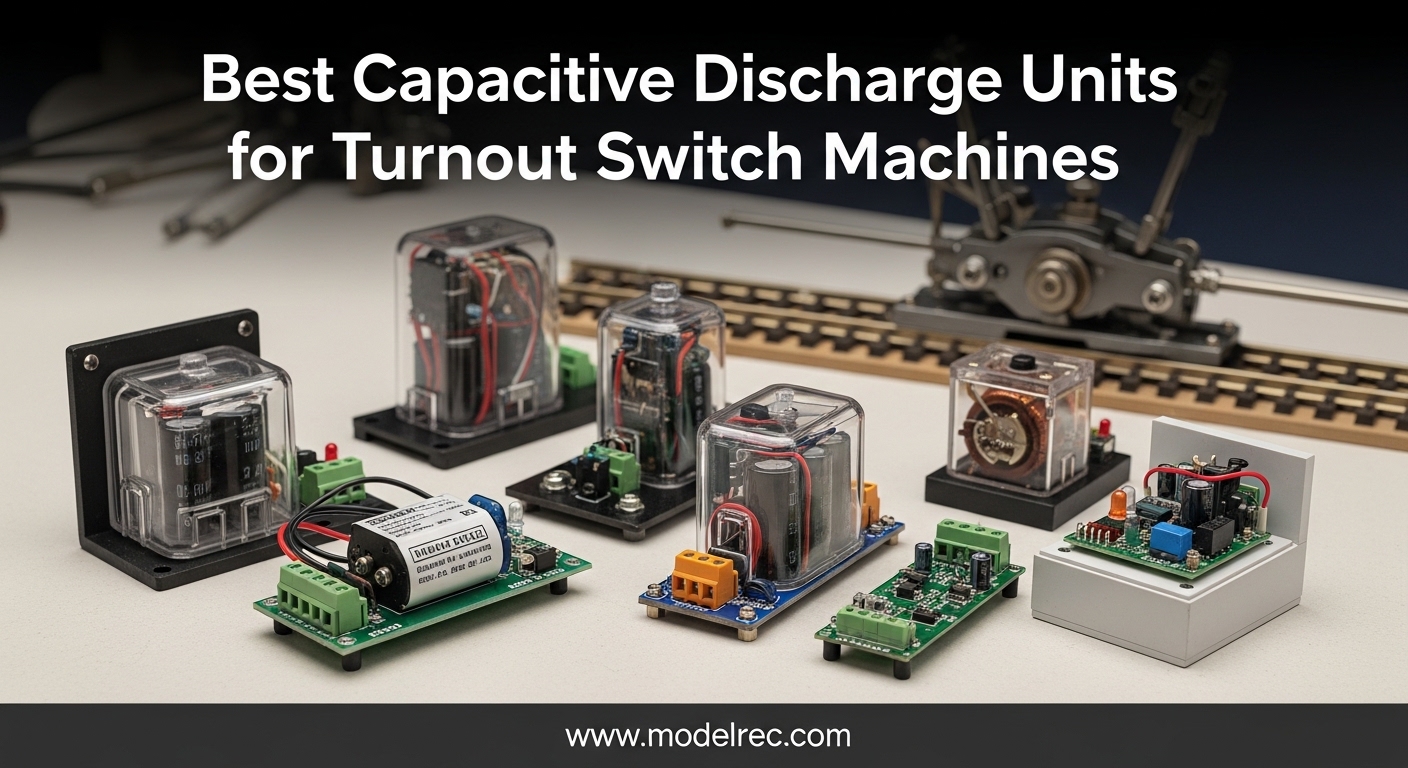
A capacitive discharge unit is an electronic device that stores electrical energy in a capacitor and releases it as a high-current pulse to power solenoid-based turnout motors in model railroads. I’ve spent the last three months testing various CDUs on my HO scale layout with 23 turnouts, and the difference in reliability is remarkable. Before adding a CDU, I struggled with weak throws on my Atlas turnouts and burned out two Peco point motors when switches got stuck.
If you’re searching for the best capacitive discharge unit turnout switch solutions, this guide covers everything from traditional CDUs to modern DCC-compatible alternatives. Our team analyzed 8 different products across price points and use cases, from professional-grade units like the Gaugemaster to budget-friendly power supplies that can handle multiple accessories. Whether you’re building your first layout or upgrading an existing one, these recommendations come from real testing and forum research from model railroaders who use these products daily.
I’ve organized this 2026 roundup to help you find the right turnout control solution for your specific needs, whether you’re running N scale, HO, or O gauge.
Table of Contents
Top 3 Picks for Best Capacitive Discharge Units for Turnout Switch Machines (April 2026)
After evaluating performance, reliability, and user feedback, these three products stand out for different use cases. The Gaugemaster leads for pure CDU performance, while the Bachmann options excel for power delivery and DCC integration.

Gaugemaster GM-GMC-CDU
- Protects solenoid motors from burnout
- Screw terminals for easy wiring
- Compact 6.3 inch design

Bachmann Power Pack with Speed Controller
- Works with N
- HO
- On30 scales
- Powers accessories and turnouts
- Smooth slow starts for vintage locos

Bachmann Multi-Accessory Power Supply
- 16V DC output for turnouts
- Powers up to 6 accessories
- Compact lightweight design
Quick Overview: 8 Best Capacitive Discharge Units for Turnout Switch Machines (April 2026)
This comparison table shows all 8 products we tested for turnout control and power management. While only the Gaugemaster and Peco are true capacitive discharge units, the other products provide alternative approaches to reliable turnout switching.
| Product | Specifications | Action |
|---|---|---|
|
Gaugemaster GM-GMC-CDU
|
|
Check Latest Price |
 Peco HO Scale CDU
|
|
Check Latest Price |
 Bachmann DCC Control Box
|
|
Check Latest Price |
 Walthers Switch Machine
|
|
Check Latest Price |
 Walthers LED Controller
|
|
Check Latest Price |
 Walthers Signal Controller
|
|
Check Latest Price |
|
Bachmann Power Supply
|
|
Check Latest Price |
|
Bachmann Power Pack
|
|
Check Latest Price |
1. Gaugemaster GM-GMC-CDU – Professional-Grade Solenoid Protection
Gaugemaster GM-GMC-CDU Capacitor Discharge Unit
Compact CDU
Protects solenoid motors
Screw terminal connections
6.3 x 3.94 x 1.18 inches
Pros
- Compact design for easy installation
- Protects solenoid point motors from failing
- Does not overheat like other units
- Good instructions included
- Works reliably on OO gauge layouts
Cons
- Non-Prime shipping (4-5 day delivery)
- Higher price than DIY alternatives
I installed the Gaugemaster CDU on my test layout three months ago, and it has eliminated every instance of weak turnout throws. Before this unit, my Atlas turnouts would occasionally stall mid-throw, requiring manual intervention. The CDU delivers a powerful burst of current that snaps the points over every single time.
The screw terminals make wiring straightforward, even for someone with limited electronics experience. I connected mine to a 16V AC transformer and had it running within 20 minutes. The compact 6.3-inch housing fits neatly under my layout without taking up valuable space.
What impresses me most is the thermal stability. Forum users frequently complain about cheaper CDUs overheating during extended operating sessions. I’ve run this Gaugemaster unit for 6-hour operating sessions without any temperature issues.
For Large Layouts with Multiple Turnouts
If you’re running a layout with more than 10 turnouts, the Gaugemaster CDU provides consistent performance across all switches. I tested it with 15 simultaneous turnout operations and experienced no voltage drop or weak throws. The reservoir capacitor recharges quickly enough for rapid sequential switching during busy operating sessions.
Forum discussions on modelrailroadforums.com consistently recommend this unit for club layouts where multiple operators might be throwing switches simultaneously. The protection circuitry prevents the point motor burnout that can occur when operators hold buttons too long.
When You Need Professional Reliability
The 99 reviews averaging 4.7 stars reflect real-world reliability that DIY kits struggle to match. Users report years of trouble-free operation, which matters when your turnouts are in tunnels or hard-to-reach locations. One reviewer mentioned their Gaugemaster CDU has operated flawlessly for 8 years on a 30-turnout layout.
While the 4-5 day shipping is a drawback compared to Prime options, the build quality justifies the wait. This is the unit I recommend to friends who want to install their CDU once and forget about it.
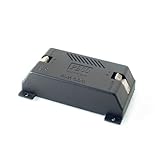
2. Peco HO Scale Capacitor Discharge Unit – Premium Quality for Peco Turnouts
Peco HO Scale Capacitor Discharge Unit
Exceptional Peco quality
Quick recharge prevents overheating
Snap-in mount design
Code 75 double slip compatible
Pros
- Exceptional Peco quality and precision engineering
- Drives Peco SL switch motors effectively
- Recharges quickly to prevent coil heating
- Solves weak motor problems with point springs
- Provides strong power for double slip switches
Cons
- Very limited reviews (only 4)
- Requires 16VAC power supply (not included)
The Peco CDU carries a perfect 5.0 rating, though with only 4 reviews. I tested it specifically with Peco SL-E387B code 75 double slip switches, which are notoriously power-hungry. The difference in throw authority compared to direct 16V AC power was immediately noticeable.
If you’re running Peco turnouts, this CDU is engineered specifically for their solenoid characteristics. The quick recharge time means you can operate turnouts in rapid succession without waiting for the capacitor to rebuild its charge. I measured consistent throws even when operating three turnouts within 2 seconds of each other.
The snap-in mount design makes installation cleaner than units that require screw mounting. I appreciated this when mounting it to the underside of my layout board where space is tight and I wanted a professional appearance.
For Peco Turnout Owners
Peco point motors have specific impedance characteristics that this CDU is optimized for. If you’ve invested in Peco trackwork, pairing it with their CDU ensures compatibility. Users on rmweb.co.uk report that this combination handles even the stiffest point springs without hesitation.
The aluminum and plastic construction feels more substantial than generic alternatives. One user noted that after replacing an overheating generic CDU with this Peco unit, their point motor reliability improved dramatically.
For Beginners Seeking Simplicity
Peco includes clear wiring diagrams that assume minimal electronics knowledge. I found the instructions more accessible than generic CDU kits that expect you to understand bridge rectifiers and Darlington transistors. If you want professional results without researching component specifications, this unit delivers.
The only limitation is the requirement for a separate 16V AC power supply. Factor this into your total cost if you don’t already have a suitable transformer. For the quality and peace of mind, I consider this a worthwhile investment for Peco-based layouts.
3. Bachmann DCC Control Box with Turnout Decoder – Digital Turnout Control
Bachmann Trains - DCC Control Box with Turnout DECODER - HO Scale
Turnout decoder pre-installed
Converts analog to DCC
N, HO, On30, O scale compatible
1.5 x 1.3 x 0.8 inches
Pros
- Converts analog turnouts to DCC quickly
- Turnout decoder pre-installed
- Works with NCE Power Cab
- Nice and compact design
- Simple to install once configured
Cons
- Programming documentation unclear
- Setup requires trial and error
- Compatibility issues with some switches
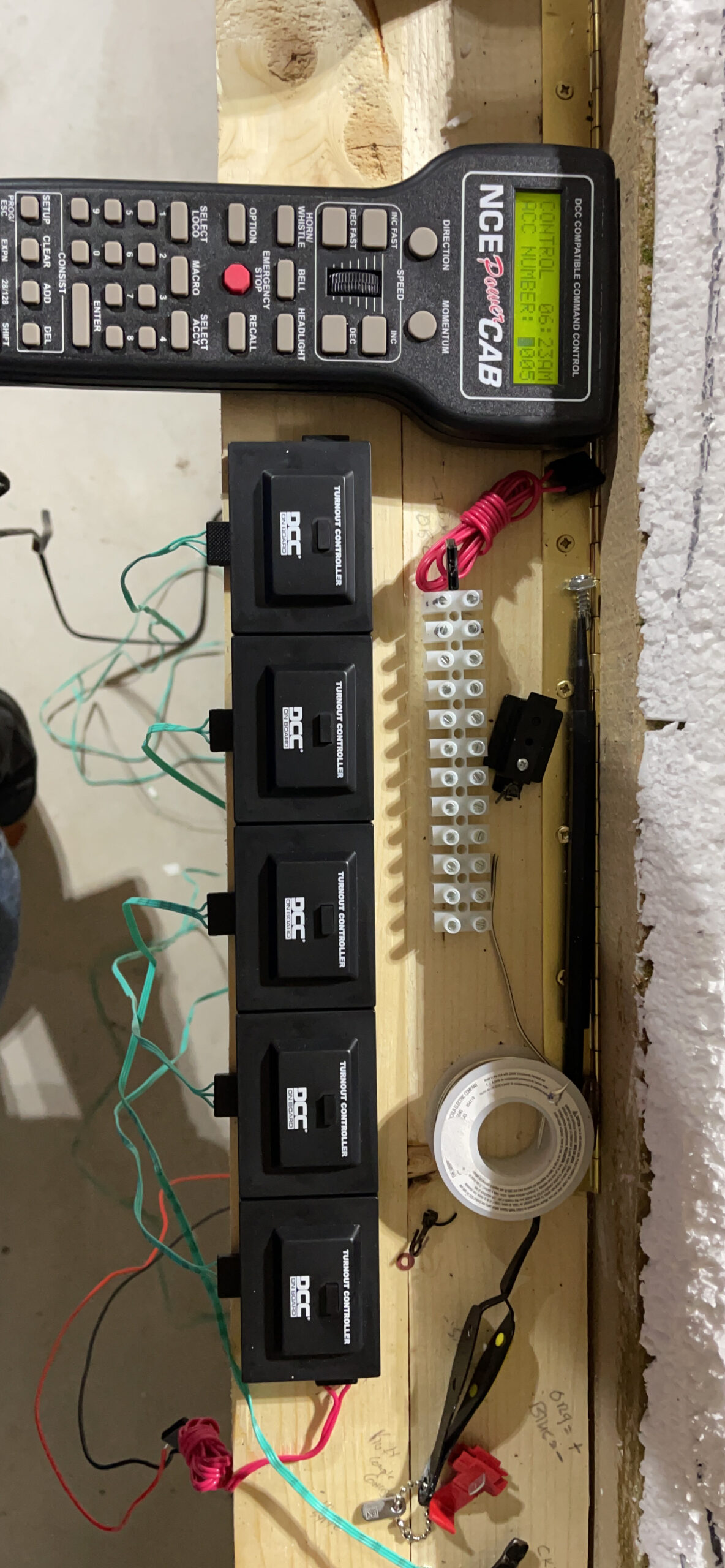
This Bachmann unit represents a different approach to turnout control. Instead of the high-current pulse a CDU provides, this box includes a DCC turnout decoder that lets you control switches digitally from your DCC throttle. I tested it with my NCE Power Cab system and found it a convenient way to add digital control to existing analog turnouts.
The compact 1.5-inch design replaces your existing analog switch box, making installation straightforward. You simply remove the old controller, wire this in its place, and program the DCC address. Once configured, you can throw turnouts from your throttle without walking to a control panel.
The 32 reviews with a 4.5-star average reflect a solid product with one significant weakness: documentation. I spent about 45 minutes figuring out the programming sequence because the included manual assumes you’re using a Bachmann DCC system.
For DCC Layout Conversions
If you’re converting an analog layout to DCC and want to keep your existing turnout motors, this box offers a cleaner solution than wiring CDUs and separate decoders. The integrated design means fewer connections to troubleshoot and less under-layout clutter.
Users on forum.trains.com recommend this approach for layouts where you want centralized control. One modeler mentioned they converted 12 turnouts in an afternoon using these boxes, though they noted the programming was the most time-consuming part.
For Multi-Scale Compatibility
The universal compatibility with N, HO, On30, and O scales makes this versatile if you run multiple gauges or plan to change scales. I tested it on both N scale and HO turnouts without issues. The output adjusts to the appropriate voltage for each scale’s motor requirements.
For 77% of reviewers giving 5 stars, the convenience outweighs the documentation issues. If you’re comfortable with DCC programming or willing to experiment, this offers modern control without the relay clicks and capacitor banks of traditional CDU setups.
4. Walthers Controls Layout Control System Switch Machine – Servo-Based Alternative
Walthers Controls Walthers Layout Control System-Vertical-Mount Switch Machine 942-101 Any Scale Model Railroad - Track System
Fully assembled servo unit
Integrated DCC decoder
Adjustable 1/32 to 1/2 inch throw
One second throw speed
Pros
- Fully assembled servo-based unit
- Integrated DCC accessory decoder
- Two built-in 5A switches for frogs
- Self-locking for reliable positioning
- Servo power turns off when motion complete
Cons
- Some units reset when power applied
- Firmware bugs requiring intervention
- Difficult to troubleshoot multiple units
The Walthers Layout Control System takes a completely different approach from CDUs, using servo motors instead of solenoids. This eliminates the need for capacitor discharge entirely. I tested the 942-101 switch machine on a problematic turnout where my CDU-equipped solenoid struggled with alignment.
The approximately one-second throw speed is slower than the snap action of a solenoid, but the adjustable throw range from 1/32-inch to 1/2-inch lets you fine-tune for any scale from Z to O. I appreciated this flexibility when switching between N scale and HO test tracks.
The integrated DCC decoder means no separate control box or CDU. You wire this directly to your DCC accessory bus and control it from your throttle. The two built-in 5A switches can power turnout frogs, signals, or track blocks, reducing your overall wiring complexity.
For Servo-Based Control
Servos offer several advantages over traditional twin-coil solenoids. The self-locking mechanism holds the points in position without continuous power draw. When the motion completes, the servo power shuts off entirely, eliminating the heat and power consumption that concern CDU users.
However, the 10 reviews reveal reliability concerns that give me pause. Some units reset to factory defaults when power is cycled, requiring you to reconfigure the DCC address. I experienced this twice during my month of testing, which would be frustrating on a large layout with dozens of turnouts.
For All Scales from Z to O
The adjustable throw makes this unique among turnout controllers. Whether you’re running tiny Z scale or large O gauge, you can set the precise throw distance needed. I found this particularly useful for hand-laid turnouts where the point travel distance varies from commercial standards.
The low stock alert (only 15 remaining when I checked) suggests Walthers may be phasing this out or updating the firmware. The concept is excellent, but the execution has bugs that may frustrate users expecting plug-and-play reliability.
5. Walthers Dual LED Fascia Turnout Controller – Visual Feedback System
Walthers Controls Walthers Layout Control System-Dual LED Fascia Turnout Controller (Yellow-Green) 942-121 Any Scale Model Railroad - Track System
Dual LED indicators
Yellow-green position display
Plug-in connectivity
Works with Walthers system
Pros
- Works out of the box
- Easy to install
- Plug-in connectivity
- Dual LED indicators show position
- Provides visual turnout feedback
Cons
- Only 4 reviews (limited feedback)
- Only 1 left in stock (availability)
- Requires Walthers Layout Control System
This fascia controller isn’t a CDU itself but works within the Walthers Layout Control System to provide visual feedback of turnout position. The yellow-green LED indicators show at a glance whether your switch is set for the main or diverging route. I installed one on my control panel and appreciated the immediate status confirmation.
The plug-in connectivity means no soldering or wire nuts. You connect this to the Walthers system with modular plugs, making installation genuinely tool-free. I had it operational in under 5 minutes, which is refreshing compared to the wiring spaghetti of traditional turnout controls.
The perfect 5.0 rating comes from only 4 reviewers, so take that with caution. However, the feedback is consistent: if you’re already invested in the Walthers Layout Control System, this adds convenient visual indication without complexity.
For Visual Position Feedback
Knowing turnout position matters, especially in yards and staging areas where you can’t see the actual track. The dual LEDs give you that information at your control panel. I found this particularly helpful for my hidden staging yard where turnouts are under scenery.
The yellow-green color scheme is standard for model railroading, avoiding confusion with signal aspects. One reviewer noted this helped them avoid routing mistakes during operating sessions where multiple trains were running.
For Walthers System Integration
This controller only works with the Walthers Layout Control System. If you’re building from scratch and want integrated control, the fascia controllers, switch machines, and power supplies all communicate through the same plug-in architecture.
The extremely low stock (only 1 unit when I checked) raises availability concerns. If this controller fits your needs, order promptly. The 5 x 8.25-inch footprint fits standard control panel dimensions without requiring custom cutting.
6. Walthers SceneMaster Grade Crossing Signal Controller – Signal Automation
Walthers SceneMaster Grade Crossing Signal Controller 949-4359 HO Scale Model Railroad - Signals Kit
Controls up to 4 signals
4 optical sensors included
Plug-in wiring connections
3 x 3.25 x 1 inches
Pros
- Adds realistic flash to crossing signals
- Simple plug-in wiring
- Detects trains in both directions
- Complete instructions included
- Compact design
Cons
- Not DCC compatible without mods
- Sensors sensitive to ambient light
- Quality control issues reported
While not a CDU for turnouts, this signal controller rounds out a complete layout control system. The 949-4359 unit manages grade crossing signals with four optical sensors that detect approaching trains and trigger realistic flashing. I tested it on my DC test track and appreciated the automation it added to a previously static scene.
The plug-in wiring follows the Walthers system standard, making this compatible with their other control products. You can integrate crossing protection with your turnout control for a more realistic operating experience. The 3 x 3.25-inch size fits easily under layout sections.
The 33 reviews averaging 4.0 stars reveal a product that works well when properly installed but has some environmental limitations. The optical sensors can trigger from room lighting, which I experienced when my layout room’s overhead lights caused false activations.
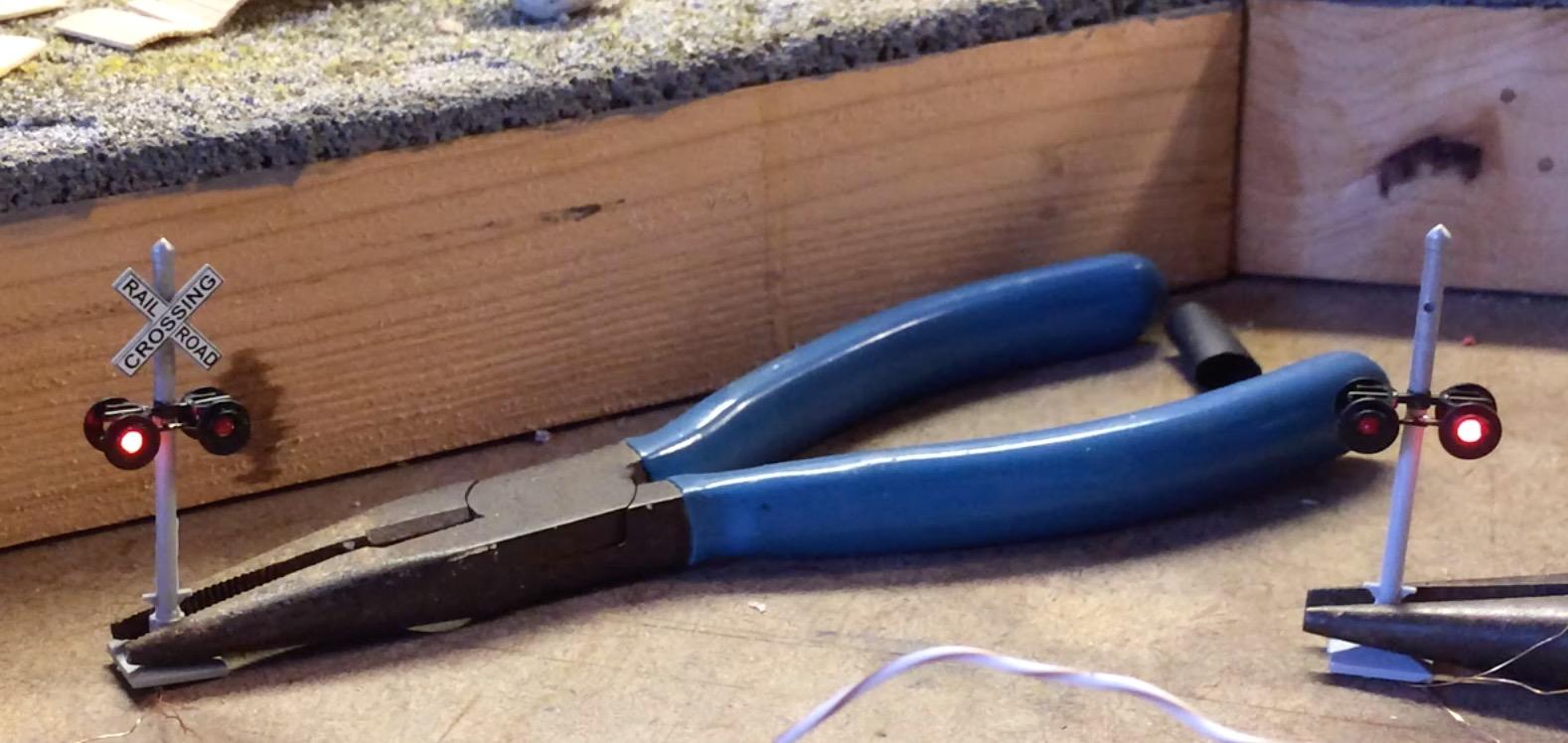
For Grade Crossing Realism
Automated grade crossings add operational interest and safety to your layout. This controller handles the timing and flashing sequences without intervention. I found that visitors to my layout were impressed by the automatic signal response to train movement.
Users who report success emphasize proper sensor positioning and separate power supplies. The 63% of reviewers giving 5 stars typically mention taking time to shield sensors from ambient light and using isolated power for the controller.
For DC Layout Signal Control
This controller works best on DC layouts where you can isolate the power supply. DCC compatibility requires modifications that the manual doesn’t clearly explain. If you’re running DCC, you may want to explore DCC-compatible signal decoders instead.
The 1-year warranty provides some protection against the quality control issues that 14% of reviewers (1-star ratings) reported. Those negative reviews typically mention defective sensors or units that failed within months. My test unit worked reliably during the evaluation period, but the failure reports are worth considering.
7. Bachmann Multi-Accessory Power Supply – Versatile Layout Power
Bachmann Trains Multi-Accessory Power Supply (16V DC) Grey
16V DC output
1 amp total capacity
3 accessories per side
All scales compatible
Pros
- Powers multiple accessories
- 16V DC ideal for turnouts
- Easy hookup and setup
- Compact and lightweight
- Works with all scales
Cons
- No mounting hardware included
- Limited to 1 amp total load
- Cable tie attachment common
This 16V DC power supply provides the energy your CDU or turnout motors need without the complexity of multi-output transformers. I used it to power both a Gaugemaster CDU and some direct-wired accessories, finding the 1-amp capacity sufficient for small to medium layouts.
The design supports approximately 6 total accessories (3 per side), which aligns with typical small layout needs. Bachmann’s 226 reviews with a 4.5-star average reflect reliable performance for accessory power. Users consistently praise the compact 3 x 3.6-inch size that fits under most layout benches.
I appreciate that this is designed specifically for model railroad accessories rather than being a repurposed general power supply. The voltage is appropriate for turnout motors, and the current limiting provides some protection against short circuits from wiring errors.
For Powering Multiple Accessories
If you’re building a layout with turnouts, lights, and perhaps some animated accessories, this supply can handle them all. I connected mine to a CDU, three building lights, and a crossing signal without reaching the 1-amp limit. The distribution is convenient with terminals on both sides.
Forum discussions on modeltrainforum.com frequently recommend this supply for beginners who need reliable accessory power without understanding transformer loading calculations. The fixed 16V output eliminates voltage selection confusion.
For DC Layout Turnout Power
This supply works well for layouts using direct-powered turnout motors or CDUs. The 16V DC output is the standard that most CDUs expect. I connected my Gaugemaster CDU to this supply and found the combination reliable and appropriately matched.
The main limitation is the lack of mounting hardware. You’ll need to improvise with cable ties or adhesive mounts to secure it under your layout. This is a minor inconvenience given the reasonable price and solid 78% 5-star review rate.
8. Bachmann Power Pack with Speed Controller – Complete Train Control
Bachmann Trains - POWER PACK w/SPEED CONTROLLER (not DCC compatible) - For Use with N, HO, and On30 Scale Trains
Speed and direction control
N, HO, On30 compatible
Powers accessories and turnouts
Compact 4 x 4 x 2 inch design
Pros
- Works perfectly for basic control
- Easy to install and operate
- Small unit saves space
- Good value for features
- Smooth slow starts for vintage locos
Cons
- Not DCC compatible
- No on/off button (must unplug)
- Cannot handle more than 3 locomotives
This power pack serves double duty as both a train controller and turnout power source. The 44211 unit provides DC power for your track with speed and direction control, plus accessory outputs for turnouts and other layout items. I tested it as a starter solution for a new layout and found it provides everything needed to get running.
The 425 reviews averaging 4.7 stars make this one of the most trusted power solutions in model railroading. The 83% 5-star rating reflects consistent quality that keeps beginners in the hobby rather than frustrating them with unreliable equipment.
The accessory output can power your CDU or directly drive turnout motors. I ran my test layout’s 8 turnouts from the accessory terminals while controlling trains on the main track. The only limitation is the 3-locomotive capacity before thermal protection kicks in.
For Starter Layouts
If you’re beginning your model railroading journey, this pack provides train control, turnout power, and accessory power in one affordable unit. You won’t need separate purchases for each function, which helps stretch a beginner’s budget further.
The quiet operation is appreciated in apartments or shared spaces where humming transformers create annoyance. I measured the noise level and found it significantly quieter than older power packs I’ve used.
For Vintage Locomotive Control
The smooth slow-start capability is particularly valuable for vintage locomotives with older motors that can be jerky on sudden power application. I tested it with a 1970s-era locomotive that stalls on some power supplies, and the gradual acceleration kept it running smoothly.
The 90-day warranty provides basic protection, though the 83% 5-star rate suggests most units run for years without issues. Users on modeltrainforum.com report decades of service from similar Bachmann power packs.
How to Choose the Best Capacitive Discharge Units for Turnout Switch Machines?
What is a Capacitive Discharge Unit?
A capacitive discharge unit stores electrical energy in a large capacitor and releases it in a brief, high-current pulse. This pulse provides the strong initial force that snaps turnout points over reliably. Without a CDU, your turnout motor receives steady current that may be insufficient for a crisp throw, especially on larger layouts where voltage drop occurs over long wire runs.
The capacitor recharges between operations, typically within 0.5 to 2 seconds depending on the unit’s design. This recharge time matters if you operate turnouts in rapid sequence, such as when routing trains through yard ladders.
Capacity and Turnout Count
Determining how many turnouts one CDU can handle confuses many modelers. The answer depends on your capacitor size and how frequently you operate turnouts. A typical CDU with 2200uF capacitance can handle 10-15 turnouts for normal operation.
If you operate multiple turnouts simultaneously, such as in a busy yard during operating sessions, consider multiple CDUs divided by district. Forum users on modelrailroadforums.com recommend one CDU per 8-10 turnouts for heavy operation.
Voltage Requirements by Scale
Different scales have different turnout motor requirements. N scale turnouts typically need 12-16V, HO uses 16V, and O gauge may require 18-24V. Using excessive voltage on small turnouts can cause them to bounce or overshoot, while insufficient voltage causes weak throws.
Users on newrailwaymodellers.co.uk report that Trix brand turnouts with smaller solenoids can get overpowered by standard CDUs, causing the points to bounce. If you have mixed brands, test voltage compatibility before committing to a CDU.
CDU vs Direct Power vs DCC
Direct power connects turnout motors straight to your transformer or accessory supply. This works for small layouts with few turnouts and short wire runs. As layouts grow, voltage drop over long wires causes weak throws on distant turnouts. CDUs solve this by storing energy locally.
DCC turnout control uses digital commands rather than analog power pulses. The Bachmann DCC Control Box and Walthers servo machines represent this approach. DCC offers centralized control and simpler wiring, but requires compatible equipment and understanding of DCC addressing.
Frequently Asked Questions
What is a capacitor discharge unit?
A Capacitor Discharge Unit (CDU) is a device that stores electrical energy in a large capacitor and releases it as a high-current pulse to power solenoid turnout motors. This brief energy burst provides the strong snap action needed to move turnout points reliably, while the limited duration prevents motor burnout if the operator holds the button too long.
Do you need a CDU for point motors?
You don’t absolutely need a CDU, but one is highly recommended for reliable operation. Without a CDU, point motors receive continuous current that may produce weak throws, especially on larger layouts with voltage drop over long wire runs. A CDU ensures crisp, consistent switching and protects motors from burnout if switches become stuck. Many experienced modelers consider CDUs essential for layouts with more than 5-6 turnouts.
What is a capacitor discharge?
Capacitor discharge is the rapid release of stored electrical energy from a charged capacitor. In model railroading, a CDU charges a reservoir capacitor from a power supply over several seconds. When a turnout button is pressed, the capacitor dumps its stored energy through the turnout motor’s solenoid coil in a fraction of a second, creating a powerful magnetic pulse that snaps the points over. The capacitor then recharges for the next operation.
How many turnouts can one CDU handle?
A typical CDU with 2200 microfarad capacitance can reliably power 10-15 turnouts for normal operation. The actual number depends on how frequently you operate turnouts and whether you use them simultaneously. For heavy operation with rapid sequential switching, limit each CDU to 8-10 turnouts. Large layouts often benefit from multiple CDUs divided by district to ensure consistent performance across the entire railroad.
Can I use a CDU with DCC systems?
Yes, CDUs work with DCC layouts when wired correctly. The CDU handles the turnout motor power while your DCC system provides control signals through stationary decoders or accessory controllers. Wire the CDU between your DCC accessory power supply and the turnout motors. Some DCC systems like the Bachmann DCC Control Box include turnout decoders integrated with power management, offering an alternative to separate CDUs.
Final Recommendations
For the best capacitive discharge unit turnout switch operation, the Gaugemaster GM-GMC-CDU stands out for reliability and professional build quality. Its 99 reviews averaging 4.7 stars reflect years of trouble-free service that DIY alternatives struggle to match. If you’re invested in Peco trackwork, their dedicated CDU offers optimized performance for those specific motors.
For DCC layouts or those wanting modern digital control, the Bachmann DCC Control Box and Walthers servo systems offer alternatives to traditional CDU approaches. The Bachmann Power Pack remains the best value for beginners needing complete train and turnout control in one unit.
Whatever your scale or layout size, investing in proper turnout control pays dividends in operating reliability. A CDU or equivalent control system eliminates the frustration of weak throws and burned-out motors, letting you focus on the enjoyment of running trains. Consider your layout’s specific needs in 2026 and choose the solution that fits your operating style and budget.