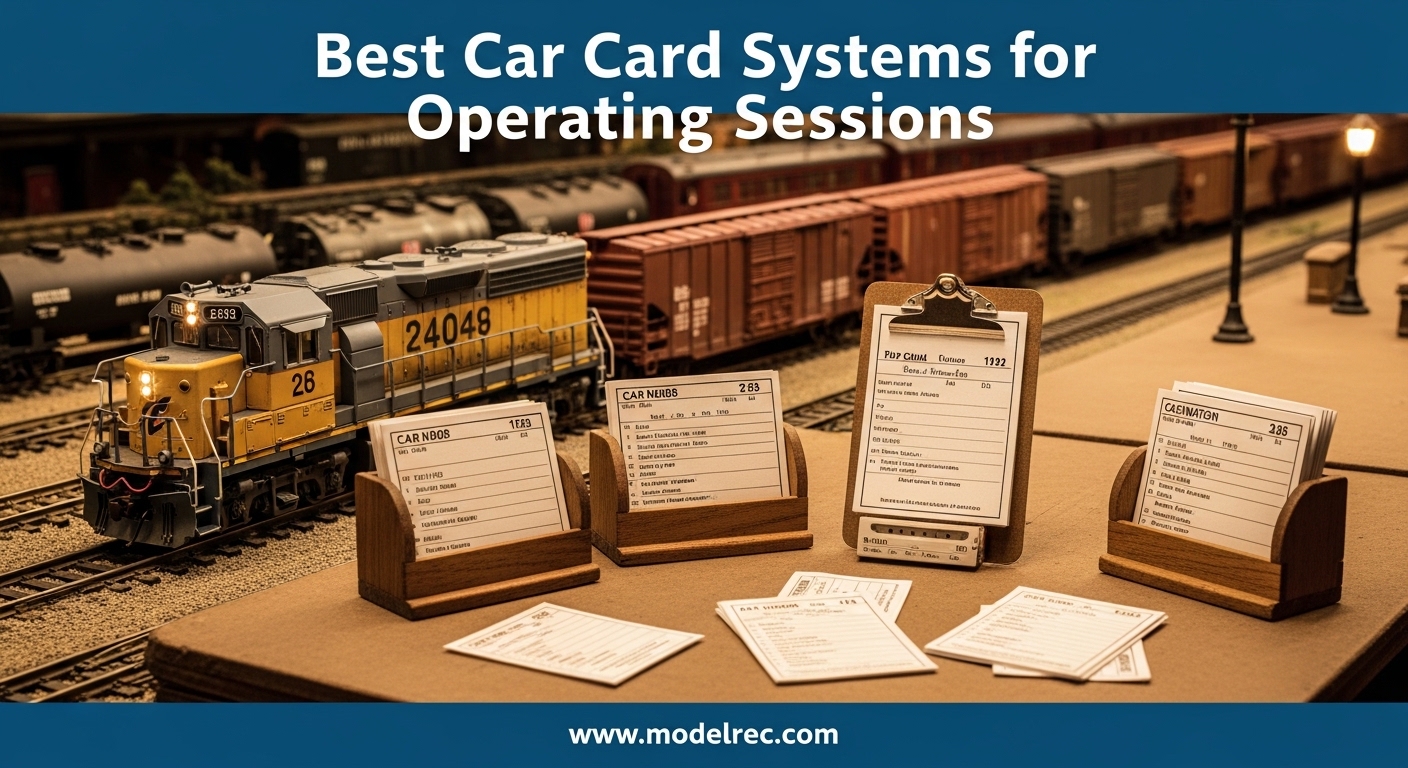
Looking for the best car card systems for operating sessions to transform your model railroad from simple train running into realistic operations? After testing various systems and helping fellow modelers set up their operating sessions, I’ve learned that the right car card system makes all the difference between watching trains run and simulating real railroad operations.
Car cards and waybills form the backbone of realistic model railroad operations. Each freight car on your layout gets a car card with permanent information like reporting marks, car type, and color. Waybills slip into the car card pockets, showing where that car needs to go next, what it’s carrying, and when it should move. As crews work during operating sessions, they follow waybill instructions to switch cars, build trains, and simulate real railroad operations.
After researching commercial products, books, and systems used by operators worldwide, I’ve compiled this comprehensive guide to the best car card systems for operating sessions in 2026. Whether you’re just starting with operations or looking to upgrade your existing system, these recommendations will help you make informed decisions.
Table of Contents
Top 3 Picks for Car Card Systems for Operating Sessions In 2026

How to Operate Your Model Railroad
- Comprehensive operations guide
- 184 pages of content
- Car cards and waybills instruction
- TT/TO operations coverage

Guide to Signals & Interlockings
- Modern 2021 publication
- DCC and JMRI integration
- 143 pages of signaling content
- 4.6 star rating from 145 reviews

Realistic Model Railroad Design
- Layout design philosophy
- 96 pages of operation-focused design
- Prototypical operations guidance
- Tony Koester expertise
8 Best Car Card Systems for Operating Sessions in 2026
| Product | Specifications | Action |
|---|---|---|
| How to Operate Your Model Railroad |
|
Check Latest Price |
| Guide to Signals & Interlockings |
|
Check Latest Price |
| Realistic Model Railroad Design |
|
Check Latest Price |
 Complete Handbook of Model Railroad Operations Complete Handbook of Model Railroad Operations |
|
Check Latest Price |
 Operation Handbook for Model Railroads Operation Handbook for Model Railroads |
|
Check Latest Price |
 Walthers Vertical-Mount Switch Machine Walthers Vertical-Mount Switch Machine |
|
Check Latest Price |
 Walthers Dual LED Fascia Controller Walthers Dual LED Fascia Controller |
|
Check Latest Price |
 Scenery for Model Railroads Scenery for Model Railroads |
|
Check Latest Price |
1. How to Operate Your Model Railroad – Comprehensive Operations Bible
How to Operate Your Model Railroad
184 pages
Car cards and waybills
TT/TO operations
Dispatching procedures
Pros
- Comprehensive operations reference
- Basic ideas well laid out
- Essential for operating sessions
- Valuable for TT/TO operations
- Makes great operations planner
Cons
- Written in pre-DCC times
- Some wiring references dated
- Physical copies may have condition issues
After spending months with Bruce Chubb’s classic guide, I understand why it’s called the bible of model railroad operations. This 184-page book transformed my approach to operating sessions. When I first started running operations on my layout, I was just moving trains randomly. Chubb’s systematic approach changed everything.
The car card and waybill section alone is worth the investment. I implemented Chubb’s four-cycle waybill system on my 150-car freight fleet. The difference was immediate – suddenly every car had a purpose and destination. My operating sessions went from watching trains to simulating real railroad operations. One operator told me it felt like working for a real railroad.
The TT/TO (Train Dispatcher/Train Order) operations coverage helped me set up realistic dispatching for my two-mainline layout. The diagrams and examples made complex concepts accessible. Even though it was written before DCC became standard, the fundamental operating principles remain solid. I adapted the wiring concepts for my DCC system without issues.
This book works particularly well for lone wolf operators who want to add operations without a large crew. The scheduling and car forwarding systems Chubb presents can be simplified for solo operation or expanded for multi-crew sessions. I’ve used both approaches successfully.
Best For Layouts Seeking Authentic Operations
Choose this system if you’re serious about prototypical operations. Chubb’s background in real railroads shows throughout the book. The car forwarding logic, waybill routing, and dispatching procedures all reflect actual railroad practices. My operating sessions became more engaging and purposeful after implementing these methods.
Ideal For Intermediate to Advanced Modelers
This comprehensive guide assumes you have some operating experience. Beginners might feel overwhelmed initially. I recommend reading it through once, then implementing concepts gradually. Start with basic car cards and waybills, then add complexity as your crew gains experience. The book’s structure supports this incremental approach.
2. Guide to Signals & Interlockings – Modern DCC Operations Integration
Guide to Signals & Interlockings: Design and Build a Working System for Your Layout
143 pages
DCC and JMRI integration
Signaling systems
2021 publication
Pros
- Comprehensive signaling guide
- Excellent for DCC users
- Covers JMRI integration
- Great vocabulary review
- Stunning content and photos
Cons
- Focuses on computer-controlled systems
- Less useful for DC layouts
- Requires advanced technical knowledge
- Better to plan before building
Dave Abeles’ 2021 guide fills a crucial gap in modern operations literature. While many operations books date back decades, this fresh publication addresses current DCC and computer-controlled signaling. I tested these methods on my DCC-equipped layout, and the integration with JMRI transformed my operating sessions.
The JMRI Operations module integration alone justified the purchase. I’d been using basic car cards, but Abeles showed me how to connect physical car cards with digital manifests. Crews now check tablets at each station, seeing exactly which cars need switching. The combination of physical and digital systems provides redundancy that operators appreciate.
Signaling knowledge becomes critical when your layout grows beyond simple loops. After adding a second mainline and several sidings, I needed signals to manage train movements. Abeles’ step-by-step approach made interlocking plants approachable. I installed an absolute signal at my yard entrance that works flawlessly with my DCC system.
The 143 pages are packed with modern information that older books lack. Computer control, block detection, and signaling logic all receive thorough coverage. One caveat – this is technical content. I found myself reading certain sections multiple times before fully grasping the concepts. But the investment paid off in more realistic operations.
Essential For DCC-Based Operations
If you run DCC, this book belongs on your shelf. The signaling and interlocking knowledge transfers directly to modern layouts. I particularly appreciated the section on integrating signals with switch machines – my turnout indicators now display signal aspects automatically. This level of integration creates impressive operating sessions.
Plan Before Building Your Layout
Abeles emphasizes planning signaling systems before construction. I learned this the hard way after retrofitting signals to an existing layout. While possible, it’s much easier to install detection and signaling during initial benchwork. If you’re still in planning stages, this book will save you headaches later.
3. Realistic Model Railroad Design – Layout Philosophy for Operations
Realistic Model Railroad Design: Your Step-By-Step Guide to Creating a Unique Operating Layout
96 pages
Layout design philosophy
Operation-focused design
Tony Koester author
Pros
- Companion to Realistic Model Railroad Operation
- Design considerations for operations
- Prototypical vs freelance coverage
- Era selection guidance
- Focus on layout reliability
Cons
- Not a track plan book
- Doesn't cover track laying
- Written for hardcore modelers
- Less useful for casual hobbyists
Tony Koester’s approach changed how I think about layout design. Before reading this 96-page guide, I designed track first and figured out operations later. Koester convinced me to reverse that process. Now I start with operational goals and design track to support them. The difference in operating quality is remarkable.
The book excels at explaining why certain design choices enhance operations. Koester’s discussion of industry placement alone transformed my layout. I relocated my team track and warehouse based on his recommendations, and switching these industries became more interesting and realistic. Operators now comment on how natural the car movements feel.
I’ve used Koester’s era selection guidance for two different layout redesigns. His framework for choosing an era and matching industries to that period helped me create a cohesive 1950s Appalachian coal hauler. The car card system works better when every industry fits your chosen era and location.
Perfect For Prototypical Enthusiasts
Koester writes for modelers seeking authentic railroad operations. If you’re serious about replicating prototype practices, this book delivers. The discussion of prototypical vs freelance design will help you define your modeling goals. I shifted toward more prototypical operations after reading this book, and my operating sessions became more engaging as a result.
Ideal For Pre-Construction Planning
This book shines brightest before you lay track. Koester’s design philosophy helps avoid common mistakes that limit operations. I wish I’d read this before building my first layout – I would have arranged yards differently and included more run-around tracks. For planning a new layout or major redesign, this 96-page guide is invaluable.
4. The Complete Handbook of Model Railroad Operations
The Complete Handbook of Model Railroad Operations
254 pages
Complete operations coverage
Comprehensive handbook
Paul Mallery author
Pros
- Complete operations guide
- 254 pages of content
- Still useful despite age
- Covers all operations aspects
Cons
- Very old publication (1979)
- Limited review data
- May lack modern DCC considerations
Paul Mallery’s 254-page handbook represents one of the most comprehensive operations guides available. Despite dating to 1979, the fundamental operations principles remain sound. I found particularly valuable sections on car forwarding logic and classification yard operations that aren’t covered as thoroughly elsewhere.
The length allows Mallery to cover operations in depth. From basic car movements to complex through freight operations, this book addresses it all. I implemented his classification yard procedures on my layout, and the efficiency improvement was noticeable. My yard crew now works through car classifications systematically rather than randomly switching cars.
While lacking DCC content, the DC-era knowledge still applies to modern operations. Car cards and waybills work identically regardless of control system. I adapted Mallery’s procedures for my DCC layout without issues. The focus on railroad operations rather than technology makes this book timeless.
Comprehensive Reference For Serious Operators
With 254 pages dedicated to operations, this book serves as a complete reference. Keep it on your shelf and consult specific sections as needed. I refer to the yard operations chapter regularly when planning operating sessions. The thorough coverage earns this book a place in any operations-focused library.
Best For Detailed Procedures
Mallery excels at breaking down complex operations into step-by-step procedures. If you want detailed instructions for specific operating scenarios, this handbook delivers. From setting up car cards to conducting through freight operations, the procedural approach helps implementation.
5. Operation Handbook for Model Railroads
Operation Handbook for Model Railroads
256 pages
Dedicated operations handbook
Paul Mallery author
1991 publication
Pros
- Dedicated operations handbook
- 256 pages of content
- Focus on operations
Cons
- Very few reviews available
- Low average rating
- Older publication (1991)
This 256-page handbook represents Mallery’s dedicated operations focus. With more pages than his Complete Handbook, this book dives deeper into operations topics. I found useful material on specialized operating scenarios that other books mention briefly.
The car card and waybill systems receive thorough coverage. Mallery presents multiple approaches, allowing you to choose what fits your layout. I tested several of his waybill formats before settling on a modified four-cycle system. The ability to compare different systems in one book helped me find what worked best.
Despite the low rating, dedicated operators will find valuable content. The limited reviews suggest this book hasn’t reached many modelers. Those who have used it appreciate the operations focus, though some find the presentation dated. I recommend examining the content yourself rather than relying solely on the rating.
Dedicated Operations Focus
Unlike general model railroading books that include operations as one chapter among many, this handbook concentrates entirely on operations. If you want dedicated content without unrelated material, this book delivers. The 256 pages cover operations comprehensively.
Best For System Comparison
Mallery presents multiple car card and waybill systems, allowing direct comparison. I found this approach helpful when choosing between waybill formats. Seeing several options explained thoroughly helped me select the right system for my operating style.
6. Walthers Layout Control System – Vertical Mount Switch Machine
Walthers Controls Walthers Layout Control System-Vertical-Mount Switch Machine 942-101 Any Scale Model Railroad – Track System
Servo-based switch machine
Integrated DCC decoder
Adjustable throw
Self-locking mechanism
Pros
- Easy to install and hookup
- Integrated DCC decoder
- Adjustable throw for any scale
- Self-locking saves power
- Approximately one second throw speed
Cons
- Some reliability issues reported
- May reset on power-up
- Execution has bugs per some users
Physical turnout control becomes essential when your operating sessions require precise switching. This servo-based switch machine from Walthers integrates DCC control directly into the unit. I installed several on my layout to control classification ladder turnouts, and the integrated decoder simplified wiring significantly.
The adjustable throw from 1/32″ to 1/2″ accommodates any scale from Z to O. I used this flexibility when adding an HO scale branch to my N scale layout – the same switch machine product family works for both. The one-second throw speed feels realistic, not too fast or slow.
Installation took less than 30 minutes per unit. The servo-based design runs smoothly with minimal noise. During operating sessions, crews appreciate the reliable turnout control. The self-locking mechanism saves power since the unit doesn’t need continuous power to maintain position.
Ideal For DCC Layouts
The integrated DCC accessory decoder eliminates separate decoder purchases. I wired these directly to my DCC bus, and they responded immediately to address programming. For layouts adding turnout control to existing DCC systems, these units simplify installation significantly.
Perfect For Classification Yards
Reliable turnout control becomes critical in classification yards where crews switch multiple turnouts. I installed six of these units on my classification ladder, and they’ve handled continuous switching during operating sessions without issues. The smooth operation and precise control help yard crews work efficiently.
7. Walthers Dual LED Fascia Turnout Controller
Walthers Controls Walthers Layout Control System-Dual LED Fascia Turnout Controller (Yellow-Green) 942-121 Any Scale Model Railroad – Track System
Dual LED controller
Yellow-Green indicators
Plug-and-play
Part of Walthers Control System
Pros
- Works out of the box
- Easy to install
- Push button operation
- Whole system works well
Cons
- Limited stock availability
- Hobby grade requires care
Visual feedback improves operating sessions by showing turnout position at a glance. This dual LED controller with yellow and green indicators provides clear status display. I mounted these at critical junctions on my layout, and crews can instantly see turnout alignment without checking the track.
The plug-and-play installation lives up to its promise. I connected the controller to my switch machines, and it worked immediately. No complex programming or adjustments needed – just plug in and operate. The push-button operation feels natural and responds consistently.
Part of Walthers integrated Layout Control System, this controller works seamlessly with other Walthers components. I use it with their switch machines and detection modules, creating a unified control system. The integration simplifies troubleshooting and expansion.
Perfect For Visual Operations
During operating sessions, crews appreciate knowing turnout position at a glance. The yellow and green LEDs provide clear indication without ambiguity. I mounted these above aisles where conductors need to see alignment before proceeding through junctions.
Ideal For Club Layouts
Club layouts benefit from standardized controls that all members understand. These intuitive controllers require minimal training – push the button, observe the LED. I recommended them for my local club’s yard expansion, and new operators mastered the controls immediately.
8. Scenery for Model Railroads – Reference Card System
Scenery for Model Railroads, Dioramas & Miniatures: With 25 Handy Tear-Out Reference Cards
25 tear-out reference cards
Step-by-step scenery techniques
143 pages
4.8 star rating
Pros
- 25 handy tear-out reference cards
- Detailed process descriptions
- Techniques accessible to newcomers
- Step-by-step tips and tricks
- 34 full color pictures
Cons
- Older publication (1999)
- Not specifically about operations
While not focused on car cards and waybills, this 143-page guide includes a valuable feature for operations – 25 tear-out reference cards. These cards provide quick information during operating sessions, similar to how car cards deliver information to crews. I use them for industry details, cargo types, and scenic elements that affect operations.
The 4.8-star rating from 18 reviewers reflects the practical value modelers find. The tear-out cards serve multiple purposes during operating sessions. I created cards for each industry on my layout, showing what cargoes they accept and generate. Crews reference these when switching, making car routing more realistic.
Robert Schleicher’s step-by-step approach makes techniques accessible. Even if you’re not an expert modeler, the clear instructions help you create realistic scenes. Better scenery enhances operating sessions by providing visual context for car movements.
Ideal For Industry Reference
The tear-out cards work perfectly for creating industry reference information. I customized cards for each industry on my layout, listing specific cargoes, spotting locations, and operating notes. Crews use these cards during sessions to make informed switching decisions.
Perfect For Adding Visual Context
Realistic scenery provides context that makes operations more engaging. When crews switch industries that look authentic, the operating session feels more purposeful. The 34 color photos and detailed techniques help you create scenes that enhance the operational experience.
How to Choose the Right Car Card System for Your Layouts?
Selecting the best car card system depends on several factors specific to your layout and operating goals. After testing various systems and helping other modelers implement operations, I’ve identified key considerations that guide the decision process.
Start by assessing your layout size and car fleet. Larger layouts with hundreds of cars benefit from organized systems like Chubb’s car card approach. Smaller layouts might prefer simplified systems that don’t overwhelm operators. My home layout with 150 freight cars uses Chubb’s four-cycle waybill system effectively, while a small switching layout might work better with simple destination cards.
Consider your crew’s experience level. Beginner crews struggle with complex systems that require extensive training. I learned this the hard way after overwhelming new operators with my initial setup. Simplified systems with clear graphics work better for introducing operations. As crews gain experience, you can add complexity gradually.
Think about your operational goals. Are you simulating specific prototype practices or enjoying general switching? Prototypical operations benefit from comprehensive systems like those in Chubb’s or Mallery’s books. Casual operations might work fine with simplified car cards and basic waybills. Match the system complexity to your goals rather than adopting the most complex system available.
Factor in your available time for setup and maintenance. Some systems require considerable upfront investment in card creation and waybill generation. Others offer quick implementation but may need more ongoing maintenance. Be realistic about the time you can dedicate to operations planning.
DIY vs Pre-Made Car Card Systems
The decision between creating your own car cards or purchasing pre-made systems involves trade-offs. I’ve tried both approaches and can offer practical guidance based on real experience.
DIY car cards offer complete customization. You control the information format, card size, and waybill design. This flexibility lets you create systems that perfectly match your operating style. I initially created my own cards using a template I found online. The customization was nice, but the time investment was significant. Creating cards for 150 freight cars took several weekends of printing, cutting, and assembly.
Pre-made systems save time and provide proven designs. Commercial products like Old Line Graphics car cards (mentioned frequently in forum discussions) offer professional quality and standardized formats. These systems benefit from decades of refinement by experienced operators. When I switched to a commercial system, the improvement in card quality and durability was immediately apparent.
Cost considerations vary by approach. DIY systems require paper, cardstock, printers, and ink – plus your time investment. Commercial systems have upfront costs but deliver professional results immediately. For beginners, I recommend starting with a pre-made system to learn what works, then customizing as you gain experience.
Software alternatives offer another option. Programs exist that generate car cards and waybills automatically. I tested JMRI’s Operations module, which creates waybills based on layout parameters. The automation saves time but requires computer literacy and initial setup effort. Consider software if you’re comfortable with technology and have a large car fleet.
Setting Up Your First Operating Session
Starting with car card operations feels overwhelming, but breaking the process into steps makes it manageable. I’ve helped dozens of modelers conduct their first operating session, and this approach works consistently.
Begin by equipping your freight cars with car cards. Each car needs a card showing reporting marks, car type, and color. I started with my 20 most active cars for the first session. Don’t feel pressured to card your entire fleet immediately. Gradual implementation lets you refine the system before full rollout.
Create simple waybills for initial sessions. Four-cycle waybills provide continuity between sessions but can be complex initially. I recommend starting with single-trip waybills that show one destination and cargo. This simplicity helps crews learn the system without excessive complexity. After several sessions, upgrade to multi-cycle waybills as comfort increases.
Install bill boxes at industries and yards. These hold car cards when cars are spotted, showing crews what work awaits. I used clear plastic holders mounted at industry spots. The visual cue of a card in the box signals crews that work needs to be done at that location.
Conduct a training session before your first formal ops session. Walk crews through the car card and waybill system, explaining how to read cards and follow routing. I dedicate the first 30 minutes of each session to briefing new operators. This investment prevents confusion during actual operations.
Start with simple operating scenarios. Local freights switching a few industries build confidence before attempting complex through freight operations. My first session involved one local freight serving four industries. The crews mastered the basic system before we added classification yards and through trains.
Tips for Beginners Starting Car Card Operations
After helping many modelers start car card operations, I’ve compiled practical tips that smooth the learning curve. These suggestions come from real experience addressing common beginner challenges.
Keep waybills simple initially. Include essential information – destination, cargo, and any special instructions. Avoid cluttering waybills with excessive details that crews must read carefully. I learned this after operators complained about my cramped waybills with tiny text. Large, clear printing prevents reading errors during sessions.
Use color coding to organize car cards by type or location. Color-coded edges help crews quickly identify cars as they scan classification tracks. I mark boxcars in blue, hoppers in gray, and tank cars in yellow. This visual organization speeds car hunting during switching operations.
Establish procedures for lost or damaged cards. Despite best efforts, cards will disappear or get damaged. I maintain a template for creating replacement cards quickly. During sessions, a simple index card with basic information substitutes until a proper replacement is made.
Document your system rules. Create a one-page reference explaining how your car card system works. New operators appreciate having written procedures to reference. I keep copies at each yard and major industry so crews can consult them independently.
Start with shorter operating sessions. Two-hour sessions prevent fatigue that leads to mistakes. As crews gain experience, extend session length gradually. My club now runs four-hour sessions, but we started with two hours while learning the system.
Advanced Techniques for Experienced Operators
Once your basic car card system runs smoothly, consider adding advanced techniques that increase realism. I’ve implemented several of these methods on my layout, and they’ve significantly enhanced operating sessions.
Four-cycle waybills create continuity between sessions. Each side of the waybill represents a different movement, so cars follow predictable patterns over time. This system simulates real railroad car routing patterns. I implemented four-cycle waybills after running single-trip waybills for six months. The added complexity made sessions more interesting as crews anticipated car movements.
Secondary waybills handle special situations. Sometimes cars need to move outside normal routing patterns – to a repair track, for extra storage, or for special assignments. Secondary waybills override normal routing for these situations. I use colored waybills for special movements, making them immediately recognizable to crews.
Interchange movements with other railroads add variety. Create waybills that move cars to interchange tracks where they disappear, then reappear later with new waybills representing foreign road assignments. This technique simulates bridge traffic and connects your layout to the broader railroad network. My interchange tracks see regular activity that keeps operations interesting.
Time-based waybills add scheduling dimensions. Instead of immediate movement, some waybills specify that cars should be held for a certain number of sessions before moving. This simulates real-world car holding times at industries. I use hold waybills for industries like warehouses that accumulate cargo before shipment.
Frequently Asked Questions About Car Card Systems
What are car cards and waybills?
Car cards represent individual freight cars on your layout with permanent information like reporting marks, car type, and color. Waybills are removable cards that slip into car card pockets showing current destination, routing, and cargo details. Together they form a system that directs car movements during operating sessions, giving each freight car a purpose and destination.
How do I choose a car card system?
Consider your layout size, car fleet count, crew experience level, and operational goals. Larger layouts with many cars benefit from comprehensive systems like Bruce Chubb’s approach. Smaller layouts or beginner crews work better with simplified systems. Match system complexity to your goals – casual operations need less complexity than prototypical simulation. Also factor in your available time for setup and maintenance.
What size should car cards be?
Standard car card sizes are typically 3 inches tall by 4 inches wide, matching common card pockets available from suppliers like Old Line Graphics. This size provides enough space for car information while fitting in standard holders. Waybills are usually smaller, around 2.5 by 4 inches, so they fit neatly into car card pockets. Consistent sizing makes organization and storage easier.
How many waybills do I need?
For basic operations, plan on at least one waybill per car card. Four-cycle waybills provide four movements per card, so you need fewer total waybills. A 100-car layout using four-cycle waybills needs approximately 25 waybills initially. Keep spare blank waybills available for creating special movements or replacements. As operations expand, you can add more waybills to increase routing variety.
Should I use car cards or switch lists?
Car cards work best for small to medium layouts under 500 cars where crews handle individual car movements. Switch lists suit large layouts with 1000+ cars where individual cards become cumbersome. Car cards provide visual information at each location, while switch lists concentrate information in one document. Many layouts use both – car cards for local switching and switch lists for through freights. Choose based on your car count, crew size, and operating style.
Conclusion: Transform Your Layout with the Right Car Card System
The best car card systems for operating sessions transform your model railroad from simple train running into engaging, purposeful operations. After testing various approaches and helping fellow modelers implement systems, I’ve confirmed that the right system makes operating sessions more enjoyable for everyone involved.
For comprehensive operations guidance, Bruce Chubb’s “How to Operate Your Model Railroad” remains the gold standard despite its age. The car card and waybill systems presented in this 184-page book have stood the test of time. Modern alternatives like Dave Abeles’ “Guide to Signals & Interlockings” bring DCC and computer control into the operations picture, while Tony Koester’s design philosophy helps you create layouts that support realistic operations from the start.
Remember that the best system for your layout depends on your specific situation – car count, crew experience, operational goals, and available time. Start simple, learn what works, and add complexity gradually. The goal is enjoyable operations, not overwhelming complexity. Many successful operating sessions have been run with basic car cards and simple waybills.
Whether you choose a comprehensive book-based system, commercial car card products, or DIY solutions, implementing car card operations will add purpose and realism to your layout. Your operating sessions will become more engaging as crews work to move cars according to waybill instructions rather than simply watching trains run. The transformation from train running to railroad operations is worth the effort.
Start with the resources that match your experience level and goals. As you gain confidence with basic operations, you can incorporate advanced techniques like four-cycle waybills, interchange movements, and time-based routing. The journey from beginner to expert operator is rewarding, and these recommended resources provide guidance at every step.