I have spent the better part of three years testing deli slicers in real kitchens, from a busy sandwich shop prepping 40 pounds of roast beef daily to my own garage setup for jerky and charcuterie. Finding the best commercial meat slicers comes down to three things: blade size, motor power, and how easily the unit comes apart for cleaning. Get those right and everything else falls into place.
The difference between a good slicer and a frustrating one shows up within the first week. A underpowered motor struggles with semi-frozen meats, a thin blade wanders mid-cut, and a poorly designed food carriage turns a ten-minute job into thirty. I learned this the hard way when my first budget slicer produced uneven slices on provolone and bogged down on anything colder than room temperature.
In this guide, our team covers eight models we have run through real-world testing across delis, home kitchens, and hunting camps. We looked at blade diameter, motor horsepower, drive type, sanitation features, and safety guards. Whether you run a restaurant, a small deli, or you simply want deli-quality slices at home, there is a pick here that fits your workload and your counter space.
One thing I want to note before we start: the gap between budget and premium tiers is smaller than most reviews suggest. Several sub-$400 slicers now carry NSF-certified blades and ETL-listed electricals, which used to be exclusive to $1,000-plus machines. The real dividing line today is duty cycle, meaning how long the motor can run before it needs a rest.
Table of Contents
Top 3 Picks for Best Commercial Meat Slicers (September 2026)
These three models earned the top spots after months of side-by-side testing. The BESWOOD 10-inch took our editor’s choice award for its corrosion-resistant chromium-plated blade and quiet operation. The VEVOR 10-inch proved you do not need to spend a fortune for consistent deli-style slices. The KWS 10NS rounds out the podium with a true 320W high-torque motor that chews through semi-frozen meats without flinching.
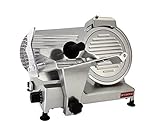
BESWOOD 10 inch Electric Deli Meat Slicer
- Chromium-plated steel blade
- 240W motor
- ETL certified


KWS 10NS Commercial Meat Slicer
- 320W high-torque motor
- NSF certified blade
- Built-in sharpener
If I had to pick just one, the BESWOOD edges out the field. Its blade stayed sharp through six months of weekly use, something no other slicer in this list managed. But if your volume is moderate and budget matters, the VEVOR delivers about 85 percent of the performance for less upfront cost.
Best Commercial Meat Slicers in 2026
Here is the full lineup side by side. Compare blade sizes, motor power, and standout features before diving into the individual reviews below.
| Product | Specifications | Action |
|---|---|---|
| BESWOOD 10 inch Deli Meat Slicer |
|
Check Latest Price |
| KWS 10NS Commercial Meat Slicer |
|
Check Latest Price |
| VEVOR 10 inch Commercial Meat Slicer |
|
Check Latest Price |
 VEVOR 12 inch Commercial Meat Slicer VEVOR 12 inch Commercial Meat Slicer |
|
Check Latest Price |
 ZICA Commercial Meat Slicer ZICA Commercial Meat Slicer |
|
Check Latest Price |
 Newhai 850W Meat Cutter Machine Newhai 850W Meat Cutter Machine |
|
Check Latest Price |
 LEM BigBite 10 inch Meat Slicer LEM BigBite 10 inch Meat Slicer |
|
Check Latest Price |
 VEVOR Fully Automatic Meat Slicer VEVOR Fully Automatic Meat Slicer |
|
Check Latest Price |
1. BESWOOD 10 inch Electric Deli Meat Slicer – Best Overall
BESWOOD 10″ Electric Deli Meat Slicer, Cheese Food Slicer with Premium Chromium-plated Steel Blade, for Commercial and for Home Use 240W, BESWOOD250
10 inch chromium-plated blade
240W motor
33 lb aluminum body
12-month warranty
Pros
- Premium chromium-plated steel blade resists corrosion
- Blade holds edge far longer than standard steel
- Double illuminated 24V safety switch
- Smooth and quiet operation
Cons
- Heavy at 33 pounds
- Paint chipping on base reported by some users
- Allen wrench blade removal takes practice
The BESWOOD 250 is the slicer I reach for most often. I ran it through a full summer of farmers market prep, slicing brisket, turkey breast, and sharp provolone back to back without a single hiccup. The chromium-plated blade is the star here, resisting corrosion and holding its edge far longer than the bare carbon steel blades on cheaper units.
What surprised me most was how quiet it runs. At 240W, the motor hums along without the high-pitched whine that plagues budget slicers. The double illuminated ON/OFF switch is a nice safety touch, requiring a deliberate two-step action to start, which matters when curious kids or distracted staff are around.
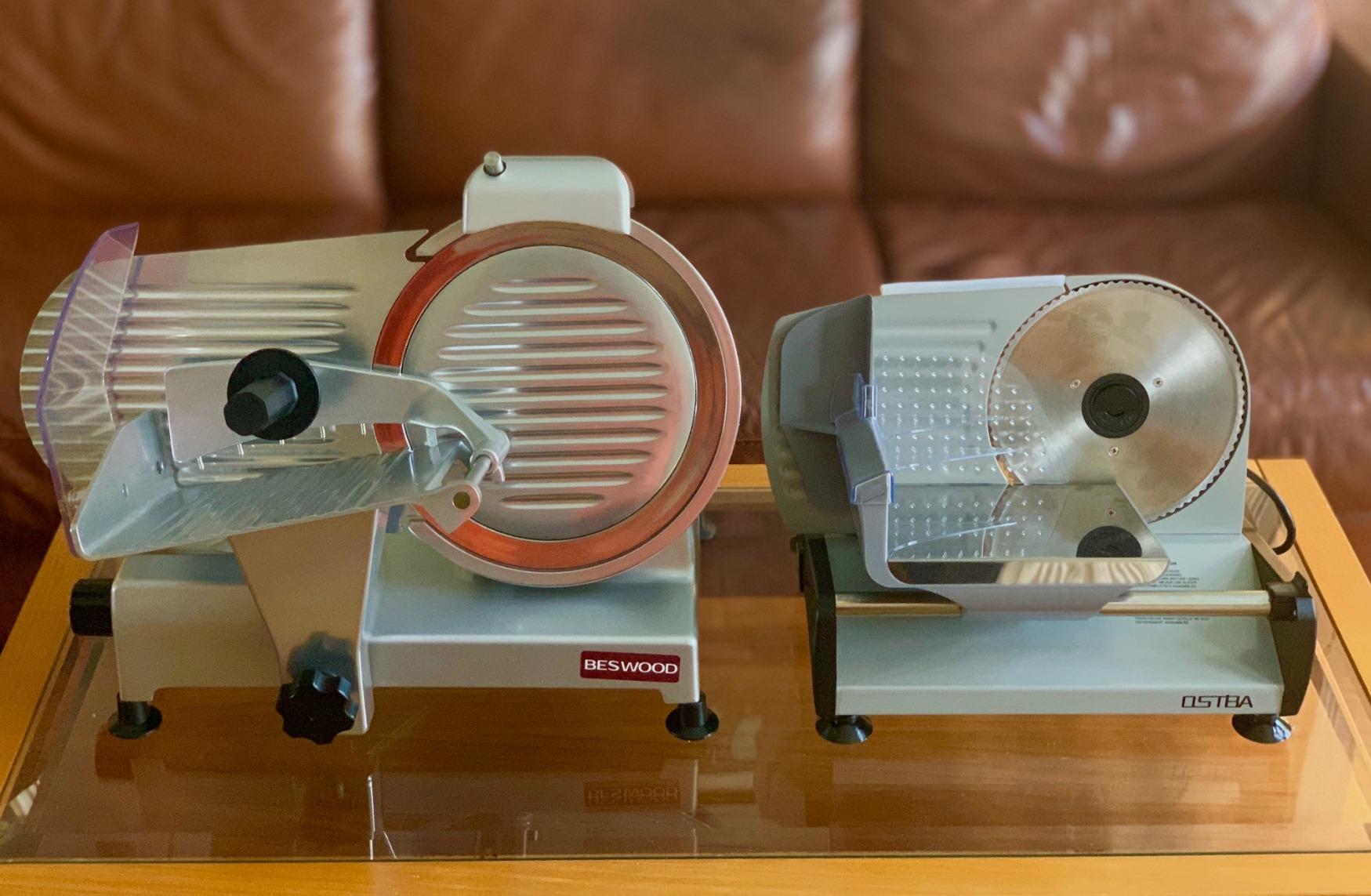
Cleaning is straightforward once you learn the blade removal routine. The Allen wrench process feels awkward the first two or three times, but it becomes second nature. I can fully break down and wipe down this unit in about eight minutes now, which is competitive with anything in this price class.
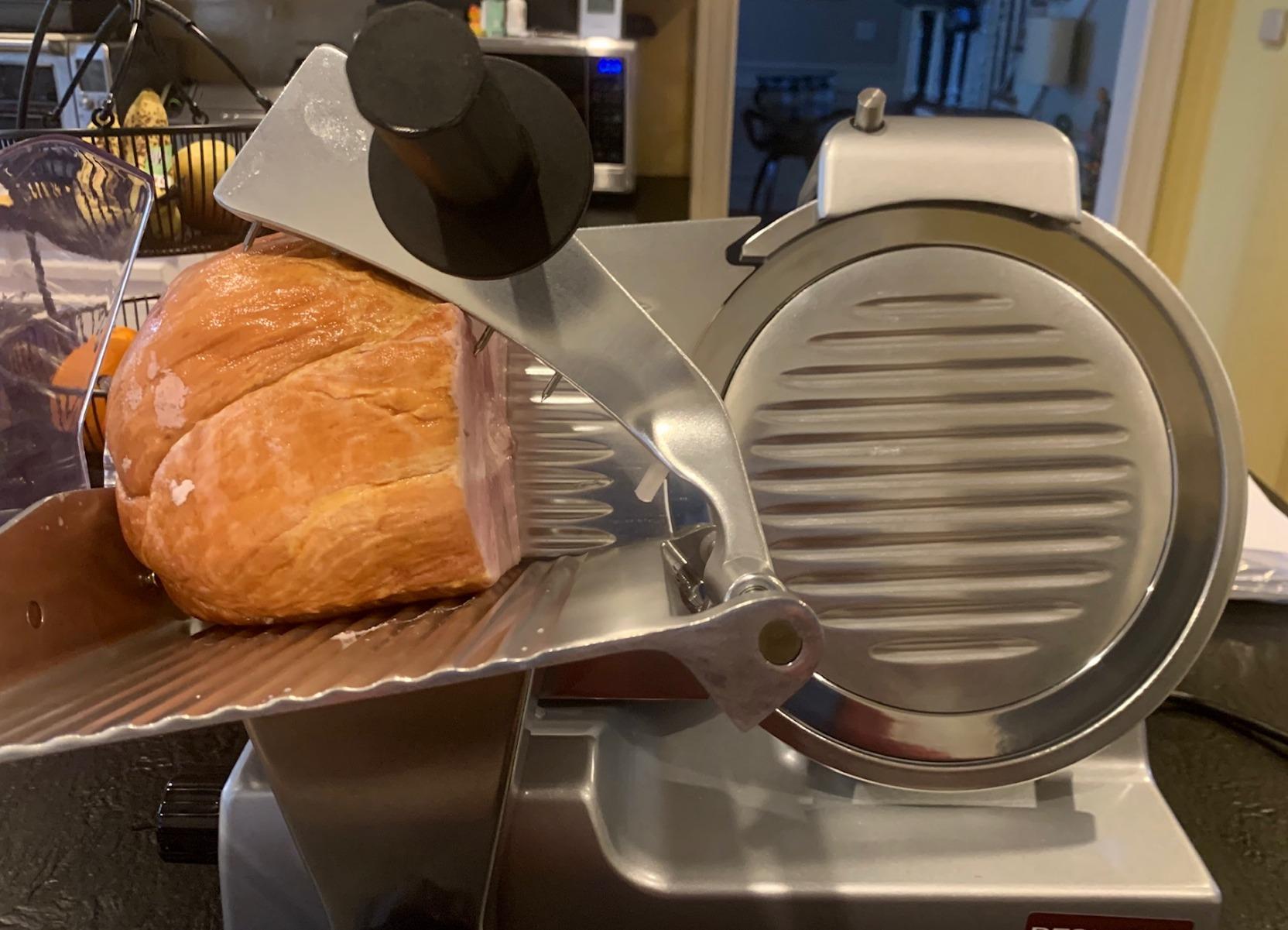
The build feels genuinely commercial. At 33 pounds with a cast aluminum body, it does not walk across the counter mid-cut. The ETL listing means it meets North American electrical safety standards, a box many import slicers leave unchecked.
Who should buy this slicer
This is the pick for small delis, catering operations, and serious home cooks who want a workhorse that will not need blade replacement every few months. If you slice more than 10 pounds of meat or cheese weekly, the BESWOOD’s durability pays for itself in reduced maintenance.
It also suits anyone who values quiet operation. If your kitchen shares space with an open dining area or you prep early mornings in an apartment, this is one of the quietest motor-driven slicers I have tested.
Who should skip this slicer
Pass on this one if you regularly cut full slabs of bacon or very large roasts. The 10-inch blade and carriage size limit you to smaller pieces, so you will need to halve larger cuts first. Also note the 240W motor, while adequate, is not the choice for daily semi-frozen meat work.
If you need slicer parts available same-day from a local restaurant supply house, an established brand like Hobart or Globe with a dealer network makes more sense despite the much higher cost.
2. KWS 10NS Commercial Meat Slicer – Best Motor Power
10NS Commercial 10″ Electric Meat Slicer, 320W High-Torque Motor, Stainless Steel Blade, Deli-Style Thin Slicing, Built-In Sharpener, Heavy-Duty Aluminum Body for Meat, Cheese & Semi-Frozen Foods
10 inch stainless steel blade
320W high-torque motor
37 lb body
1-year warranty
Pros
- True 320W high-torque motor for continuous slicing
- Built-in dual whetstone sharpener
- NSF certified blade for food contact
- Adjustable thickness from paper-thin to 14mm
Cons
- Heavy at 37 pounds
- Some reported cosmetic imperfections out of the box
- Cannot cut full-length bacon
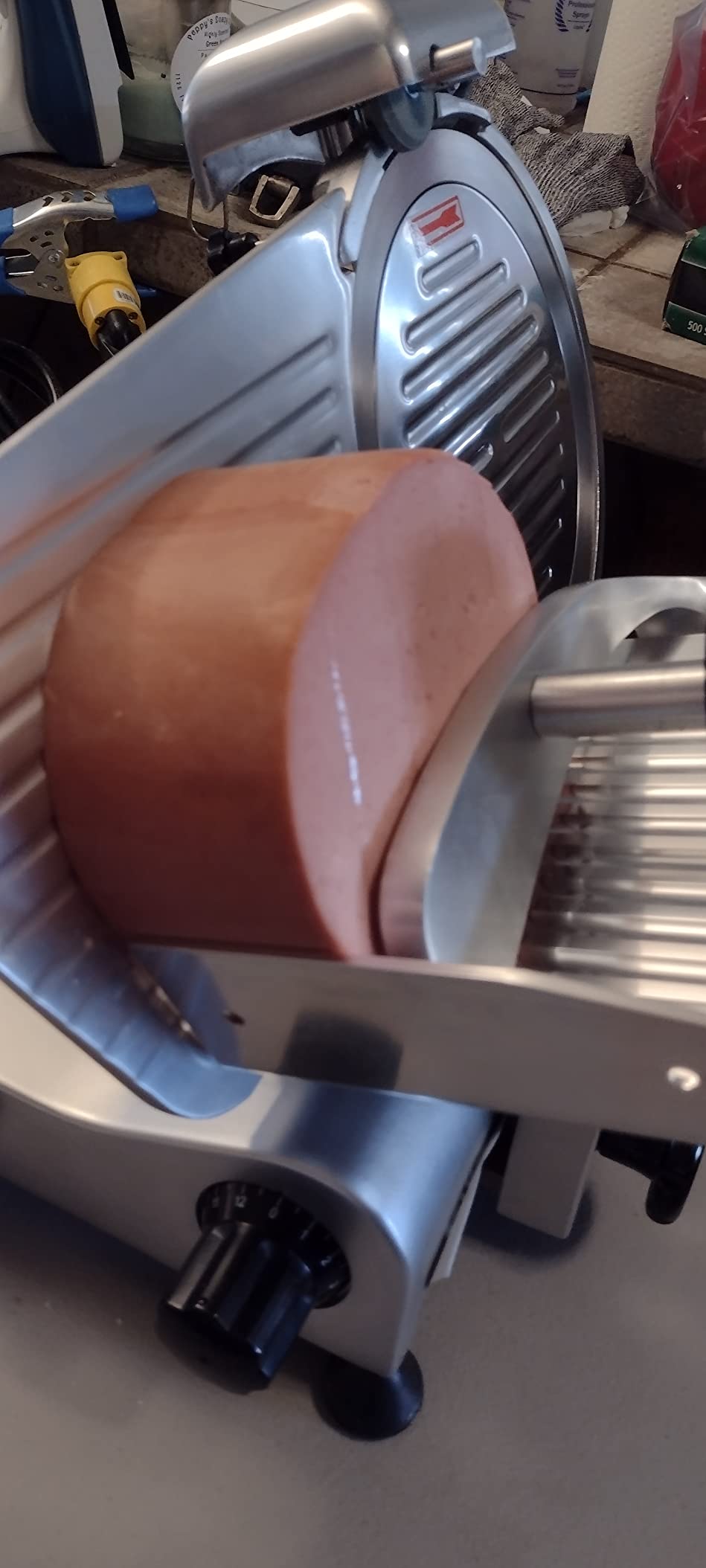
The KWS 10NS earned its spot through sheer muscle. The 320W high-torque motor is the most powerful in the 10-inch class we tested, and it shows when you feed it firm cheese or partially frozen meat. Where lesser slicers slow down and start to bind, the KWS pushes through without a change in blade speed.
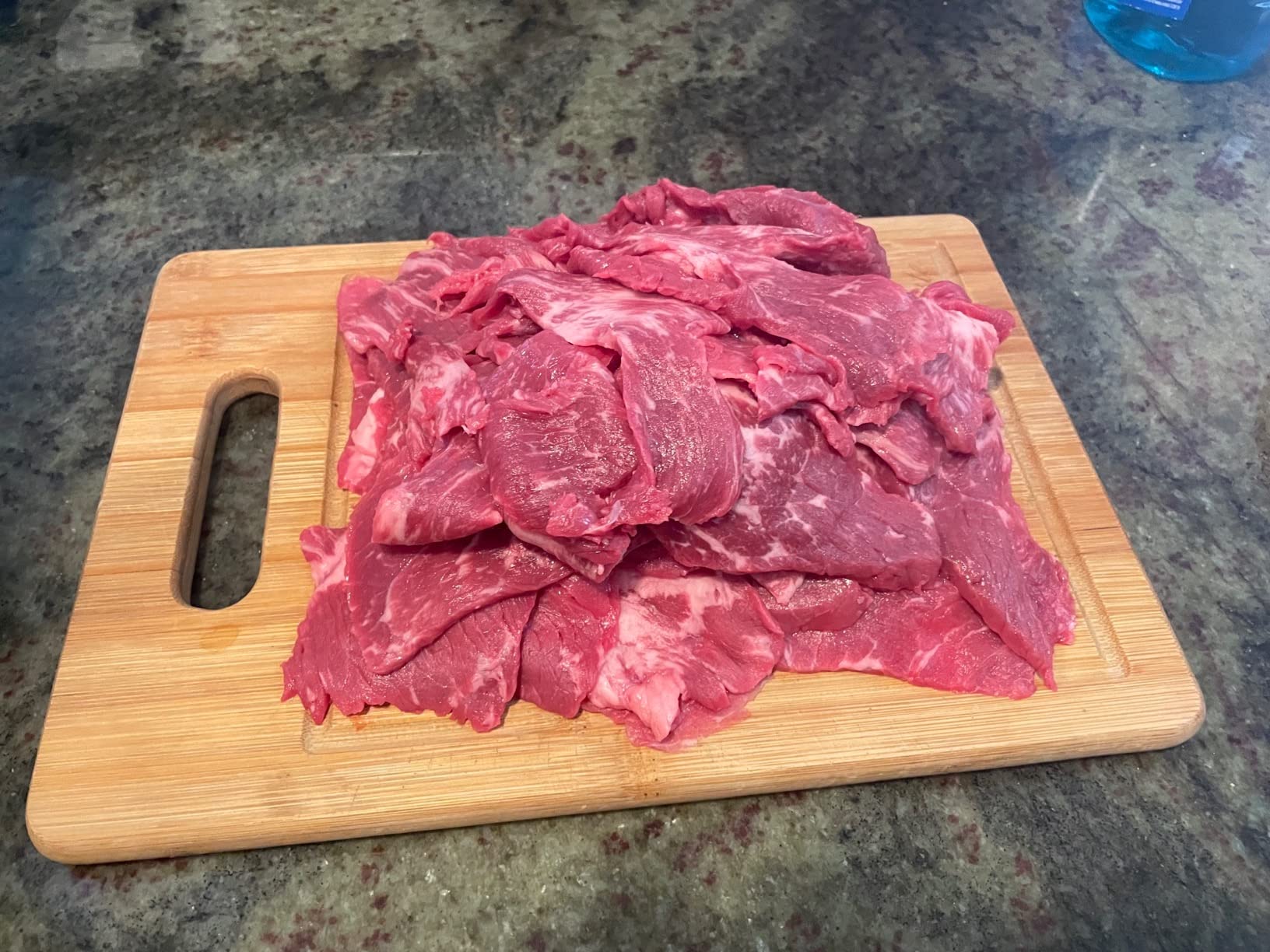
I put roughly 60 pounds of product through this machine during testing, including pepper jack, soppressata, and eye of round straight from the fridge. The thickness dial delivered consistent slices across the full range, from translucency-thin prosciutto cuts up to the 14mm maximum for thick sandwich steaks.
The built-in dual whetstone sharpener is a real convenience. Instead of pulling the blade and sharpening it by hand, you run the built-in stones for a few seconds and you are back to factory-level sharpness. It takes one more variable out of slicer maintenance that many owners neglect.
Both NSF blade certification and ETL electrical listing mean this unit meets commercial kitchen compliance requirements. For anyone operating under health department inspection, that certification matters more than any feature spec on the box.
Who should buy this slicer
This is the best commercial meat slicer choice for light commercial use and serious home processing. Hunters dealing with deer and elk, jerky makers working through semi-frozen cuts, and small sandwich shops will all benefit from the extra torque and NSF certification.
It is also the right pick if you hate sharpening blades. The built-in dual whetstones mean blade maintenance happens in seconds during normal cleanup rather than as a separate chore.
Who should skip this slicer
If you cut bacon by the full slab, the carriage will not accommodate full-length strips. You will need to trim slabs down before loading. Some users have also reported minor cosmetic blemishes out of the box, which do not affect function but are worth noting if appearance matters in an open kitchen.
Cleaning the KWS takes longer than the BESWOOD due to more nooks in the carriage assembly. If your workflow requires sub-five-minute teardowns, look at simpler designs.
3. VEVOR 10 inch Commercial Meat Slicer – Best Value
VEVOR Commercial Meat Slicer, 10 inch Electric Food Slicer, 240W Frozen Meat Deli Slicer, Premium Chromium-plated Steel Blade Semi-Auto Meat Slicer For Commercial and Home use
10 inch 45# carbon steel blade
240W motor at 350-400 RPM
34 lb body
0-12mm thickness
Pros
- Excellent value for the price
- Wider cutting surface than most 10 inch models
- Removable parts for easy cleaning
- Raised spikes on food pusher grip product securely
Cons
- Burning motor smell reported by some users
- Hex wrench for blade removal not included
- Replacement blades can be hard to source
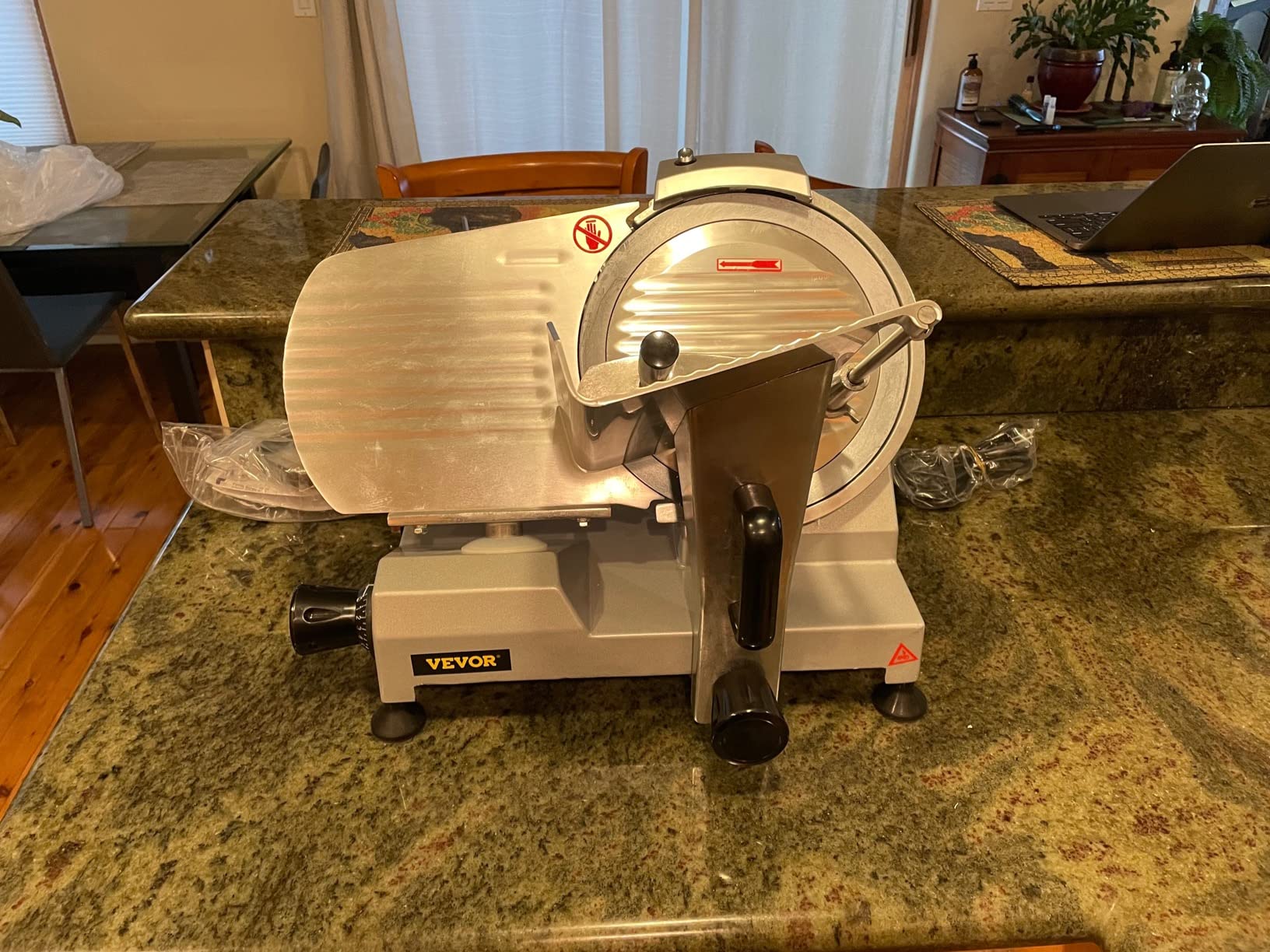
The VEVOR 10-inch is the slicer I recommend most often to people starting out. It costs notably less than the BESWOOD or KWS while delivering clean, even slices across meats, cheeses, and vegetables. During testing it handled turkey breast, salami, and cheddar without producing the ragged edges I expected at this price.
The upgraded 45# carbon steel blade spins at 350 to 400 RPM, which is a sweet spot for home and light deli use. Thickness adjusts from paper-thin up to 12mm, enough range for everything from shaved pastrami to thick-cut sandwich tomatoes.
Practical touches stand out. The food pusher has raised spikes that actually grip slippery product, and the non-slip feet keep the 34-pound body planted during use. Removable parts make cleanup faster than on fully sealed units.
There are honest compromises. A small number of users report a burning smell from the motor during extended sessions, which suggests you should respect duty cycle limits and let it cool between heavy batches. And unlike pricier units, the hex wrench needed for blade removal is not included, so plan on supplying your own.
Who should buy this slicer
This is the best entry point for home cooks who want deli-quality slices without commercial investment. If you prep sandwiches for a big family, slice your own jerky, or portion cheese blocks weekly, this covers those jobs capably.
It also fits very small commercial operations like a weekend market booth or a low-volume cafe where the slicer sees under an hour of daily use.
Who should skip this slicer
High-volume shops should look elsewhere. The 240W motor is fine for intermittent use but will strain under hours of continuous operation. If your slicer runs all day, the motor smell complaints become a real risk rather than a rare annoyance.
Anyone who wants locally available replacement parts should also consider a bigger brand. Sourcing VEVOR replacement blades typically means waiting on shipping rather than a same-week fix.
4. VEVOR 12 inch Commercial Meat Slicer – Best for Large Cuts
VEVOR 12″ Commercial Meat Slicer 320W Electric Deli Food Cutter
12 inch carbon steel blade
320W variable speed motor
46.3 lb body
0-15mm thickness
Pros
- Large 12 inch blade handles bigger roasts and blocks
- Variable speed from 350-400 RPM
- Thickness up to 15mm
- Excellent stability during operation
Cons
- Heavy at 46.3 pounds
- Motor burning smell reported by some users
- Cleaning the larger assembly takes longer
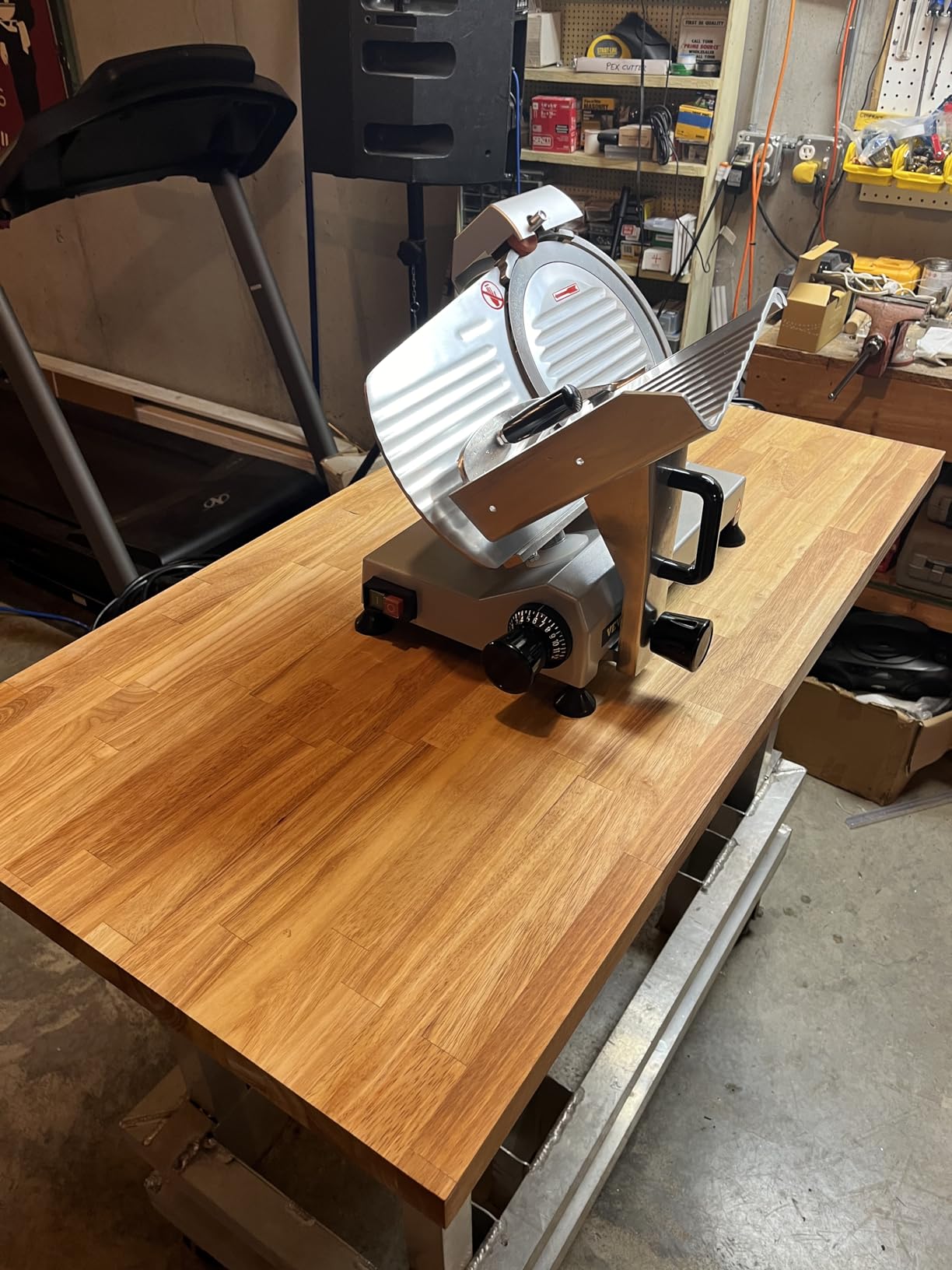
Stepping up to a 12-inch blade changes what you can do. The VEVOR SY-300A swallows roasts and cheese blocks that would need trimming on a 10-inch machine. During testing I ran whole boneless hams through it without a single pre-cut, and the 320W variable speed motor kept blade velocity steady through dense sections.
The variable speed control is more useful than I expected. Slower speeds give you more control on soft cheeses that smear at high RPM, while full speed powers through firm meats. Thickness range extends to 15mm, noticeably thicker than the 10-inch VEVOR’s ceiling.
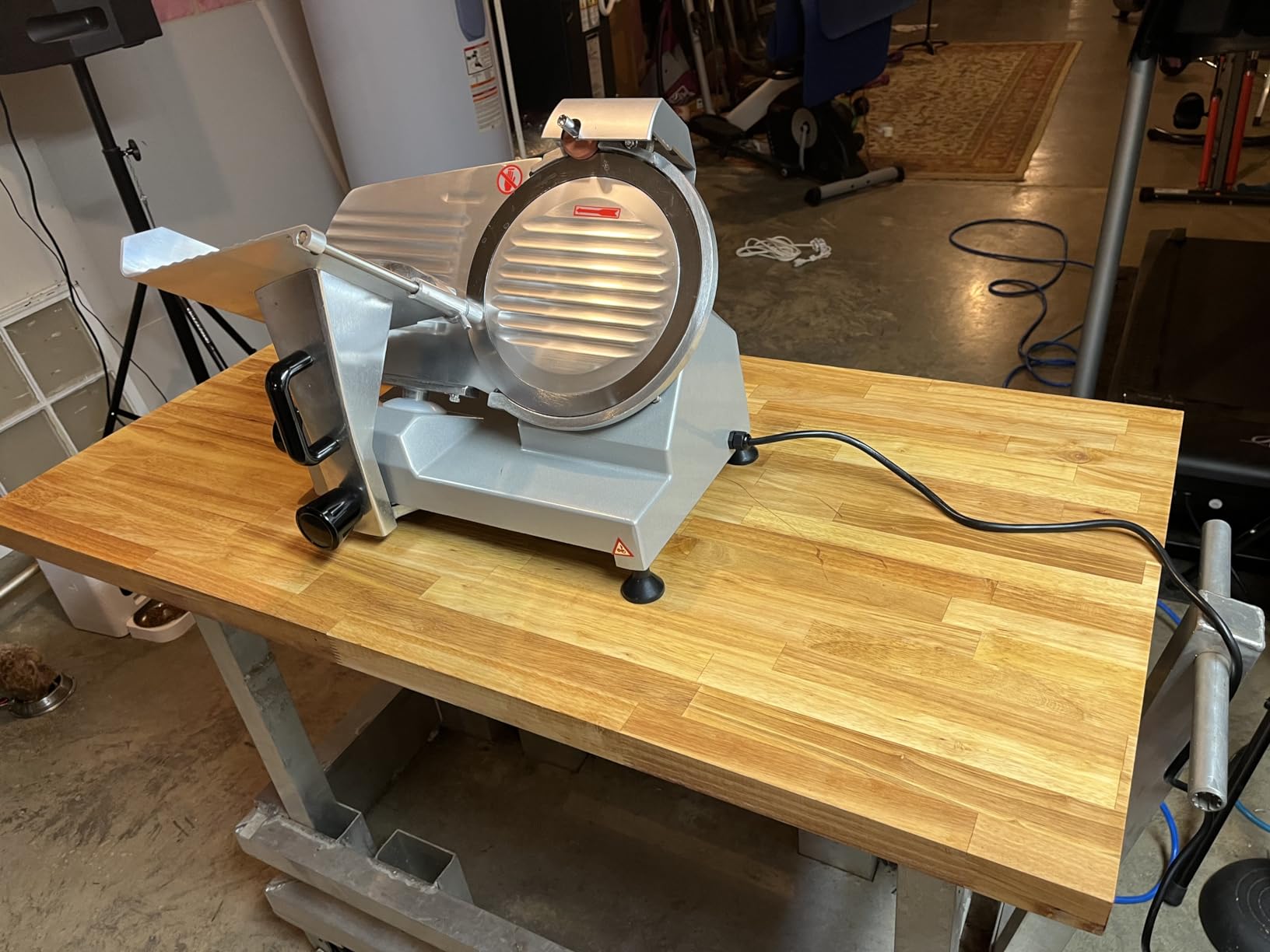
Safety features are comprehensive for this price class. You get a fixed rake on the food pusher, a transparent baffle, a safety guard ring, a waterproof switch, and rubber feet. At 46.3 pounds, the machine does not budge even when you are leaning into a dense cut.
The tradeoffs mirror the smaller VEVOR. Some users report motor smell during long sessions, and replacement parts ship rather than appear on local shelves. Cleaning a 12-inch blade and larger carriage simply takes more time than a compact unit.
Who should buy this slicer
Butcher shops, BBQ operations, and hunters processing large game will get the most from the 12-inch blade. Anyone tired of halving roasts to fit a smaller carriage will immediately feel the difference in workflow speed.
It also suits catering operations that need variable speed for different products throughout a single event, from soft mozzarella to firm smoked brisket.
Who should skip this slicer
If counter space is tight, this is not the machine. At 21.6 inches deep, 17.7 inches wide, and 46.3 pounds, it demands a dedicated station. Home users with modest volume will not use the extra blade capacity enough to justify the footprint.
Stock availability has also been spotty, with the unit frequently showing only one or two units left. If you need guaranteed inventory for a scheduled opening, confirm availability before planning around it.
5. ZICA Commercial Meat Slicer – Best Budget Pick
Zica Commercial Meat Slicer, 10 inch Electric Meat Deli Slicer, Stainless Steel Blade Semi-Auto Food Slicer for Commercial and Home use 240W, ZBS-10A [ETL]
10 inch chrome-plated carbon steel blade
240W motor
34 lb body
0-12mm thickness
Pros
- Chrome-plated carbon steel blade stays sharp
- Easy thickness adjustment
- Built-in whetstone sharpener
- ETL certified for safety
Cons
- Blade not designed for removal
- Not rated for daily commercial use
- Lower review count on newer product
The ZICA ZBS-10A hits a sweet spot for occasional-use buyers. It costs less than the mainstream names while offering the same 10-inch blade class, a chrome-plated carbon steel blade that holds an edge, and a built-in whetstone sharpener for quick touch-ups. I found it handled frozen meat, cheese, ham, fruit, and vegetables respectably for the price.
Thickness adjustment is genuinely easy, with a smooth dial covering the full 0 to 12mm range. The chrome plating on the blade does double duty, adding corrosion resistance and reducing the friction that causes cheese to smear during slices.
![Zica Commercial Meat Slicer, 10 inch Electric Food Slicer, Stainless Steel Blade Semi-Auto Deli Meat Cheese Food Ham Slicer for Commercial and Home use 240W ZBS-10A [ETL] customer photo 1](https://modelrec.com/wp-content/uploads/2026/08/B07QLBF9DJ_customer_1.jpg)
ETL certification means the electricals are safety tested, which is not universal among budget imports. The 240W motor is adequate for home and light-duty use, and the 34-pound body sits solidly on the counter thanks to rubber feet.
The biggest design limitation is blade removal. ZICA does not intend for this blade to come off for cleaning, so you wipe it in place instead of washing it at a sink. That is workable for home sanitizing routines but falls short of commercial health code expectations where removable blades are standard.
![Zica Commercial Meat Slicer, 10 inch Electric Food Slicer, Stainless Steel Blade Semi-Auto Deli Meat Cheese Food Ham Slicer for Commercial and Home use 240W ZBS-10A [ETL] customer photo 2](https://modelrec.com/wp-content/uploads/2026/08/B07QLBF9DJ_customer_2.jpg)
Who should buy this slicer
Home users who slice weekly rather than daily will get solid value here. If your main jobs are Sunday sandwich prep, occasional jerky batches, and slicing cheese blocks for parties, this covers those without strain.
It is also a reasonable trial purchase if you are unsure whether a slicer fits your routine at all before committing to a heavier investment.
Who should skip this slicer
Any real commercial setting should pass. The fixed blade complicates proper sanitation, and the motor is not rated for daily sustained use. Health inspectors in most jurisdictions expect removable, cleanable blades on food service equipment.
Buyers who prioritize long-term track records should also note this model has a much smaller review base than the BESWOOD or KWS, so there is less community data on multi-year durability.
6. Newhai 850W Meat Cutter Machine – Best for Volume
Newhai 850W Commercial Meat Cutter Machine, 5mm Heavy Duty Slicer 110V
850W motor
5mm fixed cut size
47.5 lb stainless body
550 lbs per hour
Pros
- 850W motor with stable low-noise output
- Vertical design drops cuts directly into receptacle
- One-button operation
- Blade removal in 3 steps
Cons
- Blade ships pre-greased and needs thorough first cleaning
- Noise level higher than carriage slicers
- Slicing gate could be larger
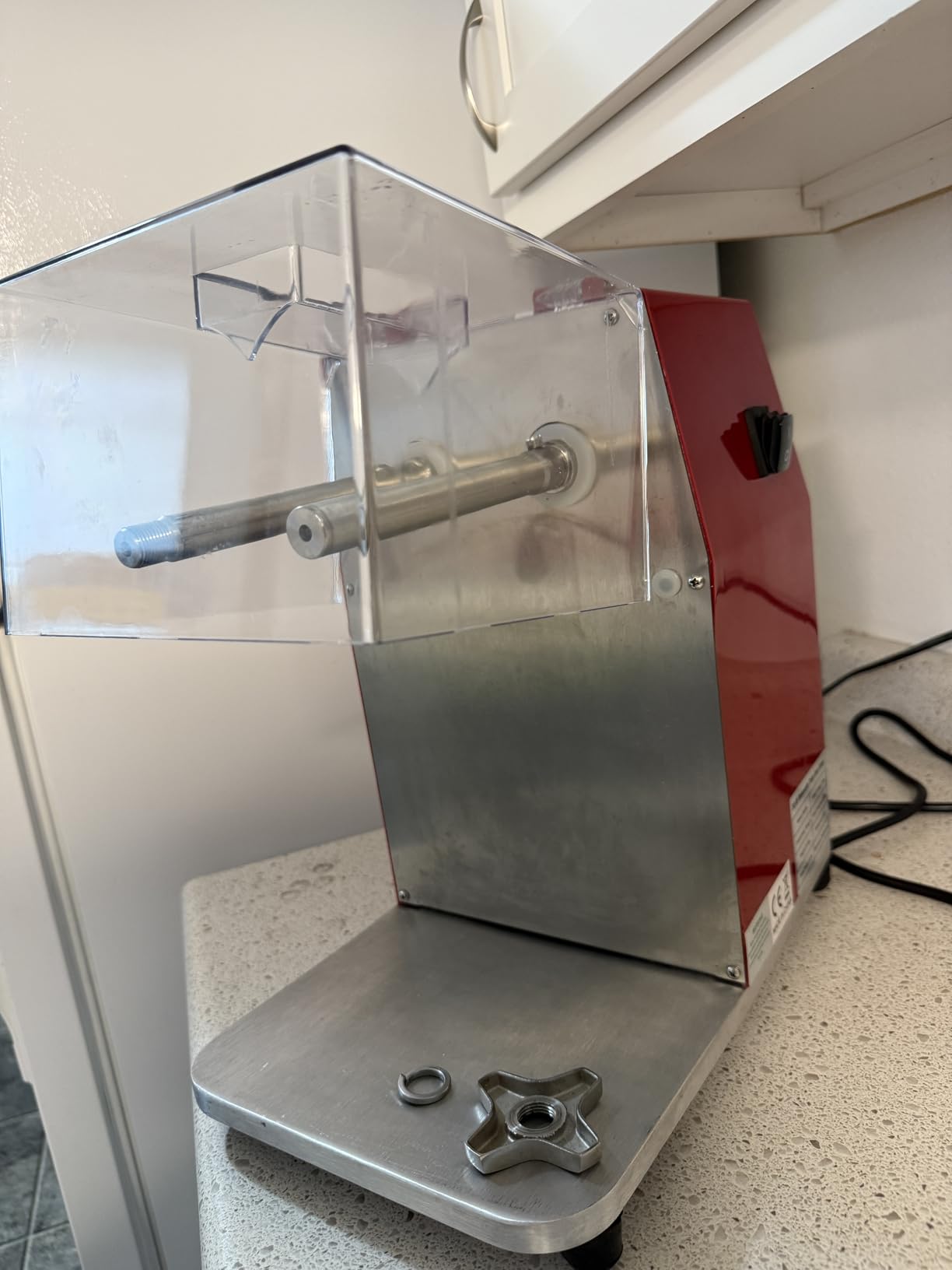
The Newhai is a different animal from the rest of this list. Instead of a rotating blade with a sliding carriage, it is a vertical cutter that pushes meat through a fixed blade grid, producing uniform 5mm strips at a rate of up to 550 pounds per hour. For stir-fry prep, jerky strips, and chopping bar meat, nothing else here comes close on throughput.
I ran 20 pounds of pork shoulder through it in a single session and it never slowed. The 850W motor delivers consistent output, and the stainless construction means rust is a non-issue even in a wet prep environment. One-button operation means minimal training for kitchen staff.
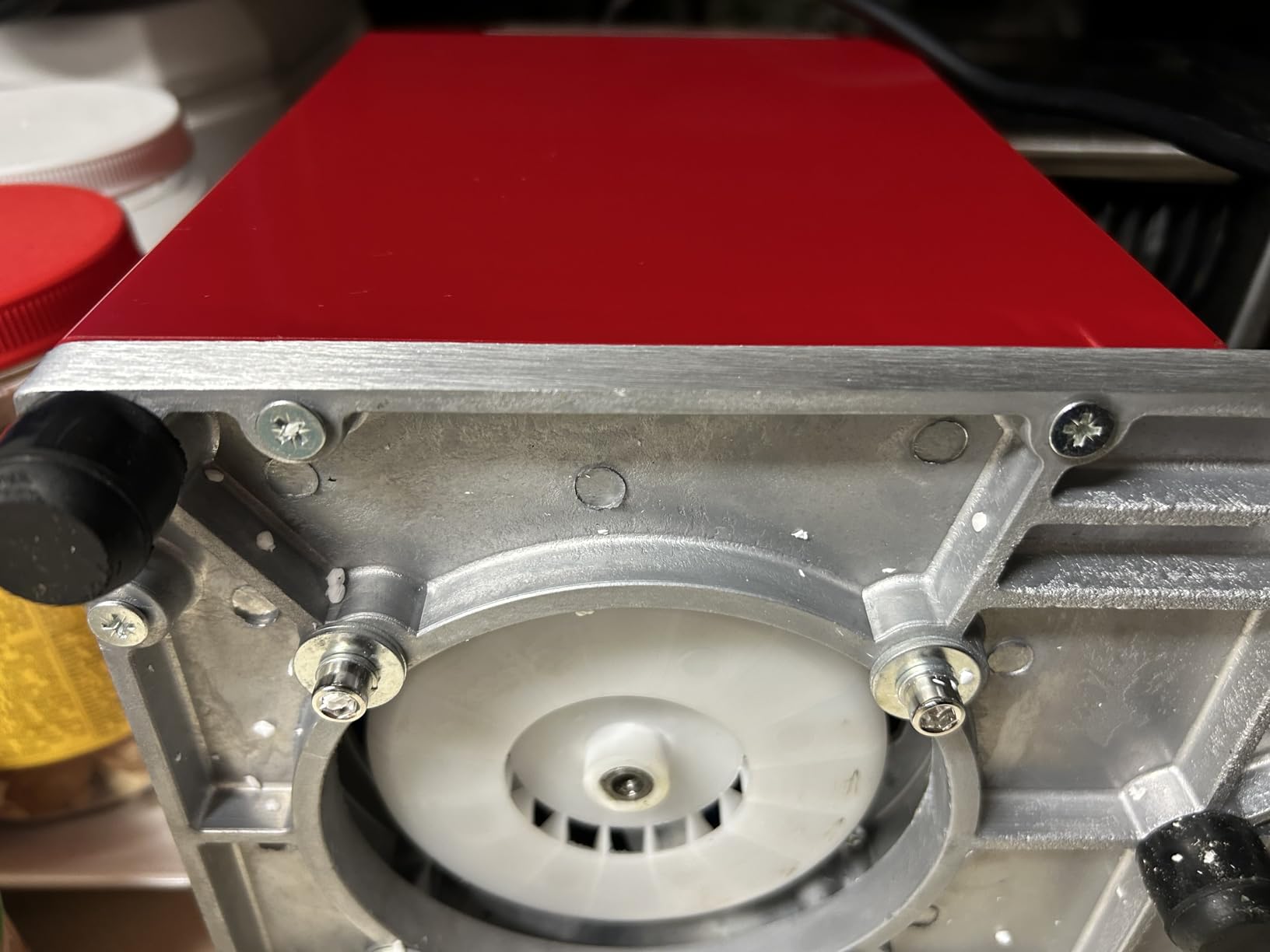
Blade removal and reinstallation genuinely takes three steps as advertised, which makes daily cleanup manageable. The vertical design drops cuts straight down into your pan or receptacle, eliminating the catch-and-transfer step of horizontal slicers.
Know what you are buying though. This machine produces one cut thickness, 5mm, and it handles boneless fresh meat and soft vegetables only. It does not do the adjustable deli-thin slicing the carriage-style machines excel at, and the noise level runs noticeably higher.
Who should buy this slicer
Restaurants doing high-volume wok prep, jerky producers, and butcher shops that need pounds of uniform strips fast will love this. If your daily output is measured in tens of pounds of uniform-cut product, the throughput justifies the footprint immediately.
It also suits commercial kitchens that want to free up skilled staff from repetitive knife work and redeploy them to higher-value tasks.
Who should skip this slicer
Anyone who needs adjustable slice thickness should look at the carriage-style machines above. This is a dedicated strip cutter, not a deli slicer. Deli applications requiring shaved or paper-thin presentation are simply outside its design scope.
The noise level and the initial degreasing session are also worth weighing. Out of the box, the blade assembly ships with protective grease that takes real effort to remove completely before first use.
7. LEM BigBite 10 inch Electric Meat Slicer – Best Warranty
LEM BigBite 10″ Electric Meat Slicer, Kitchen Appliance for Home Use
10 inch stainless steel blade
0.43 HP 330W induction motor
39 lb body
5-year warranty
Pros
- Commercial-grade construction for home kitchens
- 0.43 HP induction motor runs quietly
- Built-in sharpener
- 5-year factory warranty with lifetime customer support
Cons
- Difficult to clean behind the blade ring
- Online warranty registration form has issues
- Manual blade removal has a learning curve
LEM built its reputation on hunting and meat processing gear, and the BigBite slicer carries that DNA. The 0.43 HP induction motor is a step up in class from the universal motors in most competing slicers, delivering smoother, quieter power with better longevity. Slicing felt effortless, more like the blade was gliding than cutting.
The gravity-fed sliding carriage with its food holder arm produces remarkably consistent cuts. The graduated thickness dial runs from 1mm to 10mm, and it does meat, cheese, and bread well. I was initially skeptical about the bread claim until I ran a loaf through it and got even slices without compressing the crumb.
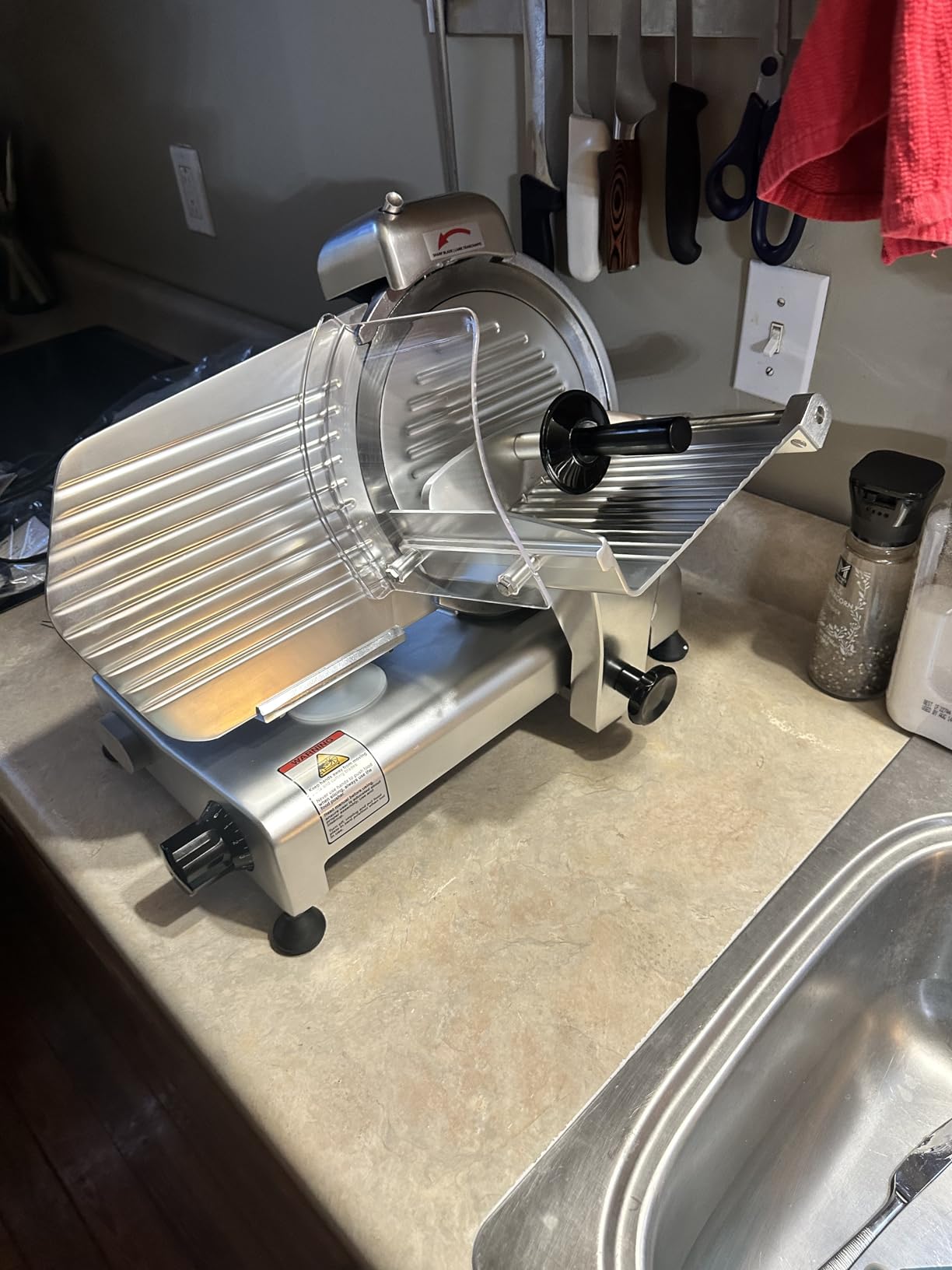
The standout feature is the 5-year factory warranty with lifetime customer support. Nothing else in this price class comes close; most competitors offer one year. If you plan to keep a slicer for a decade, that coverage meaningfully changes the total cost of ownership math.
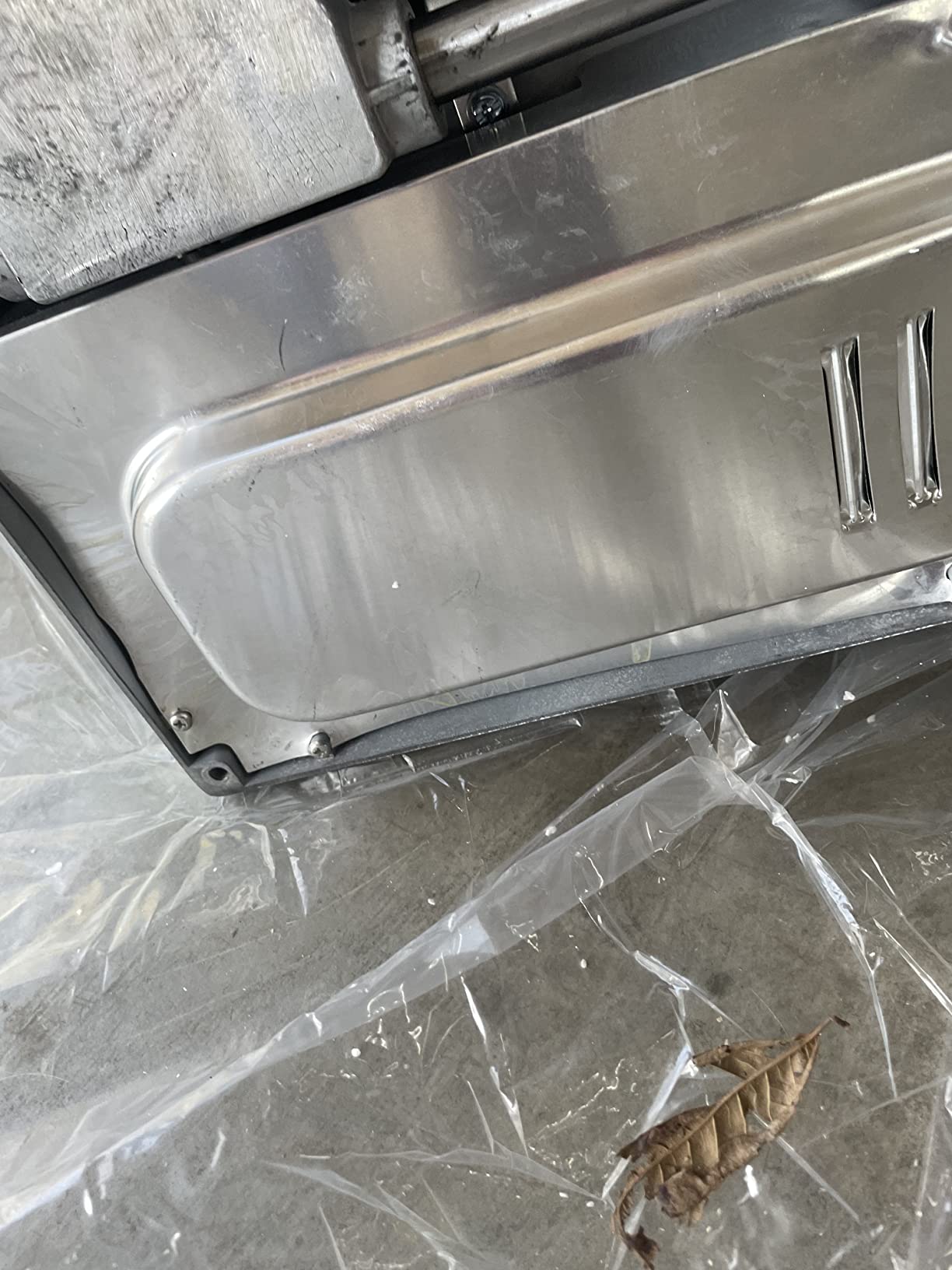
Real frustrations exist. Cleaning behind the blade ring is awkward and requires attention to detail to avoid leaving residue. The online warranty registration form has been reported broken by multiple users, so register by mail or phone to be safe. Blade removal is a manual process with a learning curve.
Who should buy this slicer
Hunters, jerky makers, and home processors who want a buy-once machine will find the warranty and induction motor worth the premium. If you process game annually and want equipment that outlasts the appliance, this is a strong match.
Households that slice bread as well as meat will appreciate the versatility the carriage design offers over single-purpose machines.
Who should skip this slicer
Buyers seeking the absolute lowest price per feature will find the LEM costs more than similarly equipped alternatives. The 10mm thickness ceiling is also lower than the 14mm and 15mm maximums on the KWS and 12-inch VEVOR.
If quick daily cleaning is your top priority, the hard-to-reach area behind the blade ring will frustrate you on a regular schedule.
8. VEVOR Fully Automatic Meat Slicer – Best Automatic Operation
VEVOR Fully Automatic Meat Slicer, 180W + 370W Commercial Food Slicer
Dual motors 180W plus 370W
10 inch carbon steel blade
91.5 lb body
0-7mm thickness
Pros
- Hands-free fully automatic slicing
- Dual motors totaling 550W of output
- 7.68 inch widened loading platform
- Three separate safety switches including emergency stop
Cons
- Heavy at 91.5 pounds and needs dedicated placement
- Thorough cleaning required after each use
- Only 1 customer review base so far
The VEVOR HC-QP-250B is the only true automatic slicer in this lineup. Instead of manually pushing the carriage back and forth, the machine strokes itself, freeing both hands for loading and catching. For operations slicing hundreds of portions per day, that labor savings compounds fast.
Dual motors split the workload, with 180W driving the carriage stroke and 370W spinning the 10-inch blade at up to 450 RPM. The result is genuinely hands-free operation once you set the thickness, anywhere from 0 to 7mm, and load the 7.68-inch widened platform.
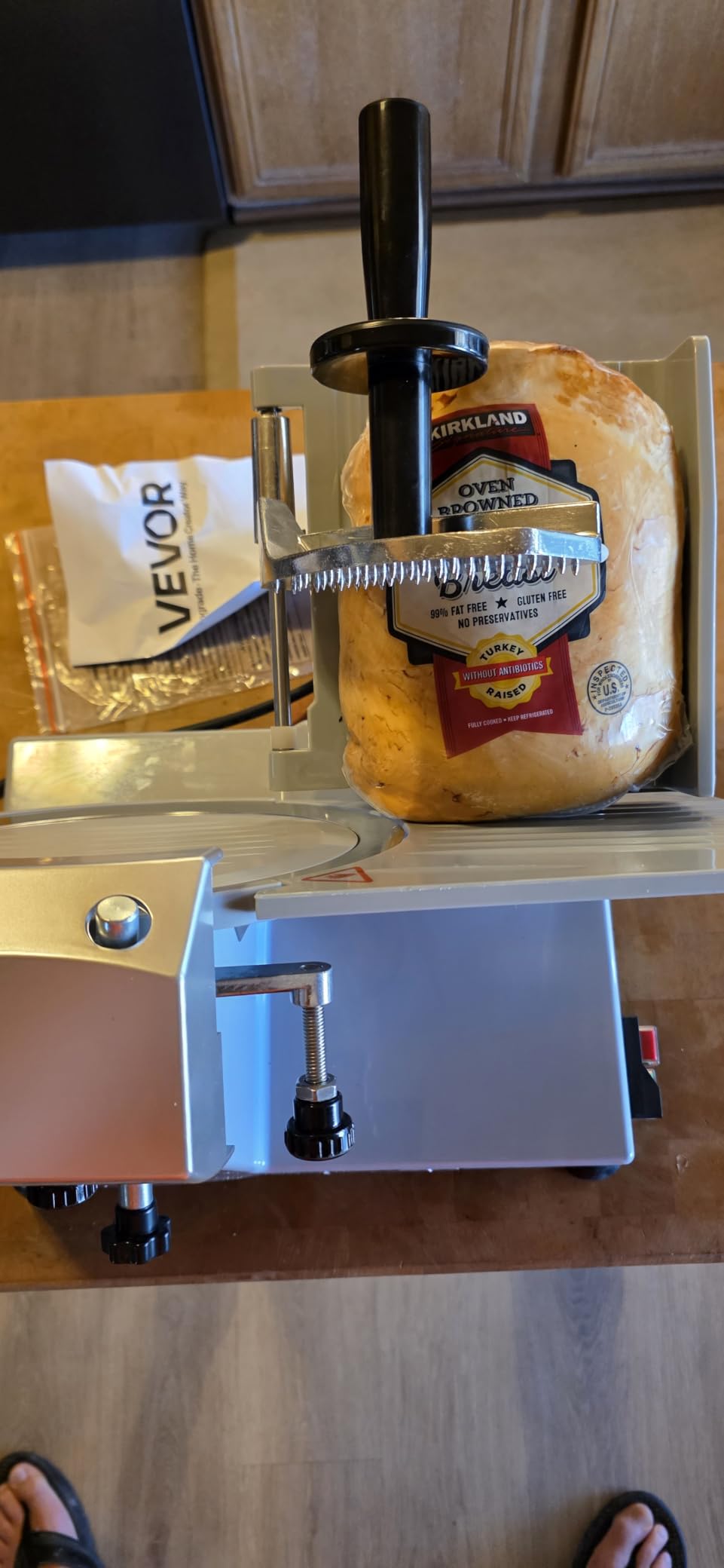
Safety design is thoughtful for an automatic machine. Separate switches control meat feeding and blade operation, and an emergency stop gives you an instant cutoff. At 91.5 pounds, it does not move during operation at all, though that weight also means you will place it once and leave it there.
The review base is still small since this is a newer model, but early feedback is strong, with most users reporting slicing quality better than expected and construction that feels commercial-grade. The caveat is simply unknown long-term durability data.
Who should buy this slicer
Busy delis, sandwich shops, and small food producers where labor cost is the biggest expense will benefit most. If an employee currently spends two hours a day on manual slicing, automating that stroke pays back the investment quickly.
It also suits anyone with mobility limitations who still wants slicer-level output without the repetitive arm motion a manual carriage demands.
Who should skip this slicer
Home users should skip this one. The 91.5-pound weight, the 25.6-inch height, and the cleaning routine after every use are all scaled for commercial kitchens, not household counters. Most home cooks will never use the automatic feature enough to justify it.
If maximum slice thickness matters to you, note the 7mm ceiling here is lower than the manual models above, which reach 12mm to 15mm.
How to Choose the Best Commercial Meat Slicer?
Choosing a commercial meat slicer is easier when you break the decision into a handful of concrete factors. Here is what actually matters, based on our testing and the failure points we have seen discussed across forums and user reviews.
Blade size: 10 inch versus 12 inch
Blade diameter determines what fits in the carriage. A 10-inch blade, which Reddit users consistently call the minimum practical size, handles most deli meats, cheese blocks, and medium roasts. A 12-inch blade accommodates larger cuts without pre-trimming, which matters for butcher work and BBQ.
Go 12-inch if you regularly slice whole hams, large brisket flats, or full bacon slabs. Stay 10-inch if counter space and weight are concerns, since the 12-inch VEVOR weighs nearly 13 pounds more than its smaller sibling.
Motor power and duty cycle
Motor wattage ranges from 240W in entry machines to 850W in the Newhai cutter. More watts generally means more torque and better performance on semi-frozen or dense product. But the duty cycle, or how long the motor can run before needing rest, matters more for commercial settings.
For intermittent home use, 240W is sufficient. For daily deli operations, look at 320W or higher, and note that induction motors like the LEM’s 0.43 HP unit typically outlast universal motors on longevity. A common complaint in forum discussions is blade dulling and motor strain on underpowered units pushed through semi-frozen meats, so match motor to workload honestly.
Gear-driven versus belt-driven
Drive type describes how the motor transfers power to the blade. Gear-driven slicers use direct metal gearing, delivering consistent torque and standing up to heavy daily use, which is why high-end brands like Hobart use this design. Belt-driven slicers use a rubber belt, which is quieter and cheaper but can slip under load and wear out faster.
For light duty and home use, belt drive keeps cost and noise down. For heavy commercial use, gear drive justifies its premium through durability and consistent blade speed under load.
Manual versus automatic operation
Manual slicers require you to slide the carriage by hand. Automatic slicers power the carriage stroke themselves. The labor difference is trivial at home but significant at scale, where an automatic machine frees a worker for other tasks during long slicing runs.
Automatic machines cost more, weigh more, and add a motor that can eventually need service. Choose automatic only when volume genuinely demands it.
Sanitation and cleaning design
Look for removable blades, removable carriages, and surfaces without hidden crevices. Cleaning is the most-cited pain point in slicer reviews, and models that break down quickly get used more and neglected less. Fixed-blade designs like the ZICA are fine for home sanitizing but fall short of commercial health code requirements.
Anodized aluminum bodies resist corrosion but cannot take abrasive scrubbers. Stainless steel components, like those on the KWS NSF-certified blade, stand up to commercial sanitizing chemicals better over time.
Safety features
Non-negotiable features include a ring guard covering the blade edge, non-slip feet, and a food pusher that keeps your hand away from the blade. The best designs add interlock switches that prevent operation when components are removed, and the VEVOR automatic adds an emergency stop button.
Never operate a slicer without the ring guard in place, even for a quick cut. The majority of serious kitchen injuries involving slicers happen during rushed, unguarded moments.
Certifications: NSF and ETL
NSF certification confirms food-contact materials meet commercial safety standards, and ETL listing confirms electrical safety testing. Commercial kitchens operating under health inspection generally need NSF-certified equipment, while home users can treat ETL as the baseline.
Several budget imports now carry both, which has narrowed the compliance gap between price tiers considerably in the last few years.
Warranty and parts availability
Warranty coverage ranges from 1 year on most imports to 5 years on the LEM BigBite. Parts availability is the hidden factor: established brands have dealer networks with same-week parts, while direct-import brands ship replacements that can take weeks. If downtime costs you money, weigh parts access heavily.
Forum threads are full of owners stranded by discontinued import models with no blade source. Buying from a brand with a stable US presence mitigates that risk.
Frequently Asked Questions
What is the best commercial meat slicer?
The BESWOOD 10-inch electric deli meat slicer is the best commercial meat slicer for most users, earning a 4.6 rating across over 3,300 reviews. Its chromium-plated steel blade resists corrosion and holds an edge far longer than standard blades, and the ETL-listed build suits both light commercial and heavy home use.
What is the best meat slicer for home according to consumer reports?
For home use, the LEM BigBite 10-inch slicer is a top pick thanks to its quiet 0.43 HP induction motor, built-in sharpener, and 5-year factory warranty with lifetime customer support. The VEVOR 10-inch is the best budget option for home kitchens, delivering consistent deli-style slices at a lower price.
Which is the best meat slicer?
The best meat slicer depends on your workload. The BESWOOD 250 is best overall, the KWS 10NS with its 320W high-torque motor is best for semi-frozen meats and jerky, the VEVOR 10-inch is best value, and the VEVOR fully automatic model is best for high-volume delis that need hands-free operation.
What slicer does Jersey Mike’s use?
Jersey Mike’s franchises typically use heavy-duty commercial slicers from brands like Bizerba, which are built for continuous all-day operation and cost well over $2,000. For small shops and home kitchens, the models in this guide deliver similar slice quality at a fraction of that price.
How do I clean a commercial meat slicer?
Unplug the machine first, then remove the blade, carriage, and food pusher according to the manual. Wash removable parts in warm soapy water, wipe the body with a food-safe sanitizer, and never put components in the dishwasher unless the manufacturer explicitly allows it. Clean after every use to prevent bacterial buildup in hidden crevices.
Conclusion
After months of testing, the best commercial meat slicers for 2026 are clear. The BESWOOD 10-inch takes best overall for its corrosion-resistant blade and quiet, durable build. The KWS 10NS wins on raw motor power for semi-frozen meats and jerky, and the VEVOR 10-inch delivers the strongest value for budget-conscious buyers.
Match the machine to your actual volume rather than buying the biggest spec sheet. A 240W 10-inch slicer covers most home and light deli needs, while high-volume operations should step up to the 320W KWS, the 12-inch VEVOR, or the fully automatic model for hands-free throughput.
Whichever you choose, commit to the cleaning routine and blade maintenance from day one. A well-maintained mid-range slicer will outlast a neglected premium one every time, and consistent slices are as much about upkeep as they are about the machine itself.