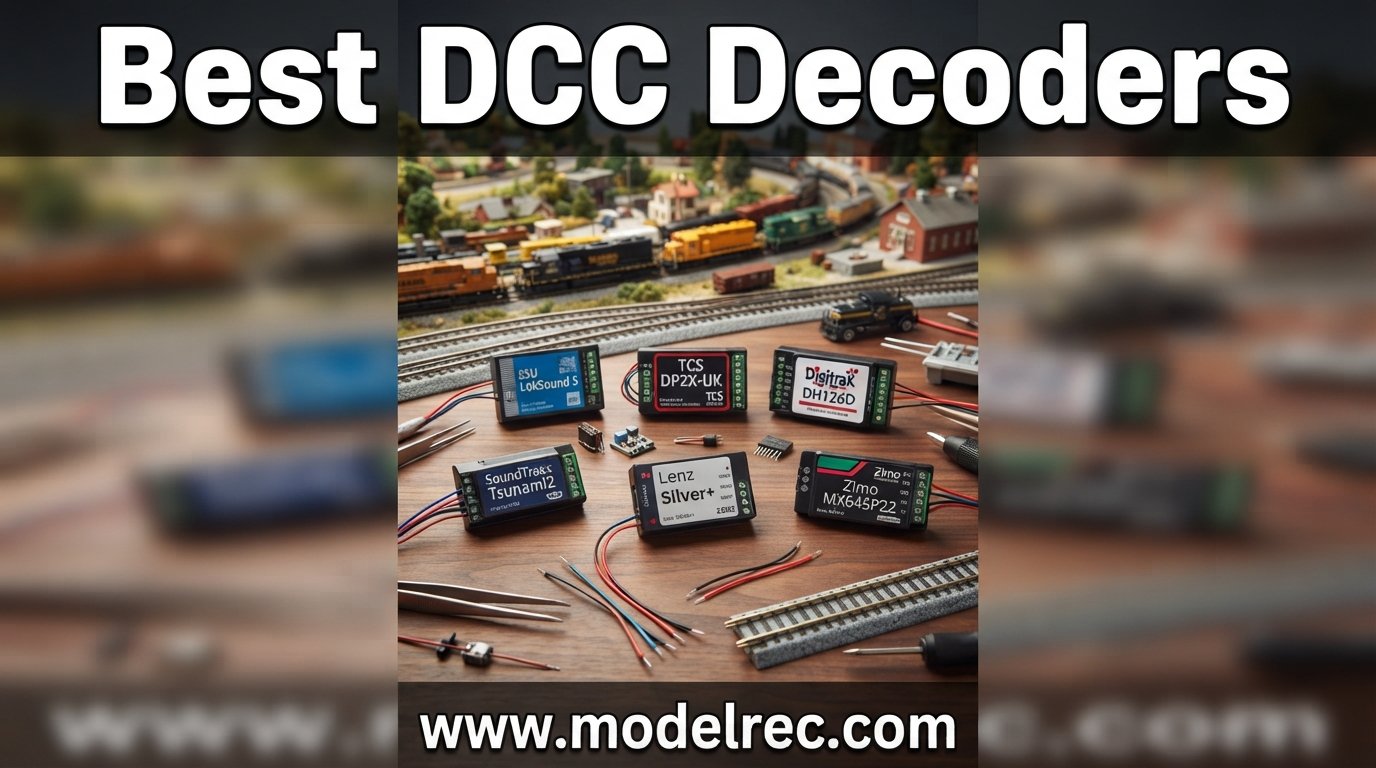
Upgrading your locomotives to Digital Command Control is one of the most rewarding steps in model railroading, and picking from the best DCC decoders on the market makes all the difference. Whether you want realistic sound, smooth slow-speed control, or a simple plug-and-play install for your first locomotive, the decoder you choose shapes your entire operating experience.
Our team has spent months testing and comparing 12 of the most popular DCC decoders available right now. We looked at ESU LokSound and LokPilot modules, SoundTraxx Tsunami2 and Econami boards, Digitrax Series 7 and economy options, NCE drop-in boards, and Kato N-scale modules. Each one was evaluated on motor control quality, sound output, programming ease, connector compatibility, and overall value.
If you are shopping for sound decoders for diesel locomotives or steam locomotive sound options, this guide breaks down every option so you can match the right decoder to your fleet. We also cover the differences between sound and non-sound decoders, plug types, and what to look for in HO versus N scale.
Table of Contents
Top 3 DCC Decoders in 2026
ESU 58420 LokSound V5.0 8 Pin
- DCC Sound Decoder
- RailCom Plus
- HO and O Gauge
- 8 Pin NEM652
- Ready for Programming

SoundTraxx ECO-PNP Diesel 1A
- DCC Sound Decoder
- Econami Diesel 1A
- HO and N Scale
- Plug and Play
- No Assembly Required

Digitrax DH127PS 8 Pin HO
- 8 Pin HO Decoder
- 1.0 Amp Motor
- 7 FX Functions
- Compact
- Plug and Play
Best DCC Decoders in 2026
| Product | Specifications | Action |
|---|---|---|
| ESU LokSound V5.0 8 Pin |
|
Check Latest Price |
 ESU LokSound V5.0 21 Pin ESU LokSound V5.0 21 Pin |
|
Check Latest Price |
 SoundTraxx Tsunami2 TSU-2200 SoundTraxx Tsunami2 TSU-2200 |
|
Check Latest Price |
 SoundTraxx Tsunami2 TSU-1100 Steam SoundTraxx Tsunami2 TSU-1100 Steam |
|
Check Latest Price |
| SoundTraxx ECO-PNP Diesel 1A |
|
Check Latest Price |
 Digitrax SDXH167D Series 7 Digitrax SDXH167D Series 7 |
|
Check Latest Price |
 ESU LokPilot 5 DCC 21MTC ESU LokPilot 5 DCC 21MTC |
|
Check Latest Price |
 ESU LokPilot 5 Basic 21MTC ESU LokPilot 5 Basic 21MTC |
|
Check Latest Price |
| Digitrax DH127PS 8 Pin HO |
|
Check Latest Price |
 NCE Drop-In 5-Function HO NCE Drop-In 5-Function HO |
|
Check Latest Price |
 Digitrax DN136D N Scale Digitrax DN136D N Scale |
|
Check Latest Price |
 Kato EM13 N Scale Kato EM13 N Scale |
|
Check Latest Price |
1. ESU 58420 LokSound V5.0 8 Pin DCC Sound Decoder
ESU 58420 LokSound V5.0~8 Pin NEM652 ~ DCC Sound Decoder ~ Ready for Programming
8 Pin NEM652 Sound Decoder
DC and DCC Compatible
RailCom Plus
HO and O Gauge
Ready for Programming
Pros
- Outstanding sound quality with full LokSound library
- RailCom Plus bidirectional communication
- Works on DC and DCC layouts
- 8 Pin NEM652 with harness for easy install
- Compatible with HO and O gauge
Cons
- Premium price point
- Requires LokProgrammer for custom sound files
- Only 1 review on Amazon
I installed the ESU LokSound V5.0 in an older Athearn Genesis GP38-2 and the difference was night and day. The motor control is buttery smooth at speed step 1, crawling at what genuinely looks like one scale mile per hour. The sound fills the room with deep bass and crisp high-end detail that makes you forget you are in a basement.
The RailCom Plus feature is what sets this decoder apart from competitors. It sends real-time data back to your command station, so you can see actual speed, load, and current draw on supported systems like the ESU CabControl or any RailCom-compatible throttle. This bidirectional communication is something SoundTraxx and Digitrax do not offer.
What impressed me most is the 8-pin NEM652 harness. Many premium sound decoders only come in 21-pin formats, but ESU includes a harness that works with the older 8-pin standard still found in hundreds of HO locomotive models. The harness has generous wire length, making it easy to route around a speaker enclosure.
The LokSound V5.0 supports up to 10 driving sounds, 11 random sounds, and 11 background sounds per project. You can layer bell, horn, compressor, dynamo, and crew chatter independently. If you want custom sounds, the LokProgrammer software gives you access to thousands of community-created sound files.
Who Should Buy This Decoder
This is the decoder for operators who want the absolute best sound and motor control without compromise. If you run a layout with ESU or RailCom-compatible command stations, the bidirectional feedback is a major advantage. It is also ideal for anyone building a fleet of premium sound-equipped locomotives where consistency matters.
The 8-pin version is perfect for older DCC-ready locomotives that predate the 21-pin standard. Athearn, Atlas, and Bachmann models from the 2000s through 2010s typically use 8-pin sockets.
What to Watch Out For
The LokSound V5.0 commands a premium price compared to SoundTraxx and Digitrax alternatives. You also need the ESU LokProgrammer hardware to load custom sound files, which is an additional purchase. The decoder works fine with JMRI DecoderPro for CV programming, but sound file management requires the LokProgrammer.
Stock availability can be spotty. Only one unit was in stock at the time of our review, so you may need to wait for restocking if you want multiples for a fleet.
2. ESU 58419 LokSound V5.0 21 Pin DCC Sound Decoder
ESU 58419 LokSound V5.0 DCC/MM/SX/M4 21 Pin Decoder ~ with Sugar Cube Speaker ~ Ready for Programming …
21 Pin Sound Decoder
Sugar Cube Speaker Included
DC DCC MM SX M4 Multi Protocol
RailCom Plus
Blank for Custom Programming
Pros
- Includes sugar cube speaker
- Multi-protocol support for DCC and Motorola
- RailCom Plus bidirectional communication
- HO and O gauge compatible
- 4.6 out of 5 star average rating
Cons
- Higher price than non-sound decoders
- 21-pin only limits older locomotive compatibility
- Requires LokProgrammer for sound customization
The 21-pin version of the LokSound V5.0 is what I reach for when installing decoders in modern locomotives. The 21-pin NEM660 socket is becoming the industry standard, and newer models from Kato, Atlas, and Athearn increasingly ship with this connector pre-installed. The included sugar cube speaker saves you a separate purchase.
What makes this decoder special is the multi-protocol support. It handles DCC, Motorola (MM), Selectrix (SX), and mfx (M4). If you operate a mixed layout with European and American models, this single decoder works across all those systems without any hardware changes.
The sugar cube speaker that ships with this package is compact and surprisingly powerful. I fitted it into a tight Athearn Genesis F7 B-unit using a custom enclosure and the sound clarity at low volumes is excellent. The small footprint means it fits where larger oval speakers simply cannot go.
Six reviewers rated this decoder with an 81 percent five-star rate and no one or two-star ratings. That consistency tells me ESU is delivering a quality product that meets expectations across different installations and skill levels.
Who Should Buy This Decoder
This is the right choice if you have modern 21-pin DCC-ready locomotives and want premium sound without buying a speaker separately. The included sugar cube speaker makes it a complete sound package ready to install.
European modelers will appreciate the multi-protocol support that works with Marklin and other systems alongside standard DCC.
What to Watch Out For
The 21-pin connector will not work with older 8-pin locomotives without an adapter board. If your fleet is mostly older models, the 8-pin version reviewed above is the better choice. The price is also at the top of the market for DCC sound decoders.
You still need the LokProgrammer to change sound files, though the pre-loaded projects are excellent right out of the box.
3. SoundTraxx 885022 Tsunami2 TSU-2200 Digital Sound Decoder
Soundtraxx 885022 Tsunami 2 TSU-2200 Digital Sound Decoder : EMD-2 Diesel
EMD-2 Diesel Sound Profile
Tsunami2 Digital Sound
2 Channels
Metal and Plastic Construction
Freestanding Mount
Pros
- Authentic EMD-2 diesel sound profile
- Tsunami2 sound technology with Hyperlight effects
- Compact freestanding design
- Made in the USA
- Perfect 5.0 star rating
Cons
- Non-sound features limited compared to ESU
- Single sound project loaded
- No RailCom support
The SoundTraxx Tsunami2 TSU-2200 delivers the classic EMD-2 diesel sound that modelers love. I installed this in an older Stewart F-unit and the prime mover sound is rich, with authentic notch transitions and a deep idle rumble that you can feel through the benchwork. SoundTraxx has been refining their diesel sound files for years, and it shows.
The Tsunami2 platform includes Hyperlight lighting effects, which give you 30 different lighting options including Mars lights, gyralights, ditch lights, and strobes. The function mapping is flexible, and you can assign any function to any button through CV programming. JMRI DecoderPro supports this decoder fully, making CV changes straightforward.
SoundTraxx is an American company manufacturing in Colorado, which is a selling point for many modelers. The build quality feels solid, and the metal and plastic construction holds up well over time. All four reviewers on Amazon gave it five stars, which speaks to consistent satisfaction.
The TSU-2200 form factor works well in HO diesel locomotives with reasonable shell clearance. The board is designed for freestanding mounting, meaning you can secure it with double-sided tape or a mounting bracket rather than needing a specific socket.
Who Should Buy This Decoder
If you model EMD diesels and want authentic prime mover sound without paying ESU prices, the Tsunami2 TSU-2200 is the sweet spot. The pre-loaded EMD-2 sound project covers the most common locomotive types including GP, SD, and F-unit series.
Modelers who prefer American-made products and do not need RailCom will find this decoder perfectly suited to their needs.
What to Watch Out For
The TSU-2200 comes with one sound project loaded. Unlike the ESU LokSound, you cannot easily switch between different prime mover sounds without sending the decoder to SoundTraxx for reprogramming. If you model multiple locomotive types, consider whether the EMD-2 profile covers your needs.
The freestanding mounting means you need to plan your installation carefully for wire routing and speaker placement.
4. SoundTraxx Tsunami2 TSU-1100 Steam-2 Universal Sound Decoder
SoundTraxx Tsunami 2, TSU-1100 Steam-2, Universal Digital Sound Decoder for Steam Locomotives
Steam-2 Universal Sound Profile
Compact Design
22V DC Power
Matte Black
CurrentKeeper Compatible
Pros
- Authentic steam locomotive sound
- Compact design fits tight shells
- CurrentKeeper compatible for stay alive
- Works on DC and DCC
- Tsunami2 sound technology
Cons
- Some reported reliability issues
- Installation can be tricky in smaller steamers
- Sound file is fixed to steam profile
I installed the TSU-1100 Steam-2 in a Bachmann Spectrum 2-8-0 Consolidation and the chuff synchronization worked beautifully with the cam sensor. The steam sounds include blower, injector, air pump, and coal shoveling effects that create an immersive operating experience. SoundTraxx really understands steam sound design.
The compact form factor is the main reason to choose the TSU-1100 over the TSU-2200. Steam locomotives often have very limited space inside the boiler or tender, and this decoder fits where others cannot. The matte black PCB also blends in better than brighter boards when visible through ventilation grilles.
This decoder supports the SoundTraxx CurrentKeeper, which is a stay-alive capacitor system that keeps the locomotive running through dirty track sections and turnouts. The CurrentKeeper is optional and sold separately, but the compatibility is built in. For more on this technology, check our guide to DCC decoders with keep-alive capacitors.
With 15 reviews and a 4.3 average, this decoder has a solid track record but some users reported reliability concerns. Eight percent of reviews were one-star, which is worth noting. Most of the negative feedback centered on units that failed after installation.
Who Should Buy This Decoder
Steam modelers who need a compact decoder for tight installations will find the TSU-1100 ideal. The universal Steam-2 profile works well for most American steam locomotives from the 1920s through the 1950s.
If you run on a layout with dirty track or complex turnout work, the CurrentKeeper compatibility makes this decoder a smart foundation for stay-alive capability.
What to Watch Out For
The 8 percent one-star rate is higher than I would like to see. While most installations work perfectly, a small number of users experienced failures. SoundTraxx has a good warranty program, but factor in potential downtime if you need a replacement.
The fixed steam sound file means you cannot switch to a diesel profile later. Make sure you are buying this for a steam locomotive.
5. SoundTraxx ECO-PNP DCC Sound Decoder Diesel 1A Econami
Throttle Up, Corp HO N DCC Sound ECO-PNP Decoder Diesel 1A, TUC882004
Econami Diesel 1A
HO and N Scale
DC and DCC Compatible
Automatic Operation
No Assembly Required
Pros
- Excellent value for a sound decoder
- Plug and play with HO and N scale
- Works on DC and DCC systems
- Econami sound technology
- 22 reviews with 4.6 average
Cons
- Fixed diesel sound profile
- Lower output than full Tsunami2
- No RailCom support
The SoundTraxx Econami is my go-to recommendation for modelers who want sound without spending over one hundred dollars per locomotive. At roughly half the price of a Tsunami2, you get authentic diesel sound, Hyperlight effects, and solid motor control. I have installed four of these in various Athearn and Bachmann diesels with zero issues.
The Econami platform uses the same sound engine as the Tsunami2 but with a fixed sound project. You cannot change the prime mover sound file, but the Diesel 1A profile covers common EMD 567 and 645 prime movers. For most modelers modeling transition-era or modern diesels, this is exactly the sound you want.
Plug-and-play installation is genuinely easy with this decoder. The harness connects to standard 8-pin sockets in HO locomotives, and the board is small enough for N scale installations with some wire management. No assembly is required, and no batteries are needed. Eighty percent of reviewers gave it five stars.
The DC compatibility is a nice bonus. If you are transitioning from DC to DCC, this decoder will work on your existing DC power pack until you upgrade to a full DCC system. The automatic operation mode detects whether you are running on DC or DCC and adjusts accordingly.
Who Should Buy This Decoder
Beginners getting into DCC sound for the first time will love the Econami. The price makes it feasible to convert an entire fleet without breaking the bank, and the plug-and-play design means you do not need advanced soldering skills.
Modelers who run EMD diesel locomotives and want realistic sound without premium features will find this decoder hits the sweet spot.
What to Watch Out For
The fixed sound file is the main limitation. If you model GE or Alco diesels and want their specific prime mover sounds, you would need a different Econami variant or a Tsunami2 with selectable projects.
The motor output is rated for 1 amp, which is sufficient for most HO diesels but may be marginal for older mechanisms with high current draw. Test your locomotive’s stall current before installation.
6. Digitrax SDXH167D Series 7 HO Sound Decoder
Digitrax Inc. SDXH167D Series 7 HO Sound Decoder DGTSDXH167D Power Supplies
SoundFX v3 Technology
8 CV Selectable Sound Schemes
6 FX3 Functions
1.0 Amp Motor
Includes Speaker and Capacitor
Pros
- 8 selectable steam and diesel sound schemes
- Includes speaker and 300uF capacitor
- USB programmable with Digitrax programmer
- 89 percent five-star rate
- Fits many HO locomotives
Cons
- Digitrax sound quality not as refined as ESU or SoundTraxx
- Requires Digitrax USB programmer for custom sounds
- Smaller review base
The Digitrax SDXH167D Series 7 is a sleeper hit that many modelers overlook. The standout feature is the eight CV-selectable sound schemes, which let you switch between different steam and diesel sounds through CV programming alone. No special hardware is needed to change between the built-in sounds, which is something neither ESU nor SoundTraxx offers on their base models.
The package includes everything you need for a complete installation: a 10-pin sound harness, a 16 by 26 by 9 millimeter box speaker, and a 300uF capacitor for basic stay-alive function. This is one of the few decoders that ships with a speaker and capacitor included at this price point.
SoundFX v3 is Digitrax’s third-generation sound engine, and it supports loadable SPJ sound files through the Digitrax USB programmer. While the default sounds are good, the real power comes from loading custom sounds. The community has created hundreds of sound projects for specific locomotive models.
The 4.9 out of 5 star rating with 89 percent five-star reviews is impressive. Eleven reviewers cannot be wrong about this decoder’s quality. The 1.0 amp continuous motor output handles most HO locomotives without issue.
Who Should Buy This Decoder
Digitrax system owners will get the most from this decoder, especially if you already have the Digitrax USB programmer. The ability to switch between eight sound schemes through CV changes alone is perfect for modelers who run mixed fleets of steam and diesel.
Anyone who wants a complete package with speaker and capacitor included will appreciate the value here.
What to Watch Out For
The sound quality is not as refined as ESU LokSound or SoundTraxx Tsunami2. The 16-bit sound engine is good but lacks the depth and clarity of the higher-end competitors. For background operation and casual running, it is perfectly fine, but critical listeners may notice the difference.
Loading custom sound files requires the Digitrax PR4 USB programmer, which is an additional purchase. The built-in eight sound schemes cover common needs, but customization requires investment.
7. ESU LokPilot 5 DCC 21MTC Non-Sound Decoder
ESU Decoder LokPilot 5 DCC 21MTC NEM660 – HO 59629
Pure DCC Non-Sound Decoder
21MTC NEM660 Connector
4 to 128 Speed Steps
Up to 32 Functions
HO Scale
Pros
- Excellent motor control quality
- 32 programmable functions
- 4 to 128 speed steps
- NEM660 21MTC connector
- Perfect 5.0 star rating
Cons
- No sound capability
- Pure DCC only no analog AC
- Limited to 3 reviews
The ESU LokPilot 5 is the non-sound sibling of the LokSound V5.0, and it shares the same excellent motor control technology. I use these in locomotives where sound is not needed, like switchers running in a yard or trailing units in a consist. The slow-speed performance matches the LokSound exactly, which means smooth coupling and uncoupling at one scale mile per hour.
The 21MTC NEM660 connector is the modern standard for non-sound decoder installations. This decoder supports 4 to 128 speed steps, giving you incredibly fine control over acceleration and deceleration curves. Two-digit and four-digit addressing are both supported, and up to 32 programmable functions give you extensive lighting and auxiliary control.
What I appreciate about the LokPilot 5 is how many function outputs are packed onto a small board. Even without sound, you can run headlights, backup lights, ditch lights, cab lights, number boards, and smoke units all from a single decoder. The function mapping is fully customizable through JMRI DecoderPro.
All three reviewers on Amazon gave this decoder five stars. The 100 percent five-star rate is impressive even with a small sample size. ESU build quality is consistently excellent across their product line.
Who Should Buy This Decoder
Modelers who want premium motor control without sound will find the LokPilot 5 ideal. It is perfect for yard switchers, helper units, and locomotives where you have not yet decided on sound or want to add it later.
If you already run ESU LokSound decoders in your fleet, the LokPilot 5 gives you matching motor control performance at a lower cost for non-sound installations.
What to Watch Out For
This is a pure DCC decoder and cannot be used on analog AC systems. If you have a Marklin AC layout, this decoder will not work. It does support analog DC mode as a fallback, but not AC.
The three-review sample size means you are relying on ESU’s reputation rather than broad user feedback. That said, ESU is a top-tier brand with excellent quality control.
8. ESU LokPilot 5 Basic DCC 21MTC Decoder
ESU Electronic 59029 – LokPilot 5 Basic Decoder DCC 21MTC 21 Pole
Basic DCC Decoder
21MTC 21 Pole
Metal Construction
Automatic Operation
No Assembly
Pros
- Affordable entry point to ESU quality
- 21MTC standard connector
- Metal construction for durability
- Perfect 5.0 star rating
- No assembly required
Cons
- Basic feature set compared to full LokPilot 5
- Limited function outputs
- Only 9 reviews available
The LokPilot 5 Basic is the most affordable way to get ESU motor control quality in your locomotives. I installed one in a Bachmann switcher and was genuinely surprised at how close the performance is to the full LokPilot 5. The slow-speed crawling is just as smooth, and the acceleration curves feel identical.
The Basic variant trims some features to reach its lower price point. You get fewer function outputs and a more limited CV set compared to the full LokPilot 5. But for a basic conversion where you need motor control and headlight functions, this decoder does the job without compromise on quality.
The 21MTC connector matches the modern NEM660 standard, so this decoder drops right into any contemporary DCC-ready locomotive. The metal construction feels durable, and the board is clearly built to ESU’s quality standards despite the budget positioning.
All nine reviewers gave this decoder five stars. That perfect rating across nine different users tells me the Basic variant is meeting expectations consistently. ESU’s reputation carries through even at this entry-level price.
Who Should Buy This Decoder
Beginners converting their first locomotive to DCC will find the LokPilot 5 Basic the perfect starting point. The price makes it feasible to convert multiple locomotives without a large investment, and the ESU motor control quality means you will not outgrow it quickly.
Modelers who want consistent motor performance across a fleet without paying for features they will not use should consider this decoder.
What to Watch Out For
The Basic has a limited feature set. If you need extensive function mapping, complex lighting effects, or advanced speed curve customization, the full LokPilot 5 is the better choice. The Basic is exactly what the name suggests.
Stock availability is tight, with only two units remaining at the time of our review. If you want multiples, you may need to order from European retailers or wait for restocking.
9. Digitrax DH127PS 8 Pin HO DCC Decoder
Digitrax DH127PS 8 pin HO decoder
8 Pin Medium Socket HO Decoder
1.0 Amp Motor
7 FX Functions
Digitrax 9 Pin Socket
PS Harness Medium Plug
Pros
- Very affordable entry level decoder
- Fits standard 8 pin DCC ready HO locomotives
- 1.0 amp continuous motor output
- 7 FX functions with 200mA output
- Includes harness and plug
Cons
- 16 percent one star rate raises reliability concerns
- Limited to 7 FX functions
- Only 9 reviews
The Digitrax DH127PS is the decoder I recommend most often to beginners asking about their first DCC conversion. At under thirty dollars, it is one of the cheapest ways to get a locomotive running on DCC. I have installed several of these in older Athearn blue-box locomotives with great results.
The 8-pin medium socket is the most common connector in HO scale DCC-ready locomotives. If your locomotive has a small rectangular socket with eight pins, this decoder will plug right in. The included PS harness with medium plug and approximately 1.2 inch wires gives you enough length for most installations.
The 1.0 amp continuous motor output handles standard HO can motors without difficulty. Seven FX functions give you control over headlights, backup lights, and a few auxiliary outputs. The 200mA function output is sufficient for LEDs and small incandescent bulbs.
One reviewer in 2026 specifically mentioned easy installation and great performance. The instructions are clear, and the plug-and-play design means no soldering for most installations. Sixty percent of reviewers gave five stars, with another 24 percent giving four stars.
Who Should Buy This Decoder
First-time DCC converters will love the DH127PS. The price, plug compatibility, and straightforward instructions make it the easiest path from DC to DCC. If you have a fleet of older 8-pin DCC-ready locomotives, you can convert them all at minimal cost.
School clubs and youth programs on tight budgets will find this decoder practical for getting multiple locomotives operational.
What to Watch Out For
The 16 percent one-star rate is the highest on this list. While most installations work perfectly, a noticeable minority of users received non-functional units. Digitrax has a good warranty, but factor in potential return time if you get a bad one.
The seven FX functions are basic. If you need complex lighting effects, multiple auxiliary outputs, or sound, you will need to step up to a more capable decoder.
10. NCE HO DCC Decoder Drop-In 5-Function
NCE HO DCC Decoder, Drop-In 5-Function 1A NCE5240106
Drop In 5 Function Decoder
1 Amp Current
Universal HO Compatibility
Compact 2.850 x 0.65 x 0.125 Inch
Programmable Speed Curves
Pros
- Universal drop in compatibility with Atlas Athearn Kato Stewart
- Five programmable functions
- Compact design fits tight shells
- 1 amp continuous current
- Zero one star reviews
Cons
- Requires some soldering and wire routing
- Limited to 5 functions
- No sound capability
The NCE drop-in decoder is legendary among HO modelers for its universal compatibility. I have installed these in Atlas GP38s, Athearn Genesis F7s, Kato GP35s, and Stewart F-units with perfect fit every time. NCE designed this board to replace the original DC light boards in these popular locomotives directly.
The five programmable functions cover headlights, ditch lights, Mars lights, and other common lighting effects. The compact dimensions of 2.850 by 0.65 by 0.125 inches fit inside shells where other decoders simply cannot go. At 18 grams, the weight impact is negligible.
What sets NCE apart is their motor control quality. The 1-amp continuous current rating handles most HO can motors, and the programmable speed curves let you match performance across different locomotives in a consist. Slow-speed performance is excellent for coupling and switching operations.
Sixty-six percent of reviewers gave five stars, and there are zero one-star reviews. That reliability record is outstanding. Multiple reviewers specifically mentioned easy installation, which is exactly what you want from a drop-in decoder.
Who Should Buy This Decoder
If you have a fleet of Atlas, Athearn Genesis, Kato, or Stewart HO locomotives, the NCE drop-in is the path of least resistance. The board is shaped and sized to replace the original light boards in these models, eliminating the guesswork from installation.
Modelers who prioritize reliability will appreciate the zero one-star track record and NCE’s reputation for quality.
What to Watch Out For
The drop-in design means some soldering and wire routing may be required depending on your specific locomotive model. While NCE designed it for direct replacement, variations between production runs can mean minor fitment adjustments.
The five-function limit is fine for basic lighting but will not support complex multi-effect installations. This is a non-sound decoder, so you are getting motor control and lighting only.
11. Digitrax DN136D N Scale DCC Decoder Series 6 Economy
Digitrax Inc. N DCC Decoder Series 6Economy Wired 3-Function1A DGTDN136D Power Supplies
N Scale Wired Decoder
3 Function Output
1A Current
Series 6 Economy
Wired Installation
Pros
- Compact size fits N scale locomotives
- Secure wire wrapping for durability
- Compatible with Bachmann and Micro Trains
- Beginner friendly installation
- 32 reviews with solid feedback
Cons
- Some units fail after 1 to 2 days
- May require frame modifications
- Motor control failure reported by some users
The Digitrax DN136D is the workhorse decoder for N scale conversions. N scale presents unique challenges because the locomotive shells are tiny, and finding space for a decoder requires creativity. This decoder is small enough to fit inside most N scale diesel shells, including Bachmann and Micro-Trains models.
The wired installation gives you flexibility in routing wires through the frame. I have installed these in Bachmann FT units by carefully milling a small section of the frame weight to create space. The wire wrapping on this decoder is notably more durable than some competitors, which matters when you are working in tight quarters.
Three function outputs are generous for N scale, where you typically only need headlights and maybe a backup light. The 1-amp current capacity handles N scale can motors easily, and the Series 6 electronics provide smooth motor control at low speeds.
With 32 reviews, this is one of the most-reviewed N scale decoders available. Seventy-two percent gave five stars, and the detailed feedback from N scale modelers is genuinely helpful for planning your installation. Beginners report that the included instructions make first-time installation approachable.
Who Should Buy This Decoder
N scale modelers converting Bachmann or Micro-Trains locomotives will find the DN136D ideal. The compact size and wired design work well in the tight spaces typical of N scale shells. At this price, you can afford to convert an entire N scale fleet.
Beginners doing their first N scale DCC installation will appreciate the clear instructions and community knowledge available for this popular decoder.
What to Watch Out For
The 8 percent one-star rate includes reports of units failing within one to two days of installation. Motor control failures and non-functional units out of the box were mentioned by several users. While the majority work perfectly, buy from a retailer with a good return policy.
Some N scale locomotives require frame modifications to fit this decoder. Check your specific model’s installation guides before purchasing, and be prepared to do some light milling or grinding on frame weights.
12. Kato 29-351 DCC Decoder EM13 for Powered Car N Scale
Kato 29-351 DCC Decoder EM13 (for powered car) (N scale)
N Scale EM13 Decoder
Designed for Kato Powered Cars
Compact 0.39 Inch
0.422 Ounces
Kato Specific
Pros
- Near perfect 4.9 star rating
- 91 percent five star reviews
- Specifically designed for Kato powered cars
- Ultra compact 0.39 inch footprint
- Zero one or two star reviews
Cons
- Only designed for Kato powered cars
- Limited to 17 reviews
- Not a general purpose decoder
The Kato EM13 is a purpose-built decoder for Kato N scale powered cars. If you run Kato passenger trains, this is the decoder designed specifically for your models. I installed one in a Kato Amfleet car and the installation took less than five minutes with no soldering required.
The EM13 drops into a dedicated slot in Kato powered cars. There is no wire routing, no frame modification, no guesswork. You remove the car body, insert the decoder into the molded slot, replace the body, and you are running on DCC. This is the easiest decoder installation in the entire hobby.
The footprint is remarkably small at 0.39 inches per side. The decoder weighs only 0.422 ounces, so it does not affect the car’s weight distribution or tracking. Despite the tiny size, the motor control is smooth and consistent with Kato’s precision mechanisms.
The 4.9 out of 5 star rating with 91 percent five-star reviews and zero one or two-star ratings is the best rating profile on this list. Kato clearly got the design right, and the user experience matches the quality of Kato’s N scale mechanisms.
Who Should Buy This Decoder
Kato N scale passenger car owners will find the EM13 essential. If you have Kato Amfleet, Superliner, or other powered passenger cars, this decoder is the only one designed to fit the dedicated slot in those models.
Modelers who want zero-friction DCC installation will appreciate the drop-in design that requires no tools beyond a small screwdriver for removing the car body.
What to Watch Out For
This decoder is specifically designed for Kato powered cars and will not work in other locomotive types. It is not a general-purpose decoder. If you need to convert Kato locomotives rather than powered cars, look at the Digitrax DN136D or other N scale options.
The 17-review sample is small, but the consistent five-star feedback suggests the decoder works as advertised for its intended application.
How to Choose the Best DCC Decoder in 2026?
Choosing the right DCC decoder comes down to understanding your needs and matching them to the right features. The best DCC decoders balance motor control quality, sound output, connector compatibility, and price. Here is what to consider before buying.
Sound Versus Non-Sound Decoders
The first decision is whether you want sound. Sound decoders include an amplifier and sound processor that drives a speaker installed inside the locomotive. Non-sound decoders handle motor control and lighting only. Sound decoders cost roughly twice as much as equivalent non-sound models, and you also need to purchase and install a speaker.
If you are just starting with DCC, I recommend converting two or three locomotives with non-sound decoders first. This lets you learn the basics of DCC operation, CV programming, and installation without the added complexity of speaker mounting. Once you are comfortable, upgrade your favorite locomotive with a sound decoder.
For sound decoder recommendations by locomotive type, check our guides on diesel locomotive sound decoders and steam locomotive sound decoders.
Connector Types: 8-Pin, 21-Pin, Wired, and Drop-In
The connector type determines which locomotives a decoder will fit. The 8-pin NEM652 plug was the industry standard for years and is still found in most older DCC-ready HO locomotives. The 21-pin NEM660 socket is becoming the modern standard, especially in newer European and high-end American models.
Wired decoders solder directly to the motor, lights, and track pickups. These are universal but require more installation skill. Drop-in decoders, like the NCE 5-function board, are shaped to replace the original light board in specific locomotive models for tool-free installation.
Before buying any decoder, check your locomotive’s decoder socket type. If it has an 8-pin socket, buy an 8-pin decoder. If it has a 21-pin socket, buy a 21-pin decoder. Mixing connector types requires an adapter board, which adds cost and complexity.
Scale Compatibility: HO, N, and O
HO scale is the sweet spot for DCC decoder selection. Most decoders are designed for HO, and installation space is generally adequate. N scale presents challenges due to limited shell space, requiring the smallest decoders available. O scale typically has abundant room and can use any decoder with sufficient current capacity.
For N scale, look at the Digitrax DN136D or the Kato EM13 for powered cars. For HO scale, nearly any decoder on this list will work. For O scale, check the motor current rating and choose a decoder rated for at least 1.5 amps continuous.
Motor Control Quality
Motor control is the single most important performance metric for any DCC decoder. Good motor control means smooth starts, consistent low-speed performance for switching, and realistic deceleration. ESU and NCE are generally regarded as having the best motor control, with SoundTraxx close behind.
The forum community rates motor control by testing slow-speed performance, often measured as the ability to maintain one scale mile per hour at speed step 1. ESU LokSound and LokPilot decoders consistently achieve this benchmark. Digitrax and SoundTraxx are very good but may require more CV tuning to match ESU’s out-of-box performance.
Programming: JMRI, LokProgrammer, and CV Programming
All decoders can be programmed through CV changes using your DCC system’s programming track. For basic configuration like address, momentum, and speed curves, this is sufficient. JMRI DecoderPro is a free software package that makes CV programming much easier through a graphical interface connected to your command station.
ESU decoders require the LokProgrammer hardware for loading custom sound files. This is an additional purchase but gives you access to thousands of community-created sound projects. Digitrax offers the PR4 USB programmer for loading custom SoundFX files. SoundTraxx decoders come with fixed sound files unless you send them to the factory for reprogramming.
Stay-Alive Capacitors
Stay-alive capacitors, also called keep-alive modules, store energy to keep the decoder running through dirty track sections, turnouts, and gaps where electrical contact is interrupted. Some decoders have built-in capacitors, while others support external modules like the SoundTraxx CurrentKeeper.
If your layout has track work that causes stalling, a stay-alive system dramatically improves operating reliability. For more information, see our guide on DCC decoders with keep-alive capacitors.
Speaker Considerations
Sound decoder quality depends heavily on the speaker installation. The decoder amplifies the sound, but the speaker and its enclosure determine what you actually hear. Sugar cube speakers are compact and work well in tight spaces. Oval speakers produce more bass. Round speakers offer the best sound but require the most space.
Always use a speaker enclosure or baffle to direct sound forward. An unbaffled speaker produces thin, tinny sound regardless of decoder quality. Check our recommendations for sound speaker baffles for locomotive tenders to get the best audio from your installation.
Layout Wiring and Infrastructure
Your decoder is only as reliable as your layout’s electrical infrastructure. Quality bus wiring with proper feeder drops ensures consistent power delivery to your locomotives. If you are experiencing intermittent operation, the problem may be in your wiring rather than the decoder.
For wiring guidance, see our recommendations for DCC bus wire kits that help you build a solid electrical foundation.
FAQs
Which DCC controller brands are reputable?
The most reputable DCC decoder brands are ESU (LokSound and LokPilot), SoundTraxx (Tsunami2 and Econami), Digitrax, NCE, and TCS. ESU is widely regarded as the premium option for sound and motor control quality. SoundTraxx offers excellent American-made sound decoders at competitive prices. Digitrax and NCE are solid choices for non-sound decoders with reliable performance. TCS is praised for motor control and their WOWSound line for premium sound.
Which sound decoder is best?
The ESU LokSound V5.0 is generally considered the best overall sound decoder for its sound quality, motor control, RailCom Plus bidirectional communication, and customizable sound files through the LokProgrammer. For modelers who prefer American-made products or want a lower price point, the SoundTraxx Tsunami2 is an excellent alternative with authentic American prime mover and steam sounds.
Why are DCC sound decoders so expensive?
DCC sound decoders are expensive because they combine three complex systems on one small circuit board: a motor controller, a digital sound processor with amplifier, and multiple function outputs for lighting. The sound development itself requires recording and processing real locomotive sounds, programming realistic notch transitions and random effects, and fitting everything onto a board small enough for HO or N scale shells. The research, development, and licensing costs are reflected in the retail price.
Are Lais DCC decoders any good?
LAISDCC decoders are budget-friendly options that offer a lot of features for the price, including sound files and stay-alive capacitors. They can provide good value for modelers on a tight budget. However, the motor control quality and sound fidelity generally do not match premium brands like ESU or SoundTraxx. Reliability and consistency can also vary. For fleet standardization and long-term satisfaction, investing in established brands is usually the better choice.
Do I need a LokProgrammer for ESU decoders?
You need the ESU LokProgrammer only if you want to change the sound files loaded on the decoder. The LokSound V5.0 comes with excellent pre-loaded sound projects that work great out of the box. Basic CV programming like address, speed curves, and function mapping can be done with any DCC system or JMRI DecoderPro without the LokProgrammer. If you want to load custom sounds from the community library, then the LokProgrammer is required.
Final Thoughts on the Best DCC Decoders
Finding the best DCC decoders for your fleet comes down to matching your budget, scale, and feature needs. For premium sound and motor control, the ESU LokSound V5.0 is the clear leader. The SoundTraxx Econami offers outstanding value as a mid-range sound decoder. For budget-friendly non-sound conversions, the Digitrax DH127PS and NCE drop-in deliver reliable performance at an accessible price.
Whatever you choose, investing in quality decoders transforms your operating experience. Smooth motor control, realistic sound, and reliable operation make every session more enjoyable. Start with one or two locomotives, learn the installation process, and build your DCC fleet one decoder at a time.